
Willys Jeep Willys buyer's guide
Willys Jeep Willys -- the model's own buyer's guide: variants, values and what to check.
Years listed: 1948-1964 · Series: Jeep
Overview and history
The Willys CJ is the civilian version of the most consequential small vehicle of the twentieth century, and you should understand that sentence literally before you buy one. CJ stands for Civilian Jeep. The wartime Willys MB and Ford GPW proved the formula in every theatre of the Second World War — a short, light, four-wheel-drive runabout on an 80-inch wheelbase, with a flathead four, a three-speed gearbox, a two-speed transfer case, beam axles on leaf springs at both ends, and a body made of flat panels a blacksmith could repair. When the war ended, Willys-Overland did the obvious and brave thing: it kept building the vehicle, painted it in farm colours instead of olive drab, added a tailgate, a power take-off and drawbar options for agricultural work, and sold it to farmers, ranchers, surveyors, utilities, municipalities and returning servicemen who already knew exactly what it could do.
The first of them, the CJ-2A, arrived for 1946 — a handful of CJ-2 pilot and agri-Jeeps preceded it in 1944 and 1945 — and the line then evolved in small, legible steps for nearly four decades. The CJ-3A refined the 2A for 1949. The CJ-3B raised the hood in 1953 to clear a taller engine. The CJ-5, introduced for 1955 and derived from the Korean War-era military M38A1, rounded the body, lengthened the wheelbase, and carried the line through the Kaiser and AMC eras until 1983. The CJ-6, CJ-7 and CJ-8 Scrambler belong to the later story. This guide concentrates on the cars as filed in our store: an early pool running from a 1947 CJ-2A to a 1965 CJ-5. Of the 18 CJs we currently track, 1947 to 1955 accounts for most of the pool, with only a thin tail of 1960s CJ-5s behind it.
That concentration is a gift: the early cars are the purest expression of the idea, and there is almost nothing on one you cannot see, reach and test in an hour — and almost nothing that forgives neglect in the places this guide walks you through: the hat channels under the floor, the frame horns and spring hangers, the Ross steering box, the kingpin bearings, and a braking system that in its earliest form trusts a single hydraulic circuit with your life.
Kaiser bought Willys-Overland in 1953; AMC bought Kaiser Jeep in 1970. Engines changed with the owners, but the architecture never did: ladder frame, two live axles, four leaf springs, a separate steel tub, and gearing low enough to climb a slope it could not descend under control on its brakes alone. A CJ is not a small old car. It is a small old tractor that happens to be road-legal.
These vehicles have also been used, modified and re-identified for seventy-odd years: engines swapped, six-volt cars converted to twelve volts well and badly, tubs replaced in steel and fibreglass, military paint and markings applied to civilian cars. None of that makes a car bad. All of it makes the serial number and data plates worth more than the badge, the paint or the story. Buy the vehicle in front of you, verified piece by piece — never the legend attached to it.
The models
Every CJ in the pool this guide serves is an open, two-door, short-wheelbase utility vehicle with a folding windshield and removable soft top or no top at all. The badge progression is the history of the vehicle in miniature: the flat-fender cars (CJ-2A, CJ-3A, CJ-3B) share the wartime 80-inch wheelbase and upright body, and the CJ-5 that follows them is recognisably the same vehicle redrawn with curved lines, a longer wheelbase and roomier seating. Learn the visual tells, because titles, badges and seller descriptions on seventy-year-old utility vehicles are routinely wrong, and the body in front of you does not lie.
| Model | Years | Engine | Output | Built | Character |
|---|---|---|---|---|---|
| CJ-2A | 1945–1949 | 2.2 four (L-134 Go-Devil), flathead | 60 hp | about 214,000 | The original civilian Jeep; the purest and simplest |
| CJ-3A | 1949–1953 | 2.2 four (L-134 Go-Devil), flathead | 60 hp | about 132,000 | The refined flat-fender; one-piece windshield, stronger axle |
| CJ-3B | 1953–1968 | 2.2 four (F-134 Hurricane), F-head | 72 hp | about 155,000 | The high-hood car; taller engine, longer production life |
| CJ-5 | 1955–1983 | F-134, later Dauntless V6 and AMC engines | 72 hp and up | about 603,000 over the full run | The rounded-body CJ; the pool here is its first decade only |
| CJ-6 | 1956–1975 | F-134, later V6 and AMC engines | 72 hp and up | about 50,000 | The 101-inch long-wheelbase sister; rare in this pool |
(Outputs are period gross figures for the US-market four-cylinder cars. Production totals are the commonly published approximations for each line; treat the last digits of any CJ production claim with suspicion, because Willys and Kaiser records mix civilian, military and export production in ways period sources do not always separate.)
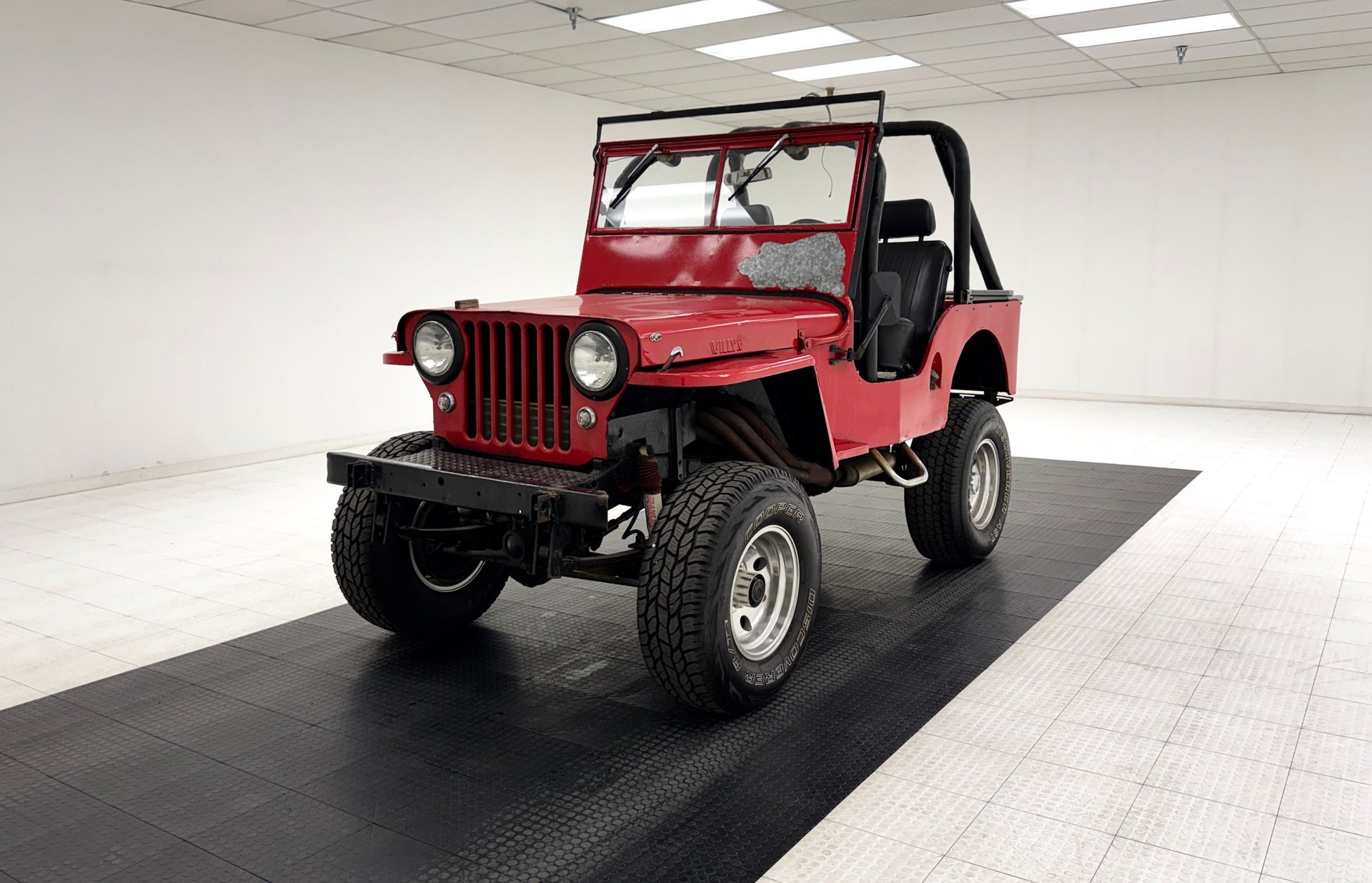
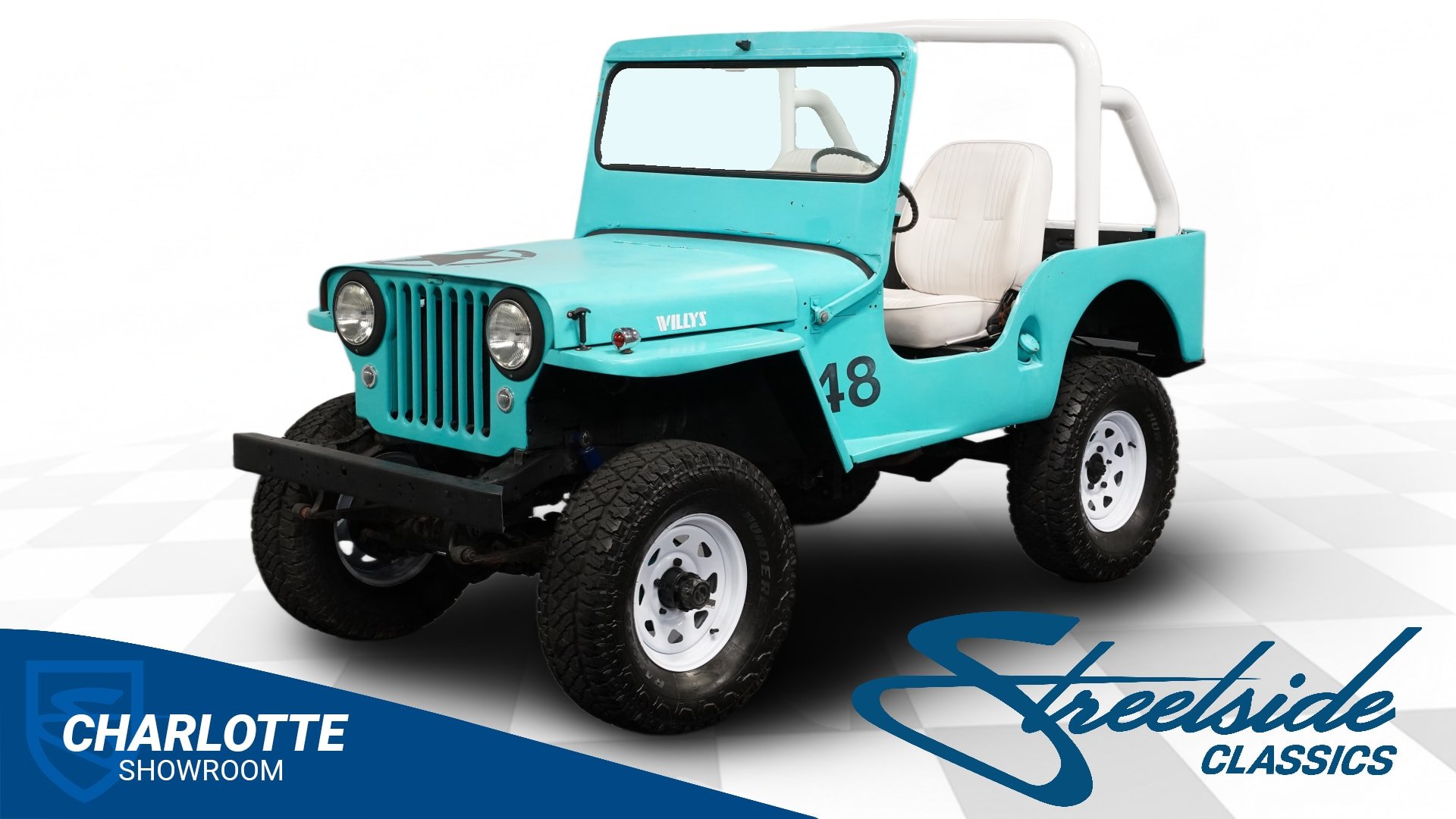
The CJ-2A (1945–49). Look for the split two-piece windshield, the seven-slot grille with the headlamps mounted behind it in the grille panel, WILLYS stamping on the hood sides and windshield frame, a tailgate — the single clearest civilian tell, because the wartime MB has no tailgate and carries its spare and fuel can on the rear panel instead — and a side-mounted spare wheel on early cars. The fuel tank sits under the driver seat, as it does on every flat-fender. Early 2As are column-shift (the T-90 gearbox worked by a lever on the steering column); most were converted to the later floor shift, and a surviving original column-shift car is a detail collectors notice. The 2A is the closest thing to a wartime Jeep you can buy with a civilian title, and the market knows it.
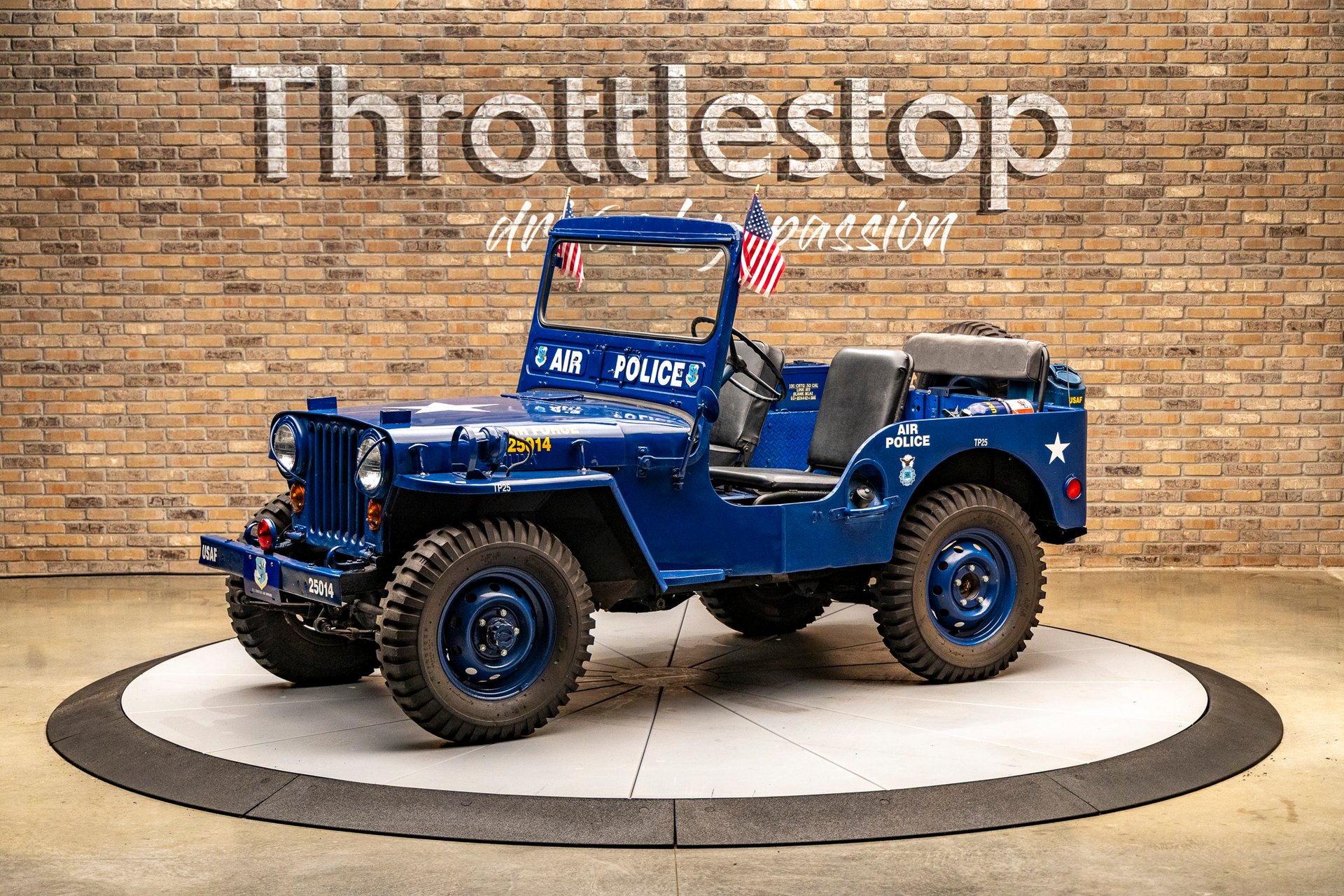
The CJ-3A (1949–53). The 3A is a 2A grown slightly more competent: one-piece windshield glass in a frame with a vent below it, the stronger Dana 44 rear axle on most cars, better seats, and small gearbox and transfer-case improvements. It is the hardest flat-fender to separate from a 2A at twenty paces — count the windshield pieces, look for the vent — which is why the serial number matters more than the silhouette. Its military sister, the M38, built alongside it for Korea, differs in detail throughout: 24-volt electrics, a sealed and waterproofed electrical system, a stronger frame. M38s and M38-dressed cars appear inside CJ listings regularly, including in our own pool. A genuine, complete M38 is a collectible in its own right; a CJ in olive paint with stencils is a CJ.

The CJ-3B (1953–68). You cannot mistake a 3B once you have seen one: the hood line is several inches taller, the grille is taller with it, and the whole front of the car looks like a 3A that has swallowed something. What it swallowed is the F-134 Hurricane engine, whose overhead intake valves made the motor too tall for the flat-fender hood. The 3B was intended as a short-run bridge model and instead stayed in production for fifteen years, heavily for export and for overseas licence production — which is why its production total is large and why so many survivors are worn commercial vehicles rather than cherished toys. In the US market it is the least common of the three flat-fenders in nice condition and the most commonly misdescribed, because a 3B hood and grille on an earlier tub creates a car that matches no factory specification at all. Verify the serial prefix before you pay a 3B price or accept a 3B story.
The CJ-5 (1955–83), as filed here to 1965. The CJ-5 is the civilian derivative of the military M38A1: rounded hood and fenders in one flowing pressing, a curved windshield, and a wheelbase starting at 81 inches (83.5 inches from 1972). Our pool ends in 1965, so the CJ-5s here are early Kaiser-era cars: F-134 four, T-90 gearbox, Dana 18 transfer case on the earliest cars giving way to the Dana 20, and — in the Tuxedo Park Mark IV trim behind the CJ-5A designation in listings — a plusher, chrome-trimmed attempt at a road-oriented Jeep. The Dauntless V6 arrived for 1966 and the AMC era brought longer noses for sixes and V8s; an early CJ-5 is not a small version of a 1970s CJ-5. Buy and price it as its own vehicle.
The CJ-6 and the specials. The CJ-6 stretches the CJ-5 to a 101-inch wheelbase (later 103.5 inches), giving a real load bed and a cult following precisely because so few were sold domestically — many went to export and fleets. It is named here so you recognise one filed simply as a CJ, and do not pay a CJ-6 premium for a stretched home conversion, which also exist. At the edges sit the two-wheel-drive DJ-3A Dispatcher, farm variants with power take-off and mower equipment, and the Tuxedo Park cars. Equipment is part of value: a working rear PTO, a period Koenig or Ramsey winch, an overdrive unit or a correct drawbar is worth real money and costs a fortune to assemble piecemeal, so inventory and test it rather than treating it as decoration.
Engines and gearboxes
The flathead four: L-134 Go-Devil
The engine that built the legend is a 134.2-cubic-inch (2.2-litre) side-valve four, the L-134, known from its wartime service as the Go-Devil. Willys rated it at 60 hp and about 105 lb-ft of torque, and the torque figure is the one that matters: it arrives low, pulls from barely above idle, and suits a vehicle geared to walk rather than run. The design is as simple as an engine gets — an L-head block with the valves beside the cylinders, a gear-driven camshaft, a single downdraft carburettor (a Carter WO on wartime and early cars, with later service and civilian variations), a distributor driven from the cam, and a cooling system that is unpressurised or lightly pressurised depending on year, with a water pump and a thermostat in the outlet. There is no overhead anything. A competent home mechanic with a manual can rebuild one on a bench, and thousands have.
A healthy L-134 starts readily, idles slowly and evenly with a soft, chuffing exhaust note, pulls cleanly without hesitation, and shows oil pressure on the gauge — modest numbers by modern standards are normal, roughly 20 psi or better hot at road speed and lower at idle, with the trend and the absence of knocks mattering more than any single reading. It should not smoke persistently. A puff of blue at start-up after sitting is valve-guide and ring wear announcing itself politely; a continuous blue haze under load is rings and bores; white vapour that does not clear as the engine warms is coolant getting where it should not, through a head gasket or, worse, a crack.
The flathead failure mechanisms are specific and testable. Overheating is the master fault, because almost every other L-134 problem either causes it or is caused by it. The water passages in a block that has spent decades with plain water or weak coolant fill with scale and rust sediment, especially at the rear of the block where circulation is laziest, and the radiator — a narrow, tall core — silts up from the bottom. The result is an engine that runs cool at 30 mph and boils at 45 mph or on a grade. Test it the way the inspection section prescribes: a proper drive long enough to heat-soak everything, then watch the gauge and check for coolant loss and for bubbles in the header tank with the engine running, which point to combustion gas leaking past the head gasket into the water jacket. A compression test separates the causes further — two adjacent low cylinders are the classic head-gasket signature, four evenly low cylinders are general wear, and a wet test (a spoonful of oil in the cylinder, then re-test) that brings the numbers up indicts the rings, while no change points at the valves and seats. Budget a straightforward top-end and cooling-system recommission in the hundreds of dollars in parts if you do the work, a professional engine rebuild in the region of $3,000–5,500 depending on machining, and understand that a cracked block — check along the distributor side and around the valve seats when the head is off — moves the conversation to a replacement block or a replacement engine, both of which exist because Willys built these by the hundreds of thousands.
The carburettor and fuel system cause most no-start complaints blamed on the engine. The Carter WO suffers three age faults: throttle-shaft bore wear, which leaks air and makes the idle unadjustable; metering-rod and jet wear, which floods or leans the mixture; and dirt, because the tank under the driver seat rusts internally and feeds the carburettor fine rust. The mechanical fuel pump adds a signature fault — a ruptured diaphragm leaking fuel into the crankcase, raising and thinning the oil. Smell the dipstick on every flathead you inspect. Fuel pressure should be low, around 2.5–4 psi; an unregulated electric pump holds the needle off its seat and floods the engine in a way no rebuild cures until the pressure is corrected. Ethanol dissolves decades of tank varnish into jet-blocking gum — a car that ran when parked and will not run now is usually a fuel-cleaning job (tank out, lines blown through, pump and carburettor kitted, $150–400 in parts), not an engine job.
Ignition on a 6-volt car is where good engines get condemned. Six volts means double the current for the same work, so voltage drop at every corroded connection counts double: a car that cranks slowly and sparks weakly may need only clean, heavy cables, clean ground straps, and a starter and generator in honest condition. Points, condenser, coil and plugs are cheap service items. Electronic-ignition and 12-volt alternator conversions can both be excellent and both be bodged — judge the wiring in front of you, not the idea.
The F-head four: F-134 Hurricane
For the CJ-3B and the early CJ-5, Willys put the intake valves in the head over the exhaust valves remaining in the block — an F-head layout — and called the result the Hurricane. Capacity is the same 134.2 cubic inches, but power rises to about 72 hp with materially better breathing and torque, and the engine is recognisable at a glance by its tall rocker cover and the carburettor (typically a Carter YF single-barrel, with a Solex widely fitted as a service replacement) sitting high, which is precisely why the 3B needed its tall hood. In the CJ-5 the same engine sits under the rounded hood designed for it from the start.
Everything said about the flathead's cooling, fuel and ignition applies here, with three additions. First, a top end to service: valve clearances to set, a rocker shaft that wears and clatters, and head-gasket failure that presents the same way and is settled by the same compression and bubble tests. Second, the single-barrel carburettor's accelerator-pump and economy circuits are the usual source of the flat spot sellers describe as character; a kit is cheap, but check throttle-shaft wear first, because a worn body will not hold a tune. Third, oil leaks: the F-134 weeps from rocker cover, timing cover and rear main on cars whose crankcase ventilation is clogged — a blocked breather pressurises the crankcase and pushes oil past sound seals, so clean the breather before you price a seal job. A professional rebuild sits in the same $3,000–5,500 region as the flathead's; the machining, not the parts, is where the money goes.
Later engines belong here as identification traps and swaps. The Dauntless V6 — the 225-cubic-inch Buick odd-fire V6 offered from 1966 to 1971 — is the most desirable later factory engine: about 160 hp, and a distinctive lopey idle from its odd-fire crankshaft that is normal and must not be diagnosed as a misfire. The Perkins 4.192 diesel was a rare early-1960s factory option — slow, economical, genuinely scarce. AMC-era sixes and the 304 V8 required the longer 1972-onward nose; meet one in a claimed-1965 CJ-5 and you are looking at a swap, priced on workmanship, cooling, gearing and title — not the badge. Small-block V8 swaps are the most common of all. A swapped car is not automatically a bad car. An undocumented swapped car is automatically a cheaper car.

Gearboxes, transfer cases and axles
The standard gearbox across the whole pool is the Warner T-90 three-speed manual: synchromesh on second and third, a sliding unsynchronised first, and ratios chosen for a vehicle that starts in second on the road and uses first as a working gear. Column shift on early CJ-2As, floor shift thereafter. The T-90 is strong enough for a stock four and marginal behind a V8 swap, which is why swapped cars so often arrive with a gearbox story. Its wear signatures are honest ones: jumping out of second gear on the overrun is the classic T-90 complaint, caused by worn synchromesh and end-float in the cluster and mainshaft assemblies, and it is a rebuild verdict, not an adjustment — a professional T-90 rebuild runs roughly $800–1,500 in parts and labour at a specialist, less if you pull the box yourself and hand over a bench job. Whine in all gears points at bearings; whine in first and reverse only is partly the nature of straight-cut sliding gears and should be judged against another T-90, not against a modern car. The optional T-98 four-speed, with a very low compound first gear, was offered in the CJ-5 era for serious working use and is prized today; it is bigger, heavier and unmistakable, and a car claimed to have one should show one — count the shift pattern and look at the size of the case.
Behind the gearbox sits the transfer case. The Spicer/Dana 18 serves the flat-fenders and earliest CJ-5s: gear-driven, part-time, with an offset rear output, famous for its strength and its whine, because every gear in it turns whenever the vehicle moves. It also provides the rear power take-off point and the mounting for the beloved Warn overdrive (later made by Saturn), a bolt-on planetary unit that splits each gear and gives a usable cruising gear — a genuine value-add, worth testing in every range. The Dana 20, which takes over in the CJ-5 during the 1960s, has a centred rear output and is quieter. Both cases leak, and a dry-looking case usually means an empty one, so check levels before you celebrate. A case that jumps out of four-wheel drive under load is a rebuild in the $600–1,200 region at a specialist; sloppy shift linkages can be re-bushed cheaply, so do that before condemning the case.
Axles are Dana units: a Dana 25 steering front axle on the flat-fenders (Dana 27 later), and at the rear a semi-floating Dana 41 on early 2As giving way to the stronger Dana 44. Ratios are low — 5.38:1 is the classic flat-fender fitment, with 4.88 and 4.27 among the alternatives — which is why a stock flat-fender is busy at 45 mph. Identify the ratio before you buy if road use matters: the tag on the differential cover bolts, or count driveshaft turns against wheel turns on a jack. Locking front hubs (Warn, most often) were dealer and owner additions in the earliest years; a car without them turns its whole front driveline whenever it moves, which is period-correct, not a defect.
Clutches are single dry plates, and judder on take-up is usually oil on the plate from a rear-main or gearbox-input leak, worn linkage, or soft mounts letting the powertrain rock. Price the cause, not the symptom: the kit is modest money (roughly $200–350 in parts), but the labour to reach it, and the leak that contaminated it, are the real bill.
Problem areas
A CJ has fewer problem areas than almost any other classic vehicle and worse consequences when the few it has are ignored, because the list is headed by the structure itself. Work through it in this order: tub, frame, steering and brakes, then everything else. Our own examined-photo evidence on this pool is thin and we will say so plainly rather than dress it up: of the 18 CJs we track, only 2 have detailed photo notes on file so far, and rust is recorded in 1 of those 2. That sample proves nothing about incidence — what follows is drawn from the model's known behaviour across seventy years, and it is the checklist the photo notes would be applied against on a larger sample.
Rust: the map
A CJ tub is a simple steel pressing with one structural secret: underneath the flat floor, running across the body, sit inverted U-section hat channels that give the floor its stiffness and carry the body mounts. They are open at their ends, they fill with mud and water thrown up from below, and they rot from the inside, taking the floor above them and the mounting points with them. A floor that looks sound from inside the tub can be a skin of paint and undercoating over a channel that has the consistency of wet cardboard. Get under the car with a torch and a screwdriver and prod the channels along their full length, especially at the body-mount bolts and where the channels meet the sills of the tub. Replacing hat channels is a known, well-documented job — repair sections are made — but it is body-off or body-tilted welding work, realistically $1,000–2,500 in professional labour for a thorough job, and a car needing channels, floors and mounts together is a restoration project whatever the paint says.
From the channels, work outward. Floor pans and tunnel: rust spreads from the channels and under any rubber mat a previous owner fitted, which traps water against the steel permanently — lift everything loose and look. The under-seat tank well and the tool box under the passenger seat: both collect water and damp, both should be opened on every viewing, and perforation here is common enough that repair panels exist for both. Rear floor, arches and corners: the seams behind the rear wheels trap mud, and the rear panel and tailgate brackets take a working life of knocks as well as rust. Front fenders and steps: rust along the mounting flanges and the step seam; steps bend and crack at their brackets. The windshield frame: it rots along its bottom rail, good originals are getting scarce, and a rusty frame is a repair-panel and labour job, not trim. The cowl, firewall and tailgate, the last of which fills with water through its top seams and rots from inside. Finally, reproduction tubs: complete new steel tubs are available, and a car wearing one is not a lesser car — but it must be priced as re-bodied, identified by missing factory stampings and spot-weld patterns and non-original seams, with its value in the frame and running gear underneath.
Frame, suspension and steering
The CJ frame is a ladder of two channel rails with riveted and welded crossmembers, and it fails in known places. Front frame horns bend in collisions and in winching and snowplough service — sight along the rails from the front and compare both sides, and look for the bumper and spring hangers pulled out of line. Spring hanger and shackle areas crack and tear, because the hangers concentrate every shock the springs receive; clean the mud off and look at the welds and the surrounding rail for hairline cracks, elongated holes and previous fish-plate repairs, which are acceptable if they are neat, welded properly and declared, and a price reduction if they are riveted tin and optimism. The rear crossmember and drawbar area tears on farm cars that have towed beyond their station. Rust attacks the frame where the rails box in mud — around the crossmembers, inside the channel where it is open, and under any plating a previous owner added. A frame with perforation at a spring hanger or steering-box mounting is a fabrication repair, priced per car, and a bent or rotten frame under a shiny tub is the classic early-CJ trap: the tub unbolts, the frame is the car. Straightening and professional frame repair quickly runs from $800 into several thousand dollars depending on extent, which is why step 4 of the inspection puts you underneath before you fall for the paint.
Springs are simple semi-elliptic leaves, and their faults are sag, broken leaves (look along each pack for a leaf that ends short or sits displaced), worn bushings and shackles worn oval in their brackets. A CJ should sit level side to side; a lean is usually one tired or mismatched spring pack, and a full set of stock springs, bushings and U-bolts is a few hundred dollars in parts and a weekend of seized fasteners. Shock absorbers are conventional and cheap. What is not cheap in consequence is ignoring the steering, so give it its due. The system is a Ross cam-and-lever steering box on the frame rail, a drag link to a bellcrank mounted on the front crossmember area on flat-fenders, and tie rods to the steering knuckles. Every joint in that chain wears, and the total free play at the steering wheel rim is the sum of all of it — two inches of play can be five small wears rather than one big one. Diagnose in order, with a helper rocking the wheel while you watch each joint in turn: box adjustment and wear (the Ross box has an adjustment, and a box adjusted hard against a worn cam feels tight in the centre and binds at the locks), bellcrank bushing wear (the classic flat-fender wander, visible as the bellcrank rocking on its pin), tie-rod ends, and finally the kingpin bearings. A Ross box rebuild at a specialist is roughly $400–800; bellcrank repair kits are cheap parts and an hour of labour; tie-rod ends are consumables.
The kingpin bearings and the death wobble deserve the myth-busting the exemplar guides give their signature faults. The front knuckles pivot on tapered roller bearings, preloaded by shims. When the bearings brinell, wear loose or lose preload — or when a knuckle seal leaks and the lubricant leaves — the knuckle gains play, the wheel can rock top to bottom, and the front end becomes prone to a violent shimmy after a bump at 25–40 mph that drivers call death wobble. But worn kingpins do not cause every wobble, and replacing them does not cure every wobble: caster lost to sagging or lifted springs, toe set wrong, unbalanced or out-of-round tyres, a bent wheel, loose wheel bearings and a worn steering damper (where fitted) all feed the same shimmy, and a lifted car on big tyres with its caster reduced is a wobble built by its owner. The test sequence matters more than the parts cannon: rock each front wheel at 12 and 6 o'clock for kingpin and wheel-bearing play, at 3 and 9 for steering play, spin for bearing roughness, then check alignment and tyre condition before anyone sells you a front-end rebuild. A full knuckle service — bearings, races, seals, shims set to the specified preload with a pull scale — is roughly $300–600 a side at a shop, parts modest, labour in the setting-up.
Brakes on the flat-fenders and early CJ-5 are 9-inch drums all round (10-inch on later CJ-5s), hydraulically operated from a single-reservoir master cylinder on the earliest cars. Two consequences follow. First, adjustment and condition are everything: drums out of adjustment, shoes contaminated by a leaking wheel cylinder or axle seal, and a pedal that needs pumping all present as a Jeep that does not stop, and all are fixable for a few hundred dollars in parts across the whole vehicle. Second, a single-circuit system has no redundancy — one burst hose or failed cylinder empties the system — which is why a dual-reservoir master-cylinder conversion is the one safety modification even originality-minded owners accept, and why the handbrake (a drum on the transfer-case output on early cars, acting on the rear wheels via cable on later ones) should be tested as a working brake, not a parking ornament: a transfer-case handbrake contaminated by a leaking transfer-case output seal is a classic pairing of faults, each explaining the other. Brake pipes run along the frame where they rust under clips; budget a full hydraulic refresh — master and wheel cylinders, hoses, pipes as needed, shoes and hardware — at roughly $600–1,200 fitted, and treat it as the first job on any car whose brake history is a shrug.
Interior, weather gear and electrics
There is barely an interior: two front seats and a rear bench or none, painted metal everywhere, a large speedometer with small gauges or warning lamps, and the fuel sender in the tank under the driver seat. Seat frames crack and padding collapses; reproduction covers are cheap by classic standards, a few hundred dollars a seat trimmed. What matters is the equipment that makes the vehicle usable: the soft top and its bows and doors — a complete, fitting top is worth real money, a new quality top with bows runs roughly $800–1,500, and a top offered in a bag is no top until you have erected it and counted the pieces. The heater core leaks onto the floor; wipers are vacuum-operated on many early cars (feeble at full throttle, when manifold vacuum falls — normal, not a fault); and the windshield seals decide whether the car is merely draughty or actively fills with water, which loops straight back to the floor rust above.
Electrics divide by voltage. Six-volt cars live or die on cable condition, as the engine section explained; a charging generator and warm-yellow lamps are a healthy system, not a deficient one. Twelve-volt conversions range from a proper alternator conversion with every bulb, gauge and sender addressed, to an alternator and a prayer in which the gauges read nonsense. Trace what has actually been done. The harness itself is minimal and reproduction harnesses are available at modest cost, so amateur wiring is fixable — price it as a harness and a weekend (roughly $500–900 fitted), not a mystery. Military-pattern cars add the M38 family's 24-volt waterproof system, excellent when complete and a specialised hunt when half-converted — one of the few faults here that can make a cheap car expensive out of all proportion.
Running gear: the rest of the truth
Tyres and wheels close the mechanical story. Original fitment is a tall, narrow 6.00-16 or 7.00-16 tyre on a steel disc wheel; most survivors run modern radials, many oversized. Big tyres are not cosmetic on a CJ: they raise gearing the engine cannot afford, load the kingpin bearings and Ross box beyond their design, and can foul the tub at full lock. A car on sensible rubber is worth more to drive than a car on impressive rubber. Check tyre age by the date code — fifteen-year-old tyres need replacing before anything else, roughly $600–1,000 for five period-size tyres fitted. Wheels crack around the lug holes; a matching spare that holds air tells you a large thing about the previous owner.
How to inspect one
Allow an hour and a half, bring a torch, a magnet, a screwdriver for prodding (with permission), a tyre gauge, and a helper for the steering checks. A CJ rewards inspection: nearly everything that matters is visible and testable without special tools. Do the steps in order — the early ones decide whether the later ones are worth your time.
- Start with identity, before anything else. Find the serial number plate — on the firewall or dash area and, on flat-fenders, a frame stamping on the top of the left front frame rail near the bumper bracket area — and match it to the title. Decode the prefix: it separates CJ-2A from CJ-3A from CJ-3B production, and a plate, a frame and a title that tell three different stories is a walk-away until the seller reconciles them. Note the engine number on the pad at the front of the block and check it is the type the model should carry. Photograph every plate. On a military-dressed car, look for M38 features — 24-volt data plates, sealed distributor and waterproof fittings, the M38 frame and body details — and decide which vehicle you are actually buying.
- Cold start, from stone cold. A four that has been warmed up before you arrive is hiding its starting, its choke behaviour and its oil pressure at start. Crank it yourself: a healthy L-134 or F-134 catches readily, idles evenly, and shows oil pressure promptly. Watch the exhaust for the first minute — blue that clears is wear, blue that stays is a rebuild conversation, white that does not clear is coolant — and listen for knocks in the first seconds before oil pressure builds.
- The dipstick and the radiator cap. Smell the oil for fuel (carburettor flooding or a ruptured fuel-pump diaphragm), read its level and feel its viscosity, and look for grey emulsion under the oil filler cap. With the engine cold, open the radiator: the coolant should be coolant, not rust soup, and the level should be at the core. You will re-check both after the drive — an oil level that has risen, or coolant that has fallen, is data no seller's assurance outranks.
- Underneath: frame first, then hat channels. Torch along both frame rails, front horns to rear crossmember. Prod the spring hangers, shackle brackets, steering-box mounting and crossmember junctions for cracks and perforation. Sight along the rails for a bend. Then the tub: prod the hat channels at every body mount, the floors above them, the tank well and the tool box. Perforation at a spring hanger or a channel that crumbles under the screwdriver ends the inspection for any car priced as a driver — this is the step that decides, exactly as the sill check decides a unibody car.
- The tub, panel by panel. Magnet along the rear corners, the cowl sides, the steps and the fender flanges. Open the tool box, lift the mats, look under the fuel tank if you can see its well, and check the tailgate seams and the windshield frame's bottom rail. Decide which tub you are looking at — original, repaired or reproduction — using the stampings and seams the rust section describes, and price accordingly.
- Steering, with a helper. Helper rocks the wheel gently against its free play while you watch, in order: the Ross box output, the bellcrank for rocking on its pin, each tie-rod end, and the drag link joints. Then rock each front wheel at 12 and 6 o'clock for kingpin and wheel-bearing play, and at 3 and 9 for steering play, and spin each wheel for bearing roughness and brake drag. You are apportioning the play among its causes, because the repair bill for a bellcrank kit and the bill for a box rebuild plus knuckle service differ by an order of magnitude.
- Transfer case and gearbox, stationary. Work the transfer lever through high, neutral and low, and the front-axle engagement; stiff is normal, immovable or jumping out under a gentle load is not. Check the oil levels in gearbox, transfer case and both axles if the seller allows plug removal — and treat a dry-looking case exterior with suspicion until a level proves it is full, per the gearbox section. Test the PTO and overdrive for function if fitted.
- Brakes, before the drive. Pedal first: it should be firm on the first press, not the second. A pedal that pumps up means air or adjustment; a pedal that sinks under steady pressure means a master cylinder passing internally or a leak. Pull the handbrake on hard and try to move the vehicle against it in gear at idle — the transfer-case handbrake test from the problem areas. Look at every flexible hose for cracking and every pipe for rust at the clips.
- The test drive: low range first, then the road. Start in a yard or field: engage low range and four-wheel drive, drive a slow full-lock circle each way and listen for binding, clicking and protest from the front axle and transfer case, then disengage cleanly. On the road, work through every gear, listen for the T-90 jumping out of second on the overrun down a grade, and feel for clutch judder and slip on a hill in a high gear. Note the speed at which the engine feels busy — it tells you the axle ratio and whether an overdrive is present and working.
- Heat soak and the boil test. Keep driving until the engine is fully hot — twenty minutes, including a grade or a stretch at the car's comfortable maximum. Watch the temperature gauge throughout. A car that boils, creeps upward relentlessly or loses coolant has the cooling-system fault the engine section describes, and the compression and bubble tests come next if you are still interested. After stopping, let it idle five minutes: hot restarting and idle quality after a heat soak expose carburettor and ignition faults that a cold start hides.
- Brakes and steering at speed, safely. From the car's comfortable cruising speed, brake firmly in a straight line on an empty road: it should pull up straight without a grab, a dive to one side or a pedal that changes its mind. Release the wheel briefly at low speed on a clear stretch and feel for wander and shimmy over bumps — and remember the wobble diagnosis sequence before you let anyone name a price for curing it.
- Electrics, weather gear and the inventory. Work everything: lights, indicators if fitted, horn, wipers, heater fan, gauges (the fuel gauge against what you know is in the tank). Erect the top, count the bows, doors and fasteners, and check the canvas. Inventory the spare, jack, PTO, winch, overdrive control, drawbar and any farm equipment, and photograph the inventory — on a CJ, the equipment list is part of the price, and the time to discover a missing top bow is before the money moves, not after.
Values
The market block beneath this guide carries the current numbers — what is listed now and what recorded sales have achieved — and this section teaches you to read the CJ market that produces them, because no other classic market spreads its prices across condition quite so violently or rewards paperwork quite so unevenly.
Start with the condition spread, which on a CJ is not a slope but a staircase with missing steps. At the bottom sit the field cars: complete-looking vehicles that have not run in years, whose real content is a frame number, a tub of unknown depth and a driveline of unknown life. Above them, the running project — starts, moves and stops after a fashion, and needs the brake refresh, cooling work and steering attention this guide prices. Above that, the honest driver: sorted mechanically, structurally sound, cosmetically worn — the car most experienced owners will tell you to buy. At the top, the restored car, where the spread widens again, because restoration quality ranges from a mechanical rebuild with the tub properly repaired on its hat channels to a cosmetic respray over every fault in this guide, and the two can photograph identically. The project-to-driver gap is mostly a costed list of known jobs; the driver-to-top-car gap is originality, correctness and proof, and it is where buyers lose money paying restoration prices for presentation.
Variant premiums are real but narrower than sellers claim. A genuine early CJ-2A with correct details — column shift surviving, correct stampings, documented early serial — earns a collector premium, as the closest civilian car to the wartime original. A correct CJ-3B earns a scarcity premium in genuinely good condition, and none as a worn commercial survivor. Early CJ-5s trade on condition and equipment more than year. Military connection cuts both ways: a genuine, complete M38 has its own collector premium; a civilian CJ in military dress has the value of the CJ underneath, and no stencil, star or hood number should move you on that point.
Asking and achieved prices part company predictably. Sellers price the story — wartime ancestry, a grandfather's farm, a restoration described by its cost rather than its content — and the market pays for structure, mechanical proof and equipment. Auction results for honestly described drivers are the anchor; dealer asks for shiny cars are the ceiling the market usually declines. The legitimate negotiation levers are the costed faults from your inspection — hat channels, frame work, a T-90 that leaves second gear, a boiling cooling system, a missing top — each with its job cost attached. Finally, the governing arithmetic: the price gap between a project and a sorted driver is almost always smaller than the cost of turning the project into that driver at professional rates. Buy the driver unless the project itself is the hobby you are purchasing — a perfectly good reason, as long as you know it is the reason.
Parts and ownership
The early CJ is one of the best-supported utility classics in existence, for a simple reason: the production run was enormous, the vehicle stayed in service commercially and agriculturally for decades, and a dedicated reproduction industry grew up around it. Between the specialist Jeep suppliers, the general classic trade and a deep stock of new-old-stock and used parts, there is very little on a flat-fender or an early CJ-5 that cannot be found.
Easy: almost every service and wear item. Engine gaskets, bearings and pistons for the L-134 and F-134; carburettor kits and complete replacement carburettors; ignition parts; water pumps, hoses and rebuilt radiators; clutch kits; T-90 and Dana 18 rebuild kits, gears and seals; brake shoes, cylinders, hoses and hardware; springs, bushings, shackles and shock absorbers; kingpin bearing and knuckle seal kits; soft tops, seat covers and canvas; wiring harnesses; and the common steel repair panels, including floors and hat channels. Order today, fit this weekend, at prices that will make owners of European classics weep.
Harder and dearer: correct early CJ-2A details (column-shift linkage parts, early stampings and small fittings, where originality is the whole point); sound original windshield frames; good original tubs of any flat-fender pattern; complete and correct M38 24-volt and waterproofing components; Perkins diesel parts; Tuxedo Park trim; and any part whose value is its date code rather than its function. Complete reproduction steel tubs solve the body problem at a price — a substantial four-figure sum before shipping, fitting and paint — and convert an originality question into a workmanship question, which is why the inspection insists you identify which tub a car is wearing.
Running costs. A sorted CJ is a cheap classic to run and a dear one to sort. Fuel consumption is in the high teens to low twenties in miles per gallon in gentle use. Servicing is oils, a grease gun applied to the many nipples on schedule, valve clearances on the F-head, points and plugs — all home-mechanic work with a factory-pattern manual, which you should buy before you buy parts. The budget lines that catch new owners are three: the first-year catch-up on a running car (brakes, cooling, steering joints, tyres by date — a four-figure sum before anything cosmetic), the recommission of a car that has sat (fuel system end to end, every brake component, every seal weeping once the vehicle moves again), and rust arriving because a previous repair painted over a hat channel instead of replacing it. Buy the structurally sound car, keep it covered and drained where the water sits, grease it, and a CJ will outlast your interest in it.
Which one to buy
- The all-rounder: an honest CJ-3A driver. The refined flat-fender, with the stronger rear axle and the best balance of wartime character and usable manners, in the deepest supply of any early CJ. If you want one flat-fender to drive, this is it.
- The original: an early CJ-2A. Buy it for the history and the details — and verify them ruthlessly, because the premium lives entirely in correctness the serial plate and stampings have to prove.
- The value buy: a CJ-3B. The F-head is the stronger engine, the high hood keeps prices honest, and a sound 3B is the cheapest route into a genuinely good flat-fender — provided the structure passes step 4.
- The road car: an early CJ-5. The rounded body, the longer wheelbase and the better seating make it the easiest early CJ to live with and to cover distance in, especially with a working overdrive. The Tuxedo Park cars are the charming end of this choice.
- The worker: any CJ with its equipment intact. A car with a working PTO, winch, overdrive and drawbar, bought with its equipment tested and inventoried, is worth more to own than a prettier car stripped of the things that made it useful.
- The project, knowingly: the field car. Buy one only if the restoration is itself the point, the frame number is clean, and your arithmetic in the Values section still works with your own labour priced at nothing.
And the rule that overrides all of the above: buy the soundest frame and tub you can find, in the specification you can live with. Engines, gearboxes, transfer cases, brakes and steering are all rebuildable at prices you can plan for, from parts you can buy this week. A rotten hat channel, a torn spring hanger and a bent frame are the CJ's version of the one unforgivable fault — and unlike the mechanicals, they are the part of the car that can never be made original again once a reproduction tub and a fabricated rail have replaced them.
See the 12 Jeep Willys cars currently listed.