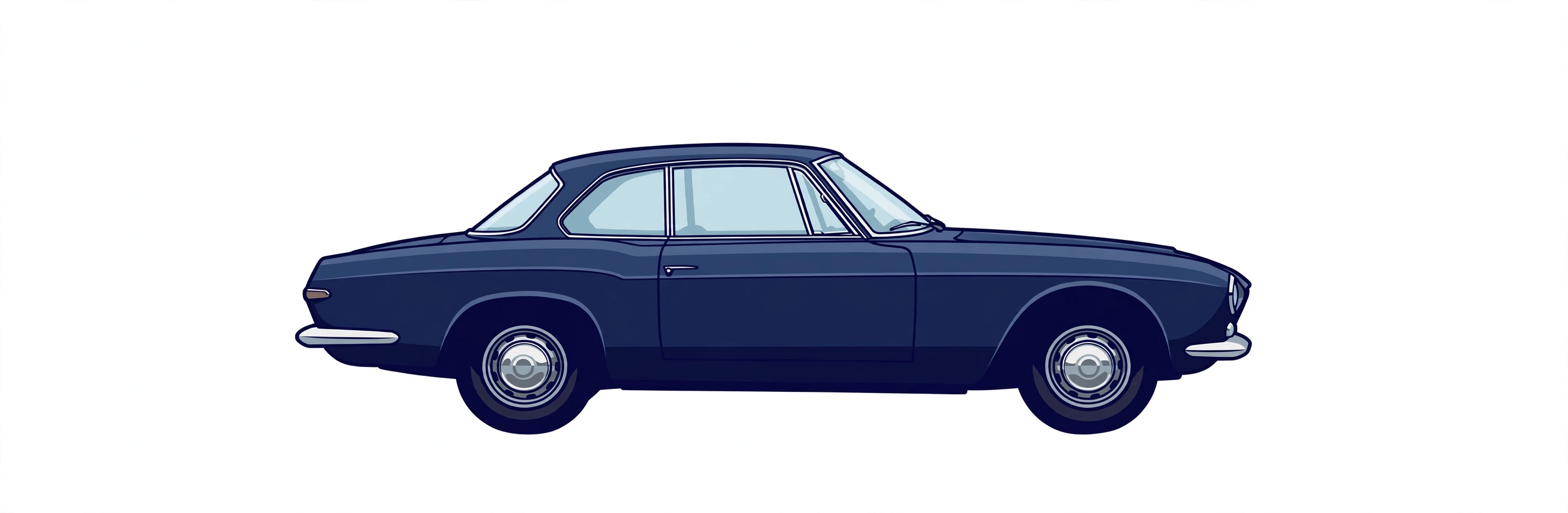
Shelby GT500 buyer's guide
Shelby GT500 -- the model's own buyer's guide: variants, values and what to check.
Years listed: 1967-1970 · Series: GT500
Overview and history
The Shelby GT500 is the big-block answer to a question the small-block GT350 could not answer. Carroll Shelby's GT350, launched in 1965, was a light, loud, high-revving competition car civilised just enough for the street. It won races and it made Shelby's name, but by 1966 the American market had moved on: buyers wanted displacement, torque and equipment, and rival manufacturers were putting ever larger engines into ever smaller cars. When Ford restyled the Mustang for 1967 and widened the engine bay to take its own FE-series big-block, Shelby saw the opening. The GT500, introduced for the 1967 model year, put a 428-cubic-inch V8 where the GT350 carried a 289, and it changed the Shelby Mustang from a racer with licence plates into a grand tourer with a drag racer's right foot.
The name itself was pure Shelby showmanship: no formula, no homologation target — Shelby simply wanted a badge bigger than anything else in the room. Underneath it, though, the engineering was serious. The 1967 car used Ford's 428 Police Interceptor engine — a torque-first FE big-block with hydraulic lifters, dual four-barrel carburettors on an aluminium intake manifold, and a factory rating of 355 hp that period testers and modern dynos alike treat as conservative. Around it Shelby built the full package: fibreglass bonnet with twin scoops, fibreglass boot lid with integral spoiler, side scoops, a roll bar with inertia-reel harnesses in the fastback, uprated suspension and brakes, and a cabin trimmed a clear step above a standard Mustang GT.
Production history matters because it explains what you are looking at. The 1967 cars were completed by Shelby American at its Los Angeles facility — the last Shelbys built under Shelby's direct control in California. For 1968 Ford took production in-house: cars were built as Mustangs at Ford's Metuchen plant and converted by A.O. Smith at Ionia, Michigan, gaining a convertible body style, more luxury options, and the name Shelby Cobra GT500. Midway through 1968 the 428 Cobra Jet arrived and created the GT500KR — King of the Road — the high point of the original line. For 1969 Ford restyled the car completely, Shelby's involvement shrank to little more than his name, and in the summer of 1969 he terminated the agreement. The 1970 GT500s are not new production at all: unsold 1969 cars re-serialised with 1970 VINs under federal supervision, given a chin spoiler and black bonnet stripes, and sold through.
The name then slept for nearly four decades, and its two revivals frame how buyers shop today. Ford's SVT division brought the GT500 back for 2007 on the S197 Mustang with a supercharged 5.4-litre V8, and developed it through the 662 hp 5.8-litre cars of 2013–2014. After another pause, the S550-generation GT500 of 2020–2022 arrived with a 760 hp supercharged 5.2-litre V8 and a dual-clutch gearbox. Those modern cars are covered throughout this guide as orientation, because the same buyers cross-shop them — but be clear about where the weight of the market sits. On Classic Listings the GT500 file is an original-era file: we currently track 154 GT500s, and every one of them is a 1967–1970 car — 53 from 1967, 49 from 1968, 44 from 1969 and 8 re-serialised 1970s, sourced overwhelmingly from auctions and specialist dealers. The modern cars trade in a different, younger market; the originals trade as documented collector cars, and documentation is the thread that runs through everything that follows.
That is the key thing to understand before you look at one. A GT500 is mechanically a Mustang — a very special one, but built from production Ford components any good shop can service. Its value, however, rests on identity: a Shelby VIN plate, a Ford VIN underneath it, registry records and paper. Clones exist in large numbers because a standard Mustang plus fibreglass produces a convincing copy, and the price gap between a real car and a copy is not a percentage — it is a multiple. Buy the identity first and the car second.

The models
Every original GT500 is a 428-cubic-inch, FE-powered Mustang conversion; what changes year to year is the induction, the body and who built the car. The modern revivals share nothing but the name and the formula — the most powerful engine Ford could fit, in the current Mustang shell.
| Model | Years | Engine | Output | Built | Character |
|---|---|---|---|---|---|
| GT500 | 1967 | 428 Police Interceptor, twin 4-barrel | 355 hp | 2,048 | The original; fastback only, Shelby-built in California |
| GT500 | 1968 | 428 Police Interceptor, single 4-barrel | 360 hp | 1,422 | Ford-built; convertible joins the fastback |
| GT500KR | 1968 | 428 Cobra Jet, ram air | 335 hp rated | 1,571 | King of the Road; the Cobra Jet flagship |
| GT500 | 1969 | 428 Cobra Jet, ram air | 335 hp rated | about 1,870 built | The restyled car; includes cars later re-VIN'd as 1970 |
| GT500 | 1970 | 428 Cobra Jet, ram air | 335 hp rated | 470 re-titled | Unsold 1969 cars with 1970 VINs; not new production |
| GT500 | 2007–2009 | 5.4 supercharged V8 | 500 hp | 22,989 across 3 years | The SVT revival; iron block, six-speed manual only |
| GT500KR | 2008–2009 | 5.4 supercharged V8 | 540 hp | about 1,700 | Las Vegas-built KR; carbon-fibre bonnet |
| GT500 | 2010 | 5.4 supercharged V8 | 540 hp | — | Restyled S197; last year of the iron block |
| GT500 | 2011–2012 | 5.4 supercharged V8, aluminium block | 550 hp | — | Over 100 lb lighter in the nose; the handling fix |
| GT500 | 2013–2014 | 5.8 supercharged V8 (Trinity) | 662 hp | — | The horsepower king of the manual era; 200 mph claim |
| GT500 | 2020–2022 | 5.2 supercharged V8 (Predator) | 760 hp | — | Dual-clutch only; Carbon Fiber Track Pack offered |
(Original-era production figures are the Shelby American Automobile Club registry totals most often cited; period sources differ by small numbers depending on how prototypes and Hertz cars are counted, which is itself a lesson — on these cars, the registry entry for the individual car in front of you matters more than any total. Period outputs for the original cars are SAE gross ratings, and the Cobra Jet's 335 hp was a deliberate under-rating for insurance and racing-class purposes; its real output was over 400 hp. The 1969 build figure and the 1970 figure overlap: the 470 cars sold as 1970s were built as 1969s.)
1967. The purest GT500 and, for many collectors, the definitive one. Fastback only — a single convertible and a single notchback coupe were built as prototypes and sit outside the normal market. Dual four-barrel carburettors, a Shelby-built car from Los Angeles, inboard grille driving lamps (moved outboard on later production to satisfy state laws — an originality detail, not a defect), a functional roll bar, and the strongest competition connection of any GT500 year. The Shelby VIN sequence, not the model year alone, is how specialists place a car in the run.
1968 and the KR. The 1968 car is a plusher, Ford-managed product: convertible or fastback, more options, sequential Thunderbird tail lamps, and an early run on the 428 Police Interceptor with a single four-barrel. A handful of early 1968 cars were built with the 427 as a short-lived option before it was dropped. From April 1968 the Cobra Jet created the KR, and the KR is the one the market chases: ram-air induction, the stronger CJ bottom end and heads, and the King of the Road name. If you buy one 1968 car, the KR is the default — but verify it is one, because KR badges on a Police Interceptor car are a classic misdescription.
1969–1970. The longest, most styled original GT500: a fibreglass nose section extending the car, five openings in the bonnet (three forward-facing NACA ducts and two rear extractors), and the Cobra Jet as standard, in ram-air R-code form on most cars. The optional Drag Pack turned the engine into the Super Cobra Jet, with 3.91 or 4.30 Traction-Lok gearing, an engine oil cooler and strengthened internals — the rarest specification of the late cars. Convertibles are scarce. The 1970 cars are mechanically identical 1969s; buy them on condition and documentation, and do not pay a rarity premium the chin spoiler alone cannot support.
The modern cars, briefly. The 2007–2009 GT500 is a supercharged iron-block car with a live rear axle and a six-speed manual as the only gearbox — charismatic, nose-heavy, and the entry point to the name. The 2008–2009 KR was finished by Shelby in Las Vegas, with a carbon-fibre bonnet and 540 hp. The 2011 aluminium-block car is the thinking buyer's S197: the weight came out of exactly the place it hurt. The 2013–2014 Trinity car is the modern collector's pick — the most powerful manual-transmission Mustang Ford has built. The 2020–2022 car is a different species: independent rear suspension, MagneRide dampers, enormous brakes and a seven-speed dual-clutch gearbox with no manual option, plus a Carbon Fiber Track Pack with carbon-fibre wheels. Treat post-title packages such as the Super Snake as separate models: they began life as GT500s but their value lives in Shelby Automobiles paperwork, not Ford's.
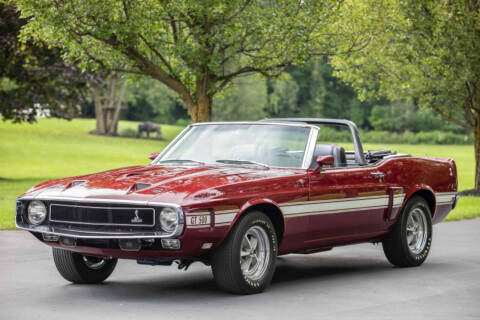

Engines and gearboxes
The 428 Police Interceptor: 1967 and early 1968
The GT500's first engine is a member of Ford's FE family — the same architecture as the 390 and 427 — built around a 428-cubic-inch (7.0-litre) block with a 4.13-inch bore and a long 3.98-inch stroke. Long stroke means torque, and torque is the whole character of the car: the Police Interceptor was Ford's heavy-duty, sustained-speed engine, with hydraulic lifters, a comparatively mild camshaft and a bottom end built for durability rather than revs. In the 1967 GT500 it breathes through two Holley four-barrel carburettors (600 cfm each, in the BJ/BK series) mounted on an aluminium dual-quad intake manifold, and wears finned aluminium valve covers and a large oval air cleaner that fill the engine bay completely. The factory rating was 355 hp at 5,400 rpm with 420 lb-ft of torque; treat the horsepower figure the way you treat all period gross ratings, as a starting point for an argument, and the torque figure as the truth about how the car drives.
On the road a healthy Police Interceptor car is effortless rather than frantic. It pulls from low rpm in any gear, runs out of breath sooner than a Cobra Jet, and suits the automatic gearbox better than any other original GT500 engine. What to listen for: a quiet hydraulic valvetrain (ticking that does not fade as the oil warms suggests a collapsed lifter, low oil pressure or simple neglect), even idle with both carburettors contributing, and no blue smoke on start-up or overrun. The dual-quad setup is the engine's signature and its main running cost: two carburettors, progressive linkage and fifty-year-old throttle shafts mean that hesitation, flooding and a rich idle are usually carburettor and linkage wear rather than engine wear. A proper rebuild of both Holleys by a specialist, with the linkage set up on the car, runs roughly $900–1,800; a car that has already had it done, with an invoice, has spent your money for you. A small number of very early 1967 cars left with 427 engines, and one famous one-off, the Super Snake, carried a race-specification 427 — if a seller presents a 427-powered car as a regular production GT500, you are in one-off or engine-swap territory and the registry, not the seller, settles which.
Identity checks on this engine are casting-based. Ford did not stamp the car's VIN into most FE blocks of this period, so originality is proved by casting numbers and date codes that precede the car's build date by a plausible interval, correct cylinder heads, and the right intake and carburettor numbers. A 390 block dressed with GT500 externals is visually almost identical and substantially less valuable; the casting numbers on the block and heads, read with a mirror and a torch, are the test. Expect to pay a specialist $300–600 for a proper numbers inspection if you cannot read them yourself — cheap insurance at GT500 money.
The 428 Cobra Jet and Super Cobra Jet: the KR, 1969 and 1970
The Cobra Jet, introduced in April 1968, is the engine that made the KR. Ford built it from production FE parts chosen by people who drag raced: a 428 block with the reinforced bottom end, cylinder heads derived from the 427 low-riser with large ports and valves, a 735 cfm Holley four-barrel on a cast-iron intake manifold, free-flowing exhaust manifolds, a hydraulic camshaft with more lift and duration than the Police Interceptor's, and functional ram air through the bonnet scoop. The advertised rating dropped to 335 hp — lower than the engine it replaced — because Ford wanted the car insurable and the engine's racing classification favourable. Nobody who has driven one believes the number; period and modern estimates put real output comfortably over 400 hp, with 440 lb-ft of torque at 3,400 rpm the figure that explains the car.
The Cobra Jet feels different in kind, not just degree: stronger everywhere, keener to rev, and noticeably harder-edged through the mid-range where the ram air and the big heads start to work. In 1969 specification the engine code tells the induction story — R-code cars have ram air, Q-code cars are Cobra Jets without it — and most GT500s are R-code. The Super Cobra Jet, created by ordering the Drag Pack option, adds an engine oil cooler, a choice of 3.91 or 4.30 rear gearing with Traction-Lok, and internal changes for sustained high rpm: stronger connecting rods in the Le Mans pattern, a different crankshaft, harmonic balancer and flywheel or flexplate balance, and revised pistons. An SCJ claim is checkable: the oil cooler and its plumbing are visible, the axle code is on the door data plate and the Ford build record, and the internal differences are documented in the Marti Report's option list. Never pay the SCJ premium on a verbal claim.
Cobra Jet weaknesses are FE weaknesses with CJ prices attached. The cast-iron intake manifold weighs around 80 lb and its removal and refitting is the standard route to the engine's most common oil leak, at the end seals; exhaust manifold bolts seize and snap in the heads, turning a manifold gasket job ($400–900 if the bolts come out) into a head-off machining job if they do not; and correct CJ heads, manifolds and carburettors are expensive and hunted, so a car missing them has a real, priceable deficit — budget $1,500–3,500 to source a correct dated carburettor alone. From 1968, Ford began stamping partial VINs on engines, often on a pad at the rear of the block or on the head, and where present and legible that stamping is the strongest engine-originality evidence an original GT500 can offer. Ask to see it, photograph it, and compare it against the Ford VIN before you discuss price.
The supercharged modern engines: 5.4, 5.8 Trinity and 5.2 Predator
The revived GT500s are all supercharged, all-aluminium-head modular V8s, and each step is a clear, checkable specification change. The 2007–2010 cars use an iron-block 5.4-litre four-valve engine with an Eaton M122 Roots supercharger: 500 hp in 2007–2009 form, 540 hp for 2010 (and for the 2008–2009 KR, which gained its extra power from a cold-air intake and calibration, the same recipe Ford then adopted for the standard 2010 car). For 2011 the block went aluminium, with plasma-transferred wire arc cylinder liners in place of pressed-in iron sleeves, saving over 100 lb over the front axle and transforming the car's balance; output rose to 550 hp. The 2013–2014 Trinity enlarged the engine to 5.8 litres, fitted a larger TVS supercharger, a carbon-fibre driveshaft and revised gearing, and produced 662 hp with 631 lb-ft — at the time the most powerful production V8 in the world, in a car Ford said would exceed 200 mph. The 2020–2022 Predator is a 5.2-litre cross-plane-crank engine related to the GT350's Voodoo but built for boost, with a 2.65-litre Eaton TVS supercharger and 760 hp.
Buying logic follows the metallurgy. Iron-block cars heat-soak their superchargers on repeated full-throttle runs, which shows as falling performance rather than damage; aluminium-block cars are the better drive. On any modern GT500, modified cars are the trap: a smaller supercharger pulley and an aftermarket tune are cheap, common and invisible at a glance, and they move a car from the documented-original market into the modified market. Check for pulley and intake changes, missing catalytic converters and any evidence of drag use. A stock, documented car is the one that holds value; budget $1,200–2,500 for a specialist inspection with a calibration read on a 2013–2014 or 2020–2022 car, because the electronics remember what the seller may not mention.
Gearboxes and axles
Original GT500s offer exactly two gearboxes, and the choice splits the market. The Ford Toploader four-speed manual is one of the strongest gearboxes Ford ever built: a close-ratio unit in most GT500 applications, with a heavy, deliberate shift, an 11.5-inch clutch on Cobra Jet cars, and a reputation for surviving the engine in front of it. Judge it on second-gear synchromesh (the first to wear), on bearing whine in third, and on a clutch that bites smoothly without judder or slip at full throttle in top gear; a Toploader rebuild at a specialist runs roughly $1,800–3,200, a clutch job $900–1,600 in parts and labour. The alternative is Ford's C6 three-speed automatic — a cast-iron-case box built for big-block torque, effectively unbreakable in standard tune, and the fitting partner for the Police Interceptor's low-speed pull. A healthy C6 shifts firmly and promptly; flaring on the 2–3 change or a long, soft engagement of reverse means wear, and a rebuild is roughly $2,000–3,500. Four-speed cars carry a consistent market premium over automatics in the original era, all else equal — which makes the automatic the value route in, and makes a gearbox swap in either direction an originality question the data plate settles.
At the back, all original GT500s use Ford's 9-inch axle, with Traction-Lok limited-slip fitted to many cars and mandatory with the Drag Pack's 3.91 and 4.30 gears; standard ratios cluster around 3.50:1. Whine at cruising speed is pinion wear; a clunk on take-up is backlash or worn Traction-Lok plates, and a rebuild runs $1,200–2,400. Verify the axle against the door data plate: an open differential in a car sold as a Traction-Lok car is a price chip and a specification warning.
The modern cars simplify and then complicate the choice. Every 2007–2014 GT500 is a Tremec TR6060 six-speed manual — there was no automatic — with the known weakness covered in the problem areas section: a reluctant 1–2 shift at high rpm on early cars. The 2020–2022 car reversed the formula completely: a Tremec seven-speed dual-clutch automatic is the only gearbox, shifting faster than any manual and dividing opinion exactly as much as you would expect. There is no conversion worth doing in either direction; buy the gearbox generation you actually want.

Problem areas
Start with the evidence, stated honestly. We have examined the sellers' photo sets for 125 of the GT500s tracked on Classic Listings in detail, and in those photo notes rust is not flagged on a single car, smoke on none, and a leak on just one. Read that correctly: it does not mean GT500s do not rust, leak or smoke. It means the cars that reach auction and specialist dealers — which is where our listings come from — are photographed after preparation, and photo notes record what photographs show. The problems below are what fifty years does to the cars the photographs flatter, and they are the reason the inspection section insists on a lift, a torch and paperwork rather than a photo set.
Identity, clones and paperwork: the expensive problem
No mechanical fault on a GT500 costs as much as buying the wrong car. A genuine original GT500 carries two identities. The Ford VIN is stamped into the body — on the inner front fender aprons, partly visible in the engine bay and partly hidden under the fenders themselves — and decodes through a Marti Report to the car's factory build: engine code, gearbox, axle, colours, options, build date and selling dealer. The Shelby VIN is on a riveted plate, on the inner fender on 1967 cars and in the windshield area on later production, and is recorded in the Shelby American Automobile Club registry, which tracks the car's specification and, for many cars, a chain of recorded owners. A real car has both numbers, they agree with each other and with the paperwork, and the registry knows the car.
A clone has one number: a Mustang's. Everything else — fibreglass, stripes, badges, even a reproduction Shelby plate — can be bought, and a well-built tribute is a perfectly legitimate car at Mustang money. The fraud line is crossed when a tribute is described, priced or papered as a Shelby, and the grey zone in between is full of cars described with careful words like Shelby-style, Shelby tribute and Shelby recreation at prices drifting toward the real thing. Your defences are mechanical and boring, which is why they work. Order the Marti Report yourself, from the Ford VIN you photographed on the car, not from a number the seller read to you. Contact the SAAC registrar for the model year and ask what the registry holds for the Shelby number. Check the Shelby plate's rivets and fonts against known-good photographs — replaced plates and restamped plates exist. Look for the hidden Ford stampings with a mirror; a car whose seller will not let you look is a car you have finished inspecting. Budget $200–400 for reports and registry enquiries on any original car; against the price of the car, and against the size of the clone gap, it is the best money in this entire guide.
One softer trap catches experienced buyers: specification drift. A real Shelby that has lost its original engine, gained a colour change, and been fitted with KR stripes or a Drag Pack axle over the decades is still a real Shelby, but it is not the car its asking price describes, and every drift item is a negotiation with a number attached. And because 1970 cars are re-serialised 1969s, a 1970 car without registry support for its number deserves more scrutiny, not less, however rare the seller says it is.
Rust and the unibody
A GT500 rusts exactly where a Mustang rusts, because underneath the fibreglass it is one — with the added complication that Shelby and KR money tempts people to restore shells that Mustang money would scrap. The structure is a unibody, so rust here is not cosmetic: it is the car's strength. Work the known map.
Floors and torque boxes. The floor pans rot from the inside out, fed by a leaking cowl (see below), and the torque boxes — the structural boxes where the rear leaf springs and front suspension loads enter the shell — rot where they trap road dirt. Surface rust on a floor pan is a clean-and-treat job; perforation at a torque box is structural welding, roughly $1,500–3,500 a side fitted and painted, and it rarely comes alone.
The cowl. The fresh-air cowl in front of the windshield fills with leaves and debris, its drain paths block, and the cowl sides rust through — after which every rain puts water inside the car, onto the floors and the wiring. The test takes sixty seconds: pour water into the cowl grille and watch where it lands. It should exit behind the front wheels; if it appears in the footwells, the cowl is perforated, and cowl repair on a finished car is a dashboard-out, windshield-out job at $2,500–5,000. Do this test on every car, including the shiny ones.
Frame rails, shock towers and aprons. Front and rear frame rails rust at their ends and around suspension mounts; battery acid attacks the right front inner apron under the battery tray; and the shock towers — which carry the entire front suspension and, on a GT500, the weight of an FE engine — crack around the spring seats and rust at their bases. Tower and rail work is fabrication, priced per car, and a car needing both is a restoration project whatever its paint says. Fresh, uniform underseal over everything, applied recently and covering seams, fasteners and brake lines alike, is a cover-up until proved otherwise — exactly as on any unibody of the era, honest old underseal is patchy, chipped and dirty.
Convertibles. The 1968-onwards convertible has no roof structure, so its inner rockers and torque boxes carry the car. Door gaps that narrow at the top, doors that drop on their latches, and a car that creaks over driveway angles are a shell telling you it is flexing because its sills are weak. Convertible structural repair is the most expensive rust work in this guide; get a lift inspection and a written estimate before you fall for an open car.
Quarters, doors and trunk. Rear wheel arches, quarter-panel bottoms behind the wheels, door bottoms (blocked drain slots fill doors with water) and the trunk floor and drop-off panels at its sides all rust in the usual Mustang pattern. Panels are available and comparatively cheap; the labour and paint are not — a quality repaint starts around $12,000 and rises quickly with panel work, which is why the buying rule at the end of this guide puts the shell first.
The FE engine in old age: leaks, heat and induction
The 428 is a durable engine with three habitual failings, all of them age rather than design. The first is oil leaks, and the geography matters. The cast-iron intake manifold's end seals are the classic source — oil at the back of the manifold runs down and is routinely misdiagnosed as a rear main seal leak, a much bigger job. Valve cover gaskets, the front cover and the oil filter adapter follow. A full reseal of the top end with the manifold refitted properly runs $800–1,600; an engine-out reseal with a rear main seal is $2,500–4,500, so the mirror-and-torch diagnosis that separates the two is worth real money.
The second is heat. A GT500 carries a big engine in a Mustang-sized engine bay behind a small grille opening, and the cooling system has no margin for a silted radiator, a missing fan shroud, a tired viscous fan clutch or retarded ignition timing. A car that creeps toward hot in traffic but cools on the move has an airflow or capacity problem; a car that heats under load has a circulation or combustion problem, up to and including a head gasket. Neither is a negotiating detail — overheating is how FE engines warp heads and score bores, and a documented cooling-system overhaul (recored or new radiator, shroud, hoses, water pump, thermostat) at $900–1,800 in the history file is a genuine selling point.
The third is induction wear, already covered engine by engine above: dual-quad linkage and twin Holleys on the 1967 car, the big 735 cfm Holley on the Cobra Jet. Add the fuel system around them. Modern ethanol fuel attacks period rubber, swells needle valves and leaves varnish in tanks and lines on cars that sit; a car recommissioned after storage needs the tank inspected, lines and hoses renewed and carburettors cleaned before any other diagnosis is trusted, at $600–1,500 for the full recommissioning of the fuel side. Original smog equipment — the Thermactor air-injection system fitted to many of these engines — was removed from most cars decades ago; its absence does not affect how the car runs, but it does affect judged originality, and correct dated smog parts are expensive to put back. Price a car missing them as a driver, not as a show car.
Valvetrain and bottom end are the good news: hydraulic-lifter FEs that have had oil changes are typically quiet and strong at mileages that would worry lesser engines, and genuine internal wear announces itself with smoke under load and bearing knock rather than subtlety. A compression and leak-down test, $250–450 at a shop, settles any argument about it.
Chassis, steering, brakes and fibreglass
The GT500's chassis problem is weight distribution: a very heavy engine over the front wheels of a car whose suspension was designed for a small-block. Front springs sag, control arm shafts wear, idler arms and tie rods develop play, and the power steering goes vague in a way owners accept as character until they drive a sorted car. A full front-end refresh runs $1,500–3,000 and transforms the car; budget it into any undocumented purchase. Check the export brace between the shock towers is present (structural triangulation, often removed and lost), and on 1967 cars check the underride traction bars for bent brackets and torn mounts — evidence of a drag-racing youth the odometer will not mention.
Brakes are front discs with rear drums on the original cars, power-assisted, and entirely adequate when maintained; the usual findings are seized rear wheel cylinders, perished flexible hoses, a tired master cylinder and discs scored by years of sitting. A full hydraulic refresh is $800–1,800. Judge the pedal and the handbrake, then judge the discs themselves for rust banding and lips.
The fibreglass is a Shelby signature and a Shelby cost centre. Original panels — bonnet, boot lid, scoops, and the 1969 nose — stress-crack around fasteners and scoop openings, warp with heat and age, and fit to period tolerances that were generous when new. Reproduction panels vary from excellent to unusable, and the labour in fitting and gapping fibreglass to a standard that survives a show field is specialist work at $2,000–5,000 for a bonnet and nose fitted and painted. Read the panel fit in the listing photographs before you travel: bonnet gaps that wander, a nose that sits proud of the fenders, and ripples along the long 1969 bonnet are all visible at photograph distance, and all priceable.
Inside, the Shelby-specific trim is the expensive part: the 1967 roll bar and inertia-reel harnesses, the under-dash Stewart-Warner gauge pod, correct consoles and tachometers. Standard Mustang interior parts are cheap and excellent in reproduction; the Shelby-only pieces are neither. A missing gauge pod on a 1967 car is a four-figure hunt, so inventory the Shelby parts against a reference list on the viewing, not after the purchase.
Electrics follow the era's pattern: failures live at connections, grounds and switches, not in the wire itself. The 1968–1970 sequential tail lamps depend on a sequencer unit that fails with age; rebuilt and solid-state replacements exist at $200–500. Convertible top hydraulics are the other regular bill (a full refresh runs $700–1,400). A car in which every electrical item works has usually been used and maintained — the best single predictor of a good GT500.
The modern cars: heat, clutches, shifts and electronics
The S197 cars (2007–2014) concentrate their problems where their specification concentrates stress. Early 2007–2009 cars suffered a documented clutch and flywheel issue — a warped flywheel causing clutch drag and premature wear — addressed under a Ford technical service bulletin; a car with the updated parts fitted, invoiced, is worth more than a low-mileage car still on its original clutch. The TR6060 six-speed's 1–2 shift at high rpm is reluctant on many 2010–2012 cars; test it at full throttle, not in the parking lot. Supercharger intercooler pumps fail silently and cost power rather than engines. The 2008–2009 KR's carbon-fibre bonnet is a five-figure replacement part if damaged, and its provenance is Shelby's Las Vegas records — check them.
The 2013–2014 Trinity cars add track-use questions: cars ordered without the Track Package lack the engine, transmission and differential coolers, and a non-cooler car with a track history will have lived a hotter life. The carbon-fibre driveshaft does not tolerate exhaust heat damage or ham-fisted removal. Tyres in the original sizes are expensive and age out before they wear out on low-mileage cars — check date codes, not tread depth. The 2020–2022 Predator cars move the risk to cost of components: the dual-clutch gearbox needs its fluid and filter services on schedule at a dealer or specialist ($800–1,500), the Carbon Fiber Track Pack's carbon wheels are catastrophically expensive to replace after a kerb strike (inspect the inner barrels on a lift, where the damage hides), and the huge front brakes consume pads and rotors at a rate that shocks owners coming from earlier cars. On every modern car, a pre-purchase inspection that includes a calibration and module scan is not optional — the difference between a stock car and a tuned car is the difference between two markets, and it does not show in photographs.

How to inspect one
Allow half a day for an original car, bring a torch, a mirror on a stick and a magnet wrapped in cloth, and arrange lift time before you agree to travel. The order is deliberate: identity first, because nothing else matters if the car is not what it claims to be; structure second, because structure decides whether you continue; mechanics after that.

- Paperwork and identity first. Photograph the Shelby VIN plate and the Ford VIN on the inner fender apron, match both to the title, and check the Shelby plate's rivets and stamping against reference photographs. Order the Marti Report from the Ford VIN you photographed. Ask the SAAC registrar what the registry holds for the Shelby number. If any of the three records disagrees with the car in front of you, stop and resolve it before another word about price.
- Decode the specification. From the Marti Report and the door data plate, write down what the car was born as: engine code (ram-air R-code or Q-code on Cobra Jet cars), gearbox, axle ratio and Traction-Lok, colours inside and out, and options including the Drag Pack. Every deviation you find later is measured against this sheet — and a Drag Pack or KR claim that is not on this sheet is not a claim, it is a story.
- Engine numbers and dates. With the mirror and torch, read the block and head casting numbers and date codes; they should precede the car's build date by weeks, not follow it and not predate it by years. On 1968 and later cars, look for the partial VIN stamping at the rear of the block or on the head. Check the intake manifold material and the carburettor numbers against the engine the car claims — dual Holleys on a 1967 Police Interceptor, a single 735 cfm Holley on a Cobra Jet — remembering the intake-manifold leak test from the problem areas section when you find oil at the back of the engine.
- Cold start. Insist the engine is stone cold. An FE in good order starts readily, the hydraulic lifters quiet within seconds, and there is no blue smoke beyond a faint puff. Watch oil pressure as it warms, listen for timing-chain rattle and exhaust manifold leaks (a ticking that fades as the manifolds expand), and note any car the seller has helpfully warmed up for you.
- The cowl test. Pour a jug of water into the cowl grille in front of the windshield. It must drain behind the front wheels. Water in either footwell means a perforated cowl, wet floors and the dashboard-out repair described in the rust section — and it re-prices the car on the spot.
- Under the car. On the lift: torque boxes, floor seams, front and rear frame rails, shock tower bases, spring mounts, and the trunk drop-offs from below. Prod suspect metal with a screwdriver, with permission. Read the underseal as you go — patchy and honest is factory; fresh and uniform over everything is a question. Perforation in torque boxes, towers or rails is structural, and it ends the inspection unless you came to buy a project.
- Body, fibreglass and gaps. Walk the car with the magnet over quarters, door bottoms and arches. Check bonnet and 1969 nose fit against the fibreglass section, look down each flank for ripples, and check convertible door gaps at the top for the narrowing that betrays weak inner rockers. Count the Shelby-specific parts present — roll bar, harnesses, gauge pod — and price the missing ones before you offer.
- The test drive. Twenty minutes minimum, including a freeway stretch. The Toploader should select second cleanly and the clutch bite without judder; the C6 should shift firmly and engage reverse promptly. The car should track and brake straight from speed, and hold temperature in traffic afterwards. Note steering play at the straight-ahead: some is period, a quarter-turn is a front-end rebuild.
- Heat, smoke and leaks, hot. After the drive, let the car idle for five minutes. Watch the temperature, look for smoke on a blipped throttle (valve stem seals) and under load (rings), then look underneath for fresh drips and identify each one — manifold end seal, valve covers or rear main, in ascending order of cost.
- Electrics and equipment. Work everything: sequential tail lamps on 1968–1970 cars, inboard lamps on a 1967, windows, heater fan on all speeds, gauges, and the convertible top through a full cycle. A car where everything works has been used and maintained; a list of small electrical failures is a list of small bills and one big clue about the car's life.
- Stance and ride. Stand back and photograph the car from the side, exactly as in the listing photographs. It should sit level with the arches even over both axles. A nose-down car wants front springs; a car that creaks or whose doors have dropped wants the structural conversation from step 6 revisited. On the drive, knocks over bumps from the front are control-arm and joint wear, priced in the chassis section.
- Modern cars: scan and service file. For a 2007–2022 car, replace steps 3 and 4 with a module and calibration scan by a specialist, verify the supercharger pulley and intake are the factory pieces, check tyre date codes and — on a Carbon Fiber Track Pack car — inspect the inner barrels of the carbon wheels on the lift. On a 2013–2014 car, confirm from the window sticker or build sheet whether the cooler packages were fitted, and drive the 1–2 shift at full throttle on 2010–2012 cars before you agree the gearbox is healthy.
Values
The build appends the current market figures beneath this guide — the listed-now summary and the recorded-sales block — so this section teaches you how to read them rather than repeating numbers that date. Four forces set a GT500's value, in this order: identity, specification, condition and documentation, and the market block makes most sense when you filter what you are seeing through all four.
Identity first, because it is not a gradient. A registry-verified original car and a tribute built from a standard Mustang are different goods that happen to look alike, and the recorded sales of genuine cars tell you nothing about what a copy should cost — or the other way round. When a result in the sales block looks impossibly cheap for the model year, the explanation is almost always identity, specification or condition, in that order, and the listing detail will usually say which if you read it to the end.
Specification is where the original-era premiums live. Within the originals, the market pays most for the cars it has always paid most for: the 1968 KR over the standard 1968 car, because the Cobra Jet is a genuinely better engine in a genuinely rarer car; the Drag Pack and Super Cobra Jet cars over standard Cobra Jets; four-speed cars over automatics; and convertibles carry a scarcity premium that is real but narrower than sellers often assume, because the fastback is the shape most buyers picture. The 1967 car holds a first-year, Shelby-built premium of its own. The 1970 cars trade close to equivalent 1969s: the re-serialisation story is documented and collectible, but the car underneath is a 1969, and the market prices it that way. Colour matters at the margins — a car in its born colour, verified on the build record, is worth more than the same car repainted into a fashionable shade, and the discount for a colour change is one of the most reliable negotiations in this market.
Condition spreads on original GT500s are wide, because the cost of moving a car up one grade is dominated by paint, fibreglass fitting and structural metal rather than mechanics. A project and a finished car are separated by a restoration bill that routinely exceeds the gap between their prices. Read every recorded sale asking one question: what would this car cost, all-in, at the condition I actually want? The cheap car is frequently the expensive answer.
Documentation is the fourth force and the one sellers most often undervalue. A car with a Marti Report, a registry entry, a build sheet, restoration photographs and invoices for the expensive systems sells faster and stronger than an identical car with a story. The asking-versus-achieved gap follows the usual pattern — ambitious asks sit, correctly priced cars move — with one GT500 twist: because identity is verifiable, the best-documented cars increasingly trade at auction, where the verification has been done for the room, while private sales carry a discount for the work and risk the buyer still has to do. On the modern cars, read the market differently: values track mileage, originality of calibration and specification far more than age, the 2013–2014 Trinity cars hold the strongest position among the S197s, Carbon Fiber Track Pack cars carry a clear premium, and any tuned or drag-used car belongs in a lower comparison set than its odometer suggests.
Parts and ownership
The GT500's great ownership advantage is that it is a Mustang underneath. The volume of the standard Mustang market means service parts, wear parts and most mechanical components are available off the shelf at ordinary prices, and any competent shop that knows FE engines and Toploaders can maintain the car. Layered on top of that base is a Shelby-specific stratum — fibreglass, trim, badges, dated engine components — where availability is good in reproduction, patchy in original parts, and priced accordingly.
Easy: filters, plugs, ignition components, brake discs, pads, cylinders and hoses, suspension bushes and joints, springs, exhaust systems in standard form, carburettor rebuild kits, water pumps, radiators, glass, weatherstrips and standard interior trim. The Mustang trade — the large national parts houses and the marque specialists — stocks all of it, and most of it is shared with the Mustang GT and the wider FE range.
Harder and dearer: correct dated Cobra Jet cylinder heads, intake manifolds and 735 cfm carburettors; dual-quad intake and carburettor sets for the 1967 car; original smog equipment with correct date codes; Shelby fibreglass that fits without days of labour; the 1967 roll bar, harnesses and gauge pod; KR-specific parts on both the 1968 original and the 2008–2009 revival, whose carbon-fibre bonnet is a specialist order at a specialist price; and, on the newest cars, carbon-fibre wheels and dual-clutch gearbox components, which are dealer-channel parts with dealer-channel prices. The Shelby American Automobile Club registry and the marque's specialist dealers are the route to most of the original-era rarities, and patience is a line item: the right dated part appears on its own schedule, not yours.
Running costs. Budget honestly for the first year: an original car bought as a driver typically wants the deferred-maintenance catch-up described throughout this guide — fuel system, brakes, cooling, front end — well into four figures at shop rates before you improve anything. Fuel consumption is what a 428 in a heavy car suggests: single figures around town, low teens on a run, premium fuel always. The modern cars are cheaper day to day and dearer when a major component speaks: tyres on the 2013–2014 and 2020–2022 cars are a significant recurring cost, dual-clutch services are non-negotiable, and a tuned car bought cheap presents its previous owner's bills. Insurance should be agreed-value for any original car, revisited as the market block beneath this guide moves. Storage matters more than mileage: these cars deteriorate by sitting, in fuel systems, brake hydraulics and seals, so the pattern that suits a GT500 best is regular use, a dry garage and a trickle charger.
Which one to buy
- The collector's original: 1967 GT500. The first year, built by Shelby American in California, dual carburettors, fastback only. If the original era is what you want and the budget stretches once, stretch here — verified by the registry, in its born specification.
- The driver's original: 1968 GT500KR. The Cobra Jet is the best engine fitted to an original GT500, the convertible offers something no 1967 car can, and the KR premium buys a measurably better car rather than just a rarer badge. Verify the engine codes before you pay for the letters.
- The value original: 1969 GT500, automatic, honestly described. The most styled car of the run, the same Cobra Jet, and the softest prices in the original market — especially in a colour change or with an automatic gearbox, both of which you can live with happily if the shell is sound and the paperwork is straight.
- The modern all-rounder: 2011–2012 GT500. The aluminium block fixed the S197's nose-heavy manners, the car is quick enough to be serious fun, and it sits in the value trough of the modern range. Stock, documented, and with the 1–2 shift tested hard.
- The modern collector car: 2013–2014 GT500. The Trinity engine, 662 hp, a manual gearbox, two years only. The modern GT500 most likely to be collected like the originals — buy the coolers, the paperwork and the original calibration.
- The track car: 2020–2022 GT500 with the Carbon Fiber Track Pack. Nothing else wearing this badge is remotely as capable, or demands as much inspection of wheels, brakes and service history. Buy it as the precision instrument it is.
And the rule that overrides all of the above: buy the verified car with the sound shell, in the specification you can live with. Engines can be rebuilt and trim can be hunted — but a GT500 whose identity does not check out is not a GT500 at any price, and a rotten unibody costs more to put right than the finished car will ever return. The registry and the lift come before the test drive, every time.
See the 34 GT500 cars currently listed.