
Pontiac Trans Am buyer's guide
Pontiac Trans Am -- the model's own buyer's guide: variants, values and what to check.
Years listed: 1969-1998 · Series: Firebird Gen 1
Overview and history
The Pontiac Trans Am is the rare American performance car that was never a separate model at all. It began in March 1969 as the Trans Am Performance and Appearance Package — option code WS4 on the Pontiac Firebird — took its name from the Sports Car Club of America's Trans-American Sedan Championship, and outlived almost everything around it: the muscle-car era, the emissions era, the death of the Pontiac V8, and three complete redesigns of the Firebird itself, before production ended with the Firebird in 2002. By the late 1970s the Trans Am was the Firebird in the public mind, and in its peak year, 1979, Pontiac built more Trans Ams than Chevrolet built Corvettes.
That long life is exactly what makes buying one confusing. A 1969 Trans Am and a 2002 Trans Am share a name and almost nothing else: the first is a raw, Pontiac-powered muscle car built for one year only, the last a refined, Chevrolet LS-powered GT with a six-speed manual. In between sit the cars most buyers actually meet — the long-lived second-generation cars of 1970½ to 1981, with their shaker scoops and spoilers, and the aerodynamic third-generation cars of 1982 to 1992 that traded cubic inches for handling. This guide treats the Trans Am as one model line across all four Firebird generations, because that is how the market and the parts trade treat it — but it will keep telling you which generation a piece of advice belongs to, because on a Trans Am the generation matters more than the badge.
The Firebird itself, launched in February 1967, was General Motors' answer to the Ford Mustang, sharing its F-body shell with the Chevrolet Camaro. What Pontiac — John DeLorean was still running the division when the first Trans Am was approved — understood early was that handling and image could sell as hard as straight-line speed. The 1969 package bundled the 400-cubic-inch Ram Air V8, heavy-duty suspension, variable-ratio power steering, a rear spoiler, functional hood scoops and distinctive striping. It was expensive, arrived mid-year, and sold in tiny numbers — and it set the template every later Trans Am followed: the biggest or most distinctive engine available, chassis tuning a step beyond the standard Firebird, and styling that announced itself a block away.
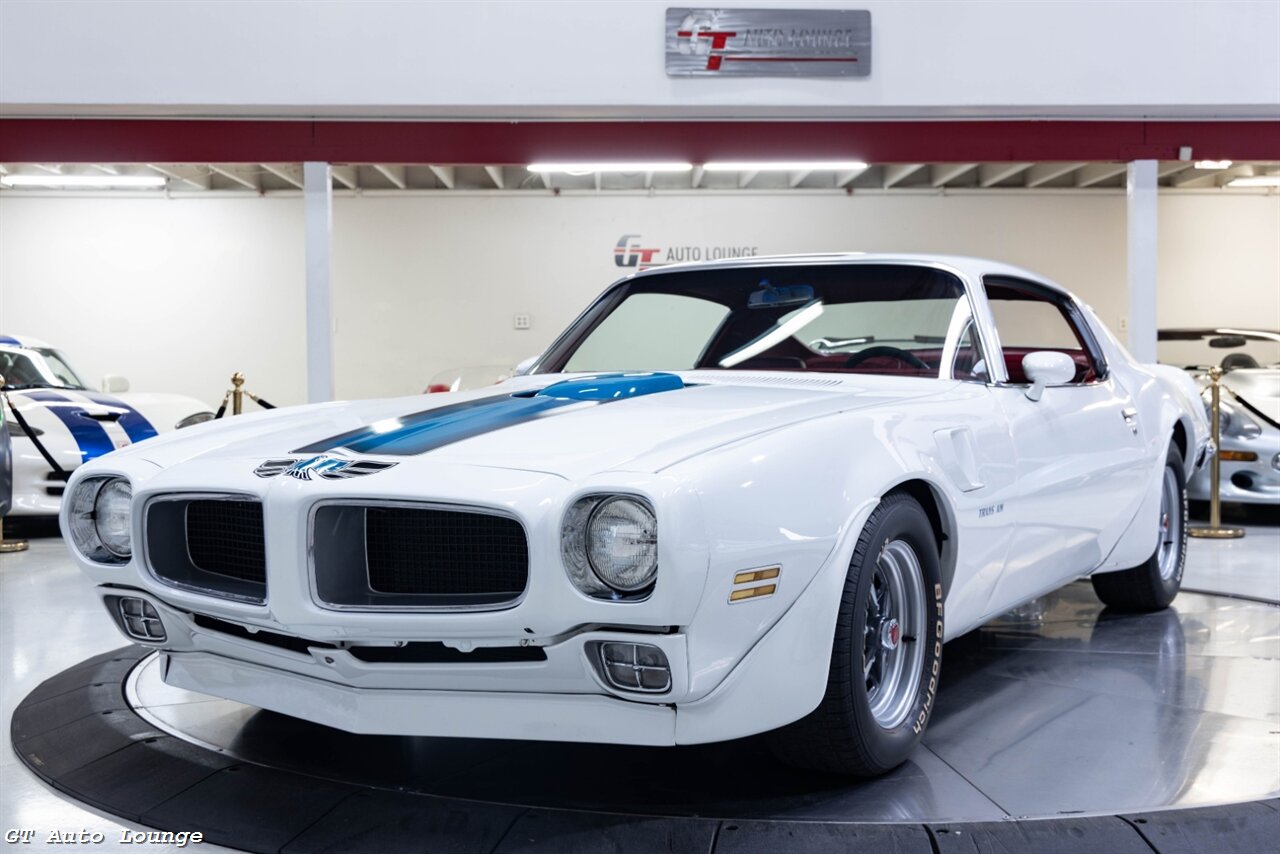
The second generation, introduced mid-1970 and therefore always called the 1970½, is the Trans Am most people picture: a lower, wider shell with a genuinely developed aerodynamic kit — front air dam, fender extractor vents, tall deck spoiler and, from 1970, the famous shaker scoop poking through the hood and shaking with the engine. Under that scoop sat Pontiac's best V8s: the 400 Ram Air III and Ram Air IV, then the 455 and the extraordinary 455 HO. When emissions rules killed high-compression muscle elsewhere, Pontiac kept the car alive with low-compression big-blocks that still made real torque, then, in 1973 and 1974, with the Super Duty 455, the last true high-performance engine of the muscle era.
The mid-1970s should have finished the car. Instead, two things saved it: the detuned 400 and 455 still drove like muscle cars, because torque, gearing and chassis balance carried the experience — and Hollywood. A black and gold 1977 Special Edition co-starred in Smokey and the Bandit, and orders surged so sharply that Pontiac struggled to build enough cars. The giant hood bird, offered from 1973 onward, went from a love-it-or-hate-it option to a cultural icon. Sales climbed year after year to the 1979 peak, even as the engines on offer shrank to a stockpiled-block Pontiac 400, an Oldsmobile 403 in most automatic cars, and, for 1980 and 1981, a turbocharged 301 that promised economy-era performance it only partly delivered.
The third generation, from 1982, was a clean-sheet car: much lighter, hatchbacked, slippery, and initially much slower — a 1982 Trans Am is a handling car, not a fast one. Pontiac rebuilt the performance through the decade: tuned-port injection from 1985, the GTA flagship from 1987, and in 1989 the remarkable Turbo Trans Am, which borrowed the Buick Grand National's turbocharged V6, outran every V8 Trans Am of its generation, and paced the Indianapolis 500. The fourth generation, from 1993, completed the rehabilitation: LT1 power, then from 1998 the all-aluminium LS1 and the WS6 Ram Air package, ending with a 2002 Collector Edition that was genuinely fast by any era's standard. Production ended in 2002; the Pontiac division itself followed in 2010.
In our own listings the shape of the surviving market is plain. We currently track 156 Trans Ams for sale or recently sold: 99 are second-generation cars, 30 are fourth-generation and 26 are third-generation, with 1979 alone accounting for 36 cars. We have also gone through the sellers' photo sets in detail for 39 of those cars: rust was visible somewhere in 8 of them, accident or panel damage in 6, and a fluid leak in 1 — a better record than most American cars of the period manage, reflecting how many Trans Ams were garaged toys rather than winter transport. Do not let that lull you: the cars that were used hard or left outside still rust in expensive places, and the sections that follow are organised around finding them.
Buy a Trans Am on generation, engine and documentation, in that order. The generation decides how the car feels and what it costs to live with. The engine decides most of its value — on a second-generation car the difference between a standard 400 and a Super Duty 455 is the difference between a driver's car and a blue-chip collectible in the same body. And documentation decides whether the engine is what the seller says it is, because no American performance badge has been cloned more enthusiastically than this one. Pontiac Historical Services — PHS — can supply the factory invoice record for almost any Trans Am from its VIN, and on any car carrying a premium for rarity, that paperwork is not an optional extra. It is the car.
The models
Every Trans Am is a Firebird underneath, sitting at or near the top of the range, above the base Firebird, the Esprit and the Formula, which shared much of the Trans Am's mechanical hardware with plainer styling. That last point matters when you shop: a Formula 400 or Formula WS6 is mechanically close to a Trans Am and usually cheaper, while a Trans Am carries the spoilers, the graphics, the image and the resale premium. Know which premium you are paying for.
| Model | Years | Engine | Output | Built | Character |
|---|---|---|---|---|---|
| Trans Am (first generation) | 1969 | 400 Ram Air III / IV V8 | 335–366 hp | 697 | The one-year original; a collector car, not a driver buy |
| Trans Am 400 / Ram Air | 1970–1972 | 400 Ram Air III / IV, then 455 HO V8 | 330–370 hp | about 3,200 in 1970, fewer after | Early second-generation muscle at full strength |
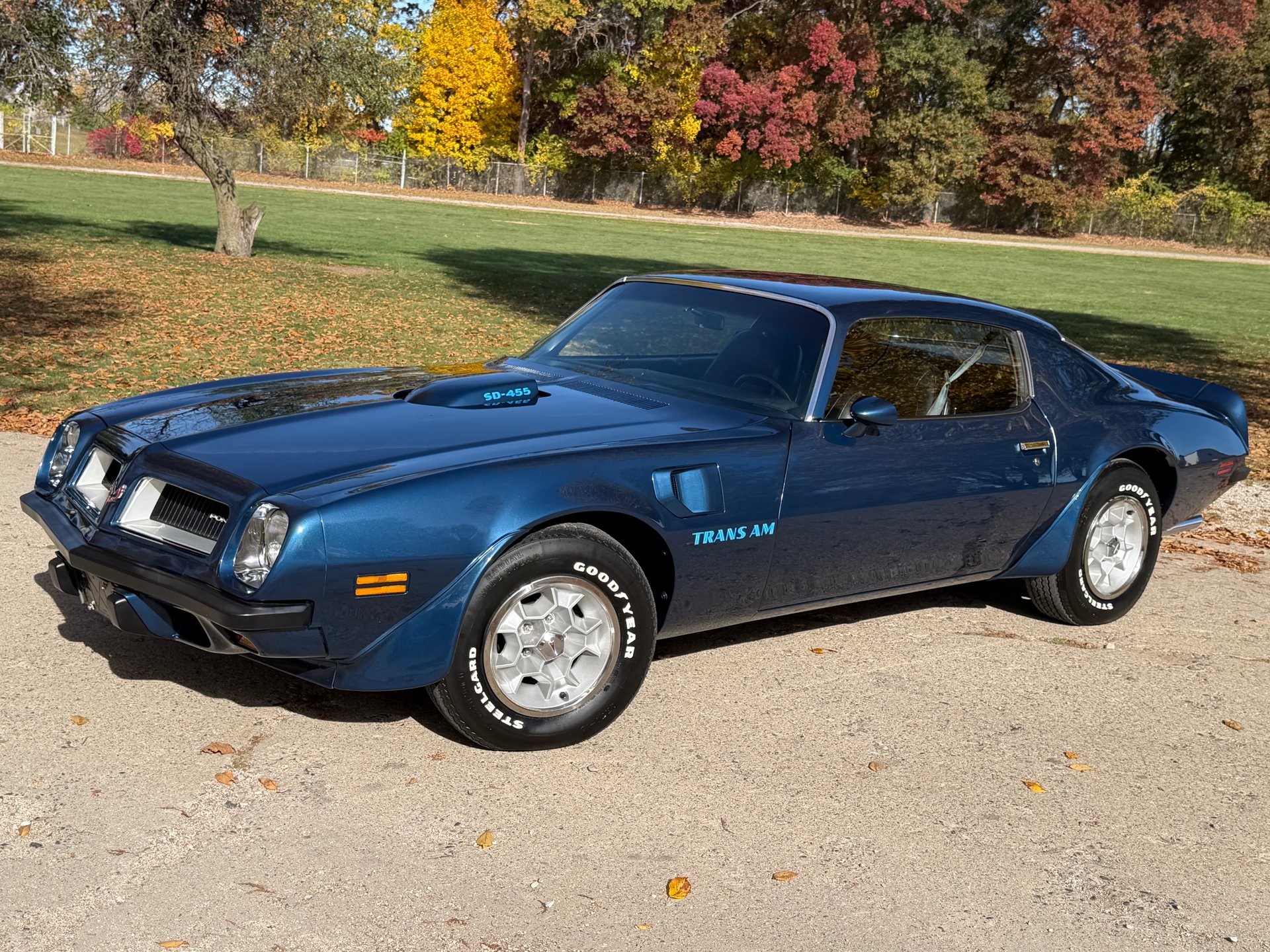
| Trans Am SD-455 | 1973–1974 | 455 Super Duty V8 | 290–310 hp | about 1,200 in total | The last muscle-era flagship; the blue-chip Trans Am |
| Trans Am 400 / 455 | 1973–1976 | 400 and 455 V8 | 170–200 hp | tens of thousands | Detuned but torquey; the affordable early Gen 2 |
| Trans Am W72 400 / 403 | 1977–1979 | 400 W72 or Oldsmobile 403 V8 | 185–220 hp | 117,108 in 1979 alone | The Bandit-era volume cars; image at its peak |
| Trans Am Turbo / 305 | 1980–1981 | 301 Turbo V8 or 305 V8 | 140–210 hp | tens of thousands | Economy-era experiment; turbo cars are a specialist taste |
| Trans Am (early Gen 3) | 1982–1984 | 305 V8, carburetted or Cross-Fire | 145–190 hp | tens of thousands | Light, sharp handling, modest pace |
| Trans Am / GTA (late Gen 3) | 1985–1992 | 305 / 350 Tuned Port V8 | 190–245 hp | tens of thousands | Injection restores the performance; GTA is the flagship |
| Turbo Trans Am | 1989 | Buick 3.8 turbo V6 | 250 hp | 1,555 | Indy pace car; fastest Gen 3 by a distance |
| Trans Am (LT1) | 1993–1997 | 5.7 LT1 V8 | 275–285 hp | tens of thousands | Fourth-generation pace with early-1990s build |
| Trans Am WS6 (LS1) | 1998–2002 | 5.7 LS1 V8 | 305–325 hp | tens of thousands | The modern Trans Am; fast, usable, tuneable |
(Outputs are the period figures as Pontiac quoted them: gross ratings to 1971, net ratings thereafter, which is why a 1971 455 HO and a 1973 SD-455 look closer on paper than they feel on the road. Production figures are given only where the factory record is solid; for the volume years the honest figure is the scale, not a spurious exact count.)
The 1969. One year, and one body-style choice that matters: 689 coupes and just 8 convertibles, all in Cameo White with blue striping, most with the Ram Air III 400 and a handful — 55 is the commonly documented figure — with the Ram Air IV. Survivors are verified by PHS paperwork and the WS4 code, because a standard 1969 Firebird 400 wears most of the same panels and clones exist. Treat any 1969 Trans Am as you would a low-production European sports car: provenance first, condition second, price last.
The early second generation, 1970–1972. The connoisseur's Trans Ams. Two colours only at first — Polar White or Lucerne Blue, with contrasting stripes — a 400 Ram Air III as standard, the Ram Air IV as the rare high-revving option in 1970, and from 1971 the 455 HO, a low-compression but still serious big-block with round-port heads and an aluminium intake. Buy on originality: correct Ram Air carburettors, distributors and exhaust manifolds are dated, coded and expensive, and a car missing them is worth materially less than the same car complete.
The SD-455, 1973–1974. Pontiac engineering's farewell to the muscle era: a reinforced block, forged internals, round-port heads and a rating — 290 hp net in 1973 — that understated an engine built to be tuned. It arrived in the new 5-mph-bumper body, in Buccaneer Red, Brewster Green or Cameo White for 1973. Production was tiny because the engine was effectively hand-finished. Every SD claim needs the engine code and PHS confirmation: the block casting and stamped code are the car's passport, and SD tributes built from standard 455s are everywhere.
The middle years, 1973–1979. The volume heart of the guide and of our listings. The 400 remained the enthusiast's engine, joined by the standard 455 to 1976. From 1977 the range simplified: a standard 400 (or, in California and high-altitude cars, the Oldsmobile 403), and the optional W72 Performance Package 400 with a hotter cam, baffled oil pan and, crucially, availability with the four-speed manual the 403 never offered. Special Editions — black with gold striping and gold snowflakes, coded Y81, Y82 or Y84 depending on year and T-top fitment — carry the image premium, and the silver 1979 Tenth Anniversary car is the most collectible of the volume cars. Judge all of them first on which engine is actually under the shaker: Pontiac fitted the Oldsmobile engine to the majority of late-1970s automatic cars, and sellers do not always volunteer it.
The third generation, 1982–1992. Shorter, lighter by roughly 500 pounds and hatchbacked, the Gen 3 inverted the formula: handling first, power second. The range-topper at launch made 165 hp in Cross-Fire form. Tuned Port Injection from 1985 and the 5.7-litre TPI from 1987 rebuilt the pace through the decade. The GTA — gold cross-lace wheels, monochrome trim, the best seats Pontiac ever fitted — is the flagship collectors have settled on, alongside the 1989 Turbo car and the rare 1991–1992 SLP Firehawk conversions. Convertibles returned from 1987, built by ASC, in small numbers.
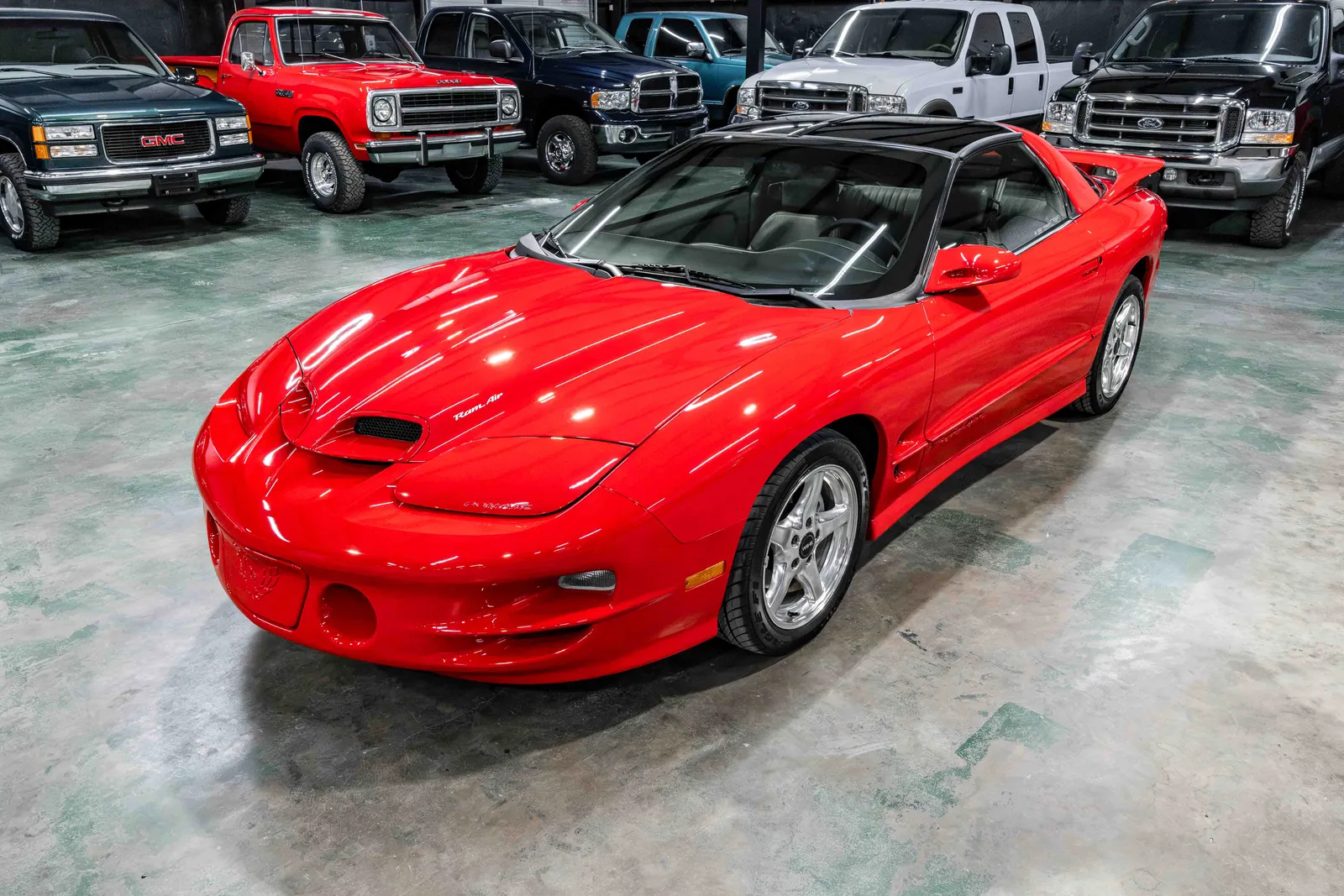
The fourth generation, 1993–2002. The last Trans Ams are also the fastest in standard form. The 1993–1997 cars run the LT1 5.7 with a six-speed manual or four-speed automatic. The 1998 facelift brought the LS1, the WS6 Ram Air package, and outputs up to 325 hp in WS6 and Firehawk form. The yellow 2002 Collector Edition closed the line. These cars are modern enough to use daily and old enough that deferred maintenance, rather than design faults, is what you are inspecting for.

Engines and gearboxes
The Pontiac V8s: 400 and 455
From 1969 to 1979 the Trans Am was defined by Pontiac's own V8. All Pontiac V8s of the period share the same external block dimensions — there is no small-block and big-block Pontiac in the Chevrolet sense — and displace 400 cubic inches (6.6 litres) or 455 cubic inches (7.5 litres) by bore and stroke. They are torque-first engines, durable when oiled properly, with one weakness a buyer must respect: the two-bolt-main bottom end fitted to most forms is entirely adequate at factory outputs and rev limits, and unforgiving of sustained high rpm on a worn engine. A healthy example starts readily, shows strong oil pressure hot — the gauge should recover promptly as revs rise — and pulls from low revs without being wound out. Blue smoke under load is ring or bore wear; blue smoke on start-up and the overrun is valve stem seals and guides. Either, on a numbers-matching early car, is a negotiation rather than a walk-away, because these engines rebuild well.
The performance hierarchy is told by the heads and the codes, not the badges. The 1969–1970 Ram Air III 400 used D-port heads, a 068-profile cam and a Rochester Quadrajet, rated at 335 to 340 hp gross. The Ram Air IV is a different order of engine: round-port heads, an aluminium intake, a much more aggressive 041 cam with high-ratio rockers, and a genuine appetite for revs that makes it thrilling and, in traffic with a manual gearbox, occasionally tiresome. Ram Air IV cars are rare, their engines rarer, and every component — carburettor number, distributor number, head castings 614 for 1970 — is dated and coded. Learn the codes for the year you are shopping, or pay someone who knows them to stand next to you.
The 455 HO of 1971–1972 kept the round-port philosophy with low compression for the unleaded era, and the standard 400 and 455 engines of 1973–1976 traded compression and cam timing for emissions compliance while keeping the torque that made the cars feel fast. The Super Duty 455 of 1973–1974 stands apart mechanically as well as commercially: reinforced main webs, forged crankshaft, rods and pistons, and round-port heads with large valves. An SD engine code — ZJ and XD among the codes for 1973, with year-specific variations to check against a reliable code list and the PHS record — is worth more than any other stamp on the car. Standard 455s wear different codes and heads, and nothing external distinguishes them at a glance. That caution is not paranoia: the value gap pays for the forgery effort.
The late-1970s W72 400 is the engine that makes a Bandit-era car worth buying to drive. Offered 1977–1979, it added a hotter camshaft, a baffled sump and a higher-capacity oil pump to the 400, lifting output to 200 hp in 1977 and 220 hp in 1978–1979, and it was the only way to order the four-speed manual in those years. Identify a W72 car by its engine code and paperwork, never by the air-cleaner callouts, which any seller can reproduce with a decal. The alternative fitted to most automatic cars in the same years, the Oldsmobile 403, is a serviceable engine in a materially less valuable car — and the market prices the difference whether the listing mentions it or not.
The compromise engines: Oldsmobile 403, Pontiac 301 and Chevrolet small-blocks
From 1977 General Motors' engine-sharing policy ended the Trans Am's Pontiac-only purity, and a buyer of any car from 1977 onward must establish whose engine is actually fitted. The Oldsmobile 403, fitted to most automatic Trans Ams from 1977 to 1979 and to all California cars, is a small-bore derivative of the Oldsmobile 350 with a reputation for running hot at the siamesed centre cylinders. In service it is smooth, torquey enough at 185 hp, and well supported. Its tells are unmistakable: Oldsmobile valve covers, the oil filler tube at the front of the engine, and codes that do not match a Pontiac build. None of this makes a 403 car a bad car. It makes it a cheaper car — and the inspection failure is paying W72 400 money for one.
The 301 Pontiac V8 of 1980–1981 was a lightweight economy design with a shortened deck, thin-wall castings and, in turbo form, a Garrett TBO-301 installation with boost limited to roughly 9 psi that was sophisticated for its moment. The Turbo car's 210 hp was respectable in 1980 and it handles sweetly because the engine is light. The problems are support and headroom: the block tolerates no serious power increase, turbo-specific parts including the unique carburettor and wastegate components are scarce, and few specialists know the system deeply. A turbo car that boosts cleanly and carries its correct, complete hardware is a fascinating period piece. One with missing or substituted parts is a project with a thin exit market, and it should be priced as one.
Chevrolet power arrived in two waves. The first was the 305 cubic inch V8 offered alongside the 301 in 1980–1981 and carried into the third generation as the standard Trans Am engine. The 305 is durable, cheap to maintain and slow in its early forms; the 5.7-litre 350 TPI that joined it from 1987 is the Gen 3 V8 to have, with 225 to 245 hp. Both wear Chevrolet architecture — distributor at the rear — and both are supported by the largest parts network in the hobby. The second wave, the LT1 and LS1, is covered next.
The injected moderns: TPI, Buick Turbo V6, LT1 and LS1
Tuned Port Injection, fitted to Gen 3 cars from 1985, replaced the carburettor with a long-runner intake and electronic multi-point injection, and its failure modes are modern ones: tired injectors that leak down and cause hot-start flooding, a failing fuel pump that shows first as a top-end lean-out, and sticking idle air control motors. None of it is exotic, all of it is diagnosable with a fuel-pressure gauge — the system wants roughly 40 to 45 psi at the rail — and a sorted TPI car is the most usable classic Trans Am of the carburettor-era body styles. Budget $800 to $1,800 to bring a neglected TPI fuel and ignition system fully back, injectors included.
The 1989 Turbo Trans Am's Buick 3.8-litre turbo V6 is the great exception in the line: the only six-cylinder Trans Am, the only Buick-powered one, and, with 250 hp officially and considerably more torque than the figure suggests, the fastest third-generation car Pontiac sold. The engine is the Grand National's intercooled turbo unit with Trans-Am-specific heads, sharing that car's virtues and vices: immense tuning potential, a devoted specialist network, and sensitivity to detonation and fuel quality. Verify the car as carefully as an SD-455 — all 1,555 were white coupes with camel interiors, and the VIN and PHS record confirm the LC2 engine fitment. A genuine car with a tired turbo is still a genuine car; a V6 Firebird with a turbo engine swapped in is not.
The fourth-generation engines are Chevrolet's best modern V8s. The LT1 of 1993–1997 is an iron-block, aluminium-head 5.7 with reverse-flow cooling and the Optispark distributor at the front of the engine — a brilliant engine with one famous weakness, because the Optispark lives under the water pump, and a weeping pump takes the distributor with it. An LT1 that misfires under load or carries a recent water-pump invoice without a matching distributor inspection is telling you its next bill: $700 to $1,400 for pump and Optispark work done together with labour. The LS1 of 1998–2002 removes that fault entirely — all-aluminium, coil-near-plug ignition, no distributor — and adds the usual LS virtues of strength and an enormous tuning aftermarket. Its known costs are cold piston slap on some engines, which is noise rather than damage, and accessory wear consistent with age. Either engine, maintained, will outlast the body it is fitted to.
Gearboxes
Manual Trans Ams are the minority in every generation. The early cars used Muncie four-speeds — the wide-ratio M20, close-ratio M21 and the heavy-duty M22 Rock Crusher behind Ram Air IV and 455 HO engines — followed from the mid-1970s by the Borg-Warner Super T-10, which carried the manual option through to 1981. Judge any of them on second-gear synchromesh, which wears first, and on whether the Hurst shifter selects reverse cleanly. A full rebuild of a Muncie or Super T-10 runs roughly $1,200 to $2,500 plus clutch, and a correct dated gearbox matters to an early car's value almost as much as a correct engine. Third-generation manuals are the Borg-Warner T5 five-speed, fitted only behind the 305 because GM did not rate it for the 350's torque — a T5 behind a claimed factory 350 car is an identity question to resolve. The fourth generation redeemed the manual completely with the T56 six-speed behind both LT1 and LS1, whose main age faults are worn synchromesh on abused cars and tired clutch hydraulics.
Automatics carried the volume, and they are good ones. The Turbo Hydra-Matic 400 served the high-torque Pontiac years and is one of the strongest three-speed automatics ever built; the lighter TH350 took over the later second-generation cars; the third generation used the 700R4 four-speed overdrive; the fourth generation used the electronic 4L60E. On any automatic, judge the fluid before the shift quality: bright red and sweet-smelling is maintained, dark brown and burnt is a rebuild conversation at $1,800 to $3,500 fitted depending on the box. A long delay engaging reverse on a cold TH400 or TH350 is the classic early warning of hardened seals. Where a manual was offered alongside the automatic behind the same engine, the manual car is rarer, usually worth more, and always worth verifying as factory-built rather than converted, because the conversion is common and worth less than either a factory manual or an honest automatic.

Problem areas
A Trans Am problem inspection divides cleanly in two. The mechanical car is conventional American hardware that any good shop can assess at predictable prices. The body and the identity are where money disappears: these are unit-construction cars built in enormous numbers to a price, many were driven exactly as the advertising invited, and the hardware that makes one example worth three times another is largely invisible in photographs. Work through the systems below in order: shell first, identity alongside it, running gear after. In our photo examination of 39 listed cars, rust appeared in 8 and visible damage in 6 — low figures for the era — but photo sets are chosen by sellers, and the areas sellers photograph least, the underside and the trunk floor, are precisely where this section starts.
Rust: the map
Rust on a Trans Am follows the F-body architecture, and the architecture changed, so the map changes with the generation. Learn the version for the car in front of you.
The shared ground rules. Every generation rusts at the bottoms of the front fenders behind the wheels, where road spray packs mud against a double-skinned panel; at the lower rear quarters; at the door bottoms, because the doors are long, heavy and fitted with drain holes that block; and around the windshield and rear glass, where perished seals let water into pillars and floors. None of these alone condemns a car, but together they date its life accurately. A car with filler in the quarters has a story the magnet will find: run a cloth-wrapped magnet over the lower quarters, arches and rockers, and note every dead spot where it will not hold.
Second generation: subframe, floors and the trunk. The 1970–1981 shell carries its front suspension and engine on a separate subframe bolted to the unit body through rubber mounts, and that joint is the first structural check. The subframe rusts at its rear legs and around the body-mount holes, the mounts perish and let the frame shift, and a car with a rotted subframe or elongated mount holes needs fabrication, not panels — put it on a lift and look, because none of it is visible from above. Floors go next: the front footwells under leaking heater boxes and windshield seals, and the rear footwells where water sits under carpet. Lift every carpet. Surface scale is a treatment; a floor you can flex with thumb pressure is a panel, at roughly $800 to $1,800 a side fitted and painted.
The trunk floor is the second-generation car's confession. The rear window and trunk seals both leak, and the floor rots over the rear frame rails — which themselves rust at the spring shackle mounts, the one place where second-generation structural rust turns terminal. Get under the rear of the car with a torch and examine the rails from the axle back: perforation at the shackles is specialist fabrication priced per car, and it caps what the car can ever be worth. The battery tray rots from acid and takes the inner fender beneath it; the core support rusts at its lower corners; and the cowl sides rust out of sight behind the fenders. T-top cars add their own map, covered under interior and trim below.
Third and fourth generations: hatch, T-tops and the floor again. The 1982-on hatchback shell is stiffer and better protected, and structural rust is rarer — but floor pans still rot from inside under wet carpet, the hatch channel rusts where water sits under the seal, and the T-top centre bar and roof apertures corrode. On any Gen 3 or Gen 4, pull the spare wheel and inspect the well, check the floor from underneath at the seat mounts, and examine door bottoms and lower front fenders exactly as you would on a 1979 car. The newest Trans Am is now over twenty years old. Rust has had time.
Suspension, steering, brakes and the rear axle
The first- and second-generation front suspension is a conventional double-wishbone layout on the subframe, and it wears conventionally: ball joints, tie-rod ends, idler arm and control-arm bushings, in roughly that order of cost and frequency. The test is in the driving — wander, a knock over sharp bumps, uneven front tyre wear — and in the lift check, rocking each wheel at twelve and six o'clock for ball-joint play and at three and nine for steering play. A full front-end refresh with quality parts and labour runs roughly $1,200 to $2,500 and transforms a loose car, so price it in rather than walking away from an otherwise sound shell. Check the subframe mounts at the same time: perished mounts mimic suspension wear, and the mount kit itself is cheap compared with the labour to fit it.
Rear suspension divides by generation. The early cars ride on leaf springs with a live axle — the GM 8.5-inch 10-bolt in most performance applications, a strong unit whose limited-slip differential, where fitted, wears its clutch packs and begins to behave like an open diff long before it makes noise. Leaf springs sag and shackles perish. Third- and fourth-generation cars use coil springs, a torque arm and a Panhard rod locating a weaker live axle — the 7.5 and 7.625-inch unit behind LT1 and LS1 cars is the known limit of a modified fourth-generation build, and a noisy one on a standard car usually means it has been launched hard and often. Torque-arm mounts are a standard Gen 3 and Gen 4 wear item and the source of the clunk on take-up that owners chase through the gearbox first.
Steering on early cars is a recirculating-ball box, and play at the straight-ahead position is wear, not adjustment. The rag joint in the column coupling perishes and adds its own play for very little money. Later cars use rack-and-pinion steering, with the usual tie-rod checks.
Brakes are discs at the front on every Trans Am and drums at the rear on most early cars, with rear discs becoming standard in the fourth generation. The inspection is standard and non-negotiable: perished hoses, seized cylinders or calipers, a soft pedal from a tired master cylinder, discs worn to a lip after long storage. A full hydraulic recommissioning runs roughly $800 to $1,800 with labour and is the first job on any car that has sat — and cars that have sat are the norm in this market, their bushes, seals and fuel systems perished with them. A Trans Am in regular recent use is worth a premium over a prettier car emerging from five years of storage.
Interior, T-tops and trim
The Trans Am interior is a large part of what you are buying — the engine-turned dash facing on second-generation cars, the deep bolstered seats of the GTA — and it is the area where completeness, rather than condition, decides cost. Start with the seats. Covers are reproduced for the popular years; the foam beneath them collapses, the driver's outer bolster wears through first, and on Gen 2 cars the seat frames crack at the hinge pivots. Sit in the driver's seat and rock: movement in the frame is welding, movement in the cushion is foam, and both are priced into a retrim at roughly $400 to $900 a seat done properly. Deluxe interiors and the silver leather of the Tenth Anniversary car are harder and dearer to match than standard black vinyl — an original, intact special interior is a genuine asset.
T-tops deserve a full paragraph because so many second- and third-generation cars have them and so many leak. Pontiac offered Hurst-built tops early, then Fisher tops — larger, with different locks and seals — from 1978, and the two systems share almost no parts. Water enters at the centre bar, the weatherstrips and the body apertures, and lands on the seats, carpet and floor beneath, which is why T-top cars need the floor inspection doubled. New weatherstrip sets run roughly $300 to $600 in parts depending on system, fitting them well is a day of careful labour, and a car whose apertures have rusted needs metal before rubber. Test with a hose, not with optimism, as the inspection section sets out. The glass panels themselves are increasingly hunted used parts.
Dashboards crack from the top down in the sun — Gen 3 pads worst of all — and a cracked dash in a Gen 3 car is close to universal, so price the car as needing the cap or replacement it visibly needs and treat an uncracked original as a bonus. The engine-turned dash bezel on Gen 2 cars fades and delaminates, and correct bezels for air-conditioned and non-air-conditioned cars differ. Headliners sag on every generation — a straightforward $250 to $500 fix with labour on the board-backed Gen 3 and Gen 4 liners — and a sagging liner is useful evidence: the car has lived with heat and damp, so go and find where the damp came from.
Exterior trim completes the picture. Spoilers, air dam and fender vents crack at their mounting points, and the front air dam on a Gen 2 car lives inches from every kerb in America — expect damage and check the mounts, not just the surface. Snowflake and Turbo alloy wheels corrode under their clear coat and are routinely repainted in the wrong gold; correct refinishing is roughly $150 to $250 a wheel. Decals are reproduced to a high standard for the popular years, which cuts both ways: a tired car's graphics are refreshable, and a tribute car's graphics prove nothing at all.
Electrics and identity
F-body electrics fail in the period American way: at the grounds, the bulkhead connector and the switches, rather than in the looms themselves. Dim headlamps, a slow starter on a hot engine — the Pontiac starter sits close to the exhaust and heat-soak slow cranking is a known Gen 2 trait with known relay and cable cures — and a wandering fuel gauge are all cheap in parts and tedious in diagnosis. The expensive items are generation-specific: Gen 3 and Gen 4 headlamp motors, which strip their gears; air-conditioning systems across all years, where a system that merely needs gas usually needs seals, a receiver-drier and an honest leak test at $600 to $1,500 to return to service properly; and on turbo 301 cars the boost control electronics, which are scarce in a way ordinary F-body electrics never are.
Identity is the final problem area, and on this model it is not a formality. Verify three numbers on any Trans Am carrying any premium at all. The VIN, on the dash plate and on the cowl tag on second-generation cars, decodes the model, year, plant and — on later cars — the factory engine; a Trans Am VIN carries its own model code, distinct from a base Firebird or Formula, and a car whose VIN decodes as anything else is a tribute, priced as one. The engine stampings — the code and partial VIN on the block pad — must match the claimed engine and, on a numbers-matching claim, the car. And the paperwork: the PHS invoice record confirms the factory options including WS4, W72, WS6 and the special-edition packages, and the build sheet, often found under the rear seat or above the fuel tank, corroborates it. Sellers of genuine rare cars expect these checks and usually have the folder ready. Resistance to them is the loudest signal in this entire guide.
How to inspect one
Allow two hours for a serious car, bring a torch, a cloth-wrapped magnet and a code list for the year you are viewing. Insist on a cold engine and, for any car above driver money, a lift inspection before money changes hands. The order below is deliberate: paperwork and shell before driving impressions, because a Trans Am is easiest to fall for on the test drive and most expensive to get wrong underneath.
- Start with the paperwork and the plates. Match the VIN on the title to the dash plate and, on a second-generation car, the cowl tag. Decode the model code: the car must decode as a Trans Am, not a Firebird or Formula. Read any PHS invoice record the seller holds, and note every premium option claimed — WS4, W72, WS6, Super Duty, special edition — for verification in the steps that follow. No paperwork on a premium car is not a neutral fact; it is a price adjustment.
- Cold start. The engine should be stone cold when you arrive. A Pontiac V8 should fire readily, show oil pressure promptly and settle without blue smoke beyond a start-up puff. A TPI, LT1 or LS1 car should start without throttle and idle cleanly. Listen for bottom-end knock in the first seconds, and on a turbo car — 301 or Buick V6 — any whistle, rattle or smoke from the turbocharger on the first blip.
- Engine identity, before you admire anything. Find the stamped code on the block pad and the head castings, and settle whose engine this is: Pontiac, Oldsmobile 403, Chevrolet or Buick. On a claimed SD-455, Ram Air IV, 455 HO or W72 car, the codes in this step are the inspection — everything else is secondary. Photograph every stamping for later comparison with the code list.
- Under the car. On the lift, work front to back: subframe legs and body-mount holes, floor pans and braces, rear frame rails to the spring shackles on a Gen 1 or Gen 2 car, floor seams and spare-wheel well on a Gen 3 or Gen 4. Prod suspect areas with a screwdriver, with permission. Perforation in rails, mounts or shackle areas is structural, as the rust section sets out, and it ends the inspection of an ordinary car at an ordinary price — continue only if the car's rarity justifies fabrication.
- Trunk and hatch. Lift the mat, carpet and spare wheel. Look for water staining, perforation over the rear rails, and fresh underseal localised to the trunk floor. Check the rear window and hatch seals, and smell for the damp that says the leak is current, not historical.
- Floors and T-tops inside. Lift all the carpets you are allowed to lift. On a T-top car, examine the roof apertures with the panels out, then refit the panels and run the hose test from the problem-areas section: water inside within minutes is a seals bill and a floors question, in that order. Check seat frames for cracks by sitting and rocking in the driver's seat.
- Body, gaps and the magnet. Run the magnet over the lower quarters, arches, rockers and fender bottoms. Check the long doors for sag — a door that must be lifted to latch needs hinge pins and bushings at minimum — and for bubbling along the bottom edge. Count the cracked or kerbed urethane pieces: air dam, spoiler ends, fender vents.
- Suspension and steering. Rock each front wheel at twelve and six and at three and nine, as the suspension section describes. Check the subframe mounts and the limited-slip: with one rear wheel jacked and the gearbox in neutral, resistance to turning the wheel by hand suggests a live positraction clutch pack; a free-spinning wheel on a car sold as limited-slip needs an explanation.
- The test drive. Twenty minutes minimum, including a highway stretch and a rough surface. The car should track straight, brake straight and pull cleanly through its rev range — a Pontiac V8 on torque from low down, a TPI or LS car through the mid-range. An automatic should shift firmly and kick down without delay; a manual should take second gear, up and down, without a baulk. Place every knock and vibration in a system from the problem areas before you name a price.
- Heat, pressure and electrics. Let the car idle hot after the drive. Watch temperature stability, and oil-pressure recovery as you blip the throttle. Work everything electrical: headlamps and, on Gen 3 and Gen 4 cars, the pop-up motors through several cycles; windows; wipers; heater and air conditioning on every setting; and on a turbo car, the boost lights or gauge through a full-boost run.
- Stance and leaks, standing back. A Trans Am should sit level side to side — a sagging front on a Gen 2 car is tired springs or perished subframe mounts, a tail-down car is leaf springs or rear bushings. Photograph the car in profile from twenty paces. Then leave it idling on clean ground for five minutes and look underneath: in our photo sample only 1 of 39 cars showed a leak, so a car that marks its territory is below the pool's standard, and the fluid's colour and position name the system.
- Interior and completeness last. Sit in every seat, work every control, and make the completeness list: correct wheels, correct shaker or Ram Air hood hardware, jack and spare, and every piece of model-specific trim the car should carry. On this model the missing-parts list is a price list, because the parts that are missing are always the parts that are expensive. Weight a complete, honest interior heavily — it is the hardest part of a Trans Am to recreate correctly.
Values
The build beneath this guide carries the live market — what is listed now, and what recorded sales have achieved — and that block, refreshed at every build, is where the numbers live. This section teaches you how to read it, because no American model line punishes a lazy reading of headline figures more thoroughly. The Trans Am market is not one market. It is at least five, stacked inside the same body shells, and a median drawn across all of them describes none of them.
At the top sit the documented rarities: the 1969 cars, the Ram Air IV and 455 HO early second-generation cars, the SD-455s, the 1989 Turbo cars and the best special editions with full paperwork. These trade as collectibles, on provenance and correctness of coded components, and move with the wider blue-chip muscle market rather than driver-car demand. Beneath them sits the Bandit-era volume market — 1977 to 1981 cars — where the spread inside a single year is driven first by engine and gearbox: a documented W72 400 with a factory four-speed and a documented Oldsmobile 403 automatic wear the same black and gold and live in different price worlds, and any average that blends them misleads buyers of both. Third-generation cars form a third market, long undervalued, in which the GTA, the 350 TPI cars and the SLP Firehawks have separated clearly from the 305 cars. Fourth-generation cars form a fourth, priced as modern performance: condition, mileage, WS6 or Firehawk status and the six-speed manual move the money, and originality matters less than maintenance history. Project cars form the fifth market, and it is the one to read most sceptically, because a Trans Am project consumes money in the order shell, paint and graphics, interior completeness, and only then mechanics — the reverse of the order sellers quote.
Three reading rules follow. First, weight recorded sales — the auction and sold evidence in the market block — far more heavily than asking prices on listings that have sat. Second, pay for documentation without apology: on any car whose price depends on a code, the PHS record and matching stampings are not paperwork, they are the asset, and an undocumented premium car should be valued as the ordinary car it may be. Third, respect the condition spread: the gap between a project and a sorted driver in this line is wider than the gap between model years, and the cheapest listed example of any desirable variant is almost always the most expensive way to own it once floors, paint, graphics and interior have taken their share.
Parts and ownership
The Trans Am is one of the best-supported American classics you can own, provided you choose your generation and engine with the parts map in mind. General Motors built F-bodies by the million, the Camaro shares most mechanical hardware with the Firebird, and the reproduction industry — Classic Industries, YearOne, Ames Performance for Pontiac-specific parts, and a deep bench of F-body specialists — catalogues everything from floor pans to decal kits for the popular years. A second-generation car with a Pontiac 400 or a fourth-generation car with an LS1 can be maintained almost entirely from catalogues. That sentence cannot be written about every variant in this guide, and the exceptions are named below.
Easy: service items for every mainstream engine, brake components across all generations, suspension and steering wear parts, weatherstrips for the popular body styles, floor pans and trunk floors for Gen 1 and Gen 2 shells, glass, and the full decal catalogue for the Bandit-era cars. Prices are American-classic reasonable and availability is measured in days.
Harder and dearer: dated, coded components for the early performance engines — Ram Air carburettors and distributors, round-port heads, correct exhaust manifolds, SD-455 internals and blocks — where the supply is the surviving original stock and prices reflect it. Turbo 301 hardware, complete and correct, is the thinnest supply in the whole line. Hurst T-top panels and seals are scarcer than Fisher equivalents. Gen 3 electronic dash components, correct GTA cross-lace wheels, Tenth Anniversary silver interior materials and one-year Gen 2 trim colours all require patience and the owners' club networks. Fourth-generation cars invert the pattern: mechanical parts are plentiful, while body panels, headlamp assemblies and interior plastics are beginning to tighten.
Running costs. A sorted Trans Am of any generation is a realistic regular-use classic. Fuel consumption is period American — expect the low to mid teens in miles per gallon from a Pontiac V8 driven as intended, rather better from an injected Gen 3 or Gen 4 car on a run — and servicing is within the ability of any good independent shop. Insurance through a classic policy is in line with other American performance cars of similar agreed value. The budget line that catches new owners is the first year: catching up deferred maintenance on a running car — brakes, hoses, bushings, fluids, tyres aged out rather than worn out — honestly costs a few thousand dollars before any improvement begins, and recommissioning a car that has sat for years, with the fuel system cleaned end to end and all seals and rubber renewed, costs roughly double that at shop rates. PHS documentation is inexpensive for the certainty it buys, and the single best ownership decision is the one the inspection section ends with: buy completeness. The Trans Am parts that exist are affordable. The ones that do not are the ones missing from the cheap car.
Which one to buy
- The all-rounder: a 1978–1979 W72 400 four-speed. The Bandit image with the right engine and the right gearbox, the deepest parts support in the line, and a market deep enough to buy well and sell honestly. Verify the W72 by code and paperwork, never by decal.
- The value buy: a 1973–1976 Trans Am 400 or 455. The early second-generation shape and real Pontiac torque without the SD or HO premium. A dry, complete car at driver money is the cheapest honest route into the model's best years.
- The collector car: the SD-455. The last muscle-era flagship and the blue-chip Trans Am. Buy only with block codes and PHS paperwork in hand, and pay for originality ruthlessly checked — a tribute is a different car at a different price.
- The modern driver: a 1998–2002 WS6 with the six-speed. LS1 pace, modern brakes and air conditioning, catalogue parts support and genuine daily usability. Buy on maintenance history and condition, stretch for the manual.
- The connoisseur's car: the 1989 Turbo Trans Am. Buick turbo pace in the sharpest Gen 3 shell, 1,555 built, and still the insider's pick of the later cars. Genuine cars only, verified by VIN and invoice — the swap is too easy to trust anything less.
- The handling car: a late Gen 3 GTA with the 350 TPI. The third generation's flagship in its best specification, long the cheapest flagship Trans Am to buy, and the one whose market has the furthest still to travel.
- The first-generation car: the 1969. Buy it as you would any one-year, low-production collectible — provenance first, completeness second — and expect to keep it, drive it gently and insure it properly.
And the rule that overrides all of the above: buy the driest, most complete, best-documented car you can find, in the generation you actually want to drive. Engines can be rebuilt, gearboxes can be rebuilt, brakes and bushings are catalogue work. A rotted shell, a missing interior and an undocumented identity are the three bills on a Trans Am that never come back — and they are the three things the cheapest cars always need.
See the 65 Trans Am cars currently listed.