
Pontiac GTO buyer's guide
Pontiac GTO -- the model's own buyer's guide: variants, values and what to check.
Years listed: 1964-1972 · Series: GTO
Overview and history
The Pontiac GTO is the car that started the muscle car era, and it did it by breaking the rules. In 1963 General Motors banned its divisions from racing and limited engine size in its intermediate cars: nothing bigger than 330 cubic inches in the A-body line. Pontiac's engineers — chief engineer John DeLorean, with Bill Collins and Russ Gee doing the key development work — read the rule carefully and noticed it limited standard equipment, not options. So for 1964 they took the new Tempest LeMans, dropped in the 389 cubic inch V8 from the full-size Pontiacs, added a floor-shifted manual gearbox, quick-ratio steering, stiffer suspension and dual exhausts, and sold the whole thing as an option package. Pontiac hoped to sell perhaps 5,000 of them. It sold 32,450 in the first year.
The name came from Ferrari — Gran Turismo Omologato, a racing homologation designation — and borrowing it was pure provocation, because the Pontiac had nothing to do with homologation and everything to do with straight-line speed at a price a young buyer could reach. That formula, a big engine in a mid-size body sold as image as much as transport, is the template every muscle car after it followed. The GTO was first, and the market has never forgotten it.
The classic GTO runs in three acts. The first, 1964–67, is the original formula maturing: the 389 grows into the 400, Tri-Power comes and goes, styling sharpens from the upright 1964 car to the curvaceous 1966–67 models most people picture when they hear the name. The second, 1968–72, is the car at its peak and then in decline: a new, shorter-wheelbase A-body in 1968, the flamboyant Judge from 1969, the 455 in 1970, then falling compression, insurance pressure and emissions rules draining the power until the GTO was an option package again and fading fast. The third is brief: a Colonnade LeMans option in 1973 and a badge on the compact Ventura in 1974, after which the name was retired. Thirty years later, in 2004, Pontiac revived it as a rebadged Holden Monaro from Australia — a genuinely good car that looked nothing like the original. This guide covers all of it, but be clear about the centre of gravity: of the 137 GTOs we currently track, the overwhelming majority are 1964–72 cars — 1965, 1970, 1967 and 1964 the deepest years — with only a handful of revival cars alongside.
That spread defines the buying problem. The classic GTO is valuable enough that cloning is endemic: because it began as an option package on an ordinary LeMans, and a real GTO is worth a large multiple of the LeMans it was based on, tribute cars, re-badged cars and outright fakes are a permanent feature of this market — several cars in our own pool are honestly advertised as tributes, and not every seller in the wider world is that honest. So this guide has two threads: the normal classic-car one — rust, wear, deferred maintenance — and, just as important, identity: proving the car in front of you is what its badges claim, using the VIN, the data plate and the paperwork service that exists for Pontiacs and almost no other marque. Get identity and condition right, in that order, and the GTO is one of the most rewarding muscle cars to own. Get either wrong and you have paid GTO money for somebody else's project.
The models
Every classic GTO is an A-body Pontiac — Tempest/LeMans based from 1964 to 1972 — offered as a two-door coupe (with a B-pillar), a pillarless hardtop, or a convertible, the hardtop usually the most numerous and the convertible usually the most valuable. The exceptions bookend the run: the 1973 car is a Colonnade LeMans, the 1974 car is a Ventura compact, and the 2004–06 car is a Holden-built coupe only. Production figures below are factory totals, all body styles combined; outputs are the headline factory ratings — gross before 1971, which flatter every engine, and net from 1972, which is why the later cars look weaker on paper than they feel.
| Model | Years | Engine | Output | Built | Character |
|---|---|---|---|---|---|
| GTO (LeMans option) | 1964 | 389 V8, 4-barrel or Tri-Power | 325 / 348 hp | 32,450 | The original; raw, light, documentation-critical |
| GTO (LeMans option) | 1965 | 389 V8, 4-barrel or Tri-Power | 335 / 360 hp | 75,342 | Stacked headlights, sharper car, sales explode |
| GTO (own series 242) | 1966 | 389 V8, 4-barrel or Tri-Power | 335 / 360 hp | 96,946 | The peak seller; the archetypal GTO shape |
| GTO (own series 242) | 1967 | 400 V8, 2-bbl, 4-bbl, HO, Ram Air | 265–360 hp | 81,722 | Last year of the early body; 400 replaces 389 |
| GTO (own series 242) | 1968 | 400 V8, 455 not yet; HO and Ram Air II | 265–366 hp | 87,684 | New short-wheelbase body, Endura nose |
| GTO and The Judge | 1969 | 400 V8, Ram Air III and IV | 350–370 hp | 72,287 | The Judge arrives; Ram Air IV is the connoisseur engine |
| GTO and The Judge | 1970 | 400 and 455 V8 | 350–370 hp | 40,149 | Last high-compression year; 455 torque arrives |
| GTO and The Judge | 1971 | 400 and 455 V8, 455 HO | 255–310 hp net/gross varies | 10,532 | Compression falls; Judge ends mid-year |
| GTO (LeMans option) | 1972 | 400 and 455 V8 | 250–300 hp net | 5,807 | Back to an option package; rare and overlooked |
| GTO (LeMans option) | 1973 | 400 and 455 V8 | 230–250 hp net | 4,806 | Colonnade body; heaviest, softest classic GTO |
| GTO (Ventura option) | 1974 | 350 Pontiac V8 | 200 hp net | 7,058 | Compact swansong; shaker scoop, modest pace |
| GTO revival (Holden) | 2004–2006 | 5.7 LS1 (2004), 6.0 LS2 (2005–06) | 350 / 400 hp net | about 40,800 US cars in total | Fast, discreet, all-independent chassis; the LS2 is the one to have |
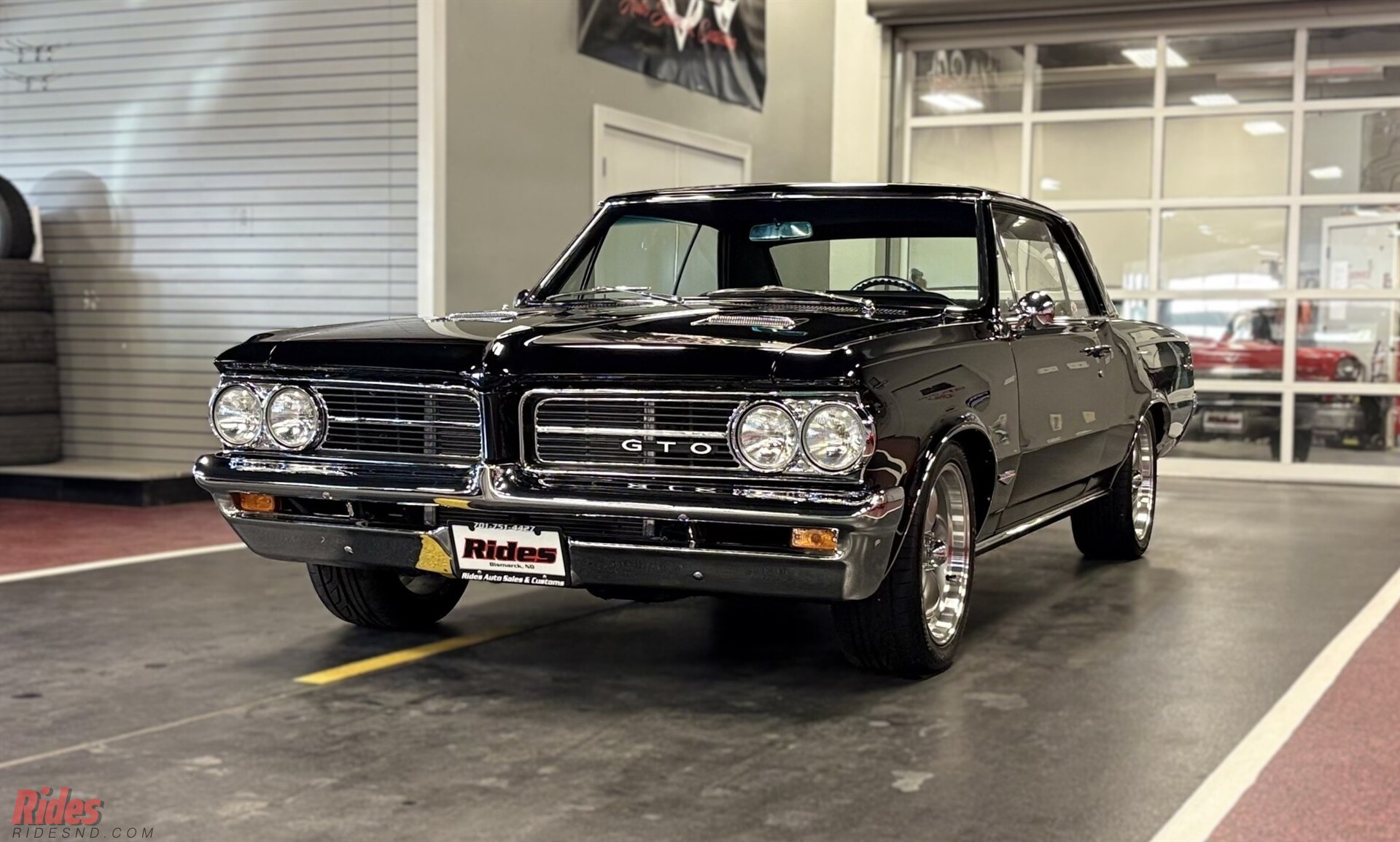
1964–65: the option-package cars. The GTO is an option on the LeMans, provable only through documentation, because the VIN is a LeMans VIN. Styling separates them easily: side-by-side headlights for 1964, the stacked vertical headlights that became a Pontiac signature for 1965. Both years are 389-only. Buy on paperwork and originality; a matching-numbers 1965 Tri-Power convertible is a blue-chip muscle car, while an undocumented 1964 coupe is a LeMans with a story until the paperwork says otherwise.
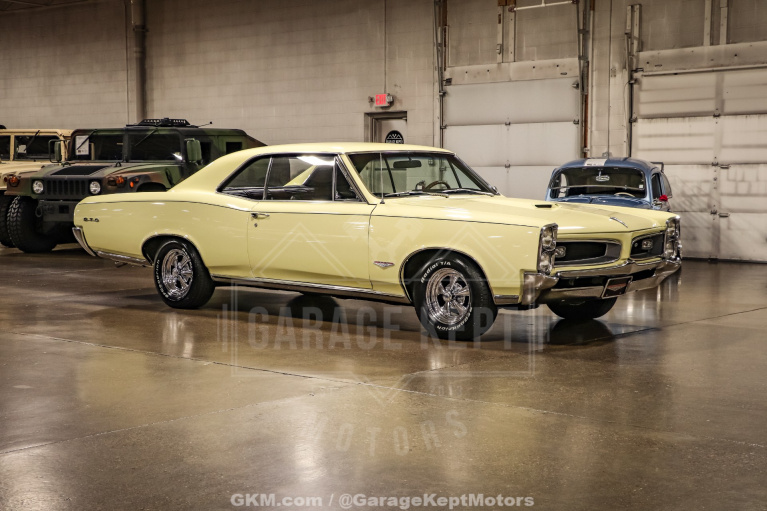
1966–67: the separate series. From 1966 the GTO became its own model series, and the VIN says so — the first three digits are 242, the single most useful identity fact in this guide. The 1966 car, with its Coke-bottle flanks and louvred tail lights, is the best-selling GTO of all time and the shape the hobby treats as definitive. The 1967 car restyled the same shell, replaced the 389 with the 400 and Tri-Power with a single four-barrel (a GM edict banned multiple carburation on everything except Corvette), and introduced the Ram Air and HO packages in recognisable form. Convertibles and Tri-Power 1966 cars top this group; the 1967 Ram Air cars are rarer than most buyers realise.
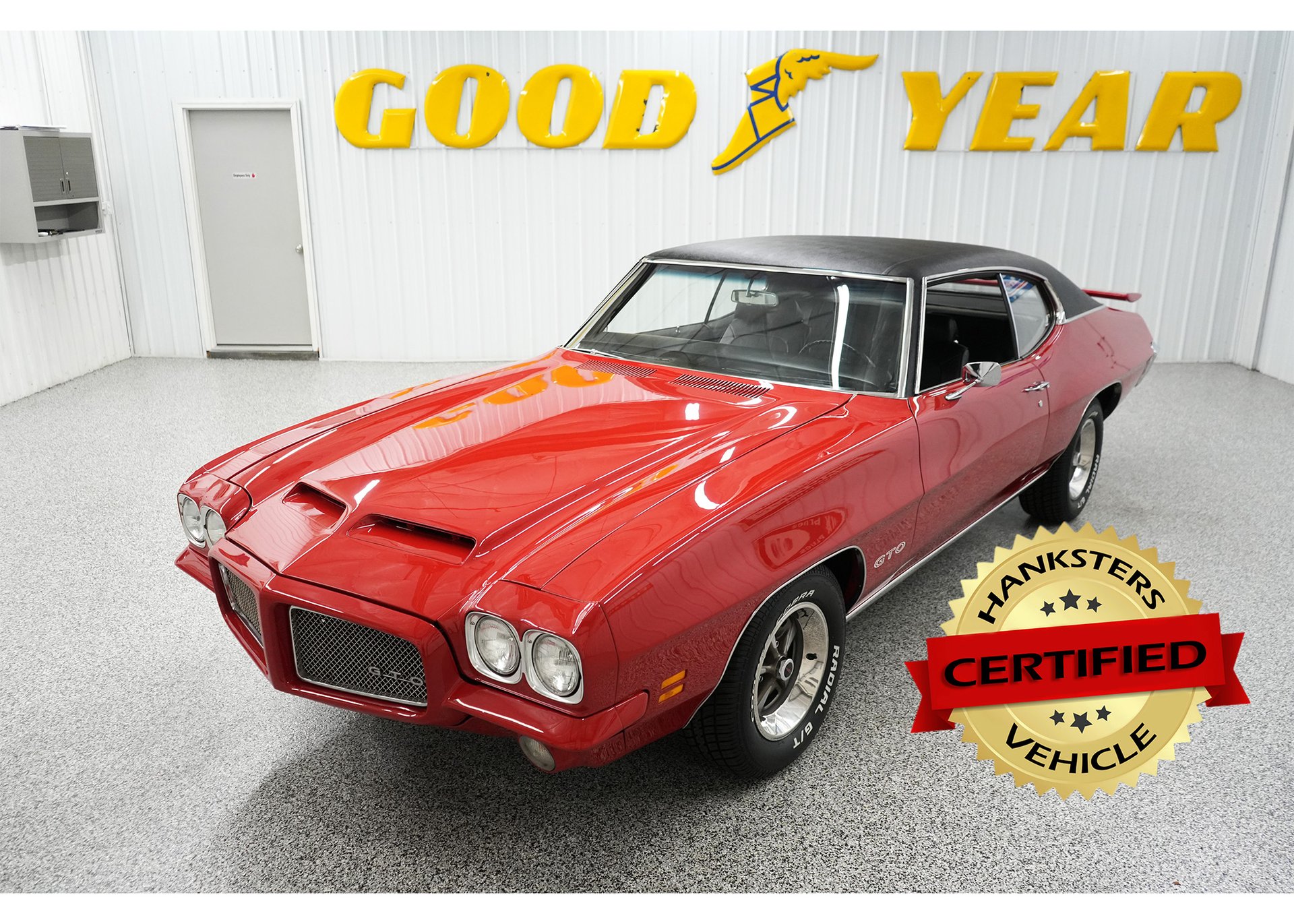
1968–70: the peak cars. The 1968 redesign put the GTO on a shorter 112-inch wheelbase, hid the headlights behind vacuum doors on many cars, and introduced the Endura energy-absorbing front bumper. The Judge arrived partway through 1969 as a stripped performance package and immediately became a flamboyant one: wild colours (Carousel Red first, Orbit Orange for 1970), stripes, a rear wing and Ram Air as standard. The 1970 car restyled the nose again, offered the 455 for the first time, and is the last of the high-compression cars. These years carry the strongest values and the strongest clone pressure: Judges are faked constantly, and a Judge is worth verifying even more rigorously than a standard GTO.

1971–74: the decline, honestly assessed. Compression fell across the board for 1971, the Judge died mid-year, and for 1972 the GTO reverted to an option package on the LeMans — so the 242 VIN check no longer applies and documentation matters again. The 1973 Colonnade car is heavy and softly tuned but genuinely rare; the 1974 Ventura-based car, with its shaker scoop from the Trans Am parts bin, is a pleasant compact muscle car rather than a fast one. These years are the value end of the market and the easiest to buy well, because clone pressure is low: nobody fakes a 1973.
2004–06: the revival. GM's Australian division built the revival GTO from the Holden Monaro: rear-wheel drive, independent rear suspension, an LS V8 and a proper six-speed manual option. The 2004 car has the LS1 and a plain bonnet; the 2005–06 cars have the 400 hp LS2, hood scoops and split dual exhausts, and are the ones to buy. Nothing mechanical is shared with the classics, and condition, mileage and accident history matter more than matching numbers — though low-mileage unmodified LS2 cars are already collectible.

Engines and gearboxes
The Pontiac V8: 389 and 400
All classic GTO engines are Pontiac's own V8 — not a Chevrolet or corporate engine — and the family is one architecture from 389 through 455: the same basic block, with displacement changed by bore and stroke. That matters to a buyer because it means engines swap between years and models with discouraging ease, and because the stampings, not the displacement cast into conversation, are what prove what you are looking at.
The 389 (1964–66) came in two states of tune that define the early cars. The standard engine used a single Carter AFB four-barrel and was rated at 325 hp in 1964 and 335 hp from 1965. The option that made the GTO's reputation was Tri-Power: three Rochester 2G two-barrel carburettors on a cast-iron manifold, the centre carburettor doing the cruising work and the outer pair opening progressively under a vacuum-and-linkage arrangement at wide throttle. Tri-Power was rated at 348 hp in 1964 and 360 hp for 1965–66, but the number undersells it — the delivery, a smooth four-barrel-like cruise that turns into a hard, loud charge when the end carbs open, is the experience people pay for. It is also the experience people fake: Tri-Power setups were sold over the counter and bolted onto ordinary 389s and 400s for sixty years, so a Tri-Power under the bonnet proves the car has Tri-Power, not that it left the factory with it. The build record settles it.
The 400 (1967–73 in the GTO) is a bored 389 and the workhorse of the range. The standard 1967–70 engine is a single Rochester Quadrajet four-barrel, rated 335 hp in 1967 and 350 hp for 1968–70 — strong, simple and the engine most GTOs actually have. Below it in 1967–68 sat an economy 400 with a two-barrel and low compression, rated around 265 hp; it is a good engine in a car that will always be worth less, and sellers do not always volunteer it, so read the engine code. Above it sat the HO (High Output) in 1967–68 — long-branch exhaust manifolds, a hotter cam, revised heads for 1968 — rated 360 hp, and then the Ram Air line below.
A healthy Pontiac V8 should start readily, idle with a slight lope (more on Ram Air cams), hold strong oil pressure — high when cold, settling but never collapsing when hot — and pull without smoke. Blue smoke at start-up that clears is valve stem seals, a known and affordable job; smoke under load is rings or bores and an engine-out conversation. These are torquey, understressed engines that last; what kills them is overheating, neglected oil, and the nylon-toothed timing chain sprocket Pontiac fitted for quietness, whose teeth harden and shed with age. Any car without a documented timing chain replacement should get one on your budget — a steel set fitted is a few hundred dollars in parts and labour, while a jumped chain is bent valves.
Ram Air, the 455 and the late engines
Ram Air was Pontiac's name for engines fed cold air through functional hood scoops, and it covers four specifications the market prices very differently. Ram Air I (1967–early 1968) combined the fresh-air system with a hotter cam and uprated valvetrain. Ram Air II (mid-1968) introduced round-port exhaust heads — the port shape is the identifier — and is rare and serious. Ram Air III (1969–70) is the volume performance engine: 366 hp, standard in The Judge, with a cam that still behaves in traffic. Ram Air IV (1969–70) is the flagship: 370 hp officially and widely believed underrated, with round-port heads, an aluminium intake and a radical cam with poor low-speed manners. Ram Air IV cars are the most valuable classic GTOs of all, and therefore the most cloned; the heads and intake are bolt-on parts, so the paperwork, not the hardware, is the proof.
The 455 arrived for 1970, created by stroking the 400 architecture, and its character is different: not more peak power on paper (the standard 455 was rated 360 hp, the later 455 HO 335 hp gross in 1971) but a wall of torque — 500 lb-ft in 1970 form — that makes the big car effortless. In a 1970 Judge or a 455 HO 1971–72 car it is a superb road engine. In ordinary conversation the 455 also attracts the biggest myth in this guide, so let us bury it here: the Super Duty 455, Pontiac's famous reinforced, round-port racing engine of 1973–74, was never offered in the GTO. It was a Firebird Formula and Trans Am engine only. A "Super Duty GTO" is a swap or a story, whatever the seller calls it.
From 1971 the story is compression and ratings. Compression ratios dropped so the engines could run on the low-lead and unleaded fuels that were coming, gross ratings gave way to net ratings for 1972 (measured with all accessories and full exhaust fitted, hence the apparently dramatic fall), and outputs declined in real terms too: a 1972 400 at 250 hp net or a 1973 400 at 230 hp net is a softer engine than a 1970 400, but not by as much as the paper gap to the old 350 hp gross figure suggests. Judge these cars on how they drive, not on the rating war. The final classic engine, the 1974 Ventura GTO's 350, is the small Pontiac V8 at 200 hp net — willing, simple and unstressed, in a car light enough that it still feels lively.
Two running faults dominate the Pontiac V8 in old age, both diagnosable at a viewing. The first is overheating, usually the water pump system rather than the radiator: Pontiac pumps work with metal divider plates behind the impeller, and the clearance between impeller and plate is critical — a rebuilt pump fitted without setting it, or with corroded plates, circulates badly at idle and the temperature climbs in traffic while staying fine on the road. Ask about the plates on any car that "runs hot in parades"; it is a known fix, not a mystery. The second is hot-start failure: the starter sits close to the exhaust, heat-soaks after a run, and the car that started perfectly cold will barely crank at the fuel station. A heat shield or high-torque starter is the standard cure, and both are cheap — which is why the inspection below insists on a hot restart.
Carburation prices cars. Tri-Power needs its three carburettors synchronised and its linkage set correctly; a badly set-up Tri-Power runs worse than a four-barrel, while a correct one is a delight — a professional rebuild and set-up of all three units is a four-figure job, so documented Tri-Power work is worth a premium. The Quadrajet (1967 on) is superb when right and a bogging nuisance when its secondary air-valve tension is wrong or its well plugs leak fuel into the manifold overnight — the classic symptom is a long crank after sitting, plus a rich smell. The well-plug fix is cheap; a specialist rebuild runs to several hundred dollars. Treat "just needs a tune" as a price, not a reassurance.
The revival engines: LS1 and LS2
The 2004–06 cars use Chevrolet's all-aluminium LS small-block: the 5.7-litre LS1 at 350 hp for 2004, and the 6.0-litre LS2 at 400 hp for 2005–06. These are fuel-injected, coil-per-cylinder engines with a deep aftermarket and no classic-car fragility; the checks are modern-car checks — oil consumption on high-mileage LS1s, noisy lifters from cold, and any sign of overheating, which the aluminium engine tolerates badly. Service history matters more than originality theatre here, though unmodified cars are already the collectible end of the revival market.
Gearboxes
The classic GTO's standard gearbox for most years was a three-speed manual; the gearboxes buyers want are the options. The four-speeds are Muncie units: the M20 wide-ratio box is the friendly road choice, the M21 close-ratio box pairs with the deeper axle ratios, and the heavy-duty M22 "Rock Crusher", with its near-straight-cut gears and characteristic whine, appears on a small number of 1969–71 performance cars and is both rare and faked by description — Muncies are identified by codes and casting numbers, not by noise. Judge any manual on second-gear synchromesh (the first to go), jumping out of gear under load, and clutch judder; a Muncie rebuild is a four-figure job, and a correct factory Hurst shifter should feel precise, not like stirring soup. Worn linkage bushes are cheap; a worn box is not.
Automatics divide by year. The 1964–66 cars use the Super Turbine 300, a two-speed that is adequate, robust and permanently unfashionable — automatic early cars are the value buy for exactly this reason. From 1967 the option was the Turbo Hydra-Matic 400, one of the strongest automatics ever made, often with the Hurst Dual-Gate "His and Hers" shifter. A TH400 should shift firmly and promptly; flaring, delayed reverse or burnt-smelling fluid means a rebuild, priced in the low four figures at a transmission shop. The revival cars offer a Tremec T56 six-speed manual — the one to have — or a competent, less collectible four-speed automatic. On any automatic, old or new, check the fluid colour and smell before the test drive and the shift quality during it.
Axle choice completes the driveline. Ratios ran from economy gears in the high twos to 3.90 and 4.33 performance sets, with the Safe-T-Track limited-slip an option performance cars should have. A deep-ratio Ram Air car is frantic on a freeway; an economy-ratio automatic is a relaxed cruiser. Buy the one that matches your driving, and verify the limited-slip by the tag and the build record rather than by doing a burnout on the test drive.

Problem areas
Everything in this section follows a careful buyer's order: identity first, because a fake is the most expensive problem a GTO can have; then the shell, because rust is the second most expensive; then the running gear, the cabin and, for the revival cars, a list of their own. Our own photo evidence backs the emphasis: we have photo-examined 84 of the GTOs we track in detail, and rust was noted in 21 of those 84 cars and visible damage in 13, while leaks were noted in only 2 and smoke in none. Sellers photograph engines proudly and floors reluctantly; the problems that price these cars are the ones you have to go looking for underneath and inside.
Identity: clones, tributes and paperwork
Start from the fact that the GTO was born as an option package, and work out what that means year by year. For 1964 and 1965, a GTO is a LeMans with an option, and the VIN, which is a LeMans VIN, cannot separate a genuine car from a well-built clone — the engines, badges, trim and even Tri-Power all bolt onto a LeMans, and they have been bolted on for decades. For 1966 to 1971, the GTO is its own series and the VIN does the work: the first three digits, stamped on the plate at the driver's door jamb and visible on the car's paperwork, must be 242. A 1966–71 car presented as a GTO whose VIN starts with the LeMans series digits (237, 239 or similar depending on body style) is not a GTO, full stop, whatever has been bolted to it. For 1972 to 1974 the GTO reverted to an option package — on the LeMans, then the Ventura — and documentation rules again.
The saving grace of the Pontiac hobby is the Pontiac Historical Services paperwork — universally called PHS. Pontiac's build records survive, and for a modest fee PHS will supply the factory invoice and option record for a car's VIN: model, engine, gearbox, axle, colours and every factory option as built. It is the single most valuable piece of paper in a GTO transaction. A seller of a genuine car will usually already have it; a car at genuine-car money without it should be priced as unproven until you have run the VIN yourself, and a seller who discourages you has answered your question. Use PHS to verify: that a 1964–65 car was built with the GTO option at all; that a Judge is a Judge (the package is an option line on the record, and Judge clones are the most common high-value fakes in this market); that a Ram Air, Tri-Power or four-speed car was built that way rather than converted; and that special colours are factory colours rather than repaints into fashionable ones.
Support the paperwork with the hardware checks. The engine carries a stamped unit number and a two-letter production code at the front of the block, and from 1968 a partial VIN derivative as well; a numbers-matching claim means those stampings correspond to the car and to the engine it is claimed to have. Restamping exists, so weight the PHS record above any single stamping. The cowl data plate records body style, build date, plant, and factory paint and trim codes — a car born green with a black bench interior that now wears red over buckets may be a fine car, but it is not an original car and should not be priced as one. A "converted" car, hardtop to convertible, is a known fraud pattern on valuable body styles, and mismatches between plate, VIN and body are walk-away territory. Finally, be fair about tributes: a disclosed tribute — our current pool contains several, including a 1964 convertible, a 1965 coupe, a 1970 Judge tribute and a 1972 convertible — is an honest car that lets a buyer enjoy the look for LeMans money. The crime is not the tribute; it is the tribute priced as the real thing.
Rust: the map
The A-body shell is a body-on-frame design, which changes the rust calculation in your favour — a rotten body does not automatically mean a rotten structure — and against it, because the frame itself, the body mounts and the floor that sits between them all have their own rot patterns, and sellers' photographs almost never show any of them. Work through it in this order.
Rear window channel and trunk. The signature A-body rot. The rear window sits in a channel that traps water under its trim, the channel perforates, and the water runs down into the trunk, where it sits under the mat and rots the trunk floor from above. Lift the mat on every car: surface scale is a clean-and-treat job, holes over the frame rails or at the trunk floor extensions are panel work, and a seller who has glued the mat down has told you why. Check the channel itself from outside, low at the corners, for bubbling under the paint around the window trim. Trunk floor replacement, done properly with the quarters protected, is a four-figure job at a body shop once paint is included.
Quarter panels, wheelhouses and lower fenders. The rear arches trap mud between the outer quarter and the inner wheelhouse, and the quarters rot from the inside out at the arch lip and behind the wheel. The front fenders rot at their bottom rear corner, where the inner brace traps debris. Bubbling at an arch lip means the inner structure is worse; a magnet wrapped in cloth, run over the lower quarters and fender bottoms, finds the filler that hides it. GTO-specific trim makes quarter work dearer than on a plain LeMans, and a full quarter replacement with paint is firmly four-figure work per side.
Floors, rockers and the cowl. Front floors rot from inside, fed by leaking windshield seals and cowl vents, exactly as on most cars of the era: lift the carpets, all four footwells, and prod. The cowl itself — the plenum at the base of the windshield where the wiper mechanism lives — rusts where leaves and water sit, and cowl perforation leaks water onto the front floors and behind the dashboard, which is why a car can have wet carpets with sound floors. Rocker panels rot at their ends. None of this is exotic, all of it is repairable with available panels, and the cost driver is accumulation: one area is a job, four areas are a restoration, and the car should be priced as the restoration.
The frame and body mounts. Get the car on a lift and look at the frame itself, particularly the rear rails and crossmembers, the areas around the body-mount holes, and the front horns. Surface rust on a frame is normal and meaningless; perforation at a mount or a rear rail is structural fabrication work, priced per car, and it kills cheap cars. The body mounts themselves — rubber cushions between body and frame — perish and collapse, which drops the body unevenly, opens panel gaps and produces clonks over bumps that get blamed on suspension; a full mount set is inexpensive in parts and a day's labour to fit, and a car sitting visibly crooked is often this, not springs. Convertible frames are boxed and stronger; they also trap water inside the boxing, so prod them harder, not softer.
The smaller traps. The core support rots under the battery — look under the tray and at the support's lower corners. Door bottoms fill with water when their drains block; run a fingertip along every door bottom. The 1968–70 Endura bumper is a moulded urethane skin over a steel armature: it cracks, sags and separates with age, correct repair is specialist work, and many cars wear a fibreglass reproduction or a painted steel LeMans bumper instead — look closely at fit at the nose. The 1968–69 hideaway headlight doors work on engine vacuum through actuators and hoses that leak with age, leaving one door up and one down; a car with the system deleted and the doors wired shut has been de-optioned in front of you. Vinyl roofs hide the roof skin completely — bubbling or a soft feel under the vinyl means rust on the roof itself, a roof-skin conversation, not a trim one.

Suspension, steering and brakes
The running gear is conventional: coil springs and unequal-length arms at the front, a live rear axle on coils and four links at the back, everything rebuildable with parts still made. Front ball joints, tie-rod ends and control-arm bushes perish or wear, giving vague steering, wandering under braking and knocks over bumps; a full front-end rebuild is a four-figure job at a shop. The steering box wears at the centre of its travel — test it by rocking the wheel at straight-ahead — and a rebuilt or quick-ratio box transforms the car. At the rear, tired control-arm bushes are the wheel-hop story: a GTO that axle-tramps violently on a hard launch usually needs bushes and dampers, not a redesign, and boxing the lower arms is the period cure. Judge the stance: a car low at one corner points back to the body mounts above, and air shocks propping up a sagging rear are a confession, not a solution.
Brakes divide the range. Drums all round were standard into the late 1960s; front discs were an option from 1967 and became common later. A drum-braked GTO in modern traffic is an exercise in forward planning, and a front disc conversion is the best usability upgrade you can make — but on a numbers-matching, high-value car, originality cuts the other way, so decide which owner you are before you buy. On any car: pedal feel (a long or sinking pedal means a full hydraulic refresh, a four-figure job at shop rates), even pulling under braking, and the hard lines along the frame, which rust and are seldom photographed. Cars that have sat need the whole system assumed guilty until inspected.
Interior, trim and electrics
The GTO cabin is where deferred costs hide, because interiors are labour-intensive and the repro market, while good, is not complete. The dashboard pad cracks in the sun, and on 1968 and later cars the padded dash is a large, shaped piece whose replacement or professional re-covering is serious money. Seat covers and foam are reproduced for the common years and are a manageable job; headliners, door cards and carpets are available for the volume years, thinner for 1973–74. The expensive sentence in an advert is "interior needs finishing" on a car whose trim colour is unusual, because dye lots and grain matching will fight you. GTO-specific items — engine-turned dash inserts, Rally gauges, the hood-mounted tachometer, Hurst shifters, the Judge glovebox emblem — are reproduced or hunted used, at prices that reward checking they are present and correct before you buy. A dead hood tach is common and fixable; one that turns out to be a cheap reproduction on a car priced with a real one is a lesson in checking everything.
Electrics fail the way all 1960s electrics fail: at the earths, connectors and switches, not in the middle of wires. Fusible links and the bulkhead connector are known weak points, dash clusters develop intermittent gauges (a wandering fuel gauge is almost always an earth or a sender), and aftermarket wiring — alarms, stereos, kill switches added over fifty years — is the biggest source of electrical grief on these cars. A car where everything works, clock and courtesy lights included, has usually been used and maintained, the best general sign there is. Air conditioning should be assumed to need work unless demonstrated cold: a full recommission of a dead system is a four-figure job, and "just needs a charge" is the oldest sentence in the classic-car language.
The revival cars: their own list
The 2004–06 GTO has no rust story yet and a completely different problem set, mostly Holden-specific. Front radius-rod bushes wear and let the geometry wander, and the front struts are known for tyre rub — check the inner shoulders of the front tyres for witness marks. The independent rear end can develop differential whine, and the two-piece propshaft's centre bearing and rubber couplings age; listen on a lift-off and re-application of throttle at speed. Ignition-lock and body-control-module faults produce the classic no-crank complaints of modern GM cars, and Holden-specific trim and switchgear are the scarcity problem — LS mechanical parts are everywhere, but a broken piece of Monaro cabin trim can mean ordering from Australia. The US conversion moved the fuel tank into the boot for crash compliance, which is why the boot is comically small; that is factory, not damage. Buy these like modern performance cars: service history, accident history, and a fault-code scan tell you more than nostalgia.

How to inspect one
Allow a full hour for the car and another half hour for the paperwork; bring a torch, a magnet wrapped in cloth, and a friend to work lights and pedals while you watch. On any classic GTO at serious money, finish by paying for a lift inspection at a shop that knows old GM cars — the cheapest certainty in this market. On a revival car, substitute a code scan and a history check for the paperwork steps.

- Start with the paperwork, before the car. Match the VIN on the title to the plate on the driver's door jamb. On a 1966–71 car the first three digits must be 242; if they are not, stop negotiating about GTO value, because the car is a LeMans in GTO dress. On a 1964–65 or 1972–74 car, ask for the PHS build record or run the VIN through PHS yourself before money moves, and confirm the GTO option, engine and gearbox are on the factory record. On a Judge, Ram Air or Tri-Power car, the record must show that package by name. No record, no premium.
- Read the cowl data plate and the engine stampings. The plate gives body style, build date, plant, paint and trim codes: compare them with the car in front of you and note every change of colour or interior for the negotiation. Then find the engine's stamped code at the front of the block and, on 1968 and later cars, the partial VIN stamping, and check both against the claim made for the engine. A "matching-numbers Ram Air IV" whose block code says standard 400 is the most expensive sentence in this hobby; read it yourself.
- Cold start, and insist on it. The engine should be stone cold when you arrive. A standard 400 or 389 starts readily, settles to an even idle and shows strong oil pressure. Watch the exhaust: blue smoke at start-up that clears is valve seals; smoke that stays is deeper. Listen for a deep knock in the first seconds (bearings, low oil pressure) and for valvetrain clatter that does not fade. A car "already warmed up for you" has had this test taken away — reschedule rather than proceed.
- The trunk and rear window test. Lift the trunk mat and the spare, and look at the floor and its extensions with the torch, as set out in the rust section: staining is housekeeping, perforation is panel money. Check the rear window channel's lower corners for bubbling. This five-minute check is the best predictor of how much body money a GTO is hiding.
- Under the car, on a lift if at all possible. Work front to back: frame horns and core support (prod under the battery side), floor pans and seams, rocker ends, body-mount points and the mounts themselves, rear rails and crossmembers, and the fuel and brake hard lines. Surface rust is scenery; perforation at a mount, rail or crossmember is structural money and, on a car priced as a driver, a walk-away. Read fresh underseal as a question, not an answer.
- Body and gaps with the magnet. Run the magnet over the lower quarters, arch lips, fender bottoms and door bottoms, and feel every door's lower edge for bubbling. Check the Endura nose on 1968–70 cars for cracks, sag and fit, and work the hideaway headlights on 1968–69 cars through several cycles. Sight down both flanks for ripples and check from behind that the car sits level — a lean sends you back to the body mounts in step 5.
- The hot restart. After the test drive in step 9, switch off, wait five minutes in conversation, and restart. The Pontiac starter heat-soak described in the engines section shows itself exactly here and nowhere else: a car that cranks slower and slower hot is telling you about a cheap fix the seller did not make, and it prices a starter, a shield and an hour of your life into the deal.
- The test drive: driveline. Fifteen minutes minimum, including a highway stretch. A four-speed should engage every gear cleanly, with second-gear synchromesh the first thing to test on a downchange; a Muncie that crunches into second is a rebuild priced into the offer. An automatic should shift firmly and kick down eagerly; flaring or a delayed reverse engagement at the end of the drive is transmission money. Listen for rear-axle whine and for the clonk of tired rear bushes on a firm (not abusive) launch.
- The test drive: chassis and brakes. The steering should be light, centred and free of a dead zone at straight-ahead; wander under braking points at bushes, ball joints or alignment, and a knock over bumps at the front end is a rebuild list, not a charm point. Brake hard from speed twice: the car should stop straight and repeatably. On a drum-braked car, judge honestly whether you will convert to discs or live with it, because that decision belongs in your budget from day one.
- Heat and electrics, all of them. Whatever the weather, run the heater and blower on every speed, work every window, the wipers, washers, lights, indicators, horn, gauges and radio. Check the temperature gauge's story across the whole drive — a car that creeps up in traffic is showing you the water-pump divider-plate problem from the engines section, and it should be priced as a known job, not discovered as one. If air conditioning is fitted and claimed, it must blow cold during this step or it does not exist for pricing purposes.
- Interior, judged from the driver's seat. Sit in every seat, but judge from the driver's: collapsed foam and a worn-through bolster are retrim money, and the common colours are the cheap ones to fix. Check the dash pad for cracks, the headliner for sag and stains (stains mean water, and water sends you back to steps 4 and 6), and confirm the GTO-specific furniture the price assumes — correct shifter, gauges, tachometer — is present and genuine rather than reproduced or missing.
- The revival substitution, for 2004–06 cars. Replace steps 1 and 2 with a title and accident-history check and a fault-code scan, then add: the inner shoulders of the front tyres for strut-rub marks, the propshaft couplings and differential for whine on a lift-off test during step 8, and every piece of Holden-specific cabin trim for damage — trim, not mechanics, is the revival car's scarcity problem. Service history outweighs low mileage without it.
Values
The market content that follows this guide on the page — the cars listed now and the recorded sales — carries every current number, refreshed as the market moves, and this section deliberately carries none. What it gives you instead is how to read those numbers like a GTO buyer rather than a spectator, because in this market the spread between the cheapest and dearest car wearing the same badge is wider than in almost any other, and the reasons are learnable.
The first driver is proof. A documented car — PHS record in hand, matching stampings, colours and specification as built — sits in a different market from an identical-looking undocumented car, and the gap is largest exactly where the temptation to fake is largest: Judges, Ram Air cars, Tri-Power four-speeds and convertibles. When you compare a listing against the recorded sales, compare like with like on documentation before you compare anything else; an undocumented car priced with the documented ones is not ambitious, it is mispriced, and the correction will happen at your expense when you come to sell. The second driver is specification as built, not as presented. A car born a standard automatic that now wears Tri-Power and a four-speed is worth its born specification plus the value of enjoyable parts, not the factory Tri-Power four-speed money its presentation invites you to pay.
The third driver is condition, with a GTO weighting: because the shell and frame are repairable with good panel support, condition money concentrates in completeness and in the expensive-to-recreate areas — a correct, complete interior in the right colour, the right engine genuinely fitted and documented, the nose and trim correct on the Endura cars. Project cars follow the usual arithmetic: the gap between a project and a finished car is wide enough that buying the project only makes sense if the restoration itself is the hobby, because the finished car can almost always be bought for less than the project plus its restoration. Driver-quality cars — sound, documented, presentable, sorted — are the rational centre of the market and the easiest to resell, because the next buyer can repeat your inspection and reach your conclusion.
Year and variant premiums follow reputation with a lag you can exploit. The 1966–67 cars and the 1969–70 Judge and Ram Air cars carry the strongest premiums; the 1971–72 cars, mechanically much of the same experience, carry a discount out of proportion to their demerits, and the 1973–74 cars are cheaper still. The revival cars trade on modern logic — mileage, history, modification — with the LS2 cars holding a clear premium over the 2004 car. Asking prices are routinely set above achieved prices, particularly by sellers pricing a tribute-adjacent car against documented sales, so treat the recorded-sales block, not the asking block, as the truth about what cars change hands for, and negotiate from inspection findings with costs attached.
Parts and ownership
The classic GTO is one of the best-supported American classics you can own, for a simple reason: it shares its platform with the Tempest, LeMans and every other GM A-body of its years, including the Chevelle, so the mechanical and body-panel aftermarket serves millions of cars, not thousands. The Pontiac-specific layer on top of that — engines, trim, GTO-only parts — is served by a mature specialist trade that has been reproducing parts for this car for forty years.
Easy: engine service and wear parts for the Pontiac V8 (gaskets, pumps, timing sets, bearings, ignition), carburettor kits and specialist rebuilds for Tri-Power and Quadrajet, suspension and steering wear parts, brake components and disc-conversion kits, body panels for the volume years (floors, trunk floors, quarters, fenders), weatherstripping, glass, seat covers and interior kits in the common colours, and exhaust systems. Most of this is order-today, fit-this-month, at prices that compare well with European classics of similar value.
Harder and dearer: genuinely correct Ram Air hardware (round-port heads and correct manifolds are hunted and priced accordingly), Endura bumper restoration, hideaway-headlight vacuum components, 1973–74-specific panels and trim, correct dated components for a concours car (the last five percent of originality costs more than the first ninety-five), and undamaged convertible top frames. For the revival cars the split is reversed: LS mechanical parts are trivially easy, while Holden-specific body, trim and electrical parts require Australian sourcing and patience.
Running costs. A sorted classic GTO is a realistic regular-use classic in season: fuel consumption in the low-to-mid teens per gallon, worse for a Tri-Power or Ram Air IV car driven as intended, servicing any competent classic shop can handle, and agreed-value classic insurance. The budget line that catches new owners is the first year. Catching up deferred maintenance on a running car — fluids, hoses, belts, brakes inspected end to end, timing chain if undocumented, carburation set up properly — honestly runs into the low four figures at shop rates before you improve anything, and recommissioning a car that has sat for years (fuel system cleaned end to end, because modern ethanol fuel attacks old rubber and varnishes tanks; every brake component renewed or proven) costs several times that. The Pontiac engine itself is rarely the bill; the bill is everything bolted to a car that was cheap for a decade. Buy a car in regular use over a sleeping car at the same price, every time.
Ownership has one Pontiac-specific pleasure: the documentation culture. Between the PHS records, the factory literature and a deep club and registry scene, a GTO is a car whose history you can actually research and prove — another reason the documented car holds its value. Keep every invoice, and keep the PHS paperwork with the car; the next buyer is paying for exactly that file.
Which one to buy
- The all-rounder: 1968–70 standard 400, four-speed or Turbo Hydra-Matic. The mature GTO experience — torque, presence, the best parts support in the range and a deep market to buy from and sell into. Documented and driver-quality beats rare and ropey, every time.
- The value buy: 1971–72 GTO. Much of the same car at a clear discount because the market prices the paper horsepower of the earlier years. Low clone pressure means your inspection money goes on condition, where it belongs.
- The archetype: 1966 Tri-Power. The best-selling year, the definitive shape and the full Tri-Power experience — provided the build record says the car was born with it. An undocumented Tri-Power 1966 is a LeMans-priced conversation, not a premium one.
- The collector car: 1969–70 Judge, Ram Air III or IV. The flagship of the range and the most faked. Buy only with the PHS record showing the package, stampings that agree, and a premium paid for proof rather than paint. A correct Ram Air IV is the blue-chip GTO.
- The early-car buy: 1965 389. Stacked headlights, the original formula with a year's development in it, and strong values for documented cars. The 1964 is the purer story and the harder authentication; the 1965 is the easier ownership.
- The overlooked car: 1973–74 GTO. The Colonnade 1973 and the Ventura 1974 are the cheapest way into a genuine, documented classic GTO, with rarity on their side and no clone problem at all. Buy the best one you can find; there are not many.
- The modern buy: 2005–06 revival. LS2 power, modern brakes and air conditioning, and a chassis that flatters a modern driver. Buy on service history and originality; the six-speed manual is the one the collectors are quietly accumulating.
And the rule that overrides all of the above: prove the car first, then buy the least rusty, best-documented example you can find, in the specification it was born with. Gearboxes can be rebuilt, carburettors set up and interiors retrimmed at prices you can plan for — but a GTO that is not a GTO is worth LeMans money no matter what you spend on it, the one mistake no restoration can undo.
See the 80 GTO cars currently listed.