
Pontiac GTO Hardtop buyer's guide
Pontiac GTO Hardtop -- the model's own buyer's guide: variants, values and what to check.
Years listed: 1965-1970 · Series: GTO
Overview and history
The Pontiac GTO hardtop is the car that invented the muscle car, and the hardtop coupe is the body style most buyers picture when they picture one. A hardtop has no B-pillar: wind the two side windows down and the whole flank opens up into one long, clean opening, with the roof floating above it. It was the volume body for the GTO through its great years — the one dealers ordered, most people bought, and the one that survives in the largest numbers today. That is both the good news and the trap. Because the hardtop was the common GTO, it is also the most-cloned GTO body there is. A Tempest or LeMans hardtop accepts every GTO badge, grille, hood and stripe, and thousands have been turned into GTOs over the last fifty years. Buying a hardtop, more than any other GTO, is an exercise in proving what the car was when it left Pontiac — not what it looks like now.
The story starts in 1963, when Pontiac's chief engineer John DeLorean, advertising man Jim Wangers and engineer Bill Collins slipped a 389 cubic inch V8 into the intermediate Tempest LeMans. General Motors barred engines larger than 330 cubic inches in intermediate cars, so they did it as an option package rather than a separate model, called it GTO after Ferrari's 250 GTO, and priced it at about three hundred dollars over a LeMans. The package sold 32,450 cars in 1964, five times what Pontiac expected, and the muscle car was born. For 1964 and 1965 the GTO was an option on the LeMans; from 1966 it became a series in its own right. Production peaked in 1966 at just under 97,000 cars across all body styles, stayed strong through 1969, then fell away fast as insurance surcharges, emissions rules and rising prices bit: about 40,000 in 1970, about 10,500 in 1971, and fewer than 6,000 in 1972, the last year of the true A-body GTO.
This guide covers the hardtop GTOs of 1964 to 1972, as they appear in the Classic Listings pool: twenty-nine hardtops, twelve for sale and seventeen sold, with the years running from 1965 to 1970 and the weight firmly on the first generation — seven cars each from 1965, 1966 and 1967, five from 1970, two from 1969 and one from 1968. No 1964, 1971 or 1972 hardtop is in the pool, which is a gap in the sample, not in the model: the 1964 is the rarest and most faked of all, and the 1971 and 1972 cars are genuinely scarce.
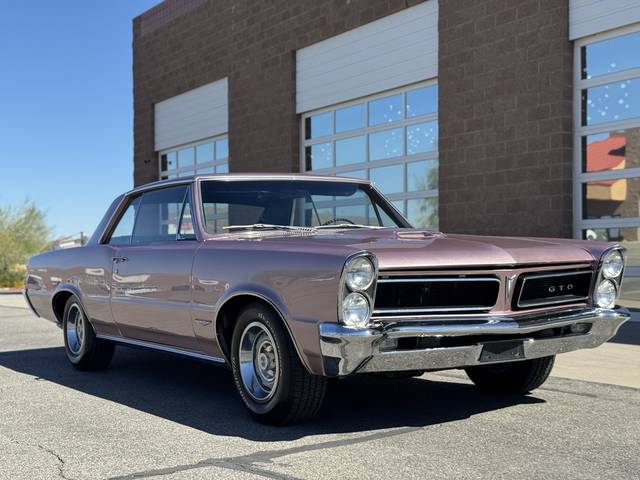
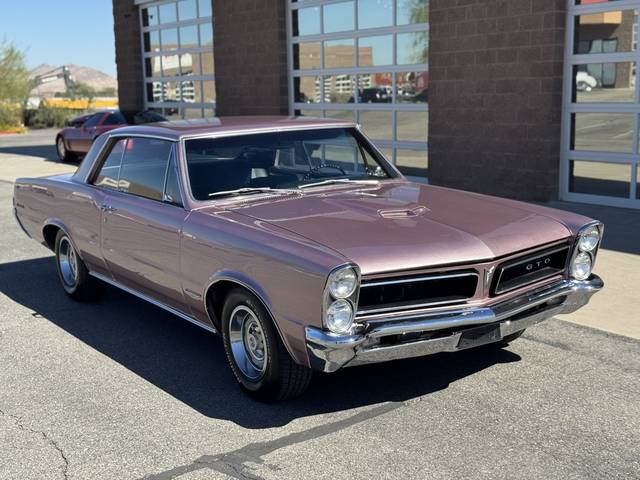
Two generations matter, and you can tell them apart at fifty yards. The first generation, 1964 to 1967, is the stacked-headlamp car: a long, flat hood, a split grille, and from 1966 a fastback-leaning roofline with louvred tail lamps. The second generation, 1968 to 1972, is the sculpted car: a shorter wheelbase, a semi-fastback roof, the Endura bumper painted body colour, and hidden headlamps on most cars. Underneath, both generations are the same honest A-body: a perimeter frame, coil springs all round, a live rear axle on four links, and a big Pontiac V8 up front. Nothing exotic, everything fixable — which is exactly why so many survive, and why so many have been rebuilt, re-engined and re-badged along the way.

The models
Every GTO hardtop is a two-door coupe without a centre pillar, but the badge tells you almost nothing, because badges are the easiest parts in the world to change. The year, the engine code and the paperwork tell you what the car is.
| Model | Years | Engine | Output | Built | Character |
|---|---|---|---|---|---|
| GTO Hardtop | 1964 | 389 V8, 4-barrel or Tri-Power | 325 or 348 hp | about 32,450 all bodies | The original; rarest and most faked |
| GTO Hardtop | 1965 | 389 V8, 4-barrel or Tri-Power | 335 or 360 hp | about 75,350 all bodies | Stacked lamps arrive; Tri-Power peak |
| GTO Hardtop | 1966 | 389 V8, 4-barrel or Tri-Power | 335 or 360 hp | about 96,950 all bodies | Separate series; the volume year and the default buy |
| GTO Hardtop | 1967 | 400 V8, 4-barrel or Ram Air | 335 or 360 hp | about 81,700 all bodies | New 400; Tri-Power gone; first Ram Air |
| GTO Hardtop | 1968 | 400 V8, 4-barrel, Ram Air or Ram Air II | 335, 360 or 366 hp | about 87,700 all bodies | New body, Endura bumper, hidden lamps |
| GTO Hardtop | 1969 | 400 V8, Ram Air III or Ram Air IV | 335, 366 or 370 hp | about 72,300 all bodies | The Judge arrives; the peak of the legend |
| GTO Hardtop | 1970 | 400 V8, Ram Air III or Ram Air IV | 335, 366 or 370 hp | about 40,150 all bodies | Exposed lamps return; Judge at its wildest |
| GTO Hardtop | 1971 | 400 or 455 V8 | 300 or 335 hp | about 10,500 all bodies | Lower compression; 455 HO the pick |
| GTO Hardtop | 1972 | 400 or 455 V8 | 250 or 300 hp net | about 5,800 all bodies | Net ratings; last A-body GTO |
(Outputs are period gross figures, except 1972, which Pontiac rated net — so 1972 figures cannot be compared directly with 1971. Built figures are total GTO production across all body styles; the hardtop was the majority body in every year.)
1964: the original. The first GTO was not a model at all but an option package on the Tempest LeMans: the 389, a floor-shifted three-speed manual, heavy-duty suspension, dual exhausts and GTO badges. Because it was an option, there is no GTO series in the 1964 vehicle identification number — the VIN says LeMans, and only the build sheet and the Pontiac Historic Services documentation prove the car. That is why the 1964 is the most faked GTO there is: any 1964 LeMans hardtop can be dressed as one with bolt-on parts, and the VIN will never contradict it. A 1964 without PHS paperwork is a LeMans with a story, priced accordingly.
1965 and 1966: the boom. The 1965 car got the stacked vertical headlamps and a 389 now rated at 335 hp with the four-barrel and 360 hp with Tri-Power. The 1966 car is the one most buyers meet: GTO became its own series, the body was restyled with a more pronounced Coke-bottle sweep and a louvred tail panel, and production hit its peak. Seven of the twenty-nine cars in the pool are 1966s — the most numerous GTO ever built, the easiest to find, and the best-supported by parts. Buy it with the same paperwork discipline as any other year, because volume is no protection against cloning.
1967: the last of the first generation. The 389 grew into the 400, with the same 335 hp base rating and a 360 hp high-output version, and the Ram Air package appeared for the first time — a functional hood scoop feeding a sealed air cleaner, with a hotter cam and stronger valve springs. Tri-Power is gone for 1967, killed by General Motors' ban on multiple carburettors, so the top cars run a single Quadrajet — a claimed 1967 Tri-Power car is a conversion, full stop — and 1967 is the last year of the stacked-lamp body. Seven 1967s sit in the pool, tied with 1965 and 1966 as the commonest year, and the 1967 hardtop is a sweet spot: the developed 400 and first-generation styling at its most resolved. A claimed 1967 Ram Air car needs Ram Air paperwork — the scoops are easy to fit, and the premium is large.
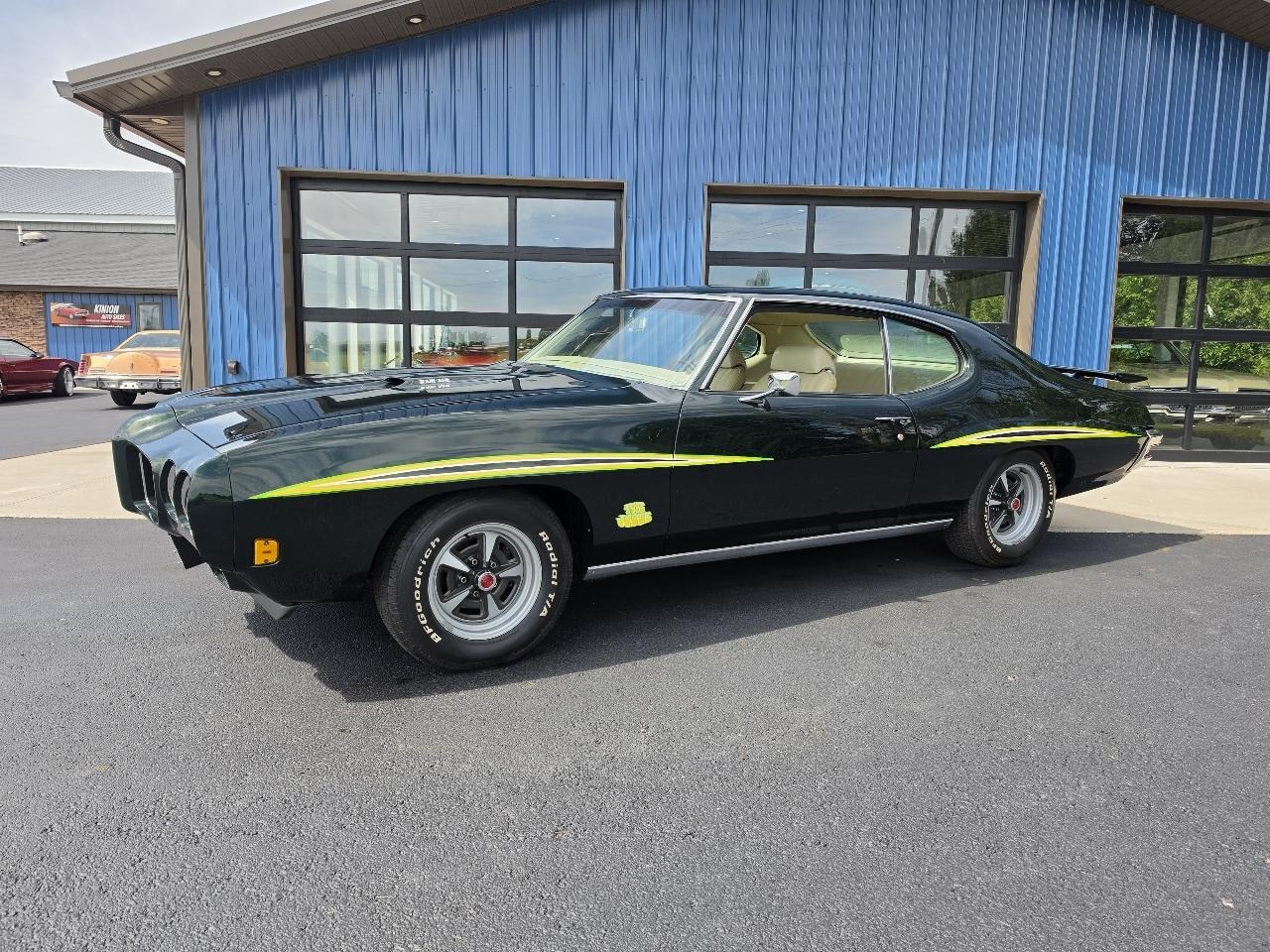
1968 and 1969: the second generation and the Judge. The 1968 car was all new: a wheelbase shortened from 115 inches to 112, a semi-fastback roofline, the Endura front bumper painted body colour, hidden headlamps, and a 400 standard at 335 hp with the Ram Air II at 366 hp. The 1969 car is the one the legend remembers, because in 1969 Pontiac launched the Judge: conceived as a cheap, stripped performance car, it became the loudest GTO of all — Carousel Red paint, a rear spoiler, Rally II wheels, and the Ram Air III engine as standard with the Ram Air IV as the expensive option. The Judge was an option package, and like every GTO option it is cloned relentlessly. A Judge hardtop without PHS documentation proving the option is a GTO with a spoiler and a paint job. One genuine 1970 Judge hardtop sits in the pool, in green, and it most rewards the closest paperwork check. The 1969 hardtop in the pool is thin — two cars — and the 1968 thinner still at one.
1970: the peak and the turn. The 1970 GTO kept the 400 and the Ram Air III and IV, but the hidden lamps went, exposed quad lamps returned, the Judge got wilder stripes, and the 455 cubic inch V8 became available for the first time — a torque monster rated at 360 hp gross. Five 1970 hardtops sit in the pool, the largest second-generation group, and the 1970 is the last year of the gross-horsepower GTO.
1971 and 1972: the fade. For 1971 Pontiac cut compression to run on low-lead fuel, power fell — the 400 to 300 hp gross, the new 455 HO to 335 hp gross — and the Judge was cancelled in February 1971. For 1972 Pontiac switched to net ratings, so the figures look catastrophic — 300 hp net for the 455 HO, 250 for the 400 — when the real drop from 1971 is modest. No 1971 or 1972 hardtop is in the pool: these are rare cars, and most were used hard and thrown away. A genuine 1971 455 HO is also the cheapest way into a documented GTO hardtop, because the market still prices them as the faded years.
Engines and gearboxes
The 389 and the 400: 1964 to 1969
Every GTO hardtop of the classic era runs a Pontiac V8 — not a Chevrolet, not a Buick, and not a small block. Pontiac built its own engines, and the GTO's are all developments of the one Pontiac V8 family that ran from 1955 to 1981. The first GTOs use the 389 cubic inch engine: a 4.06 inch bore and 3.75 inch stroke, cast-iron block and heads, and a hydraulic-lifter valvetrain. In 1964 the four-barrel version made 325 hp and the Tri-Power 348 hp; for 1965 and 1966 the ratings rose to 335 hp and 360 hp, mostly through better heads and a wilder cam in the Tri-Power cars. The 389 is a torque engine first — it makes its power low, pulls hard from 2,000 rpm, and is durable if the oil has been changed. What kills 389s is neglect: overheating from a silted radiator, and sludge from short trips and long oil intervals.
For 1967 Pontiac bored the engine out to 400 cubic inches — 4.12 inch bore, same 3.75 inch stroke — and fitted new heads with bigger valves. The base 400 kept the 335 hp rating, the Tri-Power was replaced by a single Quadrajet four-barrel at the same output after General Motors banned multiple carburettors, and the Ram Air version, with functional scoops, a hotter cam and round exhaust ports on the Ram Air II from mid-1968, made 360 to 366 hp depending on the year. The 400 is the GTO engine most buyers will live with: parts are everywhere, the specialists all know it, and a well-built one will run for decades. Judge it the way you judge any Pontiac V8: oil pressure hot at idle, no smoke on start-up, no timing chain rattle from the front of the block, and no sign of the engine having been cooked. A Pontiac V8 that has overheated hard will often blow head gaskets repeatedly afterwards — ask about cooling history, and look for staining from old coolant leaks around the head joints and water pump.
Tri-Power. The three-two-barrel setup is the GTO's signature induction and the thing sellers talk about most, so understand what it is. A Tri-Power car carries three Rochester 2GC two-barrel carburettors in a row on a cast-iron manifold. The centre carburettor does all the normal driving — it has the choke, the idle circuits and the accelerator pump — and the two outer carburettors are simple fuel valves with no idle circuits at all, opened either by a progressive mechanical linkage or, on later cars, by vacuum. A healthy Tri-Power drives like a mild single-carburettor car until you floor it, when the outer carburettors open and the engine takes a second, deeper breath. The faults follow from the design. The outer carburettors sit unused for most of the car's life, so their throttle shafts gum up, their float valves stick and their base gaskets dry out — and when they do open, they either flood the engine or do nothing. The vacuum cars fail differently: the diaphragm and check valve age, the outer carburettors open late, early or not at all, and the car feels flat in a way owners blame on the engine. A proper rebuild — all three carburettors stripped, shafts rebushed, linkage set up on the bench — runs about $900 to $1,800, and a conversion from vacuum to mechanical linkage is a common and honest modification, not a demerit. What is a demerit is a Tri-Power that is not a Tri-Power: the manifolds, carburettors and air cleaners are all reproduced or findable, and a four-barrel car converted to Tri-Power is worth four-barrel money. The engine code and the PHS paperwork settle which the car was born with.
Ram Air. From 1967 Pontiac offered the Ram Air package: open hood scoops, a sealed foam-gasketed air cleaner drawing cold air from the scoops, a hotter camshaft, stronger valve springs, and on later cars round-port cylinder heads with much better exhaust flow. The Ram Air II of 1968 and the Ram Air III and IV of 1969 and 1970 are the desirable engines — the IV in particular, with its round-port heads and 370 hp rating, is the rarest and most valuable regular-production GTO engine. They are also the most faked. The scoops, air cleaner, flapper doors and decals are all available, and fitting them to a standard car takes a weekend. The heads, the cam and the engine code are what make a Ram Air car, and those are the parts that cost money — a genuine set of Ram Air IV heads alone is a five-figure conversation. Never pay a Ram Air price for a car whose claim rests on the scoops. Read the engine code on the front of the block and check it against the PHS documentation.
The numbers that matter. Pontiac stamped the engine code — two letters — on a machined pad at the front of the block, beside the timing cover, along with a partial vehicle identification number on later cars. That code, the block casting number at the back of the block by the distributor, and the casting date together tell you what the engine is and whether it belongs in a car of that year: a correct engine's casting date falls weeks to a few months before the car's build date, never after it. Engines get swapped constantly in GTOs, and a replacement is not a catastrophe — a correctly dated Pontiac V8 from another Pontiac makes a driver-grade car, priced as one. A Chevrolet engine is a different thing entirely: the two V8s share almost nothing, and the value falls off a cliff. Make sure you are looking at a Pontiac: distributor at the back of the block, starter on the driver's side, valley pan under the intake manifold.
The 455 and the last years: 1970 to 1972
For 1970 Pontiac added the 455 — a longer-stroke version of the family, 4.15 inch bore and 4.21 inch stroke — rated at 360 hp gross. It is not a high-revving engine; it makes its power as torque, arriving earlier and in greater quantity than the 400, and a 455 car feels lazier and stronger in equal measure. It became the top option for 1971 as the 455 HO, with round-port heads, an aluminium intake and 335 hp gross, and continued for 1972 at 300 hp net. The 1971 and 1972 cars run lower compression — about 8.4 to 1 against 10.25 to 1 for a 1969 400 — so they run happily on modern regular fuel, a real ownership advantage. The trap is confusion: the 455 was fitted to full-size Pontiacs by the hundred thousand, so a 455 in a GTO is very often a transplant from a Bonneville, and the block code and casting date will say so. A genuine factory 455 GTO is worth a premium; a 400 car with a transplanted 455 is worth 400 money at best.
Gearboxes
Three transmissions cover the whole range, and the pool reflects the real split: of the twenty-two cars in the pool whose transmission is recorded, four-speed manuals are the single largest group, with three-speed automatics close behind. The base gearbox on early cars was a three-speed manual with a floor-mounted Hurst shifter — a heavy-duty unit most buyers upgraded from, so original three-speed cars are uncommon and not especially desirable. The gearbox most buyers want is the Muncie four-speed: the wide-ratio M20 for most cars, the close-ratio M21 for higher-axle-ratio cars, and the heavy-duty M22, the famous rock crusher with its straight-cut whine, on a small number of high-performance orders. Muncies are strong, and a rebuild with new synchromesh, bearings and seals runs about $1,200 to $2,500. Judge a Muncie on second gear — the synchromesh there goes first, and a crunch on a fast change or a jump out of gear on the overrun means the bill is yours. The clutch matters too: a car that judders pulling away or slips in fourth at full throttle needs a clutch job, about $600 to $1,100 with the flywheel resurfaced.
The automatic is the Turbo-Hydramatic 400, fitted from 1967 in place of the earlier two-speed Super Turbine 300. The TH400 is one of the strongest automatics ever built, it suits the GTO's torque perfectly, and it should shift firmly and without flare. A long delay engaging drive or reverse from cold, or a flare on the second-to-third change, means worn clutches or a tired pump, and a full rebuild runs about $1,500 to $3,000. Floor-shift automatic cars got the Hurst Dual Gate — the his-and-hers shifter, with a normal gate on one side and a manual gate on the other — a desirable, easily faked detail: check the console and the paperwork. Behind either gearbox sits a ten-bolt rear axle, usually with the Safe-T-Track limited-slip differential on performance cars, in ratios from a lazy 3.08 to a fierce 4.33. A whine that rises and falls with road speed, or a clunk on taking up drive, points to worn gears or universal joints, and a gear set runs about $800 to $1,600 fitted. Read the ratio off the code stamped on the axle tube, not the seller's description — a 3.23 car described as a 3.90 is a common and convenient error.
Problem areas
Everything in this section comes back to one fact about the GTO hardtop: it is a valuable car built out of common parts. The mechanicals are shared with ordinary Pontiacs and are cheap and fixable. The value sits in identity, body and originality — exactly the three things that get faked, rusted and lost. In the fourteen photo notes examined for this guide from the Classic Listings pool, rust was mentioned in eight cars and visible damage in five, while smoke and fluid leaks were mentioned in none. Read that the way a buyer should: these cars do not usually fail on their engines. They fail on their bodies and on their stories.
Identity, clones and the paperwork problem
This is the GTO hardtop's defining problem area, and it is not a mechanical one. Start with what a clone actually is. From 1964 to 1965 the GTO was an option on the LeMans, so a clone starts as a LeMans hardtop — the same body, frame and interior shell — and adds a 389 or 400 engine, GTO badges, the GTO grille and tail panel, and usually a hood with scoops. From 1966 the GTO was its own series, so the vehicle identification number does carry the GTO series, and a later clone must start from a Tempest or LeMans and will carry the wrong series in its VIN — which makes post-1965 clones easier to catch, and pre-1966 clones the hardest cars in the muscle car market to authenticate from the car alone.
The documents that settle it are these. Pontiac Historic Services — PHS — documentation is the single most important piece of paper in a GTO purchase. PHS holds Pontiac's factory billing records, and for a fee it will supply the billing card for a specific VIN, showing the original engine, transmission, axle, colours, options and selling dealer. A genuine Tri-Power car, Ram Air car and Judge will all say so on the billing card. A seller who will not let you order it, or who has a reason why the paperwork cannot be checked, is telling you the answer. Order it yourself, from the VIN you read off the car in person, not from a photograph the seller sent you. The protect-o-plate and the build sheet matter too: the build sheet, often found under the rear seat, above the fuel tank or under the carpet, lists the broadcast codes for the engine, axle and options, and the protect-o-plate carries the original engine code. Both are findable and forgeable, so treat them as supporting evidence, not proof — PHS is the proof. The trim tag, the Fisher Body plate riveted to the firewall, carries the build date, body style, and paint and trim codes. It will not tell you the engine, and must never be read as doing so — but a trim tag whose paint code does not match the colour under the carpets, or whose build date does not sit sensibly against the VIN sequence and the engine casting date, is a question that needs an answer.
The physical checks back the paperwork up. Read the engine code on the pad at the front of the block and the casting date at the rear: the date must precede the car's build date by weeks to a few months, and the code must be the right one for the claim — a Tri-Power code for a Tri-Power car, a Ram Air code for a Ram Air car. Look at the stamping itself: a factory stamp is crisp and evenly deep in a machined pad with broach marks; a restamp is often too clean, too deep, or in the wrong font, and the pad may have been ground. The VIN is also stamped on top of the frame rail, usually on the driver's side rear section; you will rarely read it without a mirror and a wire brush, but asking to look is legitimate on a high-value car, and a seller's reaction is information. Finally, price the car you can prove. A documented GTO with a replacement engine is worth GTO money less the engine. An undocumented car with a perfect engine is worth LeMans money plus the engine. Sellers argue the opposite; the auction record proves them wrong every season.
Two myths need burying. First, the hood tachometer, Rally wheels, wood steering wheel and Judge spoiler prove nothing — all were available over the parts counter and fitted to thousands of cars that never had them. Second, matching numbers is not a Pontiac concept the way it is a Chevrolet one: Pontiac did not stamp the full VIN on engines in the early years, so matching on a 1964 or 1965 car means the right code and dates, verified against PHS — anyone who says a 1964 engine matches because the VIN is stamped on it is describing a restamp.
Rust: the map
A GTO is a body on a separate perimeter frame, which changes the rust conversation compared with a unibody car. A rusty frame is serious but repairable in sections; a rusty body is the expensive part, and a rusty body on a rusty frame is a parts car. Work through it in the order the water travels.
The frame. The A-body frame rusts at the rear rails behind the rear wheels, at the body mount points, and at the front crossmember where road salt collects. Surface rust is normal and meaningless. Perforation is not: prod the rear rails and mount areas with a screwdriver, and look for the frame having been plated over, a repair that must be disclosed and priced. Body mounts matter more than they look — when the rubber collapses and the steel cages rot, the body drops, the door gaps close up at the top, and the car develops rattles no adjustment cures. A set of body mounts fitted runs about $800 to $1,800 with labour, and usually reveals the true state of the floor at the same time.
Floor pans and the trunk. Water gets in past the windshield seal, the rear window seal and the cowl, and sits under the carpets and sound deadening, which holds it against the steel. Lift every carpet. The front footwells and the area under the rear seat are the usual first casualties, and the trunk floor — especially the spare wheel well and the drop-offs behind the rear wheels — is the second. Replacement floor sections are cheap as panels, but fitting them properly, with braces and seat mounts made good, runs about $1,000 to $2,500 a side fitted and painted, and floor rust never travels alone: a car that needs floors usually needs inner rockers and trunk drop-offs too.
Rocker panels and quarters. The hardtop's long, pillarless flank makes the rockers and lower rear quarters structural to the look of the car even if not to its strength — a wavy quarter or a filled rocker destroys the long reflection that is the whole point of the body. The quarters rust behind the rear wheels, at the bottom of the wheel opening, and along the lower edge where the inner and outer panels meet. Run a magnet wrapped in cloth along the lower quarters, rockers and front fender bottoms: filler announces itself immediately. A quarter replaced and painted properly is $2,500 to $5,000 a side; a car that needs both quarters, both rockers and floors is a car whose body bill exceeds the value of most GTOs.
Doors, cowl and the windshield frame. The hardtop door is long and heavy, and its bottom edge rusts from the inside when the drain holes block — run a fingertip along the bottom edge of each open door, feel for bubbling, and check the drain slots are clear. Sagging is the other door fault: the hinges wear, the door drops, and the latch has to lift it into place, which you feel as a clunk and see as a worn striker. Hinge pins and bushes are a cheap kit; a door dropped far enough to wear the quarter panel is not. The cowl and windshield frame rust where the seal fails, and that rust is expensive because the glass comes out and the repair is visible — budget $1,500 to $3,500 for a windshield frame repair with paint. The rear window channel is the same story and leaks into the trunk, which is why the two so often arrive together.
The smaller traps. The battery tray and the inner fender beneath it rot from acid. The hood's front edge and the deck lid's rear edge trap water and bubble from inside. The Endura bumper on 1968-onwards cars is a steel core in a moulded urethane skin: the skin cracks, splits and sags with age and sun, and a proper restoration runs about $1,000 to $2,500, which is why so many cars wear a fibreglass replica or a chrome LeMans bumper. Check what is actually on the car. And check the hidden headlamp doors on 1968 and 1969 cars: they are vacuum operated, the actuators and hoses perish, and the doors droop or refuse to open — a car with one door up and one down is telling you about its vacuum system in general.
Suspension, steering and brakes
The A-body front suspension is a conventional double-wishbone layout with coil springs and ball joints, and the rear is a live axle on four trailing links with coil springs. Nothing is exotic, everything wears, and the wear is what makes an old GTO feel like a boat. Worn ball joints, tired control-arm bushes and a sloppy steering box add up to a car that wanders, tramlines and clunks — owners blame the design when the real fault is fifty years of deferred maintenance. Rock each front wheel for ball joint play, look at the control-arm bushes for perished rubber, and check steering free play: an inch or two is normal for a recirculating-ball box, a quarter of a turn is a rebuild. A steering box rebuild runs about $400 to $800, a full front-end rebuild about $1,200 to $2,500, and the transformation is total — a sorted GTO steers far better than its reputation.
At the rear, the trailing-arm bushes wear and let the axle move under power, which shows as a clunk on take-off and a car that steers itself slightly on the throttle. The coil springs sag, especially at the rear, and a tail-down GTO is usually springs, nothing more sinister. Brakes are the area to be hardest on. Early cars have drums all round as standard, with front discs an option from 1967 and increasingly common after that; a drum-brake car in modern traffic is working hard, and a disc conversion is a legitimate, common upgrade at about $1,200 to $2,500 fitted — but it is a modification, and on a numbers car it should be reversible and disclosed. Judge the system as a whole: a hard pedal with poor stopping is a booster or a seized caliper, a sinking pedal is a master cylinder, a car that pulls is a collapsed flexible hose, and any car that has sat for years needs every hydraulic component inspected before it is driven anywhere. A full hydraulic refresh runs about $800 to $1,800 with labour.
Interior, trim and electrics
The hardtop interior is a pleasant place and an expensive one to put right. The seats are buckets with a console on most cars, in Morrokide vinyl that survives well, over foam that does not: the driver's seat collapses first, the foam crumbles, and you end up sitting on the springs. A retrim kit is a few hundred dollars in parts, but fitting it properly, with new foam, is a day's work per seat — budget $800 to $1,600 for a pair done professionally. The hardtop-specific costs are in the glass and seals: with no B-pillar, the front and rear side windows must meet each other and seal against a weatherstrip carried on the rear window's front edge, and when the regulators wear and the seals perish, the windows rattle, leak and never quite align. Regulator repair and a full set of hardtop weatherstrips runs about $400 to $1,000 in parts, plus a full day aligning four pieces of glass that all depend on each other. The headlining sags, the dash pad cracks across the top in sun-belt cars (a replacement pad is $400 to $800 fitted), and the dash trim is fragile and hard to replace well.
Electrics are simple and mostly reliable, with three known irritations. The first is the starter circuit: a Pontiac starter sits close to the exhaust manifold, heat soaks into the solenoid, and the classic symptom is a car that starts perfectly cold and refuses to crank hot — owners fit a remote solenoid or a high-torque starter, both honest fixes, but a car that will not restart at the fuel station needs the cause found, not worked around. The second is earth points everywhere: dim lights, a wandering fuel gauge and slow windows are almost always corroded grounds, cheap to fix and tedious to find. The third is air conditioning, where fitted: the big A6 compressor is durable, but a system that has sat open needs a receiver-drier, seals and a recharge, and converting it to modern refrigerant properly runs about $800 to $1,800. Test everything — windows, blower on all speeds, washers, horn, every lamp — because a car where everything electrical works is a car that has been used and maintained, which is the best sign there is.

How to inspect one
Allow two hours, not one — a GTO hardtop inspection is a paperwork exercise as much as a mechanical one — and bring a torch, a magnet wrapped in cloth and a mirror on a stick. If the car passes you, pay for a lift inspection and order the PHS documentation before money changes hands.
- Paperwork first, before the car. Ask for the title, the PHS documentation, the protect-o-plate and any build sheet, and read the VIN off the car yourself — on the driver's door pillar or the dashboard plate depending on the year — and compare it character by character with the title. If there is no PHS paperwork, order it yourself from the VIN you just read, and do not complete the purchase until it arrives. For a 1964 or 1965 car this step is the whole purchase: the VIN cannot prove a GTO, so the billing card has to.
- The trim tag and the colours. Read the Fisher Body trim tag on the firewall: build date, body style, paint code, trim code. Compare the paint code with the colour in the protected places — under the carpets, inside the trunk, behind the door panels. A colour change is not a fault, but an undisclosed one on a car priced as original is, and a build date that does not sit sensibly against the VIN sequence is a red flag.
- The engine numbers. Read the two-letter engine code on the pad at the front of the block, and the casting number and date at the rear by the distributor. The code must match the claim — Tri-Power, Ram Air, 455 — and the casting date must fall before the car's build date. Check the pad for grinding. Then confirm it is a Pontiac engine at all: distributor at the rear, starter on the driver's side.
- Cold start. Insist the engine is cold when you arrive — a warm engine hides the faults you most need to hear. A healthy Pontiac V8 starts readily, the choke holds a fast idle, and there is no blue smoke beyond a brief puff. Listen for timing chain rattle from the front of the block and lifter clatter that does not fade. Watch the oil pressure as it warms: strong at speed and lower at a hot idle is normal; flickering at a hot idle is not.
- Under the car. On a lift if you possibly can. Prod the frame's rear rails, the body mount points and the front crossmember; check the floor pans from below, the trunk drop-offs and the inner rockers. Perforation in the frame is a price conversation; perforation in the frame plus floors plus quarters is a walk away. Look at the fuel and brake lines, and read the axle code stamped on the tube.
- Body and magnet. Work the magnet over the lower rear quarters, the rockers, the door bottoms and the front fender heels. Check the door bottoms with a fingertip, the drain slots, and whether the doors have dropped on their hinges. Read the panel gaps — a hardtop's long doors make bad gaps obvious — and look down each flank for ripples. Count the chrome pieces that need work and price them as you go.
- Trunk and floors inside. Lift the spare wheel and the trunk mat: look for water staining, rust in the well and the drop-offs, and a damp smell. Check the rear window channel while you are there. Then lift the carpets in both footwells and under the rear seat, and look for the build sheet while you are under the seat — finding one is a genuine bonus, and its codes should match the car.
- The hardtop glass. Wind both windows on both sides fully down and fully up, twice. They should travel smoothly, meet each other squarely, and seal against the weatherstrip on the rear window's front edge. Rattling, dropping or misaligned glass means regulator work and an alignment day, and a hardtop with bad glass leaks and whistles. Check the roof rail weatherstrips too.
- The test drive. Fifteen minutes minimum, with a highway stretch. A Muncie four-speed should change cleanly into second at speed with no crunch, and stay in gear on the overrun. A TH400 should shift firmly, engage drive and reverse without a long pause, and not flare on the change into top. The car should track straight, brake straight, and not wander or clunk over bumps.
- Heat, smoke and electrics. Let it idle hot after the drive and watch the temperature gauge — a GTO that creeps up at idle has a silted radiator or a failing fan clutch, and Pontiac V8s do not forgive overheating. Restart it hot: a car that will not crank hot has the starter heat-soak fault from the problem areas. Then work everything electrical — lamps, hidden headlamp doors on a 1968 or 1969, windows, blower on every speed, washers, horn, gauges.
- Tri-Power and Ram Air function, if claimed. On a Tri-Power car, drive it gently first — it should behave like a mild single-carburettor car — then use full throttle and feel for the outer carburettors opening as a distinct second surge. No surge means they are not opening; a bog means they are opening badly. On a Ram Air car, look inside the scoops for the flapper doors and the sealed air cleaner, and remember step 3 has already settled whether the engine itself is a Ram Air engine.
- Interior last, and the decision. Sit in the driver's seat and feel for collapsed foam; check the dash pad for cracks and the headlining. Then do the arithmetic out loud: the price, plus the body work you found, plus the mechanical work you found, against the value of a finished, documented car. In the fourteen photo notes examined for this guide, rust appeared in eight cars and damage in five — assume the car in front of you has both until you have proved otherwise, and let the paperwork, not the paint, make the decision.
Values
The figures that matter for this model are computed from this site's own listings and recorded sales, and they sit below this guide — the listed-now summary and the market block are refreshed every time the site rebuilds, so use them rather than any number quoted elsewhere. What follows is how to read them, and it matters more for a GTO hardtop than for almost any other car in the store, because few models have a wider gap between what a car looks like it is worth and what it is actually worth.
The GTO hardtop market is really four markets wearing one badge. At the top sit the documented performance cars — the Tri-Power cars of 1965 and 1966, the Ram Air cars of 1967 to 1970, and above all the Judge hardtops — where originality and paperwork move the price as much as condition does, and where a PHS-verified car and an identical-looking unverified car are different assets entirely. Below them sit the honest four-barrel hardtops, the volume of the market, priced almost entirely on body condition and whether the engine is the right one. Below those sit the driver-grade cars with replacement engines and colour changes, the best value in the range if you want to drive rather than show. At the bottom sit the clones and the rusty cars, which overlap more often than sellers admit.
Two cautions apply to every figure in the block below. These are asking prices, not achieved prices, and GTO sellers are among the most optimistic in the hobby — the auction record is the corrective, and where a variant trades at auction regularly, its achieved figures usually sit noticeably below its asking medians. And the sample is small: the pool behind this guide is twenty-nine cars, twelve for sale and seventeen sold, weighted heavily to 1965, 1966 and 1967, with a single 1968 and no 1971 or 1972 car at all. A median built on one or two cars of a given year is a story about those cars, not about the year. Read the range, not the headline, and read the sold cars as carefully as the cars still for sale.
Read any individual car against the condition and documentation spread, not against the badge. The premium order is consistent: paperwork first, then the right engine, then the body, then the specification. A documented four-barrel car with a sound shell is worth more than an undocumented Tri-Power car with perfect paint, because the first car's value can be proved to the next buyer and the second car's cannot. The project-versus-driver gap is wide for the same reason — a hardtop needing quarters, floors and a retrim consumes the price of a finished car long before it becomes one, so the cheapest GTO in the block is rarely the cheapest to own. Negotiate on the evidence you gathered: the missing PHS documentation, the engine code that does not match the claim, the quarter that took the magnet badly.
Parts and ownership
The GTO is one of the best-supported American classics of its era: Pontiac built hundreds of thousands of A-bodies, the GTO shares its mechanicals with the Tempest, LeMans and Grand Prix, and the restoration industry has served the car continuously since the 1980s. Almost nothing is unobtainable. The question is never whether a part exists, but whether the part on the car in front of you is the right one — which is why the parts conversation and the identity conversation are the same conversation.
Easy: service items, filters, plugs and points, brake drums, discs, pads and hydraulics, suspension bushes and ball joints, steering components, water pumps, radiators, exhaust systems, body mount kits, weatherstrips including the hardtop-specific seals, seat covers and foam, carpets and headlinings, and most chrome trim, which is widely reproduced. Order today, fit this weekend, at prices close to modern-car money.
Harder and dearer: correct dated components — the right block, heads, carburettors, distributor and alternator with the right codes and dates for a specific car — because those are the parts that make a car correct, and the supply is fixed while the demand is not. Ram Air round-port heads, original Tri-Power sets with the right tags, the Endura bumper restored properly at $1,000 to $2,500, hidden headlamp actuators, crack-free dash pads, and the Judge spoiler in correct form all belong here. A quality repaint starts around $10,000, which is why this guide keeps repeating the same advice: buy the body and the paperwork, and fix the mechanics.
Running costs. A sorted GTO hardtop is a realistic regular-use classic. Fuel consumption is in the low-to-mid teens in miles per gallon, worse for a Tri-Power or Ram Air car driven as intended, and the high-compression engines of 1964 to 1970 want premium fuel — hardened exhaust valve seats are the standard fix for modern unleaded, and are usually already done on any rebuilt engine. Servicing is simple and any good independent shop that knows American V8s can do it: oil and filter every 3,000 miles, points and plugs annually, and attention to the cooling system above everything else. Insurance on an agreed-value policy is essential — a GTO is a theft target and a clone-prone car, so photograph your engine codes, trim tag and VIN and keep the PHS documentation with the policy file. The budget line that catches new owners is the first year: catching up deferred maintenance on a running car honestly costs $2,000 to $5,000 before you improve anything, and recommissioning a car that has sat for years runs $4,000 to $8,000 at a shop. Buy a car in regular use over one that has been asleep, even at a higher price.

Which one to buy
- The all-rounder: 1966 or 1967 four-barrel hardtop. The deepest market, the best parts support, the 389 or 400 in its most usable form, and a car you can drive anywhere. If you want one GTO hardtop to own and use, this is it — the pool agrees, with seven cars from each of those years.
- The value buy: 1971 or 1972 hardtop. Low compression, happy on modern fuel, genuinely rare, and still priced as the faded years. You will search longer — none is in the current pool — but a documented 455 HO car is the cheapest route into a provable GTO hardtop.
- The collector car: 1965 or 1966 Tri-Power hardtop. The signature specification, the strongest following, and the car the market rewards most for correctness. Verify the engine code and the PHS billing card ruthlessly, because the premium lives entirely in the proof.
- The performance car: 1969 or 1970 Ram Air III or IV hardtop. The fastest classic GTOs and the most valuable regular-production cars. Buy only with full documentation, and pay for the heads and the codes, not the scoops.
- The showpiece: 1969 or 1970 Judge hardtop. The loudest GTO of all, and the most cloned. A Judge without PHS proof of the option is a GTO with a spoiler, and should be priced as exactly that.
- The driver: any hardtop with a replacement Pontiac engine and a sound shell. The cheapest honest way into the experience, and the right buy if the driving matters more than the documentation — as long as the price reflects it.
And the rule that overrides all of the above: buy the car whose paperwork proves what it is, with the least rusty body you can find. Engines, gearboxes, brakes and interiors are all fixable at prices you can plan for. A cloned car can never be made genuine, and a rotten shell costs more to put right than the finished car will be worth — on a GTO hardtop, those are the only two mistakes you cannot undo.
See the 9 GTO Hardtop cars currently listed.