
Pontiac GTO Coupe 2D buyer's guide
Pontiac GTO Coupe 2D -- the model's own buyer's guide: variants, values and what to check.
Years listed: 1964-1974 · Series: GTO
Overview and history
The Pontiac GTO coupe is the car that started the muscle car era, and it did it by breaking a rule. In 1963 General Motors banned its divisions from putting big engines in intermediate cars. Pontiac's engineers — John DeLorean, Bill Collins and Russ Gee among them — noticed the ban restricted engine size by car line rather than by option package, and for 1964 offered the 389-cubic-inch V8 from the full-size cars as an option on the mid-size Tempest LeMans. The option was called GTO, borrowed cheekily from Ferrari's 250 GTO. Management was furious, then, watching the order books, quietly delighted: Pontiac had expected to sell a few thousand, and sold more than 32,000 in the first year.
This guide covers the coupe-bodied cars as filed here, across the GTO's life from 1964 to 1974. One clarification matters, because Pontiac used the word loosely and sellers use it more loosely still. In the early years the GTO came as a hardtop coupe with no pillar between the side windows, as a pillared sports coupe with a fixed B-post, and as a convertible; from 1968 the range settled into hardtop and convertible. The pillared coupe is the stiffest and was often the lightest; the hardtop is the shape most buyers picture. The distinction matters on a viewing, because the pillared car hides rust in different places and its door glass seals differently. Both are coupes in the sense that matters here: two doors, a fixed roof, the full GTO package underneath.
The story falls into three acts. The first, 1964 to 1967, is the original formula on the first-generation A-body: a handsome, restrained intermediate with a big engine, and an image built by advertising as much as performance — the Royal Pontiac dealer cars, Jim Wangers, "Little GTO" on the radio. The second, 1968 to 1972, is the second-generation A-body: shorter wheelbase, semi-fastback styling, hideaway headlamps, Ram Air engines, and from 1969 The Judge, the flamboyant flagship. The third is the decline: the GTO demoted to a LeMans option for 1973 on the Colonnade body, and for 1974 moved onto the compact Ventura, sharing almost nothing with the earlier cars except the name. One 1974 car appears in our listings; treat it as a footnote.
Why does the coupe deserve a guide of its own? Because the coupe is where the market's central problem lives. A GTO coupe looks, at a glance, very like the LeMans and Tempest coupes it was built alongside, and for fifty years owners of those cheaper cars have been upgrading them — a hood here, badges there, an engine swap, Rally wheels — until the line between a real GTO and a well-executed tribute is one that paint and badges cannot settle. It can only be settled on paper. Pontiac, almost uniquely among muscle car makers, kept records that survive: Pontiac Historic Services, universally called PHS, can supply the factory billing history for a car from its vehicle identification number. That document — not the badges, not the seller's story — is the arbiter of what a coupe in front of you actually is, and getting it wrong is the most expensive mistake a GTO buyer can make: more expensive than rust, more expensive than a tired engine.
Our own listings show the market's shape plainly. We track 29 GTO coupes, 21 for sale and 8 recorded sold, spanning 1964 to 1974 — but the weight is where you would expect: seven cars from 1967, six from 1970, five from 1966, four from 1965, and single cars for 1968, 1969, 1971, 1973 and 1974. Manual gearboxes slightly outnumber automatics among cars with a recorded transmission. Seventeen of the 29 come through Facebook Marketplace sellers and most of the rest through dealers, concentrated in Iowa, Illinois and Florida. Recorded colours run to the period palette: red and grey lead, with white, black, bronze, yellow and blue behind them. Of the seven cars whose photo sets we have examined in detail, rust was mentioned for three, leaks for two and damage for two — small numbers, honestly stated, pointing the way this guide points: metal first, paper second, shine last. What separates a good buy from an expensive education is identity, rust, and the difference between a car maintained as a GTO and one merely decorated as one.
The models
Every GTO coupe sits on GM's A-body platform, shared with the Tempest and LeMans, the Chevelle, the Cutlass and the Skylark. That sharing is the car's blessing and its curse: platform parts are plentiful and cheap, but so much swaps across that a convincing clone can be assembled from catalogue parts. Read the range by generation, then by year — the year-to-year changes are real, and a buyer who knows them can catch a wrong car from across a parking lot.
| Model | Years | Engine | Output | Built | Character |
|---|---|---|---|---|---|
| GTO coupe (389) | 1964–1966 | 389 V8, 4-barrel or Tri-Power | 325–360 hp | option/model, see text | The original; an option to 1965, a model from 1966 |
| GTO coupe (400) | 1967–1969 | 400 V8, incl. Ram Air | 335–370 hp | see text | Bigger engine, the mature first-gen car |
| GTO coupe (400/455) | 1970–1972 | 400 or 455 V8, Ram Air III/IV, 455 HO | 350–370 hp gross | see text | Peak performance 1970; emissions era from 1971 |
| The Judge coupe | 1969–1971 | 400 Ram Air III/IV; 455 HO in 1971 | 366–370 hp | 6,725 in 1969; far fewer later | The flagship; the highest clone risk of all |
| GTO coupe (Colonnade) | 1973 | 400 or 455 V8 | net ratings, much lower | low thousands | Heavier, softer, the last A-body GTO |
| GTO coupe (Ventura) | 1974 | 350 V8 | net ratings | about 7,000 total GTOs | Compact X-body car; a name, not a continuation |
Production figures for individual body styles are quoted loosely in the hobby and often conflate hardtops, sports coupes and convertibles, so the table keeps totals in the text where they can be stated honestly. The anchors: about 32,450 GTOs in 1964, peaking at roughly 96,946 in 1966, then declining as insurance, emissions rules and taste closed in, to around 40,000 in both 1969 and 1970 counting The Judge, and the low tens of thousands by 1972. Treat any seller quoting a precise coupe-only figure to the last digit with suspicion unless a PHS or factory source comes with it.
1964. The original, and an option package on the LeMans, not a model — which is why 1964 identity rests entirely on documentation, there being no GTO series code in the VIN. The 389 came with a single four-barrel at 325 hp or the famous Tri-Power — three two-barrel Rochester carburettors — at 360 hp. The pillared sports coupe was the cheapest way in and is now the rarest sight.
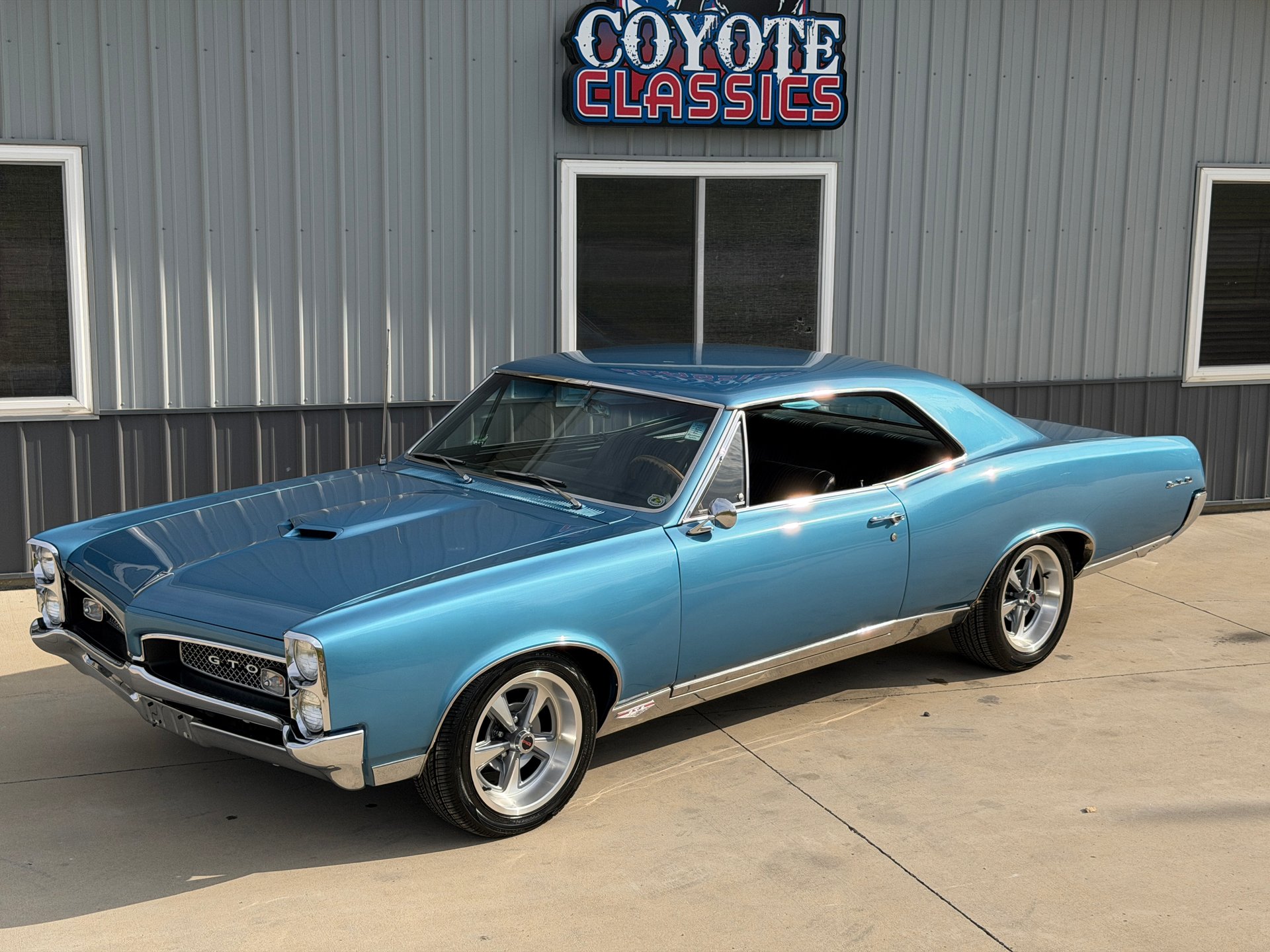
1965. The restyle that defined the early car: stacked quad headlamps, a sculpted body, the single hood scoop, Tri-Power still on top. For many buyers the prettiest GTO of all, and its one-year details — grille, tail panel, trim — are exactly what a clone builder most often gets subtly wrong.
1966. The GTO became its own model line, with its own series designation, Coke-bottle curves and the louvred tail lamps that identify a 1966 from behind. Sales peaked. Tri-Power was listed early in the year, then fell victim to a GM edict against multiple carburettors — late 1966 cars are four-barrel cars, and a claimed late-build Tri-Power car needs its paperwork read, not its seller believed.
1967. The last first-generation car and, in our listings, the most numerous. The 389 was bored out to 400 cubic inches, Tri-Power was gone, replaced by a single Quadrajet, and the range rationalised: an economy 400 with a two-barrel, the standard 400, the 400 HO, and at the top the Ram Air. Front disc brakes became available. The 1967 is the connoisseur's early car: the best-developed version of the first formula.
1968. All change: the second-generation A-body on a shorter 112-inch wheelbase for two-doors, a semi-fastback roofline, the Endura front bumper — a body-coloured, impact-absorbing nose that was a genuine innovation — and hideaway headlamps as a popular option. The GTO won Motor Trend's Car of the Year. Ram Air II arrived mid-year.
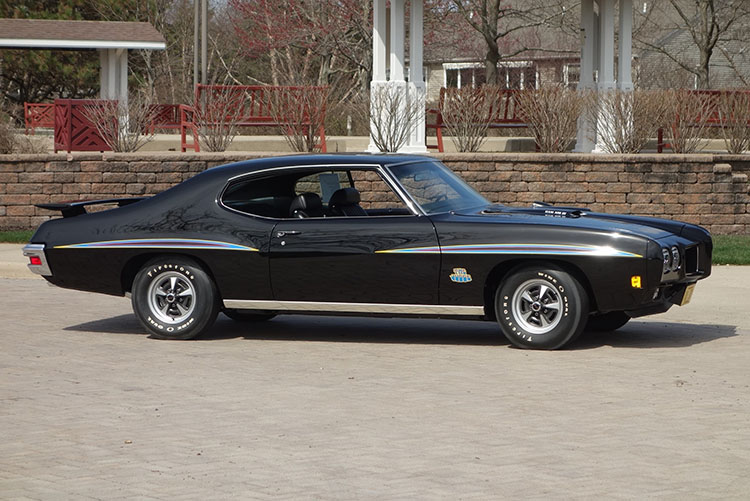
1969. The year of The Judge. Named after a catchphrase from the television comedy Rowan and Martin's Laugh-In, The Judge added stripes, a rear wing, a Ram Air engine as standard and, at launch, Carousel Red paint that photographs orange. Judge production in 1969 was 6,725 hardtops plus a few convertibles — and because a Judge is worth a multiple of a standard GTO, it is the most cloned specification in this guide. Our listings include a 1970 Judge Ram Air IV car in Starlight Black: among the most valuable GTOs of all, and among the most faked.
1970. The peak, by most measures: a restyled Endura nose, creased flanks, and the strongest engine range the GTO ever had — standard 400, Ram Air III, the rare Ram Air IV with round-port heads, and a new 455 offering torque in place of revs. The joint-biggest year in our listings, and the year where paperwork discipline matters most, because the money is biggest.
1971–1972. Emissions and compression cuts arrived together in 1971. The range simplified to the 400, the 455 and the 455 HO — now the flagship, with Ram Air IV gone — behind a distinctive one-year nose. The 455 HO is genuinely quick and undervalued. In 1972 the GTO was demoted to a LeMans option once more, and power, now quoted net, fell again. These are the value cars of the second generation: mechanically much the same underneath, priced on their lower image.
1973–1974. The 1973 Colonnade body was heavier, with fixed rear quarter windows and big bumpers; the GTO was a LeMans option with a 400 or 455, represented in our listings by one Golden Olive car in Florida. Buy one because you like it, cheaply. For 1974 the name moved to the Ventura compact with a 350 — a pleasant period compact, not an A-body muscle car, and never to be priced as one.

Engines and gearboxes
The 389 and the Tri-Power years, 1964–1966
The engine that started it is the Pontiac 389, a big, long-stroke V8: a cast-iron block with a deep skirt, canted valves in the heads, and a distributor at the rear of the bay under the windshield, awkward to reach and directly under any water leaking from the cowl seal. Do not judge a 389 by how quickly it starts on a warm day at a dealer. Judge it by its cold behaviour, its hot oil pressure, and the state of its crankcase.
The base engine carried a single four-barrel Carter AFB, rated at 325 hp gross. The famous option was Tri-Power: three Rochester two-barrel carburettors on one intake, with a progressive linkage that ran the centre carburettor alone at light throttle and brought in the outboard pair as the pedal went down, rated at 348 hp in 1964 and 360 hp in 1965–66. It works beautifully when set up correctly and is a liability when it is not: each carburettor has its own float, mixture and diaphragm, and all three must be in tune together — a rich centre and a lean end carburettor give a lumpy idle, a stumble on the transition, then clean running at full throttle, the exact presentation that tempts an owner to blame the ignition. The test is at the linkage: have a helper press the pedal slowly and watch all three throttles move in the right order. A binding linkage, or one bodged with a solid bar so all three open together, makes a car that drinks fuel and runs hot at part throttle. Rebuilding all three properly is a $1,200–2,000 job, and a setup missing its correct intake, air cleaner or linkage costs far more to reassemble than the discount it appears to carry. Read the casting numbers as a set: a Tri-Power intake on a block never dressed for it is the signature of a car assembled from parts.
The 389's weaknesses are those of any hard-worked cast-iron V8 of the period, plus two Pontiac-specific ones. The oiling system is marginal when the engine is revved hard on thin modern oil, and sustained high revs starve the furthest bearings first: a knock on a hot idle after a run — a rumble from low in the block that rises with revs — is a bearings car, and that is a full rebuild, realistically $4,000–7,000. Valve guides wear, and Pontiac's ball-stud rocker arrangement tolerates little wear before the valvetrain gets noisy: a tick that disappears with revs is often a tired lifter and cheap; a tick that follows revs is wear and is not. Blue smoke on start-up is usually valve seals; blue smoke under load is rings, and a compression test settles it — expect readings within about 10 percent of each other, and treat any cylinder 20 percent down as a conversation about money.
Cooling matters, too: the cast-iron engine sits in a crowded bay, and many cars have lost their fan shroud or clutch fan. A car hot in traffic but fine on the move is almost always a shroud, fan clutch or radiator-core problem, in that order of cheapness. A recored radiator is roughly $600–900.
The 400, Ram Air and the 455, 1967–1972
The 400 arrived in 1967 when the 389 was bored out to 4.12 inches, and it is the engine most GTO coupes in our listings carry: stronger and better developed than the 389, with improved heads, a better oiling path and the Rochester Quadrajet as standard. The standard 400 was rated at 335 hp gross, the 400 HO at 360 hp, and the Ram Air at the top. Take none of those figures literally: gross ratings were measured with no accessories and an open exhaust, and Pontiac was famously coy about its strongest engines, quoting Ram Air IV at 370 hp when the cars made more than that number implies at the wheels.
The Quadrajet is the carburettor you will actually live with on almost every 400 car: a spread-bore design, with small primaries for economy and two enormous secondaries that open under vacuum. A good carburettor, and an unforgiving one, with specific, testable failure modes. The well plugs in the base leak with age, letting fuel drain into the intake overnight — hard cold starting, flooding if you pump it, a rich idle. The secondary air valve sticks or has been tampered with: a stuck valve gives a flat spot, a valve with its spring removed gives a violent bog. Worn needle-and-seat shows as fuel dripping from the boosters at idle. None of it is expensive — a proper rebuild is roughly $400–700 — but a seller who says it just needs adjusting is describing a carburettor that has never been rebuilt in your ownership, and the rebuild is the price to budget.
Ram Air is where mythology and mechanics collide, so it needs stating plainly. It was not one engine: it was a family of packages built around functional cold-air induction — a sealed hood scoop feeding the carburettor — and progressively stronger internals. Ram Air I (1967) was essentially a 400 HO with a different cam, manifolds and the scoop. Ram Air II (1968) introduced round-port heads. Ram Air III (1969–70) used D-port heads and is the commonest Ram Air car. Ram Air IV (1969–70) is the famous one: round-port heads, an aluminium intake, a very aggressive cam — an engine that needs revs and is miserable below 3,000 rpm in traffic, exactly the character its buyers wanted. A car claiming Ram Air must show it in the engine, not on the hood: Ram Air IV heads carry round exhaust ports where a standard head carries D-shaped ports, visible with a torch and mirror from underneath — a five-minute check that can save five figures. A Judge with a standard 400 and a Ram Air air cleaner is a standard GTO wearing a costume.
The 455 arrived in 1970, a torque engine rather than a rev engine, rated at 360 hp gross in standard form; the 455 HO of 1971–72, with round-port heads and Ram Air IV-style internals, is the quicker car in practice. The 455 pulls from idle and is kinder to a manual gearbox, but its long stroke loads the bottom end harder, and an overheated or oil-starved 455 shows bearing wear earlier than a 400. Give any 455 a hot idle oil-pressure check: at least 15 psi fully hot, and a needle falling to near zero means bearings, whatever the seller says about a pessimistic gauge.
For all these engines the checks are the same: a cold start, a compression or leak-down test on any top-of-range car, oil that smells of fuel or looks milky, and the numbers — the unit number on the pad beside the timing cover, and the VIN's last digits on the block from 1968 onward. A numbers-matching car carries a substantial premium; photograph the numbers and check them against the PHS document before you negotiate.
Gearboxes and the rear axle
Most GTO coupes in our listings with a recorded transmission are manuals — 11 against 9 automatics, with one modern Tremec TKX five-speed swap among them — a split that is itself a clue about how these cars have lived: a manual car used as intended wears its synchromesh, clutch and rear axle first.
The standard manual was the Muncie four-speed, in M20 wide-ratio, M21 close-ratio and M22 heavy-duty forms. The M22 whines audibly in every gear and is the desirable one; the whine is normal, and a quiet M22 is a car with a different gearbox fitted. All Muncies wear synchromesh in the same order — second gear first, then third — and the test is simple: change up at moderate revs and feel for a graunch, then again at higher revs. A synchro tired at low revs is worn; one that crunches everywhere is finished. A Muncie rebuild is roughly $1,200–2,000. The clutch is the other consumable: a heavy pedal with a high bite is a worn clutch, and judder on take-off is a worn or oil-contaminated disc — or a rear main seal leaking onto it, which makes it a clutch-plus-seal job. Budget $800–1,400 fitted. The Hurst shifter is a pleasure when right and vague when its linkage bushings are worn, as after sixty years they will be; a rebuild kit is under $150 in parts.
The automatic is the Turbo Hydra-Matic TH400 three-speed, standard from 1967 and a superb, strong box. Firm shifts, prompt engagement of drive and reverse and no flare mean healthy; a long delay into reverse, a flare on the 2–3 shift, or brown, burnt-smelling fluid means a rebuild, roughly $1,800–3,000. Two modern swaps appear in our listings — a Tremec TKX five-speed and a 4L80E automatic — and both are honest upgrades giving overdrive the originals never had. Neither is original; price both as improvements to a driver, not collector value, and check installation quality: a good swap is invisible under the car, a bad one shows in a hacked tunnel and a speedometer that reads wrong.
At the back sit GM's 10-bolt axle on most cars and the stronger 12-bolt on high-performance applications, with a Safe-T-Track limited-slip as the option that matters — worth a premium, its absence no reason to walk away. Check the ratio on the PHS document and the tube stamping: ratios run from a relaxed 3.08 to a fierce 4.33, and the ratio changes the car's character completely. Listen for a whine rising with speed (pinion bearings) and a clunk on take-off (differential or splines); either is a rebuild of roughly $1,000–2,000.
Problem areas
Everything in this section comes from the cars themselves. In the small sample of GTO coupes whose sellers' photo sets we have examined in detail — seven cars — rust was noted on three, leaks on two and visible damage on two. A small sample, not a statistic, but it matches wider A-body experience: these cars rust in predictable places, and the difference between a good coupe and a money pit is almost never the engine. It is the metal the engine sits in, and the paper that proves the metal is a GTO at all. Work through these areas in order, because that is the order in which they end purchases.
Identity: clones, tributes and the PHS test
Start here, not with rust, because a rusty real GTO can be welded and a perfect clone cannot be un-cloned. The GTO shared its body and most of its parts with the Tempest and LeMans, and the aftermarket supplies every badge, hood, grille and stripe a clone needs. A tribute — the honest word for a LeMans dressed as a GTO — is a legitimate thing to own at a LeMans price; it becomes a fraud only when priced as a GTO. The market is full of grey-area cars: a real GTO with a wrong engine, a Judge tribute on a genuine GTO, a real Judge with its Ram Air engine long gone. Each is a different car at a different price, and only documentation tells you which one is in front of you.
Pontiac Historic Services — PHS — holds the factory billing records and will supply, for a fee, a car's billing history by its VIN: original engine, transmission, axle, colours, trim, options and selling dealer. That document is this marque's identity arbiter in a way no other muscle car enjoys quite so completely. For 1964–65 cars, option packages on the LeMans with no decisive GTO series code in the VIN, it is effectively the only proof there is; a 1964 coupe claimed as a GTO without PHS paperwork is a claim, not a car. From 1966 the VIN's series designation does real work — a car whose VIN decodes as a LeMans is a LeMans whatever is bolted to it — but the VIN alone does not prove a Judge, a Ram Air car, a Tri-Power car or a four-speed, because those were options within the series. Only the billing history settles options. For 1972–74, when the GTO was an option again, the engine code in the VIN helps, but PHS remains the clean answer.
Learn the physical cross-checks too, because paperwork and metal should agree. Check the VIN plate — on the driver's door hinge pillar on early cars, at the base of the windshield from 1968 — for original rivets and undisturbed paint. Check the cowl tag on the firewall: its paint code should match the colour under the carpets and in the trunk, not just outside, and its trim code should match the interior. Check the hidden partial VIN stamped on top of the rear frame rail, visible with a mirror and a wire brush. A car whose frame stamping, VIN plate and title all agree is one you can proceed with; a car where any two disagree is one you walk away from until a title search explains it — a mismatched identity is a legal problem wearing a muscle car costume, not a discount opportunity.
Then check the specification against the year: Ram Air pans on cars billed without Ram Air, Judge wings on standard cars (their mounting holes in a standard deck lid tell the story), Rally II wheels on early cars, cross-year grilles, and engines wearing the right dress on the wrong block — the casting date exposes those, since a correct engine casts a few weeks before the build date, never after it. No single detail condemns a car, but each wrong one chips the premium, and a car with five wrong details and no paperwork is being sold on a story.
Rust: the A-body map
The GTO's body is a separate steel shell bolted to a full perimeter frame, and both rust — the frame more dangerously, because frame rust is structural in a way a holed fender is not, and because a seller's photos almost never show it. The map below is shared with every A-body of the period — Chevelle, Cutlass, Skylark — because the water paths are a property of the platform, not the badge.
The frame. Inspect it on a lift, with a torch and a screwdriver; do not accept a driveway viewing on any car above project money. The rails rust from inside out under the body mounts, at the rear kick-up over the axle, and around the rear crossmember and spring seats. The classic failure is the rear section behind the axle, where salt and mud sit in the boxed rail; prod the bottom face along its full length and listen for the change from a ring to a crunch. Surface scale is treatable. Perforation at the kick-up, a mount or a spring seat is fabrication work — a welded-in section runs roughly $1,500–3,500 a side — and perforation in several places means a frame-off restoration, which reprices the whole car. Check the body-mount cushions too: collapsed rubber lets the body sit down on the frame, showing as door gaps that close at the top; a full mount set fitted is roughly $800–1,500. And read the underside honestly: factory finishes after sixty years are patchy and dirty, so a uniform coat of fresh black underseal over everything the week before a sale is a cover-up until proven otherwise.
Windshield and rear window channels. The most destructive rust on an A-body starts here. The glass sits in rubber seals over a steel channel; water collects under the seal at the bottom corners and the channel perforates. From there it runs inside the car: at the front onto the floors and toe boards, at the rear into the trunk and rear seat pan. Look for bubbling at the corners of the glass, lifted seal rubber and staining on the headliner. A channel repair means glass out, welding and paint — roughly $800–2,000 a window — and it is almost never the only rust on the car, because a car that has leaked at the glass for a decade has been wetting its floors for a decade.
Floor pans and trunk floor. Lift every carpet. The front footwells go first, fed by the windshield channel and a leaking heater box, then the rear footwells and the pan under the rear seat. Surface rust is a clean-and-seal job; holes are panel work, roughly $600–1,500 a side fitted, and floors never rot alone. In the trunk, lift the mat and spare wheel and check the well corners: water arrives from the rear window channel and failed trunk seals and sits invisibly in the lowest corners. A perforated trunk floor is a panel replacement at roughly $800–1,800 fitted and painted; staining alone is a weekend job.
Lower body: quarters, rockers, doors and fenders. The rear arches and lower quarters are the most visible A-body rust and the most commonly filled. Run a cloth-wrapped magnet along the lower quarters, rockers and fender bottoms behind the wheels; filler announces itself by the magnet letting go. Rockers trap mud and rot from inside — press hard along their full length. Door bottoms fill with water when the drain slots block: feel along each open door's bottom edge for bubbling. Fender heels are a standard repair panel, roughly $400–900 a side fitted and painted — but a car needing both heels, both quarters and both rockers carries a five-figure paint budget, because none of those repairs is finished until the car is painted to match.
Cowl, firewall and the small traps. The cowl vent collects leaves, holds water and rusts through into the ventilation system, which is why so many A-bodies drip on your feet in rain. The battery tray rots under the battery from acid, and the inner fender beneath goes with it — rock the battery and check the tray edges with a torch. The core support corrodes at its lower corners; a rotten one is a panel swap at roughly $600–1,200. On 1968 to 1972 cars, examine the Endura nose: a steel armature in flexible urethane, which cracks and separates with age and bad paint work. A damaged nose is a specialist repair at roughly $800–2,000, and many cars wear a lighter, cheaper fibreglass replica instead — tell them apart and price accordingly. Hideaway headlamp doors on 1968 to 1970 cars are vacuum-operated and fail in period fashion, one door up and one down: a few hundred dollars to fix, and a tell that the vacuum system has not been touched in years.
Suspension, steering, brakes and the cost of standing still
The A-body front suspension is a conventional double-wishbone layout — strong, simple and entirely rebuildable. What wears is everything with a rubber bush or a grease point: ball joints, control-arm bushings, tie-rod ends, idler arm and centre link. Rock each front wheel top to bottom and side to side, then drive and listen for knocks and wander. A full front-end rebuild is roughly $1,000–2,000 fitted — not a bad car, just one whose price should carry the job. The steering box wears at the centre of its travel, giving a dead patch straight ahead; a rebuilt box is roughly $400–700 exchanged. At the rear, tired control-arm bushings let the axle steer itself under power, felt as the tail wagging on a hard launch; a set fitted is roughly $500–900. A car sitting low at the back is usually on sagging springs — but check the frame spring seats, per the rust section, because the two look similar from the kerb and are priced very differently underneath.
Brakes divide the range: drums all round on early cars, front discs optional from 1967 and common by the end of the sixties. Drums stop adequately but fade on a long downhill. Discs wear the period way: calipers seize on standing cars, hoses perish internally and hold a brake on, master cylinders leak into the booster. The standing-still list is the real price of the cheap, long-stored examples: seized calipers, perished hoses, a tired master cylinder, varnish from ethanol fuel in an old tank, flat-spotted tyres, hardened rubber. A brake hydraulic refresh runs roughly $800–1,800 with labour; a fuel system clean runs $700–1,500. All of it belongs in the budget of any car that has sat for years — and a car in regular recent use is worth a premium over a prettier car that has been asleep, every time.
Interior, trim and electrics
The GTO cabin survives better than most, but the costs hide where they hide on every sixties GM car. Seat foam crumbles, so a presentable seat can sit like a hammock; sit in the driver's seat, because it goes first, and feel for the spring frame through the pad. A seat rebuild runs roughly $600–1,200 for the pair of buckets, and a full interior fitted professionally quickly becomes five figures if dash pad, headliner and carpets all go in together. Dash pads crack in the sun, worst on southern cars — several of our listings are Florida and Alabama cars, so look. Read the dash for originality: Rally gauges with a tachometer were an option, and a car wearing them without them on its billing history has been upgraded — fine for a driver, a deduction for a collector.
On Judge and Ram Air cars the small stuff is where a tribute gives itself away: the correct glovebox emblem, the Ram Air cable and its under-dash pull handle, the hood tachometer. A dead hood tach is usually a few hundred dollars; a missing Ram Air cable assembly is a hunt for used parts. Check every cable control, because heater and fresh-air cables seize and snap at the control head.
Electrics are period GM: robust wiring let down by earth points, fuse boxes and switches. Work everything — lights, horn, wipers, washers, blower, every gauge. A wandering fuel gauge is almost always the tank sender or its earth. The heater core leaks with age and announces itself as a sweet smell, a misting windshield and damp front carpets, which then feed the floor rust above: smell the cabin of every car you view, because a sweet smell is a bill. Air conditioning is usually present but dead; a full recommission runs roughly $1,000–2,500, so treat working air as a premium on a southern car.

How to inspect one
Allow two hours, not one: the first hour is the car and the second is the paper. Bring a torch, a cloth-wrapped magnet, a mirror on a stick and a phone for photographs of every number. If the car passes you, pay for a lift inspection before money changes hands — the frame check alone is worth the fee.
- Start with the paperwork, before the car. Ask for the PHS billing history. If the seller has it, read it first and inspect the car against it: engine, gearbox, axle, colours, options. If not, order it yourself from the VIN before travelling any distance — the cheapest inspection you will ever buy, and on a 1964–65 car, a Judge, or any Ram Air claim, it decides whether the trip is worth making. Match the VIN on the title to the plate on the car, and the plate to its rivets and paint.
- Read the cowl tag and the numbers. Decode the cowl tag: body style, paint and trim codes, build date. Check the paint code against the colour in the trunk and under the carpets. Photograph the engine pad stamping, the block casting number and date by the distributor, and the transmission and axle codes. A correct engine casts a few weeks before the car was built; a casting dated after the car is a replacement, and the price should say so.
- Cold start. Insist the engine is dead cold — a warmed-up car is a seller managing the viewing. A healthy Pontiac V8 fires quickly, may puff oil smoke that clears in seconds if the valve seals are tired, and settles evenly. Listen for a rumble low in the block (bearings) and a tick that follows the revs (valvetrain); watch oil pressure, strong cold and holding at hot idle later. Smell the dipstick oil for fuel and look for milkiness.
- Under the car, on a lift if at all possible. Torch along both frame rails and prod the rear kick-up, body mounts, spring seats and rear crossmember, as the rust section maps them. Perforation at a mount, kick-up or spring seat is structural and reprices or ends the purchase. Read the underseal: patchy and honest is factory; fresh and uniform over everything is a question. Check the brake and fuel lines, and the axle for its ratio stamping and pinion-seal leaks.
- The glass channels and the floors. Look at the bottom corners of the windshield and rear window for bubbling and lifted rubber. Inside, lift all four carpets and prod the pans; lift the trunk mat and spare wheel and check the well corners. Wet carpets in a dry-stored car mean leaking channels and floors next. Check door bottoms with a fingertip and drain slots with a torch.
- Body and gaps with the magnet. Work the magnet along the lower quarters, rockers, door bottoms and fender heels, and check panel gaps for accident history. Count the trim wrong for the year, per the identity section, and price each piece. On a 1968 to 1972 car, tap the Endura nose: urethane over steel feels different from fibreglass, and the difference is money.
- The Tri-Power or Quadrajet test. On a Tri-Power car, watch the linkage with a helper on the pedal: centre carburettor first, outboards progressive, nothing binding. On a Quadrajet car, start it from cold after sitting: hard starting and flooding point to leaking well plugs; note any bog as the secondaries open. On a Ram Air car, verify the sealed air cleaner is complete, find the Ram Air cable and pull handle in the cabin, and check the exhaust port shape from below — round ports for Ram Air II and IV, D-ports for Ram Air III.
- Suspension and steering. Rock each front wheel top to bottom and side to side; any clonk is a priced job from the problem-areas list, not a mystery. On the drive the car should track straight with at most a small dead patch at the steering centre, and should not wag its tail under power — if it does, the rear control-arm bushings are tired. Bounce each corner: one and a half bounces and settled is right.
- The test drive, fifteen minutes minimum. Use every gear. On a Muncie car, test second-gear synchromesh at low and high revs, feel the clutch bite point, and listen for the M22 whine if the car claims one — no whine, no M22. On a TH400 car, demand firm shifts, no flare on the 2–3 change and a prompt reverse. Accelerate hard once, safely: clean pull to 4,500 rpm, no flat spot, misfire or smoke. Brake hard from speed: straight, no pull, no judder, and no slowly sinking pedal at the next lights.
- Heat and electrics at the end of the drive. Let it idle hot for five minutes, watching temperature and oil pressure together — the pair is the engine's report card. Run the heater and blower on every speed, smell for the sweet heater-core smell, and work every electrical item, including hideaway headlamps if fitted, watching whether both doors rise together.
- Interior last, from the driver's seat. Sit in every seat and feel for collapsed foam. Read the dash against the billing history, find the Ram Air pull handle if the car claims Ram Air, test every cable control, and check the headliner corners for water staining. A sound, original interior is the hardest thing on the car to recreate, so weight it heavily.
- Decide on the numbers, not the day. Go home and add the priced jobs up honestly — rust first, then brakes and fuel system if the car has stood, then the front end, then the carburettor — against the PHS document and your photographs of the stampings. The car you want is the one whose total, price plus that list, still makes sense against a sorted car. If the paperwork does not settle what the car is, the answer is no at any price until it does.
Values
The GTO coupe market is really several markets wearing one badge. At the top sits the documented performance car: the Ram Air IV, the Judge with its billing history, the Tri-Power four-speed with matching numbers. In the middle sits the honest standard car — a real GTO, correctly identified, in driver condition. At the bottom sits everything the paperwork cannot support: the tribute, the clone, the wrong engine and the good story. The spread between top and bottom is wider than for almost any other American classic, and driven less by condition than by proof: two coupes identical in photographs can be several multiples apart because one has a billing history that says Judge and the other has a seller who says trust me.
Read the market block that follows this guide with that in mind: it is computed from our own listings and recorded sales, and it is a snapshot of asking behaviour, not a price list. Two cautions stand for this marque. Asking prices are optimistic as a class, and the gap between asking and achieved prices is widest exactly on the cars whose identity is least documented — a car priced as a Ram Air car without Ram Air paperwork is evidence only that the seller hopes you will not check. And our sample is weighted to 1965–70, with 1967 the most numerous year, so a single 1973 or 1974 listing should be weighed as one car, not a trend.
What drives value, in order: documentation first — a PHS-verified, matching-numbers car carries a premium no detailing can imitate, and a Judge or Ram Air car without paperwork is priced as the standard car underneath until the paper arrives. Specification second: manual gearboxes, Tri-Power, Ram Air and the 455 HO, Safe-T-Track, Rally gauges and factory colours, roughly in that order — each worth its full premium only if it is on the billing history, because an option added in 1995 is an accessory, not a specification. Condition third, and here the body and frame decide: a mechanically tired car with a sound, original shell beats a rebuilt engine in a patched body, because mechanical work is priced and finite and body work is neither.
The project-versus-driver gap is wide and honest: the route back from a rusty, long-stood project runs through the full standing-still list plus whatever the frame needs, and the total regularly exceeds the price difference. The cars to be most careful with sit in the middle — cosmetically fresh, mechanically unexamined, priced just below the good cars. Fresh paint over an unphotographed frame is the oldest transaction in the muscle car world. The standing value is the documented standard car in driver condition with honest paint, bought at a price reflecting its specification rather than its seller's ambitions. Negotiation reality is simple: a seller with paperwork negotiates on condition, and a proven car is worth close to a fair ask. A seller without paperwork negotiates on everything, and the discount should cover the possibility that the paper demotes the car. Never pay the premium first and order the proof afterwards.
Parts and ownership
The GTO coupe is one of the best-supported American classics you can own: it shares its platform with the Chevelle, Cutlass and Skylark and its mechanical parts with the whole Pontiac V8 family, so the production behind its parts catalogue runs into the millions. Between the reproduction industry — Ames Performance and Performance Years for Pontiac-specific parts, the big A-body catalogues for platform parts — and the used-parts trade, very little cannot be found. The honest division is between platform parts, cheap and everywhere, and GTO-specific parts, available but priced like low-production items.
Easy: service items, filters, plugs, points and ignition consumables; brake discs, drums, pads, shoes and hydraulics; suspension wear parts, ball joints, bushings and springs; Quadrajet and Carter rebuild kits; water pumps, radiators and hoses; exhaust systems in standard form; glass, window seals and weatherstripping; body repair panels for floors, quarters, rockers and fender heels; interior kits in standard colours and patterns. Order today, fit this weekend, at prices that will make a European-classic owner envious.
Harder and dearer: Tri-Power components — correct carburettors, intakes, linkage and air cleaners are hunted parts, and a complete setup assembled from pieces costs real money; Ram Air hardware, above all Ram Air IV heads and intakes, among the most valuable loose parts in the Pontiac world and faked, so buy on casting numbers or not at all; good original Endura noses; Judge wings and Judge-only trim; hood tachometers; and one-year trim, especially 1965 and 1971 grille and tail pieces. None of it is unobtainable; all of it rewards patience.
Running costs. A sorted GTO coupe is a realistic regular-use classic. Fuel consumption is what a big carburetted V8 promises: low-to-mid teens in mixed use, single figures if you use the performance, premium fuel for the high-compression engines. Servicing is within any competent classic workshop's ability, and much of it is honest home work. An agreed-value policy on a documented car should be set from the documentation, not the purchase price alone.
The budget line that catches new owners is the first year: catching up deferred maintenance on a running car honestly costs a few thousand dollars before you improve anything — fluids, hoses, belts, brake hydraulics, tyres if they are aged out (check the date codes; a GTO on ten-year-old tyres has not been driven, whatever the odometer says), and the carburettor rebuild the seller described as an adjustment. Recommissioning a stood car costs more, and the fuel system is the heart of it: modern ethanol fuel attacks old rubber and leaves varnish in tanks, so a stood car needs the tank dropped and cleaned or replaced, every rubber fuel line renewed and the carburettor rebuilt before it is driven further than the end of the street. Build that into the offer, not into your first month.
Ownership has one GTO-specific discipline: keep the paper with the car. The PHS billing history, invoices with the numbers recorded, photographs of the stampings — that file is part of the car's value and transfers with it. Start it on the day you buy.
Which one to buy
- The all-rounder: 1967 GTO coupe, standard 400, four-speed. The best-developed first-generation car, the most numerous year in our listings and therefore the deepest market to buy from, with the Quadrajet in place of Tri-Power complexity. If you want one early GTO to drive, this is it.
- The original: 1965 GTO coupe. The prettiest early car and the definitive stacked-lamp shape. Buy it on PHS paperwork — as an option-package year, documentation does the most work here — and prefer a four-barrel car you can use over a Tri-Power car you have to rebuild, unless that setup is complete and correct.
- The peak: 1970 GTO coupe, Ram Air III or 455. The strongest year, and the choice between the revving Ram Air III and the torquey 455 is a driving-style question, not a value question. A documented standard 400 car is the same experience for markedly less money.
- The collector car: The Judge, 1969 or 1970, Ram Air III or IV. The flagship, priced like one when it is right. Verify it ruthlessly — billing history, engine numbers, head castings, exhaust port shape — because a Judge is the most cloned specification in this guide and a wrong one is worth a fraction of a correct car.
- The value buy: 1971–1972 GTO coupe, 455 HO or 400. The same platform and most of the same driving experience at the soft end of the market, because the emissions-era image undersells honest, quick cars. The 1971 455 HO in particular is a genuinely fast car hiding in the value bracket.
- The driver's project: a pillared sports coupe, any early year. The stiffest, lightest early shell, the least fashionable body style and therefore the cheapest real GTO you can buy — the smart way into the early cars, if the frame is sound and the paper is right.
- The curiosity: 1973 Colonnade or 1974 Ventura. Buy either only because you like it for itself, at a price reflecting what it is; neither is a continuation of the A-body muscle car.
And the rule that overrides all of the above: buy the car the paperwork proves, with the soundest frame you can find, in the specification you can live with. Engines, carburettors and interiors can all be fixed at prices you can plan for. A clone bought at a real car's price, and a frame rotted through its kick-up, are the two mistakes no later spending can undo — and the paperwork mistake is the one a single inexpensive document would have prevented.