
Pontiac GTO Convertible buyer's guide
Pontiac GTO Convertible -- the model's own buyer's guide: variants, values and what to check.
Years listed: 1964-1971 · Series: GTO
Overview and history
The Pontiac GTO Convertible is the open version of the car that started the muscle-car era — and if you are standing in front of one, you are standing in front of two cars at once. Underneath is Pontiac's A-body Tempest/LeMans platform: a separate perimeter frame, coil springs at all four corners, and the big Pontiac V8 that GM's own rules said should never have been fitted to an intermediate. On top is a convertible body that gives the car its desirability and almost all of its expensive problems: a power folding top, a boxed frame unique to the open car, and a shell that has spent sixty years flexing, leaking and rusting in places a hardtop GTO does not have.
The short version of the GTO story is the part that matters to a buyer. For 1964, Pontiac — under John DeLorean, with engineer Russell Gee and advertising man Jim Wangers pushing — slipped around GM's ban on engines larger than 330 cubic inches in intermediate cars by offering the 389 V8 as an option package on the Tempest LeMans: the 389, a floor-shifted three-speed, dual exhausts, firmer suspension, redline tyres and the badges. Orders ran far past forecast, every other GM division copied the formula within a year, and by 1966 the GTO was a series in its own right. It stayed one through 1971, then reverted to a LeMans option for 1972 as insurance costs and emissions rules closed the era down.
The convertible was there from the first day to the last. In 1964 the open car accounted for roughly one GTO in five; by 1971, with convertible production collapsing industry-wide, Pontiac built only a few hundred. That arc defines today's market. The early cars are the ones you will actually find: in the pool behind this guide we track 24 GTO Convertibles for sale or recently sold, eight of them from 1967 alone, four each from 1966 and 1969, and just a single 1971. The late cars are genuinely scarce, and scarcity is what makes paperwork matter: a 1970 or 1971 convertible is valuable enough that clones are worth someone's money, and the only defence is the documentation trail described later in this guide.
These were never fragile exotics. They were mass-produced cars, used hard — drag-raced, driven through salt-belt winters, parked outside with the top leaking, and often parked for good in the 1980s when they were worth little. The Pontiac V8 is one of the toughest engines America built in the period, and the running gear is simple and almost entirely reproducible today. What kills a GTO Convertible is rarely the engine. It is the shell — windshield frame, top well, floors, boxed frame rails — and false identity: a LeMans convertible wearing GTO badges is worth LeMans money however good it looks, and telling the two apart is done from the VIN, the trim tag and the Pontiac Historical Services (PHS) record, not from badges or a seller's confidence. This guide returns to that test repeatedly because on this model it prices the car.
Buy the car in the right order, then: identity first, shell second, top third, engine last — the opposite of how most buyers approach a shiny red convertible on a sunny lot, and the whole point of what follows.

The models
Every GTO Convertible sits on the same architecture — GM's A-body on a 112-inch wheelbase, a separate steel frame, a Pontiac V8 driving the rear wheels — but the range falls into three generations that differ in body, in engines and in how you prove what the car is. One distinction cuts across all of them: before 1966 the GTO was an option, from 1966 to 1971 a series, and for 1972 an option again, and the VIN tells a different story in each period. Learn which proof applies to the year in front of you before discussing money.
| Model | Years | Engine | Output | Built | Character |
|---|---|---|---|---|---|
| GTO Convertible (Tempest LeMans option) | 1964 | 389 V8, 4-barrel or Tri-Power | 325 / 348 hp | 6,644 | The original; option package, hardest to prove |
| GTO Convertible (Tempest LeMans option) | 1965 | 389 V8, 4-barrel or Tri-Power | 335 / 360 hp | 11,311 | The most-built early convertible; stacked lamps arrive |
| GTO Convertible (own series) | 1966 | 389 V8, 4-barrel or Tri-Power | 335 / 360 hp | 12,798 | Peak production; last year of Tri-Power |
| GTO Convertible | 1967 | 400 V8, 2-barrel, 4-barrel, HO or Ram Air | 255–360 hp | 9,517 | New 400 engine, Quadrajet replaces Tri-Power, TH400 arrives |
| GTO Convertible | 1968 | 400 V8, 2-barrel, 4-barrel, HO or Ram Air II | 265–366 hp | 9,980 | New rounded body, hidden headlamps optional, Endura nose |
| GTO Convertible | 1969 | 400 V8, Ram Air III/IV | 350–370 hp | 7,436 | The Judge's year — only 108 Judge convertibles |
| GTO Convertible | 1970 | 400 or 455 V8, Ram Air III/IV, 455 HO | 350–370 hp | 3,615 | Last of the high-compression cars; 455 torque arrives |
| GTO Convertible | 1971 | 400 or 455 V8, 455 HO | 300–335 hp (gross) | 508 | The rarest regular year; low compression, Endura nose standard |
| GTO (LeMans option) Convertible | 1972 | 400 or 455 V8 | net ratings | very few | GTO is an option again; proof is paperwork-only — PHS or walk away |
(Outputs are period SAE gross figures except where noted; 1972 figures are net. Production figures are convertibles only, from the commonly published Pontiac records.)
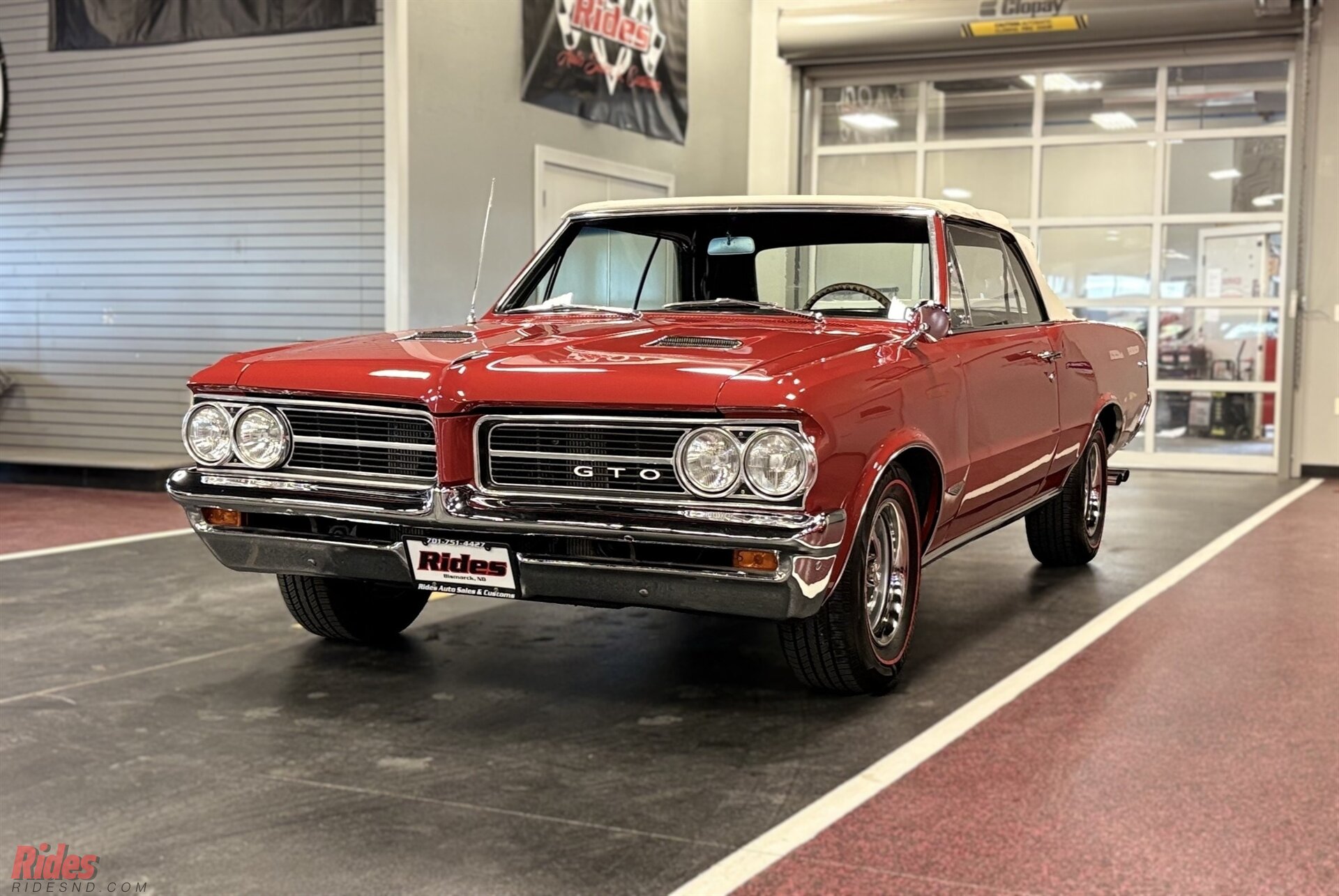
1964–65: the option years. The first GTOs are Tempest LeMans cars with the GTO option, and the VIN does not separate a GTO from any other V8 LeMans — for 1964 it begins 824 (624 for a six, which rules a car out); for 1965 the LeMans prefix is 237. Identity on these years lives and dies on paperwork: the PHS record is not a nice extra, it is the car. The 1964 is the rawest of the range — a Carter AFB four-barrel or the famous Tri-Power (three Rochester 2G two-barrels, 348 hp), a plainer interior with an engine-turned dash, and the squarer original Tempest body. The 1965 restyle brought stacked headlamps, a more finished interior and 10 extra horsepower in both tunes, and it is the better driver. Both ride like early-1960s cars: heavy manual steering, drum brakes with no disc option, and — on many — the two-speed Super Turbine 300 automatic, the weakest gearbox ever bolted to a GTO. A documented 1964 convertible is a historically important car; an undocumented one is a LeMans with a story, priced as one until PHS says otherwise.
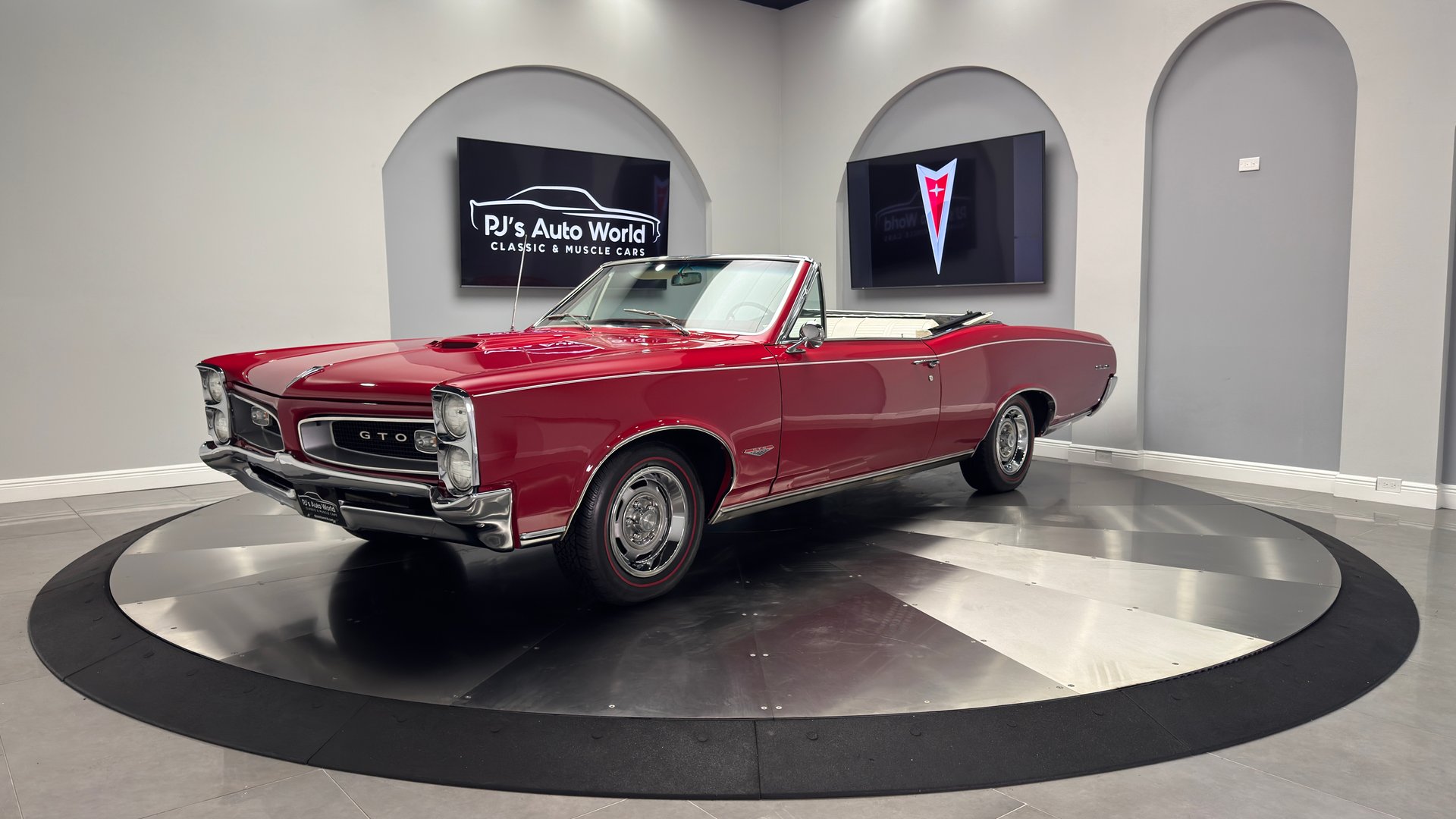
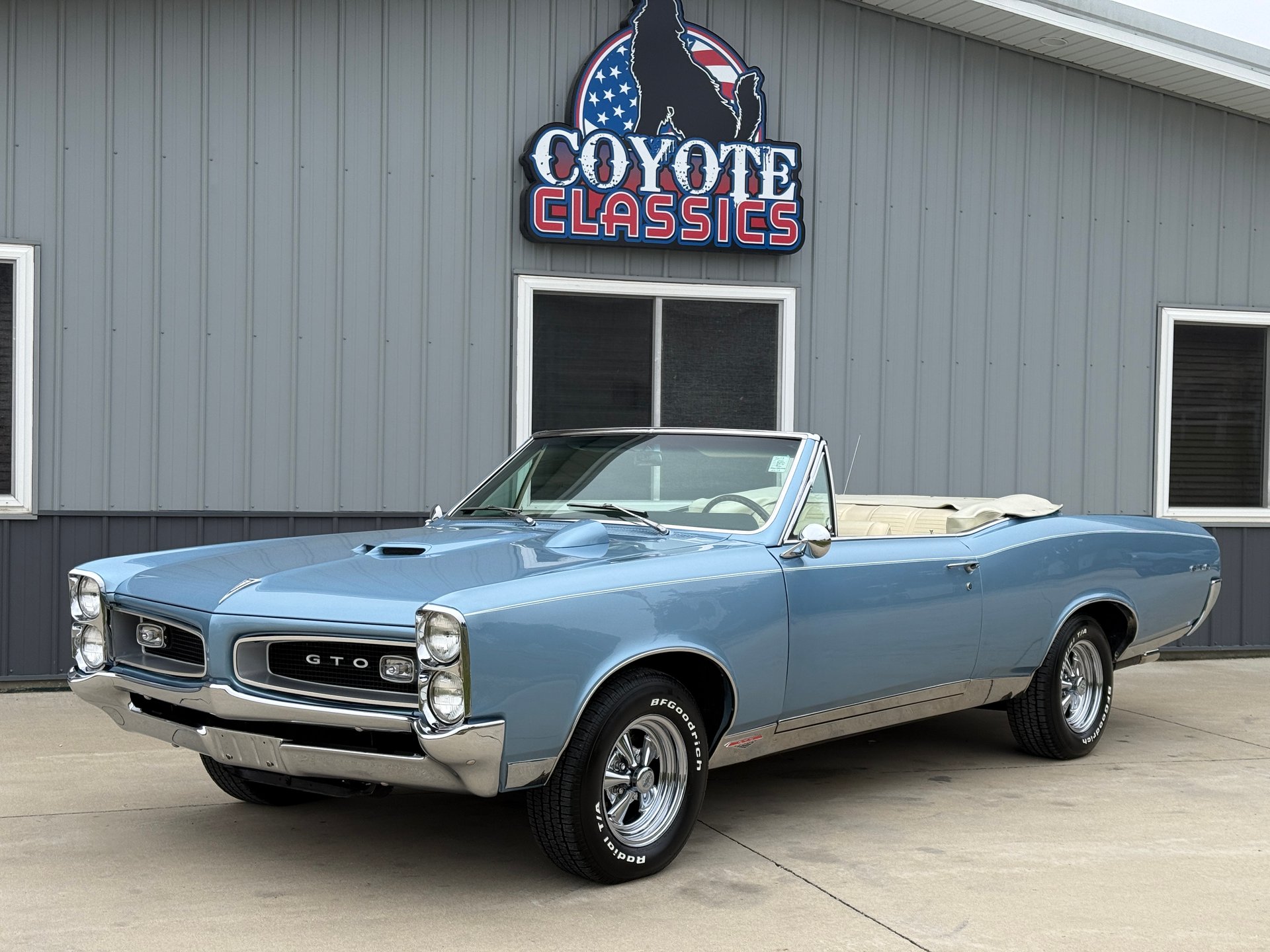
1966–67: the series years and the sweet spot. For 1966 the GTO became its own series — VIN prefix 242 — and production peaked: the 1966 convertible, at 12,798 built, is the most numerous GTO Convertible of all, and the Tri-Power was in its final year (GM's ban on multiple carburettors took effect for 1967). For 1967 Pontiac bored the 389 out to the 400, replaced the Tri-Power with a single Quadrajet, offered the 400 in 2-barrel (255 hp), 4-barrel (335 hp), HO (360 hp) and Ram Air (360 hp) forms, and — just as important today — replaced the two-speed automatic with the TH400 and made front disc brakes available. The 1967 is also the most common year in our pool, eight of 24 cars, so choice and comparables are deepest here.
1968–69: the rounded body. The 1968 restyle gave the GTO its most distinctive shape and the famous Endura front bumper — a body-coloured, impact-absorbing nose that was a genuine innovation and is a genuine restoration cost today, because cracked, distorted Endura is expensive to put right. Hidden headlamps were a popular option; their vacuum-operated doors are a known failure point. Engines centred on the 400 at 350 hp, with the round-port Ram Air II (366 hp) the connoisseur's 1968 engine. For 1969 the Ram Air III (366 hp) and Ram Air IV (370 hp) topped the range and The Judge arrived — but note the trap: of 1969 convertibles, only 108 were Judges. A Carousel Red 1969 convertible with Judge stripes is, statistically, a dressed-up standard GTO, priced that way unless PHS proves Judge status. The same applies harder to 1970: 168 Judge convertibles against 3,615 standard cars.
1970–72: the last cars. The 1970 model added the 455 V8 — 360 hp and, more to the point, 500 lb-ft of torque — alongside the 400 and Ram Air engines, and it is the last year of high compression. For 1971 compression dropped to suit low-lead fuel, ratings began the move to net figures, and convertible production collapsed to 508 cars. That rarity cuts both ways: a 1971 is the hardest car here to find and the easiest to fake, because any 1971 LeMans Sport convertible shares the shell. For 1972 the GTO reverted to a LeMans option, the convertible had effectively left the catalogue, and the few open cars claimed as 1972 GTOs need factory paperwork before any other conversation. Our pool contains no 1972 car at all.
Clones, tributes and the proof hierarchy. One of the 24 cars in our pool is listed openly as a GTO clone — a LeMans convertible built up to GTO specification — and that honesty is the model to judge everyone else by: a well-built clone drives exactly like a GTO (it is the same car underneath) and is a good buy at clone money. The problem is only ever price and paperwork. Work the hierarchy in order. First, the VIN: a 242 prefix for 1966–71 proves a GTO series car; 1964–65 and 1972 cars cannot be proved from the VIN alone. Second, the PHS packet: PHS Historic Services will supply the factory invoice and build information for a VIN for a modest fee — on an option-year car this is the difference between a GTO and a guess, and a seller who will not wait for you to order one has told you something. Third, the trim tag on the firewall: body style (67 for convertible), build date, paint and trim codes, all of which should agree with the car in front of you. Fourth, the engine and driveline stamps, covered next: matching numbers matter most on Ram Air, HO, Judge and late-year cars. A car that passes all four is a GTO. A car that fails the first two is a LeMans, however badged — price it as one, or walk away.
Engines and gearboxes
One block, four displacements: the Pontiac V8
Every GTO Convertible carries a version of the same engine, and that one fact organises this whole section. Pontiac's V8 was built around a single block architecture with the same external dimensions whether it displaced 326 or 455 cubic inches. The GTO used the big versions: the 389 (1964–66, 4.0625-inch bore × 3.75-inch stroke), the 400 (1967–72, the 389 bored to 4.12 inches), the 428 (never factory-fitted to a GTO, but a common period swap), and the 455 (1970–72, stroke lengthened to 4.21 inches). There is no small-block and big-block Pontiac in the Chevrolet sense — a 400 and a 455 are externally near-identical, which is why displacement claims are settled by codes and casting numbers, never by looking.
The engine's character is torque. Pontiac tuned for low- and mid-range pull rather than revs: the standard 400 peaks around 3,000–3,600 rpm, the 455 makes a genuine 500 lb-ft, and a healthy GTO of any year should pull hard from 1,500 rpm in a high gear without complaint. Redlines are modest — standard engines are done by about 5,200 rpm, the Ram Air IV pulls to near 5,800 — and an engine that needs revs to perform, or feels flat below 3,000 rpm, is usually reporting a worn cam, a tired carburettor or retarded timing, not its specification.
Identity lives in three places, and a serious buyer checks all three. The engine code is stamped on a pad at the front of the block, beside the water pump: two letters (later letter-and-number combinations) encoding displacement, transmission and specification — a 1967 standard 400 automatic is typically a YS code, the manual equivalent WT, Ram Air cars carry their own codes again. Carry the year-specific code chart for the car you are viewing. The casting number at the back of the block, by the distributor, and its casting date confirm the block was cast shortly before the car's build date — a casting dated after the car was built is a replacement, full stop. The partial VIN stamp, low on the front of the block on later cars (stamping was inconsistent in the mid-1960s, more reliable from 1968), ties engine to chassis. On a Ram Air, HO or Judge car these stamps are worth as much as any mechanical test in this guide: a correct-code, date-correct engine is the premium; a wrong-code engine in a perfect car is a discount, negotiated before you fall for the paint.
Mechanically, the Pontiac V8 is famously durable — the bottom end is over-built, and 150,000 miles on an unrebuilt engine that has had oil changes is entirely plausible. What goes wrong is specific. The rear main seal is a rope seal, and it weeps: a few drips are normal, a puddle is not, and the modern fix is an improved seal fitted with the engine out or the crank dropped — budget $1,200–2,500. The timing chain runs on a nylon-toothed cam gear; the nylon embrittles, sheds teeth into the oil pan and lets the chain jump — any engine on its original set is on borrowed time, and a documented steel timing set is a genuine selling point (parts around $100–200; the front-cover job $600–1,200 fitted). The valley pan and intake gaskets weep with age, and the coolant crossover at the front of the intake corrodes where it meets the timing cover — look for white and green crust there. Exhaust manifold bolts seize and snap in the heads; listen for the ticking of a manifold leak on a cold start, loudest in the first minute. And oil pressure: a healthy Pontiac shows 40–60 psi at cruise when hot; one that drops below about 15–20 psi at a hot idle is reporting bearing and pump wear, not a faulty sender.
Feeding it: Carter AFB, Tri-Power and the Quadrajet
Three induction systems cover the range, and each has its own failure signature.
The single four-barrel (1964–66: Carter AFB; 1967 on: Rochester Quadrajet). The Carter AFB on the early 389s is simple and robust; its age faults are worn throttle shafts (an idle that will not settle — check by wiggling the shaft) and a tired accelerator pump. The Quadrajet that replaced it from 1967 is the better carburettor and the more misunderstood one: a spread-bore with small primaries for economy and enormous vacuum-operated secondaries for power. When right, a Quadrajet GTO is crisp, economical on a cruise and violent when the secondaries open. Its faults are specific: the fuel well plugs in the float bowl leak internally with age, draining the bowl overnight — the classic symptom is ten seconds of cranking on a cold morning but instant warm starts — and the fix is sealing the wells during a rebuild ($400–800 by a Quadrajet specialist, the only kind to use); the air-valve adjustment drifts or is "improved" by amateurs, giving the famous bog — a half-second of nothing when you floor it, then a surge — an adjustment fault, cured by setting air-valve spring tension and choke pull-off correctly; and the float (phenolic floats absorb fuel and sink; brass floats split) causes flooding and a rich idle. A car smelling of fuel at a hot idle usually needs a float or needle-and-seat, not a rebuild. Never accept "they all bog, it's a Quadrajet" — they do not, and the test drive is where you prove it.
Tri-Power (1964–66). The option everyone wants: three Rochester 2G two-barrels on a cast-iron intake, the centre carburettor doing all the work at cruise and the outer pair — no idle circuits, purely secondary — opening progressively (mechanical linkage kits are a common, acceptable period modification). Rated 348 hp in 1964 and 360 hp in 1965–66, it is worth a real premium when original to the car, which is why it is faked: the setup bolts onto any 389 or 400, reproductions exist, and only the PHS record (or, on a 1966, the engine code) proves a car was born with it. Running faults are linkage faults — outer carburettors opening late, early or not at all, felt as a step or flat spot at about two-thirds throttle — plus Rochester age issues multiplied by three. Budget $900–1,800 for a specialist rebuild and set-up; a Tri-Power car that pulls cleanly through the transition is one someone has already spent that money on.
Ram Air and the round-port cars. From 1967 Pontiac offered Ram Air packages — a functional hood scoop, a sealed air pan, and progressively more serious engines, culminating in the Ram Air II (1968), III (1969–70) and IV (1969–70). The IV is the engine collectors chase: round-exhaust-port heads (casting 614 in 1970, 722 in 1969), a high-lift cam, 1.65:1 rockers and, on many cars, an aluminium intake. It is also the most misrepresented, because round-port heads on a standard block look the part. The checks are the head casting numbers, the engine code and the PHS record; a "Ram Air IV" without all three agreeing is a story, not a car. The 455 HO of 1971–72 is the other round-port engine and the pick of the late cars.
Emissions-era engines (1971–72). Compression fell to around 8.2–8.4:1, cam timing softened, and from 1972 ratings were quoted net — as installed, with accessories and exhaust — which is why the numbers look worse than the cars feel. A 1971 400 quoted at 300 hp gross is roughly a 255 hp net engine; it is still a strong road engine, runs happily on modern unleaded premium, and responds well to the ignition timing the factory took away. Do not let a seller charge 1970 money for a 1971 engine, or net figures talk you out of a good 1971 car. One caution applies to all years: these engines were built for leaded fuel, but Pontiac heads survive unleaded use in classic mileage patterns well; a rebuilt engine should still have hardened exhaust seats fitted, and a seller claiming a rebuild should be able to say whether they were done.
Gearboxes: three-speed, Muncie four-speeds and two automatics
The base gearbox is a three-speed manual with a Hurst floor shifter, fully synchronised from 1966 in the heavy-duty Dearborn-built unit. It is strong, unglamorous and worth the least. Judge it on second-gear synchromesh and on whether it jumps out of third on the overrun — a worn unit pops out under engine braking, tested deliberately on the drive.
The gearbox most buyers want is the Muncie four-speed, in three forms. The M20 (wide ratio, 2.52:1 first) is the standard box and the right one for a street car. The M21 (close ratio, 2.20:1 first) suits deeper rear gears and revvier engines. The M22 "Rock Crusher" (from 1966, specified with Ram Air combinations) uses straighter-cut gears and whines audibly in the lower gears — that whine is correct, not wear — and is the most faked of the three, because an M20 and an M22 look identical outside; the proof is in the shaft and cluster codes and the PHS record. All Muncies were Hurst-shifted, and the linkage is the first suspect in any vague change: worn bushings give a good box a bad name, and a linkage kit is $100–250 in parts. A box that crunches into second cold and improves warm has tired synchromesh; one that crunches hot and cold, or jumps out of second on the overrun, is a rebuild — $1,500–2,800, plus clutch while you are there ($250–450 in parts, $800–1,400 fitted). Check the speedometer too: fifty years of axle-ratio changes mean many GTO speedometers lie.
The automatics split by year, and the split matters. For 1964–66 it is the Super Turbine 300, a two-speed with a switch-pitch converter: reliable, but two ratios cannot keep a 389 in its torque band, and it is the least desirable gearbox in the range — price an early automatic accordingly. From 1967 it is the Turbo Hydra-Matic 400 (TH400), one of the strongest automatics ever built, with no inherent weaknesses at GTO power levels. A healthy TH400 changes firmly, kicks down without a pause, and engages drive or reverse in about a second without a thump. Delayed engagement when cold points to hardened seals (a soft-parts rebuild, $1,200–2,200 fitted, is the cure); flaring on the 2–3 change under power is clutch wear; a whine in all gears including neutral is the front pump or converter. The vacuum modulator governs part-throttle change quality, and a ruptured modulator diaphragm gives harsh changes plus the giveaway: fluid drawn up the vacuum hose into the intake, seen as white tailpipe smoke and a falling fluid level with no leak underneath. That is a $30 part routinely misdiagnosed as engine wear, and the first check on any TH400 car that smokes faintly and uses fluid.
At the back, the standard axle is GM's 10-bolt (8.2-inch ring gear early, 8.5-inch later), with ratios from 2.56:1 to 3.90:1 and deeper in Ram Air cars, and Safe-T-Track limited-slip as the desirable option. Faults are bearing whine that changes with load, a clunk on take-up (worn spider gears or limited-slip), and pinion seals flinging oil over the underside. Note the ratio on the test drive: a 3.90 car turns roughly 3,200 rpm at 65 mph and feels frantic on a freeway; a 3.23 or 3.36 car is the one you will actually drive anywhere.
Problem areas
Everything mechanical on a GTO Convertible can be fixed with money you can estimate in advance. What cannot be estimated so neatly — and what turns a bargain into a write-off — is the convertible shell and its frame, and that is where this section spends most of its length. Our own evidence base is modest and should be read as such: we have photo-checked 18 of the 24 cars in the pool behind this guide. In those 18, visible damage was noted on six cars, while rust was explicitly noted on only one — a figure that says more about sellers' photography than about the cars, because GTO Convertibles rust where listing photographs never show: inside the top well, under the carpets, inside the windshield frame and inside the boxed frame rails. Read the low rust count as "unproven," not as "clean."
Rust and structure: the convertible map
Rust on a GTO Convertible follows the water, and a convertible makes its own weather. The top leaks at the header, the rear curtain and the quarter windows even in good order; the water runs into the top well, the rear seat area and the floors; and the shell — lacking the roof that braces a hardtop — flexes enough to crack seam sealer and open new paths. Work the map in this order, because it is also the order of cost.
Windshield frame and header. The most convertible-specific structural check on the car, and the one most buyers skip because it requires looking up. The windshield frame — the header rail above the glass and the A-pillars carrying it — is both a structural member and the surface the top's front rail seals and latches against. It rusts from inside: water sits in the header, the pillars fill from the cowl, and by the time blistering shows outside a pillar the section is thin. Prod the header corners and pillar bases with a blunt screwdriver (with permission), check for filler with the cloth-wrapped magnet, and confirm both top latches pull the rail down evenly — a spread or rotted frame lets one latch do all the work and the top never seals. Repair is fabrication: rebuilding a header corner or pillar base is skilled work at $1,500–4,000 a side, and it is why a convertible with a crunchy windshield frame is a project whatever the rest looks like. Check the cowl sides and vent boxes behind the kick panels while you are there: they fill with leaves, hold water, and rot through into the footwells.
Floors, braces and the top well. Lift every carpet. A-body floor pans rust from the inside out under sound-deadening, fed by top leaks, cowl leaks and a leaking heater core, and the convertible's floor braces — the pressed channels under the pans that add the stiffness the roof would have provided — rust with them and matter more. Surface scale is a clean-and-treat job; perforation at a brace or body-mount point is structural welding. Floor sections are reproduced and a pan fitted and painted runs roughly $800–1,800 a side, but floors rarely rot alone: floor rust is a marker for the whole water history of the shell. The top well — the lined compartment behind the rear seat that the folded top sits in — is the convertible's sump. Its drains clog, the well holds water against the rear seat pan and the front of the trunk floor, and the liner hides all of it. Peel the liner back at the corners on every viewing. A rusted well and seat pan is a fabrication job ($1,000–2,500) that no listing photograph will ever show you.
Trunk floor and rear quarters. The trunk floor rusts from above (water past the trunk seal and through the well) and the spare-wheel area holds it. Rear quarters rust behind the rear wheels where the skins trap mud, along the lower edge ahead of the wheel, and around the arch lip. Convertible quarters cost more to put right than hardtop quarters because the top mechanism, the well and the quarter-window regulators all live in the same space and all have to come out. Lower patches are available; a full quarter with paint is a $3,000–6,000-a-side conversation. Check the convertible's equivalent of a rear window channel — the tack strip and flange the top's rear curtain attaches to, at the back of the well: it rusts under the fabric, it is what a new top is stapled to, and a fitter who finds it rotten will stop and hand you a welding bill before the new top goes on.
Frame: the boxed convertible rails. A-body convertibles do not use the hardtop's open-channel frame. The convertible frame is boxed — fully enclosed side rails — to recover the stiffness the missing roof takes away, and that creates the trap: a boxed rail rusts from the inside, invisibly, while the outside looks sound. The known places are the rails under the doors, the rear kick-up over the axle, the torque-box areas at the front mounts, and the rear crossmember. The tests are physical: a hammer-tap survey along both rails, listening for the change from a ring to a dull thud; a blunt prod at the rail bottoms and mount points; and a look at the mounts themselves — perished, crushed rubber lets the body sit down on the frame, misaligns every panel gap, and is often the real cause of doors that will not shut cleanly (a mount set is $150–300 in parts; fitting is a body-lift job at $800–1,500, and it is the moment hidden rail rust announces itself). Repair sections and even complete reproduction frames exist, but a car needing rail replacement is a body-off restoration, priced as a parts car with a good title unless the paperwork is extraordinary. Door gaps wide at the top and pinched at the bottom, or doors needing a lift to latch, mean the shell or frame has sagged in the middle — a structural verdict, not an adjustment.
The folding top: frame, hydraulics and fabric
The top is the second car you are buying, and it has its own inspection, its own failure modes and its own budget. Every GTO Convertible has a power top as standard equipment in most years and near-universal fitment in the rest: an electric motor driving a hydraulic pump behind the rear seat, two hydraulic lift cylinders, and a linkage frame that folds the fabric into the well.
The frame and linkage. The top frame is a linkage of bows and side rails that must fold symmetrically. Bent side rails — from forcing a stiff top, or a tap in a rear quarter — make the top sit crooked, pinch the fabric and refuse to seal on one side. Operate the top through its full cycle at least twice on any viewing (a seller who says "we never put it down" is asking you to buy the mechanism untested). It should move evenly, without one side leading, and land squarely on the header so both latches engage with equal effort. Straightening and re-bushing a tired frame runs $300–1,000; a frame needing replacement is a used-parts hunt, because complete new frames are not a catalogue item.
Hydraulics. The pump and cylinders run on automatic transmission fluid in most applications (some early systems used brake fluid — check the reservoir before topping up, because mixing them ruins seals). Failures are leaking cylinder seals (fluid in the well, a top that creeps down or rises reluctantly), a tired pump motor (slow operation, a laboured whine), and hoses weeping at the fittings. Cylinders run $300–600 a pair in parts, a pump $250–500, hoses $100–200 — call it $800–1,800 fitted for a full refresh — with access through the rear seat and well, which is also your chance to inspect the well floor. A top that works briskly with a dry well has been used and maintained; one that has not moved in a decade will need everything, in sequence, as each seal meets pressure again.
Fabric, rear window and seals. Top fabric is vinyl on almost all of these cars (canvas was not a factory offering in this period — a canvas top is a later replacement choice, and a good one, but not originality). Vinyl lasts ten to fifteen years in use, less in sun; the failure sequence is shrinkage (the top pulls short of the header), cracking at the fold points above the quarters, and stitching failure around the rear window. The rear window is plastic in most original tops and clouds, yellows and cracks — a cloudy window is a top replacement, not a cleaning job, because the window is sewn in. A complete new top fitted — fabric, pads, straps, well liner and window — runs $1,800–3,500, plus whatever the tack strip and well need underneath. Weatherstrips are reproduced as a set ($300–600); budget for them with the top, not after.
Chassis, steering, brakes and suspension
The A-body chassis is conventional to a fault — unequal-length control arms and coil springs in front, a live axle on coil springs with four locating links behind, recirculating-ball steering — and its faults are wear faults, priced in hundreds rather than thousands, with two exceptions that matter.
Front suspension and steering. Ball joints, control-arm bushings, tie-rod ends and the idler arm all wear; the symptoms are wandering at speed, a knock over bumps, uneven tyre wear and a wheel that does not centre. Rock each front wheel at 12-and-6 for ball-joint and bearing play and at 3-and-9 for steering play, then have a helper rock the steering while you watch each joint for lost motion. A full front-end rebuild is $600–1,200 in parts and $1,500–2,800 fitted and aligned — routine money, and a car that has had it drives like a different vehicle. The steering box wears at the centre of its travel; a rebuilt box is $300–500. Power steering (fitted to most convertibles) adds pump and hose leaks; manual cars are heavy at parking speeds — try one before you romanticise it.
Brakes: the drum-brake warning. Here is the period trap. Front discs were not available on the 1964–65 GTO and were optional from 1967; many cars of every year left the factory with four-wheel drums. A drum-braked GTO is a 3,800-pound, 360 hp car with brakes that fade on a long downhill and pull if the drums are oval — period-correct, and genuinely inadequate in modern traffic. Judge what is fitted: discs show through the wheel spokes, and many cars have been converted. A good conversion with a dual-circuit master cylinder is worth paying for; a single-circuit car deserves that conversion as your first job ($400–900 fitted), because one failed hose on a single-circuit system is no brakes at all. On any car the age list is the same — perished flex hoses, seized cylinders or calipers, a master cylinder weeping into the booster — and a full hydraulic refresh at $800–1,800 is not negotiable on a car that has sat.
Rear suspension and axle. The four-link rear locates the axle with stamped arms whose bushings perish; worn bushings let the axle steer the car under power — a car that changes line when you lift off mid-corner, or crabs under acceleration. A bushing set is $150–350 in parts and a day's labour. Coil springs sag evenly (a level car an inch low is springs; one corner down is a broken spring or mount). The axle is covered in the engines section: whine, clunk and pinion-seal leaks are its vocabulary, and a car that clunks on every take-up is adding up driveline wear you price as a group.
Interior, electrics and trim
Interior. The convertible interior suffers what the hardtop's does not: sun and water. The vinyl (Morrokide) upholstery splits at the stitching on the seat tops and rear seat back — the surfaces facing the sky with the top down — and the padding underneath crumbles. Buckets with a console are the desirable specification; a bench-seat convertible is rarer and worth less. Seat frames crack at the hinge and the tracks seize. Reproduction covers and foam are good ($600–1,200 a pair in parts, $1,200–2,500 fitted for buckets and rear seat), but a full interior — door panels, convertible-specific quarter trim, carpet, dash pad — is $3,500–7,000 fitted, and the rear quarter trim is the hardest part to source. Dash inserts differ by year — the 1964's engine-turned panel, later wood treatments — and are identity details a clone often gets wrong, making the interior a quiet identity check as well as a cost centre.
Electrics. Fifty-year-old GM electrics fail at grounds, bulkhead connectors and switches, in that order — dim lights, a slow starter when hot and wandering gauges are ground faults until proven otherwise, and a $20 ground strap has cured more "electrical problems" than any component. The convertible adds the power-top circuit (a top that works in only one direction is usually the switch or a ground, not the pump) and, where fitted, power windows at $200–450 per motor and regulator. The 1968–69 hidden headlamps are vacuum, not electric: one door up, one down, or both drooping at idle means perished hoses and actuators ($150–400 in parts), not wiring. Tachometers, Rally gauges and clocks fail individually and are specialist-repairable; price a dead cluster as a $400–900 refurbishment. Air conditioning is desirable top-up in summer: the GM A6 system is robust, a recommission runs $800–2,000, and a system left open to the air for years (missing caps, cut hoses) doubles that.
Chrome, stainless and the Endura nose. Bumpers re-chrome at $600–1,200 each; pot-metal trim pits from within and re-plates poorly, so good used or reproduction pieces are often the better spend. The 1968–70 Endura nose is a steel frame skinned in dense urethane foam, and it cracks, sags and distorts with age and sun. Restoring one properly is $1,500–3,500 at a shop that knows the material; a fibreglass substitute is visible and value-reducing, and a straight, uncracked original Endura is wearing money. Grilles, the 1967 louvered taillights and year-specific trim are reproduced unevenly — check the one-year-only parts for your year before assuming the catalogue has them.
How to inspect one
Allow two hours, and inspect in this order — identity and structure first, because either can end the viewing in ten minutes, and the test drive last. Bring a torch, a cloth-wrapped magnet, a blunt screwdriver and a phone for photographs. If the car passes you, pay for a lift inspection before money changes hands; on a boxed-frame convertible it is the best money in the purchase.
- Paperwork and VIN first. Match the title to the VIN plate (visible through the windshield on 1968-on cars; on the door pillar or jamb on earlier cars). A 1966–71 GTO must carry the 242 prefix; a 1964–65 or 1972 car cannot be proved here, so note the VIN and order the PHS record before any deposit. Photograph the firewall trim tag: body style, build date, paint and trim codes must agree with the car.
- The magnet walk. Work the magnet over the windshield header and A-pillars, rockers, lower quarters, door bottoms and front fender heels. Filler announces itself by a dead pull. Prod the header corners and pillar bases — the rust section explains why this frame is the convertible's structural heart.
- Floors and well. Lift every carpet, front and rear footwells. Peel back the top-well liner at its corners and inspect the well floor and rear seat pan. Damp, scale or daylight here re-prices the car; perforation at a floor brace ends the negotiation until a welder has quoted.
- Trunk. Lift the mat and the spare. Check the trunk floor, the well-side corners and the rear curtain's tack-strip flange. Trust the worst panel you find anywhere on the car, not the best.
- Frame from the ground. Torch along both boxed rails, hammer-tap for the ring-to-thud change, prod the rail bottoms and body-mount points, and check the mounts for crushed, perished rubber. Then stand back: door gaps even top and bottom, doors latching without lifting. Uneven gaps plus tired mounts is a body-lift conversation; a soft rail is a walk-away.
- Cold start. Insist the engine is cold. Watch for blue smoke on start-up (valve seals) that clears, or smoke that stays (rings). Listen for the cold manifold tick and for timing-chain rattle that does not fade; smell the exhaust for coolant. Check the filler cap for mayonnaise and the dipstick for fuel smell.
- Under the hood, codes before cosmetics. Read the engine code by the water pump and the casting date at the back of the block, and settle displacement, specification and date against the build date. Then: coolant crust at the intake crossover, oil at the valley pan edges, the rear-main weep, and the master cylinder for fluid loss into the booster.
- The top, twice through. Run the power top through two full cycles: even movement, square landing on the header, equal latch effort both sides. Look in the well while it is down — fluid, rust, liner condition. Check the rear window's clarity and the seams at the fold points. A top the seller will not operate is a top you price as needing everything.
- Electrics sweep. Every light, blower on all speeds, wipers, washers, gauges, horn, power windows if fitted, hidden headlamps on a 1968–69 (watch for the droop of perished vacuum hoses), and the top switch both ways. A car where everything works has been used and maintained.
- The test drive, fifteen minutes minimum. The car should pull cleanly from low revs in a high gear — torque is the Pontiac signature, and flatness low down is a fault, not a characteristic. On a Quadrajet car, floor it from a steady cruise: a half-second bog that then surges is the curable air-valve fault from the engines section; a bog that stays is fuel delivery. On a Tri-Power, feel for the step at two-thirds throttle as the outer carburettors open. A manual must take second without a crunch hot as well as cold and must not jump out on the overrun; a TH400 must engage promptly, change firmly and kick down without a pause — and check afterwards for the faint white smoke of a ruptured modulator.
- Brakes and steering, deliberately. From 50 mph, brake firmly, hands light on the wheel: it should stop straight without judder or a sinking pedal. Note what is actually fitted — discs or drums, single or dual circuit — because that, not the year, is the safety verdict. Then a rough stretch for cowl shake: some tremor is the breed; doors moving in their apertures point back to mounts and shell, step 5's territory.
- Stance and shutdown. Park level and read the stance: even at all four corners is springs doing their job; one corner down is a spring or mount; a general sag is age. Restart hot — a hot-start struggle on a Quadrajet car is usually heat and fuel percolation — and re-check underneath for fresh drips: oil at the rear main, coolant at the crossover, fluid at the modulator line. Then decide with the numbers in front of you, not the sunshine.
Values
Read the market figures appended below this guide — the current listings summary and the recorded-sales block, refreshed at every build — with this market's structure in mind, because a GTO Convertible's value is set less by its year than by four questions those figures cannot answer alone.
The first is identity, worth more than any other single factor. A documented GTO and an undocumented LeMans-based clone can be the same car to drive and sit far apart in value, permanently: the documented car has a floor set by every other documented car; the clone has a ceiling set by LeMans money plus conversion parts. The second question is the shell. The spread between a sound convertible and one needing windshield-frame, floor and rail work is wider than the spread between model years, because the welding bill on a bad shell approaches the finished value of a mid-range car; auctions price this correctly, where underside photographs move results more than engine photographs do, and classified listings under-price it, where those photographs are absent. The third is specification: Ram Air, HO, four-speed and Judge status (on the tiny number of genuine Judge convertibles) carry real premiums, each payable only against paperwork, and the 455 and late low-production cars carry a scarcity premium that is genuine but thinner than sellers claim — 1971 convertible scarcity is a fact, but so is the smaller buyer pool for an emissions-era car. The fourth is the top and interior: a car needing a top, hydraulics and a retrim carries a known, estimable bill that should come off the price in full — negotiate it as arithmetic, not haggling.
Asking and achieved prices part company predictably here: dealers ask documented money for undocumented cars and driver money for project shells, and the recorded sales are where those claims get tested. Buy against the sales evidence, price the faults from the problem-areas section, and remember that the cheapest GTO Convertible in the listings is very often the most expensive one to own.
Parts and ownership
The GTO is one of the best-supported American classics there is: Pontiac built hundreds of thousands of A-bodies, and the reproduction industry — Ames Performance Engineering above all for Pontiac-specific parts, alongside Year One, Original Parts Group and The Parts Place — has had fifty years to fill the catalogue.
Easy: almost everything mechanical. Engine internals for the 389, 400 and 455; timing sets, gaskets and seals; carburettor kits and specialist rebuilders; Muncie and TH400 parts; suspension, steering and brake components including disc conversions; exhausts; weatherstrip sets; top fabric, pads and well liners; seat covers and foam; most chrome in reproduction. Order today, fit this month, at mainstream-classic prices.
Harder and dearer: convertible-specific parts — rear quarter trim panels, top-frame components, windshield header and pillar work (fabrication, not catalogue), sound used quarters; round-port Ram Air and 455 HO components, where correct castings carry collector prices; the 1968–70 Endura nose and anyone competent to restore one; and one-year-only trim and grilles. PHS documentation is the cheapest money in the whole ownership experience: order the packet for any car you buy.
Running costs. A sorted GTO Convertible is a realistic regular-use classic. Fuel consumption is what a big carburetted V8 promises — low-to-mid teens in mixed use, single figures if you use the performance — and classic-policy insurance with an agreed value is straightforward, provided the value reflects the documentation (insure a clone as a clone, or the argument after a loss will be unpleasant). The budget line that catches new owners is the first year: catching up deferred maintenance on a running car — hydraulics, hoses, brakes, a timing set, top seals — runs into the low thousands before you improve anything, and recommissioning a car that has sat for years costs several times that, because every rubber component in the fuel, brake and top systems is on the same clock. Cars that have sat also need the fuel system cleaned end to end; modern ethanol fuel attacks period rubber and leaves varnish in tanks and carburettors. Buy a car in regular use over a sleeping car at the same money, every time — on this model, use is maintenance.
Which one to buy
- The all-rounder: 1967 400, four-barrel or HO. First year of the 400, the Quadrajet, the TH400 and available front discs, the deepest choice in the market — eight of the 24 cars in our pool are 1967s — and the easiest GTO Convertible to buy well and sell on. If you want one car to drive, this is it.
- The value buy: a documented 1965 or 1966 four-speed. Peak-production years keep prices honest, the 389 is as strong as the 400 on the road, and a Tri-Power car with paperwork is the period experience in full. Accept drum brakes only with a disc conversion done or budgeted.
- The collector car: a genuine Ram Air or Judge convertible with PHS paperwork. The premiums are real and so is the fraud; the paperwork is not a formality, it is the asset. No packet, no premium.
- The cruiser: 1970 455. The torque makes the big convertible effortless, and it is the last high-compression year. A 1971 455 HO is the connoisseur's version of the same idea.
- The honest buy at any year: the declared clone at clone money. Same car to drive, a fraction of the documented price, nothing to be re-rated later. Buy one knowingly and it is the smartest purchase in this guide; buy one unknowingly at GTO money and it is the worst.
And the rule that overrides all of the above: buy the paperwork and the shell, in that order, and let the engine and paint be whatever they are. An engine can be rebuilt in a winter and paint in a month, but a LeMans cannot be papered into a GTO and a rotten shell cannot be welded into an original one — the two things that set the car's value permanently are the two things you cannot change after buying it.