
Pontiac Grand Prix buyer's guide
Pontiac Grand Prix -- the model's own buyer's guide: variants, values and what to check.
Years listed: 1962-1986 · Series: Grand Prix
Overview and history
The Pontiac Grand Prix is two cars wearing one name, and understanding that split is the whole key to buying one well. The first car, built from 1962 to 1968, is a full-size, big-block Pontiac in a tailored suit: a Catalina-based hardtop coupe with bucket seats, a console and the division's best V8s. The second car, from 1969 onward, is the personal-luxury coupe that John Z. DeLorean and his team shrank onto an intermediate chassis, gave the longest hood in the industry, and turned into one of the defining American cars of the 1970s. Everything after that — the Colonnade cars of 1973 to 1977 and the downsized G-bodies of 1978 to 1987 — is a variation on the second car's theme, played through the emissions era and the long downsizing of the American industry. The front-wheel-drive Grand Prix that followed in 1988 sits outside the classic pool this guide covers: on Classic Listings the name runs from 1962 to 1986, and those rear-wheel-drive years are the subject here.
The Grand Prix was born from success. Under Semon "Bunkie" Knudsen and chief engineer DeLorean, Pontiac had rebuilt itself in the late 1950s into GM's performance and style division — Wide Track chassis, split grilles, stacked headlights, the GTO about to happen. For 1962 Pontiac took its full-size B-body Catalina hardtop, gave it a distinct roofline, cleaner trim, standard bucket seats and a centre console, and a standard 389-cubic-inch V8. The pitch was explicit: a Thunderbird-sized idea at a Pontiac price, with Pontiac power. It worked immediately — about 30,000 sold in that first, half-length season, and more than 70,000 in 1963.
Through the mid-1960s the big Grand Prix grew more formal and more powerful — the stacked-headlight, coke-bottle cars of 1965 and 1966 are among the best-looking big American coupes of the decade — and in 1967 it briefly became a convertible as well, the only soft-top in the model's classic history. But the full-size coupe market was softening, and DeLorean, by then running the division, made the decision that defines the car: for 1969 the Grand Prix moved to a stretched version of GM's intermediate A-body, the platform that became the G-body, with a 118-inch wheelbase, a hood of almost comic length, a short deck, and a cockpit wrapped around the driver — the famous command-position dash. Power stayed Pontiac-sized: a standard 400, an optional 428, and a top SJ model with the 428 HO. Sales more than tripled. The 1969 Grand Prix is one of the great product calls of the muscle era, made by taking size away and adding character.
The 1970s tested that character hard. The 1970 to 1972 cars refined the formula with the 455 at the top. The all-new 1973 Colonnade generation — longer, heavier, with fixed rear quarter opera windows — arrived just in time for the first fuel crisis, federal bumper standards and collapsing compression ratios, and still sold in record numbers, because by then personal luxury, not performance, was what America was buying. The downsized 1978 car cut roughly 800 pounds and a foot of length, kept the formula in miniature, and carried the name through to 1987 with V6s and small V8s where 428s and 455s had once been. A 1986 Grand Prix and a 1969 SJ share a name, a layout idea and almost nothing else, and this guide treats them that way: as distinct generations, judged on their own terms.
That history is also the ownership reality. Pontiac built these cars by the hundreds of thousands, they were used as ordinary cars, and they passed down the price ladder through the 1980s and 1990s — maintained properly while they were worth money, then run on a budget, parked, or modified. Today the spread inside any one model year is enormous: documented, rust-free SJ and early big-block cars at one end, tired Colonnade and G-body coupes with vinyl-top rust and tired 301s at the other, and a broad middle of honest drivers. In the small set of seven Grand Prix we photo-checked in detail for this guide, rust was noted on four cars and visible damage on three — a tiny sample, cited only to make the obvious point that you inspect the individual car, never the reputation. The mechanicals are fundamentally simple and tough. The difference between a good Grand Prix and a money pit is the same short list in every generation: rust in the structure, the state of the big Pontiac V8 and its cooling system, deferred maintenance, and how much of the model-specific trim is still present and unbroken.


The models
Every classic Grand Prix is a two-door coupe, with exactly one exception: the 1967 convertible, built for a single year. Within that shape, the range divides cleanly by generation, and the generation matters more than the trim badge. Read the table by generation first, then by engine.
| Model | Years | Engine | Output | Built | Character |
|---|---|---|---|---|---|
| Grand Prix (B-body) | 1962–1964 | 389 V8, 421 optional | 230–370 hp gross | about 30,200 in 1962; about 73,000 in 1963 | The original: big, restrained, Catalina-based |
| Grand Prix (B-body, restyled) | 1965–1968 | 389, then 400 V8; 421, then 428 optional | 265–376 hp gross | about 57,900 in 1965 | Stacked lights, coke-bottle flanks; 1967 adds the one-year convertible |
| Grand Prix Model J | 1969–1972 | 400 V8 standard; 428, then 455 optional | 265–370 hp gross to 1971; net ratings from 1972 | about 112,500 in 1969 | The DeLorean car: long hood, driver cockpit, the volume classic |
| Grand Prix SJ | 1969–1972 | 428 HO, then 455 V8 | 370 hp gross (1969); 455 net-rated thereafter | Included in Model J totals above | The performance flagship: top engine, suspension and trim |
| Grand Prix (Colonnade) J, SJ and LJ | 1973–1977 | 350, 400 and 455 V8; 455 to 1976, 301 from 1977 | 150–250 hp net | about 153,900 in 1973, the model's record year | Heavier, plusher, opera windows; luxury first, performance fading |
| Grand Prix (downsized G-body) | 1978–1987 | 231 V6, 301 V8, 305 V8; diesel 350 in the early 1980s | 105–160 hp net | High volume throughout; about 100,000-plus in strong early years | The formula in miniature: lighter, slower, the affordable entry point |
Outputs before 1972 are SAE gross figures, measured without accessories; from 1972 the industry switched to net ratings, which is why a 1971 and a 1972 455 with near-identical hardware carry very different numbers — never compare the two as if they were the same measurement. Production figures are given only where well documented; Pontiac did not always separate SJ production from Model J totals, and this table does not invent a split.
The first generation, 1962 to 1968. The early cars are full-size B-bodies, and they feel it: a 120- to 121-inch wheelbase, real weight, and the ride and silence of a big Pontiac. The 1962 car has the cleanest trim and the most collectible first-year story; the 1963 and 1964 cars add stacked headlights and sharper detailing; the 1965 restyle is the styling peak for many buyers, and the 1966 car refines it. For 1967 the engine line was rationalised (the 400 replaced the 389, the 428 replaced the 421), hideaway headlights arrived, and the convertible was offered for that one year only; about 8,600 convertibles were built alongside roughly 37,100 hardtops, which is why a genuine 1967 convertible is the rarest regular-production classic Grand Prix of all. The 1968 car is usually the best value of the generation precisely because collectors chase the earlier shapes. All share their bones with the Catalina and Bonneville — excellent news for mechanical parts, no help at all for Grand Prix-specific trim, glass and interior pieces.



The second generation, 1969 to 1972. This is the heart of the market and of this guide. The Model J is the standard car, with a 400 standard and the big engine optional; the SJ is the flagship package — the top engine (the 428 HO in 1969, the 455 from 1970), firmer suspension and more equipment. Interiors are the headline: a wraparound instrument cluster angled at the driver, a console, and aircraft-style detailing buyers now pay to find intact. The 1970 car is a mild facelift; 1972 is the last year before the Colonnade redesign and the first of the net ratings. A 1969 or 1970 SJ with its original engine, its numbers matching and its cockpit complete, is the most collectible Grand Prix of all, and the one where identity checks matter most, because badges and engines swap easily and the premium rides on originality.
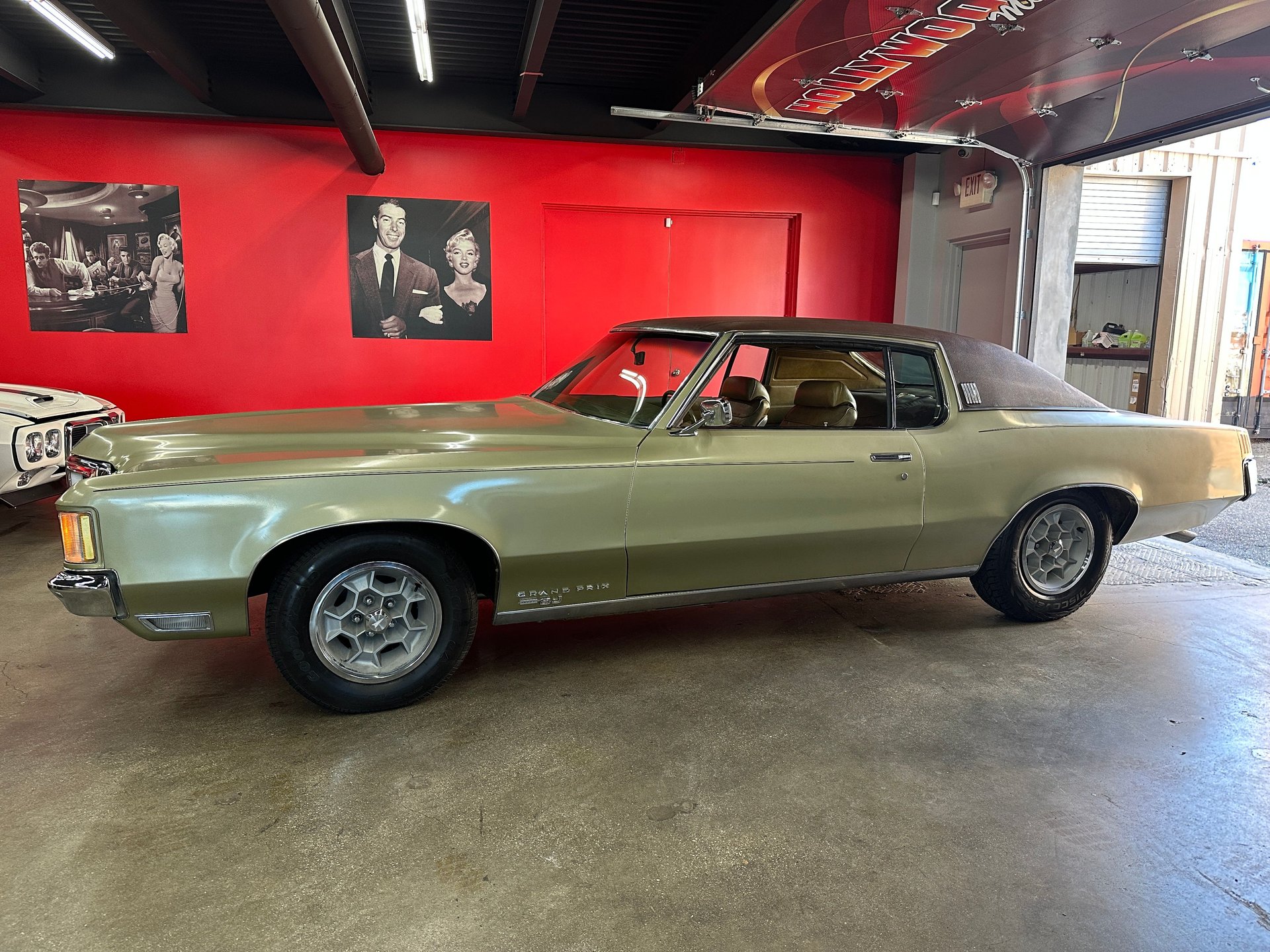
The Colonnade cars, 1973 to 1977. The 1973 redesign made the car longer, heavier and plusher, with a formal roofline, fixed opera windows in the rear pillars on most versions, and trim running from the Model J through the SJ to the luxury LJ, which put velour and padding where performance had been. The 455 survived to 1976 in steadily detuned form; the 400 was the sensible middle engine; the 350 was the base; by 1977 the new Pontiac 301 had arrived. These are the most numerous and least performance-oriented Grand Prix of the 1970s — 1973 was the model's record sales year — which makes a 400 or 455 car, condition for condition, the cheapest way into a big-engine 1970s Grand Prix. What you are really buying is style, presence and a 1970s interior, and the inspection priorities shift accordingly: vinyl-top and opera-window rust, interior plastics and the emissions-era engine's state of tune dominate.

The downsized cars, 1978 to 1987. The 1978 G-body kept the name, the buckets-and-console idea and the long-hood proportions at about four-fifths scale. Trim ran from the base model through the LJ to the sportier SJ in the early years, and later through LE and Brougham variants. Engines were now corporate-era: the Buick 231 V6 as the base, Pontiac's own 301 V8, the Chevrolet 305 in some years and markets, and, briefly and best avoided unless you specifically want one, the Oldsmobile 350 diesel. A mid-1980s Grand Prix — the pool behind this guide includes 1982, 1983 and 1986 cars — is a comfortable, simple, inexpensive classic coupe whose virtues are originality, low mileage and an unmolested interior rather than speed. Buy the best-preserved one you can find; there is no performance premium to chase, and a tired example has no cheap route back.
Engines and gearboxes
The Pontiac V8: 389, 400, 421, 428 and 455
One engine family powers almost every Grand Prix worth chasing, and it is Pontiac's own V8 — not a Chevrolet engine, but the division's design, in production in evolving form from 1955 to 1981. All of the classic displacements — 389, 400, 421, 428 and 455 cubic inches — share the same basic architecture and external dimensions, so the engines are visually near-identical. That is a blessing for parts and a trap for identity: a 455 and a 400 look the same at a glance, which is why the engine code stamped on the pad at the front of the block, beside the timing cover — not the air-cleaner decal — settles what a car actually has. The code decodes against the year to give the original application and power rating. Learn to find that pad before you go to see an SJ.
The character is consistent: enormous low- and mid-range torque, modest revs, and a lazy, understressed feel when healthy. A good Pontiac V8 starts readily, idles evenly on the standard camshafts, pulls from low rpm without complaint, and shows steady oil pressure — lower at a hot idle than a modern engine, which is normal, provided it rises promptly with rpm. Lifters that tick for a few seconds at a cold start and then quieten are usually harmless; a tick that persists hot, a deep knock under load, or oil pressure that falls away as the engine warms are rebuild conversations.
The 389 and 421, 1962 to 1966. The 389 was the standard engine from the start, with a four-barrel Rochester on most Grand Prix applications, and the 421 was the optional big brother — including, at the top, the 421 HO with Tri-Power, three two-barrel Rochester carburettors, and a gross rating up to 376 hp. Tri-Power cars are the glamour of the early range and the fussiest to keep right: three carburettors to synchronise, linkage that wears, and a centre carburettor that does most of the ordinary driving. A correctly set-up Tri-Power is reliable; a neglected one with vacuum leaks at every base gasket is a flat-spot machine, and the fault is almost always air leaks and linkage wear, not the concept. Budget for a specialist rebuild — realistically a four-figure job for a full Tri-Power set done properly, against a few hundred dollars for a single four-barrel.
The 400 and 428, 1967 to 1969. For 1967 Pontiac bored and stroked its way to a new pair: the 400, which became the workhorse, and the 428, the new big engine, offered in standard and HO forms. The 1969 SJ's 428 HO, at a gross 370 hp, is the performance peak of the classic Grand Prix story — a genuinely fast car by 1969 standards, with the torque to move a heavy coupe without effort. The ordinary 400 in a Model J is no consolation prize: it is torquey, durable and cheaper to buy and to feed, and in real road use the gap to a 428 is smaller than the badge gap suggests. Both engines respond to the same checks: look for the correct Rochester Quadrajet four-barrel (the standard fitment on most later 400s and 428s), listen for exhaust-manifold leaks at a cold start — a ticking that fades as the manifolds expand is a cracked manifold or a failed gasket, very common on these engines — and check the valley and timing-cover areas for the oil leaks that fifty-year-old gaskets guarantee.
The 455, 1970 to 1976. The 455 arrived for 1970 and is the torque champion of the family: in early gross-rated form it matched the 428 HO's headline power with still more low-end pull, it powered the SJ through the early 1970s, and it remained the top Colonnade option to 1976, in steadily softer states of tune as compression fell. A 1970 455 and a 1975 455 share a displacement and little else in feel — the later engine is a low-compression, EGR-equipped cruiser — so judge a Colonnade 455 as a cruiser and you will not be disappointed. The 455 is especially intolerant of overheating and of oil neglect, so the cooling and oil-pressure checks in the inspection section carry extra weight on a 455 car.
Fuel and ignition across the family. Almost every classic Grand Prix runs a Rochester carburettor — a four-barrel Carter or Rochester on early cars, and the Rochester Quadrajet on the great majority from the late 1960s onward. The Quadrajet is excellent when it is right: small primaries for economy and response, huge air-valve secondaries for power. Its failure modes are specific. The well plugs in the float bowl leak internally with age, giving hard hot starting and a rich idle as fuel seeps away overnight; the air-valve cam and linkage wear, giving a bog when the secondaries open; and decades of overtightening warp the air horn, giving vacuum leaks no gasket fully cures. The distinguishing test for the bog is in the linkage and the air-valve tension, not the jets — do not let a seller sell you a full rebuild for a linkage fault, and do not accept "they all bog" as an answer. Ignition is conventional points on early cars, with GM's HEI electronic ignition arriving in the mid-1970s and transforming reliability: an HEI car that misfires usually wants a module, a coil or leads, all cheap, whereas a points car wants its dwell and timing actually set. A car that runs well hot and cold, on its original-type carburettor, with no fuel smell in the bay, is worth more than one wearing an ill-matched replacement fitted to mask a fault nobody diagnosed.
The smaller and later engines: 350, 301, V6, 305 and diesel
The supporting cast matters because so many surviving cars have it. The Pontiac 350, offered in the Colonnade years, is a smaller member of the same V8 family — same virtues, less torque, and in a heavy 1973 to 1977 body it works hard; a 350 Colonnade is a cruiser, bought on condition. The Pontiac 301, introduced for 1977 and standard or optional across the late Colonnade and downsized cars, is a different, lighter design built for the emissions era, with a shorter deck and far less performance intent. A healthy 301 is smooth, economical by period standards and entirely adequate in a 1978 to 1981 coupe; a tired 301 is not worth rebuilding for performance, because there is none to unlock cheaply — buy a 301 car on body, interior and originality, and walk away from one that smokes or knocks, because the fix costs more than the premium for a better car. A turbocharged 301 existed in the Pontiac line in 1980 and 1981, most famously in the Trans Am; it is not a mainstream Grand Prix fitment, so treat any claim of a factory turbo Grand Prix as a claim that needs build documentation, not a badge.
The downsized cars broaden the mix further. The base engine from 1978 was the Buick 231-cubic-inch V6 — adequate, simple, and the engine most surviving low-line cars have; its even-fire versions run more sweetly than the early odd-fire cars. The Chevrolet 305 V8 appears in some years and in Canadian-market cars, and is a perfectly good, well-supported small-block. The Oldsmobile 350 diesel, offered in the early 1980s, is the one engine in this guide where the standard advice is simply to avoid it unless the car is exceptionally original and cheap: head-gasket failures, injection-pump wear and a parts base that has only thinned since new make it a specialist's hobby, not a driver's classic.
Gearboxes
Most Grand Prix are automatics, and the automatic story is a GM strength. The three-speed Turbo Hydra-Matic dominates — the TH400 behind the big engines in the performance years, the lighter TH350 behind smaller engines later, and the overdrive TH200-4R in the final G-body years. The TH400 has a deserved reputation as one of the strongest production automatics ever built: a healthy one shifts firmly, engages drive and reverse without a long pause or a thump, and does not flare between gears. Fluid tells the first part of the story: it should be red to light brown and should not smell burnt; dark, burnt-smelling fluid plus delayed engagement is a rebuild being announced, realistically a four-figure job even for these well-known boxes, so price it in rather than hoping. A long delay engaging reverse on a cold morning is the classic early warning.
Manual gearboxes are the rarity. Three-speed manuals were the nominal base fitment in the early years and four-speeds — the Muncie wide- and close-ratio boxes — were optional behind the big engines in the 1960s, but very few buyers ordered them, and a genuine factory four-speed car is a collector piece whose documentation matters as much as its condition. Judge a manual car on second-gear synchromesh, which wears first, and on clutch judder pulling away. From the Colonnade years onward the Grand Prix is effectively automatic-only in the market you will actually shop; a claimed manual late car needs the same documentation scepticism as a claimed turbo car. Rear axles are GM live axles — 10-bolt and, behind some big engines, 12-bolt units — with Safe-T-Track limited-slip optional; a whine on the overrun points to pinion and bearing wear, and a limited-slip that chatters on tight turns usually wants its fluid and additive changed before it wants a rebuild.
Problem areas
A Grand Prix fails in predictable places — mostly the places all big GM coupes of the period fail, plus a short list of model-specific traps around long hoods, heavy doors, vinyl tops and personal-luxury trim. Work through this section in order: structure first, because structure decides whether anything else matters, then the systems that decide what the car will cost you in the first two years.
Rust: the map
Rust on a Grand Prix follows the water, the road salt and the vinyl. The structure differs by generation — a full perimeter B-body frame on the first-generation cars, the intermediate frame from 1969 to 1977, the later G-body frame on the downsized cars — but in every case you are judging two things at once: the frame itself, and the body steel hung on it. A car can have sound sills and a rotten frame mount, or a sound frame and floors you can see through, and the repair bills are entirely different, so check both, on a lift if the car is worth real money.
Frame and mounts. Prod and tap the frame rails, especially at the rear kick-up over the axle, at the body-mount points and anywhere the factory coating has cracked and trapped salt. Surface scale is normal on a northern car; perforation, lamination — steel flaking in layers — or soft metal around a body mount is structural work, priced per car by a fabricator, and on a common model year it usually ends the negotiation. Body mounts themselves perish: collapsed rubber gives clonks over bumps, doors that no longer align, and a body sitting visibly low on one corner. A mount kit is parts money; fitting it to a car whose mount pockets have rusted is fabrication money, which is why you inspect the pockets, not just the rubber.
Floors and trunk. Water gets in past the windshield and rear-window seals, past the cowl, and, on Colonnade and downsized cars, around the opera windows and under vinyl tops, and it sits under carpets and under the trunk mat. Lift the carpets in both front footwells, and lift the spare wheel and the trunk mat without exception. The trunk floor and the spare-wheel well are the Grand Prix's truth-tellers: staining and surface rust are a clean-out and treat job you can do yourself; perforation at the well corners or along the floor seams is panel work, realistically in the high hundreds to low thousands of dollars fitted and painted per area, and floors rarely rot alone — treat floor rust as a marker for the whole shell. On a 1967 convertible, add the top well behind the rear seat and the floor beneath it.
Quarters, doors and the long panels. Rear quarters rot at the lower edges behind the wheels, around the arch lip, and at the seam where the quarter meets the rocker. Rockers trap mud thrown up by the front wheels and rot from the inside out, so press hard along their full length and be suspicious of fresh underseal. Doors are long and heavy on every generation and fill with water when their drain slots block: run a fingertip along the bottom edge of each open door, feel for bubbling, check the drains are clear, and check the hinges for drop by lifting the trailing edge — a door that lifts noticeably before it moves the car has worn hinge pins and bushes, a modest parts bill and a fiddly fitting job. Front fenders rot at the lower rear corner behind the wheel, and on the 1969 to 1972 cars the long hood deserves a careful look for ripples and rust at its rear corners — a straight, original hood is a valuable panel, because the pressing is model-specific.
The vinyl-top and opera-window trap. This is the most generation-specific rust trap in the guide, and it applies to the Colonnade cars above all, and to any vinyl-topped car of any year. A padded vinyl top holds moisture against the roof steel, and the rust forms underneath, invisible, until the vinyl bubbles, the headliner stains, or the metal perforates around the rear window and the opera windows. Press gently across the roof and around the opera-window frames and the base of the rear pillars; a crunchy or soft feel under the vinyl is rust, and the repair means removing the top, welding the roof and retrimming — a job that can run well into four figures and turns a cheap Colonnade into an expensive one faster than any mechanical fault. A car whose vinyl top has already been removed and whose roof has been painted is not automatically safer: ask why, and look for filler with the cloth-wrapped magnet. Glass surrounds deserve the same minute everywhere: the windshield and rear-window channels rot under their mouldings on all generations and leak into the floors and trunk described above.
The smaller traps. Battery trays rot from the top down under the battery, with the acid track running onto the inner fender below — lift the battery or at least rock it and inspect the tray edges with a torch. Radiator core supports rot at their lower mounts. Bumpers rust from behind, and re-chroming a full set of brightwork is a serious, four-figure bill, so count the pitted pieces and price them as you go.
Cooling, oiling and the mechanical wear points
The Pontiac V8's mechanical reputation is strong, and the thing that kills it in old age is heat. A big iron engine in a heavy car, with a radiator losing efficiency for decades, a fan clutch that no longer couples and a cooling system full of scale, will run hot in summer traffic — and a 455 in particular does not forgive repeated overheating. Head-gasket failure, warped heads and, in the worst cases, a cracked block follow. So the cooling system is not a service detail on a Grand Prix; it is a primary inspection system. Look for a radiator with a clean core and no crust at the seams, hoses that are supple rather than rock-hard or spongy, a fan clutch with resistance when spun cold, and a temperature gauge that settles and stays settled at a hot idle. A full cooling-system recommission — radiator, pump, hoses, thermostat and a flush — is typically a job in the high hundreds to around fifteen hundred dollars in parts and labour, which is cheap insurance against a five-figure engine problem.
Oil leaks are the norm, not the exception: rear main seals, valve-cover gaskets, the valley pan and the oil-pan gasket all weep with age, and the honest question is rate, not presence. A few spots on the garage floor are period character; a car that arrives with the underside washed suspiciously clean is hiding a rate you should measure on the test drive. The rear main seal is a major-strip job, so a heavy rear-main leak is real money — price it as such. Oil consumption follows the same logic: valve-stem seals give the classic puff of blue at start-up and on the overrun, a manageable top-end job; continuous smoke under load is rings and bores, which is a rebuild.
Suspension and steering wear is conventional and, by classic-car standards, mercifully cheap to put right, because the parts are shared with millions of GM cars. Front ends are double-wishbone with coil springs; ball joints, tie-rod ends, idler arms and centre links wear and give vague steering, wandering and uneven front tyre wear. A full front-end refresh is typically a job in the high hundreds to low thousands fitted, and it transforms a sloppy car, so a loose front end is a negotiating point, not a walk-away — unless the looseness is in the frame or its mounts, which returns you to the rust section. Steering boxes wear and leak; a box with play at the straight-ahead that adjustment will not remove wants a rebuild or an exchange unit. At the rear, coil springs sag — judge stance from the side, as the inspection section describes — and air shocks fitted to mask sag tell you the springs are done. Brakes are front disc and rear drum on most cars; after long storage expect seized calipers and wheel cylinders, perished hoses and a tired master cylinder, and budget for a hydraulic refresh on any car that has sat.
Exhaust manifolds crack — the cold-start tick described in the engine section — and fitting replacements with fifty-year-old studs is the labour risk, so a quiet cold start is worth paying for.
Interior, trim and electrics
The cabin is where a Grand Prix earns its name, and where completeness is hardest to restore. The 1969 to 1972 command-position cockpit, the early cars' bucket-and-console layout, the Colonnade's opera-window pillars and deep padding, and the downsized cars' Brougham velour are all model-specific environments, and the reproduction market serves the popular mechanical and wear parts far better than it serves Grand Prix-only trim. Price a car with a complete, original, unbroken interior above a mechanically fresher car with a gutted or mismatched cabin, every time.
Seats wear at the driver's outer bolster first, and the foam and padding underneath crumble with age, so a cover can look presentable over a collapsed cushion — sit in the driver's seat, not just the passenger's. Seat covers in the correct patterns exist for the popular years; a full professional retrim in correct materials runs into the low-to-mid four figures, and Colonnade and Brougham velour in the right colour is far harder to match than 1960s vinyl. Dash pads crack in the sun on all generations, and the 1969 to 1972 wraparound cluster makes its pad and surrounding trim effectively model-only parts; a crack-free original dash on those cars is a genuine asset. Door panels warp, consoles crack around the shifter, and headliners sag or are stained by the roof leaks described above. None of this is fatal; all of it is the slow, expensive kind of restoration that never shows up in a seller's description, so inventory it piece by piece.
Electrics fail at connections, switches and motors rather than in the looms. Work everything: power windows if fitted (slow is normal, stopped is a motor or a switch, and the motors are door-out work), power seat, heater blower on every speed, wipers, washers, every lamp, the horn and the instruments. Air conditioning matters because so many Grand Prix were sold with it and so few systems still work: the GM A6 compressor is tough and rebuildable, but a system that has sat empty for years wants a compressor service, a receiver-drier, hoses and seals, and a realistic recommission is a four-figure job at a shop. Pay for a car with genuinely cold air; a car advertised with "air conditioning, just needs gas" has, in almost every case, a repair you are being invited to fund. Vacuum-operated systems — hideaway headlights on the years that have them, heater controls and vacuum accessories — fail through perished hoses and diaphragms, giving lazy or one-eyed headlight doors and heater flaps that will not move; the parts are cheap, but allow the diagnosis time.
How to inspect one
Allow at least an hour, bring a torch, a magnet wrapped in cloth, a screwdriver for prodding (with the seller's permission), and a rag for the dipsticks. If the car passes you, pay for a lift inspection before money changes hands — on a car whose worst faults live in the frame, the floors and the mount pockets, it is the best money in the whole purchase.
- Start with the paperwork and the identity. Match the VIN on the title to the VIN plate — its exact location varies by year — and read the cowl or trim tag for the original paint, trim and build information. On any car carrying a premium — an SJ, a 428 or 455 car, a Tri-Power car, a 1967 convertible, a factory four-speed — verify the engine from the code stamped on the pad at the front of the block and, where the seller has it, from Pontiac Historic Services documentation, which can supply the factory build record for the VIN for a fee and settles originality arguments outright. A premium badge with no documentation is a standard car until proved otherwise.
- Cold start. Insist the engine is cold when you arrive; a warmed-up car is hiding its cold behaviour. A healthy Pontiac V8 catches promptly, may tick briefly from the lifters, and should not smoke continuously. Listen at the exhaust manifolds for the ticking of a cracked manifold or failed gasket that fades as the metal expands, and watch the tailpipe: a puff of blue at start-up that clears is valve-stem seals, continuous blue is rings, white that does not clear on a warm engine is coolant and ends the viewing until explained.
- Oil, fluid and the cooling system. Pull the engine dipstick: read the level, feel the oil for thinness and smell it for fuel, and look under the oil filler cap for mayonnaise-like emulsion, which together with coolant loss points at head-gasket trouble. Check the coolant in the radiator or overflow — it should be coolant, not rusty water — and inspect the radiator seams, the hoses and the fan clutch as described in the problem areas. Pull the transmission dipstick with the engine warm and idling in park: the fluid should be red to light brown and must not smell burnt.
- Under the car. This step decides whether you continue at all. Torch along both frame rails, the rear kick-up, the body-mount pockets, the rocker panels, the floor seams and the trunk floor from below. Perforation in the frame, the mounts or the floors is structural. Read the underseal as you go: patchy, chipped and honestly dirty is factory age; a fresh, uniform black coat blown over everything the week before the sale is a question, not an answer. Prod suspect areas with the screwdriver where the seller allows it.
- Trunk and interior floors. Lift the spare wheel and the trunk mat and inspect the well corners and seams for the water damage described in the rust section. Inside, lift the carpets in the front footwells and check for water tracks from the windshield base and cowl, damp padding and floor perforation. On a Colonnade or any vinyl-topped car, press the roof gently around the opera windows and rear pillars for the crunch of rust under vinyl, and check the headliner for water staining.
- Body, gaps and doors. Run the cloth-wrapped magnet over the quarters, rockers, lower doors and fenders, and across the roof of a car whose vinyl top has been removed — filler announces itself where the magnet's pull weakens. Check the bottom edge of each open door for bubbling, confirm the drain slots are clear, and lift each door's trailing edge to feel for hinge wear. Check panel gaps for accident history, look down each flank for ripples, and count the pitted, dented or missing pieces of brightwork and bumper chrome, pricing them as you go.
- The test drive. Fifteen minutes minimum, including a stretch at highway speed and some slow, tight turns. The engine should pull cleanly from low rpm without a bog as the secondaries open — a bog points first to the Quadrajet's air-valve linkage and tension, as the engine section explains — and without hesitation or overheating in traffic. The automatic should engage drive and reverse promptly, shift firmly without flaring, and not hunt at a steady cruise. On tight turns, listen for limited-slip chatter; on the overrun, listen for axle whine.
- Brakes, steering and stance. Brake hard from speed: the car should stop straight, without judder, pulling or a sinking pedal. The steering should be light, centred and free of knocks over bumps; wander plus clunks is the front-end refresh priced into your offer, provided step 4 cleared the frame and mounts. Stand back and judge the stance: a Grand Prix should sit level, a sagging rear is tired springs until proved otherwise, and helper air shocks are a confession, not a cure.
- Heat, idle and electrics, hot. Let the car idle fully hot and watch the temperature gauge settle and stay settled — the cooling check that matters most on a 455. Run the heater and the blower on every speed whatever the weather, work every window and the power seat if fitted, test the air conditioning honestly and record whether it blows genuinely cold or merely cool, and check every lamp, the wipers, the washers, the horn and the instruments. Lazy hideaway headlights or dead heater flaps on an equipped car are vacuum-system work: cheap parts, real time.
- Interior last, and completely. Sit in every seat and feel for collapsed padding under presentable covers, starting with the driver's cushion. Inventory the model-specific pieces: the console, the dash pad and, on a 1969 to 1972 car, the full wraparound cluster and its trim; on a Colonnade, the opera-window trim; everywhere, the door panels, the headliner and the seat belts. A complete original interior is the hardest thing about these cars to recreate, so weight it as heavily as the engine.
- Originality, again, before money. Re-check the items the premium depends on: the engine code against the claim, the carburettor type against the year, the trim tag against the paint and interior the car actually wears, and the documentation against the VIN. Engine swaps are common and, on a driver-grade car, not necessarily a fault — a well-fitted later 455 in a 400 car can be a better driver — but a swapped car is priced as a swapped car, never as the matching-numbers car the badge suggests.
- The lift inspection. If the car has passed steps 1 to 11 and the price is serious, put it on a lift with a mechanic who knows old GM cars and repeat step 4 properly: frame, mounts, floors, brake and fuel lines, and the underside of the trunk and quarters. What you are buying with this hour is certainty about the one set of faults that can exceed the value of the car to repair.
Values
The build below this guide carries the live market — the cars listed now and the recorded sales — refreshed at every build, and this section deliberately carries no figures of its own. Its job is to teach you how to read that block for a Grand Prix, because a single model year here can contain cars separated by a multiple of several times in value, and the headline number for a year, read carelessly, will mislead you in both directions.
Start with the condition spread, which is wider here than in most classic markets. At the bottom of every generation sit the project cars: non-running, rusted in the structure, or stripped of their model-specific trim, priced as parts and a title. In the broad middle sit the drivers — running, presentable, mechanically maintained, cosmetically honest cars — and this is where most transactions happen and where the recorded-sales figures are most trustworthy. At the top sit the documented, original or correctly restored cars: matching-numbers big-engine cars, low-mileage survivors with factory paperwork, and the genuinely rare specifications — the 1967 convertible, the early Tri-Power cars and the 1969 and 1970 SJ above all. The gap between a driver and a top car is not a percentage premium; it is a different market, and comparing a car you are viewing against the wrong tier is the most common Grand Prix pricing mistake.
Asking prices and achieved prices diverge in the familiar way, and more so at the top than in the middle. Driver-grade cars are plentiful enough that sellers compete, and cars that sit unsold at optimistic asks are a permanent feature of the listings — the recorded sales, not the listings, tell you what the middle of the market actually pays. At the top, the divergence runs through originality: a documented SJ with Pontiac Historic Services paperwork achieves what an undocumented car wearing the same badges does not, and the discount for a missing paper trail is the market pricing the risk described in steps 1 and 11 of the inspection, not snobbery. Factor the engine the same way. Within a generation, the big-engine cars — 421, 428 and 455 — carry a real premium, largest where the engine is rarest and best documented, in the 1969 and 1970 SJ, and smallest in the Colonnade years, where a 455 is a nicer cruiser engine rather than a performance flagship. The later cars invert the logic: a 301 or V6 downsized car has no engine premium to chase, so its value sits almost entirely in mileage, originality and preservation, and a low-mileage, unmolested late car can properly outprice a tired earlier one.
The project-versus-driver gap deserves its own warning, because it is where Grand Prix buyers most often lose money slowly. The distance between a cheap Colonnade or downsized car and a good driver looks, in the listings, like a saving; priced honestly — structural welding, a vinyl-top roof repair, a transmission rebuild, a cooling-system recommission, an interior whose model-specific pieces must be hunted one by one — it is usually a bill larger than the premium for the better car. The exception is the buyer who welds and wrenches personally; for everyone else, buy condition, because condition is what the recorded sales reward. Negotiation follows from supply: for a common driver-grade car, a firm, inspection-based offer — every deduction named and priced from this guide's problem areas — is the normal way these cars change hands; for a documented top-tier car, expect the negotiation to be about verification, not discount.
Parts and ownership
The Grand Prix sits in one of the best parts ecosystems in the classic-car world, because it shares its bones with some of the most numerous cars General Motors ever built — and in one of the trickier ones for the pieces that make it a Grand Prix, because those were made in far smaller numbers. Hold both halves of that sentence at once and you will budget correctly.
Easy: almost everything mechanical. The Pontiac V8 is served by a deep specialist trade — suppliers and engine builders keep gaskets, bearings, pistons, camshafts, timing sets, pumps and full rebuild components in ordinary stock — and the shared GM hardware is easier still: Turbo Hydra-Matic rebuild parts, brake discs, drums, calipers and hydraulics, suspension joints, steering components, springs, exhaust systems for the popular years, alternators, starters and HEI parts are all order-today items at prices close to modern-car money. Carburettor kits and specialist Quadrajet and Tri-Power rebuild services are well established, and weatherstrips for the popular years are reproduced. A competent general old-car shop can maintain the car; a Pontiac specialist can do anything it needs.
Harder and dearer: the model-specific layer. Grand Prix-only body panels — the 1969 to 1972 long hood and front fenders above all, early roof and convertible parts, Colonnade quarter and opera-window-area steel — are not reproduced to the depth of Camaro or Mustang panels, so good used panels are hunted and priced accordingly. Correct interior materials follow the same pattern: seat-cover sets exist for the popular years, while Colonnade velour in the right colours, crack-free dash assemblies for the wraparound-cockpit cars, console parts and small bright trim are search-and-wait items. Chrome is complete-car expensive: re-plating bumpers and the full brightwork set is a four-figure commitment, so the brightwork count in step 6 of the inspection is a real budget line. The 301 and the diesel are the thin ice in the engine range: their unique parts are less deeply stocked than the classic Pontiac V8's — one more reason those cars are bought on preservation, not project potential.
Running costs. A sorted Grand Prix is a realistic regular-use classic: fuel consumption in the low-to-mid teens in miles per gallon for the big-engine cars, better for the downsized cars, servicing any good independent shop can handle, and insurance in line with other cars of similar value. The budget line that catches new owners is the first year: catching up deferred maintenance on a running car — fluids, belts, hoses, a cooling-system service, brake hydraulics, tyres aged out even when the tread looks fine — honestly costs a four-figure sum before you improve anything, and recommissioning a car that has sat for years costs several times that, because a standing car needs its fuel system cleaned end to end (modern ethanol fuel attacks old rubber and leaves varnish in tanks and carburettors), every brake component inspected, and all seals and fluids renewed. Buy a car in regular use over one that has been asleep, even at a higher price.
Which one to buy
- The all-rounder: 1969–1970 Model J with the 400. The DeLorean proportions, the wraparound cockpit, a torquey and durable engine, the deepest market to buy from and sell into, and none of the SJ's originality premium to verify or to pay. If you want one Grand Prix to drive and enjoy, this is it.
- The collector car: 1969 SJ with the 428 HO. The performance flagship and the most collectible Grand Prix of all. Verify originality ruthlessly — engine code, build documentation, correct details — because a wrong-engined or undocumented SJ is worth a fraction of a correct car.
- The value buy: 1965–1966 B-body car. The best-looking of the big Grand Prix at prices the earlier and later shapes undercut for no structural reason. Buy on trim completeness and frame condition; the mechanical parts are the easiest in this guide.
- The cruiser: 1973–1976 Colonnade with the 400 or 455. Presence, comfort and a big Pontiac V8 at the lowest entry cost of any big-engine Grand Prix — provided the roof, the vinyl top and the opera-window areas pass the rust checks. A rotten-roof Colonnade is not a value buy at any price.
- The rarity: 1967 convertible. The only soft-top in the classic range, built for one year. Buy the best-documented, least-rusted example you can find; the top well and the floors decide the car.
- The affordable classic: 1978–1987 downsized car, bought on preservation. A low-mileage, original, unmolested late car — LJ, LE or Brougham trim, V6 or 301 — is simple, comfortable and inexpensive to run. There is no performance version to hold out for, so condition is the entire decision.
And the rule that overrides all of the above: buy the least rusty car you can find, with the most complete Grand Prix-specific trim, in the generation you actually want. Engines, gearboxes, brakes and cooling systems are all fixable at prices you can plan for. A rotten frame, a perforated vinyl-top roof and a gutted cockpit cost more to put right than the finished car will be worth — and a Grand Prix can never be made original from them again.
See the 22 Grand Prix cars currently listed.