
Pontiac fiero buyer's guide
Pontiac fiero -- the model's own buyer's guide: variants, values and what to check.
Years listed: 1984-1988 · Series: Fiero
Overview and history
The Pontiac Fiero is the only mass-produced mid-engined American car of its era, and it exists because Pontiac argued it past General Motors as something it was not. When GM management approved the project in the late 1970s, the Fiero was sold internally as a two-seat commuter car — an economy runabout that happened to put its engine behind the seats. The sports car Pontiac actually wanted arrived wearing that commuter costume, and the costume shaped everything about the early cars: a fuel-sipping four-cylinder borrowed from the front-drive parts bin, suspension pieces shared with the Chevrolet Chevette at the front and the front-wheel-drive X-body cars at the rear, and a steel spaceframe clothed in plastic panels that could not rust.
Production ran for five model years, 1984 through 1988, all of them built at Pontiac, Michigan. The first cars were notchback coupes in base, Sport Coupe and SE trim. A 2.8-litre V6 joined for 1985 along with the GT, the fastback body arrived for 1986, the Indy Pace Car replica marked the launch year, and the Formula brought V6 performance back to the notchback shape for the final year. Then, just as Pontiac finished fixing the car — the 1988 model received a comprehensively redesigned suspension, brakes and steering that finally matched the mid-engined layout's promise — GM cancelled it. That arc, from compromised launch to sorted finale, is the single most important fact in Fiero buying: the year on the title changes the car underneath more than on almost any other American classic of the period.
This is the model-level guide. The series guide covers the Fiero's development story and place in Pontiac history in full; here we go deeper on the things that decide a purchase — the year-by-year differences, the GT, Indy and Formula variants in detail, the two engines and how to tell them apart from the VIN, and the inspection routine that separates a sound spaceframe from a rotten one wearing shiny plastic.
The market you are shopping is small and honest. We currently track 24 Fieros on Classic Listings, 22 of them for sale, spanning every production year from 1984 to 1988 — with the final-year 1988 cars the most numerous single group, followed by 1986 and 1987. Fifteen of the cars come from private Marketplace sellers and eight from dealers, with one car that came through Bring a Trailer. Red is the commonest colour by a wide margin, then white, gold, silver, black and grey. Transmissions split heavily toward the automatic in the listings as recorded, though the manual cars are the ones enthusiasts hunt. Geographically the cars cluster in the Midwest and East — Ohio leads our listings, with New Jersey, North Carolina, Michigan, Tennessee and Florida all represented — which matters, because where a Fiero has lived decides how much of its hidden steel frame is left.
That last point is the Fiero in one sentence. The plastic body panels do not rust, so a Fiero can look immaculate in photographs while the steel spaceframe beneath — the structure the panels bolt to, the structure that carries the suspension and would protect you in a crash — quietly rots in the places the panels hide. Everything in this guide flows from that. Buy the frame, verify the engine from the VIN rather than the badge, respect the 1988 divide, and the Fiero is one of the cheapest genuinely exotic layouts you can own. Buy the shiny panels and the story, and you can own a parts car at driver money.
The models
Every Fiero is a two-seat, mid-engined coupe on the same basic spaceframe, but the range divides three ways that matter: by body (notchback or fastback), by engine (four or V6 — covered in the next section), and by year, because the specification moved almost annually. Work through the variants in that order and any listing decodes itself.
| Model | Years | Engine | Output | Built | Character |
|---|---|---|---|---|---|
| Fiero (base coupe) | 1984–1988 | 2.5 four (Iron Duke) | 92 hp | The bulk of production | The commuter original; light, simple, slow |
| Sport Coupe | 1984–1987 | 2.5 four | 92 hp | Volume seller | Base car with dress-up trim |
| Fiero SE | 1984–1987 | 2.5 four; 2.8 V6 optional from 1985 | 92 / 140 hp | Substantial minority | The well-equipped notchback; V6 SEs are sleepers |
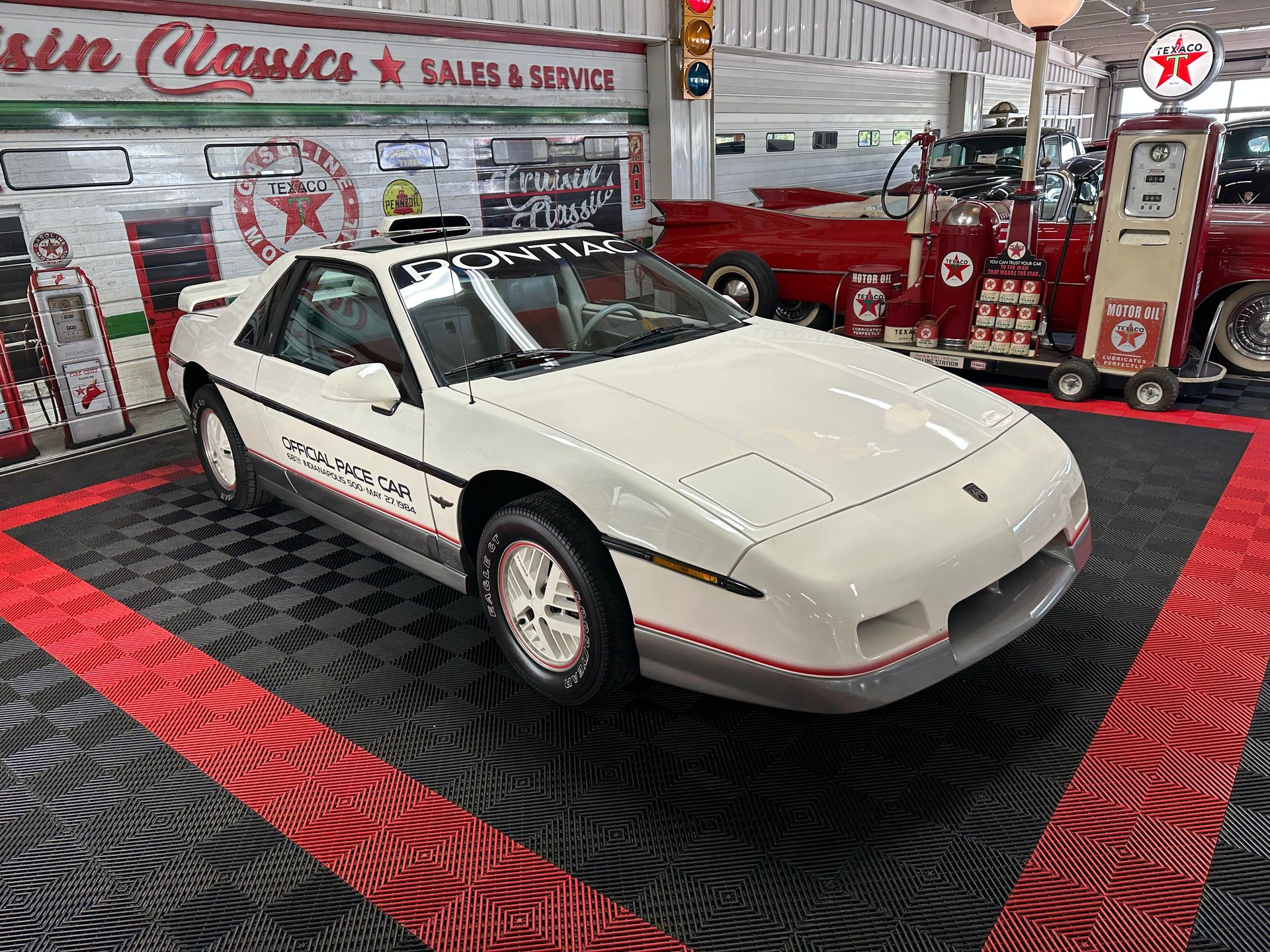
| Indy Pace Car replica | 1984 | 2.5 four | 92 hp | About 2,000 | White-over-silver, red interior; the collectible '84 |
| Fiero GT | 1985–1988 | 2.8 V6 | 140 hp | Tens of thousands | 1985 notchback, fastback from '86; the flagship |
| Fiero Formula | 1988 | 2.8 V6 | 140 hp | 5,484 | GT mechanicals in the notchback body; one year only |
(Outputs are period net figures. Treat the production numbers for individual trims other than the Indy and Formula as approximate — Pontiac's own published splits vary by source, and any seller quoting a suspiciously precise rarity figure for a mainstream trim should be asked for the document behind it.)
The notchbacks (1984–1988). The original body is a formal notchback: an upright rear window and a flat deck. Base, Sport Coupe and SE cars all wear it, and so does the 1985 GT. The notchback is the lighter, simpler shell and, to many eyes now, the more distinctive one — the fastback cars borrowed their silhouette from contemporary Italian exotics, while the notchback looks like nothing else on the road. Trim differences are mostly equipment: the SE added the more complete instrument cluster with auxiliary gauges, upgraded trim and, crucially, the option of the V6 from 1985 on.
The Indy Pace Car replica (1984). The Fiero paced the 1984 Indianapolis 500 — the actual pace cars used a special high-output engine no replica carries — and Pontiac sold roughly 2,000 replicas in white over silver with a grey-and-red interior, red-accent wheels and full striping. Every replica is a four-cylinder automatic or manual notchback mechanically identical to an SE, so the value is entirely in the livery, the interior and the documentation. That makes originality the whole inspection: correct stripes, correct interior fabric, and paperwork matter more than mileage. A repainted-in-one-colour "Indy" with a grey interior is an SE with a story, and should be priced as one.
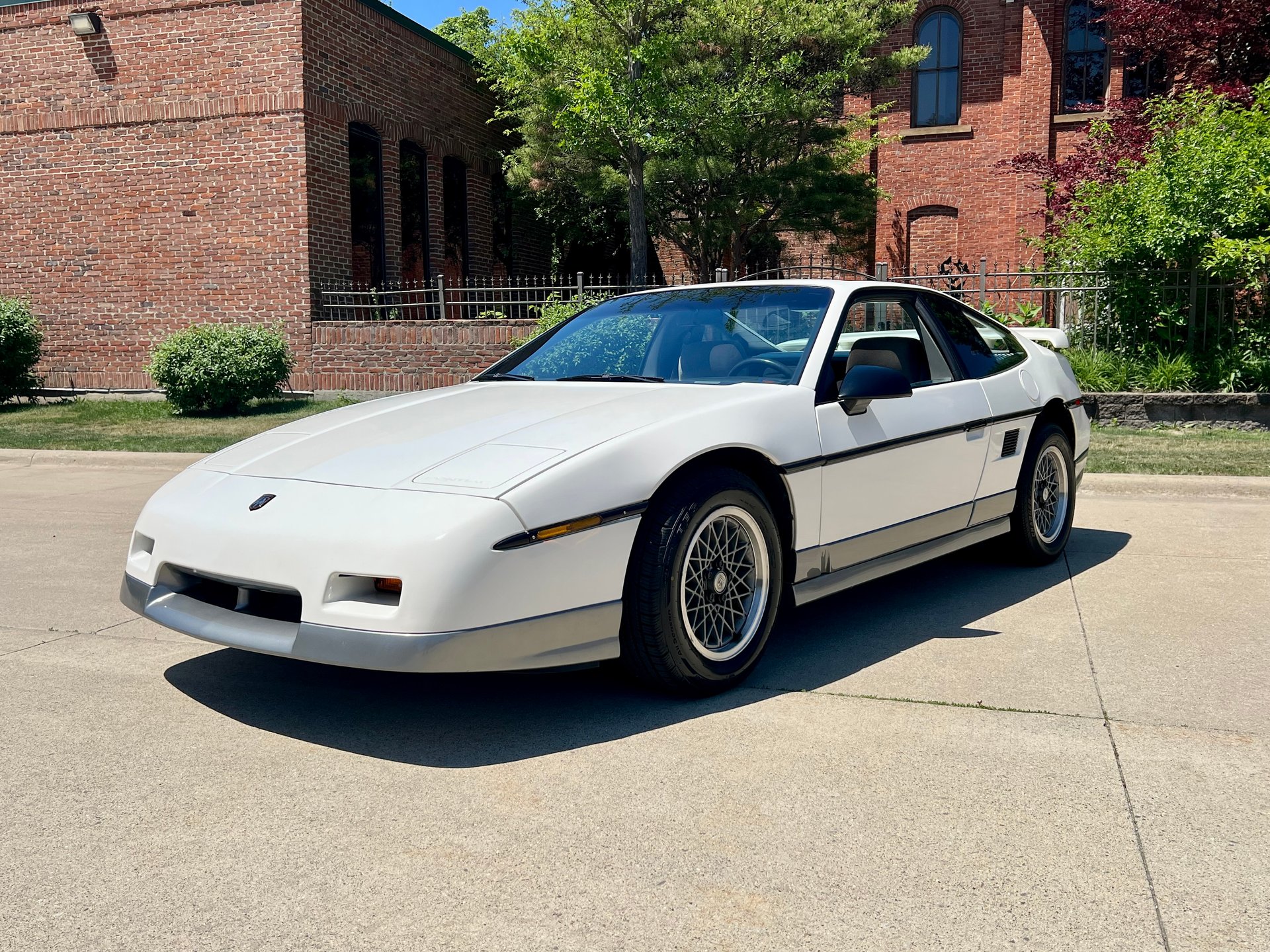
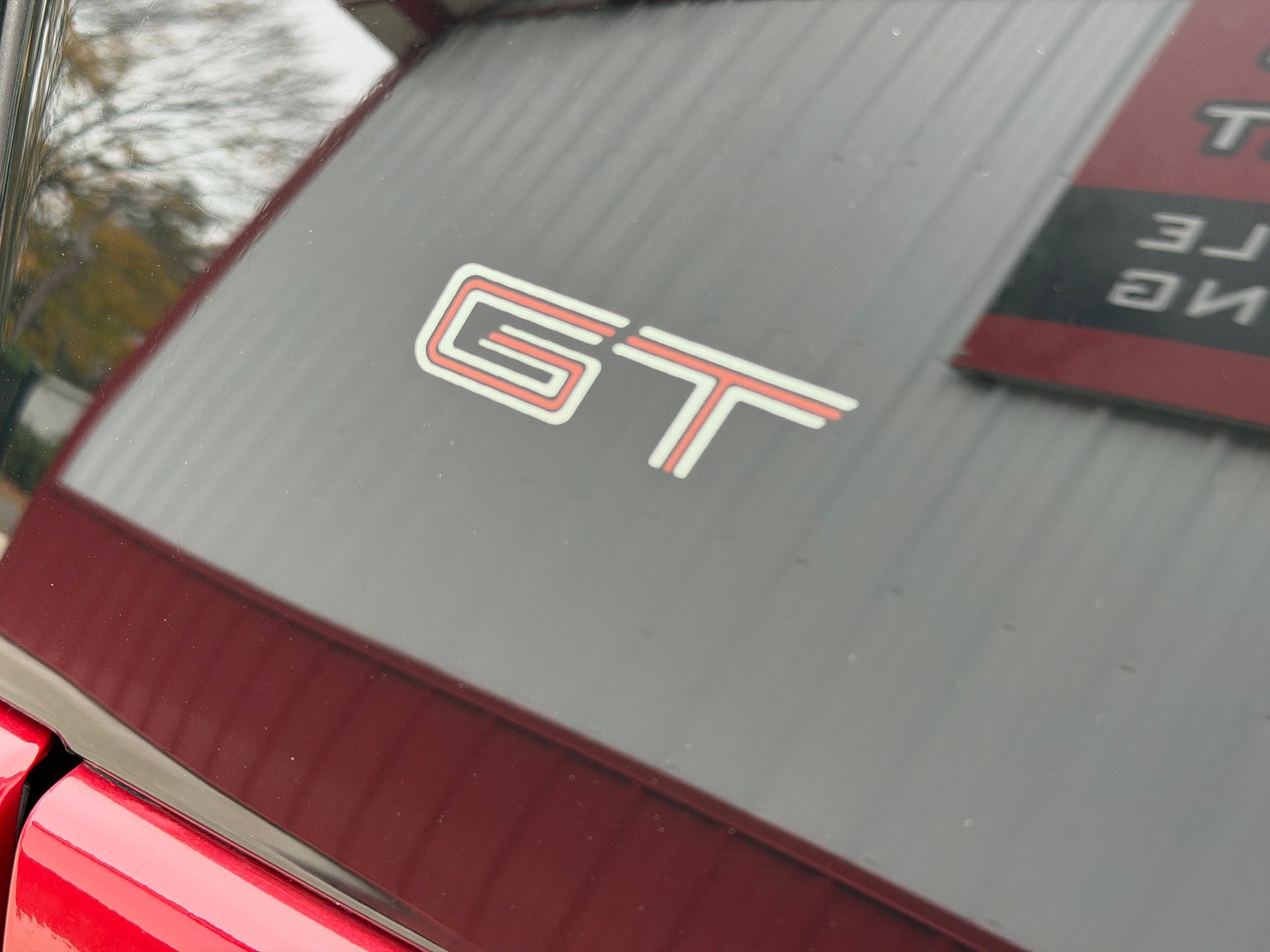
The GT (1985–1988). The GT is the Fiero most buyers picture. For 1985 only it wore the notchback body; from 1986 it gained the fastback — a long sloping rear deck with flying-buttress sail panels and a louvered engine cover — plus the V6 as standard, a rear spoiler, and the fullest equipment list. The fastback GT is the most collectible mainstream Fiero and the one the market pays up for, in any year. Within the GT line the years still matter: a 1986 GT has the early suspension and was available with a four-speed manual or, later in the run, the five-speed; a 1988 GT has the redesigned chassis and is the best-driving Fiero built. All GTs are V6 cars — a "GT" with a four-cylinder is a rebadged base car or an engine swap, and the VIN check in the next section settles it in ten seconds.
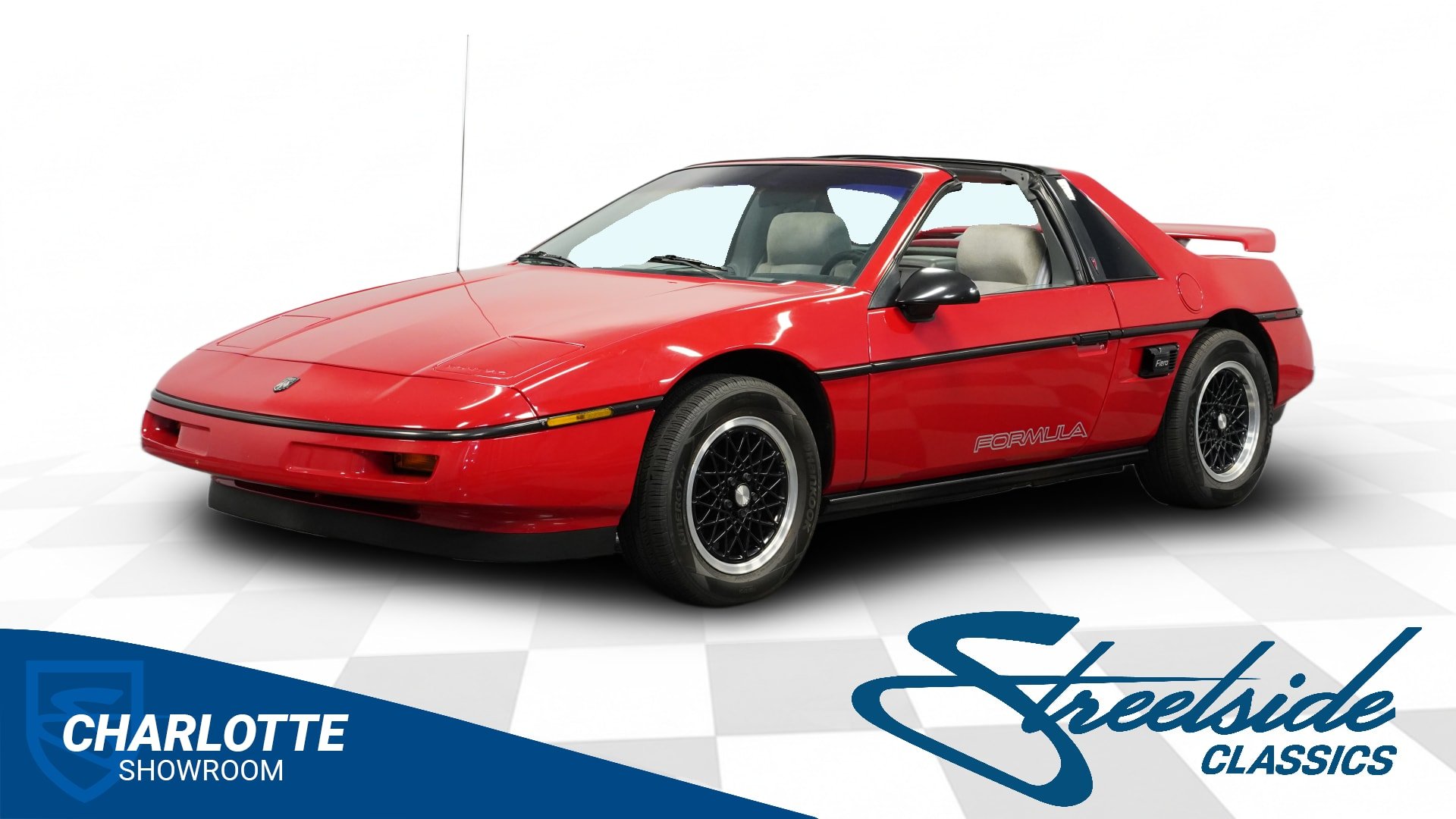
The Formula (1988). The Formula is the connoisseur's Fiero and the easiest to overlook in a listing search, because it looks like a base notchback. It is not: Pontiac fitted the GT's V6, the WS6-style suspension package and the 1988 chassis revisions to the lighter notchback shell, with subtle "Formula" decals, and built 5,484 of them for one year only. You get the best chassis and the strong engine without the fastback's weight and without the GT premium. Because the decals are small and the body is plain, Formulas are both mislisted as base cars by sellers who don't know what they have and faked by sellers who do — again, the VIN is the arbiter.
The years, quickly. 1984: four-cylinder only, launch-year teething troubles, the fire-recall story covered in Problem areas — buy an '84 for the Indy or for cheap fun, with your eyes open. 1985: the V6 and the GT arrive; the range makes sense from here. 1986: the fastback GT, and the five-speed manual becomes available on V6 cars late in the year. 1987: detail revisions, a larger fuel tank, and the four-cylinder gained balance shafts and other refinements that made it smoother — the best year for a four-cylinder car. 1988: the redesign — new front and rear suspension with revised geometry, four-wheel disc brakes with vented rotors, quicker steering — and the Formula joins the GT. If two cars are equal in condition, the 1988 is worth a real premium; if the 1988 is rotten and the 1986 is sound, buy the 1986 and never look back.
Engines and gearboxes
Two engines power every factory Fiero, and they define two different cars. Learn the VIN check first, because badges, engine covers and sellers all lie, and the VIN does not: the eighth character of the Fiero's VIN is the engine code. R is the 2.5-litre four; 9 is the 2.8-litre V6. Read it off the plate at the base of the windshield, match it to the title, and you know what the car was born as regardless of what is under the decklid today.
The 2.5-litre "Iron Duke" four
The base engine is GM's 2.5-litre overhead-valve four, universally known as the Iron Duke — a cast-iron, pushrod engine designed for economy and durability in front-drive cars, rated at 92 hp in the Fiero. It is not a sports-car engine and never pretends to be: torque arrives low, the redline arrives early, and a four-cylinder Fiero is a pleasant, nimble runabout rather than a fast car. Judge it as such and it is a likeable thing; judge it against the V6 and every test drive disappoints.
What the Duke does offer is toughness. The bottom end is famously over-built, parts are shared with a generation of GM front-drivers and are cheap, and the engine tolerates neglect that would kill something more highly strung. Its known habits are specific rather than serious. The throttle-body injection (a single-point TBI unit) is simple and reliable, but its injector and the fuel-pressure regulator age, giving hard hot starts and a rich idle. The DIS ignition on later cars — the four was revised for 1987 with balance shafts and a distributorless ignition among its changes — removed the distributor wear items but substituted coil-pack and crank-sensor failures, which present as a sudden no-start or a misfire that comes and goes with temperature. Timing is by gear drive rather than a chain or belt on the early engines, and worn timing gears announce themselves with a distinctive rattle-clatter from the front of the engine; replacement gear sets are inexpensive, though the labour to reach them is not trivial in the Fiero's tight bay.
Oil leaks are the Duke's other signature: valve cover, oil pan and the rear main seal all weep with age, and because the engine sits ahead of the rear axle in a closed compartment, leaks bake onto hot surfaces and smell worse than they are. Distinguish a weeping cover (an afternoon and a gasket) from a rear main (engine or transaxle out — price it as such). Coolant neglect hurts this engine as it hurts the V6, and the cooling section below applies to both.
A healthy Duke starts instantly from cold on the TBI, settles to a slightly lumpy but even idle, and pulls without hesitation to about 4,500 rpm, where it is done. Blue smoke on a cold start that clears is valve-stem seals — common, liveable, fixable at a top-end refresh. Smoke under load is rings, and on a four-cylinder car, whose value ceiling is low, an engine-out rebuild rarely makes economic sense unless the car is an Indy or an exceptional survivor.
The 2.8-litre V6
The 2.8 is GM's 60-degree V6 — cast-iron block and heads, pushrod valvegear, and in the Fiero a multi-point fuel injection system that lifted output to 140 hp. That number transforms the car: a V6 Fiero is genuinely brisk, sounds the part through its twin-outlet exhaust, and carries the GT and Formula identities. If you intend to drive your Fiero rather than show it, this is the engine to buy, in whichever body it comes.
The 2.8's architecture is shared with a wide range of GM cars, which keeps parts plentiful and prices sane, but the Fiero installation adds its own wrinkles. The engine sits transversely ahead of the rear axle, exhaust manifolds tucked close to the firewall and the front of the compartment, and heat management is the theme of its ownership. The front exhaust manifold (the one against the firewall) is prone to cracking and to breaking its studs, and the job is awkward enough that quotes vary wildly — get the car on a lift, listen for the ticking of a manifold leak at cold start, and shine a torch at the manifold before you agree a price; a manifold and stud job realistically runs $400–900 depending on how many studs snap. Heat also cooks the ignition components and the wiring loom along the firewall, so brittle connectors and creative previous wiring are the norm rather than the exception on an unrestored car.
Mechanically the 2.8 is a 200,000-mile engine if the oil and coolant have been changed, and a money pit if they have not. Its documented weak points: intake manifold gaskets that leak coolant internally and externally — milkshake oil or unexplained coolant loss on a 2.8 is this until proven otherwise; a distributor (on the cars that carry one) whose shaft bushings wear and scatter the timing; oil leaks from the valve covers and the oil-pressure sender that mimic worse faults; and a thirst for clean coolant, because the iron-and-alloy cooling system corrodes internally when the antifreeze is left to die. On the test drive a good 2.8 pulls cleanly from 2,000 rpm, revs to its 6,000-rpm neighbourhood without flattening, and idles evenly once warm. A flat spot or surge at cruise is usually vacuum leaks or a tired throttle-position or MAP sensor — diagnosis money, not rebuild money. A rattle from deep in the engine at hot idle, or oil pressure that falls away hot, is the opposite: walk away or price an engine.
One upgrade deserves a warning. Swapping a larger GM V6 (the 3.4 pushrod engine is the common one) or a V8 into a Fiero is a well-trodden path, and Archie V8 swaps in particular are a small industry. A well-documented swap can be a fine car, but it is no longer a Fiero for valuation purposes: it prices as a hot rod, its cooling and wiring quality are entirely down to the builder, and the VIN will still read R or 9 for the engine the car was born with. Never pay original-V6 money for a swapped car, and never pay a premium for a swap you cannot see documented.
Gearboxes
Four transmissions appear across the range. The manuals are a four-speed (Muncie-built) on early cars and a five-speed — an Isuzu unit on four-cylinder cars and the stronger Getrag-designed 282 five-speed on V6 cars, available from 1986. The automatic is GM's three-speed Turbo-Hydramatic 125, fitted to the majority of cars as our listings reflect.
The four-speed manual is sturdy but wide-ratio'd and agricultural; the Isuzu five-speed is light and pleasant but is the weakest box in the range, and hard-used examples whine and jump out of gear. The Getrag 282 is the one to have: close ratios, a precise change for its era, and strength enough for the V6. On any manual, test second-gear synchromesh on a fast downchange, check the change quality when the box is cold (the first five minutes tell the truth), and budget for the Fiero's notorious shifter-cable stretch and wear — a vague, rubbery change is usually cables and bushings, a few hundred dollars, rather than the box itself. Clutch replacement is an engine-out-adjacent job on a mid-engined car and costs accordingly, realistically $800–1,400 at a shop, so a slipping clutch is a serious price chip.
The TH125 automatic is a simple, durable three-speed that suits the four-cylinder car better than the V6 — with only three ratios the V6 spends its life either loafing or revving. Failures are usually age and heat rather than weakness: delayed engagement when cold, flaring on the 2–3 change, and fluid that smells burnt all point to a rebuild in the $1,200–2,000 range. Check the fluid colour and smell on the dipstick, and confirm the kickdown works on the test drive. A well-kept automatic in a GT is no disgrace as a cruiser; a manual in the same car is worth more and sells faster, which the Values section returns to.
Problem areas
The Fiero's problems are unusually well mapped for a car of its age, because the failure pattern is so distinctive: the bits you can see (plastic panels, interior trim) age cosmetically, while the bits you cannot see (the steel spaceframe, the coolant pipes, the engine-bay wiring) age structurally. Our current listings sample is small and our examined-photo sample smaller still — we have detailed photo notes on only a handful of the 24 cars we track — so the guidance below rests on the model's documented record rather than on incidence counts. Treat it as a checklist of where to look, in the order a experienced Fiero hand looks.
Rust: the spaceframe map
Repeat the central fact until it bores you: the body panels are plastic and cannot rust, and they bolt to a galvanised-and-painted steel spaceframe that can. A Fiero's shiny photographs therefore prove nothing. The frame rots from the inside of its box sections and in the traps the panels create, and it rots worst on cars that lived where our listings cluster — the salted-road Midwest and Northeast. Work the map in this order.
Rear frame rails and the trunk area. The single most common structural failure. The rails that carry the rear suspension cradle run beneath and behind the engine compartment, where road spray, exhaust heat cycling and trapped debris combine. The rear wheelhouses and the metal around the trunk and engine-compartment edges go with them. Prod with a screwdriver — surface scale brushes off; perforation and metal that flakes in layers do not. Rail repair is fabrication: sections can be cut out and new steel welded in by a competent fabricator, realistically $1,000–2,500 a side depending on spread, and it is skilled work because the cradle mounts must stay true. A car needing both rails and more is a parts car wearing a price tag.
The front compartment and front rails. Lift the front trunk (the "frunk") carpet and panels and inspect the floor and the rails around the radiator and spare wheel. Water sits here when the drains block, and accident damage hides here too — look for rippled metal, non-factory welds and overspray on the frame. Check the battery tray area and the metal beneath the battery, the Fiero's version of the universal battery-acid trap.
Rocker areas, floor edges and seat-belt mounts. The spaceframe's lower rails run under the doors, behind the plastic rocker covers — which is precisely why they get skipped in listings. Get the car on a lift or at minimum on stands, pull or peer behind the covers, and check the floor pan edges and the seat-belt anchorages. Belt mounts are an MoT-style safety item in the truest sense: if the metal around them is soft, the car is not safe to drive, full stop.
Suspension cradle and subframe. The rear cradle that carries the engine and transaxle, and the front crossmember, both corrode, and their mounting points in the frame corrode faster. A cradle can be unbolted and replaced or repaired off the car; rotten frame mounting points are the same fabrication conversation as the rails. While you are under there, read the underside the way the Mercedes hands read underseal: honest, patchy factory protection with stone chips is normal at forty years old; a fresh, uniform coat of black blown over everything the week before sale is a question, not an answer.
Coolant pipes. Not frame, but structural to the car's survival: two steel coolant pipes run the length of the car along the rocker areas, carrying water between the front radiator and the mid-mounted engine. They rust from the outside in, they are routinely crushed by careless jacking (a classic Fiero wound — the pipes sit exactly where a hurried tyre shop puts the jack), and a perforated pipe empties the system in minutes. New pipes are available in stainless from the Fiero specialists; fitting is a half-day job. Inspect them on every viewing, and never let a jack near the rockers without pointing at the pipes first.
The 1984 fires, and engine-bay heat generally
No honest Fiero guide can skip this, and no honest one should sensationalise it. A small number of early 1984 four-cylinder cars caught fire, and Pontiac recalled the 1984 model (with related actions touching later cars' engine-bay components) after investigations traced the fires to a combination of factors: connecting rods that could fail on a subset of engines, oil leaking onto hot exhaust components, and an engine compartment that kept heat and leaked fluids in close company. The recall work — which included revised components and shielding, and engine replacement for the worst-affected cars — was carried out decades ago, and the surviving 1984 fleet has essentially all been through it. The practical buying advice is narrow: on a 1984 car, ask for any recall documentation in the history file, confirm the engine is the car's correct unit or a documented replacement, and then judge the individual car on its condition like any other. An '84 is not a fire risk by virtue of its year in 2026; it is a forty-year-old car whose engine bay deserves the same leak inspection as any other.
The enduring lesson of the episode applies to every year: the Fiero's engine compartment is compact, enclosed and hot, and it punishes oil and fuel leaks that an open front-engine bay would forgive. So inspect for leaks as a fire-safety item, not a cosmetic one. Valve-cover oil on a V6 manifold, a weeping fuel line or injector seal, a perished rubber hose — each is cheap alone and serious together. Budget a first-month job on any unrestored car: degrease the bay, fix every leak you find, replace every rubber fuel line regardless of appearance, and check the wiring loom along the firewall for heat-brittled insulation. A few hundred dollars of prevention in the compartment that made the car's early reputation is the best money in Fiero ownership.
The cooling system: bleeding, pipes and head gaskets
The Fiero's cooling layout — radiator at the front, engine in the middle, long pipes and hoses between — is sound in design and unforgiving of sloppy service. Nearly every "my Fiero overheats" story traces to one of three causes, and all three are testable before you buy.
Air locks. The system must be filled and bled following the factory procedure, raising the rear of the car and venting at the thermostat housing until no air remains. A car filled carelessly at the radiator cap carries an air pocket at the engine, runs hot in traffic, blows coolant, and gets misdiagnosed as a head gasket. On the test drive, insist on a full warm-up and an idle in place afterwards: the temperature should stabilise, the front fan should cut in, and the gauge should stay honest. A car that only behaves at speed has air, a tired fan, or both.
The pipes and hoses covered above — crushed or rusted pipes strangle flow and then perforate. Add the radiator itself (original units are old now; recores and aluminium replacements are common and fine if fitted well) and the water pump, whose weeping announces itself at the front of the engine.
Head gaskets are the failure everyone fears and the one most often misdiagnosed in both directions. The Iron Duke has a period reputation for head-gasket failure, and overheating events — from air locks or perforated pipes — are what kill gaskets on both engines. The tests are the standard ones and they work: mayonnaise under the oil cap plus unexplained coolant loss, bubbles in the coolant with the engine running, a cooling system that pressurises stone-cold within a minute of start-up, or one cylinder's plug washed clean. A confirmed gasket is a top-end job, realistically $900–1,600 at a shop on the four, more on the V6 — and on any car, the gasket is the symptom: refuse to pay for the repair in your offer until the cause (pipes, air, fan) is also priced.
Suspension, brakes and the 1988 divide
The Fiero's chassis story is two stories. The 1984–87 cars use front suspension derived from the Chevette and a rear layout adapted from GM's front-drive cars — the engine cradle carries struts and links whose geometry was a compromise when new. They handle tidily at road speeds and feel increasingly approximate when pushed: the rear in particular has bump-steer manners that experienced owners drive around. The 1988 cars received Pontiac's own redesign — revised front suspension with new geometry, a triangulated rear layout on its own subframe, four-wheel disc brakes with vented rotors all round (earlier cars run front discs and rear drums on most trims, with four-wheel discs on later GTs) and recalibrated steering. The difference is not subtle, and it is why 1988 cars command their premium.
Wear items are conventional: struts, ball joints, tie-rod ends, wheel bearings and, above all, forty-year-old rubber bushings, which on the early rear suspension directly worsen the bump-steer as they soften. A full bushing refresh transforms an early car and is a known quantity at $600–1,200 in parts and labour depending on how much you do yourself. On 1988 cars the caution is the reverse: several suspension and brake components are one-year-only, were never shared with high-volume GM cars, and are correspondingly harder and dearer to source — a worn-out '88 can cost more to put right underneath than a worn-out '87, even though it is the better car when sorted. Brake work on any year is cheap in parts and expensive only when neglect has seized calipers and rotted lines; budget $600–1,200 for a full hydraulic refresh on a car that has sat.
Steering is rack-and-pinion, unassisted on most cars — wonderfully direct at speed, heavy when parking, and worn racks show as free play at the straight-ahead. Check for it on the drive, and check the steering column's universal joints on high-mile cars.
Body, interior, and the conversion trap
The plastic panels — a mix of SMC and other composites — crack rather than rust: look for star cracks around mounting points, crazed and lifting paint where a previous repaint was not prepared for plastic, sagging door skins, and the fastback's sail panels and louvered decklid, which go brittle and are increasingly hard to replace well. Panel gaps on a Fiero were approximate from the factory, so judge consistency, not perfection. Headlamp doors are a signature fault: the pop-up mechanisms wear their gears and bushings, leaving one lamp up, one down, or a motor that runs on — rebuild kits exist and the job is fiddly rather than dear.
Inside, the seats wear their bolsters, the dash top cracks in sun states, door cards warp, and the headliner sags. None of it is structural, all of it is visible in listing photos, and a genuinely good interior is worth paying for because trim in the correct colours and patterns (the Indy's red-accent cabin above all) is far harder to source than mechanical parts.
Finally, the conversions — because a Fiero-shaped car in a listing may not be a Fiero in the way you think. The spaceframe-plus-plastic construction made the Fiero the donor of choice for a generation of kit cars: Countach and Testarossa replicas, and the legitimate, Pontiac-sanctioned Mera — a Ferrari 308-look conversion built by Corporate Concepts and sold through Pontiac dealers in 1987–88, based on the SE and GT. A genuine Mera is a collectible with its own following and its own verification (build plates and documentation); a home-built replica on a stretched frame is a kit car, valued as one, with engineering quality that varies from excellent to alarming. Our listings even include a car recorded as a convertible — a body style Pontiac never sold — which will be an aftermarket conversion of the kind several firms offered in period. None of this is a reason to run; all of it is a reason to price the car as what it verifiably is, to inspect conversion engineering (frame stretches, wiring, cooling) twice as hard as a stock car, and to make sure your insurer and your state title agree with the seller's description before money moves.

How to inspect one
Allow ninety minutes, bring a torch, a screwdriver for prodding (with the seller's permission), a magnet for the frame checks below, and a friend to work the lights and steering while you watch. The Fiero rewards a lift inspection more than almost any car in its class — if the car passes your driveway checks, pay for an hour on a lift before money changes hands.
- Paperwork and VIN first. Match the VIN on the title to the plate at the base of the windshield. Read the eighth character: R is the four, 9 is the V6. A "GT" or "Formula" with an R code is misdescribed, whatever the badges say, and an Indy should come with documentation. Ask for the history file — recall paperwork on a 1984, service records, and any evidence of frame repair.
- Cold start. Insist the engine is stone cold. A TBI four or injected V6 should fire at once and settle. Watch for blue smoke (stem seals if it clears, rings if it doesn't), listen for a V6 manifold tick that fades as it warms, and note any deep rattle at hot idle later — that one matters.
- The decklid tour. Open the engine cover and read the bay as the fire section taught: oil leaks onto hot surfaces, perished rubber fuel lines, heat-brittled wiring along the firewall, a cracked V6 front manifold. On the Duke, check for timing-gear clatter and oil weeping from the cover and pan. Everything here is a price chip; together they are the car's maintenance autobiography.
- Underneath: the frame map. On the lift, work the rust map in order — rear frame rails, cradle mounts, front rails and frunk floor, rocker-area rails and belt mounts. Prod, don't tap politely. Perforation in rails or mounts is structural money ($1,000–2,500 a side fabricated); perforation in both rails plus floors ends the inspection for most buyers.
- Coolant pipes. Run a hand and the torch along both rocker coolant pipes for the full length of the car. Crushed sections, heavy scale and green crust at the joints all count. A car with a crushed pipe has been jacked by someone who didn't know Fieros — wonder what else they did.
- Cooling behaviour. From the cold start, watch the warm-up: temperature stabilising, front fan cutting in, no coolant smell, no bubbles in the reservoir, no immediate pressurisation of the hoses from cold (the head-gasket tell). Let it idle hot for ten minutes after the drive. A Fiero that behaves here has usually been bled and maintained properly.
- Body panels and lamps. Walk the plastic for star cracks at mounting points, crazed repaint, brittle fastback sail panels and decklid louvers. Work both pop-up headlamps twice: lazy, uneven or one-eyed operation is rebuild-kit money and a reliable sign of how the small jobs have been kept up with.
- Suspension and steering. Rock each wheel for bearing and joint play; bounce each corner; on the drive, feel for the early cars' rear bump-steer over mid-corner bumps and for straight-ahead free play in the rack. Note the year as you judge: an '88 should feel a generation tighter than an '86, and if it doesn't, its one-year-only parts are the bill.
- The test drive. Fifteen minutes, town and highway. A manual should take a fast 3–2 downchange without baulking (synchromesh), the clutch should bite cleanly mid-travel, and a rubbery change is cables until proven otherwise. The automatic should engage promptly, kick down, and never flare on the 2–3 change. The V6 should pull hard and evenly to 5,500 rpm; the four should pull without hesitation and be done by 4,500.
- Brakes and stance. Brake firmly from speed: straight, no judder, no long pedal. Then stand back and look at the car level: sagging at one corner is a spring or a mount; a generally tired stance on an early car is the bushing conversation from Problem areas, priced in.
- Interior and electrics. Sit in both seats (they are the whole cabin), check bolsters, dash-top cracks, headliner, and the Indy's special trim if that's the car. Work everything: windows, lamps, fan speeds, gauges — including the auxiliary gauge cluster on SE/GT cars — and the air conditioning if fitted, knowing a dead system on a mid-engined car is a bigger job than on a front-engined one.
- The conversion question. If anything about the car is non-standard — convertible top, replica bodywork, engine swap, Mera badges — stop and re-identify the car completely: build plates, documentation, frame modifications, title description. Then price the verified thing, not the claimed thing, per the conversion section above.

Values
This section deliberately carries no prices: the market block beneath this guide shows the live figures from our own listings — the cars for sale now, the asking spread, and recorded results — refreshed at every build. What follows is how to read those numbers like a Fiero buyer rather than a speculator, because this market rewards condition and specification far more than it rewards optimism.
Start with the condition spread, which is wider in proportion than on almost any comparable classic. A Fiero's value is set by three things in strict order: the state of the spaceframe, the specification (engine, gearbox, year), and everything else. A rust-free four-cylinder automatic is worth more than a perforated V6 GT, because the frame work on the GT costs a large fraction of the finished car's value while the four-cylinder car needs nothing structural at all. When you compare the listings in the block below, mentally sort them by frame condition before you sort them by badge — the asking prices often do the opposite, which is where the bargains hide.
Within sound cars, the hierarchy is stable. The 1988 models sit at the top of the mainstream market — the GT for its looks and chassis, the Formula as the connoisseur's equivalent — because the final-year redesign is a real, feel-it-in-the-first-mile improvement and because one-year-only parts make a sorted '88 genuinely scarce. The 1985–87 GTs follow, with manuals ahead of automatics and low documented miles ahead of stories. V6 SE notchbacks are the market's quiet inefficiency: the same engine and most of the equipment without the fastback premium. Four-cylinder cars are the entry point, priced as the fun runabouts they are — except the Indy, which trades on originality and documentation rather than performance and should be valued like the limited edition it is: correct livery and interior first, mileage second.
Asking prices and achieved prices part company in this market, and the gap is widest at the top. Exceptional cars — a documented, low-mile, final-year GT in the right colour — do achieve strong money, as auction results for the best examples show. But the ordinary car with an extraordinary asking price is a fixture of Fiero listings, and it sits. The realistic negotiation posture: pay the premium for frame condition and paperwork without haggling yourself out of a good car, and discount hard for structural rust, undocumented swaps and conversions, and any 1984 without its history — not because the year is tainted, but because the documentation is the value there. Project cars deserve special honesty: a non-running Fiero is worth what its frame and its best parts are worth, and a project GT that needs rails, paint and a recommission will cost more finished than buying the sorted car in the block below. There is no cheap Fiero that stays cheap; there are only Fieros whose bills you have read in advance and Fieros whose bills you haven't.
Parts and ownership
The Fiero is one of the best-supported American orphans of its era, for two structural reasons: GM built a great many of them (and far more cars sharing their engines and running gear), and the enthusiast community organised early and stayed organised. Dedicated specialists — the Fiero Store chief among them — reproduce or stock an extraordinary range of Fiero-specific parts, the club scene (including the long-running Fiero owners' associations and forums) holds deep technical archives, and the car's GM parts-bin ancestry means the mechanical consumables cross-reference to high-volume cars.
Easy: engine service parts for both engines, TBI and injection components, ignition parts, brake consumables for the volume years, suspension wear items for 1984–87 cars, clutch and gearbox parts for the common boxes, exhaust systems, coolant hoses, and the stainless coolant pipes that permanently solve the rocker-pipe problem. Most of this is order-today, fit-this-weekend, at prices closer to a modern runabout than to a European classic.
Harder and dearer: 1988-only suspension and brake components (the price of that one-year chassis), fastback sail panels and decklid louvers in good order, pop-up headlamp mechanism parts beyond the common rebuild kits, correct interior trim in the less common colours — the Indy's red-accent fabrics above all — GT-specific body pieces, and good original paint-panel matches, since repainting plastic properly is specialist work. Frame repair sections are a fabricator's job rather than a catalogue order. None of this is unobtainable; all of it argues for buying the most complete car you can.
Running costs. A sorted Fiero is a cheap classic to live with: fuel economy that embarrasses most classics (the four especially), insurance in the standard classic brackets, and servicing any competent independent can handle — with two caveats. Mid-engine access makes some jobs longer than the same job on a front-engined car (clutches, manifold work, anything at the firewall side of the V6), so labour quotes run higher than the parts prices suggest. And the first-year catch-up is real: on a car that has sat, budget for the full recommission — every fluid, every rubber fuel and coolant hose, the cooling system bled properly, brakes inspected end to end, tyres by date code rather than tread. Done in one pass, that turns a liability into a car you can drive anywhere; done piecemeal, it is a summer of small surprises. Owners who use their cars regularly report the familiar pattern of any good parts-bin classic: it is not the big things that cost, it is the accumulation of forty-year-old small things — and on a Fiero, unlike on most, nearly every one of those small things is still available.
Which one to buy
- The all-rounder: 1988 GT. The best chassis, the V6, the fastback looks, the strongest market. If you want one Fiero to keep, this is it — bought on frame condition and documentation, not on shine.
- The connoisseur's car: 1988 Formula. GT mechanicals and the final-year chassis in the lighter notchback shell, without the GT premium. Verify the V6 VIN code, because the plain bodywork hides in base-car listings — in both directions.
- The value buy: a V6 SE, 1985–87. The strong engine, most of the equipment, notchback simplicity, and a price that reflects the badge it doesn't wear. The cheapest way into a genuinely quick Fiero.
- The collector car: the 1984 Indy Pace Car replica. Bought on livery, interior and paperwork, in that order. A documented, correct Indy is the one four-cylinder Fiero with a real collector floor under it.
- The driver's early car: a 1986–87 GT with the five-speed. Fastback, V6, the Getrag box, and the early chassis' quirks are a bushing refresh away from being charming rather than annoying.
- The cheap fun car: a sound four-cylinder, 1987 preferred. The smoothest Duke, the lightest car, the lowest running costs — provided the frame passes step 4 and you accept the pace as part of the charm.
And the rule that overrides all of the above: buy the frame, not the panels. Every Fiero looks good in photographs, because plastic does not rust; the steel underneath decides whether you have bought a car or a project. A sound spaceframe in the specification you can live with beats a rotten flagship at any price — engines, gearboxes, brakes and trim are all fixable at prices you can plan for, but a perforated frame is fabrication money today and the one thing about a Fiero that can never be made original again.
See the 15 fiero cars currently listed.