
Pontiac chieftain buyer's guide
Pontiac chieftain -- the model's own buyer's guide: variants, values and what to check.
Years listed: 1950-1957 · Series: Full Size
Overview and history
The Pontiac Chieftain carried Pontiac through the most important decade in its history — from the first all-new post-war Pontiacs of 1949 to the last year of the name in 1958, when the V8, the hardtop and the modern full-size car had all arrived and the straight-eight was a memory. It was never the cheapest Pontiac and never the most expensive one: it was the upper line, sold in large numbers for ten model years, which is why you can still find one and why the good ones are worth hunting for. Pontiac introduced the Chieftain for 1949 as its top series, replacing the pre-war Torpedo line. The styling was new from the ground up: a lower, wider body and the two signatures every buyer should learn to read — the Silver Streaks, five chrome strips running down the centre of the hood and deck lid, and the Indian-head hood ornament, lit from within on the early cars. Under the hood sat the engine Pontiac had built its reputation on since 1933: the 248.6 cubic inch straight-eight, a flathead inline eight that was smooth, quiet and famously durable, with a three-speed manual as standard and Hydra-Matic as the option most buyers chose. The Chieftain came as a two-door sedan, a four-door sedan, a convertible and a station wagon, in De Luxe and Super De Luxe trim, and from 1950 it also offered the Catalina — Pontiac's pillarless hardtop coupe, one of the earliest hardtops in the industry.
For six model years the Chieftain changed by evolution, not revolution. The 1950 cars gained the Catalina hardtop. The 1953 cars brought a restyled body with a one-piece windshield, and the 1954 cars — the last of the straight-eight — were the most refined of the eight-cylinder cars, with the Star Chief arriving above the Chieftain as the new flagship. That hierarchy matters: from 1954 on, the Chieftain is the middle of the Pontiac full-size range, not the top of it.
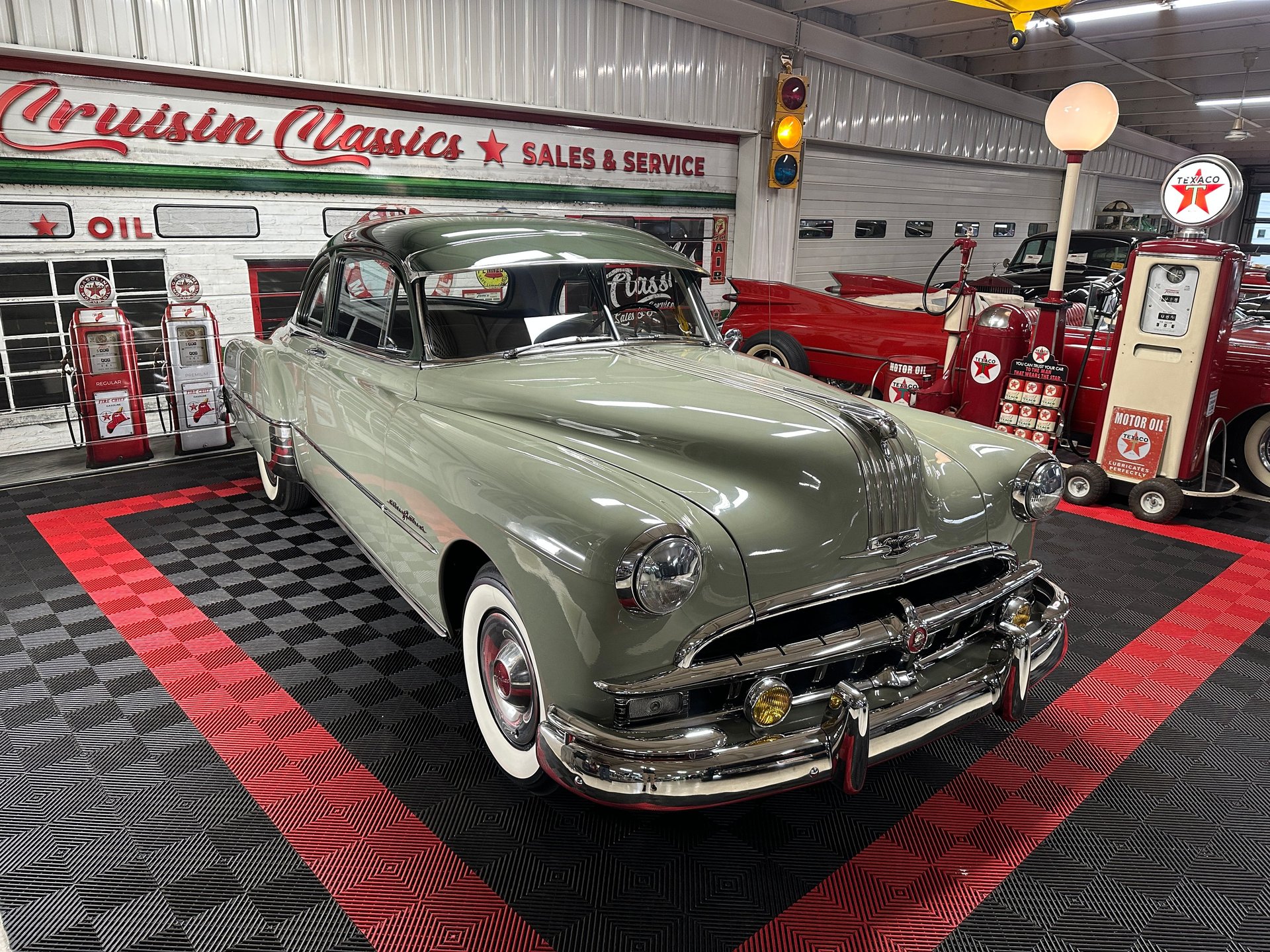
Then, for 1955, Pontiac changed everything at once. The straight-eight went out and the Strato-Streak V8 came in — a modern overhead-valve V8 of 287 cubic inches that made the Chieftain a genuinely fast car for the first time — and with it came a new chassis, an open driveshaft in place of the old torque tube, twelve-volt electrics, and styling that made the 1954 car look a generation old overnight. The V8 then grew almost every year — 316 cubic inches for 1956, 347 for 1957 with the famous Tri-Power option of three two-barrel carburettors, and 370 for 1958, the final year, when the Bonneville became a series of its own above the Star Chief and the Chieftain gained quad headlamps and the most chrome Pontiac had ever fitted to one.
That ten-year span is the whole appeal and the whole trap of this model. A Chieftain can be a slow, stately flathead sedan that cruises at fifty-five, or a Tri-Power V8 hardtop that will run with almost anything on the road in 1958. The two cars share a name and a badge and almost nothing else. Buy the car for what it actually is — year, engine, body and transmission verified against the plates — and you will get one of the most usable full-size classics of the decade.
Our own pool reflects that spread. Of the thirteen Chieftains filed on Classic Listings, twelve are for sale and one is sold, and the years run from a single 1949 car through to a single 1958 car, with the heaviest clusters in 1953 — three cars — and in 1955 and 1956, with two cars each. The photo evidence is worth taking seriously: of the seven cars whose photo notes we examined, rust is mentioned in five and damage in five, while smoke and leaks are mentioned in none — which is why the rust section of this guide is the longest one in it.
The models
Every Chieftain is a full-size Pontiac — a big six-passenger car on Fisher bodies, sold to buyers who wanted more car than a Chevrolet and less money than a Buick or an Oldsmobile. Within that footprint the range splits three ways, and you need to know which split you are looking at before you talk about price: by year and engine, by body style, and by trim. A 1949 De Luxe four-door sedan with a straight-eight and a manual gearbox is a different purchase from a 1957 Tri-Power Catalina hardtop with Hydra-Matic, and the market prices them as different cars. Production figures are not broken out by Chieftain sub-model in any published source this guide can stand behind, so the table gives you years, engine and output — the facts a buyer can verify on the car. Do not let a seller fill the production gap with a rarity claim you cannot check.
| Model | Years | Engine | Output | Built | Character |
|---|---|---|---|---|---|
| Chieftain De Luxe sedan | 1949–1954 | 248.6 straight-eight | 90–122 hp | — | The core car; stately, smooth, slowest |
| Chieftain Super De Luxe | 1949–1954 | 248.6 straight-eight | 90–122 hp | — | Better trim, same running gear |
| Chieftain Catalina hardtop | 1950–1954 | 248.6 straight-eight | 102–122 hp | — | Pillarless glamour, eight-cylinder pace |
| Chieftain convertible | 1949–1954 | 248.6 straight-eight | 90–122 hp | — | Rarest early body; check for a correct top |
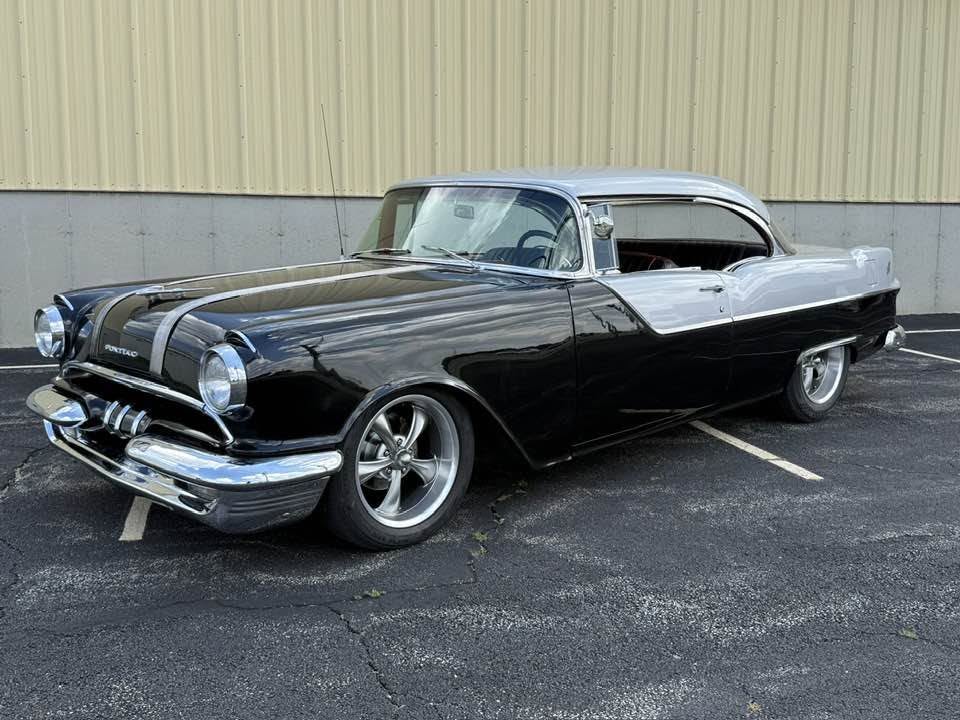
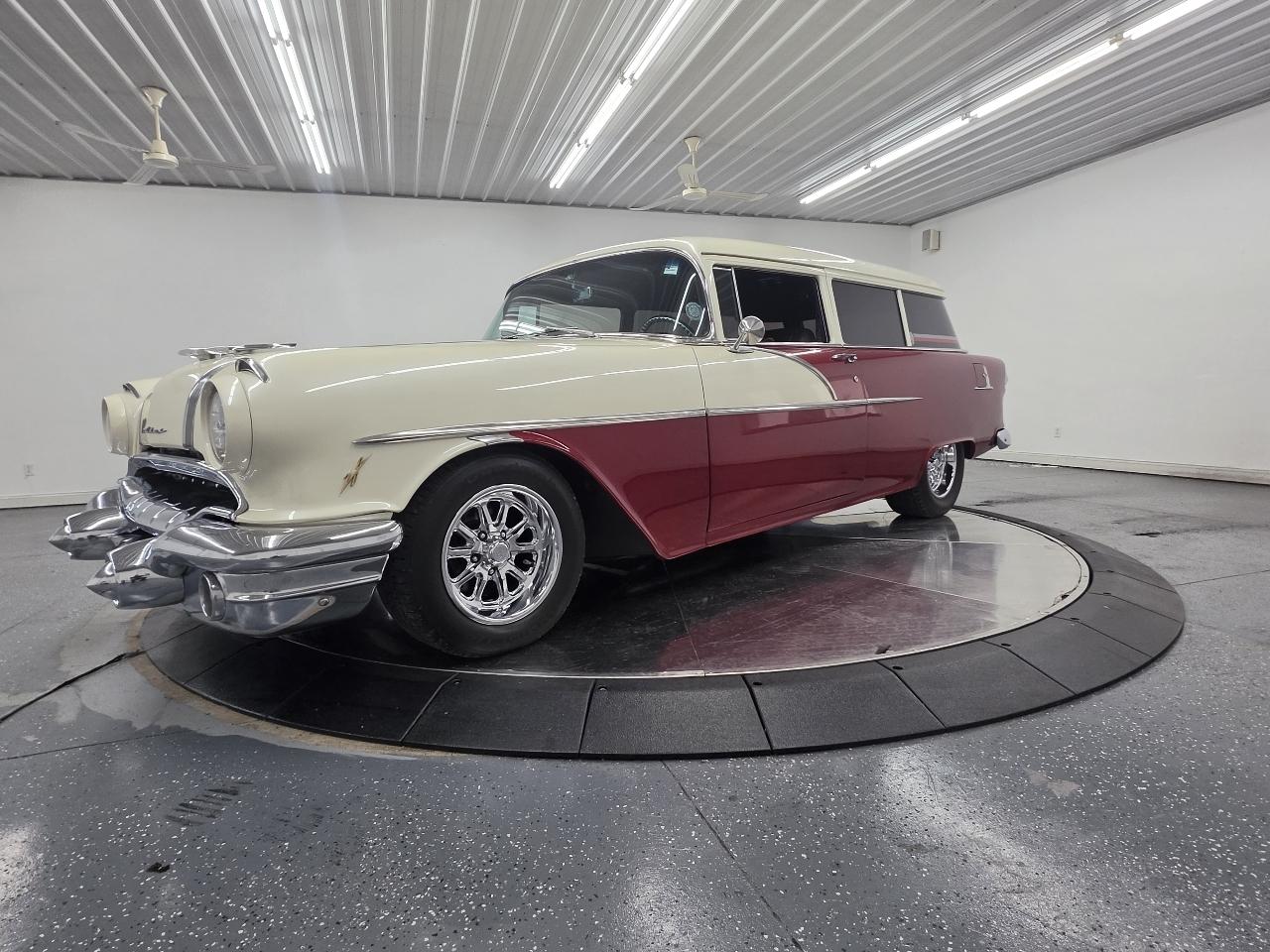
| Chieftain station wagon | 1949–1954 | 248.6 straight-eight | 90–122 hp | — | Wood-trim early cars; rot in the tailgate |
| Chieftain De Luxe sedan | 1955–1958 | Strato-Streak V8 | 173–270 hp | — | The volume V8 car; the default buy |
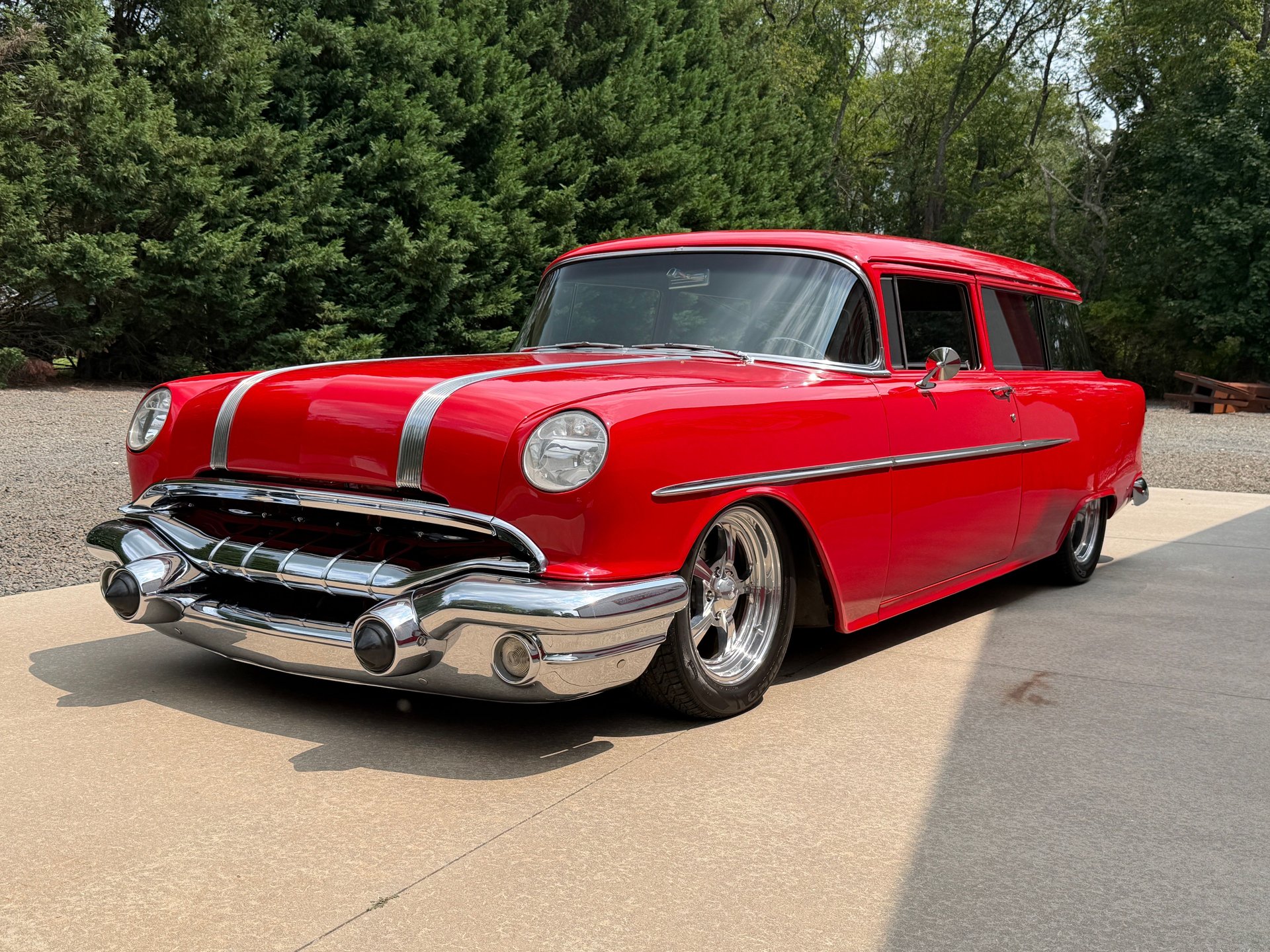
| Chieftain Catalina hardtop | 1955–1958 | Strato-Streak V8 | 173–300 hp | — | The desirable V8 body; Tri-Power cars live here |
| Chieftain convertible | 1955–1957 | Strato-Streak V8 | 173–290 hp | — | Open V8 car; scarce and dear to restore |
| Chieftain station wagon | 1955–1958 | Strato-Streak V8 | 173–270 hp | — | Safari wagons; check the tailgate and floor |
(Outputs are period gross horsepower figures as Pontiac published them. The straight-eight rose from 90 hp in 1949 to 122 hp by 1954; the V8 figures span the two-barrel base engine to the Tri-Power top option in each year. Treat any seller's horsepower claim above the top figure for its year as a modified car until the carburation and the engine code prove otherwise.)
The straight-eight cars, 1949–1954. These are the Chieftains most people picture: upright, chrome-laden, unhurried. The De Luxe was the standard car and the Super De Luxe added trim — more chrome, better upholstery, a clock — on identical mechanicals, so trim is the only thing you are paying for between the two, and it is the first thing to verify, because Super De Luxe badges are easy to fit to a De Luxe car. The Catalina hardtop, introduced for 1950, is the pick of the early range: a pillarless coupe body with the straight-eight's smoothness. Convertibles are the rarest early Chieftains and the most expensive to restore correctly — the top mechanism, the boot and the interior trim are all Chieftain-specific — so a convertible that looks like a bargain usually has a top or trim bill hiding in it. The early station wagons are charming and practical, but the tailgate, the rear floor and the wood trim on the first cars are the rot points.
The V8 cars, 1955–1958. The 1955 cars are the hinge of the whole model: same name, new everything, and the cheapest way into the V8 Pontiac story. The 1956 cars look similar but carry the bigger 316 engine and the Strato-Flight Hydra-Matic. The 1957 cars are a full restyle — longer, lower, wider, with a wraparound windshield and fins — and the 1958 cars, the last Chieftains, are the most flamboyant of all, with quad headlamps, more chrome and the 370 engine. Within the V8 years the Catalina hardtop is again the desirable body, and it is where the Tri-Power cars are found; the premium follows the body as much as the carburation. The Super Chief, introduced for 1957 above the Chieftain, is not a Chieftain at all — it is a separate series — so a Chieftain wearing Super Chief trim is a dressed car until the body plate says otherwise.
What the pool actually holds. The thirteen cars in our pool skew toward the middle of the run: three 1953 cars, two each from 1955 and 1956, and one each from 1949, 1950, 1952, 1954, 1957 and 1958. Black is the commonest recorded colour with four cars, red next with three, and single cars in black over silver, blue and green. Eight of the thirteen came from dealers and five from Facebook Marketplace, and the recorded transmissions are overwhelmingly automatic — nine of the ten cars that record a transmission at all. Only one manual is recorded in the whole pool. If you want a 1957 or 1958 Tri-Power hardtop, you are shopping in a market of one or two cars at a time.
Engines and gearboxes
The straight-eight: the 248, 1949–1954
The engine that defines the first half of this model is Pontiac's 248.6 cubic inch flathead inline eight — an L-head design, meaning the valves sit in the block beside the cylinders rather than in the head, that Pontiac had been building in one form or another since 1933. It is a long, heavy, understressed engine designed for smoothness rather than speed, and it delivers exactly that: a flat torque curve, and a willingness to pull from walking pace in top gear that no V8 of the period quite matches. Output rose across the Chieftain years as Pontiac raised compression and improved the breathing — from 90 horsepower in 1949, through roughly 102 to 108 horsepower in the early fifties, to 122 horsepower in the final 1954 form — but no straight-eight Chieftain is a fast car. Expect a comfortable cruise in the mid-fifties and acceleration best described as stately. If you want pace, buy a V8 car. If you want the authentic Silver Streak experience, this engine, correctly set up, is a delight.
The fuel system is a single two-barrel downdraft carburettor — a Carter or Rochester unit depending on year — and it is simple, rebuildable and well supported. Ignition is a Delco-Remy distributor with points, and the electrics are six-volt with a generator. Six volts matters in two ways. First, starting: a six-volt system turns the engine slowly even when everything is right, and very slowly indeed when the battery cables are tired, the earth straps are corroded or the starter is worn — so a slow crank is a system to test, not a verdict on the engine. Second, conversions: a car converted to twelve volts has usually been converted for a reason, and a badly done conversion creates faults that take hours to untangle. A correct six-volt car with clean cables, a healthy battery and a rebuilt starter is perfectly usable. Ask which you are buying.
A healthy straight-eight starts readily, idles with a soft, even burble, pulls cleanly without hesitation, and shows steady oil pressure. The checks that price one are specific. Listen for a deep knock from the bottom end at a hot idle — main bearing wear on an engine this old is an engine-out job. Watch the temperature gauge on a run, not just at idle: the long block and head are prone to local overheating if the radiator core is silted, and a car that runs hot in traffic but cool on the road is telling you the radiator wants money first, not the head gasket. Check for oil in the coolant and coolant in the oil, the classic head-gasket tells, and check the exhaust manifold for cracks — the long cast manifold expands over a long span and cracks with age and uneven tightening, ticking when cold and quieting as it warms. Valve adjustment is mechanical, not hydraulic, on the flathead, so a top-end rattle that does not fade is tappets that need setting. None of this is exotic. A straight-eight run regularly on fresh oil, with a clean cooling system and a rebuilt carburettor, will outlast its owner. One that has sat for a decade will need the fuel system cleaned end to end — tank, lines, pump and carburettor — before any other diagnosis means anything, because varnish and rust from old fuel imitate every other fault this engine can have.
Identity matters here as much as condition. The straight-eight was also sold in the cheaper Streamliner and in the 1954 Star Chief, so an engine number alone does not prove a Chieftain. What proves the car is the combination of the serial plate, the Fisher body plate on the firewall with its style, paint and trim codes, and the body style itself. A 1954 car with a V8 under the hood is a conversion — Pontiac built no V8 in 1954 — and a 1949 car with a V8 is the same conversation in reverse. Conversions are not automatically bad cars, but they are worth conversion money, not original-car money.
The Strato-Streak V8: 287, 316, 347 and 370, 1955–1958
For 1955 Pontiac replaced the eight with an engine that changed the marque: the Strato-Streak V8, a modern overhead-valve design with a short stroke and a deep-skirt block that made it strong and tunable. In its first form it displaced 287.2 cubic inches and was rated at 173 horsepower with a two-barrel carburettor and 180 horsepower with a four-barrel. It grew to 316.6 cubic inches for 1956, rated at 192 horsepower with a two-barrel and 205 horsepower with a four-barrel. For 1957 it grew again to 347 cubic inches — 252 horsepower in base form, higher with a four-barrel, and 290 horsepower with Tri-Power — and for 1958 it reached 370 cubic inches, with figures running from 240 horsepower for the base two-barrel car to 300 horsepower for the Tri-Power car. The Bonneville's fuel-injected 370, rated higher still, was never a Chieftain engine: a fuel-injected Chieftain is a conversion or a misdescription, full stop.
Carburation is where the V8 Chieftain splits into cars you can run on a budget and cars you need to price carefully. The base two-barrel cars use a single Rochester two-barrel — simple, cheap to rebuild at $250–500, and entirely adequate. The four-barrel cars use a Rochester or Carter four-barrel, at $400–800 rebuilt properly. Tri-Power is the headline: three Rochester two-barrel carburettors on a dedicated manifold, the centre carburettor doing the work in normal driving and the outer pair opening under load, offered for 1957 and 1958. A correct Tri-Power setup — manifold, three matched carburettors, linkage and air cleaner — is a valuable and much-copied assembly. Clone setups built from mismatched parts are common, and they run, but they are not worth genuine Tri-Power money. Check the manifold casting, check that the three carburettors are a matched set, and check the engine code stamped on the machined pad at the front of the block, ahead of the right-hand cylinder head: the code identifies the year, displacement and transmission combination the engine was built to, and a Tri-Power premium not supported by the code and the hardware is a premium you should not pay. A full professional Tri-Power rebuild and setup runs $1,200–2,500 — and a Tri-Power car that idles badly and stumbles on transition is almost always a linkage and sealing problem, not a reason to condemn the engine.
On the road a healthy Strato-Streak should start instantly, hot or cold, idle evenly, and pull hard without smoke. Blue smoke on start-up that clears points to valve stem seals — a known, fixable job. Blue smoke under load is rings or bores, and that is an engine-out conversation at $4,000–8,000 for a proper rebuild with machining. A top-end tick that fades as the engine warms is usually a lifter or an exhaust leak at the manifold face; a tick that stays is a valvetrain inspection before you agree a price. Cooling is the V8's other watch item: these engines make real heat, and a car that creeps up in traffic wants a radiator recore at $600–1,200 and a thermostat test before anyone sells you a head-gasket job. As with the eight, a car that has sat needs its fuel system cleaned before diagnosis, and modern ethanol fuel attacks the old rubber in the system, so budget for fuel hoses and a pump diaphragm in ethanol-resistant material on any car you recommission.
Gearboxes: Hydra-Matic and the three-speed manual
Most Chieftains you will meet are automatics, and the pool confirms it — nine of the ten cars that record a transmission are automatic. There are two Hydra-Matic generations to learn. The early cars, 1949 to 1955, use the original Hydra-Matic: a four-speed automatic with a fluid coupling rather than a torque converter, famous for firm, deliberate shifts. It has no park position on the early cars — you park in reverse with the engine off and the handbrake on — which surprises every first-time driver and is correct behaviour, not a fault. The later cars, from 1956, use the Strato-Flight Hydra-Matic, a smoother development with a controlled-coupling design. Both boxes are strong when maintained and expensive when neglected: a full specialist rebuild runs $2,500–4,500, so the test drive matters. Changes should be firm and clean without flaring, and the fluid should be red and sweet-smelling, not brown and burnt. A box that slips or delays engagement is a rebuild priced into your offer, not a fluid change waiting to cure it.
The manual alternative is a three-speed column-shift gearbox, with synchromesh on the upper ratios, and it suits both engines well. Only one manual is recorded in our thirteen-car pool, so expect to wait for one. Judge a manual on second-gear synchromesh, which wears first, on clutch judder pulling away, and on a gearbox that jumps out of top under load — a gearbox-out job at $1,200–2,500 with the clutch. Overdrive was offered on manual cars in some years and is worth having for touring: check that it engages and disengages cleanly. On any Chieftain, check the linkage as carefully as the box itself — worn column linkage makes a sound gearbox feel broken, and it is a $150–400 fix.
Problem areas
Everything in this section is drawn from the cars themselves — from the photographs sellers publish and from the photo notes on the cars in our own pool. The headline figure should set your expectations before you travel to see any Chieftain: of the seven cars whose photo notes we examined, rust is mentioned in five and damage is mentioned in five. Smoke and leaks are mentioned in none, which tells you the mechanicals present well in photographs — and nothing at all about how they run. Rust and damage are what the camera can see, and on this model they decide whether a car is a purchase or a project. Work through the body first, the mechanicals second, and the trim third, every time.
Rust: the map
Rust on a Chieftain follows the water, and on a car styled with this much chrome and this many sealed seams, the water has had seventy years to find its routes. Work through the car in this order, and do not skip the underside: a Chieftain can present beautifully from standing height and be structurally finished underneath, and sellers' photographs rarely include a single underside shot.
Rocker panels and sills. The single most important check on any Chieftain. The rockers are structural, they trap mud and road salt thrown up by the front wheels, and they rot from the inside out, so by the time blistering shows in the paint the inner structure is usually worse. Press hard along the full length of each rocker, crouch and look at the underside seam, and be suspicious of fresh underseal, fresh paint low on the car, or stainless trim that sits slightly proud — all three are classic ways to dress a rotten rocker for a photograph. A rocker cut out, welded and painted properly runs $1,000–2,500 per side. Prod with a screwdriver, with the seller's permission. Sound metal rings; rotten metal crunches and gives.
Floor pans. Water enters past the windshield seal, the cowl vents and the heater box, and sits under the carpets, where it rots the pans from the top down while the underside still looks presentable. Lift the carpets in all four footwells — insist on it — and prod the pans, especially the front footwells under the pedals. Surface rust is a clean, treat and seal job you can do yourself. Perforation is a welding job at $600–1,500 per side fitted, and floors almost never rot alone: treat floor perforation as a marker for the rockers, the cowl and the body mounts.
Trunk floor and spare wheel well. The rear window seal and the trunk seal leak with age, and the water collects exactly where you cannot see it — under the spare wheel and in the well corners. Lift the spare and the trunk mat on every viewing. Staining and surface rust are a clean-out and seal job. A perforated trunk floor is a panel replacement and paint at $800–2,000 done properly, and a well patched with flat sheet and filler, rather than a proper pressing, tells you how the rest of the car's repairs were approached. Check the tailgate and rear floor twice as carefully on a station wagon: a wagon with a rotten tailgate is a fabrication project, not a panel swap.
Frame, crossmembers and body mounts. The structural heart of the car, and the reason a lift inspection — $120–200 at a shop that will put the car up and let you walk under it with a torch — is the best money in this guide. Check the frame rails for perforation, especially at the crossmember junctions and where the rails kick up over the rear axle, and check the body mount points and the front crossmember. Cosmetic surface rust on a frame is normal and treatable. Perforation at a mount or a crossmember junction is fabrication work, priced per car, and it quickly exceeds the value of a cheap example. Learn to read underseal while you are under there. Honest old underseal is patchy — thin at the edges, chipped where stones have hit it. A uniform coat of fresh black stone-chip blown over everything the week before the sale is a cover-up until the seller proves otherwise.
The smaller traps. Door bottoms rot when the drain slots block and the doors fill with water — run a fingertip along the bottom edge of every door and check the drains are clear. Front fenders rust behind the front wheels where mud packs against the inner structure, and at the headlamp surrounds where the trim traps moisture. The cowl and windshield surround rust where the seal perishes, and that rust is expensive because it is structural and hard to repair invisibly. Rear quarters rust over the wheel arches, and on the 1957 and 1958 cars the elaborate chrome side trim hides the lower quarter behind brightwork nobody removes for a photograph — get a magnet, wrapped in cloth so it does not mark the paint, onto every lower panel. The battery tray rots under the battery, invisibly, and the acid track runs down the inner fender behind it: lift the battery out, or at minimum rock it and inspect the tray edges with a torch. None of these traps alone kills a car. Together they are the difference between a car that needs paint and a car that needs a body shop for a year.

Engine, cooling and fuel
The mechanical failure modes split cleanly by engine, and the two engines share only one of them — neglect. Any Chieftain that has sat for years, whatever its engine, needs the same recommissioning before any other fault-finding means anything: drain and clean the fuel tank, blow out or replace the fuel lines, rebuild the fuel pump with ethanol-resistant parts, rebuild the carburettor or carburettors, change every fluid, and inspect every rubber hose and seal. Budget $1,500–3,500 at a shop for that work done properly. A car recommissioned badly — fresh fuel poured into a dirty tank — will run for a week and then strand you with a blocked filter and a carburettor full of rust dust.
On the straight-eight, the specific traps are the cooling system, the exhaust manifold and the six-volt electrics already covered in the engine section, plus two more. The first is oil pressure that fades at a hot idle: check it on a fully warm engine after a run, not on a cold start in the seller's driveway, because cold thick oil hides worn bearings beautifully. The second is a head gasket that weeps rather than blows — a slow loss of coolant with no visible leak, emulsion under the oil filler cap on a car that only does short runs, bubbles in the radiator with the cap off and the engine running. A head-gasket job on the flathead, with the long head skimmed and the studs correctly torqued in sequence, runs $800–1,800 at a specialist.
On the V8, add valvetrain wear, timing-chain stretch and carburation to that list. A Strato-Streak with a sloppy timing chain shows it as a wandering idle and ignition timing that will not stay where you set it; the chain and gears are a $600–1,200 job with labour. Rochester carburettors wear at the throttle shafts, which leaks air, leans the idle mixture and produces the hunting, stalling idle that owners chase with mixture screws for years — the test is to wiggle the throttle shaft and feel for play, and the fix is a rebush during the rebuild, not a bigger idle jet. Tri-Power cars add the outer-carburettor sealing problem: outer carburettors that do not seal shut at idle make the car idle rich and lumpy, and the fault is linkage and base sealing, not the centre carburettor everyone rebuilds first. Cooling on the V8 is marginal in modern traffic if any part of the system is tired: a recore at $600–1,200, a correct shroud and a water pump without play in its bearing — grab the fan and rock it — will make a V8 Chieftain usable in summer. A V8 that overheats only at idle wants airflow; one that overheats at speed wants coolant flow or a head-gasket test.
Suspension, steering and brakes
A Chieftain's chassis is conventional for its era — independent front suspension with coil springs, a live rear axle on leaf springs, hydraulic drum brakes all round — and conventional means every wear item is understandable, available and priced in hundreds rather than thousands. What defeats buyers is the accumulation: a car that needs kingpins, springs, shocks, brake hydraulics and steering joints all at once is a $3,000–6,000 recommissioning bill wearing a cheap asking price, so inspect the chassis as a system and add the items up out loud.
Front suspension wear shows first in the kingpins and the control-arm bushings. Rock each front wheel top to bottom with the car jacked and feel for play; then grease the front end properly — these cars have grease points that want attention every thousand miles or so in period service — and judge the play again, because a joint starved of grease for a decade can feel worn and come back close to specification once it is actually lubricated. A specialist kingpin job, with the bushes pressed and reamed to fit, runs $700–1,400 per side. Coil springs sag with age, and a Chieftain that sits low at the front or lists to one side is usually springs and perished rubber seats, not a bent frame — measure the ride height side to side and write the numbers down. Rear leaf springs flatten and their shackle bushings perish, giving a tail-down stance and a thump over bumps; a replacement spring set fitted runs $600–1,200. Shock absorbers are cheap and almost always tired — budget a set on any car without a recent invoice.
Steering on the early cars is manual as standard, with power steering an option that became common on the V8 cars. Manual steering should be light at speed, heavy but smooth at parking pace, and free of a dead band at the straight-ahead: a wide dead band is a worn steering box or worn linkage joints, and you distinguish them by having a helper rock the wheel while you watch each joint in turn. Power steering adds a pump, a control valve and hoses to the leak list — check the fluid level, listen for pump groan on full lock, and inspect the hoses for weeping, because a power-steering overhaul runs $600–1,200. On either system, read the front tyres before you drive the car: wear on both edges is under-inflation or tired springs, wear on one edge is alignment or a bent component, and cupping is shocks.
Brakes are drums all round, single-circuit hydraulics on the early cars, and they are the one system where period charm stops and safety starts. A Chieftain that has sat will need a full hydraulic inspection: wheel cylinders weep with age, flexible hoses perish internally and can act as one-way valves that hold a brake on, and master cylinder bores corrode. A full brake refresh — cylinders, hoses, shoes, hardware, master cylinder and fluid, with the drums skimmed or replaced as needed — runs $900–2,000 with labour, and it is non-negotiable money on any car without a recent invoice for exactly that work. Power brakes, where fitted, add the booster: a hard pedal with the engine running, or a pedal that sinks slowly at a stop, is booster or master-cylinder money. Judge the handbrake separately, and on the early Hydra-Matic cars remember that the handbrake is also your parking brake in the true sense, because the gearbox has no park position to hold the car for you.
Interior, trim and electrics
The cabin is where a Chieftain's cost hides in plain sight, because the mechanicals are shared with millions of GM cars and the trim is not. Seat padding and springs collapse with age and use: sit in the driver's seat, not just the passenger's, because the driver's cushion goes first and once you can feel the spring frame through the pad you are pricing padding, springs and covering together at $400–900 per seat, and a full interior retrim in correct materials runs well into five figures on a hardtop or convertible. Headliners sag and stain where the roof has leaked — a stained headliner is a leak diary, so trace the stain back to the windshield seal or the rear window before you price it as a cosmetic job at $400–800 fitted. Door cards warp when their lower edges get wet, which they do when the door drains block, so a warped lower door card and a bubbled door bottom are the same fault seen from two sides.
Chrome and stainless trim are this model's glory and its budget trap. A Chieftain carries a great deal of brightwork — grilles, bumpers, side spears, window surrounds, the Silver Streak strips themselves — and re-plating is priced by the piece. A single bumper re-chromed properly runs $600–1,200; a full car's worth of show-quality plating runs into five figures and is the commonest reason a restoration stalls. Count the pitted, dented and missing pieces and price them before you buy, and pay particular attention to year-specific pieces: the 1957 and 1958 side trim, the Catalina brightwork and the Indian-head ornaments are the pieces the reproduction market serves worst, and a missing year-specific spear can take a year of swap meets to replace. Stainless can often be straightened and polished for $150–400 a piece where chrome would need plating, so learn to tell the two apart — stainless does not pit and bubble the way chrome over steel or pot metal does. Pot-metal pieces — handles, emblems, grille details — pit worst of all; heavy pitting there is a replacement hunt, not a plating quote.
Electrics divide by era. The six-volt straight-eight cars fail at connections and earths: dim lamps, slow wipers and a wandering fuel gauge are almost always corroded earth points and tired cables, cheap in parts and tedious in time, and the generator and regulator are rebuildable for $300–600. The twelve-volt V8 cars are conventionally reliable, with the same earth-point caveat. Test everything on a viewing, methodically: every lamp, the horn, the wipers on every speed, the heater blower, the radio and every window. A heater that does not blow is worth testing even in July, because the blower and the heater core live behind the dashboard and a core replacement is a labour-heavy job at $800–1,600 all in. A car where everything electrical works has usually been used and maintained rather than stored and forgotten, and on a Chieftain that pattern beats shiny and dormant every time.
How to inspect one
Allow at least an hour, bring a torch, a magnet wrapped in cloth, a screwdriver for prodding with the seller's permission, and a helper to rock the steering wheel while you watch. If the car passes you, pay for a lift inspection before money changes hands — on a Chieftain it is the best money in the whole purchase, because everything that decides this car's value lives underneath it.
- Start with the paperwork and the plates. Match the serial number on the title to the plate on the car, then read the Fisher body plate on the firewall: style, body number, paint and trim codes. The body plate is what proves a Catalina hardtop, a convertible or a particular trim level — badges prove nothing, because badges unbolt. Check the engine against the year while you are there: a straight-eight in a 1955 or later car, or a V8 in a 1954 or earlier car, is a conversion, whatever the seller calls it.
- Cold start. Insist the engine is cold when you arrive, and say so when you book the viewing. A straight-eight should crank slowly on its six-volt system but fire readily and settle to an even burble; a V8 should start at once, hot or cold. Watch the exhaust for the first thirty seconds — a puff of blue that clears is valve seals, blue that stays is rings or bores — and listen for a bottom-end knock as the oil pressure builds.
- Under the car, first, not last. Torch along both rocker panels, prod the seams and the jacking areas, then work through the floor seams, the frame rails, the crossmember junctions and the body mounts from the rust section. Perforation in rockers, mounts or rails is structural and it decides whether you continue at all. Read the underseal as you go: patchy and honest is age, a fresh uniform black coat is a question.
- Trunk and spare well. Lift the spare wheel and the mat. Look for water staining, perforation in the well corners and a damp smell, and check the rear window seal from inside while you are there. On a wagon, spend twice as long: the load floor, the tailgate aperture and the tailgate itself.
- Floors inside. Lift all four carpets. Prod the front footwells under the pedals and the rear footwells at their lowest points, and look for water tracks from the windshield base, the cowl and the heater box. Wet carpets in a car described as dry-stored mean leaking seals and rust already starting.
- Body, gaps and chrome. Run the cloth-wrapped magnet over the rockers, the lower doors, the front fenders behind the wheels and the rear quarters, especially behind the side trim on a 1957 or 1958 car. Filler announces itself where the magnet falls dead. Check every door bottom with a fingertip, lift the battery and inspect its tray, and then count the brightwork — every pitted bumper, spear, handle and emblem, priced as you go.
- Engine checks, warm. With the engine fully warm after a run, check oil pressure at a hot idle on the eight, read the dipstick level and colour, and look for bubbles in the radiator and emulsion under the filler cap. On a V8, wiggle the carburettor throttle shaft for wear, check the fan for water-pump bearing play, and on a Tri-Power car watch the outer carburettors as your helper opens the throttle — they should open together and seal shut again at idle.
- Kingpins, steering and stance. Jack the front, rock each wheel top to bottom, then have the car greased if the seller allows and judge the play again before you condemn a kingpin — the grease-first rule from the problem areas applies here in full. Have your helper rock the steering wheel while you watch each linkage joint. Then stand back and read the stance: level is correct, tail-down is tired springs, a list to one side is a spring or a mount, and any of them is a number in your negotiation.
- The test drive. Fifteen minutes minimum, including a stretch at fifty-five or better. An early Hydra-Matic should shift firmly and deliberately, with no flaring; a Strato-Flight should shift smoothly without slipping; a manual should engage second cleanly and pull away without judder. A straight-eight should pull from low speed without hesitation, a V8 should pull hard and clean. Brake firmly from speed more than once: the car should stop straight, the pedal should stay firm and high, and the handbrake should hold the car on a slope by itself.
- Heat, electrics and accessories. Let the car idle hot. Watch the temperature behaviour — creeping at idle is airflow, creeping at speed is flow or gasket — and then, whatever the weather, run the heater and blower on every speed. Work every lamp, the wipers, the horn, the radio and every window. A dead blower or a dead heater core is dashboard labour, and it belongs in the price.
- Interior last, from the driver's seat. Sit in every seat and feel for collapsed padding and spring frame, look at the headliner for the stains that map the leaks, and check the door cards at their lower edges for warping. A sound, original interior is the hardest part of a Chieftain to recreate, so weight it heavily.
- Add it up out loud. Rockers, floors, chrome, brakes, engine work, interior — list every item you have found with its cost range from the problem areas, in front of the seller, before you name a figure. A Chieftain bought with its bills already counted is a hobby.

Values
The figures that matter for this model are computed from this site's own listings and recorded sales, and they sit below this guide — the listed-now summary and the market block are refreshed every time the site rebuilds, so use them rather than any number quoted elsewhere. What follows is how to read them.
Our pool is thirteen cars: twelve for sale and one recorded as sold, weighted to the middle of the run — three cars from 1953, two each from 1955 and 1956, and single cars from six other years, with no 1951 car at all. Treat every figure in the market block as a sketch drawn from a handful of cars, not as a price index. A single exceptional car, or a single desperate project listing, can move a median for a year group by a large amount, and for the years represented by one car the figure is simply that car's asking figure wearing a median's clothes. The range matters more than the middle number, every time, for this model.
Within that range, condition does most of the pricing, and specification does the rest. The spread between the cheapest and the dearest Chieftain is not mainly a spread between years — it is a spread between a rusty project sedan that needs rockers, floors and chrome, and a sorted driver hardtop with a thick history file. Read any individual car against the condition spread first: where do its shell, its chrome and its interior place it, honestly, on the evidence of the inspection, not the description. Then apply the specification premiums, which are real but smaller than sellers claim. The Catalina hardtop carries a premium over the sedan in both eras. The V8 cars carry a premium over the straight-eight cars of equivalent condition, because they are faster and more usable in modern traffic. Tri-Power carries a further premium when — and only when — the manifold, the matched carburettors and the engine code all support it. Convertibles carry the largest body premium and the largest restoration risk at the same time, which is why their spread is the widest of all.
Two cautions apply to every figure you read. These are asking figures, not achieved figures — sellers routinely ask more than the market pays, hold out through a season, and settle quietly for less, and with only one recorded sale in the pool there is no achieved-price record here deep enough to correct the asking figures against. And the project-versus-driver gap on this model is wider than the headline spread suggests, because the costs that separate them — rocker and floor welding, a full brake refresh, chrome — are exactly the costs the problem areas price. A car priced in the middle of the band with a sound shell and a history file is almost always better value than the cheapest example of a dearer specification. There is no such thing as a cheap Chieftain that stays cheap.
Parts and ownership
The Chieftain is one of the better-supported American cars of its decade: Pontiac built a great many of them, the mechanicals are shared across the Pontiac range and in many cases across General Motors, and a strong club and specialist trade supports the Silver Streak and early V8 cars. What it is not is a Chevrolet. Trim and year-specific body parts follow Pontiac volumes, not Chevy volumes: the running gear is easy, the jewellery is not.
Easy: service items for both engines — filters, plugs, points, condensers, belts and hoses — brake shoes, cylinders, hoses and hardware, suspension wear parts including kingpin kits, water pumps, exhaust systems in standard form, glass rubbers and weatherstrips, carburettor rebuild kits for the two-barrel and four-barrel cars, and Hydra-Matic service parts. Order today, fit this weekend, at prices close to modern-car money. A routine service runs $200–400 in parts and your own labour, or $400–700 at a shop that knows old cars.
Harder and dearer: Tri-Power hardware, above all a correct manifold and a matched set of carburettors with linkage; straight-eight exhaust manifolds without cracks; year-specific chrome and stainless side trim, worst of all for 1957 and 1958; Catalina brightwork and window seals; convertible top frames, mechanisms and correct trim; station wagon tailgates and load-floor panels; pot-metal emblems and handles in restorable condition; and six-volt electrical components in quality form. None of it is unobtainable — swap meets, club classifieds and Pontiac specialist breakers turn most of it up eventually — but eventually is measured in seasons, not weekends. A quality repaint in a correct colour starts around $8,000–12,000, which is why this guide's mantra is to buy the body, the chrome and the interior, and fix the mechanics.
Running costs. A sorted Chieftain is a realistic regular-use classic. The straight-eight returns fuel economy in the mid-teens, the V8 a little less, and both will cruise at modern secondary-road speeds all day if the cooling system is right. Insurance is in line with other full-size American cars of the value. The budget line that catches new owners is the first year: catching up deferred maintenance on a running car honestly costs $2,000–5,000 before you improve anything, and recommissioning a car that has sat for years runs $4,000–8,000 at a shop once the fuel system, brakes, tyres and seals are done properly. Tyres deserve their own line — a car on old rubber needs a set before it needs anything else, at $800–1,400 fitted — because aged tyres on a two-ton car are a safety item, not a cosmetic one. Buy a car that has been in regular use over one that has been asleep, even at a higher price, and join the club: its technical knowledge and classifieds are worth more than any single part you will buy.

Which one to buy
- The all-rounder: a 1955 or 1956 De Luxe sedan with the V8 and Hydra-Matic. The best-supported, most usable Chieftain there is — modern pace, twelve-volt electrics, parts everywhere. If you want one Chieftain to drive and enjoy, this is it.
- The value buy: a straight-eight sedan, 1952–1954. Mechanically simple, smooth, charming, and priced gently because buyers chase the V8s. A sorted late straight-eight car with a sound shell is the cheapest route into a good Chieftain — just make sure the cooling system and the six-volt electrics have already had their money spent.
- The charmer: a 1949 or 1950 Chieftain. First-year and second-year cars with the full Silver Streak treatment and the lit Indian head. Slow, stately and completely distinctive. Buy the best shell you can find, because early trim is the hardest to replace.
- The collector car: a 1957 or 1958 Catalina hardtop with Tri-Power. The flagship specification of the final years, priced like one when it is right. Verify originality ruthlessly — manifold, matched carburettors, engine code, body plate — because a cloned or rusty example is worth a fraction of a correct car.
- The family car: a Chieftain station wagon. Six passengers, a load floor, and the most practical body in the range. Check the tailgate and rear floor twice as hard as you check a sedan's trunk.
- The brave buy: a convertible, either era. The rarest body and the largest restoration risk in the range. Only buy one that is complete — top frame, mechanism, boot and trim all present.
And the rule that overrides all of the above: buy the least rusty, most complete car you can find, in the specification you can live with. Engines, gearboxes, brakes and carburettors are all fixable at prices you can plan for. A rotten shell and a missing set of year-specific chrome cost more to put right than the finished car will be worth — and they are the two things about a Chieftain that can never be made original again.
See the 6 chieftain cars currently listed.