
Plymouth Road Runner buyer's guide
Plymouth Road Runner -- the model's own buyer's guide: variants, values and what to check.
Years listed: 1968-1975 · Series: B-Body
Overview and history
The Plymouth Road Runner is the muscle car reduced to its essence — and that was exactly the point. By 1967 the muscle market had drifted upmarket: Plymouth's own GTX, Pontiac's GTO and their rivals had become trimmed, optioned and expensive. Plymouth product planner Joe Sturm and his team saw the gap underneath them. Their answer, launched for 1968, was a car that spent its money in one place only — the drivetrain and the chassis hardware needed to survive it — and saved everywhere else. A big-block V8, heavy-duty suspension and brakes, a bench-seat interior with rubber mats in place of carpet on early cars, a taxicab-spec cabin, and nothing else you did not need to go fast.
The name came from the Warner Bros. cartoon bird, and Plymouth paid a reported five-figure sum for the licensing rights — money repaid the first time a salesman demonstrated the horn. The dual-tone horn chirped "beep-beep," the bird appeared on the doors, the dash and the steering wheel, and a car that could have been a grim austerity special instead had a personality. It also had a price: the pillared coupe opened under three thousand dollars at a time when a Hemi GTX cost half as much again before options.
Underneath, the Road Runner is a B-body — Plymouth's intermediate platform, shared with the Belvedere, Satellite and GTX, and with Dodge's Coronet and Charger. That defines everything about the car: torsion-bar front suspension, a leaf-sprung live rear axle, a unit body with a bolt-on front subframe, and a parts base shared across one of the largest families of sixties American cars. Our own listings reflect that filing: every Road Runner we track — 99 cars, spanning 1968 to 1975 — sits in the B-Body series.
The formula landed instantly. Plymouth hoped for roughly 20,000 sales in 1968 and built about 44,300. For 1969 the range added a convertible and the mid-year A12 440 Six Barrel package, won Motor Trend's Car of the Year award, and peaked at about 81,000 US sales. Then the market turned: insurance surcharges on anything with a performance name, rising prices and tightening emissions rules cut 1970 sales roughly in half despite the arrival of the winged Superbird, and the redesigned 1971 car — the last year for the 426 Hemi and the 440 Six Barrel — sold about 14,200. From 1972 the Road Runner survived as a progressively softer coupe — still a B-body, merged with the GTX badge for its last big-engine years, rebodied onto the Fury line for 1975, and finally a graphics package on the compact Volaré. Those later cars are in this guide because they are in the market, but be clear-eyed: the Road Runner the world collects is the 1968–71 car, and the guide's weight follows the demand.
What defines a Road Runner today is the spread between those two facts. It was built in large numbers as a cheap car, used hard by young owners, drag-raced, crashed, rusted and parted out — and the survivors divide sharply into documented, numbers-matching performance cars at the top and everything else below. Because the difference between a genuine 383 car and a genuine Hemi car is one digit in the VIN and a large multiple in value, and because a Satellite can be dressed as a Road Runner with a weekend's work, identity checks matter more on this model than on almost any other American car of the era.

The models
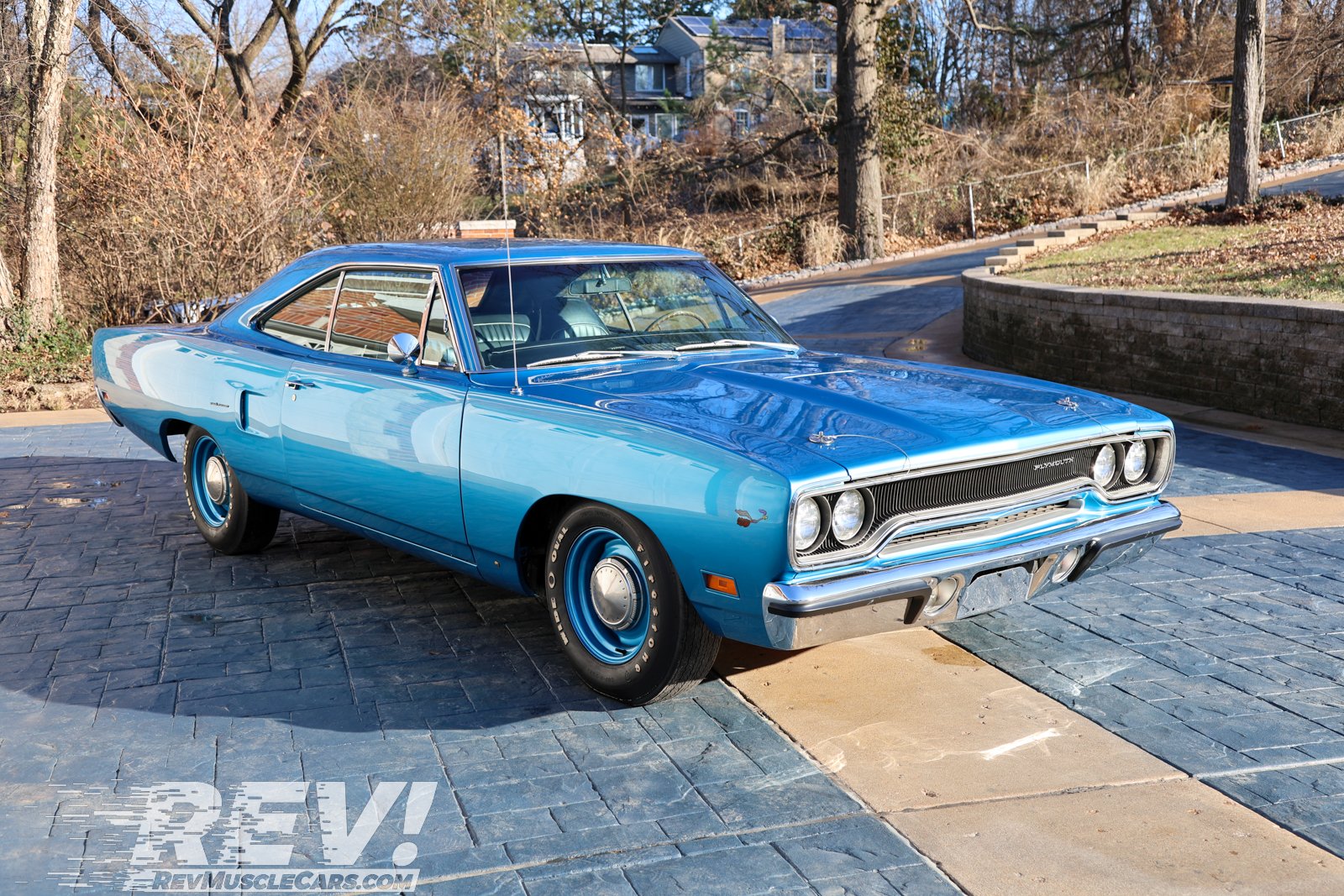
Every Road Runner is a two-door B-body. The range divides into three eras: the original 1968–70 cars on the first shell, the rounded "fuselage" 1971–74 cars, and the one-year 1975 Fury-based car. Within the first era the body choice is coupe (with a B-pillar — the "post" car), hardtop (no pillar), and, for 1969–70 only, convertible. The post coupe is the lightest, stiffest and cheapest shell, and period racers preferred it; the hardtop is the prettier car and the one most buyers picture.
The badge never told you the engine — the VIN does, and the models section of any Road Runner conversation is really an engine conversation. The table below is organised by the versions that matter in today's market. Outputs are period SAE gross ratings for the early cars; from 1972 Chrysler published net ratings, which is why the later figures fall off a cliff on paper even where the hardware changed less than the numbers suggest. Production figures are given only where they are reliably documented.
| Model | Years | Engine | Output | Built | Character |
|---|---|---|---|---|---|
| Road Runner 383 | 1968–1971 | 383 Magnum big-block, 4-barrel | 335 hp (300 hp in 1971) | The volume car — most of roughly 183,000 built 1968–71 | The standard Road Runner; fast, simple, the market's core |
| Road Runner 426 Hemi | 1968–1971 | 426 Hemi, twin 4-barrels | 425 hp | 2,003 across four years | The flagship; rare, expensive, documentation is everything |
| Road Runner A12 440 Six Barrel | 1969 (mid-year) | 440 Six Barrel, 3×2-barrels | 390 hp | 1,412 | The drag package: lift-off hood, Dana 60, 4.10 gears |
| Road Runner 440 Six Barrel | 1970–1971 | 440 Six Barrel, 3×2-barrels | 390 hp (385 hp in 1971) | 1,815 in 1970; 246 in 1971 | The Six Barrel as a regular option; hood scoop cars |
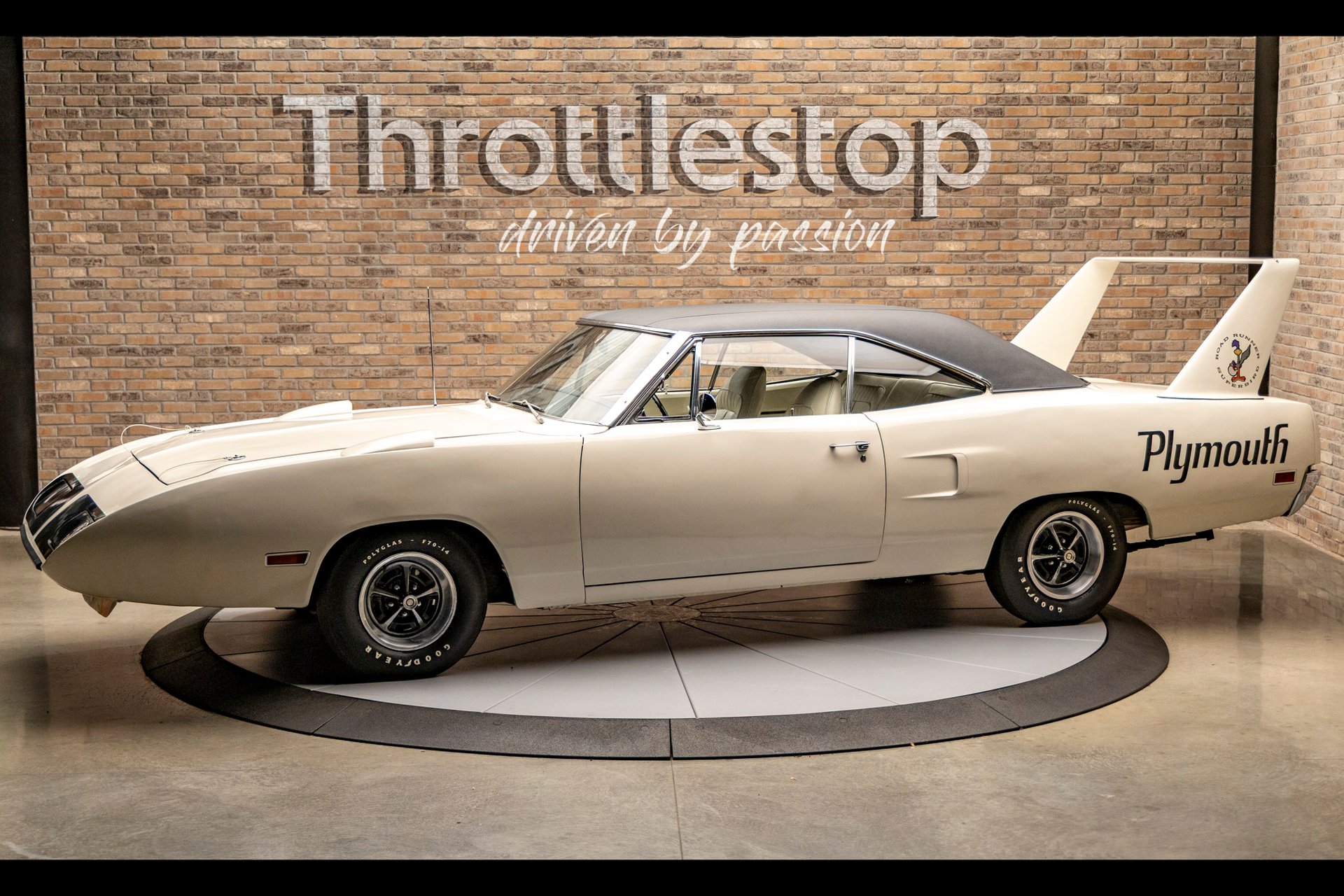
| Road Runner Superbird | 1970 | 440 Super Commando, 440+6 or Hemi | 375 / 390 / 425 hp | 1,935 for the US | NASCAR homologation special; nose, wing, vinyl roof |
| Road Runner 340 | 1971–1973 | 340 small-block, 4-barrel | 275 hp gross; 240 hp net from 1972 | 1,681 in 1971 | The insurance-era answer; light, revvy, underrated |
| Road Runner (fuselage era) | 1972–1974 | 318, 340, 360, 400 or 440 V8s | 170–280 hp net | About 28,000 across 1972–74 | Softer, heavier, cheaper; the 440 cars wear GTX badges too |
| Road Runner (Fury-based) | 1975 | 318, 360 or 400 V8 | 150–235 hp net | 7,183 | One year on the big Fury shell; a nameplate in transition |
1968: the original. Two bodies — the pillared coupe at launch, a hardtop added during the year — and two engines: the 383 Magnum as standard and the 426 Street Hemi as the sole performance option. About 44,300 were built against a 20,000 forecast, and the car embarrassed Plymouth's own GTX, which cost more and, in 383 terms, went no faster.
1969: the peak. A mild facelift, rectangular side markers, a convertible added (roughly 2,500 US cars across 1969–70, making it the rarest regular body), and in February 1969 the A12 package: the M-code 440 Six Barrel engine, a matte-black fibreglass lift-off hood with a huge scoop, a Dana 60 rear axle with 4.10 gears, heavy-duty everything and plain steel wheels. Just 1,412 A12 Road Runners were built — 615 post coupes and 797 hardtops — and they are the most single-minded factory street racers Plymouth ever sold. Hemi production that year was 787 cars. Total Road Runner output peaked at about 84,400 including exports.
1970: the last flourish. New sheet metal with a loop front bumper, an optional Air Grabber hood whose scoop rose from the hood at the pull of a dash switch, the 440 Six Barrel promoted to a regular option (1,815 cars), and the Superbird. The Superbird existed to satisfy NASCAR's homologation rule and lure Richard Petty back from Ford: a Road Runner hardtop fitted with an 18-inch nose cone, a head-high rear wing, a flush rear window plug under a mandatory vinyl roof, and a choice of 440 four-barrel, 440 Six Barrel or Hemi. Plymouth built 1,935 for the US market. They were hard to sell new — some sat on lots into 1971 — which is precisely why genuine, documented cars are so sought after now. The convertible died after 1970, and total production fell to about 43,400.
1971: the fuselage car, and the last of the giants. An all-new rounded body and the best-handling chassis of the run — but the market had gone. The Hemi (55 cars) and 440 Six Barrel (246 cars) bowed out at the end of the year, the 383 dropped to 300 hp as compression fell, and a 340 small-block joined the range as the insurance-friendly option. About 14,200 were built. A good 1971 is genuinely underrated: rarer than a 1969, better finished, and the last year of the full menu.
1972–75: the long fade. From 1972 the big-block option effectively made the car a Road Runner GTX — both badges on one car — and ratings went net: the 400 big-block became the standard performance engine, the 440 the top option. The 1973–74 cars gained the isolated "Torsion-Quiet" chassis revisions and heavier impact bumpers, with a 318 two-barrel as the base engine, which tells you where the market had gone. In 1975 the name moved onto the full-size Fury body for one year (7,183 built) before becoming a Volaré option package. These cars are honest, usable and cheap relative to the early ones — buy them as cruisers, not as investments, and check the same rust map as any B-body.
Two identity facts frame everything that follows. First, the Road Runner's VIN begins RM — R for the B-body Plymouth line, M for the Road Runner's medium price class — followed by two digits for the body (21 coupe, 23 hardtop, 27 convertible) and a fifth digit that names the original engine. A car whose VIN starts RS is a GTX, RP a Satellite, RH a Belvedere — and a "Road Runner" with any of those prefixes is a clone, whatever the decals say. Second, the fender tag — the stamped metal plate on the driver's-side inner front fender — and the broadcast sheet, the paper build record often found tucked in the rear seat springs, between them document how the car actually left the factory. On a 383 car their absence is a negotiating point; on a Hemi, A12 or Superbird it is a serious value question.


Engines and gearboxes
The 383 Magnum: the standard engine
The 383 is a Chrysler B-series big-block: a short-deck wedge-head V8 of 383 cubic inches, and in Road Runner tune — badged Magnum at Plymouth, with a Carter AVS four-barrel carburettor, a performance camshaft, dual exhausts and 10:1 compression in 1968–70 — it was rated at 335 hp and 425 lb-ft of torque. It is the engine the car was designed around, and it suits it perfectly: strong from idle, happy to rev to 5,500 rpm, mechanically simple, and built from some of the most durable cast iron Detroit ever poured. The 383's bottom end is famously understressed; a standard engine that has had oil changes will outlast the body around it.
What to listen and look for: a healthy 383 starts on the button hot or cold, idles with a slight lope (the Magnum cam is not a luxury-car grind) and pulls cleanly without blue smoke. Blue smoke at start-up that clears is valve stem seals — a weekend job with the heads on. Smoke under load is rings or bores, and that is a rebuild conversation. Hydraulic lifters that tick for a few seconds from cold and quieten are normal; a lifter that never quietens, or a deep knock that follows rpm under load, is not. Oil leaks are a given at this age — the rear main seal and the valley pan ends are the usual sources — and are a haggling point rather than a verdict, provided the oil itself is clean and the level honest.
The 1971 383 dropped to 300 hp as compression fell for low-lead fuel, and feels softer than the earlier cars; much of that is tune and tired distributors rather than the engine itself. One period trap: the 383 is a B-block and the 440 an RB ("raised B") — taller and wider, with a visibly higher intake manifold and the engine ID pad in a different place. Sellers confuse the two, innocently and otherwise.
The 440: Magnum, Super Commando and Six Barrel
The RB 440 is the big brother — same wedge-head architecture on a taller block, and the strongest torque producer of the regular-production engines. In the Road Runner you meet it three ways. The 440 Super Commando four-barrel (375 hp, Carter AVS) was the Superbird's base engine and was otherwise GTX territory. The 440 Magnum is the same basic engine under Dodge naming. And the Six Barrel is the famous one: three Holley 2300 two-barrel carburettors — a centre carburettor for cruising and two vacuum-operated outboards that open under load — on an aluminium Edelbrock manifold in the 1969 A12 cars and a Chrysler cast-iron manifold thereafter, rated 390 hp and 490 lb-ft.
The Six Barrel's road manners surprise people: on the centre carburettor alone it is docile and reasonably economical, and then the outboards open and the car lunges. Its failure modes are equally specific. The outboard carburettors are opened by a vacuum diaphragm signal, not a mechanical linkage, so a perished diaphragm, a split signal hose or gummed pivots on a car that has sat means the outboards open late, unevenly or not at all — the car feels flat and the owner blames the engine. Sticking outboard throttle plates from stale fuel varnish are the other classic. A Six Barrel that runs sweetly on the centre carb but stumbles at full throttle is usually a carburettor-service bill, not an engine bill: budget $600–1,200 for a proper three-carburettor strip, clean and set-up by someone who knows the system, and treat a car that has already had it — with an invoice — as worth a premium. Never let a seller "demonstrate" the outboards by revving a cold engine at a standstill; the test is under load, on the road, in the inspection drive.
The A12 version of the engine (M-code in the VIN) added heavy-duty internals — a forged crankshaft, heavy rods and a performance cam — and came only with the Dana 60 axle and 4.10 gears described below. A 1970–71 Six Barrel car (V-code) is mechanically near-identical in feel but was a normal production option with normal axle choices.
The 426 Hemi
The Street Hemi is a different engine entirely, not a tuned wedge: hemispherical combustion chambers, two Carter AFB four-barrels, solid lifters, a forged bottom end and a factory rating of 425 hp that period testing treated as a polite fiction. It is also a different ownership proposition. The Hemi wants its valve lash set (solid lifters — a maintenance item, not a fault), fresh fuel and regular use, its dual carburettors synchronised by someone who has done it before, and every part specific to it costs several times the wedge equivalent. A full professional rebuild of a genuine Hemi is a $25,000–40,000 conversation at a specialist; even a top-end refresh with correct parts runs well into five figures. Against that, a correct Hemi is mechanically robust when maintained — the failures that kill them are overheating, detonation on modern fuel at full advance, and neglect during long storage.
Two myths to bury. First, a Hemi Road Runner is not automatically the fastest car here in the real world: a well-tuned Six Barrel matches it to speeds you can use, which is why the A12 existed. Second, "Hemi" on the fender proves nothing at all: the value lives in the J-code (1968–69) or R-code (1970–71) fifth digit of the VIN, a matching-numbers block, and paperwork. Of the 2,003 Hemi Road Runners built across 1968–71, a meaningful share have lost their original engines to racing. A Hemi car with a period-correct but non-original engine is a fine thing to own and a very different thing to pay for.
The later engines: 340, 318, 360 and 400
The 340 small-block (1971–73) deserves respect: a high-winding LA-series V8 with a forged crank in early form, rated 275 hp gross and 240 hp net, and in the lighter-feeling fuselage cars it makes a balanced, revvy driver's car that the insurance companies of 1971 taxed less heavily. From 1972 the performance lead passed to the 400 — a bored-out B-block replacing the 383, rated around 255–260 hp net in four-barrel form — with the 440 continuing as the top option at about 280 hp net in the Road Runner GTX. The 318 and 360 small-blocks filled out the 1973–75 range. All of these are honest, durable engines whose enemies are the emissions-era bolt-ons rather than the castings: lean carburettor calibrations, retarded timing, tired vacuum hoses by the yard, and the Carter ThermoQuad carburettor fitted to many of them, whose phenolic (plastic) centre bowl warps and cracks with heat and age, causing flooding and hard hot starting that owners misdiagnose for years. A ThermoQuad rebuilt by a specialist who pressure-tests the bowl is a good carburettor; a warped bowl is a replacement, not a rebuild — budget $400–800 for the job done properly.
From the mid-seventies catalytic converters arrived. None of this makes the later cars bad; it makes the state of the emissions hardware a question to ask, because missing or bodged systems are where driveability complaints on 1973–75 cars usually live.
Gearboxes and axles
Two transmissions cover the classic years, and both are among the best Detroit made. The A833 four-speed manual — with an Inland shifter in 1968 and a Hurst shifter from 1969 — is a strong, notchy box whose wear shows first as second-gear synchromesh crunch on a fast downchange and a whine in first and second from worn bearings. A rebuild by a Mopar specialist runs roughly $1,500–2,500 plus the clutch. The TorqueFlite 727 three-speed automatic is close to unbreakable in standard tune: judge it on shift quality (firm, prompt, no flare on the 2–3 change) and on fluid that is red and sweet-smelling rather than brown and burnt. A TorqueFlite rebuild is $1,800–3,000 at a general transmission shop, and parts are everywhere. A three-speed manual was the nominal base box in some later years and is rare enough to be a curiosity rather than a feature.
The rear axle is Chrysler's 8¾-inch unit in most cars — a drop-out centre section that makes ratio changes easy, which is also why so many cars no longer carry their original ratio. Sure-Grip limited-slip was an option; test it by the methods in the inspection section, because a worn Sure-Grip behaves like an open axle. The exception is the Dana 60 — the huge 9¾-inch truck-derived axle, standard under A12 cars and four-speed Hemis — whose presence or absence is a primary authenticity check on those cars: an A12 with an 8¾ axle is a car with a story to explain. Ratios run from 3.23 for cruisers to the A12's 4.10; a 4.10 car is a delight to 60 mph and hard work on the freeway, and that character is correct, not a fault.

Problem areas
Everything in this section is written for a buyer standing in front of a specific car. We currently track 99 Road Runners for sale or recently sold in the US, and for 63 of them we have worked through the sellers' photo sets in detail. Rust featured in the photo notes of 14 of those 63 cars, and visible damage in 6 — and those figures flatter the model, because listing photographs systematically avoid the underside, the trunk floor and the insides of the rear quarters, which is exactly where a B-body keeps its secrets. Treat every Road Runner as a rust suspect until you have personally proved otherwise. The mechanicals on these cars are simple, strong and fixable at predictable prices; a rotten shell is the one fault that reliably costs more than the finished car is worth.
Rust: the map
B-body rust follows water and road salt, and it works from the inside out. Go through the car in this order.
Front subframe, K-member and torsion-bar crossmember. The Road Runner's unit body carries its engine and front suspension on a bolted subframe, and its torsion bars anchor into a transverse crossmember under the front floor. Both are structural, both live in the spray zone, and the crossmember in particular rots where the bars pass through it — a failure that is not a patch but a fabrication job. On a lift, look for perforation, flaking and previous plated repairs around the bar anchors and along the front frame rails where they sweep up over the axle line. Professional repair here is priced per car and starts in the low thousands per side once the engine and suspension are out of the way; walk away from a cheap car that needs both sides.
Floor pans. Water enters past the windshield seal and the cowl vents, sits under the carpet and sound-deadening, and eats the pans from the top down — the opposite of what most buyers prod for from underneath. Lift the carpets in all four footwells and look. Surface rust is a clean-and-treat job; perforation means pan sections, reproduced and costing roughly $600–1,500 a side fitted and painted. Floors rarely rot alone: floor rust is a marker for the cowl, the sills and the trunk.
Trunk floor and extensions. The rear window seal and the trunk seal leak, the water runs down into the spare-wheel well and the trunk floor extensions behind the rear wheels, and it stays there under the mat. This is the single most common serious rust site on the model. Lift the spare and the mat on every car, without exception. A replacement trunk floor is a known job — panels are reproduced, and fitted and painted you are looking at roughly $1,000–2,500 — but the extensions and the inner wheelhouses that go with them are where the estimate grows teeth.
Rear quarters, wheel lips and the panel below the rear window. The lower rear quarters trap mud thrown up by the wheels and rot from inside; the wheel-arch lips bubble next; and on hardtops the panel between the rear window and the trunk lid — and the window channel itself — holds water under the bright trim. Prod the lower quarters from inside the trunk as well as outside: filler over rot feels dead under a knuckle and a cloth-wrapped magnet slides off it. Quarter repair ranges from a $500 lip section to a full quarter replacement in the several thousands, per side, before paint. On a Superbird, add the rear window plug and the wing mounting areas to this list, and remember the nose cone is steel on a genuine car — fibreglass noses belong to clones and to accident repairs, both of which reprice the car.
Sills, door bottoms and front fenders. The rocker panels rot, especially at their rear ends ahead of the back wheels. Door bottoms fill with water when their drain slots block; run a fingertip along every door's lower edge and feel for bubbling. The front fenders rot at the top behind the wheel and at the bottom rear corner. None of these alone kills a car; together they tell you how it has lived, and the panel-and-paint bill for "a bit of bubbling everywhere" is routinely a five-figure surprise.
The coating question. Learn to read underseal the way you read a fender tag. Factory undercoating after fifty years is patchy, thin at the edges and honestly dirty. A fresh, uniform coat of black stone-chip blown over everything the week before a sale — seams, brake lines, fuel lines, the lot — is a cover-up until the seller proves otherwise.
Identity: clones, swaps and missing paperwork
No section of this guide matters more on the rare cars. A Belvedere or Satellite shell, a 383 and a set of decals can be assembled into a convincing "Road Runner," and a 383 Road Runner can be re-engined into a convincing "Hemi car" — the market premium for the real thing funds both conversions.
The VIN is the first and hardest test. Road Runner VINs begin RM for 1968–75. The fifth digit names the original engine: H for the 383 high-performance engine in 1968, J for the Hemi in 1968–69, M for the A12 440 Six Barrel in 1969, and from 1970 a revised letter set — N for the 383, V for the 440 Six Barrel, R for the Hemi. A car whose VIN says it left the factory with a 383 is a 383 car forever, whatever engine sits in it now; it may be a wonderful car, but it is priced as a 383 car with an engine swap, and any seller arguing otherwise is telling you what you need to know about the rest of his claims.
The fender tag and broadcast sheet are the second test. The fender tag, screwed to the driver's inner fender, decodes the car's original engine, transmission, axle, paint, trim and scheduled build date; the broadcast sheet — most often found in the springs of the rear seat, sometimes behind the glovebox or under the carpet — is the fuller record. Both are reproduced and both can be faked, which is why specialists cross-check them against the hidden body stampings: from 1969 the last digits of the VIN are stamped on the radiator core support and under the trunk weatherstrip on the driver's side, and a matching partial VIN is stamped on the engine block's pad (by the oil pan rail on later engines) and on the transmission. Numbers that all agree, on a tag with honest patina, are what "documented" means. A missing fender tag on a Hemi, A12 or Superbird is not a detail; expect it to take a substantial slice off what the car can be sold for later, and price your purchase the same way.
Engine swaps cut both ways. Plenty of honest Road Runners run non-original engines — the original 383 was blown at a drag strip in 1974 and a 440 went in, and the car has been better for it ever since. That is a driver's car at a driver's price. The trap is the reverse presentation: a swapped car described with careful words ("Hemi-powered," "date-code correct engine") at a matching-numbers price. Read listings for what they do not say: "numbers matching" is a specific claim, and its absence from a premium-priced listing is itself information.
Suspension, steering and brakes
The front suspension is torsion bars, upper and lower control arms and an anti-roll bar on performance models; the rear is a pair of leaf springs locating the live axle. It is all simple, all rebuildable, and all fifty years old. Worn ball joints and control-arm bushings show as knocks over bumps, vague straight-line manners and feathered front tyre wear; a full front-end refresh with quality parts runs roughly $800–1,800 in parts and labour. Sagging rear leaf springs drop the tail and change the car's stance — compare the arch heights side to side, and look for cracked leaves or a spring that has been re-arched as a stopgap. Torsion bars themselves rarely fail, but their anchor points do, which returns you to the crossmember check above.
Steering was manual as standard on early cars, with a slow ratio and real weight at parking speeds — correct, but make sure the weight you feel is the ratio and not a worn box or dry joints. Power steering was a common option and is the nicer road car; on power cars, check the pump and hoses for leaks and the box for play at centre. A steering box rebuild runs $400–800.
Brakes are the era's weak point by modern standards: most Road Runners left the factory with drum brakes all round, heavy-duty 11-inch drums on performance models, with front discs a rarely-ticked option. Drums in good order stop the car adequately once; repeated hard stops fade them, and a car that has sat will have seized wheel cylinders and perished hoses regardless. Budget $600–1,500 for a full hydraulic refresh — master cylinder, wheel cylinders or calipers, hoses, fluid — on any car without a recent invoice for it, and treat a front-disc conversion on a driver's car as a plus, not a purity fault. On a documented rare car, originality cuts the other way: keep the drums and drive accordingly.
Interior and trim
The Road Runner's cabin was cheap when new, which is now its charm and its restoration trap. Bench seats in vinyl (cloth-and-vinyl on some years), simple door cards, and — on the early coupes — rubber mats instead of carpet. Originality here means austerity: a 1968 car with plush carpet, bucket seats and a console has been "improved," and on a car being sold as original that improvement is a deduction, not a bonus. Seat foams collapse and covers split at the driver's entry bolster; a bench retrim in correct-pattern vinyl runs roughly $1,500–3,000 with foams, and correct reproduction covers exist for the common years. The dash pad cracks from the top in sun states; replacements for the popular years are reproduced at $400–800, but fit varies and a good uncracked original is worth preserving. Headliners sag, and on hardtops the sail-panel boards warp.
The details price the car more than buyers expect. The beep-beep horn — a specific purple-painted unit with the bird decal — is present, working and correct on a good car and missing or replaced with a generic horn on most; a correct original is a several-hundred-dollar part. The Air Grabber on 1970–71 cars is a system, not a scoop: vacuum canister, dash switch, under-hood ducting and the fibreglass scoop itself, and a car whose scoop does not rise on command has vacuum leaks or missing parts that cost real money to make right. Convertible tops (1969–70) add a full inspection of their own: frame operation, hydraulics, rear window condition and the state of the well and boot — a new top fitted runs $1,500–2,500, and rust in the top well follows the trunk rules above.
Decals and stripes are reproduced and cheap; what is not cheap is correctness — the right stripe package for the year, the dust-trail graphics on 1970 cars, the correct bird decals in the correct places. None of it affects how the car drives; all of it affects what the next buyer pays.
Electrics
Fifty-year-old Mopar electrics fail in known places, and three of them are so characteristic that you should test for them on every viewing. The ballast resistor — a small ceramic block on the firewall — is the classic Mopar no-start: the engine fires while the key is turned and dies the instant you release it. The part costs a few dollars; carry a spare and you will be a hero at exactly one cruise night per decade. The bulkhead connector, where the wiring harness passes through the firewall, corrodes and overheats, taking the charging circuit with it; melted plastic or a bypassed connector is common and fixable, but find it before it finds you. The ammeter carries the car's full charge current through the dash, and its connections are a known hot spot — many cars have been converted to a voltmeter or had the ammeter bypassed, a sensible safety modification that should be done neatly and declared.
Beyond the big three: voltage regulators fail and cook batteries; the electronic ignition fitted from the early seventies (standard across the range by 1973) is reliable but its control boxes and pickups are now old enough to be consumables; and every ground strap on the car is a suspect in any dim-light or slow-crank complaint. A car where everything electrical works — horn (both beeps of it), wipers on all speeds, washers, lights, gauges, heater blower — has usually been used and maintained, which remains the best single sign there is.

How to inspect one
Allow two hours, not one. Bring a torch, a cloth-wrapped magnet, a small screwdriver for prodding (with the seller's permission) and a phone for photographs. If the car passes you, pay for a lift inspection before money moves — on a B-body it is the best money in the whole purchase, because the two structural checks that decide the car's fate, the torsion-bar crossmember and the trunk extensions, cannot be done properly at kerb height.
- Paperwork and VIN first. Read the VIN plate through the windshield on the driver's side of the dash. It must begin RM, the body digits must match the car in front of you (21 coupe, 23 hardtop, 27 convertible), and the fifth digit must match the engine the price is based on — H or N for a 383 car, J or R for a Hemi, M or V for a Six Barrel. Then decode the fender tag's engine, transmission, paint and trim codes against the car, and ask for the broadcast sheet, title history and invoice file. Disagreement between any two of these stops the inspection until it is explained.
- Hidden stampings on any premium car. On a 1969 or later Hemi, A12, Six Barrel or Superbird, check the partial VIN stamped on the radiator core support and under the trunk weatherstrip against the dash plate, and the partial VIN on the engine pad against both. A seller of a genuine car expects this request; resistance to it is an answer.
- Cold start. Insist the engine is cold when you arrive — a warmed-up car hides lifter noise, choke faults and hard starting. A 383 or 440 should fire quickly and settle to a slightly lumpy idle. Watch the exhaust: a puff of blue at start-up is valve seals; continuous blue is worse. Listen for a deep knock under light load and for exhaust manifold leaks ticking at the front of the engine.
- The Six Barrel test, under load. On a Six Barrel car, the test drive must include a full-throttle run in a high gear from moderate speed. The outboard carburettors should open with a distinct surge and a change of intake note. A car that pulls cleanly to moderate rpm and then goes flat has the vacuum-diaphragm or stale-fuel faults described in the engines section — price the carburettor service, do not condemn the engine, and do not pay a premium for a system you have not felt work.
- Under the car. Torch along the torsion-bar crossmember and prod the bar anchor areas; check the front frame rails, the K-member mounts, the floor seams and the rear spring shackles. Perforation at the crossmember or rails is structural and repricing; surface rust is a negotiation. Read the underseal as you go — patchy and honest is factory, a fresh uniform black coat over everything is a question.
- Trunk. Lift the spare wheel and the mat, every time. Look for perforation in the floor and extensions, water staining, and a damp smell. Prod the inner lower quarters from inside. Check the rear window channel and, on a Superbird, the window plug seams and wing mounts while you are there.
- Floors inside. Lift all four carpets and look under the sound-deadening where it will move. Water tracks from the cowl and windshield base, and pans rusted from the top down, are the standard finds. Wet carpets in a "garage-kept" car mean leaking seals and rust already started.
- Body and gaps. Run the magnet over the lower quarters, wheel lips, sills and door bottoms; knock the quarters and listen for the dead note of filler. Check panel gaps for accident history, door bottoms for bubbling, and the cowl and firewall for the rust that floor rust predicts. Photograph the car from dead side-on: stance faults and ripples you talk yourself out of in person are obvious in a picture.
- Suspension and steering. Rock each front wheel top-to-bottom and side-to-side for ball-joint and bearing play. Bounce each corner and watch it settle. On the drive, the steering should track straight with no wander or knock over bumps; on a manual-steering car, heavy parking effort is correct, but play at the wheel centre is not.
- The test drive. Twenty minutes minimum, including a highway stretch and, where legal, one hard stop from speed. The TorqueFlite should change firmly with no flare on the 2–3 shift and engage reverse promptly; the A833 should take second cleanly on a downchange. A big-block should pull without hesitation or pinking; pinking under load on modern fuel means timing or carbon, and it is a tune conversation, not an engine verdict. Brake hard: the car should stop straight, and on drums expect one good stop, not five.
- Axle and Sure-Grip. In a safe, open space, note whether a hard launch leaves one tyre mark or two — a Sure-Grip car that spins one wheel has a worn limited-slip unit. Listen for axle whine on a light throttle at cruising speed, which points to worn gears or bearings and a rebuild bill.
- Electrics and the details. Work everything: lights, wipers, washers, heater blower on all speeds, gauges, and the horn — both notes of the beep-beep, from the correct purple unit. On an Air Grabber car, work the dash switch and watch the scoop rise. On a convertible, run the top up and down twice and check the well for water and rust. Count the dead items and price them: together they describe how the car has been kept.
Values
The market block beneath this guide carries the live numbers — what is listed now, and what recorded sales have achieved — and it is refreshed at every build, so this section deliberately carries none. What it can teach you, durably, is how to read those numbers, because the Road Runner market is really four markets stacked on top of each other and sharing one name.
At the top sit the documented performance cars: matching-numbers Hemis, A12s, Six Barrel cars with paperwork, and genuine Superbirds. Here the money follows proof — VIN, fender tag, broadcast sheet, hidden stampings and history file agreeing with each other — and the spread between a documented car and an identical-looking undocumented one is not a percentage, it is a different market. A Hemi car that has lost its original engine, or a Superbird that cannot prove its nose and wing, falls out of this tier entirely, however good it looks. If you are buying in this tier, you are buying paperwork with a car attached, and specialist verification before purchase is not an extravagance.
Below that sits the broad middle: genuine 383 cars, 440-powered fuselage-era cars, and honest drivers of every year. This is where most of the 99 cars we track actually trade, and here condition rules in the normal way — body first, because panel and paint costs are the same whether the car is rare or common, then mechanical freshness, then originality of detail. Asking prices in this tier habitually run ahead of achieved prices; read the recorded-sales figures in the market block, not the asking figures, as your anchor, and treat any car that has sat listed for months as the market having already voted.
The project end of the market is where the Road Runner's cheap-car origins bite. A rusty 383 car is not a bargain at any plausible discount if it needs a trunk floor, quarters and a crossmember, because the welding and paint bill is the same bill a Hemi would carry, against a finished value a fraction of the Hemi's. The project-versus-driver gap on this model is therefore unusually wide, and the honest rule is that a running, driving, presentable car at a firm price is almost always cheaper than a project at a soft one. The exceptions are the rare variants, where a project with its paperwork intact can make sense — because there, the paperwork is the asset.
Premiums that are real and durable: four-speed cars over automatics in the classic years; High Impact colours that the fender tag supports; convertibles, on simple scarcity; the 1971 cars' last-of-the-line engines; and originality — an unrestored car with honest patina increasingly out-earns a shiny over-restored one. Premiums to refuse: for stripes, decals and horns added to a car that never had them; for a swapped engine described in careful language; and for any Superbird claim that rests on the wing alone. Negotiation reality: sellers of documented cars know what they hold and rarely move far; sellers of mid-tier drivers usually have room, especially where your inspection has produced a priced list of faults — which is one more reason to inspect first and talk money second.
Parts and ownership
The Road Runner is one of the best-supported American classics you can own, for a simple reason: it shares its platform, engines and running gear with the entire Chrysler B-body family — Charger, Coronet, Super Bee, Satellite, GTX, Belvedere — and that family's combined production and collector following keeps the reproduction industry busy.
Easy: engine service parts for the 383, 440 and small-blocks (gaskets, pumps, ignition, carburettor kits), TorqueFlite and A833 service and rebuild parts, brake hydraulics and friction parts, suspension wear items, exhaust systems, weatherstripping, and the common years' sheet metal — floor pans, trunk floors and quarter panels are all reproduced. Order today, fit this weekend, at prices close to modern-car money.
Harder and dearer: Hemi-specific everything — heads, valvetrain, the dual-carburettor linkage and correct dated components carry Hemi prices because the production base was 2,003 cars. Six Barrel carburettor cores and correct A12 parts (the lift-off hood, the Dana 60 in the right configuration). Superbird nose and wing components, where genuine and reproduction parts are both expensive and the difference matters. Correct fender-tag-level details: the purple beep-beep horn, dated glass, correct-pattern seat covers for the less common years, and convertible top frames. A quality repaint on a B-body starts in the low five figures done properly — which is why this guide's mantra is to buy the body and the paperwork, and fix the mechanics.
Running costs. A sorted Road Runner is a simple car to live with: a big-block returns fuel economy in the low teens per gallon at best, drinks premium in the high-compression years, and asks for valve-lash attention (Hemi), ignition upkeep, and an annual once-over of brakes and hoses. The budget line that catches new owners is the first year: catching up deferred maintenance on a running car honestly costs a few thousand dollars before you improve anything, and recommissioning a car that has sat for years — fuel system cleaned end to end because modern ethanol fuel attacks old rubber and varnishes tanks, every brake component inspected, all fluids, seals and tyres renewed — runs well beyond that at shop rates. Budget a recommissioning in the $3,000–6,000 range for a long-stored driver, more if the Six Barrel system or the convertible top needs specialist hands. Buy a car in regular use over one that has been asleep, even at a higher price; on this model, use is maintenance.
Club support is deep: the Mopar hobby has registries for A12 and Superbird cars whose records can settle an identity question before you buy — use them, because on the rare cars the community often knows the car.
Which one to buy
- The all-rounder: a 1968–70 383 car. The original formula in its purest form — 335 hp, simple hardware, the deepest parts support and the broadest market to buy from and sell into. A hardtop for looks, a post coupe for stiffness. If you want one Road Runner to drive, this is it.
- The value buy: a 1971 383 or 340. The fuselage car is rarer than the 1969, better finished, and priced below the earlier shell because fashion has not caught up. The 340 in particular is a balanced, revvy driver's car that the market underrates.
- The driver's Six Barrel: a 1970 440 Six Barrel. The A12 experience — the surge when the outboards open — without the A12's lift-off hood, 4.10 gears and collector premium. Verify the V-code and feel the outboards work on the test drive.
- The collector car: the A12. One year, 1,412 cars, and the most single-minded street package Plymouth built. Buy the paperwork first and the car second; a documented A12 is a blue-chip Mopar.
- The flagship: a matching-numbers Hemi car. The top of the market, priced like it, and worth it only when the VIN, stampings and history all agree. A Hemi car without its original engine is a different purchase at a different price — make sure you are paying the second price, not the first.
- The cruiser: a 1972–74 car with the 400 or 440. Softer, quieter, cheaper, and the same B-body underneath. Buy the best-condition one you can find and enjoy the discount the market gives the later years.
- The brave buy: a Superbird. Nothing else on the road looks like it, and genuine cars are blue-chip — but the clone population is large and the genuine article's proof lives in paperwork and details, not in the wing. Specialist verification is not optional.
And the rule that overrides all of the above: buy the car whose identity you have verified and whose shell you have personally checked — in that order. Engines, gearboxes, carburettors and tops are all fixable at prices you can plan for. A clone bought at a genuine car's price, or a shell rotten at the crossmember and trunk, is a loss no amount of mechanical sorting will recover.

See the 64 Road Runner cars currently listed.