
Plymouth GTX buyer's guide
Plymouth GTX -- the model's own buyer's guide: variants, values and what to check.
Years listed: 1967-1971 · Series: B-Body
Overview and history
The Plymouth GTX is the muscle car for the buyer who wanted the speed without the shouting. Plymouth launched it for 1967 as the Belvedere GTX, the top of its intermediate B-body range, and the formula never changed in five years: the biggest engines Chrysler built, fitted as standard rather than as options, wrapped in the best-trimmed body Plymouth sold in that size class. Where the Road Runner that arrived a year later was a stripped car with a cartoon bird on it, the GTX was pitched from day one as the gentleman's muscle car — bucket seats, deep trim, brightwork everywhere, and a 440-cubic-inch V8 under the hood before you had ticked a single option box.
That positioning matters to you now, because it defines what a GTX is and what it is not. There is no such thing as a small-block GTX, a six-cylinder GTX, or a GTX sedan. Every genuine car is a two-door hardtop or, for the first three years, a two-door convertible, and every genuine car left the factory with a 440 four-barrel, a 440 Six Barrel, or a 426 Hemi. If the car in front of you has a 383, a 318, or four doors, it is a Satellite or a Belvedere wearing GTX badges. The identity checks that settle this — the RS23 or RS27 VIN prefix, the fifth-digit engine code, the fender tag on the driver's inner wing — are covered in the inspection section, and they are the first thing to learn, because the GTX premium is exactly what tempts people to build tributes.
The car sits on Chrysler's B-body platform, shared with the Satellite and Road Runner and with Dodge's Coronet and Charger: torsion-bar front suspension, a live rear axle on leaf springs, unit construction around a K-member, and heavy-duty hardware — bigger torsion bars, heavy-duty leaves, heavy-duty brakes, a front anti-roll bar — fitted as standard because the engines demanded it. Wheelbase was 116 inches for 1967 through 1970 and 115 inches on the restyled 1971 car. These are big, heavy, honest cars, and they drive like it: enormous torque, relaxed cruising, and handling that gives up as you push.
The arc of the five years is the arc of the whole muscle era in miniature. The 1967 car is a squared-off Belvedere in its best suit. For 1968 the B-body was reskinned with the rounded styling that made the matching Charger famous, and sales peaked. The 1969 car refined the same shell. For 1970 the car was restyled again, the convertible dropped and the Six Barrel added, and sales halved anyway as insurance surcharges bit. For 1971 the B-body was reskinned once more in the fuselage style, and the GTX shrank to fewer than 3,000 cars before the name was demoted to an option package on the Road Runner for 1972. Published totals differ slightly between sources, but the shape is consistent: roughly 57,000 GTXs across five years on the commonly published counts, with convertibles and Hemis a tiny fraction.
Our own listings underline how the surviving population looks. We currently track 20 GTXs, 13 for sale and 7 recorded as sold: 1968 is the most common year in the pool with 8 cars, followed by 1970 with 5, 1967 with 3, and 1969 and 1971 with 2 each, and Texas accounts for more of the pool than any other state. Treat that as a snapshot of what comes to market, not a census: you will usually have a choice of 1968 and 1970 cars, while a 1971 or convertible search is a waiting game.
What kills these cars is what kills every unit-body Mopar of the era: rust in the floors, trunk, quarters and torsion-bar crossmember, and decades of hard use from engines that encouraged it. What saves them is that the mechanicals are among the toughest Detroit ever built and the reproduction industry supports the B-body deeply. Buy the shell and the identity first; everything else on a GTX can be rebuilt, most of it from a catalogue.
The models
There is one GTX at a time, not a range of them, so this section is organised by year and body style. The constants are the RS-series identity, the big-block-only engine policy and the top trim level; the variables are the sheetmetal, the convertible's availability, and which of the three engines the first buyer paid for.
| Model | Years | Engine | Output | Built | Character |
|---|---|---|---|---|---|
| GTX hardtop 440 | 1967–1971 | 440 four-barrel (RB) | 375 hp (370 hp in 1971) | The bulk of about 57,000 total | The standard car; the default buy |
| GTX convertible 440 | 1967–1969 | 440 four-barrel (RB) | 375 hp | 680 in 1967, 1,026 in 1968, about 700 in 1969 | Rare, costly to restore, priced accordingly |
| GTX hardtop Six Barrel | 1970–1971 | 440 Six Barrel (RB) | 390 hp (385 hp in 1971) | 678 in 1970; a few hundred in 1971 | The connoisseur's 440; induction is the value |
| GTX convertible Six Barrel | — | — | — | Never built | Any claimed example is a conversion |
| GTX Hemi hardtop | 1967–1971 | 426 Hemi | 425 hp | A few hundred a year; just 30 in 1971 | The collector flagship; verify ruthlessly |
| GTX Hemi convertible | 1967–1969 | 426 Hemi | 425 hp | A few dozen across three years | Among the rarest production Mopars |
(Outputs are period gross ratings. Published production counts vary slightly by source; the hardtop and convertible splits given here and below are the commonly published figures. The year totals those splits come from are about 12,109 for 1967, 18,940 for 1968, 15,602 for 1969, 7,748 for 1970 and 2,942 for 1971.)
1967: the Belvedere GTX. The first car wears its Belvedere origins openly: squared-off sheetmetal, stacked headlamps, a formal roofline, decorative hood scoops and the richest interior in the intermediate line. Production was about 12,109 cars, of which only 680 were convertibles — the rarest convertible year. The 440 is the early high-compression version, and four-speed cars use the Inland shifter most owners have long since replaced with a Hurst. These cars feel a generation older than a 1968, because in body terms they are: different shell, and a smaller reproduction catalogue for year-specific trim.
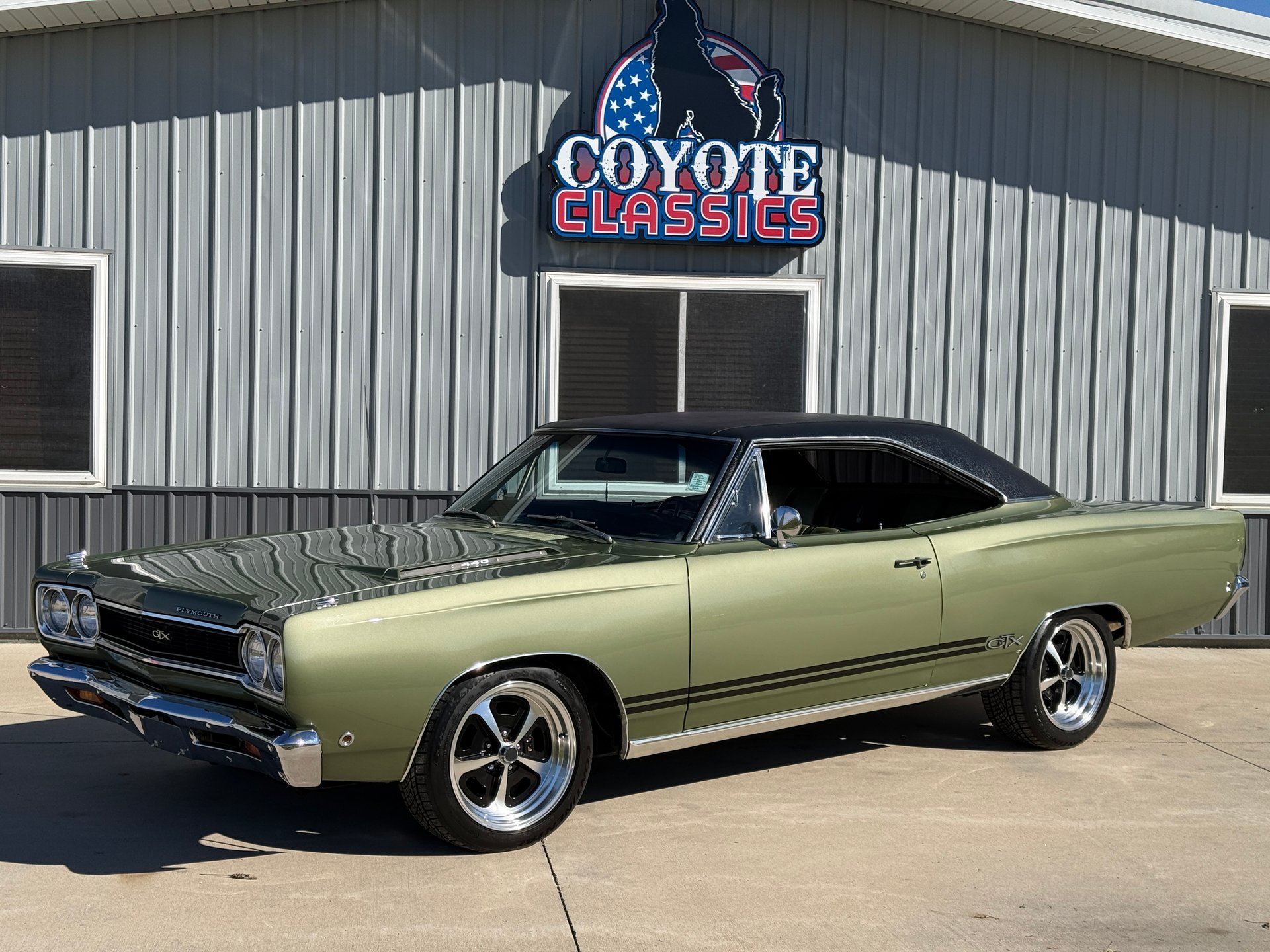
1968: the reskin and the peak. The all-new 1968 shell is the one most people picture: rounded quarters, a flying-buttress hardtop roof and a much more modern cabin. The GTX sat above the new Road Runner, sharing the Sport Satellite's trim level. About 18,940 were built, 17,914 of them hardtops and 1,026 convertibles — the biggest convertible year, and the one to shop for if choice matters. Hemi production was still in the hundreds. The 1968 is also the easiest GTX to buy: the deepest listings pool, the best panel and trim support, and no year-specific mechanical oddities.
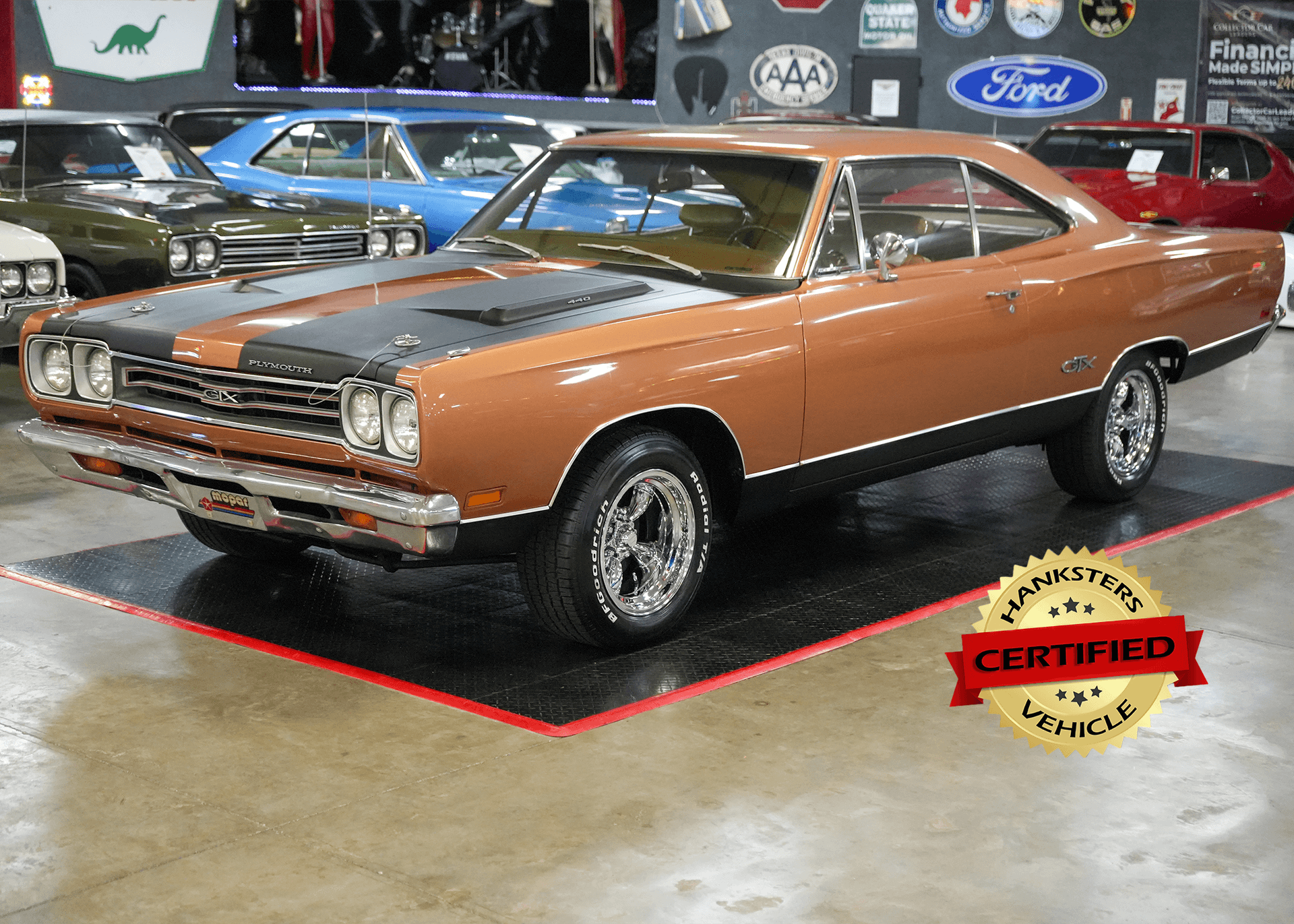
1969: the refinement. Same shell, new grille and tail treatment, black lower-body paint in place of the earlier stripes. About 15,602 built, with convertibles down to about 700 — the last convertible year, and only eleven of those convertibles carried the Hemi. The mid-year A12 Six Pack package arrived in 1969 on the Road Runner and Super Bee, but the GTX did not get the Six Barrel until 1970, so a 1969 GTX advertised as a factory Six Barrel car is a conversion, full stop. Likewise the functional fresh-air hood story belongs properly to 1970 and 1971 on the GTX, so examine any earlier installation as an addition until the fender tag proves otherwise.

1970: the facelift and the Six Barrel. A new front with a loop-style bumper and grille, new tail treatment and revised quarters, still on the 1968 shell's structure and 116-inch wheelbase. The convertible was deleted, so every 1970 GTX is a hardtop. Production fell to 7,748 despite this being, mechanically, the most complete GTX of all: the Six Barrel arrived as a regular option (678 built, split almost evenly between four-speeds and automatics), the Air Grabber vacuum-operated fresh-air hood was a proper GTX option, coded N96, and the Hemi remained available. High-impact colours — Sublime, Vitamin C Orange and their relatives — belong to this era and suit it. If you want one GTX to drive hard, a 1970 440 car is very hard to beat.
1971: the fuselage finale. A different shell again: fuselage styling with loop bumpers, a longer, lower, more rounded body on a 115-inch wheelbase, and a cabin that feels more seventies than sixties. The engine policy held — 440 four-barrel now rated 370 hp gross, the Six Barrel at 385 hp, the Hemi still nominally 425 hp — but the market had gone. Just 2,942 cars were built, 30 of them Hemis, and after 1971 the name survived only as a 440 option package on the Road Runner through 1974. Rarity here does not automatically mean desirability: the year-specific sheetmetal and trim are the hardest of any GTX to source, so condition matters even more than on a 1968.

Hardtop or convertible. Convertibles exist only for 1967 to 1969 and total only about 2,400 cars. They carry a large premium, are priced on condition and originality far more than on the 440's state, and add convertible-specific costs: hydraulics, a frame that hides rust in its reinforced rails, and perished weather equipment. A convertible with a tired top, a weak pump and rust in the floor is three restorations at once. The hardtop is the rational buy in every year; the convertible is the emotional one, bought on shell and documentation alone.
Tributes and clones — the standing warning. Because a Satellite is the same shell and a 440 drops straight in, GTX tributes are everywhere, and some are honestly described and fairly priced as such. What you must never pay for is tribute hardware at genuine-car money. The VIN settles the model: a genuine GTX begins RS23 (hardtop) or RS27 (convertible) — R for the Plymouth B-body line, S for the Special price class that denotes the GTX. A car beginning RP, RH, RM or RL is not a GTX, however it is badged. The engine is the VIN's fifth character, and its codes changed across the run — L for the 440 high-performance engine on the late-sixties cars, U for the 440 four-barrel and V for the Six Barrel on 1970 and 1971 cars, the Hemi carrying its own code (J in the late sixties, R for 1970 and 1971). Decode the actual year, then make the fender tag, body stampings and any broadcast sheet agree with the VIN, as the inspection section sets out.
Engines and gearboxes
The 440 four-barrel: the standard engine
Every GTX story starts with the RB-series 440, Chrysler's big wedge: the raised-block big-block, with a 4.32-inch bore and 3.75-inch stroke, a tall deck giving a long-rod, torque-rich character, iron block and heads, a forged crankshaft in high-performance form, and a single Carter AVS four-barrel on an iron dual-plane intake. In GTX specification it is the Super Commando: 375 hp gross at 4,600 rpm and 480 lb-ft of torque for 1967 through 1970, compression around 10.1:1 in the early cars softening toward the end of the run, and 370 hp in 1971. Period tests made a 440 GTX a high-14-second quarter-mile car on street tyres; the number matters less than the delivery — a huge, flat wave of torque from just off idle to about 5,000 rpm, where the hydraulic camshaft calls time.
It is a famously durable engine, and its weaknesses are age weaknesses rather than design weaknesses. The nylon-toothed timing gear fitted to many production big-blocks sheds its teeth with age, and the debris ends up in the oil pickup; any 440 with no documented timing-set work should be assumed to need a steel set, a cheap parts job that is mostly labour. Valve stem seals harden and crumble, giving the classic puff of blue smoke on start-up and on the overrun. Exhaust manifolds crack around the centre ports where the heat-riser passage concentrates heat, manifold studs seize and snap in the heads, and the heat riser valve itself seizes, usually shut, cooking one bank and strangling performance. Oil leaks come from the valley pan — the stamped steel pan that is also the intake gasket surface, and seals exactly as well as the last person who fitted it cared to make it — plus the rear main seal and valve cover gaskets. A 440 that uses a little oil, stays cool and holds good oil pressure is healthy; one with low hot idle pressure and a bottom-end rattle is a rebuild, and a full quality rebuild with machine work typically runs $6,000–12,000 depending on specification.
Cooling is the 440 GTX's most common roadside failure. The system was adequate when new and is marginal now: radiators silt up, the viscous fan drive loses its fluid and freewheels when it should lock up, shrouds go missing, and scale narrows the water passages. A GTX that creeps up in traffic but cools at speed has an airflow or fan-drive problem; one that gets hot at speed has a circulation or capacity problem. Test both conditions on the drive, and check the shroud before blaming the radiator.
The Carter AVS (Air Valve Secondary) carburettor suffers the usual ethanol-era problems: swollen accelerator-pump cups, warped air horns from decades of uneven tightening, and vacuum leaks at the throttle shaft bores. Its signature fault is the secondary air valve set wrong — too loose and the engine bogs as the secondaries flop open, too tight and the car feels strangled. Both are adjustment, not rebuild. A full carburettor rebuild by a specialist is a $400–800 job; before paying it, rule out ignition, because a tired points distributor imitates carburation faults faithfully. Many cars now run electronic ignition — Chrysler's own later system, retrofitted, is the period-correct route — whose failure points are the ballast resistor and the control box, both cheap. Carry a spare ballast resistor in the glovebox; it is the most common no-start cause on any Mopar of this era and a two-minute fix.
The 440 Six Barrel: three carburettors, one personality
For 1970 and 1971 the GTX could be ordered with the 440 Six Barrel — Dodge called the same hardware the Six Pack. Three Holley 2300-series two-barrel carburettors sit on one manifold (aluminium, Edelbrock-made, on early 1970 production, replaced by a Chrysler iron manifold during the year): a centre carburettor of about 350 cfm that the engine runs on in normal driving, and two outboards of about 500 cfm each, opened progressively by vacuum as load rises. Total airflow is quoted around 1,350 cfm. Output was 390 hp and 490 lb-ft for 1970, 385 hp for 1971. A well-set-up Six Barrel feels like a 440 four-barrel until about two-thirds throttle, then considerably stronger — and the induction noise through an Air Grabber hood is a large part of what buyers are paying for.
The Six Barrel's reputation for being temperamental is mostly a reputation for being misadjusted. The system lives or dies on three things. First, vacuum integrity: the outboards are opened by diaphragms fed from the centre carburettor, and perished diaphragms, split hoses or a leaking base gasket leave them late, early or never — felt as a flat spot, a surge, or a car no quicker than a four-barrel. Second, float levels and fuel delivery: three carburettors demand more from the pump and needle valves, and modern fuel sinks marginal floats and leaks past marginal needle tips, flooding the manifold on hot restarts. Third, idle is set on the centre carburettor alone; owners who tune the outboards at idle chase their tails. Test the full sequence on the drive: clean idle, surge-free cruise on the centre carburettor, then a hard, even pull as the outboards open. Specialist setup with the carburettors rebuilt runs roughly $1,200–2,500 in parts and labour; verify the hardware visually — three Holleys in a row, correct linkage, correct manifold and air cleaner — because a missing or incorrect manifold destroys the point of the car, and the big oval air cleaner and Air Grabber ducting are expensive to replace.
Identity for a Six Barrel car is the V code in the fifth position of the VIN on 1970 and 1971 cars and the E87 engine code on the fender tag. Because the induction bolts onto any 440, Six Barrel conversions of ordinary 440 cars are common and often excellent as drivers — but they are conversions, and the price must say so.
The 426 Hemi: the flagship, and the trap
The 426 Hemi was the GTX's halo option in every year: two four-barrel Carter carburettors on an aluminium intake, hemispherical combustion chambers with huge inclined valves, a forged crankshaft, cross-bolted main bearing caps, dual valve springs, a solid-lifter camshaft in the street tune, and a nominal 425 hp at 5,000 rpm with 490 lb-ft of torque — a rating everyone in period understood to be diplomatic. The street Hemi is not a racing engine detuned so much as a racing architecture civilised: it wants its valve lash set, its two carburettors synchronised, its oil changed, and its owner engaged. In return it is the strongest production engine of the muscle era and the reason Hemi GTXs — a few hundred cars a year, a few dozen convertibles across 1967 to 1969, and just 30 cars in total for 1971 — sit in a different market from every other GTX.
Buying one is an exercise in verification, not driving impressions. Hemi value lives in originality: correct casting numbers and date codes on the block, the VIN-derived stamping where the year carries it, correct heads, carburettors, intake and exhaust manifolds, and the heavy supporting hardware a genuine Hemi car received. A Hemi replaced with a later crate engine or a non-original block is still a fast car and a much cheaper one. The mechanical checks are the 440's with the volume turned up: listen for valvetrain clatter beyond the normal solid-lifter tick, watch oil pressure like a hawk, and expect plug fouling if the car is used only for short gentle runs — Hemis carbon up when babied and clear when driven properly. Specialist Hemi work is priced in a different world: a full rebuild by a recognised builder is a $20,000-plus job, and individual correct components trade for sums that buy whole 440 engines. Do not buy a Hemi GTX without a specialist's inspection and a documentation review; it is the most expensive sentence in this guide to ignore.
Gearboxes and axles
Two transmissions were offered, and both are among the best of their kind. The automatic is Chrysler's A727 TorqueFlite, coded D32 on the fender tag. It is close to unbreakable in a street car, and its failure modes are almost all neglect or maladjustment: fluid never changed, bands never adjusted, and above all a misadjusted throttle-pressure (kickdown) linkage. On a TorqueFlite that linkage controls line pressure as well as kickdown; a disconnected or badly set linkage makes soft, early shifts that feel comfortable and burn the clutches and bands in short order. Burnt-smelling, dark fluid in a softly shifting car is a rebuild warning, and a quality 727 rebuild is roughly $1,800–3,500 fitted, with converters and internals all available. The manual is Chrysler's A833 four-speed, coded D21, with a Hurst shifter in most years (1967 cars used the Inland, whose vague action is the first thing owners change). The heavy-duty 18-spline version sits behind Hemis and many 440s; wear shows as second-gear synchromesh crunch, jumping out of gear on the overrun, and sloppy external linkage that is adjustment and bushings, not a rebuild. A full A833 rebuild runs roughly $1,500–3,000. Clutch linkage is mechanical, with a Z-bar and rods that wear at every pivot; a heavy or juddering clutch is as often linkage and engine mounts as the clutch itself.
Our listings pool matches the wider market: automatics dominate — 17 of our 20 cars describe an automatic in one wording or another, against 3 four-speed manuals — so a genuine four-speed car is the scarcer and usually dearer find.
The rear axle is Chrysler's 8-3/4-inch unit in most cars: a dropout centre section, ratios commonly 3.23:1 for cruising automatics, with 3.55:1 and 3.91:1 performance ratios, and the Sure-Grip limited-slip as an option — a cone-type unit in this era, which wears its cones and gradually becomes an open differential that still drives perfectly well. Test it on a tight full-lock turn and by jacking the rear and turning a wheel: with a working Sure-Grip the opposite wheel turns the same way. Four-speed Hemi cars, and cars with the Track Pak and Super Track Pak packages, received the Dana 60 with ratios up to 4.10:1 — a value marker on a car claiming those packages, identified by its ten-bolt rear cover rather than the 8-3/4's smooth dropout face. Axle whine under light throttle that changes on lift-off is pinion bearing or gear wear; a rebuild of an 8-3/4 centre section is a $800–1,800 job, and gears, bearings and Sure-Grip parts are all reproduced.
Problem areas
A GTX divides cleanly into three judgements. The shell decides whether the car is worth anything at all. The identity decides whether it is worth GTX money. The mechanicals, on a car that passes the first two, decide only how much more you will spend — because almost everything mechanical on a B-body is available, understood and rebuildable. One honesty note on evidence: our photo-note sample for this model is a single examined car, no basis for incidence claims, so this section makes none — the rust map and failure modes below are the established B-body pattern, and the inspection section turns them into tests for the individual car in front of you.
Rust: the B-body map
Rust on a B-body follows water and road dirt, and the unit construction means several of the classic spots are structural. Take them in the order a restorer fears them.
Torsion-bar crossmember and front frame rails. The torsion bars anchor in a crossmember under the front floor, and that crossmember, the rails around it and the K-member mounts take everything the front wheels throw up. Rot here is the B-body equivalent of a rotten chassis: it distorts suspension geometry, is difficult and expensive to repair properly, and hides behind undercoating and road film. Get the car on a lift and prod the crossmember ends and the rails where they sweep up over the rear axle line as well. Fabrication-level repairs run into several thousand dollars per side done properly, and a car needing crossmember, rails and floors at once is a parts car or a full rotisserie project, priced as such.
Floor pans. Water enters past the windshield seal, cowl vents and heater box, and sits under the carpet and sound deadener. Lift the carpets in both front footwells and under the rear seat. Surface scale is treatable; perforation at the seat mounts, the crossmember line or the seatbelt anchors is structural. Reproduction pans are available and a side fitted and painted is roughly $800–1,800, but floors rarely rot alone — read floor rust as a marker for the whole shell's life.
Trunk floor and rear quarters. The trunk floor rots from the top down: the rear window channel and trunk seal leak, water sits in the spare wheel well and the troughs over the frame rails, and the floor perforates above the fuel tank and at its outer edges. Lift the mat and the spare. The rear quarters rot at the arch lips, at the bottom behind the wheel where the skins trap mud, and along the lower edge in front of the wheel. Magnet-test every arch and lower quarter; filler over a rotted arch lip is the most common cosmetic cover-up on these cars. Full quarter replacement with paint is a $3,000–6,000 per side proposition; patch work is cheaper and shows sooner.
Cowl, windshield channel and Dutchman panel. The panel between the rear window and the trunk lid — the Dutchman panel — and the rear window channel rust under their bright trim, and the leak path runs straight into the trunk. At the front, the cowl sides and windshield channel rust where the seal sits, feeding the floor rot. Bubbling at the corners of either screen is never just bubbling: budget for glass-out repairs, because the channel underneath will be worse. On hardtops, check the roof at the rear pillars and drip rails, especially on vinyl-top cars — the vinyl traps moisture and an intact-looking top can hide a roof skin perforated along the rails and rear window frame. Press along a vinyl roof's edges with your fingertips; crunching is rust, and it is a roof-skin conversation, not a vinyl replacement.
Rockers, door bottoms and fender heels. Rockers rot from inside where the drain slots block. Door bottoms fill with water when their drains clog and bubble along the lower seam. Front fenders rot at the heel behind the wheel and at the top where the inner reinforcement traps dirt, and the battery tray area suffers acid damage — lift the battery and look at the tray and the apron beneath, because a tray is cheap and an apron is not. Hoods rust along the front lip's inner seam and trunk lids along the rear seam; both are often replaced rather than repaired, which is why spot-weld patterns matter on a car sold as original.
Convertible specifics. The 1967 to 1969 convertibles add a hydraulic top whose pump, rams and hoses are all perished by now unless renewed, a top frame that rusts at its pivots, and reinforced floor structure that traps water exactly where the reinforcement hides it. Check the top well, the rear seat base and the underfloor bracing. A convertible needing hydraulics, frame work and a new top is a $3,000–6,000 job before the shell's own rust, so price the whole stack, not the pieces.
Identity, numbers and the tribute problem
This is the problem area that costs GTX buyers the most money, because a tribute car bought at genuine money loses a third of its price the day the truth is priced in. The checks are simple; doing them before the money moves is the discipline.
The VIN. Genuine GTX VINs begin RS23 (hardtop) or RS27 (convertible). The plate sits on the driver's side of the dashboard, visible through the windshield on 1968 and later cars; 1967 cars carry the earlier-style plate on the driver's door pillar. The fifth character is the engine: L for the 440 high-performance engine in the late sixties, U for the 440 four-barrel and V for the Six Barrel on 1970 and 1971 cars, J for the Hemi in the late sixties and R for the Hemi in 1970 and 1971. A car whose VIN says 440 and whose bay holds a Hemi is an engine swap — possibly a wonderful car, never a factory Hemi car. A car whose first two letters are not RS is not a GTX at all.
The fender tag. The stamped tag screwed to the driver's inner fender carries the build specification in codes, read from the bottom line up: engine codes E86 for the 440 four-barrel, E87 for the Six Barrel, E74 for the Hemi; transmission codes D32 and D21; paint and trim codes; the build date; and options such as N96 for the Air Grabber. A missing tag is common — they were removed for paint and lost — and on a 440 hardtop it lowers confidence and price modestly. On a Hemi, Six Barrel or convertible car it is serious: those cars are priced on specification, and a missing or reproduction tag removes the cheapest proof of it. A tag whose screws, patina or code fonts look new deserves line-by-line decoding, because made-to-order reproduction tags are a known feature of this market. Cross-check the tag against the body stampings — on 1969 and later cars the VIN is stamped into the radiator support and the driver's trunk rail under the weatherstrip; on earlier cars the shipping order number ties the tag to stampings on the radiator support and trunk lip. Mismatches mean the tag, or the panel, came from another car.
The broadcast sheet. The paper build sheet — often found under the rear seat springs, sometimes under the carpet, behind the glovebox or above the fuel tank — is the fullest record of how the car was built. A surviving, legible, VIN-matching sheet is worth real money on any GTX and close to essential on a Hemi or Six Barrel car. Its absence proves nothing (most are gone), but its presence ends arguments. Photograph it and keep it with the car's file.
Engine and transmission numbers. From 1968 onward, partial VIN stampings appear on the engine and transmission on many cars — on the block at the rear flange by the oil pressure sender, and on the transmission's machined pad. A matching-numbers 440 is worth a premium; a correct-date replacement block is worth less; a Hemi car without its numbers engine is a different price class entirely. The 440's raised pad beside the distributor, stamped with displacement, assembly date and HP marking where applicable, tells you what the block was built as — which catches the oldest trick in the book, a low-performance 440 from a New Yorker wearing GTX dress-up parts. Casting dates should precede the build date by weeks to a few months.
Suspension, steering and brakes
The front suspension is torsion bars, control arms, ball joints and an anti-roll bar, all in heavy-duty GTX specification. The bars rarely fail, but their crossmember anchors rust (above), the ride-height adjusters seize, and a car sitting low or uneven at the front is telling you about adjusters, tired bars or crossmember trouble, in ascending order of expense. Ball joints and bushings wear and make the front end knock and wander; a full wear-parts refresh with an alignment is roughly $800–1,800 in parts and labour. The steering is a recirculating-ball box, manual or power-assisted; wear gives straight-ahead free play no alignment cures, and rebuilt boxes are available for $400–900 exchange. Power steering pumps whine and leak from the front seal and hoses; the Federal and TRW variants use different fittings, so identify which is fitted before ordering parts.
At the rear, leaf springs sag, bushings perish, and the pinion snubber — the rubber bumper that controls axle wind-up under the 440's torque — is usually missing or destroyed on cars launched hard for fifty years. Rear height down with the springs inverted in their arch means new springs, roughly $400–800 a pair fitted.
Brakes are heavy-duty 11-inch drums as standard, with front discs optional — four-piston fixed-caliper Bendix discs on the late-sixties cars, single-piston sliding calipers for 1970 onward — and power assistance optional. Judge the system, not the driveway pedal feel: steel lines corrode from inside, hoses swell shut internally and act as one-way valves that hold a brake on, cylinders and calipers seize after storage, and master cylinders bypass internally so the pedal sinks slowly at a stop. A full hydraulic refresh is $800–2,000 and should be assumed on any car without recent invoices for it. Disc cars need the correct master cylinder and proportioning; a conversion still running drum hardware stops badly in a way only a hard test stop reveals, which is why the inspection includes one.
Electrics, cooling ancillaries and the cabin
Chrysler electrics of this era fail at three famous points. The bulkhead connector, where the harness passes through the firewall, corrodes and overheats; on ammeter cars the full charging current passes through the dash ammeter and its bulkhead terminals, and melted connectors and cooked ammeter wiring are the B-body's one genuine fire risk — inspect the connector for heat distortion, and regard a cleanly executed ammeter bypass with a voltmeter conversion as a safety improvement, not a modification to penalise. The ballast resistor fails and the engine dies or will not start, as noted above. And the instrument voltage limiter on the back of the cluster fails and takes the fuel and temperature readings with it, so a GTX whose gauges all read low together usually has one cheap fault, not four. Headlamp switches carry full current and fail hot, and three-speed wiper motors are expensive to rebuild properly. None of this is exotic, and a car where every electrical item works has been maintained by someone who cared — the best single proxy for the whole car's life.
The heater core leaks into the passenger footwell and is a dashboard-deep job on air-conditioned cars; air conditioning was a popular option and its hardware is all serviceable, but a system that has sat open needs a rebuild rather than a recharge, roughly $1,200–2,500 to recommission properly. In the cabin, the costs are seat foam and covers (reproduced, with a front pair retrimmed at roughly $1,000–2,000 in parts and labour), dash pads, headliners, and the year-specific details — 1967 trim, 1971 trim — reproduction has not covered. Brightwork is extensive; re-plating bumpers runs roughly $600–1,200 each, and pitted pot-metal makes good used or reproduction parts the realistic answer. Price the cabin as carefully as the engine: a complete, correct interior is the hardest part of a GTX to recreate.
How to inspect one
Allow two hours, bring a torch, a cloth-wrapped magnet, a friend, and a code reference for the car's year. If the car passes you, pay for a lift inspection before money moves — on a unit-body Mopar the underside is where the truth is stored.
- Paperwork and VIN first. Before you look at the car, look at the title and the VIN. Confirm the RS23 or RS27 prefix, decode the fifth character for the engine the factory fitted, and match the VIN to the dashboard plate (or door-pillar plate on a 1967). If the VIN says the car is a Satellite, stop negotiating about GTX value — this is now a conversation about a different car.
- Fender tag and body stampings. Decode the tag from the bottom line up: engine code (E86, E87 or E74), transmission code (D32 or D21), paint, trim, build date. Then find the body stampings — radiator support and driver's trunk rail on 1969 and later cars, order-number stampings on earlier cars — and make them agree with the tag. Ask for the broadcast sheet; if one exists, check it against the car, option by option.
- Cold start. Insist the engine is stone cold. A 440 should fire quickly, hold oil pressure, and settle to an even idle. Note start-up smoke (a brief blue puff is valve seals; a cloud is worse), listen for bottom-end knock in the first seconds, and watch the temperature gauge's whole story from cold — you will need it again at the end of the drive.
- The magnet walk. Work every wheel arch, lower quarter, rocker, door bottom and fender heel with the wrapped magnet. Weak pull or no pull means filler. Look down each flank for ripples, check panel gaps, and open and close every panel — doors that drop on their hinges and a trunk lid that needs a slam are telling you about wear, and about alignment that rust or accident damage may explain.
- Underneath, on a lift if at all possible. Prod the torsion-bar crossmember ends, front rails, K-member mounts, floor seams and rear rails over the axle. Perforation in the crossmember or rails is structural and reprices the car on the spot. Read the underseal as you go: patchy, chipped and dirty is honest; a fresh, uniform coat over everything, applied for the sale, is a question the seller must answer with photographs of what is underneath.
- Floors and trunk from inside. Lift the carpets in both front footwells and under the rear seat; lift the trunk mat and spare wheel. Look for water tracks from the windshield base and rear window channel, perforation at seat and seatbelt mounts, and rust in the trunk floor troughs. On a vinyl-top car, press the roof along the drip rails and rear window frame for the crunch of hidden rust. On a convertible, add the top well, rear seat base and reinforced rails.
- Engine identity and health. Read the pad beside the distributor on a 440 for its displacement and HP stampings, check casting dates against the build date, and look for the partial VIN stamping at the rear of the block where the year carries it. On a claimed Six Barrel, count the carburettors and check the manifold and linkage are the real system. On a claimed Hemi, verify heads, intake, carburettors and manifolds — then stop and book a specialist, because step 7 on a Hemi is a professional's job, not a driveway one.
- Fluids and leaks. Pull the engine dipstick (clean oil at the right level, no fuel smell, no mayonnaise), the transmission dipstick on an automatic (red and sweet-smelling is right; dark and burnt is a rebuild warning), and look at the coolant. Then look under the car for the valley-pan leak, the rear main drip and power steering fluid on the hoses.
- The kickdown test and the drive. Fifteen minutes minimum, including highway speed. On an automatic, confirm the throttle-pressure linkage is connected before you move off, then feel for firm, correctly timed shifts and a working kickdown; soft, early, flaring shifts are a fault, not a comfort feature. On a four-speed, test second-gear synchromesh on a firm downchange and listen for the box jumping out on the overrun. A 440 should pull cleanly from low revs; a Six Barrel should transition onto its outboard carburettors without a bog or surge past two-thirds throttle.
- Heat and brakes. In traffic, watch the temperature: creeping up at idle points at the fan drive, shroud or airflow; rising at speed points at circulation and capacity. Then, from speed on a clear road, brake hard once: the car should stop straight and strong, the pedal firm and not sinking. A pull, judder or sinking pedal prices the hydraulic refresh in the problem areas.
- Steering, suspension and stance. Note straight-ahead free play (steering box), knocks over bumps (ball joints and bushings) and rear axle tramp on a firm launch (springs, bushings, a dead pinion snubber). Afterwards, stand back: front ride height even side to side, rear sitting on its springs rather than under them, all four arch gaps consistent. Jack the rear of a Sure-Grip car and turn a wheel to confirm the limited-slip still grips.
- Electrics and cabin last. Work everything: lights, wipers on all speeds, washers, horn, heater fan on all speeds, every gauge (all reading low together is the cluster voltage limiter, one cheap part), and the air conditioning's compressor clutch. Check the bulkhead connector for heat damage. Then sit in every seat, feel for collapsed foam, and price the cabin honestly before you total the car in your head.
Values
The GTX market is a condition market and an identity market before it is a year market, and the section beneath this guide — the live listings summary and the recorded-sales block the build maintains — is where the current numbers live. This section teaches you how to read them, because the spread inside a single model year is wider than the spread between years.
Start with the shape of the spread. At the bottom of any year's listings sit the projects: rusted shells, apart cars, cars with the wrong engine and no paperwork. At the top sit the documented, numbers-matching, correctly restored or genuinely original cars, and between the two there is no smooth ladder — there is a cliff where a car stops needing structural work. A GTX that needs floors, quarters and a trunk floor is not worth a fixed amount less than a solid car; it is worth its parts and its identity, because the bill to cross the cliff exceeds the finished car's value unless the car is a Hemi, a Six Barrel or a convertible. When you compare a listing against the recorded sales, first decide which side of that cliff it is on. Comparisons across the cliff are meaningless.
Asking prices and achieved prices part company predictably. Sellers of mid-market 440 hardtops — the bulk of the market — ask for the car they believe they have: the restored, matching-numbers one. Recorded-sale results price the car that actually sold, its filler, tired interior and undocumented engine priced in by buyers who had inspected it. Expect the gap to be widest in that mid-market, and narrowest at the top, where documented cars are scarce enough that sellers hold the power, and at the bottom, where projects are priced by weight of parts.
Within the model, the premiums stack in a clear order, and each is really a payment for verifiability. The Hemi premium is the largest and most fragile: it rests on the VIN code, the engine numbers and the documentation, and evaporates as each weakens — a Hemi car with a replacement engine is a different asset, not a slightly cheaper Hemi car. The Six Barrel premium is smaller and sturdier, because the hardware is visible and the V-code checkable in a minute, but it still halves on a conversion of a U-code car. The convertible premium is scarcity on top of condition: a solid convertible finds buyers even in soft markets, while a rusty one is unsellable at any plausible figure because its restoration stack is the longest in the range. The four-speed premium is real but modest — the one premium a driver recovers in enjoyment rather than resale.
Year premiums are softer than folklore says. The 1968 is the most numerous and the most wanted, which keeps its market liquid rather than expensive. The 1971 is far rarer, but its buyers are specialists, so rarity shows up as time-to-sell as much as price. The 1967 trades at a small discount for its older shell and thinner trim supply, making a solid 1967 the value entry into genuine GTX ownership. Colour moves individual cars — a factory high-impact colour, proven by the fender tag, pulls a car up its condition class — but colour claimed without the tag code proves nothing.
Negotiation reality: the honest private seller of a mid-market GTX has usually owned the car for years, knows its faults, and has priced in some movement; the dealer car at the top of the asking range is priced for the buyer who will not travel. Travel. Few muscle cars reward inspection more, because the difference between the best and worst example at the same asking figure is a set of structural repairs. And the rule that prices everything: identity first, shell second, specification third, cosmetics last. A car that wins on the first two and loses on the last two is the bargain; a car that wins on the last two and loses on the first two is the trap.

Parts and ownership
The B-body is one of the best-supported American cars of its era, because it shares its architecture with the Charger, Road Runner, Satellite and Coronet — a production base in the millions — and the Mopar reproduction industry is mature. Sheetmetal is the headline: quarter panels, floor pans, trunk floors, fender patches, door skins and frame-rail and crossmember repair sections are all reproduced, and the panels are good enough that competent body shops work with them daily. The caution is year specificity: 1968 to 1970 structural panels interchange in ways the outer skins do not, the 1967 car has its own smaller catalogue, and 1971 panels and trim are the thinnest coverage in the range.
Easy: everything mechanical in the 440, TorqueFlite and 8-3/4 ecosystem — engine internals, gaskets, timing sets, water pumps, carburettor kits, ignition parts, transmission rebuild kits, axle bearings and gears, brake hydraulics, suspension wear parts, leaf springs, torsion bars, weatherstripping, seat covers and foam, carpets and headliners. Order this week, fit this weekend, at prices that make European classics of the era look absurd.
Harder and dearer: Hemi-specific everything (heads, intakes, carburettors, manifolds and correct hardware trade in a specialist market of their own), Six Barrel manifolds and correct carburettor cores, Air Grabber ducting and air cleaners, convertible top frames and hydraulics in good order, 1967-only and 1971-only trim, dash pads for the less common years, unpitted pot-metal brightwork, and date-coded components for a numbers restoration — a correctly dated Carter AVS or a date-matched 440 block is a hunt, not an order. Glass is available, but shipping and fitting dominate its cost.
Running costs. A sorted 440 GTX is a realistic regular-use classic: fuel consumption in the low-to-mid teens miles per gallon, less if you use the performance, and premium fuel is wise in the high-compression early cars. A quart of oil between changes is period normal. Servicing suits any competent classic shop and most home mechanics — the engines predate emissions complexity and the factory manuals are reprinted. The budget lines that catch new owners are the catch-up year — deferred brakes, suspension wear, perished rubber and a tired cooling system honestly run $3,000–7,000 in parts and labour — and the ethanol tax: fuel hose, pump diaphragms and carburettor soft parts now age in years rather than decades, so use ethanol-rated components and drive the car regularly, because a GTX that sits deteriorates faster than one that works.
Ownership practicalities are friendly: breakdowns are usually diagnosable at the roadside (carry the spare ballast resistor), insurance is mainstream classic cover, and the community — B-body forums, Mopar clubs, registries that will decode a fender tag from a photograph — is large and generous. Keep the documentation file growing from the day you buy. On a car whose value is identity, the file is part of the asset.
Which one to buy
- The all-rounder: 1968 to 1970 440 hardtop. The deepest pool to buy from, the best parts and panel support, the classic shell, and all the performance most drivers will ever use. If you want one GTX to drive, this is it.
- The value buy: 1967 440 hardtop. The same mechanical formula in the older shell at a gentler price. Buy the most complete car you can find — the 1967-only trim is the penalty for buying an incomplete one.
- The driver's pick: 1970 Six Barrel. The most complete mechanical specification, the best induction noise in the business with the Air Grabber, and a premium that is still proportionate. Verify the V-code before you pay it.
- The open car: 1968 convertible. The biggest convertible production year, so the best choice and the best parts story of the three drop-top years. Buy it on shell and paperwork alone; everything else is a known bill.
- The connoisseur's car: 1971 hardtop. The rarest mainstream GTX, the most distinctive styling, and a specialist market. Buy the best one rather than the cheapest — 1971 panels and trim punish project buyers.
- The collector car: any documented Hemi. A few hundred a year, a few dozen convertibles in total, and a market that runs on paperwork. Buy only with a specialist's inspection and a documentation file that survives scrutiny; treat any gap in either as a price class, not a detail.
And the rule that overrides all of the above: buy identity and shell first — a genuine RS-code car with a solid crossmember, floors and quarters, in the specification you can live with. Engines, gearboxes, brakes and interiors are all rebuildable from a catalogue at prices you can plan for. A tribute bought at genuine money, or a genuine car with a rotten structure, is the one purchase no amount of later spending makes right.
See the 10 GTX cars currently listed.