
Plymouth Fury buyer's guide
Plymouth Fury -- the model's own buyer's guide: variants, values and what to check.
Years listed: 1957-1987 · Series: Fury
Overview and history
The Plymouth Fury is two cars wearing one badge, and knowing which one you are looking at is the whole game. From 1956 to 1961 the Fury was Plymouth's limited-production performance flagship — a two-door hardtop (and, from 1958, a convertible) sold in a single colour scheme, built in small numbers, and fitted with the strongest engines Plymouth could offer. From 1962 onward the name slid downmarket until it covered nearly the whole full-size Plymouth range, and by the time the big C-body cars arrived in 1965, "Fury" meant everything from a slant-six taxi-grade sedan to a 440-powered Sport Fury convertible. This guide is the model-level companion to our Fury series coverage: it goes generation by generation through what each car actually is, how to tell a real performance car from a badge, and where the money goes when you buy one.
The Fury began in 1956 as a sub-series of the Belvedere: one body style, a two-door hardtop, finished in eggshell white with a gold anodised side spear and a gold grille. Under the bonnet sat a 303-cubic-inch V8 with dual four-barrel carburettors — serious hardware in 1956, and a deliberate statement that Plymouth, the sensible family brand, could build a fast car. For 1957 the formula sharpened: Virgil Exner's Forward Look styling gave the car the tallest fins in the industry, the colour became Buckskin Beige with gold trim, and the 318 V8 with twin four-barrels made the Fury one of the quickest American cars of its year. The 1958 car added a convertible and the optional 350 "Golden Commando" big-block. These three years are the Fury as legend: genuinely limited, genuinely fast, and today the most valuable cars in this guide by a wide margin.
The fall was quick. For 1959 the Fury became a full series rather than a limited model, and for 1960–61 the name topped a finned range already looking dated against cleaner rivals. Then came the famous mistake: Chrysler downsized its 1962 full-size cars on the assumption the whole industry was going smaller. It wasn't. The 1962–64 Furys are B-body-sized cars — trim, light and, in Max Wedge drag form, ferociously quick — but showroom buyers wanted full-size cars, and Plymouth spent three years selling a mid-size car at full-size prices. Those cars are covered in depth below, because they dominate today's affordable end of the market and because the Max Wedge and Race Hemi heritage hangs over every one of them.
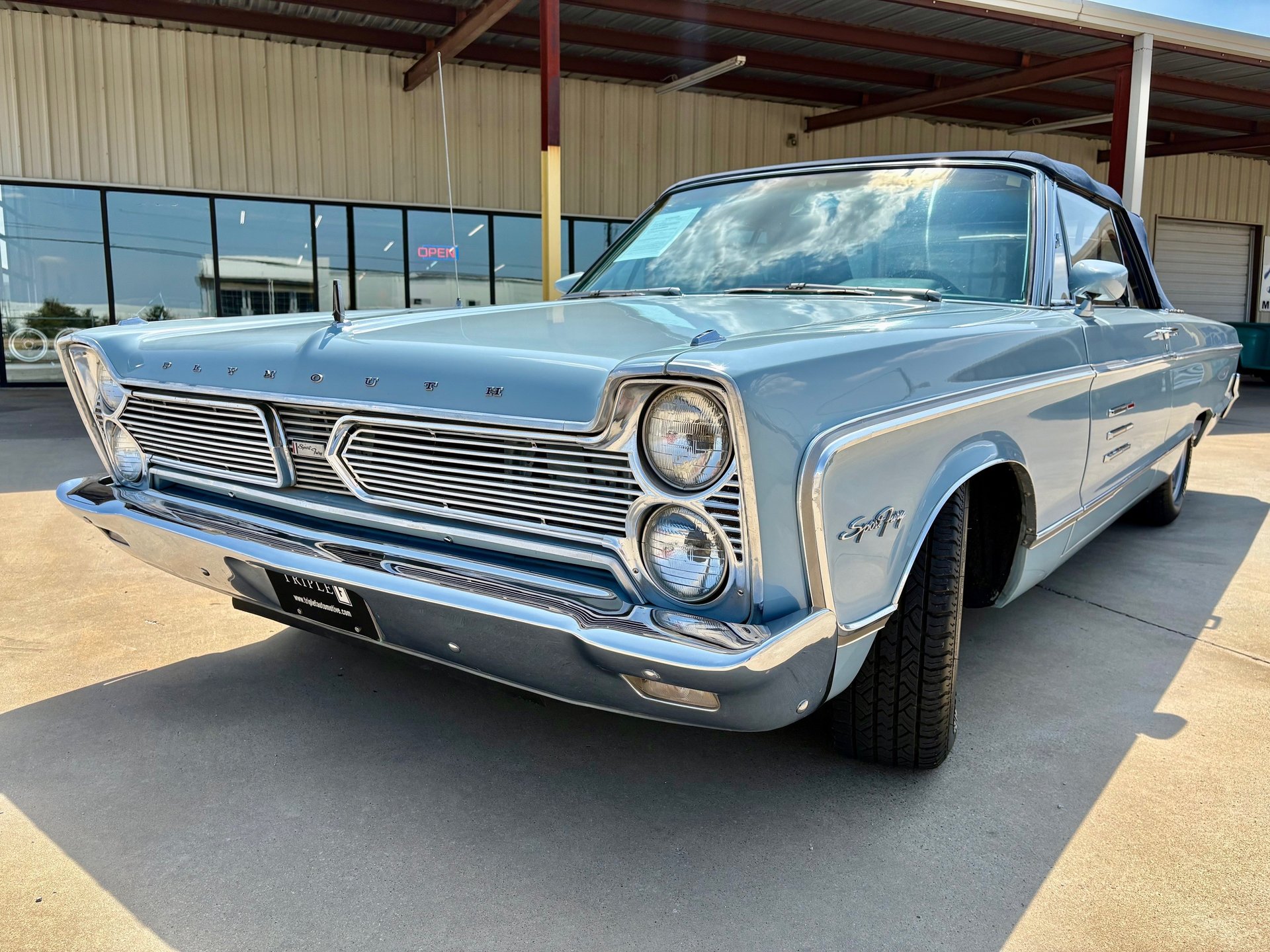
Redemption arrived in 1965 with the C-body: a genuinely full-size Fury on a 121-inch wheelbase, stacked headlights, squared-off styling, and a range structure — Fury I, Fury II, Fury III, Sport Fury and the luxury VIP — that carried the car through its best years. The 1965–68 cars are the heart of the Fury market now, and they are the heart of our listings too: of the 29 Furys we currently track, the years 1963 through 1968 account for 23 of them, with 1965 the single biggest year at seven cars. The 1969 redesign brought the "Fuselage" look — rounded, slab-sided, enormous — and the range ran through 1973 in that form before a squarer, more formal restyle for 1974. The last big Fury ran to 1978, shrinking in spirit if not in inches: emissions-strangled engines, heavy bumpers and fleet sales. A mid-size B-body Fury also ran from 1975 to 1978 alongside the big car — the badge was doing two jobs by then, and the 1977 Fury Sport in our photo pool below is one of those smaller cars. The Gran Fury name carried on into the 1980s on the M-body platform, a car that shares the badge and almost nothing else; the single 1987 car in our listings is one of those, and it sits outside this guide's span.
That span matters because it decides what you are buying. A 1957 Fury is a collectible with a restoration economy around it. A 1965–68 Fury is a big, simple, honest American cruiser a competent home mechanic can keep forever. A 1975–78 car is a malaise-era survivor, bought cheap and loved for its ride and sheer size. None of the three shares a single body panel with the others.

The models
Because the Fury name covered so much ground, the models section of this guide is organised by generation rather than by trim badge. The badges — Fury I, II, III, Sport Fury, VIP — only make sense inside their generation, and the same badge in different years can mean cars of entirely different size, structure and value.
| Generation | Years | Platform / wheelbase | Signature engines | Character |
|---|---|---|---|---|
| Limited performance flagship | 1956–1958 | Full-size, 115 in (1956), 118 in (1957–58) | 303 and 318 dual-quad V8s, 350 Golden Commando | The collectible Fury; one colour, small numbers |
| Fin-era flagship series | 1959–1961 | Full-size, 118 in | 318, 361, 383; SonoRamic cross-ram options | Exner styling at its wildest; rust-prone |
| Downsized cars | 1962–1964 | B-body, 116 in | Slant six, 318, 361, 383, 413 and 426 Max Wedge | Light, quick, drag-racing royalty; not full-size |
| C-body, first form | 1965–1968 | C-body, 121 in | Slant six, 318, 383, 426 Hemi (rare), 440 | The market's centre of gravity; the default buy |
| Fuselage cars | 1969–1973 | C-body, 120 in | 318, 360, 383, 400, 440 | Huge, soft, formal; the last of the big convertibles (to 1970) |
| Formal era | 1974–1978 | C-body, 121–122 in | 318, 360, 400, 440 (to 1978) | Fleet favourite; emissions-era power; buy on condition |
| Mid-size Fury | 1975–1978 | B-body, 115 in (coupe) | 318, 360, 400 | The Road Runner's replacement shell; a different car entirely |
1956–1958: the real thing. One colour scheme per year — white with gold in 1956, Buckskin Beige with gold in 1957–58 — gold grille, special interior, and the strongest available engine as standard. The 1957 is the icon, helped by the fact that its close relation, the 1958 Belvedere, became the most famous Plymouth in the world on film; a red-and-white 1958 hardtop in our listings would be a Belvedere, not a Fury, because no red Fury was ever built in 1958. Authenticity is everything here: the data plate, the engine and the trim must all agree, because a cloned Fury is a Belvedere with paint. Genuine cars are rare enough that each one is effectively known to the marque clubs.
1959–1961. The Fury became the top full-size series, with the Sport Fury as a performance-flavoured hardtop and convertible for 1959. The styling went further out — 1960's fins were the tallest Plymouth ever fitted, and the 1961 car, with its finless rear and scowling face, is an acquired taste that has become fashionable precisely because it is so strange. Engines ran from the 318 up through 361 and 383 big-blocks, with the long-ram SonoRamic induction available on the 383 — two four-barrels on long cross-over intake tubes, and a specialist subject all by itself. These are unitary-construction cars, and their survival rate is poor: most were rusted out by the late 1970s.
1962–1964: the downsized cars. Built on what became the B-body platform, these are the Furys you will actually find for sale at approachable money — our listings hold four 1963s and five 1964s, more than any other years except 1965. The range ran from slant-six sedans through Sport Fury hardtops and convertibles with bucket seats and a console. In the showroom they were the wrong size; on the drag strip they were perfect. The 413 and then 426 Max Wedge cars, and the 1964 Race Hemi, made this generation the most successful drag-racing Plymouth of all, and that halo covers the whole generation: a 1964 Sport Fury with a 426 wedge is a serious collector car, while a 318 sedan is an affordable way into a light, simple, good-driving sixties Plymouth.
1965–1968: the C-body heartland. The full-size car done properly. The trim ladder ran Fury I (fleet and taxi), Fury II, Fury III (the volume seller, roughly equivalent to a Chevrolet Impala), Sport Fury (buckets, console, heavier-duty suspension, the performance image) and, from 1966, the VIP — Plymouth's answer to the Ford LTD and Chevrolet Caprice, with pillow-tufted luxury trim and a formal vinyl roof. Body styles covered two- and four-door hardtops, sedans, convertibles (Fury III and Sport Fury), and wagons badged separately as the Fury wagon line. Engines ran from the 225 slant six through the 318 small-block to 383 and 440 big-blocks; a handful of 1966 Sport Furys were built with the 426 Street Hemi, and they are the most valuable C-body Furys of all. Seven of our 29 tracked cars are 1965s alone, and the 1965–68 group is where a buyer today has real choice: several cars, in several states, at several condition levels.
1969–1973: the Fuselage cars. Bigger in every direction, with loop bumpers, concealed headlights on some models and a ride tuned for the interstate. The convertible died after 1970 across the Chrysler range, making the 1969–70 Fury convertibles the last big Plymouth ragtops. The Sport Fury GT of 1970 — 440-powered, heavy-duty everything — is the connoisseur's Fuselage car. From 1972 the big-block story fades: the 383 was replaced by the 400, compression fell, and net horsepower ratings make the later cars look weaker than they feel.
1974–1978: the formal era. The last C-bodies were squared off, heavily bumpered and sold increasingly to fleets; the police-package cars in particular lived hard lives. For 1975 the Fury name also went onto the mid-size B-body (replacing the Satellite). A 1977 Fury Sport like the one pictured below is that mid-size car — pleasant, simple, and valued as a cruiser, not as a big-block prize. The big car's last year was 1978; after that, Gran Fury continued the name on smaller platforms.




Engines and gearboxes
A Fury can have anything from a slant six to a Street Hemi under the bonnet, and the engine is the single biggest driver of both value and running cost. The good news is that every engine Plymouth fitted is a known quantity with a deep parts trade behind it. The work is in identifying what a car actually has — because badges lie, engines get swapped, and a 440 where a 318 used to live changes the car and its price in both directions.
The six and the small-blocks: slant six, 273, 318 and 360
The 225-cubic-inch slant six was the base engine in the downsized cars and the early C-bodies, and it is exactly what its reputation says: an inclined, seven-main-bearing six that will run almost forever on neglect, pull a full-size Fury adequately around town, and feel strained on a freeway grade. Its real vices are exhaust-manifold cracks, a carburettor that wears its throttle shaft and idles accordingly, and valve clearances that nobody has adjusted since the second owner. A slant-six Fury I sedan is the cheapest Fury there is; buy it for the body, not the drive.
The small-block V8 story is the 318. The 1957–58 Fury's 318 was the early polyspherical-head "A" engine with dual four-barrels; from the early 1960s the Fury's 318 became the LA-series wedge-head engine, one of the most durable V8s ever made in America. In two-barrel form it is unstressed, smooth and entirely adequate; it responds well to a four-barrel and dual exhausts, which is why so many have been modified. The 273 (1964–66 in smaller Plymouths, occasionally found in these cars) is a revvier, smaller version of the same idea. The 360 arrived in the 1970s as the larger LA option — more torque, similar manners, slightly thirstier. All LA small-blocks share the same checks: a rear main seal that weeps with age, a timing chain that stretches and retards the cam timing (a sluggish small-block with a clean carburettor is often a chain, not a tune-up), and exhaust manifold bolts that snap in the heads when disturbed. Oil pressure should be strong; a small-block that rattles its lifters for a few seconds at start-up after sitting is showing you worn lifters or drain-back, common and not fatal, but a hot idle with the oil light flickering is a worn engine until proven otherwise.
Identification matters here. The 318 and 360 look alike at a glance, and sellers guess. The engine size is stamped on a pad at the front of the block, below the left-hand cylinder head; read it, do not take the air cleaner's word for it. A 360 swapped into a car sold as a 318 is a bonus; the reverse is a price cut.
The big-blocks: 361, 383, 413, 426 Wedge and 440
The B-series and RB-series big-blocks are the Fury's glory engines. The B engines — 361, 383 and later the 400 — are the low-deck design; the RB engines — 413, 426 Wedge and 440 — are the raised-deck version with a longer stroke. The 383 is the sweet spot of the whole range: fitted from the fin era through 1971, strong, free-revving for its size, happy on a single four-barrel, and cheaper to rebuild than any of the rarities. The 440, from 1966 in the C-body cars, is the torque engine: in a two-and-a-half-ton Fury it is the difference between adequate and effortless, and the 440 cars carry a lasting premium for it. In standard form the 440 is a gentle giant; the high-performance versions with the bigger cam and better heads, and the 1970 Sport Fury GT's engine, are a step beyond.
The legends sit at the edges. The 413 and 426 Max Wedge engines of 1962–64 were built for drag racing: high compression, cross-ram intakes with two four-barrels, free-flowing exhaust manifolds that look like iron plumbing, and a solid-lifter cam that needs its clearances set. A genuine Max Wedge car is a documented, valuable thing — and the most cloned car in this guide. The engine stampings, the fender tag, the cross-ram hardware and the car's paper trail all have to agree; any Max Wedge claim priced like a real one needs verification by someone who knows the codes, before money moves. The 426 Race Hemi of 1964 and the Street Hemi of 1966 (a handful of Sport Furys) sit above even that. A real 1966 Hemi Sport Fury is a museum-grade car; treat any Hemi Fury claim as unproven until the numbers have been checked against the known cars.
Big-block checks are generation-proof. These engines run hot in traffic if the cooling system is tired, and the Fury's big engine bay hides a marginal radiator well: ask for a long idle after the test drive and watch the gauge. Exhaust manifolds crack, particularly the high-performance castings, and a ticking that fades as the engine warms is usually a manifold or its gasket, not a lifter. The Carter AFB and AVS four-barrels and the Thermoquad fitted to later cars are all rebuildable; the Thermoquad's plastic main body warps and cracks with age and heat, which gives vacuum leaks and a wandering idle — a known part, replaceable with a rebuilt unit or a modern carburettor, but price it into a 1970s car. Points ignition was standard into the early 1970s; Chrysler's electronic ignition from 1972 onward is better and is the common retro-fit on earlier cars — a welcome one, not a demerit.
Period outputs need reading with care. The strong 383s of the late 1960s were rated around 330 horsepower gross, the standard 440 around 350–375 gross depending on year and tune, and after 1971 the industry switched to net ratings, so a 1974 440's lower published figure does not mean it is that much slower than a 1968 car. What actually changed in the seventies was compression, cam timing and exhaust restriction — the later engines feel softer off the line, and no tune-up gives a low-compression smog engine its 1968 manners back. Buy a formal-era car for ride and presence, not pace.

Gearboxes: TorqueFlite and the manuals
The TorqueFlite automatic is the gearbox of the Fury story, and it is one of the best automatic transmissions ever built. Two versions matter. The A-904 is the lighter unit fitted behind slant sixes and most small-blocks; the A-727 is the heavy-duty box behind big-blocks and high-performance small-blocks, and it is close to unbreakable in road use — drag racers built a whole sport on its strength. The 727 in a Fury should engage drive and reverse promptly from cold, shift firmly without flaring, and kick down cleanly. A long pause before reverse engages on a cold morning is the classic early warning of hardened seals inside the box: the car will still drive, but a rebuild is in its future, realistically a $1,800–3,000 job at a transmission shop, less if you pull the box yourself. Slipping under load, burnt-smelling fluid or a box that has been "topped up" with additive are all price deductions, not character.
Two period quirks catch out newcomers. Cars through 1964 selected gears by push-button; the lever arrived for 1965. TorqueFlites built before 1966 have a rear pump, which means they can be push-started — and that the car must be chocked with respect on a slope if the parking brake is weak. The neutral safety switch is a common no-crank cause on all years: a Fury that will not turn over until you jiggle the selector usually needs a $30 switch, not a starter motor. Manual gearboxes — three-speed column change on the cheap cars, four-speeds with a Hurst shifter on Sport Furys — are rare in the big cars and delightful when found; the four-speed behind a 383 or 440 transforms the car and carries a premium. Judge a manual on second-gear synchromesh and clutch judder, and check that a claimed four-speed car has the correct hump, linkage and pedals rather than a conversion assembled from parts.
Axles are the Chrysler 8¾-inch unit on most performance cars — a strong, drop-out-centre axle with a wide range of ratios and the Sure-Grip limited-slip as an option — and lighter 7¼ or 8¼ units behind sixes and small-blocks in later years. A whine on the overrun that changes with throttle is pinion bearing or gear wear; the 8¾'s parts support is excellent and a centre-section swap is a driveway job, which keeps axle trouble in the "negotiable" column rather than the "walk away" column.
Problem areas
Everything about a Fury is fixable with parts that exist, except the shell. That sentence organises this whole section: work through the rust map first and hardest, then the mechanical systems in the order they cost money. Our photo-checking of the Furys on the site is a small sample — 12 cars examined in detail, with rust mentioned in the notes for one of them — so treat the listings' photographs as a starting point only; the incidence figures that would settle how typical that is do not exist for this model yet, and the checks below assume the worst until a car proves otherwise.
Rust: the map
Chrysler products of this era rust with enthusiasm and in specific places, and the Fury adds one structural complication: from 1960 onward these are unitary cars with a bolt-on front stub frame, so "chassis rust" means body rust in the load paths. Work the map in this order.
The front stub frame and torsion-bar crossmember. The single most important structure on any 1960-on Fury. The front suspension hangs off a stub frame bolted to the body, and the torsion bars anchor into a crossmember that is part of that assembly. Where the stub frame meets the body, and around the torsion-bar anchor sockets, rust weakens the exact points that carry the front suspension loads. A car with soft metal around the bar anchors is not a project, it is a parts car, because the repair is fabrication in a structural area and it must be right. Get under the front of the car with a torch and a screwdriver and prod the crossmember ends and the stub-frame rails; surface scale is normal, perforation or a screwdriver that sinks is disqualifying. Budget-wise, treat any quoted "small patch" here as a fabrication job priced per car, and walk away from a cheap car that needs it.
Floor pans and the trunk floor. Water comes in past the windshield and rear-window seals and the cowl vents, sits under the carpet and the trunk mat, and eats the pans from the top down — which is why a Fury can look sound underneath and be holed above. Lift every carpet. The C-body trunk floor and the spare-wheel well are the same story: the rear window seal leaks, the well fills, and the floor rots under the spare. Floor sections are available and a side fitted runs roughly $600–1,500 depending on how much seam work is involved, but floors never rot alone — a holed floor means the water path has been open for years and the sills and lower quarters have been drinking too.
Rear quarters, wheel arches and lower doors. The C-body's rear quarters trap mud behind the wheel and rust from the inside out, bubbling through at the arch lip and low behind the wheel. The fin-era cars rust in the same places plus everywhere the elaborate trim traps water against the panel — under the side spears, around the tailfin bases, along the roof drip rails. Door bottoms fill when their drain holes block. None of these is structural, but quarter-panel work on a big C-body is a large panel done properly or a visible patch done cheaply, and a full repaint after metal work starts at modern classic money — which is why the buying rule at the end of this guide is what it is.
The cowl, windshield surround and roof. On hardtops especially, check the windshield pillars and the base of the glass: rust here leaks into the dash and the front floors and is fiddly, glass-out work to repair. Vinyl roofs — fitted to most VIPs and many Fury IIIs — hide roof rust completely; press along the roof edges and around the rear window under the vinyl and feel for crunch. A bubbling vinyl roof is a roof skin repair and a new vinyl top, and it should move the price by four figures.
The earlier cars. The 1956–59 cars are body-on-frame designs, so their rust map differs: frame rails and body mounts matter as much as panels, and the frames do rust, especially at the rear kick-up and around the spring hangers. On any fin-era car, also assume the elaborate pot-metal and stainless trim is pitted or cracked until you have handled it — trim for these cars is the scarcest commodity in this entire guide.
Torsion-bar suspension, steering and brakes
Every Fury from 1957 onward rides on torsion bars at the front — longitudinal bars sprung against adjusters in the crossmember — with a live axle on leaf springs at the rear. The system is strong, simple and almost entirely a maintenance story.
Ride height is the first diagnostic. A Fury sets its front ride height with the torsion-bar adjusters, so a car sitting nose-down has sagged bars, a seized or backed-off adjuster, or worn front-end geometry being masked. Bars rarely break on road cars, but they do sag, and a bar that has been wound up repeatedly to compensate is near the end of its adjustment. The fix can be as simple as a proper ride-height reset and alignment, or as deep as replacement bars; what you must not do is buy a low car and assume the cheap answer. Check for even height side to side as well — a list to one side with correct bar adjustment points at a broken rear leaf.
Front-end wear. Ball joints, tie-rod ends, idler arm and the control-arm bushings all wear, and the big cars are heavy, so a front end that has never been rebuilt will be loose everywhere at once. The idler arm is the classic: play there gives a wander that owners blame on the steering box. A full front-end refresh with quality parts is a $1,200–2,500 proposition at a shop, parts and alignment included, and it transforms these cars — budget it into any purchase that has not documented it. Power steering boxes weep from the sector and input seals and develop on-centre play; a rebuilt box or a seal kit is available and the job is well understood.
Brakes. Drum brakes all round were standard into the late 1960s, with front discs optional from the mid-1960s and increasingly common, then standard-fit thinking in the 1970s. A drum-brake C-body stops adequately when everything is fresh and poorly when it is not — budget a full hydraulic refresh (cylinders, hoses, master cylinder, shoes and hardware) at $700–1,500 in parts and labour on any car that has sat. Disc conversions exist and are popular, but a converted car should be judged on the quality of the conversion, and an original disc car is worth more to most buyers. The single most common brake finding on a stored Fury is a seized wheel cylinder and a pedal that goes to the floor after a week of standing — master cylinders fail internally and pass fluid without leaking a drop outside. Never drive a freshly woken Fury further than the end of the street until the hydraulics have been proven.
Rear springs and axle. Leaf springs sag and occasionally crack a leaf at the eye; shackles and their bushings wear and let the axle steer the car from behind over bumps. Air shocks fitted to prop up a sagging rear are a tell, not a solution. The 8¾ axle's pinion seal weeps and the axle bearings growl; both are ordinary jobs with excellent parts support.
Engines and drivetrain in service
The engine-specific detail lives in the engines section; what follows are the service-life failures that price a car on viewing day.
Cooling. Big-blocks in particular run at the edge of their cooling capacity in modern traffic. A Fury that is fine at 50 mph and creeps upward at idle has a clogged radiator core, a tired fan clutch (where fitted), a missing fan shroud or a water pump on its way out — in roughly that order of probability, and all four are cheaper than the head-gasket job that ignoring them eventually buys. Look for rusty coolant, a radiator cap that has been uprated to hold more pressure (a bodge that finds the next weak point, usually the heater core), and staining down the core. A recore or quality replacement radiator is a few hundred dollars; a heater core on a C-body is a dashboard-adjacent afternoon of labour, so test the heater and look for the sweet smell of coolant in the cabin.
Oil leaks and consumption. Rear main seals, valve-cover gaskets and the valley pan on big-blocks all weep with age; a dry big-block is a recently resealed big-block. What matters is consumption: a quart every few hundred miles with blue smoke on the overrun after a long idle is valve-stem seals (a head-on job, a few hundred dollars in parts); smoke under load is rings and bores, and that is a rebuild conversation starting in the mid four figures for a small-block and rising for a big-block done properly. Slant sixes and 318s tolerate astonishing wear before they smoke, which cuts both ways — a quiet, clean-running 318 can still be a worn 318, so judge it on oil pressure and blow-by at the filler cap, not on manners alone.
Fuel systems after storage. Modern ethanol fuel attacks the rubber and leaves varnish in tanks that sit. Any Fury that has stood for years needs the tank inspected or cleaned, the rubber lines renewed end to end, and the carburettor rebuilt before it will run right — price a full recommissioning at $2,500–6,000 at a shop including brakes, fluids and tyres. A car that "ran when parked" five years ago is a project with a story, priced accordingly.
TorqueFlite behaviour. Covered in the gearboxes section, but repeated here because it prices cars: cold reverse delay means seals, flaring between shifts means wear, and both mean a rebuild budget of $1,800–3,000. The good news is that a rebuilt 727 behind a big-block is then done for the car's lifetime in normal use.
Interior, trim and electrics
The cabin is where the C-body Fury's cost hides, because the mechanical parts are cheap and the soft parts are not.
Seats and soft trim. Bench seats split along their seams and the foam underneath crumbles; Sport Fury and VIP bucket seats add console and trim complexity. Correct-pattern reproduction seat covers exist for the popular C-body years, and a front-and-rear retrim in vinyl with new foam runs roughly $1,500–3,500 fitted; correct NOS-pattern material for a VIP's brocade or a fin-era car's special interior is a treasure hunt, not an order. Judge the driver's seat first — it is always the worst, and it is the one that prices the job.
Dashboards and instruments. Padded dashes crack from the speaker grille outward; a cracked C-body dash pad is the norm, and reproduction pads for the popular years exist but are a significant purchase and a fiddly fit. Instruments are generally reliable; fuel gauges lie because of the sender and its ground, and the voltage limiter behind the cluster fails and takes the fuel and temperature gauges erratic together — a known, cheap part once you know it exists. Ammeters on the earlier cars carry the full charging current through the bulkhead connector, and that connector is a documented weak point on 1960s Chrysler products: melted bulkhead terminals and intermittent everything-electrical trace back to it. On any car with electrical gremlins, the bulkhead connector is the first place to look, before condemning components.
Electrics generally. Chrysler electrics of this era are simple and repairable; the failures are age failures — grounds, switches, the bulkhead connector, and window motors on the cars that have them. Power windows on a C-body are slow when healthy; a dead one is usually the motor or a broken wire in the door jamb, both fixable. Air conditioning, where fitted, will almost certainly not work on a car that has sat: budget a compressor, drier, seals and a conversion-or-repair decision, $1,000–2,500 to have cold air again, and treat working air as a genuine premium feature worth paying for.
Glass and brightwork. Hardtop glass is mostly available used; windshields for the popular C-body years are reproduced. The trim story splits by generation: C-body stainless and pot-metal is findable used and reproducible in the common pieces, while 1956–61 trim — the gold Fury anodising, the fin-era grilles, the one-year-only pieces — is the scarcest material in this guide. A fin-era car missing trim is missing it semi-permanently; a C-body missing trim is a few months of searching.
How to inspect one
Allow an hour and a half — a Fury is a lot of car — and bring a torch, a thin screwdriver for prodding (with the seller's permission), a magnet in a cloth, and a friend to work the lights and brakes while you watch. If the car passes you, pay for time on a lift before money changes hands: the torsion-bar crossmember check in step 4 cannot be done properly any other way.
- Paperwork and identity first. Match the VIN on the title to the plate on the car (driver's door jamb or cowl area depending on year) and, on 1968 and later cars, the dash plate visible through the windshield. Find the fender tag under the bonnet and read the engine and trim codes off it. On any performance claim — Sport Fury, 440 car, Max Wedge, Hemi — the tag, the engine stamping and the paperwork must all agree. A car whose story depends on one document is a car to price as the lesser version.
- Cold start. Insist the engine is stone cold when you arrive. A healthy Fury engine fires quickly, settles to an even idle and shows no blue smoke beyond a possible puff from tired valve seals. Listen for lifter clatter that does not fade, a bottom-end knock under light load, and an exhaust tick that fades as it warms — the manifold signature from the problem-areas section.
- Under the bonnet. Read the engine stamping pad at the front of the block and confirm the engine is the one the car is sold as. Check the oil for mayonnaise under the filler cap, the coolant for rust and oil, and the automatic transmission fluid: it should be red and sweet-smelling, not brown and burnt. Look at the bulkhead connector for melted terminals — the electrical weak point named in the problem areas — and at the radiator for the staining and uprated cap that betray a cooling system at its limit.
- Underneath: the structural pass. On the lift or on your back, work the rust map in order: torsion-bar crossmember and stub-frame junction first, then floor pans, trunk floor from below, rear spring hangers, and on 1956–59 cars the frame rails and body mounts. Prod with the screwdriver. Perforation at the crossmember or stub frame ends the inspection — that is the walk-away finding. Honest, patchy factory underseal is reassuring; a fresh uniform coat of black over everything, seams and brake pipes included, is a question the seller needs to answer.
- Trunk and interior floors. Lift the spare wheel and the trunk mat and look for water staining and rust in the well corners. Inside, lift all the carpets you are allowed to lift; prod the front pans where the water path from the cowl ends. Wet carpet in a "garage-kept" car means the seals leak and the pans have been drinking.
- Body, gaps and the magnet. Walk the flanks at eye level looking for ripples, then run the cloth-wrapped magnet along the lower quarters, arch lips, door bottoms and sills — filler announces itself by the magnet's weak pull. Check the vinyl roof, if fitted, by pressing along its edges for the crunch of rust underneath. Count the pitted or missing trim pieces and price them by generation: C-body trim is findable, fin-era trim may not be.
- Stance and front end. Stand back and check the car sits level, front height even side to side. A nose-down or listing car sends you back to the torsion-bar discussion in the problem areas. Rock each front wheel top-to-bottom and side-to-side for bearing and ball-joint play, and have your friend turn the steering lock to lock while you watch the idler arm and tie-rods for lost motion.
- The start-up electrics sweep. Work everything: lights, indicators, horn, wipers and washers, heater blower on every speed, every window, the radio, and the gauges. Erratic fuel and temperature gauges together point at the cluster voltage limiter; intermittent everything points at the bulkhead connector. Neither is expensive — both are negotiating facts, and a car where everything works has usually been used and maintained, the best sign there is.
- The test drive. Twenty minutes, including a freeway stretch and a rough road. The TorqueFlite should engage promptly, shift firmly and kick down cleanly; note any cold reverse delay the seller "forgot" to mention. The car should track straight hands-off, brake straight and hard without judder or pull, and show no wander over bumps — wander plus a knock is the front-end rebuild priced into your offer. A big-block should pull hard and clean to freeway speed; a small-block that feels strangled is often a stretched timing chain or a tired carburettor, both negotiable, neither free.
- Heat soak and idle. After the drive, let it idle for ten minutes. Watch the temperature gauge — creep at idle after a clean run is the cooling-system verdict from the problem areas. Check oil pressure at hot idle, look under the car for fresh drips now that everything is warm and pressurised, and sniff for coolant in the cabin with the heater on full.
- Interior last, from the driver's seat. Sit in the driver's seat and feel for collapsed foam and broken springs; it is always the worst seat and it prices the retrim. Check the dash pad for cracks, the headliner for sagging and water stains (stains mean leaks, which mean floors), and the rear window surround on hardtops for the paint cracking that betrays shell flex.
- The numbers conversation. Before you discuss price, list what you found in the order this inspection found it: structure, engine identity, cooling, gearbox behaviour, front end, trim. A Fury's price is set by those six things, and a seller who has watched you check them properly knows a low offer is an informed one.


Values
The build's market block beneath this guide carries the live numbers — what is listed now, and what recorded sales have achieved — and this section deliberately carries none. What it can teach you, durably, is how the Fury market is shaped, because the shape changes much more slowly than the figures.
The spread inside the badge is the widest in American classics. A Fury can be a slant-six sedan bought for parts-car money or a documented Max Wedge or Hemi car trading in serious collector territory, and both wear the same name in the same classifieds. Never value "a Fury"; value a specific generation, body style, engine and documentation level. The computed block below separates the cars the way the market does, and the first thing to check in it is how thin the sample is for the variant you want — for the rare cars, one exceptional or desperate listing moves the median more than any trend does.
Condition spreads are extreme, and they are structural. The gap between a project C-body and a sorted one is not a percentage, it is a multiple, because the restoration arithmetic does not close: the metalwork, paint and interior of a full-size unitary car cost what they cost regardless of the badge, so a rough Fury is worth little more than its parts and a good one is worth the sum of the work it has already absorbed. This is why the market's centre of gravity — the 1963–68 cars that dominate our listings, 23 of the 29 cars we track — splits so cleanly into cheap projects and properly priced drivers with very little in between. The middle cars, presentable but needy, are where buyers overpay: they cost driver money by the time the deferred work is done.
Premiums follow engines and roofs, in that order. Within any generation, the big-block cars carry the premium, the 440 above the 383, the four-speed above the automatic where it exists, and documented performance cars — Max Wedge, Street Hemi, Sport Fury GT — above everything. Convertibles and two-door hardtops outrun sedans and wagons of the same spec; the VIP and Sport Fury trims add a little. What does not add value, despite sellers' hopes: a non-original bigger engine (it adds running pleasure, not money, and subtracts it on the documented cars), modern wheels and audio, and a repaint in a non-original colour on a car whose buyers are originality buyers.
Asking prices and achieved prices part company on these cars. The big Plymouths are a thinner market than the equivalent Chevrolets and Fords, so sellers anchor on the best result they have seen and wait. Auction results are the honest cross-check: a car that would not sell at auction has told you its ceiling, whatever the classifieds say. Expect the negotiation on a privately listed Fury to be a real one, conducted best with the inspection list from this guide in your hand. Each verified defect is a priced job, and priced jobs are the language sellers respect.
The generations move independently. Fin-era cars answer to the 1950s collector market; the 1962–64 cars carry a drag-racing premium that has nothing to do with their size; C-bodies track the general big-American-car market, which rewards drivers over trailer queens; formal-era cars are bought on condition alone, with fleet and police history a deduction unless the car is sold honestly as exactly that. Read the market block generation by generation, and the numbers will make sense.
Parts and ownership
The Fury is one of the best-supported big American cars of its era to actually own, with one sharp exception at the fin-era end. Chrysler built these cars in the hundreds of thousands across the generations, the mechanical architecture is shared with the whole Chrysler, Dodge and Plymouth family, and the Mopar hobby has the deepest reproduction and NOS trade in the American classic world.
Easy: everything mechanical that wears. Engine internals for the slant six, the LA small-blocks and the 383 and 440 big-blocks are catalogue items, often several grades deep; TorqueFlite parts and rebuild kits are everywhere; brake, steering and suspension wear parts, water pumps, radiators, exhausts in standard form, glass rubbers and weatherstrips for the popular C-body years, and ignition and charging parts are all order-today items at prices close to modern-car money. The 8¾ axle's support is effectively total. If a Fury part has a Chrysler part number and fits a Charger or a Road Runner as well, it exists.
Harder and dearer: generation-specific sheet metal (patch panels exist for the common C-body rot spots; full quarters and fin-era panels are used-part territory), correct interior materials for the VIP and the fin-era specials, Thermoquad carburettors in genuinely good order, high-performance exhaust manifolds (Max Wedge castings are collector items in themselves), air-conditioning compressors and controls, and everything gold-anodised or one-year-only from 1956 to 1961. Chrome and stainless for the C-body cars is findable used; for the fin cars, budget re-plating and a long search, and treat a complete fin-era car as worth a premium precisely because its trim is on it.
Running costs. A sorted Fury is a realistic regular-use classic: fuel consumption in the low-to-mid teens for a small-block C-body on a run, worse for a big-block around town and frankly poor for a fin-era dual-quad car — plan your expectations, not your wallet, around that. Servicing is within any competent general classic shop's ability, and much of it within a home mechanic's: these are simple cars with room to work. Insurance is in line with other American classics of similar value. The budget line that catches new owners is the first year: catching up deferred maintenance on a running car honestly costs $2,000–5,000 before any improvement, and recommissioning a car that has sat for years runs $4,000–8,000 at a shop once the fuel system, brakes, tyres and every rubber component have been dealt with. Buy a car in regular use over a sleeping car even at a higher price — the arithmetic in the values section is why.
Ownership reality. The Fury's size is the one cost that never goes away: a C-body is over eighteen feet long, needs a real garage, and will not fit modern parking. Against that, it rides like nothing built since, carries six people in genuine comfort, and asks for nothing exotic in return. The ownership community — marque clubs, model registers and a deep online knowledge base for the C-body cars in particular — is strong, and the Max Wedge and Hemi cars have documented registries that make verifying a performance car a realistic exercise rather than a hope.

Which one to buy
- The all-rounder: a 1965–68 Fury III or Sport Fury with the 318 or 383. The heartland cars — the years our listings actually offer choice in — with the best parts support, honest performance and a ride that explains why these cars sold. A 383 Sport Fury hardtop is the single best Fury most buyers can own.
- The value buy: a 1963–64 Sport Fury. The downsized cars are lighter, simpler and cheaper than the C-bodies they preceded, with the Max Wedge legend in their family tree. A 318 or 383 hardtop in good order is the least money that buys the full Fury experience.
- The performance car: a 440 C-body, or a documented Max Wedge. The 440 in a 1966–70 Sport Fury or a 1970 Sport Fury GT is effortless, durable speed. A Max Wedge 1963–64 is a collector car with a drag-strip pedigree — buy it only with the documentation verified, and pay for the verification before the car.
- The collector car: a 1957 or 1958 Fury. The limited-production originals. Buy the most complete, most documented car you can find; trim completeness and originality are the value, and a cloned or incomplete car is a Belvedere-priced lesson.
- The cruiser: a 1969–73 Fuselage car, ideally a 1969–70 convertible. Maximum size, maximum ride, the last of the big Plymouth convertibles. Buy on condition and interior, and let the engine be whatever it is.
- The honest cheap seat: a formal-era sedan, 1974–78, or the mid-size Fury. Bought for very little, run for very little, loved for the ride. Check the torsion-bar crossmember twice and pay project money without apology.
And the rule that overrides all of the above: buy the least rusty Fury you can find, with its identity verified, in the generation you actually want. Engines, gearboxes, front ends and interiors are all fixable at prices you can plan for. A rotten torsion-bar crossmember, a holed shell under a vinyl roof, or a performance car whose numbers do not agree are the three findings that no budget fixes — and they are the three things this guide has taught you to check first.
See the 19 Fury cars currently listed.