
Plymouth Duster buyer's guide
Plymouth Duster -- the model's own buyer's guide: variants, values and what to check.
Years listed: 1970-1975 · Series: A-Body
Overview and history
The Plymouth Duster is the car that proved a compact did not have to be an apology. Launched in September 1969 as a 1970 model, it was Plymouth's fast, cheap answer to a market that had discovered the Ford Maverick and was about to discover the insurance bill on a big-block muscle car. Take the utterly sensible Valiant — Chrysler's A-body compact sedan, in production in one form or another since 1960 — keep its floorpan, its front clip, its doors and its running gear, and replace everything from the windshield back with a new semi-fastback two-door coupe body. That was the whole recipe, and it worked because the ingredients underneath were already good and the new top half looked like it cost far more than it did.
The name came with a swirl. The Duster's badge is a cartoon whirlwind with eyes, drawn in-house after Plymouth could not license the Tasmanian Devil character from Warner Bros. The Duster was sold on personality at a price almost anyone could reach, and the same coupe could be a slant-six economy car, a 318 V8 cruiser, or — in Duster 340 form — one of the quickest, best-balanced muscle cars of its era, a car that embarrassed bigger machinery in a straight line and could actually stop and turn as well.
Production ran from the 1970 through the 1976 model years, all of it on the A-body platform, all of it a two-door coupe — there was never a Duster convertible, wagon or four-door, whatever a listing title suggests. The wheelbase is the Valiant's 108 inches. The Dodge equivalent is the Demon of 1971–72, renamed Dart Sport for 1973 after objections to the Demon name; the two are mechanical twins with different front clips, tail panels and trim, and badges, grilles and tail lights do not interchange as freely as sellers imply.
The arc of the seven years is the arc of American performance in miniature. The 1970 and 1971 cars are the pure ones: high-compression engines, gross horsepower ratings, slim chrome bumpers, minimal emissions equipment. For 1972 compression fell across the industry, ratings switched from gross to net, and the cars got heavier in detail if not yet in spirit. For 1973 the Duster received its one real facelift — a new grille and hood, new tail panel and tail lights, larger 5-on-4.5-inch wheel bolt pattern, single-piston disc brake hardware shared with the bigger cars on performance models, and the federally mandated 5-mph front bumper, with the matching rear bumper following for 1974. The fold-down rear seat and a fold-down panel into the trunk, marketed as the Space Duster, arrived as an option the same year and is one of the most genuinely useful features ever fitted to a muscle-era coupe. The 340 was replaced by the 360 for 1974, catalytic converters arrived for 1975, and for 1976 — the final year — Plymouth built the Feather Duster economy special alongside the last 360 cars before the nameplate was retired and the Volare took over the compact slot.
In our current Classic Listings pool: 31 Dusters tracked, spanning 1970 to 1975 with 1971 and 1973 the most common years at seven cars each, all filed under the A-body series, most of them automatics, colours running from blue and green through yellow, purple and black. Of the nine cars whose photo sets we examined in detail, rust was noted in two and visible damage in two — a small, kinder sample than the car's reputation suggests, but the examined cars are the photographed, presentable ones, and the Duster's structural weak points are precisely the places listing photographs avoid. This guide is built around those places.
Why buy one now? Because the Duster sits in a sweet spot the rest of the muscle market has vacated: a real Mopar A-body with a real performance variant, a vast parts base, and running gear shared with hundreds of thousands of Valiants, Darts and Demons — yet a good one still costs owner-driver money to buy and run. The trap is equally clear. These were cheap cars, driven hard, modified freely and stored carelessly, and the difference between a good Duster and a money pit is rust in the structure and a history of well-meant modification — not the engine badge on the fender.

The models
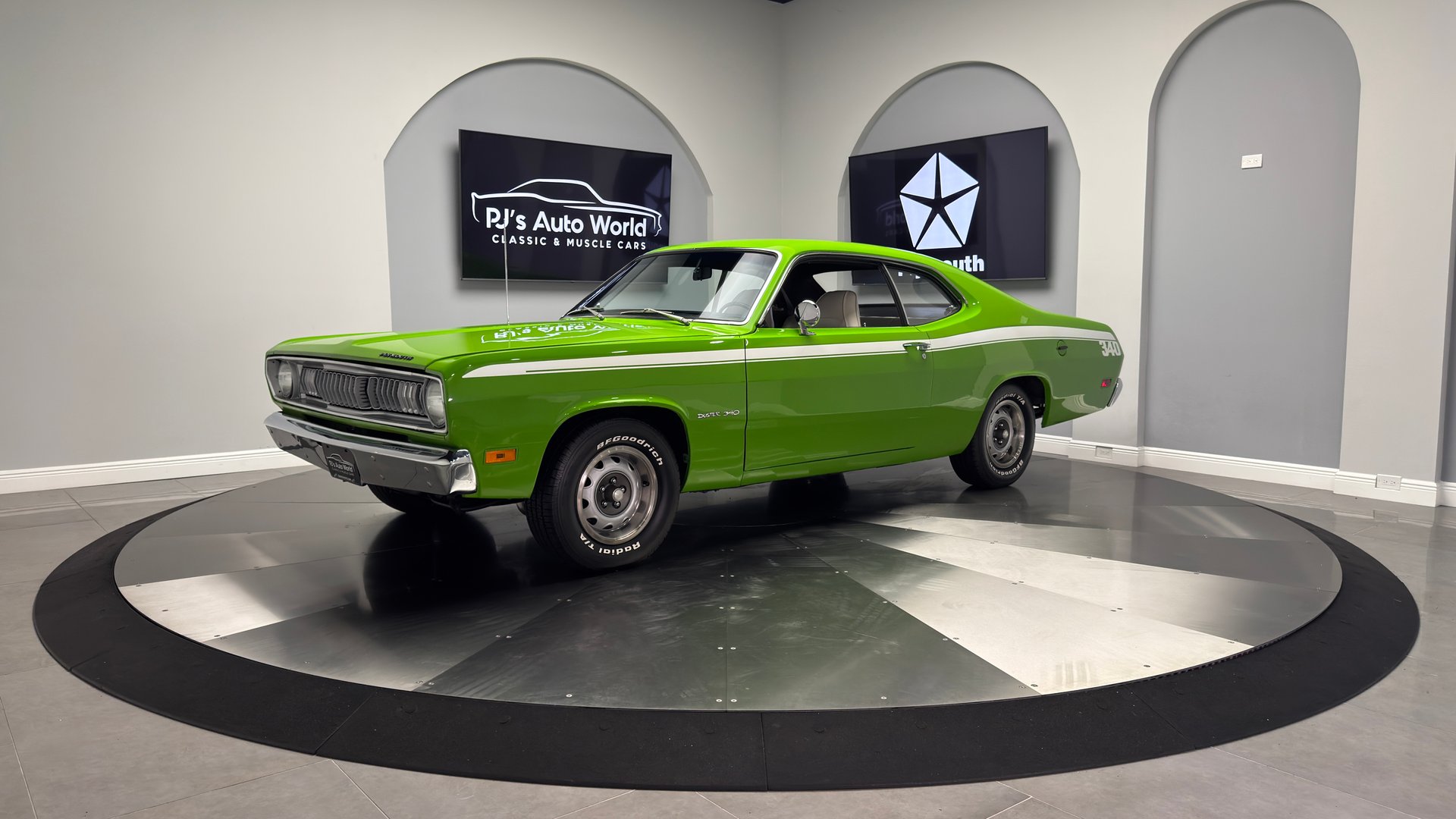
Every Duster is a two-door A-body coupe on a 108-inch wheelbase, and the range divides not by body — there is only one — but by engine and trim package, two things constantly confused in listings. A Twister looks like a 340 and is not. A Gold Duster is a trim package, not an engine. A Duster 360 is a separate performance model, not a base car fitted with a bigger engine — although plenty of base cars have since been fitted with bigger engines, which is why the fifth character of the VIN, the engine code, matters more on this car than on almost any other Mopar of the period.
| Model | Years | Engine | Output | Built | Character |
|---|---|---|---|---|---|
| Duster (six) | 1970–1976 | 198 or 225 slant six | 125 / 145 hp gross, falling to about 95–105 hp net | The bulk of production | The economy car; light, simple, slow, nearly indestructible |
| Duster (318) | 1970–1976 | 318 LA V8, 2-barrel | 230 hp gross, about 150 hp net from 1972 | Very numerous | The all-rounder; the sweet spot for a driver |
| Duster 340 | 1970–1973 | 340 LA V8, 4-barrel | 275 hp gross; 240–245 hp net from 1972 | 24,817 in 1970; 12,886 in 1971; 15,681 in 1972; 11,160 in 1973 | The performance flagship; the collector car |
| Duster Twister | 1971–1972 | 225 six or 318 V8 | As the base engines | Appearance package only | 340 looks — shark-tooth style grille, stripes, Rallye wheels — without the 340 |
| Gold Duster | 1973–1975 | Six or 318 | As the base engines | Trim package | Vinyl roof, upgraded trim and badging; a cruiser, not a performer |
| Duster 360 | 1974–1976 | 360 LA V8, 4-barrel | 245 hp net in 1974, falling thereafter | 3,969 in 1974; low thousands after | The 340's successor; rarer than a 340, softer, still quick |
| Feather Duster | 1976 | 225 slant six | About 95 hp net | One year only | Aluminium panels and an overdrive manual; the economy special |
(Outputs are period gross figures for 1970–71 and net figures from 1972, which is why the same engine appears to lose a quarter of its power overnight — the engine changed less than the measuring method did. Total Duster production across all variants ran well into six figures in the best years — over 200,000 cars in several of them — so rarity claims belong to specific variants, never to the Duster as a whole.)
The six-cylinder cars. The base Duster is a Valiant in a party dress, and there is no shame in that. The 198 slant six was offered at launch and the 225 was the volume engine throughout; both are canted 30 degrees — the famous Leaning Tower of Power. A six-cylinder Duster is light, easy on fuel by period standards, and the cheapest classic Mopar motoring there is. What it is not is fast: a seller describing one as a muscle car is selling the silhouette, not the performance. A six-cylinder VIN car wearing V8 badges is worth six-cylinder money with a story attached.
The 318 cars. The 318 LA small-block with a two-barrel carburettor was the thinking buyer's Duster when new and remains so. It gives the car genuine, relaxed pace, the full V8 soundtrack at a murmur rather than a shout, and none of the 340's purchase premium or thirst for premium fuel in the early high-compression years. Most were automatics, most were driven as family transport, and a clean, unmodified 318 car is arguably the best Duster to own if the plan is to drive it. It is also the most common starting point for clones: a 318 car is one engine swap away from looking like a 340, which is flattering to the 318 and a standing warning to 340 buyers.
The Duster 340, 1970–73. The flagship, and one of the great performance bargains of the muscle era: high compression in 1970–71, a forged crankshaft in the early cars, big-valve heads, a windage tray and a four-barrel carburettor, in a coupe light enough for it to matter. Period tests put a well-driven 340 Duster through the quarter mile in the low-to-mid fourteens, in big-block company. Identifying a real one is a paperwork exercise first: the VIN engine digit must be the 340 code, the fender tag and broadcast sheet should agree, and the block numbers should be consistent with a 340 rather than a 318 wearing 340 decals. The 1972–73 cars lost compression and a little edge — slightly cheaper, slightly softer, nearly as quick in the real world.
The Twister, 1971–72. The Twister package put the 340's visual cues — aggressive grille treatment, stripes, Rallye wheels — onto the six and 318 cars for buyers who wanted the look at insurance-friendly money. Twisters are charming, increasingly recognised, and catastrophically easy to misdescribe as 340s. A Twister is worth Twister money; the moment one is priced as a 340, walk back to the VIN.
Gold Duster and the trim packages, 1973–75. As the market sobered, Plymouth dressed the car up rather than speeding it up: Gold Duster trim brought a vinyl roof, plusher trim, badging and striping, and similar packages — Silver Duster among them — came and went. These are pleasant, often well-kept cars, bought by older owners and driven gently. None of the trim packages adds performance, and none should add a performance premium.
The Duster 360, 1974–76. When emissions rules and the loss of the 340's high-compression hardware killed the smaller engine, Plymouth answered with displacement: the 360, in the performance E58 specification with a four-barrel carburettor, dual exhausts and the heavy-duty running gear, became the Duster 360. The 1974 car, at 245 net horsepower, is a real performer — closer to the 340 in spirit than the paper suggests, because net ratings flatter it less. The 1975 and 1976 cars, strangled a little more each year and carrying catalytic converters from 1975, are softer. All 360s are rare beside the 340s — under four thousand in the best year — and rarity has not yet translated into 340 money, which makes a verified 1974 Duster 360 one of the smarter buys in this guide.
The Feather Duster, 1976. The farewell special, and the strangest: aluminium hood and trunk lid inner structures, bumper reinforcements and intake manifold, a specially tuned 225, and the option of an overdrive four-speed manual, all aimed at fuel economy. Feather Dusters are thin on the ground and worth verifying carefully, because the aluminium parts are the car — one that has lost them to accident repair is a slant-six Duster with a badge.

Engines and gearboxes
The slant sixes: 198 and 225
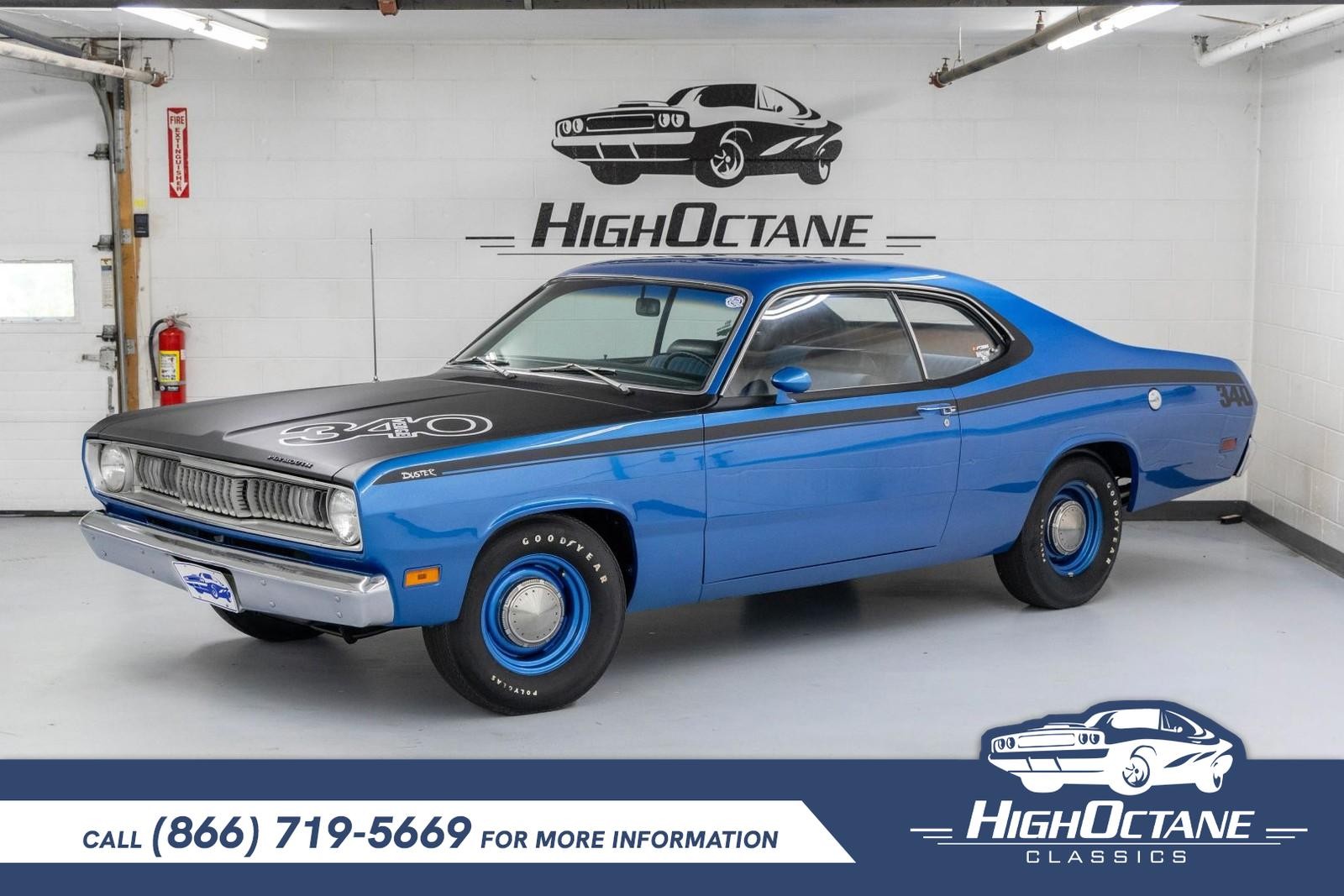
The slant six is one of the most durable engines ever put in an American car. The design dates to 1960: a cast-iron inline six, canted 30 degrees, with a forged crankshaft in the early engines, a deep-skirt block, and intake runners made deliberately long by the slant to improve low-speed torque. The 198 cubic inch version (RG engine) was the launch base engine; the 225 (also RG, longer stroke) was the one most buyers took and the one that survived to the end in the Feather Duster. Outputs look modest — 125 hp gross for the 198, 145 hp gross for the early 225, falling through the net-rating era to the mid-nineties — but the numbers miss the point: this engine almost never dies of internal wear in normal use. A slant six with 150,000 miles and regular oil changes is usually a better engine than a neglected V8 with half that.
What troubles it is ancillary, mostly in the intake and exhaust. The single-barrel carburettor — Carter BBS or Holley 1920 — has simple faults: a worn throttle shaft leaking air and ruining the idle, a sticking choke, flooding from a sunk float or dirt in the needle valve. Budget $250–600 for a proper rebuild or quality replacement fitted and set up, and rule it out before anyone diagnoses deeper. The exhaust manifold cracks around the centre ports where the heat riser passage concentrates thermal stress, and the heat riser valve seizes — usually shut, cooking the intake and causing a hot flat spot. A ticking that rises with revs and fades as the engine warms is manifold or gasket until proved otherwise. The intake and exhaust manifolds bolt together at the heat box: a leak there is a vacuum leak, an exhaust leak and a driveability fault in one gasket.
Ignition on early cars is single points; electronic ignition became standard during 1973 and was widely retrofitted earlier, usually a favour from a previous owner. Solid lifters on early engines want periodic clearance checks — a clattering top end is often simply adjustment, but a quiet one never adjusted may be tight, which is worse. Oil leaks come from the valve cover, fuel pump pad and rear main, in that order of frequency. A slant-six engine budget should be measured in hundreds; a seller asking V8 money for engine work on a six needs to show the invoice.
The 318: the LA small-block in its working clothes
The 318 is the default Mopar small-block of the era, a member of the LA family introduced in 1967 — the L is for lightweight, the thin-wall casting that separated these engines from the earlier polyspherical A engines. In the Duster it came in one state of tune: two-barrel Carter BBD carburettor, single exhaust, mild camshaft, 230 hp gross in 1970–71 and about 150 hp net from 1972 as compression and ratings fell together. It is understressed to the point of indolence, which is the highest praise a fifty-year-old engine can earn. A healthy 318 starts instantly, idles at a murmur, pulls without complaint from low revs, and shows no smoke beyond a first-start puff if the valve stem seals have aged.
Its failure modes are the LA family's, in mild form. The nylon-toothed timing sprocket sheds teeth with age and heat; the chain stretches, timing wanders, the idle goes lumpy, and teeth in the oil pickup can turn a timing job into an engine job. Treat chain replacement as scheduled surgery on any LA engine of unknown history — $600–1,200 at a shop for chain, sprockets, water pump and seals — and ask for evidence. The Carter BBD wears its throttle shaft bores, giving an erratic idle no mixture screw cures. Valve stem seals harden and give the classic blue puff on start-up, then clean running: seals are a driveway job with compressed air, and an engine-out explanation for them is a seller inventing work. Rear mains weep and oil pressure senders lie. All of it is fixable with shelf parts everywhere, which is precisely the 318's appeal.
The 340 and 360: the performance LA engines
The 340, fitted from 1970 to 1973, deserves its reputation and needs its mythology handled carefully. It is a 4.04-inch bore, 3.31-inch stroke engine — oversquare, built to rev — with 10.5:1 compression in 1970–71, a forged crankshaft, shot-peened rods, a windage tray, big 2.02-inch intake valves, a high-lift camshaft for its class, and a Carter AVS four-barrel in the early cars giving way to the Carter ThermoQuad for 1972–73. The advertised 275 hp gross was widely believed at the time to be conservative, a rating chosen with one eye on the insurance tables. For 1972 compression dropped to 8.5:1, the cast crankshaft arrived during the run, the heads went to smaller 1.88-inch intake valves for 1972–73, and the net rating settled at 240–245 hp. A 1970–71 engine is the collector's choice; a 1972–73 engine is 95 percent of the experience.
The ThermoQuad deserves its own paragraph because it causes more misdiagnosis than any other component on these cars. It is a spread-bore carburettor with small primaries and huge secondaries, a central fuel bowl made of phenolic resin — plastic, in plain language — and a distinctive howl when the secondaries open. The bowl warps and cracks with heat and age, the O-rings between bowl and base leak, and the result is flooding, hard hot starting and fuel smells blamed on everything except the bowl. A ThermoQuad that has been properly rebuilt with a sound bowl is an excellent carburettor; one that has not is a recurring bill. Budget $500–900 for a specialist rebuild, more if the bowl itself needs replacing with a good used or reproduction part, and smell for fuel at a hot restart on any viewing.
The 360 that replaced it for 1974 is a longer-stroke, larger-bore engine (4.00 by 3.58 inches) tuned for torque and emissions compliance rather than revs. In Duster 360 form it carried the E58 performance package: four-barrel ThermoQuad, dual exhausts, a performance camshaft and the heavy-duty driveline. At 245 net horsepower in 1974 it is genuinely quick, and it makes its power lower down and with less drama than a 340. Its weaknesses are the 340's weaknesses plus age: timing chain, ThermoQuad bowl, valve seals, and on 1975–76 cars the catalytic converter and its associated heat under the floor, which cooks carpet backing, floor paint and eventually the floor itself if the converter overheats on a misfiring engine. A misfire on a catalyst car is not a tune-up item to defer; raw fuel in a converter is how floors and cars get burned.
Across both performance engines, the identity check is the money check. A 340 block carries its displacement cast into the side of the block, low on the driver's side, and the stamped pad near the front of the block and the VIN derivative stamping by the oil pan rail tie a specific engine to a specific car. A 318 and a 340 look alike at a glance in a dark engine bay under an air cleaner wearing a pie tin that says 340 Four Barrel — the pie tin is a $40 part. Read the casting, read the stamps, and let the seller's story follow the numbers, never the other way round.

Gearboxes and rear axles
Chrysler's TorqueFlite is the best American automatic of its era, and the Duster uses two of them. The A904 TorqueFlite (and its slant-six sibling) sits behind sixes and 318s; the heavier A727 sits behind 340s and 360s and is identifiable by its larger case and pan shape. Both are three-speeds, both are famously tough, and both fail in predictable ways: hard seals with age give a slow engagement into drive or reverse on a cold morning that improves as the box warms — the classic TorqueFlite symptom, and a soft-parts rebuild rather than a death sentence at $1,500–2,800 fitted at a transmission shop. Band adjustment and fluid condition tell you a lot on a viewing: burnt-smelling, brown fluid and a box that flares on the 2–3 shift mean the rebuild has not been done yet, whatever the mileage. A TorqueFlite that shifts firmly, engages promptly hot and cold, and has red fluid is one of the lowest-risk components on the car.
Manuals are the minority — in our pool, automatics outnumber manuals heavily, matching period sales. The A230 three-speed is the base box: sturdy, slow, nearly unbreakable. The prize is the A833 four-speed, Hurst-shifted on performance cars, close-ratio behind the 340, with a reputation for strength earned in far heavier cars. Judge one on second-gear synchromesh on a fast downchange, on jumping out of gear on the overrun, and on shifter bushings — a sloppy Hurst linkage is cheap bushes, not a rebuild, and a full A833 rebuild runs $1,200–2,200 at a specialist. The Feather Duster's 1976 A833 overdrive variant, with a 0.73 overdrive fourth, is a different box in feel — wide gaps, economy intent — and correct for that car alone. Clutch judder is a warped or contaminated disc or tired linkage; the Z-bar bushings wear and make the pedal vague long before the clutch dies.
Rear axles come in three sizes, and size is a specification check. The 7.25-inch served sixes; the 8.25-inch became the common later axle; the 8.75-inch, with its drop-out carrier, was the performance axle behind early 340s. Sure Grip limited-slip was optional and worth testing: one wheel spinning on wet grass in a claimed Sure Grip car means worn clutches or cones. Axle whine on a steady cruise is pinion bearing or gear wear, an axle-out job; a clunk on taking up drive is as often spring bushes or a universal joint as backlash, so diagnose in order of price. Note the 1973 bolt-pattern change: early cars take 5-on-4-inch wheels, later cars 5-on-4.5-inch, and wrong wheels forced or spaced onto a car are a safety item, not a styling opinion.
Problem areas
Everything here is ordered by what it costs if you miss it, and that order starts with the shell. We examined nine cars' photo sets in detail; rust was noted in two and visible damage in two. Do not let those modest numbers relax you: A-bodies rot in structural places photographs flatter, the examined sample is the cars sellers chose to photograph, and fifty years of cheap-car life means the average Duster has had more exposure to salt and deferred repair than the average Barracuda or Charger. Almost everything mechanical is a known part at a known price. Structural rust is the one thing that reliably turns a bargain into a parts car.
Rust: the map
A Duster is a unibody. There is no separate frame to save it: the front subframe rails, floor, torsion bar crossmember, rocker panels and rear spring mounts are the structure, welded into one shell, and rust in any of them is a structural conversation, not a cosmetic one. Work through it in this order.
Front floors and the toe boards. The single most common Duster rust, and the place to start. Water gets in past a perished windshield gasket, a leaking cowl and blocked cowl drains, and sits under the carpet in the front footwells. Lift the carpets — all of them, not a corner — and from underneath look where the pans meet the toe board and crossmember. Surface scale is treatable; pinholing is a patch; a floor that flexes under a thumb is a pan replacement. Pans are cheap as panels — the money is labour, realistically $800–1,800 a side fitted, more if the crossmember or seat mounts are involved. Rotten front floors mean water in the cowl and usually the rockers too: floors are a marker for the whole front structure.
The torsion bar crossmember and its mounts. The A-body's defining structural trap, and the check that separates a Duster inspection from a generic old-car look-over. The front suspension's torsion bars anchor at the rear into a crossmember under the front seats, and their front ends load the lower control arms hung from the K-frame. The crossmember and the floor around its mounts trap mud and rot from the inside. If the anchor area is soft, the torsion bar can pull its mounting — a failure that drops a front corner of the car and is dangerous, not merely expensive. Prod hard around both anchor points from underneath, look for cracked underseal, swelling and layered rust, and treat perforation here as a fabrication job priced per car, not a panel swap. A seller who will not let you under the car has not saved you time; he has given you the answer.
Front subframe rails and K-frame area. The rails that carry the K-frame, engine and front suspension run forward from the floor. They rot where they meet the floor, around the K-frame mounting points, and where road grit blasts the coating behind the front wheels. Perforation here is structural welding, and misalignment follows rust: a car whose front wheels sit unevenly in their arches, or whose panel gaps changed after a bump the seller calls minor, may be telling you about rail movement. Budget fabrication at shop rates — $1,500–4,000 for a serious rail and crossmember campaign is not unusual — and weigh it against the value of the finished car before you fall for a cheap 340 with soft rails.
Rocker panels, lower quarters and rear wheel lips. The rockers are structural members as well as sills, and they rot from the inside out behind their own drain slots. Press along the full length; bubbles under paint at the rear of the rocker, where it meets the quarter, are the classic first showing. The rear quarters rot at the wheel lip, where the inner and outer skins trap dirt, and at the lower rear behind the wheel, where everything the tyre throws up collects against the trunk extension. Lower front fenders behind the front wheels do the same job at the other end. Quarter and lip repair ranges from a $400–900 localised patch and blend to a full quarter skin at $1,500–3,000 a side fitted and painted, and the difference between those numbers is only visible once the paint and filler come off — which is why a magnet and a fingertip along every lip earn their keep in the inspection below.
Trunk floor, spare wheel well and trunk extensions. The rear window and trunk seals leak, the water runs to the lowest point, and the lowest point is the spare wheel well and the drop-off extensions at each side of the trunk floor. Lift the spare, lift the mat, and look at the well corners and the seam where floor meets extension. A fuel tank sits under this floor, and its top surface and straps live in the same damp; a car with a rotten trunk floor often needs tank attention in the same campaign. Trunk floor replacement is a panel job — $700–1,500 fitted — but it is also the easiest rust to inspect honestly, so use it as your calibration: a seller whose trunk floor matches his description of the car is more believable about the floors you cannot see.
The smaller traps. The cowl sides and the fresh-air vent boxes rot and leak onto the floors they then get blamed for. Door bottoms fill with water when their drains block — run a fingertip along the lower edge of each open door and feel for bubbling. The battery tray and the inner fender beneath it corrode from acid. The hood's rear corners, the trunk lid's lower lip, the drip rails and the windshield and rear window frames all hold water against seams. None of these alone kills a car. Together they are the biography of how it has been stored, and a car that is honest in the small places is usually honest in the big ones.


Front suspension, steering and brakes
The A-body front suspension is torsion bars, upper and lower control arms, and ball joints — a good design with no kingpins and no exotic parts, whose enemy is simply fifty years. Torsion bars themselves rarely fail unless rust pits their surface at the anchor ends, where a pit becomes a stress riser and a bar can snap; surface rust on a bar's hexagonal anchor end is a replacement conversation, and bars are replaced in matched logic, not welded, ever. Ball joints — the uppers screw into the control arm, a Chrysler peculiarity that makes the right socket a necessity and cross-threading a known amateur disaster — wear and knock. Bushings perish, especially the lower control arm pivot bushings and strut rod bushings, and the car wanders and clunks over bumps. A full front-end refresh with joints, bushings, tie-rod ends and an alignment is $900–1,800 in parts and labour at a generalist shop, less if you do the labour yourself, and it transforms a vague car. Budget for it on any Duster without a recent invoice, rather than treating it as a defect unique to the car in front of you.
Steering is a recirculating-ball box, manual or power. Play at the wheel is usually a worn coupler — the little pot coupling at the column base, whose shoes wear and whose failure matters — tired tie-rod ends, or an idler arm, before it is the box itself. The coupler deserves a specific check because a failed coupler is a loss-of-steering event: grab and rock it, look for play and perished seals, and price a rebuild kit in tens of dollars against what it protects. Power steering pumps whine on tired fluid and leak from the front seal and hoses; boxes leak from the sector shaft seal. None of this is dear. All of it is negotiable when found.
Brakes divide the range in two. Many six and 318 cars left the factory with four-wheel drums, adequate in 1970 and marginal now; front discs were optional, widely fitted, and effectively standard thinking on 340 and 360 cars, with the hardware changing at the 1973 facelift from the earlier Kelsey-Hayes four-piston fixed calipers and two-piece rotors to the later single-piston sliding calipers and one-piece rotors that share parts with the bigger B-bodies. Know which system a car has before you price brake work, because early disc parts cost more and the two systems do not mix piecemeal. A full hydraulic refresh after long storage — master cylinder, hoses, calipers or wheel cylinders, fluid — runs $700–1,600 fitted. Disc conversions for drum cars are a mature, well-documented aftermarket job and a legitimate improvement; a badly executed conversion with mismatched master cylinder and no proportioning thought is worse than good drums. Test pedal feel, straight-line stopping and the parking brake, which lives in the rear drums and fails by neglect on disc cars too.
At the rear, leaf springs carry an axle that locates itself on them, and the wear items are the spring eye and shackle bushings, the hangers they mount to, and the springs' temper. A Duster sitting low or lopsided at the rear is usually tired springs or a broken leaf; a car sitting high at the rear has often been fitted with air shocks to mask tired springs, which loads the shock mounts with weight they were never designed to carry and cracks them. Check the front spring hangers and the rear shackle mounts against the floor and rails with the same suspicion as the torsion bar crossmember — they are welded structure, they trap mud, and a spring hanger pulling out of a rotten mount is the rear suspension's version of the same failure.
Interior, trim and electrics
A-body interiors were built to a price and have aged accordingly, but they are simple, and nearly everything is reproduced. The dash pad cracks across its top in the sun — every unrestored car in a southern state has it — and a quality replacement or restoration runs $500–1,000 fitted. Seat foam and upholstery kits are available for the common bench and bucket patterns; budget $1,200–2,500 for a professional retrim of a front and rear set in vinyl, more for the correct grain and pattern done to show standard, and check the seat frames and springs underneath, because Duster seat frames crack at the hinge and recliner points and a retrim over a broken frame is money wasted. The fold-down Space Duster rear seat mechanism, where fitted, jams and its release cables stretch; work it on the viewing. Headliners sag and tear at the seams, door cards warp at their lower edges where door water has reached them — which ties the interior back to the door drains in the rust section — and carpets hide the floors, which is why the inspection insists on lifting them.
Trim is where Duster money quietly goes. Grilles differ by year and by package, are plastic, crack at their mounting tabs, and good originals for the early shark-tooth style Twister and 340 grilles are hunted parts. Tail panels and tail light bezels pit and crack. The correct stripe kits are reproduced and cheap; the brightwork is mostly stainless and revives with polishing, which is a mercy. Glass is available; window regulators wear at their pivot rivets and make windows drop and rattle. Price a car needing a grille, a dash pad and a retrim as what it is: several thousand dollars of small things, none of which a seller can talk away.
Electrics on a Mopar of this era have two famous faults and a long tail of ordinary ones. The first famous fault is the bulkhead connector, where the main harness passes through the firewall: its terminals corrode and overheat, most notoriously on the charging circuit, and the symptoms range from flickering lights and a lying ammeter to a melted connector and a dead car. Pull the connector apart on any car you are serious about and look for green corrosion and heat-discoloured plastic. The second is the ammeter itself, through which the full charging current passes in the dash: loose or corroded ammeter terminals are a recognised under-dash fire risk on Chrysler products of this period, and many knowledgeable owners bypass or upgrade the circuit. Treat evidence of careful electrical upgrading here as a plus, and melted insulation as a stop-and-price-it item, with an auto-electrician's harness work at $600–1,500 depending on how far the damage has gone. The ballast resistor — the white ceramic block on the firewall — fails open and gives the classic crank-but-no-start, or starts-and-dies-when-the-key-is-released; it costs a few dollars, every Mopar owner carries a spare, and a car that will not start on a viewing with those symptoms may be the cheapest fault you ever negotiate over. Voltage regulators, fusible links, tired grounds and perished insulation make up the rest. A Duster where every light, gauge, blower speed and wiper setting works has been maintained by someone who cared, which remains the best single predictor of the rest of the car.
Mechanical wear, modifications and accident history
Beyond the engine-specific items in the previous section, price the ordinary wear of a fifty-year-old car: radiators silted and rodded past their best, water pumps with play, fuel tanks full of varnish and rust scale after storage — a tank clean or replacement plus lines and filters is $400–900 and is effectively compulsory on a car that has sat — exhausts, universal joints, wheel bearings, and shocks. Modern ethanol fuel attacks period rubber and cork throughout the fuel system; a car in regular recent use is worth more than a lower-mileage car that has slept for a decade, because recommissioning the sleeper costs $2,000–5,000 before you improve anything.
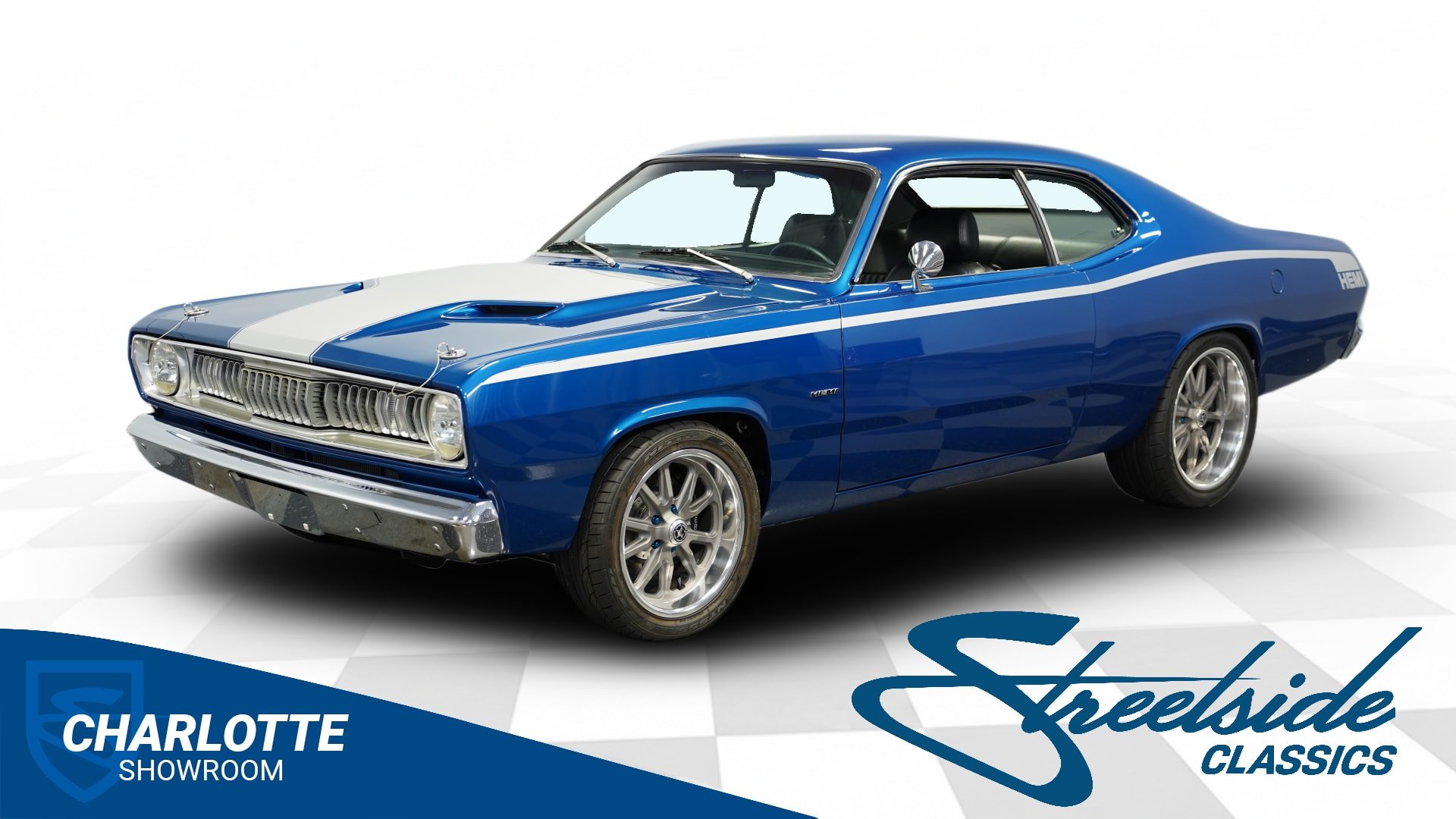
Modification is the Duster's particular market hazard, because the platform invites it and the parts interchange across the whole Chrysler range. Big-block swaps, late-model Hemi swaps like the restomod in our photo pool, stroker small-blocks, changed axles, disc conversions, mini-tubs, subframe connectors, repainted engine bays in body colour — some of it is excellent, much of it is unfinished, and all of it moves the car's value from the Duster market to the quality-of-build market. The questions are always the same: who did it, is it finished, does it run cool and drive straight, and is the paperwork honest about what the car started as. Subframe connectors, incidentally, are a recognised stiffening improvement on a unibody A-body and not a defect — but fresh connectors welded over rotten floors are lipstick on a structural problem, so read the order of the work, not just its presence. Accident history shows in the usual places: mismatched panel gaps at the hood and doors, overspray on weatherstrips and in the trunk, replaced front clips — remember the Duster shares its front clip with the Valiant, so a clip swap is easy and common — and ripples in the subframe rails. A straight, unhit shell is worth a premium on this car precisely because so many were hit, repaired cheaply and sold on.
How to inspect one
Allow at least an hour, insist on seeing the car cold, and bring a torch, a cloth-wrapped magnet, a small screwdriver for prodding with the seller's permission, and a friend to work lights and pedals while you watch. If the car passes you, pay for time on a lift before money changes hands — on a unibody A-body the underside is the car, and an hour underneath is worth more than a day polishing your impressions of the paint.

- Start with the paperwork and the identity. Match the VIN plate at the driver's side of the dashboard, visible through the windshield, to the title. Read the fifth character — the engine code — and check it against the engine in the car and the price being asked: a six or 318 code under a 340 price ends the negotiation until the price matches the code. Decode the fender tag on the driver's inner fender for engine, transmission, axle, paint and trim, and look for a broadcast sheet — under the rear seat, above the glovebox or under the carpet on cars that still have one. A thick history file is worth real money on any Duster.
- Cold start. The engine must be cold when you arrive; a warmed-up car is hiding something, even if only a choke fault. A six should settle to a steady idle, a 318 to a murmur, a 340 or 360 to a lumpy, purposeful idle. Watch for blue smoke on start-up (valve stem seals if it clears, worse if it does not), listen for exhaust manifold ticks as it warms, and note the choke behaviour — a ThermoQuad car that needs three attempts hot is telling you about its fuel bowl.
- Under the hood, in order. Check oil level and condition, smell the oil for fuel, look for coolant in the oil and oil in the coolant, and read the casting on the side of a claimed 340 or 360 block rather than trusting the air cleaner decal. Examine the bulkhead connector for corrosion and heat damage, the ballast resistor and its wiring, the battery tray and inner fender beneath it, and the general standard of wiring — factory loom and tidy repairs are a character reference for the whole car.
- Under the car: the structure decides. On a lift or with the car safely raised, work front to back: front subframe rails and K-frame mounts, front floors and toe boards, the torsion bar crossmember and both anchor points — prod hard here, this is the step that walks you away from rotten cars — rocker panels along their full length, rear floors, front leaf-spring hangers, rear shackle mounts and the rails around them. Perforation in the crossmember, rails or hangers is structural, and structural rust reprices or ends the deal on the spot.
- Floors and trunk from inside. Lift all the carpets, front and rear, and look for water tracks from the cowl and windshield base, damp sound deadening and pan repairs — and judge the quality of any repair you find, welded and sealed versus riveted and smeared. Then the trunk: spare out, mat up, well corners and extensions examined, rear window seal checked while you are there. The trunk floor is your honesty calibration for the rest of the shell.
- Body, gaps and the magnet. Walk the car slowly in good light. Run the magnet over the rear wheel lips, lower quarters, rocker ends, lower fenders and door bottoms — filler announces itself. Sight down each flank for ripples, check hood, door and trunk gaps for accident history, feel along every door's bottom edge for bubbling, and count the cracked, pitted or missing trim pieces, especially the grille, and price them before you fall in love.
- Suspension and steering. Rock each front wheel top-to-bottom and side-to-side for ball joint and bearing play. Bounce each corner and watch it settle. Grab the steering coupler at the column base and rock it for play. Check torsion bar anchor ends for rust pitting, rear springs for broken leaves and sag, and look for air shocks masking tired springs. On the drive that follows, the car should track straight, return to centre, and clunk at nothing.
- Brakes, wheels and tyres. Identify the system first — drums or discs, and if discs, early or late hardware — then test it: firm pedal, straight hard stop from speed, no judder, a parking brake that holds. Check tyre age as well as tread, look for uneven wear that betrays alignment or bushing wear, and confirm the wheels match the car's bolt pattern — 5-on-4-inch early, 5-on-4.5-inch from 1973 — with no forced fits or spacer stacks.
- The test drive. Fifteen minutes minimum, including a stretch at highway speed. An automatic should engage promptly hot and cold and shift firmly without flaring; a manual should take second gear cleanly on a downchange and stay in gear on the overrun. A performance car should pull hard and clean to the top of its rev range; a six should pull without hesitation or manifold ticking under load. Listen for axle whine on a steady cruise and clunks on taking up drive, and note every one against the asking price.
- Heat, electrics and the bulkhead test. Let it idle hot and watch the temperature gauge behave. Work everything: lights, indicators, wipers and washers, blower on all speeds, horn, every gauge, interior lights. Flickering lights or an ammeter needle that dances at idle points back to the bulkhead connector and charging circuit from the problem areas section — cheap parts, tedious tracing, and a fire risk if the melting has started, so look, do not just operate.
- Stance and ride height. Stand back and look. A Duster should sit level side to side, with the front ride height set by the torsion bars — a nose-down car may be sagging bars or simply maladjustment, and the two have very different prices. A tail-down car is tired rear springs; a tail-high car is often air shocks or heavy-duty springs fitted to mask them. Photograph the car square from the side: stance faults you excuse in person are obvious in a picture.
- Interior last, and honestly. Sit in every seat, feel for collapsed foam and cracked frames, work the fold-down rear seat if fitted, check the dash pad, headliner and door cards, and operate every window. Then add it up: a dash, a retrim and a grille are thousands, and a sound original interior is the hardest thing on a Duster to recreate — weight it accordingly, and let the total, not the test drive's grin, set your offer.

Values
The build below this guide carries the live market — the cars listed now and the recorded sales — and it is refreshed at every build, so this section deliberately carries no figures of its own. What it can teach you, durably, is how to read those numbers when you get there, because the Duster market punishes a naive reading more than most.
Start with the condition spread, which on a Duster is not a spread so much as a cliff system. At the bottom sit the project cars: slant-six and 318 coupes with structural rust, missing trim and a decade of sleep behind them, cars whose real price is the shell's price because everything else will be bought again during the restoration. Above them, driver-quality cars — sound underneath, mechanically sorted, cosmetically honest — form the broad middle of the market and the best value in it, because a Duster driver can be used as found in a way a project cannot. At the top, the money concentrates hard on two things: verified performance identity and originality. A documented 340, especially a 1970–71 four-speed car in a High Impact colour with its numbers and paperwork intact, lives in a different market from every other Duster, and a documented 1974 Duster 360 is beginning to be priced as the connoisseur's alternative rather than the consolation prize. Restored cars sit uneasily between: a restoration on this platform costs more than the finished car usually sells for, so a freshly restored Duster is often the previous owner's gift to you — provided the photographs and invoices prove the rust was cut out rather than covered, which on this car means underside and in-progress pictures, not finished beauty shots.
Asking prices and achieved prices part company predictably. Private sellers of ordinary cars ask driver money for project cars on the strength of the silhouette; the recorded sales in the market block below are the correction, and the gap between a model's asking pattern and its achieved pattern is the truest measure of how much hope is in its listings. Auction results flatter exceptional cars and punish ordinary ones in public, which is useful information in both directions. Dealer asking prices for turn-key cars include preparation, warranty and premises, and comparing them directly with private project listings is comparing different products.
Variant premiums follow identity, not appearance. The 340 premium is real and large, which is why it is faked, which is why the VIN code, fender tag and block casting are the value, and the car is merely attached to them. Twisters earn a modest premium over the equivalent base car as recognised packages and should never be priced within reach of a 340. Gold Duster and the other trim packages add showroom appeal and very little money. Four-speed cars earn a premium over automatics in the performance models and almost none in sixes. High Impact colours — the purples, greens, yellows and oranges in our listings pool — help a performance car and are neutral elsewhere. Modifications subtract unless they are exceptional: a restomod or engine-swapped car is worth the quality of its build to the small audience that wants exactly that build, and its seller's parts total is not its value.
The project-versus-driver gap is the calculation that decides most Duster purchases. Price the structural welding, the recommissioning and the trim a specific project needs, honestly and at shop rates even if you intend to do the work yourself, and compare the total with a sorted driver. On this platform the driver wins that comparison so often that the exceptions — a verified 340 project, a one-family car with paperwork — prove the rule. Negotiate on evidence: the crossmember, the floors, the identity codes and the trim list are all inspectable facts, and a seller confronted with them, politely and specifically, is negotiating about a car rather than a dream.
Parts and ownership
The Duster is one of the best-supported American cars of its era to own, for a simple arithmetical reason: Chrysler built A-bodies by the million, the Duster shares its mechanical life with the Valiant, Dart, Demon, Dart Sport and the early Barracuda, and the performance variants plug it into the centre of the Mopar hobby. A car that shares its brakes, suspension and running gear with that many siblings is a car whose parts problem has been solved by other people's volume.
Easy: service items for every engine — filters, plugs, points and condensers for the early cars, electronic ignition service parts for the later ones — plus slant-six and LA V8 engine internals, gaskets and seals, water pumps, radiators, carburettor kits for the Carter and Holley units, TorqueFlite soft parts and full rebuild kits, A833 service parts, ball joints, bushings, tie-rod ends, brake service parts for the common disc and drum systems, shocks, leaf springs, exhaust systems, glass rubbers and weatherstrips, floor pans, trunk floors and the common rust repair panels, stripe kits and most interior soft trim in the popular colours and patterns. Order today, fit this weekend, at prices that make European classic owners wince with envy.
Harder and dearer: correct early 340 hardware — the high-compression-era heads, manifolds and forged-crank engines are hunted and priced as such — sound ThermoQuad fuel bowls, the early Kelsey-Hayes disc brake components, year- and package-correct grilles in uncracked condition, especially the aggressive early performance and Twister styles, dash pads in the less common colours, Space Duster fold-down seat hardware, Feather Duster aluminium panels, and date-coded correctness parts for a concours 340. None of it is unobtainable; all of it rewards patience and club knowledge over a credit card in a hurry. A quality repaint starts in the high four figures and rises steeply with the rust repair underneath it, which is the whole argument of this guide in one sentence: buy the shell, fix the mechanics.
Running costs. A sorted Duster is a realistic regular-use classic. Fuel consumption runs from the low twenties miles per gallon in a gently driven slant six on a long run, through the mid-teens for a 318, to the low teens — and single figures under provocation — for a 340 or 360. Servicing is within the ability of any competent home mechanic and any generalist shop that still speaks carburettor; the specialist Mopar trade exists for the performance engines and for concours correctness, not for keeping a driver alive. Insurance for an agreed-value classic policy is in line with other American cars of similar value. The budget line that catches new owners is, as always, the first year: catching up deferred maintenance on a running car honestly costs in the low thousands before you improve anything, and recommissioning a car that has sat for years — fuel system end to end, every brake component, all fluids, seals and tyres — runs several thousand more at shop rates. Buy a car in regular use over a sleeping car with lower miles, join the A-body community's forums and clubs where the interchange knowledge lives, and keep the fender tag, broadcast sheet and any numbers photographs in a file: on a car whose value is its identity, your paperwork is part of the car.
Which one to buy
- The all-rounder: Duster 318, automatic or manual, 1970–72. The V8 soundtrack and pace, the early cars' simplicity, parts on every shelf, and no performance premium to buy or to protect. If you want one Duster to drive everywhere, this is it.
- The value buy: a driver-quality 318 or late 360-era car, 1973–75. The facelift cars are cheaper for reasons of fashion rather than merit, are often the least modified, and carry the better brakes and bolt pattern. A sound 1974 Duster 360 at driver money is the sharpest buy in the whole range.
- The performance car: Duster 340, 1970–71. High compression, forged crank, the full reputation — earned. Verify the VIN code, fender tag and block casting ruthlessly, because the premium is the identity, and a clone at real money is the most expensive mistake this market offers.
- The connoisseur's car: Duster 360, 1974. Rarer than a 340, nearly as quick in the real world, priced as the understudy. The one-year sweet spot before the catalyst era softened the car.
- The economy classic: slant-six Duster, any year, or a Feather Duster for the completist. The cheapest honest way into the shape, with running costs to match. Buy the Feather only with its aluminium panels verified present.
- The cruiser: Gold Duster with a 318. Vinyl roof, plush trim, gentle previous owners. The Duster as a period compact luxury coupe, and none the worse for it.
- The looks-for-less car: Twister. All the visual attitude of the performance cars at base-engine money — bought knowingly, at Twister money, with the VIN checked twice precisely because it looks like something it is not.
And the rule that overrides all of the above: buy the least rusty shell you can find, with its identity verified, in the specification you can live with. Engines, gearboxes, brakes, carburettors and interiors are all fixable at prices you can plan for. A rotten torsion bar crossmember, pulled spring hangers and a shell full of filler cost more to put right than the finished car will be worth — and a Duster whose numbers do not match its badges will never be worth what you paid for the story.
See the 28 Duster cars currently listed.