
Plymouth Barracuda buyer's guide
Plymouth Barracuda -- the model's own buyer's guide: variants, values and what to check.
Years listed: 1964-1974 · Series: Barracuda
Overview and history
The Plymouth Barracuda is three different cars wearing one name, and understanding that is the whole secret to buying one well. From 1964 to 1966 it was a fastback version of the compact Valiant, launched on 1 April 1964 — two weeks before the Ford Mustang it is forever compared with. From 1967 to 1969 it was a larger, wider A-body offered as a fastback, a notchback coupe and a convertible, with engines growing until a 440 big-block was being shoehorned in at the factory. From 1970 to 1974 it was the E-body: a purpose-built pony car shared with the Dodge Challenger, and the car that produced the 426 Hemi 'Cuda, the 440 Six Barrel 'Cuda and the AAR 'Cuda — three of the most collectible American cars of the muscle era.
That spread is why a model guide matters here. Cross-shopping the whole run is not choosing between trim levels: you are choosing between a charming, glassy early fastback you can drive every day, a compact late-1960s coupe that can be anything from a slant-six runabout to a big-block street brawler, and an E-body ranging from a mild 318 cruiser to a Hemi car whose identity paperwork is worth more than most finished classics. The name stayed the same. Almost nothing else did.
The first-generation car deserves more respect than the Mustang story usually allows it. Plymouth took the Valiant — a sound, unibody compact with torsion-bar front suspension — and gave it the largest rear window ever fitted to a production car at the time, a wraparound fastback glass that defined the car and still does. Underneath it was Valiant sensible: slant-six economy or the new 273 small-block V8, a folding rear seat and a seven-foot load floor with the seat down. Plymouth sold 23,433 in the shortened 1964 season and 64,596 in 1965. The Mustang outsold it many times over, but that was marketing scale, not the car.
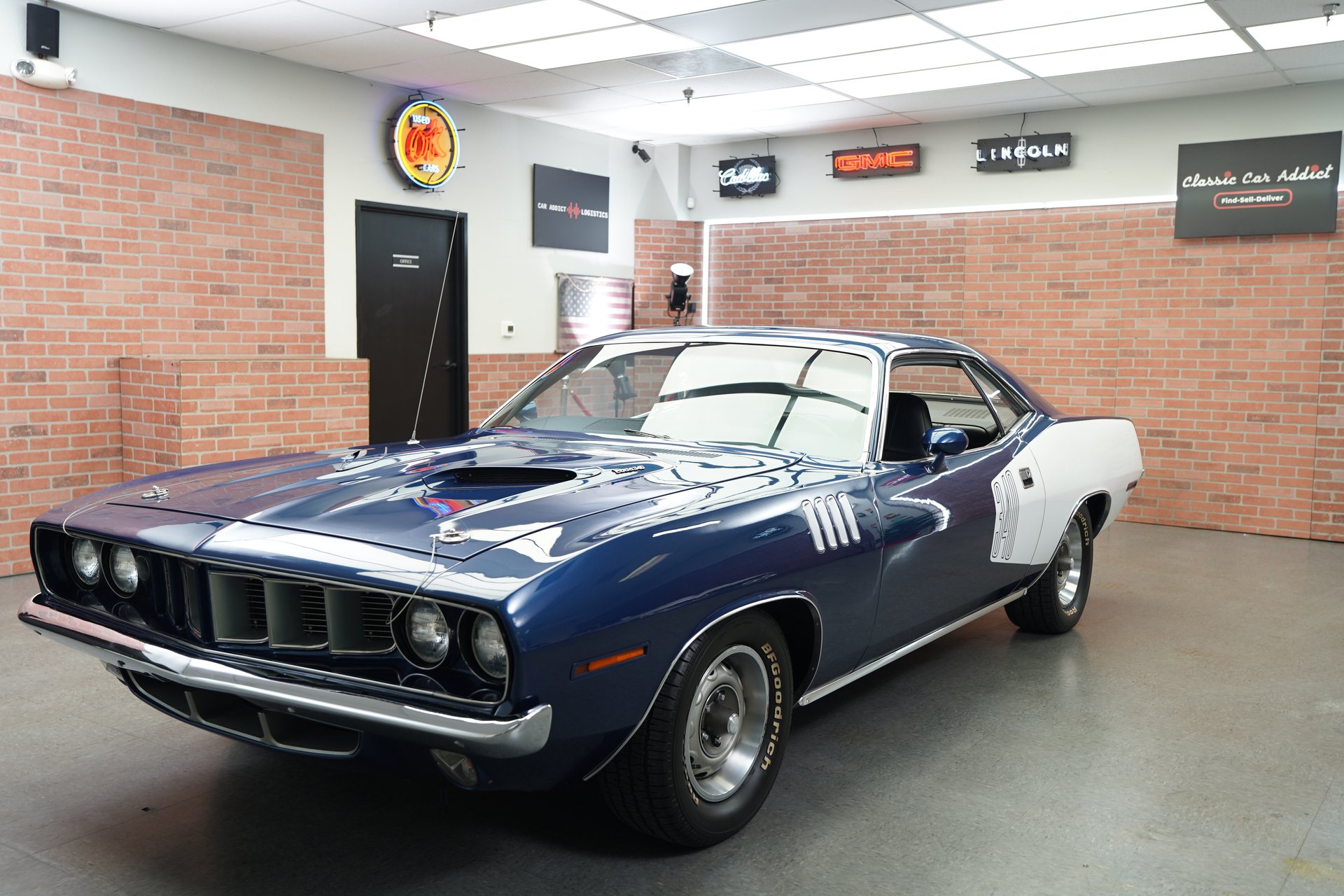
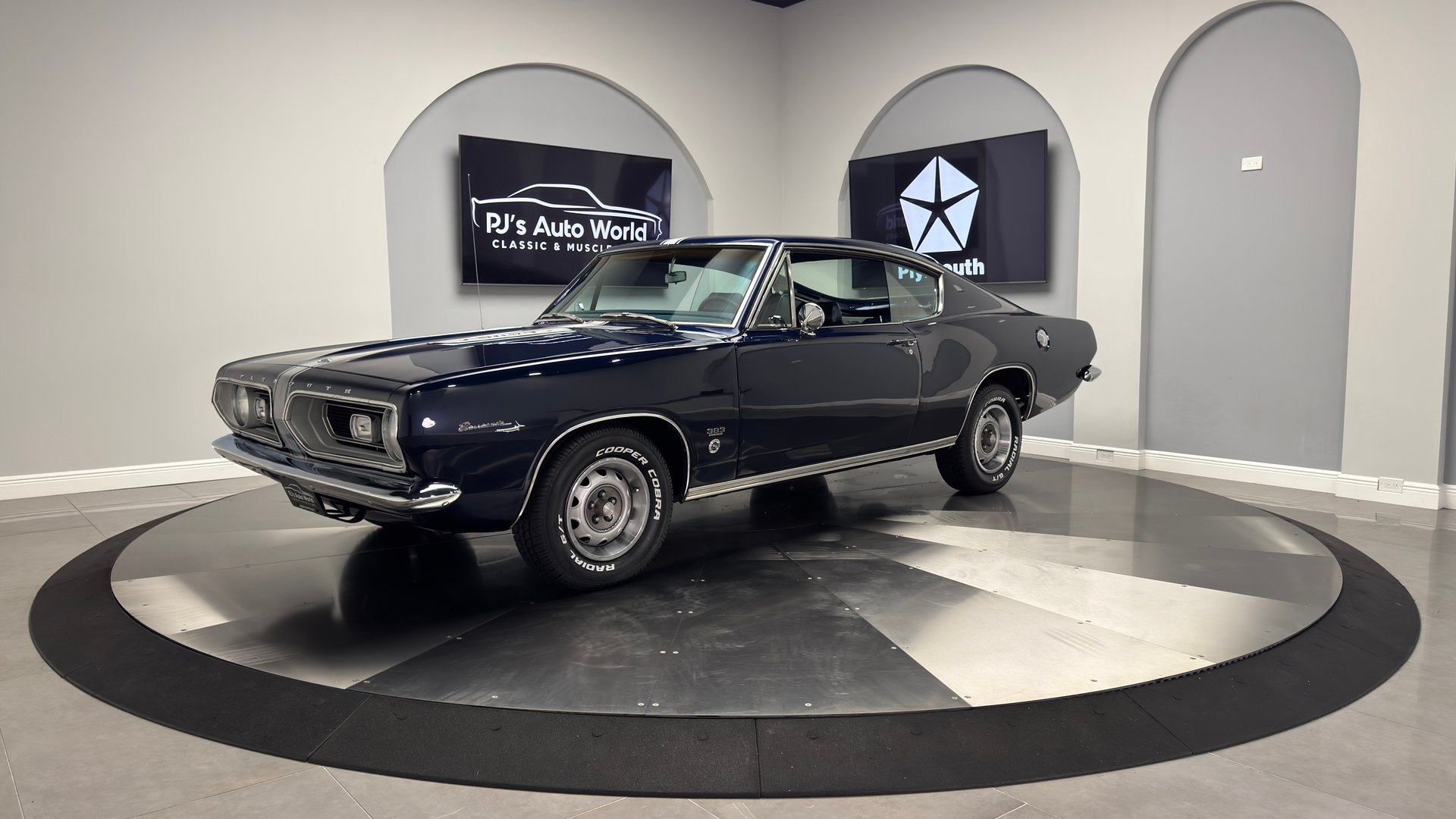
The second generation, for 1967, was Plymouth's correction. The wheelbase grew to 108 inches, the body grew wider, and the single fastback became three body styles. Crucially, the engine bay was widened for big-block power, and the escalation was relentless: the excellent 340 for 1968, the 383 alongside it, and for 1969 a factory 440 car — the M-code — barely civilised and now one of the rarest A-bodies of all. Formula S was the handling package from 1965, and for 1969 the performance models were spun off under the abbreviated name 'Cuda.
The E-body of 1970 was the clean-sheet car, designed around the big engines from the start — room for the 426 Hemi as a catalogue option rather than a conversion. The line split formally: Barracuda and the luxury-trimmed Gran Coupe were the standard cars, and 'Cuda was the performance model, with the 383 as its entry engine and the 340, 440, 440 Six Barrel and Hemi above it. The styling was the last confident expression of the muscle era, and the moment was already ending: insurance surcharges, fuel prices and emissions rules cut sales after 1971, the big-blocks and the convertible disappeared, and the 1972–74 cars carried on as softer 318, 340 and finally 360 coupes. Production ended in 1974.
Today's market reflects all three lives at once. In our own listings we track 111 Barracudas, 89 of them currently for sale: 1970 is the single biggest year with 26 cars, the two A-body generations make up a large, active middle, and the 1972–74 E-bodies sit at the gentler end. Texas and Florida supply the most cars — which is not the same thing as rust-free, since plenty began life in the snow belt before migrating south.
Buy any Barracuda on three things, in this order: the shell, the identity, and the engine. The shell because every Barracuda is a unibody and structural rust is fabrication work, not panel work. The identity because the gap between a base Barracuda and a genuine 'Cuda — and between a genuine Hemi car and a tribute built from a 318 coupe — is the largest value gap in the Mopar world, settled by factory codes, not badges or stories. And the engine last, because these engines are tough and rebuildable, and almost any mechanical fault is cheaper than a rotten crossmember or a cloned identity.

The models
Three generations, three platforms, and within the third generation a formal split between Barracuda and 'Cuda that you must be able to read at a glance. The table below is the orientation map. Production figures are given only where the factory record is genuinely solid; for low-volume variants the honest figure is often a range, and the table says so rather than inventing precision.
| Model | Years | Engine | Output | Built | Character |
|---|---|---|---|---|---|
| Barracuda (first generation) | 1964–1966 | 170/225 slant-six, 273 V8 | 101–235 hp | about 127,000 | Valiant fastback; glass, charm, simplicity |
| Barracuda Formula S | 1965–1969 | 273, then 340/383 | 235–300 hp | small minority of production | The handling package: suspension, tach, power |
| Barracuda (second generation) | 1967–1969 | 225 six, 273/318/340, 383 | 145–300 hp | about 140,000 | Three body styles; the range widens every year |
| 'Cuda 440 (M-code) | 1969 | 440 big-block | 375 hp | about 340 | Factory big-block A-body; barely civilised, very rare |
| Barracuda / Gran Coupe (E-body) | 1970–1974 | 198/225 six, 318, 340/360 | 95–245 hp | the bulk of about 113,000 E-bodies | The standard cars; cruisers through to sharp 340s |
| 'Cuda 340 and 383 | 1970–1971 (340 to 1973) | 340 small-block, 383 big-block | 275–335 hp | tens of thousands combined | The volume performance cars; the driver's pick |
| 'Cuda 440 Six Barrel | 1970–1971 | 440 with three two-barrels | 390 hp | roughly 2,600 | Six Barrel theatre with real pace; usable Hemi alternative |
| 'Cuda 426 Hemi | 1970–1971 | 426 Hemi | 425 hp | about 780 | The flagship; convertibles are the rarest of all |
| AAR 'Cuda | 1970 only | 340 Six Barrel | 290 hp | 2,724 | Trans-Am homologation special; one year, one spec |
| Barracuda (late E-body) | 1972–1974 | 318, 340, then 360 | 150–245 hp | about 49,000 | Softer, rarer than you think, and undervalued |
First generation, 1964–66. One body style only: the fastback, with its huge rear glass, fold-down rear seat and a trunk that passes through into the cabin under a removable panel. Trim was simple — standard and, from 1965, the Formula S package with firmer suspension, wider wheels, a tachometer and the 273 Commando V8 as the usual partner. Convertibles and notchbacks do not exist in this generation; anyone offering you a 1965 Barracuda convertible is offering you a Valiant or a mistake. These cars live or die on their glass, their bright trim and their shell.
Second generation, 1967–69. Three body styles — fastback, notchback coupe and convertible — on the widened A-body. The range is a ladder: slant-six and 273/318 cars at the bottom, bought as stylish transport; the Formula S in the middle, which by 1968 meant the new 340 and some of the best-balanced handling of any American car of the period; and big-block cars at the top — the 383 from 1967, and the 1969 M-code 440 'Cuda, built by stuffing the largest engine Chrysler made into its smallest performance body, with power steering and air conditioning deleted because they did not fit. Alongside the street range sit the 1968 BO29 Super Stock Hemi cars, around 100 lightened drag-racing shells. They are competition cars with their own paperwork world; price and verify one as such.
E-body, 1970–74. The split that matters: Barracuda (code letters BH in the VIN) is the standard car, 'Cuda (code letters BS) is the performance model, and the difference was made at the factory, in the body number, not at the dealership with a stripe kit. Gran Coupe was the luxury Barracuda, with a leather-trimmed interior and an overhead console — a trim level, not a performance car, a distinction sellers blur constantly. The 'Cuda range ran 383, 340, 440 four-barrel (1970 only), 440 Six Barrel and 426 Hemi, with the AAR as a one-year side branch built to homologate a Trans-Am programme. Convertibles were offered for 1970 and 1971 only, and a genuine Hemi 'Cuda convertible — 14 built for 1970, 7 for 1971 — is the most valuable regular-production muscle car configuration there is. From 1972 the range contracted: no big-blocks, no Hemi, no convertible, and the 340 soldiering on until the 360 replaced it for 1974.
Read the year spread of any market against that table and it makes sense: 1970 dominates because it was the full-range year, and 1971 is scarcer because sales collapsed across the whole pony-car market. None of the three generations is the wrong Barracuda — they are answers to three different questions, mapped to buyers in the final section.

Engines and gearboxes
The slant-six and the LA small-blocks: 170, 225, 273, 318, 340 and 360
Every Barracuda engine story starts with the slant-six, and you should not sneer at it. The 170 and the 225 are the same iron-block six, canted 30 degrees to fit under a low hood line, with a durability reputation that is entirely earned — they tolerate neglect that would kill a V8, and a 225 makes a pleasant, economical classic. What kills them is rarely mechanical. Exhaust manifolds crack, the single-barrel carburettor wears its throttle shaft and leaks air, and seals weep oil. Heavy smoke is usually stem seals or a blocked breather before it is rings. Budget a manifold and a carburettor rebuild — a few hundred dollars in parts — before you budget an engine.
The LA small-block family is the backbone of the range: 273 (1964–69), 318 (1967 onward), 340 (1968–73) and 360 (1974). They share architecture — thin-wall iron block, wedge heads, hydraulic lifters — and a general toughness, but they are not interchangeable in character or value, and the differences are exactly where sellers get creative.
The 273 is the early V8: a small-bore engine that revs sweetly and, in Commando form with its four-barrel carburettor, solid-lifter cam and 10.5:1 compression, makes 235 hp and transforms a first-generation car. A standard 180 hp two-barrel 273 dressed as a Commando is a common sight, so verify the intake and the engine stampings, not the air cleaner decal.
The 318 is the workhorse: two-barrel only from the factory in these cars, understressed, and the engine in the majority of surviving E-body Barracudas. It will run for decades on indifferent maintenance. Its vices are timing-chain stretch (a sloppy chain retards the cam and makes the car feel flat and thirsty), a leaking intake end seal, and general oil weeping. None of it is expensive. A 318 car is priced as a cruiser and should be bought as one.
The 340 is the jewel of the small-blocks and the engine that makes the best driver's Barracuda in any generation. Forged crankshaft and rods in the early years, 10.5:1 compression, big-valve heads (the 1968–71 X heads, then J heads), a windage tray, and a factory rating of 275 hp that everyone in the period understood to be conservative. It revs to 6,000 rpm happily, weighs far less than a 383 over the front wheels, and in a Formula S or an E-body 'Cuda it gives the best-balanced car Plymouth built. Weak points are honest ones: the timing chain, valve stem seals by 80,000 miles, and on 1972–73 cars a cast crank and lower compression that make them slightly softer — still good engines, worth slightly less, and frequently passed off as the earlier version. On a car priced as a 1969 340, check the casting dates.
The 360, fitted for 1974 only, is a longer-stroke, low-compression smog-era engine — the softest of the performance small-blocks in factory form. Under the hood of a 1974 car it is correct; under the hood of anything earlier it is a replacement, and should be priced as one.
Across all the LA engines, three checks price the car. Oil pressure hot: a healthy small-block holds strong pressure at cruise and a clear reading at hot idle; a flickering idle figure that rises with revs is bearing wear until proven otherwise. Timing chain: a car that will not take a stable timing setting has stretch, and chain and gears run 400 to 800 dollars fitted. Smoke: blue smoke on start-up that clears is stem seals (cheap); blue smoke under load is rings or bores — a rebuild conversation starting in the low thousands.
The big-blocks: 383, 440 and the Six Barrel cars
The B and RB big-blocks are what turned the Barracuda into a muscle car. The 383 (B-series, short deck) arrived in the A-body for 1967 and in the E-body as the base 'Cuda engine. In high-performance form it makes 330 to 335 hp, revs more freely than the 440, and in the A-body it is the big-block that still lets the car handle. The cooking two-barrel versions fitted to standard cars are different engines in feel, so on a 383 car the question is always which 383: the VIN engine code and the fender tag settle it.
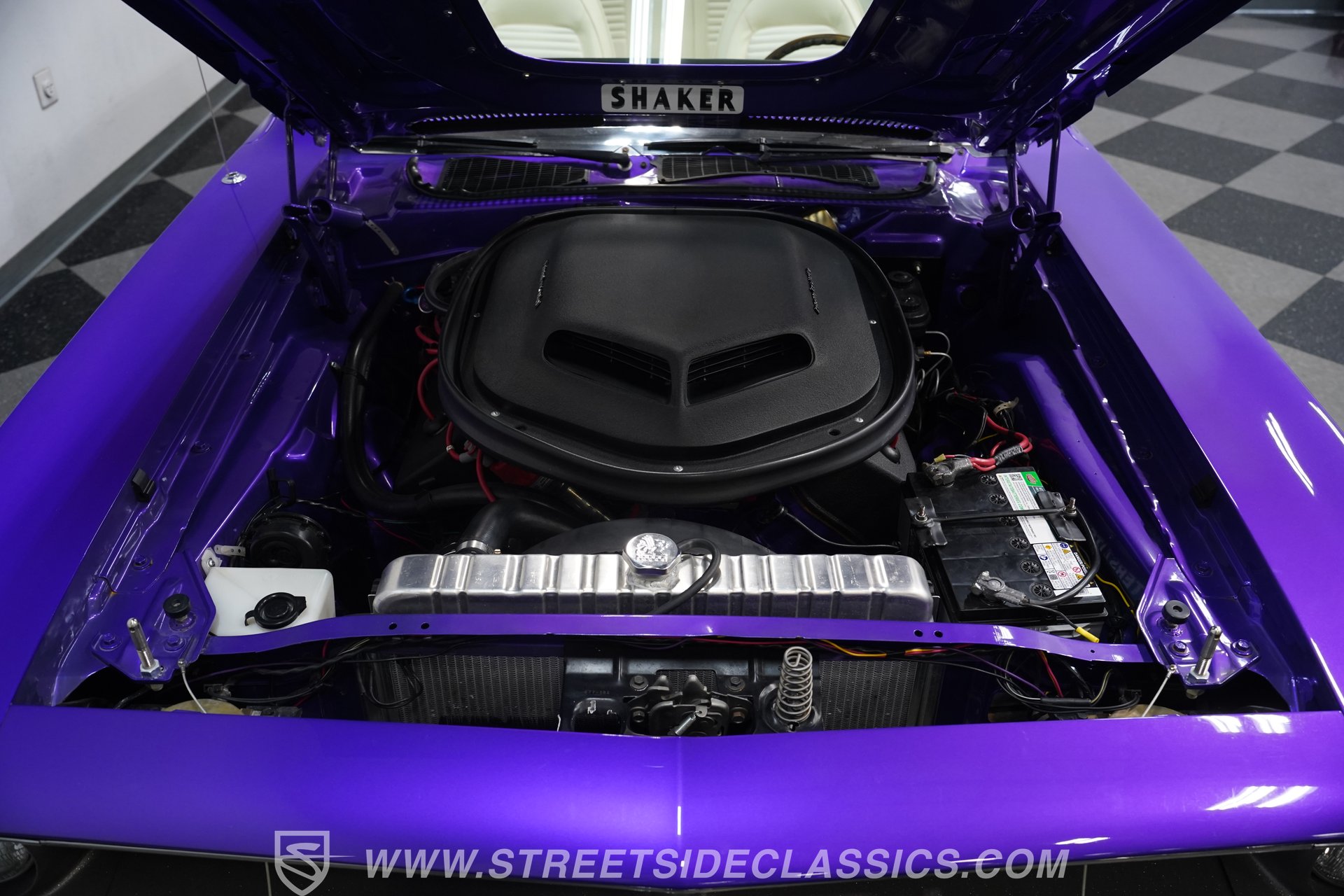
The 440 is the RB, the raised-deck engine, in three factory forms. In the 1969 M-code cars it is a 375 hp four-barrel shoehorned in with no room for power steering. In the 1970 E-body it is a 375 hp four-barrel 'Cuda option for one year. And in its most famous form it is the 440 Six Barrel of 1970–71: three Holley two-barrels on an aluminium intake, the centre carburettor doing all the idling and light-throttle work and the vacuum-operated outboards opening as demand rises, rated at 390 hp and, in period testing, frequently the equal of the Hemi in a straight line while behaving far better in traffic.
Six Barrel ownership reality is specific. When the linkage and vacuum diaphragms are right, the system is smooth at a cruise and ferocious when the outboards open. When it is wrong — perished diaphragms, a warped base, linkage adjusted by guesswork — the car stumbles at the transition and drinks fuel. The diagnostic order matters: ignition first, then fuel pressure (around 5 to 7 psi at the pump), then the outboard diaphragms tested with a hand vacuum pump, and only then carburettor removal. A full Six Barrel set rebuilt by a specialist runs roughly 900 to 1,600 dollars; a single centre-carburettor fault misdiagnosed as a full set is the classic wasted bill. Ask when the outboards were last exercised — on a gently driven car their throttle shafts can seize in their bores.
Big-block enemies are heat and neglect. Cooling on a big-block A-body was marginal from new, so a 383 or 440 A-body that runs hot in traffic is describing its design as much as a fault — but overheating at speed means a blocked radiator core, a collapsed hose or a failing water pump, and none of those should be waved away. Exhaust manifolds crack, particularly the high-performance castings, and correct replacements are hunted parts. Oil consumption on a hard-used 440 is commonly rings and valve guides together, and a proper big-block rebuild with machining is a 6,000 to 12,000 dollar job — which is why a documented rebuild is worth a real premium and an undocumented freshly painted engine is worth none.
The 426 Hemi and the AAR 340 Six Barrel
The street 426 Hemi of 1970–71 is a detuned descendant of the race engine: iron block and heads, hemispherical combustion chambers, two Carter AFB four-barrel carburettors, hydraulic lifters (the race engines were solid-lifter), and a factory rating of 425 hp that was, like the 340 figure, a polite fiction. It is an engine of genuine mechanical presence — wider than anything else in the range, distributor at the front, plug leads running through the valve covers to plugs in the centre of each chamber — and its valve train wants its oil changes respected.
What a buyer needs to know is narrower than the legend. The street Hemi is not fragile, but it is unforgiving of stale fuel and long storage. Dual quads that have sat with ethanol fuel in them need rebuilding as a pair (budget 1,200 to 2,000 dollars for both), and an engine that has not turned in years must never simply be started — Hemi-specific parts are expensive and some are unobtainable except as reproductions, so a seized Hemi is a five-figure problem where a seized 318 is a nuisance. A full, correct Hemi rebuild sits in the 18,000 to 30,000 dollar range. A healthy Hemi that starts cleanly, holds oil pressure and does not smoke is one of the great engines — backed, at Hemi money, by a specialist inspection you should treat as non-negotiable.
The AAR 'Cuda engine is a different special: a 340 with a strengthened block, topped with three Holley two-barrels on an Edelbrock aluminium intake — the 340 Six Barrel, rated 290 hp. Only the AAR (and its Dodge counterpart, the Challenger T/A) got it; no other 340 left the factory with three carburettors. Because a standard 340 can be dressed as an AAR engine in an afternoon, the block casting and the paperwork carry the value. The AAR also sits higher at the rear than any other E-body, on larger rear tyres with side-exit exhausts — a stance so distinctive that a level-sitting AAR is a car with a story to explain.
Gearboxes
Three gearboxes cover the whole range, and all three are strong. The TorqueFlite automatic came in two sizes: the A904 behind slant-sixes and small-blocks in standard cars, and the A727 behind big-blocks, Hemis and high-performance small-blocks. Both are among the most durable automatics ever made, and both share one critical vulnerability outside the box: the kickdown linkage. On a TorqueFlite that linkage controls line pressure as well as kickdown, and a car driven with it disconnected will burn the box up while shifting beautifully softly the whole time. Trace it on your inspection, confirm it moves through its full travel, and treat a seller who says it runs fine without it as pricing in a rebuild — a 727 rebuild runs roughly 1,800 to 3,200 dollars. Correct behaviour is firm, prompt shifts, firmer with throttle; flaring on the 2–3 change or a delay into reverse from cold is wear.
The manual that matters is the A833 four-speed, with a Hurst shifter — and from 1970, in E-bodies, the famous Pistol Grip handle. The A833 is immensely strong; its synchromesh wears in proportion to how it was driven. Second gear baulking when cold that clears warm is tired synchromesh announcing itself, and a box that jumps out of gear under load needs a rebuild, roughly 1,500 to 2,800 dollars. Hemi and 440 Six Barrel cars got the heavier 18-spline input shaft version; standard cars the 23-spline — a detail that matters when verifying a drivetrain claimed to be original. Clutch behaviour should be smooth and high in the pedal travel; judder is oil contamination or a warped disc, and on big-block A-bodies, where access is tight, the labour bill for a clutch dwarfs the parts bill — ask when it was last done.
Rear axles complete the picture. The 7.25-inch axle behind sixes and early small-blocks is adequate and no more. The 8.75-inch axle is the performance standard — a drop-out centre section that makes ratio changes easy, which is precisely why you must check what ratio is actually in a car rather than trusting the tag. Sure Grip (limited-slip) was an option across the performance range; test it on the drive, as described in the inspection. The Dana 60 was fitted to many Hemi and 440 four-speed cars and is both nearly indestructible and a strong originality marker — a claimed four-speed Hemi car on an 8.75-inch axle needs its paperwork to explain why.

Problem areas
Everything in this section should be read against one fact: every Barracuda is a unibody. There is no separate chassis to save a rotten car — the shell is the structure, the suspension hangs from it, and the money in any restoration goes into it first. Our own photo examination underlines the point quietly: of 56 Barracudas we photo-checked in detail, rust was noted in only 6 cars and visible damage in 5 — a cleaner picture than many classics of the era, and one that says more about how these cars are now presented (restored, southern, photographed kindly) than about how they were built. Treat a clean photo set as a starting point, not a verdict: the cars that were going to rust did so decades ago, in places listing photographs still avoid.
Rust: the map
Work the shell in structural order, not cosmetic order.
Front frame rails and the torsion-bar crossmember. This is the Barracuda's structural heart and its most expensive rust. The torsion bars anchor at the rear into a crossmember under the front floor and at the front into the K-member under the engine. The front frame rails rot where salt and water sit — around the K-member mounts, at the torsion-bar anchors, and where the inner wings meet the rails. Perforation here is not a patch; it is jig work, section replacement and alignment afterwards, and a car needing both rails and the crossmember carries a fabrication bill starting around 3,500 dollars that climbs past the value of a standard car without pausing. Prod with a screwdriver, with permission, and distrust any rail recently stone-chipped in uniform black while the rest of the underside is honestly dirty.
Floor pans and trunk floor. Water gets in past the windshield seal, the cowl vents and — on first-generation cars — around the vast rear glass, then sits under carpets and sound deadening. Front floors go first, at the toe boards and along the tunnel seams; E-body trunk floors go above the fuel tank and in the drop-off extensions either side. A floor section fitted and finished runs roughly 600 to 1,400 dollars a side. Floors rarely rot alone: floor rust is your instruction to look harder at everything in this list, not a standalone line item.
Cowl, A-pillars and the windshield surround. The cowl plenum collects leaves through its vent, holds water against its seams, and rusts from the inside — announced by water on the front floor after rain and eventually perforation at the cowl sides behind the front wheels. Cowl repair means wings off and often the windshield out; it is skilled work and priced like it. On E-bodies, check the A-pillar bases and hinge pillars with the doors open, and flex each door gently: sag is worn pins (cheap), but movement of the pillar itself is structural — a walk-away on a standard car.
Rear quarters, wheelhouses and the rear frame rails. The classic Mopar pattern: quarters bubble behind the rear wheels where the skin meets the trunk drop-offs, wheelhouse lips crust under trim, and the rear frame rails perforate around the leaf-spring hangers — front hangers especially, where the rail is boxed and traps mud. Spring hanger failure is a safety item: a car whose rear springs are held by perforated rails does not get driven home. Rear rail and hanger work runs roughly 1,200 to 2,800 dollars a side fitted, before paint. On A-body fastbacks, add the channel under the rear glass: the seal perishes, water sits in the channel, and the panel perforates under paint that still looks presentable from six feet away. Run a fingertip along it and press.
The generation-specific traps. First-generation cars: the rear glass surround again, the structural sills shared with the Valiant, and the boot floor around the fuel tank. Second-generation cars: front wing tops, door bottoms where the drain slots block, and the convertible top well, which rusts the floor behind the rear seat on cars whose tops have leaked for years. E-bodies: the vinyl roof trap — vinyl tops rust underneath, at the roof seams and rear pillar bases, invisibly until the vinyl lifts; the battery tray and the inner wing beneath it (acid, from the top down — lift the battery or at least rock it and torch the tray edges); the Dutchman panel between the rear glass and the trunk lid; and the trunk lid's rear lip, which fills with water through its seams. Torque boxes — the reinforcing boxes at the spring and torsion-bar anchors fitted to convertibles and big-engine cars — are a good originality sign when present and a rust trap in themselves.
Engines, cooling and fuel systems
The mechanical problem areas divide cleanly by engine, and the Engines section above covers the diagnosis in depth; what belongs here is the pattern of what actually goes wrong on cars as they are sold today.
Storage damage outranks wear. Most Barracudas for sale have spent years covering few miles, and the failure list is a storage list: varnish in carburettors from ethanol fuel left standing, fuel tanks rusted from the inside (a tank feeding rust flakes will block a fresh carburettor in a hundred miles), and fuel hoses that look sound and weep under pressure. Any car presented as freshly woken should have receipts for tank work, lines and a carburettor rebuild — roughly 800 to 1,800 dollars of work — or assume you are about to pay for it yourself.
Cooling. Big-block cars run hot by design margins, but E-body small-block cars have no such excuse: a 318 or 340 that overheats has a fault, usually a radiator core blocked with sediment or a viscous fan drive that freewheels when it should lock. A quality replacement radiator fitted runs roughly 500 to 900 dollars; treat it as a known cost, not a haggling catastrophe.
Oil leaks and the honest engine bay. Expect seepage: rocker covers, intake end seals on small-blocks, rear main seals and the oil pressure sender are the standard Mopar set. What you are judging is degree and honesty. A concours-shine bay on a car with no receipts is a question; an honest bay with light seepage and everything present is a far better sign. In our photo sample, smoke and leak mentions were absent — zero of the 56 examined cars — which reflects presentation: engines are photographed cold and clean. Your cold start, not the listing, is the smoke test.
Numbers and originality. On performance cars a replacement engine is a value event, not just a mechanical one: the partial VIN stampings on the engine pad and transmission case either match the car's VIN or they do not, and on a 'Cuda that match is a substantial part of the price. In a standard Barracuda a non-matching engine is a small discount; in a car priced as numbers-matching, it makes it a different car from the one advertised.
Suspension, steering and brakes
Barracuda front suspension is torsion bars and control arms, and the wear pattern is predictable: ball joints (the uppers thread into the control arms and seize there, turning a wear item into an arm replacement), idler and pitman arm play, and rubber bushes that are fifty years old whatever the odometer says. A full front-end refresh, fitted and aligned, runs roughly 1,200 to 2,500 dollars, and it transforms these cars — vague, wandering steering on a test drive is usually this bill, not a design flaw, because a tight torsion-bar Mopar steers with real directness.
Ride height is your free diagnostic. A car sitting nose-down has sagging torsion bars, an adjuster wound down to mask wear, or the wrong bars fitted — big-block and small-block bars differ in rate, and a big-block conversion still on small-block bars sits wrong in a way you can see from across the street. At the rear, leaf springs flatten with age; a tail-low car needs springs, roughly 500 to 900 dollars the pair fitted, with hanger condition checked while they are out.
Brakes divide by era. The disc systems are simple and cheap to refresh — a full hydraulic overhaul runs roughly 700 to 1,400 dollars fitted. All-drum cars, especially first-generation cars on small 9-inch drums, stop adequately for gentle use and inadequately for modern traffic; a disc conversion is the best money you can spend on an early car, but price it (1,000 to 2,000 dollars fitted) and do not let a seller price a drum car as if the work were done. Pulling to one side is a seized caliper or collapsed hose; a sinking pedal is master cylinder bypass.
Power steering is over-assisted and light by modern standards — original, not a fault — but it should be silent. Groaning is low fluid or a dying pump; a dead spot at centre is box wear, and a rebuilt box fitted is a 600 to 1,100 dollar job.
Electrics, interior and trim — and the clone problem
Chrysler electrics of this era fail at connections and at one famous component: the bulkhead connector, where the engine harness passes through the firewall, corrodes pin by pin and produces the classic Mopar set of intermittent faults — flickering lights, a wandering ammeter, a car that cuts out over bumps and restarts. Cleaning it is cheap in parts and tedious in labour. The ammeter itself is a known weakness: the full charging current passes through it, its terminals loosen and heat, and many cars have been sensibly modified with a bypass — a modification to welcome, provided it is neatly done. Alternators and regulators are cheap; a car that does not charge is an afternoon, not a project.
Interiors price the car more than buyers expect. The E-body dash pad is one huge pressing that cracks across its top surface in sun-state cars, and a quality reproduction fitted is a 700 to 1,300 dollar job. Seat covers, foams and door cards are well reproduced for the popular years and patchy for 1972–74 and Gran Coupe leather. Convertible top frames bend and their rams leak; a new top fitted runs roughly 1,200 to 2,200 dollars, frame work on top. Brightwork — the 1971 E-body grille above all — includes some of the most expensive used trim in the Mopar world, so count damaged grille and bumper pieces as real money, not detailing.
Finally, the problem area that is not mechanical at all: identity fraud, from innocent to deliberate. The range contains the widest value spread of any model line of its era, and the hardware to climb it — badges, stripes, hoods, even engines — bolts on. The defences are factory records. The VIN's second character separates Barracuda (H) from 'Cuda (S) on E-bodies; the fifth is the factory engine code, and a Hemi car left the factory with the Hemi code, whatever sits under the hood today. The fender tag's sequence number must match the body stampings on the cowl and radiator support. The broadcast sheet — often tucked in the rear seat springs or above the fuel tank — is the fullest record of all. A car whose VIN, tag, stampings and sheet agree is verified. A missing fender tag (a common, sometimes innocent loss) means verify harder, not automatic rejection — but stampings that disagree with the tag are a walk-away at performance money. None of this applies at slant-six money. All of it applies at 'Cuda money, where you are buying a record as much as a car.


How to inspect one
Allow ninety minutes, bring a torch, a cloth-wrapped magnet, a screwdriver for prodding (with permission) and a notebook. Insist on a cold engine and, for any performance car, arrange a lift inspection before money changes hands — on a unibody Mopar it is the best money in the whole purchase. Work in this order, because the early steps can end the inspection and save you the rest.
- Paperwork and identity first. Match the VIN on the title to the VIN plate (on the dashboard, visible through the windshield on E-bodies; on the door pillar on earlier cars). On an E-body, decode it on the spot: the second letter separates Barracuda from 'Cuda, the fifth is the factory engine code. Then the fender tag, then the body stampings on the cowl and radiator support — they must agree with the tag's sequence. Ask for the broadcast sheet, receipts and any registry documentation on a performance car. A thick, boring history file is worth thousands; a dramatic story with no paper is worth nothing.
- Cold start. The engine must be stone cold — a warmed-up car hides choke faults, piston slap and start-up smoke. A carburetted car should start with one set of the throttle and settle as the choke comes off. Blue smoke at start-up that clears points to valve stem seals; smoke that persists, or returns under load on the drive, is rings and bores. Listen for a deep knock in the first seconds (bearings) against a light top-end tick that fades as oil arrives (normal on a hydraulic engine that has stood).
- Under the hood, statically. Check the oil — level, colour, and a smell of fuel, which means a flooding carburettor or a failed fuel pump diaphragm diluting the sump. Check the coolant for oil sheen and the cap for rust sludge. Trace the TorqueFlite kickdown linkage on an automatic and confirm it is connected through its full travel — the gearbox section explains why this thirty-second check prices a rebuild. Note the radiator, the fan drive and the battery tray beneath the battery.
- The structural pass, underneath. Torch along the front frame rails, the torsion-bar crossmember, the K-member mounts, both sills, the floor seams and the rear frame rails at the spring hangers. Prod the suspect places. Perforation in rails, crossmember or hangers is structural and, on a standard car, ends the inspection here. Read the underseal as you go: patchy and honest is factory age; a fresh, uniform black coat over everything is a question the seller needs to answer with photographs of the work.
- Trunk and water paths. Lift the trunk mat and the spare. Look for rust in the well, in the drop-off extensions and along the Dutchman panel, and feel for damp. On fastbacks, press along the channel under the rear glass. Inside, lift every carpet you are allowed to lift: front toe boards, rear footwells, and behind the rear seat on convertibles. Water tracks show as staining long before they show as holes.
- Body and gaps. Walk the car slowly and look down each flank for ripples. Run the magnet over the rear quarters behind the wheels, the lower doors, the sills and the front wing tops — filler announces itself by a dead response. Check door bottoms and drain slots, the A-pillar bases with the doors open, and, on a vinyl-roof car, press the roof seams through the vinyl for the crunch of rust underneath. Count damaged brightwork pieces and price them individually; on a 1971 car, start with the grille.
- Stance and suspension. Stand back and judge the stance first: level side to side, correct rake for the model (an AAR sits tail-high on purpose; nothing else does). Bounce each corner and watch it settle in one movement. Rock each front wheel for ball joint and bearing play. Check the torsion-bar adjusters for thread remaining — an adjuster at its limit is a sagging bar out of compensation.
- The test drive. Fifteen minutes minimum, including a highway stretch and a rough surface. A small-block should pull cleanly to 4,500 rpm; a 340 should want to keep going. Flat spots on a Six Barrel car as the outboards open are a linkage and diaphragm story, not a character trait. The TorqueFlite should shift firmly, firmer with more throttle, with no flare on the 2–3 change and no long pause into reverse. A manual should take second gear cold without a fight. Brake hard from speed twice: straight, no pull, no judder, a pedal that stays where it stopped.
- Heat and electrics. Let the car idle hot for five minutes after the drive. Temperature should stabilise; oil pressure should hold a steady hot idle reading. Work everything: lights, wipers, washers, heater blower on all speeds, every gauge, the horn, and on a convertible the top — twice. Flickering or dying electrics over bumps point at the bulkhead connector: a labour bill to price, not a mystery to fear.
- Limited-slip and axle check. On a loose or wet surface, apply power from rest: a Sure Grip car leaves two even marks and pulls straight; a car that spins one wheel violently has an open axle where the tag promised a Sure Grip, or a worn unit. Listen for axle whine on a light throttle at 40 to 50 mph and for a clunk taking up drive — pinion and bearing wear.
- Interior last, but weight it. Sit in the driver's seat and feel for collapsed foam and broken springs. Check the dash pad across its full width for cracks (price the full replacement job, not a cover) and every piece of model-specific trim: AAR, shaker, Gran Coupe and 1971 cars carry parts bills out of proportion to the car's value. A complete, original, uncracked interior on a sun-state car is rare and worth paying for, because it cannot be recreated at any sensible price.
- The second visit rule. If the car passes steps 1 to 11, the lift inspection and, on performance cars, a marque specialist's identity check come before the deposit, not after. The lift confirms the rails, crossmember and hangers you prodded from the ground; the specialist confirms the codes you decoded. On a slant-six cruiser this is prudence. On a Hemi, Six Barrel or AAR car it is the purchase itself — you are buying verification as much as metal.
Values
The build beneath this guide carries the live market — what is listed now and what recorded sales have achieved — refreshed at every build. This section teaches you how to read it, because this market punishes a buyer who reads a single figure and stops thinking.
Start with the condition and identity spread, which on this model is wider than on almost any other American classic. The same model year can contain a project needing a shell rebuild, an honest driver, a restored car and a verified, numbers-matching performance car, and the distance between the bottom and the top of that spread is not a percentage — it is a multiple, several times over. Compare any car against others of the same generation, the same factory model (Barracuda against Barracuda, 'Cuda against 'Cuda), the same factory engine code and the same condition tier. Averages drawn across those boundaries are meaningless, and sellers who quote them are usually standing on the favourable side of one.
Asking and achieved figures diverge in a predictable pattern. Standard cars — slant-six and 318 coupes, late E-bodies, notchbacks — are often advertised optimistically by sellers anchored on performance-car headlines, and they negotiate: a standard Barracuda priced against 'Cuda money will sit, and the recorded sales, not the listings, show where it will move. Genuine performance cars behave the opposite way: a verified 340 Formula S, a correct Six Barrel car or a documented AAR attracts buyers who have already done the verification sums, and the gap narrows sharply. Hemi cars sit outside normal negotiation entirely — they trade in a registry market where the last comparable sale matters more than any asking figure, and where an unverified car is not a cheap Hemi but an expensive question.
Premiums attach to specific, checkable things, and you should pay them only when the check has been done. Originality of the drivetrain on a performance car. A broadcast sheet and a matching fender tag. A high-impact colour the car was actually born in — the tag records the paint code, and a car repainted into a fashionable colour carries the value of its original colour plus the repaint's quality, not the value of a factory car in that colour. The convertible body: rare and valuable on a genuine car, and the most cloned configuration in the range, which is why the premium belongs only to verified cars. Four-speed manuals carry a premium in the performance models and almost none in the standard cars. The AAR premium belongs to the block, the paperwork and the specification together, not to the stripes and the hood, which any 340 can wear.
The project-versus-driver gap is where Barracuda buyers most often miscalculate. A project E-body needs the same shell work, interior work and trim hunt as a project 'Cuda, at labour rates that do not care which badge is on the car — so a cheap standard car can absorb a restoration bill exceeding its finished value, while a cheap performance car, bought at the right entry figure, can absorb the same bill and emerge whole. Price the work before the car: a driver with needs you can schedule is almost always better value than a project with needs you cannot. Buy the best shell your budget reaches, in the specification you actually want.
Parts and ownership
The Barracuda is one of the best-supported American classics you can own, with a caveat by generation: the popular performance E-body is supported almost to modern-car standards, while the early fastbacks and late, low-volume cars ask for more patience.
Easy: service items for every engine — filters, plugs, points and ignition conversions, water pumps, alternators, starters — plus brake hydraulics and discs, suspension and steering wear parts, exhaust systems in standard patterns, weatherstrips for the common body styles, and a deep reproduction catalogue for 1970–71 E-body trim, seat covers, carpets and dash components. The Mopar hobby is large and swap-meet rich; ordinary running parts are an order today, fit this weekend proposition at prices close to modern money.
Harder and dearer: first-generation bright trim and rear glass rubber, second-generation convertible top frames, correct big-block A-body exhaust manifolds, Six Barrel carburettor components in correct form, Hemi-specific engine parts of any kind, the 1971 E-body grille and other one-year trim, Gran Coupe leather and its overhead console, shaker hood components, correct AAR fibreglass hoods, and crack-free original dash pads for any E-body. None of it is unobtainable; all of it is hunted, priced accordingly, and slow. A car missing several items from this list is a car whose completion date you do not control.
Running costs. Budget the first year honestly. A car in regular use needs ordinary servicing plus the deferred items every old car carries — allow a four-figure sum in the low thousands for the first year's catching up even on a good car. A car recommissioned from storage needs the full programme from the problem areas: fuel system end to end, brake hydraulics, every hose and belt, tyres (age, not tread, decides) and fluids throughout — a substantially larger four-figure commitment before anything is improved. Fuel consumption runs from the low twenties in a slant-six car to the low teens in a big-block driven as intended; agreed-value insurance is in line with other cars of similar value, and the identity verification in this guide matters to your insurer as much as to you.
Ownership character. These are simple, repairable cars that reward use. The slant-six and 318 cars are realistic regular drivers once their brakes and cooling are sorted. The 340 cars are the sweet spot of pace and usability. The big-block and Hemi cars are event cars — tractable when set up properly, but heavy on fuel, tyres and attention. Club and registry support is excellent across all three generations, strongest for the E-body performance cars, where registries track individual cars by VIN — one more reason a verified car's history compounds while an undocumented car's story evaporates at resale.
Which one to buy
- The all-rounder: a 340 car — a 1968–69 Formula S or a 1970–71 'Cuda 340. The best engine in the range for real driving, in the two best-balanced chassis. Deep parts support, strong resale, pace that needs no excuses. If you want one Barracuda to drive hard and keep, this is it.
- The value buy: a second-generation notchback or a 1972–74 E-body. The notchback gives you every A-body engine and option for less than the fastback beside it; the late E-body gives you the famous silhouette at standard-car money. Buy either on shell condition.
- The gentle classic: a first-generation fastback, 273 Commando or 225 slant-six. Glass, charm and simplicity, with Valiant running costs and a load bay no other classic offers. Judge it on its rear glass channel and its trim, and it will not disappoint you.
- The cruiser: a 318 E-body, ideally a 1970–71 convertible. The shape and the open top without the performance-car price or temperament. Verify a convertible's identity with the same rigour as a 'Cuda's — the body style is cloned precisely because it is desirable.
- The muscle car: a 440 Six Barrel 'Cuda, 1970–71. Hemi pace and theatre with better road manners and a fraction of the Hemi's purchase and rebuild exposure. Buy the paperwork first and the car second.
- The collector car: a verified 426 Hemi 'Cuda. Fourteen convertibles and a few hundred coupes a year, a registry market, values set by documentation as much as by metal. Specialist verification is not advice here — it is the transaction.
- The character pick: the AAR 'Cuda. One year, one engine, a stance like nothing else and a Trans-Am story no other Barracuda can tell. Buy it for the block, the sheet and the specification together, and walk away from stripes-and-hood cars priced as the real thing.
And the rule that overrides all of the above: buy the shell and the paperwork, and let the engine be the thing you fix. A rotten unibody costs more to put right than the finished car will ever be worth, and an unverified performance car is worth tribute money, not the money its badges describe. Structure and identity are the car.
See the 80 Barracuda cars currently listed.