
Oldsmobile Toronado Coupe 2D buyer's guide
Oldsmobile Toronado Coupe 2D -- the model's own buyer's guide: variants, values and what to check.
Years listed: 1966-1978 · Series: Toronado
Overview and history
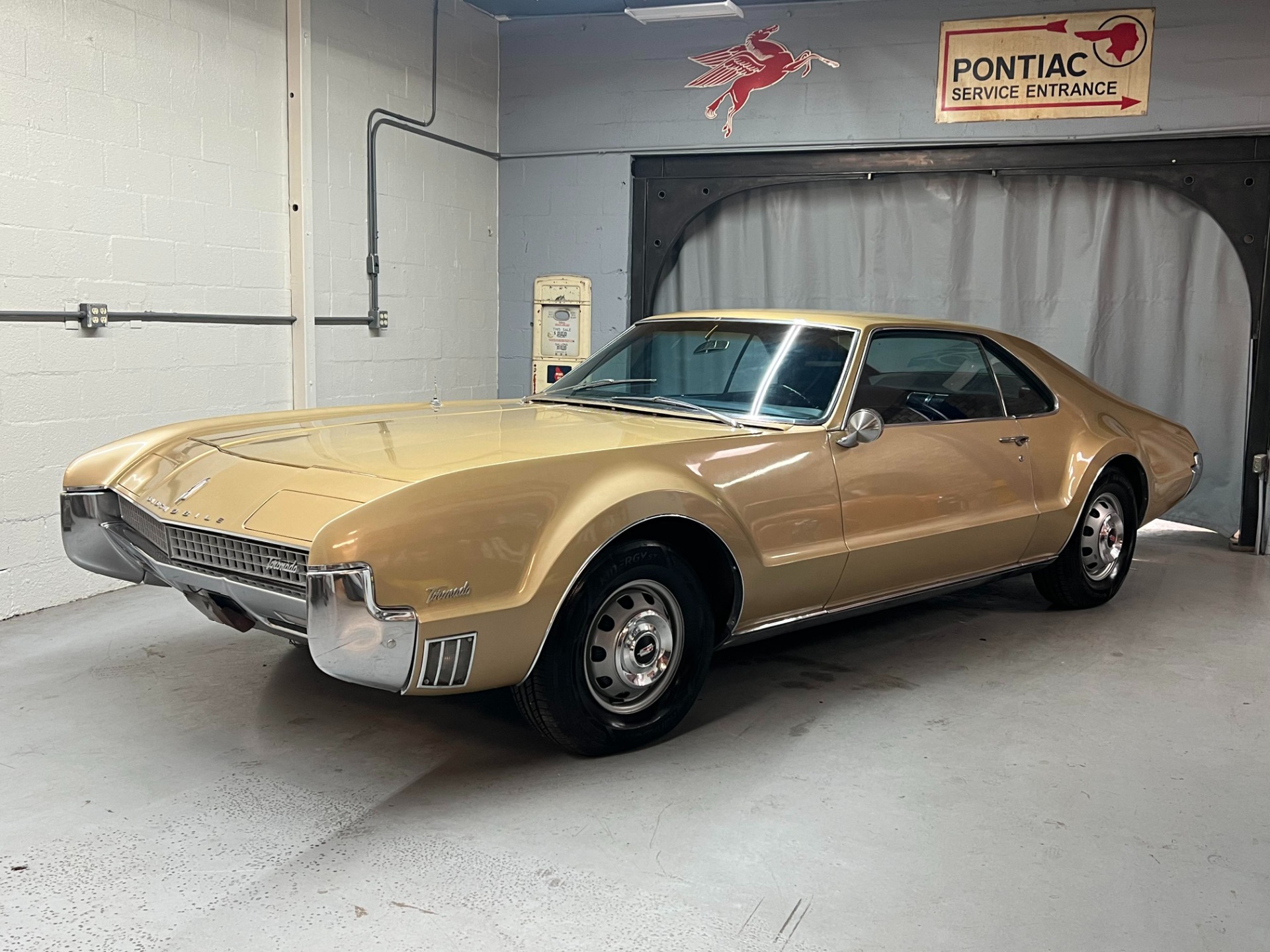
The Oldsmobile Toronado is the car that brought front-wheel drive back to American production — not in a small economy car, but in a big, expensive, V8 personal-luxury coupe that made the layout feel like the future. When it arrived for 1966 it was genuinely radical: a 425-cubic-inch Rocket V8 driving the front wheels through a chain-driven automatic transaxle, torsion-bar front suspension, a flat floor with no transmission tunnel, and styling so clean that it still looks modern next to its chrome-heavy contemporaries. General Motors had spent seven years and enormous money developing the Unitized Power Package that made it possible, and Oldsmobile got it first, a year ahead of the Cadillac Eldorado that shared the engineering.
This is the model-level guide, and it goes deep by generation and variant: the original 1966–70 cars, the bigger 1971–78 colonnade-era cars, the downsized 1979–85 cars, and the final transverse-engined 1986–92 cars. A companion series guide tells the broader story; here the emphasis is on telling one generation and engine from another, and a sound car from a trap, when you are standing in front of it.
Be plain about the pool this guide is weighted to. We currently track 19 Toronados on Classic Listings, 17 for sale and 2 sold, heavily weighted to the beginning: 6 cars from 1966 and 5 from 1967, 2 each from 1968 and 1970, and single cars from 1971, 1972, 1977 and 1978. So 15 of the 19 cars are first-generation 1966–70 cars, 4 are second-generation 1971–78 cars, and there is not one 1979–85 or 1986–92 car in the pool at all. This guide follows that weighting: the first two generations get the most space because they are the cars you are most likely to be offered, while the later cars are covered properly but more briefly. Do not read the absence of later cars as absence from the road; tidy later cars change hands quietly, and tatty ones are rarely worth listing.
The Toronado's life falls into four clear acts. The first-generation cars (1966–70) are the design and engineering landmark: fast, handsome, and built around the big 425 and then 455 Rocket V8s. The second generation (1971–78) grew longer, heavier and plusher, shared its shell more closely with the Buick Riviera and Cadillac Eldorado, and rode through the emissions era on shrinking power outputs. The third generation (1979–85) was downsized sharply — shorter, lighter, far more economical — and offered the widest engine choice in the model's history, including a V6 and the notorious diesel V8. The fourth generation (1986–92) shrank again, switched to a transverse V6 layout like every other modern front-drive car, and finished with the sport-trimmed Troféo before Oldsmobile killed the name in 1992 after 26 years.
Why buy one now? Because no other classic gives you this combination: genuine engineering significance, effortless big-V8 torque in the early cars, a fine ride, and a market that still prices Toronados below their Eldorado and Riviera cousins for no reason except badge snobbery. The front-drive layout that scared buyers in period is now a known quantity with known fixes. What kills Toronados is rust in the floors and quarters, deferred maintenance, and interiors and trim that cost far more to restore than the mechanicals do.


The models
Every Toronado ever built is a two-door coupe with front-wheel drive and an automatic gearbox — there was never a manual, never a convertible from the factory, and never a four-door. What changes across 26 years is size, engine, and intent. Read the table by generation first and by badge second, because the badges — standard, Deluxe, Brougham, Caliente, Troféo — are trim levels laid over four very different cars.
| Model | Years | Engine | Output | Built | Character |
|---|---|---|---|---|---|
| Toronado (first generation) | 1966–1967 | 425 cu in Rocket V8 | 385 hp gross | about 40,800 (1966) and 21,800 (1967) | The landmark car; hidden lamps, purest styling |
| Toronado (first generation) | 1968–1970 | 455 cu in Rocket V8 | 375 hp gross | about 26,500 (1968), 28,200 (1969), 25,400 (1970) | More torque, facelifted nose, the GT option |
| Toronado GT (W-34) | 1968–1970 | 455 cu in Rocket V8, W-34 tune | 400 hp gross | small numbers, a fraction of production | The hot one; dual exhausts, firmer suspension |
| Toronado (second generation) | 1971–1976 | 455 cu in Rocket V8 | 250 hp net falling with emissions tune | roughly 30,000–45,000 a year in good years | Bigger, softer, plusher; the boulevard car |
| Toronado (second generation) | 1977–1978 | 403 cu in V8 | 185 hp net | about 34,100 (1977) and 24,400 (1978) | The small-block late cars; XS roof option in 1977 |
| Toronado (third generation) | 1979–1985 | 350 or 307 cu in V8, 231 cu in V6, 350 diesel V8 | 105–170 hp net depending on engine | about 49,900 in the strong 1979 year, falling after | Downsized, efficient, the widest engine choice |
| Toronado (fourth generation) | 1986–1989 | 3.8-litre (231 cu in) V6 | 140–150 hp net | falling, roughly 12,000–17,000 a year | Transverse V6, digital-era cabin, much smaller car |
| Toronado Troféo | 1990–1992 | 3.8-litre 3800 V6 | 165 hp net | small numbers to the end in 1992 | The sport-trimmed finale; firmer, monochrome, best equipped |
(Outputs are period figures: gross ratings to 1970, net ratings from 1971 on, exactly as the factories quoted them at the time — which is why the 1971 figure falls off a cliff on paper while the car itself simply got heavier and softer. Annual production figures are given as approximations where the record supports them; treat any seller quoting suspiciously exact rarity for a mainstream year with suspicion.)
First generation, 1966–70. The only Toronados most collectors argue about, and the bulk of the listings pool. The 1966 car came in standard and Deluxe trim, with hidden headlamps behind vacuum-operated doors, a distinctive fluted grille treatment, and fastback-like rear styling over a remarkably spacious cabin. The 1967 car is recognisable by its eggcrate grille and revised trim, and it brought optional front disc brakes — a worthwhile option to hunt for. The 1968 facelift lengthened the nose, moved to a split grille look, and introduced the 455 engine and the W-34 GT option; hidden lamps lasted through 1969, and the 1970 car has exposed headlamps and the cleanest, most conventional face of the five years. Inside, watch the trim names rather than assuming equipment: air conditioning, power windows and the like were widely ordered options, not givens, on every year of this generation.
The W-34 Toronado GT, 1968–70. The performance option, and the first-generation car to verify most carefully precisely because it carries a premium. The W-34 package centred on a 400 hp version of the 455 with a hotter camshaft, a specific carburettor and air-cleaner setup, dual exhausts, and suspension and cooling upgrades. It was never a drag-strip special — this is still a heavy front-drive coupe — but it is the quickest and most purposeful early Toronado, and genuine cars are documented by build records in a way a badge swap is not. Price the paperwork, not the claim.
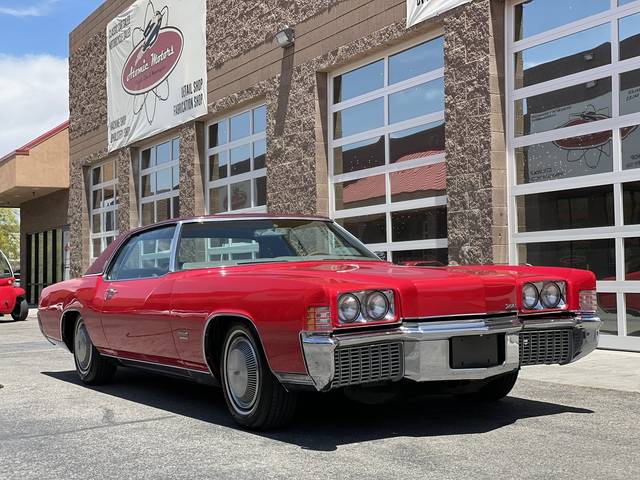
Second generation, 1971–78. A bigger car in every dimension, styled for the 1970s: longer bonnet, formal roofline, opera windows on many cars, and from 1973–74 the federally mandated impact bumpers that add length and weight. The 1971–76 cars run the 455, in steadily softer states of tune; the 1977–78 cars switch to the 403 small-block, which suits the car better than the power figures suggest because it is lighter over the front wheels. Trim climbs from standard cars through Brougham, with crushed-velour interiors that define the era. The curiosity is the 1977 Toronado XS, with its dramatically wrapped rear window treatment; the stillborn XSR, with a removable roof panel arrangement, never reached normal production, so any claimed XSR needs factory-level documentation. In the listings pool this generation appears as single 1971, 1972, 1977 and 1978 cars — thin representation for cars built in large numbers, which makes good ones genuinely easy to overlook and undervalue.
Third generation, 1979–85. Downsized by roughly a foot in length and several hundred pounds, on the revised E-body that it again shared with Riviera and Eldorado. This is the Toronado for a buyer who wants to use the car daily in modern traffic: smaller, lighter, far better on fuel, with rack-and-pinion steering and a much more modern feel. Engine choice is the whole story here — petrol V8s (the Oldsmobile 350 at first, the 307 later), a Buick 3.8 V6 in the early years, and the 5.7-litre diesel V8 that you should read about carefully in the engines section before touching. The Caliente trim of 1984–85, with its two-tone paint and plusher cabin, is the collector pick of this generation.
Fourth generation, 1986–92. The Toronado rethought as a compact, transverse-engined, electronically managed coupe — a different car wearing the same name. All cars use versions of the Buick 3.8 V6 and a four-speed overdrive automatic. The cabin went digital, with electronic instruments and, on later cars, touch-screen controls that are a specialist item now. The Troféo of 1990–92 is the one to have: sport suspension, monochrome trim, better seats and the strongest 3800 V6. These cars are not in the current pool at all, and remain the cheapest way into the name.
Engines and gearboxes
The big Rocket V8s: 425 and 455, 1966–76
The first- and second-generation cars live or die by two members of Oldsmobile's big-block Rocket family, and both are among the toughest American V8s ever built: forged-steel crankshafts in the early cars, deep-skirt blocks, generous bearing areas, and a reputation for covering very large mileages in heavy cars without complaint when the oil has been changed.
The 425 (1966–67). Fitted only to the first two years, rated at 385 hp gross with 475 lb-ft of torque, fed by a Rochester Quadrajet four-barrel carburettor on most cars. It is a high-compression engine designed for the premium leaded fuel of its day, and that fact shapes ownership now: run on modern unleaded without attention, a hard-used 425 can suffer valve-seat recession, though in gentle classic use many cars cover years before it shows, and hardened seats fitted during a head overhaul settle it permanently. The 425 has a slightly freer-revving character than the 455 that replaced it, and 1966–67 specialists value it for that. Check the basics with real care: oil pressure strong and steady, no blue smoke on start-up that fails to clear (valve seals, cheap) versus smoke under load (rings, expensive), and no rhythmic ticking from a worn camshaft lobe, a known big-mileage Oldsmobile wear point that shows first as a lazy cylinder at idle.
The 455 (1968–76). A long-stroke development of the same architecture, and the defining Toronado engine: 375 hp gross and a huge 510 lb-ft in 1968–70 standard tune, 400 hp in W-34 GT tune, then quoted at 250 hp net for 1971 as compression fell and ratings changed, and softer still through the mid-1970s as emissions equipment arrived. Do not let the paper decline mislead you into thinking a 1975 car is gutless — it is heavier and taller-geared, not broken — but do understand that the 1968–70 cars are the performers of the big-block run, and the market knows it. All 455s share the same ownership points: the Quadrajet is an excellent carburettor when rebuilt by someone who understands it and a misery when the throttle shafts wear and leak air at the base (the test is a wiggle of the shaft and an idle that will not settle), the choke and its heat-riser plumbing govern cold behaviour, and the exhaust manifolds crack and warp with age and heat cycling, announcing themselves with a ticking on cold start that fades as the metal expands. From 1975, the GM HEI electronic ignition fitted to these cars is a genuine improvement — reliable, strong-sparking, and cheap to service — and air pumps, EGR valves and their vacuum hose forests are the era's real running problem: perished hoses and seized valves cause flat spots and failed idle quality far more often than the engine itself does. A vacuum diagram, a hand vacuum pump and patience fix most of it for the cost of hose by the foot.
On either big-block, suspect the cooling system on any car that has sat. A Toronado that creeps up in traffic but cools on the move is usually telling you about a clogged radiator core, a lazy fan clutch or collapsed hoses, in roughly that order. Budget a cooling-system overhaul — radiator, water pump, hoses, thermostat and fan clutch — as one job in the $900–2,200 range with labour on a neglected car, and treat documented recent work there as money already spent for you.
The later V8s and the diesel: 403, 350, 307 and the 5.7 diesel, 1977–85
The 403 (1977–78). Oldsmobile's small-block V8 in its largest form, 185 hp net, fitted when the 455 left the range. It is a lighter engine and the late second-generation cars handle their noses better for it. Its known weakness is cooling margin and head-gasket life when overheated — the 403's siamesed cylinder bores leave less metal between cylinders, so an overheated 403 is a more serious event than an overheated 455. Judge any 403 car hard on cooling-system history, watch the temperature gauge on the test drive like a hawk, and walk away from a car with a story about repeated overheating and top-ups. In ordinary health it is a sweet, torquey, understressed engine that suits the car well.
The petrol 350 and 307 (1979–85). The downsized cars started with Oldsmobile's 350 V8 at around 170 hp and moved to the 307, at around 140 hp in most years, as the standard V8. Both are conventional, durable small-blocks whose problems are the era's, not the design's: Quadrajet wear as above, and from 1981 the Computer Command Control electronic carburettor system, whose mixture-control solenoid, oxygen sensor and throttle-position sensor must all work for the car to run cleanly. A 1980s Toronado that hunts at idle, stinks of fuel or lights its check-engine lamp is usually a sensor or a perished vacuum line away from health, but fault-finding needs the factory diagnostic routine and a willingness to work through it — budget specialist time, not just parts, and value a car with documented CCC work. The 307 is slow by modern standards and there is no cheap, honest way to make it fast; buy it for cruising, not pace.
The 5.7-litre diesel V8 (optional across 1979–85, and in the Eldorado/Riviera family too). This needs plain words. The Oldsmobile diesel was adapted from the petrol 350 block and became one of the most notorious engines GM ever sold: head bolts that stretch and head gaskets that fail, cracked heads and blocks on hard-used cars, injection-pump and injector wear, and a reputation earned in period that has never recovered. Some survive well in careful hands, and a documented car with a later, improved engine or a full history of head work is a different proposition from an unknown one — but as a buying matter the rule is simple: do not buy a diesel Toronado as your route into the model unless the price, the paperwork and your own mechanical sympathy all line up, and never buy one with coolant loss, pressurised hoses from cold, or mayonnaise under the filler cap. A petrol conversion is a known path and many cars were converted in period; a converted car is judged as a petrol car, plus questions about the quality of the conversion. The diesel's one virtue — economy — does not pay for its risks at classic mileages.
The V6s: Buick 3.8 and 3800, 1979–92
The third-generation cars offered the Buick 231-cubic-inch (3.8-litre) V6 in their early years, and the fourth-generation cars use it exclusively, in developed 3800 form. It is one of GM's great engines: compact, torquey, and in fuel-injected 3800 form (165 hp in the final Troféo) genuinely strong and economical. Early carburetted versions share the era's carburettor and emissions-hardware checks; the injected cars add the usual 1980s electronic checks — idle-air control, crank and cam sensors, and perished vacuum elbows — all cheap parts whose diagnosis is the cost. On any high-mileage 3800, listen for timing-chain rattle at start-up, check for coolant leaks at the plastic intake-manifold gaskets on later engines (a known age-related failure, and a repair in the few-hundred-dollar range for parts with labour on top if caught before coolant contaminates the oil), and confirm the supercharger-era confusion does not apply here: no Toronado was supercharged from the factory, whatever a listing claims. These engines outlast the cars around them when maintained; neglect shows as sludge under the filler cap and a service history with gaps you could drive through.
Gearboxes: the Turbo Hydra-Matic transaxles
There was never a manual Toronado, and the automatic is not a conventional one — understanding it is central to buying any Toronado well.
TH425 (1966–78). The first- and second-generation cars use the Turbo Hydra-Matic 425, a three-speed automatic transaxle derived from the famously strong TH400, rearranged for front-wheel drive in the Unitized Power Package. The engine sits longitudinally, the torque converter sits at the back of the engine, and drive passes forward again through a wide Hy-Vo silent chain to the gearbox itself, which sits alongside and below, with the final drive and differential integrated into the package. It is an ingenious, compact, and in service remarkably durable arrangement — but it has its own inspection language. The drive chain stretches and wears with very high mileage and hard use; a worn chain announces itself as a whine or a snatch on take-up and is an internal job, not an adjustment. The final drive is a separate section with its own lubricant needs on early cars — confirm it has been serviced, because it is the forgotten sump of the whole car. Shift quality is the everyday test: changes should be firm, prompt and consistent, kickdown should arrive without a flare, and any delay engaging drive or reverse from cold, any shudder on take-up, or dark, burnt-smelling fluid on the dipstick prices a rebuild. A TH425 overhaul by a shop that knows the unit is realistically a $2,500–4,500 job with removal and refitting; the parts exist, the knowledge is the scarce bit, so a documented rebuild by a named specialist is worth a premium and a cheap recent rebuild by an unknown shop is a question, not a comfort.
TH325 and TH325-4L (1979–85). The downsized cars use a lighter three-speed transaxle, the TH325, replaced for 1982 by the TH325-4L four-speed with an overdrive top gear and a lock-up torque converter — the one to have for highway use, and identifiable by its gear selector markings. These are conventional GM units of the era, less exotic than the TH425 and widely understood; the checks are the same (fluid colour and smell, shift quality, lock-up that engages smoothly without shuddering on light throttle at cruising speed), and a rebuild is a $2,000–3,500 job at a general transmission shop. A lock-up shudder is often a fluid and converter-clutch issue rather than a dead gearbox, but price it as work until a specialist says otherwise.
TH440-T4 / 4T60 (1986–92). The transverse cars use GM's four-speed overdrive transaxle in 440-T4 and later 4T60 forms. In health it is smooth and unobtrusive; its age faults are electronic and hydraulic — shift solenoids, a tired torque-converter clutch, and delayed engagement when seals harden. Fluid that has never been changed is the enemy, so a documented fluid history is worth hunting for in this generation above all others.
One cross-generation rule: the front-drive hardware downstream of the gearbox — constant-velocity joints, driveshafts, front wheel bearings and hubs — is Toronado-specific ownership, covered in Problem areas. The gearbox gets the glory; the joints and bearings send the bills.


Problem areas
Everything in this section is what to hunt for on a real car, organised by system so you can work through it on a viewing. Where our own examined-photo evidence exists, it is cited honestly: we have photo notes for 8 of the 19 cars in the current pool, and rust is mentioned in 4 of those 8 — half the examined cars — with body damage noted on 1. That is a small sample, and it is not a census of every Toronado, but it matches the wider truth of these cars: the mechanicals are tough, the bodies and the front-drive hardware are where the money goes, and a car that looks straight in listing photographs still needs the forensic pass below.
Rust: the map
Toronado rust follows water, weight and trapped mud, and it differs by generation because the bodies differ — but the order of inspection barely changes.
Floors and trunk floor. The first-generation cars are unit-bodied with a front subframe arrangement, and their floors rot from wet carpets inward and from road salt upward. Lift every carpet you are allowed to lift, press along the floor pans, and look hardest at the front footwells, under the rear seat, and around the seat and seat-belt mountings, where rust stops being cosmetic and becomes structural. The trunk floor and the spare-wheel well collect water from perished trunk and rear-window seals; staining is a clean-and-seal job, perforation is a panel job, and a trunk floor repair done properly — metal cut out, new metal in, sealed and painted — is a $700–1,800 job depending on extent. On second-generation cars add the area under the vinyl roof covering (below) and the lower rear quarters behind the wheels, where the big formal body traps mud. On the downsized cars, check the same floors plus the strut and suspension mounting areas that a smaller, lighter shell works harder.
Sills, quarters and wheelarches. Prod the sills along their full length and check the jacking points; bubbling at the bottom of a front wing, behind a wheelarch lip, or along a quarter panel is the visible tip of a longer story. Wheelarch and lower-quarter repairs are the classic Toronado body bill: a single arch or quarter section cut out, welded and painted properly runs roughly $900–2,500 a side, and a car needing both sides, sills and floors is a restoration project whatever the listing calls it. Use a magnet in a cloth over arches, sills and lower doors — filler announces itself by the magnet's indifference — and treat fresh, uniform underseal blown over everything underneath as a question, exactly as you would on any classic: nobody re-underseals a sound underside the week before a sale for your benefit.
Vinyl roofs. A large share of second-generation and Brougham-trim cars wear padded vinyl roofs, and they are the single most dangerous cosmetic feature on the model. Water gets under the vinyl at the seams and at the rear-window and opera-window apertures, and the roof skin rusts invisibly until the covering bubbles, the window frames soften, or water appears inside. Press gently along the roof edges and around every window aperture in the vinyl; crunching, bubbling or a soft feel means the roof is a metalwork job — stripping the vinyl, repairing the skin and re-covering runs $1,500–3,500 done properly — and a car that needs it should be priced as though it does, however pretty the paint below it is. A vinyl roof that is firm, tight and unblemished is fine; a cheap re-cover over unrepaired rust is worse than honest damage, because it hides the timetable.
Frames, subframes and mounts. Get the car on a lift if it passes everything else. On early cars inspect the front subframe and its mounting points, the rear suspension mounting areas, and the torsion-bar anchor region; on later cars, the front subframe and strut towers. Perforation in mounting metal is fabrication work priced per car, and it quickly exceeds the value of a cheap example. In the listings world this is also the view sellers' photographs most often avoid: if a set of forty photographs contains no underside at all, assume the underside is the reason until a lift proves otherwise.
The smaller traps. Door bottoms (blocked drain holes fill the door with water — feel along the bottom edge for bubbling), the battery tray and the metal below it (acid works from the top down, invisibly — rock the battery and check the tray edges with a torch), headlamp surrounds, the base of the windshield, and the rear-window surround on every generation. None alone kills a car; together they tell you how it has lived.
Front-wheel-drive hardware: joints, bearings and suspension
This is the Toronado's unique ownership section, and the one generalist buyers under-price.
Constant-velocity joints and driveshafts. All that V8 torque goes through the front wheels, and the CV joints and their rubber boots do the work. Split boots are the early warning: grease out, grit in, and a joint that clicks on full lock or clunks on take-up is already wearing. Clicking on lock is the classic test — drive slowly in a circle both ways on full lock and listen. A boot replaced in time is a small job; a joint replaced is a $350–800 job a side with parts and labour depending on generation and availability, and a car clicking on both sides has two bills waiting. On the fourth-generation cars the joints are conventional modern items; on the early cars, confirm parts supply with a specialist before you buy a car that needs them, not after.
Front wheel bearings and hubs. The early cars carry large, heavily loaded front wheel bearings that take cornering, braking and drive loads at once. Play felt rocking the front wheel, a rumble that changes with steering load on the road, or heat at a hub after a drive all price bearing work, and on the big early cars this is specialist work with specialist parts — budget $600–1,400 a side fitted if a bearing is genuinely gone, and treat a seller's claim of recent bearing work without an invoice as no work at all. Grease-starved, long-parked cars can feel rough without being worn out, exactly like dry kingpins on other classics: the honest move is to price the work in and let a post-purchase specialist check settle it.
Suspension by generation. First-generation cars use torsion bars at the front — check ride height side to side (a sagging corner is a tired or incorrectly set bar, and re-setting height is an adjustment, not a rebuild, if the bar itself is sound) — and a beam rear axle on leaf springs, whose bushes and shackles wear and knock. Second-generation cars are conventional coil-sprung GM underneath, with the era's ball joints, idler arms and rubber bushes all perishable and all cheap individually and expensive as a full front-end refresh ($1,200–2,500 with alignment if everything is tired at once). Third- and fourth-generation cars use MacPherson struts at the front: leaking struts, worn top mounts that knock over bumps, and tired rear suspension bushes are the list, and a full strut replacement is a $700–1,400 job with parts and labour. Across all generations, perished rubber is the theme: a Toronado that wanders, knocks and creaks is usually a box of bushes away from civility, and that is negotiable money, not a walk-away — unless the metal the bushes bolt to is rusty, which returns you to the rust section.
Steering and brakes. Power steering is universal and heavy at parking speeds by design; judge it for leaks (pump, hoses, and the steering box or rack by generation), for play at the wheel, and for a pump whine that means low fluid or a dying pump — a pump is a few hundred dollars fitted, a box or rack more. Brakes: front discs were optional on 1967 cars and standardised later, with drums on the earliest base cars — know which you are looking at, because a front-disc conversion or a disc car is worth having. What actually stops old Toronados is storage: seized calipers, perished flex hoses, corroded pipes and a tired master cylinder are the standard recommissioning list, $900–2,200 for a full hydraulic refresh with labour, and a rust band and lip on every disc tells you the car has sat, whatever the mileage claims. The parking brake is its own small system and its own small bill; a car that will not hold on a slope has told you its rear brakes need attention, not that the whole system is scrap.
Interior, electrics and the comfort systems
Interiors. Toronado cabins are big, elaborate and expensive to put right, and they are where a cheap car reveals itself as an expensive one. Seat coverings split at the seams and at the driver's entry bolster first; sit in the driver's seat, because that is the one that prices the job — foam collapses, springs tire, and a professional retrim of a pair of front seats runs from about $1,200 in vinyl to several thousand in leather, with the elaborate Brougham velour patterns hardest of all to match honestly. Headlinings sag, especially on vinyl-roof and sunroof-era cars where water has been in the roof; a headlining replacement is a $600–1,200 job and a sagging one on a vinyl-roof car should send you back to press on the roof again. Carpets hide the floors and should be lifted, not admired. Dash pads crack in sun states, door panels warp and delaminate at their lower edges where door water has been, and the bright plastic chrome of the 1970s cars flakes — cosmetic individually, a four-figure programme collectively. In the fourth-generation cars, add electronic dashboards and touch controls: a dead digital cluster or an unresponsive touch screen is a specialist repair ($400–1,000 depending on unit and generation), not a fuse, until a specialist proves otherwise.
Hidden headlamps, 1966–69. The vacuum-operated headlamp doors are the first-generation car's signature and its signature fault. The system runs on engine vacuum through a reservoir, an actuator and a forest of small hoses; perished hoses and a leaking reservoir give doors that rise slowly, wink, or open one at a time — charming at a show, a failed inspection in some states, and a diagnostic afternoon for you. The fix is usually hoses, seals and a reservoir rather than the actuators, in the $150–500 range for parts with your own labour, more at a shop. Doors that sit unevenly when closed point to bent linkage or accident history, which is a different conversation. Test the lamps on every viewing of a 1966–69 car, several times, and watch both doors.
Climate control and air conditioning. Most Toronados were ordered with air conditioning, and GM's automatic climate systems of the 1970s add vacuum-operated doors, programmers and sensors to the basic refrigeration circuit. A system that blows only through the defrost vents has usually lost its vacuum supply — a hose, not a compressor. A compressor that cycles, air that is cool rather than cold, and oily joints in the pipework price a recommissioning: seals, receiver-drier, a refrigerant conversion conversation (period systems were built for R12; most survivors have been or will be converted to R134a, with varying quality), and a bill of $800–2,000 to make a dead system work properly. Test heat as well as cold on every viewing, in every month of the year: heater cores leak into front footwells (sweet smell, misting screen, damp carpet — and now you are back at floor rust), and a core replacement on some generations is a dashboard-out labour bill wearing a cheap part as a disguise. Blower motors fail too, and on several generations they live in awkward places; a dead blower is never just a blower until you have priced the access.
Electrics generally. Fifty years of heat cycles fail connections before they fail wires: dim lamps, lazy windows, intermittent accessories and wandering gauges are earth points and connectors first, components second. Power-window motors and switches are the standard bill — a motor is a $250–600 fitted job a window — and a car where every window, the seat, the aerial, the cruise control and the clock all work has usually been used and maintained, which is the best single sign a viewing can give you. Alternators, starters and batteries are ordinary GM parts at ordinary money. On 1980s cars, add the check-engine system: a lamp that has been removed to hide a fault is a known seller's trick, so confirm the lamp lights with the ignition and goes out after starting, exactly as the inspection section has you do.


How to inspect one
Allow at least an hour, bring a torch, a magnet wrapped in cloth, and a screwdriver for prodding with the seller's permission. If the car passes you, pay for a lift inspection before money changes hands — on a front-drive Toronado, with its subframes, CV joints and hidden floors, it is the best money in the whole purchase.
- Start with the paperwork and the identity. Match the VIN on the title to the plate on the car and check the engine matches the story: a 1966–67 car should carry the 425, a 1968–76 car the 455, a 1977–78 car the 403, and any claimed W-34 GT or XS needs build documentation, not badges. A thick history file, especially for transaxle, CV joint, bearing or cooling work, is worth real money — price its absence.
- Cold start. Insist the engine is cold when you arrive. A carburetted big-block should start with a pump of the throttle and settle to an even idle; watch for blue smoke that clears (valve seals) versus smoke that stays (rings), listen for exhaust-manifold ticking that fades as it warms, and on a diesel, simply apply the diesel rule from the engines section — coolant behaviour from cold decides.
- Fluids and the forgotten sump. Check engine oil (level, smell, mayonnaise under the filler cap), coolant (colour, oil contamination, pressurised hoses from cold on a diesel), and transmission fluid on the dipstick — dark and burnt-smelling prices the TH425 or TH325 rebuild described in the gearboxes section. Ask when the final drive on an early car was last serviced; a blank look is an answer.
- Under the car. Torch along both sills, prod the jacking points, check the floor seams, the front subframe and its mounts, and the rear suspension mountings from the rust section. Perforation in mounting metal is structural and decides whether you continue at all. Read the underseal as you go: patchy and honest is factory; a fresh uniform black coat over everything is a question, not an answer.
- Trunk and floors inside. Lift the spare wheel and the trunk mat and look for water staining and rust in the well corners. Then lift all four carpets inside and prod the pans, hardest at the front footwells and the seat mountings. Wet carpets in a dry-stored car mean leaking seals and rust starting — and on a vinyl-roof car, check the headlining for the water's other signature before you move on.
- The vinyl roof test, where fitted. Press gently along every roof seam and around the rear window and opera windows. Firm and tight is fine; crunching, bubbling or softness is the $1,500–3,500 roof job from the rust section, and it re-prices the car on the spot.
- Body, gaps and brightwork. Run the magnet over the sills, arches and lower doors. Check door bottoms for bubbling, the battery tray for acid damage, panel gaps for accident history, and on a 1966–69 car, the alignment of the closed headlamp doors. Count the tired chrome and trim pieces and price them — on a Toronado the brightwork bill surprises everyone.
- Front-drive hardware. Rock each front wheel for bearing play, then on the drive, circle slowly on full lock both ways and listen for CV-joint clicking, as the front-drive section describes. A car clicking on both sides has two bills; split boots without clicking are one small bill now or a big one later.
- The test drive. Twenty minutes minimum, including a highway stretch. The automatic should engage drive and reverse promptly, change firmly without flaring, and kick down cleanly; on an overdrive car, confirm top gear and lock-up engage smoothly without shudder. The engine should pull cleanly without flat spots (Quadrajet or vacuum plumbing on a V8, sensors on a later car), and the temperature gauge should settle and stay settled — on a 403, this step is the whole verdict.
- Brakes, steering and stance. Brake hard from speed: straight, no judder, no pull. Note steering play and any power-steering whine or leaks. Then stand back and look: a Toronado should sit level — a sagging front corner on a torsion-bar car, a tail-down stance, or a lean all point back to the suspension checks in Problem areas. Photograph the car from the side at a distance; stance faults you talk yourself out of in person are obvious in a picture.
- Heat, cold and electrics. Whatever the weather, run the heater and the air conditioning, the blower on every speed, and check where the air actually comes out — defrost-only is the vacuum fault from the climate section. On a 1966–69 car, work the headlamps several times and watch both doors rise together. Work every window, the seat, lights, wipers, washers and aerial. On a 1980s car, confirm the check-engine lamp lights with the ignition and goes out after starting.
- Interior last. Sit in every seat, drive from the driver's seat if you can, and feel for collapsed foam and tired springs. Check the headlining, door-panel bottoms and dash pad. A sound, original interior is the hardest thing about a Toronado to recreate, so weight it heavily — and if the car has passed steps 1 to 11 and the cabin is good, you are looking at the right car.


Values
The market block beneath this guide carries the live numbers — what is listed now, and what recorded sales have achieved — and it is refreshed at every build, so this section teaches you how to read it rather than repeating figures that would date. Read it with four Toronado truths in mind.
First, the condition spread is enormous, and it is driven by body and interior, not by mileage. A Toronado is a big, complicated coupe whose restoration costs — metalwork, paint, chrome, interior — are the same whether the finished car is a mainstream year or a rare one, so the gap between a project and a sorted driver is wider than for simpler classics, and the project end is cheaper than it looks only until the first welding estimate arrives. When you compare a listing against the recorded sales, compare like with like: a shiny car with a soft vinyl roof and clicking CV joints belongs in the project conversation, whatever its photographs suggest.
Second, the generation premium is real and it is ordered. First-generation cars carry the market, with 1966–67 cars prized for the original design and the 425, and documented W-34 GT cars sitting at the top of the early range because genuine examples are scarce and verifiable. Second-generation cars are the value end of the classic Toronado market — built in large numbers, less collected, and often cheaper than an equivalent Eldorado or Riviera in the same condition, which makes a sound 1971–76 455 car one of the great buys in American classics if you buy condition rather than year. Third- and fourth-generation cars are modern-classic money: bought well, they are cheap, usable cars; bought badly, their electronics and trim can still outspend their value, and the Troféo is the only late car with a collector argument. Diesel cars sit at a discount to petrol equivalents in almost every case, and they earn it.
Third, asking and achieved prices part company on this model more than most. Big personal-luxury coupes are a taste market: the right buyer pays properly, and the wrong month produces no buyer at all, so listings sit and sellers who need a sale move. Use the recorded-sales block, not the asking block, as your anchor; treat a long-listed car as an invitation to a fault-based negotiation (every priced fault from the inspection is a line item), and a freshly listed, correctly priced early car as one to move on, because good first-generation cars are genuinely scarce — as our own listings, 15 early cars out of 19, confirm.
Fourth, originality pays in specific places. Matching engine to year and model, documented GT or XS specification, original interiors in good order, and colours the car was born with all hold value; engine swaps, colour changes over tired paint, and deleted emissions or climate equipment all subtract it, because the next buyer prices the work of putting it right. There is no cheap Toronado that stays cheap. There are, however, honestly priced ones — and they are almost always the cars with paperwork.
Parts and ownership
The Toronado is better supported than its front-drive exoticism suggests, because it shares so much with the mainstream GM world — and worse supported in a handful of specific places that this section names so you can check them before you buy, not after.
Easy: engine service items for every engine fitted — filters, plugs, ignition parts (HEI parts especially), water pumps, belts and hoses; Quadrajet rebuild kits and the specialists who rebuild them properly; brake pads, discs, calipers and hydraulics for the disc-braked cars; exhaust systems in standard form; alternators, starters and batteries; and most suspension wear parts for the second-, third- and fourth-generation cars, which are shared with high-volume GM siblings. Order today, fit this weekend, at prices close to ordinary-car money.
Harder and dearer: TH425-specific transaxle parts and, above all, TH425 knowledge — the rebuilders who know the chain drive and final drive are a short list, so ask the community who they are before you need one; early front wheel bearings and CV components, which should be sourced and priced during the purchase, not assumed; torsion bars and early suspension hardware; hidden-headlamp vacuum actuators and reservoirs (serviceable, but specialist); vinyl-roof and opera-window trim; Brougham velour and other patterned interior fabrics, which are effectively unobtainable as exact matches and push you toward a full retrim; digital clusters and touch-screen units for the late cars; and good chrome, everywhere, on every generation — re-plating is a serious bill, so brightwork condition belongs in the purchase price. A quality repaint on a car this size starts in five figures at a good shop, which is why the standing advice of this guide is to buy the body and the interior, and fix the mechanics.
Running costs. A sorted early Toronado is a realistic regular-use classic with one honest caveat: fuel. Big-block cars return consumption in the low-to-mid teens in miles per gallon on a good day and single figures around town; the downsized cars improve that substantially, and the V6 cars are genuinely economical by classic standards. Servicing is ordinary GM work any good independent can handle, with two Toronado-specific habits worth forming: keep the front-drive hardware inspected at every service (boots, bearings, final-drive lubricant on early cars), and never let the cooling system become a next-year job, because on a 403 or a diesel it is the engine. Insurance is in line with other classics of similar value. The budget line that catches new owners is the first year: catching up deferred maintenance on a running car honestly costs a few thousand dollars before you improve anything, and recommissioning a car that has sat for years — fuel system cleaned end to end against modern ethanol fuel, every brake component inspected, all fluids, seals and tyres renewed — costs several thousand more. Buy a car in regular use over a sleeping car at a lower price, every time.
Community and knowledge. The Toronado has an active owner community through the Oldsmobile club world and marque forums, and for this model it is the parts-and-knowledge network for the transaxle, the front-drive hardware and the trim the general trade does not carry. Join before you buy, and use the classifieds: the best late cars often change hands inside the community without reaching the open listings.
Which one to buy
- The landmark: 1966–67 Toronado. The original design, the 425, hidden headlamps, and the strongest collector case in the range. A disc-braked 1967 Deluxe with a sound body and original interior is the Toronado most buyers picture — buy the best one you can find, because restoration arithmetic punishes the cheap ones.
- The performer: 1968–70 Toronado, ideally a documented W-34 GT. The 455's torque in the lightest, sharpest body, and in GT form the quickest early car. Verify the GT claim with paperwork, price the car as a standard Toronado without it, and enjoy the best drive the big-block cars offer.
- The value buy: 1971–76 Toronado with the 455. The same mechanical heart in a bigger, plusher, cheaper car. Brougham trim, a firm vinyl roof (press it — see the inspection), documented cooling work and a good interior make this the most Toronado per dollar in the range.
- The late cruiser: 1977–78 Toronado with the 403. Lighter-nosed, sweet-running, and overlooked. Buy it on cooling-system history above all else, and it will cross continents quietly and comfortably.
- The usable classic: 1979–85 Toronado, petrol V8, Caliente if you can find one. Downsized, economical by the standards of the name, and modern enough for daily traffic. Petrol only for most buyers; a diesel only with full documentation.
- The modern finale: 1990–92 Toronado Troféo. The 3800 V6, sport trim and the best equipment of the last generation, at money that still assumes nobody wants one. Bought on condition, it is the cheapest Toronado ownership there is.
And the rule that overrides all of the above: buy the least rusty car you can find, with the front-drive hardware proven and the paperwork to match. Engines, gearboxes and brakes are all fixable at prices you can plan for. A rotten shell, a rusted vinyl-roof skin and a worn-out transaxle are the three bills that exceed the finished car's value — and the three things this inspection exists to catch.