
Oldsmobile Cutlass Supreme buyer's guide
Oldsmobile Cutlass Supreme -- the model's own buyer's guide: variants, values and what to check.
Years listed: 1966-1987 · Series: 4-4-2
Overview and history
The Cutlass Supreme was Oldsmobile's answer to a question American buyers asked all through the 1960s and 1970s: how much luxury, chrome and quiet can you fit into a mid-sized car before you may as well buy the big one? For two decades the Supreme sat at the top of the Cutlass range — the best-trimmed, best-equipped version of Oldsmobile's intermediate — and for much of that time it was not a niche choice but the mainstream one. The Cutlass line was the best-selling car in America in 1976 and stayed at or near the top of the sales charts into the early 1980s, and the Supreme was the version most of those buyers actually took home. This is a guide to the rear-wheel-drive Supreme, from its 1966 debut to the last of the traditional cars in 1987–88. A coupe-specific companion guide exists on this site; everything here covers the full model range — sedans, hardtops, coupes, convertibles and wagons' worth of Supreme badges — with the weight on the cars that actually turn up for sale.
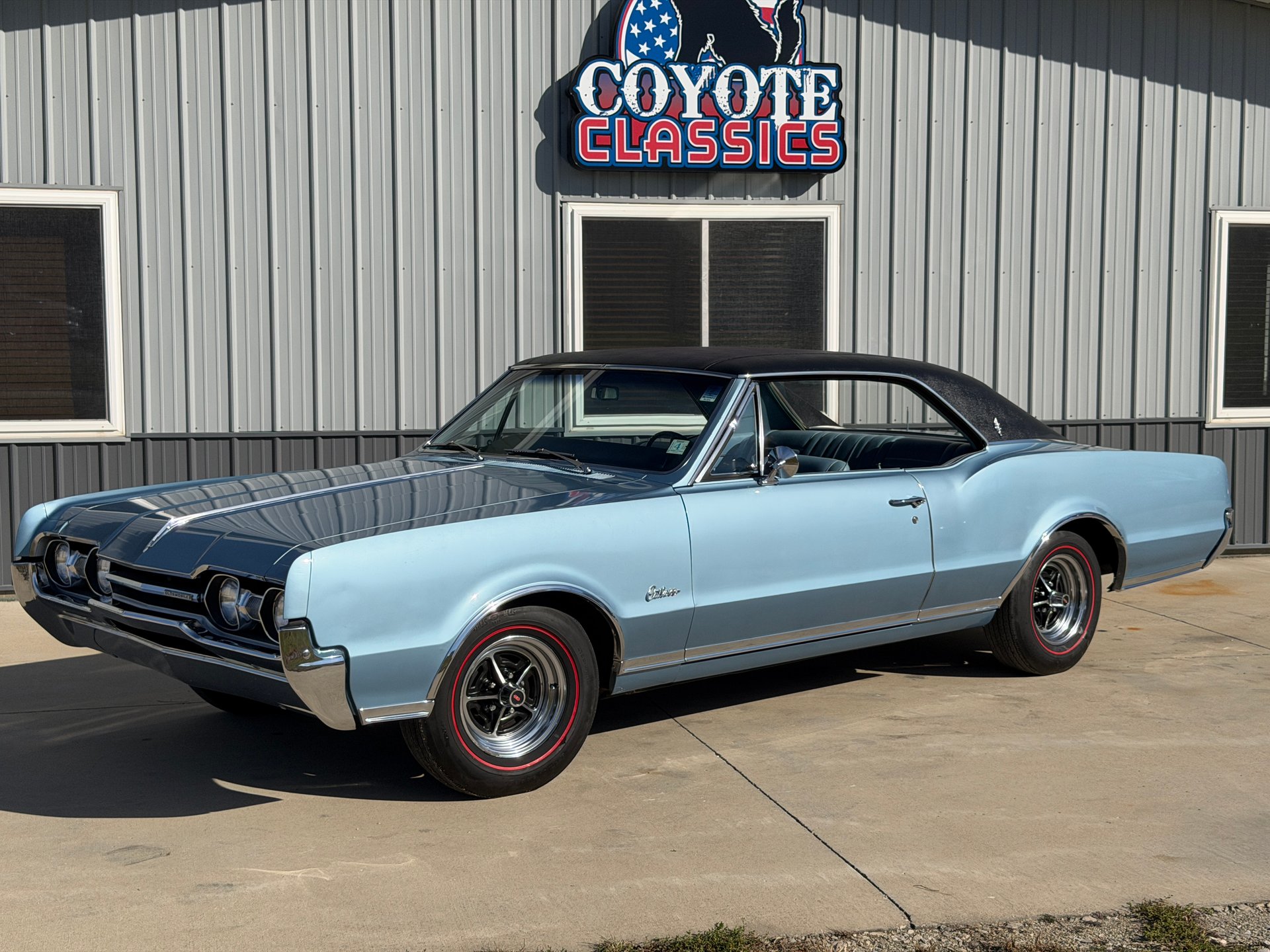
The name arrived for 1966, as the flagship of the F-85/Cutlass family, initially as a single body style: a pillarless four-door hardtop sedan, trimmed and priced above everything else in the line. For 1967 the Supreme spread across the range — two-door hardtop, convertible and sedan — and from then on it never looked back. Three generations matter to a buyer today. The first, 1966–72, rides on GM's A-body platform: the graceful 1966–67 cars, then the restyled 1968–72 cars that coincide with the peak of the muscle era. The second, 1973–77, is the "Colonnade" generation — bigger, heavier, formally styled coupes and sedans with fixed centre pillars, opera windows and padded vinyl roofs, built for comfort rather than speed. The third, 1978–87, is the downsized A-body (renamed the G-body for 1982): smaller, lighter, squarer cars that carried the Supreme name through the emissions era and became some of the best-selling automobiles in the country.
Two distinctions matter before anything else, because sellers blur both. The Supreme is not a 4-4-2. The 4-4-2 was Oldsmobile's performance model and then option package, with its own engines, suspension and identity; a Supreme could be ordered with a big engine, and in 1970–71 the Supreme SX even came standard with the 455, but an SX is not a 4-4-2 and should never be priced as one. Nor is every Hurst/Olds a Supreme, or vice versa: the Hurst cars were limited editions built off different Cutlass bases in different years. Badges are cheap. The VIN and the trim tag are what settle what a car is, and the inspection section shows you where to read them.
The market you are shopping in today reflects the production split. We currently track 23 Cutlass Supremes for sale or recently sold: 21 for sale and 2 sold, spanning 1966 to 1987. The early A-body cars appear in ones and twos — a 1966 project, a pair of 1967s, single 1968, 1969 and 1972 cars, a pair of 1970s — while the late G-body cars arrive in a block: four each from 1984, 1986 and 1987 alone, plus 1977 and 1985 cars. Fifteen of the 23 come from private Marketplace sellers and eight from dealers, and the geography is southern-weighted — five cars in Florida, three in North Carolina, two each in Missouri, South Carolina and Indiana. Black is the commonest colour in the sample (four cars), then blue (three), burgundy and grey (two each). Almost everything is automatic, as almost every Supreme was. That mix tells you the two ownership propositions plainly: the 1966–72 cars are collector cars now, bought on condition and originality, while the 1978–87 cars are still cheap, usable old cars bought on rust, maintenance and how honestly they have been kept. Both propositions stand or fall on the same thing — the body. The Rocket engines are tough and the parts situation is good; the steel is what you are really buying.


The models
The Supreme's story divides cleanly by generation, and each generation is effectively a different car wearing the same badge. Learn the breaks — 1966, 1968, 1973, 1978 — and you can place any car in the listings in seconds.
| Model | Years | Engine | Output | Built | Character |
|---|---|---|---|---|---|
| Supreme (first A-body) | 1966–1967 | 330 V8 | 250–320 hp | Tens of thousands a year | The elegant original; hardtop sedan first, coupe and convertible from 1967 |
| Supreme (restyled A-body) | 1968–1972 | 350 V8, 455 in SX | 180–310 hp | The muscle-era volume car | The collector favourite; convertible is the prize |
| Supreme SX | 1970–1971 | 455 V8 | 320–365 hp | Low thousands | A 455 in a luxury suit — fast, rare, not a 4-4-2 |
| Supreme (Colonnade) | 1973–1977 | 350 V8, 455 to 1976 | 150–275 hp | Hundreds of thousands | Formal, heavy, comfort-first; Brougham trim on top |
| Supreme (downsized A/G-body) | 1978–1987 | 231 V6, 260/307 V8, diesel | 95–180 hp | The best-selling years | The affordable driver; Supreme and Supreme Brougham |
(Outputs are period factory ratings — gross figures before 1972, net figures from 1972 on — and vary with carburation and emissions equipment. Treat any single horsepower claim on a listing with suspicion until you know which engine and which rating system it came from.)
1966–67: the original. The 1966 Supreme was one body style, a four-door hardtop, and it sold on trim: better upholstery, more brightwork, a plusher cabin than a plain Cutlass. For 1967 the range widened to a two-door hardtop coupe, a convertible and the sedan, all on the 115-inch-wheelbase A-body. These are slim, pretty cars, and the lightest Supremes ever built. The standard engine was the 330-cubic-inch Rocket V8; most survivors are automatics. In our listings the early cars are the scarcest part of the sample — one 1966, filed honestly as a project, and two 1967s.
1968–72: the muscle-era car. GM restyled the A-body for 1968 with a shorter 112-inch wheelbase for coupes, curvaceous rear fenders and a fastback-leaning roofline on the hardtops. The Supreme stayed the top trim, now with the new 350 Rocket as its standard V8. This is the generation the hobby loves: the cars look right, the engines are the strongest of the Supreme's life, and the convertible — built through 1972 — is the single most sought-after Supreme body style. The 1970 Supreme convertible was chosen as the Indianapolis 500 pace car, which tells you where the model sat in Oldsmobile's range that year. Two 1970 cars and a 1972 sit in our current sample, in burgundy and from dealers — typical of how these cars are sold now.
The Supreme SX, 1970–71. The SX is the connoisseur's footnote and the trap for the unwary in equal measure. It was a Supreme — coupe or convertible — fitted as standard with the 455 big-block, a heavy-duty suspension and SX badging, but without the 4-4-2's full performance package. Genuine SX cars are rare and quick. They are also the Supreme most often misrepresented: a standard 350 car with a swapped 455 and an SX badge is worth standard-car money. The VIN does not by itself prove an SX, so original paperwork — build sheet, dealer invoice, protect-o-plate — is what carries the premium. No paperwork, no premium.
1973–77: the Colonnade. Federal rollover fears killed the true hardtop, and GM's answer was the Colonnade body: coupes and sedans with a fixed B-pillar, frameless-looking door glass and, on Supreme coupes, a formal notchback roofline that became the decade's best-known silhouette. The Supreme and the plusher Supreme Brougham, with its opera windows and loose-pillow upholstery, were the volume sellers. Engines shrank in output year by year as emissions rules bit — the 455 lasted to 1976 — and weight climbed. These are boulevard cars: quiet, soft and chrome-laden. Two 1977 cars appear in our sample, both late Colonnades, and the generation remains the cheapest way into a chrome-bumper Supreme.
1978–87: the downsized car. GM shrank the A-body for 1978 and the Supreme shrank with it — roughly 600 pounds lighter than the Colonnade, on a 108-inch wheelbase, with crisp squared styling. The range ran Supreme and Supreme Brougham coupes and sedans; the sportier Calais was a separate model, not a Supreme trim. Base power was now the Buick-built 231 V6, with Oldsmobile's small V8s above it and, from 1979, a diesel option that this guide will steer you around. The platform was renamed G-body in 1982 when GM's new front-drive A-cars took the letter. The 1984–87 cars dominate our listings — twelve of the 23 — because they were built in enormous numbers, sold everywhere, and are only now being recognised as usable classics rather than old cars. A front-wheel-drive Cutlass Supreme also existed from 1988 on a completely different platform; it is a different car and outside this guide.


Engines and gearboxes
The Supreme's engines fall into two eras with a hard dividing line at 1973. Before it, Oldsmobile's Rocket V8s are famously strong, simple and cheap to rebuild; after it, the small V8s and the V6 are durable but choked by emissions equipment, and the diesel is a well-documented mistake. A buyer who knows which side of that line the car sits on — and which of the period's three transmissions it has — knows most of what the car will cost to run.
The Rocket V8s: 330, 350 and 455
The first-generation Supreme's standard engine was the 330-cubic-inch Rocket V8, offered with a two-barrel carburettor at about 250 horsepower or a four-barrel at about 310–320. It is a short-stroke, high-revving small-block by the standards of its day, with a cast-iron block and heads, and it is one of the least troublesome engines Oldsmobile ever built. The 330 has no systematic weakness: the issues you find in practice are the ones any sixty-year-old engine has — a tired carburettor, a weeping water pump, dried valve-cover and intake gaskets, and a cooling system that has been topped up with tap water for decades. A 330 that starts easily, holds oil pressure, and idles without smoke is a sound engine. These cars also came with the Super Turbine 300 two-speed automatic — one car in our sample carries exactly that transmission — which is a light-duty, Buick-designed unit. It works fine behind a 330 in normal use, but it is not a performance box, and a two-speed car is worth a little less than a three-speed one.
The 350 Rocket replaced the 330 for 1968 and became the Supreme's standard engine for the next decade, through the Colonnade years. It is the Oldsmobile engine you are most likely to meet: 350 cubic inches, a four-barrel Rochester Quadrajet on most Supremes, rated anywhere from 180 net horsepower in a smog-strangled mid-1970s car to about 310 gross horsepower in a 1968–70 four-barrel car. Do not let the gross-versus-net change confuse you — the engine did not lose 130 horsepower overnight in 1972; the rating system changed, and emissions equipment took the rest over several years. The 350 is a torque-rich engine with an unusually strong bottom end: forged crank, sturdy main caps, and a reputation for surviving neglect that few contemporaries share. Its normal failures are modest. The Quadrajet's throttle shafts wear and lean the idle out; the fuel-well plugs at the bottom of the float bowl leak and flood the engine when hot; and on later engines the nylon-coated cam timing gear sheds teeth as it ages — a quiet, sudden stop rather than a noisy decline. Oil leaks at the timing cover and rear main seal are common and cheap to live with; a car that smokes blue on the overrun is burning oil past valve stem seals, which is a fixable job; blue smoke under load is rings, and that is a rebuild conversation.
The 455 is the big block, offered in the Supreme through the SX of 1970–71 and as an option through 1976 in the Colonnade cars. It is a physically larger engine — wider, taller, heavier — and a fundamentally different experience: massive torque at idle speed, effortless highway pull, and fuel consumption to match. In SX tune it was rated around 365 horsepower gross in 1970, falling to 320 in 1971 as compression dropped. A 455 car should pull hard from a standstill without complaint; a car that needs revs to move has a tired engine or, more often, a rear axle ratio chosen for the highway. The 455 shares the Quadrajet's quirks and adds its own: exhaust manifold bolts that seize and snap, a tendency to run hot when the fan clutch is worn or the radiator is clogged with decades of sediment, and — on high-mileage cars — the same nylon timing gear issue. Engine identity matters here more than anywhere else in the guide. A genuine 455 can be checked by the engine code and casting numbers: the block casting number is on the driver's side of the block, and a 455's displacement is not written anywhere a seller can easily fake. A 350 dressed with a 455 air cleaner is one of the oldest scams in this hobby.

The emissions era and the G-body engines
By 1973 the Rocket was still being built, but it was being smothered: lower compression, retarded timing, air pumps, and — from 1975 — catalytic converters and the first GM electronic controls. The Colonnade Supreme's 350 and 455 ran fine but made far less power than the same engines had a decade earlier. A buyer should not judge a 1976 car by 1969 numbers; the right test is whether the engine starts, idles and pulls cleanly for what it is, with no flat spots and no overheating.
The downsized 1978 car brought a new engine hierarchy, and it is this hierarchy that defines most of today's market. The base engine was the Buick 231-cubic-inch V6, a 90-degree V6 that had already been through several lives at Buick and was, by Oldsmobile's use, generally reliable — slightly rough at idle, unremarkable, and perfectly adequate. Above it sat Oldsmobile's own small V8s: first the 260, a small-bore 350 derivative that was underpowered and best thought of as an economy engine with a V8's fuel consumption, then the 305 Chevrolet V8 in some years and markets, and finally the 307 — the last Oldsmobile V8, built from 1980 through the end of the line. The 307 is the engine most 1980s Supremes actually have: 140 horsepower in standard form, 180 in the high-output version fitted to the performance models. It is smooth, quiet, durable, and slow. Buy it for what it is — a relaxed cruiser engine that will run for a long time if serviced — and do not buy a 307 car expecting to hot-rod it. The Computer Command Control system from 1981 puts an electronic Quadrajet and a rudimentary engine computer in charge of the mixture, and it is a frequent source of poor running on cars where sensors and vacuum lines have been neglected: a rough idle, hesitation and a permanently lit check-engine light are usually the oxygen sensor, the mixture-control solenoid or the vacuum plumbing, not the engine itself. Ask whether the system is intact; a car whose previous owner "deleted" the computer controls may run better on the day and be illegal to register in a state with emissions testing the next.
Then there is the diesel. Oldsmobile offered a 350-cubic-inch diesel V8 from 1979 and a 4.3-litre diesel V6 later, both based on the gasoline engine architecture, and both are notorious for the same reasons: head gaskets, injection-pump failures and cracked blocks, aggravated by owners and mechanics who treated them like gasoline engines. A running diesel Supreme can be bought very cheaply — and the diesel is the one engine in this guide where "cheap" is not a bargain, it is the market correctly pricing a liability. Unless you are specifically seeking a diesel project with full eyes open, treat a diesel car as a body with a free parts car attached, and buy it only on the body's merits with a petrol swap priced in. The diesel's real legacy for buyers is a trap: a surprisingly cheap G-body Supreme that looks like a bargain is often a diesel car the seller is not emphasising. Check the fuel filler, the glow-plug light on the dashboard and the VIN's eighth digit before you start believing the asking price.
Gearboxes
Almost every Supreme was an automatic, and the automatics are the ones to judge carefully, because there were three very different units. The early cars use the Super Turbine 300 two-speed, a Buick unit that Oldsmobile borrowed — simple and adequate, but with only two forward gears it is always either revving or lugging, and it is the least desirable box in the range. The 1968-and-on Turbo Hydra-Matic 350 (TH350) is the standard three-speed automatic for most of the Supreme's life and is one of the best transmissions GM ever built: strong, simple, and rebuildable anywhere for a modest price. The big-block and high-torque cars got the heavier TH400. A TH350 or TH400 should engage drive and reverse promptly and change up firmly without flaring — a long delay, a flare between gears or a shudder on the upshift means a rebuild, roughly $1,500–2,500 at a transmission shop, and you should price it in before you offer.
The G-body era added two boxes you must tell apart, because one is a strength and the other is the car's best-known weakness. The TH200, fitted widely behind the V6 and small V8s from 1978, is a light-duty three-speed built for fuel economy, and it is genuinely fragile: it was designed for lighter duty than the cars it ended up in, and high-mileage examples fail — slipping, losing reverse, or quitting altogether. A TH200 car that shifts cleanly today can still be living on borrowed time; a TH350 swap is a common and sensible upgrade, and its presence in a car you are considering is a plus, not a demerit. The TH200-4R, the four-speed overdrive automatic fitted from the mid-1980s, is the one you want: the overdrive drops highway revs and fuel consumption, and the unit is strong enough that it has been retrofitted into far faster cars. Most late G-body Supremes in our listings are automatics — 16 of the 23 cars are recorded as automatic, with one Turbo 350 and one three-speed among the named variants — and a 1985–87 car with a 200-4R is the easiest daily-driving Supreme of the lot.
Manual cars are the exception. Three-speed column shifts and four-speed floor shifts existed on early Supremes, usually behind the smaller engines, and a five-speed manual was offered in the late 1970s behind the V6 and 260. They are rare enough that they carry a premium in some circles and are worth judging on the usual points: clutch take-up, synchromesh (second gear goes first), and a linkage that does not fight you. A manual Supreme is a driver's car and a genuine rarity; a badly converted one, with an automatic car's tunnel hacked about, is a project and priced accordingly.
Problem areas
Everything mechanical on a Cutlass Supreme can be fixed with money and patience, and most of it for less than owners of European classics would expect. What decides whether a Supreme is a good buy is the body and frame, because a Supreme is a steel-intensive American car from an era when rustproofing was an afterthought, and the generations differ sharply in where they rot. In our own photo-checked sample — five Supremes from the current listings whose photo sets we examined in detail — rust appeared in two of the five. That is a small sample, and it is biased toward cars photographed honestly, but treat it as a floor, not a ceiling: assume the steel needs a forensic examination and be pleasantly surprised when a car passes.
Rust: the map
Work through it by generation, because the water goes to different places on each one.
1966–72 A-body: the rear window channel, the trunk floor and the frame kick-ups. The single most characteristic rot spot on the 1968–72 cars is the channel below the rear window. The glass sits in a channel that collects water every time it rains, the drain holes block, and the panel rots from inside the channel outward — often invisibly, under the chrome moulding, until the trunk fills with water and the trunk floor follows it. Lift the trunk mat and look at the floor over the fuel tank and in the corners of the spare-wheel well: staining is a warning, holes are a panel job at $800–1,800 fitted and painted. The same water path soaks the package tray and the rear seat base. Next, the frame: the A-body frame is a full perimeter frame and it rots at the rear kick-ups, where the rails curve up over the rear axle, and at the body-mount points under the cowl and mid-body. Surface scale is normal; perforation at a body mount is structural and is fabrication work priced per car. Front fenders rot at the bottom behind the wheels, where a splash shield traps mud against the skin; doors rot along the bottom edge where the drain slots block; and the front floor pans rot where the windshield seal leaks onto the carpet. Prod the floor at the front seat mounts — a car can have a shiny underside and paper-thin floors under the mats.
1973–77 Colonnade: the padded roof, the opera windows and the quarters. The Colonnade adds a trap of its own: the padded vinyl landau roof fitted to most Supreme Broughams. Vinyl shrinks, splits at the seams and lifts at the edges, and water gets underneath it and sits against the roof steel — which then rusts under a roof that looks merely scruffy. Press along the roof rails and around the opera windows; crunching or bubbling under the vinyl means the roof is perforated, and that is a roof-skin repair with the vinyl off, $1,500–3,000 done properly, before new vinyl goes back on. The rear quarters rot behind the wheels, the lower front fenders rot behind the wheels, and the big doors — heavier than the early cars' — sag on their hinges and then chip their own rear edges. The 5 mph bumpers are heavy steel behind an aluminium or chrome face; check the mounts, because a light parking knock in 1985 could have bent a mount that has been quietly rusting since.
1978–87 G-body: the rear frame rails. This generation has the most famous structural weakness of the whole Supreme run, and it is the check that matters most on the cars that dominate today's listings. The G-body frame rails behind the rear wheels — the section that carries the rear bumper — rust from the inside out, fed by road spray thrown up by the rear tyres into a rail with inadequate drainage. A car can present with clean floors, clean doors and a sound trunk, and have rear rails you can push a screwdriver through. Get under the back of the car, behind each rear wheel, and prod the rail where it runs to the bumper mounts; also check the crossmember above the rear axle and the body mounts. Rear-rail repair is specialist fabrication — sections are made, but the job is $1,500–3,500 a side at a shop that does it properly, and a car needing both sides is a car to walk away from unless the price already reflects it. The rest of the G-body map is conventional: door bottoms and the lower rear quarters, the trunk floor at the corners, the floor pans where the T-top cars (offered on coupes in this era) have leaked for thirty years, and the base of the windshield. A T-top car with wet carpets has been leaking since the seals hardened; price the floors accordingly.
Across all three generations, learn to read the underside the way you would on any old car. Factory finishes look honestly patchy after forty-plus years — thin at the edges, chipped, dirty. A uniform coat of fresh black underseal blown over everything, rails, mounts and brake lines included, the week before a sale is a cover-up until the seller proves otherwise.

Engines and drivetrain wear
The Rocket engines' problems are covered in the engines section — Quadrajet wear, nylon timing gears, exhaust manifold bolts — and none of them is a walk-away on its own. What should stop you is evidence of the engine's core being tired: heavy blow-by from the oil filler, blue smoke under load, low oil pressure hot, or a knock from the bottom end. Oldsmobile engines are rebuildable everywhere and a quality rebuild of a 350 runs $3,500–6,000, but a Supreme that needs an engine rebuild on top of bodywork is a project car and must be priced as one.
The transmissions divide exactly as described above: TH350 and TH400 are strengths, the ST-300 two-speed is a limitation, the TH200 is a liability you price in, and the TH200-4R is a bonus. Rear axles are the GM corporate units — the 8.5-inch ten-bolt on most cars is strong and silent; a whine under load or a clunk on take-up points to worn gears or U-joints, both ordinary jobs. The limited-slip differential was an option; check for it if the seller claims one, because an open diff with a limited-slip badge is another small fiction.
One era-specific trap deserves its own paragraph: the emissions plumbing. Cars from 1975 onward carry catalytic converters, air pumps, EGR valves and, from 1981, the Computer Command Control system. Original equipment that has been removed — a gutted converter, a missing air pump, a carburettor swapped for a non-electronic one — may make the car run acceptably today and fail an emissions inspection in any state that tests. Before you buy a 1975–87 car, know what your state requires and check that what the law wants is still bolted to the car.
Suspension, steering and brakes
The Supreme's chassis is conventional GM: double-wishbone front suspension with coil springs, a live rear axle on coil springs and trailing arms, recirculating-ball power steering and, from the late 1960s, front disc brakes on most cars. It is all rebuildable with ordinary parts, and the failure pattern is uniform across generations: rubber. Ball joints and control-arm bushings perish, idler arms and centre links wear and make the steering vague, and the steering boxes themselves develop play that owners try to adjust out at the sector screw — over-tightening the box masks the symptom and accelerates the wear. Rock each front wheel at the top for ball-joint play, and on the drive expect the steering to be light and slightly remote (that is how they were) but not wandering. A car that needs constant correction at highway speed needs front-end work: budget $800–1,800 for a full refresh of bushings, joints and links at a shop.
Springs sag — G-body cars in particular sit low at the back on tired coils — and shock absorbers are a consumable nobody replaces. Brakes are discs front and drums rear on most cars; the standard recommissioning list after a car has sat is seized calipers, perished flex hoses, a tired master cylinder and a rust band on every disc, $700–1,500 to put right. The rear drum brakes inside the parking-brake arrangement are ordinary; a parking brake that barely holds is its own small job, not a verdict on the hydraulics. Power steering pumps whine when low or worn, and the high-pressure hose weeps on almost every car — annoying, cheap, and not a reason to reject a car.
Interior, trim and electrics
The cabin is where the Supreme sold itself, and where the generations differ most in cost. The 1966–72 cars use durable vinyls and simple trim; the wear points are the driver's seat bolster, cracked dash pads on sun-baked cars, and headliners that sag. Colonnade Broughams added loose-pillow velour upholstery that crushes and fades, and acres of fake wood that peels at the edges. G-body cars suffer the era's GM interior diseases: headliners whose foam backing disintegrates so the cloth hangs (a re-trim is $300–600), sun-cracked dash pads, brittle plastic trim that snaps at its clips, and power window motors that slow to a crawl — the motors are cheap, the door surgery to reach them is the cost.
Electrics are the least of a Supreme buyer's worries. There is no Lucas-style horror story here: the cars use simple, well-understood GM wiring, and faults are almost always at the connections — earth straps, bulkhead connectors, and the fusible links. Air conditioning is the expensive exception. Most Supremes were ordered with it, the R12 systems are now decades old, and a dead system is usually a compressor, a condenser and a receiver-drier plus a refrigerant conversion: $800–2,000 to return to blowing cold, which in Florida and the Carolinas — where a third of our listed cars sit — is close to a necessity rather than a luxury. Test it on every viewing. A seller who says it "just needs a charge" is describing a leak, and the charge is the cheapest part of finding it.
Chrome and brightwork deserve a budget line of their own on the early cars. The 1966–72 Supremes carry model-specific stainless and chrome that is only partly reproduced; re-plating a full set of bumpers and trim runs $2,000–4,000, and missing pieces are hunted at swap meets. On Colonnade and G-body cars the brightwork is plainer and the plastic grilles and lamp surrounds are the fragile parts — sun-bleached and cracked, and increasingly hard to find in the right colour and finish.
How to inspect one
Allow an hour, bring a torch, a cloth-wrapped magnet and a screwdriver for prodding, and arrange the viewing so the engine is cold when you arrive. On any car that passes your own checks, pay for a lift inspection before money changes hands — on a G-body especially, the rear frame rails cannot be judged properly from a driveway, and the lift fee is the cheapest information you will ever buy on one of these cars.

- Start with the paperwork and the VIN. Match the VIN on the title to the plate on the driver's side of the dashboard, visible through the windshield on later cars, and to the stamping on the cowl or door jamb of the earlier ones. Decode it: the VIN and the trim tag together tell you the model year, the plant, the original engine and the original colours and trim. This is the step that catches the dressed-up cars — a "455 SX" whose trim tag says it left the factory as a 350 car in a different colour is a standard Supreme with a story, and it should be priced as the standard car. Ask for the build sheet, the protect-o-plate and any invoices; on an SX or a convertible, paperwork is worth real money.
- Cold start. Insist the engine is stone cold. A Rocket V8 should fire quickly, settle to an even idle and show no smoke beyond a puff. Blue smoke that persists is valve seals or rings; a rattle that stays after the first seconds is not "just the lifters" until someone proves it. A diesel that needs excessive cranking and glow-plug cycles is telling you about its compression and its injection pump — walk away unless the car is priced as a body shell.
- Read the fluids. Pull the dipstick: oil that is black and thin is overdue; oil with a grey, milky emulsion is coolant, and that is a head-gasket conversation. Check the transmission fluid — it should be red and smell neutral; brown, burnt-smelling fluid in a TH200 car is a rebuild announcement. Check the coolant for rust and oil. None of these is automatically a rejection, but each one prices a job into your offer.
- The rear frame rails — G-body cars first. On a 1978–87 car, go straight to the back, crouch behind each rear wheel, and prod the frame rail where it runs rearward to the bumper mounts, plus the crossmember over the axle. This is the generation's structural weak point from the rust section, and perforation here decides whether you continue at all. On 1966–72 cars the equivalent check is the frame kick-ups over the rear axle and the body mounts; on a Colonnade, the floor pans and the roof.
- The rear window channel and trunk. On 1968–72 cars, run a fingertip along the moulding below the rear window and look for bubbling or lifted chrome; then open the trunk, lift the mat and the spare, and inspect the floor over the tank and in the well corners. Water in the trunk means the channel is leaking, and the channel is where the rust started. On Colonnade and G-body cars, check the trunk floor corners and look for staining under the rear window from inside.
- Floors and the roof. Lift the carpets or at least the mats in all four footwells and prod around the seat mounts. On a Colonnade Brougham, spend a full minute on the vinyl roof: press along the rails and around the opera windows for crunching under the padding. On a T-top G-body, look for water tracks down the pillars and damp carpets, and assume the floors need a closer look.
- Body and gaps. Walk the car with the magnet over the lower fenders, door bottoms, rear quarters and sills — filler announces itself by the magnet falling away. Sight down both flanks, check the door gaps stay even, and count the damaged chrome and trim pieces, pricing them as you go: on a 1966–72 car, missing brightwork is a swap-meet hunt, not a catalogue order.
- Front end and steering. Rock each front wheel top-to-bottom and side-to-side for ball-joint and bearing play. Check the idler arm and centre link by having a helper rock the steering wheel while you watch the linkage from below if you can. Play at the wheel rim of an inch or so is period-normal; a car that wanders and knocks needs the $800–1,800 front-end refresh from the problem areas, priced in.
- The test drive. Fifteen minutes minimum, including a highway stretch. The automatic should engage promptly, change firmly and not flare; a TH200 car that slips or hesitates on the 2–3 shift is showing you its future. The engine should pull cleanly without flat spots — hesitation on a Quadrajet car is usually the carburettor or the vacuum plumbing, and on a 1981-on car it is the Computer Command Control system asking for attention. Brake hard from speed: straight, no judder, no pull.
- Heat and electrics. Let the car idle hot and watch the temperature gauge — a Rocket that creeps upward at idle has a clogged radiator or a dead fan clutch. Run the air conditioning and expect genuinely cold air, not a seller's promise; work every window, the blower on all speeds, the lights, wipers, horn and radio. On a G-body, check the headliner has not dropped and the dash pad has not cracked through.
- Stance and underside. Stand back and look at the car level: a G-body sagging at the rear is on tired springs; a car sitting crooked has spring or body-mount trouble. Then get underneath — or better, pay for the lift — and read the frame, the floors, the brake and fuel lines and the underseal. Honest patchiness is factory; fresh black coating over everything is a question.
- Interior last. Sit in the driver's seat and judge the bolster and the cushion; check the seat belts, the headliner, the dash pad and the door cards. A sound original interior is the hardest part of a Supreme to recreate at any price, so weight it heavily — and on a Brougham, remember the velour and the padded roof are the car's character, so their condition is the car's condition.
Values
The build below this guide carries the current market numbers for the Cutlass Supreme — the cars listed now and the recorded sales — so this section teaches you how to read them rather than repeating figures that would date. The Supreme market is really three markets wearing one badge, and the spread inside each one is driven by the same things: body style, engine originality, and above all the condition of the steel.
The 1966–72 cars are collector cars, and within them the hierarchy is steep. Convertibles sit at the top — they were the glamour body style, they were built in smaller numbers, and a convertible with a sound frame and its original engine is the Supreme the hobby competes for. Hardtop coupes follow, sedans trail, and the SX premium is real but conditional: it attaches to documented cars only. An SX with its build sheet and original 455 is a genuinely rare car; an SX badge on a car without paperwork is decoration, and the market, when it is paying attention, prices it that way. Beware the asking-versus-achieved gap on these cars in particular: early Supremes are often listed optimistically by sellers pricing the badge and the chrome rather than the rear window channel and the frame, and the recorded sales tell a soberer story than the asking prices do.
The Colonnade cars are the value end of the chrome-bumper world. They were built in huge numbers, they are heavy and soft by design, and the market pays for condition and originality rather than rarity — a one-owner Brougham with a sound roof and a working everything is worth more than a scruffy car with a bigger engine, because the Colonnade buyer is buying the 1970s experience intact. The padded vinyl roof cuts both ways: it is the look the buyer wants, and it is the first place the body fails, so roof condition is effectively the Colonnade's price setter.
The 1978–87 G-body cars are the volume market and the cheapest way into a Supreme — which is exactly why the condition spread matters most there. The bottom of the G-body market is crowded with diesel cars, TH200 cars with tired transmissions, and clean-looking coupes with rotten rear frame rails, and all three are cheap for structural reasons the photos may not show. The top of the market is a different population: low-mileage Broughams, late cars with the overdrive automatic, and any G-body with a documented, rust-free frame. The gap between a project G-body and a good one is wide, but it is honest — it maps closely onto the cost of the frame work, the transmission and the interior the cheap car needs. Read the recorded sales with that map in mind: when a G-body sells well, it is almost always the frame and the paperwork talking, not the colour.
Across all three generations, one rule holds: the cheap Supreme is the one whose asking price has not yet met its rust. Originality carries the premium, documentation defends it, and a car that has been in regular use beats a lower-mileage car that has sat for a decade, because sitting is what kills the brakes, the fuel system and the seals. Negotiate from the inspection, not from the listing — every fault in the checklist above has a price, and the sellers who know these cars expect you to use it.
Parts and ownership
The Supreme's great ownership advantage is that it is an Oldsmobile built from General Motors' shared cupboard. The engines are Oldsmobile's own, but the transmissions, rear axles, brakes, suspension components and much of the electrical hardware are shared across GM's divisions and were built in the millions. A Supreme will never strand you for want of a water pump, a brake caliper or a set of ball joints.
Easy: service items, filters, plugs and ignition parts for every engine in the range; brake discs, pads, calipers and hydraulics; suspension wear parts, springs and shock absorbers; TH350 and TH400 rebuild parts and complete rebuilds at any transmission shop; Quadrajet rebuild kits and the specialists who rebuild them properly; exhaust systems in standard form; glass rubbers and weatherstrips for the popular body styles; and tyres in the original sizes or their modern equivalents. Order today, fit this weekend, at prices close to modern-car money.
Harder and dearer: model-specific chrome and stainless trim for the 1966–72 cars, only partly reproduced and priced accordingly; Colonnade vinyl roof work done properly, which is a body-shop job rather than a trim order; G-body rear frame rail sections and the fabrication labour to fit them; correct interior trim — Brougham velour in the original patterns, un-cracked G-body dash pads, headliner boards; the Computer Command Control components on 1981-on cars, where the sensors and solenoids are increasingly hunted as good used parts; diesel injection components, which are specialist and priced like it; and a quality repaint, which starts at modern money on any car this size. The pattern is the same as on every American classic of the era: the mechanicals are cheap, the cosmetics are where the money goes.
Running costs. A sorted Supreme is a realistic regular-use classic. The Rocket V8s return fuel economy in the low-to-mid teens; the V6 and 307 G-body cars do better, and the overdrive-equipped late cars are the most economical of the lot on a highway run. Servicing is within the ability of any competent independent shop — there is nothing on the car that needs a marque specialist except, arguably, a properly set-up Quadrajet and the diesel's injection system. Insurance is in line with other American classics of similar value, and club support through the Oldsmobile community is strong, with an active swap-meet and reproduction trade built around the A-body and G-body cars.
The budget line that catches new owners is the first year. Catching up deferred maintenance on a running car — fluids, belts, hoses, brakes, tyres, a carburettor rebuild — honestly runs $1,500–3,500 before you improve anything. Recommissioning a car that has sat for years runs more: the fuel system cleaned end to end, because modern ethanol fuel attacks old rubber and leaves varnish in tanks and lines; every brake component inspected; the cooling system flushed and its hoses and water pump judged; and all the seals given a chance to leak, which several of them will take. A G-body car that needs its rear rails done should have that priced before purchase, not discovered after — it is the one job on the later cars that rivals an engine rebuild for cost. Buy a car that has been driven, maintain it on a schedule rather than on a breakdown, and a Supreme will reward you with the thing it was built for: quiet, comfortable, untemperamental miles.
Which one to buy
- The all-rounder: a 1968–72 Supreme hardtop coupe with the 350. The look the hobby wants, the engine with the best balance of strength and support, and the deepest market to buy from and sell into. If you want one early Supreme to drive and enjoy, this is it.
- The collector car: a 1970–72 Supreme convertible. The pace-car generation, the glamour body style, and the Supreme most likely to hold its value — provided the frame, the rear window channel's convertible equivalent and the paperwork all check out.
- The connoisseur's car: a documented Supreme SX, 1970–71. A genuine 455 car in a luxury suit, rarer than the 4-4-2 everyone else is chasing. Buy the documentation first and the car second; without it, pay standard Supreme money.
- The value buy: a 1973–77 Supreme Brougham with a sound roof. The cheapest chrome-bumper Supreme there is, and the full 1970s experience — velour, opera windows and all — for project money. The roof and the rear quarters decide everything.
- The daily driver: a 1985–87 Supreme or Supreme Brougham with the 307 and the overdrive automatic. The easiest Supreme to live with: economical by the range's standards, simple to service, and still cheap. Buy it entirely on the rear frame rails and the transmission's behaviour.
- The one to walk past: any diesel Supreme, and any G-body with perforated rear rails at a "clean car" price. The diesel is a liability the market has already priced, and the rails are the one repair that can exceed what a late Supreme is worth finished.
And the rule that overrides all of the above: buy the soundest body and frame you can find, in the generation you can live with. Engines, gearboxes, brakes and air conditioning are all fixable at prices you can plan for. A rotten rear window channel, a perforated Colonnade roof or a rusted-out G-body frame rail costs more to put right than the finished car will be worth — and it is the one thing about a Cutlass Supreme that can never be made original again.