
Oldsmobile 88 buyer's guide
Oldsmobile 88 -- the model's own buyer's guide: variants, values and what to check.
Years listed: 1948-1995 · Series: Full Size
Overview and history
The Oldsmobile 88 is not one car. It is a nameplate that ran for half a century — from 1949 to 1999 — and in that time it was a compact-by-its-day hot rod, a chrome-laden 1950s cruiser, a vast 1970s barge, a downsized rear-drive family sedan, and finally a front-wheel-drive car powered by a V6. Buyers who say they want an 88 usually mean one particular slice of that story, most often the early Rocket-powered cars of 1949 to 1956 or the big, confident Delta 88s of the 1960s and 1970s. This guide covers the nameplate as a whole, because the listings do: on Classic Listings we currently track 45 examples spanning 1948 to 1995 in the data as filed, with the weight of the pool in the 1950s — nine cars from 1956 alone, five from 1950 — and a long tail through the Dynamic 88 and Delta 88 years into the 1980s. That spread is the first thing to understand. An 88 from 1950 and an 88 from 1985 share a badge, a division, and almost nothing else you can touch.
The idea that created the 88 was simple and, in 1949, radical. Oldsmobile took its lighter A-body shell and dropped in the new overhead-valve Rocket V8 developed for the larger 98. Light body, big engine. The result, badged Futuramic 88, was one of the first true American performance cars of the postwar era: quicker than cars costing far more, and durable enough to dominate early NASCAR racing. The song came later — Rocket 88, recorded in 1951, is routinely cited as a candidate for the first rock and roll record — but the reputation was earned on the road first.
From there the 88 settled into the role it kept for thirty years: Oldsmobile's volume full-size car, below the flagship 98, sharing its engines and offering most of its pace and comfort for less money. The hierarchy matters today. The base 88 was the entry car; the Super 88, added for 1951, gave you the stronger tune and better trim. In the 1960s the names multiplied — Dynamic 88, then Delta 88, introduced for 1965, which took over as the core name and carried the line into the downsized era, with Delta 88 Royale as its dressed-up version. By the time the rear-drive car ended after 1985, the 88 had been America's archetypal big family Oldsmobile for a generation.
Then the car changed underneath the badge. For 1986 the Delta 88 moved to General Motors' front-wheel-drive H-body, powered by versions of Buick's 3800 V6, and the final generation of 1992 to 1999, including the supercharged LSS, is arguably the most usable 88 ever built. It is not the car most classic buyers are shopping for: treat the front-drive cars as a separate purchase that happens to share a name. What unites the classic, rear-drive 88s is character — torquey, quiet, heavily built cruisers with soft suspension, light steering, and interiors designed for distance. The mechanicals are tough and rebuildable almost indefinitely; the body, trim, and interior separate a car worth buying from one that will absorb money forever.
That is also why year and body style matter more than the badge: a 1956 Super 88 Holiday hardtop is a collectible with a real following, a four-door sedan of the same year is a cheaper, softer market, and a 1980s Delta 88 is a usable old car whose value lies in condition rather than rarity. Do not price, insure, or restore one variant using another variant's logic. Read the models and engines sections to place the car in front of you, then work the problem areas and the inspection in order — the text flags which faults are era-specific and which belong to every old 88.

The models
Every classic 88 is a full-size, body-on-frame, rear-wheel-drive car until the front-drive break of 1986. Within that long run, think in generations rather than in model years, because Oldsmobile restyled frequently but re-engineered in steps. The table below places the main variants a buyer will actually meet. Production figures are given only where a reliable period total is genuinely established; for most individual trim and body combinations no trustworthy figure survives in a form worth printing, and the honest entry is a dash rather than an invented number.
| Model | Years | Engine | Output | Built | Character |
|---|---|---|---|---|---|
| 88 (Futuramic) | 1949–1953 | 303 cu in Rocket V8 | 135 hp at launch | — | The original hot rod; light shell, big engine |
| Super 88 | 1951–1953 | 303 cu in Rocket V8, higher tune | 150–165 hp | — | More power and trim; the early performance pick |
| 88 | 1954–1956 | 324 cu in Rocket V8 | 170–202 hp | — | Bigger, plusher, still quick; Holiday hardtops define it |
| Super 88 | 1954–1956 | 324 cu in Rocket V8, four-barrel | 185–230 hp | — | The mid-1950s flagship 88; 1956 is the pool's peak year |
| 88 / Super 88 / Golden Rocket 88 | 1957–1958 | 371 cu in Rocket V8 | 250–300 hp | — | Heavier, flashier; 1957 is the last of the leaner cars |
| 88 / Super 88 | 1959–1960 | 371 or 394 cu in Rocket V8 | 270–325 hp | — | Finned, wide, and dramatic; rust and trim decide value |
| Dynamic 88 / Super 88 | 1961–1964 | 394 cu in Rocket V8 (330 in some Dynamic cars) | 250–330 hp | — | Cleaner styling, strong engines, good drivers |
| Dynamic 88 / Delta 88 | 1965–1966 | 330, 400, or 425 cu in V8 | 250–360 hp | — | Delta name arrives; big-block torque, fine cruisers |
| Delta 88 | 1967–1970 | 350, 400, or 455 cu in V8 | 250–365 hp | — | The mature big Olds; 455 cars are effortless |
| Delta 88 / Delta 88 Royale | 1971–1976 | 350 or 455 cu in V8, later 403 | 160–275 hp net | — | Vast, soft, emissions-era; convertibles end in 1975 |
| Delta 88 / Royale | 1977–1985 | 231 V6, 260, 307, 350, or 403 V8, 350 diesel | 105–180 hp net | — | Downsized but still rear-drive; the affordable classic 88 |
| Delta 88 (front-drive) | 1986–1991 | 231/3800 V6, some fours early | 125–165 hp | — | H-body family car; judge it as a 1990s sedan |
| Eighty Eight / LSS | 1992–1999 | 3800 V6, supercharged in LSS | 170–240 hp | — | The last 88s; LSS is the interesting one |
(Outputs are period gross figures for the classic cars and net figures from the early 1970s onward, as the industry changed its rating method; treat any single horsepower number on a 1950s or 1960s car as a period claim to be read alongside torque and gearing, not as a dyno result.)
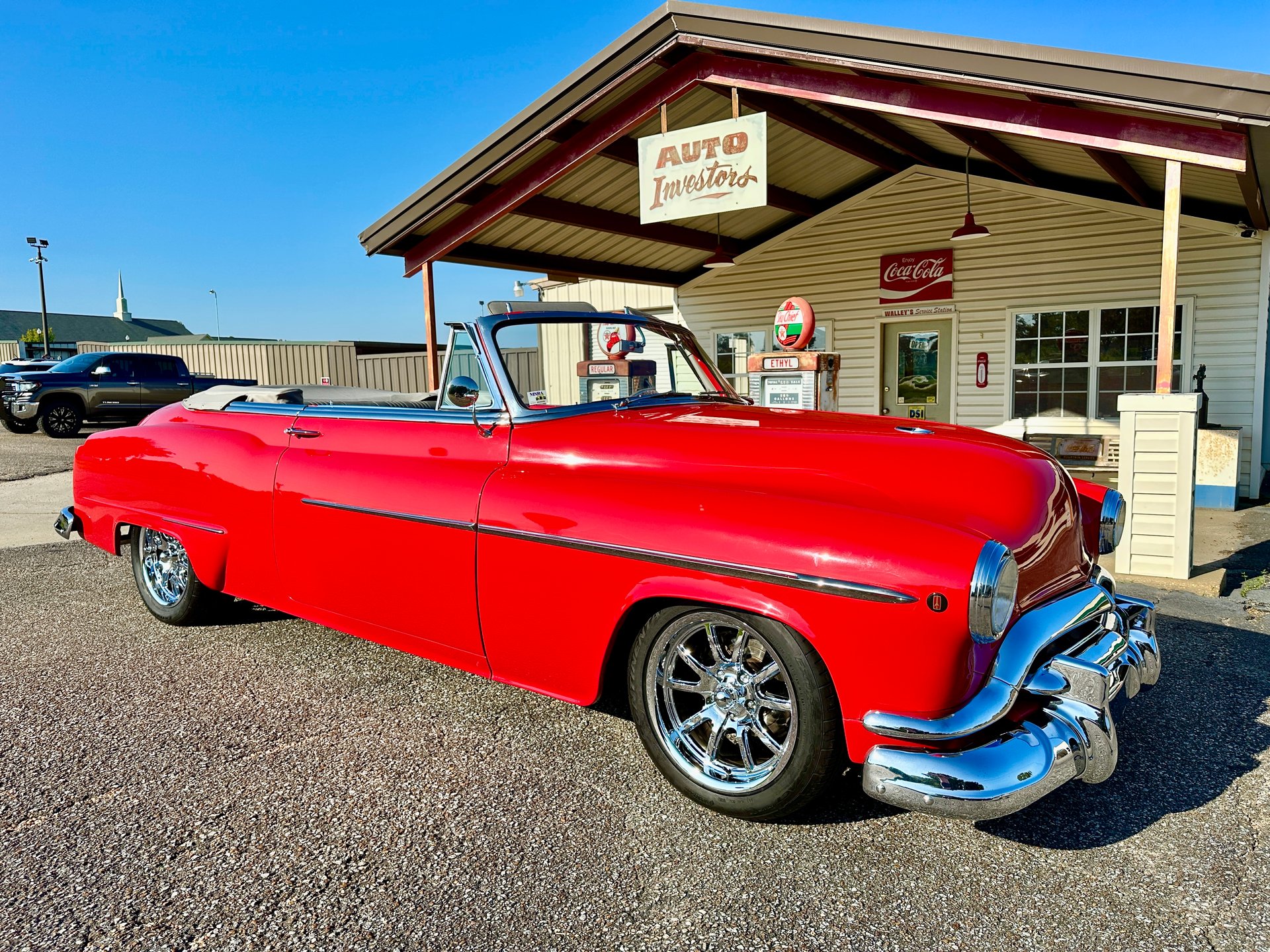
The first generation, 1949 to 1953. The car that started it, wearing Futuramic styling shared with the 98 but on the shorter, lighter shell. Two-doors, convertibles, sedans, and wagons were offered, and the convertible and two-doors are the collectible shapes. The Super 88 from 1951, with its stronger tune, is the one enthusiasts chase. These are the smallest, simplest classic 88s and the hardest to find with good original trim. A genuine early car with a tired engine beats a shiny car with the wrong engine, because identity is a large part of what you are paying for.
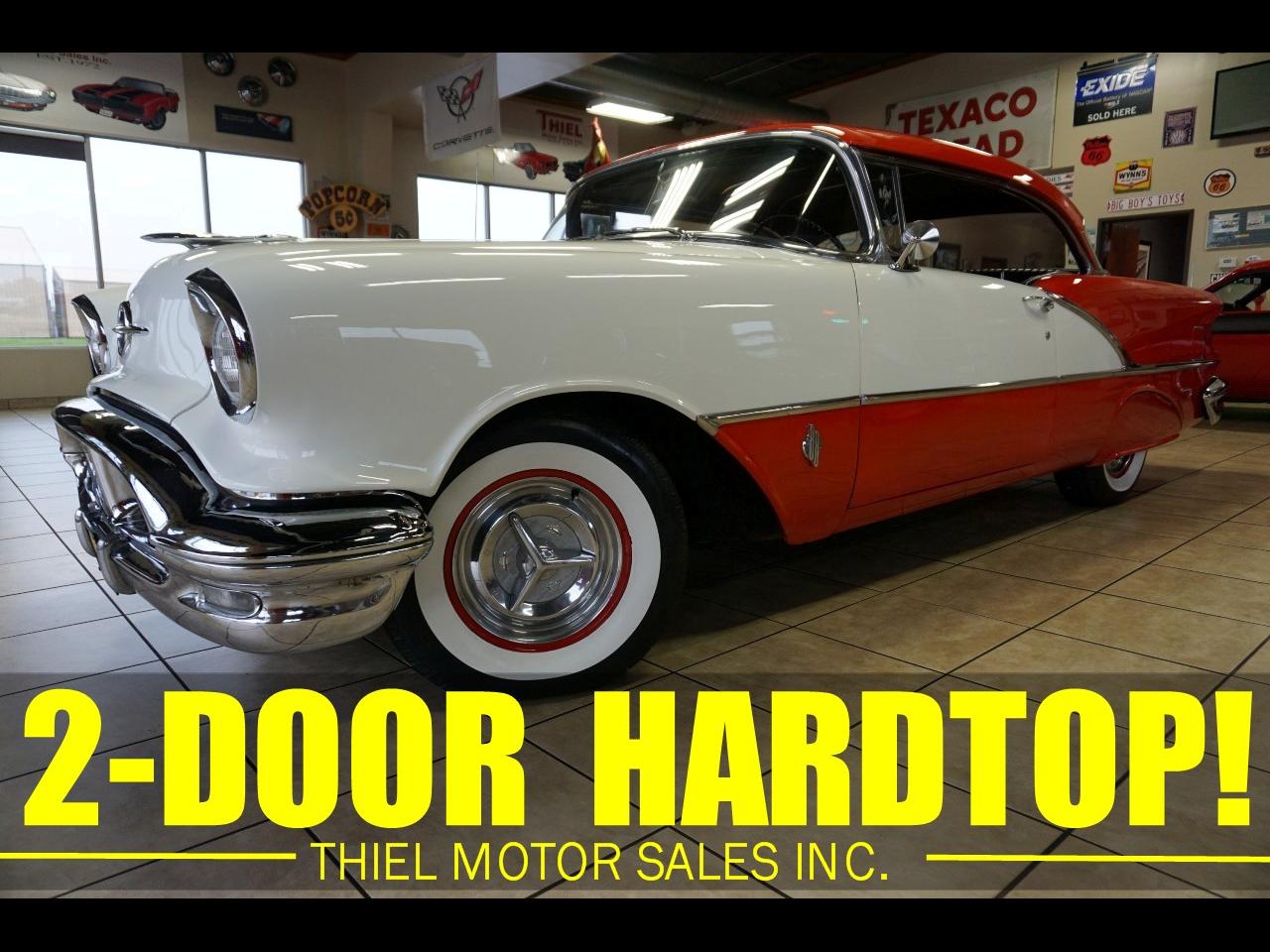
The mid-1950s cars, 1954 to 1956. For most buyers, this is the 88. The 1954 redesign brought a larger, lower body, a panoramic windshield, and the 324; 1955 added the split grille and bolder two-toning; 1956 refined the formula with more power. The Holiday hardtops are the signature styles, the convertible the rarest and dearest, and in our current pool 1956 is the single most common year. They suffer, as all mid-1950s GM cars do, from rust in the lower body and from interiors and chrome that are expensive to put right properly.

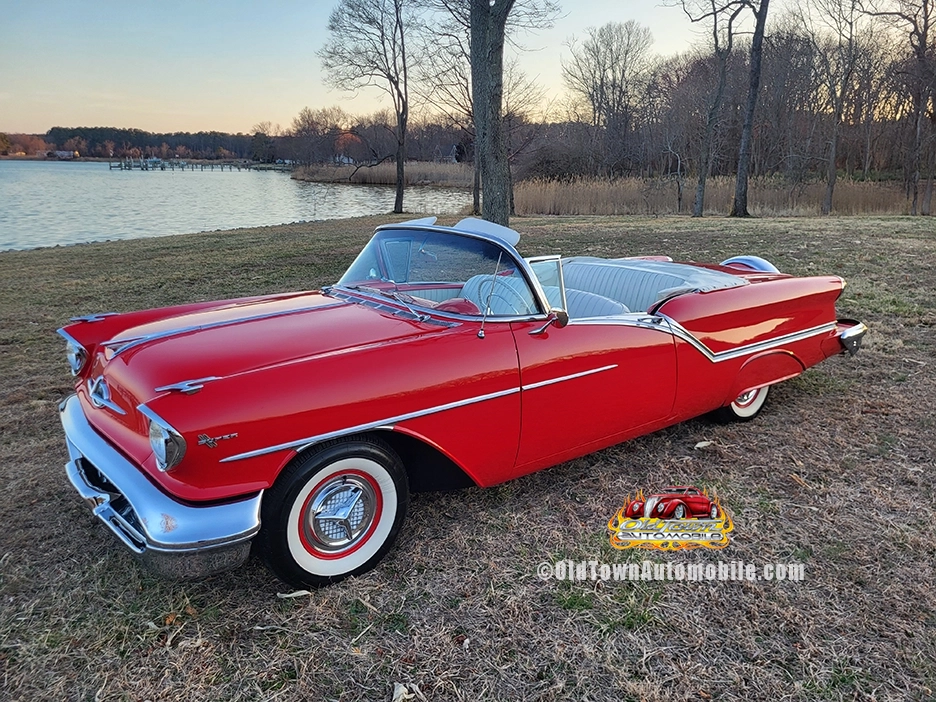
The late 1950s, 1957 to 1960. Bigger engines — the 371, then the 394 — bigger bodies, and styling that went from the relatively restrained 1957 to the full finned exuberance of 1959 and 1960. The 1957 cars, including the Golden Rocket 88 trim and the J-2 option, have a strong following. The 1959 and 1960 cars are dramatic and increasingly difficult in trim and glass: curved windshields and model-specific brightwork that is costly and sometimes effectively unavailable except used. Buy these years on completeness — a complete, slightly shabby 1959 beats a shinier car missing its trim.
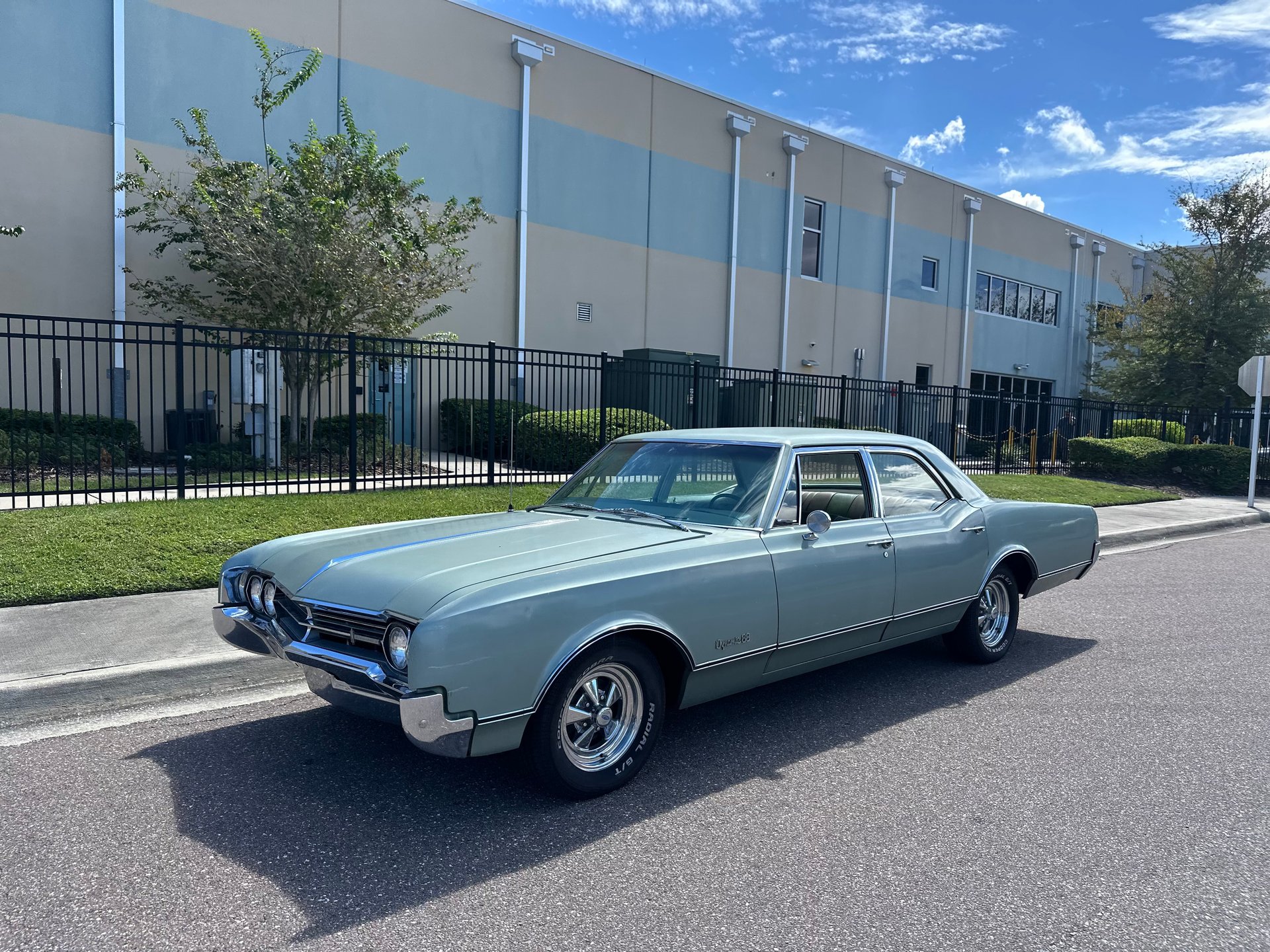
The early and mid-1960s, 1961 to 1966. The styling cleaned up sharply for 1961, and the cars are strong, honest drivers. Dynamic 88 was the volume line; Super 88 sat above it until Delta 88 arrived for 1965. The 394 and the 425 and 400 that followed are all torquey, durable units. A 1964 Dynamic 88 or a 1965 to 1966 Delta 88 is, for many buyers, the best value in the whole story: modern enough for a freeway without planning, priced below the 1950s cars in comparable condition. Watch the same rust map as every other year, and pay particular attention to the frame on salt-state cars.

The Delta years, 1967 to 1976. Delta 88 became the car. The 1967 to 1970 cars, with the 350, 400, and from 1968 the 455, are big, fast in a straight line, and deeply comfortable. The 1971 to 1976 cars grew again — the largest 88s ever built — while net power fell under emissions tuning. They are softer, quieter, and in convertible form (built through 1975) genuinely special, but their sheer size hides rust in places a smaller car does not have, and the welding bill scales with the car. A 1970s Delta in honest, original condition is an undervalued car.
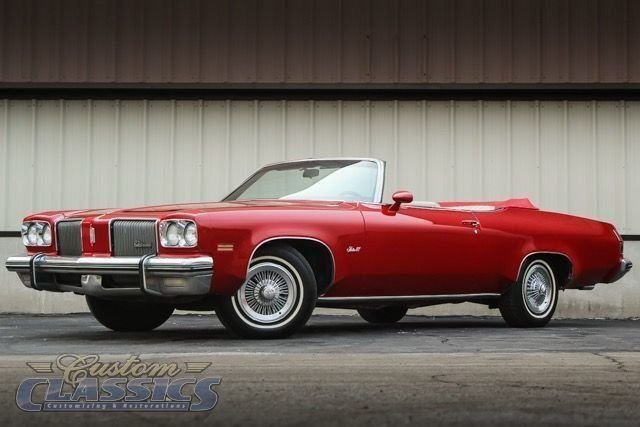
The downsized rear-drive cars, 1977 to 1985. General Motors shrank its full-size cars for 1977, and the resulting Delta 88 was lighter, tidier, and in many ways better to drive, while remaining a traditional body-on-frame, rear-drive sedan, coupe, and wagon. Engines shrank too, and buying gets complicated: the same badge can hide a Buick 231 V6, a 260 or 307 V8, a 350 or 403, or the troubled 350 diesel. The 307 cars are smooth and slow; the 350 and 403 cars feel like proper big Oldsmobiles. These are the cheapest classic 88s to buy and among the cheapest to run, and good original coupes and wagons are getting harder to find.

The front-drive cars, 1986 to 1999. Covered for completeness. The 1986 to 1991 Delta 88 and the 1992 to 1999 Eighty Eight are H-body sedans: front-wheel drive, transverse V6, four-speed automatic, no frame to rust in the classic sense but subframes, sills, and brake and fuel lines that corrode in salt country all the same. The 3800 V6 is one of the most durable engines GM ever built, and the supercharged LSS is a genuinely quick, comfortable car. Buy one as you would any 1990s GM sedan: on service history, transmission behaviour, intake and coolant history, and rust in the structural pressings — not on classic-car logic.
Engines and gearboxes
The Rocket V8s: 303, 324, 371, and 394
The Rocket is the reason the 88 exists, and understanding its first four displacements will place any 1949 to 1964 car. All are overhead-valve, cast-iron V8s with a short stroke for their era, hydraulic lifters in most applications, and a reputation for durability that was earned when rival engines were still side-valves or straight-eights. They share a character: strong low- and mid-range torque, a willingness to rev that surprised contemporaries, and a tolerance for hard use provided the oil is changed and the cooling system is kept honest.
The 303 cubic inch (5.0-litre) engine of 1949 to 1953 makes about 135 hp in standard 88 tune and more in the Super 88, with its higher compression and, in later years, a four-barrel carburettor. It is a sweet, free-revving engine in the light early body. Its known needs are the known needs of any early overhead-valve V8: valve gear wear if oil changes were skipped, timing chain stretch, and cooling systems that have had seventy years to fill with scale. A 303 that starts promptly, idles without a lifter chorus, and holds temperature in traffic is a healthy engine. A 303 that overheats at the first hill is almost always telling you about the radiator, the water pump, the thermostat, or silt in the block — in roughly that order of cost — before it is telling you about the engine itself.
The 324 (5.3-litre) of 1954 to 1956 is a developed 303, making 170 hp in its first year and rising past 200 hp by 1956, with Super 88 four-barrel cars at the top. It suits the heavier body well. One era-specific trap: these cars have spent decades on modern fuel their carburettors and pumps were never designed for. Ethanol attacks old rubber and leaves varnish when a car sits, so a 324 that has sat for five years is a fuel system waiting to be cleaned end to end — tank, lines, pump, carburettor — a predictable recommissioning cost, not a surprise.
The 371 (6.1-litre) of 1957 to 1960 and the 394 (6.5-litre) of 1959 to 1964 are the big Rockets. The 371 jumped to 250 hp and upward, with the J-2 option adding two extra two-barrel carburettors that cut in under load for a claimed 300 hp; the 394, a bored 371, became the standard big-car engine of the early 1960s, up to the low 330s in Super 88 tune. Both are immensely torquey and heavier on fuel, front suspension, and cooling. A genuine J-2 carries a premium, its linkage and vacuum actuation must be set up correctly or the car runs worse than a four-barrel car, and conversions exist — verify a claimed J-2 from its hardware, not a badge.
Across all four early Rockets, the tests are the same. Cold start: a healthy engine fires without extended cranking, shows oil pressure promptly, and does not smoke blue beyond a brief puff. Blue smoke under load is rings or bores; on the overrun it is guides and seals, a smaller job. Grey-black smoke is carburetion or ignition, not wear. Listen for a deep knock that follows revs (bottom end — walk away or price a rebuild), a top-end rattle that fades as pressure builds (lifters — negotiable), and rattling from the front cover (timing chain — a real job). A proper Rocket rebuild is a four-figure job that quickly becomes five figures at a specialist; the engines are worth rebuilding, but only into a body that deserves it.
The later Oldsmobile V8s: 330, 350, 400, 425, 455, 403, 307, and 260
For 1965 Oldsmobile modernised its V8 line, and the 88 spent the next twenty years powered by a family of related engines in two broad groups: the small-block cars — 330, 350, 260, and 307 cubic inches — and the big-block cars — 400, 425, 455, and 403. All are overhead-valve, cast-iron, carburetted V8s (throttle-body and electronic carburetion arrive only at the very end of the rear-drive run), and all share the classic Oldsmobile virtues of torque, smoothness, and tolerance. They differ in feel more than in reliability, and the difference matters to what you buy.
The 350 (5.7-litre) is the workhorse and, for many owners, the best all-round classic 88 engine: fitted from 1968 through 1980, strong, simple, and excellently supplied. Early high-compression cars are lively; later emissions-tuned cars are softer but no less durable. The 455 (7.5-litre) of 1968 to 1976 is the flagship: enormous, lazy torque, a car that accelerates by leaning on the engine rather than revving it — a good 455 in a 1969 or 1970 Delta 88 is one of the great effortless drives in the classic American market. Its costs are fuel, cooling load, and front-end weight. The 425 and 400 of 1965 to 1967 are the transitional big-blocks, and the 403 of 1977 to 1979 runs well but has a thinner cooling margin if the radiator, fan clutch, or shroud is below par.
At the smaller end, the 330 of the mid-1960s is smooth and underrated, and the 307 that powered most 1980s cars is durable, quiet, and slow, especially in later electronic-carburettor form, where a neglected feedback carburettor makes a sound engine run badly in imitative ways. The 260 is the economy V8: adequate in a downsized car, a reason on its own to prefer a 350 or 403 car. The Buick 231 V6 powered base downsized cars and works hard in a Delta. The Oldsmobile 350 diesel has a well-earned reputation for head gasket, head bolt, and injection pump trouble; buy one only knowingly, at diesel money.
Emissions-era cars share traps unrelated to core health: perished, misrouted vacuum hoses, EGR valves stuck open or shut, seized air pumps, and chokes out of adjustment. On a 1970s or 1980s car that runs poorly, verify timing, choke, and vacuum routing against the underhood diagram before condemning the carburettor, and the carburettor before the engine. A Quadrajet is excellent when its throttle shaft bushings are tight and its well plugs sealed; a worn one leaks air at idle and no adjustment cures it — a proper rebuild, realistically a few hundred dollars, not an engine problem. Finally, do not assume the engine is the one the badge implies: GM fitted engines across divisional lines in the late 1970s, so check the block stampings and casting numbers before paying an Oldsmobile-engine premium. A swapped engine is a buy at swapped-engine value.
The front-drive V6s: the 3800 family
The 1986 to 1999 cars are covered briefly because their engines deserve a separate, shorter verdict. The Buick-derived 3800 V6 — fitted as the 231 in earlier H-body years and developed through Series I and Series II forms — is a pushrod, iron-block engine of outstanding durability, and in supercharged form in the LSS and top Eighty Eight trims it makes the big sedan genuinely brisk. Its known faults are specific and fixable: plastic upper intake manifolds on Series II naturally aspirated cars that warp and leak coolant internally and externally; lower intake gaskets that weep coolant and oil; coolant elbows that become brittle with heat and age; and the usual 1990s list of sensors, ignition modules, and crank position sensors that fail with heat cycles. A Series II car that is losing coolant without a visible leak is an intake conversation until proven otherwise, because coolant drawn into the engine can hydrolock it. None of this diminishes the engine's core reputation. A maintained 3800 with documented intake work is among the lowest-risk engines in this entire guide.
Gearboxes
Most classic 88s a buyer meets are automatics, and the automatic's identity changes by era in ways that affect how the car should feel — and what counts as a fault.
The earliest cars use the four-speed Hydra-Matic, GM's pioneering automatic, in its original dual-range form. It is a robust box with a distinctive character: firm, positive shifts, a fluid coupling rather than a torque converter, and behaviour that feels abrupt to a driver raised on modern automatics. Firm is correct. Slipping, flaring between ratios, or a failure to select a range is not, and Hydra-Matic work is specialist work — find the invoice for previous attention or price the risk in. From the mid-1950s, controlled-coupling and Jetaway variants smoothed the changes; the Super Turbine 300 two-speed and then, decisively, the Turbo Hydramatic family took over in the 1960s.
The Turbo Hydramatic 400 (TH400), fitted to big-block and heavier cars, is one of the strongest automatics ever fitted to a production car: a three-speed with a torque converter, clean shifts, and a tolerance for big torque that made it the default choice behind 455s. The Turbo Hydramatic 350 (TH350) behind small-block cars is its lighter sibling and nearly as well regarded. Both should shift firmly without flaring, engage drive and reverse promptly from rest, and hold a ratio under load without hunting. A long delay engaging reverse on a cold morning, a shift that slides rather than engages, or fluid that is brown and burnt-smelling rather than red and sweet, all point the same way: a rebuild, realistically in the low-to-mid four figures at a competent shop for removal, rebuild, and refitting, with the TH400 at the upper end. Fluid and filter changes are cheap insurance on a sound box and no cure at all for a worn one.
Downsized cars add the lighter TH200 and overdrive TH200-4R family members; the overdrive boxes are sensitive to correct TV cable adjustment — a misadjusted cable can burn a 200-4R in short order, so a car that shifts oddly after engine work deserves a cable check before a rebuild verdict. Front-drive cars use the 4T60 and 4T65-E transaxles; treat a slipping one as a major cost against the car's modest value. Manual gearboxes — three-speed column-shift cars and a few later cars — are rare: judge synchromesh on second, clutch judder, and linkage wear individually. And remember, column and floor shifters were trim choices, not gearbox specifications: read the gearbox from the car and its codes, never from where the lever sits.
Problem areas
Everything in this section follows the same order a careful buyer should use: structure first, then the running gear that keeps the car safe, then the systems that decide what ownership costs, then the interior and electrics that decide what the car is like to live with. The evidence from our own pool points the same way as experience does. Of the 17 cars in the brief for this guide whose photo sets we examined in detail, rust was mentioned in the notes for 9 of them, and visible damage for 5. That is a small sample and it is not a census of all 88s — it is a reminder, from the site's own listings, that body condition is the first question on this nameplate, not the last. Assume a car needs a forensic body examination and be pleased when it passes.
Rust and structure: the map
An 88 is a body-on-frame car in every classic generation, which cuts both ways. A rusty body panel is not automatically a structural failure, because the frame carries the loads. But the frame itself rusts, the body mounts that join the two perish and collapse, and the floor and lower body that keep weather and exhaust out of the cabin rot in predictable places. Judge body and frame as one system.
The frame. Work the full length on a lift if you can, and by torch and hand if you cannot. The vulnerable sections are the side rails where they kick up over the rear axle, the crossmembers — particularly the one under the front seat area and the rear crossmember — the torque-box areas where suspension loads feed in, and any section where factory undercoating has trapped salt and moisture against the steel. Surface scale is normal on a fifty-year-old frame and is a clean-and-protect job. Perforation, flaking that reveals thinning, and cracks around spring and control-arm mounts are fabrication work. A frame repair, cut out and welded properly, is priced per section and per car — a single rail section can run into four figures fitted — and a frame that is perforated in several places ends most purchase conversations, because the welding bill approaches the value of all but the most collectible variants. Cars from the northern states in our pool — Iowa, Illinois, Minnesota, and the Northeast all appear regularly — deserve the longest time underneath. A southern or western car is not automatically sound, but its frame is where its price premium, if it has one, is earned.
Floors and trunk. Water enters past windshield and rear window seals, past cowl vents, and through failed door seals, and it settles under carpets and sound deadening that hold it against the floor. Lift every carpet you are allowed to lift, front and rear, and prod the pans at their lowest points and along the seams. In the trunk, lift the mat and the spare wheel: the well and the lower rear quarters behind the wheels are classic traps, and the fuel tank strap area and the floor above the tank hide corrosion until the tank comes out. Floor sections can be replaced — budget in the region of several hundred to over a thousand dollars a side fitted and painted, depending on how much surrounding metal goes with them — but floors almost never rot alone. Floor rust is a marker: read it as evidence about the sills, the lower quarters, and the frame beneath, and extend the inspection rather than pricing the floor in isolation.
Sills, lower quarters, doors, and wings. The rocker panels and the lower six inches are where a classic 88 shows its life. Mud and salt collect behind the front wheels, inside the rear arches, and along door bottoms where drain holes block. Run a fingertip along every door bottom, check its lower inner skin, and check the rear quarters around the wheel opening, where double-skinned sections trap moisture. On 1950s cars add headlamp surrounds, lower front wings, and the areas around the chrome bumpers, whose brackets create water traps. Bubbling paint on lower bodywork is perforation announcing itself from behind, and the visible bubble is routinely a third of the affected area. Fresh underseal or new sill covers on a car offered as original are a question the seller must answer with history, not an answer in themselves.
Body mounts and the convertible and hardtop problem. Rubber mounts compress, crack, and in salt country their steel cages rot. Collapsed mounts show as uneven panel gaps, doors that no longer close cleanly, and clonks over bumps no suspension work cures. A mount set is a modest parts cost; fitting is a body-lift shop job, and rotten pockets turn it into welding. Holiday hardtops and convertibles flex more than sedans by design, so they show mount problems earlier: judge a hardtop by door and glass fit with everything closed, and a convertible by door gaps, top alignment, and whether the cowl and sills are solid, because they carry loads a roofed car shares with its roof.
Roofs, vinyl, and glass surrounds. Vinyl roofs trap moisture against the roof skin and rear window surround, and rust under one can be extensive while the vinyl still looks presentable; blisters and a crunchy feel are warnings. Window surrounds rot under their chrome finishers, and replacement glass for the curved screens of 1959 and 1960 is a specialist search.
Suspension, steering, and brakes
The classic 88 front suspension is an independent double-wishbone layout with coil springs; the rear is a live axle on coils in most classic years, with leaf springs on some early cars and wagons, located by control arms. It is a durable system whose enemies are age, perished rubber, and deferred lubrication and alignment rather than any design flaw.
Front end. Ball joints, bushings, tie-rod ends, and the idler and centre link all wear, and the wear spreads: vague steering, wandering at freeway speed, uneven tyre wear, and knocks are the combined symptom. No single part is expensive — a full refresh, fitted and aligned, typically lands in the high hundreds to low four figures — but a claim of a rebuilt front end should come with invoices, because the difference between greased and rebuilt is invisible in photographs. Springs sag, most visibly on big-block and air-conditioned cars, and shock absorbers are cheap and often decades old: a car that floats and pitches has told you its dampers are done.
Steering. Most cars from the mid-1950s onward have power assistance, effectively standard by the 1960s. The Saginaw boxes are strong and rebuildable, and play at the wheel comes first from worn linkage and only then from the box, so diagnose in that order. Pumps whine when low or worn and hoses perish; a pump or box rebuild is a few hundred dollars — a negotiable fault, not a walk-away.
Brakes. Drums all round on early cars, front discs an option in the late 1960s and common through the 1970s. Judge the system, not the pedal alone. A car that has stood commonly needs the full hydraulic refresh — master cylinder, wheel cylinders or calipers, hoses, and fluid — budget in the region of eight hundred to two thousand dollars for a thorough shop job, more if hard lines must be remade. Corroded steel lines are the safety item to hunt on any northern car: inspect them along the frame rail and across the rear axle, and treat a flaking or weeping line as an immediate replacement. Pulling under braking, a sinking pedal, and a weak handbrake are each separate diagnoses — do not let a seller combine them into one vague assurance.
Cooling, fuel, and exhaust systems
More classic 88s are let down by their support systems than by their engines. Cooling: radiators silt up, fan clutches freewheel when they should drive, shrouds go missing, and heater cores reach the end of their lives. A gauge that climbs in traffic points at airflow or radiator capacity; one that climbs under load points at circulation or, worst case, combustion gas in the coolant. A replacement radiator is a few hundred dollars; a heater core is a cheap part behind an expensive dashboard, so test the heater on every viewing. Fuel: tanks rust from inside on cars that have sat, sender units fail, and rubber lines must be treated as a service item on any newly bought car. Exhaust: manifolds crack and gaskets blow with a ticking that rises with revs; manifold work is priced by how many studs break — allow a contingency whenever it is quoted.
Interior, trim, and electrics
This is where a cheap 88 becomes an expensive one without any single dramatic failure.
Seats and soft trim. Bench seats dominate, in cloth, vinyl, or combinations. Foam collapses long before covers wear through, so sit in the driver's seat and judge support, not surface. A professional retrim runs from the low four figures for a straightforward vinyl bench interior to well beyond that for a full restoration with door cards, headlining, and carpets — which is why a good original interior is worth a premium that can exceed an engine rebuild. Sun is the other enemy: dashboards crack and 1970s and 1980s plastics go brittle. Read every listing's interior photographs at full size before travelling.
Chrome and brightwork. The 1950s cars carry chrome on a scale no modern car attempts, and re-plating is priced per piece, by size and by pitting. A full re-chrome of a mid-1950s car is a four-figure programme, easily exceeding the mechanical work the same car needs. Pot-metal trim — grilles, ornaments, handles — pits from within and is the hardest material to restore well. Completeness beats shine: a complete set of straight, dull trim beats a shiny car missing two model-specific pieces that exist only in the used market.
Wood, plastic, and instruments. Dashboards are steel, padded vinyl, and from the 1960s applied woodgrain, which lifts, fades, and cracks; correct replacement is a specialist or used-part search. Instruments fail individually — senders first — and none of it is fatal, but a car whose instruments all work has usually been used and maintained, the best single predictor of a good purchase.
Electrics. Six-volt systems on the earliest cars (12 volts arrived for 1953) demand respect for cables and earths, and many early cars have been converted — judge a conversion by its workmanship. On 12-volt cars, wiring fails at connections and earth points rather than in its runs: dim lights and intermittent accessories are almost always earths — cheap parts, patient labour. Work every power window, seat, and top switch, run a power top through a full cycle, and price a dead accessory as its motor, switch, and wiring until a test narrows it down. Air conditioning is its own budget line: a system idle for years needs seals, a receiver-drier, possibly a compressor, realistically several hundred to well over a thousand dollars to return to cold service. A car advertised as needing only a recharge almost never needs only a recharge.
How to inspect one
Allow at least an hour and bring a torch, a cloth-wrapped magnet, and a notebook. Read the car in the order below: identity and structure before cosmetics, cold running before the test drive, and the interior last, because a beautiful cabin has talked more buyers into rotten cars than any other single thing. If a car passes you, pay for a lift inspection before money changes hands — the underside is where the truth lives.
- Start with identity and paperwork. Match the vehicle identification number on the title to the plate or stamping on the car — on classic cars look at the driver's door pillar, the cowl or firewall tag, and any frame stamping the year provides — and confirm the engine in the car is the engine the description claims, using the block stampings and casting information from the engines section. A Super 88, a J-2 car, or a 455 car priced on its specification must prove that specification in metal. Ask for invoices, not stories: engine, gearbox, brake, and body work with paperwork is worth a premium you can justify; the same work claimed without paperwork is a hope.
- Cold start, engine cold on arrival. Insist on it. A Rocket or later V8 should fire without prolonged cranking, show oil pressure promptly, and settle without blue smoke beyond a puff, without a deep knock, and without a rich, eye-watering idle once the choke comes off. Note how long the seller wants to warm the car before you drive it — a long warm-up is sometimes courtesy and sometimes camouflage for a cold-running fault.
- Under the bonnet, systematically. Check oil level and condition and smell it for fuel; check coolant level, colour, and any oil film; look for the leaks every old V8 eventually shows — rocker covers, front and rear seals, power steering — and judge them by rate, not by presence. Inspect every rubber hose and belt by squeezing, not glancing. On an emissions-era car, compare the vacuum routing and equipment with the underhood diagram and note anything missing or plugged.
- Under the car: frame first. Torch along both frame rails, the kick-ups over the rear axle, every crossmember, and the spring and control-arm mounts, following the rust map in the problem areas section. Perforation in the frame is the closest thing this nameplate has to an automatic walk-away. Then read the floors from below, the brake and fuel lines along the rail, and the body mount pockets. Patchy, honest, aged coating is normal; a uniform fresh black coat over everything, applied for the sale, is a question.
- Sills, floors, and trunk from above. Press along both sills, run a fingertip along every door bottom, lift all the carpets you may, and prod the floor pans at their seams and low points. Lift the trunk mat and the spare wheel and inspect the well and the lower quarters from inside. Damp carpets in a car described as dry-stored mean leaking seals and corrosion starting where you cannot yet see it.
- Body, gaps, and trim completeness. Walk the car slowly and look down each flank for ripples and mismatched reflections. Run the magnet over sills, arches, lower doors, and quarters — filler announces itself. Check door, bonnet, and trunk gaps for evenness, operate every door, and on a Holiday hardtop check glass fit with the windows raised; on a convertible, run the top through a full cycle and judge door gaps with the top up and latched. Count the missing or damaged trim pieces by name and search your memory of the parts section: completeness is value.
- Steering, suspension, and stance. Stand back and judge ride height and level. Rock each front wheel for bearing and joint play, bounce each corner for damper response, and look for uneven front tyre wear that betrays alignment and worn linkage. Turn the steering lock to lock at rest and note notchiness, pump whine, and leaks. On the drive that follows, the steering should centre willingly and the car should track straight on a level road without constant correction.
- The test drive: gearbox and brakes first. Fifteen minutes minimum, including a stretch at freeway speed. The automatic should engage drive and reverse promptly, shift firmly without flaring — remembering that an early Hydra-Matic is firm by design — and hold its ratios under load. Brake firmly from speed more than once: the car should stop straight, without judder, pull, or a sinking pedal. A six-cylinder-era drum car will not stop like a modern car, but it must stop straight and repeatably.
- The test drive: engine under load. Accelerate hard through the gears once the engine is warm. Hesitation and flat spots point to carburetion, ignition, or vacuum faults in that diagnostic order from the engines section, not automatically to engine wear. Listen for detonation on later low-compression cars fed poor fuel, for exhaust manifold ticking as revs rise, and for driveline shunt and axle whine on the overrun. At a hot idle afterwards, watch temperature and oil pressure behaviour for a full two minutes.
- Heat, air, and every electrical switch. Whatever the weather, run the heater and blower on every speed and feel for heat — a dead blower or a cold heater is money, and on some years dashboard-out money. Test air conditioning honestly: cold at the vents after several minutes, or it is a system to be budgeted, not a recharge to be assumed. Work every window, the seat adjustment, lights, indicators, washers, horn, radio, and every instrument, and note each failure by name for the negotiation.
- Interior, judged from the driver's seat. Sit in every seat, but price the interior from the driver's cushion, the driver's door card, and the dashboard top — the three places sun and use strike first. Feel for collapsed padding and broken springs under intact covers. Check headlining seams, carpet condition over the floors you inspected in step 5, and whether odours tell a damp story the carpets have not.
- Decide on structure and completeness, then on price. Add up, in writing, the frame and body work, brake refresh, fuel and cooling recommissioning, and interior and trim items the car needs, using the cost ranges in this guide. Sound structure and completeness make mechanical needs plannable; perforated structure or scarce missing trim means no asking figure makes the car cheap.
Values
The build appends the live market picture beneath this guide — the cars listed now and the recorded sales the site holds — and that block, refreshed at every build, is where the current numbers belong. This section teaches you how to read it, because on a nameplate that ran for fifty years the spread inside a single badge is wider than on almost any other car in this programme, and a single median figure for an 88, taken alone, will mislead you more than it helps you.
Start with the condition spread, which on an 88 is the whole story. The cheapest cars share a profile — rust, long storage, incomplete trim, or all three — and a project that needs sill, floor, and quarter work, a brake and fuel recommissioning, and an interior is not a cheaper version of a good car; it is a good car plus a restoration bill that routinely exceeds the finished car's value. The driver-quality middle — sound structure, honest paint, working systems, an interior you can sit in without apology — is where most satisfied ownership happens, and its movement tells you what the market is really doing. The top belongs to a different logic: exceptional originality, the collectible body styles, documented provenance, and verified performance specification.
Variant premiums follow identity. Convertibles outrun hardtops, hardtops outrun sedans, and two-doors outrun four-doors of the same year and condition. Super 88 specification outruns base 88 where it can be verified. A genuine 455 car of 1968 to 1970 carries a premium that reflects how it drives; a 307 car of the 1980s is priced, correctly, as usable classic transport. The front-drive cars sit in their own market, where value follows mileage, service history, and 3800 intake history, and the supercharged LSS is the only variant with a following of its own. Never carry a premium from one group into another.
Asking and achieved figures part company predictably: optimistic asks on ordinary cars sit unsold while correctly priced cars move, and the recorded sales beneath this guide are the corrective. Where the sample for a variant is one or two cars, treat any figure as an anecdote and widen your comparison to neighbouring years and body styles of the same generation. In negotiation, verifiable costed faults — brakes, cooling, a diagnosed gearbox rebuild — are legitimate adjustments. Structural rust is not a chip but a reclassification, from driver to project, and the price should move by the category. Documentation moves money the other way: a car with invoices and verified identity is worth a real premium, because you are purchasing certainty as much as metal.
Parts and ownership
The 88's parts position is the classic big-GM position: mechanical and service parts are excellent, body and trim parts are the constraint, and the dividing line runs almost exactly between what the car shares with other GM products and what was unique to an Oldsmobile of one or two years.
Easy. Service items for every engine in this guide — filters, plugs, points and ignition components, belts, hoses, water pumps, thermostats — are available from general suppliers at ordinary prices. Brake components, wheel bearings, suspension wear parts, steering joints, shock absorbers, and exhaust systems in standard form are all well supplied for the volume years, helped by the enormous production of the parent GM platforms. Turbo Hydramatic 350 and 400 rebuild parts and expertise are available everywhere automatic gearboxes are understood. Tyres in the original sizes require a specialist classic supplier rather than a high-street fitter, and correct whitewall widths for 1950s cars are a deliberate purchase, but they exist.
Harder and dearer. Body panels are the honest difficulty. Repair sections for floors and sills exist for the popular years; full quarters and model-specific panels for 1950s cars are a used-part and fabrication market. Chrome and pot-metal trim is priced per piece and can dominate a restoration budget. Curved glass for 1959 and 1960, Holiday hardtop glass and seals, convertible top frames, and year-specific interior materials all require patience and the marque-specialist network. Early Hydra-Matic expertise is concentrated in a few specialists — the parts exist, the knowledge is the scarce item — and a complete, correctly set up J-2 system is a specialist purchase. For front-drive cars the position inverts: mechanical parts are plentiful, while trim and lamps are already becoming a used search.
Running costs. Fuel consumption is what the engines promise: early Rockets in the mid-teens to the gallon in mixed use, small-blocks modestly better, a 455 in single figures around town and the low teens on a gentle run. Budget by size, not age: tyres, brakes, and suspension are all big-car parts. The cost that catches new buyers is the first year — catching up deferred maintenance on a running car honestly costs in the low four figures before any improvement, and recommissioning a car that has sat for years runs well beyond that at shop rates. Buy a car in regular use over a sleeping car at the same price, every time.
Living with one. A sorted classic 88 is a realistic regular-use classic: parts arrive, specialists exist, the cars tolerate modern traffic, and the torque, quiet, and ride suit distance. Its constraints are size and thirst — garaging is a real question for the 1971 to 1976 cars, so measure the garage before the car. Join the marque community early: for scarce trim and the Hydra-Matic and J-2 questions it is the difference between a weekend's search and a season's.
Which one to buy
- The all-rounder: a 1964 to 1966 Dynamic 88 or Delta 88. Strong engines, mature gearboxes, clean styling, freeway ability without planning, and prices below the 1950s cars in like condition. If you want one classic 88 to drive, this is the band to shop in.
- The icon: a 1954 to 1956 Super 88 Holiday hardtop. The defining mid-1950s car, with the 324 at its best and the strongest following in the range. Buy it on structure, chrome completeness, and interior, in that order.
- The original: a 1949 to 1953 Super 88. The light-body, Rocket-engine formula in its purest form, and the most historically interesting 88 of all. Verify identity ruthlessly and accept that trim, not mechanics, is the long search.
- The cruiser: a 1968 to 1970 Delta 88 with the 455. Effortless torque, deep comfort, and a market that still prices these below their driving experience. A convertible of these years is the open-air pick of the whole range.
- The value buy: a 1977 to 1985 Delta 88 with the 350 or 403. The downsized rear-drive car is the cheapest honest route into 88 ownership — traditional frame, traditional feel, modern enough to use. Avoid an unknowing diesel purchase and price a 260 or 307 car for what it is.
- The usable modern: a 3800-powered Eighty Eight, ideally a supercharged LSS. Not a classic purchase but a good car, bought on service and intake history. The lowest-risk engine in this guide lives here.
- The one to buy knowingly: a 1959 or 1960 car, complete. Dramatic, rewarding, and unforgiving of missing trim and glass. Completeness is the entire decision.
And the rule that overrides all of the above: buy the soundest structure and the most complete car you can find, in the generation you actually want. Engines, gearboxes, brakes, and cooling are all fixable at prices you can plan for. A perforated frame, a rotten lower body, and missing one-year trim are not — they cost more to put right than the finished car will be worth.
See the 34 88 cars currently listed.