
Oldsmobile 4-4-2 buyer's guide
Oldsmobile 4-4-2 -- the model's own buyer's guide: variants, values and what to check.
Years listed: 1966-1972 · Series: 4-4-2
Overview and history
The Oldsmobile 4-4-2 — written 442 on later badges, and always spoken as "four-four-two" — is the Lansing division's answer to the Pontiac GTO, and for a few years around 1970 it was arguably the better-engineered car of the two. It began life in 1964 not as a model at all but as a performance package on the intermediate F-85 and Cutlass: a four-barrel carburettor, a four-speed manual gearbox and dual exhausts, which is exactly what the three numbers originally stood for. Underneath sat Oldsmobile's new small-block V8 in 330-cubic-inch form, and the package wrapped it in heavier suspension, bigger brakes and a serious intent that the standard Cutlass never had.
That origin matters to a buyer today, because the name then changed its meaning twice. For 1965 the engine grew to 400 cubic inches and the formula was quietly rewritten as 400 cubic inches, four-barrel, dual exhaust — the four-speed was no longer compulsory, since an automatic was now offered. From 1968 to 1971 the 4-4-2 became a separate model in its own right, with its own series designation, still based on the Cutlass and the General Motors A-body platform. Then, for 1972, it stepped back down to an option package on the Cutlass, and in that form it lived on through the downsized cars of the late 1970s and a final rear-wheel-drive revival in the mid-1980s.
This guide is a cross-generation orientation, but it concentrates where the market concentrates. On Classic Listings we currently track 37 cars under the 4-4-2 name, 34 of them for sale and 3 recorded as sold. The spread tells the story at a glance: 36 of those 37 cars are from 1965 to 1972, with the heaviest concentrations in 1970 (8 cars), 1969 (7 cars), 1966 (5 cars) and 1971 (5 cars), and a single 1987 car standing for the later revival. If you are shopping from live listings, you are overwhelmingly shopping for the 1965–72 cars, and the inspection, rust and identity advice in this guide is weighted accordingly — with the later cars dealt with honestly where they differ.
Why does the 4-4-2 hold its audience when so many period muscle cars blur together? Three reasons. First, torque: Oldsmobile tuned its big-blocks for low- and mid-range pull rather than headline revs, and a 455 car moves with an ease that makes contemporary rivals feel busy. Second, finish: Oldsmobile sat above Pontiac and Chevrolet in the General Motors hierarchy, and it shows in the interiors, the sound deadening and the way a good car still shuts with a single, damped thud. Third, the W-30: Oldsmobile's factory hot-rod option gives the range a genuine flagship that rewards knowledge, and a real one is a different purchase from a standard car — in money, in scarcity and in the paperwork you must demand.
Set against that, two warnings frame everything that follows. The first is identity: because the 4-4-2 was a package before it was a model, and a package again after 1971, and because an ordinary Cutlass can be dressed to look like one, the market is full of clones, tributes and honest misdescriptions. The badge proves nothing; the VIN, cowl tag, engine stampings and paperwork prove things, and this guide returns to them repeatedly. The second warning is rust: the A-body shell traps water in predictable places — window channels, cowl, floors, trunk and rear frame — and a shiny respray over a rotten shell is the classic way to lose money on one of these cars. Mechanical work is well understood and comparatively affordable. Structural welding and correct trim are not.


The models
Read the range in five chapters. The 1964–65 cars are the founding package cars. The 1966–67 cars develop the idea, add the triple-carburettor flourish and introduce the W-30. The 1968–71 cars are the standalone-model years and the heart of today's market. The 1972 cars keep the look while the industry is turning away from performance, with the name reverting to an option. And the later revivals — the late-1970s option cars and the 1985–87 rear-wheel-drive cars — are a separate, milder proposition that should be bought for what they are, not for what the badge once meant.
Body styles follow the Cutlass line — hardtop coupes, pillared post coupes and convertibles — and convertibles and W-30s sit at the top of the desirability order in every year they were offered.
| Model | Years | Engine | Output | Built | Character |
|---|---|---|---|---|---|
| 4-4-2 package (F-85/Cutlass) | 1964 | 330 cu in V8, four-barrel | 310 hp | 2,999 | The original formula: four-barrel, four-speed, dual exhaust |
| 4-4-2 package (F-85/Cutlass) | 1965 | 400 cu in V8, four-barrel | 345 hp | 25,003 | First 400 car; the early sweet spot |
| 4-4-2 package (F-85/Cutlass) | 1966 | 400 cu in V8; triple two-barrel L69 optional | 350 hp; L69 360 hp | 21,997 | Tri-power year; W-30 arrives in tiny numbers |
| 4-4-2 package (F-85/Cutlass) | 1967 | 400 cu in V8 | 350 hp | 24,829 | Refined last-of-line early car; W-30 more visible |
| 4-4-2 (separate model) | 1968 | 400 cu in V8; W-30 | 325–350 hp; W-30 360 hp | 36,642 | New A-body styling; the volume peak |
| 4-4-2 (separate model) | 1969 | 400 cu in V8; W-30 | 325–350 hp; W-30 360 hp | 26,720 | Hurst/Olds halo alongside; strong all-rounder |
| 4-4-2 (separate model) | 1970 | 455 cu in V8; W-30 | 365 hp; W-30 370 hp | 19,330 | The peak: standard 455 torque, W-30 flagship |
| 4-4-2 (separate model) | 1971 | 455 cu in V8; W-30 | 340 hp; W-30 350 hp | 7,589 | Lower compression, still a real 455 car |
| 4-4-2 option (W-29, Cutlass) | 1972 | 350 or 455 cu in V8 | 180–270 hp net | about 9,845 with the option | Looks the part; verify engine and option codes |
| 4-4-2 (Cutlass Supreme) | 1985–1987 | 307 cu in V8 | 170 hp | 3,000 in 1985; 4,047 in 1986; 4,208 in 1987 | Handling-and-trim revival; buy as a cruiser |
(Outputs are period gross ratings for the 1964–71 cars, as Oldsmobile published them at the time; the industry switched to net ratings for 1972, which is why the 1972 figures fall so sharply on paper without the cars changing anything like as much. Production figures are the commonly recorded factory totals for the named year or option; treat the 1972 figure as approximate, because option counts were recorded differently from standalone-model production.)
The founding cars, 1964–65. The 1964 car is rare and historically important, but comparatively gentle: a fast Cutlass rather than a big-block bruiser, and one that authenticates on paperwork because the package left no unique VIN series. The 1965 car is the early car most buyers actually want — real 400 pace, crisp styling, and survival in reasonable numbers. A genuine 1965 with its Protect-O-Plate or build records is worth materially more than an identical-looking car with none, for reasons the problem-areas section explains.
The development cars, 1966–67. The 1966 range added the L69 option — three Rochester two-barrel carburettors on the 400, rated at 360 hp — a one-year flourish collectors love and drivers must set up patiently. The same year Oldsmobile slipped the W-30 into production in very small numbers. The 1967 cars cleaned up the styling, kept the 400, and made the W-30 slightly more formal, recognisable in period by its red plastic inner front fenders. Both years sit in package-era identity territory: the car began life as an F-85 or Cutlass with an option, so documentation is the authentication.


The standalone years, 1968–71. The A-body was redesigned for 1968 and the 4-4-2 became a model in its own right, with the 344 series designation that becomes your best friend at inspection time: a genuine 1968–71 car's VIN begins with 344, and a car of those years wearing the badges without it is a Cutlass in costume. The 1968–69 cars ran the 400 in standard and higher-output forms; the related Hurst/Olds, with its 455, is a separate model and not a 4-4-2 variant. For 1970 Oldsmobile standardised the 455 and produced the definitive car. For 1971 compression fell for low-lead fuel and production dropped sharply — but a 1971 remains a genuine 455 standalone-model car, and often the value entry into that combination.
1972 and after. For 1972 the 4-4-2 reverted to option W-29 on the Cutlass, orderable with the 350 or the 455, a four-speed still available behind the 455 — and the cars look almost identical to a 1971 at ten paces. That is the trap: identity rests on cowl-tag and paperwork evidence for W-29 and on the VIN engine code, not on a unique series. The Colonnade cars of 1973–77 and the downsized 1978–80 cars carried the name as an option with milder engines, and the 1985–87 revival put it on the rear-wheel-drive Cutlass Supreme with the 307, overdrive automatic, uprated suspension and distinctive trim — represented in our current pool by a single 1987 car. Buy the later cars as handsome cruisers with a famous name, not as undervalued 1970 cars.
Engines and gearboxes
Every classic 4-4-2 runs an Oldsmobile V8, but "Oldsmobile V8" covers two related architectures and five displacements you will actually meet, and telling them apart is a core buying skill. Oldsmobile divided its post-1964 V8s into small-block and big-block families that share a design language — and a great many external fittings — but differ in deck height. The big-block block stands roughly an inch taller at the deck, which is the physical check that settles arguments when stampings have been ground, restamped or simply misread. Displacement alone does not tell you the family: the 400 exists in both early big-block form and, confusingly, a later small-block 403 sits outside this guide's core years. Learn the years, the codes and the deck, in that order.
The small-blocks: 330, 350 and 307
The 330 (1964) launched the family: an oversquare, free-revving engine with a forged crankshaft in its early performance form, rated at 310 hp in the original 4-4-2 with its Rochester four-barrel. It is a delightful engine — smoother and keener to rev than the big-blocks — but it gives away a hundred horsepower-feet of feel in ordinary driving, and a 1964 car should be priced as the historic original, not as a rival to a 455.
The 350 arrived for 1968 as the Cutlass line's workhorse small-block and matters to this guide in two places. First, ordinary Cutlasses — the raw material for most clones — very often carry it, so meeting a 350 under the hood of a car advertised as a 1968–71 4-4-2 is an identity alarm, not a detail, because the standalone-model cars left Lansing with big-blocks. Second, it was a legitimate 4-4-2 engine in the 1972 option year, when W-29 could be ordered over a 350 car. Judge a 1972 on its option paperwork, and judge any earlier "matching" 350 car as a Cutlass until paperwork proves otherwise. In ordinary tune the 350 is tough, understressed and cheap to keep; it simply does not deliver the big-block shove the badge promises.
The 307 belongs to the revival cars of 1985–87: an emissions-era small-block with a computer-controlled Rochester Quadrajet and 170 hp through tall gearing. It is smooth and durable, and its real-world checks are vacuum hoses, mixture-solenoid behaviour and oil leaks from hardened seals — not compression heroics.
Small-block identification uses the casting and stamping evidence together — casting number at the bellhousing flange, and on 1968-on cars the partial VIN derivative on a pad low on the block, which should match the car's own VIN on a numbers-matching claim. Never accept a decode from one photographed number alone; the honest seller expects you to check two or three.
The big-blocks: 400 and 455, and the W-30
The 400 was the founding muscle engine: introduced for 1965 at 345 hp with a single Rochester four-barrel, lifted to 350 hp for 1966–67, and offered in the 1968–69 standalone cars at 325 hp in automatic form and 350 hp in higher-output applications. Two different 400s hide under that displacement, distinguished by block casting and year — the 1965–67 and 1968–69 engines differ in lifter-bank geometry and camshaft compatibility — so an engine swap described as "just another 400" deserves questions about exactly which 400, from which year, with which heads. Heads carry castings specialists decode by year and application, and a W-30 claim stands or falls partly on the heads fitted.
The triple-carburettor L69 of 1966 deserves its own paragraph because sellers price it and buyers misunderstand it. Three Rochester two-barrels on a factory intake gave 360 hp and superb period theatre, but no large real-world advantage over a well-set-up four-barrel car, and they demand patient synchronisation: idle quality, tip-in and fuel smell tell you whether the setup is sorted or merely present. A parts-built conversion can look convincing in photographs. Correctness lives in the intake casting, carburettor list numbers, linkage and air cleaner — price a claimed L69 as a four-barrel car until those details check out.
The 455 arrived in the 4-4-2 for 1970 as the standard engine and defines the peak cars. In standard form it was rated at 365 hp with a Rochester Quadrajet and a torque output of 500 lb-ft at low revs — the number that explains the driving experience. This is not a peaky engine. It pulls from just off idle, overwhelms period rear tyres without trying, and makes an automatic car feel effortless rather than lazy. The 1971 version kept the displacement and the character with a lower compression ratio for the low-lead era, rated at 340 hp gross; the 1972 versions were quoted net, at up to 270 hp in the higher-output 455 application, a paper fall that overstates the real difference. What actually changed across 1970–72 was compression, camshaft mildness and exhaust restriction, in that order — which is also the order in which owners have been reversing the changes ever since, so establish what is actually inside a car rather than assuming the factory specification survives.
The W-30 package is the summit, offered from 1966 in tiny numbers and most famously on the 455 in 1970, when it was rated at 370 hp — a nominal 5 hp over standard that nobody who has driven both believes tells the whole story. The specification combined selected and blueprinted-feel engine components: a more aggressive camshaft, heavy-duty valve springs, a low-restriction outside-air induction system feeding the air cleaner through scoops under the front bumper and large hoses, and for 1970 an aluminium intake manifold and distinctive fibreglass hood with functional scoops on most applications. Earlier W-30s announced themselves with red plastic inner fenders and, on the 1966–67 cars, a battery relocated to the trunk. The red inner fenders and the intake are the parts everyone copies; the paperwork is the part nobody can copy convincingly. A genuine W-30 should come with factory documentation — a build sheet, a dealer invoice, Protect-O-Plate evidence or credible registry and specialist verification — and the market prices an undocumented "W-30" as a standard car with options added, which is exactly how you should price it too.
Running behaviour gives you the first verdict on any of these engines. A healthy Oldsmobile V8 starts readily, idles with a slight, even lope in big-block form, shows strong oil pressure at speed (an ease at hot idle is normal) and pulls cleanly without detonation on premium fuel. Blue smoke at start-up after standing points to valve stem seals, a bounded job; continuous blue smoke under load is rings or bores and an engine-out conversation. A rhythmic tick is often an exhaust manifold leak before it is a lifter; a deep knock under load is a walk-away until proven otherwise. Oil weeps from rocker covers, the rear main area and the timing cover are endemic on cars that have sat — a completely dry fifty-year-old bay usually means it has just been cleaned for your visit.
Carburation is Rochester throughout: the Quadrajet on most cars from the late 1960s, earlier four-barrels, and the L69 triples for 1966. Budget roughly $400–900 for a proper specialist Quadrajet rebuild with correct parts, and treat a rich idle, a fuel smell and soot-black plugs as a tuning bill first and an engine bill only if the inspection checks say so.


Gearboxes: Muncie four-speeds, three-speeds and Turbo-Hydramatics
The original third number was the four-speed manual, and manual cars remain the driver's choice. Most performance applications used Muncie gearboxes — wide-ratio M20, close-ratio M21, heavy-duty M22 in a few high-performance applications — with factory Hurst shifters in the later 1960s. Judge one on second-gear synchromesh on a fast downchange, clutch judder pulling away, and whether the shifter feels precise or like a spoon in a bowl: linkage bushes are cheap, internals are not. A Muncie rebuild typically runs about $1,200–2,500 in parts and labour before the clutch; a clutch kit fitted adds roughly $700–1,200. Three-speed manuals were the nominal base fitment in several years and survive rarely; a genuine one is honest but not prized.
Most cars you will meet are automatics, and the classic-years automatic is the Turbo-Hydramatic 400 three-speed behind both 400 and 455 engines. It suits the torque and fails legibly: delayed engagement, flaring on the 2–3 change, dark or burnt fluid, a missing kickdown. Bright fluid at the correct level plus firm changes is what you want. A TH400 rebuild is roughly $1,800–3,500 depending on hard parts — a negotiation, not a catastrophe — but get the box fully hot on the test drive, because a cold TH400 hides faults a hot one announces. The earlier two-speed Jetaway on some mid-1960s cars is a period piece worth a specialist conversation about parts. The 1985–87 cars use the TH200-4R overdrive automatic (rebuild roughly $1,500–2,800); hunting between gears at a steady cruise is its characteristic complaint.
Rear axles came with torque-first ratios and the Anti-Spin limited-slip as the desirable option. Check it honestly: with both rear wheels raised and the gearbox in neutral, turning one wheel should drag the other the same way on a limited-slip car. Counter-rotation means an open differential and a seller with a story. Whine on a light throttle, backlash clunk and a weeping pinion seal are the usual age faults — budget roughly $800–1,800 for a specialist axle refresh with bearings and seals.
Problem areas
Everything in this section follows one rule: on a 4-4-2, identity and structure decide value, and everything else is a negotiable repair. A note on evidence: we photo-checked 29 of the 37 cars currently tracked under this name, and the recorded aggregates for that sample show no mentions of rust, smoke, leaks or damage. Read that correctly — it means the recorded notes for this pool are thin, not that 29 A-bodies have survived fifty years without corrosion. Inspect harder from the car itself: your eyes, magnet and torch outrank any listing summary, including ours.
Rust: the map
Rust on an A-body follows the water and the mud, and it does so in the same order on a 1965 car as on a 1972. Work through it in this order, because the first items are the ones that end purchases.
Frame, especially the rear kick-up and the convertible frame. The boxed and open-channel sections of the A-body frame rot from the inside, fed by road salt and by mud packed into the rear kick-up where the rails sweep over the rear axle, around the body-mount holes, and along the side rails under the doors. Surface scale is normal; perforation, flaking layers and softness to a screwdriver prod are not. Convertible frames and the fully boxed sections trap moisture differently and deserve an even slower look. Frame repair is fabrication: a specialist will price a proper sectioned repair at roughly $1,500–4,000 per affected area, and a badly rotten frame on a hardtop can exceed the sense of the whole purchase, because everything else bolts to it. Put the car on a lift if you are spending real money. There is no honest shortcut.
Cowl, windshield channel and rear window channel. The front and rear glass sit in channels that collect water when their seals age and their drain paths block. Rust starts invisibly under the bright trim, then perforates the channel, then delivers water into the car: at the front it runs down the cowl sides and into the front footwells and the cowl's lower corners by the front body mounts; at the rear it fills the package-tray corners and drops into the trunk. Bubbling paint at a window corner, a damp smell, water staining on the parcel shelf or rust scale under the rear seat are all the same story at different chapters. A window-channel repair done properly — glass out, metal cut back and welded, paint blended — runs roughly $1,000–2,500 per end of the car, and it is the gateway repair: ignore it and the floors and trunk follow.
Floor pans and trunk floor. Lift every carpet. Floors rust from the top down where water has sat under sound deadening and from the bottom up where underseal traps moisture against seams: front footwells first, then rear footwells and the panel under the rear seat. The trunk floor rusts in its low corners, around the tank straps and over the rear frame, fed by the rear window channel and a perished trunk seal. A replacement pan section fitted and finished typically costs about $600–1,500 a side, but floors almost never rot alone — price floor rust as a marker for cowl, channels and trunk. A car needing floors, trunk and channels is a shell restoration wearing a drivable disguise.
Lower body: sills, fenders, doors and quarters. Lower front fenders behind the wheel, door bottoms where drain holes block, rear quarters around the wheel opening and the arch lips all bubble from inside. Prod with a thumb, run a cloth-wrapped magnet over the arches and quarters, and treat filler-thick panels as welded repairs you have not seen the invoice for. A single quarter or arch repair with paint blending is roughly $800–2,000 a side; a car needing both quarters, both rockers and both door bottoms is a restoration, not a tidy-up. Check the inner wheelhouses from inside the trunk — outer rust with a rotten inner house is two jobs, not one.
Core support and battery tray. The core support rusts at its lower mounts and around the battery, where acid spill attacks the tray, the inner fender beneath it and the support itself. Rock the battery and check the tray edges with a torch. Repair or replacement with the front clip realigned is roughly $700–1,800 in parts and labour — rarely a walk-away, but an excellent tell: acid damage left to spread for years is deferred maintenance you can see.

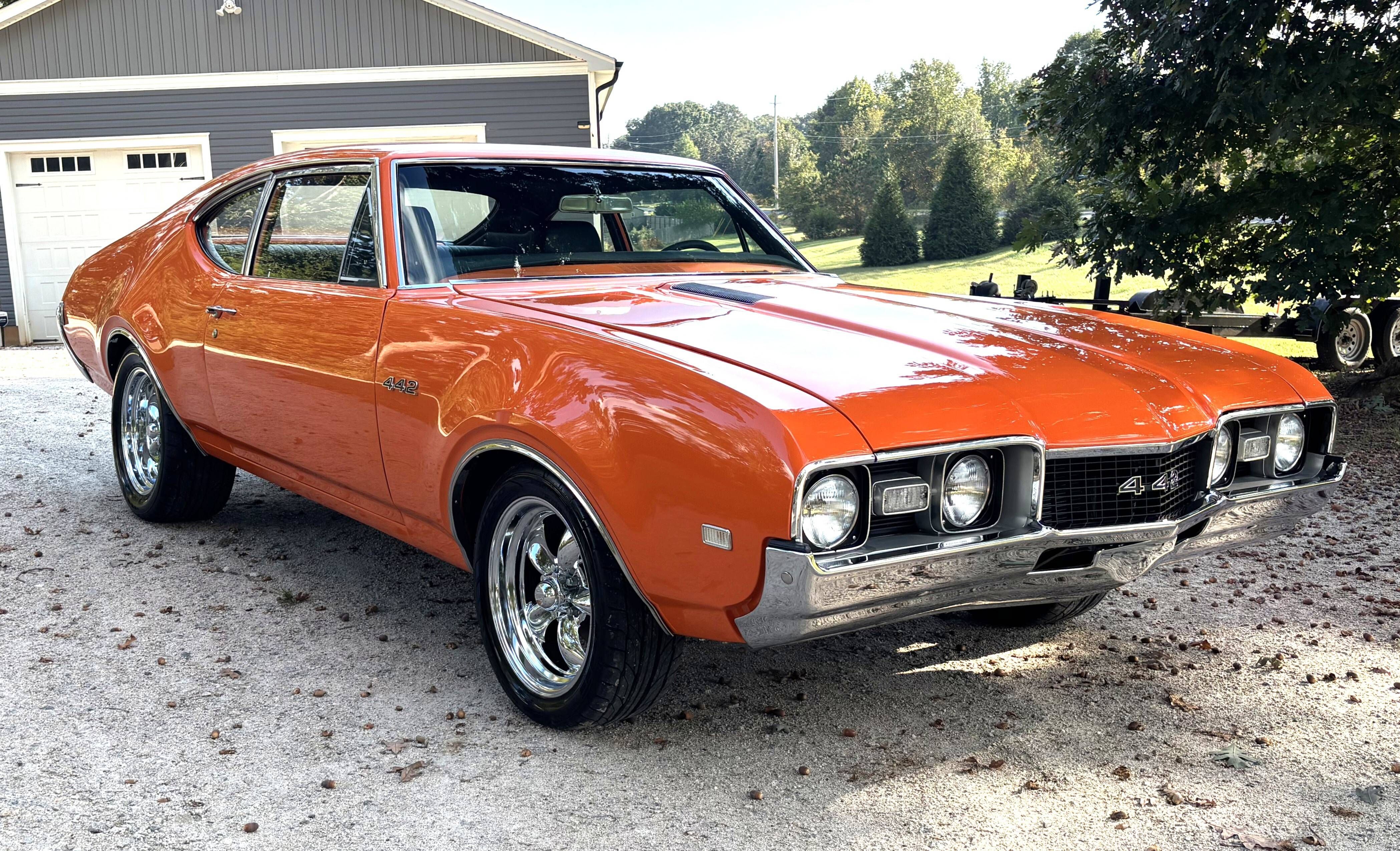
Identity, clones and paperwork
This is the 4-4-2's defining problem area, and it deserves the same seriousness as rust, because the money at stake is larger. A Cutlass and a 4-4-2 share a shell, most trim and, to a casual eye, everything. Converting one into the other takes badges, stripes, a hood, grilles and, in the ambitious cases, a big-block engine swap. None of that makes the result a 4-4-2, and the price difference between a genuine car and a tribute is the entire premium the badge carries.
Use the defences in order. For 1968–71, start with the VIN: the standalone cars carry the 344 series prefix, and that single check disposes of most misdescribed cars in seconds. Read the plate at the base of the windshield yourself, photograph it, and match it to the title. For 1964–67, there is no unique series to find, because the car was sold as an F-85 or Cutlass with an option package. Authentication rests on paperwork: the build sheet (sometimes found under the rear seat or above the fuel tank), the Protect-O-Plate, the window sticker or dealer invoice, and the cowl tag's accessory codes read by someone who knows the plant and year. An early car with none of that is a Cutlass-priced gamble however good it looks, to be bought — if at all — at money that survives the worst-case answer. For 1972, the test is W-29 option evidence plus the VIN's fifth character, the engine code: a car whose engine and code disagree has had a swap, which may still be a fine car but is not the factory combination. For the 1985–87 revival, option evidence and the service-parts label do the same work, at smaller stakes.
Engine identity needs the same discipline. From 1968, Oldsmobile stamped a partial VIN derivative on a pad low at the front of the block; on a numbers-matching claim, it should match the car's VIN. Head and block castings and date codes should sit plausibly before the car's build date and belong to the claimed application. A correct-type replacement engine, honestly disclosed, costs a matching-numbers car some premium and a driver car almost nothing; an undisclosed one discovered later costs resale value. W-30 claims sit at the top of this pyramid: red inner fenders, scoops, hoses and even an aluminium intake are all buyable parts. Documentation is the product. No documents, no W-30 money — applied without exceptions, that sentence will save a buyer more than any other in this guide.
Finally, check that the cowl tag's codes match the body and interior in front of you, that its rivets look undisturbed, and that the title VIN matches the plate digit for digit. A swapped tag, a restamped pad or a title discrepancy is not a negotiation point; it ends that car's candidacy at collector money.
Engine, cooling and exhaust: the wear that matters
Beyond identity, the big-block's age faults are conventional and mostly affordable — with two exceptions that change the price of a car. The first is overheating with a cause. These engines cool through a large crossflow radiator, a clutch fan and, on air-conditioned cars, a heavy load at idle. A car that runs hot in traffic may need no more than a recored or replacement radiator (roughly $400–900 in parts, plus labour), a fan clutch ($80–200 in parts) and correct shrouding. But a car that overheats under load, pushes coolant, or shows combustion gas in the coolant is describing head-gasket or head trouble, and on an Oldsmobile that is a $1,500–3,000 repair conversation with machining on top if a head has cracked between the valves. Do the cheap tests in the inspection section before you agree a price. The second exception is low oil pressure when hot. A tired engine with worn bearings can idle along happily on a test drive and show its truth only on the gauge after twenty minutes at temperature. Price a confirmed low-pressure engine as a rebuild: a quality Oldsmobile V8 rebuild, out, machined, reassembled and back in, typically runs about $5,000–9,000 at a specialist, and scarce correct parts for a claimed-matching engine add time rather than reduce cost.
The ordinary list is shorter. Exhaust manifolds crack and their studs seize — budget $400–1,000 a side if a manifold must come off and studs extracted. The intake's choke-heating crossover cooks its gasket and leaks, announcing itself as a tick and a sooty trace. Timing chains stretch and retard the cam; a chain set is a few hundred dollars in parts and a day of labour, and a car that feels inexplicably flat with good compression is a candidate. Fuel systems suffer from standing and ethanol fuel — tank varnish, perished lines, a tired pump, a dirty Quadrajet — at roughly $800–2,000 to put right end to end including the carburettor work above.
Chassis, steering and brakes
The A-body chassis is simple, strong and almost entirely rebuildable with parts you can order today, so it rarely kills a purchase — but its condition decides whether a car feels like a 4-4-2 or like a boat. Both ends wear at their rubber bushings first. Perished rear control-arm bushings let the axle steer the car under power — the classic symptom is a car that changes line as you get on and off the throttle — and a full bushing refresh, front and rear, typically runs about $1,000–2,200 in parts and labour. Ball joints, tie-rod ends and idler arms are cheap parts whose combined wear produces the vague steering sellers call character; a complete front-end wear rebuild is roughly $900–1,800 fitted, and a rebuilt power-steering box about $600–1,100 fitted. Together, this is the difference between a car you drive home confidently and a car you trailer.
Brakes divide the range. Front discs were available from the mid-1960s and grew common, but plenty of early cars carry four-wheel drums, and a drum car in modern traffic needs its adjustment and hoses perfect rather than merely adequate. Judge the system, not the pedal alone: seized calipers or wheel cylinders, perished hoses, a tired master cylinder and corroded hard lines are the standard standing-car list, and a full hydraulic refresh with labour runs about $900–2,000. A disc conversion on a drum car is well-trodden at roughly $1,200–2,500 in parts and fitting — money well spent on a driver, a deviation to price on a car sold for originality. Check tyre date codes: an old set is a replacement bill of roughly $800–1,600 and a safety item on the drive home, not a detail.
Interior, trim and electrics
The cabin is where the Oldsmobile premium was spent, and where correct restoration gets expensive fastest. Seat covers, door panels, headliners and carpets are reproduced for the popular years, and a full interior refresh in correct-pattern materials typically runs about $2,500–5,500 in parts and trimming labour — but the small things are the trap. Pot-metal trim pits, convertible top frames bend and their rams leak, and year-specific grilles, bezels and badging are hunted used parts, not catalogue items: price missing trim as a hunt, not an order. A column-shift bench car converted to buckets and a floor shifter is a fine driver and a misdescribed collector car, and those are different prices.
Electrics fail at connections: earth straps, bulkhead connectors and fuse-box terminals corrode, and the symptoms — dim lamps, lazy windows, a fuel gauge with opinions — are tedious rather than expensive. The bigger items are air conditioning, where a full recommission with compressor, hoses and seals runs roughly $1,500–3,000, and power accessories at a few hundred dollars per unit fitted. A car where everything electrical demonstrably works has usually been used and maintained — still the best single predictor of a good purchase. A car where nothing works has usually been standing, and standing is the root cause behind half the faults in this guide.

How to inspect one
Allow a full hour, and two if the car claims to be a W-30 or numbers-matching. Bring a torch, a cloth-wrapped magnet, a small mirror, a screwdriver for prodding (with the seller's permission), and your phone for photographs of every plate and stamping. If the car passes you, pay for a lift inspection before money changes hands — the frame and rear kick-up cannot be judged honestly from a creeper on a driveway.
- Paperwork and VIN first, before the bonnet opens. Read the VIN plate at the base of the windshield yourself and match it, digit for digit, to the title. On a 1968–71 car, require the 344 series prefix; without it, reprice the car as a Cutlass on the spot or walk away. On a 1964–67 car, ask for the build sheet, Protect-O-Plate, window sticker or dealer invoice, and treat their absence as a price fact, not a detail. On a 1972, read the VIN engine code and the cowl tag for the W-29 option evidence. Photograph the cowl tag and check its style and trim codes against the car in front of you.
- Cold start, arranged in advance. Insist the engine is cold when you arrive and watch the owner's hands: a warmed-up car hides choke faults, piston slap and low oil pressure. A healthy car starts with a brief crank, settles to an even idle, and shows no blue smoke beyond a possible small puff from tired valve seals. Note the oil-pressure and temperature gauges from the first minute — you will compare them hot, at the end of the drive.
- Engine identity while it warms. Find the partial VIN derivative on the block pad of a 1968-on car claiming matching numbers and compare it with the windshield VIN. Read the head and block casting evidence, check the deck-height family agrees with the claimed engine, and look for the specific hardware behind any special claim: L69 intake and carburettor list numbers on a 1966, W-30 induction parts and documentation on a W-30. A claim that cannot be pointed at, part by part, is not a claim you pay for.
- Under the car: frame first. On the lift or with the car safely raised, start at the rear kick-up and work forward: frame rails, body-mount holes, floor braces, the seams where the floor pans meet the sills. Prod suspect scale. Perforation in the frame or at a body mount is structural and reprices or ends the purchase, exactly as the rust section sets out. Read any fresh, uniform underseal as a question — honest fifty-year-old coating is patchy, thin at the edges and dirty.
- The water path: cowl, channels, floors, trunk. Check for bubbling at the windshield and rear-window corners, lift all four carpets and prod the footwells, look under the rear seat, then open the trunk, lift the mat and any spare, and inspect the low corners and the panel over the rear frame. Damp, staining or scale in two or more of these places is one connected story — price the window channels and the floors together, not whichever one the seller mentions.
- Lower body and gaps. Run the wrapped magnet along the sills, the lower fenders, the door bottoms and both rear quarters and arches; filler announces itself by the magnet's weaker pull. Sight down each flank for ripples, check that the doors shut without lifting or dropping, and look at the panel gaps around the hood and trunk lid for accident history. Check the battery tray and the core support with the torch while the hood is open.
- Suspension and steering on the ground. Bounce each corner and watch it settle in one movement. Rock each front wheel top-to-bottom and side-to-side for bearing and ball-joint play, then have a helper turn the steering lock to lock while you watch the linkage for lost motion before the wheels answer. Look at the rear control-arm bushings for cracking and extrusion — the throttle-steer fault in the problem-areas section starts here.
- The test drive, long enough to get everything hot. Fifteen to twenty minutes minimum, including a highway stretch. The car should pull cleanly from low revs without detonation, cruise without wandering, and brake straight and hard without judder or a sinking pedal. In an automatic, demand firm changes, a working kickdown, and clean engagement into reverse. In a manual, test second-gear synchromesh on a brisk downchange and listen for clutch judder pulling away.
- Heat and pressure, judged hot. Let the car idle for five minutes after the drive. Temperature should stabilise and hot oil pressure should still be convincing. Coolant bubbling into the overflow, a sweet smell, or emulsion under the oil filler cap each reopen the head-gasket conversation — settle it with a combustion-gas test before you settle a price.
- Axle and limited-slip check. Note any whine on a light throttle and any clunk as drive takes up. Where you can raise the rear safely, turn one rear wheel with the gearbox in neutral: on a car claimed to have Anti-Spin, the other wheel follows in the same direction. Counter-rotation means an open differential, and the option's premium comes off the price.
- Electrics, heater and accessories, every switch. Work the lamps, wipers, washers, windows, blower on every speed, heater, horn, radio and gauges. Run the air conditioning if fitted. On a convertible, cycle the top fully and watch for even movement and ram leaks. A string of small failures points to standing and earth faults; price the recommissioning honestly.
- Interior and trim last, priced as a whole. Sit in every seat and feel for collapsed foam and broken springs. Check the headliner, the dash pad, and every piece of year-specific bright trim: what is missing here is a hunt, not an order. Finish with a photograph from twenty feet — stance and arch gaps read honestly at distance, and faults you talked yourself out of up close are obvious in the picture.

Values
The market block beneath this guide — the cars listed now and the recorded sales the site tracks — carries the live numbers, and it is refreshed as listings change. This section teaches you how to read those numbers, because on a 4-4-2 the spread inside a single model year is wider than the spread between years, and the reasons are consistent enough to learn.
Condition is the first driver, and on these cars condition means structure before shine. A genuinely rust-free or properly restored shell with sound floors, channels and frame sits in a different market from a resprayed car with filler in the quarters and scale on the kick-up, even when the photographs look similar — which they often do, because fresh paint photographs better than honest metal. When you compare two cars in the listings, compare their undersides, their window corners and their trunks before you compare their colours. The second driver is identity, and it operates like a step, not a slope. A documented 1968–71 car with the correct series prefix and a matching-numbers engine, a documented early package car, and a documented W-30 each trade in their own tier, and an undocumented lookalike trades in the tier below no matter how convincing the stripes are. If a listing's price assumes the top tier, the paperwork described in this guide is what entitles it to.
Variant premiums follow scarcity with a story. Convertibles carry a premium over hardtops in the same year and condition, and post coupes — lighter and often better preserved — are the connoisseur's quiet discount. The 1970 cars sit at the top of the ordinary range because the standard 455 and the peak styling arrive together; the 1971 cars, mechanically close and visually near-identical, are the value way into the same experience, their lower compression being a smaller real-world penalty than the market's discount suggests. The 1966 L69 triple-carburettor cars carry a premium when the hardware is verified correct, and very little when it is merely present. The 1985–87 revival cars trade in their own, much lower market as cruisers; comparing their prices with classic-era cars tells you nothing about either.
Asking prices and achieved prices are different animals here, and the gap is widest exactly where identity is vaguest. A seller asking documented-car money for an undocumented car is hoping you will not do the checks. Weight achieved prices over asking prices, recent sales over old ones, and treat any single exceptional result as one car on one day. Project cars need the coldest eye: the true gap to a driver is the purchase price plus shell work, paint, trim hunt and recommissioning, minus nothing for your time — arithmetic that routinely makes the honest driver the cheaper car. The cheap end of every year's listings shares the same story: rust, standing, missing paperwork, or all three.
Negotiation is evidence-based on these cars. A failed VIN check, an open differential sold as Anti-Spin, a W-30 without documents, floor rust under new carpet — each is a demonstrable fact with a cost attached, and sellers who know the market expect to be priced on them. Bring the facts, and be ready to walk away from the car whose story changes as you check it.
Parts and ownership
The 4-4-2 is one of the better-supported American muscle cars to own, because it sits on the high-volume A-body platform and under an engine family built in the millions. Support is not uniform, though: deepest for the 1968–72 cars, thinner for the early package years, and thinnest for year-specific trim in every year.
Easy: service items, filters, ignition parts, brake discs, drums, pads, shoes and hydraulics, suspension bushings, ball joints and steering wear parts, cooling-system components, carburettor kits, exhaust systems in standard form, glass, window and trunk seals, weatherstripping, carpets, seat covers and headliners for the popular body styles. Order today, fit this weekend, at prices close to modern-car money. The A-body's shared architecture helps here: much of the chassis and brake hardware is common across the General Motors intermediates of the period, and any competent classic-American specialist can service the car.
Harder and dearer: correct Quadrajet cores and detail carburettor parts by year and application, W-30 induction components and the red inner fenders, correct cylinder heads and dated castings for a numbers-sensitive restoration, convertible top frames and hydraulics, year-specific grilles, bezels, badging and pot-metal trim, and quality rechroming, which is slow and expensive everywhere. A full professional repaint in the original colour starts where it starts on any classic — as a five-figure conversation once trim removal, rust repair and reassembly are honestly included — which is why this guide keeps repeating the same advice: buy the body and the paperwork, and fix the mechanics.
Running costs. A sorted 4-4-2 is a realistic regular-use classic for someone who accepts period fuel consumption: big-block cars return economy in the low-to-mid teens in miles per gallon in mixed use, and they want premium fuel at factory compression and timing. Servicing is simple and cheap by classic standards — the engines are understressed in ordinary use and nothing in the routine schedule needs a marque-only specialist. The budget line that catches new owners is the first year: catching up deferred maintenance on a running car — fluids, hoses, belts, brake hydraulics, bushings, out-of-date tyres — honestly runs into the low thousands before you improve anything, and recommissioning a car that has stood for years runs higher still. Club support is a real asset: the Oldsmobile Club of America and the model's registry and forum culture make decode knowledge, parts leads and W-30 verification expertise all findable, and an hour in that community before you buy a special car is worth more than an hour under it afterwards.
Buy a car in regular use over one that has been asleep, even at a higher price. Use keeps seals supple, brakes free and faults visible; a sleeping car hides its faults until you own them, then presents them one at a time, at retail, over your first year.

Which one to buy
- The all-rounder: 1969 4-4-2 hardtop, 400. Standalone identity you can verify in seconds, strong parts support and a deep market to buy from and sell into. If you want one classic 4-4-2 to drive and enjoy, this is the centre of the range.
- The peak car: 1970 4-4-2, 455. The standard big-block, the torque, the styling year most buyers name first. Pay for structure and documentation, and let colour and stripes fall where they may.
- The value buy: 1971 4-4-2, 455. Nearly the 1970 experience — same identity, same displacement, near-identical looks — at the lower-compression year's discount. The smartest money in the classic range.
- The driver's early car: 1965 4-4-2 with paperwork. The first 400 car, lighter and prettier than the later cars, provided the documentation survives. Without it, buy only at Cutlass money.
- The collector car: a documented W-30, 1970 above all. The flagship, priced like one when it is right. Price any undocumented car as the standard car it provably is.
- The open car: any year convertible with a sound frame. Convertibles carry their premium honestly when the boxed frame and floors are right. Pay for the shell, not the sunshine.
- The cruiser: 1985–87 4-4-2. Handsome, comfortable, easy to own and honestly priced as what it is — the name and the shape of the idea without classic-era costs.
And the rule that overrides all of the above: buy the car whose identity you can prove and whose frame, floors and window channels you have seen with your own eyes. Engines, gearboxes, brakes and bushings are all fixable at prices you can plan for. A clone bought at genuine-car money, and a rotten shell under fresh paint, cannot be repaired after the fact — they are this market's two set-up mistakes.
See the 20 4-4-2 cars currently listed.