
Mercury Eight buyer's guide
Mercury Eight -- the model's own buyer's guide: variants, values and what to check.
Years listed: 1947-1950 · Series: Full Size
Overview and history
The Mercury Eight is the car that invented Mercury. Until 1939, Ford Motor Company sold two kinds of car in America: the cheap, plain Ford, and the expensive Lincoln and Lincoln-Zephyr. Edsel Ford believed there was a buyer in between — someone who wanted Ford simplicity and price discipline with more size, more chrome and more engine — and in the autumn of 1938, as a 1939 model, Mercury arrived to serve exactly that buyer. The Eight was the only Mercury there was for its first thirteen years.
The first Mercury Eight was, underneath, a Ford: a 116-inch wheelbase chassis, a beam front axle on a transverse leaf spring, and the famous flathead V8. But it was not a rebadged Ford. E. T. Gregorie's styling gave it a longer bonnet, a wider body, a distinctive waterfall grille and a cabin trimmed a clear step above a Ford's, and the engine was Mercury's own version of the flathead — 239 cubic inches against the Ford's 221 — with 95 horsepower where a 1939 Ford made 85. Buyers understood it at once: about 75,000 Mercurys sold in that first year, a remarkable debut.
The pre-war Eights, built from 1939 through the short 1942 model year, are handsome, upright cars with separate front wings, running boards and a grille that grew taller every year. The war stopped civilian production in February 1942, and when Mercury came back for 1946 it came back with the 1942 car, lightly revised. The 1946 to 1948 Eights are therefore 1942 cars with a 100-horsepower flathead and a new grille: honest machines, and the cheapest route into a pre-war-style Mercury today.
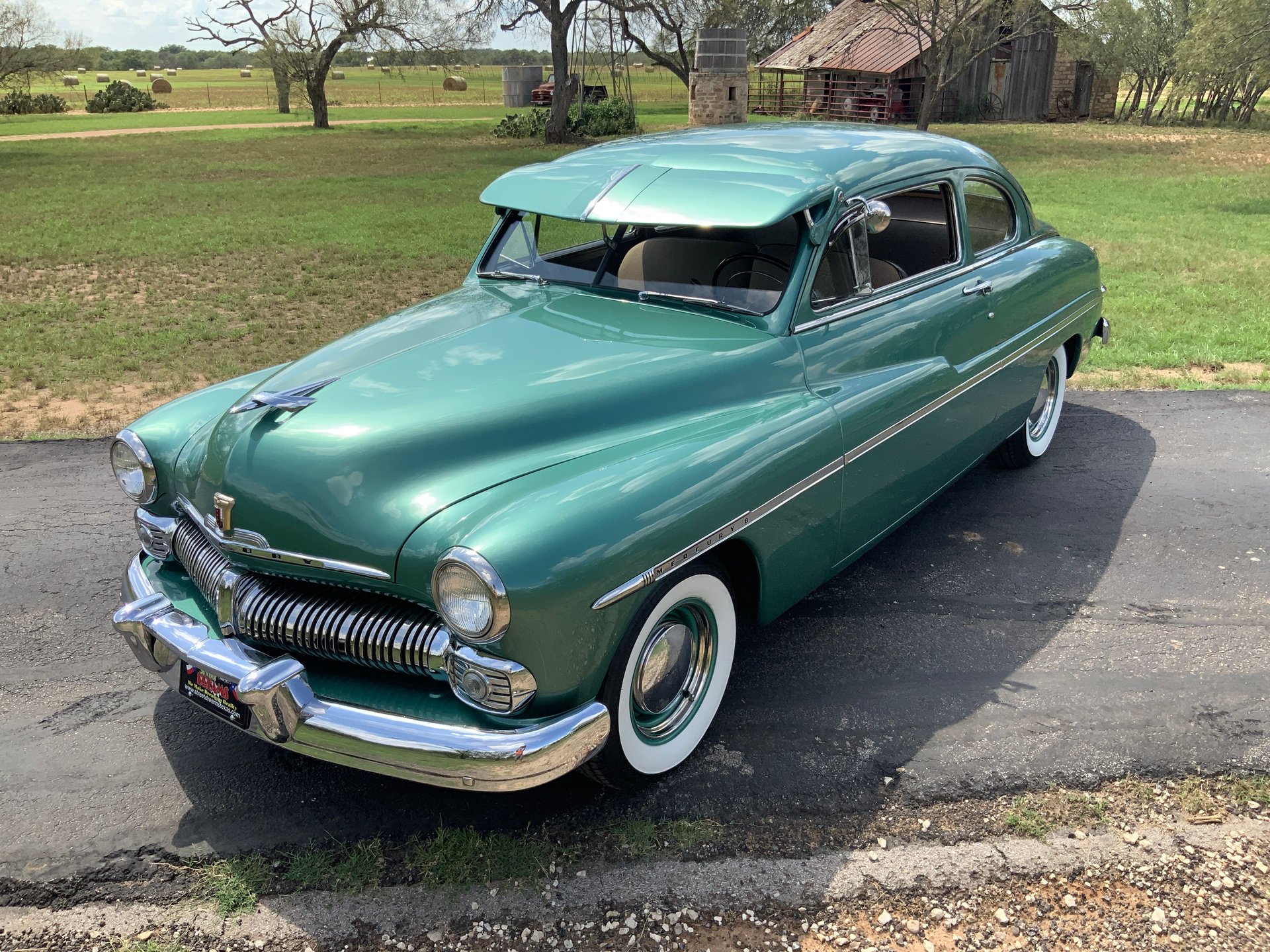
The car most people picture when they hear "Mercury Eight" is the post-war one. For 1949 Mercury launched an entirely new car: slab-sided, pontoon-fendered, with the wings blended into the body, independent coil-spring front suspension, and a new 255-cubic-inch flathead making 110 horsepower. It was lower, wider and far more modern than the car it replaced, and it sold in huge numbers — around 300,000 in 1949 alone. The two-door Club Coupe of 1949 to 1951 became a legend, because a black 1949 Club Coupe, chopped and customised by George Barris, was the car James Dean drove in Rebel Without a Cause in 1955. Every 1949 to 1951 coupe has lived in its shadow ever since.
The 1949 to 1951 cars also gave Mercury two of its most desirable variants. The wood-bodied Station Wagon — the "woodie" — carried maple and mahogany panelling built at Ford's Iron Mountain plant in Michigan, and is now among the most valuable post-war American wagons. In 1950 came the Monterey, a top-trim coupe with a padded vinyl roof covering, special interior trim and extra brightwork, so successful that Monterey became a model name in its own right within two years. The 1951 Eight was the last of the line: the final flathead Mercury, the first with an automatic — the three-speed Merc-O-Matic — and the last car to wear the Eight badge.
Today the Eight occupies a sweet spot: a genuine flathead Ford-family car with all the parts support and club knowledge that implies, but rarer and more distinctive than the equivalent Ford, with better trim and a bigger engine. The difference between a good Eight and a money pit is rust and completeness — a woodie missing its wood, or a convertible missing its top frame, can swallow the value of the finished car before you start. Buy the car, not the story.
The pool behind this guide holds seventeen Mercury Eights — twelve for sale, five sold, spanning 1940 to 1951, with 1950 the best represented year. It is a small pool, and the guide says so where it matters.
The models
There is only one Mercury Eight model, but it comes in two very different generations, and the generation matters more than the badge. A 1940 Eight and a 1950 Eight share a name, a flathead V8 and a maker — and almost nothing else. The pre-war cars (1939–42, then 1946–48) are separate-wing, running-board cars on a beam-axle chassis. The post-war cars (1949–51) are integrated-body cars with independent front suspension and a bigger engine. Both generations offer coupes, sedans, convertibles and the woodie wagon, with the Monterey as a trim level on the post-war coupes.
| Model | Years | Engine | Output | Built | Character |
|---|---|---|---|---|---|
| Eight | 1939 | 239 flathead V8 | 95 hp | c. 75,000 | The first Mercury; floor-shift, separate wings, waterfall grille |
| Eight | 1940 | 239 flathead V8 | 95 hp | c. 150,000 | Sealed-beam headlamps, column shift, the best-looking pre-war year |
| Eight | 1941–42 | 239 flathead V8 | 95–100 hp | c. 170,000 | Taller grille, first woodie wagon; 1942 cut short by the war |
| Eight | 1946–48 | 239 flathead V8 | 100 hp | c. 430,000 | The 1942 car brought back; the value entry into the Eight |
| Eight | 1949 | 255 flathead V8 | 110 hp | c. 300,000 | All-new slab-sided body; the James Dean coupe's year |
| Eight | 1950 | 255 flathead V8 | 110 hp | c. 300,000 | Monterey trim arrives; the woodie at its best |
| Eight | 1951 | 255 flathead V8 | 112 hp | c. 310,000 | Last flathead Eight; first Merc-O-Matic automatic |
(Built figures are approximate year totals across all bodies; published sources differ, and body-level splits are not consistently recorded. Outputs are period gross figures. Wheelbase: 116 inches (1939–42), 118 inches (1949–51).)
The pre-war cars: 1939–42. The 1939 Eight came as a two-door coupe, a two-door sedan, a four-door Town Sedan and a convertible coupe, all on the 116-inch chassis with the 239 flathead. The styling is Gregorie at his most elegant: a long bonnet, a pointed waterfall grille and teardrop headlamps. The 1940 car is the one most collectors pick from this group — sealed-beam headlamps, a column gear change in place of the 1939 floor shift, a cleaner grille, and the highest production of any pre-war year, which keeps parts and choice easier. For 1941 the grille grew taller, the wings wider, and Mercury added its first Station Wagon. The 1942 cars are rare by circumstance: production ended in February 1942, with only about 41,000 built.
The post-war revival: 1946–48. When civilian production resumed, Mercury put the 1942 car back into production with a new grille, a new dashboard and a 100-horsepower tune of the 239. There is little to distinguish a 1946 from a 1948 at a glance — the grille bars and minor trim are the tells. These are solid, simple cars, and because Mercury built more than 400,000 of them across the three years, they are the most affordable Eights and the easiest to find in honest, unmodified condition. The convertible and the woodie from these years are a different matter: both are scarce and priced accordingly.
The new Mercury: 1949. The 1949 Eight was a clean-sheet car, and it shows from twenty yards. The separate wings are gone, the body sides are flat slabs running the full length of the car, the windscreen and cabin are wider, and the whole car sits lower and looks longer. Underneath, the beam front axle gave way to independent coil-spring front suspension, the brakes grew, and the new 255 flathead made 110 horsepower. The bodies were the Club Coupe, the Sport Sedan, the Club Convertible and the Station Wagon. The Club Coupe is the famous one — the James Dean car was a 1949 — but the Sport Sedan is the roomiest and cheapest, the convertible the scarcest and dearest, and the wagon the woodie collectors chase.
1950: the Monterey and the peak. The 1950 car looks almost identical to the 1949 at a glance — the grille and the parking lamps are the giveaway — but it added the year's most important option: the Monterey. Launched as a top-trim Club Coupe with a padded canvas-covered roof, a special two-tone interior and extra chrome, the Monterey was Mercury's answer to the hardtop craze, and it sold well enough that the name stuck. A genuine Monterey coupe carries a premium over a standard Club Coupe, and the trim is the thing to verify, because the roof covering and the interior are routinely faked or lost. The 1950 woodie is also the pick of the wagons: the last full year of the classic wood construction.
1951: the end of the line. The 1951 Eight got a new grille with a heavier centre bar, revised trim, and two mechanical landmarks: the flathead's final tune, 112 horsepower, and the first Mercury automatic, the Merc-O-Matic. A 1951 car is therefore the most usable Eight — the automatic suits the flathead's lazy torque — but it is also the car where originality gets hardest to prove, because automatic and manual cars look identical from the kerb. Verify the transmission from the car, not the advertisement. The 1951 Monterey came as a convertible as well as a coupe, and is the rarest factory Monterey of the three years.

One more distinction matters, and it is the one sellers most often blur: the Monterey is not a separate model in 1950–51 — it is a trim level of the Eight. A car advertised as a "Monterey" should show the trim: the padded roof covering, the two-tone interior, the extra brightwork and the badging. A standard Club Coupe with a vinyl roof added last year is not a Monterey, whatever the listing says. The same discipline applies to the woodie: a steel wagon with wood appliqué stuck on is not a woodie, and the price difference is large.
Engines and gearboxes
Every Mercury Eight ever built carries the same engine in two sizes: Ford's flathead V8, the side-valve V8 that powered American Fords, Mercurys and hot rods from 1932 to 1953. It is one of the best-supported old engines in the world — parts, knowledge and specialists are everywhere — but it has a character all its own, and the buyer who understands it buys a better car. The two sizes matter: the 239 in the pre-war and 1946–48 cars, and the 255 in the 1949–51 cars. Both are side-valve (valves in the block beside the pistons), both run a single two-barrel downdraught carburettor, and both are 6-volt, positive-earth cars. Neither is an engine you rev; both make their torque low down.
The 239 flathead: 1939–48
The 239-cubic-inch flathead (3,923 cc) is Mercury's enlarged version of the Ford V8: the same bore of 3.1875 inches as the Ford, but a longer stroke of 3.75 inches, which is where the extra capacity and torque come from. Output was 95 horsepower for 1939 to 1941 and 100 horsepower from 1942 through 1948. It is a three-main-bearing engine with a cast-iron block and iron heads, aluminium pistons, and a distributor mounted at the front of the engine, driven off the camshaft, with the coil on top of it. The carburettor is a two-barrel downdraught unit — Stromberg or Holley/Ford 94-family — fed by a mechanical fuel pump.
What a healthy 239 feels like is worth fixing in your mind before you drive one, because a tired flathead still runs and will flatter a seller. A good one starts promptly from cold on choke, settles to a slow, even, almost silent idle — a flathead at idle is one of the smoothest old engines there is — pulls cleanly from walking pace in top gear, and cruises at 55 to 60 mph with the temperature needle steady and oil pressure strong. What a bad one does is specific: a misfire under load that feels like a soft hiccup is usually ignition or a valve; blue smoke on the overrun is valve guides; blue smoke under load is rings and bores; a rattle from deep in the block at start-up that fades is bearing wear announcing itself; and an engine that needs constant choke to run clean is describing a vacuum leak, a tired carburettor or low compression, in roughly that order.
The 239's known weaknesses are the flathead family's, and they are all in the problem-areas section in detail: cylinder-block cracking (the exhaust passages run inside the block, and years of heat cycling can crack the metal between a valve seat and the adjacent bore), exhaust valve seat wear on modern unleaded fuel, cooling that is adequate when the system is clean and marginal when it is not, and oil leaks from the rope rear-main seal. None of these is a reason not to buy the engine. A 239 that passes the compression, oil-pressure and temperature tests in the inspection section is a durable motor, and a full rebuild by a flathead specialist runs roughly $4,500–8,000 depending on the machining the block needs — ordinary money for an engine of this age. A rebuilt carburettor is $350–600 exchange, a rebuilt distributor $250–450, and a water-pump pair (the flathead has two, one per bank) around $150–250.
The 255 flathead: 1949–51
For the new 1949 car Mercury stroked the flathead again: the 255-cubic-inch engine (4,185 cc) keeps the 239's bore and takes the stroke to 4 inches, for 110 horsepower in 1949 and 1950 and 112 horsepower in 1951. It is the same architecture — three main bearings, side valves, front distributor — with detail improvements that matter: better cooling passages, a revised intake manifold, and fifteen years of flathead development. The 255 is the strongest factory flathead Mercury ever fitted to a passenger car, and in period it made the 1949 Mercury one of the quickest cars in its class; it is also the engine the early hot-rodders took seriously, which is why good 255 blocks are hunted today by the traditional hot-rod world as well as by restorers. That demand cuts both ways: it keeps parts flowing, but engines were swapped freely for decades, so a "numbers-matching" claim on a 1949–51 car deserves checking. The flathead's engine number is not a VIN-match in the modern sense — judge originality by casting dates and correct ancillaries, not by a seller's matching-numbers story.
On the road the 255 feels like the 239 with a stronger mid-range: the 1949–51 cars are heavier, but the bigger engine more than compensates, and a 255 in a 1950 coupe will cruise at modern highway speeds without strain. Its failure modes are the flathead's, with two additions. First, the later cars run hotter — a bigger engine in a tighter, lower engine bay — so the cooling tests in the inspection matter even more. Second, the extra stroke makes it slightly more sensitive to worn main bearings: listen for a deep knock under load at low revs, hot, which on a 255 should be priced as a rebuild.

Gearboxes: three-speed manual, overdrive and Merc-O-Matic
The standard gearbox for the whole Eight run is a three-speed manual with synchromesh on second and top, first gear unsynchronised. The 1939 car has a floor-mounted lever; from 1940 the change moved to the steering column — "three on the tree" — and stayed there. It is a strong, simple box that suits the flathead's torque. Judge it on three things. Synchromesh on second is the first casualty of age — a crunch on a hurried downchange into second, once warm, means worn synchro rings, a gearbox-out job at roughly $1,200–2,500 rebuilt and fitted. A box that jumps out of gear under load has worn engagement dogs or a tired detent — the same money. And the clutch is a mechanical-linkage unit with a heavy pedal by modern standards: judder on take-up is usually an oil-contaminated or worn plate, or tired engine mounts — a clutch replacement is $600–1,100 in parts and labour, and the mounts are cheap, so test the cheap explanation first.
From 1949 Mercury offered the option that transforms a late Eight on a long road: a Borg-Warner overdrive, engaged electrically behind the three-speed manual, giving an effective fourth gear that drops cruising revs by roughly a third. An overdrive car is the long-distance pick of the manual cars, and the unit itself is well supported. Test it properly — it engages above about 28 mph when you lift off the throttle, and drops out on kickdown — because a dead solenoid or a worn governor makes it a three-speed car with extra weight. A solenoid replacement is $150–300; a full overdrive rebuild is specialist work at $800–1,500.
The 1951 car added Mercury's first automatic: the Merc-O-Matic, a three-speed torque-converter automatic built by Borg-Warner to Ford's design (the same family as the Ford-O-Matic), with a selector quadrant on the column. It is a fundamentally sound box, but its behaviour needs interpreting. Changes should be smooth and prompt; a long, flaring upchange, a delay engaging Drive or Reverse from cold, or dark, burnt-smelling fluid all point to worn bands and clutches, and a rebuild at a specialist who knows the Borg-Warner box runs roughly $2,500–4,500. Check the fluid's colour and smell on the dipstick before anything else on a 1951 automatic car, and budget the rebuild into any car whose fluid is black.
A note on swaps, because the Eight attracts them: later Ford and Mercury V8s, small-block Chevrolets and modern automatics have all been fitted to these cars, and the pool behind this guide includes a woodie wagon described as a resto-mod. A swapped car is not a bad car — some are superb — but it is a different car, priced on its build quality rather than its originality, and every system on it has to be judged on its own merits rather than by this guide's flathead checks. If originality matters to you, the casting dates, the carburettor, the distributor and the gearbox are the four things to verify.
Problem areas
An Eight is between 75 and 87 years old. Everything on it has had time to wear out, rust, be repaired badly, be repaired well, and wear out again. The good news is that the failure modes are known, consistent and checkable: the flathead's weaknesses are the flathead family's, the body's weaknesses follow the water, and the trim weaknesses are a matter of what survives and what can be remade. The map below draws on the cars that come to market — including the twelve cars in this guide's pool whose listing photographs were examined in detail. In those twelve, rust is mentioned in the photo notes on five cars and visible damage on five, while no car in the twelve shows a smoke or oil-leak mention. Read that last figure honestly: a photograph set cannot show you an oil leak under a car, so the absence of those mentions in a sample of twelve tells you about photographs, not about flatheads. The rust and damage figures are the kind of thing photographs do show — and five of twelve is the right starting assumption for any Eight you go to see.
Rust: the map
Rust on an Eight follows the water, and the two generations rot in different places.
All cars: floors, sills and the cowl. The floor pans are the first check on any Eight. Water gets in past the windscreen rubber, the cowl vent and the door seals, sits under the carpets, and eats the floor from the top down while the underside still looks presentable. Lift every carpet you are allowed to lift, press the floor hard along the seams and around the seat mounts, and look for the tide marks and surface scale that precede holes. The sills (rocker panels) rot from the inside: they fill with mud thrown up by the wheels, hold it wet, and perforate along the bottom edge and at the ends where they meet the wheel arches. Fresh black underseal along a sill, applied over bubbling paint, is a cover-up until proven otherwise. A floor or sill repair done properly runs roughly $800–2,000 per side for floors and $1,000–2,500 per side for sills, and a car that needs both sides of both is carrying a five-figure body bill before paint.
Pre-war cars (1939–48): wings, running boards and the spare-wheel well. The separate front wings rot at the bottom rear edge, where they meet the running board, and around the headlamp mounting. The running boards — steel under a rubber covering — trap water between the rubber and the steel and rot invisibly until the board goes soft underfoot: stand on each board, and treat a board that flexes or crunches as a rusted board, not a tired one. Door bottoms fill with water when the drain holes block, so run a fingertip along the lower six inches of every door for bubbling. The trunk floor and spare-wheel well collect water from a perished trunk seal, and the well is the classic Eight rust trap: lift the spare wheel out entirely, because the well rusts underneath it, out of sight, on cars whose trunk floor looks clean.
Post-war cars (1949–51): rear quarters, doglegs and the battery tray. The slab-sided body moved the traps rather than removing them. The rear quarter panels rot at the bottom, behind the rear wheels, where road dirt packs against the inner panel; the "dogleg" — the curved section at the front of the rear wheel arch, behind the rear door on a sedan — is a mud trap that perforates from inside and is awkward, expensive metal to remake, typically $1,500–3,000 a side fabricated and painted. The front wings rot behind the front wheels in the same way. The battery tray and the inner wing beneath it suffer acid damage: lift the battery, or at minimum look at the tray edges and the metal below it with a torch. On the woodie wagon, add the tailgate frame and every steel panel the wood touches — wood against steel holds moisture permanently.
The flathead: cracks, cooling and oil
The flathead V8's design puts its exhaust passages inside the block, running past the valve seats and the cylinder walls, which makes the block itself the exhaust manifold. That is the root of the engine's one serious weakness: block cracking. Decades of heat cycling can crack the metal in the deck between a valve seat and the adjacent bore. A crack between a valve seat and a bore is often harmless in service — many flatheads run for years with one — but a crack that opens into a water passage pressurises the cooling system and eventually overheats the engine. The tests that find it are in the inspection: early pressurisation from cold, bubbles in the radiator, unexplained coolant loss. A cracked block is not automatically scrap — specialists pin and stitch cracks, at roughly $800–1,800 depending on access — but an engine with a crack into the water jacket and low compression on the adjacent cylinder is a rebuild conversation.
Cooling is the flathead's daily concern. The system is adequate when clean and marginal when not: two water pumps circulate coolant through a block with long, easily silted passages, and a radiator that has lost a third of its flow to scale will let the engine run hot in traffic while cruising cool at speed — the classic flathead complaint, and a diagnostic in itself. An Eight that overheats at idle but holds temperature at 50 mph has a flow or fan problem (radiator, pumps, or a slipping belt); one that overheats everywhere has a head-gasket, timing or block problem. Retarded ignition timing makes a flathead run hot, and it is the cheapest cause to check and the one most often missed. Budget a radiator recore at $600–1,100, pumps at $150–250 the pair, and a full cooling-system overhaul at $1,200–2,200 fitted. Repeated overheating is also how blocks crack, so a car with an overheating history needs the crack tests, not just a new radiator.
Valves and seats. The side-valve layout puts the valves in the block, and the exhaust valve seats are cut in the block iron itself. Modern unleaded fuel, without lead's cushioning effect, wears those seats over time; the symptom is a gradual loss of compression and a misfire that no ignition work cures, worst on the centre exhaust valves, which run hottest. The fix is hardened seat inserts, a machine-shop job normally done as part of a rebuild at roughly $600–1,200 for the seat work alone. Closed-up valve clearances from seat wear give the same misfire, so a valve adjustment belongs in the history of any car that runs unevenly.
Oil. The flathead's oiling is simple and its leaks are famous. The rope rear-main seal weeps on almost every engine not rebuilt with a modern seal conversion; the oil pan, timing cover and fuel-pump mounting all join in. A flathead that does not mark its parking space is either freshly rebuilt or out of oil — treat a dry underside with the same suspicion as a wet one, and judge leaks by rate: a drip after a run is character, a puddle is a seal job ($400–900 for a rear-main with the engine in place). Oil pressure is the real health gauge: strong at speed, clearly off the stop at hot idle. An engine whose hot idle pressure collapses to near zero has worn bearings, and that is rebuild money, $4,500–8,000, however sweetly it runs.
Carburettor and ignition. The two-barrel downdraught carburettor (Stromberg or Holley/Ford 94 family, depending on year) is simple, rebuildable and worn on most cars: throttle-shaft wear gives an air leak and a hunting idle that no mixture adjustment settles, and a perished accelerator-pump cup gives a flat spot on take-off. Both are rebuild items, $350–600 exchange for a properly rebuilt unit. The front-mounted distributor is the flathead's other service trap: driven off the camshaft nose, it lives in the heat and road dirt at the front of the engine, and its points are a distributor-out job on the pre-war cars — which is why so many cars run on points that should have been changed years ago. A car that starts poorly hot or misfires under load is describing its ignition until proven otherwise. Budget a distributor rebuild at $250–450, and ask when the points were last done; "unknown" means "by you, first."

Chassis, steering and brakes
The two generations differ fundamentally here. The pre-war cars ride on beam axles front and rear with transverse leaf springs, with lever-action or early tubular shock absorbers depending on year, and hydraulic brakes: Mercury had them from its 1939 launch, a selling point over the contemporary Ford. The post-war cars have independent coil-spring front suspension, a live rear axle on longitudinal leaf springs, and larger hydraulic drum brakes all round. Both generations are drum-braked on every wheel; there are no factory disc brakes on any Eight, and any disc conversion is a later modification, judged on its workmanship.
Steering. Both generations use a worm-and-roller steering box, and both wear the same way: play at the wheel from a worn box and worn tie-rod and drag-link ends. A little free play at the centre is normal; more than about two inches at the wheel rim, or a car that wanders, means the box needs adjustment or rebuilding ($400–900) and the linkage needs its ends ($300–700 fitted for the set). On the pre-war cars, check the kingpins in the front beam axle: rock each front wheel top-to-bottom, and treat play as a kingpin-and-bush job at $600–1,200 a side fitted. On the post-war cars, the equivalent check is ball joints and the idler arm, at similar money. Perished suspension bushes on a 1949–51 car make the front end knock over bumps; a full bush and joint refresh is $800–1,600 and transforms the car.
Brakes. Judge a drum-brake car on its hydraulics and adjustment, not on the pedal alone. A pedal that sinks slowly under steady pressure is a master cylinder bypassing internally ($150–350 rebuilt or replaced); a pedal that needs pumping is air or adjustment; a car that pulls to one side under braking has a seized or leaking wheel cylinder, a contaminated shoe, or a collapsed flexible hose — and after seventy years, every flexible hose should be treated as due. A full brake hydraulic refresh — master cylinder, four wheel cylinders, three hoses, shoes and fluid — runs roughly $900–1,800 fitted, and is the first money to spend on any Eight that has sat. The handbrake is a cable system to the rear drums; one that barely holds is usually stretched cables and worn rear shoes, a small job.
Springs and stance. A pre-war car that sits low at the front has a tired transverse spring or worn shackles; a post-war car low at the back has sagged rear leaf springs. Neither is expensive in parts ($200–500 a spring) but both change how the car drives. A lean to one side, seen from behind on level ground, is a spring or a shackle — on a pre-war car, possibly a cracked spring leaf, which is a replacement, not a repair. Shock absorbers on the pre-war cars are often the original lever-action units, rebuildable at $150–300 each; a car bouncing twice after a bump has no working shocks, whatever the seller says.
Body, wood and interior trim
The Eight's body is steel over a separate chassis on every year, which is good news for repair and bad news for one specific check: the body mounts. The body sits on the frame on rubber and timber insulators, and when they perish or the brackets rust, the body drops and the door gaps go uneven. Uneven door gaps on an Eight are therefore a mounts-and-frame question before they are an accident question. Check the frame on a lift for rust at the crossmembers, the body-mount brackets and the rear kick-up over the axle; a perforated frame rail is fabrication work, priced per car, and it ends negotiations on a cheap car.
The woodie. The Station Wagon's wood is structural as well as decorative: maple framing with mahogany (later birch) panels, built by Ford's Iron Mountain operation, varnished rather than painted. Wood fails in three ways — varnish failure (cosmetic, and the start of the other two), rot at the joints and bottom edges where water sits, and damage inside apparently sound members. A full professional re-wood is one of the most expensive jobs in American restoration: a complete new wood body from a specialist runs roughly $25,000–45,000 fitted and finished, and even a partial repair — one rotted pillar, two door frames, a tailgate — is $3,000–8,000. That is why the woodie's rule is absolute: buy the wood, not the car around it. A wagon with sound original wood and tired mechanics is a good buy; a wagon with beautiful paint, a rebuilt engine and soft wood is a financial trap wearing a nice suit.
Chrome and trim. Mercury sold itself on brightwork: heavy grilles, bumper overriders, side spears on the post-war cars, window surrounds, and the Monterey's defining extra trim. Re-chroming is priced by the piece and adds up brutally — a grille assembly re-plated runs $800–2,000, bumpers $600–1,200 each, and a complete car's brightwork can pass $8,000 — so count the pitted, dented and missing pieces and price them, and treat missing model-specific trim (Monterey badges and spears, woodie hardware, convertible top irons) as a search problem as well as a cost, because some of it is simply not reproduced.
Interior. Pre-war cars wear broadcloth or mohair; post-war cars wear vinyl and cloth, with leather on some convertibles and Montereys. The patterns are reproducible, but a full retrim to original standard is $4,000–9,000 depending on material, so a sound original interior is worth real money. The failure points are the driver's seat cushion and bolster (always judge from the driver's seat), the headlining (sagging, water-stained), and the rubber: window, door and windscreen seals perish, leak, and start the floor rust described above. A full seal set is $400–900 in parts. On convertibles, the top frame and its mechanism are the inspection: a bent or seized frame is $1,500–4,000 to put right before the cost of the top itself ($1,200–2,500 fitted in correct material).
Electrics and the 6-volt system
Every Eight is a 6-volt, positive-earth car with a generator (not an alternator) and a voltage regulator. The system is adequate when its connections are clean and its cables are the heavy gauge 6 volts demands — and most Eight electrical trouble is exactly that mundane: corroded earth straps, thin replacement cables fitted by someone who did not know 6 volts needs twice the copper, and an old battery. Dim headlamps, a slow starter and a wandering charging gauge are connection problems until proven otherwise, and the fix is cleaning, correct cables ($80–200 the set) and sound earths, not a 12-volt conversion. A generator rebuild is $200–400, a starter rebuild $150–350, a regulator $60–150. Judge a 12-volt conversion the same way as an engine swap: it can be done well or badly, and every gauge, bulb and motor had to be dealt with — check that the fuel gauge and the clock still work, because they are the two items conversions most often leave wrong. The wiring loom itself, cloth-braided on the pre-war cars, perishes and chafes; a replacement loom is $500–1,200 in parts, and brittle insulation at the engine-bay bulkhead is the visible warning. A car where everything electrical works has usually been used and maintained, which on a car of this age is the best single sign there is.
How to inspect one
Allow at least an hour, bring a torch, a cloth-wrapped magnet, a small screwdriver for prodding (with the seller's permission) and a friend to work the lights and brakes while you watch. Insist on a cold engine when you arrive. If the car passes you, pay for a lift inspection before money changes hands — the lift and the compression gauge between them settle almost every question this guide raises.

- Start with the paperwork and the plates. Match the serial number on the title to the stamping on the frame (on the left front frame rail on pre-war cars; check the maker's plate on the firewall or door pillar for the post-war cars) and confirm the body style and year on the plate match the car in front of you. On a car sold as a Monterey, verify the Monterey trim is present and period — padded roof covering, two-tone interior, badging — not added. On a woodie, confirm the body is a genuine Station Wagon body, not a converted sedan. A thick history file, with invoices for engine, brake and wood work, is worth thousands on this model.
- Cold start. The engine should be stone cold. A flathead in health starts on choke within a few turns, settles quickly to an even idle as the choke comes off, and shows no blue smoke beyond a faint puff. Prolonged cranking or an idle that hunts points to the carburettor and ignition checks in the problem areas. Listen at start-up for a deep rattle that fades — bearings — and a top-end tick that stays — valves.
- The compression and oil-pressure test. Ask for a compression test, or do one: a healthy flathead shows even readings across all eight cylinders, within about ten percent of each other. One low cylinder beside a valve seat is the crack-and-seat question from the flathead section — price it, do not guess it. Then, hot, read the oil pressure: strong at cruising revs, clearly off the stop at idle. Collapsing hot idle pressure is rebuild money.
- Cooling, from cold. With the engine cold, take the radiator cap off and watch as it warms: bubbles streaming in the filler neck within the first minutes, or a system that pressurises hard almost immediately, means combustion gas in the coolant — a head gasket or the block crack described above. Then drive it: temperature steady at cruise and in a few minutes of idling traffic is the standard. Hot at idle but cool at speed is flow; hot everywhere is a bigger conversation.
- Under the car. Torch along both sills, prod the floor seams, the body mounts, the frame crossmembers and, on a pre-war car, the running-board mountings and the spare-wheel well from below. Perforation in the frame or the mounts is structural and ends the viewing unless the price already says "project." Read the underseal as you go: thin and patchy is honest; a fresh, uniform coat over everything is a question.
- Trunk and spare well. Lift the spare wheel out completely. Look for water staining, rust in the well corners and a damp smell. On a woodie, examine the tailgate frame and the steel floor under the wood from inside. Check the trunk seal and, on post-war cars, the rear window rubber while you are there.
- Floors inside. Lift all the carpets you can. Look for water tracks from the windscreen base and the cowl vent, prod the pans along the seams and around the seat mounts, and feel for the softness that precedes holes. Wet carpets in a "dry-stored" car mean leaking seals and rust already started.
- Body, gaps and the magnet. Run the magnet over the sills, the lower doors, the rear quarters and the doglegs on a post-war car — filler announces itself where the magnet will not hold. Check door bottoms for bubbling, the battery tray for acid damage, and door gaps for evenness, remembering that uneven gaps ask about body mounts before they ask about accidents. Count the pitted or missing chrome pieces, especially model-specific trim, and price them as you go.
- The wood, on a wagon. Go panel by panel: press a fingernail into the bottom edges of the door frames, the pillars and the tailgate joints. Sound wood is hard and rings when you tap it; rotted wood is soft, dark at the joints and dull. Check the varnish honestly — failed varnish is a refinishing bill; soft members are the five-figure conversation from the problem areas. If the wood is soft in more than one structural member, walk away or price the car as a re-wood.
- Steering and suspension. Rock each front wheel top-to-bottom and side-to-side: top-to-bottom play is kingpins on a pre-war car, ball joints on a post-war one; side-to-side is steering linkage. Grease and adjustment first, verdict second — a dry joint can feel worn and come back. On the drive, the car should track straight and knock over nothing. Bounce each corner: one bounce and settle is a working shock absorber; anything more is not.
- The test drive. Twenty minutes minimum, including a stretch at 55 to 60 mph. The manual box should change cleanly without a crunch once warm, stay in gear on the overrun, and the clutch take up without judder. An overdrive car should engage when you lift off above about 28 mph and drop out on kickdown. A Merc-O-Matic car should engage Drive and Reverse promptly from cold and change without flaring — and check its fluid colour and smell again when you get back. Brake firmly from speed twice: the car should stop straight, with a firm, high pedal and no pull, judder or fade.
- Electrics and interior last. Work everything: headlamps, indicators, horn, wipers, heater fan, every gauge, the clock and the radio. Dim lamps and a lazy starter are usually cables and earths — price them as such. Sit in the driver's seat and feel for a collapsed cushion; check the headlining for water stains; on a convertible, operate the top through a full cycle and inspect the frame for bends and seized joints. A sound, original interior is the hardest thing on this car to recreate, so weight it heavily.
Values
The figures that matter for this model are computed from this site's own listings and recorded sales, and they sit below this guide — the listed-now summary and the market block are refreshed every time the site rebuilds, so use them rather than any number quoted elsewhere. What follows is how to read them.
This is a small market. The pool behind this guide holds seventeen cars, twelve for sale and five sold, and the wider market is not much deeper. In a market that thin, a single exceptional car — a concours woodie, a documented Monterey — or a single desperate sale moves the apparent median violently, and the range matters far more than any central figure. Read the spread, not the headline: what the cheapest cars share, and what the dearest cars have that the cheapest do not, is the real information.
The spread itself is driven by three things, in this order. First, generation and body: the 1949 to 1951 cars carry the market, the Club Coupe carries a premium that is partly engineering and partly film history — the James Dean association is real, it is durable, and sellers price it in whether or not a given buyer cares — and the woodie wagon and the convertible sit above the coupes and sedans of their years because they are scarcer and costlier to restore. The Monterey trim adds a further premium on a 1950 or 1951 coupe, provided the trim is genuine and complete; a Monterey missing its defining trim is a Club Coupe with a story. Second, condition of the specific things this guide flags: sound wood on a wagon, an uncracked and even-compression flathead, original floors and sills. On an Eight, condition is not a gradient, it is a cliff — the gap between a sound driver and a car needing wood, welding and an engine is routinely wider than the gap between two different models. Third, originality versus modification: resto-mods and original cars are priced by different logics. A well-built resto-mod is priced on its build; an original car on its completeness and history. Neither logic transfers to the other.
Two cautions apply to every figure you read. These are asking prices, not achieved prices: sellers of charismatic cars ask with optimism, and the recorded-sales side of the block below is the corrective — where a variant trades regularly, achieved figures usually sit below asking medians, and the five sold cars in this pool are worth more of your attention than the twelve asking. And read the pre-war cars separately from the post-war ones: the 1939 to 1948 sedans are the softest part of this market, priced gently because buyers overlook them in favour of the 1949 shape, which is why a sound 1946 to 1948 car is the value entry. There is no such thing as a cheap Eight that stays cheap — but there is such a thing as an underpriced generation, and at the moment that is the pre-war sedan.
Parts and ownership
The Eight is one of the best-supported American cars of its era, for a simple reason: it is a Ford underneath. The flathead V8 was built in the millions, and the reproduction trade that serves the 1932 to 1953 Ford world serves the Mercury almost as well. Mechanical parts are rarely the problem. Trim, wood and Mercury-specific brightwork are where ownership gets expensive and slow.
Easy: engine service and rebuild parts for both flatheads — gaskets, bearings, pistons, valves, water pumps, carburettor and distributor rebuild kits and exchange units; brake hydraulics and shoes; clutch parts; suspension wear parts; exhaust systems; generator and starter rebuilds; glass rubbers and seal sets; and most chassis hardware. Order today, fit this month, at ordinary classic-car prices. A routine service — oil, plugs, points, filters — is a few hundred dollars in parts and an afternoon's work.
Harder and dearer: the wood, above everything. Replacement wood for a wagon comes from a handful of specialist woodworkers, is made to order, and carries the costs given in the problem areas — a full re-wood is the single largest bill this model can present. Next, Mercury-specific chrome and trim: grilles, side spears, Monterey badges and trim, convertible top irons and woodie hardware are reproduced patchily or not at all, and good used or re-plated original pieces are the usual route, at the re-chroming prices quoted earlier. Body panels are not reproduced as complete pressings; a rotted dogleg or rear quarter is a fabrication job. A quality repaint, on a car this size with this much chrome to remove and refit, starts around $12,000 and rises quickly with bodywork.
Running costs. A sorted Eight is a realistic regular-use classic. The flathead wants its oil changed, its points maintained, its cooling system kept clean and its valve clearances checked — the maintenance rhythm of its era, well within any good independent classic specialist's competence. Fuel consumption sits in the mid-teens miles per gallon, worse around town; the cars run happily on modern unleaded fuel with the valve-seat caveat from the problem areas kept in mind. Insurance is in line with other cars of similar value, and club membership pays for itself in technical help and parts leads alone. The budget line that catches new owners is the first year: catching up deferred maintenance on a running car — brakes, hoses, seals, a cooling-system overhaul, ignition and carburettor rebuilds — honestly costs $2,500–6,000 before you improve anything, and recommissioning a car that has sat for years runs $5,000–10,000 at a shop. Buy a car in regular use over a car that has been asleep, even at a higher price: on a flathead car, use is maintenance.
Which one to buy
- The all-rounder: 1949–50 Club Coupe. The famous shape, the 255 flathead, and the easiest Eight to sell on. If you want one Eight to drive and enjoy, this is it.
- The value buy: 1946–48 sedan. The pre-war look, the 239 flathead and the lowest entry cost in the range, because buyers walk past these cars to get to a 1949. The most Eight for the money there is.
- The icon: 1949 Club Coupe. The James Dean year and body. You will pay for the association — make sure the floors, block and compression justify the premium.
- The showpiece: 1949–51 Station Wagon. The woodie is the most valuable Eight and the most rewarding to own when the wood is right. Buy the wood, not the car around it.
- The cruiser: 1951 Monterey or Merc-O-Matic car. The final flathead, the first automatic, and the easiest Eight to live with. Verify the trim on a Monterey and the fluid on an automatic.
- The tourer: 1940 coupe or sedan. The prettiest pre-war year, sealed beams and a column change, with the elegance the post-war cars traded for presence.
- The project: any Eight with a sound shell and a soft price. The mechanicals are all fixable at prices you can plan for. The shell, the frame and — on a wagon — the wood are not.
And the rule that overrides all of the above: buy the least rusty, most complete car you can find, in the generation you can live with. Engines, gearboxes, brakes and electrics are all fixable at prices this guide has put numbers on. A rotten shell, a perforated frame or a rotted wood body costs more to put right than the finished car will be worth — and it is the one thing about a Mercury Eight that can never be made original again.

See the 5 Eight cars currently listed.