
Mercury Cougar XR-7 Coupe 2D buyer's guide
Mercury Cougar XR-7 Coupe 2D -- the model's own buyer's guide: variants, values and what to check.
Years listed: 1967-1979 · Series: Cougar
Overview and history
The Mercury Cougar is not one car. It is a name Ford's Mercury division used, with only a few gaps, from 1967 to 2002, on a pony car, a muscle car, a personal-luxury coupe, a downsized Fox-body coupe, an independent-rear-suspension coupe and finally a front-wheel-drive coupe. Those cars share a badge and almost nothing else. A guide that pretends otherwise will mislead you, so this one starts with the honest orientation: when most buyers and nearly every seller in today's classic market say Cougar, they mean the first generation of 1967 to 1970, and to a lesser extent the larger second generation of 1971 to 1973. That is where the demand, the parts support, the club knowledge and the money are. The later cars are covered here in proportion — what they are, what to check, and who should buy one — but they are not padded into equals they never were.
The original Cougar, launched for the 1967 model year, was Mercury's answer to a problem Ford had created for itself. The Mustang had invented a market and Mercury dealers had nothing to sell into it. The Cougar was built on the Mustang's platform, stretched to a 111-inch wheelbase against the Mustang's 108 inches, the extra length giving a more formal roofline, a roomier rear seat and a quieter, plusher car. There was no convertible and no fastback in 1967 and 1968 — only a two-door hardtop — and no cheap six-cylinder car. Every early Cougar was a V8, with hidden headlamps behind a vacuum-operated grille, sequential rear turn signals that swept outward in three segments, and trim deliberately above a comparable Mustang. The market understood at once: the Cougar was Motor Trend's Car of the Year for 1967, Mercury sold about 151,000 in that first year, and Dan Gurney's Trans-Am team very nearly took the 1967 championship from the factory Mustangs.
That positioning — the gentleman's Mustang — is still the reason to buy one. A Cougar gives you the Mustang's mechanical simplicity, parts availability and performance options in a body that is rarer, better trimmed and, model for model, usually cheaper in equivalent condition. The penalty is the mirror image: Cougar-specific sheet metal, trim, grille parts and interior pieces are far scarcer than Mustang equivalents, because Ford made Mustangs by the million and Cougars by the hundred thousand. Buy the car for that trade, with your eyes open.
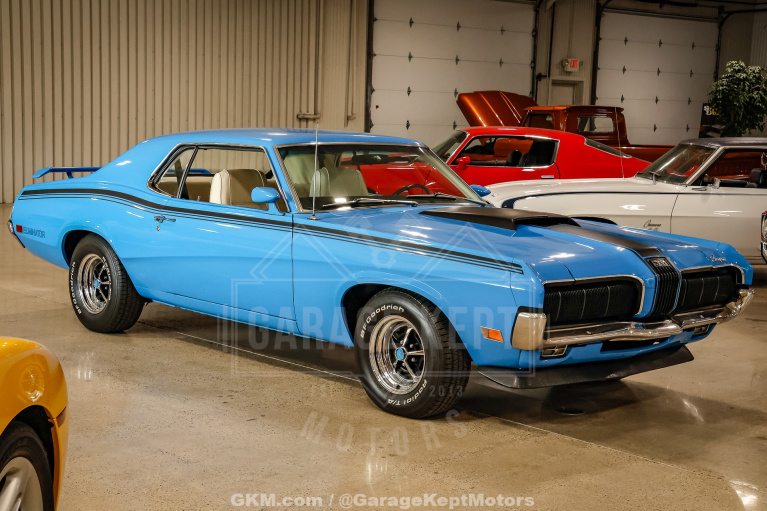
The range evolved fast. The XR-7 added leather, a wood-grained dashboard, full instrumentation and richer trim. The GT package added performance suspension, bigger brakes and the larger engines. For 1968 only, the GT-E put first the 427 and then the 428 Cobra Jet under the hood of a luxuriously trimmed coupe, one of the great sleeper muscle cars. For 1969 a convertible finally arrived, the body grew slightly, and the Eliminator joined as Mercury's explicit muscle variant, with spoilers, stripes, a blacked-out grille and the strongest engines. It lasted two years and is now the most collected Cougar of all. In our current Classic Listings pool of 48 Cougars, the 1967 to 1973 cars dominate — 1969 alone accounts for 11 cars, 1972 for 7, 1967 for 6, 1970 for 6, 1968 for 5 — and that distribution is the market talking.
For 1971 the Cougar grew again on the larger Mustang's new platform, its performance peak arriving immediately as the 429 Cobra Jet and receding just as fast as emissions rules and insurance surcharges closed the muscle era. From 1974 it left the pony-car market entirely and became a personal-luxury intermediate, twinned first with the Torino and then with the Thunderbird and LTD II lines. The name was downsized onto the Fox platform for 1980, restyled into the aerodynamic XR7 of 1983 to 1988, reborn on the MN12 platform for 1989 to 1997 with independent rear suspension and, briefly, a supercharged V6, and finally transferred to a front-wheel-drive coupe for 1999 to 2002. Each later car has its loyalists. None should be bought with first-generation expectations, money or parts assumptions.
One more orientation point. Because the early Cougar shares so much with the Mustang, sellers borrow Mustang language loosely and sometimes dishonestly. An Eliminator is not established by stripes and a spoiler, an XR-7 is not established by badges, and a 428 car is not established by an air cleaner lid. Mercury built these cars with excellent paper trails — door data plates, buck tags and the Marti Report records drawn from Ford's own production database — so identity on a valuable Cougar is unusually provable. Insist on proving it, in the order the inspection section sets out.
The models
Think of the range in three buying groups. The first is the 1967 to 1970 hardtops and convertibles — base, XR-7, GT, GT-E and Eliminator — and it is the group this guide spends most of its length on, because it is the group most readers are actually shopping. The second is the 1971 to 1973 cars, larger and softer, bought for presence and value rather than sharpness. The third is everything from 1974 onward. Within each group, trim and engine matter more than model year, and originality matters more than either on the valuable cars.
| Model | Years | Engine | Output | Built | Character |
|---|---|---|---|---|---|
| Cougar hardtop | 1967–1970 | 289 / 302 / 351 V8 | 195–290 hp | The bulk of about 437,000 first-generation cars | The entry point; V8 only, hidden lamps, plush for a pony car |
| Cougar XR-7 | 1967–1970 | 289 / 302 / 351 / 390 V8 | 195–320 hp | About a quarter of first-generation production | Leather, wood dash, full gauges; the luxury formula |
| Cougar GT | 1967–1968 | 390 V8 | 320 hp | A minority option package, not a separate line | Handling, brakes and the big-block in one package |
| Cougar GT-E | 1968 only | 427, then 428 Cobra Jet V8 | 390 hp / 335 hp | 394 | The sleeper flagship; verify ruthlessly |
| Cougar Eliminator | 1969–1970 | 351 / Boss 302 / 390 / 428 CJ V8 | 290–335 hp | About 2,411 in 1969, about 2,268 in 1970 | The muscle variant; spoilers, stripes, strongest engines |
| Cougar convertible | 1969–1973 | 351 / 302 / 429 V8 | 240–370 hp | A small minority of production | Open XR-7 luxury; check the top frame and floors twice |
| Cougar / XR-7, second generation | 1971–1973 | 351 / 400 / 429 V8 | 240–370 hp early, falling fast | About 177,000 across the three years | Bigger, heavier, softer; 1971 is the performance year |
| Cougar XR-7, intermediate | 1974–1979 | 351 / 400 / 460 V8, later 302 / 351 | 150–200 hp net era | XR-7 became effectively the whole line | Personal luxury, not muscle; presence for modest money |
| Cougar XR-7, Fox | 1980–1988 | 3.8 V6 / 2.3 turbo four / 5.0 V8 | 105–225 hp | Large numbers, few survivors in good order | Downsized, then aero from 1983; XR7 turbo is the curiosity |
| Cougar XR7 / LS, MN12 | 1989–1997 | 3.8 V6 / 3.8 supercharged / 5.0 / 4.6 V8 | 140–230 hp | Substantial; supercharged XR7 only 1989–1990 | Independent rear suspension; the modern driver's Cougar |
| Cougar, front-drive | 1999–2002 | 2.0 four / 2.5 V6 | 125–170 hp | About 230,000 across the run | A Contour-based coupe wearing the name; a used car, not a classic |
Outputs above are period gross ratings for the 1960s and early 1970s cars, and net ratings thereafter — the 1972 change of measurement system is why later figures fall off a cliff the cars themselves did not. Treat the 428 Cobra Jet's 335 hp in particular as a polite fiction for insurance purposes; period trap speeds say it made substantially more.
The base hardtop and the XR-7, 1967 to 1970. This is the core of the market and the sensible buy. The base car is already well equipped by pony-car standards — hidden lamps, sequential signals, V8 power, a proper interior — and the XR-7 adds the cabin that makes a Cougar feel special: leather-faced seats, a simulated wood dashboard with full round gauges, an overhead console on early cars, and door trim a period Mustang owner could only envy. The XR-7 premium today is real but modest compared with the premium for rare engines, and it is the premium most worth paying, because you sit in the cabin for every mile. A 1969 and 1970 car is slightly larger and gains the convertible and the Eliminator; a 1967 and 1968 car is the purest shape, with the scarcest trim. There is no bad year in this group. There are only bad shells, covered in the problem areas.
The GT and the GT-E. The GT was a package — performance handling, power front disc brakes, a larger engine and identifying trim — frequently claimed and infrequently documented. The GT-E of 1968 is a different matter: a specific, low-production model, launched with the 427 side-oiler rated at 390 hp and switched mid-year to the 428 Cobra Jet, with two-tone treatment, quad exhaust tips, its own grille and badges, and XR-7-level luxury underneath. With 394 built, a genuine GT-E is a serious collector car and a frequently faked one. Nothing about a GT-E should be taken on a seller's word: the Marti Report, the door plate codes and the engine stampings either agree or the car is priced as what it can be proved to be.
The Eliminator, 1969 and 1970. Mercury's muscle flagship, sold as a package on the hardtop with chin and deck spoilers, blacked-out grille, side stripes, a hood scoop — functional only on ram-air cars, a point sellers blur — and engines running from the 351 Windsor four-barrel through the Boss 302 to the 390 and the 428 Cobra Jet. The Boss 302 Eliminator is the connoisseur's car: a high-revving homologation engine in a Mercury almost nobody ordered. The 428 Cobra Jet Eliminator is the drag-strip car. The 351 car is the one you can actually buy, drive and maintain without collector anxiety. As with the GT-E, identity lives in the paperwork and codes, not in stripes any paint shop can apply.


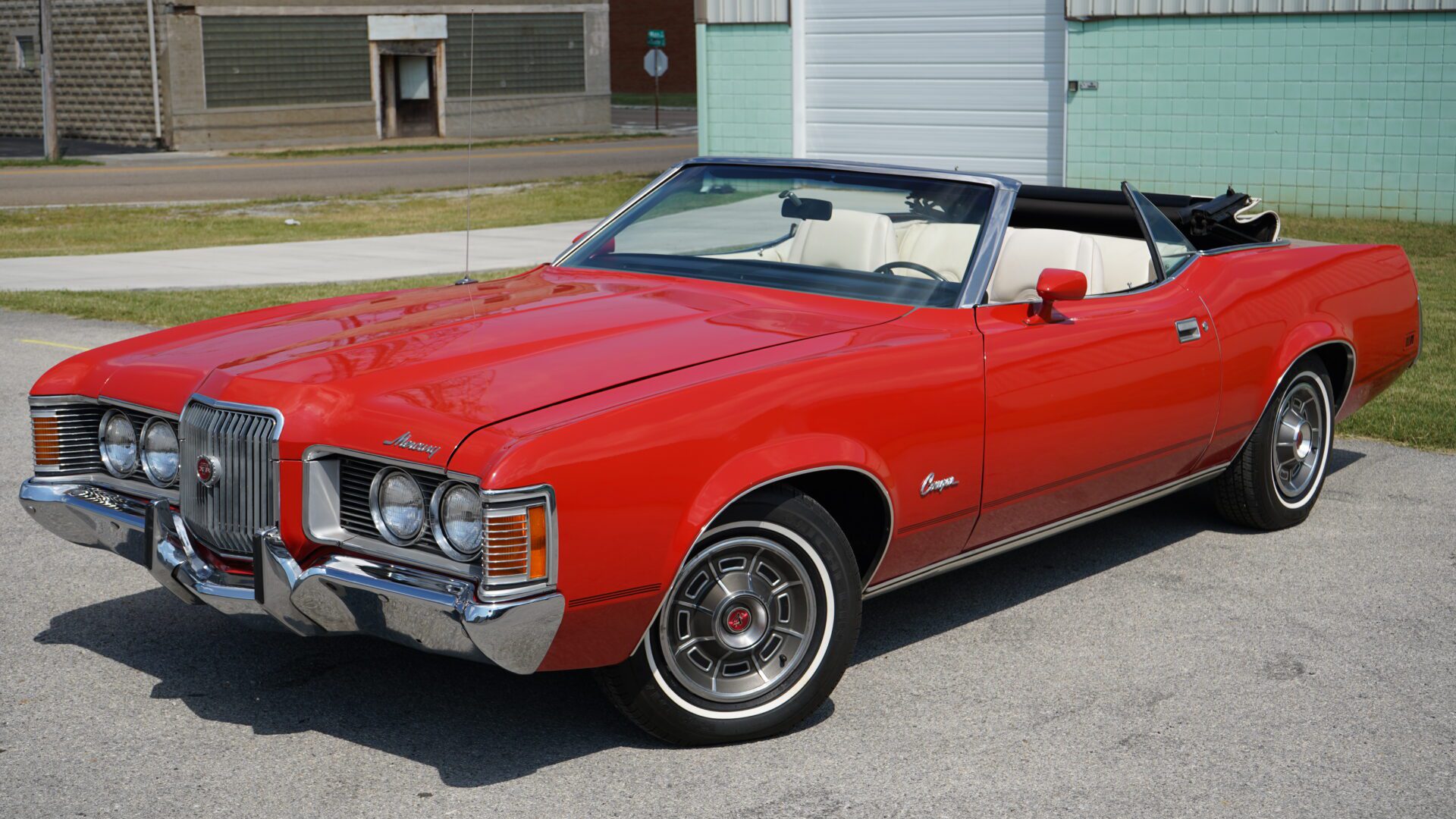
The second generation, 1971 to 1973. Bigger in every dimension, sharing its platform with the equally enlarged Mustang. The 1971 car is the one with real performance — the 429 Cobra Jet was available for that year only in this body — and the one collectors of this generation want. The 1972 and 1973 cars ride better than they accelerate, and their appeal is honest: presence, comfort, XR-7 luxury and a convertible option through the end of the American convertible era, for money that would buy a markedly worse first-generation car. Buy one as a cruiser and you will be pleased. Buy one expecting a 1969 car with a different face and you will not.
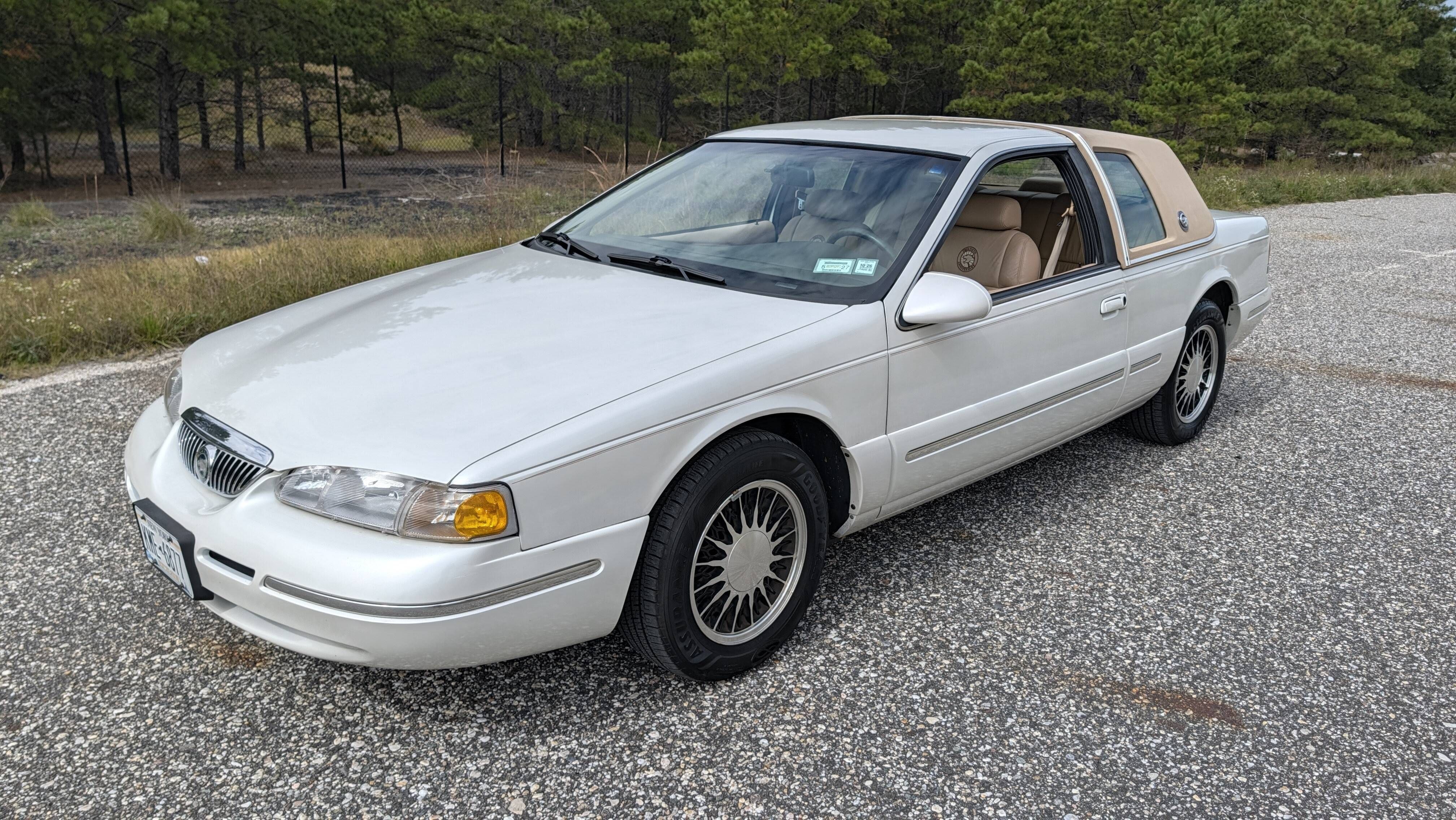
The later cars, briefly and honestly. The 1974 to 1979 XR-7s are personal-luxury coupes in the Thunderbird mould — opera windows, deep-pile interiors, big lazy V8s strangled progressively by emissions equipment. Survivors in good order are now scarce because values stayed low for decades, which is both the risk and the opportunity. The 1980 to 1982 Fox cars are the forgotten downsized generation; the 1983 to 1988 aero cars include the XR7 with the 2.3-litre turbocharged four and, later, the 5.0 V8 — light, tuneable and increasingly appreciated. The 1989 to 1997 MN12 cars are the most modern Cougars that still feel like Cougars: rear drive, long hood, independent rear suspension, and in the 1989 and 1990 XR7 a supercharged 3.8 V6 with a five-speed manual option. The 1999 to 2002 front-drive car is a competent Contour coupe in Mercury dress; buy one as cheap transport, not as a classic investment. In our pool the later cars appear only as a thin tail — single examples from 1977, 1979, the 1980s and one 1997 car — which reflects survival and demand accurately.

Engines and gearboxes
Every first-generation Cougar engine is a Ford V8, and that is good news: these are among the best-understood, best-supported engines in the classic world. The work is in knowing which V8 you are looking at, because Ford built several families that look similar in a photograph, carry wildly different values, and fail in different ways. The engine code is the fifth character of the VIN on a 1967 to 1970 car and is coded on the door data plate as well. Learn to read it first, and cross-check it against the physical engine, because fifty years is time enough for at least one swap on most cars.
The small-blocks: 289, 302 and 351 Windsor
The backbone of the range. The 289 powered the launch cars, in two-barrel form at about 200 hp and four-barrel form at about 225 hp; the rare 271 hp high-performance version was a Mustang offering, not a regular Cougar one, so treat any Cougar claimed to carry it with care. The 302 replaced the 289 for 1968, and the 351 Windsor joined for 1969, at about 250 hp in two-barrel form and about 290 hp in four-barrel form. These are pushrod, hydraulic-lifter, iron engines of legendary toughness. A healthy Windsor starts promptly, idles evenly, shows strong oil pressure hot and does not smoke. Blue smoke at start-up that clears is valve stem seals, a known and affordable job. Blue smoke under load is rings or bores. A rhythmic top-end tick is usually a lifter or a worn rocker. The failure that matters is neglect made visible: sludge under the rocker covers, a timing chain so slack the timing wanders at idle, and a cooling system scaled up from years of plain water.
The special small-block is the Boss 302, offered in the Eliminator for 1969 and 1970. It carries the large-port, canted-valve heads of the 351 Cleveland on a strengthened 302 block, a solid-lifter camshaft, an aluminium intake and a large Holley, built to make the engine legal for Trans-Am racing. It revs where a normal 302 will not, makes its power high in the range — rated at 290 hp — and is fussy, valuable and frequently misrepresented. A Boss engine carries specific casting numbers, a specific distributor and carburettor, and screw-in core plugs. A claimed Boss 302 Eliminator without those details documented is a 302 car with a story, priced as one.
Carburetion is Autolite or Motorcraft two- and four-barrels on ordinary cars, Holley four-barrels on performance versions. The common running faults are period Ford faults: a sticking or misadjusted choke, a perished accelerator pump diaphragm giving a flat spot as you open the throttle, vacuum leaks at the carburettor base and intake ends, and floats and needle valves defeated by ethanol fuel after storage. None is expensive; all are routinely misdiagnosed as a worn engine. A compression test and a vacuum gauge — a healthy Windsor pulls a steady 17 to 21 inches at idle — separate a tune-up problem from a rebuild in twenty minutes, and a seller who will not allow those tests has given you information.
The big-blocks: FE 390 and 427, and the 428 Cobra Jet
The FE family gave the Cougar its muscle credentials. The 390, offered from 1967, is a 6.4-litre iron big-block rated at about 320 hp in four-barrel GT form, with enormous mid-range torque and a thirst to match. It fills the engine bay completely, making every service job slower — plugs, manifold bolts and starter access are all fights — and puts weight over the front wheels you can feel in the steering. A good 390 car is a wonderful road car. A tired one is expensive, because access labour multiplies every job.
The 427, fitted to the GT-E for the first part of 1968, is the racing engine: a side-oiler block in its Cougar application, rated at 390 hp, built in tiny numbers, with originality now everything. The 428 Cobra Jet that replaced it is the better road engine and the one you are far more likely to meet: low-riser style heads, a large Holley, a cast-iron intake that weighs as much as a small child, functional ram air on cars so equipped, and a factory rating of 335 hp nobody took literally. The tells are specific: correct casting numbers and date codes, the ram-air assembly, staggered rear shocks on four-speed cars to control axle tramp, and the VIN engine code — Q for a non-ram-air Cobra Jet, R for ram air. A 390, a 410, a 427 and a 428 share a family resemblance and external identification is unreliable, so on any big-block car at a big-block price the verification is casting numbers, date codes, VIN code and Marti Report agreeing. One out of four is not verification.
FE failure modes are consistent. Manifold bolts snap and manifolds crack on cars run hot. The rear main and intake end seals leak oil, often impressively, without indicating internal wear. Cam and lifters suffer if oil changes were skipped. And the cooling system, marginal on a 390 in traffic when new, is the first thing to upgrade sympathetically on a car you intend to use: a correct shroud, a clean radiator and a working temperature gauge matter more than any chrome under the hood.
The Cleveland and the second generation: 351C, 400 and 429
For 1970 Ford introduced the 351 Cleveland alongside the Windsor, and telling them apart matters because they share almost no parts. The Cleveland has larger, canted-valve heads, valve covers held by eight bolts against the Windsor's six, and a thermostat housing mounted to the block rather than the intake manifold — the quick visual check. The 351C powered many 1970 Eliminators and became the mainstay of the 1971 to 1973 cars, in two-barrel form for ordinary use and four-barrel form, including the Cobra Jet variant of 1971 to 1972, for performance. It is a strong engine with two known weaknesses: oiling at sustained high revs, irrelevant on a road car not raced, and thin cylinder walls on some castings, which is why a repeatedly bored Cleveland deserves a sonic test before a rebuild budget is committed. By 1973 compression and cam timing had been pulled back for emissions and the same badges described markedly slower cars — read the year, not just the engine name.
The 429 of 1971, from the 385-series family that also produced the 460, was the last true muscle Cougar: rated at 370 hp in Cobra Jet form, with ram air available, in a car already heavier than the first generation. Its single-year scarcity makes a documented 1971 429 car the second-generation equivalent of a GT-E claim — verify it the same way. The 400 that followed in the mid-1970s cars is a tall-deck emissions-era engine built for low-rev smoothness; it does that job reliably and no other. Its timing chain should be assumed due on any car without an invoice: many Ford V8s of the era used a nylon-toothed cam sprocket for quietness, a jumped tooth from a disintegrating sprocket is a classic 1970s no-start, and a proper double-roller chain set is a modest job that transforms how the engine idles.
The later engines: Fox and MN12 cars
The 1980s and 1990s cars use fuel-injected Ford engines, and the buying logic changes from originality to service history. The 5.0 high-output V8 of the aero Fox and early MN12 cars is the Windsor's descendant, with a roller camshaft and a deserved reputation for lasting 200,000 miles if the oil was changed. The 2.3 turbo four of the 1983 to 1986 XR7 is characterful and tuneable, dependent on its turbo having been fed clean oil and allowed to cool after hard use; smoke on start-up and under boost means turbo seals or engine wear, and only a fully hot test drive distinguishes a quirk from a bill.
The supercharged 3.8 V6 of the 1989 and 1990 XR7, shared with the Thunderbird Super Coupe, is the most interesting late Cougar engine: an Eaton supercharger, an intercooler, about 210 hp and strong low-rev torque. Its known costs are head gaskets — the 3.8 family weakness, aggravated by boost — and the supercharger drive. Coolant loss, coolant in the oil, or a temperature gauge that climbs under boost is a walk-away-or-price-it-in conversation, not a top-up. The 4.6 modular V8 that replaced the 5.0 from 1994 is a smooth overhead-cam engine whose main issues are a plastic intake coolant crossover that cracks with age and heat on related Ford applications, and automatic transmission condition, covered below. On any late car, documented history beats low mileage claimed without one.

Gearboxes
Most Cougars were automatics, and the automatic is no disgrace here — it suits the car's luxury half. The three-speed Cruise-O-Matic family covers most applications: the C4 behind small-blocks in lighter duty, the C6 behind big-blocks, and the FMX, a cast-iron-cased three-speed, behind many 351 cars. All three are strong and rebuildable anywhere in North America. A healthy example engages drive and reverse promptly without a thump, changes cleanly, kicks down when asked, and does not flare — revs rising without drive — on the two-to-three change. Flaring, delayed cold engagement that improves as the box warms, or fluid that is brown and burnt-smelling rather than red and sweet are the three warnings of a rebuild, typically into the low thousands of dollars fitted at a transmission shop. A fluid and filter change cures a merely dirty box; it cures nothing on a box whose clutches are worn, and fresh fluid in a car for sale should prompt the question of what it looked like before.
Manual cars are the minority and carry the collector interest. Three-speed manuals were nominal base fitment on some early cars and are neither pleasant nor valuable. The Ford Toploader four-speed behind performance cars is one of the great gearboxes of the era: iron-cased, immensely strong, its shift quality dependent on its external linkage and bushes. A Toploader that baulks second or jumps out under load is usually linkage first and synchromesh second — price the diagnosis before a rebuild. Clutch judder points at oil contamination or a hot-spotted flywheel as often as a worn plate. The five-speed with the supercharged MN12 XR7 is the Mazda-sourced M5R2, with synchromesh on second and third as its wear item; a manual supercharged car in good order is a genuinely sought-after late Cougar. The later four-speed overdrive automatics, the AOD and its electronic successors, live or die on fluid history and correct throttle-valve cable setting: a misadjusted TV cable on an AOD can destroy the box in a short drive, so a late car that changes gear oddly should be driven gently to a transmission shop, not tested harder.
Problem areas
Everything in this section is ordered by what ends Cougar purchases. On a first- or second-generation car that order is rust in the unibody structure first, identity and originality second, the Cougar-specific systems — hidden headlamps and sequential signals — third, and the ordinary Ford mechanicals last, because those are the cheapest and best-understood part of the car. A note on our own evidence: in the photo sets we examined for 23 Cougars in the current pool, rust was noted in 2 cars. Read that as a floor, not a rate. Listing photographs are taken to sell cars, they rarely show torque boxes, cowl sides or a trunk floor's underside, and the absence of rust in a seller's photographs is evidence of nothing except the seller's choice of photographs. The cars that fail do so in the places photographs avoid, which is why this section tells you where to put your own hands and eyes.
Rust and the unibody: the map
The Cougar is a unitary-construction car: there is no separate frame, and the floor, the torque boxes, the inner rockers, the front subframe sections and the cowl together are the structure. Surface rust on a fender lip is cosmetics. Perforation in a torque box is a structural repair, and the difference between those two sentences is the difference between a car to buy and a car to leave.
Front shock towers and inner fender aprons. Look first at the shock towers, the turrets the front suspension hangs from, and the aprons running forward from them, especially around the battery tray. Battery acid attacks the apron beneath it, salt attacks the tower bases, and towers crack around the upper control arm mounts on hard-driven cars. Prod with a screwdriver, with permission, from the wheel arch as well as the engine bay — a tower repaired from one side only is still rusty on the other. Reproduction sections exist because the Mustang shares the architecture, and a proper repair is a known job at a Mustang-literate shop, typically from the high hundreds into the low thousands of dollars per side fitted and painted depending on how far the rust has travelled. A tower that has moved — read it in uneven gaps and a car that will not hold an alignment — is a far larger conversation.
Cowl and the leak that rots everything below it. The cowl vent in front of the windshield feeds a plenum whose drains and seams are the early Cougar's most consequential rust point. Leaves enter, drains block, water sits, and the cowl rusts through from inside; from then on every rain pours water onto the front floors. The test is decisive: pour a jug of water into the cowl vent grille. On a sound car it runs out behind the front wheels. On a failed car it runs onto the front carpets within seconds. A cowl repair is dashboard-and-windshield-out work, a substantial four-figure job at shop rates, which is why a dry cowl is worth paying for and a wet one reprices the whole car. Check every early car's floors assuming the cowl has leaked at some point, because on most of them it has.
Floors, torque boxes and inner rockers. Lift all the carpets, including the rear footwells, and look under the car at the torque boxes — the boxed sections at the front of the rear wheel arches where the leaf spring mounts meet the structure, and their counterparts at the rear of the front subframe. These boxes trap mud, rust from inside and carry suspension loads, so softness here is structural in the full sense. Floor pans are cheap panels and a straightforward repair, in the hundreds of dollars a side for panel and welding before carpets and paint, but floors rarely rot alone: a car needing both front floors usually needs the cowl above them and the torque boxes behind them, and the honest budget is for the system, not the panel. Fresh underseal applied uniformly over everything underneath in the week before a sale is a cover-up until proved otherwise; honest factory coating after fifty years is patchy, chipped and dirty at the edges.
Trunk floor, drop-offs and rear quarters. Water enters past the rear window and trunk seals and failed seam sealer, and collects in the trunk floor extensions and the drop-offs behind the rear wheels, invisible until you lift the mat and spare and look into the corners with a torch. Quarters rust at the wheel lip and behind the wheel, complicated by Cougar-specific shapes far harder to source than Mustang quarters. The fuel tank's top surface is the trunk floor on early cars, so a rusty trunk inspection includes the tank, and a tank rusty on top is a replacement, not a patch, at modest parts cost plus fitting labour. Taillight panel rust matters disproportionately because the full-width sequential lamp housings mount there, and good housings and lenses are scarce trim.
Doors, fenders and the convertible additions. Door bottoms fill with water when their drains block, announcing it as bubbling along the lower skin. Front fenders rust behind the wheel and at the top inner ledge. On convertibles add the top well, the rear seat bulkhead and the reinforced rockers the open cars received: a convertible with soft rockers has lost structure a hardtop can partly spare, and a bent top frame or missing hydraulic rams and pump is a specialist repair, typically well into four figures for frame and hydraulics made right before any top fabric is priced. Run the top fully up and down under its own power, twice.
The later cars rust differently. The intermediate 1970s cars rust under vinyl roofs — a blistered vinyl top is a rust diagnosis, not a trim item — and in the rear quarters and trunk. Fox cars rust at the strut towers, floors and hatch or trunk seams. MN12 cars are better protected but rust at the rockers, rear arches and subframe mounts, and a salt-state car deserves the same torch-and-screwdriver hour as a 1968 car.

Hidden headlamps, sequential signals and Cougar-specific systems
These are the systems that make a Cougar a Cougar, and the ones a Mustang mechanic may never have touched.
The vacuum headlamp doors, 1967 to 1970. The covers are operated by engine vacuum, stored in a reservoir in the engine bay and applied through a large vacuum motor. When the system is tight, the doors open promptly and stay open. When it leaks, they open slowly or unevenly, wink, drift closed at idle when vacuum is lowest, or refuse to open at all. The mechanism is fail-safe in the period sense: loss of vacuum tends to let the doors fall open rather than trapping you without lights, and there is a manual override. Fault-finding is vacuum fault-finding: hoses for splits, the reservoir for rust pinholes, the check valve, the motor diaphragm. A hose-and-seal refresh is a modest-parts, weekend-labour job. A car whose doors have been wired or propped open permanently is telling you the system was abandoned rather than repaired, and the rest of the car usually matches that standard. Check the grille bars the doors carry: straight, unbroken 1967 and 1968 grille sections are among the scarcest Cougar parts of all, and a cracked grille can cost more to put right than the vacuum system several times over.
The sequential turn signals. The rear lamps light in three segments sweeping outward, driven on early cars by a motor-driven cam unit in the trunk and on later first-generation cars by an electronic unit. Failure modes are distinctive: all three segments at once (the unit has failed or been bypassed), a sequence running inward, one dead segment (bulb, socket earth or wiring), or one side only. Modern replacement electronic units are reliable and an accepted repair, typically a modest parts cost and an hour to fit. What is not acceptable at a top price is a car rewired to flash conventionally with the unit missing, because restoring the housings, wiring and unit is exactly the Cougar-specific cost this guide keeps warning about. Watch the full sequence from behind the car yourself — do not accept a dashboard tell-tale as evidence.
Electrics and vacuum accessories generally. Period Cougars also use vacuum for heater controls on many cars, and engine vacuum is the brake booster's source, so a car with a lumpy aftermarket camshaft can present with heavy brakes, lazy headlamp doors and a heater that changes mode under acceleration — one cause, three symptoms. Electrical faults follow the Ford pattern: earth points first, regulator and alternator second, XR-7 cluster connections third. Gauges that wander together are a cluster or earth fault far more often than three simultaneous sender failures.
Suspension, steering and brakes
The front suspension is the Mustang's double-wishbone layout, with a reputation for wearing upper control arm shafts and ball joints when grease intervals were skipped — lubricate first, then judge play, because a dry joint feels like a worn joint. The classic handling fault is a car that wanders and follows road camber: alignment, worn idler and tie-rod ends, a worn steering box or perished strut-rod bushes, in roughly that order of cost. Power steering leaks from the control valve, ram seals and hoses on many applications, and a groan at full lock with frothy fluid is air from a leak, not a dying pump. A full front-end refresh is a known quantity at a Mustang-literate shop, in the low thousands of dollars fitted including alignment, and it transforms the car — which is why a car that has had it, with invoices, beats shiny paint on original 1968 bushes.
At the rear, leaf springs sag and shackles perish; judge stance from the side on level ground, where a nose-high car usually has sagging rear springs, not strong front ones. Brakes are front discs on GT and performance cars and an increasing share of the range over the years, drums elsewhere. The inspection is standard Ford: perished hoses, seized cylinders or calipers after storage, a master cylinder that sinks under sustained pressure. A full hydraulic refresh after long storage is a predictable job in the high hundreds to low thousands of dollars fitted, and it is not optional money on a car that has sat.
Interior, trim and the cost of completeness
The Cougar interior is the car's selling point and its restoration trap. XR-7 leather cracks and dries to cardboard in sun-state cars, and a full professional retrim in leather is a five-figure conversation on a bad car; correct seat covers cost far less, but the foam and labour underneath still add up, so a good original interior is worth a substantial premium. The XR-7's simulated wood dashboard fades and delaminates, early overhead consoles sag and lose switches, door panels warp at the tops, and the 1970 rim-blow wheel's horn switch fails and is fiddly to make right. None of this stops a car being driven, but Cougar trim was made in far smaller numbers than Mustang trim, so the rule is absolute: completeness beats condition. A worn but complete interior can be improved piece by piece; an incomplete one means hunting parts for years, and sellers price incomplete cars as if the missing pieces were Mustang-cheap. They are not.
Air conditioning follows the usual Ford rules: assume compressor seals and hoses are due, ask whether the system has been converted from its original refrigerant, and treat blowing cold as a pleasant surprise rather than a specification. A dead system made cold again is typically a four-figure job once compressor, drier, hoses and a flush are counted. On MN12 cars the interior ages at the seat bolsters and door panel tops, and the automatic ride control, where fitted, should be tested on both settings on the drive, not discovered afterwards.

How to inspect one
Allow at least an hour for a first-generation car, bring a torch, a cloth-wrapped magnet, a screwdriver for prodding with permission, and a jug for the cowl test. If the car passes you, pay for a lift inspection before money changes hands — on a unitary car whose structure is its floor and boxes, the lift is not a formality.
- Start with identity and paperwork. Read the VIN and door data plate, decode the engine code — the fifth character on an early car — and the trim and axle codes, and check them against the title and the car in front of you. On any GT-E, Eliminator, Boss 302 or Cobra Jet claim, demand the Marti Report and check the casting numbers and date codes. A claim the paperwork does not support is priced as the car that can be proved.
- Cold start. Insist the engine is cold when you arrive. It should start promptly and settle; watch for blue smoke at start-up (stem seals) and under load later (rings), listen for a top-end tick that does not fade, and note the oil pressure hot at idle before you finish the drive.
- The cowl test. Pour a jug of water into the cowl vent grille. It must emerge behind the front wheels. Water on the front carpets means the cowl has rusted through, as the rust section describes, and the floors below it need the closest inspection of the day.
- Shock towers and aprons. Examine both towers and inner aprons, around the battery tray especially, from the engine bay and inside the wheel arches. Prod for softness. Look for cracking at the control arm mounts and repairs done from one side only.
- Under the car. Work through the torque boxes, inner rockers, floor seams, front subframe sections and rear spring mounts with the torch. Perforation in boxes or rockers is structural. Read the underseal: patchy and honest is factory, a fresh uniform coat over everything is a question.
- Trunk and tank. Lift the mat and spare. Check the trunk floor, the drop-offs behind the rear wheels and the corners under the rear window for water tracks and rust, and remember the tank top is the trunk floor on an early car.
- Body and trim completeness. Run the magnet over the quarters, door bottoms and fender bottoms. Check the grille bars for cracks and the taillight housings for damage, and list every missing piece of Cougar-specific trim. Price completeness, not shine: this list is a real number in the negotiation.
- Headlamp doors and sequential signals. Switch the lamps on and off several times, cold and after the drive. The doors must open promptly, together, and stay open at idle. Then stand behind the car and watch both signals run their full outward sequence, plus the hazards. Winking doors and all-at-once signals point to the vacuum and sequential systems in the problem areas, in that order.
- The test drive. Fifteen minutes minimum, including highway speed. An automatic must engage promptly, change without flare and kick down when asked; a Toploader must take second gear cleanly up and down. Brake firmly: the car must stop straight without judder or a sinking pedal. Note wander and any steering groan at full lock.
- Suspension and stance. On level ground, read the stance from the side — rear sag means springs, as the problem areas explain. Bounce each corner and listen. Rock each front wheel for play, remembering the grease-first rule before condemning a joint.
- Interior and electrics, last but weighted. Sit in the driver's seat and judge the XR-7 cabin from there. Work every window, the heater and blower on all speeds, the washers and the radio, and run the air conditioning if fitted. On a convertible, operate the top twice under power. On a late car, test the ride control on both settings and, on a supercharged XR7, watch the temperature gauge under boost.
- The history file. Read the invoices, not just the folder's thickness. Dated evidence of a cowl repair, a front-end refresh, a transmission rebuild or a sequential unit replacement is worth money, because those are the jobs you will otherwise be buying yourself within the first year.

Values
The build beneath this guide carries the current market figures — what is listed now and what has been recorded as sold — and those are the figures to negotiate from. This section teaches you how to read them, because the Cougar market has one of the widest condition spreads of any American classic, and a single median across the name is nearly meaningless.
Start by separating the name into its real markets, because they barely touch each other. A documented GT-E, a Boss 302 Eliminator and a 428 Cobra Jet Eliminator trade in a collector market with its own buyers and standards of proof. A base or XR-7 small-block hardtop trades in a driver market, priced against comparable Mustangs — against which it usually offers more car for the money — and against the cost of restoring a worse example. A second-generation cruiser, a 1970s XR-7 and a Fox or MN12 car each trade in thinner markets where a single exceptional or desperate sale moves the apparent numbers a long way. Never carry a figure from one market into a negotiation in another.
Within any one market, condition drives the spread more than specification, with one exception: originality of the drivetrain on a rare-engine car. A numbers-matching Cobra Jet car and an otherwise identical car with a replacement engine are different assets, and the gap between them is larger than the entire value of an ordinary hardtop. Below that level the condition ladder is steep, because the expensive Cougar work — cowl, torque boxes, grille and trim, XR-7 interior — is labour-heavy and parts-scarce. The gap between a project and a sorted driver is therefore wider than the gap between a sorted driver and an excellent car, the opposite of how sellers present it. Price the work the car needs from the inspection, in writing, and subtract it from the sorted-car figure, not from the seller's hope.
Asking prices run ahead of achieved prices as a matter of habit, widest on cars with a story — a claimed rare engine or Eliminator asserted without documents. The Marti Report culture is your protection: documented cars command their premium openly and undocumented claims should command none at all. Convertibles carry a premium over hardtops, XR-7 over base, and the first-generation cars carry the name's centre of gravity — but a rust-free base hardtop is a better purchase at a strong price than a rusty XR-7 at a weak one, every time. For the later cars, a genuinely unmolested, well-documented Fox or MN12 car can be worth a multiple of the rough examples that set casual expectations.
Parts and ownership
The Cougar ownership bargain is two bargains in one. The mechanical half is Mustang ownership: engines, gearboxes, suspension, brakes and steering are Ford parts shared with one of the best-supported classics in the world, at modest prices, with knowledge in every club and Mustang-literate workshop on the continent. The Cougar-specific half — body panels, grille and taillight parts, trim, interior pieces and the sequential and vacuum systems' unique components — was made in far smaller quantities, is reproduced far more selectively, and is hunted in a smaller market. Ownership is easy. Restoration to completeness is the patient part.
Easy: engine internals and service parts for every Windsor, Cleveland and FE application, carburettor kits, ignition parts, brake hydraulics and friction parts, suspension bushes, ball joints and springs, steering wear parts, exhausts, cooling parts, automatic transmission rebuild kits, floor pans and Mustang-shared structural pressings, glass and weatherstrips for the common body styles. Order this week, fit this weekend.
Harder and dearer: grille sections and headlamp door parts for the 1967 to 1970 cars, taillight housings and lenses, XR-7 trim and correct leather and woodgrain pieces, overhead consoles, Eliminator spoilers and stripes of correct pattern, convertible top frames and hydraulics, Cougar-only sheet metal, GT-E trim, and correct dated components for a Cobra Jet or Boss engine. None is unobtainable. All reward buying a complete car over a cheap incomplete one, which is why that advice appears in every section of this guide.
Running costs. A sorted early Cougar is a realistic regular-use classic: fuel consumption in the low to mid teens in miles per gallon for a small-block, worse for an FE, servicing any competent independent can handle, and insurance in line with other classics of similar value. The budget line that catches new owners is the first year. Catching up deferred maintenance on a running car — brakes, hoses, belts, fluids, aged-out tyres, and the vacuum and sequential systems made right — is a real four-figure commitment at shop rates before you improve anything, and recommissioning a car that has sat for years costs more again, because the fuel system must be cleaned end to end and every brake component inspected. The later cars reverse the pattern: cheaper to run daily, with electronic and trim items beginning their own scarcity curve. Club support is strong for the early cars — the clubs maintain registries that matter for the rare models — and the Marti Report service gives every 1967-onwards Ford product an identity check owners of most other marques can only envy. Use it.
Which one to buy
- The all-rounder: a 1968 to 1970 XR-7 with a 302 or 351 small-block. The cabin that makes a Cougar special, an engine any Ford shop can maintain, the deepest market to buy from and sell into. If you want one Cougar to drive, this is it.
- The value buy: a base hardtop, 1967 to 1970, in a condition grade above the XR-7s you can afford. You give up leather and gauges and keep the hidden lamps, the sequential signals and the shape — and a sound base car beats a rusty XR-7 on every measure that costs money.
- The muscle car: a 428 Cobra Jet Eliminator, documented. Pay for the Marti Report, the casting numbers and the ram-air hardware, not for the stripes.
- The connoisseur's car: a Boss 302 Eliminator or a 1968 GT-E. The two rarest performance Cougars, bought with registries, reports and expert eyes from the first viewing. At this level you are buying evidence as much as a car.
- The cruiser: a 1971 to 1973 XR-7, hardtop or convertible. Presence, comfort and a big-car ride for driver money. The 1971 car is the performance year. Buy the best shell and interior you can find.
- The modern driver: a 1989 or 1990 supercharged XR7, or a well-kept 5.0 or 4.6 MN12 car. Independent rear suspension, real pace in the supercharged car, the lowest running costs in this guide. Head gaskets and history are the whole conversation on the supercharged car.
- The left-field buy: a 1983 to 1988 XR7 turbo or 5.0. Light, tuneable, still undervalued, and scarce in unmodified order. Buy originality now, while it is still cheap to do so.
And the rule that overrides all of the above: buy the most complete, least rusty car you can find, with its identity proved on paper. Engines, gearboxes and brakes are fixable at prices you can plan for. A rotten cowl, a missing grille and an undocumented rare engine are the bills that turn a bargain into the most expensive Cougar you could have bought.