
Jeep Wrangler "Sport" Sport Utility 2D buyer's guide
Jeep Wrangler "Sport" Sport Utility 2D -- the model's own buyer's guide: variants, values and what to check.
Years listed: 1956-2005 · Series: Jeep
Overview and history
The Jeep Wrangler is not really a model in the normal sense. It is a job description that has survived eighty years of fashion: a small, open, body-on-frame off-roader with solid axles front and rear, a folding windshield, removable doors and a top you can take off with hand tools. Everything else — engines, gearboxes, wheelbase, the number of doors — has changed around that brief. You are buying the brief first and the individual car second, and which generation interprets the brief your way is the whole of the decision.
The line starts with the Willys MB of the Second World War and its civilian descendants, the CJ series — CJ for Civilian Jeep — built by Willys, then Kaiser, then American Motors. The CJ-5, from 1955, and the longer-wheelbase CJ-7, from 1976, are the direct ancestors of everything here: leaf springs all round, a steel tub with no meaningful weather protection, and a driving experience that is honest, noisy and slow. Plenty of sellers still list a CJ-7 as a Wrangler, and our own listings pool does the same, including late-1970s cars — so learn to tell them apart first. A CJ has a tailgate that opens downward on chains; a Wrangler has a side-hinged rear gate and, on the first generation, the detail everyone remembers.
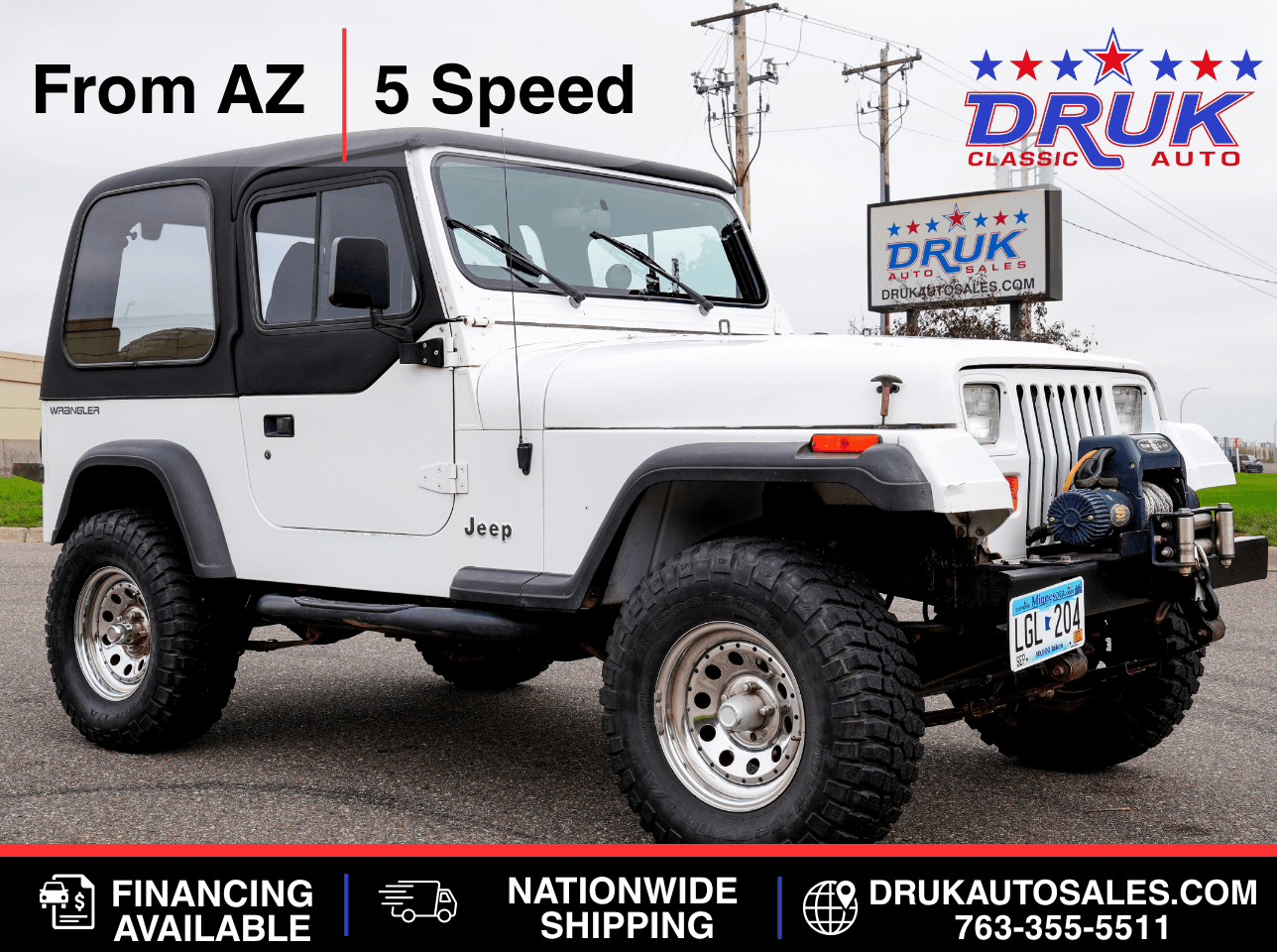
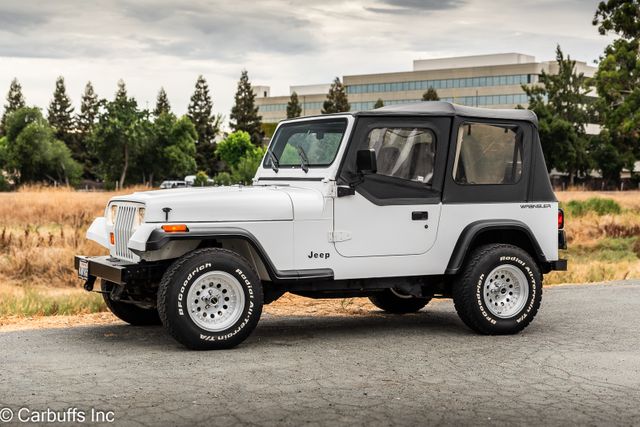
The Wrangler name arrives for 1987 with the YJ, built under AMC and then, from August 1987, under Chrysler, which had bought AMC largely to get Jeep. The YJ kept the CJ formula — leaf springs, solid axles, the same basic tub — but widened the track, fitted a proper roll bar tied into the windshield frame, and, notoriously, replaced the round headlamps with rectangular ones. Traditionalists never forgave it. The market largely has: a YJ is now the cheapest honest way into the shape, and the square lamps have become a period charm.
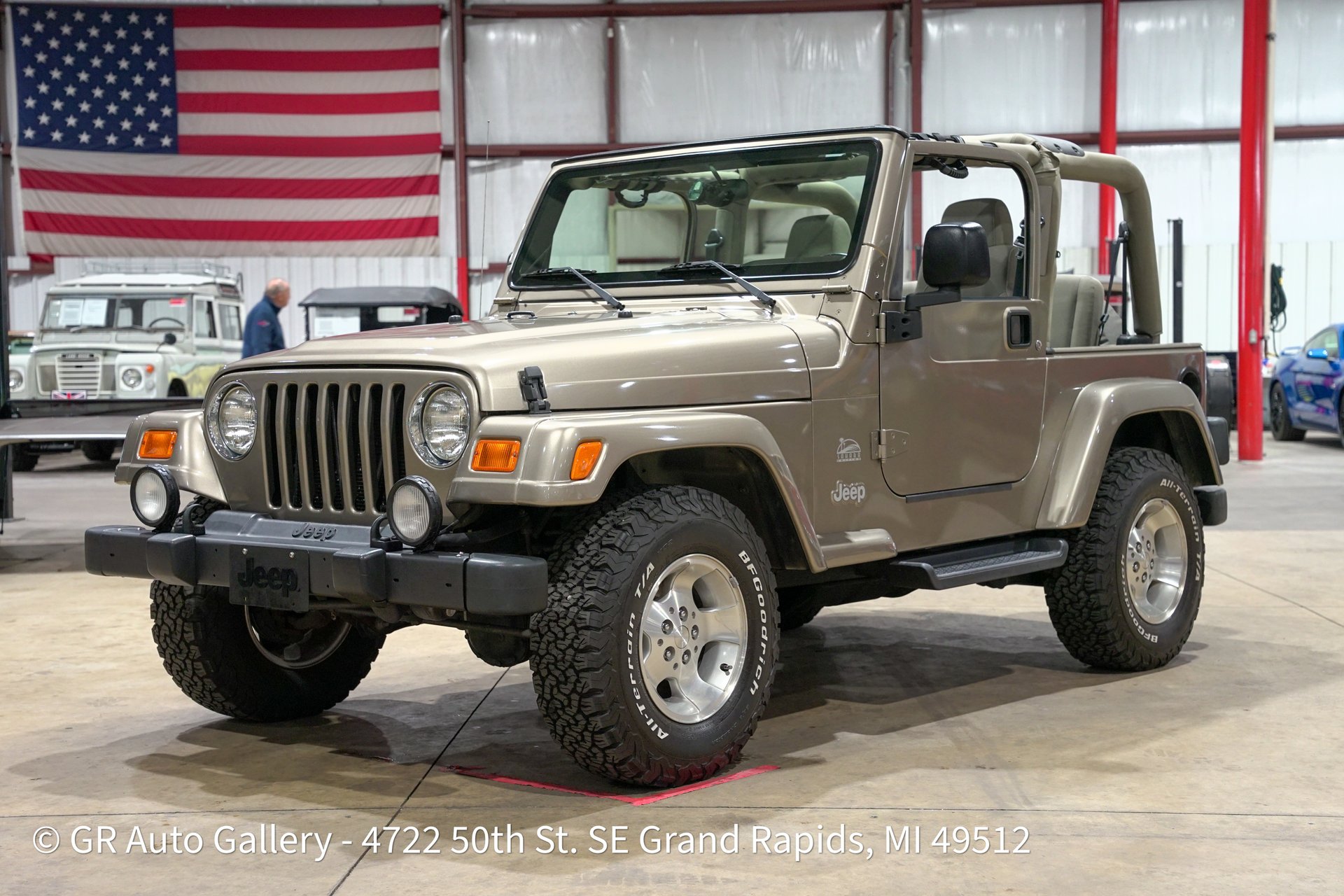
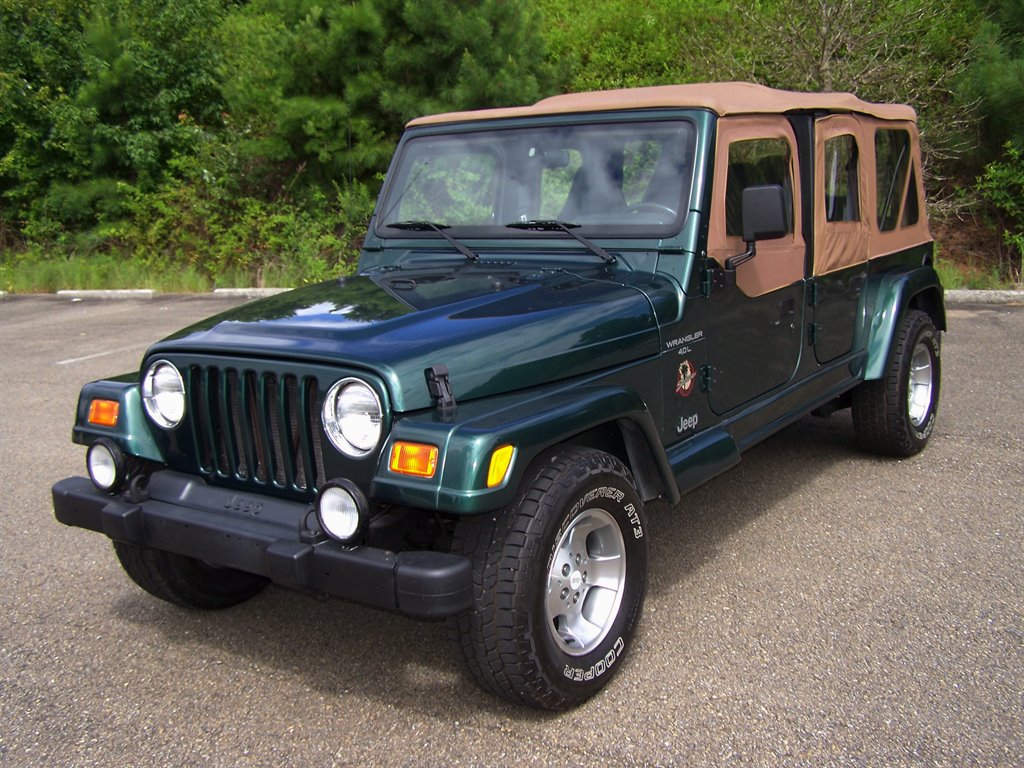
The TJ, for 1997, defines the modern classic Wrangler. Round headlamps returned, leaf springs gave way to coils front and rear, the interior became a recognisable car interior with airbags and air conditioning that worked, and the 4.0-litre six reached its best form. The TJ rides and handles dramatically better than a YJ without giving up anything off road, and it is the generation most buyers cross-shopping the whole span should start with. A long-wheelbase Unlimited, universally called the LJ, joined for 2004 and has grown a cult following since.
The JK, for 2007, widened the car again, added the first factory four-door — the Unlimited — and replaced the AMC-derived engines with Chrysler V6s. The four-door outsold the two-door and changed who bought Wranglers. The JL, from 2018, refined the JK in every direction — aluminium panels, an eight-speed automatic, turbo and diesel options, a plug-in hybrid, eventually a factory V8 — while keeping the solid axles, the folding windshield and the removable everything.
Our own listings pool tells you where the classic market lives. The overwhelming weight sits in the YJ and TJ years, roughly 1987 to 2006, peaking in the mid-1990s and again in the mid-2000s, with a scatter of CJ-7s behind them and Florida the largest state by a wide margin. Manuals outnumber automatics clearly, matching how these cars were bought new. So the buying detail here concentrates on CJ, YJ and TJ, with JK and JL covered as the modern end of the same idea rather than as classics — yet.
One warning belongs in the overview. No other classic is modified as routinely, as extensively and as inexpertly as a Wrangler: lift kits, oversize tyres, axle swaps, armour, winches, lights. A stock, unmodified YJ or TJ is now the rare car, and originality, not equipment, is what you will struggle to find. Judge every modification as a liability until its quality proves otherwise.
The models
Read the range by generation first and trim second. The generation decides how the car rides, steers, rusts and drives; the trim decides upholstery and flares. Within a generation, engine choice matters more than the trim badge, and axle and transfer-case specification matters more than either off road. The table is the map; the notes after it are the traps.
| Model | Years | Engine | Output | Built | Character |
|---|---|---|---|---|---|
| CJ-7 | 1976–1986 | 2.5 four / 4.2 six / 5.0 V8 | 112 hp (4.2) | 379,299 | The last CJ; the ancestor, not yet a Wrangler |
| CJ-8 Scrambler | 1981–1986 | 2.5 four / 4.2 six | 112 hp (4.2) | 27,792 | Long-wheelbase CJ pickup; rare and collectible |
| Wrangler YJ Base / S / SE | 1987–1995 | 2.5 four / 4.2 six, then 4.0 six | 121 hp (2.5 MPI) / 181 hp (4.0) | YJ total about 685,000 | Leaf-sprung entry point; square lamps |
| Wrangler YJ Sahara / Renegade / Islander | 1988–1995 | 4.2 six, then 4.0 six | 181 hp (4.0) | Included in YJ total | Trim and graphics packs; Sahara is the keeper |
| Wrangler TJ SE | 1997–2006 | 2.5 four, then 2.4 four | 120 hp (2.5) / 147 hp (2.4) | Included in TJ total | The light-duty TJ; fine on road, limited off it |
| Wrangler TJ X / Sport | 1997–2006 | 4.0 six | 190 hp | Included in TJ total | The core of the market; Sport is the default buy |
| Wrangler TJ Sahara | 1997–2004 | 4.0 six | 190 hp | Included in TJ total | Top trim; two-tone seats, body-colour flares |
| Wrangler TJ Rubicon | 2003–2006 | 4.0 six | 190 hp | Included in TJ total | Factory off-road flagship; 4:1 case, lockers, Dana 44s |
| Wrangler TJ Unlimited (LJ) | 2004–2006 | 4.0 six | 190 hp | About 44,000 including Rubicon Unlimited | Long wheelbase; the connoisseur TJ |
| Wrangler JK / JK Unlimited | 2007–2018 | 3.8 V6, then 3.6 V6 | 202 hp (3.8) / 285 hp (3.6) | Over 2 million JKs all told | First four-door; the family Wrangler |
| Wrangler JL / JL Unlimited | 2018–present | 2.0 turbo four / 3.6 V6 / 3.0 diesel / 6.4 V8 | 270 hp (2.0) / 285 hp (3.6) | Production continuing | The modern car; aluminium, eight-speed auto |
Outputs are the period factory net figures for the US market. Production splits by individual trim were not published in a form worth trusting, so the table gives generation totals where they are genuinely known and says so where they are not — treat any seller quoting an exact build figure for a specific trim with suspicion unless a build sheet backs it.
The CJs. The CJ-7 is a fine thing and a different purchase from a Wrangler: slower, rougher, more rust-prone and more collectible in unmodified form. The CJ-8 Scrambler, the pickup-bodied long-wheelbase car, is the blue-chip CJ — under 28,000 built and a genuine following. Do not let a seller price a CJ-7 off Scrambler results, or sell you a CJ as a cheap Wrangler: parts, manners and values are their own subject. What CJs and early YJs share is the AMC engine family, covered next.
The YJ trims. The base car was sold as plain Wrangler, then S, then SE, almost always with the 2.5 four unless the six was optioned. The Laredo brought chrome and carpet; the Islander brought sunset graphics; the Renegade, 1991 to 1994, wrapped the car in wide fibreglass flares that trap mud against the tub and are now hard to replace — check behind them carefully. The Sahara, from 1988, is the durable pick: better seats and trim, usually the six, and a specification owners tended to keep. On 1987 to 1990 cars the six is the old 4.2, not the 4.0, and the manual gearbox is the weak French-built unit described below. The sweet YJs are 1991 onwards — 4.0 injection, the better gearbox, and from 1992 a family-style roll bar allowing proper rear belts.
The TJ trims. The SE is the four-cylinder car: lighter, cheaper, adequate on the road, breathless with big tyres and the weakest resale. The X, from 2002, put the 4.0 into a plainer shell and is a sensible buy. The Sport is the volume 4.0 car and the default recommendation. The Sahara adds two-tone seats and body-colour flares and usually the Dana 44 rear option — check the build, because Sahara does not guarantee the axle. The Rubicon, from 2003, is a genuinely different mechanical specification, not a sticker pack: Rock-Trac case with 4:1 low range, Dana 44s with selectable lockers, 4.10 gearing, discs all round. Verify a Rubicon by hardware and VIN, never by decals — Rubicon stickers on a Sport are one of the oldest tricks in this market. The Unlimited stretches the wheelbase from 93.4 to 103.4 inches; the Rubicon Unlimited of 2005 and 2006 is the most sought-after TJ variant and the one most often misdescribed.
JK and JL, briefly. The JK's story is two engines: the 3.8 V6 to 2011, adequate and unloved, and the 3.6 Pentastar from 2012, which transforms the car — buy the Pentastar car unless the earlier one is dramatically cheaper and cleaner. The four-door is the practical JK and JL; the two-door holds the classic shape and compromises. On the JL the 2.0 turbo four is stronger at altitude than its size suggests, the diesel is torquey and rare, and the 392 V8 is a factory hot rod priced like the collectible it will be.

Engines and gearboxes
The AMC fours and sixes: 2.5, 4.2 and the 4.0
Almost every CJ, YJ and TJ you will look at runs one of three AMC-derived engines, and they share a personality: iron, understressed, tolerant of neglect up to a point, and ultimately limited by their ancillaries and by rust in the car around them rather than by the engine itself.
The 2.5-litre four — AMC's own design, not the Pontiac Iron Duke fitted to very early CJ-7s — powered base cars from 1983 through the TJ SE to 2002, first with throttle-body injection and from 1991 with multi-point injection at about 121 hp. It is a willing, rattly engine, perfectly adequate in a stock two-door on stock tyres and progressively less adequate with every inch of lift and tyre the previous owners added. Its weaknesses are exhaust manifold cracking, vacuum leaks on the early cars, and simple wear, because four-cylinder cars were worked hard to keep up. Do not dismiss one for gentle road and beach use — but price it as a four, because the next buyer will.
The 4.2-litre 258 six is the CJ and early YJ engine: 112 hp, enormous low-speed torque for its output, and a Carter two-barrel carburettor — the BBD — that is the single most complained-about component in the whole CJ and YJ world. The BBD's idle tubes block, its choke and stepper-motor feedback system on later cars confuses everyone, and the result is the classic 4.2 ownership experience: a car that idles badly, stalls at lights and runs rich. The mechanisms matter. Most BBD misery is blocked idle pickup tubes and perished vacuum hoses, not a worn-out carburettor body, and a patient clean and rebuild transforms many cars owners had given up on. The durable fixes are equally well known: a Weber conversion or, better, a throttle-body or multi-point injection conversion, of which the Mopar MPI kit was the factory-blessed route. A 4.2 already converted to injection, with the work documented, is worth a premium over a carburettor car; a 4.2 with a badly fitted Weber and a box of excuses is not. Head and block are tough; the plastic valve cover on 1980s cars warps and leaks as a matter of course — an aluminium cover is the standard cure — and rear main seal weeps are near-universal.
The 4.0-litre PowerTech six is the engine the classic Wrangler market is built around. Developed by AMC from the 4.2 and fitted to the YJ from 1991 and every six-cylinder TJ, it makes 181 hp in the YJ and 190 hp in the TJ, pulls from idle, cruises at modern speeds, and routinely passes 200,000 miles with oil changes. Its faults are specific and checkable. Exhaust manifolds crack at the collector, giving a tick on cold start that fades as the metal expands — budget for a manifold, do not treat the tick as character. The rear main seal weeps with age; a drip on the bellhousing is common and tolerable, but price the job if it marks the driveway. Cooling is marginal on modified cars, so a gauge that sits obediently below the middle mark after a hard run is a real buying point. Two sub-variants need naming. Heads coded 0331, fitted to 2000 and 2001 cars, are prone to cracking between the third and fourth cylinders, announced by unexplained coolant loss and milky residue under the oil filler cap; the later TUPY revision cured it, and the casting mark is visible through the filler — check it on any 2000 or 2001 car. And 2005 and 2006 TJ 4.0s carry the oil pump drive assembly, the OPDA, whose wear can produce a squealing noise from the back of the engine and, ignored, camshaft damage; listen at cold start on those years, and treat a documented OPDA replacement as a plus.
The later engines: TJ 2.4, JK 3.8 and 3.6, JL range
The TJ SE swapped the AMC 2.5 for Chrysler's 2.4-litre PowerTech four from 2003, at 147 hp. It is smoother and stronger on paper and has a timing belt where the old four had a chain — so the buying question changes from condition to paperwork: a 2.4 with no evidence of a belt change at the specified interval is a bill waiting, and interference damage is the failure you are avoiding. Otherwise it shares the SE's fundamental limitation: fine stock, strained modified.
The JK's 3.8-litre V6, 2007 to 2011, is a minivan engine doing honest work — 202 hp, simple pushrod architecture, known for oil consumption that owners must monitor rather than ignore and for exhaust manifold cracks of its own. A 3.8 that has been run low on oil is the risk; check the level before the test drive and be suspicious if it arrives freshly topped to the mark with no history. The 3.6-litre Pentastar, from 2012 in the JK and standard in the JL, is a thoroughly modern double-overhead-cam V6 at 285 hp: stronger everywhere, better on fuel, and with two known patterns — early JK cars had cylinder-head issues on the left bank, largely handled under extended factory coverage, and the plastic oil filter housing and cooler assembly can leak with age, showing as oil in the valley and a smell rather than a drip. Neither is a reason to avoid the engine; both are reasons to want paperwork.
The JL adds the 2.0-litre turbo four at 270 hp — punchy, and dependent on turbo and cooling health, so a full history matters more here than on any six — the 3.0-litre EcoDiesel V6 at 260 hp and huge torque, rare and emissions-equipment-sensitive, and the 6.4-litre 392 V8, exactly as excessive as it sounds. Hybrid 4xe cars sit outside classic scope for now; battery history is a specialist check, not a driveway one.
Gearboxes, transfer cases and axles
Manuals dominate the classic pool, and the gearbox fitted is one of the great YJ traps. Early six-cylinder YJs, 1987 to mid-1989, used the Peugeot-built BA10/5, a light-duty box that was marginal behind the 4.2 when new and is a liability now: weak synchromesh, scarce parts, and a habit of jumping out of gear. The AX-15 that replaced it — backing the 4.0 in YJ and TJ to 1999 — is a proper, durable Aisin box and the one you want. Four-cylinder cars used the lighter AX-5, adequate behind the four and nothing else. TJ manuals moved to the NV3550 for 2000 to 2004 — strong, slightly notchy, with a specific lubricant appetite, so grinding on a car filled with the wrong oil is a known false alarm — and then the six-speed NSG370 for 2005 and 2006, whose reverse-gear and synchro wear makes a careful test of every gear essential on those years. CJ manuals range from strong three- and four-speeds to the light T-5, which, like the Peugeot box, should be treated as consumable behind a V8.
Automatics are the minority choice and mostly good ones. The three-speed TorqueFlite-derived boxes behind CJ, YJ and early TJ sixes are tough and cheap to rebuild, at the cost of busy highway revs. The four-speed 42RLE in later TJs and early JKs adds overdrive and a reputation for running hot; a cooler and unburnt fluid are the checks, and shudder or delayed engagement hot is a rebuild conversation, realistically a mid-four-figure job at a specialist. On any modern auto, insist on evidence of fluid services rather than sealed-for-life optimism.
The transfer case is the Wrangler's party piece and generally the most reliable part of the drivetrain. The NP231 Command-Trac in most YJ and TJ cars is part-time four-wheel drive — two-wheel drive, four-high and four-low at 2.72:1 — with a chain drive whose stretch announces itself as a slap or rattle on overrun and a habit of jumping out of four-low under load when the linkage and mode fork wear. The NP242 Selec-Trac, optional on some CJs and later cars, adds a full-time four-high setting and is the nicer road case. The Rubicon's NV241OR Rock-Trac gives 4:1 low range, the headline number for slow off-road work, and is verified by its case tag and the crawl behaviour itself on test, not by the dashboard switches alone. On every car: engage four-high and four-low on a loose or wet surface during the inspection, confirm the dash lamp and the actual engagement, and confirm it comes back out cleanly — a case that has not been shifted in a decade seizes its linkage and pretends to be a bigger fault than it is.
Axles decide how much modification a car will tolerate. The standard pairing is a Dana 30 front and a Dana 35 rear; the 35 is the acknowledged weak link behind a 4.0 on oversize tyres. The Dana 44 rear — optional on many Sports and Saharas, standard on Rubicon and on the LJ — is the axle you want for a car that will work off road, and its presence moves value: read the axle, do not trust the listing. Ratios vary from economy 3.07s to 4.10s on Rubicon and four-cylinder manuals, and a car re-geared correctly for its tyres is worth more than a car on 35s still turning factory gearing, which will feel gutless and cook an automatic.

Problem areas
Everything mechanical on a Wrangler can be fixed with ordinary money. What kills Wranglers is rust in the frame, abuse disguised as modification, and water — water kept out badly by a removable top, water trapped in a boxed frame, water sitting under carpets in a tub with drain plugs nobody ever pulled. Work through this section in that order and you will price any YJ or TJ correctly. A note on our own evidence first, because it matches the wider market exactly: in the small set of Wranglers whose seller photo sets we have examined in detail for this site — ten cars — rust was mentioned in the notes for five of them, half the sample, and visible damage for two. The sample is small, so treat the proportion as a warning rather than a statistic: go in expecting rust, and make the car prove otherwise.
Frame and tub rust: the map
The Wrangler frame is a ladder of boxed steel rails, and boxed rails rot from the inside. Mud, road salt and water enter through drain and access holes, sit in the box sections, and perforate the steel from within — so the outside can look sound, freshly painted and presentable while the inside of the rail is lace. This is the single most important inspection on any YJ or TJ, and it cannot be done from listing photographs. In our listings pool Florida supplies more Wranglers than any other state by a factor of several, and a Florida car that has lived at the beach has breathed salt air its whole life even if it never saw a salted road; a northern car has had the salt applied directly. There is no safe origin. There are only inspected frames and uninspected ones.
TJ frame, rear control-arm and skid-plate areas. The TJ frame's known kill zones are consistent enough to list in order. First, the sections around the rear control-arm mounts and the rear wheel arches, where the rail curves and traps debris. Second, the centre section under the transfer-case skid plate: the plate bolts to captive nuts in the frame, road salt lives between plate and rail, and the rail perforates behind the plate where you cannot see it — the giveaway is skid-plate bolts that spin, snap or sit in crumbling metal when removal is attempted, which is why a seller who has recently had the plate down for a clutch or transfer-case job, with photographs, owns a more valuable car than one whose plate has not moved in twenty years. Third, the front rails around the steering box and track-bar mount. Repair sections — replacement frame segments and caps from the specialist suppliers — exist for all of these zones and a competent welder can save most frames, but price it honestly: a single professional frame-section repair with the car on a lift, rust cut back to sound metal and the section welded and coated, is a four-figure job per zone, and a frame rotten in three zones is a parts car wearing a price tag. The test is a hammer and a screwdriver in the seller's presence, agreed in advance: tap along every rail, listening for the change from a ring to a dull crunch, and prod hard at the suspect zones. Surface scale that rings is manageable; metal that flakes, flexes or admits the screwdriver is structural.
YJ frame and spring hangers. The YJ frame shares the boxed-rail problem and adds leaf-spring hangers as a failure point, particularly the rear shackle mounts at the very back of the rails, where the rail ends themselves rot and the shackle tears at weakened metal. Check also around the steering box, the front crossmember and the body mounts along the full length of both rails. YJ frames were not as well protected as late TJ frames in some years and were better in others; generalisations are worthless, the hammer is not. Body mounts deserve their own minute on both generations: the rubber pucks perish, the captive nuts spin in rusted tub channels, and a car that needs every mount is facing a tub-off conversation to do the job properly — a day or more of labour before any welding the discovery prompts.
The tub. Tub rust follows the water paths. Floor pans go first at the front footwells, where leaks and wet boots deliver water under carpets that hold it against the steel — lift every carpet, pull the drain plugs, and prod the pans, especially at the seat-belt anchors, because an anchor in rotten steel is a safety failure, not a cosmetic one. The body channels under the tub, the cowl sides, the windshield frame itself — a bolt-on panel that rots around its lower edge and is replaceable at moderate parts cost plus paint — the rear arches and the panel below the tailgate all follow. A windshield frame fitted and painted, or a floor-pan side fitted and finished, is each a manageable job in the hundreds-to-low-thousands range depending on paint; but count the zones. One zone is a repair. Four zones is a restoration, and a restoration tub on a rotten frame is a car to walk away from.
The CJ difference. CJ tubs and frames rust with fewer inhibitions and fewer repair panels for some sections. The same map applies, plus front fenders and the hat channels under the tub. CJ values support proper metalwork on a good car in a way YJ values often do not, but the arithmetic still has to be done car by car.
Steering, suspension and the death wobble
Every solid-axle Jeep owner knows the phrase. Death wobble is a violent, self-sustaining oscillation of the front axle and steering, triggered by a bump at road speed — typically in the 45 to 60 mph band — that only stops when you brake well below the trigger speed. It is not cured by a steering stabiliser, which is the myth to bury first: the stabiliser can mask the onset, and a seller proudly showing a brand-new stabiliser on a car that wobbles has shown you the mask, not the cure. True death wobble is a system failure: the axle is located by control arms and a track bar, and wear lets it move enough to start the oscillation. The causes, in check order, are a worn track-bar mount or bushing — the axle-end mount wallows oval and is the classic culprit — worn ball joints, tired control-arm bushings, worn linkage ends, a loose steering box, wrong caster after a lift, and badly balanced oversize tyres. Diagnosis is the dry-park test, helper rocking the steering while you watch every joint for lost motion. A track-bar job is modest money; a full front-end refresh — ball joints, linkage, bushings, alignment — runs into the low thousands at a shop. A car that wobbles on test is not automatically a walk-away, but price it as needing the full refresh, because partial fixes are the norm in this market.
Springs, lifts and geometry. YJ leaf springs sag, crack leaves at the eye and wear their bushings until the axles steer the car from underneath; tired leaves are obvious in the stance and cheap in parts, with the labour in seized bolts. TJ coils sag less, but the aftermarket has usually been there first. Judge a lift by its completeness: a proper lift addresses track bars, control-arm geometry, brake lines, steering angles and gearing; a cheap lift addresses ride height only and exports the cost to handling, wobble and tyre wear. A slip-yoke eliminator and double-cardan rear shaft on a lifted TJ mark an owner who understood driveline angles — vibration without one is the shaft angle complaining. It is fixable, but price the fix; do not accept that vibration as Jeep character.
Brakes and bearings. Disc front and drum rear on most YJ and TJ cars, discs all round on Rubicon, LJ and later cars: systems are simple, parts are cheap, and the standard findings are seized rear drum adjusters, perished flex hoses, callipers sticky from sitting and handbrakes that barely hold. Front unit bearings wear with oversize tyres and rumble under steering load. A full hydraulic refresh is a predictable four-figure-or-less shop bill you budget in year one rather than fear.
Tops, seals, water and the interior
A Wrangler top is a compromise you choose. The factory soft top is noisy and entirely adequate when its frame is straight, its windows clear and its zips work; budget for a replacement skin on any older car, a parts cost in the hundreds using the existing frame, more if the frame is bent. Hardtops seal and lock better, need two people and storage space, and crack at the rear corners; a good one adds real value, a cracked one is fibreglass repair plus paint. Inventory what is actually included in the sale — a missing hardtop or door uppers is a four-figure gap between the car as photographed in summer and the car as usable in January.
Water inside the car comes from predictable places: the cowl vent and its drain, which blocks and pours water onto the front floors through the heater box; perished door and windshield seals; a soft top fitted badly at the door surrounds; and the rear gate seal. Wet front carpets on a dry day mean the cowl drain until proven otherwise — a free fix involving a hose and compressed air that sellers somehow never perform. The heater itself is strong on 4.0 cars when the core is clear; weak heat plus coolant loss plus a sweet smell is a heater-core job, and on a TJ that is a dashboard-out job of several hours, so price the labour, not the inexpensive core. Air conditioning, where fitted, is conventional and repairable; a system that needs only gas usually needs a leak found, and the honest budget includes it.
Interiors wear in proportion to top-off life. Seats split at the entry bolster, frames crack at the mounts on hard-used cars, foam collapses on the driver's side first, and carpets in a car that has lived topless are best regarded as disposable. Seat covers hide all of this, which is why you lift them. None of it is expensive by classic standards — retrimming is a modest job and carpets are a kit — but a genuinely good original interior tells you the car was garaged and used gently, which correlates with everything else you care about. Believe the correlation.
Electrics, gauges and the modified-car problem
Wrangler electrics are simple and their failures are correspondingly honest: earth straps corrode, the YJ bulkhead connector passes water and green corrosion, ignition switches wear, and intermittent gauges are usually the connector behind the cluster rather than the senders. The TJ cluster's habit of dropping all gauges at once and recovering is a known connector issue, fixable and not a sign of deeper doom. The 4.0's management is robust; crank position sensors fail with age and heat and cause the classic cut-out when hot — a car that cuts out hot and restarts cold is very often a crank sensor, not a mystery, and the part is modest money.
Aftermarket electrics are another matter. Winches wired without proper cable, light bars tapped into lighting circuits, alarms fitted by three successive owners, chopped looms — modified Wranglers accumulate electrical archaeology faster than any other classic. Budget time to return wiring to stock on any heavily accessorised car. The principle closes this section: every modification transfers an unknown from the seller to you. Some are excellent — a correctly geared axle swap, a quality lift fitted whole, an injection conversion on a 4.2. Most are incomplete. The unmodified car is the known quantity; the modified car is a list of questions, and the inspection, next, is how you ask them.

How to inspect one
Allow ninety minutes, bring a torch, a small hammer, a screwdriver for prodding, a magnet, a tyre tread gauge and a helper if you can. Insist on a cold engine and, if the car passes the first pass, pay for lift time before money changes hands — on a Wrangler the lift inspection is not a formality, it is where the frame verdict lives.

- Start with identity and paperwork. Match the VIN on the title to the plate at the base of the windshield and the stampings the seller can show you. Decode the VIN for year, engine and assembly plant, and check the engine fitted matches the engine the car claims — six swapped into a four-cylinder shell is common and not necessarily bad, but it must be priced and documented as a swap. On a Rubicon, verify the hardware in step 9, not the decals. A build sheet or original window sticker is worth having and settles axle, gearing and limited-slip arguments on the spot.
- Cold start. The engine should be stone cold when you arrive. A 4.0 should fire at once and settle to an even idle; listen in the first ten seconds for exhaust manifold ticking that fades as it warms, timing rattle, and, on 2005 and 2006 cars, any squeal or chatter from the oil pump drive at the back of the engine. A 4.2 on a carburettor gets more patience but not unlimited patience — repeated cranking, pumping and excuses are data. Watch the exhaust: blue smoke on start that clears is valve seals; smoke that stays is deeper.
- The frame, underneath. Torch and hammer along both rails, full length, before anything else underneath distracts you. Work the known zones from the problem areas section: TJ rear control-arm mounts and centre section behind the skid plate, YJ rear shackle mounts and rail ends, steering-box areas on both. Ring is good, crunch is structural. Prod the body mounts and look at the skid-plate bolts — bolts sitting in flaking metal tell you what the hidden rail looks like. Perforation in a main rail zone ends the viewing unless the price already assumes frame repair sections and welding.
- The tub, inside and out. Lift every carpet. Prod the front footwells, the seat-belt anchors and the rear load floor. Check the cowl sides, the base of the windshield frame, the door bottoms, the arches and the panel under the rear gate. Run the magnet over arches, rockers and lower doors — filler over rust is the standard cosmetic repair, and it announces itself. Count the rot zones as you go: one zone is a repair bill, three or more is a restoration, and the offer should say which you are buying.
- Oil, coolant and the head-casting check. Pull the dipstick: level, colour, any sign of neglect. Look under the oil filler cap for milky emulsion — on a 2000 or 2001 car, check the head casting mark visible through the filler for the early crack-prone casting described in the engines section, and ask directly about coolant loss. A car that arrives with oil suspiciously fresh and coolant suspiciously full, with no history, is asking you to trust it — do not, yet.
- Gearbox and clutch, stationary then moving. On a manual, select every gear at rest, including reverse — graunching reverse on the six-speed cars and jumping selections on an early Peugeot-box YJ are priced faults, not quirks. Feel the clutch bite and listen for release-bearing noise. On an automatic, check fluid colour and smell: dark and burnt is a rebuild priced into the offer.
- The test drive, deliberately. Twenty minutes minimum, including a stretch at 50 to 60 mph over imperfect road — the death-wobble band. The car should track straight hands-light, with no oscillation after bumps. Any wobble that starts is the full front-end refresh from the problem areas section priced in, whatever the seller blames. Brake firmly from speed: straight stop, no judder, no pull. A 4.0 should pull cleanly from low revs in a high gear without pinking or hesitation; a lifted car on stock gearing will feel strangled, and that feeling is a gearing bill, not an engine fault.
- Four-wheel drive, on a loose surface. Engage four-high, drive, engage four-low, drive, disengage, reverse a few yards to unwind. The lamp, the engagement and the behaviour must all agree. On a Rubicon, engage both lockers and confirm the lamps and the locked behaviour. A case that will not engage, jumps out under load, or slaps on overrun is a chain, linkage or fork conversation — fixable, but it goes on the list in money, not in hope.
- Axles, steering joints and stance. Do the dry-park test: helper rocking the wheel while you watch the track bar, linkage ends and steering box for lost motion. Rock each front wheel for bearing and ball-joint play. Then read the stance — level side to side, tyres wearing evenly. Uneven wear plus play at two joints is one coherent story: a tired front end, priced whole.
- Tops, doors and water. Work every zip, check window clarity, look for cracked hardtop corners, and confirm door uppers and surrounds are actually present. Pour a bottle of water into the cowl vent and watch the front footwells — water inside means the blocked cowl drain from the problem areas section. Inventory the top hardware against winter, not against viewing-day weather.
- Heat, electrics and accessories. Run the heater full hot and the air conditioning full cold. Work every gauge, lamp, wiper speed, washer and horn. A TJ cluster that drops and recovers is the known connector fault, priced as a fix, not feared as a failure. Look at aftermarket wiring with your eyes, not the seller's description: chafed or melted wiring is removal work you are buying.
- The modification audit, last. List every non-stock item — lift, tyres, axles, gearing, armour, lights, engine work — and grade each: done with paperwork, done but undocumented, or done badly. A stock car needs no audit, which is precisely its value; a modified car that fails the audit is worth stock money minus the cost of putting it right, and you should offer exactly that or walk away.
Values
The build below this guide carries the live market — what is listed now, and the recorded sales picture — refreshed at every build, and that is where the numbers live. This section teaches you how to read them, because with Wranglers the spread inside a single model year is wider than the spread between model years, and a median read without the condition story will mislead you in both directions.
The first driver is the frame, and it is close to binary. A YJ or TJ with a verified sound frame is a car; the same car with perforation in two zones is a project whose value is its drivetrain, its top and its title. Expect the gap between those two states to be the largest single gap in the market — larger than the gap between a four and a six, larger than the gap between a Sport and a Sahara. When you compare a listing against the recorded sales, the first question is never the trim or the mileage. It is whether the frame evidence is in the photographs at all, and a listing with forty photographs and none underneath is telling you something the seller may not intend.
The second driver is originality, and its direction surprises sellers. For years the market paid for equipment: lift, tyres, armour, lights. The classic end now pays for absence — no lift, stock tyre size, factory axles, uncut tub — because unmodified cars have become the scarce ones and every modification is an unknown the buyer inherits. Heavily built cars still sell, to a thinner audience, and the catalogue total of the parts is never recovered. An unmodified car you improve yourself, keeping the removed parts, is both the safest store of value and the most honest route to a modified Wrangler later.
Variant premiums are real but specific. The Rubicon premium over a comparable Sport is genuine, because the hardware is genuine — provided it is verified, since decals are cheap. The LJ premium is genuine and growing, and the Rubicon Unlimited sits at the top of the TJ tree. Sahara trim adds a modest premium when the interior is genuinely good, and nothing when the seats are split, because the trim is the interior. Four-cylinder cars sit at a persistent discount no low mileage fully erases, and 4.2 carburettor cars sit below 4.0 injected cars unless exceptionally original or already injection-converted with paperwork. Scramblers price in their own market and should never justify a CJ-7 asking figure.
Asking and achieved prices diverge with a Wrangler twist: the optimistic asks cluster on modified cars, where the seller is pricing the build, and on frame-suspect cars photographed from flattering angles, while achieved sales cluster on honestly described stock cars. Project-versus-driver arithmetic is unforgiving: the gap between a project TJ and a driver looks like an opportunity until you price a frame section, a top, a front-end refresh and a year of weekends, at which point the driver was the cheaper car. Buy the driver unless the project is the point.
Negotiation room lives in the documented faults — the manifold tick, the wobble with its itemised front-end list, the missing hardtop, the tub-rust zones you counted. Bring the list, price each item from the ownership picture below, and negotiate from evidence rather than percentage.
Parts and ownership
The Wrangler is one of the best-supported classics in the world, full stop. Between the factory heritage programmes, the big Jeep specialists, the off-road aftermarket and a dismantling trade fed by enormous production volumes, there is almost nothing on a CJ, YJ or TJ you cannot buy, and most of it is priced like parts for a working vehicle rather than a museum piece — because for much of the aftermarket, it still is one.
Easy and cheap: service items, filters, plugs, ignition components, water pumps, radiators, brake discs, pads, callipers and hoses, suspension bushes, ball joints and linkage, clutch kits, exhausts, soft-top skins, seat covers, carpet kits, glass and seals. Order today, fit this weekend is a realistic rhythm for most maintenance these cars need, and the online knowledge base — manuals, forum archives, walk-throughs for essentially every job in this guide — is deeper than for almost any other classic.
Available, at a price: replacement frame repair sections for the known TJ and YJ rot zones, floor pans and tub repair panels, replacement tubs in steel and fibreglass for CJ and YJ, hardtops and doors on the used market, rebuilt transfer cases and gearboxes, and specialist work such as a proper automatic rebuild — a mid-four-figure job with the box out and warranted — or a professional frame-section repair, priced per zone once the welder has seen sound metal to weld to. None of it is unobtainable; all of it rewards shopping the established Jeep specialists rather than general marketplaces.
Harder and dearer: the Peugeot BA10/5 gearbox, whose parts scarcity is itself the argument for converting a failed one to the later AX-15 pattern; good original Renegade body-kit panels for the YJ; crack-free early dashes; original Sahara interior trim in the correct fabrics; and, on CJs, good original steel tubs and the better grades of original trim, where the reproduction market is thinner than the TJ owner would believe. The pattern is the usual one: mechanical parts are a solved problem, cosmetic originality is the scarce resource, and you buy the car whose cosmetics you can live with because the mechanics can always be bought.
Running costs. A sorted 4.0 is a realistic regular-use classic: fuel in the mid-to-high teens in mixed use, worse lifted; servicing any competent independent can handle, with specialists earning their rate on diagnosis — death wobble, transfer-case behaviour, modified-car geometry — rather than routine work. The line that catches new owners is the first year of catching up deferred maintenance and unpicking previous shortcuts: allow a first-year figure in the low thousands on a driver bought with open eyes, and on a cheap car the inspection list itself is the budget. Insurance is friendly, agreed-value cover is readily available, and a stock car is the easiest of all to place.
Buy the frame, buy the originality, fix the mechanics: that is the ownership proposition in one line.
Which one to buy
- The all-rounder: TJ Sport with the 4.0. Coil springs, the best form of the six, a deep market to buy from and sell into, and parts support that will outlive us all. If you want one classic Wrangler to drive, tour and occasionally trail, this is it.
- The value buy: a late YJ with the 4.0. The 1991 to 1995 cars give you the injected six and the good gearbox in the cheaper, leaf-sprung shell. Square lamps included, character guaranteed — just spend the saving on the frame inspection, because the YJ needs it most.
- The off-road pick: TJ Rubicon, verified. The 4:1 transfer case, lockers and Dana 44s are a mechanical specification no Sport can imitate for the price difference — provided you verify the hardware and the VIN, because the decals imitate it for almost nothing.
- The connoisseur TJ: the LJ Unlimited, ideally the Rubicon Unlimited. The long wheelbase rides better, tows better and carries more, and the 2005 to 2006 Rubicon version is the TJ the market will keep rewarding. Buy the best frame you can find and keep it stock underneath.
- The classic pick: a CJ-7 with the 4.2, unmodified. A different, older pleasure — slower, simpler and genuinely collectible in honest condition. Injection-converted cars are the usable ones; original carburettor cars are the pure ones; decide which owner you are before you shop.
- The modern buy: a JK with the 3.6 Pentastar, or a JL. If the Wrangler is to be an only car, the Pentastar JK from 2012 onwards is where the classic shape meets modern manners, and the JL improves on it in every direction. Buy on service history, not on accessories.
- The one to think twice about: any four-cylinder car on oversize tyres, and any tall-lift car with no paperwork. The four is a fine engine in a stock car and a strained one in a built one; the undocumented build is a list of bills wearing a price tag. Either can be right at the right figure — and the right figure is well below the six-cylinder, stock-car money.
And the rule that overrides all of the above: buy the soundest frame you can find, in the most original car you can live with. Engines, gearboxes, tops, seats and steering can all be bought, fitted and warranted at prices you can plan for. A rotten frame and a cut-about tub are the two things about a Wrangler that money cannot make original again — and on this car, original and sound is exactly where the value has gone.
See the 108 Wrangler "Sport" Sport Utility 2D cars currently listed.