
Jeep Wagoneer buyer's guide
Jeep Wagoneer -- the model's own buyer's guide: variants, values and what to check.
Years listed: 1967-1993 · Series: Jeep
Overview and history
The Jeep Wagoneer invented the luxury SUV a quarter of a century before the term existed. When Kaiser Jeep launched it in late 1962 as a 1963 model, there was nothing else like it: a steel station-wagon body on a proper four-wheel-drive chassis, with car-like trim, an automatic gearbox option, power steering, air conditioning and — briefly — independent front suspension, at a time when every other 4x4 wagon was a farm tool with windows. The International Travelall and the Chevrolet Suburban were trucks. The Wagoneer, styled by Brooks Stevens, was aimed at the family that skied, towed a boat and still wanted to arrive looking respectable. Every Range Rover, Grand Cherokee and Escalade since has followed the template this car drew.
The bones stayed remarkably constant. The SJ Wagoneer — the big one, and the car this guide is about — kept the same basic body shell, the same ladder frame and the same leaf-sprung live axles from 1963 to the end of production in 1991, through three owners: Kaiser Jeep, then American Motors, which bought Jeep in 1970, then Chrysler, which bought AMC in 1987 and kept the Grand Wagoneer in production for four more years simply because people kept buying it. Engines, gearboxes, transfer cases and trim changed constantly underneath that unchanging silhouette, which is why this guide spends so much time on specification: two Wagoneers that look identical can be mechanically unrelated.
The arc of the model runs in three acts. The early Kaiser cars (1963–70) are slim-bumpered, relatively simple machines with six-cylinder or early V8 power and part-time four-wheel drive. The AMC cars of the 1970s added the things that define the classic Wagoneer in most buyers' minds: big AMC V8s up to the 401, the full-time Quadra-Trac system, and in 1978 the Limited, the first Wagoneer with leather seats and the full woodgrain treatment. The third act is the Grand Wagoneer of 1984–91: AMC renamed the top SJ model, standardised the 360 V8 and the Selec-Trac system, and sold essentially a 1960s vehicle, heavily accessorised, into the early 1990s at luxury-car prices. The last Grand Wagoneers — the 1991 Final Edition cars — are now the most collected of all.
Alongside the SJ, AMC built a second, smaller Wagoneer on the compact XJ Cherokee platform from 1984 to 1990: a woodgrained XJ with plusher trim, sold as the Wagoneer and Wagoneer Limited. It is a different vehicle in every mechanical respect — unibody, coil-spring front suspension, four- and six-cylinder engines — and it appears in our listings pool only at the margins. Treat the two as cousins, not variants, and check which one a listing actually describes before applying anything in the SJ sections below. A one-year coda came in 1993, when Chrysler applied the Grand Wagoneer name to a woodgrained version of the ZJ Grand Cherokee; rare, interesting, and again mechanically unrelated to the SJ.
Our own listings show where today's market actually sits. We currently track 44 Wagoneers, 29 of them for sale and 15 recorded sold, spanning 1964 to 1993 — but the centre of gravity is unmistakable: the late SJ Grand Wagoneers of 1986–91 make up the largest single block of the pool, with a scattering of 1970s cars, a handful of early cars and the occasional XJ-era example. That matches the wider market. The woodgrained Grand Wagoneer is the icon, the one television and nostalgia made famous, and it is the car most buyers are really shopping for when they type "Wagoneer" into a search box.
What defines buying one is simple to state and hard to act on: the mechanicals are truck-tough, well understood and almost entirely fixable, while the body and frame are thirty to sixty years old, were never rustproofed to a modern standard, and carry a tailgate, a woodgrain finish and an interior that are all expensive to put right. The difference between a good Wagoneer and a money pit is rust, deferred maintenance and bodged vacuum and electrical systems — in that order.
The models
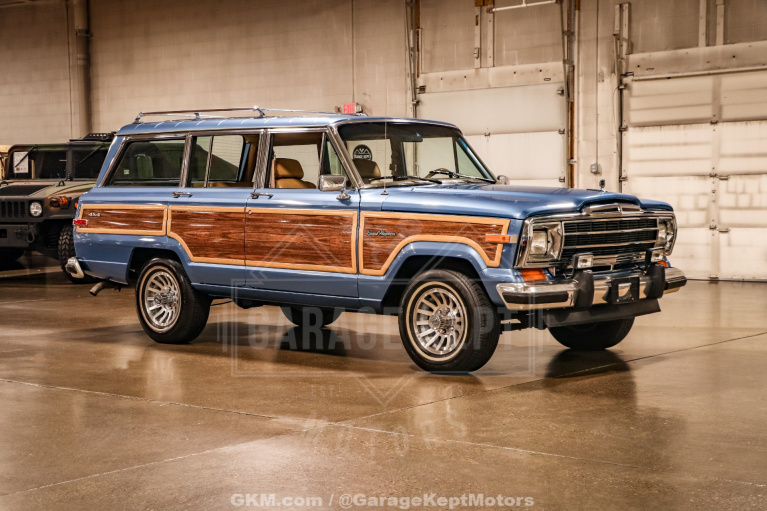
Every SJ Wagoneer is a four-door wagon on the same frame; the badges chart the trim ladder and, loosely, the era. Plain Wagoneers are the working cars, Custom and Super Wagoneer mark the early luxury attempts, Limited (1978–83) brings leather and standard woodgrain, and Grand Wagoneer (1984–91) is the final, fully loaded form. Panel-sided cars without woodgrain exist throughout — woodgrain was an option before it became standard on the top trims — and the two-door and panel-truck variants of the early years belong to the Cherokee and Gladiator story rather than this one.
| Model | Years | Engine | Output | Built | Character |
|---|---|---|---|---|---|
| Wagoneer (early) | 1963–1970 | 230 OHC six / 327 V8 | 140 / 250 hp | — | The Kaiser original; simple, slim-bumpered, part-time 4WD |
| Super Wagoneer | 1966–1969 | 327 V8 | 270 hp | about 1,485 | The first luxury flagship; air con, power everything, rare |
| Wagoneer (AMC era) | 1971–1983 | 258 six / 304, 360, 401 V8 | 110–215 hp | — | The mainstream car; Quadra-Trac era, V8s dominate |
| Wagoneer Limited | 1978–1983 | 360 V8 (401 early) | 175–195 hp | — | Leather, woodgrain, every option; the Grand Wagoneer in embryo |
| Grand Wagoneer (SJ) | 1984–1991 | 360 V8 | 144–175 hp | — | The icon; fully loaded, Selec-Trac, the collector default |
| Wagoneer (XJ) | 1984–1990 | 2.5 four / 2.8 V6 / 4.0 six | 105–177 hp | — | The compact cousin; unibody Cherokee in woodgrain dress |
| Grand Wagoneer (ZJ) | 1993 only | 5.2 V8 | 220 hp | — | One-year Grand Cherokee special; a footnote, not an SJ |
Production figures by individual SJ trim were not consistently published across the Kaiser, AMC and Chrysler eras, so the table leaves them blank rather than inventing them; the honest summary is that the SJ line ran for twenty-eight model years in the hundreds of thousands in total, with the late Grand Wagoneers built in the low tens of thousands a year at their late-1980s peak. Outputs are period figures and mix gross and net ratings — early cars were rated gross, later cars net, which is why a 1989 Grand Wagoneer can show a lower number than a 1966 Super Wagoneer while being no slower in any way that matters on the road.
The early cars (1963–70). The Kaiser Wagoneer arrived with the overhead-cam Tornado 230 six, a three-speed manual or Borg-Warner automatic, and Dana axles with a Dana 20 transfer case. Two-wheel-drive cars were offered at first, and the 1963–64 cars could be had with a torsion-bar independent front suspension — fascinating, rare, and a parts hunt today; most buyers are better served by the conventional live-axle cars. The AMC-designed 327 Vigilante V8 joined for 1965, the Buick 350 took over V8 duty from 1968, and the Super Wagoneer of 1966–69 showed where the model was heading: bucket seats, air conditioning, power tailgate window and a 270 hp V8, at a price that startled contemporaries. Early cars are lighter, simpler and more charming than the late ones, and their thinner trim and brightwork is correspondingly harder to replace.

The AMC mainstream (1971–83). AMC rationalised the range around its own engines: the 258 six as the economy choice, and the 304, 360 and 401 V8s above it, with the GM Turbo HydraMatic automatic and, from 1973, the full-time Quadra-Trac transfer case that made the Wagoneer a genuine all-weather road car. The 1974-on cars gained front disc brakes across the range and steadily more emissions equipment. The Cherokee, launched in 1974, took over the sporting and two-door roles, leaving the Wagoneer to climb upmarket — a climb completed by the 1978 Limited, with individual leather seats, thick carpet, air conditioning, cruise control and the full woodgrain treatment as standard. If you want the Grand Wagoneer experience with 1970s mechanical simplicity — and a Quadra-Trac car with the 401 is a genuinely strong performer — a Limited is the connoisseur's route in.

The Grand Wagoneer (1984–91). For 1984 AMC split the SJ range: the plain Wagoneer badge moved to the new compact XJ, and the big car became Grand Wagoneer only, one fully loaded model with the 360 V8, TorqueFlite automatic, Selec-Trac, leather, air conditioning and woodgrain all standard or near-standard. Specification then barely changed for eight years — a revised grille and dashboard details here, a rear wiper and overhead console there — because it did not need to: the Grand Wagoneer had a devoted, affluent buyer base and no direct rival. Chrysler kept it after 1987 for the same reason. The 1991 cars, sold with Final Edition badging, closed the line. In our pool the Grand Wagoneer is the market: the 1986–91 cars are the most numerous, the most traded and the most restored, and condition-for-condition they set the price ceiling for the whole Wagoneer name.

The XJ Wagoneer (1984–90). The compact Wagoneer is a Cherokee Limited in woodgrain dress: unibody construction, Quadra-Link coil-spring front suspension, and a choice of the 2.5-litre four, the GM 2.8 V6 (1984–86) or, from 1987, AMC's 4.0-litre six — the engine that transforms the car and the only XJ Wagoneer most enthusiasts recommend. Wagoneer Limited XJs carry real wood-look siding and the plushest Cherokee interiors of the era. They are lighter, more economical and far more modern to drive than an SJ, and they rust in completely different places, which the problem-areas section separates out.
Engines and gearboxes
The sixes: Tornado 230, AMC 232 and 258, and the XJ engines
The first Wagoneer engine is also the most interesting: Kaiser's Tornado 230, a 3.8-litre overhead-cam straight six derived from the Continental flathead's block architecture, rated at 140 hp and, in its day, the only mass-produced American OHC engine. It is torquey, characterful and — the honest caveat — fussy: the long timing chain and its tensioners wear, the cam and followers suffer if oil changes were skipped, and the engine has a period reputation for oil leaks and overheating in hard use that careful owners can manage and neglectful ones confirm. Parts support is thinner than for anything else in this guide. A Tornado car is for an enthusiast who wants the early experience specifically.
AMC's iron sixes are the opposite proposition. The 232 and, from 1971, the 258 (4.2 litres) are pushrod, seven-main-bearing engines of legendary toughness: about 110 hp in later net form, unstressed, and capable of very high mileages on nothing more than oil changes. Their failure modes are mundane — a plastic or fibre valve cover that warps and leaks on later cars, carburettor and choke faults on the Carter two-barrel, exhaust manifold bolts that snap, and ignition modules on the electronic-ignition cars. In a Grand Wagoneer the six was dropped early; in a 1970s Wagoneer it makes a slow but sweet and economical truck. Judge a six by oil pressure, by blow-by at the filler cap, and by whether it has been overheated: a warped head on a cooked 258 is the one expensive six-cylinder fault, and it shows as coolant loss, a misfire on the middle cylinders and mayonnaise under the filler cap.
The XJ Wagoneer's engines belong to the Cherokee story. The 2.5 four is willing but underpowered in a loaded wagon; the GM 2.8 V6 of 1984–86 is the one to avoid — weak, leak-prone and short on parts support — while the 4.0 six from 1987 (177 hp in early form) is strong, durable and the making of the car. Early 4.0s use the Renix engine-management system, which has no fault-code memory a home mechanic can read easily and a crank-position sensor that fails with heat and age; budget for the sensor on any Renix car that has not had one.
The V8s: 327, Buick 350, and the AMC 304, 360 and 401
The first V8 Wagoneers used AMC's 327 Vigilante, a 250 hp engine in standard form and 270 hp in the Super Wagoneer, and it suits the car: smooth, torquey and long-lived, with hydraulic lifters and a forged crank. Its age is its problem — engine-specific parts are a specialist hunt compared with the later AMC V8s. From 1968 to 1971 Kaiser bought in Buick's 350 Dauntless, a 230 hp engine with a strong bottom end and the Buick habit of needing its timing cover and oil pump clearances respected at rebuild time. A Buick-powered car is a perfectly good buy; just confirm which V8 you are looking at before pricing engine work, because sellers routinely call every early V8 "the 327".
From 1971 the Wagoneer standardised on AMC's own small-block family — 304, 360 and 401 cubic inches from the same block, and the engines that power the overwhelming majority of Wagoneers on the market today, including every SJ Grand Wagoneer. These are excellent truck engines: deep-skirt blocks, strong cranks, and torque curves that peak where a heavy wagon needs them. The 304 (about 150 hp in net form) is adequate; the 360 is the sweet spot, rated between roughly 175 and 195 hp in the 1970s and falling to the mid-140s on paper in the late, emissions-tuned Grand Wagoneers, though the real-world difference is smaller than the numbers suggest; the 401, offered through the late 1970s, is the powerhouse, with a forged crank and connecting rods from the factory and the strongest following among drivers who tow.
Their shared weaknesses are specific and testable. Oil pressure is the first: the oil pump lives in the timing cover, the cover wears, and a hot idle that drops the gauge toward zero with the light flickering means pump and cover work, not thicker oil. Timing chains stretch and the original nylon-toothed cam sprockets shed teeth with age and heat — a car still on its original sprocket is a breakdown scheduled; ask for the invoice for a double-roller set. Exhaust manifolds crack, especially the right-hand side on 360s, and tick when cold in a way that fades as the manifold expands and seals itself — the fade is the diagnostic. Rear main seals weep, valve covers leak onto the manifolds and burn off in a smell owners describe as normal (it is common, not normal, and the fix is cheap), and the Motorcraft carburettors — the 2100 and 2150 two-barrels — wear their throttle shafts and develop vacuum leaks that present as a hunting idle no mixture adjustment will cure. The late cars add an electronic feedback carburettor and a Motorcraft ignition module with a known heat-failure habit: a Grand Wagoneer that dies hot and restarts cold has usually announced a module, a coil or a pickup, in roughly that order of cost. A full AMC V8 rebuild by a shop that knows the family runs roughly $4,500–7,000; a timing-chain set fitted is $600–1,100; a rebuilt carburettor fitted and set up is $450–800. None of it is exotic, which is precisely the Wagoneer's appeal.
Transfer cases: Dana 20, Quadra-Trac, Command-Trac and Selec-Trac
Four-wheel drive is the Wagoneer's reason to exist, and the transfer case is where the eras differ most. Early cars use the Dana 20, a gear-driven, part-time case with a floor lever: simple, strong, and not to be used in four-wheel drive on dry pavement, where transmission wind-up will eventually break something. It asks only for oil and for its linkage to be kept adjusted.
From 1973 AMC offered the Borg-Warner 1339 Quadra-Trac, a full-time system with a chain-driven case and a limited-slip centre differential, and it changed the car's character: a Quadra-Trac Wagoneer can be driven in 4WD on any surface, all the time. Two faults dominate. The Morse chain stretches with mileage and announces itself as a clunk or a ratcheting skip under load, most obviously on full-lock turns; a replacement chain fitted runs roughly $900–1,600. And the case demands its own special fluid — the modern equivalent of the original Quadra-Trac lubricant — because the centre differential's clutches depend on its friction characteristics; a case filled with ordinary ATF or gear oil will chatter, bind and wear, and "it has always juddered on turns" on a Quadra-Trac car is a fluid question first and a chain question second. An optional low-range unit bolts behind the case; the vacuum-operated Emergency Drive switch on the dashboard locks the centre differential, and its vacuum motor and hoses are now fifty years old.
Chrysler-era and late AMC cars moved to New Process cases. The part-time NP208 (Command-Trac) is a strong, simple chain-drive case. The NP229 Selec-Trac fitted to most Grand Wagoneers adds a viscous coupling for full-time road use, a part-time locked mode and low range, selected by a floor lever and a vacuum switch — and it brings the Wagoneer's most characteristic modern fault: the vacuum system. A front-axle disconnect and mode selection both depend on vacuum motors, a vacuum reservoir and yards of small-bore hose. When (not if) the hoses perish, the car may refuse to engage four-wheel drive, refuse to leave it, or flash its indicator while doing neither. The parts are cheap; the diagnosis is the work. A Grand Wagoneer whose 4WD selection cannot be demonstrated working on the test drive should be priced as a two-wheel-drive car until proven otherwise.
Gearboxes
Three automatics cover the SJ story. Early cars use a Borg-Warner three-speed, adequate and now a specialist rebuild. From the mid-1960s to 1979 the standard automatic is GM's Turbo HydraMatic 400, one of the strongest three-speeds ever built, adapted to the Jeep transfer cases; it should shift firmly and without flare, and a rebuild at a general transmission shop runs roughly $2,200–3,500. From 1980 the TorqueFlite 727 — Chrysler's equally tough three-speed — took over behind the AMC engines and stayed to the end. Both are judged the same way: fluid that is red and unburnt, engagement of drive and reverse without a long pause or a clunk, and no flare on the 2–3 shift under power. Manuals — three-speeds early, four-speeds including the granny-low T-18 in the 1970s — are rare in wagons, delightful in a plain car and almost unheard of in a Limited or Grand Wagoneer; judge them on synchromesh, clutch take-up and transfer-case lever operation together, since a stiff case lever on a manual car often means a linkage that has not moved in years rather than a failed case.
Problem areas
Everything in this section applies to the SJ unless it says otherwise; the XJ's different failure pattern gets its own subsection at the end. In our own pool, the photo sets we have examined in detail are a small sample — 10 cars — and even in that small sample rust was noted on 3 of them and visible damage on 1, which matches the wider truth: these are old, heavy, steel trucks that lived outdoors and worked for a living, and the inspection is a forensic exercise, not a formality. Almost everything mechanical on a Wagoneer can be fixed with money and patience. Structural rust, a rotten tailgate and a destroyed interior are the three things that reliably turn a bargain into a write-off.
Rust and the frame: the map
Rust on a Wagoneer follows the water, the mud and the road salt, and it works from the inside out. Go in this order.
The frame. The SJ frame is a proper ladder chassis and generally stronger than the body it carries, but it has three killing zones. The rear horns, from the rear spring hangers to the back bumper, trap mud inside the rails and rot through from within — prod them with a screwdriver, especially around the shackle mounts, because a rear spring hanger tearing out of a rotten rail is a known failure, not a theoretical one. The middle of the rails, under the doors, suffer where the factory drain holes block. And the front rails around the steering box and front spring hangers crack as well as rust on hard-worked cars. Surface scale is normal and treatable; perforation, flaking layers or a rail that rings dull instead of sharp under a hammer tap is fabrication work, priced per car, and it is the single most common reason to walk away from a cheap Wagoneer. A frame section cut out and replaced runs roughly $1,500–3,500 a side at a fabrication shop, before anyone touches the body.
Floor pans and body mounts. The front and rear footwells collect water from leaking windshield seals, cowl vents and door seals, and the pans rot under the carpet where nobody looks. Lift every carpet. The body mounts matter as much as the pans: the SJ body sits on rubber mounts on outriggers, and when the mounts collapse or the outriggers rot, the doors go out of alignment, the tailgate aperture twists and panel gaps wander — so a Wagoneer whose doors need a slam and whose gaps are uneven is often telling you about its mounts, not its hinges. A floor section fitted and painted runs roughly $600–1,400 a side; a full set of body mounts and hardware is a few hundred dollars in parts and a long day of labour, more if the captive bolts snap, which they do.
Rockers, quarters and wheel arches. The rocker panels below the doors rot from the inside, fed by blocked drain slots; the rear quarters rot behind the rear wheels where mud packs between the outer skin and the inner structure; and the front fenders bubble at their bottom rear corners. On woodgrained cars all of this hides behind the Di-Noc film and its trim surround, which is why the inspection section has you feeling the quarters from inside the cargo area and reading the woodgrain itself for the blistering that betrays rust underneath. Press hard along every lower panel. Fresh underseal, fresh paint on the bottom six inches only, or new woodgrain over unexamined quarters are the three classic cover-ups.
The tailgate. Treat the tailgate as a component, not a panel. It is a heavy steel gate carrying an electric window that slides down into it, and its bottom edge and internal window channels rot from the inside because the gate fills with water whenever its seals and drain holes are neglected — which is always. A gate whose bottom edge is bubbled, whose window travels slowly, crookedly or not at all, or which rattles with loose rust inside when you swing it, is a major cost centre: good used tailgates are scarce and expensive, repair is specialist fabrication, and a full tailgate restoration — metalwork, window mechanism, motor, seals and paint — can run $2,000–4,000. This is the Wagoneer equivalent of the sill test on other classics: the gate's condition prices the car.
The rest of the map. The roof gutters and the roof skin above the windshield (leaks here soak the headliner and are routinely misdiagnosed as windshield-seal leaks), the cowl and firewall around the heater box, the battery tray and the inner fender beneath it, the fuel tank and its skid plate — the plate traps mud against the tank and the pair rot together — and the spare-wheel area of the cargo floor. None of these alone kills a car. Together they tell you how it has lived, and the sum of small welding jobs is how a cheap Wagoneer becomes an expensive one.

Suspension, steering, brakes and axles
The SJ rides on leaf springs front and rear with live Dana axles — a Dana 30 or 44 in front depending on year, a Dana 44 or AMC 20 at the rear — and the design is as durable as it sounds. What wears is everything attached to it. Leaf springs sag, most visibly at the rear, so a Wagoneer that sits nose-up is usually on tired rear springs rather than modified suspension; a set of four springs fitted runs roughly $900–1,600. Spring and shackle bushings perish and let the axles wander. Shock absorbers are cheap and almost always overdue.
Steering is the system's weak point in feel rather than strength. The Saginaw box wears, the rag joint (the flexible coupling in the column) disintegrates with age and oil, tie-rod ends and the drag link wear, and the result is the famous Wagoneer wander: two or three inches of free play at the wheel and a car that needs constant correction on the highway. Each part is individually cheap — a rag joint is a small part and an hour's labour, a rebuilt box fitted runs roughly $600–1,000 — but the test matters: free play with the engine off is partly normal in this system, so judge it on the road, at speed, on a straight with a crosswind if you can. A car that still wanders after the joints and coupling are renewed needs its caster checked; sagging springs change the geometry, which is why steering and springs are one conversation, not two.
Brakes are front discs and rear drums on most cars (four-wheel drums on the earliest, front discs standardised during the 1970s), with a vacuum booster. Parts are cheap and available. What is not cheap is undoing thirty years of sitting: seized calipers, perished flex hoses, a corroded master cylinder and a rusted-through steel line set are the standard recommissioning list, roughly $800–1,800 for a full hydraulic refresh with labour. The rear axle deserves one specific check: the AMC 20 fitted to some years uses two-piece axle shafts with a hub keyed and nutted to the shaft, and a hub that has spun or a nut that has loosened is a known failure — any rear-end noise, play at the rear wheel or evidence of the hub having moved means the axle comes apart for inspection before the car is driven hard. Dana 44 cars avoid the issue entirely, which is one reason axle identification is in the inspection checklist.
Woodgrain, tailgate electrics, interior and trim
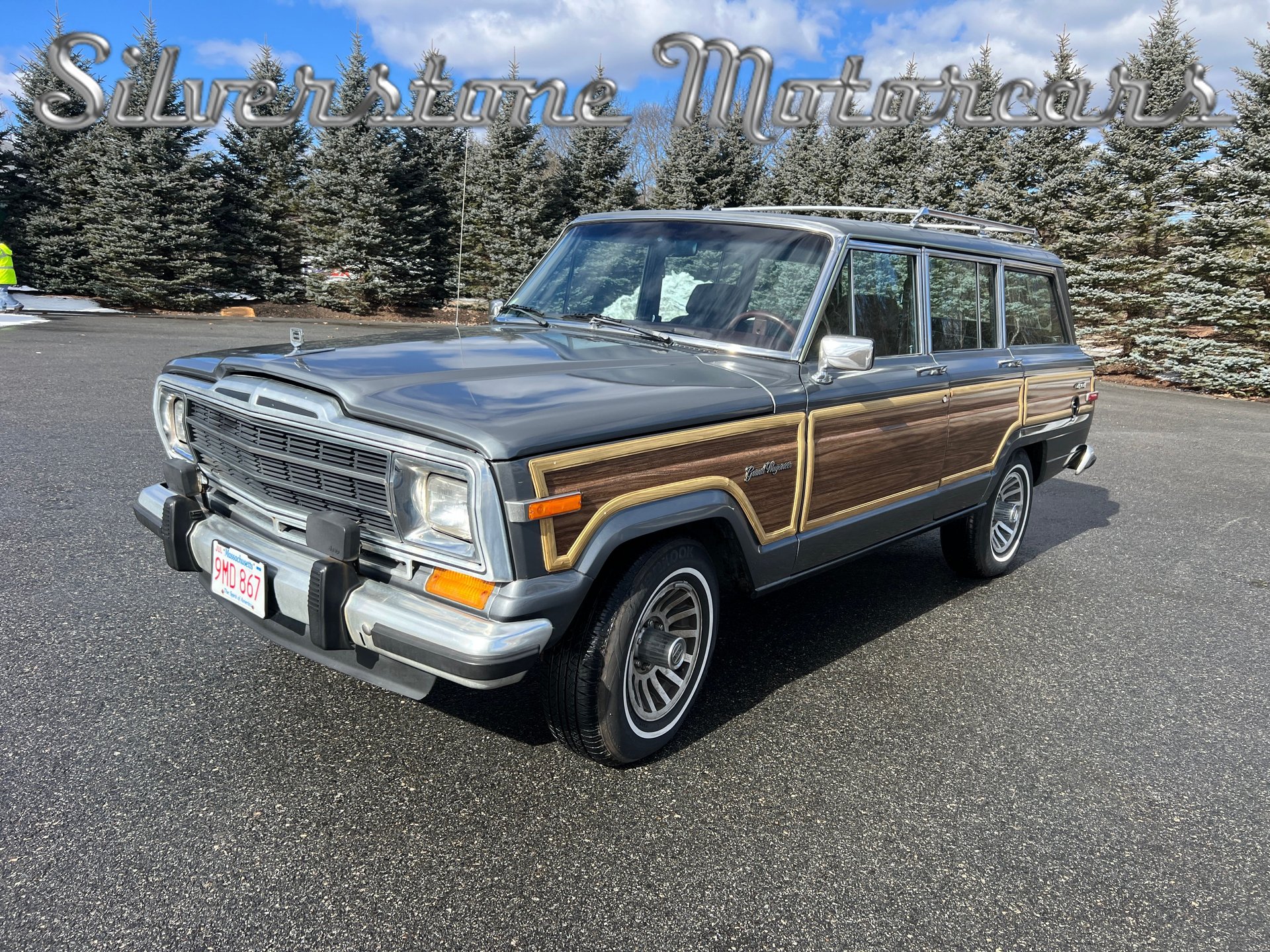
The woodgrain is not wood and not paint: it is a printed vinyl film (3M Di-Noc) applied to the side panels and tailgate, framed by a moulded surround that imitates a wooden frame. Sun cooks it, edges lift, the print fades and cracks, and water gets behind it and rusts the panel it decorates. Replacement kits exist and the material itself is a few hundred dollars, but fitting it properly — panels stripped, rust dealt with, film applied without bubbles, surrounds refinished — is a $1,500–3,000 job done well, and a car wearing brand-new woodgrain over unexamined quarters should make you more suspicious, not less. The surround trim cracks at its corners and good pieces are hunted used parts.
Inside, the Grand Wagoneer's leather-and-carpet luxury was built to a price and ages accordingly. The leather splits on the driver's bolster first; the foam underneath crumbles; the headliner sags, universally, because its foam backing turns to dust — a re-trimmed headliner is a $400–900 job and a sagging one is near-certain on any car that has not had it done. Carpets fade and hold the smell of every leak the car ever had. The dashboard pads crack in sun-state cars. None of this is structural, all of it is visible, and a full professional interior restoration costs more than most mechanical rebuilds, which is why a genuinely original, intact interior is worth a real premium. Seat condition, like tailgate condition, is a price-setter: sit in every seat, because the passenger side of a Wagoneer interior routinely looks a decade younger than the driver's side.
The electrics deserve their own warning, because the SJ has one genuinely dangerous known fault: on cars with the dash ammeter, the full charging current passes through the gauge and its bulkhead connections, and corroded connections there overheat — melted wiring and under-dash fires are documented. Many cars have been converted to a voltmeter or had the ammeter bypassed, and evidence of a sensible conversion is a plus, not a demerit; an original ammeter car deserves a close look at the wiring behind the dash and at the bulkhead connector for heat damage. Beyond that, the failure pattern is the usual one for the era, concentrated in the tailgate: the rear window motor, its safety switch and the wiring that flexes at the gate hinge fail together and separately, the dash switch and the key switch at the gate rarely both work, and the correct diagnosis order is power at the gate, then the safety switch, then the motor — in that order, because motors are condemned daily for what is actually a failed switch. Power windows, locks, seats and the cruise control on late cars all fail at their switches and vacuum or electrical connectors first. A Wagoneer where everything electrical demonstrably works has been maintained by someone who cared, and that is one of the best buying signals there is.

The XJ Wagoneer: a different list
The compact XJ fails differently because it is built differently. Its unibody rots in the floor pans, the rocker panels and the frame rails around the spring and control-arm mounts — and because the structure is the body, perforation here is structural in a way an SJ body panel is not. The 4.0 six is strong but its cooling system is marginal and its sealed early form cannot be bled of air carelessly; overheating warps heads. The Renix electronics, the crank sensor, the Peugeot manual gearbox fitted to some early cars (weak; the Aisin boxes are the ones to have) and the vacuum front-axle disconnect shared with its SJ contemporary make up the rest of the standard list. Buy an XJ on the 4.0 engine, a rust-free shell and a working cooling system, in that order.
How to inspect one
Allow two hours, not one: a Wagoneer is a big vehicle with a frame, a tailgate and a four-wheel-drive system that all need separate verdicts. Bring a torch, a magnet wrapped in cloth, a screwdriver for prodding (with the seller's permission), a tyre-pressure gauge and a phone to photograph the underside. If the car passes you, pay for a lift inspection before money changes hands — on a frame vehicle it is the best money in the whole purchase.
- Start with identity and paperwork. Match the VIN on the title to the plate on the driver's door jamb and the stamping on the frame. Confirm which Wagoneer you are actually looking at — SJ or XJ, and which engine and transfer case the codes and the hardware say, not the badge. A "401" that is really a 360, and a "Grand Wagoneer" that is really a Limited with later trim, are both common enough to check for by default. A thick history file, especially one with frame, tailgate or transfer-case invoices, is worth real money.
- Cold start. Insist the engine is cold when you arrive. A V8 should fire promptly, hold a fast idle that steps down as it warms, and show no blue smoke beyond a single puff (valve seals) and no smoke under load (rings). Listen for the cold exhaust-manifold tick described in the engines section, and for timing-chain rattle at start-up that does not fade.
- Oil pressure, hot. Drive or idle the car fully warm and read the gauge at hot idle. An AMC V8 whose pressure collapses at hot idle with the warning light flickering is pricing a timing-cover and oil-pump job into the deal. Smell the oil on the dipstick for fuel, and look under the filler cap for emulsion — the cooked-six head-gasket tell.
- Under the car: frame first. Torch along both frame rails, prod the rear horns around the spring hangers, the mid-rails under the doors and the front rails at the steering box. Perforation in any of these is structural and reprices or ends the inspection, exactly as the rust section sets out. Then the body mounts and outriggers: collapsed mounts and rotten outriggers explain bad door shut and wandering gaps, and they are part of the same verdict.
- Floors, rockers and quarters. Lift all the carpets, front and rear, and the cargo-area covering. Prod the pans, feel the rockers along their full length, and feel the rear quarters from inside the cargo area, behind the trim, where the mud trap lives. On a woodgrained car, read the film for blistering as you go — the magnet over the lower quarters and rockers will find filler the eye misses.
- The tailgate test. Open and close the gate, swing it and listen for loose rust inside, run the rear window fully down and up twice from both switches, and inspect the gate's bottom edge and window channels with the window down. A slow, crooked or dead window, a bubbled bottom edge or a gate full of rust flakes is the $2,000–4,000 conversation from the problem-areas section, held before you buy, not after.
- Transfer case and 4WD, demonstrated. Do not take four-wheel drive on faith. On a Dana 20 car, engage and disengage high and low range. On a Quadra-Trac, drive full-lock circles on a loose or wet surface and listen for chain skip and judder — and ask what fluid is in the case, because the wrong fluid mimics the worn chain. On a Selec-Trac Grand Wagoneer, work through every mode on the lever and switch and confirm the front axle actually engages; the vacuum faults in the engines section mean an undemonstrated system is priced as not working.
- Axles, steering and springs on the move. On the test drive — twenty minutes minimum, with a highway stretch — judge the steering wander at speed, rock each front wheel for bearing and joint play back at base, check the rear wheels for the AMC 20 hub play described in the problem areas, and stand back to read the stance: nose-up means tired rear springs, and tired springs change the steering geometry, so the two observations belong together.
- Gearbox behaviour. The TH400 and TorqueFlite should engage drive and reverse promptly, without a clunk, and shift firmly under power with no flare on the 2–3 change. Smell and read the fluid: dark and burnt means a rebuild conversation at the prices in the gearbox section. On a manual car, test second-gear synchromesh and the transfer-case lever in the same drive.
- Brakes and a hard stop. From speed, brake firmly: the car should stop straight, without judder, pull or a pedal that sinks. Then inspect what you can see — disc condition, hose perishing, fluid level and colour. Budget the full hydraulic refresh from the problem-areas section on any car that has sat, whatever the pedal feels like.
- Electrics, everything, including the dash. Work every window, the tailgate window again, locks, seats, lights, wipers front and rear, heater and air conditioning, cruise control if fitted. On an ammeter car, look behind the dash and at the bulkhead connector for heat damage — the one inspection item on this list that is about fire, not money. A car where everything works has been maintained; price that signal in.
- Interior last. Sit in every seat, especially the driver's, and feel for split leather and collapsed foam. Lift your eyes: a sagging headliner is near-universal and priced in the problem areas; a good one has usually been replaced, which is a plus. Check the woodgrain and its surrounds in daylight, corner by corner. A sound, original interior is the hardest part of a Wagoneer to recreate, so weight it as heavily as the frame.
Values
The market block beneath this guide carries the current numbers — what is listed now, and what recorded sales have achieved — and it is refreshed from our own store data at every build, so this section deliberately carries no prices of its own. Its job is to teach you how to read those numbers, because the Wagoneer market punishes anyone who reads a single median and stops thinking.
The first thing to understand is the condition spread, which on Wagoneers is wider than on almost any comparable classic. The same model year of Grand Wagoneer can be a rusted, non-running parts donor, an honest driver with tired woodgrain and a sagging headliner, or a fully restored truck with a rebuilt drivetrain, new woodgrain over sound metal and a retrimmed interior — and the distance between the bottom and the top of that range is not a percentage, it is a multiple. When you compare a listing against the recorded sales, compare it against cars in its own condition band, not against the model's overall median. A driver priced like a restored car is the most common overpricing pattern in this market; a restored car priced like a driver is the rarest bargain in it.
Second, asking prices and achieved prices diverge in a specific direction here. The Grand Wagoneer's fame pulls in optimistic sellers — the model has a genuine celebrity-and-nostalgia premium, and some asking prices are set by what the seller has seen a concours truck achieve rather than by what their truck is. Auction results and recorded sales are the discipline: they show what buyers actually paid, condition by condition. Where a listing has sat unsold for months at a price above the achieved range for its condition band, the market has already given its verdict, and a buyer's offer anchored to the recorded sales is not an insult, it is evidence.
Third, know which variants carry premiums and why. The 1991 Final Edition Grand Wagoneers sit at the top, followed by the best late Grand Wagoneers generally — the market pays for the final, fully developed form of the icon. The 401-powered 1970s cars carry a driver's premium that their production rarity supports. Early cars, Super Wagoneers especially, are a thinner, more specialist market: the right buyer pays properly for the right car, but the queue of buyers is shorter, so selling takes longer and pricing evidence is sparser. XJ Wagoneers sit in a different and lower market altogether, pulled along by Cherokee values rather than by the SJ's fame — do not let a seller price an XJ off Grand Wagoneer headlines, and do not let a buyer price a good SJ off XJ money either. Originality cuts both ways: an unrestored, unrusted survivor with its factory woodgrain and interior intact can out-earn a shinier restored car, because the restoration inputs — tailgate, woodgrain, interior — are exactly the expensive parts, and original ones cannot be bought at any price once they are gone.
Finally, the project-versus-driver gap. A project Wagoneer is cheap to buy and expensive to own in a very predictable way: frame work, a tailgate, woodgrain and an interior, done properly, will together cost more than the premium of a good car over a project — before the engine, transfer case and brakes are touched. The recorded sales make this visible if you read them by condition: the gap between project money and good-driver money is consistently smaller than the cost of closing it. Buy the best condition band you can afford, and treat any car priced below its band as a question to be answered by the inspection, not as a discount.
Parts and ownership
The Wagoneer is one of the best-supported American classics of its era, for a simple reason: Jeep built the SJ for twenty-eight years, the mechanicals are shared with the CJ, J-trucks and Cherokees of the period, and the Grand Wagoneer's collector boom has pulled a reproduction industry into existence behind it. Several US specialists now concentrate on the SJ alone, stocking everything from woodgrain kits to tailgate components.
Easy: service items for every engine in this guide, brake discs, pads, calipers and hydraulics, suspension wear parts, leaf springs and bushings, steering joints and couplings, water pumps, radiators, exhaust systems, TH400 and TorqueFlite rebuild parts and labour (any competent transmission shop knows both), Dana axle parts, glass seals and weatherstripping, and the common electrical consumables — ignition modules, switches, window motors. Order today, fit this weekend, at prices close to ordinary truck money.
Harder and dearer: good tailgates and tailgate internals, the woodgrain surround trim in uncracked condition, Quadra-Trac chains and the correct case fluid, early Tornado and 327 engine-specific parts, Super Wagoneer and other early trim and brightwork, uncracked dashboard pads, and the vacuum components for the Selec-Trac system — individually cheap, but correct diagnosis is the scarce resource. A quality repaint on a vehicle this size, with the woodgrain removed and refitted properly, is a five-figure conversation at professional rates, which is why the standing advice for this model is to buy the body, the frame, the tailgate and the interior, and fix the mechanics.
Running costs. A sorted Wagoneer is a realistic regular-use classic with truck appetites: fuel consumption in the low-to-mid teens per gallon from a V8 car, less from a six, servicing that any good independent shop can handle, and insurance in line with other classics of similar value. The budget line that catches new owners is the same one that catches buyers of every deferred-maintenance classic — the first year. Catching up on a running car honestly costs $2,000–5,000 before you improve anything: fluids everywhere including the transfer case with its correct fluid, belts, hoses, brake hydraulics, ignition consumables and the vacuum hoses a late car depends on. Recommissioning a car that has sat for years runs $4,000–8,000 at a shop, with the fuel system cleaned end to end (modern ethanol fuel attacks old rubber and leaves varnish in tanks), every brake component inspected, and all seals assessed. Buy a car in regular use over one that has been asleep, even at a higher price — on a Wagoneer, use is what keeps the transfer case, the tailgate window and the vacuum systems alive.
Which one to buy
- The all-rounder: a 1988–91 Grand Wagoneer. The final form of the icon — 360 V8, TorqueFlite, Selec-Trac, every toy fitted — with the deepest market to buy from, the best specialist support and the strongest resale. If you want one Wagoneer to drive and enjoy, this is it.
- The value buy: a 1978–83 Wagoneer Limited. The Grand Wagoneer experience — leather, woodgrain, Quadra-Trac — before the name change, usually for noticeably less than an equivalent late car. The same inspection applies, and the same tailgate prices the deal.
- The driver's car: a 401-powered 1970s Wagoneer. The strongest engine Jeep fitted, forged internals from the factory, and a premium the performance justifies. Verify the engine is a genuine 401 before paying the premium — the badge proves nothing.
- The charmer: an early Kaiser Wagoneer. Slim bumpers, simple mechanicals, the Tornado six or the 327, and a period charm the late cars cannot match. Buy it for love, with your eyes open about early trim and engine-specific parts.
- The modern classic: an XJ Wagoneer Limited with the 4.0. Lighter, quicker, more economical and far more modern to drive, at a fraction of SJ money. A different vehicle — judge it by Cherokee rules, the 4.0 and a rust-free unibody above all.
- The collector car: a 1991 Final Edition Grand Wagoneer. The last of the line, the price ceiling of the market, and the car where originality pays the highest dividend. Verify Final Edition provenance and original woodgrain and interior ruthlessly, because a wrong or restored-over car is worth a fraction of a correct one.
And the rule that overrides all of the above: buy the least rusty Wagoneer you can find, with a sound tailgate and an intact interior, in the specification you can live with. Engines, gearboxes, transfer cases and brakes are all fixable at prices you can plan for. A rotten frame, a destroyed tailgate and a gutted interior cost more to put right than the finished car will be worth — and they are the things about a Wagoneer that can never be made original again.
See the 20 Wagoneer cars currently listed.