
Jeep CJ5 buyer's guide
Jeep CJ5 -- the model's own buyer's guide: variants, values and what to check.
Years listed: 1968-1986 · Series: Jeep
Overview and history
The CJ is the civilian descendant of the wartime Willys MB, and it never pretended to be anything else. CJ stands for Civilian Jeep, and for forty-one years — from the CJ-2A of 1945 to the last CJ-7 and CJ-8 of 1986 — the formula barely changed: a separate steel frame, a folding windscreen, a flat-sided open tub with removable doors and top, live axles on leaf springs at both ends, a part-time four-wheel-drive system with low range, and the shortest overhangs of anything on the road. Everything a modern SUV hides, a CJ wears on the outside. That is the whole appeal, and it is also the whole buying problem, because a vehicle built this simply, used this hard and left outside this often survives or dies on the condition of two pieces of metal: the frame and the tub.
The line runs through three owners. Willys-Overland launched the CJ-2A in 1945, essentially the military jeep with a tailgate and civilian colours. The CJ-3A of 1949 tidied the windscreen into one pane, and the CJ-3B of 1953 raised the hood to clear the taller Hurricane F-head — the high-hood look that identifies a 3B at fifty paces. Kaiser bought Willys in 1953 and introduced the CJ-5 of 1955, based on the military M38A1: rounder fenders, a longer wheelbase than the flatfenders, and a production run that lasted until 1983. Its long-wheelbase sister, the CJ-6, arrived in 1956 and stayed, mostly for export and fleet buyers, until 1981.
American Motors bought Kaiser Jeep in 1970, and the AMC era is where most of today's market lives. AMC lengthened the CJ-5's engine bay in 1972 to take its own straight-sixes and the 304-cubic-inch V8, and in 1976 it launched the CJ-7: a longer wheelbase again, a wider choice of gearboxes including an automatic, optional full-time four-wheel drive, and doors and a hardtop designed for the car rather than adapted to it. The CJ-7 is the usability sweet spot of the whole line and the model most buyers actually want. The last new CJ was the CJ-8 Scrambler of 1981, a CJ-7 stretched into a short-bed pickup, built in small numbers and now the most sought-after of the late cars. Production of the CJ-7 ended in 1986, replaced for 1987 by the Wrangler YJ — square headlamps, a galvanised body, a different philosophy. Purists have drawn the line there ever since, which is one reason honest CJs keep getting harder to find.
Our own listings show exactly that late-weighted shape. We currently track 90 CJs for sale or recently sold, 72 of them for sale as we write, spanning 1968 to 1986 — and the year histogram is a cliff face at the AMC end: 1979 is the single biggest year with 15 cars, the 1983 to 1985 cars form the next band, and everything from 1976 onward accounts for the overwhelming majority. The pre-1976 cars — the early CJ-5s and the last flatfender-era survivors — appear only in single digits. The tracked cars cluster in the Southeast and Midwest: North Carolina, Florida, Ohio, Alabama, Georgia and Texas lead the list. Read that geography into every car you view — humidity, mud and, near the coast, salt air are the rust sections' whole reason for existing.
One more thing defines today's market. CJs were cheap working vehicles for most of their lives: ploughed with, hunted from, driven on beaches, left behind barns, modified by every owner they passed through and repaired with whatever was on the shelf. Very few are original, and the modifications range from excellent to lethal. So the CJ discipline is not the pampered-sports-car discipline: you are hunting first for a sound frame, a sound tub, a driveline not abused past its limits, and modifications you can identify and reverse. Everything else on a CJ unbolts on a driveway in a weekend. The frame and the tub cannot.

The models
The CJ badge covers a family, not a single car, and the first job is knowing which member of it you are looking at — because wheelbase, doors, tops, gearboxes and values all change with the number after the CJ. The table below covers the models that make up the market today. Outputs are period factory figures, gross ratings for the earlier cars and net ratings from the early 1970s onward, which is why the numbers step down on paper around 1972 without the cars getting much slower. Production figures are the commonly established whole-run totals, given only where the number is genuinely known.
| Model | Years | Engine | Output | Built | Character |
|---|---|---|---|---|---|
| CJ-2A | 1945–1949 | 134 flathead four (L134) | 60 hp | about 214,760 | The original civilian jeep; flatfender, agricultural, charming |
| CJ-3A | 1949–1953 | 134 flathead four (L134) | 60 hp | about 131,900 | One-piece windscreen; the tidier flatfender |
| CJ-3B | 1953–1968 | 134 F-head four (F134 Hurricane) | 75 hp | about 155,490 | The high-hood car; long-lived, mostly work and export |
| CJ-5 | 1955–1983 | F134, Dauntless 225 V6, AMC 232/258 sixes, 304 V8, Iron Duke four | 75–150 hp | about 603,300 | The core CJ for three decades; short, nimble, basic |
| CJ-6 | 1955–1981 | F134, Dauntless V6, AMC sixes and 304 V8 | 75–150 hp | about 50,170 | The long-wheelbase CJ-5; rare in the US, space for real loads |
| CJ-7 | 1976–1986 | 258 six, 304 V8, Iron Duke 151 four, AMC 150 four, 232 six early | 82–150 hp | about 379,300 | The all-rounder; automatic option, hardtop, the usable CJ |
| CJ-8 Scrambler | 1981–1985 | Iron Duke 151 four, 258 six | 82–115 hp | about 27,790 | The pickup CJ; rarest late car, strongest following |
The flatfenders: CJ-2A, CJ-3A and CJ-3B. These are the cars closest to the wartime original — flat front fenders, a windscreen that folds flat onto the hood, minimal weather protection and a top speed set by gearing and courage rather than power. The 2A and 3A use the L-head Go Devil four; the 3B's F-head Hurricane puts the intake valves in the head and is the stronger, more usable engine. Flatfenders are bought as vintage vehicles, driven at vintage speeds and judged by vintage standards: originality matters, correct Willys hardware matters, and a car that has been re-engined with a V8 is worth less, not more, however quick it is. They barely appear in our listings — the tracked span starts in 1968 — so treat any flatfender purchase as a specialist market of its own.
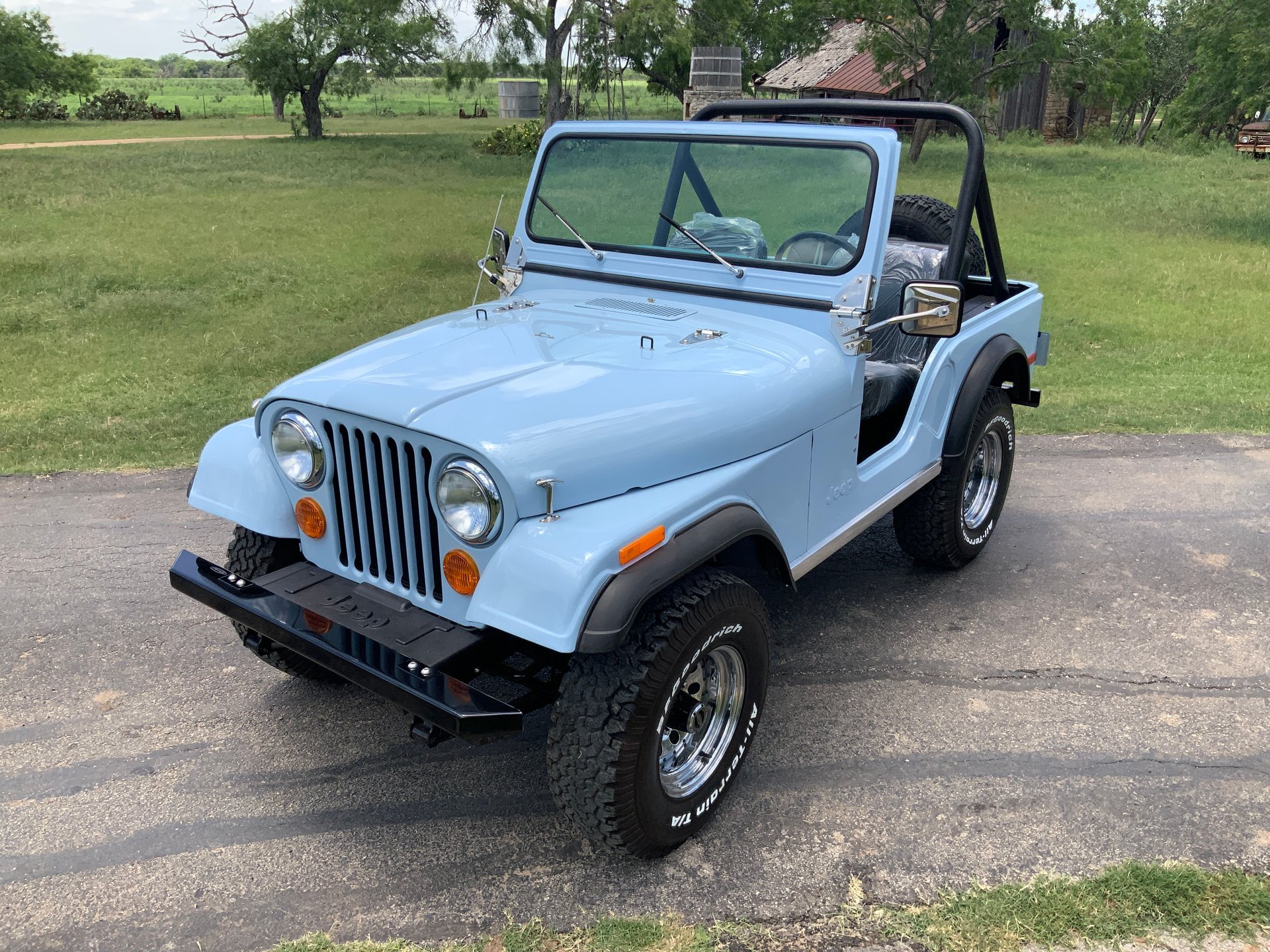
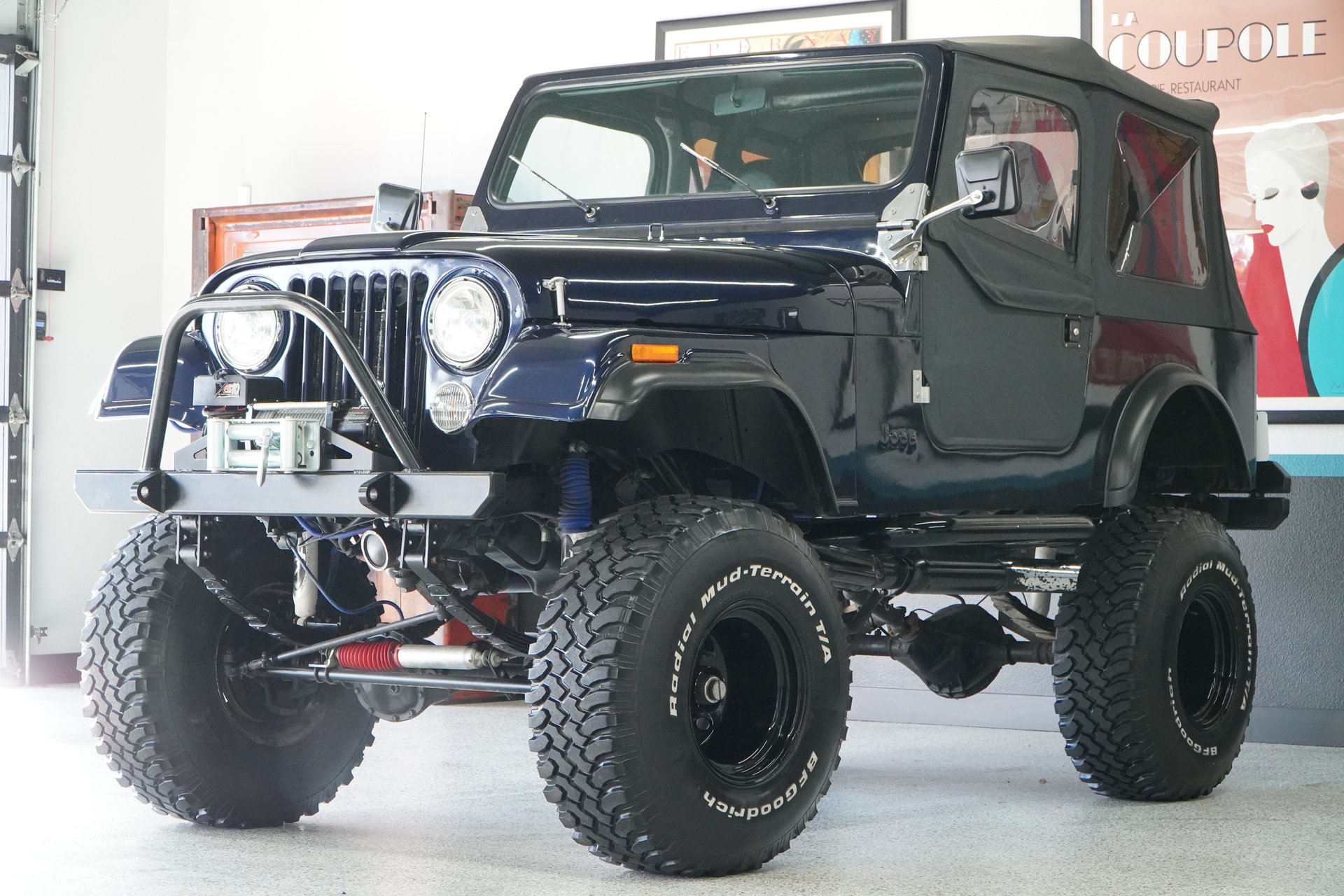
The CJ-5 (1955–1983). The volume car of the line and, in AMC form, the second most common CJ in our listings. Two distinct cars hide under the one badge. The 1955–71 Kaiser cars have the short nose, the F-head four or — from 1966, and transformatively — the Buick-derived Dauntless 225 V6, and Willys-pattern running gear. The 1972–83 AMC cars have the lengthened front clip, AMC sixes or the 304 V8, stronger frames and much better parts support. What never changed is the shape: an 83.5-inch wheelbase, a short curved door opening that no full hard door was ever properly designed for, and a driving position and ride that remind you constantly how short the car is. A CJ-5 is the most characterful of the late CJs and the least practical: awkward to get into, cramped once you are there, and the first to feel busy at highway speed.
The CJ-6 (1955–1981). A CJ-5 stretched by 20 inches of wheelbase, sold as the working and export CJ. The extra length buys real load space and calmer road manners. US-market cars are genuinely scarce, and scarcity cuts both ways: a premium when you buy, a thin market when you sell, and some body and top parts that are CJ-6 only.
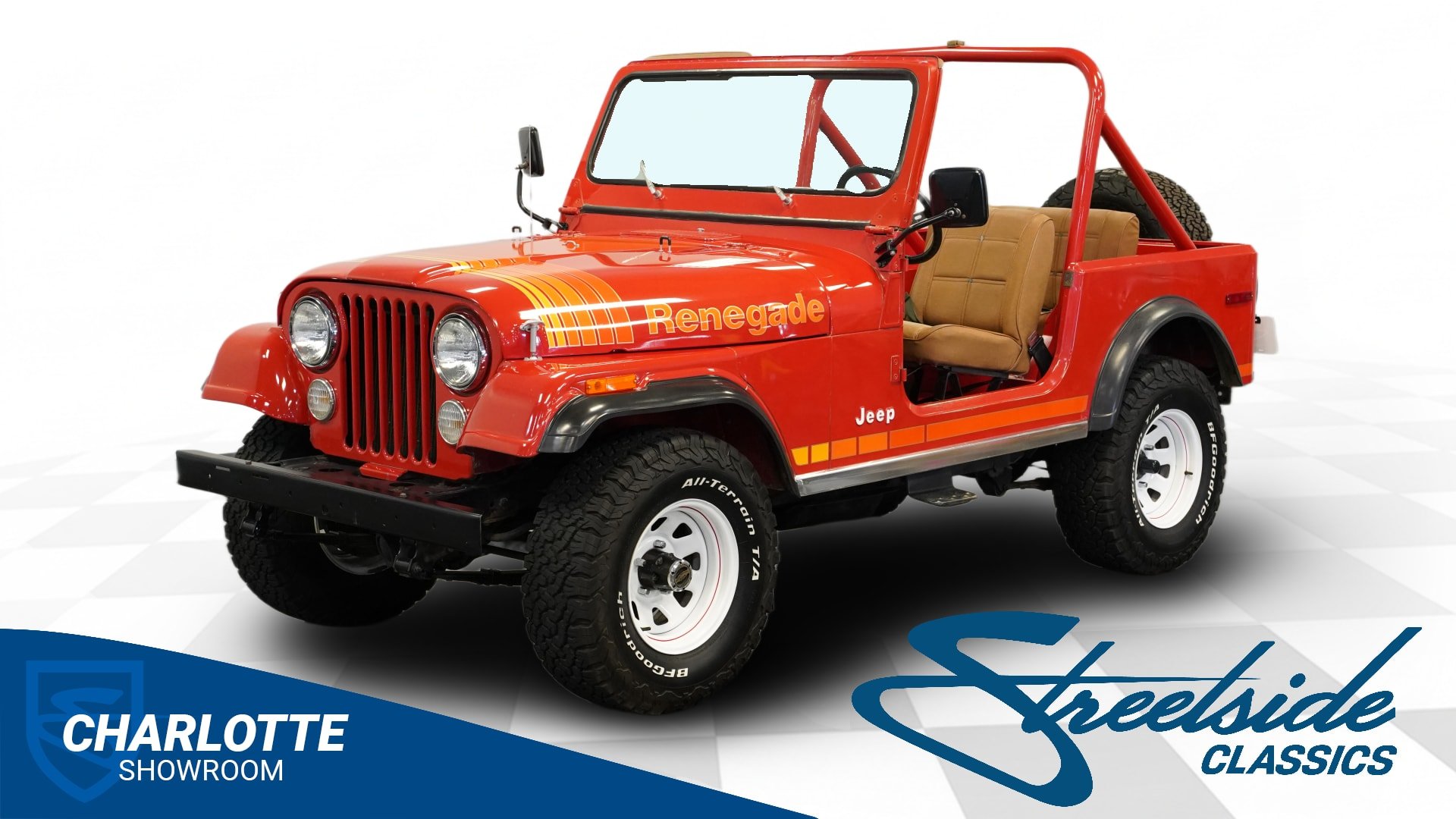
The CJ-7 (1976–1986). The car AMC designed to widen the CJ's audience, and the centre of today's market — the brief's own display model for the whole CJ pool is a CJ-7, which tells you where the listings weight sits. The wheelbase grew to 93.5 inches, the door openings became full-size and rectangular, the tailgate and hardtop were designed in from the start, and for the first time a CJ could be had with an automatic gearbox and, with it, full-time four-wheel drive. Trim packs layered on top: Renegade (graphics, wheels, dress-up), Laredo (chrome, leather-wrapped wheel, clock and tachometer, the luxury CJ), Golden Eagle and the denim-trimmed Levi's editions of the late 1970s. A CJ-7 is the CJ you can use every day, take on a freeway without planning your will, and fit a proper top and doors to. It is the default recommendation at the end of this guide for a reason.
The CJ-8 Scrambler (1981–1985). A CJ-7 stretched to a 103.5-inch wheelbase with a short separate pickup bed, a half cab as standard and a full-length soft top optional. Jeep built fewer than 28,000, many went to fleets and overseas — the postal service in Alaska used a right-hand-drive version — and survivors have the strongest enthusiast following of any late CJ. The Scrambler's extra length makes it the best-driving CJ of all and the most useful; its rarity makes it the most expensive and the most cloned. A CJ-8 built from a cut-down CJ-7 is a known thing: check the VIN, the frame length and the bed's factory seams before you pay Scrambler money.
Trim is not identity. Renegade stripes, Laredo chrome and Golden Eagle decals were all sold over the parts counter and have been applied to base cars for forty years. Trim adds value only when the rest of the car supports it; what prices a CJ is the model, year, engine and gearbox it actually carries, and the state of the frame and tub.

Engines and gearboxes
The fours: Go Devil, Hurricane and Iron Duke
The original CJ engine is the Willys L134 Go Devil, a 134-cubic-inch (2.2-litre) flathead four making about 60 hp, fitted to the CJ-2A and CJ-3A. It is as simple as an engine gets — side valves, a single Carter carburettor, a six-volt electrical system on early cars — and it will run, apparently forever, on neglect that would kill anything modern. What it will not do is hurry: gearing limits a flatfender to about 45–50 mph in comfort, and judging one by modern standards misses the point entirely. The F134 Hurricane that replaced it in the CJ-3B and early CJ-5 keeps the exhaust valves in the block and moves the intakes into the head — the F-head layout — and makes about 75 hp. It is the better engine in every way that matters on the road, and its taller deck is why the 3B needed the high hood.
At the other end of the run sits the GM Iron Duke 151 (2.5 litres, about 82 hp), the base engine in CJ-7s and CJ-8s from 1980 to 1983, fitted because AMC needed a cheap, emissions-clean four. It is a durable Pontiac-built engine in a car it cannot comfortably move: an Iron Duke CJ-7 is slow in a way a six never is, and the market prices it accordingly. AMC's own 150 four replaced it from 1984, better matched but still the economy choice. Unless you specifically want a lightweight trail car, buy a six — the fours are cheaper for a reason that becomes obvious on the first hill.
The Dauntless V6 and the AMC sixes
The engine that first made a CJ properly quick was not a Jeep engine at all. From 1966 Kaiser offered the Dauntless 225 — Buick's odd-fire V6, built on tooling Jeep bought from General Motors — in the CJ-5 and CJ-6. At 160 hp in a car weighing little over a ton, it transformed performance, and its uneven, lopey idle is a design feature of the odd-fire crankshaft, not a misfire: learn the rhythm before you let anyone diagnose it. Dauntless cars have a devoted following, strong torque and one standing caution — flywheel and clutch parts are V6-specific, and the engine left the range when AMC took over and GM bought the tooling back.
The engines you will actually meet in most listings are AMC's straight-sixes, the 232 (3.8 litres) and above all the 258 (4.2 litres), standard or optional in the CJ-5 from 1972 and the backbone of the CJ-7 range to the end in 1986. The 258 makes roughly 110–115 hp in net terms depending on year and carburation, but the number that matters is torque — a little over 190 lb-ft, arriving low and staying flat. A healthy 258 starts easily, pulls from idle in almost any gear, and is famously hard to kill: seven main bearings, a simple single- or two-barrel carburettor, and a tolerance for indifferent servicing that borders on the irresponsible. What ages is everything bolted to it. The Carter BBD two-barrel carburettor fitted to most 1978-onward 258s is the single most complained-about component in the late CJ world: its idle tubes clog with debris, producing a car that idles badly or not at all, stalls at junctions, and gets misdiagnosed as ignition, vacuum leaks and worse. The test is the pattern — a 258 that runs cleanly at speed but will not idle has a BBD asking for a clean-out or rebuild, a job costing a few hundred dollars done properly, not an engine fault. Earlier cars use the simpler Carter YF or Motorcraft 2100-pattern carburation and give less trouble. Valve cover gaskets leak on every six ever built — the later plastic valve covers warp and leak worse — and a six with oil down its right-hand side is normal, while a six with low oil pressure hot, a deep knock under load or blue smoke under power is a rebuild conversation in the $3,500–6,000 range at a machine shop.
Emissions equipment is the other six-cylinder tax, and it grows with every model year. A 1981-onward car carries a thicket of vacuum hoses, an air pump on many versions, a computer-controlled carburettor in the final years and a catalytic converter. Hoses perish, previous owners delete systems half-heartedly, and the result is a car that runs worse than either a clean original or a properly simplified one. In states with smog inspection, an incomplete emissions system is not a bargaining point, it is a fail — check what your state requires before you fall for a late car with an empty engine bay and a confident seller.
The 304 V8
AMC's 304-cubic-inch (5.0-litre) V8 was the CJ's factory performance option from 1972 in the CJ-5 and CJ-6 and through the CJ-7's life, rated at about 150 hp net in most years with torque around 245 lb-ft. On paper the gain over the 258 looks modest; on the road it is not. The 304 gives a CJ genuine pace, a proper V8 soundtrack and effortless highway cruising, and it does it with an engine that shares its architecture with AMC's larger 360 and 401 — which is where the trap sits. Because the three engines look alike and swap easily, the CJ world is full of V8 cars whose engine is not what the badge, the listing or sometimes the seller believes it to be. AMC cast the displacement into the side of the block: get under the car with a torch and read it. A 360 or 401 swap is not necessarily a bad car — it may be a better one — but it is a modified car, it must be priced as one, and a swap done without the matching cooling, gearing and brake consideration is a warning about the rest of the workmanship. The 304's own weaknesses are ordinary AMC V8 weaknesses: oil pressure that fades with wear (watch the hot idle figure), timing-cover and rear-main leaks, and cooling that was marginal from the factory in a short engine bay — a V8 CJ that runs hot in traffic usually needs radiator capacity and fan attention, in the $400–1,000 range, before it needs an engine. Note what was never fitted: no CJ left the factory with a 360 or 401, whatever the listing says, and no factory CJ V8 came with fuel injection. Both claims in an advert mark the car as modified, full stop.

Gearboxes and transfer cases
Manual gearboxes span the whole history of the marque, and identifying which one a car carries matters, because strength varies enormously. The early cars use the Warner T-90 three-speed, adequate behind a four and marginal behind anything else. The T-14 and T-15 three-speeds served the V6 and early AMC cars. The T-18 four-speed, with its very low first gear, is the trail driver's prize in 1970s cars — slow, immensely strong, and worth a premium in a car that will actually be used off-road. From 1976 the common CJ-7 manual is the T-150 three-speed, and from 1980 the SR4 and then the T-4 and T-5 four- and five-speeds arrived: lighter-duty car-derived boxes that are pleasant on the road and the weak link in a hard-used late car. A T-5 behind a V8, or in a car on oversize tyres, that whines, jumps out of gear or crunches into third is a rebuild in the $1,200–2,500 range — and a reason to ask what else the driveline has absorbed. The T-176 four-speed fitted to many 1980-onward sixes is the stronger late box and the one to prefer. Automatics are CJ-7 only: the GM Turbo Hydra-Matic 400 from 1976 to 1979, always paired with Quadra-Trac, and the Chrysler TorqueFlite 999 from 1980 on. Both are strong, well-understood boxes; judge them on fluid colour, shift quality and engagement delay, with a rebuild in the $1,800–3,200 range if they fail the test.
Transfer cases divide the same way. The Dana 18 (early cars, offset rear output), the Dana 20 (most 1972–79 AMC cars) and the Dana 300 (1980–86) are part-time cases with a proper low range, and the Dana 300 in particular is one of the best transfer cases ever fitted to a production 4x4 — gear-driven, compact and strong. The exception is Quadra-Trac, the Borg-Warner 1339 full-time system fitted to automatic CJ-7s from 1976 to 1979: a chain-driven case with a centre differential, excellent on slippery roads when new, and now dependent on a Morse chain and a specialised fluid that are both increasingly hard to source. A Quadra-Trac car that shudders, clunks or binds on turns is telling you the chain is stretched or the differential is worn, and that is specialist money — $1,500–3,000 to put right properly. Many have been converted to part-time; a converted car is fine if the conversion is complete and documented. Axles follow the same pattern of honest strength with one famous exception: Dana 27 and 30 fronts and Dana 44 rears on earlier cars are all serviceable, but the AMC 20 rear axle fitted from 1976 has two-piece axle shafts whose hubs can spin under hard use — the standard cure is a one-piece shaft kit, a few hundred dollars in parts, and finding a car already fitted with one is a quiet mark in its favour.
Problem areas
Everything in this section reduces to one sentence: on a CJ, metal condition is destiny. Our own photo examination makes the point with a small but blunt sample — of the 8 CJ listings whose photo sets we have examined in detail for this guide, 6 showed rust somewhere in the photographs. That is a small sample and we quote it as one, but it matches the wider market exactly: assume rust is present until a car proves otherwise, panel by panel, with a torch. The mechanicals of a CJ are simple, strong and cheap by classic-car standards. A rotted frame or tub is none of those things, and it is the one purchase mistake that cannot be undone at sensible money.
Rust: the frame first, then the tub
The frame. A CJ frame is a ladder of boxed and channel sections, and it rots in predictable places, from the inside out and from the mud traps inward. Start at the rear: the frame horns behind the rear spring hangers, around the rear crossmember and the fuel tank, are the classic failure zone — mud and road salt sit there, the metal thins, and cracks start around the shackle mounts. Work forward along the rails at every spring hanger and body mount, prod the sections under the doors where the frame kicks up over the axles, and finish at the front horns and the steering box mount, where rust and stress cracking combine. Surface scale is normal on a forty-year-old frame and is not a verdict. Perforation, flaking layers, cracks at hangers, or a frame that rings dull and soft under a screwdriver is a verdict: walk away, unless the car is priced as a frame-swap project and you genuinely want one — a replacement galvanised frame plus the labour of swapping everything over runs well into five figures by the time the car drives again, $6,000–12,000 all-in at a shop. Be doubly suspicious of a frame freshly painted in uniform black or thickly undercoated for sale: as with every classic, fresh coating over everything is a cover-up until the seller proves otherwise, and honest frames look honestly patchy. Also check straightness. CJs were used off-road by people learning off-road, and a frame bent at a horn or twisted from a hard hit shows in uneven panel gaps, a crabbing stance and tyre wear that no alignment cures.
The tub. The steel body tub rots where water and mud sit against it. The map, in the order to check it: floor pans under the mats and seats, especially the front footwells where water enters past the cowl and windscreen seals; the hat channels — the pressed reinforcing channels under the floor that also carry the body mounts — which rot invisibly from inside and announce themselves as a tub that flexes, sags on its mounts or cracks around the mount bolts; the cowl sides and the panel below the windscreen; the rocker panels and the lower rear quarters behind the wheels; the wheelhouses, particularly where the roll bar feet and seatbelt mounts attach — a safety point, not a cosmetic one, because a seatbelt or roll bar bolted into rotten metal is decoration; and the tailgate and rear valance area on cars so fitted. A fibreglass tub changes the examination rather than ending it: glass bodies do not rust, which is their entire appeal, but they are replacement bodies — the car has already had the rust story once — and quality varies from excellent to dreadful. Check a glass tub for star-cracking around mounts, for proper grounding (a fibreglass body needs added earth straps, and electrical weirdness on a glass-tub car is usually exactly that) and for how the swap was finished. An aluminium tub is the premium version of the same conversation. Either way, price the car as the modified vehicle it is. Tub rust repair in steel — floors, channels and quarters cut out and welded — runs roughly $1,500–4,000 a side for the worst-affected areas done properly with paint on top, and a full professional tub replacement is a five-figure job; that arithmetic is why a sound original tub outranks every other virtue on a CJ.
Body mounts and hardware. The rubber mounts between tub and frame perish and let the tub sit down unevenly; a mount kit is a couple of hundred dollars in parts, but bolts rusted into their channels turn fitting it into a weekend. Doors, hinges and the windscreen frame rust and wear at their pivots; a windscreen frame rotten along its lower edge is a few hundred dollars plus paint, and it matters because it is also where the water that kills the floors gets in.
Steering, suspension and the driveline underneath
A CJ's steering is a recirculating-ball box, a long drag link and tie rods, working against short wheelbase geometry — and wear anywhere in the chain multiplies everywhere else. The standing test: with the car stationary and the engine off, rock the steering wheel and watch the front wheels. Play before the wheels respond, a knock from the box, or slop you can feel at the tie-rod ends means a front-end refresh — tie-rod ends, drag link, steering shaft joints and possibly a box rebuild, $500–1,500 in parts and labour depending on how far it goes. On the road, a sound CJ tracks acceptably straight and wanders only as much as its design dictates. A car that darts, tramps or needs constant correction is worn, misaligned, lifted badly or some combination of all three — not showing character. The steering box mount on the frame deserves its own look: the bracket and the frame rail behind it crack under the strain of oversize tyres, and a cracked mount is a safety item.
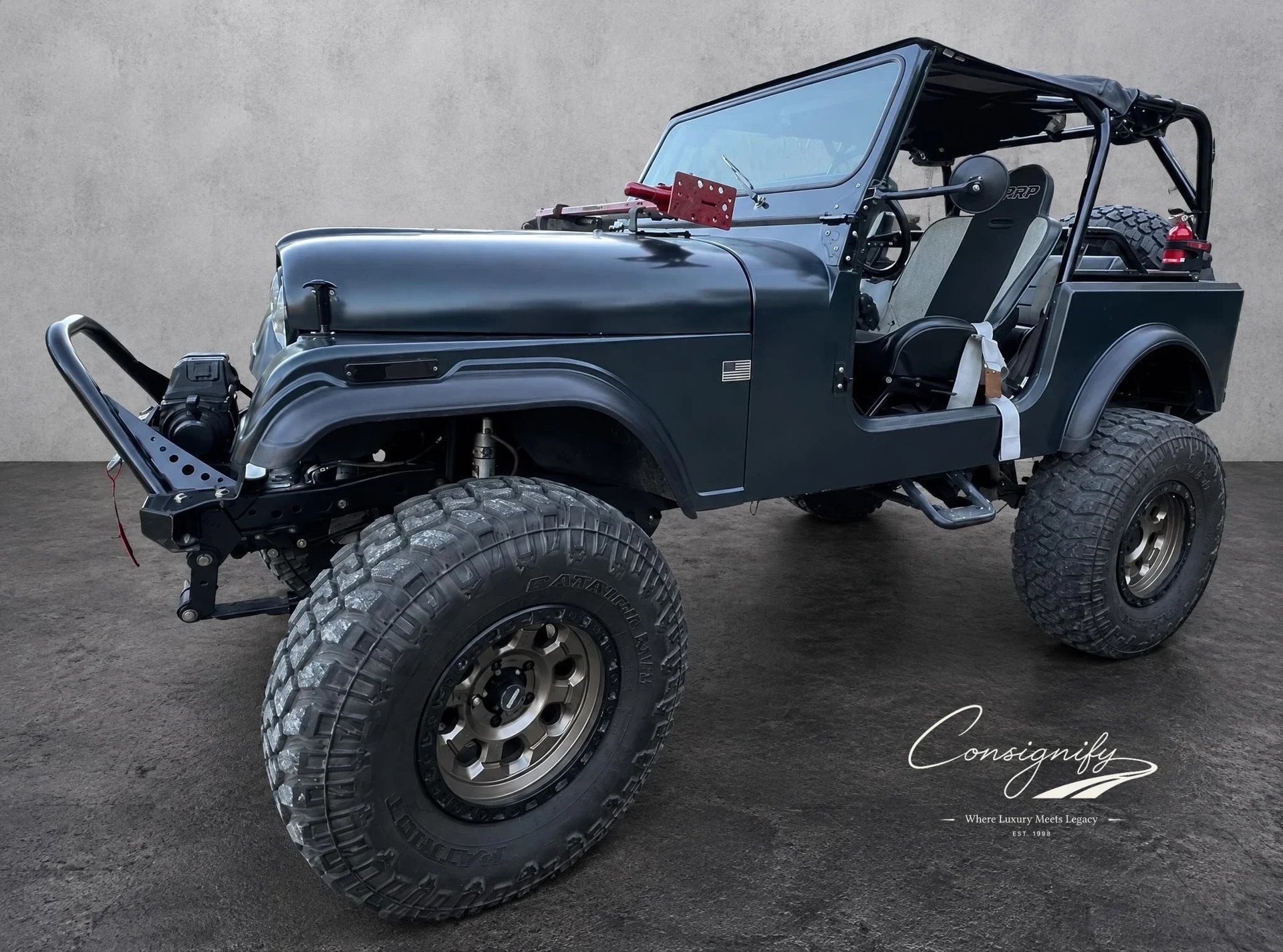
Leaf springs sag, crack leaves and wear their bushings oval; shackles bend and their bushings perish. A CJ sitting low on one corner or leaning permanently is telling you spring or mount, and a spring set with bushings is a $600–1,200 job fitted. Shock absorbers are cheap and universally neglected. Then come the lifts, because a large share of surviving CJs sit on one. A modest lift, properly done with matched springs, corrected steering geometry, longer brake hoses and a transfer-case and driveline setup that respects working angles, is fine. The failures are specific: driveline vibration from pinion angles nobody corrected, steering geometry that produces bump steer, brake hoses stretched tight at full droop, and a transfer case dropped on spacers as a shortcut. Ask who made the lift, how tall it is, and what was done about steering and brake lines — and treat vibration on the test drive as the lift's report card.
Underneath, work the driveline joint by joint. Universal joints are cheap and their failure is announced by clunks on taking up drive; a neglected one that lets go takes a yoke with it. Wheel bearings, kingpin or ball-joint condition depending on axle, and hub function all need a hand on them: jack each front corner, rock the wheel top and bottom for bearing and joint play, and spin it for roughness. Locking hubs should engage and release cleanly; automatic and full-time arrangements on late cars should do the same without graunching. Engage four-wheel drive and low range on any viewing — on loose ground, not dry tarmac, where a part-time system will bind and complain in a way that tells you nothing except that it works. A transfer case that will not select low, jumps out of gear under load, or whines loudly in every range is a rebuild in the $900–2,000 range for the gear-driven Dana cases, and more for Quadra-Trac, for the reasons given in the engines section.
Tyres are a driveline component on a CJ, not an accessory. Oversize tyres — 33 inches and up — on standard gearing make a six work hard, make a four hopeless, stress the AMC 20's two-piece shafts and the light-duty late gearboxes, and flatter nobody's fuel consumption. Mismatched tyres front to rear, or a spare of a different size, can damage a full-time system and strain a part-time one. Price a set of sensibly sized tyres into any car wearing worn or absurd rubber: $800–1,400 a set in typical CJ sizes, fitted.
Brakes, electrics and the interior
Brakes divide by era. Early cars run drums all round; front discs arrived optionally in the mid-1970s and became standard on CJ-7s toward the end of the decade, with power assistance increasingly common on late cars. Drum-braked cars stop adequately when everything is fresh and adjusted, and poorly when any part of that sentence lapses. What forty years actually delivers is seized wheel cylinders, perished flex hoses, corroded hard lines — check the lines along the frame rail with your eyes and fingers, because a rusted-through brake line is the most dangerous single fault a CJ can hide — and master cylinders tired past their seals. A full hydraulic refresh with lines, hoses, cylinders and a master cylinder runs $800–1,800 fitted, and it is money you should assume you will spend on any car without a recent invoice for exactly that work. The parking brake on CJ-7s works on the rear drums and is chronically weak; on earlier transfer-case-brake cars it works on the driveline and is only as good as its adjustment. A CJ that pulls to one side under braking has a seized cylinder or caliper until proved otherwise.
Electrics are simple in design and tired in execution. The charging system, ignition and lighting all fail at connections, earths and forty-year-old switches rather than in principle. Ignition divides by era: points on early cars, AMC's Prestolite electronic system on mid-1970s cars — the least loved of the lot, with modules that fail and are increasingly replaced by conversions — and the Motorcraft DuraSpark system on later cars, the better arrangement. A car that cuts out hot and restarts cold is describing an ignition module until proved otherwise. The wiring itself is the bigger inspection: CJs accumulate accessory wiring the way ships accumulate barnacles, and a harness full of Scotchlocks, unfused feeds and mystery switches is a fire risk and a diagnostic fog. Budget a rewire or a thorough tidy — $500–1,500 depending on ambition — for the worst cars, and count a clean, original engine-bay harness as a genuine selling point. Gauges and senders lie cheerfully with age; verify oil pressure and temperature with mechanical gauges if an engine's health is the question, rather than trusting the dash.
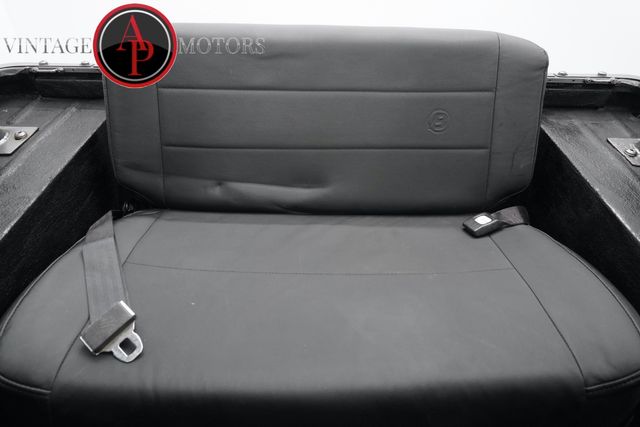
The interior is the cheapest part of a CJ to put right and the least important to the purchase — with two exceptions. Seats are simple: vinyl splits, foam collapses, frames crack at their mounts, and replacing a pair is a few hundred dollars. Tops are the real cost. A good soft top with frames and doors runs $800–1,800; a CJ-7 factory hardtop in sound condition is valuable and increasingly scarce, and cracked fibreglass, missing rear hatches and perished seals all price in. Test the heater anyway — a car with no heater demists nothing. The safety exceptions are seatbelts and the roll bar: belts fray, retractors seize, anchor points rot, and the bar's feet need the same check. Neither fault is expensive to fix; both are disqualifying until fixed.
Modifications: the standing warning
No other classic in our listings is as routinely and heavily modified as the CJ. Engine swaps (Chevrolet small-blocks above all, plus AMC 360s and 401s in factory-looking clothes), axle swaps, spring-over conversions, lockers, winches, body lifts and cage additions range from professionally engineered to genuinely dangerous, and from the driver's seat the two can feel identical. Your defence is paperwork and pattern recognition. A good modification comes with receipts, named components and supporting changes — the V8 swap with the bigger radiator, the lift with corrected steering, the lockers with stronger shafts. A bad one comes with a story. Check welds on anything structural: cage mounts, spring perches, steering conversions. Check that a spring-over car has had its steering properly re-engineered, because a badly done spring-over is the single most dangerous common CJ modification. And remember the value rule: with very few exceptions, modifications subtract value, because the next buyer is buying your trust in a stranger's workmanship. A modified car must be bought at a discount reflecting its narrow resale audience — however much the current owner spent building it.
How to inspect one
Allow at least an hour, bring a torch, a magnet wrapped in cloth, a screwdriver for prodding (with the seller's permission) and overalls you do not mind ruining — a CJ inspection happens underneath the car. If the car passes you, a lift inspection before money changes hands is money well spent, because the frame examination in step 4 is the purchase.
- Start with the paperwork and the VIN. Match the title to the VIN plate — on AMC-era cars it sits on the firewall and on the dash plate visible through the windscreen — and decode it: the VIN encodes the year, the model and the original engine, which settles arguments about what the car started as, whatever it carries now. Check the frame for a stamped number where the model year provides one, and be wary of a car whose paperwork, plate and specification tell three different stories. On a CJ-8, this step is the Scrambler test from the models section: VIN, frame length and factory bed seams, before anything else.
- Cold start. Insist the engine is cold when you arrive. A 258 six should start readily and settle to an even idle; a Dauntless V6 idles unevenly by design, which is different from a misfire — listen for rhythm, not smoothness. Watch for blue smoke at start-up (valve seals), smoke under load later (rings), and listen for timing rattle, deep knocks and exhaust manifold ticks that fade as the engine warms.
- The idle test. Let the six idle fully warm. A 258 that runs cleanly at speed but will not idle is describing the Carter BBD's clogged idle tubes from the engines section — a few hundred dollars, priced in, not a walk-away. A car that cuts out hot and restarts when cold is describing its ignition module. Check the oil: level, smell of fuel, and mayonnaise under the filler cap. Verify oil pressure with the engine hot — the dash gauge lies on these cars, so if the engine is the question, a mechanical gauge is the answer.
- Under the car: the frame. This step decides whether you continue at all. Torch and screwdriver along both rails: rear horns and rear crossmember first, then every spring hanger and body mount, the kick-up sections, the front horns and the steering box mount. Prod hard. Perforation, flaking or cracks at hangers mean the car is a project priced as one, per the rust section — and read the coating as you go: honestly patchy is factory age, a fresh uniform black coat over everything is a question, not an answer.
- The tub. Lift every mat and look at the floors. Prod the footwells, the hat channels at the body mounts, the cowl sides, the rockers, the rear quarters and both wheelhouses — including the roll bar feet and seatbelt anchors, which are safety structure. Run the magnet over the rockers and lower quarters. Check whether the tub is steel at all: a fibreglass or aluminium tub is a replacement body, priced as the modification it is, with the grounding and finish checks from the rust section.
- Steering and front axle. Rock the steering wheel and watch for lost motion before the wheels respond, per the steering section. Jack each front corner: rock the wheel top-to-bottom for bearing and joint play, spin it for roughness, and work the locking hubs in and out. Look at the steering box bracket and the frame behind it for cracks.
- Springs, stance and tyres. Stand back and sight the car: level, or sagging at a corner; sitting at stock height, or lifted — and if lifted, by whom and with what supporting work. Check spring leaves for cracks, bushings for oval wear, brake hoses for stretch at full droop, and all five tyres for size match, age and wear pattern. Uneven wear with a straight frame is alignment; uneven wear with bent horns is history.
- Engage everything. On loose ground, select four-wheel drive high and low. A part-time Dana case should engage cleanly, stay engaged under load and whine only modestly; a Quadra-Trac car should not shudder or bind on turns. Check the gearbox through every gear for synchromesh, whine and jumping out — third gear on a T-4 or T-5 first, per the gearbox section — and an automatic for engagement delay, flare and fluid colour.
- The test drive. Twenty minutes minimum, including a stretch at 55–60 mph if the car and the roads allow. A CJ should track acceptably, pull cleanly, and brake straight. Driveline vibration is the lift's report card; darting and tramping are wear or geometry, not character. A V8 car should feel effortless; a four-cylinder car will not, and that is the engine, not a fault. Brake hard from speed, twice — the second stop is the one that tells you about fade and seized cylinders.
- Brakes and lines, properly. Back at base, with the car stopped, pump the pedal and hold it: it should stay firm and high. Then get back underneath and run your fingers along the hard brake lines on the frame rail — the corrosion check from the problem areas. A line that flakes or weeps ends the negotiation until it is priced in, because it is the one fault on the car that can kill somebody.
- Electrics and accessories. Work everything: lights, indicators, wipers, washers, heater blower, every gauge. Open the engine bay and read the wiring like a document — original harness with honest repairs, or a thicket of unfused accessory feeds. On a fibreglass-tub car, electrical faults default to the added earth straps until proved otherwise.
- Tops, interior and the paperwork of modifications. Fit or inspect whichever tops and doors the car is sold with — a CJ-7 hardtop's condition is real money. Check seat frames and belts and their anchors. Finally, collect the modification file: receipts, component names, who did the work. A seller who can document the car has usually maintained it; a car with extensive work and no paper is priced as unknown work, however shiny it looks today.
Values
The build below this guide carries the current market numbers — what CJs are listed at now and what recorded sales have achieved — refreshed at every build, so this section deliberately carries no price figures of its own. What it teaches is how to read those numbers, because the CJ market is one where a single figure for the model is close to meaningless.
Start with the condition spread, which on a CJ is wider than on almost any other classic we cover. The distance between a rotted, modified project and a sound, original, well-documented car is not a percentage, it is a multiple — and the market block's range will show you exactly that, with the bottom of the range occupied by cars whose frames or tubs have already failed the inspection in this guide and the top by cars that would pass it. When you compare a car against the numbers, compare it against the slice of the market it actually belongs to: a rusty CJ-7 is not cheap relative to the CJ-7 median, it is expensive relative to the rusty-CJ-7 market, which is a different and much colder place.
Model hierarchy drives the second layer. The CJ-8 Scrambler carries the strongest premium of the late cars, earned by genuine scarcity — fewer than 28,000 built — and it is the premium most often faked, which is why the inspection starts with the VIN. The CJ-7 is the volume market: deepest supply, deepest demand, the easiest CJ to price and the easiest to sell. The late CJ-5 trades at a discount to a comparable CJ-7 that reflects its awkward doors and short cabin rather than any mechanical inferiority — the value buyer's opening. Flatfenders and Kaiser-era cars sit in a separate, thinner, specialist market where originality outranks condition in a way it never does on AMC cars. Engine and gearbox move money within each model: a 304 V8 or a T-18 four-speed adds real value, an Iron Duke four subtracts it, and a Quadra-Trac car is priced by how much of its chain-and-fluid problem the seller has already solved.
Third, read asking prices as asking prices. CJs are disproportionately sold by private sellers and small dealers with an emotional number in mind, and the gap between ambitious asks and achieved prices is a standing feature of this market — the recorded-sales block beneath this guide is the corrective to anchor a negotiation to. Modifications widen the gap: sellers price modified cars by what the build cost, buyers by risk, and the achieved numbers side with the buyers. A CJ project looks cheap because the parts genuinely are cheap — but frame and tub work are labour-shaped holes that swallow the saving whole. The honest rule: the most expensive CJ is a cheap one with a rotten frame, and the best value is a sound, unglamorous, unmodified driver bought at a fair recorded price.
Parts and ownership
The CJ is one of the best-supported classics in America, for a simple structural reason: the aftermarket adopted it decades ago and never let go. The Jeep specialist trade — the large catalogue houses and a deep bench of smaller specialists — can supply almost everything, and the Wrangler that succeeded the CJ kept the ecosystem alive and growing.
Easy: service items, filters, plugs, points and ignition consumables; brake components for every era, including lines, hoses and cylinders; carburettor rebuild kits, including for the troublesome Carter BBD; universal joints, wheel bearings and hub parts; leaf springs, bushings and shock absorbers; body mount kits; soft tops, seats, seat covers and interior trim; radiators, water pumps and cooling parts for the AMC engines; and a remarkable range of reproduction steel — floor pans, hat channels, rocker panels, windscreen frames and complete tubs in steel, fibreglass and aluminium. Order today, fit this weekend is a realistic description of most CJ maintenance, at prices close to modern-car money.
Harder and dearer: Quadra-Trac consumables — the drive chain and the correct specialised fluid are the standing scarcity, and they price the whole 1976–79 automatic proposition; Dauntless V6-specific clutch and flywheel parts; Prestolite ignition components, which most owners solve by conversion rather than replacement; factory CJ-7 hardtops in undamaged condition and their rear hatches and seals; CJ-6 and CJ-8 body-specific panels and tops, where low original production means thin reproduction; correct early Willys hardware for the flatfender cars; and good original frames — a galvanised replacement frame is available and excellent, but it is a major purchase plus a full swap, not a part in the usual sense. A quality repaint on a CJ is cheaper than on most classics because the panels are flat and the trim is minimal — but rust repair ahead of paint is priced by the hour like anything else, which returns you to the mantra of this guide: buy the frame and the tub, and fix the mechanics.
Running costs. A sorted CJ is a cheap classic to run and an expensive one to sort. Fuel consumption is in the low-to-mid teens mpg for a six, worse for a V8 on oversize tyres; servicing suits any competent home mechanic; insurance is in line with other classics of the value. The line that catches new owners is the first year: catching up deferred maintenance — brake hydraulics, steering joints, bushings, fluids in five separate cases and boxes, carburettor and ignition service — honestly costs $1,500–4,000 before you improve anything. Cars that have sat need the fuel system cleaned end to end and every brake component inspected. Buy a car in regular use over one that has been asleep, even at a higher price.
Which one to buy
- The all-rounder: CJ-7 with the 258 six. The usable CJ — proper doors, a real hardtop option, highway manners, the deepest parts support and the deepest market to buy from and sell into. A T-176 or automatic car in sound, unmodified condition is the CJ most buyers should own.
- The value buy: late CJ-5 with the 258. Mechanically the CJ-7's equal and cheaper for reasons of doors and cabin space that may not matter to you at all. If your driving is local and open-air, the CJ-5 discount is money for nothing.
- The character pick: CJ-5 with the Dauntless V6. The Kaiser-era car with the engine that made CJs quick — lopey idle, real torque, a devoted following. Buy the best-documented one you can find and learn its specific parts world before you need it.
- The collector car: CJ-8 Scrambler. The rarest late CJ and the best-driving, with the strongest following — and the most cloned. VIN, frame and bed seams first, premium second, exactly as the inspection sets out.
- The working classic: CJ-6. Twenty extra inches of wheelbase, real load space and genuine scarcity in the US market. The pick if the car has to earn its keep, and a conversation everywhere it goes.
- The vintage experience: CJ-3B or CJ-3A. The flatfenders are a different hobby — slow, simple and utterly charming. Buy originality, drive at vintage pace, and do not expect them to do a CJ-7's job.
- The one to think twice about: Iron Duke CJ-7 or CJ-8. The fours are cheap because they are slow. Buy one only at a price that assumes you will sell it cheaply too — or because a lightweight trail build is genuinely what you want.
And the rule that overrides all of the above: buy the soundest frame and tub you can find, in the model you want. Engines, gearboxes, brakes, tops and steering are all fixable at prices you can plan for. A rotten frame or tub costs more to put right than the finished car will be worth — and on a CJ, it is the one thing that can never be made original again.

See the 47 CJ5 cars currently listed.