
International scout buyer's guide
International scout -- the model's own buyer's guide: variants, values and what to check.
Years listed: 1960-1980 · Series: Trucks
Overview and history
The International Scout is the utility vehicle that got there before the rush. When International Harvester launched it for the 1961 model year, the market for a small, civilised four-wheel-drive wagon barely existed. The Jeep CJ was still a farm tool with a canvas top, the Ford Bronco was five years away, and the Blazer and the modern sport-utility idea were further away still. International, a company that built farm tractors, heavy trucks and refrigerators, simply applied truck thinking to a smaller job: a steel box on a proper ladder frame, four-wheel drive, a removable top, and just enough comfort that a rancher, a survey crew or a suburban family could use the same vehicle on Monday and on Saturday.
That origin explains everything you need to know before you buy one. A Scout is not a car with four-wheel drive added. It is a light truck, built by a truck company, with truck engines, axles and service habits, wrapped in bodywork that was always the thinnest, least protected part of the package. The mechanicals, cared for even halfway, will outlast almost anything else of the period; the body, left outside in a wet climate, will dissolve around them. Nearly every buying decision in this guide comes back to that one split.
The first generation, the Scout 80 of 1961 to 1965 and the Scout 800 family that followed it to 1971, is the small Scout: an 100-inch wheelbase, flat panels, a fold-down windscreen on the early cars, and a choice of pickup cab, full-length Traveltop wagon roof, or no top at all. The second generation, the Scout II of 1971 to 1980, is bigger in feel if not much in wheelbase, better trimmed, far better suited to highway use, and the one most buyers today want to live with. Alongside it came the longer 118-inch Terra pickup and Traveler wagon from 1976, and special editions — the soft-top, doorless SSII most famously — that now carry their own premiums.
Production ended in October 1980, when International, deep in financial trouble and refocusing on heavy trucks, closed the Fort Wayne, Indiana line that had built every Scout. Total production across all types is commonly put at about 532,674 vehicles. That sounds like a lot until you set it against survival: Scouts worked for a living, rusted eagerly, and for decades were worth so little that nobody stored them indoors. The good survivors advertised today are the minority somebody loved early enough.
On Classic Listings we currently track 41 Scouts, 37 of them for sale, with the weight of the listings in the Scout II years — 1977 is the most common year, followed by 1978, 1973 and 1979 — and manual and automatic gearboxes splitting the pool almost evenly. Our examined photo-note base is still very small, just four cars in detail, so this guide makes no incidence claims from it. Where the text describes rust, leaks or wear, it is describing what forty-plus years of ownership and workshop experience have established — and what your own inspection has to confirm on the individual car.
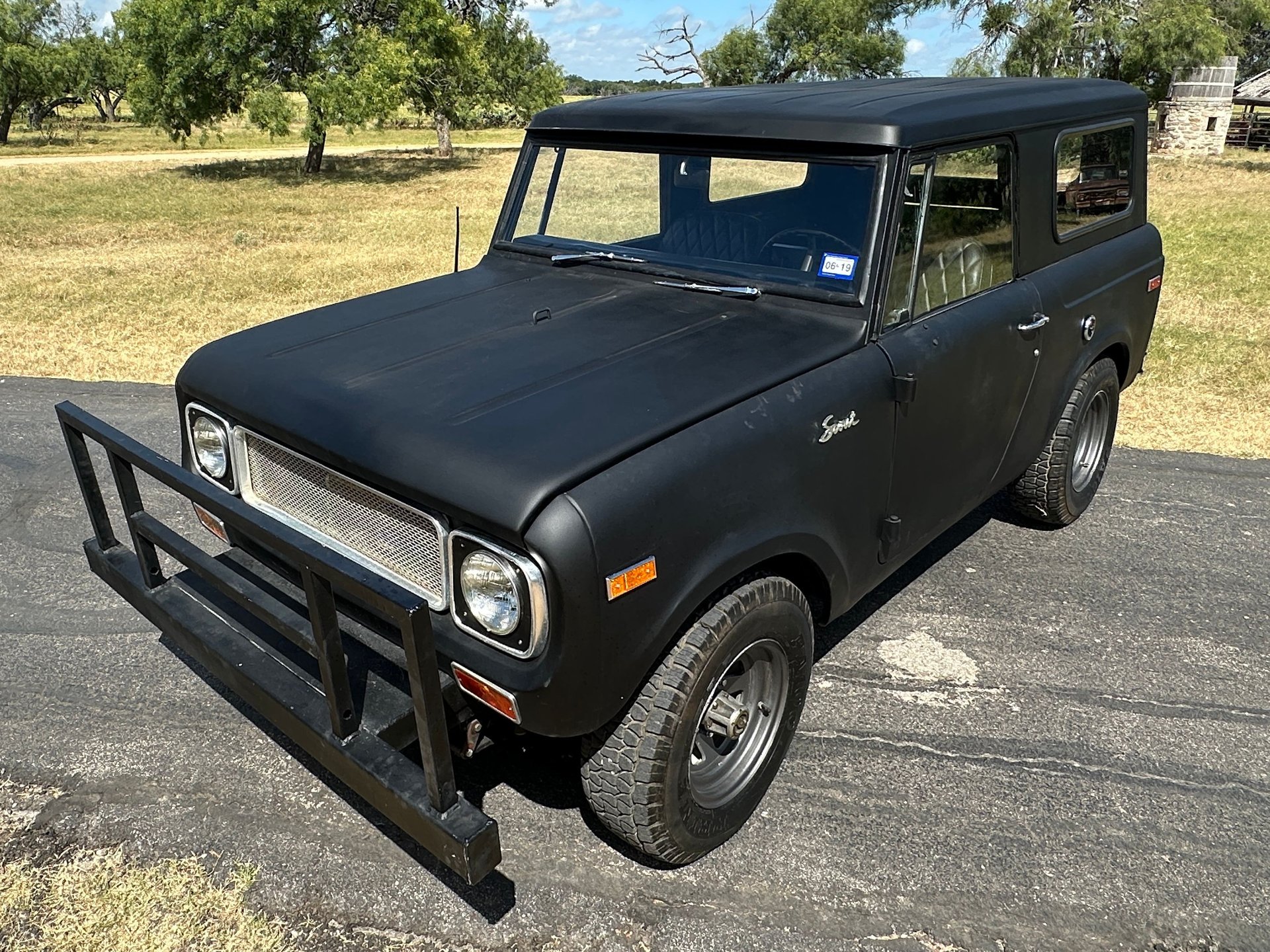

The models
Every Scout is a two-door utility on a separate frame, with a live axle at each end and part-time four-wheel drive. Beyond that, the range divides first by generation, then by body, then by engine — and the badge does not always tell you the engine, because International sold the same body with four, six and eight cylinders across a twenty-year run. Learn the generations first. Engine and trim come second.
| Model | Years | Engine | Output | Built | Character |
|---|---|---|---|---|---|
| Scout 80 | 1961–1965 | 152 four | 93 hp | Part of about 532,674 Scouts all types | The original; simplest, slowest, most collectible early truck |
| Scout 800 | 1966–1968 | 152 or 196 four, 232 six, 266 V8 | 93–155 hp | Not published separately | The 80 civilised; fixed windscreen, better trim, V8 arrives |
| Scout 800A | 1969–1970 | 152 or 196 four, 232 six, 266 or 304 V8 | 93–180 hp | Not published separately | The mature small Scout; widest engine choice of the early cars |
| Scout 800B | 1971 | 196 four, 232 six, 304 V8 | 104–180 hp | Not published separately | One-year bridge to the Scout II; rare and easily misbadged |
| Scout II | 1971–1980 | 196 four, 258 six, 304 or 345 V8, diesel | 104–182 hp | The bulk of later production | The all-rounder; the Scout most buyers should start from |
| Scout II Terra | 1976–1980 | 196 four, 258 six, 304 or 345 V8, diesel | 104–182 hp | Not published separately | 118-inch pickup; longer bed, better ride, working-truck past |
| Scout II Traveler | 1976–1980 | 258 six, 304, 345 or 392 V8, diesel | 111–182 hp | Not published separately | 118-inch wagon with a liftgate; the family and tow Scout |
| Scout II SSII | 1977–1979 | 196 four, 258 six, 304 or 345 V8 | 104–182 hp | Low thousands, exact figure not firmly published | Soft top, no steel doors, inserts and decals; the image Scout |
Outputs are period gross or early net ratings depending on year; makers changed rating methods in the early 1970s, so a later car with a lower printed figure is not necessarily slower. Production figures by individual variant were not published in a form that survives cleanly, and any source giving a precise build count for, say, an 800A V8 should be treated with suspicion. The honest total is the all-Scout figure of about 532,674, and rarity judgements here are built on survival and demand, not invented build numbers.
The Scout 80 (1961–65). The original, and the purest. Sliding side windows on the earliest cars, a fold-down windscreen, vacuum wipers at first, and one engine at launch: the Comanche 152 four, literally the front half of International's 304 V8. Bodies were the Cabtop half-cab pickup, the full Traveltop, and the open configuration with the top removed. The Red Carpet special of 1964 and the Champagne Series cars show International learning, in real time, that buyers wanted comfort as well as capability. A turbocharged 152 arrived for 1965; it is rare, interesting, and not meaningfully faster in the way a modern turbo is.
The Scout 800, 800A and 800B (1966–71). The 800 kept the 80's size and fixed its worst faults: fixed windscreen, wind-up windows, better seats and sealing, and, crucially, options. The 196 four joined the range, the AMC-sourced 232 six gave a smoother alternative, and the 266 V8 made the small Scout genuinely quick for its day. The 800A for 1969 added the 304 V8 at the top. The 800B for 1971 was a single transitional year, and the early Scout most often misdescribed in adverts — check the build plate and the Line Setting Ticket rather than the listing title. If you want an early Scout to drive rather than show, an 800A with the 304 and a four-speed is the sweet spot of the first generation.
The Scout II (1971–80). The car that carries the market. Launched in April 1971, it kept the 100-inch wheelbase but added width, a lower step-in, power steering and front disc brakes arriving in stages, and a cabin that could approach car standards in later, well-optioned cars. The standard body is the Traveltop wagon, and the top still unbolts. Model years matter. Early cars, 1971 to 1973, are lighter and simpler, with a Dana 30 front axle; from 1974 the Dana 44 front axle became standard, which off-road buyers strongly prefer. From 1976 came the long-wheelbase cars and the diesel. The final year, 1980, is a specification island: the Dana 300 transfer case replaced the Dana 20, the diesel gained a turbo, and emissions details differ from 1979 in ways that matter when you order parts.
Terra and Traveler (1976–80). The 118-inch pair are the most usable Scouts on the road: the extra length goes into ride, load space and towing stability. The Terra is a pickup with a longer bed than the old Cabtop. The Traveler is a full wagon with a one-piece liftgate, and the only Scout that regularly carried the big 392 V8. A Traveler with a 345 or 392, an automatic and air conditioning is the closest a period Scout gets to a modern family SUV.
The SSII (1977–79). The Super Scout II answered the doorless, topless Jeep CJ-7 head-on: soft top, soft half-doors or none, plastic door inserts, roll bar and bold decals. Originality is everything, because the defining parts are exactly the parts that get lost, and ordinary Scout IIs have been dressed up as SSIIs for as long as SSIIs have been worth more. The Line Setting Ticket and factory soft-top evidence are what you are buying. A genuine, complete SSII is a collector car; a converted Scout II in SSII clothes is a Scout II, priced as one.
Special editions. Rallye, Midas conversions, CVI customs and dealer specials: judge them all the same way — the underlying car first, the package second. A Rallye stripe does not repair a floor. A Midas interior in good original condition is a real plus, because retrimming one correctly is difficult, but it adds value to a sound car, not instead of one.


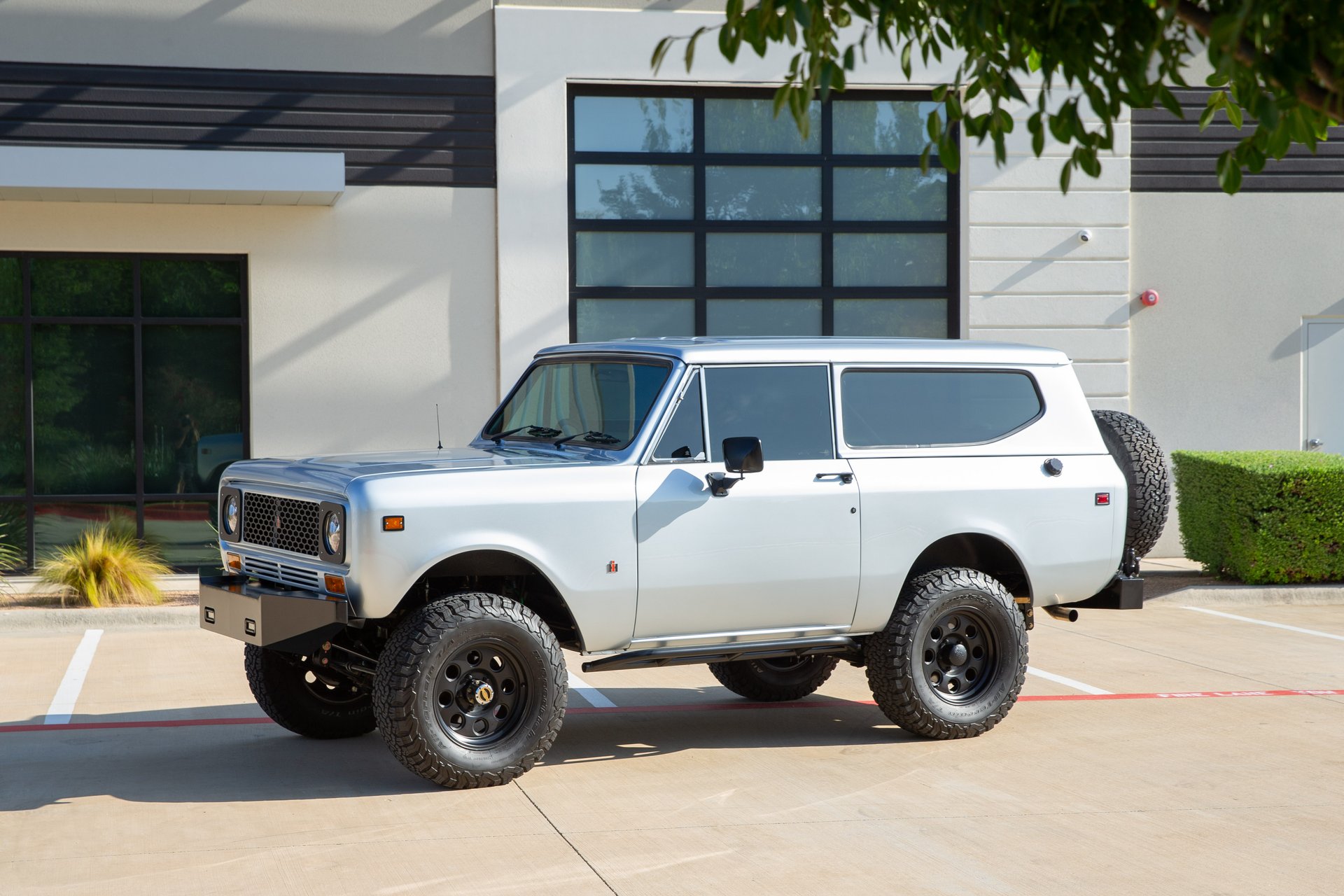
Engines and gearboxes
Scout engines divide into three families: International's own fours and V8s, the AMC sixes bought in, and the Nissan diesels of the later Scout II years. All are simple designs a competent general mechanic can service, and none needs a laptop. What they need is oil, coolant, ignition parts in good order, and an owner who understands that a 1970s truck engine works at low revs and high torque, not at high revs.
The International fours and V8s: 152, 196, 266, 304, 345 and 392
International's light-line V8s are among the toughest petrol engines ever put in an American utility vehicle: heavy, iron, low-revving designs with generous bearing sizes and cooling sized for truck work, built in 266, 304, 345 and 392 cubic inch sizes on one architecture. The Comanche fours are cut from the same cloth — the 152 is half of a 304, the 196 half of a 392, sharing the V8s' bank layout as a slant four — and a great deal of workshop knowledge crosses over.
The 152 four (1961–70). About 93 hp gross, and the honest description is adequate, willing and slow. A 152 Scout cruises at 50 to 55 mph and works hard on hills. Its virtues are simplicity and durability: points ignition, a single-barrel carburettor on most cars, almost nothing to go wrong that a roadside toolkit cannot address. The turbocharged 152 from 1965 lifted output to roughly 111 hp; surviving turbo cars are rare, the hardware is a restoration specialism, and the gain is modest — buy a turbo car for interest and originality, never for speed.
The 196 four (1966–80). The bigger four is the better four: about 102 to 104 hp and substantially stronger torque, pulling a Scout II with real competence up to about 60 mph. It stayed the base Scout II engine to the end, and in a standard-wheelbase car with sensible gearing it is a defensible choice — lighter than the V8s, easier on fuel, same toughness. What it will not do is tow a heavy trailer at highway speed or hold 70 mph into a headwind.
The 266 V8 (1967–69, 800 series). The first Scout V8, at about 155 hp, and the engine that changed the small Scout's character. Rarer than the 304 that followed, with a thinner engine-specific parts trail, but the same family and virtues: nearly 304 pace, more rarity, a little more parts homework.
The 304 V8. If one engine defines the Scout, it is this one: the volume V8 of the 800A, 800B and Scout II, roughly 180 hp in earlier ratings and less on paper in later net-rated cars, with torque to move a Scout, a load and a trailer without drama. It suits every gearbox offered, the automatic particularly well, and has the deepest parts base of any Scout engine. A healthy 304 starts promptly, idles with a slight even lope, holds strong oil pressure — healthy hot at cruising revs, lower but steady at idle — and pulls cleanly from low revs. Blue smoke at start-up after sitting points to valve stem seals, a known and manageable job. Smoke under sustained load, low compression on one cylinder, or a deep knock are engine-out conversations: a full professional rebuild of an International V8, with machining, removal and refitting, runs to several thousand dollars, so compression figures belong in every serious viewing.
The 345 V8. The torque step up, and the engine most experienced Scout II owners name as their favourite for a working car. Output figures overlap the 304's on paper, which misleads buyers who shop by horsepower: the 345's advantage is a fatter, earlier torque curve that makes an automatic feel effortless and towing realistic. It drinks a little more and fills the bay more fully, so manifold and starter access are tighter. Otherwise the same rules: buy on compression, oil pressure, cooling and oil-change evidence, not the badge.
The 392 V8. The big one, found mainly in the Traveler and International's heavier light trucks, and only rarely — usually by special order or swap — in a standard Scout II. It is also where verification matters most, because 392s command a premium and a 345 and a 392 look alike at a casual glance. Confirm identity from the engine number pad — on International V8s the stamped pad sits on the front of the block, on a machined boss beside the fuel pump area — and from the Line Setting Ticket, not an air-cleaner decal. A genuine factory 392 Traveler is a prize; a car with a later truck 392 swapped in is a good working Scout priced as a swap, not a factory rarity.
Across all the International petrol engines, three failure patterns repeat. First, cooling: radiators silt, water pumps wear, fan drives go lazy, and a Scout that runs hot in traffic will cook its head gaskets if you let it — test every car fully hot, at idle, after a drive. Second, the V8 valley and manifold area weeps oil with age; damp is normal, dripping that coats the transfer case needs seals budgeted. Third, ignition neglect: points, condensers, rotors and caps are cheap, and half the Scouts advertised with a carburettor fault have an ignition fault. Service the ignition first, in full. Carburettors themselves — single and two-barrel Carter, Holley and Motorcraft units by year and engine — are conventional and rebuildable, usually suffering perished pump seals, blocked idle passages and vacuum leaks rather than deep failure. A specialist carburettor rebuild, with set-up, is a few hundred dollars; an engine needing one is no bargain killer. An engine needing a rebuild is.
The AMC sixes: 232 and 258
International bought its sixes from American Motors, and they are good engines — smoother than the fours, lighter than the V8s, and in 258 form torquey enough to be a genuine all-round choice rather than a base-model apology. The 232 served the 800 series and early Scout IIs; the 258 served the Scout II to the end, at around 110 hp net in later cars, a figure that understates how they drive, because the torque arrives early and the gearing suits it.
The six's habits are its own. Valve cover and rear main seal weep with age. Carburettor setups suffer the same vacuum-leak and perished-rubber faults as the V8 cars, compounded on late cars by a thicket of emissions hoses that crack, fall off and get reconnected wrongly; a late six that idles badly needs its vacuum plumbing checked hose by hose before anything expensive is blamed. Exhaust manifolds crack, as on most long sixes. None of that is serious. Overheating history and skipped oil changes are: look for emulsion under the filler cap, bubbles in the radiator with the engine running, and a temperature story that does not match the seller's.
For the buyer, the six is the value engine in a Scout II: cheaper to buy and feed than a V8, giving away surprisingly little below 60 mph. If your Scout will live on back roads and short trips, a good 258 car is not a compromise. It is the sensible buy.
The Nissan diesels: SD33 and SD33T
From 1976 International offered the Nissan SD33, a 3.2-litre inline six diesel, and for 1980 the turbocharged SD33T. Output is modest — about 81 hp naturally aspirated, about 101 hp for the turbo — and performance is leisurely in a way no petrol Scout is. In exchange you get outstanding fuel economy by Scout standards, a long-lived engine with a strong following, and a different character entirely: all low-rev torque, no revs, and noise the factory deadening only partly tames.
Buy a diesel Scout as a deliberate specialist choice. The engine, a Chrysler-Nissan industrial design, is durable, but diesel-specific parts — injection equipment, glow-plug components, SD33T turbo hardware — come from a thinner supply chain than any petrol part, and the knowledge base lives in a smaller corner of the clubs. Cold starting is the test: a healthy SD33 starts after one glow cycle with minimal cranking and clears its initial smoke quickly. Extended cranking, persistent white smoke, or a seller who has warmed the car before you arrive are warnings. A diesel that starts cleanly, idles evenly and pulls without overheating is a charming, economical vehicle. One that does none of those needs a diesel specialist's estimate before you bid, not after.
Gearboxes, transfer cases and axles
Manual gearboxes. Early cars use three-speed manuals, Warner T-90 family in the 80 and related units in the 800s: sturdy, slow-shifting, with an unsynchronised first-gear habit you learn in the first mile. The four-speeds are the desirable manuals. The T-18 and, in later Scout IIs, the T-19 are heavy truck four-speeds with a very low crawler first gear rarely used on the road; the close-ratio T-19 is the most road-friendly. Judge a manual on second-gear synchromesh, on whether it jumps out of gear on the overrun, and on clutch behaviour: a high, juddering clutch is a clutch job, a few hundred dollars in parts and a solid day of labour, because gearbox and transfer case come out together. Whine in the intermediate gears is common and usually lived with; a box that screams, crunches everywhere or cannot be kept in gear is a rebuild, well into four figures once removal is counted.
Automatic gearbox. Early automatic Scouts used a BorgWarner three-speed; the Scout II standardised on the Chrysler TorqueFlite 727, one of the strongest three-speed automatics ever built, and the transmission that makes a V8 Scout II so easy to live with. A healthy 727 changes firmly, kicks down without flare, and engages reverse without delay or thump. Delayed engagement when cold, flaring under load, or fluid that is brown and smells burnt point to work needed — a professional 727 rebuild is a known-quantity job in the low-to-mid thousands of dollars fitted, and any good automatic shop knows the box. Check the fluid at every viewing: pink and sweet is right, dark and burnt is a negotiation.
Transfer cases. Part-time four-wheel drive throughout, with low range. The Dana 20 is the standard Scout II case: gear-driven, strong, noisy by modern standards, its low-range whine normal. The Dana 300, for 1980 only, has a lower low-range ratio and a cult following among off-road builders. Early 80s used the Dana 18 family case. On any of them: engage high and low on a loose surface (never wind up part-time four-wheel drive on dry tarmac), listen for jumping out of low under load, and check for leaks at the gearbox joint and output seals. A case that will not stay in low has worn internals or linkage — linkage first, because it is cheap; internals second, because they are not.
Axles and gearing. Dana axles throughout: Dana 27 or 30 at the front of early cars, Dana 44 at the rear of most Scouts and at the front of Scout IIs from 1974. Ratios vary widely — around 3.07 and 3.31 for road cars, 3.73 as a common middle choice, 4.09 and lower for working specification — and the ratio transforms the car. A 304 automatic on 3.07 gearing is a relaxed cruiser blunt off the line; on 4.09 it feels eager and runs out of revs at highway speed. Read the axle tags and the Line Setting Ticket, and match gearing to your use before you fall for the paint. Limited-slip differentials, badged Powr-Lok or Trac-Lok by year, were a popular option and a genuine plus; budget for the correct additive at the first service.
Problem areas
A Scout's problems divide into the problem that ends cars and the problems that merely cost money. The first is rust, and on a Scout it is not one problem among many — it is the inspection, the negotiation and, very often, the decision. Everything after the rust section assumes a shell worth saving. If the shell fails, the rest of the car's virtues are a parts inventory for somebody else's project.
Rust: the map
Scouts rust from the bottom up and from the inside out, in structural places early, because the body mounts to the frame at points that trap mud and moisture, and the lower body was built from steel with minimal protection by modern standards. A Scout with shiny paint and no underside photographs is an unanswered question, not a clean car. In our tiny examined photo-note sample for this model — four cars — rust was mentioned in two and visible damage in two, which tells you nothing statistical; it is a reminder to look. Assume rust until the individual car proves otherwise, panel by panel.
Body mounts and the floor they carry. Start here, because this is the Scout's defining rot point. The body sits on rubber mounts bolted through reinforced floor sections — in the front footwells, under the seats and at the rear of the tub. Water and salt collect around the bolts, the reinforcement rusts, and the floor follows. The symptoms you can feel are a body sitting low or unevenly, doors out of alignment, and a creak or clunk over bumps as the body moves on collapsed mounts. The test is physical: get underneath with a torch, find every mount, and prod the metal around each bolt. Sound metal rings and resists; rotten metal flexes, flakes and lets the screwdriver through. A mount rubber is cheap. Welding new mount sections into a floor, body supported and alignment held, is fabrication — budget in the low thousands of dollars for a car needing several mounts and their floor sections done properly, and understand that a car needing all of them usually needs sills and floors too. One collapsed mount is a job. A set of them is a restoration.
Floor pans, front and rear. The footwells collect every leak from the windscreen, cowl and door seals, and the carpet holds the water against the steel. Lift every carpet. Early floors are flat and simple, making repair sections straightforward; Scout II pressings are more complex, but repair panels are available from the specialists. Surface rust that wires off to sound metal is a clean, treat and paint job. Pinholes are a patch. A floor that flexes under your weight or shows daylight is a cut-out and weld job, realistically several hundred to over a thousand dollars a side fitted and painted — and floors, like mounts, travel in packs.
Rocker panels and sills. The rockers are the tub's lower edge, directly in the spray line, and they rot from inside. Press hard along the full length, look for bubbling, filler edges and fresh stone-chip applied over trouble, and check the ends where the rocker meets the front wing and rear quarter — the junctions go first. Replacement panels are available and the welding is conceptually simple, but the rocker carries door alignment with it, so a badly fitted rocker shows in every shut line. Price a side as a panel plus a day of competent welding and paint blending, not a Saturday patch.
Inner front wings, cowl and the windscreen frame. The inner wings trap mud behind the wheels and rust along their lower seams and around the battery area. The cowl collects leaves and water at the vent, and the windscreen frame — a separate, bolted structure on early cars, a notorious trap on all of them — rusts at its base and corners, letting water straight into the footwells. On a Scout 80, check the fold-down screen's hinge line and channels; on a Scout II, look for bubbling at the screen rubber's lower corners. Frame repair is fiddly, skilled work and good used frames are hunted parts; a rotten frame on a sound car is negotiable, a rotten frame plus rotten floors is a pattern.
Rear quarters, tailgate and the Traveler liftgate. The rear arches rust at the lip and behind it, where mud packs between outer skin and inner tub — prod inside the arch with your fingers, do not just look. The standard Scout II tailgate rusts at its lower edge and hinges, and the spare wheel hides the worst of it: move the spare. The Traveler's one-piece liftgate rusts at its lower edge and around the glass, and liftgate parts are thinner on the ground than tailgate parts, so judge a Traveler's rear end a grade harder. Fuel filler surrounds, step areas and a Terra's bed floor get the same treatment: assume the underside of any horizontal panel is one grade worse than its top.
The frame itself. The good news: Scout frames are heavy, simple ladders that survive far better than the bodies. The bad news: they rust at the rear spring hangers, around the steering box mounting — a known stress point, sometimes reinforced with a plate — in the rear crossmember area, and anywhere a previous owner welded a hitch or plough mount and left bare metal. Surface scale is normal; perforation, cracked rails at the steering box, or a frame plated in several places without explanation are structural conversations. A bent frame shows in uneven gaps and a car that crabs on the road test; walk away from one unless you are buying a parts car at a parts price.
Steering, suspension and brakes
Scout steering is a recirculating-ball box, manual on early cars, power-assisted on most later Scout IIs. Play at the wheel comes from the box itself, from the drag link and tie-rod ends, or from a flexing, cracked frame rail at the box mounting — separate the three before pricing the car, with a helper rocking the wheel while you watch from underneath. Play in the box is an adjustment first, a rebuild second, a mid-hundreds to low-thousands job. Play in the joints is parts and an alignment. A flexing rail is welding. Power pumps whine when low or worn and hoses weep; neither is serious, both are bargaining points.
Leaf springs all round sag, crack individual leaves — look along the pack from the side — and wear their bushes until the car clunks and wanders. A Scout sitting nose-down or leaning has finished springs; a full set of springs, bushes and dampers, fitted, is a four-figure job that transforms the car, so price it in rather than fearing it. Shackles and their mounts rust: prod every spring hanger as part of the rust inspection, because a hanger that tears out is a safety failure, not a cosmetic one.
Brakes divide by era. Early cars have drums all round: adequate when perfectly maintained, which they rarely are — seized adjusters, perished wheel cylinders and contaminated shoes are the standard findings. Scout IIs moved to front discs in stages through the early 1970s, with a servo on power-brake cars; the parts are conventional and available. On any Scout that has sat, budget for a full hydraulic refresh — master cylinder, wheel cylinders or calipers, hoses, fluid — at several hundred to over a thousand dollars in parts and labour, because forty-year-old hydraulics are not a place to economise. Test hard on the drive: pulling to one side is a seized caliper or collapsed hose until proved otherwise.
Drivetrain wear beyond the engine
The driveline decides how a Scout feels. Universal joints wear and announce themselves as a clunk on taking up drive and a vibration at speed; cheap parts, a morning's job, and a seller who has not done them has not maintained the car. Pinion seals weep and axle bearings rumble — listen with windows up and radio off, coasting and under load, because an axle quiet under load and noisy on the overrun is wearing a pattern a specialist should price. Front hubs must engage and release cleanly; a hub that will not lock is usually grease and neglect, not new parts. Clutch linkage wears at every pivot and makes a good clutch feel bad — judge slip by revs rising without speed on a hill in a high gear, not by pedal feel. Transfer case and gearbox mounts perish and let the driveline move, mimicking clutch judder; mounts are cheap rubber and an hour or two of labour, so look there before anyone sells you a clutch.
Interior, tops and trim
Scout interiors were working interiors, and their enemies are sun, water and the removable top. Vinyl splits at its stitching and the driver's entry bolster; foams collapse; the driver's seat always goes first, so sit in it, not the passenger seat. A full Scout II retrim in correct-style vinyl runs into the low thousands of dollars; early, simple seats cost less. Midas and conversion interiors, with their distinctive fabrics, are far harder to match — a torn Midas seat is a specialist problem.
The steel Traveltop rusts along its seams, drip rails and mounting edge, and its seals perish and let water into exactly the rear quarters and floors you have just inspected. Budget for seals on any car and check the top's underside and the tub rail with the same suspicion as the floors. Soft tops are consumables — a replacement runs from a few hundred to over a thousand dollars by maker and completeness — but frames, bows and door inserts are the rare parts, so inventory them piece by piece. Traveler fibreglass tops crack at their mountings and craze; repairable, but price it.
Dashboards crack in the sun, instruments fail one by one — fuel gauges most often, usually the sender or an earth rather than the gauge — and heater cables seize. None of it is individually expensive; together it is the difference between a car that feels cared for and one that feels used up, and on a Scout that feeling is data. A cabin where everything works was usually owned by somebody who also changed the oil.
Electrics and the charging system
Scout electrics are simple, and their faults are age and earths, not design. Dim lights, slow indicators, wandering gauges and clicking starters are earth points, cables and connections nine times in ten: clean, tighten and retest before replacing components. Alternators and starters are conventional and sensibly priced. Previous owners add their own faults — auxiliary lights, winches and stereos spliced into forty-year-old looms — and a bay full of scotch-lock connectors and mystery relays is a car you will spend weekends sorting. Price your patience honestly. The one non-negotiable test is the cold start: a Scout that needs the seller's booster pack to start the viewing has a battery, cable, earth or starter fault that is part of the price, whatever the seller calls it.
How to inspect one
Allow two hours, not one. Bring a torch, a magnet wrapped in cloth, a screwdriver for prodding with the seller's permission, a mat for lying under the car, and a helper for the steering and light checks. Insist on a cold engine when you arrive. If the car passes you, pay for an hour on a lift before money changes hands — on a Scout, the lift is where the body mounts tell the truth, and it is the best money in the whole purchase.
- Paperwork and identity first. Match the VIN plate to the title. On a Scout the plate is on the driver's door area or jamb depending on year; find it, photograph it, and check it agrees with the paperwork before you look at anything else. Ask for the Line Setting Ticket — the factory build sheet, originally glued inside the glovebox on many cars, and available as a reprint from the historical services holding International's records. The ticket settles the original engine, gearing, axles, trim and special-edition claims. A car sold as a factory 392, a genuine SSII or an original diesel stands or falls here.
- Cold start. Turn the key yourself, from cold. A petrol Scout should fire promptly, with choke behaviour that settles as it warms; a diesel should start after one glow cycle with minimal cranking. Watch the exhaust: blue smoke that clears is stem seals, blue smoke that stays is wear, white smoke that persists on a diesel is a warning. Listen for a deep knock in the first seconds and for top-end clatter that does not fade.
- Body mounts and floors, underneath. Torch and screwdriver along every body mount, floor seam, rocker inner and spring hanger, exactly as the rust section maps them. Prod; do not tap politely. Perforation at a mount or hanger ends the inspection at driver money whatever the paint looks like. Read fresh underseal as a question: honest old coating is patchy, a uniform fresh coat over everything the week before a sale is a cover story until proved otherwise.
- Floors and top from inside. Lift every carpet and mat. Check the footwells, under the seats and the rear load floor, move the spare wheel and look under it, and examine the tub rail and the Traveltop's underside for the leaks that feed the rust. Wet carpet in a dry-stored car is a leaking top or screen seal and a floor already started.
- Panels, gaps and the magnet. Run the cloth-wrapped magnet over the rockers, arch lips, lower quarters, door bottoms and cowl: filler announces itself where the magnet falls weak. Check door alignment against step 3 — sagging doors plus rotten mounts is one fault, not two. Look down each flank in raking light for ripples in those flat early panels. Count the rust bubbles and price them as welding, not touch-up.
- Engine, hot and cold checks. Cold, check the coolant for emulsion and rust colour, and the filler cap for mayonnaise. Hot after the drive, check oil pressure, temperature stability at idle, and leaks at the valley, rear main area and water pump. Pull the dipstick: thin, overfull oil smelling of petrol on a carburettor car points to a failing fuel pump diaphragm or chronic flooding — a fault to price either way. Note the V8 engine number pad and compare it with the ticket from step 1.
- Ignition and fuelling evidence. Judge by behaviour: even firing, clean pickup, no hesitation as the throttle opens. Half the Scouts with a described carburettor fault have tired points, a worn distributor or a split vacuum hose. You cannot fix it at a viewing, but you can refuse to pay for a carburettor rebuild a service would cure — and refuse equally a seller's assurance that a misfire is just the points if the compression story is unknown.
- Gearbox and transfer case. Work every gear on the drive. A manual should hold every gear on the overrun down a hill; jumping out is a rebuild conversation. An automatic should engage drive and reverse promptly from cold and change without flare. Engage four-wheel drive high and low on a loose surface, confirm low range stays engaged under load, and lock and unlock the hubs. Listen for universal joint clunk as you take up drive.
- Steering, suspension and brakes on the road. Fifteen minutes minimum, including a rough surface and, if gearing allows, a faster stretch. The steering should centre, track straight and knock at nothing; if play is present, have your helper rock the wheel while you watch the linkage. Bounce each corner afterwards and look along the spring packs for cracked leaves. Brake hard from speed twice: straight, no pull, no judder, a pedal that stays firm. A pull is a caliper or hose; a sinking pedal is hydraulics.
- Stance and gearing. Stand back. A Scout should sit level side to side; a nose-down or leaning car needs springs or mounts, and step 3 has told you which. Note the axle ratio from the tags or ticket and judge the car as that gearing dictates: a tall-geared car that feels blunt may be correct, a low-geared car that screams at 55 mph is also correct. Buy the gearing that suits your use.
- Interior, top and electrics, last but completely. Sit in the driver's seat and feel for the frame through the pad. Inventory the top: seals, bows, inserts, windows, every piece present and named. Work every light, gauge, heater control, wiper and washer. A dead fuel gauge is a sender until proved otherwise; a dead heater on a cold day is a car you will not use in winter until it is fixed.
- The lift, if it has passed you. Repeat step 3 with light and room to work: mounts, hangers, frame rails at the steering box, rear crossmember, brake pipes and fuel lines, plus axle, gearbox and transfer case leaks. If a seller will not allow a lift inspection on a car priced as a good car, that refusal is the inspection result.
Values
The market block beneath this guide carries the current numbers — what is listed now, and what recorded sales have achieved — refreshed as the market moves, so this section deliberately carries no figures of its own. Its job is to teach you how to read those numbers, because the Scout market punishes a buyer who reads a single median and stops thinking.
Start with the condition spread, wider on a Scout than on almost any comparable vehicle. At one end sits the project truck: rusted mounts and floors, tired engine, a top in name only, sold on its frame, title and potential. At the other sits the genuinely restored or exceptionally preserved Scout II — rot cut out and documented, mechanicals rebuilt, interior correct — with several times its purchase price spent on it, visibly and with invoices. Between them sits the honest driver, the largest and most mispriced group: sound underneath, presentable on top, maintained, cosmetically imperfect. Compare any listing against the recorded sales beneath this guide within its band, not against the whole range. A driver priced against restored results is not a bargain awaiting a discount; it is a driver with the wrong price, and the negotiation is about moving it back into its own band.
Generation and body drive the next layer. The Scout II carries the broadest demand and the deepest, most liquid market: more buyers, more comparable sales, easier entry and exit. The Traveler has risen as buyers have understood its usability, the Terra trades on pickup rarity, and a genuine SSII carries a premium that evaporates the moment its special parts or paperwork go missing — that premium is paid for completeness and proof, not decals. The early cars are a thinner enthusiast market: an 80 or 800 sells to a buyer who wants that specific simplicity, takes longer to sell, and rewards originality — original paint, engine, uncut body — more than restoration shine. Diesels sit in their own sub-market, valued strongly by the few who want one and discounted by everyone else, making a good diesel either a keen buy or a slow sale depending on which side of the trade you stand.
Engine and specification move value inside each band. V8 cars command more than sixes, and sixes more than fours, in the Scout II market, the 345 the most sought regular engine and a verified factory 392 Traveler at the top of the tree. In the early cars the order scrambles: a correct turbo 152 or a V8 800A carries rarity value a common later V8 does not. Manuals and automatics both sell readily — the pool on this site splits almost evenly — so gearbox is preference, not value, except where originality to the Line Setting Ticket is the car's whole story. Air conditioning, power steering and front discs are worth real money as fitted, working equipment, because retrofitting them costs more than the premium asked.
Asking and achieved prices part company at the top of the driver band, where a seller prices a presentable car against restored results and waits. Recorded sale results, of the kind summarised beneath this guide, are the discipline: they show what buyers actually paid for cars whose condition can be compared with photographs. A seller pricing from the highest restored result ever recorded is telling you the negotiation starts with an education, and your walk-away is part of it.
Finally, the project-versus-driver gap, where Scout money is truly made and lost. The gap looks like a saving and is usually a bill: mount and floor welding, a brake refresh, top seals, tyres and deferred service will consume the apparent saving on all but the cheapest projects, before paint is discussed. The exception is the buyer who welds and prices their own labour at nothing for pleasure. If that is not you: buy the driver, pay the driver's price, and let somebody else discover what the project needed.
Parts and ownership
The Scout is one of the best-supported orphan utility vehicles in America, because its community refused to let it die. International left the light-truck business decades ago, but between the specialist suppliers who bought up factory stock, the clubs, and the crossover with International's truck parts system, a Scout owner today is better served than the owner of many vehicles whose makers still exist.
Easy: service items for every engine — filters, plugs, points and condensers, caps and rotors — brake parts for drum and disc systems, wheel cylinders, calipers and hoses, universal joints, clutch kits, TorqueFlite 727 service and rebuild parts (the box serves half the American industry), water pumps, alternators, starters, spring bushes, dampers, and common V8 gaskets and seals. Order this week, fit this weekend, at prices in line with any American truck of the era.
Available, at specialist prices: body repair panels — floors, rockers, body mount sections, arch repairs — from the Scout and Light Line specialists, soft tops and hardware, windscreen frames and glass rubbers, seat covers and trim in the standard patterns, rebuild parts for the Dana 20, Dana 300, T-18 and T-19, and diesel service parts through the Nissan industrial network. This is the tier where joining an owners club pays for itself in a single order: the right panel, first time, with advice on how it fits.
Harder and dearer: SSII door inserts, bows and correct soft trim; Traveler liftgate parts; Midas and conversion fabrics; correct Scout 80 trim, sliding-window hardware and fold-down screen parts; 152 turbo hardware; SD33T turbo and injection components; and good brightwork, mercifully limited on a Scout. None of it is unobtainable — the club and used-parts network turns up almost everything eventually — but eventually is a timescale, and a car missing a rare part should be priced as missing it until the part is in your hands.
Running costs. Fuel consumption is period truck consumption: a four or six in gentle use can return figures in the high teens of miles per gallon, a V8 in mixed use sits in the low-to-mid teens, a towing V8 goes below that, and the diesel is the economy champion by a wide margin. Anyone quoting modern SUV economy for a petrol Scout is selling something. Servicing is simple and inexpensive in parts; the discipline is frequency — oil, grease points, coolant, brake fluid — because every expensive Scout failure in this guide starts as a cheap service item skipped. Budget honestly for the first year: aged tyres, a brake inspection and likely hydraulic work, every fluid, the ignition service, seals, and whatever your inspection found. Home mechanics clear that list for parts money; owners paying a shop should expect recommissioning a standing car to be a four-figure commitment before any improvement work. Insure on an agreed value, documented with photographs, precisely because the condition spread is so wide.
Using one. A sorted Scout is a realistic regular-use classic: simple enough to service on a driveway, tough enough for winter and work, small enough for a town, and — as a Scout II with power steering, discs and an automatic — easy enough for any driver in the household. It is not quiet, refined or fast by modern standards, and it will not become those things. Buy it for what it is and it will be used constantly; buy it expecting a modern SUV in period dress and it will be for sale again within the year.
Which one to buy
- The all-rounder: Scout II with the 304 or 345 V8 and the TorqueFlite automatic. Power steering, front discs, a top that comes off, parts everywhere and the deepest market to buy from and sell into. If you want one Scout for everything, this is it.
- The value buy: Scout II with the 258 six. Discounted against the V8 cars, barely slower below highway speed, cheaper to feed and service. A sound six-cylinder Scout II is the most Scout per dollar in the range.
- The working Scout: Terra or Traveler with the 345. The long wheelbase rides, tows and carries better, and the 345 pulls without effort. Check a Terra's bed and a Traveler's liftgate a grade harder than the standard car.
- The early charmer: Scout 800A with the 304 and a four-speed. The small Scout with the right engine and gearbox — simple, light on its feet and the most fun early car to drive. A Scout 80 is more collectible; an 800A is more usable.
- The collector car: a genuine SSII, or a verified factory 392 Traveler. Both premiums rest entirely on proof — Line Setting Ticket, correct special parts, completeness. With the proof, they are the blue-chip Scouts. Without it, a Scout II with a story, priced accordingly.
- The economist: an SD33 or SD33T diesel Scout II. Superb economy, real character and a devoted following, bought deliberately after a clean cold start and a specialist's blessing. Never buy a diesel Scout by accident.
- The project to avoid: any Scout with rotten body mounts, floors and spring hangers together. Engines, gearboxes, brakes, tops and trim are all buyable. A shell gone in its structure costs more to put right than the finished Scout will be worth, and it can never be made original again.
And the rule that overrides all of the above: buy the least rusty Scout you can find, in the specification you can live with. Everything else — every engine, gearbox and brake — is fixable at a price you can plan for. The body and its mounts are the car.
See the 27 scout cars currently listed.