
GMC Sierra buyer's guide
GMC Sierra -- the model's own buyer's guide: variants, values and what to check.
Years listed: 1970-1995 · Series: C/K Trucks
Overview and history
The GMC Sierra is the same truck as the Chevrolet Silverado underneath, and a different truck in the showroom — and understanding that split, and where it stops mattering, is the whole skill of buying one well. Mechanically, generation for generation, a Sierra shares its frame, engines, gearboxes, axles and almost all of its failure modes with its Chevrolet twin. What GMC sells you on top of that shared hardware is trim: a different grille and badge, a plusher cabin a step earlier than Chevrolet offered it, trim names of its own — Sierra, SLE, SLT and, from the turn of the century, Denali — and a buyer who tended to be older, better funded and more likely to keep the truck stock and serviced. That is why a clean Sierra is often an easier buy than an equivalent Silverado: the GMC was more likely to be the second vehicle, the tow vehicle, the one that lived in a garage.
Start with the name, because sellers get it wrong and the error prices trucks. Sierra began life not as a model but as a trim level: GMC introduced it as the top trim package on its C/K pickups for 1975, and through the 1970s and 1980s you will find trucks badged C1500, K1500, C10 or K10 with Sierra, High Sierra or Sierra Classic as an equipment statement, not a model name. Only with the GMT400, launched for 1988, did Sierra become the model itself — the truck was a GMC Sierra 1500, full stop, and Chevrolet did not follow with Silverado as a standalone name until 1999. So a 1978 High Sierra and a 2001 Sierra 1500 SLE are the same lineage wearing the name two ways, and neither seller is lying to you. What matters is the generation underneath the badge, because the generation decides the engines, the rust map, the parts prices and the problems.
We currently track 22 GMC Sierras for sale or recently sold on Classic Listings — 18 for sale and 4 sold at the time of writing — and the shape of that small pool is honest about where the classic Sierra market lives. The years run from 1970 to 2001, and the weight sits in three places. First, a handful of 1970–1972 trucks from the last years of the 1967–1972 C/K generation — handsome, simple, carburetted trucks that predate the Sierra badge but file under the name today. Second, and heaviest, the 1973–1987 Square Bodies, ten of the 22 by the year count — the default classic American pickup. Third, the modern-classic end: GMT400 trucks from the mid-1990s and GMT800 trucks from 1999 to 2001, with injection you would trust daily, Vortec then LS-family power, and cabs that still feel modern. Eleven of the 22 arrive via Facebook Marketplace, nine through dealers and two through Bring a Trailer — half this market is still private sellers, not the polished trade.
Say plainly what the pool does not hold. There are no GMT900 Sierras (2007–2013) in the current listings, no K2XX trucks (2014–2018) and nothing from the current T1XX generation, even though the Sierra name runs unbroken from 1988 to today. This guide still covers those later trucks where their problems differ — the AFM lifter story on the 2007-onwards 5.3 is one every Sierra buyer researching online will meet, and it is dealt with in Problem areas, flagged as a later-generation issue. The transmissions recorded are overwhelmingly automatic — only one manual appears in the set. The classic Sierra, as it actually trades, is a V8 automatic pickup from 1973 to 2001, bought for presence, simplicity and parts support. Almost everything on these trucks can still be bought cheaply, and almost every job can be done by a competent independent shop. The differences that decide money are narrower than the badge suggests: which generation, which engine, how much rust, and whether the trim on the title is the trim on the truck.
The companion Silverado guide covers the shared platform from the Chevrolet side; this is the GMC-side map — the same mechanical record read through GMC's trim ladder and the places, Denali above all, where GMC genuinely diverged and the divergence is worth money. Where the two trucks are identical, this guide says so and spends its words on the shared fault.
The models
Every Sierra is a full-size pickup on a ladder frame, rear-wheel drive in C form and four-wheel drive in K form, and the numbering has been consistent for half a century: 1500 is the half-ton, 2500 the three-quarter-ton, 3500 the one-ton. Within that frame, the story is told by generation first and trim second. Learn the generations that matter to a classic buyer and where the truck in front of you sits in its trim ladder, and the rest of this guide falls into place.
| Model | Years | Engine | Output | Built | Character |
|---|---|---|---|---|---|
| C/K Sierra / Sierra Grande (Square Body era trims) | 1975–1987 | 305 / 350 V8, TBI from 1987 | 160–210 hp | Very large numbers across the C/K range | The classic buy: simple, square, endlessly supported |
| Sierra 1500 GMT400 | 1988–1998 | 4.3 V6 / 5.0 / 5.7 TBI, then Vortec | 160–255 hp | Very large numbers | The modern-feeling classic; Vortec cars from 1996 are the sweet spot |
| Sierra 2500 / 3500 GMT400 | 1988–2000 | 5.7 / 7.4 V8, 6.5 turbodiesel | 230–290 hp | Large numbers, HD ran a year or two past the 1500 | The work truck; 4L80-E, heavier frame, longer parts tail |
| Sierra 1500 GMT800 | 1999–2006 | 4.8 / 5.3 / 6.0 LS-family V8 | 270–345 hp | Very large numbers | The best-driving classic Sierra; LS power, modern brakes and steering |
| Sierra HD GMT800 | 2001–2006 | 6.0 / 8.1 V8, Duramax diesel | 300–365 hp | Large numbers | Serious towing; Allison automatic behind the diesel and 8.1 |
| Sierra 1500 GMT900 | 2007–2013 | 4.8 / 5.3 / 6.2, AFM on most 5.3s | 295–403 hp | Very large numbers | Not in the current listings; buy on lifter history, not mileage alone |
| Denali (GMT800 / GMT900) | 2001–2013 | 6.0, then 6.2 V8 | 325–403 hp | Small fraction of Sierra output | The GMC-only flagship: AWD, Quadrasteer early, the premium to verify |
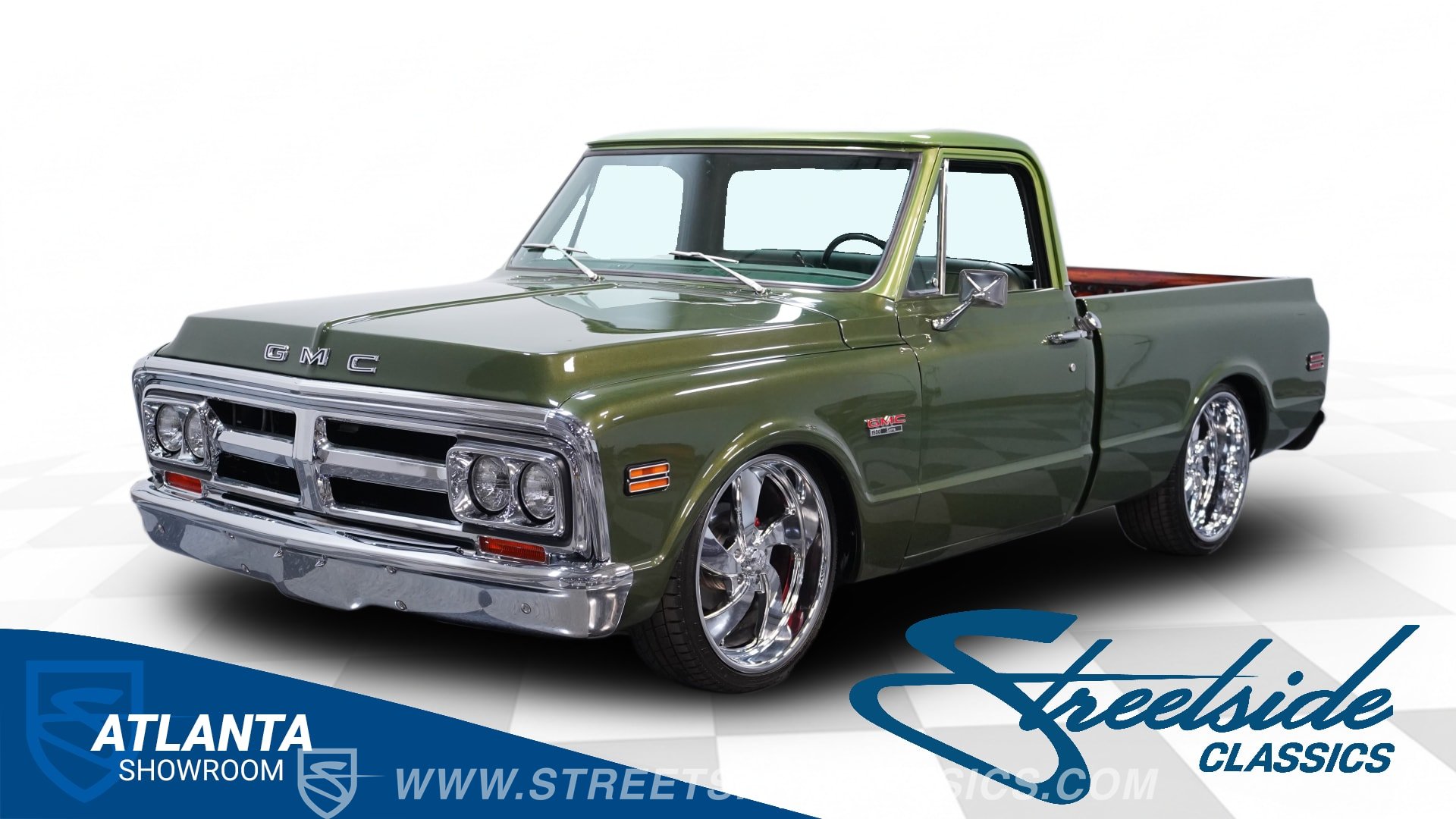
The 1967–1972 trucks. Three of the pool's trucks are 1970–1972 models, here because the generation is beloved, not because it is numerous. Coil-spring rear suspension on most half-tons gives them the best ride of any classic GM pickup, and GMC's four-headlamp face separates them from the Chevrolet crowd. Sierra badging on these trucks, where it appears at all, is a later addition or a top-trim reference; judge them as C/K trucks. Rust in the cab and bed decides everything, the 350 V8 is the engine to have, and original sheet metal is worth more than any option.
The Square Body, 1973–1987. The Rounded Line generation — square to every eye that has named it since — is the centre of gravity of this guide and of the listings: trucks from 1974, 1976, 1978, 1981, 1985, 1986 and 1987 all sit in the pool. GMC's trim ladder ran Sierra as the base-plus package, then Sierra Grande, High Sierra and Sierra Classic at the top at various points — the names moved around the ladder across fourteen years, so read the glovebox option label and the equipment on the truck, not the fender badge alone, before paying a top-trim premium. Cabs were regular and crew, beds Fleetside in 6.5- and 8-foot lengths plus the Stepside early on, and the K trucks carried a solid front axle to the end — the last of the simple 4x4s. The 1987 model year matters out of proportion to its age: it brought throttle-body injection to the half-tons, making it the most usable Square Body. An injected 1987 Sierra Classic K10 is, for many buyers, the exact truck this market is organised around.

GMT400, 1988–1998 (1500) and to 2000 (heavy-duty). The generation that made Sierra a model name: a sleeker cab, independent front suspension on the K1500 for the first time, anti-lock brakes early in the run, and an interior that moved the game on by a decade. The pool holds 1995 and 1996 trucks, which bracket the generation's most important divide: 1995 is the last of the throttle-body engines and the first year of the much-improved interior; 1996 brings the Vortec engines with sequential injection and a power jump you feel in the first hundred yards. Trims ran Sierra (base, often badged SL on later order sheets), SLE and SLT, the SLT bringing leather by the late 1990s. The heavy-duty 2500 and 3500 outlived the 1500 by two model years because the GMT800 HD was late — so a 1999 or 2000 Sierra 3500, like the crew cab in our listings, is a GMT400 under the skin despite its model year. Check the shape, not the year, before applying any generation-specific advice, this one included.

GMT800, 1999–2006. The LS generation, and the newest trucks in the pool — 1999, 2000 and 2001 models, including an SLE in Pewter Metallic. Stiffer frame, rack-and-pinion steering on 1500s, four-wheel disc brakes across most of the range, and the Gen III small-block family: durable in a way that reset expectations. GMC's divergence from Chevrolet widened here in exactly one place that matters — at the top. The 2001 Sierra C3 took the 6.0-litre V8, all-wheel drive and every option and made a luxury truck of it; for 2002 it became the Sierra Denali, adding Quadrasteer four-wheel steering. Denali is a GMC-only nameplate, and the one Sierra variant where originality, spec verification and the premium behave like a collector car rather than a used truck. Mainstream trims ran Work Truck, Sierra, SLE and SLT; an SLT with leather, Bose audio and the 5.3 is a pleasant place to cover distance.

GMT900 and later, briefly. The 2007–2013 GMT900 kept the formula, sharpened the styling, improved the interior — and introduced Active Fuel Management on most 5.3s, with the lifter consequences detailed later in this guide. The 2014 K2XX and 2019-onwards T1XX trucks are modern vehicles outside the classic market and the current listings entirely. When a clean GMT900 Denali with the 6.2 starts appearing in classic listings in numbers, it will earn its full section. Today it has not.
Engines and gearboxes
Three engine eras cover every Sierra you are realistically going to buy, and they behave like three different ownership propositions: carburetted small-blocks to 1986, throttle-body and Vortec from 1987 to 1998, and the LS era from 1999. Learn which era the truck in front of you belongs to first, because the same symptom — a flat spot, a hot-start problem, a ticking top end — has a different cause, test and bill in each one.
The carburetted small-blocks and the straight sixes, to 1986
The backbone of the early Sierra is the Chevrolet small-block V8 in 305 cubic inches (5.0 litres) and 350 cubic inches (5.7 litres), with the 400 small-block in the 1970s, the 454 big-block (7.4 litres) at the top of the Square Body range, and the 250 and 292 inline sixes and later the 4.3-litre V6 at the bottom. These are pushrod, iron-block engines of legendary simplicity. The virtue: almost nothing on them is expensive, almost everything can be fixed at the roadside, and a 350 with oil in it will run, roughly, almost forever. The vice: by the late 1970s they were strangled by emissions equipment — air pumps, EGR, vacuum hoses by the dozen, and the Rochester Quadrajet asked to meter through all of it — and a forty-year-old example's running quality depends on how much of that equipment survives and how much has been removed, badly or well.
Judge a carburetted Sierra on three things. First, cold behaviour: a Quadrajet with a working choke starts from cold with one pump of the pedal and fast-idles evenly; a truck that needs throttle nursing for two minutes is telling you the choke system, not the engine, wants money — a proper rebuild runs roughly $400–800, a quality replacement carburettor $500–900 fitted. Second, the flat spot: hesitation off idle is accelerator-pump wear or a vacuum leak at the carburettor base, tested by looking down the venturi while a helper snaps the throttle — you should see a strong, immediate squirt of fuel. Third, smoke discipline: blue smoke at start-up that clears is valve stem seals, $600–1,200 with the heads on; blue smoke under load is rings, and that is a rebuild conversation at $3,500–6,500 for a quality long-block swap — on a Square Body still often worth doing, because everything else about the truck is cheap.
The 305 deserves its reputation honestly stated: not a bad engine, a slow one, optimised for emissions-era economy, with the possibility of the soft camshaft wear that afflicted period GM V8s — a rhythmic tick and a misfire no plug or lead cures may be a wiped cam lobe, tested by a compression check and watching rocker movement with the covers off. Budget $1,200–2,200 for a cam, lifters and timing set fitted. The 454 is the opposite: torque everywhere, single-figure fuel consumption when towing, and cooling as its governing problem — a big-block that runs hot in traffic wants its fan clutch, shroud and radiator audited before its head gaskets are condemned. The 6.2-litre diesel in 1980s trucks is an economy diesel, not a powerhouse: glow-plug health and the Stanadyne injection pump decide its value, and most buyers should pass; the pool's trucks are petrol V8s, which reflects the surviving market accurately.
Throttle-body injection and the Vortec engines, 1987–1998
Throttle-body injection — TBI — arrived on the half-tons for 1987 and is the best thing that ever happened to the Square Body and early GMT400 as usable classics. Two injectors in a unit that looks like a carburettor, a simple ECU, fuel pressure around 9–13 psi, and almost nothing to go wrong beyond the fuel pump, the injectors and the sensors any parts store stocks. A TBI 350 makes about 210 hp in GMT400 form, starts in any weather, and asks for nothing exotic for decades. The failure modes are few: a failing in-tank pump gives a truck that starts cold, loses power hot and may cut out under load — test fuel pressure first, because half the "TBI problems" in classified ads are a $150 pump and an afternoon. Injector spray is visible with the air cleaner off: two even cones, or budget for injectors. The 4.3 V6 is the same architecture with two cylinders missing — listen for timing-chain and balance-shaft rattle at idle on high-mileage examples.
The 1996 Vortec update is the generation's dividing line and the engine most GMT400 buyers should target. The Vortec 5000 (5.0) and Vortec 5700 (5.7) gained sequential central-port injection, better heads and outputs of 230 and 255 hp. They feel a full generation quicker than the TBI trucks. They also introduced the era's two signature faults, both detailed in Problem areas: the central sequential injection "spider" assembly inside the intake, whose poppet injectors stick and whose pressure regulator leaks fuel into the plenum, and the lower intake manifold gaskets, whose plastic carrier lets coolant weep externally or, worse, into the oil. Neither is a reason to avoid the engine; both are reasons to price a truck correctly. A Vortec with a documented spider replacement (the upgraded multi-port conversion is the permanent fix, roughly $600–1,100 fitted) and documented intake gaskets is worth a premium over an identical truck with neither — and paperwork is the only reliable way to tell them apart, because both faults hide until they don't.
The LS-family engines, 1999 onwards — and what came after
The GMT800 brought the Gen III small-block, badged Vortec but a clean-sheet engine: the 4.8-litre LR4, the 5.3-litre LM7, the 6.0-litre LQ4 and high-output LQ9, and, in the HD trucks, the 8.1-litre big-block and the 6.6-litre Duramax diesel. Outputs ran from 270 hp for the 4.8 to 345 hp for the LQ9, and the 5.3 in the middle — 285–295 hp in most applications — is the engine the market settled on, correctly. These engines are durable in a way that still surprises people raised on the older small-blocks: 250,000 miles on an unopened LM7 with regular oil changes is unremarkable, and the coil-near-plug ignition has no distributor to wear. Buy on evidence of oil changes and on the specific faults in the next section — piston slap, intake gaskets, knock-sensor corrosion — not on mileage fear.
Two LS-era points deserve emphasis because sellers blur them. First, piston slap: many early Gen III engines slap audibly from cold — a hollow knock that fades within a minute or two as the pistons expand. GM treated it as a noise characteristic rather than a durability fault, and the surviving fleet's mileages back that up: a truck that slaps cold and is quiet hot, with clean oil and good pressure, earns a modest discount, not a walk-away. A knock that persists hot is a different sound — rod bearings or a failing lifter — and no seller's "they all do that" should cover it. Second, the 6.0 in the Denali and C3 (LQ9, 345 hp) demands premium fuel, and its premium over a 5.3 truck should buy you the whole Denali package verified, not just the engine.
Gearboxes and transfer cases
Almost every Sierra you will meet is an automatic, and the automatic's identity follows the generation. Square Bodies use the three-speed Turbo-Hydramatic 350 and 400 and, from the early 1980s, the 700R4 four-speed overdrive — a good gearbox whose survival depends on the TV cable being correctly adjusted: a misadjusted cable drops line pressure and burns the box, so a 700R4 truck with vague, stacked shifts wants a cable check before a rebuild quote; any 700R4 rebuild runs roughly $1,800–3,000. The GMT400 and GMT800 half-tons use the 4L60-E, the 700R4's electronic descendant, the most common Sierra gearbox of all — and the one with the most predictable failure in this guide. Its sunshell fractures, taking reverse, second and fourth with it; its 3–4 clutch pack wears; a box that towed heavy on the factory cooler alone lives a shorter life. A quality rebuild with the upgraded shell runs roughly $2,200–3,500 fitted, and a truck with that invoice in its file has had the generation's defining bill already paid. Heavy trucks got the far stronger 4L80-E, which fails rarely and expensively ($3,000–4,500); behind the Duramax and 8.1 sits the Allison 1000, stronger again and priced accordingly. The GMT900 moved half-tons to the 6L80 six-speed, whose converter-clutch wear shows as a shudder at light throttle.
Manuals are the minority taste — one manual appears among the transmissions recorded in our listings — and they are good ones: the NV3500 five-speed in GMT400 and GMT800 half-tons, the NV4500 in the heavy trucks, and four-speeds in the Square Body era. Judge one on second-gear synchromesh, clutch bite point and release-bearing noise, and value it as rarer, more involving, and harder to sell on, in that order.
Four-wheel-drive Sierras carry chain-driven transfer cases — the NP208 and NP241 in the Square Body and GMT400 eras, the NP246 Autotrac and NP261/263 in the GMT800. The NP246 has a signature internal fault, pump rub, covered in Problem areas: the pump's locating tabs wear a pinhole through the rear case half and the case empties itself slowly. On any K truck, engage four-wheel drive on the test drive — high, low and Auto where fitted: a case that will not engage or grinds is a $800–2,000 conversation, encoder motor or case itself. Solid-axle Square Body K trucks add locking hubs: hubs that will not lock are a $300–700 fix and a sign the four-wheel drive has been left to seize for a decade.
Problem areas
Everything mechanical on a Sierra can be fixed with parts that still exist. What decides whether a truck is a buy or a bill is the same short list on every generation — rust first, then the generation's signature engine and gearbox faults, then deferred maintenance. Work through this section in that order, and note the one piece of evidence our own listings give you: of the 4 Sierras in the current pool whose photo sets we examined in detail, 1 carried a damage mention in its photo notes, and none of the 4 carried rust, smoke or leak mentions. Read that honestly: it is a sample of 4 trucks out of 22, it says the photographed end of this market presents clean, and it says nothing about the undersides nobody photographed. On trucks of this age, the absence of a rust photograph is not evidence of the absence of rust — it is why the inspection section sends you underneath with a torch.
Rust and the frame: the map
Rust on a Sierra follows water, salt and mud traps, and each generation has its own map.
Square Body, 1973–1987. The cab corners are the signature: the rear corners of the cab trap mud thrown by the rear wheels and rot from the inside out. Bubbling corners are rust you can price — patch panels are cheap, fitting and painting both sides properly runs roughly $800–1,800 — while holed corners usually mean the same story in the rockers, cab floor supports and inner fenders. Work the full circuit: rockers along their whole length, the floor at the driver's heel, front fenders behind the wheels, the bed floor at its front panel where leaves and water sit, and the tailgate's bottom edge. The frame is strong and rarely the issue on a southern truck; on a northern truck, check the rear rails around the spring hangers and fuel-tank crossmember, where scale thins the metal from the outside in. Prod with a screwdriver, with permission: surface scale that rings is cosmetic, metal that flakes or gives is structural, and frame repair on a Square Body quickly stops making sense against an ordinary truck's value — which is why the southern premium in this market is real and worth paying.
GMT400, 1988–1998. The map moves. Cab corners still go, and add the rockers (especially on extended cabs), the door bottoms where the skin folds over the door frame, the rear wheel arches on the bed — the GMT400 bedside rusts at the arch lip in a way the Square Body's usually did not — and the front fender bottoms. Underneath, the frame holds up better than the body, but brake and fuel lines along the driver's rail corrode in salt states and a weeping line means a full set, not a patch: a complete stainless set fitted runs roughly $800–1,500. Check the spare-tyre carrier and its crossmember, which live in the salt spray and are rarely looked at until the spare drops.
GMT800, 1999–2006. This generation's rust story is the most serious of the three, and the one buyers underweight because the cabs still look modern. Two items dominate. First, the rocker panels: GMT800 rockers rot comprehensively in salt country, inner and outer together, and by the time the outer panel bubbles the inner structure is usually involved — full replacement both sides, fitted and painted, runs roughly $1,500–3,000, and slip-over cover panels are a cosmetic answer a magnet will expose in seconds. Second, the brake lines: GMT800 trucks are known across the industry for brake-line corrosion, lines along the frame rail and across the rear axle rusting to failure — a hard pedal one day and a pedal to the floor the next, because a rusted line lets go under pressure. Any GMT800 from a salt state without documented line replacement should be budgeted for a full set on day one ($900–1,600 for a pre-bent stainless set fitted), and a truck whose lines show heavy flaking should not be driven home until they are done. Frame rust follows the lines: the boxed frame suffers at the rear, around the spring hangers and spare carrier. A GMT800 with clean rockers, documented lines and a solid rear frame is a genuinely sorted truck; one cheap because of "some rust" is usually cheap because of all three.
Across all generations, learn to read fresh underseal. Factory coatings after twenty years are patchy, chipped and dirty in a consistent way. A uniform coat of fresh black stone-chip over rockers, frame rails, brake lines and cab corners the week before a sale is a cover-up until the seller proves otherwise. It does not condemn a truck, but it moves every rust check from visual to physical: magnet, torch and screwdriver, or a lift and a professional.
Engines: the signature faults by era
Vortec spider injection and intake gaskets (GMT400, 1996–1998). The central sequential injection unit sits inside the intake manifold, out of sight, and fails two ways: poppet injectors stick, giving a misfire that moves around the cylinders, and the integral fuel-pressure regulator leaks, giving hard hot starts and fuel washing into the intake. Diagnosis is by fuel-pressure test and by history, not by looking. The lower intake gaskets fail differently: the plastic carrier cracks around the coolant ports, and coolant weeps externally at the intake's front corners or internally into the valley and the oil — coolant loss with no puddle, plus mayonnaise under the filler cap, is the classic presentation. Intake gaskets fitted run roughly $700–1,200; the spider, replaced with the upgraded multi-port conversion, $600–1,100. A 1996–1998 truck with both invoices had a seller who understood the model. One with neither, a coolant habit and a hot-start problem has both bills queued for you.
LS-era intake, knock sensors and oil (GMT800). The Gen III intake is plastic and does not warp, but its gaskets dry and leak vacuum, giving a lean rough idle from cold that improves warm — and beneath that intake, in the valley, sit the two knock sensors, where water collects around the rear sensor, corrodes it and its harness, and sets a code that costs roughly $600–1,000 to put right properly, because the intake has to come off to reach them. Oil consumption on GMT800 5.3s is usually the PCV system in the driver's valve cover rather than rings; a litre between changes on a high-mileage truck is common, a litre every thousand miles wants investigation. A gauge that drops at hot idle on an LS is often a failing oil-pump pickup O-ring — a cheap part drawing air — before it is a worn engine, and the fix, while labour-heavy at $800–1,400, is a known quantity. Piston slap belongs here as a classification exercise: cold noise that fades is slap; noise that stays is not.
AFM lifter failure (GMT900 5.3, 2007 onwards — later generation, not in the current listings). Active Fuel Management deactivates four cylinders by collapsing their lifters with oil pressure, switched by solenoids under the intake. The lifters are the weak point: they collapse and do not recover, and the presentation is a ticking that becomes a misfire, often with a cylinder-specific code, on a truck that may have modest mileage. In the worst cases the failed lifter damages the camshaft lobe, and the job grows into a full AFM delete — non-AFM camshaft, standard lifters, valley cover and a tune — at roughly $3,500–6,000 fitted, against $2,000–3,500 for a lifter-only repair that keeps the system that failed. Oil consumption precedes failure on many of these engines; the updated valve cover and shielded relief valve are the factory mitigations to look for in the history. The buying rule is why this fault earns space in a guide whose listings stop at 2001: on any 2007-onwards 5.3, the AFM history — delete done, lifters done, or untouched — is the first question, ahead of mileage, trim and colour.
Cooling, across all eras. Radiators silt, fan clutches lose their bite (a fan you can spin freely by hand on a hot engine is a dead clutch, $150–350 fitted), plastic tanks crack at the necks, and coolant left unchanged for a decade turns acidic and attacks gaskets. A full refresh on a neglected truck runs roughly $900–1,800 and is the best reliability money you can spend on any Sierra that has sat.
Gearboxes, transfer cases and axles
The 4L60-E's failure pattern is so consistent it functions as a service schedule: sunshell fracture (loss of reverse, second and fourth), 3–4 clutch wear (flare on the 2–3 and 3–4 shifts under load), and converter-clutch wear (a shudder at light throttle around 40–50 mph). A box that shifts cleanly cold and hot, engages reverse instantly and shows pink, unburnt fluid is healthy; brown, burnt-smelling fluid on a truck with no rebuild history means the $2,200–3,500 rebuild is in its near future and should be in your offer. The 700R4 in late Square Bodies adds the TV-cable trap from the engine section. The 4L80-E fails by simply wearing out at high mileage, announced by lazy shifts and converter shudder, and its strength is why HD trucks hold their value as tow vehicles.
Transfer-case pump rub (GMT800 NP246 and related cases) is invisible until it is expensive. Inside the case, the oil pump is located by tabs against the magnesium rear case half; the tabs fret and a pinhole wears through from the inside. The case then loses fluid slowly, in a mist too fine to drip convincingly, and runs dry while the truck still drives normally in two-wheel drive. The evidence is a fine oil film on the rear of the case; the fix, caught early, is a replacement case half or saver plate at $600–1,200 fitted, and caught late a case rebuild at $1,500–2,500. Every GMT800 4x4 inspection should include a hand wiped over the back of the transfer case — ten seconds, and the cheapest test in this guide relative to what it can save you. Encoder motors on push-button cases fail across GMT400 and GMT800 trucks, presenting as a service-4WD light and a case stuck in its last range; the motor is roughly $300–600 fitted and is a diagnosis, not a disaster.
Axles are the strong point of the range. The 10-bolt rear axle in half-tons and the 14-bolt in heavy trucks are durable, with two known habits: the G80 locking differential in many GMT400 and GMT800 half-tons locks with a bang owners mistake for breakage (it is the design working — one that chatters constantly or never locks is worn, and a fluid change settles many), and pinion seals weep on everything, a $200–400 fix that matters because a weeping seal ignored becomes a low axle. Front CV boots wear first on lifted trucks — one more reason a stock-height truck is the safer buy.
Steering, brakes and electrics
Square Body steering is a recirculating-ball box whose looseness accumulates across the box, the idler and pitman arms and the tie-rod ends; judge it as a system, budget $800–1,600 for a full front-end refresh with alignment, and never accept "they all wander" for a truck that changes lanes on its own. GMT400 K trucks eat idler and pitman arms as a pair ($400–700 fitted). GMT800 rack-and-pinion steering is tighter and dearer when the rack weeps ($800–1,400). On lifted trucks — and this market is full of them — every steering and CV angle has changed from factory and wear rises accordingly; a lift is a multiplier on this whole subsection.
Brakes follow the generations: rear drums on most Square Bodies and GMT400 half-tons, four-wheel discs on most GMT800s. The GMT800's electronic brake control module develops solder-joint failures that light the ABS and brake warnings together and kill the anti-lock while leaving normal braking — a module repair runs roughly $150–400 — and its front wheel-speed sensors corrode and trigger low-speed ABS activation, the pedal pushing back as you roll to a stop. GMT800 instrument clusters fail by stepper motor: gauges that sweep wrongly, stick or die one by one, fixed by a cluster rebuild at roughly $200–400 and so common that an all-alive original cluster is mildly remarkable. Trailer wiring on every generation should be assumed guilty until a test lamp proves it innocent.
Interiors wear in proportion to work. GMT400 dashes crack across the top in sun states — a replacement is a significant job and good used ones are hunted, so a crack-free dash is worth real money in the offer. GMT900 dashes crack around the passenger airbag; a buyer cross-shopping a 2006 and a 2008 should know the newer truck carries the worse dash. Seat foams collapse on the driver's side first, and a seat you can feel the frame through means pads and a cover at $400–900. Headliners sag on everything from the 1990s onwards; $250–500 retrimmed. None of this stops a truck working. All of it prices one.
How to inspect one
Allow an hour, bring a torch, a magnet wrapped in cloth and a screwdriver for prodding (with the seller's permission). If the truck passes you, pay for a lift inspection before money changes hands — it will find the transfer-case, brake-line and frame evidence a driveway viewing cannot, and it costs less than any single repair in Problem areas.
- Start with the paperwork and the plates. Match the VIN on the title to the plate at the base of the windshield and the door-jamb sticker, and find the Service Parts Identification label — in the glovebox on most of these trucks — which lists the factory option codes: engine, gearbox, axle ratio and trim as built. That label settles arguments badges cannot: whether a claimed Denali, SLT or 6.0 truck left the factory that way. Ask for invoices, weighted as Problem areas direct: intake gaskets and spider on a Vortec, gearbox rebuild on a 4L60-E truck, brake lines on a GMT800, lifter history on anything 2007 onwards.
- Cold start, from outside the truck. Insist the engine is cold and stand at the exhaust for the start. Blue smoke that clears is valve seals; smoke that stays is rings. On an LS truck, listen for piston slap — a hollow knock that should fade within two minutes — and separate it from any tick that persists hot, which is a lifter or worse and does not get the "they all do that" pass. On a GMT900 5.3, a cold tick that grows rather than fades is the AFM story starting, and it ends the viewing unless the price already reflects it.
- Under the bonnet, fluids first. Pull the oil dipstick: level, colour, and smell — fuel in the oil on a Duramax, mayonnaise on the filler cap on a Vortec, both point at specific bills named in Problem areas. Check the coolant's colour and age, not just its level; rusty or oily coolant re-prices the cooling system and possibly the intake gaskets. Read the transmission dipstick: pink and sweet is health, brown and burnt is a rebuild entering the negotiation.
- The rust circuit, in order. Cab corners, rockers full length, floor at the driver's heel, door bottoms, bed arches and front panel, tailgate bottom edge — the rust map worked in its order, with the magnet on every panel that looks too straight and the screwdriver on every corner that looks too black. Fresh, uniform underseal moves every check from looking to prodding. On a GMT800, treat the rockers as guilty until the magnet and torch acquit them.
- Underneath, on the lift if at all possible. Frame rails at the spring hangers and rear crossmember, brake and fuel lines along the driver's rail — on a GMT800, flaking lines end the test-drive discussion until they are replaced — and the back of the transfer case, wiped with a clean hand: the pump-rub check from Problem areas, ten seconds that can save a case. Classify any oil weep as seal money or engine money before you go further.
- The 4x4 test. On any K truck, engage four-wheel drive high, then low, then Auto where fitted. It should engage without grinding, hold without flashing lights and disengage cleanly. A service-4WD light is the encoder-motor conversation from Problem areas — price it, do not ignore it. On a Square Body, work the hubs by hand; on an independent-front-end truck, check CV boots for splits, especially on anything lifted.
- The test drive, loaded with questions. Fifteen minutes minimum, including a highway stretch and a rough road. The automatic should engage reverse instantly (the 4L60-E sunshell test — a pause or a missing reverse is the fracture announcing itself), shift 2–3 and 3–4 without flare under load, and hold converter lockup without shudder. A manual should take second gear cold without a crunch. Note steering play, wander, and any pull under braking.
- Brakes, hard and gentle. Brake firmly from speed: straight, no judder, no pedal sink. Then roll to a gentle stop and feel for low-speed ABS pushback on a GMT800 — the corroded wheel-speed sensor signature. Check the parking brake holds on a slope; on drum-brake trucks it is its own mechanism and its own small bill when it does not.
- Heat, cooling and electrics at idle. Let it idle hot after the drive; the temperature should settle and stay, and a creeping gauge sends you back to the cooling paragraph in Problem areas. Now work everything: every gauge (GMT800 stepper motors — a dead gauge is a cluster rebuild, not a mystery), windows, locks, lights, wipers, heater and air conditioning on every fan speed, and the trailer connector with a test lamp if the truck will tow for you.
- The Denali and trim verification pass. If the truck is sold as a Denali, C3, SLT or any premium trim, verify it like a collector car: option label against equipment, the 6.0 under the bonnet, all-wheel drive working, Quadrasteer cycling on an early Denali (turn lock to lock parked and watch the rear wheels counter-steer). Trim that cannot be verified from the label is trim you do not pay for, however good the badges look.
- Stance and modifications audit. Stand back and photograph the truck in profile; it should sit level and even. Then list every deviation from stock — lift, wheels, tyres, exhaust, tuning — and price each twice: once as the value the seller claims, once as the wear multiplier it represents for you. The modified 1987 in our figures is the honest example: its stance is a previous owner's decision, and your inspection of its ball joints, CV angles and steering should be the lifted-truck version from Problem areas.
- Interior and bed, last and honestly. Sit in the driver's seat and feel for the frame through the pad; check the dash top for the GMT400 crack and the GMT900 airbag crack where relevant; then stand in the bed and look at the floor and front panel — a bed tells the truth about a truck's working life that no valet can hide. A worn bed on a mechanically documented truck is honest wear. A perfect bed on a truck with no paperwork is a question.
Values
The market block beneath this guide carries the current listing figures, refreshed at every build, and it is the only place in this guide where prices appear — deliberately, because the Sierra market moves by generation and condition far more than by any single number. What follows instead is how to read that block, and the Sierra market generally, like someone who has priced these trucks before.
Start with the condition spread, because on Sierras it is wider than on almost any car market. The same model year and badge can describe a rusted work truck at the end of its economic life and a garaged, documented SLT that wants for nothing, and the gap between those two trucks is not a percentage — it is several multiples. The drivers of the spread are exactly the items in Problem areas, in the same order: frame and cab rust first, then the signature mechanical bills (a 4L60-E rebuild, Vortec intake and spider work, GMT800 brake lines and rockers, AFM history on later trucks), then paperwork, then originality of trim. When two asking prices look far apart for similar trucks, work down that list before assuming one seller is dreaming; usually the cheaper truck is cheaper for a named reason, and occasionally the dearer one is dear for no reason at all — which is the one to negotiate with.
Asking and achieved prices part company in predictable places. Private Marketplace sellers — half of our current pool — tend to price from other asking prices, so the local market can sit above where trucks actually change hands, and a polite offer anchored to a named, costed fault list moves more trucks than a lowball. Dealer trucks carry margin but also, at the good end, the sorting already done: a dealer GMT800 with lines, rockers and gearbox documented has absorbed the three bills that make private cheap trucks expensive. Auction results are the cleanest read on the top of the market and the least useful guide to the middle, where most Sierras trade privately without a public result.
Premiums attach to specific, verifiable things. The Square Body premium is generational: short-bed K10s, factory big-block trucks and the injected 1987s lead it, and a GMC badge neither adds nor subtracts against a Chevrolet equivalent — the money follows bed length, drivetrain and rust, not the grille. The Vortec premium over an identical TBI GMT400 is real and earned. The Denali premium is the sharpest in the range and the one to verify hardest: a genuine, documented early Denali with working Quadrasteer is a scarce truck with a following; a badged SLE with a Denali grille is an SLE, and the option label from step 1 is what separates the two prices. Modifications almost never return their cost: a lifted truck is worth its underlying condition, not the sum of its parts invoices — which is why modified trucks are frequently the value here for a buyer who wanted those modifications anyway.
The project-versus-driver gap deserves a final word, because Sierra projects are seductive: cheap, simple, and every part exists. Price a project by adding the named bills in this guide, in order, plus the one nobody lists — paint and body finishing, a large invoice on a full-size truck however you approach it. A driver with the bills already paid is almost always the cheaper truck over two years. The exception is the buyer who does the work themselves and counts the hours as the hobby: for them, a rust-free southern project with a tired drivetrain is the best buy on this page, because the one thing you cannot bolt on is a sound shell.
Parts and ownership
The Sierra's parts story is the strongest argument for the whole model line, and it is a Chevrolet story as much as a GMC one: sharing its mechanicals with the Silverado and the wider GM truck range, it rides on one of the deepest parts supplies in the classic vehicle world. Engines were built in the tens of millions, and the aftermarket treats these trucks as a core market, not a niche.
Easy, and close to modern-car money: service items, filters, plugs and ignition consumables for every era; brake discs, drums, pads and hydraulics; suspension wear parts; cooling-system components; TBI and Vortec service parts; LS sensors, coils and accessories; patch panels for cab corners, rockers and arches on Square Body and GMT400 trucks; weatherstrips and glass for the volume generations. Order today, fit this weekend is a realistic rhythm for most of the ownership experience, and any competent independent shop will work on these trucks without a specialist premium — the labour rates in this guide's job costs assume exactly that.
Harder, dearer or hunted: correct GMC-specific trim and badging (the shared mechanical supply does not extend to GMC grilles, Denali trim and Sierra-only interior pieces, which are thinner on the ground than Chevrolet equivalents); Quadrasteer components for the early Denali, where the rear steering rack and its electronics are specialist or used-parts territory; crack-free GMT400 and GMT900 dashboards; factory-style SLT leather upholstery; 6.5 diesel injection equipment; and date-coded parts for a top-level Square Body restoration. None of it is unobtainable. All of it rewards buying the most complete truck you can find rather than the cheapest shell.
Running costs. Fuel is the honest headline: low-to-mid teens in mixed use for a small-block truck, single figures from a working 454, high teens on a gentle run from a well-kept 5.3 — these are trucks, and a buyer surprised by truck fuel bills has misread the vehicle. Insurance is unremarkable, agreed-value cover is widely available for the Square Body and earlier trucks, and factory-size tyres are mainstream money; oversized tyres on lifted trucks are not, and a set can cost more than a gearbox rebuild's deposit. The first-year budget is the figure to plan: catching up deferred maintenance on a running, honest Sierra — cooling system, fluids throughout, brakes audited, signature items checked — realistically runs $1,500–4,000 at a shop before you improve anything, and half that in parts if you do the work yourself. A sorted Sierra thereafter asks for oil, filters and attention, and gives back a vehicle that can still work for its living. That, more than the badge, is why these trucks hold their following.
Which one to buy
- The all-rounder: GMT800 Sierra 1500 SLE or SLT, 5.3 V8, 2000–2002. The best-driving classic Sierra, with LS durability and the deepest modern parts support — bought on brake lines, rockers and transfer case, as Problem areas direct. The 2001 SLE in our listings is the template.
- The classic buy: 1987 Sierra Classic, TBI 350. The Square Body shape with fuel injection — the last year of the generation and the most usable. A K10 short-bed is the blue-chip specification; a long-bed C10 is the same ownership experience for meaningfully less.
- The value buy: GMT400 Vortec 1500, 1996–1998. A generation newer than the Square Body, a generation cheaper than the GMT800, with the Vortec's pace — provided the intake gaskets and spider are documented or priced in. A 1996 truck with both invoices is the quiet bargain of this guide.
- The work truck: GMT400 3500 or GMT800 HD, 6.0 or 7.4 V8. If the truck must tow and haul, the heavy chassis, the 4L80-E and the simple petrol V8s cost least per working mile. The 1999 crew cab in our listings — a GMT400 under its model year — is exactly this buy.
- The collector: early Sierra Denali, 2001 C3 or 2002–2006 Denali. The one GMC-only flagship: the 6.0, all-wheel drive and Quadrasteer on the early cars. Verify everything from the option label, and walk away from badged tributes at Denali money.
- The character buy: 1970–1972 C/K Sierra-trim truck, 350 V8. The prettiest face GMC ever put on a pickup and the simplest mechanicals in this guide. Buy the shell, enjoy the coil-spring ride, and accept a 1970s vehicle in every system, brakes and steering included.
- The later buy, with eyes open: GMT900 Denali 6.2. Not in the current listings: the 6.2 avoids the AFM story that governs every 5.3 of its era, and a documented one is the modern Sierra with an enthusiast future. A GMT900 5.3 is a buy only with its lifter history in writing.
And the rule that overrides all of the above: buy the least rusty truck you can find, with the generation's signature bills either documented as paid or priced into your offer. Engines, gearboxes and transfer cases are all fixable at prices you can plan for. A rotten frame, cab and rockers cost more to put right than the finished truck will be worth — and on a Sierra, where the mechanical supply is bottomless and the shells are the finite resource, the shell is the truck.
See the 12 Sierra cars currently listed.