
GMC Jimmy Sport Utility 2D buyer's guide
GMC Jimmy Sport Utility 2D -- the model's own buyer's guide: variants, values and what to check.
Years listed: 1971-1995 · Series: C/K Trucks
Overview and history
The GMC Jimmy is really two different vehicles wearing one name, and the first job of any buyer is to know which one is standing in front of them. The original is the full-size Jimmy of 1970–91: a body-on-frame 4x4 built from GMC's C/K pickup line, with a short wheelbase, a removable top and small-block V8 power. It is, underneath, the same truck as Chevrolet's K5 Blazer — the Jimmy is what happened when the Blazer formula was sold through GMC dealers with GMC badges, GMC trim names and a slightly more upmarket pitch. The second Jimmy is the S-15 Jimmy of 1983–94 and its 1995-on successor: a compact SUV spun off the small S-15 pickup, V6-powered and sold in far greater numbers. Both are now bought as classics — but they share almost no parts, no driving character and no market logic, and this guide keeps them separate throughout, because nearly every mistake in this market starts with judging one by the other's standards.
The full-size Jimmy arrived for the 1970 model year, one year after the Chevrolet Blazer it twins. The Blazer itself had been Chevrolet's answer to the Ford Bronco and the International Scout: rather than design a new vehicle, GM shortened the K10 pickup frame to a 104-inch wheelbase, kept the pickup's engines, gearboxes, axles and front sheet metal, and put a two-door wagon body on top with a fully removable fibreglass top. GMC took the identical recipe for 1970. The differences from a Blazer are real but shallow — grille, badges, trim names, some interior fabrics and colours — and that shallowness is the Jimmy's great practical strength: everything the huge Blazer and C/K truck world knows, makes and stocks applies to your truck.
The first generation ran 1970–72, on the rounded styling GM truck people call the Action Line. The second generation — the square-body, or Rounded Line in GM's own language — ran a remarkable 1973–91, with a facelift in 1981 and another, milder one for 1989. Two changes inside that long run matter more than any styling tweak: for 1976 the full convertible top gave way to a fixed steel half-cab over the front seats with a removable hardtop over the rear only, a safety-driven change that ended the true open truck; and in 1987 carburettors gave way to throttle-body fuel injection, which transformed cold starting and everyday drivability. The full-size line ended after 1991; its GMT400-platform replacement, with a fixed steel roof, was launched for 1992 as the GMC Yukon — a close mechanical cousin of the last Jimmys, but not a Jimmy, and not a removable-top truck.
The S-15 Jimmy followed the same recipe one size down. Launched for 1983 alongside the S-15 compact pickup, it took that truck's frame, engines and running gear and added a two-door wagon body; a four-door joined it in 1991, and that is when the small Jimmy became a mainstream family vehicle rather than a lifestyle toy. The S-15 prefix kept the two Jimmys apart on the same showroom floor; when the full-size truck was replaced by the Yukon it was dropped, and the rounded second-generation truck of 1995 on is a Jimmy again. In our own listings the small truck is a footnote — just two of the 27 Jimmys we track are the 1994 and 1995 cars — but it is covered honestly below.
Why buy one now, rather than the Blazer it duplicates? It is the last of the big, simple, removable-top American 4x4s, mechanically a pickup understood by every shop in America — and GMC sold far fewer of them, so a Jimmy is the rarer sight, with GMC-only editions that have no Chevrolet equivalent.
Our own listings show the shape of today's market plainly. We currently track 27 Jimmys, 21 of them for sale and 6 recorded as sold. The years cluster in two humps: nine cars from 1970 to 1974 — the full convertibles and the first square-bodies — and sixteen from 1983 to 1991, with 1986 and 1988 the joint most common years at three cars each. Automatics dominate, as they did when the trucks were new: only a handful of the cars we track are manuals. Blue and white are the most common colours, with brown and tan — the true period palette — close behind. Most cars reach us through Marketplace sellers, with dealer listings making up most of the rest.
One warning before anything else: a large share of full-size Jimmys, especially early ones, have been modified — lifted, re-engined, re-axled, repainted in non-original colours, or all four. Modification is part of this model's culture and is not automatically a defect, but the inspection section treats originality as something to establish, not assume.

The models
Every full-size Jimmy is a two-door wagon on a shortened pickup frame. In GMC's truck coding of the period the 4x4 line is the K-series, and the Jimmy was overwhelmingly a 4x4 — but a two-wheel-drive version was offered in both full-size generations and is now rare and, in the early years, genuinely sought after as a street truck. GMC trim names differ from Chevrolet's, and they are the first identity tell: where a Blazer runs Custom Deluxe, Cheyenne and Silverado, a Jimmy runs from a plain base trim through Sierra and High Sierra to Sierra Classic at the top, with the CST package the desirable early option.
| Model | Years | Engine | Output | Built | Character |
|---|---|---|---|---|---|
| Jimmy (first generation) | 1970–1972 | 250 six / 307 / 350 V8 | 155–255 hp | Low volume beside Blazer | The original full convertible; the collector truck |
| Jimmy (square-body, early) | 1973–1980 | 250 six / 305 / 350 / 400 V8 | 100–175 hp (net) | — | Full top to 1975, half-cab from 1976; smog-era power |
| Jimmy (square-body, late) | 1981–1991 | 305 / 350 V8, 6.2 diesel | 130–210 hp | — | Lighter nose, overdrive automatic, TBI injection from 1987 |
| Jimmy 2WD | 1970–1982 | Six / small-block V8 | As above | Low volume | The street Jimmy; rare early, dropped after 1982 |
| S-15 Jimmy (first generation) | 1983–1994 | 2.5 four / 2.8 V6 / 4.3 V6 | 92–200 hp | High volume | Compact original; 4-door from 1991, 4.3 is the one to have |
| Jimmy (second generation) | 1995–2001 | 4.3 V6 | 190–200 hp | High volume | Rounded family SUV; the affordable daily classic |
(GM published Jimmy production inside its truck totals in a way that does not give clean, trim-by-trim build figures a buyer can rely on, so this guide does not invent them; the Jimmy was always the minority twin, GMC's volumes a fraction of Chevrolet's. Outputs are period figures — gross ratings before 1972, net ratings after — which is why the same 350 V8 appears to lose power across the 1971–72 boundary. It did not; the ruler changed.)
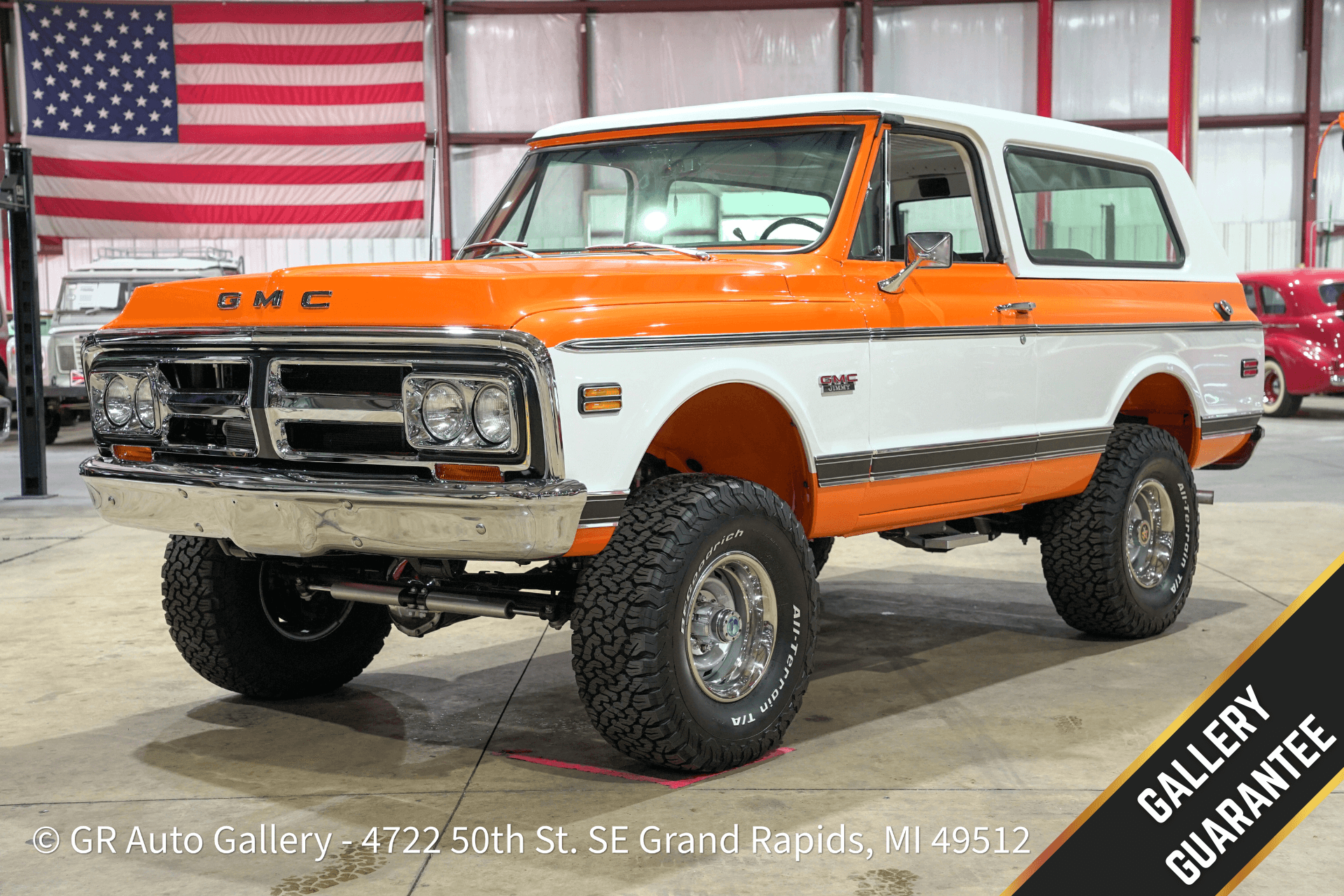
First generation, 1970–72. The collector's Jimmy. Styling matches the 1967–72 GMC pickups, the top comes off completely — unbolt it and the whole roof, sides and rear lift away — and the specification is pure truck: leaf springs all round, a Dana 44 front axle on 4x4s, and front disc brakes standardised early in the run. The 350 V8 is the engine the market wants; the 250 six is honest but slow in a truck this heavy; the 307 sits between and fools nobody. In our listings this generation is well represented for something so scarce when new — cars from 1970, 1971 and 1972 account for six of the 27 Jimmys we track, with 1971 the most common early year.
Square-body, 1973–80. Bigger-feeling, squarer, and built on the 106.5-inch wheelbase it kept to the end of the full-size line. Trucks to 1975 are still full convertibles — the last of the true open Jimmys, and worth a premium over a 1976 for exactly that reason. From 1976 you get the steel half-cab: safer, quieter, far less leaky, and the rear top section still removes. This is the smog era, so outputs sagged — a mid-seventies 350 makes roughly what a 307 made in 1970. The 400 small-block is the torque pick of this span; the 305 that arrived at the end of the decade is the economy engine and feels it. Two GMC period specials belong to this span. The Desert Fox (1977–78) was a factory special edition — special paint and striping, a roll bar, auxiliary lights and off-road furniture — and a genuine one is a find. The Casa Grande (1976–77) was the GMC counterpart to Chevrolet's Blazer Chalet: a factory-offered camper conversion built by Chinook Mobilodge, with pop-up roof and living quarters in place of the rear seat. Survivors are rare and should be judged as camper conversions, not as butchered Jimmys.
Square-body, 1981–91. The 1981 facelift lightened the front end and took weight out of the truck; more importantly, the decade brought the 700R4 overdrive automatic, the 6.2-litre diesel from 1982, and for 1987 throttle-body injection on the petrol V8s, the single biggest drivability step in the Jimmy's life. The 1989-on trucks got a revised grille and composite headlamps and are the most civilised square-bodies: fuel-injected, overdrive-equipped, air-conditioned trucks you can drive across a state without thinking about it. This is the heart of our own market — the 1983–91 cars are the majority of everything we list — and if you want a Jimmy to use rather than to show, start here. The diesel is a specialist taste, covered in the engine section, and the 305 cars are the budget entry, fine if priced as such.
The small Jimmy: S-15, 1983–94, and Jimmy, 1995 on. The S-15 Jimmy mirrors the full-size story one size down: a two-door wagon on the compact pickup frame, with the four-door (1991 on, on a longer wheelbase) becoming the volume seller. GMC trim ran through Sierra Classic, Gypsy, High Sierra and later SLS and SLT grades. The decision that matters on a small Jimmy is not the trim; it is the engine and the door count. The early trucks came with a 2.5-litre four and a 2.8 V6 that were adequate in a pickup and marginal in a loaded 4x4 wagon. The 4.3 V6, offered from the late 1980s and dominant from the early 1990s, transforms the truck — it is effectively three-quarters of a small-block V8, with the torque to match — and a 4.3 truck is the default recommendation. The 1995 second generation — the one car of its kind in our current listings, alongside a single 1994 S-15 — is rounder, safer and better finished, but also more appliance-like, and the market prices it that way: cheap, useful trucks, bought on condition alone.

Engines and gearboxes
The full-size sixes and small-block V8s
The full-size Jimmy's engine bay holds the most familiar engines in America, and that familiarity is the model's greatest ownership asset: an inline six for the base trucks, and Chevrolet's small-block V8 — 307, 305, 350 and 400 cubic inches — for everything else, carburetted until 1986 and throttle-body injected from 1987. One identity point first, because GMC history confuses buyers: older GMC trucks famously used GMC's own engines, including a big V6 family in the 1960s, but the Jimmy never did. Every full-size Jimmy engine is the shared GM corporate unit found in the equivalent Blazer and C/K pickup — which is precisely why parts and knowledge are everywhere.
The 250 six (and its taller-deck 292 brother, offered early and rarely ordered in a Jimmy) is a simple, torquey inline six that will run badly for years before it runs not at all. In a truck this heavy it is slow — motorway merging is a planned event — and the market prices six-cylinder trucks accordingly. Its virtues are real: nothing in the bay is expensive, fuel consumption is the best of the range, and an unmodified six-cylinder truck has often lived a gentler life than a V8. Check for oil weeping from the side covers, a cracked exhaust manifold (a ticking that fades as it warms), and wear in the carburettor's throttle shaft, which gives an idle no adjustment will stabilise.
The small-block V8 is the default Jimmy engine and one of the most durable designs ever built — with known, specific weaknesses a buyer can test for. The 350 is the pick of the family: the largest supply of parts, the best balance of power and economy, and enough torque to make gearing rather than power the limiting factor off-road. The 307 (early trucks) is a smaller-bore engine that sellers occasionally describe hopefully as a 350 — the engines look identical outside, so check the casting and suffix codes on the pad at the front of the right-hand block deck, rather than trusting the air-cleaner decal, which is a sticker, not evidence. The 305 (1980s trucks) is the economy small-block: fine in service, unloved by the market, and the first thing restomod builders remove — a 305 truck with a later 350 swapped in is common and legitimate if disclosed. The 400 (1970s trucks) has siamesed cylinder bores, runs hotter by design, and cracks heads and blocks in ways the other small-blocks do not if it has ever been seriously overheated; any 400 truck needs its cooling history interrogated. Note what is not on the list: there was no factory big-block Jimmy. A 454 under the bonnet is a swap, full stop — judge it as one, however it is described.
Across all the small-blocks, the failure list is consistent. Valve stem seals harden with age and give the classic puff of blue smoke on start-up after sitting, clearing within seconds. A puff on start-up is a seal job — top-end work in the region of $600–1,200 at a shop — not a rebuild. Smoke under load, by contrast, is rings and bores, and that is an engine-out conversation. Rear main seals weep — the two-piece seal on early engines more than the one-piece seal from 1986 — and a dry underside on a high-mileage small-block is rarer than a damp one; judge the rate, not the presence. The flat-tappet camshafts in every pre-1987 engine were designed for oils carrying more zinc (ZDDP) than most modern oils provide; premature cam and lifter wear on a freshly rebuilt engine run on the wrong oil is a genuine modern failure mode, and a knowledgeable seller should be able to tell you what oil the truck runs and why. Listen for a single rhythmic tick at idle that rises with revs: one worn lifter is a nuisance; a cam lobe going flat shows as a cylinder that will not respond to tuning, and that is a camshaft, not an adjustment.
Carburettors. Most carburetted Jimmys run a Rochester Quadrajet four-barrel (two-barrel Rochesters on some base trucks). The known real faults are a warped air horn from decades of uneven bolt tightening — an idle and off-idle stumble that no jet change cures — worn throttle-shaft bores leaking air, and a perished choke pull-off diaphragm, which gives the classic cold-start stall. A proper rebuild by a specialist who will bush the throttle shafts runs roughly $400–800; the amateur test is whether the truck starts from cold on the choke, idles steadily hot, and pulls without a flat spot. Throttle-body injection (1987 on) replaces all of that with two injectors in a unit that behaves like an electric carburettor: cold starts on the key, no choke ritual, and faults that reduce to a tired fuel pump (a weak pump shows first as a lean surge at cruise), perished vacuum hoses, and a leaking throttle-body base gasket. A TBI truck that runs badly is usually a sensor or a vacuum leak, not a rebuild — but budget for the in-tank pump on any high-mileage example.
The 6.2 diesel
From 1982 the square-body Jimmy offered Detroit Diesel's 6.2-litre naturally aspirated V8, also sold in vast numbers to the US military in CUCV form. It makes little power — around 130–150 hp depending on year — but its torque arrives low, its economy beats any petrol Jimmy's, and it has a devoted following. It is also the engine in this guide most likely to bankrupt a buyer who treats it like a small-block. The known faults: head gaskets and, on overheated engines, cracked heads and blocks (the cooling margin is thin, and the fan, radiator and thermostat must be perfect); a Stanadyne rotary injection pump that wears and gives hot-start failure — a hot engine that refuses to restart will often start after the pump is cooled, which is diagnostic, not a cure, and a pump rebuild is specialist work around $800–1,500; glow-plug faults, which present as white smoke and endless cranking on cold mornings; and harmonic balancer rubber that perishes and, ignored, can take the crankshaft with it — inspect the balancer on any diesel truck and budget its replacement as routine. Buy a diesel only with evidence of cooling-system and balancer care, and only if you actually want one: the market is thin in both directions — hard to buy well, hard to sell at all.
The S-15 engines
The small Jimmy's engine history is a story of arriving at the right answer at the end of the 1980s. Before that, the base 2.5-litre Iron Duke four (tough, rough and slow) and the 2.8-litre 60-degree V6 (smooth enough, underpowered in a 4x4, and prone to oil leaks from every gasket it owns — plus intake leaks and a timing chain that stretches) powered trucks the market now buys mainly on price and condition.
The 4.3 V6 is the engine that matters. Derived from the 350 small-block with two cylinders removed — same bore, same stroke, same architecture — it came in throttle-body form, then central-port injection (CPI, the W-code engine, the strongest of the first-generation small trucks), then sequential injection on the 1995-on Vortec. It is torquey, long-lived and cheap to fix, with three signature faults. First, the intake manifold gaskets: the plastic-framed gaskets fail and leak coolant externally, or worse, internally into the oil — milky residue under the oil filler cap and a coolant level that falls with no puddle is the test, and the job runs $700–1,200 at a shop with the updated gasket design. Second, on CPI trucks, the central injector spider and its poppet nozzles live inside the intake manifold, fed by a fuel pressure regulator that eventually leaks into the manifold: hard starting, a rich smell and misfires follow, and the cure is a replacement injector assembly — parts in the $300–600 range, with an upgraded multi-port conversion available that is the fix to prefer. Third, the remote oil-cooler lines on 4x4 trucks weep and then leak at their crimps — a cheap part whose failure, ignored, empties the sump; budget replacement if they are damp. Add distributor wear and you have the 4.3's whole charge sheet — a short list for an engine this common, which is the point.
The 1995 second-generation truck standardised the 4.3 in Vortec sequential-injection form: the intake-gasket fault carried over, the spider fault did not, and the rest is modern-car ageing — sensors, carboned EGR valves, and ignition parts on schedule.
Gearboxes and four-wheel drive
Full-size Jimmy manuals are the three-speed column-shift of the earliest base trucks and, far more commonly, the SM465 four-speed: a heavy truck gearbox with a very low granny first used for crawling and pulling away under load — effectively a three-speed on the road. It is nearly unbreakable; judge it on bearing noise and on whether it jumps out of gear under load. Automatics dominate — in our own listings they outnumber manuals by a wide margin, as they did when the trucks were new: the TH350 three-speed in most 1970s trucks, the stronger TH400 in some heavy applications, and from 1982 the 700R4 four-speed with overdrive, the gearbox that makes a late square-body a motorway truck. Early 700R4s failed behind diesels and in towing use; buy one whose box shifts cleanly and shows evidence of fluid changes, and know a full rebuild is a known quantity at roughly $1,800–3,000. Whatever the automatic, the tests are the same: fluid red and unburnt-smelling (brown and burnt is a rebuild negotiation), shifts firm without being violent, no delay engaging drive or reverse from cold, and no flare between gears.
The transfer case is where Jimmy identity checks matter. First-generation trucks used gear-driven cases — the Dana 20 in the earliest years and the cast-iron NP205, heavy, noisy and effectively indestructible. Most square-bodies use chain-driven, aluminium-case units: the full-time NP203 in mid-1970s trucks (now usually converted to part-time operation), then the NP208, whose chain stretches with age and abuse and announces itself as a bang or ratcheting under load in four-wheel drive; late trucks got the NP241, a stronger development of the same idea. Part-time systems need the front hubs locked, and automatic locking hubs that fail to engage or release are a period fault that has sent many owners to manual replacements. Test any system on a loose surface, never on tarmac, where a locked part-time system winds itself up: engage low range, confirm it pulls, listen for chain slap, and check the front propshaft and its double-cardan joint, whose wear gives a vibration sellers blame on tyres.
The S-15 runs lighter versions of the same hardware: five-speed manuals, the 700R4 and then the electronic 4L60E automatic, and New Process transfer cases (NP231, and the electronic-shift NP233, whose encoder motor or switch can leave you in two-wheel drive with a flashing light). Vacuum-actuated front-axle engagement is the other classic fault: a perished actuator under the battery tray means the light says 4x4 and the front axle says otherwise. Test engagement on dirt, not on the lamp.

Problem areas
Everything in this section follows the order a buyer should think in: the body first, because on a Jimmy the body decides whether the truck is a purchase or a project; then the frame, steering and running gear; then the top, the tailgate and the interior, where these trucks hide their second tier of costs. The mechanicals come last because, on a GM truck, they are the most fixable part of the package. Our own photo-checking sample for the Jimmy is small — three cars examined in detail so far, with rust recorded on one and visible damage on two — so treat that as a prompt to look harder, not as statistics: the wider C/K truck record says body condition is what separates these trucks, and nothing about a GMC badge changes the physics of rust.
Rust: the map
A Jimmy rusts like the pickup it is, with two additions of its own: a removable top that lets water in at the top, and a tailgate and rear quarters that trap it at the back. Work through it in this order.
Rocker panels and cab floor. The structural heart of the check. The rockers rot from inside, fed by mud thrown up by the front wheels and held against their inner faces; the cab floor follows, especially under the mats, where water from leaking top seals and windshield rubbers collects. Press hard along the full rocker length, lift the carpets and sill plates, and prod the floor around the cab mounts. On square-bodies add the cab corners and the floor supports — the boxed sections under the floor that carry the body mounts, which rot invisibly until the body starts to sit crooked on the frame. Repair is well understood — panels are cheap and every truck shop has done the job — but it is welding, not cosmetics: a pair of rockers, cut out, welded and painted, runs roughly $800–1,800, and floors with their supports are easily $1,500–3,000 a side once the cab corners join in. Fresh underseal or new rocker covers over soft metal is the oldest trick in the truck market; a magnet wrapped in cloth and a screwdriver, used with permission, settle it.
Front wings, wheel arches and inner wings. The square-body's squared arches trap mud at their lips, and bubbling at the arch edge means the inner structure is already involved — the visible bubble is the last stage, not the first. Front wing bottoms behind the wheels rot in sympathy with the rockers. The radiator core support rusts at its mounts, worst on salt-state trucks, and a sagging nose with uneven headlamp aim is often core-support rust rather than bent metal. On first-generation trucks add the cowl sides and the lower windshield frame: the early Jimmy's windshield frame is a known rot point precisely because the full top bolts to it and water sits in the joint — and a rotten windshield frame on a 1970–75 full-convertible is a serious repair, because that frame is both structure and top mounting, and it is Jimmy-and-Blazer-specific metal, not a pickup panel off the shelf. Look for filler along the top of the frame where the latches sit.
The rear: quarters, tailgate and rear floor. The Jimmy's own territory. Rear quarters bubble over the wheel arches and rot at their lower trailing edges behind the wheels, where road spray is thrown straight at the seam. The tailgate rusts along its bottom edge and around its window channel — and it is a complicated panel carrying a roll-down rear window, its regulator and (on later trucks) an electric motor, so its repair costs more than its size suggests; a tailgate shell and paint is a $600–1,400 conversation before any glass or mechanism work. Lift the rear carpet or mat and check the load floor and the body mounts at the very back; water that enters past the top's rear seal runs down and sits exactly there, and the rearmost crossmember and mount area is the square-body's quiet rot spot — invisible in listing photographs, decisive on a lift. On S-15 Jimmys the same map shrinks but does not change: rockers, door bottoms, rear quarters over the arches, the bottom of the liftgate, and the rear frame around the spring hangers, where road salt collects.
Doors, frames and the small traps. Door bottoms fill with water when their drain slots block: run a fingertip along the bottom edge of each door for bubbling, then check the drain slots are clear. The battery tray rots underneath the battery, and on S-15s the tray hides the 4x4 vacuum actuator beneath it, so one inspection covers two faults. The frame is strong but not immortal: look hardest at the rear spring hangers, the body mounts, and the rear crossmember on any truck that has towed. Surface rust is normal at this age and treatable; flaking and perforation around a hanger or mount is structural. None of the small traps alone kills a truck; together they tell you how it has lived.
Frame, suspension and steering
The Jimmy's chassis is pickup hardware, and it wears the way pickup hardware wears: slowly, visibly, and with two specific faults every buyer must test for rather than discover.
The steering-box frame crack. Square-body GM trucks crack the frame rail around the steering box mounting, worked by decades of steering loads, big tyres and off-road leverage. It starts as hairline cracks around the bolt holes and ends as vague, wandering steering and a box that moves when the wheel is turned. The test belongs in every viewing: have a helper rock the steering wheel while you watch the box and the rail — movement at the mounting is the crack announcing itself. The fix is known (a weld-in repair plate or bolt-in brace, a few hundred dollars in parts plus labour), but a badly cracked rail on an otherwise expensive truck is a negotiation, and a rail plated badly is a question about the rest of the workmanship.
Springs, shackles and lifts. Leaf springs sag, bushes perish and shackle hangers wear; a truck that sits nose-high or leans is telling you which corner to inspect. The bigger Jimmy-specific issue is the lift kit: a large share of surviving trucks carry one, ranging from a properly engineered kit with corrected steering geometry to a stack of blocks and hope. Front lift blocks on a driven front axle are a red flag; a dropped pitman arm that was never fitted and steering that self-centres badly are the tells of a cheap lift. A lifted truck is not an automatic walk-away — it is an automatic discount and a professional geometry check.
Steering and front axle. Worn tie-rod ends, a tired drag link and a slack steering box give the classic square-body wander; the rag joint (the flexible coupling in the steering column) perishes and adds play owners blame on the box. On 4x4s, front propshaft joints wear and vibrate, ball joints wear and knock, and manual hubs seize from disuse. Brakes are front discs and rear drums, and the recommissioning list after a truck has sat is the standard one: seized calipers, perished flex hoses, a tired master cylinder and a rust band on every disc — a full hydraulic refresh with labour runs roughly $800–2,000, and it is not optional money on a two-ton truck.
The top, the tailgate and the interior
This is the Jimmy's second tier of costs — the items that set your first year's budget.
The removable top. On 1970–75 trucks the whole top unbolts; on 1976–91 trucks the rear section does. Either way, the top is fibreglass, it is heavy, it needs two people and storage space, and its seals are the truck's main water inlet. Perished seals leak onto the rear floor and the cab floor — which is why the rust section reads the way it does — and a top stored badly warps and cracks at its corners and around the hatch. Check the gelcoat for crazing, the rear hatch hinges and struts, the side glass rubbers, and the bed-rail bolt holes for torn fibreglass where careless removal has levered against them. A good top with good seals is worth real money; never believe a dry rear floor claim on a truck whose top seals are visibly perished. The half-cab trucks add a seal between the steel cab and the removable section that is the single most common leak on a late Jimmy: water there runs down behind the seats and rots the cab floor from a direction the rocker check alone will not explain.
The tailgate window. Every full-size Jimmy tailgate carries a roll-down window, cranked by hand on early and plain trucks, electric on most later ones. The mechanism lives inside the tailgate, in the damp, and it fails accordingly: regulators wear, guides tire, electric motors die, and the window channels and weatherstrips perish and let more water in to continue the work. A window that is slow, crooked or noisy is a tailgate-out repair — budget $300–800 in parts and labour — and a window that does not move at all needs a diagnosis before it needs a discount, because the fault can be a switch, a motor or a safety interlock doing its job. Test it at every viewing, all the way down and all the way up.
Interior and trim. The cabin is pure truck: vinyl or cloth seats, a painted or padded dash, and trim that ranges from hose-it-out plain to Sierra Classic plush. The dash pad cracks in the sun — on square-bodies, across the speaker grille and along the passenger side first — and a crack-free original pad is a genuine selling point because replacements never quite match. Seat foam collapses and vinyl splits at the driver's entry bolster; sit in the driver's seat, because it is always the worst. Door cards warp, window motors tire, and half-cab headlinings sag. None of this is expensive by European-classic standards — seat retrimming in vinyl is a $500–1,500 job depending on scope — but GMC-specific trim pieces, badges and Sierra Classic fabrics are thinner on the ground than Chevrolet equivalents, the one place the Jimmy's rarity costs its owner anything. Do not assume the Chevrolet catalogue covers the GMC-specific pieces, because in the details it does not.
Electrics and the rest
Fifty-year-old truck electrics fail at the connections, not in the middle of the wires. The fusible links at the starter and the main earth straps are the classic no-start and dim-lights culprits — cheap parts, tedious diagnosis. Alternators, starters and regulators are inexpensive everywhere: the electrical system will annoy you, but it will not bankrupt you. Air conditioning is a real asset on a late truck and a real cost when dead: a full recommission of a long-dormant system runs $1,000–2,500 at a shop, so a claim of cold air should be demonstrated, cold, at idle, not described. Fuel tanks rust from inside on trucks that have sat with old fuel, senders fail and lie, and modern ethanol fuel attacks period rubber lines — a truck recommissioned after storage needs its fuel system cleaned end to end, and a seller who has done it will have the invoices.
How to inspect one
Allow at least an hour, bring a torch, a magnet wrapped in cloth, a screwdriver for prodding (with the seller's permission) and a helper for the steering test. If the truck passes you, pay for a lift inspection before money changes hands — everything that decides a Jimmy's value lives underneath it.

- Start with the paperwork and the identity. Match the VIN on the title to the plate on the truck — the driver's door jamb and, on later trucks, the dashboard plate visible through the windshield. Then open the glovebox and read the Service Parts Identification label, the sticker listing the factory option codes: original engine, gearbox, axle ratios, trim and paint. A missing label, or codes that contradict the truck in front of you, are not necessarily fatal — but every contradiction is a question the seller answers, not you. Check the engine suffix code on the block pad against the 350 claim, as the engine section describes, and confirm an early truck is a Jimmy and not a re-badged Blazer by the VIN and title, not by the grille.
- Cold start. Insist the engine is cold when you arrive. A carburetted truck should start on the choke and settle; a TBI truck should start on the key. Watch for the blue puff that clears (valve stem seals, a known job) against smoke that stays (rings, a rebuild conversation), and listen for a rhythmic tick that rises with revs.
- Underneath first, not last. Torch along both rockers, prod the cab corners and floor supports, and check the floor seams, the rear load floor and the rearmost body mounts. Perforation in rockers, supports or mounts is structural. Read any underseal as you go — patchy and honest is factory age; a fresh, uniform black coat over everything is a question, not an answer. This step decides whether you continue.
- The frame and the steering-box test. Work along both frame rails, hardest at the rear spring hangers and body mounts. Then have your helper rock the steering wheel while you watch the steering box: movement at the mounting is the square-body frame crack from the problem section announcing itself. Price the repair plate into the offer or walk away, depending on how bad it is.
- The top. On a full-convertible truck, examine the windshield frame for filler and rust where the top latches — that frame is structure. On any truck, inspect the top's gelcoat, corners, hatch and seals, the bed-rail bolt holes, and the half-cab joint seal on 1976-on trucks. Then read the floors again with the leaks in mind: the top is where the water gets in, the floors are where it does its work.
- The tailgate window. Run it all the way down and up, twice. Slow, crooked or noisy means regulator, guides or motor money inside a panel that also rusts along its bottom edge — check that edge and the window channel while you are there.
- Body and gaps. Run the magnet over the rockers, arches, lower doors and rear quarters — filler announces itself. Check door bottoms for bubbling, the battery tray for acid damage, the core support at its mounts, and panel gaps for accident history. On a lifted truck, look for front lift blocks and steering geometry that was never corrected, and price the truck as modified, not original.
- Four-wheel drive, on dirt. Never test a part-time system on tarmac. On a loose surface, lock the hubs (seized hubs are information), engage four-wheel drive and low range, and confirm the truck pulls from the front as well as the back. Listen for the bang of a stretched NP208 chain under load, and feel for front propshaft vibration. On an S-15, ignore the dashboard lamp and verify the front axle actually engages — the vacuum actuator under the battery tray is the classic liar.
- The test drive. Fifteen minutes minimum, including a highway stretch. The automatic should engage drive and reverse without a long pause or a thump, change firmly without flaring, and (on a 700R4 truck) settle into overdrive. A manual should not jump out of gear under load. The steering should track straight without constant correction — wander plus play at the box sends you back to step 4. Brake hard from speed: it should stop straight, with no judder and no pull.
- Heat, idle and electrics. Let it idle hot. Watch temperature stability — interrogate any 400 or 6.2 diesel that runs hot, for the reasons the engine section gives — and work every electrical item: windows, blower on all speeds, wipers, washers, lights, horn, gauges, and the air conditioning, demonstrated cold at idle if the seller claims it works.
- Stance and ride. Stand back and look. A Jimmy should sit level and even; a lean points at springs, shackles or a rotten floor support, and a nose-high stance on a lifted truck is a geometry question. Photograph it from a distance — stance faults are obvious in a picture.
- Interior last. Sit in every seat, feel for collapsed foam, and judge the dash pad, door cards and headlining honestly. A sound original interior — especially GMC-specific Sierra Classic trim — is the hardest part of the truck to recreate, so weight it heavily, and check under the mats one last time for the damp that tells you the top seals' true condition.
Values
The computed market block beneath this guide carries every current figure — what is listed now, and what recorded sales have achieved — refreshed as the market moves, so this section deliberately carries no prices of its own. What it can teach you, durably, is how to read those figures for this model, because the Jimmy market has a shape that catches newcomers out.
Start with the twin problem, because it frames everything else. A Jimmy and a Blazer of the same year, engine and condition are the same truck, so their values track each other closely — but not identically. The Jimmy is the scarcer truck, and scarcity helps a good one: the buyer who wants the GMC specifically will pay a premium for a correct, well-documented Jimmy over an equivalent Blazer. Scarcity cuts the other way for a rough one, because the pool of Jimmy-specific buyers is smaller, and a project Jimmy can sit while an identical Blazer project sells to someone who simply wanted a K5. The honest cross-check is always the equivalent Blazer — if a Jimmy is priced far above its Chevrolet twin, the premium has to be earned by condition, originality or a genuine GMC-only specification, not by the badge alone.
The condition spread is the widest fact in this market. At one end sit the project trucks: runners with rust in the structural places, trucks recommissioned from long storage, diesels with no cooling-system history — vehicles whose purchase price is the smaller half of what they will cost their next owner. At the other end sit the best first-generation full convertibles and the finest late square-bodies: correct, documented, rust-free trucks that have crossed from used-truck money into collector money. Between those poles, the driver-quality square-body is the volume of the market. Read any asking figure against that spread before you read it as high or low: condition explains more of a price than year, trim or mileage combined.
Within the range, the premiums have a logic. The full-convertible trucks of 1970–75 carry one, because the open truck ended in 1975 and cannot be substituted by a later one; first-generation trucks carry one over square-bodies of equal condition. A genuine 350 carries one over a 305, and a documented engine over a claimed engine. The late, injected, overdrive-equipped trucks carry a usability premium; two-wheel-drive early trucks, once the cheapest seats in the market, have been re-rated by the street-truck scene; the diesel prices to its small, devoted audience and to nobody else. A correct, unlifted truck and a well-built modified truck can both be strong money, while a badly modified truck — cheap lift, undisclosed swap, filler under fresh paint — is worth less than either, because the next buyer pays to undo it before paying to own it.
The small Jimmy prices on a different logic: condition and the 4.3 engine, full stop. Its figures sit far below the full-size trucks, and comparing them is the most common misreading of this model's market.
Finally, the negotiation reality. Most Jimmys change hands privately, through Marketplace and word of mouth — the majority of our own supply — which means asking prices are opening positions, history is often oral, and the inspection is your only warranty. The gap between asking and achieved, visible in the recorded-sales block below, is where an honest inspection pays for itself. There is no such thing as a cheap Jimmy that stays cheap: the inexpensive trucks are inexpensive because the rust, the top, the tailgate or the recommissioning bill is waiting, and the problem section above is the price list for finding out which.
Parts and ownership
The full-size Jimmy is one of the best-supported classic trucks in America, for a simple reason: it is a C/K pickup wearing a wagon body, and GM built those pickups in the millions. Blazer and Jimmy owners shop from the same catalogues and suppliers, and almost nothing mechanical on a full-size Jimmy is more than a phone call away.
Easy: service items, filters, plugs, brake discs, pads, calipers and hydraulics, suspension and steering wear parts, leaf springs and bushes, engine parts for every small-block (the aftermarket for this engine family is effectively bottomless), Quadrajet rebuild kits and specialists, TBI sensors and pumps, glass rubbers and weatherstrips, and repair panels for rockers, floors, cab corners and arches — the square-body restoration industry reproduces the rot-prone panels as a matter of routine. Order today, fit this weekend, at prices close to modern-truck money.
Harder and dearer: good original fibreglass tops (repairable, but a cracked or warped top is fibreglass-shop time, not a catalogue order), tailgate shells and window mechanisms in good order, crack-free dash pads, GMC-specific trim, badges and Sierra Classic interior pieces — the one genuine Jimmy tax, because Chevrolet volumes do not subsidise GMC-specific trim the way they subsidise everything mechanical — first-generation windshield frames, 6.2 diesel injection pumps, and correct Desert Fox and Casa Grande equipment, effectively unobtainable except from donor vehicles. Buy the body, fix the mechanics remains the mantra.
The S-15 picture is nearly as good: the small trucks were built in huge numbers, the 4.3 shares its architecture with the small-block V8, and mechanical parts are cheap and everywhere. The harder items are CPI spider assemblies, electronic transfer-case encoder motors and interior trim for the better GMC grades — and the same rule applies: buy on body and interior, because the mechanicals are the cheap half of the truck.
Running costs. A sorted Jimmy is a realistic regular-use classic truck, with truck appetites: fuel consumption in the low-to-mid teens per gallon for a petrol full-size truck, rather better for a diesel or a 4.3 small truck. Servicing is any competent independent shop's daily work — there is no specialist tax on a small-block — and insurance sits in line with other classics of similar value. The budget line that catches new owners is the first year: catching up deferred maintenance on a running truck honestly costs a four-figure sum before you improve anything, and recommissioning a truck that has sat for years runs well beyond that at shop rates. Trucks that have sat need their tanks and lines treated as contaminated until proven clean, because modern ethanol fuel attacks old rubber and leaves varnish behind. Buy a truck that has been in regular use over one that has been asleep, even at a higher price: on a Jimmy, use is maintenance, and storage is a slow fault list.
Which one to buy
- The collector truck: a 1970–72 first-generation Jimmy, 350 V8. The original full convertible, the scarcest form of the model, and the one whose premium is structural — open trucks ended in 1975 and GMC made few to begin with. Verify originality ruthlessly: VIN, SPID label, block codes.
- The all-rounder: a 1987–91 square-body, 350 TBI, Sierra Classic. Injected, overdrive-equipped, air-conditioned and supported by the deepest parts pool in the range. If you want one Jimmy to drive anywhere, this is it — and it is the heart of today's market, so the choice is widest here.
- The value buy: a 1981–86 square-body in honest condition. The same truck without the injection and the latest face. A carburetted truck with a properly rebuilt Quadrajet, bought at 305 money with a 350 under the bonnet, is the cheapest route into a good Jimmy.
- The open-air buy: a 1973–75 square-body. The last full convertibles, without the first-generation premium. You give up the early styling and take on smog-era power; you keep the full open truck. The windshield frame check decides whether an example qualifies.
- The worker: a 6.2 diesel, bought knowingly. Economy, low-down torque and a devoted niche — but only with documented cooling-system and balancer care, and only if you actually want a diesel, because selling one is as niche as buying one.
- The entry point: an S-15 Jimmy with the 4.3 V6. The affordable end of the name: a usable daily-driver classic with real 4x4 hardware. Two-door for the classic shape, four-door for the practical buy — and never pay full-size money for it, because it is not a full-size truck.
- The street truck: a two-wheel-drive early Jimmy. Rare, increasingly sought after, and the one variant where a tasteful lowered stance is the culture rather than a defect. Judge it as a cruiser, not as a failed 4x4.
And the rule that overrides all of the above: buy the least rusty truck you can find, in the specification you can live with. Engines, gearboxes, transfer cases and tailgate motors are all fixable at prices you can plan for. A rotten shell — rockers, floor supports, rear mounts and quarters together — costs more to put right than the finished truck will be worth, and it is the one thing that can never be made original again.