
GMC 1500 Regular Cab Long Bed buyer's guide
GMC 1500 Regular Cab Long Bed -- the model's own buyer's guide: variants, values and what to check.
Years listed: 1966-1987 · Series: C/K Trucks
Overview and history
The GMC 1500 is not one truck. It is the half-ton badge GMC carried, with one naming detour explained below, across three distinct generations of General Motors pickups — and on this site every one of the 24 GMC 1500s currently tracked is filed under the C/K Trucks series, spanning model years 1966 to 1987. That spread is the classic American pickup story in miniature: a big-V6 work truck from the mid-1960s, the handsome coil-sprung Action Line trucks of 1967–72 that collectors now chase hardest, and the long-lived Rounded Line trucks of 1973–87 that everyone calls Square Bodies, worked so hard that survivors range from one-owner time capsules to trucks held together by habit.
GMC matters because it was never simply a Chevrolet with a different grille, even when the sheet metal converged. In the 1960s GMC built its identity on being the professional truck: its own big-displacement V6 family that Chevrolet never offered, its own trim names, its own dealer network selling to fleets and contractors. By the Square Body era the mechanical differences from a Chevrolet C10 had narrowed to grilles, trim and badging, but the work-truck connotation stuck — and trim names like Sierra that began as GMC trim levels became so valuable that GMC eventually put Sierra on the door as the model name itself. You also buy into the largest, cheapest parts ecosystem in the classic world: the GM truck platform shared with Chevrolet.
The 1960–66 trucks — represented here by a pair of 1966s — are the last of the old school: an early-sixties shape, torsion bars giving way to coils, and, in a GMC, the remarkable 305 cubic inch V6 as standard where a Chevrolet would have had a straight six or a small V8. They feel like farm equipment in the best and worst senses. The 1967–72 Action Line trucks are the sweet spot of this guide and the centre of gravity of this site's listings: three 1968s and three 1969s, plus a 1971, make them the largest cluster in the pool. GM redesigned the trucks completely for 1967 — lower, wider, with a coil-spring rear suspension that rode like no pickup before it, small-block and big-block V8s, and factory air, power steering and brakes that made a pickup usable as a daily car. These are the trucks the restomod industry is built on, and where the gap between a good one and a rusty one is now measured in tens of thousands of dollars of metalwork. The 1973–87 Rounded Line, the Square Body, is the longest run: single trucks and pairs from 1973 through 1986 and a trio of 1987s on this site. Wind-tunnel-styled, with fuel tanks outside the frame rails, full-time four-wheel drive and diesels on offer, it ran fourteen years with one facelift in 1981, and the last 1987s were the first with throttle-body fuel injection. Square Bodies are where the value still lives, precisely because they were too useful to be preserved: most were worked to death, and a straight, unrusted one is now genuinely scarce.
One naming trap before anything else. In GMC's 1960–66 numbering, 1000 meant half-ton and 1500 meant three-quarter-ton: a genuine 1966 GMC 1500 left the factory as the heavier truck. From 1967 GMC renumbered, and 1500 became the half-ton designation it has remained ever since — C1500 two-wheel drive, K1500 four-wheel drive. So on a pre-1967 truck, do not take the badge at face value: count the wheel lugs, look at the springs, read the VIN plate, and establish what the truck actually is. The site files these trucks under the 1500 model key as sellers describe them; your job is to verify the hardware.
The models
Every GMC 1500 on this site is a pickup — regular cab trucks dominate, in short-bed and long-bed form, two-wheel drive and four-wheel drive — but within that sentence sits a matrix of generation, wheelbase, bed, drive and trim you need to decode before you can judge a listing's price. Work through it in that order: generation first, then configuration, then trim.
| Model | Years | Engine | Output | Built | Character |
|---|---|---|---|---|---|
| GMC 1000/1500 (first C/K) | 1960–1966 | 305 V6, 283/327 V8 | about 150 hp (V6) | not reliably published by model | The old school; GMC's own V6, torsion bars early, coils late |
| C1500 Action Line | 1967–1972 | 250/292 six, 307/350/396 V8 | 155–300 hp by engine | not reliably published by model | The collector sweet spot; coil-spring ride, classic shape |
| K1500 Action Line 4x4 | 1967–1972 | 250 six, 307/350 V8 | 155–255 hp by engine | not reliably published by model | Leaf springs, locking hubs, the adventure-truck original |
| C1500 Rounded Line | 1973–1980 | 250 six, 305/350/400/454 V8 | varies widely by year | not reliably published by model | The early Square Body; pre-facelift face, heavy-gauge feel |
| C1500 Rounded Line | 1981–1987 | 250/4.3 six, 305/350 V8, 6.2 diesel | varies widely by year | not reliably published by model | The facelift truck; lighter, leaner, TBI in the final year |
| K1500 Rounded Line 4x4 | 1973–1987 | sixes and V8s, 6.2 diesel | varies widely by year | not reliably published by model | Full-time NP203 in the seventies, part-time thereafter |
Beds and wheelbases. The short bed — 6.5 feet, on the 115-inch wheelbase in the Action Line and 117.5-inch in the Square Body — is the collector configuration: it looks right, parks like a car, and carries the premium in every generation. The long bed — 8 feet, on the 127-inch and 131.5-inch wheelbases — was the working configuration, is more common in honest survivor condition, rides better laden, and is consistently the value buy; the site's display model is itself a Regular Cab Long Bed. Each bed came in two styles: Fleetside in Chevrolet language, Wideside in GMC's, the slab-sided bed nearly every buyer wants; and Stepside, GMC's Fenderside, the old-fashioned bed with separate rear fenders and often a wood plank floor — check its wood, fender flanges and step brackets hard, because they rust in places a Fleetside does not have.
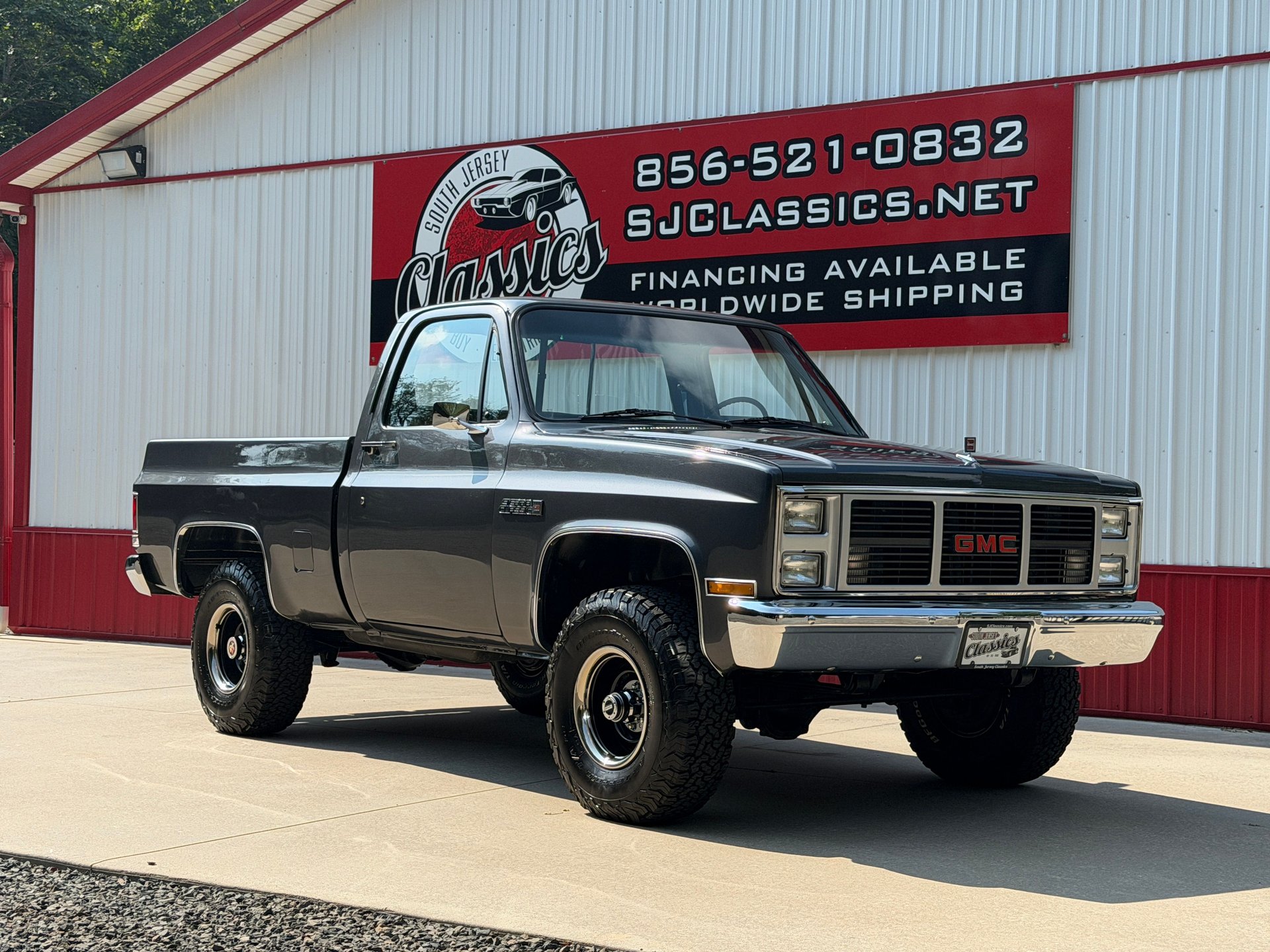
Two-wheel drive versus four-wheel drive. C means two-wheel drive, K means four-wheel drive, and the difference is a whole second truck underneath: a K1500 carries a solid front axle on leaf springs, a transfer case, locking hubs and a raised ride height where a C1500 carries independent front suspension and, in the first two generations, those famous rear coils. K trucks command strong money now, but they were bought to work in mud and snow, and their frames, floors and front axles have lived harder lives on average — the light blue 1969 K1500 in the photographs is exactly the truck the market dreams about, which is why a K truck needs the most sceptical inspection of all.
Trim: where GMC names its own tune. On Action Line trucks the ladder ran from the base Custom up through Super Custom, and for 1972 the Sierra and High Sierra packages arrived at the top. On Square Bodies it settled into Custom Deluxe, then Sierra, Sierra Grande and High Sierra, topped by Sierra Classic. Trim matters twice over. The top trims brought the options buyers now want — air conditioning, tilt wheel, cruise, carpet, two-tone paint — so a Sierra Classic is usually a better-equipped truck to live with. And trim is the easiest thing to fake: badges, door panels and a later grille transform a Custom Deluxe in an afternoon. The glovebox Service Parts Identification label, the SPID label, lists the factory options by code and is the single most valuable piece of paper in a Square Body or late Action Line truck. Photograph it, decode it, and buy the truck the label describes — the same logic that governs factory big-block and diesel trucks, whose value rests entirely on paperwork because every defining feature can be retrofitted.
What the current market actually looks like. The 24 trucks tracked here split 23 for sale and one sold, with 19 offered by private Marketplace sellers and five through dealers — this market trades mostly person to person, on photographs and a description, with dealer trucks at the documented, premium end. Brown is the commonest colour with six trucks, followed by black, gold and white with three each, then yellow, blue and red — a very seventies and eighties palette. Automatics dominate: 18 of the trucks with a recorded transmission are automatics, with a handful of manuals scattered through. If you want a manual, a short bed, or a colour that is not brown, you are fishing in the thin part of this pool, and should expect to wait, travel, or pay — usually two of the three.

Engines and gearboxes
No other classic in this programme gives you this much engine choice, because a GMC 1500 could be ordered as anything from a six-cylinder farm truck to a big-block muscle truck wearing work boots. Learn each family's one or two real failure modes — most of these engines have remarkably few — and learn to identify what is actually under the hood, because fifty years of interchangeable GM parts means the engine in the truck is often not the engine it was born with. Casting numbers, the stamped pad code on a small-block, and the SPID label settle identity; a seller's description does not.
The GMC V6 and the straight sixes: the working engines
The most GMC engine here is one Chevrolet never sold. From 1960 to 1966 GMC's standard light-truck engine was its own 305 cubic inch V6 — a 60-degree, big-bore, short-stroke six with huge bearings, part of a family that grew through 351 and 401 versions up to a 478 for medium trucks. It makes roughly 150 hp and, more to the point, its torque low down. Its costs are thirst, modest power, and a thinner parts pipeline: service items are available and an enthusiast community supports the family, but a full rebuild is a specialist conversation, realistically $4,000–7,000, and performance parts effectively do not exist. Judge a V6 on oil pressure, quiet running and freedom from coolant in the oil; they rarely die, they wear out slowly, and a tired one announces itself with low hot oil pressure and bearing rumble. If a 1966 truck carries its V6, that is a feature to value — but price it knowing the next owner pool is smaller than for a V8.
The straight sixes are the opposite bargain: the 250 cubic inch Chevrolet six that became the base engine from the mid-1960s onward, joined by the torquier 292 earlier and, in the last Square Bodies, the 4.3-litre V6 that replaced it in 1985. The 250 is one of the toughest engines GM ever built: seven main bearings, simple valve gear, and a failure list that mostly reads as neglect — cracked manifolds, worn valve guides giving a puff of blue smoke on start-up, carburettor and ignition wear. It will not make a heavy truck fast, but as a local driver or a first classic it is honest, cheap and almost impossible to kill except by overheating or running it out of oil. Check any six for a cracked manifold — a ticking that fades as it warms — and for the one-piece integrated head-and-manifold casting used on some late-seventies 250s, which cracks and is best replaced wholesale with an earlier separate manifold set-up.
The small-block V8s: 283, 307, 305 and 350
This is the centre of the GMC 1500 world, and the 350 cubic inch Chevrolet small-block is the single most important engine in this guide. Offered in these trucks from 1968 onward, the 350 is the engine the parts industry and every mechanic in America know best: it makes its power everywhere, tolerates abuse, and rebuilds for $3,000–6,000 at ordinary shop rates. Around it sit its relatives: the sweet, durable 283 and 327 of the 1960–66 trucks, valued for originality now; the durable but unloved 307 of 1968–73, whose truck should be priced as a future 350 swap unless exceptionally original; and the Square Body 305, an economy small-block carrying one famous weakness — the soft camshaft lobes of the late-seventies and early-eighties GM V8s, which wear round and give a popping through the carburettor, a dead cylinder that has spark and fuel, and metal in the oil. A 305 or early-eighties 350 that pops back under load with good ignition is a camshaft until proved otherwise; a cam and lifter set is a few hundred dollars in parts and up to $1,500 fitted.
Across all small-blocks, the inspection grammar is the same. Cold start from stone cold: a puff of blue that clears is valve stem seals, a $300–800 job done in place; smoke that persists under load is rings or bores and is a rebuild conversation. A deep knock that follows revs is bearings and ends the negotiation at engine value. The timing chain is a service item — nylon-toothed cam sprockets on many original engines shed teeth with age, and a chain slack enough to slap is about to jump; budget a steel set into any undocumented high-miler. Carburetted small-blocks wear a Rochester Quadrajet, superb when right and vilified when worn: the real faults are worn throttle-shaft bores leaking air — $350–700 for a proper rebuild including a bush job — a warped air horn, and choke faults, none of which is cured by the parts-store carburettor swap so many trucks have suffered. From the mid-seventies the ignition is GM's HEI system, whose module fails suddenly and completely — carry a spare, because an HEI truck that dies hot and restarts cold is describing a module, not a mystery. The 1987 trucks replaced the carburettor with throttle-body injection, TBI: a step-change in cold starting and manners, bought at the price of modern fault-finding, where a failed coolant sensor makes the truck run rich and the cure is diagnosis rather than adjustment.
The big-blocks and the diesels
The big-block option — the 396, badged and built in 402 cubic inch form in the later Action Line years, and the 454 in Square Bodies — turns a half-ton into something else: effortless, thirsty, heavy over the front axle and now highly collectable where it was a genuine factory option in a short-bed truck. Precisely because the engines swap so easily, a claimed factory big-block truck lives or dies on documentation: the SPID label and build records are the truck, the engine is evidence. Big-block failure modes are small-block modes scaled up — valvetrain wear, cooling systems that must be perfect, manifold bolts that seize and snap — plus one of their own: front springs, bushings and steering have carried that weight for fifty years, so a big-block truck that steers vaguely needs front-end money, not an alignment. Expect single-digit to low-teens fuel consumption.
The diesels need an honest paragraph. The 5.7-litre diesel offered from 1978 was an Oldsmobile-derived conversion of a petrol design, and its reputation was earned: head gasket failures, injection pump wear, and a fragility that taught America to distrust diesels. A running 5.7 truck today is a curiosity; a non-running one is a petrol swap waiting to happen, priced as a shell. The 6.2-litre diesel that replaced it for 1982, designed with Detroit Diesel, is much better: no powerhouse — it is an economy diesel — but durable when maintained. Inspect the harmonic balancer on every 6.2: its failed rubber lets the crank pulley wobble and, left alone, can contribute to crankshaft damage, so replace it on age at a few hundred dollars. Glow plug faults present as impossible cold starting and are usually the controller or relay rather than eight dead plugs. Injection pump wear at high mileage is an $800–1,800 exchange conversation. Judge any 6.2 on cold starting — from genuinely cold, with one glow cycle — because a clean cold start is healthy in compression, glow and fuel delivery all at once.
Gearboxes, transfer cases and axles
The manuals are the simple end of the world: three-on-the-tree column shifts in the sixties, whose worn linkage bushes are linkage money, not gearbox money, and the heavy Muncie SM465 and SM420 four-speeds — granny-low first gears, immense strength, rebuildable for $1,200–2,500. Clutches are $800–1,500 fitted, and judder on take-up is a worn plate, a tired flywheel face, or broken engine mounts.
The automatics carry this market — three quarters of the trucks in the current pool with a recorded transmission are automatics — and there are three names to know. The TH350 is the default three-speed of the Action Line and early Square Body years: strong, simple, cheap to rebuild at $1,500–2,800, and honest in failure — slipping under load, flaring on the 2–3 change, delayed engagement when cold, and fluid that smells burnt and looks brown instead of red is a box on borrowed time. The TH400 is the heavy-duty three-speed behind big-blocks, with the same failure grammar at slightly higher cost. The 700R4 four-speed overdrive of the later Square Bodies is the one to interrogate: early 1982–86 versions had genuine weaknesses, the design was progressively strengthened, and by 1987 it was respectable — but every 700R4 lives or dies on one adjustment, the throttle valve cable, the TV cable, which controls line pressure and is not a kickdown cable whatever a previous owner believed. A misadjusted TV cable burns a 700R4 in miles, not months. Check the cable is present, correctly routed and firm, that overdrive holds without shuttling and the converter locks up steadily; budget $2,000–3,500 for a quality rebuild with the later updates if any answer is wrong.
Four-wheel-drive hardware divides by era. Action Line K1500s use a part-time transfer case — the Dana 20 and then the New Process 205, a gear-driven, cast-iron, near-indestructible case whose faults are leaks, worn linkage and neglect — with manually locking front hubs. Seventies Square Body K trucks offered the NP203 full-time case, chain-driven, with a differential in the case; NP203s wear their chains — a slapping rattle on overrun is the tell — drink fuel, and were commonly converted to part-time, so establish what a seventies K truck actually has. The eighties moved to the aluminium NP208 part-time case: lighter, adequate, and vulnerable to being run low on fluid. Front axles are the Dana 44 and later the GM ten-bolt; check joint wear, hub engagement, and above all that front and rear axle ratios match — the test is a slow tight turn in 4WD on gravel, where a healthy truck scrabbles slightly and a mismatched one winds up and fights you. Rear axles announce wear the same way everywhere: a howl that changes between drive and overrun is pinion bearings or gear set-up, a rumble in turns is differential bearings, and a clunk on taking up drive is the sum of every worn joint in the driveline.


Problem areas
Everything mechanical on a GMC 1500 can be fixed with a catalogue, a card and a competent shop. What follows is therefore weighted the way your money will be: body and frame first and longest, because that is where these trucks die, then the chassis, then fuel, cooling and electrics, and finally the interior. Assume every truck you view has some of this list; the skill is pricing what you find accurately enough to buy the right truck at the right money.
Rust and the frame: the map
Rust on a GM truck follows water, gravity and trapped mud, and it attacks the cab first because the cab is where water gets in and cannot get out. Work through it in the order a professional does, from the failures that end the inspection outward to the ones that merely cost money.
Cab corners. The single most reliable rust site on every generation here. The rear lower corners of the cab form a pocket that collects everything thrown up by the front wheels, and it rots from the inside out: paint bubbles, the bubble becomes a hole, and by the time the hole is honest the inner structure is involved too. Replacement panels are cheap; a corner cut out, welded, sealed and painted runs roughly $600–1,500 a side, more if the rot has spread into the floor edge and rocker. One cab corner is a job; two plus what you find next is a pattern, and patterns are what you are really inspecting for.
Rocker panels and cab supports. The rockers under the doors tie the cab together and carry the door alignment, and they share the cab corners' diet of mud and trapped moisture. Worse, and less visible, are the cab supports: the pressed-steel mounts bolting the cab to the frame through rubber cushions. On Square Bodies especially, the front supports rust until the cab literally settles — the tell is a cab sitting low at the front, door gaps closing at the top, doors that need a lift to latch. A cab sitting crooked on its mounts is not an alignment issue; it is metal that has stopped existing. The labour is cab-up work: budget $1,500–4,000 for a proper support and floor campaign, the dividing line between a driver truck you improve and a project you rebuild. Prod every support from underneath; soft metal that a screwdriver goes through has ended more purchases than any engine fault in this guide.
Floors, cowl and windshield frame. Water enters at the windshield seal, the cowl vent and the kick-panel vents — on Square Bodies the cowl is a leaf trap that composts for decades — and sits under the mat eating the floor pans from the top down, where you cannot see it until you lift the mat. Always lift the mat. Surface scale is a clean, treat and seal job; perforation at the seat mounts or cab supports is structural in effect and joins the welding budget above. The windshield frame rusts on both generations, and it is the expensive version of the same problem: a leaking seal is a rubber, a rusted frame is cutting and welding around glass, $1,000–2,500 done properly.
Inner fenders, battery tray and the bed. The battery tray rots from acid, invisibly, under the battery — lift it out or rock it and look beneath, because the acid track takes the inner fender and, on Square Bodies, the radiator core support with it; a flexing core support joins the offer maths at $700–1,800 fitted and painted. Beds rust at the arches, the lower rear corners, and — worst — in the floor and the cross sills beneath it. Lift any bed mat or liner: a bed floor you cannot see is one you have not inspected, and bed work runs from a few hundred dollars of local repair to a full floor in the low thousands.
The frame itself. The frame is a ladder of C-channel rails, and it rusts where mud packs: behind the cab, around the rear spring hangers, at the crossmembers, and along the lower flange where scale builds in layers and thins the rail from within. Surface rust is normal at this age; laminated scale you can peel, perforation, or a rail that rings dull under a hammer tap is a walk-away unless you are buying a frame swap project on purpose. Two checks matter most. On Square Bodies, check the frame around the steering box: the rail flexes there and cracks develop around the bolt holes — encouraged by big tyres and off-road use — ranging from a weld-and-reinforce repair, a few hundred dollars with a repair plate, to a cracked-through rail that ends the discussion; turn the steering lock to lock while a helper watches the box for movement. On K trucks, check horns, hangers and crossmembers with twice the suspicion. And read the frame's straightness as accident evidence: ripples, kinked flanges, fresh black paint on one rail only, or a truck that crabs on the test drive all say the frame has a history.
The Square Body fuel tank question. The 1973–87 trucks carry their fuel tanks outside the frame rails, between the rail and the bedside — the famous side-saddle arrangement that was the subject of enormous controversy and litigation after production. Inspect the tank, its straps and the surrounding metal as you would any fuel system — rusted straps, a weeping seam or perished hoses are immediate-repair items at $400–1,200 for a tank and straps fitted — and check for accident damage to the bedside over the tank. Fuel system condition is a day-one job on any of these trucks; do not buy a corroded tank and defer it.
Suspension, steering and brakes: fifty years of work
The front suspension divides by generation and drive, and each version wears in its own dialect. The 1960–62 trucks' torsion bars sag and their adjusters seize; the coil-sprung independent front ends that followed wear ball joints, control arm bushings and idler arms into a front end that wanders, clunks and eats front tyres on their inner edges. The test is physical: jack the front up safely, rock each wheel top to bottom for ball joint play and side to side for linkage play, and lever the control arms to feel bushing give. A full front-end refresh — joints, bushings, idler, tie rods, alignment — is $1,200–2,800 fitted, and it transforms a truck; budget it into any undocumented high-miler and do not let a seller call it an alignment issue. K trucks substitute a solid front axle on leaf springs: joint wear, tired spring bushings, and steering play combined from box, drag link and a cracked frame mount at the box. At the rear, the Action Line's coils and trailing arms wear bushings and sag, and worn panhard rod bushings let the axle steer the truck from behind over bumps; leaf-sprung trucks — most K trucks, all Square Bodies — wear spring eye and shackle bushings, sag flat or break a leaf, and on hard-worked trucks the spring hangers rust where they rivet to the frame. Sagged springs are a few hundred dollars a pair; hangers are welding.
Steering boxes wear into play at centre that no adjustment fully cures — overtightening makes the steering bind off-centre, so a worn box is an exchange unit, $400–900 fitted, not an adjustment. Power steering pumps leak from every seal after forty years and whine when dying; hoses with perished braid get replaced on sight. Brakes divide by era: front discs standardised through the Action Line years, so the earliest trucks may be drums all round, while Square Bodies are disc front and drum rear throughout. The standard recommissioning list is seized calipers or wheel cylinders, perished flexible hoses, a master cylinder bypassing internally — a pedal that sinks slowly at a stop is the tell — rusted hard lines, and a failed booster giving a hard pedal and a hissing idle. A full hydraulic refresh is $1,000–2,500 fitted, and it is the least negotiable spend in this guide: whatever else you defer, do not defer brakes.
Fuel, cooling and electrics
Fuel systems on carburetted trucks suffer the modern disease: ethanol-blended fuel attacks old rubber, dissolves old tank deposits and varnishes carburettors on trucks that sit — and classic trucks sit. Expect, on any truck that has stood, a tank needing cleaning or replacement, a dead sender unit — a gauge reading permanently full, empty or wandering is sender and earth faults nine times out of ten — rubber lines to replace wholesale, and a Quadrajet full of the consequences. The electric in-tank pump on a 1987 TBI truck is a tank-down job when it fails, $500–1,000 fitted, and a TBI truck losing fuel pressure under load is pump and filter before it is electronics.
Cooling systems are the small-block's one real demand: radiator, water pump, thermostat, hoses and fan clutch form a system with no reserve on a heavy truck in summer traffic, and the failure pattern is cumulative neglect — a radiator half-blocked with scale, a fan clutch freewheeling when it should be driving, hoses hard as wood. A truck hot in traffic but cool on the road is describing airflow and fan clutch; one hot everywhere is describing radiator capacity or a head gasket, and the distinction is a combustion-gas test in the coolant, which any shop can do in minutes. Overheating is how these engines die: a warped-head conversation starts at $1,500 and climbs, so temperature behaviour on the test drive is pass-or-fail, not a quirk.
Electrics are GM-simple and age in the connections. Earth straps between engine, frame and cab rot and produce every ghost fault in the book, from slow cranking to gauges that lie; replacing the main cables and straps is a cheap first move on any truck with electrical weirdness. Starting faults divide cleanly: a single click is connections or a solenoid; slow cranking hot is the classic small-block starter heat-soak, cured by a heat shield or a modern high-torque starter at $200–450 fitted. Budget suspicion for taped splices and household wire in the harness, and price a butchered one as an auto-electrician's day, $500–1,200; complete reproduction harnesses exist at sane prices.
Interior, glass and trim
A truck interior tells the truth about the truck's life because nobody retrimmed a work truck for fun. The bench seat collapses at the driver's side first: foam that has powdered, springs that have broken, a cover worn through at the entry edge where a driver slides in ten thousand times. Sit on the driver's side, always; a passenger side that looks fine is evidence of nothing. A seat rebuild — foam, springs repaired, new cover fitted — is $800–1,800 depending on trim correctness, and correct reproduction covers exist for the common trims. The dashboard pad cracks in the sun on Square Bodies with a reliability that is almost a service interval; reproduction pads exist at $300–700 plus fitting, and a cracked pad on an otherwise honest truck is cosmetic — while a cracked pad plus a sagging headliner, broken door pulls and worn pedal rubbers is a portrait of the whole truck. Door internals wear: window regulators strip or slow to a crawl, latch wear makes doors need a slam, and weatherstrips harden into ornaments, letting in the water that rots the floors from the section above. A full weatherstrip set is a few hundred dollars and a weekend, and it is the highest-value spend on any truck you intend to keep, because it stops the rust mechanism at its source. Instruments fail individually — fuel senders as described, speedometer cables that chatter, Square Body cluster circuit boards whose contacts corrode into intermittent gauges — and all of it is available and fixable. Trim divides by generation: Action Line chrome and Square Body plastic are reproduced extensively, but GMC-specific grilles, badges and trim are consistently harder and dearer than the Chevrolet equivalents, and a GMC missing its correct grille should be priced with the hunt in mind. Finally, air conditioning: a complete but dead factory system is a $1,200–2,500 recommissioning — compressor, hoses, seals, refrigerant conversion — while a system with its compressor removed is a parts hunt priced accordingly. In the South, where so many of these trucks live, working air is the difference between a truck you use from May to September and one you admire from the porch.
How to inspect one
Allow two hours, not one, and bring a torch, a magnet wrapped in cloth, a screwdriver for prodding with the seller's permission, and a friend to work the steering while you watch underneath. Inspect cold, in daylight, on the ground first and underneath second. If the truck passes you, pay for a lift inspection before money changes hands: the cab supports and the frame are the price of the truck, and both live underneath.
- Start with the paperwork and the plates. Match the VIN on the title to the plate on the door jamb or dash as the year dictates. On a pre-1967 truck, settle the naming question now: count the lugs, look at the springs, and establish whether it is the half-ton the badge implies today or the heavier truck the badge meant then. Decode the glovebox SPID label on any truck that has one, and photograph it. A truck whose SPID says 305 and whose engine is a 350 is a swapped truck; that may be fine, but it must be priced as swapped.
- Cold start, standing outside. Insist the engine is stone cold and stand at the exhaust. A puff of blue that clears is valve seals; continuous smoke is rings. Listen for a deep knock under the start-up rattle, and watch the oil pressure gauge come up. On a 6.2 diesel, one glow cycle and a clean cold start is the whole engine report in five seconds.
- Under the hood, systematically. Dipstick: level, colour, and a smell of fuel, which means a failing pump diaphragm or chronic rich running. Coolant: clean and coloured, or rusty, oily, or low — and low coolant with no leak needs the combustion-gas test from the problem areas section before money moves. Check the battery tray, the radiator, every hose by squeezing, and the wiring for amateur repairs. On a small-block, read the stamped code pad at the front of the block against what you are being sold.
- The cab rust circuit. Cab corners first, fingers behind the panel as well as eyes in front of it. Then rockers, then door bottoms with the doors open, feeling the lower edge and checking the drain holes. Lift the floor mat on both sides and look at the pans and seat mounts. Run a fingertip around the windshield frame and the cowl, and press each corner of the floor hard; a floor that flexes is a floor that is thin. Score every site as surface, perforated or structural — the total, not any single site, is the welding bill.
- Underneath: frame, supports and tanks. Torch along both frame rails, hammer-tap any laminated scale, and prod the cab supports until each one proves it is metal. On a Square Body, watch the steering box against its rail while your friend turns the wheel lock to lock, looking for the frame crack the problem areas section describes. Check spring hangers, bed cross sills, the brake line along the rail, fuel tank straps and seams, and every rubber mount. Perforation in a rail, a support or a hanger is structural: that finding reprices the truck or ends the inspection, and either outcome is the inspection doing its job.
- The bed. Lift any liner or mat and inspect the floor you were not meant to see. Check the wheel arches from inside and out, the lower rear corners, the tailgate's lower edge and hinges, and on a wood-floor truck the planks and fender flanges. Sight along the bedside in daylight: filler and ripples announce themselves at a shallow angle, and the magnet confirms what your eye suspects.
- Suspension and steering, hands on. Front end raised safely: rock each wheel top to bottom and side to side, lever the control arms, and separate ball joint play from linkage play from bearing play — each is different money. On a K truck, do the same at the solid axle and check the locking hubs engage and release. Look at the springs for sag, broken leaves and helper bodges. Read tyre wear as a written record: inner-edge wear is geometry, a feathered tread is toe, and four mismatched tyres mean the owner stopped spending money some time ago.
- Gearbox and driveline on the ground. Automatic fluid should be red and sweet-smelling, not brown and burnt; engagement of drive and reverse should be prompt without a thump. Manual: clutch bite point, judder, and noise in each gear as far as a yard allows. On a 700R4, find the TV cable and confirm it is connected and correctly routed before the test drive, not after — the gearbox section explains why this one cable is the whole gearbox. On a four-wheel drive, check the transfer case lever moves through its range; the full test happens on the drive.
- The test drive, at least twenty minutes. A truck needs time to show you its cooling system, its gearbox when hot and its steering at speed. The automatic should change firmly without flaring, a 700R4 should find overdrive and lock up without shuttling, a manual should take each gear without baulking. Brake firmly from speed more than once: straight, no judder, no sinking pedal. Lift off and reapply the throttle to hear axle whine change between drive and overrun. Test four-wheel drive on gravel with a slow tight turn — slight scrabbling is health, winding up is mismatched ratios. Watch the temperature gauge throughout, and for five minutes of idling at the end, heater on full.
- Electrics and equipment, everything on. Lights, indicators, horn, wipers, heater blower on every speed, every gauge, and the air conditioning if fitted — a compressor that engages with cold air at the vents is worth real money in a southern truck, and one that screeches or does not engage joins the budget. Power windows and locks, worked twice each: slow is tired, stopped is a motor or a switch, priced differently.
- Interior last, from the driver's seat. Sit where the driver sits and feel for the collapsed foam and broken springs the trim section describes. Check the dash pad, door cards, headliner and pedal rubbers. A sound, original, high-trim cabin is hard to recreate at any sane price, so weight it — and weight a butchered cabin, cut for speakers and switches, the other way.
- The restomod additions, if the truck is modified. Price the workmanship, not the parts list: wiring properly loomed and fused, fuel lines rated for injection pressure, cooling sized for the engine, brakes that match the power. The truck to buy is the one whose conversion paperwork comes in a folder.
Values
The market block beneath this guide carries the current numbers for GMC 1500s on this site — how many are listed, what is being asked and what has sold — refreshed from the listings themselves, so this section teaches you how to read that market rather than repeating figures that would date. Read it with three facts about this pool in mind. It is small, at 24 trucks. It spans three generations and twenty-two model years, so any single average mixes trucks that share nothing but a badge. And it trades mostly between private sellers, so asking prices are opening positions in a negotiation far more often than in a dealer-priced market.
The condition spread is the widest in almost any classic market, and it is driven by one variable above all: metal. At the bottom sit the project trucks — rusted, tired, sometimes not running — whose price is really the price of a title, a frame and a set of panels, and whose true cost is the restoration the buyer volunteers for. In the middle sit the honest drivers: solid or repaired cabs, presentable older paint, a small-block that starts and pulls, an interior that shows its life without embarrassment. These are where inspection earns its keep, because the difference between a middle truck that needs nothing structural and one that needs cab supports is invisible in photographs and decisive in money. At the top sit three kinds of truck that should never be averaged together: exceptional originals, quality restorations priced on what the work cost, and restomods priced on the build. A top price attached to a middle truck wearing top-truck paint is the commonest overpayment in this market.
Generation and configuration set the bands within which condition operates. Action Line trucks of 1967–72 carry the collector premium, strongest in short-bed, big-block and well-optioned examples, and the 1969 model year that anchors this site's pool sits squarely in that band. K trucks carry their own premium in every generation. Square Bodies divide at the 1981 facelift and by trim: a Sierra Classic with factory air and a documented history is a different market object from a working Custom Deluxe at the same mileage, and the final-year fuel-injected trucks earn a usability premium among buyers who intend to drive rather than show. Long beds trade below short beds in the collector bands and at no real penalty in the working bands, which is why the long-bed driver is the recurring value answer here. Diesels divide opinion as they did when new: the 6.2 has a following that pays for a good one, the earlier diesel does not.
Asking and achieved prices part company predictably. Private sellers price from the best truck they have seen advertised, not from the truck in their yard; auction results, where a truck has them, are the harder evidence and usually the more honest number. Documentation moves money both ways — a SPID label, a build sheet and a folder of invoices add real value, and their absence on a truck claiming originality subtracts it. Geography moves money too: a genuinely rust-free truck in the North earns a premium over the same truck in the dry South and West, because transport is cheap compared with welding. Finally, negotiate on the inspection, not the photograph: the findings that legitimately move a price are the costed ones — cab supports, a frame crack at the steering box, a 700R4 with burnt fluid — each with a job cost attached from the problem areas section.
Parts and ownership
A GMC 1500 is, by classic standards, almost absurdly well supported — and the reason is arithmetic. GM built these trucks in the millions across two divisions, the Chevrolet twin means most parts serve an enormous combined fleet, and the American truck aftermarket is the largest classic parts industry on earth. For Square Body and Action Line trucks there is effectively no ordinary part you cannot buy: the major suppliers cover sheet metal, trim, interior, glass, weatherstrip, suspension, brakes and brightwork, and a working truck can be maintained from service parts at any parts counter in the country.
Easy: everything serviceable and mechanical. Filters, belts, hoses, plugs, ignition parts including HEI modules, water pumps, alternators, starters, brake discs, drums, pads, calipers and hydraulics, suspension joints and bushings, springs, shock absorbers, clutch kits, carburettor rebuild kits, radiators, exhaust systems, tyres in the common sizes, and glass and weatherstrips. Small-block and six-cylinder parts are same-week, ordinary-money items anywhere in America; a working owner with a manual and ordinary tools can do most of this guide's maintenance list on a driveway.
Harder and dearer: the GMC-specific and the generation-specific. GMC grilles, badges and trim carry the GMC tax — smaller original production, thinner reproduction — and correct pieces for a specific year can involve a hunt where the Chevrolet equivalent is a catalogue line. The GMC 305 V6 is the deepest example: supported by a loyal specialist community, but a world away from small-block convenience, and an owner should join that community and stock the known wear items. Big-block exhaust manifolds crack and are priced like it; correct emissions equipment for the late-seventies and eighties trucks ranges from unloved to effectively unavailable new, which matters in states that inspect it. Diesel injection pumps and good 6.2 balancers are specialist items. Quality paint and bodywork is the universal expense: a proper repaint with the panel work these trucks usually need starts in the mid four figures and climbs steeply with the welding list, which is the economic engine behind this guide's advice to buy metal, not promises.
Running an old GMC as a truck. The ownership proposition is the best in this programme if you choose the right truck: vehicles designed to be repaired by the people who used them, with room to work and no system that requires a laptop. Budget honestly for the first year: catching up deferred maintenance on a running truck — fluids, brakes, hoses, belts, tyres on age, steering wear, weatherstrips — honestly costs in the low thousands before you improve anything, and recommissioning a truck that has sat for years is a mid-four-figure programme at shop rates. Fuel consumption is period truck consumption: a small-block in mixed use returns figures in the low-to-mid teens, a big-block fewer, a 6.2 diesel notably more. Using the truck as a truck is what they were built for, with the caveat that every winter on salt spends the cab metal this guide has taught you to price. The owners' community is vast and practical, and most of its knowledge is free.
Which one to buy
- The all-rounder: a 1968–72 C1500 with the 350 small-block. The collector shape, the coil-spring ride, the best engine the platform offers for ordinary use, and the deepest parts support. Short bed if the budget allows, long bed if it does not — the driving experience is the same.
- The value buy: a long-bed Square Body driver. A solid long-bed Sierra with a 350, working air and a cab that passes the rust circuit buys you ninety percent of the classic truck experience for the smallest cheque here.
- The easiest to live with: a 1987 C1500. The only fuel-injected truck in the classic range, with the mature 700R4 overdrive and the full parts catalogue behind it. For weekly, all-weather use, the final year is the answer.
- The adventure truck: a K1500, Action Line for character, Square Body for value. Buy the frame and the front axle first and the lift and tyres last — most K trucks wear their modifications over their maintenance. A stock-height, unmolested K1500 is rarer than the modified kind.
- The character buy: a 1960–66 GMC with its 305 V6. The most distinctive engine in this guide, in the most distinctive shape, for the buyer who values being the only one at the show. Go in with your eyes open about parts and the pre-1967 numbering trap.
- The muscle truck: a documented factory big-block Action Line. A genuine 396 or 402 truck, proved by the SPID label, is the performance flagship. An undocumented one is a small-block truck with a big engine fitted, bought at exactly that price.
- The economy buy: a 6.2 diesel Square Body that starts cleanly from cold. For the buyer who will use the truck over distance, a healthy 6.2 gives running costs nothing else here matches. The cold start is the audition: one glow cycle, clean start, no ether stories — or walk away.
And the rule that overrides all of the above: buy the cab and the frame, and let the engine be whatever it turns out to be. Engines, gearboxes, axles and brakes are catalogue items at plannable prices, in the best-supported platform in the classic world. Cab supports, cab corners, floors and a sound frame are the truck itself — and a cheap GMC with rotten metal is the most expensive truck in this guide, whatever the badge says.