
Ford Torino buyer's guide
Ford Torino -- the model's own buyer's guide: variants, values and what to check.
Years listed: 1968-1976 · Series: Torino
Overview and history
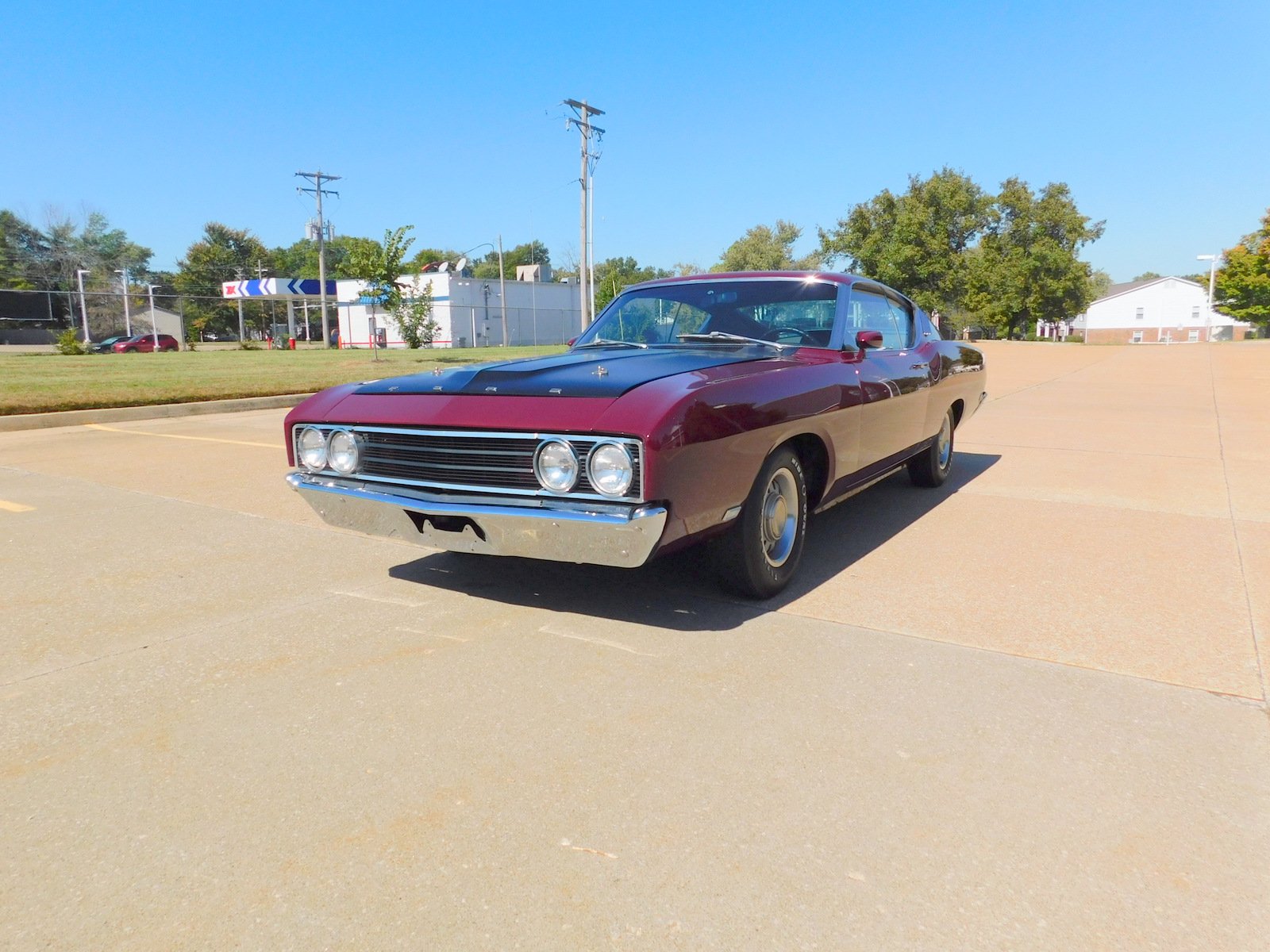
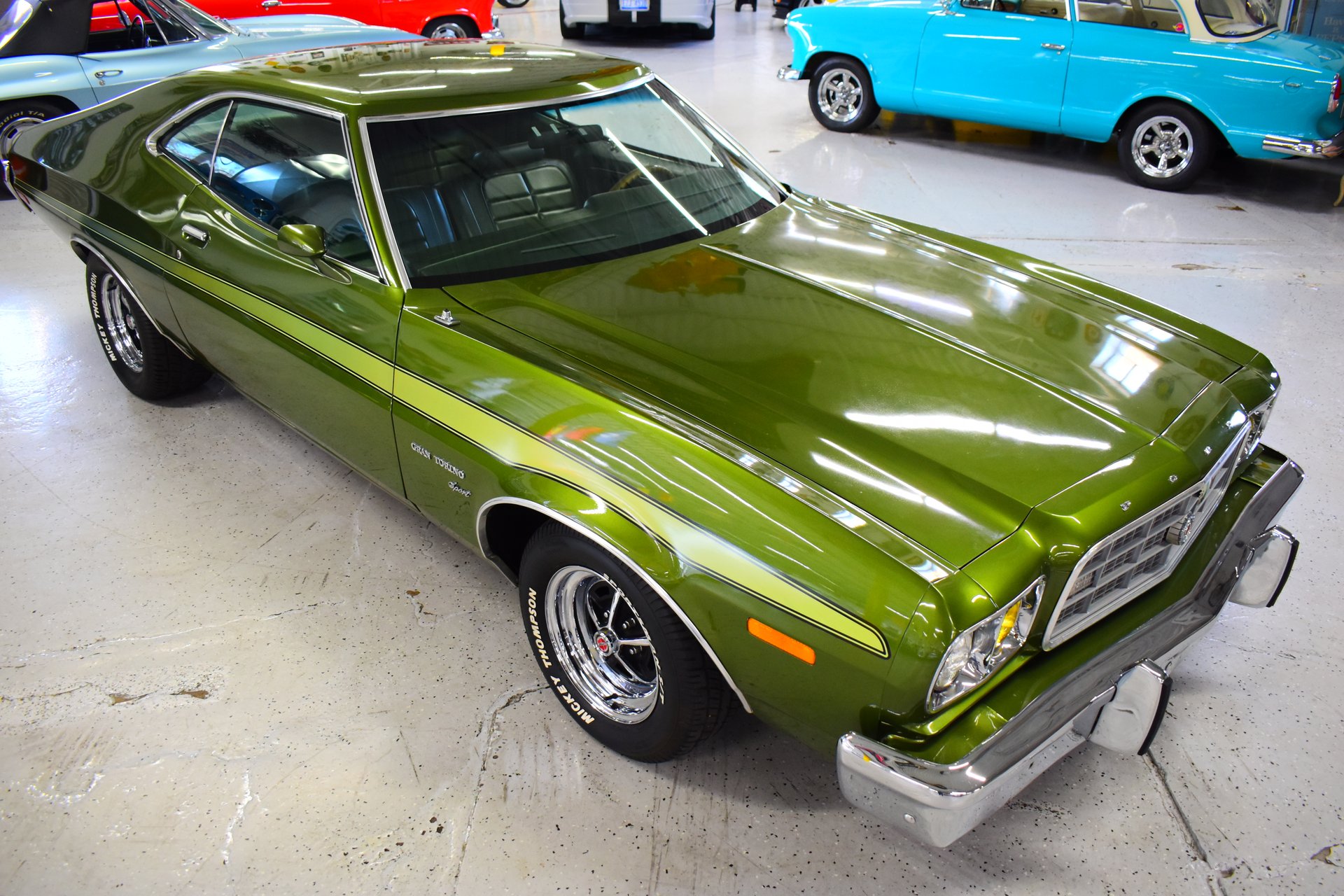
The Ford Torino is not one car but three, wearing one name across the most turbulent decade Detroit ever had. From 1968 to 1976 the badge covered a NASCAR-homologation fastback with a 428 Cobra Jet, a regional sales special in Grabber Green, a vast green Gran Torino Sport with a laser stripe, and the red-and-white coupe the whole world knows from television. A buyer who shops for "a Torino" without first deciding which Torino is shopping blind — the three generations share a name, a general size class and almost nothing else that matters when you come to inspect, value or restore one.
The name arrived for 1968 as the top trim of the Fairlane, Ford's intermediate line — Torino, the Italian spelling of Turin, chosen when Ford was naming cars after places that sounded fast. The 1968–69 cars are unit-body intermediates on a 116-inch wheelbase: formal hardtops, convertibles, wagons and the sloped SportsRoof fastback that made the line's reputation. The Torino GT was the performance trim, the Fairlane Cobra (1969, usually just called the Torino Cobra) was the street weapon built around the 428 Cobra Jet, and the 1969 Torino Talladega — extended nose, flush grille, fastback roof — existed for one reason: to make that shape legal in NASCAR, where it won. These are muscle cars in the full sense, priced and judged like muscle cars today.
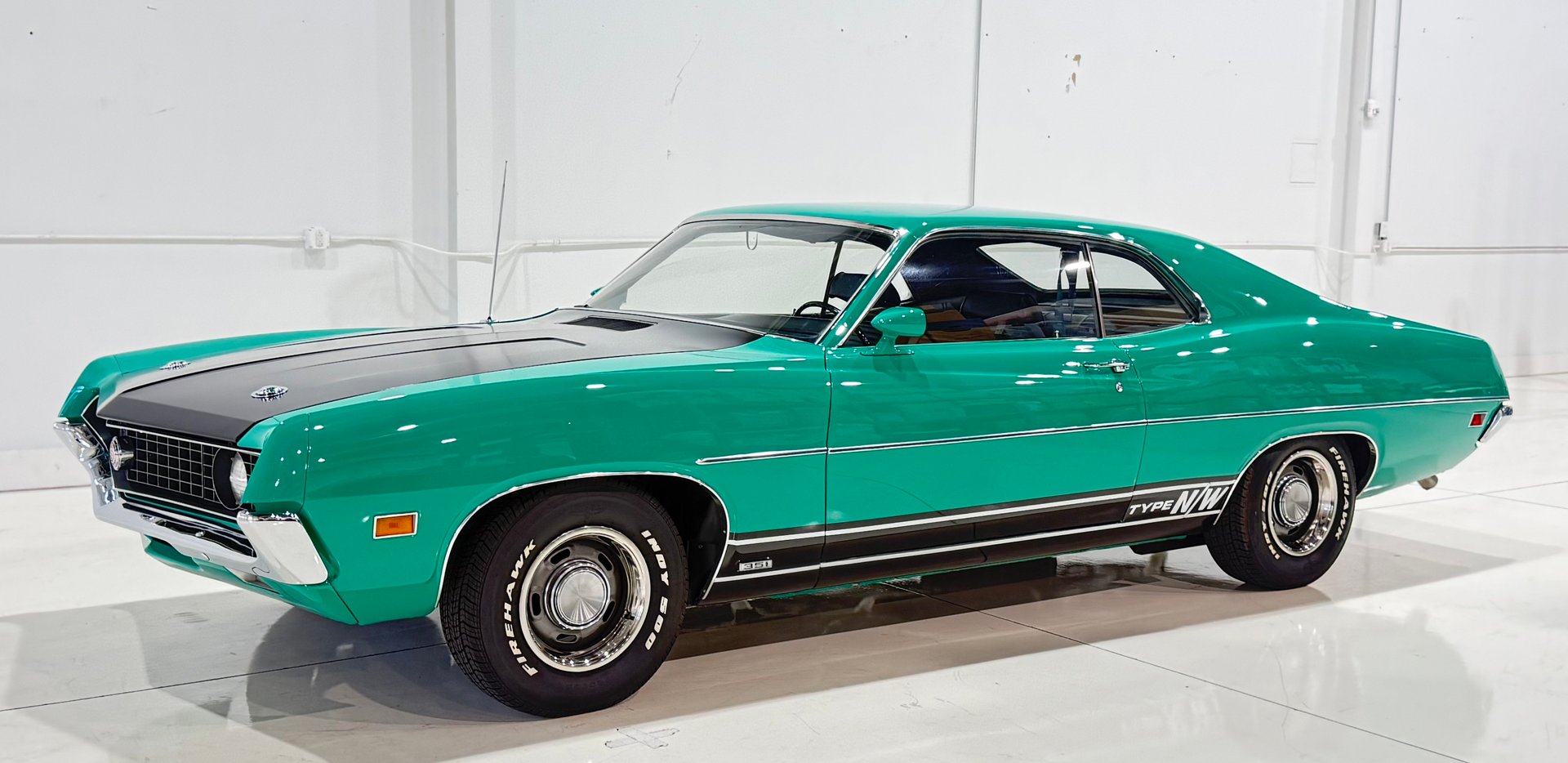
For 1970–71 Ford restyled the car completely — longer, wider, curvier, still unit-body — and split the range wide open: Torino, Torino Brougham, Torino GT and the Torino Cobra, the last now a Torino model in its own right with the 429 Cobra Jet and Super Cobra Jet at the top of the engine list. This is the generation of the shaker scoop, the hideaway headlamps and the regional Type N/W special in our photographs. It is also the last generation in which performance was the point.
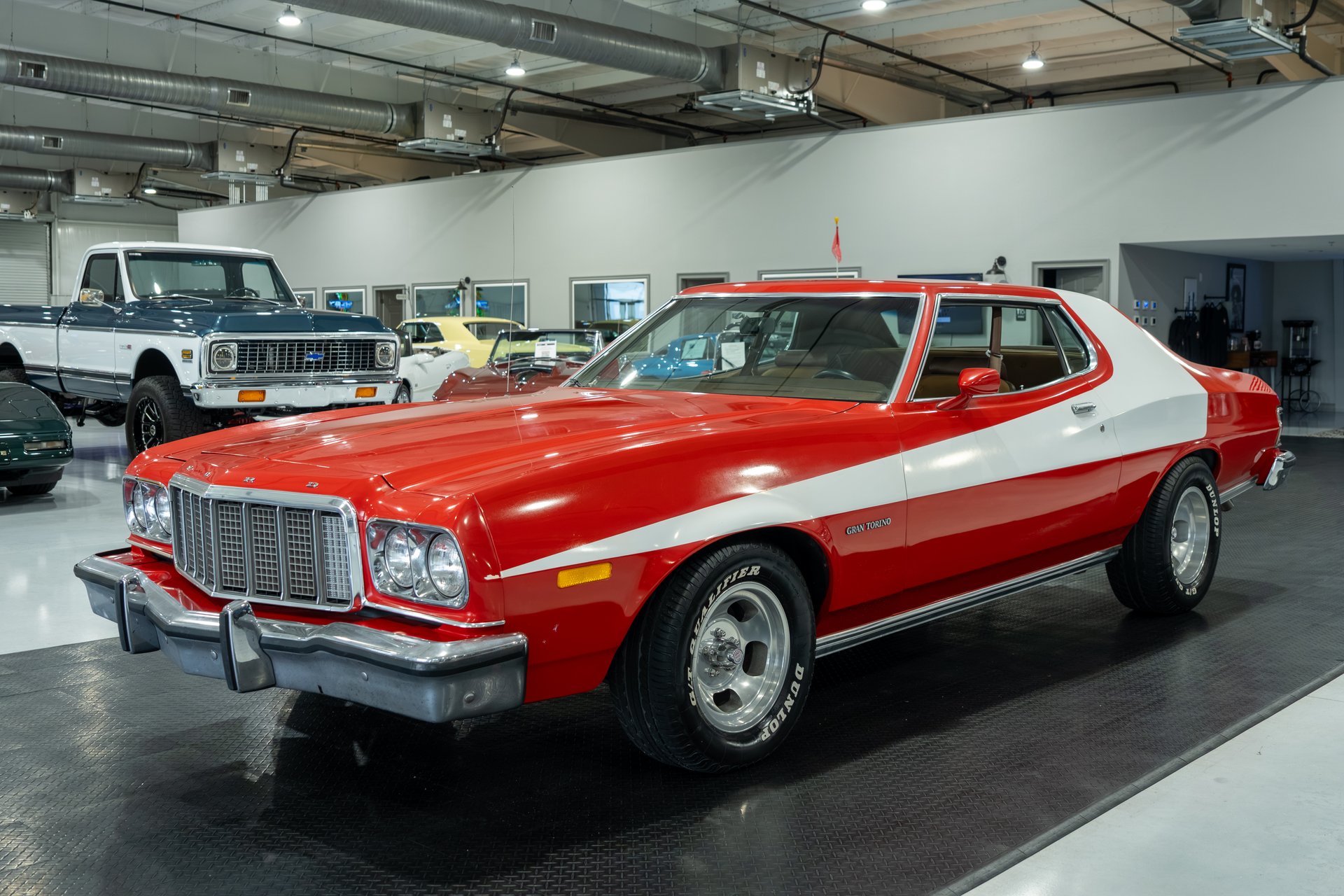
The 1972 redesign changed the car's skeleton, not just its skin. The 1972–76 cars are body-on-frame, heavier, softer and bigger in feel, sold as the Torino and — from 1972, taking over as the volume name — the Gran Torino, with the Gran Torino Sport as the sporting trim and the Elite spun off as a personal-luxury sister for 1974–76. Federal bumper rules, emissions tuning and the 1973 fuel crisis all landed inside this generation's life, so a 1972 Gran Torino Sport fastback and a 1976 Gran Torino coupe are close relatives mechanically but very different cars to drive and to value. The line ended after 1976, replaced by the LTD II, and by then the television car — the red coupe with the white vector stripe, factory-offered as a limited edition for 1976 — had fixed the late car's image permanently.
Why buy one now? Because the Torino gives you the full intermediate-Ford experience — FE and 385-series big-blocks, Clevelands, Toploaders, 9-inch rear ends — in a car that is still, variant for variant, cheaper to buy and easier to live with than the equivalent Mustang, and because the range is so wide that there is a correct Torino for almost every budget and intention, from a 302 hardtop cruiser to a documented Super Cobra Jet. The trap is the same width: badges were cheap when these cars were new and are cheaper now, the rare variants are the most cloned cars in the Ford world, and the difference between a real Cobra and a dressed-up GT is the difference between two different markets. This guide works through all three generations — what each model actually is, how to prove it, where each generation rusts and fails, and how to inspect one in an order that settles the expensive questions first.
Our own listings underline the spread. We currently track 37 Torinos from 1968 to 1976, and the year mix is the market in miniature: 1970 is the single biggest year with 12 cars, 1969 follows with 8, and the 1972–76 frame cars together make up a third of the pool. Of the 21 cars in the tracked set whose sellers' photo sets we have examined in detail, 6 showed rust somewhere in the photographs and 5 showed visible damage — small numbers against some contemporaries, but read them correctly: they count what sellers chose to photograph, and the inspection section of this guide exists because the decisive Torino rust is the kind that rarely appears in a listing at all.

The models
Read this section as three ranges, not one. Within each generation the ladder runs the same way — standard car, luxury trim, sporting trim, homologation or halo car — but the names move between generations, and a badge that means "flagship" in one year means "mid-range" in another. The table gives the cars that matter to a buyer; the text below it covers the identity traps, which on Torinos are worth more than the specifications.
| Model | Years | Engine | Output | Built | Character |
|---|---|---|---|---|---|
| Torino GT SportsRoof | 1968–1969 | 390 FE V8 (also 302, 428) | 320 hp (390) | — | The fastback GT; the classic first-generation buy |
| Torino GT convertible | 1968–1969 | 302/390/428 V8 | up to 335 hp (428 CJ) | — | Rarest body of the GT range; pace-car replicas abound |
| Fairlane Cobra / Torino Cobra | 1969 | 428 Cobra Jet FE | 335 hp (underrated) | — | The street racer; SportsRoof or hardtop, Q-code or R-code ram air |
| Torino Talladega | 1969 | 428 Cobra Jet FE | 335 hp (underrated) | about 754 | The NASCAR homologation car; extended nose, fastback only |
| Torino Cobra | 1970–1971 | 429 Cobra Jet / Super Cobra Jet | 370 / 375 hp | about 7,700 (1970) | The peak Torino; shaker or ram air, Drag Pack decides SCJ |
| Torino GT | 1970–1971 | 302/351/429 V8 | up to 370 hp | — | The volume performance car; hideaway lamps, laser stripe |
| Torino Type N/W | 1970 | 351 V8 | about 250 hp | a few hundred | Northwest regional special; stripes, blackout hood, trim |
| Gran Torino Sport | 1972 | 351C/400/429 V8 | up to 248 hp (net, 429) | — | Last fastback Sport; the strongest of the frame cars |
| Gran Torino Sport | 1973–1974 | 302/351/400/460 V8 | up to about 260 hp (net, 460) | — | Fastback for 1973, formal roof after; smog-era tuning |
| Gran Torino | 1975–1976 | 302/351/400/460 V8 | up to about 220 hp (net, 460) | — | The cruiser; the 1976 TV-stripe edition is the famous one |
(Outputs are period gross ratings for 1968–71 and net ratings for 1972 onward — the industry changed the measuring stick for 1972, which is why the later figures look smaller against engines that had also genuinely lost tune. The 428 Cobra Jet's 335 hp was a deliberate under-rating for insurance and racing-class purposes; a healthy one makes more. Production figures are given only where they are genuinely documented; Ford did not publish clean per-variant splits for most Torino trims, and any source that quotes one to the last car is inventing it. A Marti Report, from the surviving factory records, is the document that settles what an individual car actually is.)
The first generation, 1968–69. The Torino began as the Fairlane's top trim, so early cars carry Fairlane thinking throughout: the range runs from a 200-cubic-inch six hardtop to the GT. The GT is the car to understand — bucket seats, stripes, and the engine list that runs 302, 390 and, from mid-1968, the 428 Cobra Jet. The SportsRoof fastback outsold and out-remembered the formal hardtop and the convertible, and it is the shape that raced. For 1969 Ford added the Cobra as a Fairlane model — plain trim, steel wheels, one job — and the Talladega as the homologation special. The trap of the generation is that GT, Cobra and Talladega share bodies, engines and most panels: everything that makes a Talladega valuable can be bolted onto a GT, and has been. The VIN, the body codes and the Marti Report are the car; the nose and the badges are evidence, nothing more.

The second generation, 1970–71. The 1970 car is all-new sheet metal over the same unit-body idea, and the range tops out with the Torino Cobra: 429 Cobra Jet standard thinking, a Super Cobra Jet when the Drag Pack option brought the solid-lifter engine, external oil cooler and Detroit Locker axle. The GT below it is the prettier car — hideaway headlamps on many, the laser stripe, a choice of 302, 351 Cleveland or Windsor and 429 Thunder Jet. Regional specials appeared, as they did across Ford's range: the Type N/W in our photographs — N/W for Northwest, sold through Pacific Northwest dealers — combined a blackout hood, side tape treatment and trim changes over a 351, and is a trim rarity rather than a performance model, valued for its scarcity and its looks. The 1971 cars are near-identical with detail changes and falling compression; a 1971 Cobra is a rarer car than a 1970 and drives the same. The generation's trap is the opposite of the first: the Cobra looked plain on purpose, so Cobras get dismissed as GTs and GTs get dressed as Cobras. The fifth character of the VIN — the engine code — and the body-style code separate them before you even open the hood.
The third generation, 1972–76. The frame car is a different proposition: a Gran Torino Sport of 1972 is still a fastback with a 351 Cleveland, a 400 or a 429 and real pace, but the mission has changed from racing to presence. The 1972 Sport's one-year grille and fastback roof make it the collector pick of the generation. For 1973 the Sport kept a fastback (the SportsRoof) alongside the formal hardtop; from 1974 the fastback was gone, the bumpers grew, and the range settled into coupes, sedans and wagons, with the Elite taking the luxury-coupe role from 1974. Engines shrank in tune year by year — the 460 arrived as the big option, the 351 Cleveland gave way to the 351M, and by 1975–76 the cars were cruisers with standard power steering, power discs and air conditioning more common than any performance option. The 1976 limited-edition red-and-white car — the factory's own version of the television stripe — is the exception: a trim package on an ordinary Gran Torino coupe that the market treats as a model in its own right. Buy one for what it is, verify the package as far as records allow, and never pay a performance premium for it.
Engines and gearboxes
A Torino engine bay can hold anything from a 250 six to a 460, and the engines fall into four families with almost nothing in common. Learn the families, learn the engine code in the VIN — the fifth character on these cars — and you can price most engine bays from the driver's door before the hood opens.
The small-blocks: 302 Windsor and the 351s
The 302 (and the 289 that lingers in very early 1968 listings) is the Windsor small-block: light, simple, and the default engine in GTs and Gran Torinos alike. It will not make a Torino fast, but it is the cheapest Ford V8 in the world to keep — every wear part is over-the-counter, and a tired one announces itself honestly with oil smoke on start-up (valve seals), a worn timing chain's slack at the distributor, and lifter tick that fades as oil pressure builds. The 351 Windsor of 1969–70 is the same architecture stretched taller; judge it the same way.
The 351 Cleveland (1970–74) is the engine this range is remembered for, and the one that needs a buyer's full attention. It comes in two personalities: the 2-barrel, small-port engine of ordinary Torinos and GTs, and the 4-barrel with big ports and — in 1970 form — high compression and quench-chamber heads that make it one of Ford's great street engines. The Cleveland's known weaknesses are specific. Its oiling system prioritises the camshaft over the main bearings, so an engine that has been run hard on low oil or extended to high rpm on a tired pump suffers at the crank; listen for a deep knock under load that a Windsor's lighter noises never make. The thin-wall block casting can crack — a Cleveland that loses coolant with no visible leak, or shows rusty weeping at the core plugs and the lifter-valley ends, needs a pressure test before it needs a purchase. Exhaust manifold bolts seize and snap in the heads, turning a gasket job into a machine-shop job; budget accordingly on any car with a manifold blow. And identity matters: Cleveland and 351M engines look alike at a glance, and the 351M (1975–76, with the 400) is the low-compression truck-derived replacement — check the engine's deck height and the VIN code, because a 1976 car is a 351M car whatever the air-cleaner decal says. A proper Cleveland rebuild with machining runs roughly $4,500–8,000; a Windsor or 302 rebuild is $3,500–6,500 at the same standard.

The FE big-blocks: 390, 427 and 428 Cobra Jet
The first generation runs on FE engines — Ford's 1958-vintage big-block family — and the FE is a heavy, torquey, fundamentally durable engine with three Torino personalities. The 390 is the workhorse: 320 hp in GT tune for 1968, hydraulic lifters, and a bottom end that shrugs off mileage. The 427 side-oiler appears in a handful of 1968 cars and is a specialist subject beyond this guide's scope — if you are offered one, you are in documented-race-engine territory and the Marti Report and engine stampings are the whole conversation. The 428 Cobra Jet is the one you will actually meet: a 428 with 427-style low-riser heads, a 735 cfm Holley on the ram-air cars, a nodular-iron crank in Super Cobra Jet form, and a factory rating of 335 hp that nobody, including Ford's own drag teams, took literally.
FE failure modes are well mapped. The exhaust manifolds crack and the bolts fuse into the heads — on a 390 or 428, manifold work is the single most common first big bill, $800–2,000 with machining if studs snap, and a car with a ticking manifold blow at cold start that seals as it warms is showing you the cheap version of the fault. The intake manifold is cast iron and weighs around 80 lb, which is why so many have been swapped for aluminium — not a fault, but a tell that someone has been inside the engine. Rear main seals weep, the two-piece rope-seal design being what it is; a drip at the bellhousing on an otherwise dry FE is normal life, while oil on the clutch of a manual car is not. FE oil pressure reads low at hot idle on the factory gauge even when healthy — verify with a mechanical gauge before condemning bearings. The Cobra Jet premium rides entirely on identity: the VIN engine code (Q for Cobra Jet, R for ram-air Cobra Jet in 1969), the casting numbers and dates on block and heads, and the Marti Report. A 428 block is externally near-identical to a 390, and the market is full of 390s wearing Cobra Jet valve covers. Pay for the codes, never the covers.
The 385-series: 429 and 460
For 1970 the big-block job passed to the 385-series — the 429, and from 1972 in Torinos, the 460. These are the strongest street engines in this guide. The hierarchy runs: 429 Thunder Jet (360 hp, the GT's big option), 429 Cobra Jet (370 hp, big-port heads, 700 cfm Rochester Quadrajet — yes, a GM carburettor from the factory — or Holley depending on application), and 429 Super Cobra Jet (375 hp, solid lifters, forged pistons, part of the Drag Pack). The 460 of the frame cars is the same architecture in luxury tune: quiet, immense low-speed torque, and strangled progressively by emissions equipment as the seventies wore on.
What fails is mostly what bolts to them. The 385-series timing cover and water pump arrangement means a pump change is a bigger job than on an FE, and the factory nylon-toothed timing gear of the smog years sheds teeth into the oil pan — any 1972–76 429 or 460 without a documented timing-set change wants one, roughly $600–1,200 fitted, before it wants anything else. Retarded factory cam timing on the emissions engines (the timing set itself was indexed retarded) is why a 1975 460 feels lazier than its size promises; a straight-up timing set is the cheapest transformation in Torino ownership. Diverter valves, Thermactor air pumps and EGR plates carbon up and leak vacuum; on a late car, a rough idle is emissions plumbing more often than it is the engine. The engines themselves — blocks, cranks, heads — are over-built and rarely the problem. As with the FE, identity is money: a Cobra Jet 429 carries its code in the VIN and its big ports under the valve covers, and a Thunder Jet in Cobra dress is a $400 set of decals away from a dishonest listing.

Gearboxes and axles
Four transmissions do nearly all the work. The standard 3-speed manual is a cruiser's box, column-shifted on plain cars. The Toploader 4-speed — top-loading, iron-cased, famously strong — is the manual behind GTs, Cobras and big-block cars, and it is the gearbox to want: judge it on second-gear synchromesh (the first to go), a whine in third (worn bearings), and a shifter that has not been slopped loose by fifty years of Hurst conversions. A Toploader rebuild is $1,200–2,500. The automatics split by engine: the C4 behind sixes and small-blocks, the iron-case FMX behind many 351 cars, and the C6 behind big-blocks and heavy-duty applications. The C6 is close to unbreakable in street use and cheap to rebuild ($1,500–2,800); the FMX is strong but heavy and its rebuild costs more for fewer specialists ($1,800–3,000). All three automatics fail the same honest ways at this age — hardened seals giving a long, lazy engagement into drive or reverse on a cold morning that improves as the box warms, and fluid that has never been changed. A cold-engagement delay of a second or two that disappears warm is seals, and it is a negotiation point, not a walk-away; a box that flares between second and third under power is a rebuild.
At the back, nearly everything worth having runs the Ford 9-inch axle — the strongest, best-supported rear end of the era, with its drop-out carrier making ratio changes a bench job. Traction-Lok limited-slip was optional throughout; the Drag Pack Super Cobra Jets brought the Detroit Locker and 3.91 or 4.30 gears with an external engine oil cooler. Check any 9-inch for a whine on the overrun (worn pinion bearings or a lash problem), leaks at the pinion seal, and — on a car claimed to be a Drag Pack car — the axle tag and the cooler, both of which should exist and match the paperwork. Six-cylinder and light-duty small-block cars may carry the smaller 8-inch axle, which is adequate for their power and a useful originality tell: a claimed big-block car sitting on an 8-inch has a story to explain.
Problem areas
Torino problems divide cleanly by generation, because the cars do. The unit-body cars (1968–71) rust like unit-body cars — in the structure that holds the suspension. The frame cars (1972–76) rust like frame cars — in the frame itself and in the body panels the frame cannot save. Everything else — engines, trim, electrics — follows the same deferred-maintenance pattern as every big Ford of the period. Work through this section in the order given; it is the order of financial consequence.
Rust and structure: unit-body cars, 1968–71
Torque boxes and front structure. The front torque boxes — the boxed sections where the front subframe rails meet the floor and rocker structure — take the front suspension loads and trap road salt and mud in equal measure. They rot from inside, invisibly, behind the front wheels. Get the car on a lift or get under it with a torch and a screwdriver: prod the torque-box seams, the frame-rail sections ahead of them, and the floor where the boxes weld in. Perforation here is structural welding on a jig if it is advanced — $2,500–6,000 a side done properly — and it is the single most common reason a cheap 1968–70 car is cheap. Sellers' photographs almost never show it.
Floors, cowl and trunk. The cowl vent chamber rusts at its drains, then leaks onto the front floors — the classic Torino tell is a wet front carpet in a car that "never goes out in the rain", and floor pans holed under the front seats with the cowl as the cause. Replacement pans are available and the job is well understood ($1,200–2,800 a side fitted and finished), but price the cowl repair in too or you will be doing the floors twice. Rear floors and the panel under the rear seat follow. Trunk floors rust from the inside out under the mat, fed by the rear window and trunk seals and by the SportsRoof's fastback glass channel in particular; lift the mat and the spare on every car. The fastback's rear window channel and the formal roof's vinyl-top skin (where fitted) both hold water against steel — bubbling at the base of a vinyl roof is rust with a cover on it, and the cover has to come off to price it.
Panels. Lower rear quarters behind the wheels, wheel-arch lips, door bottoms (drain holes block, doors fill), front fender heels behind the front wheels, and the battery tray with the inner fender beneath it — acid eats down from the tray into the apron. None of these alone kills a car; together they are the difference between a driver and a body-shop year. Good reproduction steel exists for the popular panels of the 1970–71 cars; 1968–69 fastback-specific sheet metal is thinner on the ground, which is one reason straight early cars command what they do.

Rust and structure: frame cars, 1972–76
The frame. Body-on-frame construction moved the structural risk into the perimeter frame, and the frame rusts where it is boxed and where it holds mud: the rear kick-up over the axle, the torque-box equivalents at the body mounts, the front horns behind the bumper, and along the side rails where the factory coating has cracked. Surface scale is normal life; perforation at a body mount or the rear kick-up is a frame repair or a frame swap, and either reprices the car completely. Take a hammer-tap or screwdriver test along the rails on a lift — a frame car that will not go on a lift is a car you are being asked to buy blind in exactly the place it can be rotten. Body mounts themselves perish: collapsed or perished mounts give door gaps that wander, clonks over bumps and a body that sits visibly unevenly on the frame; a mount set is cheap parts and a full day's labour.
The body. The frame cars rust in the same panels as the early cars — quarters, arches, door bottoms, trunk floor — plus two signatures of their own. The 1973-on 5-mph bumper systems add weight and trap water behind the big chrome bumpers, and the filler panels between bumper and body rot quietly. And the formal-roof cars' vinyl tops, often over an opera window on 1974–76 coupes, hide roof rust exactly as on the early cars, with the added problem that the roof skin and C-pillar structure of the formal coupe is a bigger repair when it goes. The 1972 Sport fastback's rear glass channel is the early-warning spot on the most valuable frame car — check it before you check anything shiny.
Mechanical wear beyond the engines
Front suspension and steering. All Torinos use coil-spring front suspension with the spring on the upper arm in the Ford manner, and all of them wear the same way: upper ball joints and control-arm bushings first, then lower joints, idler arm and tie-rod ends, giving the vague, wandering, knock-over-bumps front end that sellers describe as "drives like an old car". It does not have to. A full front-end rebuild with quality parts is $900–1,800 fitted and transforms the car. Power steering boxes leak at the sector seal and the Ford integral boxes develop on-centre play that adjustment only partly cures; a rebuilt box is $400–700 exchanged. On frame cars, add perished body mounts to the same symptom list before you condemn the steering.
Brakes. Front discs were standard on GTs and Cobras and spread across the range; by the frame years power discs are near-universal. The system is simple and the parts are cheap — the cost on a stored car is the full hydraulic refresh: seized calipers, perished hoses, a master cylinder bypassing internally (pedal sinks slowly at a light), and hard lines rusted along the frame or floor. Budget $800–1,800 for a complete hydraulic recommission and do it as one job. Rear drums are rarely a problem beyond shoes, cylinders and adjustment.
Cooling and fuel systems. Big Fords run hot in modern traffic when the system is marginal: a recore or quality replacement radiator ($400–800), a fan clutch that has lost its drive, and shrouds that went missing in 1983 are the standard list. Cars that have sat need the fuel system treated as contaminated end to end — varnish in the tank, ethanol-attacked rubber, a carburettor full of gum. A tank clean or replacement, lines, pump and carburettor rebuild is $900–2,000 done once and done properly, and it is the difference between a car that starts in March and a car that starts an argument.
The sitting car: storage damage
A large share of the Torinos offered today have sat — in barns, in garages, in fields in the worst cases — and sitting damages these cars in a predictable order that a buyer can work through. Tyres flat-spot and age out regardless of tread. Brake hydraulics absorb moisture and corrode from inside, which is why the recommissioning budget in the parts section treats the whole system as one job. The fuel system varnishes from the tank forward, and a car that "ran when parked" five years ago will not run now on its own system without the clean-out described above. Rodents take the seat foam, the headliner backing and the insulation off the wiring, and rodent damage in a fastback's headliner or a formal car's rear seat is an interior-strip job to put right, not a cleaning job. Rubber perishes on a schedule set by time rather than miles: suspension bushings, body mounts on the frame cars, vacuum hoses (budget a full set on a hideaway-lamp car), window seals and the trunk seal all come due together on a stored car, and together they are the difference between a recommissioning bill in the low thousands and one that keeps arriving in instalments. None of this is a reason to avoid a stored car — stored cars are where the original interiors and unmodified engine bays survive — but it is a reason to price a stored car as a shell, a drivetrain and a parts inventory, and never as a driver with a flat battery. The cheapest Torino to own is almost always the one that never stopped being driven.
Interior, trim and electrics
The Torino interior is vinyl, heat and sunlight, and its condition is the most honest mileage gauge the car has. Seat covers split at the seams and the driver's bolster goes first; foam collapses under a cover that still looks presentable, so sit in the driver's seat, not beside it. Reproduction seat kits exist for GT, Cobra and Gran Torino Sport patterns — $600–1,200 for covers, plus foam and fitting — but Brougham and formal-roof patterns are thinner coverage, and a sun-baked dash pad (cracked across the speaker grille and along the defroster slots) is a $300–600 part plus fitting when you can find the right colour. The 1970–71 hideaway-headlamp cars add a vacuum system to the fault list: the doors are vacuum-operated, and a car whose lamps wink, droop or refuse is usually suffering perished vacuum hoses and a tired actuator or reservoir rather than anything exotic — but the parts are model-specific and the diagnosis takes time, so price the fault, do not wave it away.
Trim is the frame cars' quiet expense. The Gran Torino Sport's laser stripe is a decal, reproduced and fittable; the brightwork, the Sport's grille and the 1972 one-year parts are not so easy, and a 1972 Sport missing its correct grille or front panel is a car whose hardest parts hunt is still ahead of its owner. On the 1976 striped edition, the red-and-white scheme is paint and tape over a standard coupe — what you are buying is the documented package, so condition of the paint is condition of the car in a way it is not on a plain coupe. Electrics across all years are period Ford: a fusebox, fusible links, and failures at connections and grounds rather than in the looms. The 1975-on electronic ignition module (DuraSpark) fails with heat and age and causes the classic "cuts out hot, restarts cold" complaint — a module is cheap, and a spare in the glovebox is the experienced owner's answer. Alternators, regulators and starter solenoids are over-the-counter everywhere.

How to inspect one
Allow two hours for a serious car, bring a torch, a magnet in a cloth, a screwdriver for prodding (with permission), a mechanical oil-pressure gauge if a big-block is involved, and a friend to work the lights and pedals. Decide the car's identity before you judge its condition: on Torinos, what it is is worth more than how it is. If the car passes you, a paid lift inspection settles the structure — on a unit-body car it is the best money in the whole purchase.
- Paperwork and identity first. Match the VIN on the title to the plate on the driver's door and the stampings the year provides. Read the fifth character — the engine code — and check it against the engine in the car and the story you are being told: Q and R codes are Cobra Jet codes in their years, and a car wearing Cobra Jet dress on a lesser code is a lesser car. Read the door data plate for body, trim, axle and transmission codes. For any GT, Cobra, Talladega or Sport at a premium price, require the Marti Report or order one — it is the factory record, and its absence on a halo car is itself information.
- Cold start. Insist the engine is stone cold. A healthy Ford V8 of any family starts on the choke, settles as it warms, and shows no blue smoke beyond a start-up puff (valve seals) — continuous blue smoke under load is rings or bores and reprices the engine. Listen cold for the FE/Cleveland manifold tick that seals warm, for lifter clatter that should fade within a minute, and for any deep knock under a light load blip, which on a Cleveland means stop and think.
- Oil and coolant. Pull the dipstick: level, smell (fuel means carburettor flooding or short-trip life), and condition. Check coolant for oil sheen and the oil filler for mayonnaise emulsion — either means a head-gasket or crack conversation, and on a Cleveland, ask for a cooling-system pressure test before money moves. On any big-block, a mechanical oil-pressure reading hot at idle and at 2,500 rpm replaces all gauge folklore.
- Structure, early cars. On a 1968–71 car, go under before you go anywhere else: torque boxes, front rails, floor seams, rocker inners, rear torque boxes and spring mounts. Prod with the screwdriver at the seams. Perforation in torque boxes or rails is structural, expensive, and the end of the viewing for any car priced as a good one. This is the step the whole inspection turns on for the unit-body generations.
- Structure, frame cars. On a 1972–76 car, the same time goes to the frame: rear kick-up, body-mount points, front horns, side rails, hammer-tapped along their length. Then the body mounts themselves — look for perished, extruded rubber and uneven panel gaps that suggest collapsed mounts — and the trunk floor and rear glass channel above them.
- Floors and trunk, all cars. Lift carpets in all four footwells (wet fronts point at the cowl on early cars), prod the pans, then empty the trunk: mat up, spare out, look at the floor, the drop-offs to the quarters, and the rear window channel. Water staining is a leak to find; perforation is a panel to price.
- Body and panels. Magnet along quarters, arch lips, door bottoms and fender heels. Check door drain slots are clear, the battery tray and the apron under it, and — on any vinyl-roof car — the roof skin at the vinyl's edges with your fingertips: crunch under the vinyl is rust, and it is never small once you can feel it. Count the trim that is missing or wrong for the model; on a 1972 Sport or a hideaway-lamp GT, missing model-specific trim is a parts hunt priced in months, not just money.
- Engine bay identity. Casting numbers and date codes on block and heads where visible, correct carburettor for the claim (a Cobra Jet's big Holley or Quadrajet, as applicable), ram-air hardware complete if claimed — shaker, sealing ring, factory-cut hood underside. Dress-up parts prove nothing; codes and dates are the evidence. Note the missing emissions equipment on late cars against your state's rules before you fall for the car.
- Gearbox and axle. Manual: second-gear synchromesh on a firm shift, clutch bite point and judder, whine in each gear. Automatic: cold engagement delay into drive and reverse (a second or so that clears warm is seals; worse is a rebuild quote), shift quality under power, fluid colour and smell on the dipstick. Axle: whine on drive and overrun, pinion-seal leaks, and the axle tag on any car claiming Traction-Lok or Drag Pack gears.
- The test drive. Twenty minutes, mixed roads. The steering should track straight with modest on-centre play; wandering plus knocks over bumps is the front-end rebuild from the problem section, priced in. Brake hard from 50: straight stop, no judder, no pull, and a pedal that stays firm at the next light. A big-block car should pull cleanly from low rpm without detonation on its fuel; a Cleveland that pinks under load on premium wants its timing and its carbon checked, in that order.
- Heat and electrics. Idle it hot for ten minutes. Temperature stable, oil pressure holding, charging light out. Work everything: hideaway lamps through two full cycles on a 1970–71 GT or Cobra, heater fan on all speeds, wipers, washers, all windows, horn, every light. On a 1975–76 car, a hot cut-out that restarts when cool is the ignition module introducing itself — cheap, but confirm it is that and not the fuel system by when and how it dies.
- Stance and the walk-around. Stand back on level ground. A Torino sits level and square; a sagging corner is a spring or a mount, a unit-body car sitting twisted is a structure question you go back to step 4 with. Photograph the car in profile from both sides — gaps, stance and ripples you talked yourself out of in person are obvious in a picture. Then, and only then, talk about the interior's cosmetics and the colour.
Values
The build below this guide carries the live numbers — what Torinos are listed for now and what recorded sales have achieved — and this section teaches you how to read them, because the Torino market punishes anyone who reads a single median as a price.
The first thing the numbers hide is that there are at least four separate markets sharing one name. Documented halo cars — real Talladegas, real Super Cobra Jets, ram-air Cobras with paperwork — trade in the muscle-car market, against Boss Mustangs and big-block Chevelles, and their prices are set by identity and provenance. Volume performance cars — GTs, ordinary Cobras, 1972 Sports — trade in the tier below, where condition and originality still dominate but a wrong engine or a colour change costs a visible percentage rather than the car's whole premium. Ordinary Torinos — small-block hardtops, sedans, wagons — trade as classic cruisers, priced against other big Fords and bought to use. And the late Gran Torinos trade on condition and specification almost alone, with the single exception of the 1976 striped edition, whose television fame gives a documented, correctly finished car a premium out of all proportion to the package's mechanical content — and gives every red coupe with a stripe kit an asking price you should decline to underwrite without the records.
Within any one of those markets, the condition spread is the whole story. The gap between a project Torino and a sorted one is wider than the gap between models: a rusty Cobra is worth less, finished, than a sound GT, because the restoration of a unit-body car with torque-box and floor work in it consumes the premium the badge was supposed to provide. Read the recorded sales with that in mind — the low results are almost never bargains that slipped through; they are structure, identity or title problems the photographs did not show. Conversely, the top results for ordinary cars are usually originality: a low-mileage, unmodified Gran Torino in its factory paint is a genuinely scarce object now, scarcer in its way than a restored Cobra, and the market has begun to price survivor big Fords accordingly.
Asking and achieved prices part company widest on the dressed cars. A GT wearing Cobra Jet hardware, a hardtop wearing Talladega claims, a coupe wearing the television stripe: these are listed at the real car's money and sell, eventually, at their own, and the time-on-market figures in the live block tell you which is which — a car that has sat for months at halo money with a lesser VIN code has already been valued by every informed buyer who saw it. Your negotiation leverage on Torinos is documentation and structure, in that order: a missing Marti Report on a premium car, torque-box rust on an early car, frame perforation on a late one, are each worth more than any cosmetic fault, and each is a reason to reprice rather than merely to haggle. Finally, buy the generation you actually want at the top of its condition range rather than the generation you settled for at the bottom: the Torino market rewards the best example of any variant and discounts the worst example of the best variant, and it has done so consistently enough that the recorded sales show it plainly.
Parts and ownership
The Torino shares its mechanical life with the entire intermediate and full-size Ford world of its years, and that is its great ownership virtue: there is no Torino engine, gearbox or axle that the Mustang, Galaxie and truck markets do not also keep alive. What is Torino-specific is the body and trim, and the ownership economics follow that split exactly.
Easy: everything mechanical. Windsor and Cleveland service parts, FE gaskets and ignition, 385-series wear parts, carburettor kits for the Autolite, Motorcraft and Holley units these cars wear, C4, FMX and C6 soft parts, Toploader synchros and bearings, 9-inch gears and bearings in every ratio ever offered, brake hydraulics and friction parts, suspension wear parts, steering wear parts, radiators, water pumps, alternators and starters. Most of it is order-today, fit-this-weekend, at prices the Mustang market's volume keeps honest. A Torino is one of the cheapest big-block classics in the world to keep mechanically.
Harder and dearer: body and identity parts. SportsRoof-specific sheet metal for 1968–69, good 1972 Sport grilles and front panels, hideaway-headlamp vacuum components and grilles for 1970–71, correct Cobra and Drag Pack hardware (shaker assemblies, oil coolers, Locker carriers), Talladega-specific nose panels — genuinely scarce, and priced like it — and formal-roof and Brougham interior patterns. Chrome is a rechroming bill rather than a catalogue order on most years, and the big frame-car bumpers are expensive to plate well. The rule is the same as the W-body rule everywhere: buy the body and the trim complete, and fix the mechanics with a credit card and a weekend.
Running costs. A sorted Torino is a realistic regular-use classic in a way many muscle cars are not: it is a big, simple, softly tuned Ford, and any competent independent shop can service it. Fuel consumption is the honest cost — expect low-to-mid teens miles per gallon from a small-block car driven gently, single figures to low teens from a big-block driven as intended — and insure it as what it is, with the halo variants on agreed-value policies that reflect the documentation you verified at purchase. The budget line that catches new owners is recommissioning: a car that has sat for years needs the fuel system, brake hydraulics, cooling system and tyres done as one programme, realistically $2,500–5,000 in parts and labour before anything is improved, and a car bought as a driver that turns out to need torque boxes or a frame section has not got more expensive — it was always that car; the inspection is how you find out before the money moves. Join the Torino-specific registries and forums for the variant you buy: production knowledge for these cars lives there, Marti data in hand, and the registries are also how a Talladega or Super Cobra Jet's identity gets corroborated beyond a single report.
Which one to buy
- The all-rounder: 1970–71 Torino GT with a 351 Cleveland. The pretty generation, the great engine, hideaway lamps and the laser stripe if you find them, parts for everything, and a market deep enough to buy well and sell honestly. If you want one Torino to drive everywhere, this is it.
- The muscle car: 1969–71 Cobra, bought on paperwork. A documented 428 or 429 Cobra Jet car is the Torino at full strength — and the premium is the documentation. A Cobra with a Marti Report, matching codes and its ram-air hardware is a blue-chip Ford; the same car without them is a GT with a story, and should be priced as one.
- The collector car: Torino Talladega. Around 754 built, one shape, one engine, one purpose. Buy the most original, best-documented car you can find, verify roofline, nose and records in that order, and expect the registry to know the car already.
- The value buy: 1972 Gran Torino Sport. The last fastback, the frame car's best year, Cleveland power, one-year styling — and priced as a seventies car rather than a sixties one. The best performance-per-dollar in this entire guide, provided the frame and the rear glass channel pass inspection.
- The cruiser: 1974–76 Gran Torino with a 400 or 460. Everything the late cars do well — quiet, torquey, air-conditioned distance work — at cruiser money. Buy on condition and specification, insist on the timing-set history, and enjoy the cheapest big-block Ford motoring there is.
- The famous one: 1976 striped edition. Buy it because the television car makes you happy, verify the package in the records, pay for documentation and paint condition, and never let a seller price a stripe kit as a limited edition.
And the rule that overrides all of the above: buy identity and structure first, and specification second — a verified car with sound torque boxes or a sound frame is worth more than any engine, stripe or badge the seller can describe. Engines, gearboxes, brakes and interiors on a Torino are all fixable at prices you can plan for, and the parts world will help you. A cloned halo car never becomes a real one, and a rotten structure costs more to put right than the finished car will be worth.
See the 29 Torino cars currently listed.