
Ford Thunderbird buyer's guide
Ford Thunderbird -- the model's own buyer's guide: variants, values and what to check.
Years listed: 1955-2005 · Series: Thunderbird
Overview and history
The Ford Thunderbird is not one car. It is eleven generations, built from 1955 to 1997 and again from 2002 to 2005, that share a name, a long hood and a personal-luxury brief — and almost nothing else. A 1955 two-seat roadster, a 1966 Landau hardtop, a 1987 Turbo Coupe and a 2002 Retro convertible have different bodies, engines, suspensions and failure modes. The first decision a buyer makes is therefore not which year or colour. It is which Thunderbird, for which job, you actually want.
That breadth is visible in the cars we track. We currently list 272 Thunderbirds spanning 1955 to 2005 — 202 for sale and 70 sold or archived. The 1955 to 1957 two-seaters account for 101 of them, with 1957 the single largest year at 47 cars, followed by 1956 at 29 and 1955 at 25. The 2002 to 2005 Retro cars account for 51, with 2002 the largest Retro year at 26. Between those bookends, the four-seat classics of the 1960s form the next band — 1966 at 20 cars, 1964 at 17, 1963 at 14, 1962 at 11, 1965 and 1960 at 10 each — while 1970s and 1980s cars appear only in single figures. The market you will actually shop is dominated by Baby Birds, Flair Birds and Retro Birds; the other generations exist, and some are excellent, but you will wait longer to find a good one.
The name was created for 1955 as Ford's answer to the Corvette and to the European sports cars returning servicemen had brought home. Ford never called the first Thunderbird a sports car; the launch advertising called it a personal car, and that distinction governed the next fifty years. Where the Corvette chased lap times, the Thunderbird chased comfort, style and effortless V8 torque: a steel body when the Corvette was fibreglass, roll-up windows, power seats and a telescoping wheel on a car that looked like a roadster. It outsold the Corvette by more than twenty to one in 1955, and Ford learned the lesson it never forgot — Thunderbird buyers wanted luxury first.
So for 1958 Ford made the car bigger, gave it four seats and a fixed roof, and sales roughly doubled again. That Square Bird invented the personal-luxury coupe as a mass-market formula: a heavily styled two-door, loaded with options, built on ordinary Ford mechanicals, sold at a premium. Every generation after it is a variation on that 1958 decision. Only three times did Ford break the pattern and build a Thunderbird that genuinely handled: the Aero Bird Turbo Coupe, the Super Coupe, and, in a softer way, the Retro car that revived the 1955 idea.
This guide is the model guide, the buyer-orientation companion to the Thunderbird series guide, which carries the deepest single-scope detail. Here the job is comparison: lay the generations side by side, explain what each engine and gearbox really does, map the problems by system, and give you an inspection order that works whether the car in front of you is a supercharged 1957 or a 2004 Retro. Be honest about your use. A Baby Bird is a fair-weather, two-person car that happens to be an icon. A Flair Bird is a heavy, quiet cruiser that will cross a state in an afternoon. A Retro Bird is a modern car in period clothes. None substitutes for another, and the most expensive mistake is buying the shape you fell for to do a job it was never built for.
Our own photo work sets the inspection tone. For 162 Thunderbirds in our store we have examined the sellers' photo sets in detail: rust was noted in 49 of those 162 cars and visible damage in 48, while fluid leaks were noted in only 2 and smoke in none. Photographs cannot smell fuel in oil or feel a soft torque box, but the pattern is honest — on Thunderbirds the body and trim tell you more, earlier, than the engine does. The shells, convertible mechanisms, vacuum and electrical accessories and interiors are where the money goes.

The models
Every generation has a collector nickname, and sellers use them as shorthand — they are also a chronology: Baby Bird (1955 to 1957), Square Bird (1958 to 1960), Bullet Bird (1961 to 1963), Flair Bird (1964 to 1966), Glamour Bird (1967 to 1971), Big Bird (1972 to 1976), the downsized 1977 to 1979 car, Box Bird (1980 to 1982), Aero Bird (1983 to 1988), the MN12 car (1989 to 1997) and Retro Bird (2002 to 2005). The table compresses the range to the cars a buyer will realistically meet; production figures and outputs are period figures where genuinely known.
| Model | Years | Engine | Output | Built | Character |
|---|---|---|---|---|---|
| Thunderbird two-seater | 1955–1957 | 292 or 312 cu in Y-block V8 | 193–300 hp | 53,166 | The icon; two seats only, roadster brief |
| Square Bird | 1958–1960 | 352 FE V8; 430 MEL optional | 300 hp; 350 hp | about 198,000 | First four-seater; invented personal luxury |
| Bullet Bird | 1961–1963 | 390 FE V8 | 300–340 hp | about 214,000 | Jet-age styling; Sports Roadster rarity |
| Flair Bird | 1964–1966 | 390 FE V8; 428 optional 1966 | 300 hp; 345 hp | about 300,000 | The classic cruiser; Landau luxury |
| Glamour Bird | 1967–1971 | 390, 428 or 429 V8 | 315–360 hp | about 278,000 | Four-door sedan joins; hidden lamps |
| Big Bird | 1972–1976 | 400, 429 or 460 V8 | 172–202 hp net | about 328,000 | Largest Thunderbirds ever; torque, not speed |
| Thunderbird (downsized) | 1977–1979 | 302, 351 or 400 V8 | 122–173 hp net | about 955,000 | Best seller; LTD II based, half the price |
| Box Bird | 1980–1982 | 4.2 V8, 302 V8 or 3.3 six | 115–131 hp | about 287,000 | Fox platform; lightest, least loved |
| Aero Bird | 1983–1988 | 2.3 turbo four, 3.8 V6, 302 V8 | 88–190 hp | about 880,000 | Turbo Coupe handles; aero styling landmark |
| MN12 Thunderbird | 1989–1997 | 3.8 V6, supercharged 3.8, 302 or 4.6 V8 | 140–230 hp | about 970,000 | Independent rear suspension; Super Coupe |
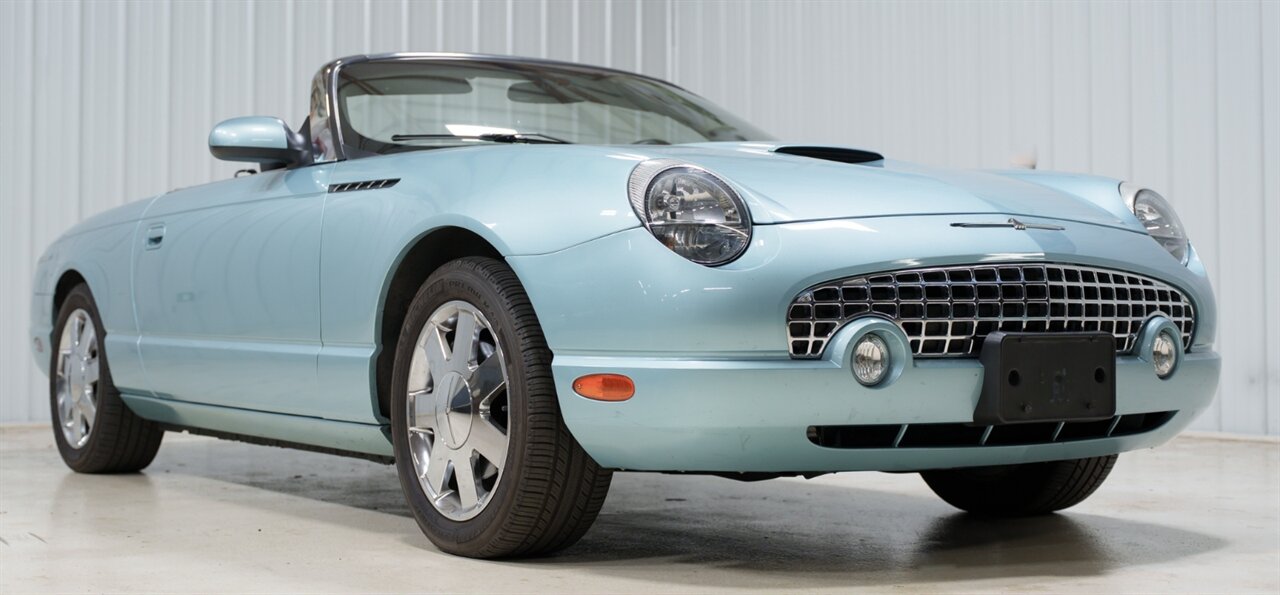
| Retro Bird | 2002–2005 | 3.9 Jaguar AJ V8 | 252–280 hp | 68,262 | Two-seat revival; modern under Retro clothes |
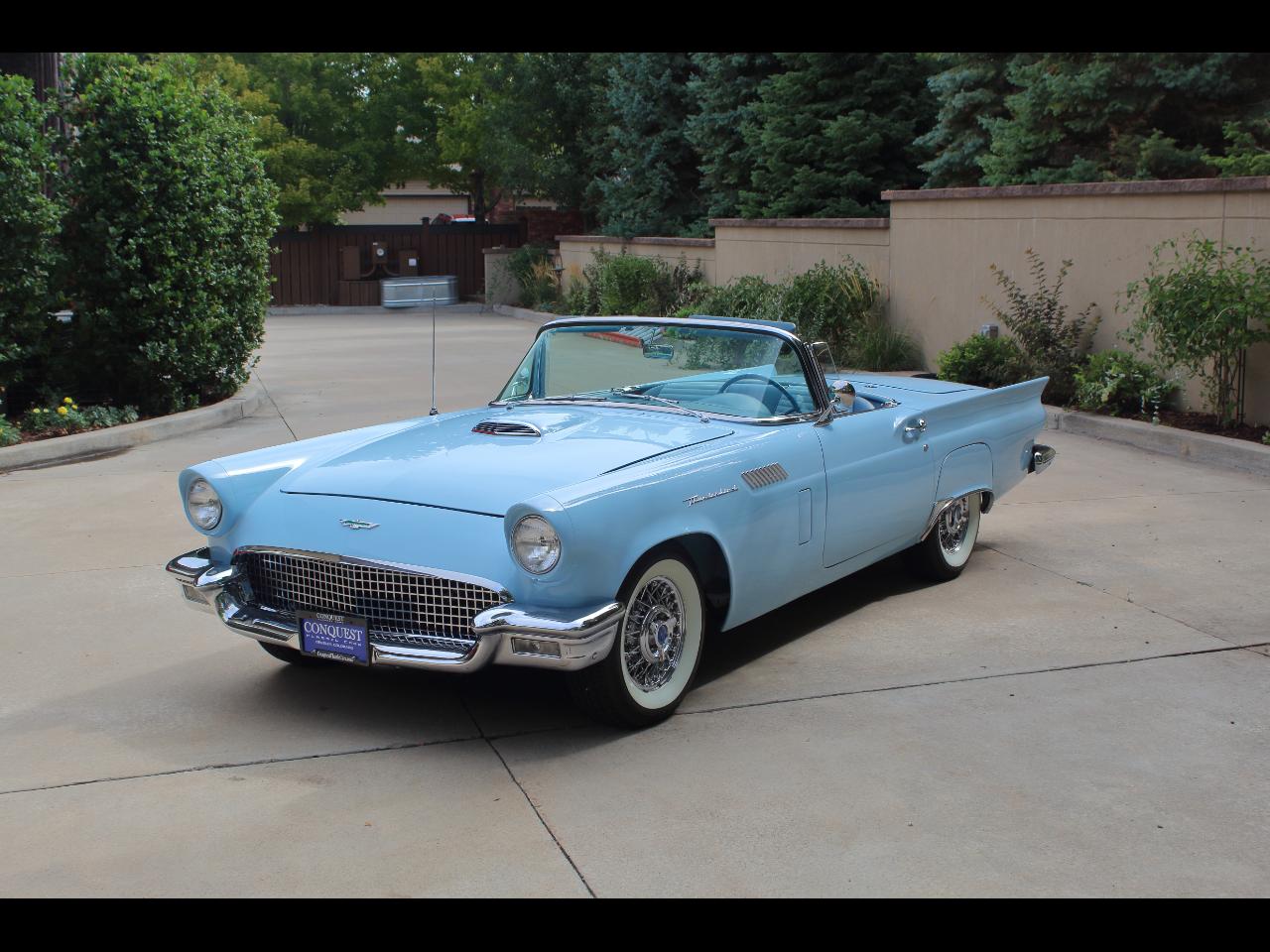
The two-seaters, 1955 to 1957. One body style, a convertible with a folding soft top and an optional removable fibreglass hardtop, with the famous porthole windows from 1956. The 1955 car has a 6-volt system, no portholes and the spare inside the trunk. For 1956 Ford moved the spare to a continental kit, added portholes, went to 12 volts and offered the 312. The 1957 car is a one-year restyle — longer rear fenders with small fins, a larger grille, a revised dash — and the performance peak, with dual-quad and supercharged options. 1957 is the most numerous in our listings and the most sought after; 1955 is the purest and the most compromised as a driver. All three sit on a ladder chassis with a separate body: a Baby Bird body can be lifted off its frame, and rust is not the unibody death sentence it becomes from 1958 on.
Square Bird, 1958 to 1960. The revolution. Four seats, a hardtop coupe as the volume model, a convertible, and from mid-1960 a sliding steel sunroof. Construction changed to unibody, engines grew to the FE 352 with the big MEL 430 as a rare option, and the styling went square and chrome-laden — hence the name. The convertible top is an engineering showpiece: the decklid lifts, the top folds entirely into the trunk, the decklid closes. It is also, sixty years on, a relay, limit-switch and hydraulic puzzle that must be tested through several full cycles, not one.
Bullet Bird, 1961 to 1963. A complete restyle with a pointed nose and one of the finest interiors Ford ever made, including the Swing-Away steering column that moves aside for entry. The standard engine is the 390. Two cars stand out. The Sports Roadster (1962 to 1963) is a convertible with a fibreglass tonneau covering the rear seat, wire wheels and a passenger grab bar — genuine cars carry their own body code and are faked often enough that the data plate check in the inspection section is not optional. The M-code car carries a triple-carburettor 390 at 340 hp; it is rare, valuable and also faked.
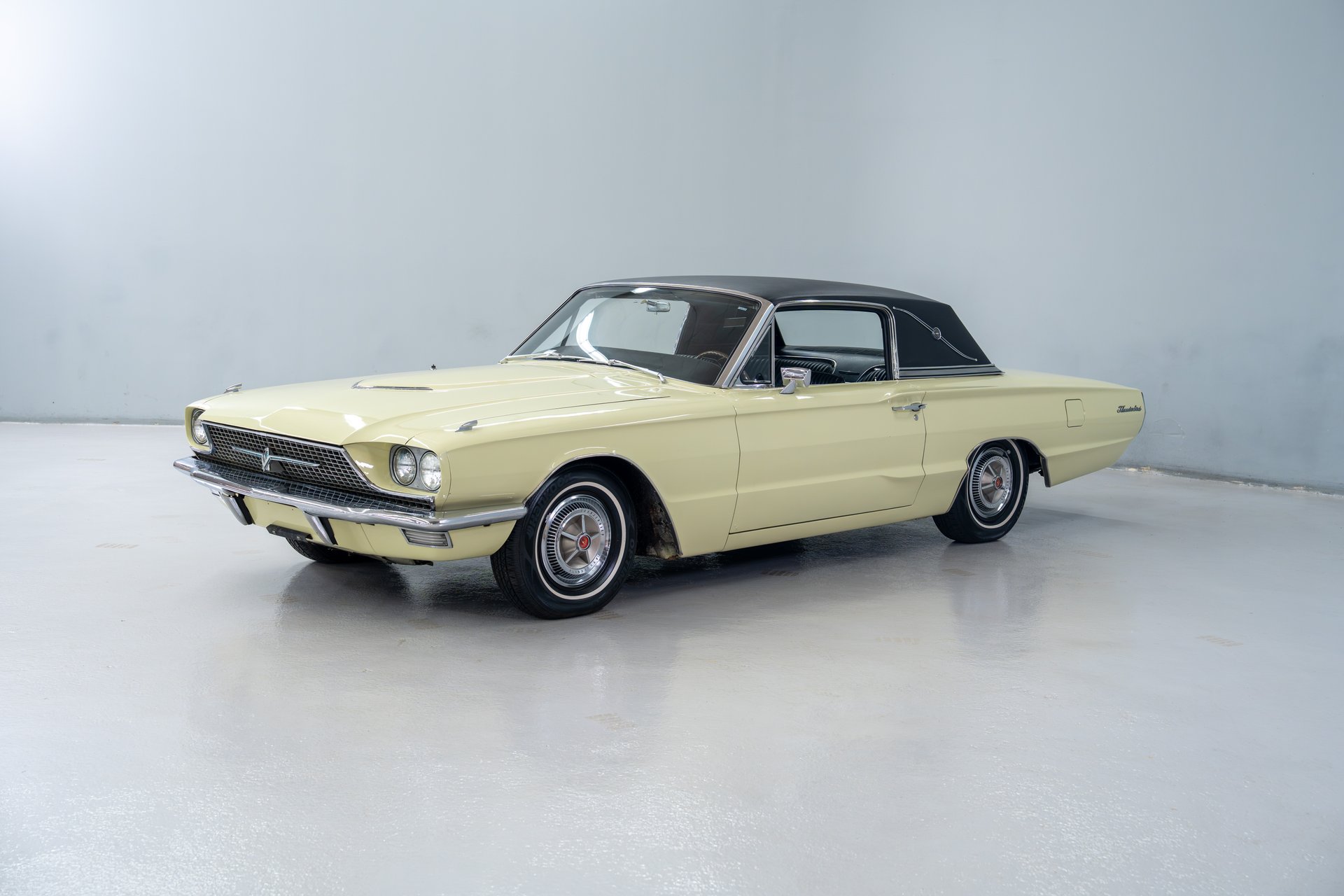
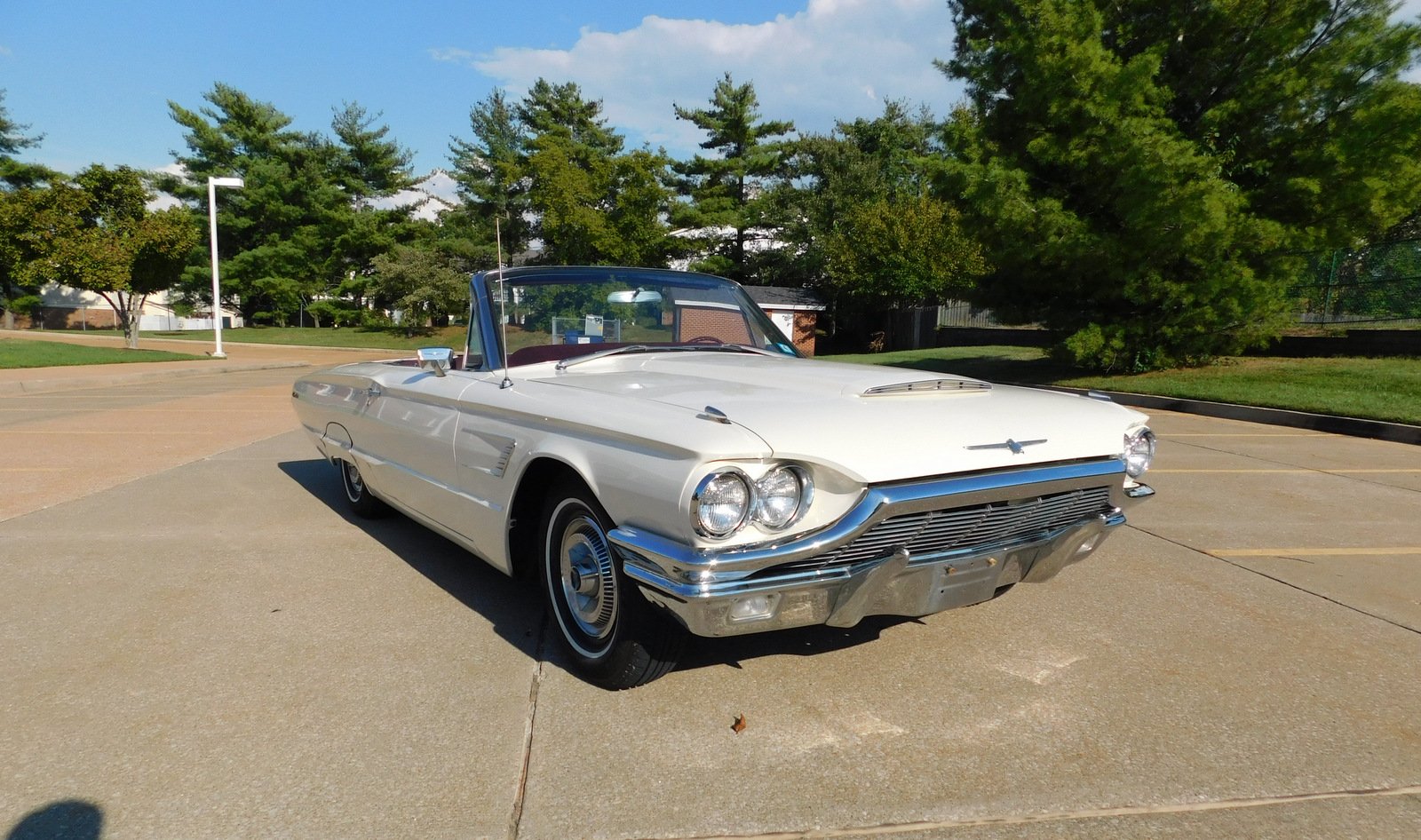
Flair Bird, 1964 to 1966. The best-selling classic generation and, for most buyers who want a four-seat Thunderbird to use, the default choice. Convertibles continue with the fully disappearing top, and the Landau hardtop, with padded vinyl roof and S-bars, becomes the prestige model. Two details date a car precisely: sequential rear turn signals arrived for 1965, flashing through three segments, and front disc brakes arrived the same year. The 1966 car is a facelift with a full-width grille and the optional 428 Q-code engine. The 1966 Town models deleted the rear quarter windows for a formal roofline — handsome, and a blind spot you should experience before you buy.
Glamour Bird and the four-door, 1967 to 1971. Ford restyled again, added a four-door Landau sedan with rear-hinged suicide rear doors and hid the headlamps behind vacuum-operated doors; the convertible was dropped. Engines are 390, 428 and the 429 from the new 385-series family. The 1970 car gained a pronounced beak grille, which is why enthusiasts split 1970 to 1971 off as their own sub-generation. These cars are large, quiet and comparatively cheap, and their vacuum and hidden-lamp systems are the ownership story.
Big Bird, 1977 downsizing and the Fox cars, 1972 to 1982. The 1972 to 1976 cars are the largest Thunderbirds ever built, sharing their platform with the Lincoln Continental Mark IV, powered by 400, 429 and 460 V8s whose net outputs fell through the emissions era even as torque stayed ample. They ride superbly, use fuel at a rate you must budget for honestly, and cost less than almost any other classic Thunderbird in comparable condition. For 1977 Ford moved the car to the intermediate LTD II platform, cut the price nearly in half and sold more Thunderbirds than ever before. The 1980 car moved again, onto the Fox platform shared with the Mustang; it is competent, light and almost entirely unloved, which makes trim and model-specific parts the problem rather than rust or engines.
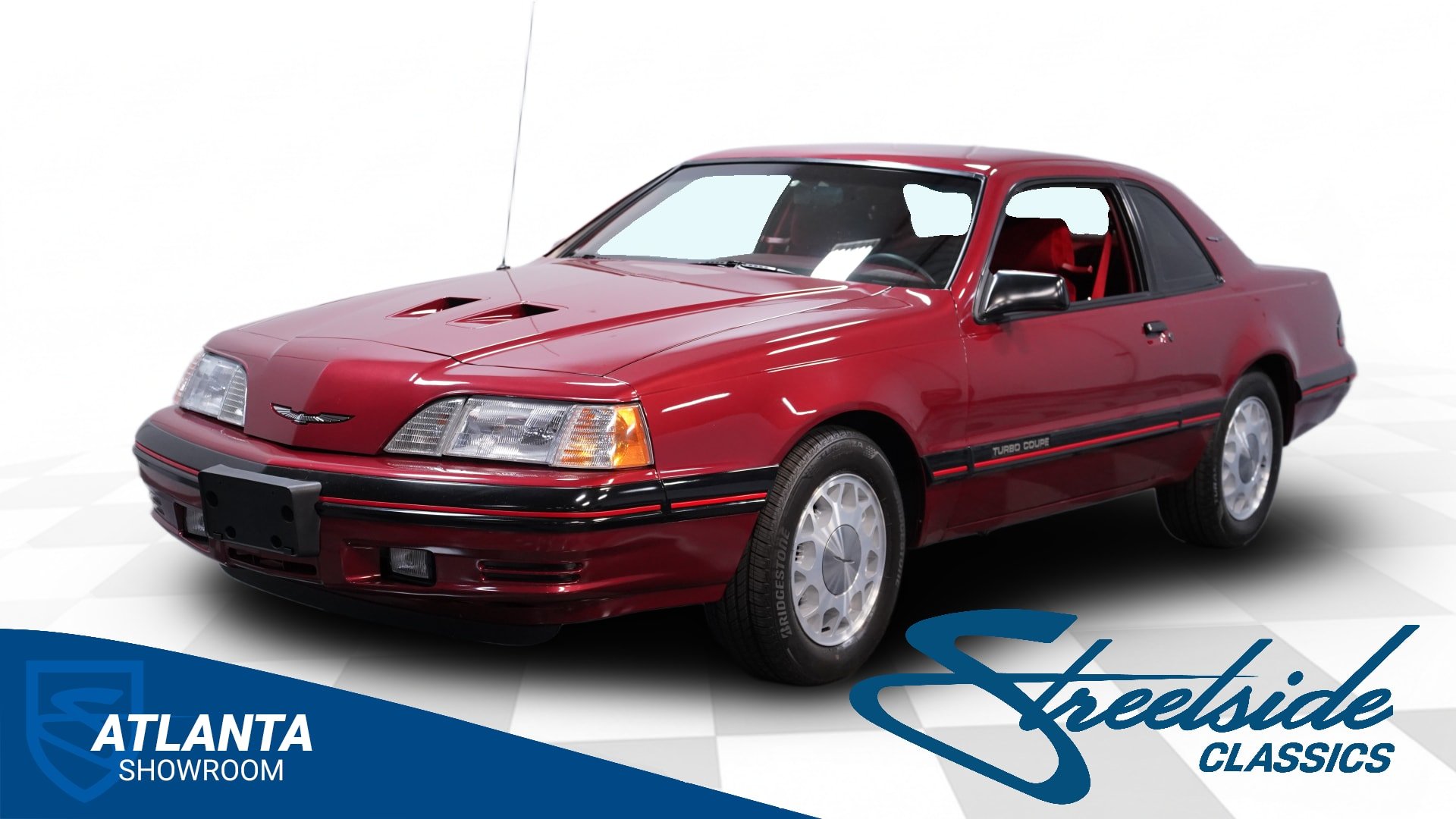
Aero Bird and MN12, 1983 to 1997. The 1983 restyle is one of the great aerodynamic turnarounds in American design, and the Turbo Coupe — turbocharged 2.3 four, manual gearbox available, from 1987 an intercooled 190 hp version — is a genuine driver's car. The 1989 MN12 car went further: independent rear suspension, a supercharged 3.8 V6 in the Super Coupe, and from 1994 the 4.6 Modular V8 in the LX. These are the cheapest Thunderbirds to buy and the most modern to run before the Retro; their problems are electronics, 3.8 head gaskets and Super Coupe wear, all covered below. Production ended in 1997.
Retro Bird, 2002 to 2005. Ford returned to the 1955 formula with modern engineering: a two-seat convertible with a removable porthole hardtop, built on the DEW98 platform shared with the Lincoln LS and Jaguar S-Type, powered by Jaguar's 3.9 AJ V8 through a five-speed automatic only. Special editions — Neiman Marcus for 2002, 007 coral for 2003, Pacific Coast Roadster for 2004, Inca Gold for 2005 — carry trim and colour differences, not mechanical ones. Its expensive failures are electronic modules and coil packs rather than rust and vacuum leaks, though at twenty years old it now has classic-car problems of its own.
Engines and gearboxes
The Y-block small V8s and the supercharged 1957
The Baby Birds use Ford's Y-block V8, so named for the deep-skirted block whose side profile forms a Y. It is an overhead-valve engine, introduced in 1954 to replace the flathead, with the distributor at the rear, the oil pump driven from the camshaft and a reputation for a weak top-end oil supply that needs context. Two displacements matter. The 292 cubic inch (4.8-litre) engine was standard across the run: about 193 hp in 1955 form, rising to about 200 hp for 1956 and 212 hp for 1957. The 312 cubic inch (5.1-litre) engine, optional from 1956, is the one collectors want: about 215 to 225 hp in 1956 single-carburettor form, and for 1957 a ladder of options that you must verify rather than assume. The D-code 312 carries a single four-barrel Holley and about 245 hp. The E-code carries two four-barrel carburettors and about 270 hp. The F-code carries a Paxton VR57 centrifugal supercharger, a single four-barrel in a pressure bonnet, and a factory rating of 300 hp. F-code cars were built in small numbers — a few hundred at most, with about 208 commonly cited for the supercharged passenger-car run plus a small number of dual-quad supercharged racing variants — and they are the most valuable Baby Birds of all, which is exactly why verification, covered in the inspection section, is a data-plate and engine-stamp exercise and never a badge exercise.
Mechanically, judge a Y-block on oil pressure, top-end noise and rear-main leakage. The Y-block feeds its rocker shafts through passages in the head that sludge shut when oil changes were skipped, starving the rockers; a car that clatters at the top has usually been under-maintained rather than worn out in the bottom end, and pulling a rocker cover tells you more in ten minutes than a compression test alone. External rocker oiling kits are a common period fix — not a defect, but evidence the original passages were blocked, so ask when and why it was fitted. Rear main seals seep with age; budget a seal as a service job at roughly $600 to $1,200 rather than treating dampness as a rebuild verdict. Carburettor condition dominates driveability: single Holley four-barrels rebuild for a few hundred dollars, E-code dual-quad matching is specialist work, and F-code Paxton blowers are rebuildable by a few specialists at roughly $1,500 to $2,500 — cheap relative to the value the correct blower adds, and ruinous to fake, because the F-code package includes specific heads, camshaft, distributor and carburettor details beyond the blower itself.
The FE and MEL big blocks: 352, 390, 428 and 430
From 1958 to the end of the 1960s the Thunderbird is a big-block car, and the FE family does nearly all the work. The 352 (5.8-litre) was the standard Square Bird engine at 300 hp. The 390 (6.4-litre), from 1961, became the defining engine for a decade: 300 hp in standard Z-code form, and 340 hp as the M-code triple-carburettor engine in Bullet Birds. The 428 Q-code, optional in 1966, gives 345 hp and a broad, quiet torque delivery that suits the Flair and Glamour cars perfectly. FE engines are heavy, durable and understressed in Thunderbird tune. Their characteristic faults are exhaust manifold cracking and broken manifold bolts (a ticking on cold start that fades as the manifold expands is the tell, and broken stud extraction can turn a gasket job into a heads-off job), oil leakage from intake end seals and the rear main, and lifter noise after standing. None is a reason to reject a car; all are reasons to price work in. An FE that smokes blue under load, knocks or shows milky oil is a rebuild conversation at $5,000 to $9,000, reflected in the price before you buy.
Alongside the FE sits one rarity. The 430 MEL (Mercury Edsel Lincoln) engine, J-code in the 1959 to 1960 Square Bird, was rated at 350 hp. It is a big, heavy, Lincoln-shared engine with strong low-end torque and parts support a clear step below the FE; a genuine J-code car is a collector piece, and an ordinary buyer is better served by a 352 or 390 car. The 385-series engines that replaced the FE — the 429 and its longer-stroke 460 brother — are simple, torquey pushrod V8s whose smog-era net ratings (the 460 fell to around 202 hp net by the mid-1970s) badly understate how they move a heavy car. Their faults are timing-chain stretch on original nylon-toothed cam sprockets, exhaust manifold cracking shared with the FE, and emissions-hardware neglect. The 400 in 1970s cars is the weak relation: adequate, unloved, and prone to the same issues without the 460's torque.
The later engines: Windsor V8s, the turbo four, the 3.8 and the Modular and Jaguar V8s
The 1977 downsizing moved the Thunderbird onto ordinary Ford V8s: the 302 and 351 Windsor small blocks and the 400, all in low-compression, emissions-tuned form, all simple to maintain and none fast. The Fox-era cars added the 255 cubic inch 4.2 V8 and even a 3.3-litre straight six in the base Box Bird — engines to buy only if the car itself is exceptional, because they give away torque the chassis can use and gain nothing in economy worth having. The engines that matter after 1982 are three.
First, the 2.3 Lima turbo four in the Turbo Coupe. In 1983 form it made about 145 hp; the intercooled 1987 to 1988 manual car made 190 hp, the automatic about 150 hp to protect the gearbox. Its failure modes are turbo-specific: a coked or starved turbo oil feed line cooks the turbocharger bearings, a blown head gasket is the classic failure under sustained boost with overheating, and the distributor-mounted TFI ignition module fails with heat and gives a cut-out when hot that restarts when cool — the single most useful distinguishing test on any 1980s Ford in this guide. Hot cut-out with no spark points to TFI before it points to fuel.
Second, the 3.8 Essex V6, naturally aspirated in base cars and supercharged in the Super Coupe. The standard 3.8 made about 140 hp and is remembered, fairly, for head-gasket failure: aluminium heads on an iron block, with period gasket design, let combustion gas into the cooling system, showing as unexplained coolant loss, bubbles in the expansion tank with the engine running and, late, overheating. Ford extended warranty coverage on many of these engines when new, which tells you the failure was systemic. The Super Coupe's Eaton M90 supercharged version made 210 hp at launch and 230 hp in 1994 to 1995 form, with torque that embarrasses the V8s of the same years. It adds supercharger nose-drive wear (a rattle at idle from the coupler) and the same head-gasket vigilance. A Super Coupe with documented head gaskets and a quiet supercharger is a serious performance car for the money; one with coolant loss and no history is a bill.
Third, the V8s that close the classic run. The 5.0 High Output Windsor in the 1991 to 1993 MN12 LX gives about 200 hp and pushrod simplicity. The 4.6 Modular V8 that replaced it for 1994, about 205 hp, is smoother and longer-lived; its composite intake manifold cracks at the coolant crossover and leaks, and spark-plug thread care matters on aluminium heads. The Retro Bird's 3.9 AJ35, a Jaguar AJ-V8 derivative with variable valve timing from 2003 (lifting output from 252 to 280 hp), is the most refined Thunderbird engine and the least home-mechanic friendly. Its pattern is coil-on-plug failures giving a single-cylinder misfire a scanner names precisely, plastic thermostat housing and coolant outlet leaks, and timing-chain tensioner wear on high-mileage early engines giving a cold-start rattle that must not be ignored. A set of coils and plugs is typically a few hundred dollars in parts and a plastic coolant housing replacement $400 to $900 fitted.
Gearboxes
Most Thunderbirds are automatics. Baby Birds use the Fordomatic, a three-speed automatic that normally starts in second unless you select low or floor it — a second-gear start is correct behaviour, not slip. A three-speed manual was standard and a manual with overdrive optional. Square Birds moved to the Cruise-O-Matic family, and the big-block cars standardised on the C6, one of the strongest three-speed automatics ever built, fitted behind 390, 428, 429 and 460 engines. A healthy C6 changes firmly, engages reverse promptly and does not flare; a rebuild is roughly $1,800 to $3,200 fitted, and documented C6 work is a selling point. The downsized and Fox cars use the C4, C5 and then the AOD four-speed overdrive, whose throttle-valve cable adjustment is its weak point — a misadjusted TV cable can burn the gearbox in miles, so an AOD car that shifts oddly needs the cable check before any test drive is extended.
Manual gearboxes return where they matter. Turbo Coupes use the Borg-Warner T5 five-speed, whose second-gear synchromesh is the wear test on any viewing. Super Coupes use the Mazda-sourced M5R2 five-speed, heavier in feel, with synchromesh wear and a clutch that is a larger job than on the Turbo Coupe. Retro Birds are automatic only, using the 5R55N five-speed shared with the Lincoln LS and Jaguar S-Type: smooth when right, prone on neglected cars to solenoid pack and valve-body wear showing as harsh or delayed shifts. A Retro with a documented fluid history is worth a premium, because many cars were simply never serviced. On every automatic the test is the same: fluid red and clean-smelling, engagement without delay or thump, no flare under load, and a kickdown that works. Burnt, brown fluid plus delayed reverse is a rebuild negotiation, whatever the generation.
Problem areas
Work through this section by system, not by generation, because the systems repeat even when the bodies change. Rust decides whether a pre-1980 Thunderbird is viable at all. Convertible mechanisms decide whether a Square, Bullet or Flair Bird is a pleasure or a project. Vacuum and electrics decide the same for Glamour and Big Birds. Head gaskets, electronics and cooling decide it for Aero, MN12 and Retro cars. Our photo evidence supports that order: in the 162 photo sets we examined, rust appeared in 49 cars and visible damage in 48, while leaks and smoke barely registered. Photographs under-report mechanical wear, but they do not invent rust. Assume you will find some, and grade it with the map below.
Rust and structure: the map by construction type
Baby Birds: separate chassis, body that lifts off. The frame rusts at the rear kick-up, outriggers and spring hangers, but frame rust is repairable in a way unibody rust is not. The body rusts where water sits: floor pans, inner and outer rockers, lower front fenders behind the wheel, the trunk floor around the spare well (worst on 1955 cars, where the spare lives inside), the battery tray and the lower rear quarters. Because the body unbolts, a frame-off restoration claim is checkable: look for new body mounts and a frame finish that matches the story. Patch panels are widely available and a floor section fitted is typically $500 to $1,500 a side, but a car needing floors, rockers, trunk and quarters at once is a restoration, not a driver with faults.
1958 on: unibody, and the torque boxes are the car. From the Square Bird onward there is no separate frame to save you. The shell carries everything through rockers, floor pans, cowl sides and, critically, the torque boxes — the boxed reinforcements where floor, rocker and subframe rails meet, under the front footwells and ahead of the rear wheels. Torque-box rust is the classic Flair and Bullet Bird killer: structural, hidden by underseal and trim, and expensive to do properly at commonly $1,500 to $3,000 a side fitted and painted, with cars often needing both sides plus the floor above. Prod where the owner permits, tap and listen for the change from a ring to a thud, and get the car on a lift before money moves. The rest of the map follows water: front floors from windshield and cowl leaks (pour a jug of water into the cowl vent — it should pour from the drains behind the front wheels, not into the footwells), trunk floors and drop-offs from rear window and trunk seal leaks, rear arches and lower quarters, roof skin and rear pillars under Landau vinyl (bubbling under vinyl is rust, not vinyl failure), and the battery tray and apron beneath it. On convertibles add the area under the top well, where a leaking top rots metal you cannot see without lifting trim.
Later cars: less rust, different places. Fox, Aero and MN12 cars rust in more ordinary places: front strut towers and subframe mounts on Fox-derived cars (tower perforation is structural and a walk-away on a cheap car), rockers, rear arches, and the rear subframe mounting points on MN12 cars that locate the whole rear suspension. Retro Birds rust least of all; look at subframe hardware and brake lines rather than expecting classic perforation. On any Thunderbird, read underseal as evidence: a fresh, uniform coat of black stone-chip over sills, torque boxes and floor seams in the week before a sale is a cover-up until the seller proves otherwise.
Convertible tops, hardtops and the disappearing-top mechanism
Three different open-car systems need three different tests. The Baby Bird has a manual or power-assisted folding soft top that stows behind the seat, plus a separate removable hardtop that two people lift off. Test the soft top frame for bent bows and torn linkage, the canvas for rear-window clouding and seam failure, and the hardtop for fibreglass cracking around the mounting points and for porthole trim completeness. A new soft top fitted runs roughly $1,200 to $2,500 depending on material; a hardtop headliner and weatherstrip refresh is a few hundred dollars in parts and a weekend of care. Fit matters more than fabric: a top that does not meet the windshield header evenly will leak and whistle no matter how new the canvas is.
The Square, Bullet and early Flair Bird convertibles use the fully disappearing top, in which relays, limit switches, solenoids and hydraulic cylinders raise the decklid, fold the top into the trunk and close the decklid over it. Diagnosis is sequential — the system will not start step three until the switches confirm step two — and the failure is usually electrical logic, not hydraulics: a relay with burnt contacts, a limit switch out of adjustment, a broken wire in the decklid harness. The viewing test is non-negotiable: run the full cycle down and up at least twice. A top that works once and then stops is telling you about a marginal relay or switch. Budget $800 to $2,500 for a specialist to recommission a dead system, and treat a convertible with the top locked down as a car with a non-working top until proven otherwise. With the top down there is almost no luggage space, so check how the decklid opens manually.
Retro Bird tops are conventional modern power tops — hydraulic pump, latching header, heated glass rear window in the soft top — plus a removable hardtop that needs its storage stand and its rear-deck protective film to avoid paint damage. Test for pump groaning, uneven side-to-side movement and leaks at the cylinder rams; a set of rams or a pump is a $600 to $1,400 fitted proposition. On every convertible in this guide, check the floor and trunk for the water damage the top caused when its seals were old, because tops get replaced and floors keep the record.
Vacuum, electrics and accessories: where the luxury lives and dies
The Thunderbird's selling proposition was equipment, and equipment is what ages. Three systems account for most accessory grief. First, vacuum. Hidden headlamp doors on 1967 to 1971 cars, heater and air-conditioning controls and cruise control all depend on engine vacuum switched by small valves and diaphragms that perish. The classic Glamour Bird symptom is headlamp doors that droop shut overnight or rise slowly one side at a time: that is a vacuum leak or a failed actuator diaphragm, not an electrical fault, and the distinguishing test is a hand vacuum pump on each actuator — a good actuator holds vacuum, a split one does not. A full re-hose of a tired system is a $150 to $400 job that transforms a car sellers describe as electrically possessed.
Second, sequential turn signals. The 1965 to 1971 sequential rear lamps, flashing through three segments per side, originally used a motor-driven cam and relay assembly in the trunk. The motor wears, the contacts pit and the sequence stumbles, sticks or flashes as a block. Solid-state replacement sequencers exist and are a legitimate, reversible fix; what you are pricing on a viewing is whether the lamps, sockets and wiring are sound, because corroded sockets and cut wiring turn a sequencer swap into a rewire. Test both sides, plus hazards, plus brakes, because the systems interact through the same lamps.
Third, power accessories and wiring generally. Power window motors and their nylon gear plugs (the plugs crumble and the motor spins without moving the glass — a cheap part, a door apart to fit it), power seat tracks, and air-conditioning compressors now running R134a conversions of varying honesty. A system claimed to work must blow cold at idle and at cruise; a car that blows cold for five minutes from a fresh charge is a car with a leak. On pre-electronic cars, failures live at connections and earth points, not in the middle of wires, and a car where everything works has usually been used and maintained. On Aero, MN12 and Retro cars, scan for codes, test every module-driven function, and treat multiple simultaneous complaints as a battery, earth or charging problem before treating them as multiple module failures — a weak battery manufactures faults.
Engines, cooling and running gear in service
Two engine faults deserve repetition because sellers misdescribe them. Y-block top-end clatter with sludged rocker gear is maintenance debt, curable with cleaning and oil-system work — not automatically a worn-out engine, and a compression test plus oil pressure reading separates the two. FE exhaust ticking that fades when warm is manifold and gasket, not a lifter, and the test is to listen at the manifold joint cold, then hot. Cooling is the system that kills good engines in every generation: radiators recored ($400 to $800), heater cores that are a dashboard-out job on many 1960s cars ($1,200 to $2,500 fitted, so test the heater on every viewing, in July as in January), and on Retro and MN12 cars plastic thermostat housings and expansion tanks that fail with heat cycles. An overheating big-block on a test drive is a stop-and-negotiate event, never a drive-it-home event.
Suspension and steering wear follows weight: idler arms, centre links, ball joints, control-arm bushings and, on strut cars, strut mounts and subframe bushings. Power steering boxes leak from the sector shaft seal; a groan at full lock with clean, full fluid is a pump, a groan with frothy fluid is air from a suction leak. Brakes divide at 1965: front discs transform Flair Birds, while drum cars need drums, cylinders and hoses assessed as a system — a full hydraulic refresh is $800 to $1,800 in shop terms and is the first safety spend on any car that has sat. Cars that have sat need the fuel system cleaned end to end (ethanol attacks old rubber and varnishes tanks), and a recommissioning budget of $2,000 to $5,000 covering fuel, brakes, fluids, tyres and ignition is honest planning. Check tyre date codes, not just tread: a heavy Thunderbird on ten-year-old tyres is not safe at highway speed.
How to inspect one
Allow at least an hour for a classic Thunderbird and forty minutes for a Retro, bring a torch, a cloth-wrapped magnet, a tyre tread and date-code check, a hand vacuum pump if you are viewing a 1967 to 1971 car, and a basic code reader for anything from 1989 on. Insist on a cold start. If the car passes you, pay for a lift inspection before money changes hands — on a unibody Thunderbird it is the best money in the whole purchase, because the torque boxes and floors from the rust section cannot be judged from a driveway.
- Paperwork and identity first. Match the title VIN to the warranty data plate — on the firewall on 1955 to 1957 cars, on the driver door edge or jamb on 1958 to 1966 cars, at the windshield base and on the door label on later cars. Decode it before you admire the car: body style, original colour and trim, build date, axle code and, crucially, the engine code as the fifth character of the VIN on classic cars. That letter settles the arguments this guide has flagged. On a 1957 car, F is the supercharged 312 claim — then verify the engine itself, because plates can be swapped: check for the Paxton blower and pressure bonnet and the F-code carburettor and distributor details, and cross-check the car against club registries before paying an F-code price. D is a single-four-barrel 312, E is dual-quad, C is a 292 — price each as what plate and engine together prove. On a Sports Roadster, the body code must be the roadster code and the tonneau fittings, wire wheels and grab bar must be present as a system. Ask for invoices: documented engine, gearbox, top and rust work is worth thousands.
- Cold start and first listen. From cold, a carburettor V8 should start with choke, settle to a fast idle and come down as it warms. Listen for FE manifold ticking (loud cold, fading warm points to manifold and gasket, per the problem areas), persistent Y-block top-end clatter (rocker oiling), timing-chain rattle on high-mileage 429, 460 and Retro AJ engines, and lifter noise that does not clear. Watch the exhaust: blue smoke on start-up that clears is valve stem seals, blue smoke under load is rings, white sweet-smelling vapour that persists when warm is coolant and, on a 3.8 car, points straight at head gaskets.
- Under the bonnet, fluids and leaks. Check engine oil level and condition, and smell it — fuel dilution, milky emulsion and glitter all end the viewing in different ways. Check coolant, transmission fluid on the dipstick where fitted (red and clean versus brown and burnt is the cheapest gearbox verdict there is), power steering and brake fluid. On a Super Coupe, listen to the supercharger at idle for nose-drive rattle and check the expansion tank for bubbles with the engine running. On a Retro, plug in the reader now, before the test drive clears anything, and note stored as well as live codes.
- Structure on the ground, then on a lift. Work the rust map from the problem areas in order: rockers, floors from inside (lift carpets, trunk mat and spare), torque boxes and floor seams from below, cowl drains with the water test, trunk drop-offs, wheel arches with the magnet, roof pillars on vinyl-roof cars, battery tray. On a Baby Bird, split the verdict between frame and body. Perforation in torque boxes, rockers, Fox strut towers or MN12 rear subframe mounts is structural — the walk-away or price-as-restoration decision, before any discussion of engines or trim.
- Convertible and hardtop function, where fitted. Baby Bird: raise and lower the soft top, check header fit, and fit the hardtop if it is part of the sale — a hardtop never fitted in your presence may not fit this car. Square, Bullet and early Flair convertibles: run the disappearing top through at least two full cycles and confirm manual decklid access. Landau cars: check the vinyl roof by hand for bubbling at the pillars. Retro: run the power top twice and inspect the hardtop, stand and latches if included.
- Interior and accessories, every switch. Sit in the driver seat and feel for collapsed padding. Work every power window through its full travel (slow glass with a spinning motor is the nylon gear plug failure from the problem areas), the power seat, the Swing-Away or tilt column, wipers, hidden-lamp doors on 1967 to 1971 cars (test the actuators with the hand pump), sequential signals on both sides, heater and blower on every speed, and air conditioning for sustained cold. A dead heater blower or core on a 1960s car is dashboard-out money, so this step prices the car.
- The test drive, fifteen minutes minimum. Include town work, a highway stretch and a hill. The automatic should engage without delay, change firmly without flare and kick down when asked; a Fordomatic car starting in second at light throttle is correct, not slipping. An AOD car with odd shifts needs its TV cable checked before you extend the drive. A Turbo Coupe should build boost cleanly without a hot cut-out (the TFI test from the engines section). A Super Coupe should pull from low revs without rattle or temperature movement. Drum cars should stop straight without grabbing, disc cars without judder. Wander plus a knock over bumps is front-end wear priced into the offer.
- Heat soak and hot restart. Let the car idle for five minutes and watch temperature and oil pressure. Then switch off, wait five minutes and restart. Hard hot starting on a carburettor car is usually fuel percolation, ignition or a tired starter — all negotiable, all different prices — while a Retro or MN12 car that will not hot-restart with codes set needs a specialist diagnosis priced before you buy.
- Stance and underside, standing back. A Thunderbird should sit level side to side; a nose-down unibody car suggests structural sag that sends you back to step 4. On Super Coupes check the ride control function. Look down each flank for ripples, check tyre wear patterns, and read the date codes — budget roughly $600 to $1,200 for a set if they are older than seven years regardless of tread.
- Price the faults before you negotiate. List what you found by system with the job ranges from the problem areas against each item. A sound shell with a working top and tired mechanicals beats a shiny car with soft torque boxes at the same price, every time. Structural rust plus a dead top mechanism plus an engine fault means you are funding a restoration, and the negotiation should say so plainly.
Values
The build beneath this guide carries the live market — the cars listed now and the recorded sales — refreshed at every build, and that block is where the numbers live. This section teaches you how to read it, because Thunderbird values are driven by generation, identity and condition far more than by year or mileage, and a single median across eleven generations means almost nothing until you split it.
Start with the split. The two-seat Baby Birds and the Retro Birds behave like distinct markets that happen to share a name with the four-seat cars. Within the Baby Birds, identity is value: a verified supercharged F-code 1957 sits in a different world from a C-code 292 car in the same colour and condition, with D-code and E-code cars on the steps between, and the premium attaches to the data plate and engine evidence, not to the presence of a blower bolted on later. Within the four-seat classics, the Flair Bird Landau and convertible and the Bullet Bird Sports Roadster and M-code carry the premiums, for the same reason — they are the cars the period buyers aspired to and the cars later owners faked, so verified originality is the scarce commodity. Big Birds, Box Birds and base Aero and MN12 cars sit at the accessible end: condition-for-condition they cost a fraction of a Baby Bird, and the spread between a project and a good driver within those generations is narrower in money, though just as wide in work.
Condition spread is the second lesson, and it is steeper on Thunderbirds than on most Fords because the expensive systems are the body, the top and the interior rather than the engine. A rust-free, top-working, original-interior Flair Bird and a rusty, top-dead, retrim-needing car with the same engine are not two points on one scale; they are different purchases, one a car and one a restoration with a car attached. Asking prices reflect hope unevenly — sellers of ordinary four-seat cars routinely ask Baby Bird money on the strength of the name, while auction results settle where verified condition and identity say they should. Read the gap between the listed-now summary and the recorded sales as the negotiation reality for that generation: where it is wide, sellers are testing the name; where it is narrow, good cars move quickly.
The project-versus-driver gap follows the same logic. On a Baby Bird or Flair Bird convertible, structural welding, a top recommission and a retrim can cost more than the difference between a project price and a driver price, so the driver is usually the cheaper car. On a Retro, Turbo Coupe or Super Coupe the gap compresses, because the faults are components with knowable prices, and a mechanically faulty but bodily sound car can be the value purchase. Originality premiums are specific: matching engine identity, original colour and trim as decoded from the plate, and documented special-edition status on Retro cars add value; engine swaps, colour changes away from the plate and added options presented as factory subtract it. Buy the car whose plate, engine and condition agree, and let the market block below tell you what that agreement is currently worth.
Parts and ownership
Thunderbird parts support divides cleanly by era. The Baby Birds are among the best-supported American cars of the 1950s: reproduction sheet metal, weatherstrips, interior kits in original patterns, chrome and trim, and mechanical parts shared with the wider Y-block world. The Square, Bullet and Flair Birds are nearly as well served — vendors stock top relays, switches and cylinders, sequential signal components, interior kits and FE mechanical parts. Service parts are ordinary money, Thunderbird-only trim and top parts are specialist money, and a quality repaint starts in the five figures at a good shop, which is why this guide keeps returning to buying body and interior first.
The middle generations are the patchy zone. Glamour and Big Bird mechanical parts are easy — the engines, C6 gearboxes and axles were built in millions — but model-specific trim, hidden-lamp vacuum parts and 1970s vinyl and plastic in original colours require hunting and patience. The Box Bird's one-generation trim is the hardest in the range to complete a car from. Aero and MN12 cars invert the pattern: mechanical and electronic parts are the hunt, because Ford has discontinued much of the MN12 catalogue, while used panels and interiors survive in quantity. Turbo Coupe and Super Coupe specifics are club-and-specialist territory, and a parts car is a rational purchase for a Super Coupe keeper.
Retro Bird ownership runs through the platform, not the badge. The DEW98 underpinnings shared with the Lincoln LS and Jaguar S-Type mean suspension, brake and many electronic parts cross-reference beyond the Thunderbird catalogue, and the AJ V8 is supported through the Jaguar world. Thunderbird-only parts — hardtops and their hardware, porthole trim, special-edition interior pieces, top hydraulics — are finite and priced accordingly, so a Retro bought with its hardtop, stand, tonneau and books complete is worth more than the same car missing them by more than the cost of hunting the pieces later, if they can be found at all.
Running a Thunderbird well is mostly a matter of use and fluids. These cars deteriorate by standing: brake hydraulics absorb moisture, vacuum diaphragms stiffen, carburettors varnish, tyres age, and seals that hold oil in a weekly-driven car weep on a monthly one. A sorted classic is a realistic regular-use car — fuel consumption in the low-to-mid teens for a big-block cruiser, worse for a 460 around town, better for a Turbo Coupe or Retro — serviced by any good independent Ford or classic specialist. Join the clubs early: the Vintage Thunderbird Club International covers the classics, the International Thunderbird Club spans the range, and the Super Coupe and Retro communities carry diagnostic knowledge no manual assembles in one place. Catching up deferred maintenance on a running car honestly costs a few thousand dollars in the first year before you improve anything; the owners who enjoy these cars planned for that year.
Which one to buy
- The icon: a 1957 Baby Bird, D-code 312. The most developed two-seater, 12-volt electrics and the strongest market to buy from and sell into. Verify the plate and engine, buy the best shell you can find, and let someone else chase F-code money unless verified originality is the point.
- The value two-seater: a 1955 or 1956 car, honestly described. Same silhouette and driving experience for less than a comparable 1957. A C-code 292 in sound condition beats a tired 312 at the same price.
- The classic cruiser: a 1965 or 1966 Flair Bird, hardtop or Landau. Front discs, sequential signals, the 390 (or a verified 428 in a 1966 car) and the deepest classic parts support after the Baby Birds. Buy the convertible only with the top mechanism proven through repeated cycles.
- The collector's Bullet Bird: a verified Sports Roadster or M-code. Buy on plate evidence alone, with club cross-checks, and treat every unverified example as the standard car it almost certainly is.
- The overlooked luxury buy: a 1967 to 1971 Glamour Bird, including the four-door. Big-block torque, hidden lamps, suicide doors on the sedan and the lowest entry cost per pound of classic Thunderbird. Buy on vacuum function and rust.
- The driver's car: a 1987 or 1988 Turbo Coupe manual, or a Super Coupe. The Turbo Coupe is the lighter, simpler handler; the Super Coupe is faster and more complex, and its head gaskets and supercharger must be documented.
- The modern classic: a 2003 to 2005 Retro Bird. Full-output engine and the benefit of early-car lessons. Buy with hardtop, stand and service history complete, and coils and cooling plastics budgeted.
And the rule that overrides all of the above: buy the soundest shell and the most verified identity you can find, in the generation that fits your use. Engines, gearboxes, top relays and coil packs are all fixable at prices you can plan for. A rotten unibody, a faked Sports Roadster or F-code, and a missing Retro hardtop are the things money cannot quietly put right — and the inspection in this guide is built to catch them before the money moves.