
Ford Thunderbird Convertible buyer's guide
Ford Thunderbird Convertible -- the model's own buyer's guide: variants, values and what to check.
Years listed: 1955-1978 · Series: Thunderbird
Overview and history
The Thunderbird convertible is not one car. Ford built it in three completely separate eras, with three different mechanisms, three different structures and three different sets of bills. The 1955 to 1957 two-seater — the Baby Bird — is a body-on-frame roadster whose folding soft top stows behind the seats and whose optional fibreglass hardtop lifts off by hand. The 1958 to 1966 four-seat convertible is a unibody car whose top performs the most elaborate disappearing act in American production history: the decklid opens, the top folds itself entirely into the trunk, and the decklid closes over it, leaving a clean deck with no folded canvas visible. The 2002 to 2005 Retro Bird is a modern two-seat power-top convertible on a Jaguar-derived platform, with a removable porthole hardtop that deliberately copies the 1956 car. Between 1966 and 2002 Ford sold no factory Thunderbird convertible at all — a fact that matters every time a later car is advertised as one.
That spread is exactly what our own listings show. We currently track 72 Thunderbird convertibles spanning 1955 to 2004, 55 of them for sale and 17 sold or archived. The Baby Birds dominate: 1957 alone accounts for 24 cars, with 13 from 1955 and 9 from 1956 — 46 of the 72, nearly two thirds of everything you will actually find to buy. The Flair Bird convertibles of 1964 to 1966 form the second band, 1966 the strongest year at 10 cars, with Bullet Bird convertibles from 1962 and 1963 and single Square Bird convertibles from 1959 and 1960 behind them, and a handful of Retro cars, 3 from 2003 and 1 from 2004, at the far end. In other words, the convertible market is a Baby Bird market with a Flair Bird annex and a Retro footnote, and this guide is weighted the way the cars are: deepest on the two-seaters and the disappearing-top cars.
The Baby Bird was created for 1955 as Ford's answer to the Corvette, but Ford refused to build a sports car. The launch word was personal car: a steel body when the Corvette was fibreglass, roll-up windows, a power seat, a telescoping wheel and a proper folding top, on a shortened Ford sedan chassis with a Y-block V8. It outsold the Corvette by more than twenty to one in its first year, and taught Ford the lesson that governed the nameplate for fifty years — Thunderbird buyers pay for style, comfort and effortless torque, not lap times. For 1958 Ford made the car a four-seater and sales roughly doubled again; the convertible survived and gained its party trick, the fully concealed top, at the cost of nearly all its luggage space with the top down. The Bullet Bird of 1961 to 1963 added the Sports Roadster, a convertible wearing a fibreglass tonneau over its rear seat. The Flair Bird of 1964 to 1966 was the last of the line: for 1967 the convertible was dropped, and it stayed dropped for thirty-five years, until the Retro car revived the 1955 formula on modern underpinnings.
Why does the convertible deserve its own guide? Because on these cars the top is not an accessory, it is a structural, electrical and financial system in its own right. A 1960s convertible with a dead top mechanism is a car whose defining feature does not work, whose trunk cannot be used normally, and whose repair requires a specialist who understands a relay sequence most general shops have never seen. The convertible also rusts in places a hardtop does not — the top well, the windshield header, the floor under a leaking top — and flexes in ways a hardtop does not.
Our own photo work sets the tone for the whole inspection. For this guide's pool we examined 50 sellers' photo sets in detail: rust was noted in 15 of those 50 cars and visible damage in 14, while smoke and fluid leaks were noted in none. Read that honestly. Photographs cannot show you a relay with burnt contacts, a torque box soft under its underseal or a top cylinder weeping into the trunk, so a clean photo set proves less on a convertible than on almost any other classic. But the pattern is still useful: on these cars the body, the trim and the top tell you more, earlier, than the engine does — and the engine is the part every seller wants to talk about.

The models
Every Thunderbird generation has a collector nickname, and convertible sellers use them as shorthand — Baby Bird, Square Bird, Bullet Bird, Flair Bird, Retro Bird. The table compresses the factory convertible range to the cars a buyer will realistically meet. Production figures are convertible production where genuinely known; period outputs are the factory gross ratings of the day, useful for comparison rather than as dynamometer truth.
| Model | Years | Engine | Output | Built | Character |
|---|---|---|---|---|---|
| Baby Bird convertible | 1955–1957 | 292 or 312 cu in Y-block V8 | 193–300 hp | 53,166 (all two-seaters) | The icon; two seats, folding top plus lift-off hardtop |
| Square Bird convertible | 1958–1960 | 352 FE V8; 430 MEL optional | 300 hp; 350 hp | about 24,300 | First four-seater; the disappearing top arrives |
| Bullet Bird convertible | 1961–1963 | 390 FE V8 | 300–340 hp | about 26,300 | Jet-age styling; Sports Roadster tonneau car |
| Flair Bird convertible | 1964–1966 | 390 FE V8; 428 optional 1966 | 300 hp; 345 hp | 21,093 | The classic cruiser; last factory convertible until 2002 |
| Retro Bird convertible | 2002–2005 | 3.9 Jaguar AJ V8 | 252–280 hp | 68,262 (all Retro cars) | Two-seat revival; modern power top, porthole hardtop |
The Baby Birds, 1955 to 1957. One body style only: every two-seat Thunderbird is a convertible, sold with a folding soft top, with the removable fibreglass hardtop optional — many cars were ordered with both, some with the hardtop alone, so establish exactly which tops a car carries before you value it, because a correct hardtop is a significant asset and a missing one a significant cost. The years differ more than the silhouette suggests. The 1955 car runs a 6-volt system, carries its spare inside the trunk and has no hardtop portholes. For 1956 Ford went to 12 volts, added the porthole hardtop, offered the larger 312 and moved the spare to a rear continental kit — which is why a 1956 or 1957 car is a meaningfully better road car than a 1955. The 1957 car is a one-year restyle with longer rear quarters, small fins, a larger grille and the full performance ladder, up to the dual-quad E-code and the supercharged F-code. It is the most numerous year in our listings, the most sought after and the most expensive — and the year where engine-code verification matters most, because the difference between a single-carburettor car and a genuine E-code is a large amount of money riding on one letter of the data plate.

Square Bird convertibles, 1958 to 1960. The revolution: four seats, unibody construction, and a top that disappears completely into the trunk under a power-opened decklid. The 1958 convertible is genuinely rare — production was low in the shortened first year — while the 1959 and 1960 cars are the ones you will find, the 1960 adding the last of the 430 MEL big-block option. These are heavy, chrome-laden cars whose entire ownership experience is the top mechanism and the options list. Buy the best-documented mechanism you can find, because a Square Bird convertible with the top locked down is a hardtop with a very small trunk and a very large question mark.
Bullet Bird convertibles, 1961 to 1963. A complete restyle around a pointed nose and one of the finest interiors Ford ever built, with the Swing-Away steering column that slides aside for entry. The standard and effectively only engine is the 390, in single-carburettor form or, rarely, the M-code triple-carburettor version. The car everyone wants is the Sports Roadster of 1962 and 1963: a convertible fitted with a fibreglass tonneau covering the rear seat, wire wheels and a passenger grab bar. Genuine Sports Roadsters carry their own body designation and are faked often enough — a tonneau and wire wheels bolt onto any convertible in a weekend — that the data-plate check in the inspection section is not optional on one. The ordinary convertible is the same car for substantially less money, and the value buy of the generation.
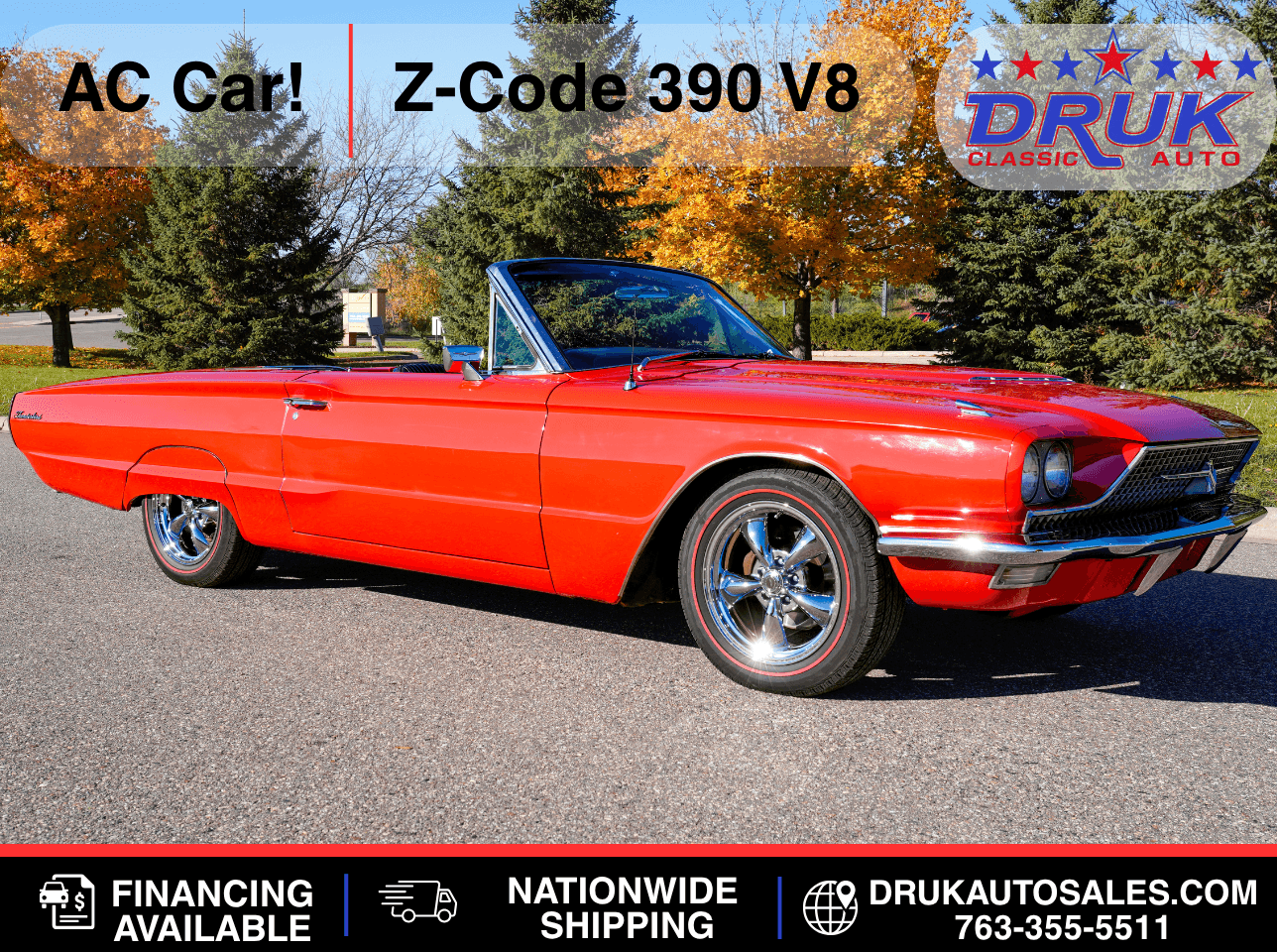
Flair Bird convertibles, 1964 to 1966. The best-selling classic convertible generation and, for a buyer who wants a four-seat open Thunderbird to use rather than to show, the default choice — 1966 is the second most numerous year in our whole convertible pool. The disappearing top continues, and two dated improvements matter on the road: front disc brakes and sequential rear turn signals both arrived for 1965, the signals flashing through three segments per side. The 1966 car is a facelift with a full-width grille, the optional 428 Q-code engine, and the lowest convertible production of the three years. A 1965 or 1966 car with the 390, working discs and a top that cycles cleanly is the sweet spot of the entire four-seat range.
The gap, 1967 to 2001 — and the conversions. Ford built no Thunderbird convertible for thirty-five years. That does not stop later convertibles from existing: coachbuilt and dealer-commissioned conversions of 1970s cars were cut by outside firms, and individual hardtops have been converted ever since. Our own pool contains the warning signs in plain sight — a 1965 car listed explicitly as a convertible conversion, and a single 1978 car, from a year when no factory convertible existed. A conversion is not automatically a bad car, but it is a different car: the roof was removed by someone other than Ford, the reinforcing (if any) is whatever the converter fitted, the top is a proprietary mechanism with no factory parts book, and the value is a fraction of a factory car's. Price and inspect it as a conversion, with paperwork for who cut it, or walk away.
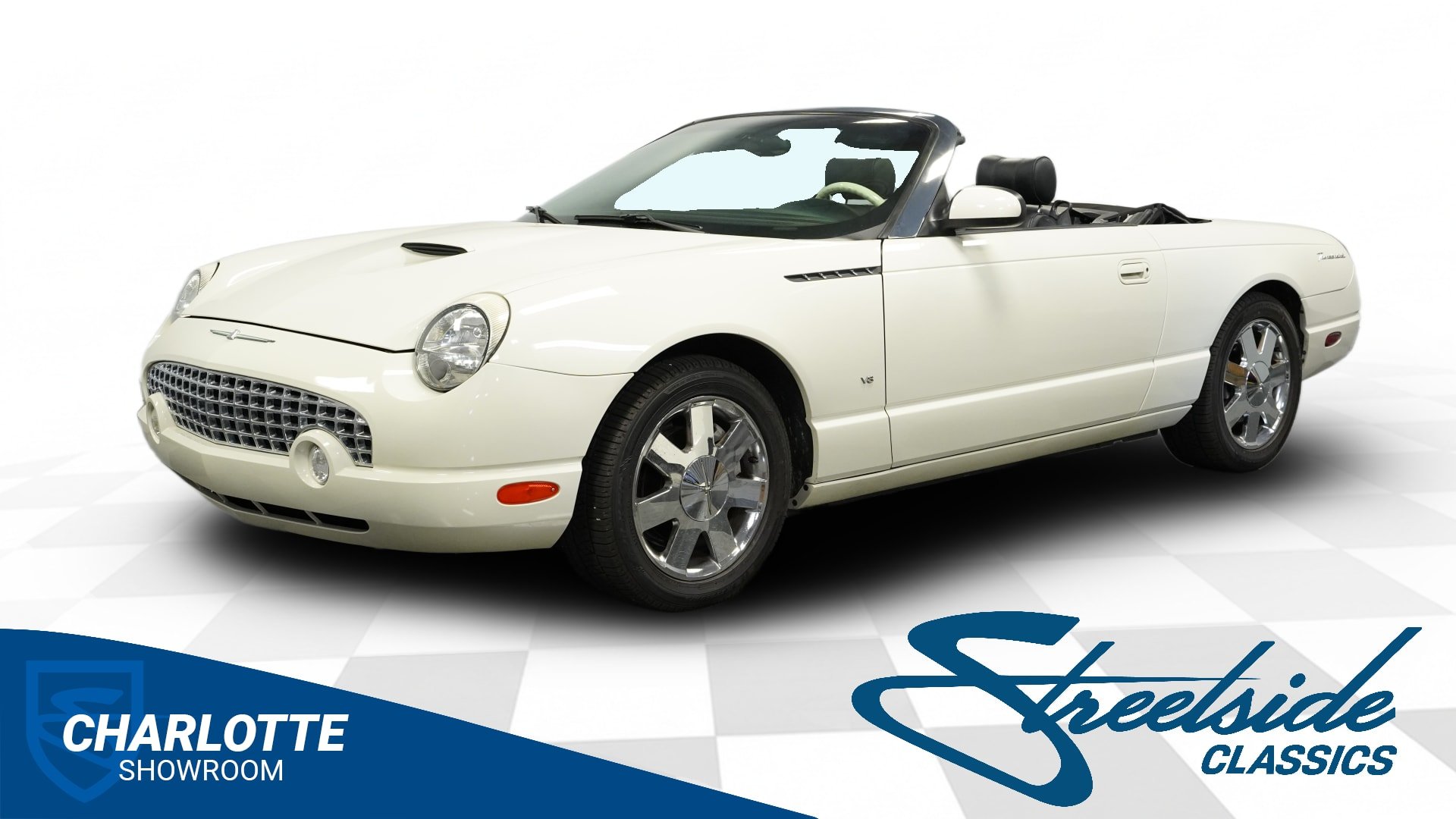
Retro Bird convertibles, 2002 to 2005. Ford returned to the 1955 formula with modern engineering: a two-seat convertible with a power soft top and a removable porthole hardtop, built on the DEW98 platform shared with the Lincoln LS and Jaguar S-Type, powered by Jaguar's 3.9-litre AJ V8 through a five-speed automatic only. Production ran to 68,262 cars across four years. The special editions — Neiman Marcus for 2002, 007 coral for 2003, Pacific Coast Roadster for 2004, Inca Gold for 2005 — differ in colour and trim, not mechanical substance. In our pool the Retro is a small presence, 4 cars against 46 Baby Birds, bought for different reasons: it starts, steers, stops and air-conditions like a modern car, because underneath the styling it is one. Its expensive failures are electronic and cooling-system failures, not rust and relays.
Engines and gearboxes
The Y-block: 292 and 312, and the E-code and F-code ladder
Every Baby Bird carries Ford's Y-block V8, named for the deep-skirted block whose side profile forms a Y. It is an overhead-valve engine introduced for 1954 to replace the flathead, with the distributor at the rear, and it has one characteristic weakness that explains most of its reputation: the rocker shafts are fed with oil through small passages in the cylinder heads, and those passages sludge shut when oil changes are skipped. A Y-block that clatters at the top end has usually been starved, not worn out in the bottom end, and the ten-minute test is to pull a rocker cover and look. Sludge, dry rocker tips and scored shafts confirm the story; external rocker-oiling kits, a common period fix that pipes oil to the shafts from outside, are not a defect in themselves but are evidence the original passages blocked — ask when and why the kit was fitted.
Two displacements matter. The 292 cubic inch (4.8-litre) engine was standard across the run: about 193 hp in 1955 form, roughly 200 hp for 1956 and 212 hp for 1957. The 312 cubic inch (5.1-litre) engine, optional from 1956, is the collector engine: about 215 to 225 hp in 1956 single-carburettor form, and for 1957 a ladder of options you must verify rather than assume, because the money follows the letter code. The D-code 312 carries a single four-barrel Holley and about 245 hp. The E-code carries two four-barrel carburettors on a dedicated intake and about 270 hp. The F-code carries a Paxton VR57 centrifugal supercharger feeding a single four-barrel inside a pressure bonnet, rated at 300 hp. F-code cars were built in very small numbers — a few hundred at most — and are the most valuable Baby Birds in existence, which is why an F-code claim is a data-plate and engine-stamping exercise and never a badge exercise: the genuine package includes specific heads, camshaft, distributor and carburettor details beyond the blower itself, and a blower bolted to an ordinary 312 makes an ordinary 312 with a blower, priced accordingly.
Judge any Y-block on four things. Oil pressure first: healthy at a hot idle and rising promptly with revs. Top-end noise second, per the oiling story above. Rear main leakage third: these engines seep with age, and a seal renewed as a service job, realistically $600 to $1,200 in a shop, is maintenance, not a rebuild verdict. Carburation fourth, because carburettor condition dominates how a Baby Bird actually drives. A single Holley four-barrel rebuilds for a few hundred dollars. E-code dual-quad matching — correct carburettors, linkage and air cleaners — is specialist work and the parts are hunted. An F-code Paxton is rebuildable by a handful of specialists at roughly $1,500 to $2,500, cheap relative to the value the correct blower protects. Cooling: the engine bay is tight and the radiator small, so a car that creeps up in traffic usually has a silted core or a tired water pump — but a car that boils has usually boiled before, so check for the staining and soft hoses that tell that story.
The FE big blocks: 352, 390 and 428, plus the 430 MEL
From 1958 to 1966 the Thunderbird convertible is a big-block car, and Ford's FE family does nearly all the work. The 352 (5.8-litre) was the standard Square Bird engine at 300 hp. The 390 (6.4-litre) arrived with the Bullet Bird and became the defining Thunderbird engine for a decade: 300 hp in standard form, and 340 hp as the rare M-code triple-carburettor engine, whose three two-barrels run on the centre carburettor alone at cruise and open progressively — wonderful when set up by someone who understands it, miserable when set up by someone who does not. The 428 Q-code, optional for 1966 only in this guide's range, gives 345 hp and a broad, quiet wave of torque that suits the heavy Flair Bird perfectly; Q-code cars carry a premium that, again, lives in the data plate and not in the badge.
FE engines are heavy, durable and understressed in Thunderbird tune, and their characteristic faults are consistent across all three displacements. Exhaust manifold cracking and broken manifold bolts top the list: a ticking on cold start that fades as the manifold expands and seals itself is the classic tell, and it matters because extracting broken studs can turn a gasket job into a heads-off job — several hundred dollars in the easy case, well into four figures when studs snap. Oil leakage from the intake end seals and the rear main is endemic and, at seep level, normal. Lifter noise after standing usually clears with use and clean oil; lifter noise that stays, on an engine with low hot oil pressure, is a wear conversation. What should stop you is narrower: blue smoke under load rather than on the overrun, a knock under load, or milky oil. Those are rebuild territory at $5,000 to $9,000 for a proper FE rebuild, and that figure belongs in the negotiation before you buy.
Alongside the FE sits one rarity. The 430 MEL engine — Mercury Edsel Lincoln — was the J-code option in 1959 and 1960 Square Birds, rated at 350 hp. It is a big, heavy Lincoln-shared engine with strong low-speed torque and parts support a clear step below the FE's. A genuine J-code convertible is a collector piece and should be bought as one, with paperwork; an ordinary buyer who wants to drive is better served by a 352 or 390 car at the same money. Confirm which engine a Square Bird actually carries, because the 430's premium is real and its badge is transferable.
Cooling and ancillaries follow the Y-block pattern, scaled up: heavy cars, air conditioning increasingly common, and no margin for a silted radiator. Air conditioning is a system to test, not a line in the advertisement — a system that blows cold for five minutes and warm thereafter has a leak, priced at $800 to $2,000 to find, fix and recharge properly.
The Retro Bird's Jaguar V8, and gearboxes across the range
The Retro convertible's 3.9-litre AJ35 is a Jaguar AJ-V8 derivative, an all-alloy double-overhead-cam engine utterly unlike the pushrod iron that precedes it. Cars for 2002 make 252 hp; from 2003 variable valve timing lifted output to 280 hp, which is why the later cars feel noticeably keener. It is the most refined Thunderbird engine and the least home-mechanic friendly. Its failure pattern is specific. Coil-on-plug failures give a single-cylinder misfire that a scanner names precisely — a set of coils and plugs is typically a few hundred dollars in parts, and a documented recent set marks a maintained car. The plastic thermostat housing and coolant outlets crack and leak with age; a replacement housing fitted runs roughly $400 to $900, and coolant loss should never be topped up and ignored, because an overheated alloy engine warps heads that a cast-iron FE would forgive. Timing-chain tensioner wear on high-mileage early engines gives a cold-start rattle that must not be dismissed as character. A Retro with full history, a quiet cold start and dry coolant housings is the most reliable car in this guide by a wide margin — and the one where a missing history costs most, because its faults are diagnosed with a scanner and fixed with modules.
Gearboxes. Most convertibles in every era are automatics, and each era's automatic has correct behaviour that sellers misdescribe in both directions. Baby Birds use the Fordomatic, a three-speed automatic that normally starts in second gear unless you select low or use full throttle — a second-gear start is correct behaviour, not slip, and a seller apologising for it does not know the car. A three-speed manual was standard and a manual with overdrive optional; manual Baby Birds exist in our pool in single numbers, with second-gear synchro wear the test on any viewing. Square Birds moved to the Cruise-O-Matic family, and the big-block cars standardised on the C6 by the end of the Flair Bird run — one of the strongest three-speed automatics ever built. A healthy C6 changes firmly, engages reverse promptly and does not flare; a rebuild is roughly $1,800 to $3,200 fitted, and documented C6 work is a selling point worth paying for, because it removes the largest single mechanical bill the car can present.
The Retro Bird is automatic only, using the 5R55N five-speed shared with the Lincoln LS and Jaguar S-Type: smooth when right, prone on neglected cars to solenoid-pack and valve-body wear showing as harsh, delayed or flaring shifts. A Retro with a documented fluid history is worth a premium over a lower-mileage car with none. On every automatic in this guide the test is identical: fluid red and clean-smelling rather than brown and burnt, engagement without delay or thump, no flare under load, a working kickdown, and no delay into reverse — delayed reverse plus burnt fluid is a rebuild negotiation, whatever the year on the title.
Problem areas
Work through this section in the order it is written, because that is the order in which convertible money disappears. Structure first: a rusty convertible is a bigger problem than a rusty hardtop, because the roof that braces a hardtop shell is absent and the floor, rockers and torque boxes do the whole job. The top mechanism second: on the 1958 to 1966 cars it is a sequential machine that can disable the trunk as well as itself. Water third, because a leaking top rots the structure the top bolts to. Electrics last, because they are the only items almost always fixable at a price you can know in advance. Our photo sample points the same way: rust noted in 15 of the 50 photo sets we examined, visible damage in 14, and no smoke or leaks visible at all.
Rust and structure: two constructions, two maps
Baby Birds: separate chassis, a body that lifts off. The two-seater sits on a ladder frame, and that changes the rust verdict fundamentally. The frame rusts at the rear kick-up over the axle, at the outriggers and at the spring hangers, but frame rust is repairable in a way unibody rust is not, and the body unbolts — a genuine frame-off restoration claim is checkable, because the body mounts, frame finish and hardware should all match the story. The body rusts where water sits: floor pans, inner and outer rockers, lower front fenders behind the wheels, the trunk floor around the spare well (worst on 1955 cars, where the spare lives inside the trunk and traps moisture against the floor), the battery tray area and the lower rear quarters. Patch panels are widely available and a floor section properly fitted is typically $500 to $1,500 a side — but count the panels before you call a car solid: a Baby Bird needing floors, both rockers, trunk floor and both quarters at once is a restoration wearing a driver's clothes. The convertible-specific extra is the top well behind the seats, a water trap listing photographs almost never show. Lift the top out of its well on every viewing.
1958 on: unibody, and the torque boxes are the car. From the Square Bird onward there is no frame to save you. The shell carries everything through its rockers, floor pans, cowl sides and, critically, the torque boxes — the boxed reinforcements where floor, rocker and front subframe rails meet, under the front footwells, with a second pair ahead of the rear wheels. Torque-box rust is the classic Bullet and Flair Bird convertible killer, worse on convertibles than on hardtops because the open shell leans on those boxes harder. It is structural, it hides under underseal and carpet, and it costs commonly $1,500 to $3,000 a side to do properly, fitted and painted — with cars frequently needing both sides plus the floor above them. Prod where the owner permits, tap and listen for the change from a ring to a thud, watch for door gaps that have closed up at the rear (a flexing shell announces itself in its gaps first), and get the car on a lift before money moves. A convertible whose doors still open cleanly with the car jacked at one corner is telling you something good; a door that sticks when lifted is telling you something expensive.
The rest of the unibody map follows water, and on convertibles the water has more ways in. Front floors rot from windshield and cowl leaks: pour a jug of water into the cowl vent and it should pour from the drains behind the front wheels, not into the footwells. The trunk floor and its drop-offs rot on convertibles in a worse place than on hardtops, because the trunk contains the folded top, and the top well and the floor beneath the mechanism collect every leak the top seals allow. Rear arches and lower quarters rot from the inside out on all years. The windshield header and the tops of the A-pillars are convertible-only rust: the header carries the top latches, and perforation there is fabrication work in a place that also has to seal. The battery tray and the apron beneath it rot on every generation. And read the underseal as evidence: factory coating is patchy and honest after sixty years, while a fresh, uniform coat of black stone-chip over rockers, torque boxes and floor seams in the week before a sale is a cover-up until the seller proves otherwise.
The top mechanisms: three systems, three tests
This is the section that separates a convertible guide from a coupe guide, because each era's top fails in its own way and each demands its own test.
Baby Bird: a folding frame and a lift-off hardtop. The soft top is a manually operated folding frame that stows in the well behind the seats. Its failures are mechanical and visible: bent bows and worn linkage make the top sit crooked, a crooked top will not meet the windshield header evenly, and a top that does not meet the header evenly will leak and whistle no matter how new its canvas is — fit matters more than fabric. Judge the canvas for rear window clouding, seam failure and shrinkage that pulls the front rail short of the header. A new soft top properly fitted runs roughly $1,200 to $2,500 depending on material. The hardtop is a separate examination: fibreglass cracking around the mounting points, porthole trim completeness on 1956 and 1957 cars, headliner condition, and weatherstrips, which are the difference between a snug winter top and a rattling, leaking one. A headliner and weatherstrip refresh is a few hundred dollars in parts. Confirm, physically, which tops the car actually has: both, soft only, or hardtop only are three different cars at three different prices.
Square, Bullet and Flair Birds: the disappearing top. This is the most complex convertible mechanism fitted to any American production car of its era, and it works as a strict sequence. Relays, limit switches, solenoids and hydraulic cylinders raise the decklid, erect or fold the top into or out of the trunk, and close the decklid over it, with locking screws pulling it down at the end. The system will not begin step three until the switches confirm step two is complete — which means diagnosis is sequential, and the failure is usually electrical logic rather than hydraulics: a relay with burnt contacts, a limit switch a fraction out of adjustment, a solenoid that works cold and fails hot, or a broken wire in the decklid harness that flexes at every cycle. Hydraulic cylinders do leak with age, announcing themselves as fluid in the trunk and a top that moves unevenly side to side.
The viewing test is non-negotiable, and it is the single most valuable paragraph in this guide. Run the full cycle — down and up — at least twice, with the engine running, and watch every stage. A top that works once and then stops has told you about a marginal relay or switch, and a seller who will only demonstrate one cycle, or who explains that the top is down for the season and cannot be raised, is selling you a non-working top at a working top's price. Budget $800 to $2,500 for a specialist to recommission a dead or unreliable system, and more if cylinders need rebuilding or the decklid harness needs remaking. Two corollaries. With the top down there is almost no luggage space, because the trunk is full of top. And a car presented with the top locked down and the mechanism disconnected should be priced as a car with no top at all until the mechanism is proven, however good the canvas looks through the rear window.
Retro Bird: a modern power top. The Retro top is a conventional modern power soft top — hydraulic pump, latching header, heated glass rear window — plus the removable porthole hardtop. Test for pump groaning, uneven movement and leaks at the cylinder rams; a set of rams or a pump is a $600 to $1,400 fitted proposition. Check the hardtop's rear deck protection: the hardtop sits on the deck paint, the protective film and pads matter, and a deck ring-marked by its own hardtop signals careless use that usually shows elsewhere too. Confirm the hardtop's storage stand and tools are with the car. On every convertible in this guide, finish the top examination by checking the floors and trunk for the water damage the top caused while its seals were old — tops get replaced, and floors keep the record.
Water, seals and the interior it ruins
A convertible is a car with a planned hole in it, and the interior pays for every seal that perishes. Work through the water paths in order. The windshield header seal leaks directly onto the front occupants' laps and, more importantly, down the A-pillars into the cowl and front floors. The side window seals leak into the doors themselves, whose drain holes block and whose bottoms then rot from inside — run a fingertip along the bottom edge of every door and feel for bubbling under the paint. The rear of the top, where it meets the deck, leaks into the top well and the trunk. On hardtop-equipped Baby Birds and Retro cars, perished hardtop seals do the same damage in winter that the soft top does in summer.
Inside, the costs hide in plain sight. Seat pads collapse — sit in the driver's seat, not the passenger's, because the driver's goes first and a collapsed pad plus a worn-through cover is a retrim conversation, not a cushion. Vinyl splits along its seams and at the entry bolster with age and sun; leather cracks the same way and costs considerably more to put right, with a professional full retrim running into five figures on any of these cars. Carpets are evidence before they are trim: damp carpets, a musty smell or water tracks in the footwells mean the seals have been leaking and the floors underneath need lifting and a prod, whatever the seller says about dry storage. Dash pads crack in the sun on 1960s cars, and a Retro car's interior faults are electronic as much as cosmetic — seat motors, switch packs and modules. The rule across all eras: a sound, original interior is the hardest thing to recreate at any price, so weight it heavily and pay for it willingly.
Electrics, vacuum and accessories: where the luxury lives and dies
The Thunderbird's selling proposition was equipment, and equipment is what ages. On the Baby Birds the charming trap is the windshield wipers, which are vacuum-operated: they sweep briskly at cruise, slow to a crawl under acceleration when manifold vacuum falls, and stop altogether on a long hill — correct period behaviour up to a point, and a genuine safety conversation on a car you intend to drive in weather, with electric conversions common and worth asking about. The 1955 car's 6-volt system: dim lights, slow cranking and a starter that sounds tired are normal 6-volt manners in a healthy car, judged on cable condition and earth points, not on comparison with a 12-volt car.
On the 1958 to 1966 cars the accessories multiply: power windows whose motors and nylon drive components crumble (the motor spins, the glass stays — a cheap part behind a door that must come apart), power seat tracks, and on 1965 and 1966 cars the sequential rear turn signals, flashing through three segments per side from a motor-driven sequencer unit in the trunk whose contacts pit and whose motor wears until the sequence stumbles, sticks or fires as a block. Solid-state replacement sequencers exist and are a legitimate, reversible fix; what you are pricing on a viewing is whether the lamps, sockets and wiring are sound, because corroded sockets turn a sequencer swap into a rewire. Test both sides, plus hazards and brakes, since the systems interact through the same lamps. Air conditioning is tested the same way: cold at idle and at cruise, or it is a leak with a story.
The general electrical rule for every pre-electronic car here is that old wiring fails at its connections, not in the middle of its wires. Dim lights, intermittent accessories and wandering gauges are earth points and corroded terminals — cheap to fix, tedious to find, and diagnostic of how the car has been kept. A convertible where everything electrical works, top included, has usually been used and maintained, which is the best single sign there is. On Retro cars the rule inverts: scan for codes, test every module-driven function, and treat multiple simultaneous complaints as a battery, earth or charging problem before treating them as multiple failed modules, because a weak battery manufactures faults on a modern car as surely as a corroded earth does on a 1957.
How to inspect one
Allow at least an hour, and arrange the viewing so the top can be cycled and the car can be driven — a convertible inspected statically, top up, in a dark garage has not been inspected. Bring a torch, a magnet wrapped in cloth and a screwdriver for prodding where the seller permits. If the car passes you, pay for a lift inspection before money changes hands; on a unibody convertible it is the best money in the whole purchase.
- Start with the paperwork and the data plate. Match the title VIN to the car's stampings and the data plate, and decode the plate's engine and body codes before anything else. On a 1957 car the engine letter is the money: D, E and F code cars are worth multiples of a single-carburettor car, and the plate, not the air cleaners, settles which one you are looking at. On a 1962 or 1963 Sports Roadster, confirm the body designation is the genuine roadster code — a tonneau and wire wheels bolt onto any convertible. On any post-1966 convertible, ask who converted it; there is no factory code to find, because Ford built none.
- Cold start. Insist the engine is cold when you arrive. Watch for blue smoke on start-up (valve seals, forgivable) against smoke that continues under load (rings, not forgivable), and listen at the top end of a Y-block for the rocker clatter that means the oil passages in the engines section have sludged shut.
- Cycle the top — twice. This is the convertible step, and it outranks everything mechanical. Run the full cycle down and up at least twice with the engine running. On a 1958 to 1966 car, watch each stage — decklid up, top moving evenly on both sides, decklid down and locked — and treat a stall, one-sided movement or a second-cycle failure as a priced repair, using the recommissioning range from the problem areas section. On a Baby Bird, raise and lower the soft top by hand and feel for bent bows and a front rail that will not meet the header evenly. On a Retro, listen for pump groaning.
- Under the car. Torch along both rockers, prod the torque boxes on any 1958 or later car, and check the floor seams, front subframe rails and the area under the top well. Perforation in torque boxes or rockers is structural. Read the underseal as you go: patchy and honest is factory, a fresh uniform black coat over everything is a question. On a Baby Bird, check the frame kick-up, outriggers and spring hangers — surface rust there is a negotiation, not a verdict.
- The door-gap flex test. With the car on its wheels, open and close both doors and note the effort and the gaps. Then have the car jacked at one front corner, as your lift inspection will do anyway, and try the doors again. A sound shell shrugs; a weak one binds its doors. This test, plus the torque-box prod in step 4, settles the structure of a unibody convertible better than any photograph.
- Trunk and top well. On a disappearing-top car, examine the trunk with the top up (the only time there is room to see): look for hydraulic fluid, water staining, rust in the floor and drop-offs, and the relay and switch hardware for the top, which lives here. On a Baby Bird, lift the soft top out of its well and inspect the well and the panel behind the seats. On every car, lift the spare and the mats.
- Floors inside. Lift the carpets in all footwells. Look for water tracks from the cowl and windshield header, prod the pans, and pour water into the cowl vent if the seller permits — it should exit behind the front wheels, not into the footwell. Wet carpets in a dry-stored car mean leaking seals and rust already started.
- Body and gaps. Run the magnet over the rockers, arches, lower doors and rear quarters — filler announces itself. Check door bottoms for bubbling, the windshield header for perforation around the top latches, the battery tray for acid damage, and count the pitted chrome pieces, because on a Square or Bullet Bird the chrome bill is a real number.
- The test drive. Fifteen minutes minimum, top down for at least part of it so you can hear the car. The automatic should engage without delay, change firmly and take reverse promptly — and remember a Fordomatic's second-gear start is correct, not slip. A V8 should pull cleanly without hesitation; brake hard from speed and expect a straight stop, remembering front discs only arrive for 1965, so an earlier car on drums should be judged as a drum car that pulls up evenly, not as a defective disc car. Top down at speed, listen for the wind noise that tells you how the seals really fit.
- Electrics and accessories, every one. Work every window, the seat, the lights, the washers and the horn. On a 1965 or 1966 car, test the sequential signals on both sides plus hazards and brakes. On a Baby Bird, drive the wipers under load and watch them slow — vacuum wipers are period behaviour, but know what you are accepting. Run the air conditioning at idle and at cruise; five minutes of cold followed by warm is a leak. On a Retro, scan for codes and test every switch and module function.
- Heat and idle. Let the car idle hot after the drive. Watch temperature stability — a car that creeps up at idle has the silted radiator or tired pump from the engines section — and oil pressure behaviour, and check the automatic's fluid colour and smell while the car is warm.
- Interior and tops last, priced properly. Sit in every seat and feel for collapsed pads. Confirm exactly which tops the car carries — soft top, hardtop, or both — and that any hardtop is present, uncracked around its mounts and complete with its trim and, on a Retro, its stand and tools. A sound original interior and two good tops are the hardest things to recreate, so weight them as heavily as the structure.
Values
The build appends the current market figures for these cars — what is listed now and what has actually been recorded as sold — directly beneath this guide, refreshed at every build, and those figures are the ones to trade on. This section teaches you how to read them, because on Thunderbird convertibles the spread inside any single model line is wider than the spread between model lines, and a headline number for a year is nearly meaningless until you know which car, with which engine code, which tops and what structure, is being compared.
Condition is the first driver, and on convertibles condition means structure before shine. A Flair Bird with sound torque boxes, tired paint and a top that cycles cleanly is worth more, to anyone who has owned one, than a gleaming car with soft boxes and a top that performs once — but listings photograph the shine and not the boxes, which is why asking prices cluster optimistically and the gap between asking and achieved prices on the 1960s convertibles is consistently wide. Sellers price the car they see; the market pays for the car underneath. Negotiate hardest on exactly the items this guide prices for you: torque boxes, top recommissioning, chrome and interiors.
Engine codes are the second driver, and they operate as steps, not slopes. Within the 1957 cars, a verified E-code stands a clear step above a D-code, and a verified F-code stands in a different market altogether — thin, collector-driven, and moved by individual exceptional cars rather than by any trend you can read off a median. The same step logic applies to a genuine Sports Roadster over a standard Bullet Bird convertible, and to a 1966 Q-code 428 car over a 390 car. In each case the premium attaches to the verified code and evaporates without it, so the data-plate step of the inspection is the most valuable step in this guide.
Tops are the third driver, and the one most often miscounted. A Baby Bird or Retro car with both tops, both in good order, is a different proposition from the same car with one, and listings do not always say which you are being offered. A disappearing-top car whose mechanism has been recommissioned by a known specialist, with the invoice to prove it, carries a genuine premium over an identical car whose top merely worked on the day — because the second car's mechanism is an unknown with a known price range. Conversely, the project end of the market is dominated by cars whose tops do not work and whose sellers have priced them as though they do; the honest project, priced as a project, is where the value consistently hides.
Finally, the eras price differently. Baby Birds are the deepest, most liquid market here — our pool is nearly two thirds two-seaters — priced by a large, knowledgeable buyer base that punishes wrong engines and rewards originality. The four-seat convertibles trade in a thinner, more condition-sensitive market where the right car takes patience to find and the wrong one takes longer to sell. Retro cars price like modern used cars with a collector floor forming under the best colours and editions: mileage, service history and module health move them more than originality does. In all three eras the rule is the same — there is no cheap Thunderbird convertible that stays cheap, because the difference between the cheap car and the good one is a list of jobs with prices, and this guide has given you the list.
Parts and ownership
Easy: service items for every pushrod engine in the guide — filters, plugs, ignition components, belts and hoses — plus brake components (with the 1965 disc changeover respected when ordering), suspension wear parts, exhaust systems, Y-block and FE gaskets and seals, glass rubbers and weatherstrips, soft-top canvas in standard colours, and the electrical consumables that fix most period electrical complaints. The FE's ubiquity across Ford's range is the owner's friend: a 390 Thunderbird shares its mechanical world with Galaxies and Ford trucks, and parts pricing reflects it.
Harder and dearer: disappearing-top relays, limit switches and solenoids (serviceable and rebuildable, but specialist-supplied, and the knowledge to sequence the system is scarcer than the parts), top hydraulic cylinders, Sports Roadster tonneau hardware and correct wire wheels, E-code dual-quad carburettors and linkage, F-code Paxton components and the engine internals that make a supercharged car correct, 430 MEL engine parts across the board, torque-box and floor panels fitted properly (the panels are available; the labour is the price), full chrome sets in show condition, and Retro Bird electronic modules and plastic coolant housings — available, but at modern Jaguar-adjacent prices rather than classic Ford ones. A quality repaint on a big unibody convertible starts in five figures, which is why the mantra of this guide is to buy the structure and the interior, and fix the mechanics.
Running costs. Budget the first year honestly. Catching up deferred maintenance on a running convertible — fluids, brakes, hoses, seals, a top service and the electrical tidying every old car needs — realistically runs $2,000 to $5,000 before you improve anything, and recommissioning a car that has sat for years, with the fuel system cleaned end to end against modern ethanol fuel, every brake component inspected and the top mechanism brought back stage by stage, runs $4,000 to $8,000 at a shop. A sorted car thereafter is a realistic regular-use classic: fuel consumption in the low-to-mid teens for the big-block cars, rather better for a Retro, servicing any good independent can handle on the pushrod cars, and insurance in line with other classics of similar value. Two habits pay out of proportion to their cost. Cycle a disappearing top regularly even in storage — switches, relays and seals stay honest when used, and most dead tops died of disuse, not wear. And store any convertible with its seals clean and its top well dry, because the structure you are protecting is the one the water reaches first.
Which one to buy
- The all-rounder: 1965–1966 Flair Bird convertible, 390. Disc brakes, sequential signals, the deepest parts support of any convertible in this guide and a top mechanism every Thunderbird specialist knows. If you want one classic Thunderbird convertible to drive and enjoy, this is it.
- The icon: 1956–1957 Baby Bird. The car the name means. Buy a 1956 or 1957 over a 1955 for the 12-volt system, the portholes and the 312, verify the engine code on the plate, and pay for structure and tops before paint. A D-code car honestly bought beats an E-code story every time.
- The value buy: 1961–1963 standard convertible. The Bullet Bird without the Sports Roadster premium is the same 390, the same disappearing top and the same fine interior for substantially less money — and it keeps its rear seat, which the tonneau car gives up for its looks.
- The showpiece: 1957 E-code or F-code. Bought as a collector car, with the code verified, the correct induction hardware present and the paperwork in order. The F-code is a documentation purchase that happens to include a car.
- The modern classic: 2003–2005 Retro Bird. The later cars, with the stronger engine, a full service history, a quiet cold start and both tops with their stand and tools. The only Thunderbird convertible you can buy with modern-car expectations — and the only one whose inspection starts with a scanner.
- The brave buy: a Square Bird with a dead top, priced as one. The mechanism is recommissionable at a knowable price and the 1958 car is genuinely rare — but only if the structure passes step 4 and the price reflects the top work. Priced as a working car, it is not brave, just expensive.
And the rule that overrides all of the above: buy the convertible whose structure is sound and whose top works, in the era you can live with. Engines, gearboxes, brakes and sequencers are all fixable at prices you can plan for. A rotten torque box costs more to put right than the finished car will be worth, and a top mechanism bought on a promise is a bill bought on the same terms — the two systems that define these cars are the two to verify before anything else charms you.