
Ford Ranchero buyer's guide
Ford Ranchero -- the model's own buyer's guide: variants, values and what to check.
Years listed: 1961-1974 · Series: Torino
Overview and history
The Ford Ranchero invented a category and then spent twenty-three years proving how many different cars could wear the same idea. It is a pickup built from a car — a two-door passenger-car front end, a car dashboard, car seats and car ride, with an open steel load bed where the rear seat and trunk would have been. Ford launched it for 1957, two years before Chevrolet answered with the El Camino, and built it continuously through 1979. Across that run the Ranchero was, in turn, a full-size Fairlane, a compact Falcon, a mid-size Fairlane and Torino, and finally a LTD II — which means there is no single Ranchero to buy. There are at least six distinct vehicles sharing one name and one brilliant compromise, and the first job in buying one is knowing which of them you are looking at.
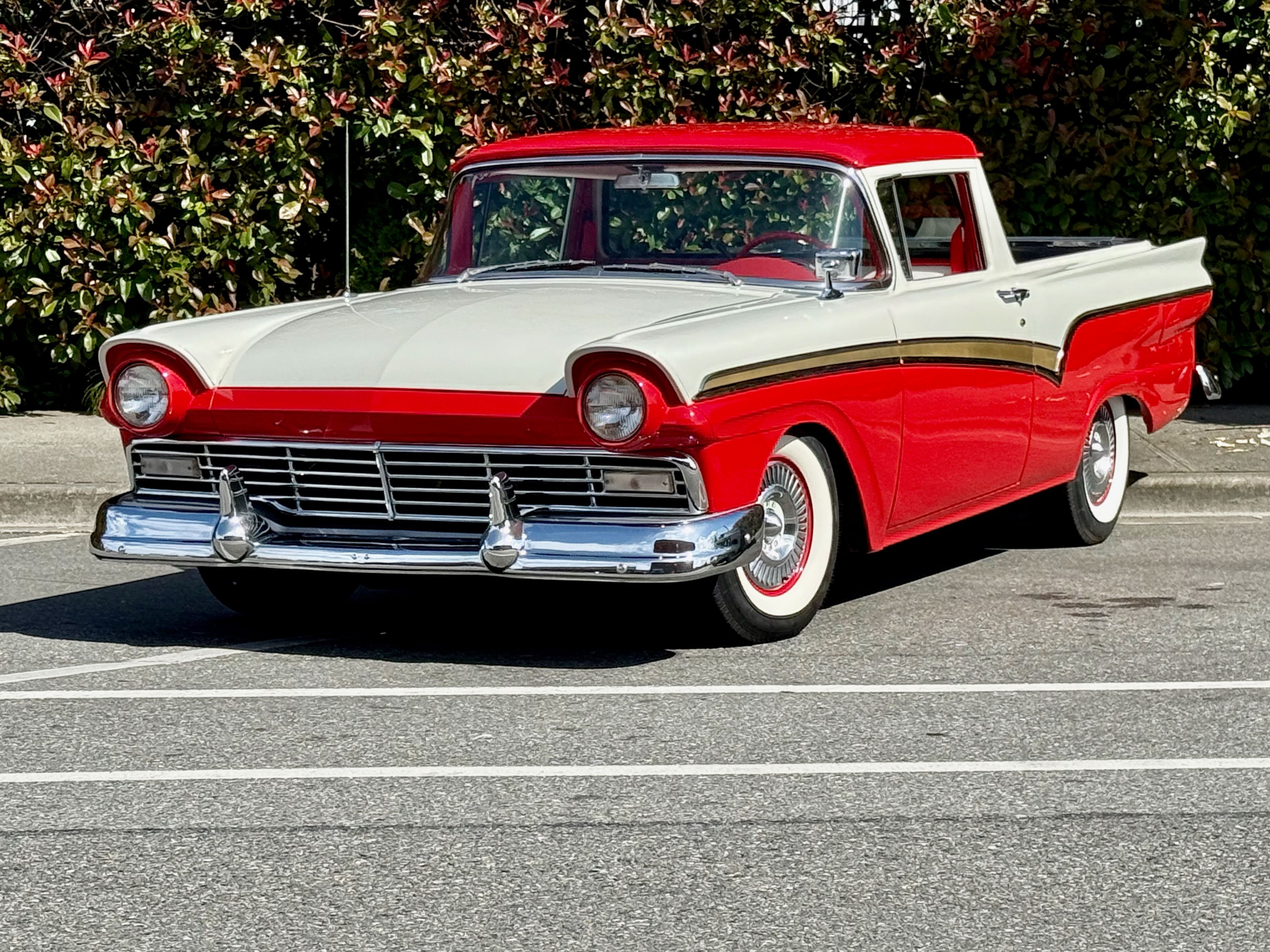
The original 1957 car was based on Ford's full-size two-door Ranch Wagon and Custom sedan platform. It looked like a 1957 Ford with the back of the roof cut away, because that is essentially what it was: the bed was integrated into the body, the tailgate opened flat, and the spare lived behind the seat. It sold to farmers who wanted a car on Sunday and a truck on Monday, and to tradesmen who carried tools rather than gravel. Ford offered it as the plain Ranchero and the better-trimmed Ranchero Custom, and kept it through the full-size restyles of 1958 and 1959 — the 1959 car, longer and lower, is the most flamboyant of the early cars.
Then Ford changed the formula completely. For 1960 the Ranchero shrank onto the new compact Falcon platform: a light, simple, genuinely useful little truck that sipped fuel through a small six, carried half a ton in a six-foot bed and cost very little to run. That Falcon Ranchero, built through 1965 with a restyle for 1964, is in many ways the purest expression of the idea — no pretension, no wasted weight, just a car that happens to have a bed — and the compact years are among the best-selling in the nameplate's life.
For 1966 Ford moved the Ranchero up a size again, onto the intermediate Fairlane platform — though the 1966 car kept Falcon-style front sheetmetal, a one-year hybrid that confuses buyers to this day — and from 1967 it was a true Fairlane Ranchero, with V8s back in force. The Torino-based cars of 1968 to 1971 added muscle-car engines and trim: GTs with stripes and bucket seats, and, at the top, big-block cars including the 428 Cobra Jet. The 1972 redesign made the Ranchero bigger, heavier and more formal, on a separate frame for the first time in the nameplate's history, and the final generation of 1977 to 1979 was based on the LTD II: still large, still V8-powered, still unmistakably a Ranchero.
Production ended after 1979. Buyers who wanted a small truck were turning to proper compact pickups, and buyers who wanted a big truck bought an F-Series; the car-pickup died of specialisation, not failure. What it left behind is one of the most usable classics you can own: a Ranchero drives, parks and insures like the car it is based on, and on the way home it will carry an engine block or a set of wheels without borrowing a truck. That dual life is also its buying trap. Rancheros worked — they hauled, they were overloaded, they sat outside — and the bed that makes them useful is where water collects and rust starts. The mechanicals are ordinary Ford, tough and cheap to fix by classic standards. The body, especially where the bed meets the cab, is what you are really buying.
A note on identity: because the Ranchero shared everything ahead of the bed with high-volume Ford cars, parts interchange is superb and fakery is easy — engines get swapped, GT badges added, Squire panels fitted to plain cars. None of that matters on a driver bought at driver money. On a big-block GT bought at collector money it matters a great deal, which is why this guide returns to the data plate, the VIN and the casting numbers again and again: on a Ranchero those stamps are the difference between a story and a car.
The models
Every Ranchero is a two-door with an integrated open bed, but almost everything else changed across the generations: size, construction, engines and character. Buy by generation first and trim second. A mint Falcon Ranchero and a mint Torino GT share nothing except the concept, the badge and the kind of owner who smiles at both.
| Model | Years | Engine | Output | Built | Character |
|---|---|---|---|---|---|
| Ranchero / Custom (full-size) | 1957–1959 | 223 six, 272/292/312 Y-block V8, 352 FE (1958–59) | 144–300 hp | about 21,700 in 1957; smaller numbers after | The original; full-size style, real presence |
| Falcon Ranchero | 1960–1965 | 144/170/200 six, 260/289 V8 (1963–65) | 85–271 hp | high volume; the compact best-seller years | Light, simple, economical; the purest Ranchero |
| Fairlane Ranchero | 1966–1967 | 200 six, 289/390 V8 | 120–320 hp | mid-size volume | The bridge car; 1966 wears Falcon-like front panels |
| Torino Ranchero 500 / GT / Squire | 1968–1971 | 200/250 six, 302/351/390/428 V8 | 115–335 hp | tens of thousands | Muscle-era cars; GT and Cobra Jet are the prizes |
| Torino Ranchero 500 / GT / Squire | 1972–1976 | 250 six, 302/351/400/460 V8 | 95–202 hp net | large and heavy years | Frame car; comfort over speed, smog-era power |
| LTD II Ranchero 500 / GT / Squire | 1977–1979 | 302/351/400 V8 | 130–169 hp net | final three years | The last of the line; big, soft, collectible by scarcity of survivors |
(Outputs are period gross figures for the earlier cars and net figures where Ford rated them that way in the 1970s; treat any single horsepower number on a fifty-year-old Ford as a guide to where the engine sat in the range, not a promise about the car in front of you, most of which have been rebuilt or swapped.)
The full-size cars, 1957–1959. The 1957 Ranchero and Ranchero Custom are the collectors' early cars: one-year styling, six or Y-block V8 power, and a bed long enough for real work. The 1958 restyle added quad headlights and a heavier look; the 1959 car is the longest and lowest of the three. All three are body-on-frame cars, which matters at inspection: a rusty frame is serious, but separable, unlike the structural rust of the unibody generations that followed. Trim and brightwork for these cars is the hardest in the whole Ranchero story to replace, so completeness counts for more than mechanical condition.
The Falcon cars, 1960–1965. The compact Ranchero is a Falcon with a bed: unibody construction, leaf springs at the back, small sixes, and the 260 then 289 V8 from 1963 turning it into a surprisingly quick little truck. The 1960–1963 cars have rounded early Falcon styling; the 1964–1965 cars are squarer and sharper, with the stronger 200 six and the 289. These are the cheapest Rancheros to run, the easiest to work on and the most honest — nobody bought one to pose in. That also means most were used up, and a solid, unmodified Falcon Ranchero is scarcer than production numbers suggest.

The Fairlane cars, 1966–1967. The step up to the intermediate platform gave the Ranchero real size again: longer bed, roomier cab and the full Fairlane engine range up to the 390 big-block. The 1966 car is the odd one — Fairlane underneath, front styling closely related to the Falcon it replaced, a one-year body that makes some trim and panel parts uniquely awkward. The 1967 is a clean Fairlane, stacked headlights and all, and the easier car to live with. Both are unibody cars with a reputation for torque-box and floor rust you ignore at your peril.
The Torino cars, 1968–1971. This is the muscle generation. The range ran from the plain Ranchero and the better-trimmed Ranchero 500 through the woodgrained Ranchero Squire — fake wood panels down the sides, in the great American station-wagon tradition — to the Ranchero GT, with stripes, styled wheels, bucket seats and the strong engines. For 1970 and 1971 the body was restyled longer and sleeker. The engine list is the Torino list, ending at the 428 Cobra Jet for 1968–1969 and the 429 for 1970–1971, and a genuine factory big-block GT is a serious collector car. The faking incentive is highest here: check the VIN's engine code against the engine fitted, every time, and treat a big-block claim without paperwork as a small-block car with a story.
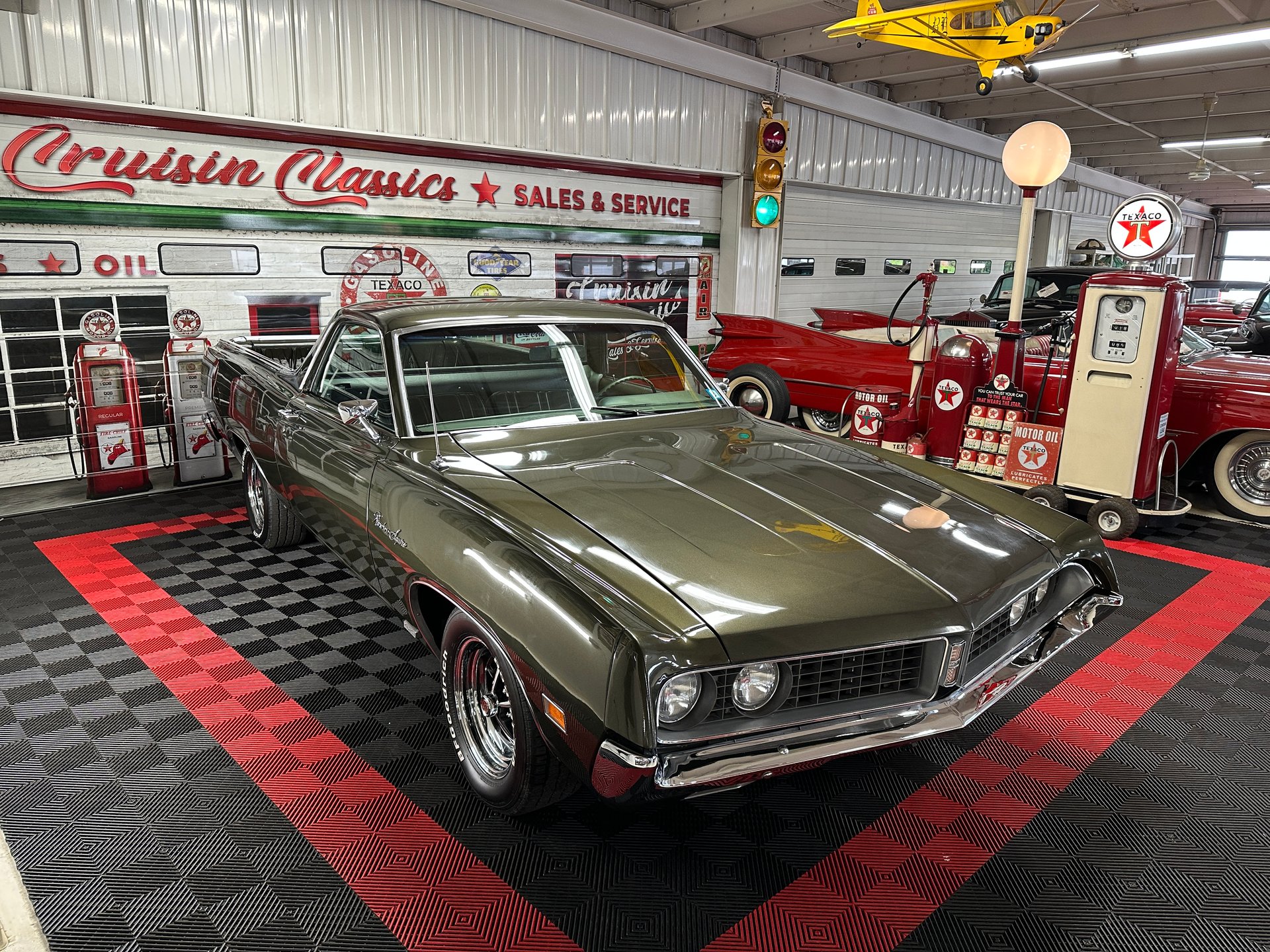
The big Torino cars, 1972–1976. The 1972 redesign put the Ranchero on a perimeter frame with a longer wheelbase, a formal front end and considerably more weight. These are comfortable, quiet, torquey load-carriers, and the smog-era engines — low compression, retarded timing, early emissions equipment — make them cruisers rather than muscle cars, whatever GT badges they wear. The 1973 cars gained the heavy mandated front bumper; styling was freshened for 1974. A good one is lovely over distance. A bad one is a very large amount of rusty car.
The LTD II cars, 1977–1979. The final Rancheros were based on the LTD II, itself a reworked Torino platform. Engines were the 302, 351 and 400 V8s — no six — all in low-compression emissions tune, and the GT survived as a trim and handling package rather than a performance car. These are the rarest Rancheros as survivors, because for years they were worth so little that nobody preserved them; a clean, original GT or Squire now draws attention out of proportion to its pace.

Engines and gearboxes
The sixes: Mileage Maker, Thriftpower and the big-car sixes
The Ranchero story starts, at the bottom of every range, with a Ford inline six — and the sixes deserve more respect than the market gives them, because they are the engines most original buyers chose and the ones that suit the car's working character best.
The 1957–1959 cars used the 223 cubic inch Mileage Maker six, an overhead-valve design making about 144 hp, alongside the V8s. It is a simple, torquey, understressed engine whose main enemies are neglect: sludge from missed oil changes, a worn timing chain that lets ignition timing wander, and overheating from a silted radiator. Parts are available but it is no longer a mainstream rebuild, so a tired 223 is a bigger bill than a tired small-block V8.
The Falcon cars used the Thriftpower six in 144, 170 and, from 1964, 200 cubic inch forms — light, simple engines with an integral intake manifold cast into the head, which is the design fact that shapes everything about them. You cannot simply bolt on a bigger carburettor, because the manifold is part of the head casting, fed through a small log-shaped plenum; the single-barrel Autolite or Carter carburettor sits on top and the end cylinders always run a little differently from the middle ones. Tuning a Falcon six is therefore about condition, not modification: correct valve clearances (a quiet top end on a car not adjusted in years usually means the clearances have closed up, not that all is well), a carburettor not worn oval at the throttle shaft, and timing set with the vacuum advance actually working. A failed vacuum advance diaphragm is the classic Falcon-six flat spot — the car pulls away acceptably, hesitates in the mid-range and feels strangled, and owners blame the carburettor. The test is a hand vacuum pump on the advance can: it must move the plate and hold vacuum. A can that will not hold is a cheap part and a transformed car.
The 200 six, standard in later Falcon cars and the Fairlane and early Torino Rancheros (joined there by the 250, a taller-deck development), is the pick of the sixes: seven main bearings in later form, real torque for a compact, the best parts support. The 250 continued into the big 1972–1976 cars, where it has to move a great deal of Ford and feels it, though the engine itself remains willing and durable. On any Ford six, listen for a deep knock under load (main bearings), check for oil weeping from the rear main seal, and look at the exhaust manifold for cracks around the centre ports; a ticking that fades as the engine warms is often a manifold crack or blown gasket rather than a lifter, and the soot mark at the joint tells you which.
The small-block V8s: Y-block, Windsor and Cleveland
The 1957 cars offered the Y-block V8 in 272, 292 and 312 cubic inch forms — a deep-skirted, heavy, characterful engine; the 312 with a four-barrel carburettor made up to 245 hp, and the supercharged and dual-quad versions offered in 1957 passenger cars are rarely seen in Rancheros, so treat any such claim as a conversion until paperwork proves otherwise. Y-block ownership is defined by its top-end oiling and its rear main seal. Oil reaches the rocker shafts through passages that sludge up, starving the rockers; a noisy, dry-looking top end with external bypass oil tubes fitted is telling you its history honestly, because those tubes were the period fix. Lift the valve covers on any Y-block you are serious about and look for oil actually present at the rockers. A rebuild is specialist work — budget in the region of $4,500–7,500 for a proper job — which is why so many early Rancheros now run later engines, and why an original, healthy 312 car deserves its premium.
The engine that defines the middle Ranchero years is the Windsor small-block: the 260 and 289 in Falcon and Fairlane cars, then the 302 from 1968 and the 351 Windsor from 1969. It is one of the best-supported classic V8s in existence — every part available, every machine shop fluent, a full rebuild ordinary money at roughly $3,500–6,000. The checks are generic but decisive. Cold-start rattle lasting more than a second suggests timing-chain stretch, which also shows as wandering ignition timing on a timing light, the mark jittering instead of sitting steady. Blue smoke on start-up that clears is valve stem seals; blue smoke under load is rings and bore wear. Persistent coolant loss with no visible leak, or a milky emulsion under the filler cap on a car that does proper journeys (short trips produce harmless condensation — the distinction is whether it clears after a long hot run), points to head gaskets or, on hard-overheated engines, cracked heads. The 271 hp high-performance 289 was offered in the mid-sixties cars and is genuinely rare in a Ranchero; the VIN engine code and the specific components — solid-lifter cam behaviour, correct carburettor, manifolds and distributor — all have to agree before you pay high-performance money.
The 351 Cleveland, offered in the Torino cars from 1970, is a different small-block family entirely: canted-valve heads, big ports, in two- and four-barrel forms, the four-barrels strong performers. Clevelands are fussier about cooling-system condition, and their oiling makes sustained high rpm on a worn engine unwise. The test that matters is oil pressure hot at idle, read on a mechanical gauge if the dash gauge looks lazy, plus a cooling system that holds pressure. From the mid-seventies the 351M (Modified) replaced the Cleveland in the big cars: a tall-deck engine related to the 400, durable but soft in emissions tune, famous for cracked exhaust manifolds and factory-retarded timing sets; a replacement set installed straight-up is the first thing most owners do, so ask.
The big-blocks: FE and the 385 series
The 352 FE arrived in the full-size Ranchero for 1958, and the FE family — 352, 390 and 428 — powered the heavy end of the range through 1969. The FE is a big, deep-skirted, torque-first engine. The 390, offered in the Fairlane and Torino Rancheros, is the common one and the sweet spot: strong, durable, well supported, and happy on modern fuel at its period compression if the ignition is set sensibly. The 428 Cobra Jet of 1968–1969 is the legend: underrated at 335 hp, with Ram Air induction on some cars, turning a Ranchero GT into a straight-line machine that still has a bed. It is also the most faked engine in the Ranchero world. A genuine Cobra Jet car is identified by the VIN engine code first — the fifth-position letter must be the Cobra Jet code for that year — then by casting numbers and date codes, the correct heads and the heavy-duty chassis equipment that came with it. An FE is identified by casting numbers on the block (displacement is not reliably cast where you can read it in the car, which is exactly why fakery flourishes), so on a claimed 428, budget for verification before money moves, not after.
FE failure modes are well known. Exhaust manifold bolts snap — the manifolds expand and contract against the heads for fifty years and the bolts corrode in place — so a blowing manifold gasket is frequently a broken-stud extraction job, and a quote for the gasket alone is optimism; $600–1,400 for manifold work with stud extraction is realistic. Oil leaks from the rear of the intake manifold and the valve covers are endemic and mostly harmless. A pushrod or lifter problem can present as a single-cylinder misfire that moves with nothing you swap; a compression test and a leak-down test sort it.
For 1970 the 429, from the 385 series, took over as the top Torino Ranchero engine, in standard and Cobra Jet forms, and the 460 served the 1972–1976 cars alongside the 400. The 385-series engines are enormously strong in the bottom end, make torque everywhere, and drink accordingly. In smog tune the 460 makes unremarkable power for its size, but utterly unstressed, and these are among the longest-lived engines in the guide if the oil has been changed. Watch for a worn timing set (the nylon-toothed cam sprocket of the era sheds teeth into the sump — with no record of a timing set, price one in at roughly $500–900 fitted), exhaust manifolds cracked between the centre ports, and a cooling system coping with a very large engine plus air conditioning.
Gearboxes
Most Rancheros are automatics, and Ford's automatics are among the car's strong points — provided you know which one you have, because four families are in play and their characters and rebuild costs differ.
The early cars used the two-speed Fordomatic and then the three-speed Cruise-O-Matic. The manual option across almost the whole run was a three-speed column-shift, with a four-speed — Ford's own Toploader, one of the strongest manual gearboxes ever fitted to an American car — available on V8 Falcon, Fairlane and Torino cars. A Toploader car is worth a premium and is identified by the gearbox itself, not by a knob with four speeds marked on it: clones exist. Judge any manual on second-gear synchromesh (first to wear, tested on a brisk up-change and a down-change into second), on clutch judder pulling away, and on whether a three-speed column shift is merely vague — worn linkage bushes, cheap — or jumping out of gear under load, which is internal wear and a rebuild.
The C4, fitted to sixes and small-blocks from 1964 onward, is a light, simple three-speed automatic, cheap to rebuild (roughly $1,200–2,200) and tolerant of age. The C6, fitted behind big-blocks, is one of the strongest automatics Ford ever made; a C6 that shifts cleanly, with fluid red and sweet-smelling, will usually outlive the car, and a rebuild runs roughly $1,800–3,000. Between them sits the FMX, the cast-iron-case Cruise-O-Matic development fitted to many intermediate cars — durable but heavier and less loved by rebuilders, so confirm a local shop will take one on before buying an FMX car with a fault. The universal tests are the same for all: fluid dark brown and burnt-smelling means the box has been hot and the clutches are worn, whatever the seller says about a recent service; engagement of drive and reverse should take a second or less without a thump (a delay followed by a bang is low pressure or worn seals, and it gets worse); changes under load should be firm, with no flare — a rise in revs between ratios — on the 2–3 change, the classic first sign of a tired box. Kickdown matters too: a disconnected kickdown linkage makes a healthy box feel gutless, and it is an adjustment, not a rebuild, so test full-throttle behaviour before condemning anything.
One driveline note for every generation: the rear axle is a leaf-sprung live axle — the Ford 8-inch in most small-block and six cars, the 9-inch behind big-blocks. The 9-inch centre section unbolts from the front of the housing, making ratio changes easy — and meaning the axle fitted may not be the one it left with, so on a collector car check the axle tag. A whine that changes on and off the throttle is axle wear; a clunk on taking up drive is usually universal joints or pinion backlash, and joints are cheap.
Problem areas
Start with what our own photo evidence can and cannot say. We photo-checked 10 of the Rancheros in our current pool in detail: rust was noted in 1 of those 10 cars and visible damage in 3 of the 10, with no smoke or leak mentions recorded. Do not read that as a clean bill of health. Ten cars is a small sample of dealer-presented cars photographed to sell, and the places Rancheros rust worst — under the bed mat, inside the rear quarters, in the torque boxes — are exactly the places listing photographs avoid. The sample is too small and too flattering to price rust risk from, so this section is built from the model's known failure map, and your inspection has to supply the evidence car by car. Assume the structure needs a forensic examination, and be pleasantly surprised when a car passes.
Rust and structure: the map
Rust on a Ranchero follows the water and the load, and the load bed is where both meet. Work through it in this order.
The bed floor and the bed-to-cab joint. The single most important Ranchero check, with no equivalent on the cars it is based on. The bed is steel, it sits outside, and for decades it held water under load mats, toolboxes, camper shells and cargo. Water also runs down the back of the cab and collects at the joint where the bed floor meets the cab, behind and below the seat, in a seam most sellers never photograph. Lift everything out of the bed — everything, including the mat and the spare — and prod the floor, especially the front corners and the seams over the rear wheels. Surface rust with a sound ring when you tap it is a clean-and-protect job. Perforation is a panel job, and bed floor sections are not available for every year, so a holed bed can mean fabrication: budget $1,500–4,000 for proper metalwork and paint where sections must be made, and treat a bed hidden under a spray-in liner or plywood as an unknown priced as a fault until you have seen under it. On the unibody generations — Falcon, Fairlane and Torino through 1971 — the bed is part of the structure, and rust starting in the bed floor spreads into the rear quarters, inner wheelhouses and the rear subframe rails that carry the leaf-spring mounts. That is the propagation path that kills these cars.

Rear quarters, wheelhouses and tailgate. The lower rear quarters rust from the inside out, fed by water and mud thrown up behind the rear wheels and by blocked drains in the quarter wells. Press hard along the bottom edge behind each wheel and look for paint bubbling, filler edges and a dull sound under a cloth-wrapped magnet. The tailgate rusts along its bottom edge and around the handle and hinges, and because it is a Ranchero-specific panel — no sedan or wagon shares it — a rotten one is a hunt for a good used panel rather than a catalogue order. Check that it opens, closes and latches squarely; a tailgate that must be lifted or slammed to latch is telling you the bed sides or hinge mounts have moved or rotted. On Squire models, add the woodgrain applique: the panels trap moisture against the steel, and the metal under a lifting or bubbled panel is usually worse than the panel suggests.
Floors, torque boxes and front structure on the unibody cars. The Falcon, Fairlane and 1968–1971 Torino Rancheros are unibody cars, and their structural map is the Mustang and Falcon map the Ford world knows well. The front torque boxes — where the front subframe rails meet the sills, under the front footwells — take road spray, trap mud and rot, and they carry suspension and steering loads, so perforation there is structural, not cosmetic. Floor pans rust from inside, fed by leaking windshield seals, a leaking heater core or plenum, and wet carpets that never dried; lift the carpets in both footwells and prod, because a work Ranchero's vinyl floor covering hides a great deal. The cowl is the third trap: leaves collect in the plenum below the windshield, hold moisture against the cowl panels, and the first symptom is water dripping onto the front floor in rain — by which time the cowl metal is holed and the repair is a dashboard-out fabrication job. The test is in the inspection section: pour water into the cowl vents; it should exit behind the front wheels, and if it arrives in the footwell the cowl is perforated. On Falcon cars add the front spring towers and inner fender tops, which crack and rust around the suspension mountings on hard-worked cars, and the battery tray and apron beneath it, which rot from acid as on every Ford of the era.
Frame cars: 1957–1959 and 1972–1979. The frame generations swap unibody worries for frame worries, which are simpler and more honest: get the car on a lift and look at the frame rails, especially the rear kick-up over the axle, the spring hangers, body mounts and crossmembers. Surface scale is normal. Perforation, flaking in layers, or a rail that dents under a screwdriver prod is a walk-away on a common model and a specialist fabrication conversation on a rare one. Collapsed body mounts let the body sit down on the frame, showing as dropped doors and gaps that close at the top; the mounts are a kit, but fitting them to a rusty frame is not a weekend. The beds and quarters of frame cars rust exactly as the unibody cars' do — the frame saves the structure, not the skin.
Cab, doors and glass surrounds. Door bottoms fill with water when their drains block, and Ranchero doors are long, heavy two-door car doors whose hinges wear as well as their bottoms rusting, so judge a door by its shut lines and its drop on the hinges as well as its lower edge. Windshield and rear glass surrounds rust under their seals, and the rear glass sits directly above the bed-to-cab seam, so leaks there feed the seam below. Check the headliner and the area behind the seat for water staining, and smell the cab: a musty cab in a dry week is a leaking cab.
Suspension, steering and brakes
The front suspension divides by generation: conventional coil-spring and control-arm layout with ball joints on the full-size and seventies frame cars; a compact arrangement with the spring acting on the upper arm on Falcon cars, famous for squeaking when its spring perches and bushes dry out; a coil spring on the upper control arm with a strut rod locating the lower arm on the Fairlane and Torino unibody cars. The wear items are common across all of them — ball joints, control-arm bushes, strut-rod bushes, tie-rod ends, idler arms — and so are the symptoms: vagueness and wander, knocks over bumps, uneven front tyre wear. None of it is expensive by classic standards: a full front-end refresh with alignment runs roughly $800–1,800 depending on generation, and every part is on the shelf. What turns cheap into dear is rust in the mountings the parts bolt to — spring towers, torque boxes, frame rails — which is why this section follows the rust section and not the other way round.
Power steering, where fitted, leaks as a hobby: pump, hoses and, on the linkage-type systems used on many sixties cars, the control valve and ram seals. A system that groans at full lock or foams its fluid is usually a seals-and-hoses job, not a rack (there is no rack on any classic Ranchero). Manual steering on a six-cylinder Falcon is light and direct; on a big-block car it is a workout, and a badly converted car — power box with manual linkage geometry, or vice versa — wanders in a way no alignment fixes, so on a modified car ask what was changed.
At the rear, leaf springs sag, crack leaves and wear their bushes, telling you by sitting down at the back and by axle tramp under hard acceleration, worst on big-block cars. Air shocks and helper springs are evidence of a life of overloading — not a fault in themselves, but a reason to look harder at the spring mounts and bed floor above the axle. Brakes are drums all round on early and Falcon cars, with front discs arriving through the sixties and standard on seventies cars. The checks are hydraulic: a pedal that sinks slowly at a standstill is a master cylinder passing internally; a hard pedal with poor stopping on a disc car is a failed booster or seized calipers; pulling to one side is a seized caliper, a collapsed flexible hose acting as a one-way valve, or contaminated linings, distinguished by cracking the bleed screws and watching which wheel is reluctant to flow. A full hydraulic refresh is $700–1,600 fitted, and on any Ranchero that has sat for years it is the first job, not an option.
Interior, bed trim and electrics
The Ranchero cabin is a car cabin — bench seat in most, buckets in GTs and some deluxe cars — and it wears like one, with two Ranchero-specific twists. The first is the seat: a working Ranchero's driver's side takes a sliding, tool-belted, in-and-out punishment a sedan seat never sees, so judge it from the driver's position, feel for broken springs and collapsed foam, and budget $400–900 for a bench re-trim in vinyl with new foam, more for buckets and correct patterned material. The second is the area behind the seat, where the spare, jack and tools live on many models: dark, prone to collecting water from rear-glass leaks, and a reliable early-warning rust site that costs nothing to check.
Dashboards crack in the sun on seventies cars, headliners sag, and door cards warp from door leaks. Heater cores leak into the passenger footwell and present as a sweet smell, a misting windshield and a damp carpet — on most generations the core is a fiddly job rather than a dashboard-out marathon, but confirm the generation before accepting a quote. Run the blower on every viewing, as you should every window crank or switch: the big two-door glass is heavy, regulators wear, and a window that needs helping up is a regulator and channel-felt job in the low hundreds, not a catastrophe.
Brightwork and bed trim are the hidden cost centre. The stainless and aluminium bed rails, tailgate trim, Squire panels and GT stripes are model- and year-specific, thin on the ground and expensive when found; a car missing its bed trim may be missing a two-year hunt, not a cheap part. A slightly scruffy car with every piece present is usually a better buy than a shiny car with the hard pieces gone.
Electrics are period Ford simple, and faults are period Ford faults: corroded earth (ground) connections, external voltage regulators on early cars that let charge voltage wander, and wiring previous owners have added to with hope. The charging test that matters is voltage at the battery at a fast idle with the lights on — a healthy, steady rise above resting voltage, not flickering with revs. On seventies cars add vacuum hoses by the yard and, on the last cars, Duraspark ignition modules that fail with heat and present as a car that dies hot and restarts cold. A spare module in the glovebox is the previous owner's field diagnosis: the fault has already happened once.
Air conditioning, fitted to many seventies cars and GTs, prices the same way: a complete system needing gas and seals is a weekend of money; a system with compressor removed, hoses cut and condenser missing is a $1,500–3,000 recommission at shop rates, and in a hot state that number belongs in the negotiation.
How to inspect one
Allow at least an hour, bring a torch, a cloth-wrapped magnet, a hand vacuum pump if you have one, and a friend to work the controls while you watch underneath. Insist on a cold start, and if the car passes you, pay for a lift inspection before money changes hands — the lift is where the bed, the frame or the torque boxes tell the truth.
- Start with the paperwork and the stamps. Match the VIN on the title to the plate on the car — on sixties cars it is on the driver's door jamb area and stamped on the inner fender apron; on seventies cars the plate is visible through the windshield on the dash. Decode the VIN's engine letter and compare it with the engine fitted: on a GT or big-block claim, this single check settles more arguments than any other. Read the door data plate for original colour, trim, axle and transmission codes, and note anything the car no longer matches — a colour change is fine at driver money and a deduction at collector money.
- Cold start. The engine should be cold when you arrive; a warmed-up car is a seller managing a symptom. A six should start with a little choke and settle. A V8 should fire cleanly without pumping the throttle. Watch the exhaust for the first thirty seconds: blue smoke that clears is stem seals, blue smoke that stays is rings, white vapour that smells sweet and does not clear is coolant, black soot is a rich carburettor or a stuck choke.
- The bed, first and properly. Empty it. Lift the mat, the spare and anything stored in it. Prod the bed floor at the front corners, along the cab joint and over the rear wheels. Tap and listen. Then check the tailgate bottom edge, open it, confirm it latches square, and press the lower rear quarters behind the wheels. Perforation in the bed floor or quarters on a unibody car is structural money — decide here whether you continue at all.
- Under the car. Torch along the structure for your generation: torque boxes, floor seams, subframe rails and spring towers on unibody cars; frame rails, kick-ups, spring hangers and body mounts on frame cars. Prod anything soft and read the underseal as you go — patchy and honest is factory, a fresh uniform black coat over everything is a question. Check the leaf-spring mounts and the bed floor from below, where hidden rust is often plain.
- The cowl test on unibody cars. Pour a jug of water slowly into the cowl vents at the base of the windshield. It should run out behind the front wheels. Water in the footwell means a perforated cowl, which is a dashboard-out repair — price it or walk. While you are there, lift the front carpets and prod the footwells.
- Engine checks with the engine warm. Pull the dipstick: level correct, oil not thinned with fuel, no emulsion that survives a hot run. Remove the filler cap and look for sludge. On a Y-block, arrange to see under a valve cover or accept the top-end oiling question as open. Check oil pressure hot at idle, watch the temperature gauge through a full warm-up, and squeeze the top radiator hose after shutdown — firm with pressure is right; rock hard while running means combustion gas, soft and collapsing means a dying cap or a leak.
- Body, gaps and the magnet. Run the cloth-wrapped magnet over the lower quarters, bed sides, door bottoms and around the wheel arches — filler announces itself where the magnet falls away. Sight down both flanks, check door drop on the hinges, count the missing or damaged pieces of bed and Squire trim and price the hunt, not just the part.
- Suspension and steering. Rock each front wheel top-to-bottom and side-to-side for ball-joint and bearing play. Bounce each corner: more than one rebound is a dead shock absorber. On the drive, note wander, knocks and whether the steering self-centres. Groaning at full lock and foaming fluid is the power-steering seals-and-hoses conversation.
- The test drive. Fifteen minutes minimum, with a highway stretch. An automatic should engage drive and reverse within a second, change firmly with no flare on the 2–3 change, and kick down at full throttle. A manual should take second cleanly up and down — second-gear synchromesh is the test, as the gearbox section warns. A six should pull without the mid-range hesitation that betrays a dead vacuum advance; put the hand pump on the advance can back at base and prove it.
- Brakes, hot and hard. From speed, brake firmly: the car should stop straight, the pedal should stay firm and high, and repeated stops should not lengthen it. A sinking pedal at the next traffic light is the master cylinder. Check the parking brake holds on a slope — on a pickup people actually park loaded, it matters.
- Heat, electrics and air. Run the heater and blower on every speed and smell for coolant. Work every light, wiper, washer, horn, gauge and window. Put a voltmeter on the battery at a fast idle with the lights on and confirm a steady charge. If it has air conditioning, run it: cold air is a system that exists; warm air with a present compressor is a budget line; missing components is a bigger one.
- Stance and load sense, last. Stand back. A Ranchero should sit level side to side; a rear down with tired springs is common and fixable, a rear down on one side is a broken leaf or rotted mount until proven otherwise. Look at the tyres: even wear across all four is the signature of an aligned, maintained car; feathered fronts and worn rear centres tell the overloading story without a word from the seller.
Values
The market block beneath this guide carries the current numbers — cars listed now and recorded sales — refreshed as the market moves, so this section teaches you how to read it rather than repeating figures that would stale. The Ranchero market has one rule that explains almost every price: the spread between a project and a good car is enormous, and it is driven by bodywork, not mechanics. Every engine in this guide can be rebuilt for a known, finite sum by any competent shop. A perforated bed, rotted torque boxes and missing Squire trim cannot be fixed for a sum anyone can quote in advance, and the market prices that uncertainty ruthlessly. When two apparently similar cars sit far apart in price, the difference is almost always underneath, and it is usually justified.
Asking prices and achieved prices part company predictably. Dealer-presented cars — and most Rancheros reach the market through dealers and auctions rather than private sellers — are photographed well, described optimistically and priced for the negotiation. Auction results are the honest counterweight: a car bid on in public has a value somebody actually committed to, and the gap between a long-running ask and a quick auction result tells you how much of the ask is hope. Use the recorded sales under this guide as the anchor and the listings as the menu, not the other way round.
Variant premiums follow rarity plus desire, in that order of reliability. The 1957 cars carry the first-year premium and the strongest collector following of the early cars. In the middle years, a genuine factory big-block — a 390 car with matching stamps, above all a 428 Cobra Jet GT — carries a premium a swapped car must never be allowed to borrow: the premium lives in the VIN and the paperwork, not the cubic inches, and evaporates the moment the stamps do not agree. The Falcon cars are the value end of the Ranchero world: cheapest to buy well, cheapest to run, and increasingly appreciated as survivors thin out, with the 1964–1965 V8 cars the pick of the compacts. The Squire's woodgrain and the GT's stripes add money only when the trim is complete and original-looking; a Squire missing its panels is a plain Ranchero with extra holes and extra rust risk, and should be priced as one. The 1977–1979 cars were the cheapest Rancheros of all for decades, and tidy survivors are now climbing from that low base precisely because so few were saved — but climbing from a low base is not the same as valuable, and a late car still has to earn its price on condition.
The project-versus-driver gap is the Ranchero's defining value feature. A driving, presentable car with a sound bed is a finished purchase. A non-running car with a holed bed, a seized engine and missing trim is not the same car at a discount; it is three separate restoration budgets — body, mechanical and trim — each of which can approach the finished car's value on its own. Buy the best body you can find and let mechanical condition be the negotiable part, because mechanical work is priced by the hour and Ranchero bodywork is priced by the discovery.
Parts and ownership
The Ranchero's great ownership advantage is that it is a Ford car wearing a pickup bed, and the Ford car parts industry is one of the deepest in the classic world. Falcon, Mustang, Fairlane and Torino parts cover most of what a Ranchero needs mechanically and much of what it needs in the cabin. The Ranchero-specific parts — bed, tailgate, rear quarters and their trim — are where supply thins, and that asymmetry should shape how you buy and budget.
Easy: engine service and rebuild parts for the Windsor and FE engines and the 200/250 sixes, carburettor kits, ignition parts, water pumps, radiators and hoses, brake hydraulics and friction parts, suspension wear parts, shock absorbers, leaf springs, universal joints, C4 and C6 rebuild kits, glass rubbers and weatherstrips, and most interior soft trim for the popular years. Order today, fit this weekend, at prices close to modern-car money.
Harder and dearer: Y-block and 223-six engine internals (available, but specialist and slower), uncracked Cleveland and 351M exhaust manifolds, bed floor panels and rear quarters for the less popular years, tailgates in any year, Squire woodgrain panels and their stainless trim, GT-specific trim, 1957–1959 brightwork, correct patterned seat material for deluxe interiors, and emissions-era vacuum and thermal parts for the late cars, never reproduced because nobody thought the cars would be worth saving. A quality repaint costs as on any large classic — the Ranchero has a lot of flat, visible steel, and the bed has to be painted inside as well as out, which adds real hours.
Running costs. A sorted Ranchero is a realistic regular-use classic: sixes return fuel economy in the low-to-mid twenties on a gentle run, small-blocks sit in the mid-teens, and big-blocks make no promises at all. Servicing is ordinary Ford work any good independent shop can handle. The budget line that catches new owners is the first year of catching up deferred maintenance: honestly $2,000–5,000 in parts and labour on a running car before you improve anything — brakes, hoses, belts, tyres, fluids, seals and the vacuum advance can somebody should have replaced decades ago. Recommissioning a car that has sat for years runs higher, because the fuel system needs cleaning end to end (modern ethanol fuel attacks old rubber and leaves varnish in tanks and carburettors), every brake component needs inspection, and dried-out seals leak the moment the car works again. Buy a car in regular use over a sleeping beauty, even at a higher price — and if you buy the sleeper, do the brakes and fuel system before the first real drive, not after the first real scare.
One ownership habit is Ranchero-specific: keep the bed dry. Garage the car if you can; if not, keep the bed floor clean, the drains clear and a breathable cover rather than a sealed tarp that holds condensation against the steel. Five minutes with a brush after carrying anything wet is the cheapest rust prevention in this guide.
Which one to buy
- The all-rounder: a 1968–1971 Torino Ranchero 500 with a 302 or 351. Car comfort, a useful bed, V8 pace without big-block thirst or prices, and the best all-round parts support of the larger cars. If you want one Ranchero to use for everything, this is it.
- The value buy: a 1964–1965 Falcon Ranchero with the 200 six or a 289. The purest Ranchero, cheapest to buy well and to run, and a genuinely practical little truck. Make sure the unibody structure — torque boxes, floors, bed — is sound, because on these cars the body is the whole budget.
- The collector car: a 1957 Ranchero Custom, or a genuine 428 Cobra Jet GT. The first-year car for the early collector; the Cobra Jet for the muscle collector — bought only on VIN, casting numbers and paperwork that all agree, because the premium lives in the proof.
- The cruiser: a 1972–1976 Ranchero with a 400 or 460. Enormous, soft, torquey and unbothered by distance or loads. Buy the best body and most complete trim you can find, and accept the fuel bills as the price of the last big American car-pickups.
- The character pick: a Ranchero Squire, any generation. The woodgrain sides are gloriously of their era, and a complete, tidy Squire draws a crowd a GT walks past. Inspect under the panels twice as hard as anywhere else, for the reasons the rust section gives.
- The entry point: a 1977–1979 LTD II Ranchero. The last of the line, the cheapest route into a finished, driving V8 Ranchero, with survivor scarcity quietly working in its favour. Completeness of the emissions-era engine-bay plumbing is the thing to buy.
And the rule that overrides all of the above: buy the soundest bed and structure you can find, in the generation you actually want. Engines, gearboxes, brakes and interiors are all fixable at prices you can plan for, from parts that exist. A rotten bed floor spreading into quarters and rails on a unibody car, or a perforated frame on a frame car, costs more to put right than the finished Ranchero will be worth — and it is the one part of the car no catalogue can sell you back.
See the 7 Ranchero cars currently listed.