
Ford Mustang Hatchback buyer's guide
Ford Mustang Hatchback -- the model's own buyer's guide: variants, values and what to check.
Years listed: 1979-1993 · Series: Mustang Fox
Overview and history
The Fox-body Mustang hatchback is the car that saved the Mustang as a performance car — and then spent fifteen years proving it. Launched for 1979 on Ford's new Fox platform, shared with the Fairmont, it replaced the unloved Mustang II with something lighter, roomier, more European in its proportions and, crucially, available again with a proper V8. The hatchback — Ford called it the three-door — was the volume body style alongside the notchback coupe and, from 1983, the convertible. This guide covers only the hatchback, 1979 to 1993, because the hatchback is where the Fox story lives: the Pace Car, the GT, the SVO, the 5.0 LX that humiliated cars costing three times as much, and the 1993 Cobra that closed the era.
The early cars were products of the malaise era and feel it: soft suspension, strangled engines, a 2.3 four as the base motor and, for 1980–81, a wheezing 4.2 V8 making less power than a modern family hatchback. Then, in 1982, Ford brought back the GT and a proper 5.0 High Output V8, with an advertisement that became the era's mission statement: "The Boss Is Back." Carburettor gave way to injection in 1986, the aero nose arrived in 1987, mass-air metering in 1988–89 made the 5.0 famously modification-friendly, and by the late 1980s the 5.0 hatchback — GT or LX — was the default American performance buy: cheap, fast, simple, and supported by an aftermarket that grew into an industry.
That success is also the buyer's central problem today. These cars were bought to be driven hard, raced, and modified, and most of them were — a first car, a drag car, a street racer and a winter beater, often in the same ownership. Finding one that has not been launched on slicks, cut for a cage, or "improved" with parts of unknown origin is now the whole game. Our listings pool makes the shape of the surviving market plain: of 192 Fox hatchbacks we track, the years cluster hard at the end of production — 1989 alone accounts for 40 cars, with 1990, 1991, 1992 and 1993 making up most of the rest, and only a handful of cars from 1979 to 1984. The late 5.0 cars are what survived, what is traded, and what the money follows.
The good news is that the Fox is an honest car: a simple unit-body with a strut front end, a live rear axle, an iron V8 you can rebuild in a home garage, and almost no electronics you cannot understand. Everything that goes wrong is known and fixable — except structural rust and a hard life, and this guide exists to teach you to spot both.
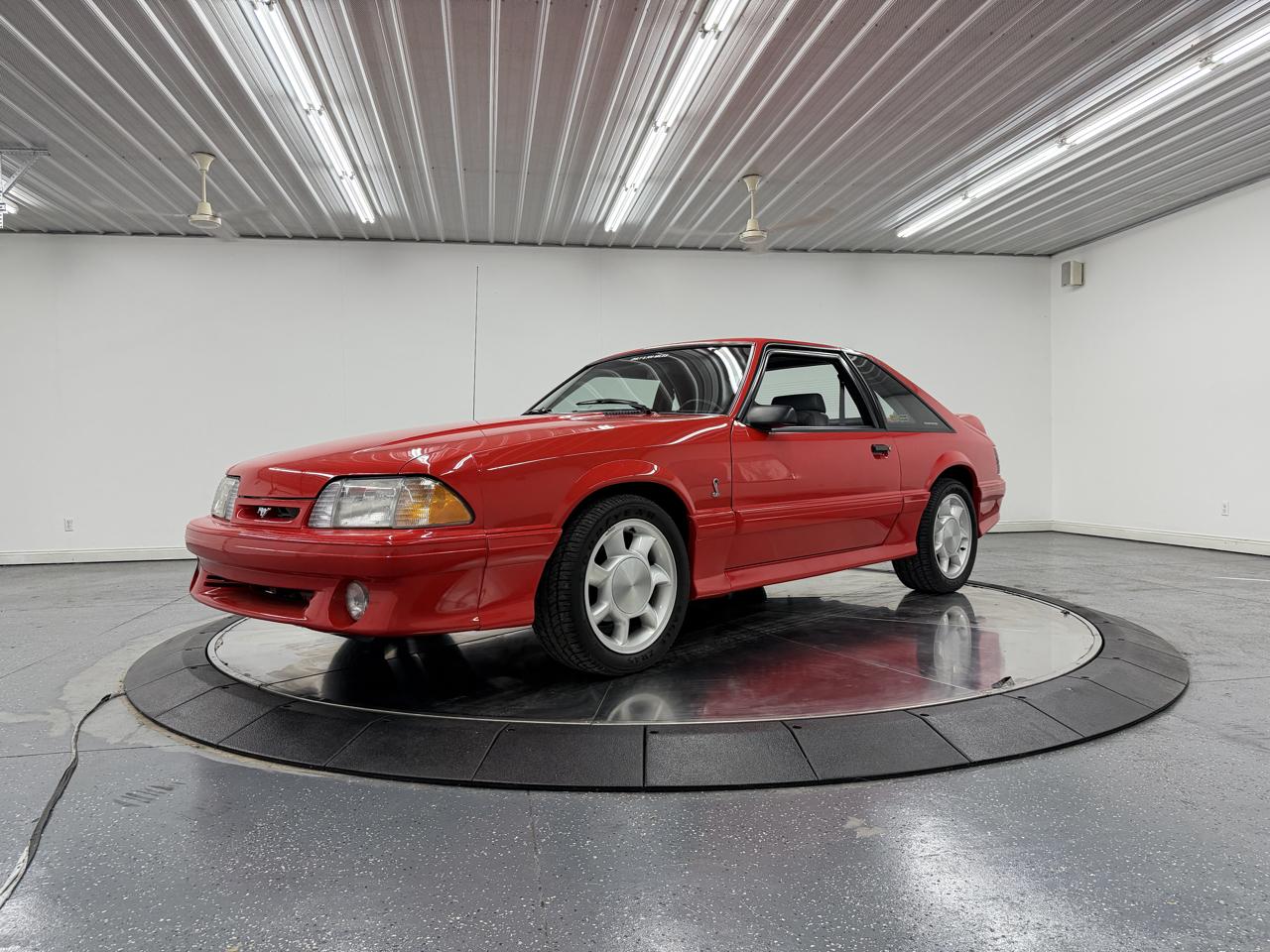
The models
The Fox hatchback range looks confusing from a distance — L, GL, GLX, LX, GT, Turbo GT, SVO, Cobra — but it resolves into a simple ladder once you separate the trim from the engine. Trim decided how the car looked and what it carried; the engine decided what it was. Always price the car in front of you as engine first, trim second, badge last, because badges on a Fox are cheap to buy and easier to fit than any other part on the car.
| Model | Years | Engine | Output | Character |
|---|---|---|---|---|
| Base / L / LX hatchback | 1979–1993 | 2.3 four (carb, later EFI) | 86–105 hp | The economy car; light, slow, now rare unmodified |
| 2.3 Turbo / Turbo GT | 1979–1981, 1983–1984 | 2.3 turbo four | 132–145 hp | Period curiosity; fragile early, better as Turbo GT |
| GL / GLX hatchback | 1982–1983 | 2.3, 3.3 six, 3.8 V6, 5.0 | various | Early-80s trim step; mostly a badge and a cabin |
| GT hatchback | 1982–1993 | 5.0 HO V8 (4.2 in some early contexts) | 157–225 hp | The flagship; spoilers, seats, and the image |
| LX 5.0 hatchback | 1987–1993 | 5.0 HO V8 | 225 hp | The sleeper; GT running gear, plain clothes, often quicker |
| SVO hatchback | 1984–1986 | 2.3 turbo four, intercooled | 175–205 hp | The handler; turbo, brakes and suspension over straight-line speed |
| Indy Pace Car replica | 1979 | 2.3 turbo or 5.0 V8 | 132 / 140 hp | The launch special; graphics, Recaros, collectible when correct |
| Cobra (SVT) | 1993 | 5.0 Cobra V8 | 235 hp | The finale; GT-40 heads and intake, hatchback icon |
| Saleen hatchback | 1984–1993 | 5.0, later supercharged options | 225 hp and up | Tuner car, serialised; verify with Saleen, not the seller |
(Outputs are period Ford ratings, which changed method and optimism over the run — treat the early-1980s figures as approximate and the 1987–93 5.0's 225 hp and 300 lb-ft as the benchmark the era is remembered by. Ford revised the rating method for 1993, so a 1993 GT's lower paper figure does not mean a weaker engine.)
The base cars and the LX. For most of the run the entry hatchback carried the 2.3 "Pinto" four, carburetted at first and fuel-injected from 1987, with the inline six and later the 3.8 V6 as the step-up options in the early 1980s. From 1987 the range simplified into LX and GT, and the LX is the connoisseur's trap and treasure in one: order an LX with the 5.0 and you got the GT's engine, gearbox, 8.8-inch axle and suspension in a plainer, lighter shell with no ground effects — the drag racer's default. An LX with a four-cylinder is a completely different car sharing the name. Check the VIN, not the badge: the engine code is the eighth character, and it settles what the car was born as.
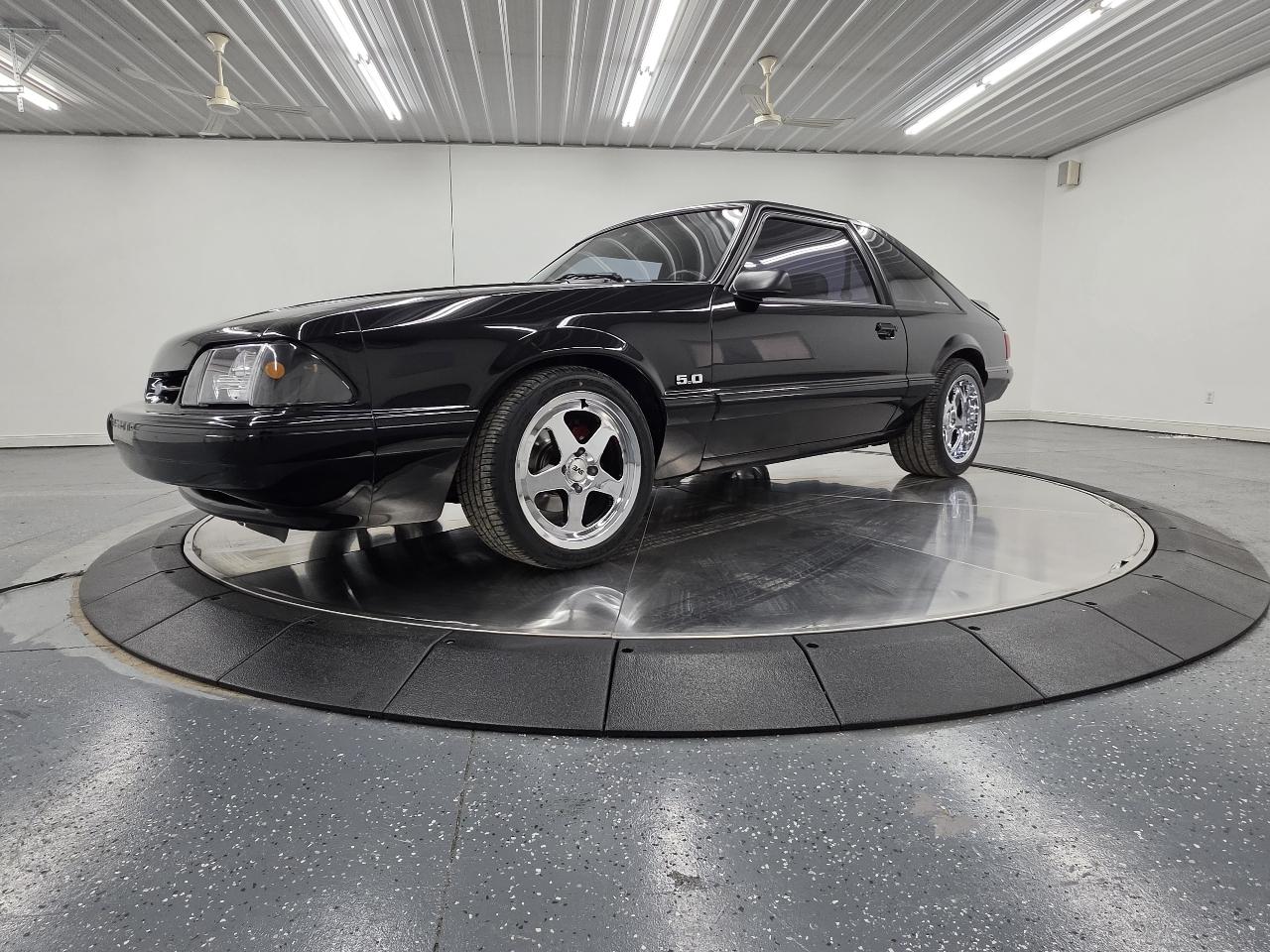
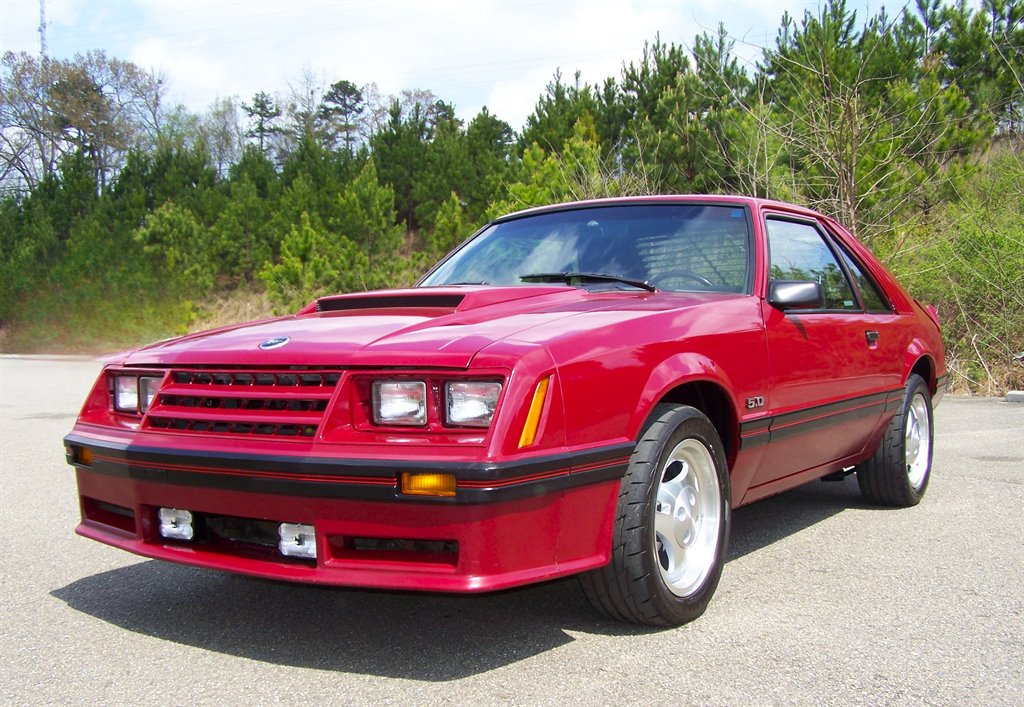
The GT. The GT returned in 1982 after a thirteen-year absence and never left. Early GTs (1982–84) have the crisp, upright "four-eye" nose — four sealed-beam lamps behind a slatted grille. The 1985 GT is a landmark: the last carburetted 5.0, with a roller camshaft and the best throttle response of any stock Fox. The 1986 GT brought sequential fuel injection and the 8.8 axle. The 1987 facelift — flush aero headlamps, deep air dam, louvred tail lamps, ground-effects skirts — split opinion then and splits it now; "four-eye" versus "aero" is the Fox world's great taste divide, and both camps pay for good cars. GT furniture means fog lamps, sports seats, a hatch spoiler, and from 1987 the cheese-grater tail lamps everyone either loves or replaces.
The turbo cars and the SVO. Ford's first answer to the fuel crisis was a turbocharged 2.3, offered 1979–81 and again as the Turbo GT in 1983–84. The early draw-through carburettor turbo is a museum piece: laggy, hot, and hard on itself. The SVO (1984–86) was something else — Ford's Special Vehicle Operations building a Mustang for corners: an intercooled, injected turbo four making up to 205 hp, a five-speed with a Hurst shifter, four-wheel discs, Koni adjustable dampers, quicker steering, a biplane rear spoiler and flush lamps that previewed the aero era. The SVO is a hatchback-only special with its own market — and its own special case as a purchase, with SVO-specific parts and a value logic driven by low production and difference, not by comparison with the 5.0 cars. Do not buy an SVO as a cheap GT; buy it because it is an SVO.
The specials. The 1979 Indy 500 Pace Car replica — silver and black, orange and red graphics, Recaro seats — was the launch-year halo, built in roughly ten thousand copies with either the turbo four or the 5.0. Correctness is everything: the graphics, seats and trim are the value, and a repainted Pace Car missing its livery is a 1979 hatchback with a story. The 1993 SVT Cobra is the bookend: GT-40 heads, a Cobra intake, a revised cam, 65 mm throttle body, a softer, better-damped suspension tune, rear discs and seven-spoke wheels. About five thousand hatchbacks were built, plus 107 stripped Cobra R models. Saleen cars, from 1984, are serialised tuner conversions — verify any Saleen by its number and records, never by its decals, because the decals fit any hatchback.

Engines and gearboxes
The 2.3 four and its turbo variants
The base engine for the entire run was the 2.3-litre overhead-cam four — the "Lima" engine, first seen in the Pinto — an iron-block, iron-head four of 2,301 cc with a single overhead camshaft driven by a timing belt. In carburetted Fox form it made under 90 hp; the fuel-injected version fitted from 1987 made 88 hp at first and 105 hp from 1991, when Ford gave it a second spark plug per cylinder, a distributorless ignition and a revised head. It is a tough, simple engine with two signature behaviours. First, the timing belt: a service item, not a lifetime part, though the 2.3 is non-interference in standard form, so a snapped belt strands you rather than destroying the engine — budget a belt, tensioner and front seals without a dated invoice. Second, valve stem seals: blue smoke on start-up that clears is stem seals, a cheap-ish job; smoke under load is rings. A hunting idle on injected cars is usually the idle air control valve or a vacuum leak, both cheap. High mileage is normal on these fleet and commuter cars and not, by itself, a verdict — neglect is, and it shows in black oil, perished belts and rust-coloured coolant.
The turbocharged 2.3 came in two distinct generations, and confusing them costs money. The 1979–81 engine used a draw-through carburettor: the turbocharger drew mixture through a carburettor mounted ahead of it, with no intercooler and no electronic management worth the name. It made about 132 hp, lagged badly, ran hot, and suffered carburettor icing, oil coking in the turbo bearing if the engine was switched off hot, and a reputation for fragility that was earned. Survivors are historic curiosities — the Pace Car's standard engine among them — and should be bought with eyes open and a specialist's number in your phone. The Turbo GT of 1983–84 replaced the carburettor with Ford's EEC electronic fuel injection and made about 145 hp; it is a better engine in every way, but rare, and one year only in most buyers' minds.
The SVO engine (1984–86) was the turbo four done properly: electronic injection, an air-to-air intercooler, and a premium-fuel switch that changed boost and timing, for 175 hp (1984) and 205 hp (1985½–86). It rewards maintenance and punishes improvisation: the turbo wants clean oil and a cool-down idle after hard use, intercooler hoses perish and leak boost invisibly, and detonation on poor fuel hurts a boosted engine faster than any other fault here. Any turbo car that pinks or smokes under boost (turbo seals) needs a specialist appraisal before money moves.
The sixes: 3.3 inline and 3.8 V6, briefly
Two sixes filled the gap in the early years, and neither is a reason to buy a car. The 3.3-litre (200 cu in) inline six, to 1982, was the old Falcon-family engine: pushrod, iron, unkillable and slow. The 3.8-litre Essex V6 replaced it for 1983–86, making roughly 110–120 hp — carburettor first, then throttle-body, then multi-point injection. Its known weakness, in all Ford applications, is head gaskets: coolant loss with no visible leak or mayonnaise under the oil cap on a six is a head-gasket conversation until proven otherwise. Their buying significance is negative space: a sound six-cylinder shell is the classic starting point for a V8 conversion — exactly why you must check what any "5.0" car started life as — while a genuinely original, unconverted six is a period piece, priced as a curiosity, not as a GT that has not happened yet.
The 5.0 HO: the heart of the Fox
The 5.0 is why you are reading this guide. Ford's small-block V8 — 302 cu in, 4,942 cc, iron block and heads, pushrods, a single camshaft in the valley — was a twenty-year-old design when the Fox launched, and in High Output form it became the defining American performance engine of the 1980s. Its virtues are torque, simplicity and tuneability; its vices are all known and all manageable. Learn the chronology, because the years are not interchangeable and the market knows it.
1979–1981: the wilderness. The 1979 car's 5.0 (badged 5.0L, rated about 140 hp) was a standard low-compression engine with a two-barrel carburettor. For 1980–81 Ford substituted the 4.2-litre (255 cu in) small-block — externally similar, internally smaller, rated around 115–120 hp — as the only V8. A 4.2 car is not a 5.0 car at a discount; it is a different, weaker engine, and the VIN engine code settles which one a car has. Many 4.2 cars have since been re-engined with 5.0s, which is fine as a driver and fatal to any claim of originality.
1982–1985: the HO arrives, carburetted. The 1982 HO made about 157 hp with a two-barrel carburettor and a larger camshaft than the standard engine. For 1983 a four-barrel Holley lifted output to about 175 hp. The 1984 car is the awkward one — many were built with throttle-body "Central Fuel Injection" and an automatic, making less power — while five-speed cars kept the four-barrel. The 1985 HO is the carburetted peak: Holley four-barrel, hydraulic roller-lifter camshaft (the first year for it), tubular exhaust manifolds, about 210 hp, and a sharpness no injected Fox quite matches.
1986: injection and the 8.8. Sequential electronic fuel injection (SEFI) arrived for 1986, with speed-density engine management — the computer infers airflow from manifold pressure, rpm and a calibration table rather than measuring it. Output was about 200 hp, the exhaust became a true dual system, and the rear axle grew from the 7.5-inch to the stronger 8.8-inch that stayed to the end. The 1986 engine is a one-year combination in detail: its cylinder heads (the E6 castings, with a fast-burn chamber designed for the early injection) and its flat-top pistons without valve reliefs limit later camshaft and head swaps unless the pistons are changed or fly-cut. None of that matters on a stock car; all of it matters if you plan to modify one.
1987–1988: the definitive recipe. For 1987 Ford fitted the E7TE truck-derived cylinder heads, a revised camshaft and intake, and lifted the HO to the famous figures: 225 hp and 300 lb-ft of torque. This is the engine the legend is about — a fat mid-range, a 5,800 rpm appetite, and a noise no modern V8 replicates. Speed-density management continued through 1988 for most cars (California 1988 cars received mass-air metering first). The practical consequence is famous: a speed-density car tolerates mild changes but cannot meter the air from a bigger camshaft or major airflow changes, so it runs poorly or needs a mass-air conversion; a mass-air car adapts, which is why modifiers hunt them.
1989–1993: mass air and maturity. Mass-air (MAF) metering became standard nationwide for 1989 — a heated-element sensor measuring the air directly — and stayed to the end. These are the most usable, most tuneable and most numerous 5.0s, and the core of our listings pool. Forged pistons gave way to hypereutectic pistons for 1993 (fine for stock and mild use, less forgiving of detonation and boost — a fact that matters if you plan forced induction), and the 1993 Cobra received its own package: GT-40 iron heads, a cast Cobra intake, a milder Cobra-specific camshaft, 1.7-ratio roller rockers, a 65 mm throttle body, 24 lb injectors and a Cobra computer, for 235 hp.
Living with the 5.0. A healthy HO starts instantly, idles at a lumpy-but-steady lope, shows good oil pressure hot, and pulls clean from 2,000 rpm to the redline without smoke or a top-end rattle. The service realities: the rear main seal weeps (see Problem areas), the water pump and fan clutch are consumables, the timing chain stretches over high mileage and dulls cam timing before it ever jumps, and the distributor's TFI module and PIP sensor are age-failure items causing hot-start and cutting-out faults misdiagnosed as fuel problems for decades — a spare TFI in the glovebox is period-correct ownership. Oil consumption is usually stem seals and a clogged PCV screen under the intake (a ten-dollar part whose neglect pressurises the crankcase and pushes oil out of every seal — check it before condemning the rear main). Fuel pressure should sit around 39 psi at the rail, vacuum hose off the regulator; a lean, rich or hunting car wants a pressure test before parts. A stock 5.0 with clean oil and a maintained cooling system is a 200,000-mile engine. Most have not had that life, which is what the inspection is for.

Gearboxes: T5, AOD and the early automatics
The T5 five-speed manual is the gearbox most buyers want and the one that has lived the hardest life. Early Foxes used a four-speed (the single-rail overdrive SROD in 1979–83 V8 cars, leisurely and fragile under HO torque); the Borg-Warner T5 arrived for 1983 and, in strengthened "World Class" form from 1985, stayed to the end. V8 T5s carry stronger gearsets than four-cylinder T5s, with first gear around 3.35:1 in most HO applications and 2.95:1 in some variants — a live buying trap, because four-cylinder T5s are weaker, differently geared, and routinely swapped in as cheap replacements. Judge any T5 on three things: synchromesh into second and third, above all on a downchange; a whine in first, second, third and fifth but not fourth (fourth is direct — a whine that vanishes there is the cluster gear and bearings talking); and jumping out of gear under load, which means worn engagement teeth, not adjustment. The T5 uses automatic transmission fluid, not gear oil. A quality rebuild runs roughly $1,200–2,500; stronger aftermarket variants are common modifications, judged under the audit in the inspection.
The AOD four-speed automatic (1980 onward, standard-fit on many GTs and LX 5.0s) is a smooth, long-lived cruising box with an overdrive top and one famous fragility: the throttle-valve (TV) cable that sets line pressure from throttle position. If the TV cable's grommet at the throttle body perishes — and the original plastic grommet always perishes — the cable detaches, line pressure collapses, and the box can burn its clutches in a few miles, sometimes on the test drive home. Check the grommet on every AOD car; a $5 brass-and-pin kit is the cheapest insurance in this guide, and an AOD that already flares on the 2–3 shift or shudders into overdrive is already hurt. A rebuild runs roughly $1,800–3,200. A stock AOD behind a stock 5.0, with a sound TV cable, is pleasant and durable; a modified engine ahead of a tired AOD is a bill with a date on it.
The early automatics — C3, C4 and C5. Before the AOD, four- and six-cylinder cars used the light-duty C3 three-speed, and early V8 and six cars the C4 and its lock-up derivative the C5. Simple, well-understood three-speeds: cheap to rebuild ($1,200–2,200), intolerant of old fluid, and diagnosed the old way — delayed engagement from cold is tired seals, dark burnt-smelling fluid is clutch material. On any automatic, pull the dipstick: fluid should be red and sweet-smelling, level correct checked hot and idling in park, and the history should show changes, because "sealed and forgotten" is how these boxes die.
Problem areas
Everything here is the Fox as it actually ages. A note on evidence first: we have detailed photo notes for 137 of the hatchbacks in our pool, and within those notes rust is mentioned once and accident damage once. Do not read that as a rust-free verdict. The pool leans on auction-presented cars, photographed to sell; undersides are the least-photographed part of any Fox; and the rust that kills these cars hides exactly where listing photographs do not go — inside the strut towers, under the floors, behind the torque boxes. Your inspection must supply the evidence car by car.
Rust and structure: the map
The Fox is a unit body — there is no separate chassis — so rust is never merely cosmetic once it reaches the load paths. The platform was not galvanised, rustproofing from new was inconsistent, and the design traps water and road salt in specific, predictable places. Work through them in this order, because the order is the order of consequence.
Strut towers and the front frame rails. The single most important check on any Fox. The struts carry the entire front suspension and steering load into two pressed-steel towers, tied to rails running back under the floor. The towers rust from the wheelarch outward and at the seams where tower, rail and inner wing meet; the rails rust under the towers and where the K-member (the bolted subframe carrying engine and lower arms) mounts. Look at the tower tops and seams for bubbling; then, from the wheelarch, prod the tower's outer face and the rail beneath. Surface scale is treatable; perforation, seam separation or flex is structural welding — tower and rail repair, with the engine or K-member dropped for access, runs roughly $1,500–4,000 a side, and a car needing both sides plus floors is a shell, priced as a shell. Fresh underseal or paint confined to the towers is a question the seller must answer with photographs of the work, not reassurance.
Floor pans and seat mounts. The floors rust from both directions: salt and water from below, and — more often — water from above, leaking past the windshield seal, cowl, heater box and hatch seal, then sitting under the sound deadening. Lift every carpet. The critical points are the seat mounts: the thin floor cracks around the seat tracks even without rust, because the loads concentrate there, and rust turns a crack into a collapse. A rocking driver's seat is often the floor letting go, not a broken seat. Press hard around all four mounts of each front seat and along the tunnel seams. Replacement pans are cheap; fitting runs roughly $800–2,000 a side, and floors rarely rot alone.
Torque boxes. The reinforced junctions where the rear lower control arms mount to the body, tying the axle's torque into the shell — and on a car whose cultural purpose was launching hard on sticky tires, they are both a rust point and a fatigue point. They crack, tear at the spot welds and, in hard-used cars, pull away from the floor. This is the Fox equivalent of a cracked chassis, invisible from a standing look. Get underneath: look for torn seams, elongated bolt holes, non-factory welds (evidence of repair — judge its quality), and aftermarket reinforcement plates and "battle box" kits, fitted both to strengthen sound boxes and to disguise tired ones. Reinforcement on a sound car by a careful owner is a plus; reinforcement hiding tears is a negotiation or a walk. Repair runs from roughly $600 for reinforcing a basically sound box to fabrication money when the surrounding floor has gone with it.
The hatch, its hinges and its aperture. The defining panel is also a water-management problem. The hatch is large, heavy and hung on two roof hinges whose mounting areas crack and rust; the gas struts fail and let it slam (accelerating hinge and latch damage — a hatch that will not stay up is a $40 strut pair and a warning to check the hinges); and the aperture seal perishes and lets water into the spare-wheel well and rear floor, rusting them from inside. The hatch skin rusts along its lower edge and around the window, and louvres and spoilers trap moisture against the paint. Operate it on every viewing: it should lift with strut assistance, sit square with even gaps, latch without a slam, and show no water staining in the well.
Doors, quarters and the rest. Door bottoms rot from inside when drain holes block — run a fingertip along each door's bottom edge for bubbling. Lower rear quarters rust behind the wheels and at the arch lips, where the GT's 1987–93 ground-effects covers trap mud and salt and hide the evidence — look behind the covers, not at them. The cowl and windshield base channel water into the front footwells; the battery tray and apron beneath it corrode from acid; tail-panel and filler-area seams bubble. Sunroof and T-top cars (T-tops to 1988) add leak paths and seal costs. None alone kills a car; together they tell you whether the shell lived indoors or out.

Mechanical: engine, cooling and driveline
The heater core — the Fox's signature job. Every owner eventually meets it: the core, a small radiator buried in the heater box behind the dashboard, begins to leak. The signs are a sweet coolant smell, a windscreen that mists with a greasy film the demister cannot clear, and a damp passenger footwell misdiagnosed as a rain leak for months. On air-conditioned cars the repair is the famous dashboard-out job: dash out, column dropped, box split — a part costing roughly $50–100 consuming six to ten hours, $800–1,800 at a shop or a long weekend of yours. Test the heater and smell for coolant on every viewing, whatever the season, and treat a looped-off heater hose in the bay (the classic bypass) as a car with the bill already printed — the seller has told you the core leaks by disconnecting it.
Rear main seal and oil leaks. The 5.0's rear main weeps with age, dripping from the bellhousing and mimicking a sump or gearbox leak. The seal is cheap — the early two-piece design can be changed with the sump dropped — but the one-piece seal on 1986-on engines wants the transmission out, so labour is the price: roughly $600–1,200, shared with clutch work it overlaps. Diagnose first: a clogged PCV screen (see Engines) pressurises the crankcase and manufactures leaks at the rear main, valve covers and intake seals that vanish when the screen is cleaned. Valve-cover and intake gaskets weep on almost every unrestored car; budget them, do not fear them.
The T5 in service. Second-gear synchromesh goes first (a crunch on a hurried 1–2 or 3–2 change), the input bearing whines, and hard-launched cars wear the shift forks, giving a vague gate and gears that will not stay engaged. The cable clutch's self-adjusting quadrant under the dashboard strips its plastic teeth with age, leaving a low, dragging clutch misdiagnosed as a dying gearbox; the aluminium quadrant and adjustable cable are the standard, honest fix, and their presence marks an owner who knew the car. A clutch is roughly $700–1,400 fitted.
The 8.8 axle and quad shocks. From 1986 the V8 cars carry the 8.8-inch axle with Traction-Lok limited-slip on GT and LX 5.0 models — strong, but its clutches wear out silently, leaving a one-wheel-peeling car. Test it: a limited-slip car leaves two marks and pulls straight; a worn one spins the inside wheel. A clutch-pack refresh is roughly $400–800. A hum that changes between drive and overrun is the pinion bearing's signature, and axle seals weep onto the rear brakes. The famous "quad shocks" — two vertical dampers plus two horizontal axle dampers controlling wheel hop — are a diagnostic gift: worn horizontals let the axle tramp under a hard launch, which owners chase with tires and bushings. Rear control-arm bushings perish and let the axle steer the car under power — a Fox that wiggles under throttle wants bushings, roughly $300–700 fitted, before anything else.
Brakes and steering. The stock brakes were marginal when new: front discs and rear drums on most models (rear discs on SVO and 1993 Cobra, not the standard GT), with fade if driven hard. Judge the system whole: a hard, high pedal and a straight stop is health; a sinking pedal is the master cylinder; pulsing is warped rotors; a car that has sat wears rust bands and seized rear cylinders. A full hydraulic refresh runs roughly $800–1,800. The rack-and-pinion steering's pump whines characteristically (a parking-speed groan is often just a Ford pump being a Ford pump), the rack leaks from its seals, and tie-rod ends and ball joints wear with the dampers. Front struts and upper mounts are consumables: a Fox that crashes over bumps is usually on dead struts, roughly $500–1,000 the pair fitted — but check the towers before assuming that, for the reasons above.
Cooling. The 5.0 makes heat and the old stock system barely copes: a silted radiator, a fan clutch that no longer locks up, and a cracked or missing shroud add up to a gauge that creeps in traffic. An electric-fan conversion is the commonest fix and ranges from excellent to dangerous depending on the wiring — hence its scrutiny in the audit below. A car that runs cool in traffic, with clear coolant and a fan that roars when hot, has been maintained; a car shown only already warmed up, on a cool morning, near the seller's house, is telling you something.

Interior, trim and the hatchback cabin
The Fox interior was built to a price and shows it in specific, expensive-to-reverse ways. Plastics embrittle: dashboard pads crack across the top, door cards warp and pull from their clips, consoles crack at the hinge, headlinings sag. None is structural, all is visible every drive, and the reproduction market — good for soft trim, carpet and foam — still leaves gaps for hard plastics in the right colours. A complete, uncracked original interior in an uncommon colour is rarer than a rebuilt engine, and the market is slowly learning to price it that way.
Seat frames and the "gangster lean." The signature interior fault has a name every owner knows: the driver's seat back twists and leans inward toward the console, because the seat-back frame cracks at its welds under years of a driver hauling himself out against it — aggravated when the floor mount beneath has cracked and let the seat work loose. Sit in the driver's seat, compare its back with the passenger's, and rock it for movement at the frame rather than the tracks. A cracked frame is a weld-or-replace job ($200–500 with the seat out), a cracked floor is the structural repair above, and the two together are the normal Fox combination. Foam collapses on the driver's bolster and covers split at the entry bolster first. Judge the interior from the driver's seat, always: it is the one that prices the cabin.
The rest of the cabin. Window regulators slow and fail, hatch and door seals perish and whistle, heater vacuum motors fail and stick the air distribution, and the 1987-on ashtray door — the most famous broken part on the late interior — snaps its spring and hangs open on nearly every unrestored car. Treat it as a barometer: a seller who fixed it fixed other small things; a cabin where nothing small works predicts the engine bay.

Electrics
Fox electrics are simple and fail in patterned ways. The weak point is the alternator output connector on the early 2G alternators, whose plug overheats, melts and, in documented cases, starts fires; the later 3G swap is the standard cure and one of the few modifications to welcome unconditionally. The column ignition switch (the electrical switch, not the lock) separates with age and intermittently kills accessories, blower and ignition feed. Grounds corrode — engine-to-body strap and battery cables first — producing slow cranking and dim lights blamed on batteries and alternators.
On injected cars the EEC-IV computer is reliable; its sensors are the service items: TFI module and distributor pickup (hot no-start), throttle position sensor, idle air control valve (hunting, stalling), and oxygen sensors that age into a rich, thirsty car. Codes read with a jumper wire and test light — a seller who lets you pull them has nothing to hide, and a car with its check-engine bulb removed has told you its story. Fan, fuel-pump and EEC relays are cheap age items; bodged bypass wiring for them is an audit item, not a footnote. Work every electrical item on a viewing, because on a Fox the electrical checklist is also the maintenance checklist: cars where everything works have been looked after everywhere else too.
How to inspect one
Allow two hours, bring a torch, a magnet wrapped in cloth, a screwdriver for prodding (with the seller's permission), and — for any car that passes you — a booked lift inspection. The Fox rewards method: its killers are structural and hidden, its virtues mechanical and audible, and the order below puts the walk-away checks first.

- Start with identity: VIN, buck tag and door sticker. The VIN plate sits at the base of the windshield; its eighth character is the engine code and must match what the seller claims the car was born as — a "factory 5.0" whose VIN says four-cylinder is a conversion, priced as one. The buck tag, screwed to the radiator support behind the driver's headlamp, carries the build codes; the door sticker carries build date, axle, transmission and trim codes. All three should agree with the title. On a 1993 Cobra, verify the Cobra codes against the SVT documentation — clones are common and convincing. On a Saleen or Pace Car, verify serial and livery against registry records, not decals.
- Cold start, engine cold by arrangement. An injected 5.0 should fire at once, catch a fast idle and settle to its lope without hunting, smoke or a top-end rattle that outlasts a second. Blue smoke at start-up is stem seals; smoke under load later is rings. A car presented warm has had its cold behaviour — the hardest thing an old engine does — edited out of your viewing.
- Strut towers and front rails, hood up and torch on. Read the tower seams, the tower-to-rail junctions and the rails under the towers for bubbling, seam separation and fresh local paint or underseal. Prod the suspect spots. Then look from the wheelarches at the towers' outer faces. Perforation here reprices the car as a welding project; stop and renegotiate or walk before falling for anything else on it.
- Under the car: torque boxes, floors, rails. Work front to back: K-member mounts and front rails, floor pans (prod around every seat mount), the torque boxes — torn spot welds, cracked seams, elongated holes, and the quality of any reinforcement — then rear rails, the spare-wheel well from below, and the fuel and brake lines. This step, not the test drive, decides most Fox purchases.
- The hatch and the water story. Lift the hatch: struts should hold it, hinges should show no cracking or rust at the roof mounts, gaps even, the latch catching without a slam. Lift the spare and well trim: staining, rust or a damp smell is the hatch seal leaking, and the water's next stop is the rear floor. Check the front footwells and under every carpet while you are on water duty — a dry Fox exists, and this is how you prove you have found one.
- The modification audit. List everything that is not stock: intake, heads, cam claims, headers, throttle body, mass-air conversion on a speed-density car, underdrive pulleys, electric fan and its wiring, nitrous solenoids or lines (or the plugged holes where they lived), a supercharger or its brackets, subframe connectors, a cage or its cut-out scars, battery relocated to the hatch, aftermarket gears, a line-lock, drag suspension. Then classify: bolt-ons with receipts from known makers, fitted well, are neutral-to-positive on a driver; cut metal, mystery wiring, nitrous history and "built engine, no paperwork" are deductions — you are buying the previous owner's judgement with the car. Photograph the bay and compare it with a stock bay later, calmly.
- The T5 test, on the drive. From cold, the gearbox should take second without a crunch at a normal pace and at a hurried pace; downchange 3–2 at moderate revs — the synchro test that cannot be faked. Listen for a whine present in first, second, third and fifth but absent in fourth (cluster and bearings). Check it stays in gear under load and on the overrun, especially second and third. On an AOD car, check the TV cable grommet at the throttle body before the drive — if it is perished or detached, do not drive the car hard until it is secured — then judge the shifts: no flare on 2–3, no shudder into overdrive.
- The drive itself: axle, bushings and hop. Fifteen minutes minimum, including a highway stretch and, where safe and legal, a firm launch. A healthy Traction-Lok car pulls straight and grips; a rear that wiggles under power wants control-arm bushings; tramp and hop point to the quad-shock horizontals and bushings together. Brake firmly from speed: straight, no pulse, no pull. Wander plus a knock over bumps is ball joints and tie-rod ends priced into the offer.
- Heat and the heater core. Run the heater hot on full fan, whatever the weather: smell for coolant sweetness, watch for a greasy mist on the windscreen, feel the passenger footwell for damp afterwards. Let the car idle hot and watch the gauge; the fan should cut in or the clutch fan roar, and the temperature stabilise. Check the heater hoses at the firewall — a looped bypass hose ends the negotiation about the core.
- Electrics, all of them. Work every switch: windows, locks, blower speeds, demister, wipers, washers, hatch release, every lamp. Pull the EEC codes if the seller agrees. Look for bypassed relays, Scotch-locked fan wiring and a heat-damaged alternator plug. A car where everything works is a maintained car.
- Interior and the seat test. Sit in the driver's seat and rock it: movement at the floor is the mount, movement in the backrest is the frame — the gangster lean. Compare its angle with the passenger side. Feel the foam, check the dash top for cracks, door cards for warp, headlining for sag, and work the belts. Then check the hatch-area trim, which sun and water destroy first.
- Paperwork and the stock-parts question. Invoices, window sticker or build documentation if they survive, receipts for engine or gearbox work, and — on a modified car — the stock parts: a car sold with its original intake, wheels, exhaust and airbox in boxes can be returned to stock, and that option has real value here. Ask directly what racing the car has done. An honest "it was a bracket car for three seasons, here are the timeslips" is worth more than a denial contradicted by the subframe connectors you found at step 6.

Values
There are deliberately no price figures in this section — the listings and recorded sales beneath this guide carry the numbers, refreshed as the market moves. What follows is how to read them, because the Fox hatchback market is really two markets sharing one set of listings, and confusing them is how buyers overpay.
The first market is the stock-car market, and it is the one appreciating. A 5.0 hatchback that retains its original engine, its factory intake and exhaust, its original wheels, paint and interior — a car that has survived the modification era unmodified — is now the scarce commodity, and scarcity is what collectors price. Within it, the premiums follow logic you can verify: the 1993 Cobra sits at the top as the limited, final, best-developed car; the 1985 GT carries the last-carburettor, roller-cam premium; four-eye cars in original condition have their own following that pays for correctness over speed; the SVO prices on rarity and difference; and a documented, original LX 5.0 increasingly prices alongside the equivalent GT, because buyers have worked out that the lighter, plainer car is the rarer survivor. Colour, a five-speed over an AOD, a sunroof or its absence, and above all documentation — window sticker, build records, one-owner history — move individual cars within their band.
The second market is the modified-car market, and it works by opposite rules. Modifications subtract value in proportion to their permanence and mystery, whatever they cost: a car with extensive engine work and no receipts is worth less than the same car stock, because the buyer is purchasing unknown clearances, an unknown tune and an unknown past of nitrous or boost. The exceptions prove the rule — modifications that are bolt-on, documented, from respected makers, reversible, and accompanied by the stock parts in boxes can hold or modestly help a driver's value. Cut cars, caged cars and cars with racing history price as racing cars: by the shell's soundness and the parts' resale, not by the model guide's bands.
The asking-versus-achieved gap is wide and instructive. Auction results — our pool is auction-heavy, with 132 of its 192 cars arriving via Bring a Trailer — show what documented, well-photographed cars achieve when two committed buyers meet; asking prices show what sellers hope, routinely anchored to the best result for the best car, applied to a lesser one. Read any ask against achieved results for the same year, engine and — decisively — the same originality. The project-versus-driver gap is equally stark: towers, torque boxes, floors, a heater core, a T5 rebuild and a repaint, added together, exceed the difference between a rusty project and the sorted car. Buy condition and originality; let someone else buy potential.
Parts and ownership
The Fox Mustang has the strongest parts support of any car in this guide series. Ford built over two million of them, the 5.0 aftermarket became an industry, and between remaining Ford stock, the reproduction trade (seat foam to floor pans to torque-box reinforcements) and the performance aftermarket, there is almost nothing you cannot buy. The ownership skill is choosing between the three grades: serviceable used, reproduction, and performance — in that order of originality and reverse order of availability.
Easy and cheap: all service items, filters, belts, hoses, water pumps, radiators, clutches, brake wear parts and hydraulics, suspension wear parts, struts and dampers including the quad-shock horizontals, mounts and bushings, floor pans and structural repair panels, seat foam and upholstery kits, carpets, weatherstrips including the hatch seal, alternators (fit the 3G and be done), starters, and the entire 5.0 bolt-on catalogue. Order today, fit this weekend, at prices that make European classic owners wince with envy.
Harder and dearer: correct, date-coded restoration parts and NOS trim; SVO-specific parts (intercooler, unique lamps and panels, biplane spoiler), trading in a small, knowledgeable market; 1979–82 trim and plastics in the right colours; crack-free dashboard pads; good original sport seats; Cobra-specific parts the clone market bids up; and quality paint and structural welding, where the real restoration money goes — tower, floor and torque-box work is priced per car by the welder who has seen underneath yours.
Running costs. A sorted 5.0 is a realistic regular-use classic: roughly 17–24 US mpg depending on gearing and right foot, insurance in line with its value, and servicing any competent general shop can handle — specialists are for structural welding, T5 rebuilds and SVO or turbo questions. The line that catches new owners is the first year of deferred maintenance: fluids, belts, hoses, brakes, dampers, bushings, a PCV screen, a TFI module and the small electrics honestly run $1,500–4,000 on a running car without a recent documented service, and recommissioning a car that has sat runs $3,000–7,000 before cosmetics. Sitters also hide a heater core that leaks on its first hot run and tires that look new and date from another decade. Buy a car in regular use over a sleeping beauty at the same money, every time.

Which one to buy
- The all-rounder: 1989–1993 GT or LX 5.0, five-speed. Mass-air metering, the mature 225 hp engine, the 8.8 axle, the deepest parts and knowledge pool, and the widest choice — our listings are dominated by exactly these years, so you can afford to be choosy. GT for the look, LX for the sleeper's lightness and the quieter life.
- The character buy: 1985 GT. The last carburetted HO, the roller cam, the sharpest throttle response and the four-eye face. Buy the best original one you can find; a modified 1985 is just an old Mustang, a stock one is a landmark.
- The collector car: 1993 Cobra. The finale and the premium, justified by the GT-40 package, the single-year production and the documentation culture around it. Verify ruthlessly — VIN, codes, SVT papers — because the clone market is skilled and the premium rides entirely on authenticity.
- The thinker's car: SVO. The handler, the technocrat, the turbo car done properly. Buy it for what it is — steering, brakes, balance — with SVO-specific knowledge and parts priced in, never as a substitute GT.
- The value buy: a stock AOD car. The automatic cars price below the five-speeds and have often lived gentler lives. Check the TV cable grommet before the test drive, judge the shifts honestly, and enjoy the discount the market gives you for a gearbox that suits the car's cruising side.
- The period piece: an original four-cylinder or Pace Car. A surviving unmodified base car, or a correct Pace Car with its livery and Recaros intact, is a piece of 1979 preserved. Buy correctness, not speed, and do not convert it — the unconverted survivors are the ones disappearing.
And the rule that overrides all of the above: buy the most original, least rusty car you can find, and verify its structure before its story. Engines, gearboxes, heater cores and interiors are all fixable at prices you can plan for. A perforated strut tower, a torn torque box and a life of undocumented modification are the three things that turn a Fox from the best-value performance classic of its era into a lesson — and all three are visible on the inspection, if you do it in the order this guide sets out.