
Ford Mustang Coupe buyer's guide
Ford Mustang Coupe -- the model's own buyer's guide: variants, values and what to check.
Years listed: 1964-2001 · Series: Mustang Fox
Overview and history
The hardtop coupe is the Mustang. Not the fastback the posters show, not the convertible the parades use — the coupe, the plain-roofed hardtop Ford launched on 17 April 1964 and sold in numbers no pony car has matched since. Of the 960 Mustang Coupes we track, 878 are first-generation cars: 269 from 1965 and 309 from 1966 alone, with 1967 (137) and 1968 (108) behind them. The later cars — 57 Fox-body coupes and 25 SN95 coupes, running out to 2001 — get their due below, but almost everything here is weighted to 1965–73, because that is where the cars, the buyers and the problems are.
The coupe's dominance was there from day one. At the April 1964 launch the range was just two cars: the hardtop coupe and the convertible; the fastback — officially the 2+2 — did not arrive until August 1964. The coupe was the cheapest Mustang, the one Lee Iacocca's team had costed down from the Falcon for a young buyer in a first job. Ford expected around 100,000 sales in the first year; it took 22,000 orders on the first day, built roughly 418,000 in the extended 1965 model year, and peaked at over 607,000 Mustangs in 1966 — around 422,000 of them coupes. That arithmetic still shapes the market: coupes are plentiful, parts are plentiful, and knowledge is plentiful.
Underneath, the early car is Falcon engineering wearing a much better suit: the Falcon's unibody platform, six-cylinder engines and much of its suspension — coil springs over the upper control arms at the front, a live axle on leaf springs at the rear, drum brakes as standard. That parts-bin honesty is the coupe's great strength: almost nothing is exotic, almost everything is reproduced, and almost every fault is known, named and priced. It is also the weakness. The body was never galvanised, and water management — cowl drains, window seals, seam sealing — was adequate for a five-year American car, not a sixty-year-old collectible. A coupe's mechanicals will forgive decades of neglect. Its shell will not.
The shape evolved in clear steps. The 1964½ and 1965–66 cars are the original: light, narrow, neat. The 1967–68 cars are wider and heavier, restyled to take the FE big-block. The 1969–70 cars grew again, the 1971–73 cars most of all, before the oil crisis shrank the Mustang II to Pinto-based size. The Fox coupes of 1979–93 brought the notchback back as the lightest way into a 5.0 V8, and the SN95 cars kept a coupe through the modular-engine era.
This guide treats those eras differently. The 1965–73 hardtop gets the forensic treatment — its own structure, rust map and engine families. The Fox and SN95 coupes get an honest, shorter treatment inside the same sections: different structures and failure modes, but modern enough, and few enough here, not to need the same page count. The Mustang II, absent from our coupe listings, is covered in the model history and then left alone.
Buy a coupe as you would any unibody car of its age: structure first, identity second, mechanics third, cosmetics last. The sections that follow are written in that order.
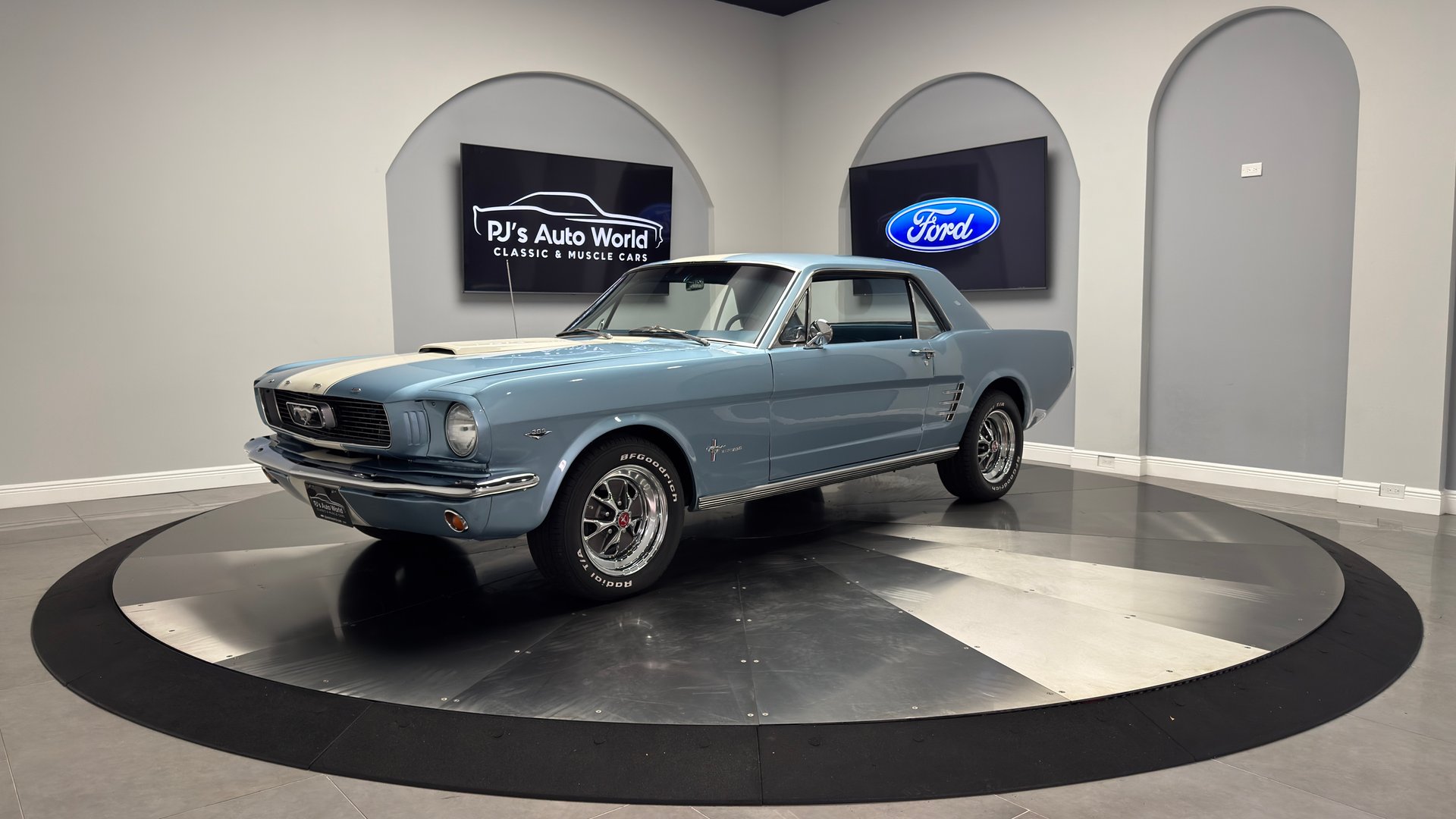
The models
Every first-generation coupe shares one idea — two doors, a fixed steel roof, a small rear seat — but the range inside it is enormous. At one end, a 1965 coupe with a 200 six, a three-speed manual, drum brakes and no options. At the other, a 1968 coupe with a 428 Cobra Jet, a four-speed Toploader and disc brakes. They share a roof pressing and almost nothing about how they drive or what you should pay. The badge on the wing tells you almost nothing, so the door data plate and the VIN's fifth character — the engine code — are the documents that matter. The inspection section decodes both.
| Years | Engine | Output | Character |
|---|---|---|---|
| 1964½–1966 | 170 cu in six (1964½), then 200 cu in six | 101 hp (170), 120 hp (200) | The base car; light, simple, slow, cheapest to run |
| 1965–1968 | 289 cu in V8, 2-barrel (C-code) | 200 hp (1965–67), 195 hp (1968) | The default V8 coupe; the all-rounder |
| 1965–1967 | 289 cu in V8, 4-barrel (A-code) | 225 hp | The sweet spot: proper pace, no Hi-Po fragility |
| 1965–1967 | 289 Hi-Po (K-code) | 271 hp | Solid lifters, four-speed; the collector six-cylinder-shell V8 |
| 1968–1973 | 302 cu in V8, 2- and 4-barrel | 210–220 hp early, falling with net ratings | 289's successor; 1968 J-code 4-barrel is the pick |
| 1969–1973 | 250 cu in six | 155 hp gross, less later | The last six-cylinder coupes; torque over revs |
| 1969–1973 | 351 Windsor / 351 Cleveland | 250–290 hp gross early | The 1969–70 performance coupe without big-block weight |
| 1967–1968 | 390 cu in FE V8 (S-code) | 320 hp (1967), 325 hp (1968) | Big-block torque; nose-heavy, thirsty, charismatic |
| 1968½–1970 | 428 Cobra Jet (R/Q-code) | 335 hp (underrated) | The fastest straight-line coupe; rare in this body |
| 1971 | 429 Cobra Jet / Super Cobra Jet | 370 hp (CJ) | One year only; the biggest coupe there ever was |
| 1969–1973 | Grande (luxury trim, coupe only) | Six or V8 as ordered | Vinyl roof, soft trim, quieter cabin; coupe-only model |
| 1979–1993 | Fox coupe: 2.3 four, 3.3/3.8 six, 5.0 V8 | 88–225 hp | The notchback; LX 5.0 is the drag-strip favourite |
| 1994–2001 | SN95 coupe: 3.8 V6, 4.6 V8 | 145–260 hp | Modern structure, modular engines, daily-usable |
(Outputs are period SAE gross figures, net after Ford's 1972 switch; treat them as comparative, not absolute.)
The six-cylinder coupes (1964½–1973). The six was not the poverty option the modern market assumes — it was the car Ford expected to sell, and did. The 1964½ cars carried the 170 six; from true 1965 the standard engine was the 200, and from 1970 the option was the 250, a taller-deck stroker with real low-speed torque. A six-cylinder coupe is lighter over the nose than any V8 and steers more sweetly without assistance. It is also slower in a way modern traffic notices, and — critically — it was built with lighter running gear throughout: four-lug wheels, a small 7.25-inch rear axle, lighter spindles and steering. That is why a six converted to a V8 differs fundamentally from a factory V8 car, as the inspection section explains.
The small-block coupes (1965–1973). The 289 in C-code two-barrel form is the volume V8 and the right default: 200 hp, a C4 automatic or three- or four-speed manual, five-lug running gear and an 8-inch rear axle. The A-code four-barrel adds 25 hp and a keener throttle for no real penalty. The K-code Hi-Po is a different animal — solid-lifter cam, dual-point distributor, free-flowing manifolds, a 9-inch axle on most cars and a mandatory four-speed or, from 1966, a specially built C4 — and it is priced like one; verify it from the VIN's fifth character, never from badges. The 302 replaced the 289 for 1968; the four-barrel J-code is a one-year sweet spot. For 1969–70 the 351s take over: the Windsor for torque and simplicity, the Cleveland for revs and canted-valve heads. By 1971–73, emissions tuning and net ratings had taken the edge off, and the big late coupes are cruisers first.
The big-block coupes (1967–1971). Ford widened the 1967 car to fit the FE engine, and the 390 coupe is fast, nose-heavy and thirsty in equal measure. The 428 Cobra Jet, from April 1968, is the serious car: underrated at 335 hp, available in the coupe, and rare in this body because most performance buyers chose the fastback. A genuine R-code (ram-air) or Q-code coupe is the sleeper of the range. For 1971 only, the 429 — a 385-series engine, unrelated to the FE — came in Cobra Jet and Super Cobra Jet forms before emissions rules and insurance killed it.
The Grande (1969–1973). The Grande is the coupe's own model, never a fastback or convertible. It is not a performance package: it is luxury trim — padded vinyl roof, plusher seats, woodgrain, extra sound deadening — with any engine from the 250 six to the 351 underneath. Grandes were bought by gentler owners and garaged more, so a survivor is often the soundest shell in its price band. The market discounts it for the vinyl roof — check underneath for trapped rust, as the problem-areas section explains — and a smart buyer pockets the discount.
Special editions in the coupe body. The coupe carried more promotional specials than the fastback, because it was the volume car dealers wanted to shift. Best documented: the 1968 GT/CS California Special — coupe-only, with Shelby-style fibreglass boot lid and scoops, sequential Thunderbird tail lamps and fog lamps, built at San Jose — and its Colorado twin, the High Country Special of 1966–68. The 1972 Sprint put red, white and blue Olympic-year trim on coupes with any engine; the 1966 Sprint 200 dressed up a six to celebrate the millionth Mustang. Treat every special as a trim story over a standard drivetrain: the value lives in documentation — a Marti Report confirming DSO and options — not in the stripes.
Mustang II (1974–1978). The notchback coupe and plusher Ghia were the volume Mustang IIs, Pinto-based, with a 2.3 four, a 2.8 V6 and, from 1975, a 302 V8 strangled to as little as 122 hp. None appears in our listings; buy one, if you do, as cheap period charm, checking Pinto-style rust and the V8's model-only parts.
Fox coupes (1979–1993). The Fox notchback is the lightest V8 Mustang of the modern era: the LX coupe with the 5.0 HO (225 hp in its best 1987–93 form) became the drag-strip default because it weighed less than the hatchback and was stiffer. Below it sit the 2.3 Lima four and the 3.3 and 3.8 sixes — transport, not classics. The coupe-only story is the SSP police package: mostly coupes, with certified speedometers and documented agency histories. In our pool the Fox accounts for 57 cars, mostly 1987–93 5.0s, and originality is the battle.
SN95 coupes (1994–2001). The SN95 kept the Fox floorpan in a far stiffer, safer shell, with dual airbags and four-wheel discs on V8 cars. The range runs from the 3.8 Essex V6 (145 hp) through the last 5.0 of 1994–95 to the 4.6 modular V8 — 215 hp at first, 260 hp in the 1999–2001 New Edge cars that close out our pool. Their problems are modern: plastic intake manifolds on early 4.6s, automatic wear, electronics.

Engines and gearboxes
The sixes: 144, 170, 200 and 250 Thriftpower
The Falcon six family — Ford's Thriftpower line — powered more coupes than any V8, and deserves respect rather than apology. These are overhead-valve engines with an integral intake manifold cast into the head on the small engines — the log manifold, with a single Autolite 1100 one-barrel carburettor in the middle of it. The 144 belongs to the earliest Falcon story and is rare in a Mustang; the 170 (U-code in 1964½) gives 101 hp, the 200 (T-code from 1965) gives 120 hp and is the six you will actually meet, and the 250 (L-code from 1970) is a taller, longer-stroke engine — 155 gross hp on paper, but the point is torque from idle and a less frantic feel at highway speed.
A healthy six starts instantly, idles with a soft sewing-machine evenness and pulls without a flat spot. The failure modes are almost all in the fuel and ignition support systems, not the engine itself. The Autolite 1100 and its spark-control (Load-O-Matic) distributor are a matched pair: the Load-O-Matic has no centrifugal advance and works entirely on vacuum signals from that specific carburettor, so a generic replacement carburettor without a distributor change gives a permanent hesitation everyone blames on something else. The test is a timing light and a vacuum gauge: watch the advance respond as the throttle opens. The exhaust manifold cracks between the centre ports after decades of heat cycles, and valve-stem seals harden into the classic puff of blue smoke on start-up that clears in seconds — annoying, cheap, not a rebuild. Real wear shows as low oil pressure hot, piston slap that does not fade, and blow-by puffing from the oil filler. Maintained sixes routinely pass 150,000 miles without the head coming off.
Two traps catch six-cylinder buyers: the small bellhousing on early cars limits gearbox swaps, and expectation — a 200 six with a C4 is a 60-mph cruiser, not a modern highway car, and no tune-up changes that. Judge it as period transport and it delights. On later cars the six story changes names: Fox base engines were the 2.3 Lima four and the 3.3 (a 200 descendant), then the 3.8 Essex V6, which the SN95 carried on with — its one famous fault is head-gasket failure, particularly on 1994–95 cars, announced by coolant loss without a leak and emulsified oil.

The small-block V8s: 260, 289, 302 and 351
Ford's Windsor small-block is the coupe's defining engine family, and one of the best-supported classic engines in the world. The 260 (F-code) belongs to the 1964½ cars: 164 hp, and a smaller bore that makes it the least rebuildable of the family today — most worn 260s are replaced with 289s or 302s, which is period-normal and should be disclosed, not hidden. The 289 (1965–68) is the core engine: 200 hp in C-code two-barrel form (Autolite 2100), 225 hp in A-code four-barrel form (Autolite 4100), 271 hp in the K-code Hi-Po. The 302 (1968 on) is a stroked 289; the 1968 J-code four-barrel (230 hp) is the pick of the standard engines. The 351 Windsor (1969 on) is a taller-deck version again — H-code two-barrel for torque, M-code four-barrel (290 hp in 1969) for pace — and the 351 Cleveland (1970–73) is a different engine sharing only the displacement: large-port 4V heads that breathe superbly at speed and feel soft at low revs in a heavy automatic coupe, and small-port 2V heads honestly better matched to how a coupe is driven.
What goes wrong is well mapped. Timing chains stretch and retard the cam timing, giving a car mysteriously flat everywhere — check for slack by rocking the crank pulley against the distributor rotor. Rear main seals weep (a drip on the driveway is normal-period; a drip onto the exhaust is a job). Exhaust manifolds crack, and their bolts snap during removal, turning a gasket job into a machine-shop job. The Autolite 2100 and 4100 are among the best carburettors ever fitted to an American car — simple, tolerant, rebuildable for $250–450 — while the Motorcraft 4300 and variable-venturi units on later 1970s cars have the opposite reputation and are often replaced; note that as a deviation from originality rather than a fault. PerTronix electronic ignition conversions inside the original distributor are near-universal and, on a driver, a plus.
The Hi-Po deserves its own warning because its premium is the largest in the range. A genuine K-code has solid lifters that tick accordingly, a dual-point distributor, a manual choke and no vacuum advance, and should rev eagerly to 6,000 rpm. It should also come with paperwork. Clones are common, and the VIN settles it: no K in the fifth position, no Hi-Po premium, whatever is under the bonnet now.
The Fox and SN95 V8 story is the 5.0 HO and then the 4.6. The 5.0 (1986 on in its best form) is a roller-cam, sequential-injection Windsor with 225 hp and a torque curve perfectly matched to the light coupe; its faults are tired TFI ignition modules (sudden cutting out when hot), worn valve seals and normalised oil consumption. The 4.6 modular of 1996 on is an overhead-cam engine of different character — smooth, quiet, long-lived — with two traps: the plastic coolant crossover on the early composite intake manifold, which cracks and leaks into the plug wells, and spark plugs that eject from the shallow threads of early heads. A 4.6 with a documented aluminium-crossover manifold has had its main bill already paid.
The big-blocks: 390, 427 and 428 FE, and the 429
The FE family is a big, heavy, deep-skirted engine designed in the 1950s, and in the coupe it means the 390 and the 428. The 390 (S-code, 1967–69) gives 320–325 gross hp and a wall of torque, in a package that fills the bay completely, makes some spark-plug changes a knuckle-losing exercise, and adds enough nose weight to change the car's balance fundamentally. FE faults are specific: exhaust manifold bolts seize and snap as a matter of course (budget machine-shop time into any manifold job; $600–1,200 all-in is realistic), the vast iron intake manifold weighs around 85 lb and incorporates part of the head's top face, so every intake gasket job is a two-person lift, and oil leaks from its rear are a rite of passage. Heat is the standing condition: a 390 with a marginal radiator, missing shroud and slipping fan clutch will overheat in traffic, and the fix is system restoration, not an electric-fan bandage.
The 428 Cobra Jet (1968½–70) uses the FE block with 427-style heads, a 735 cfm Holley on ram-air cars and a factory rating of 335 hp everyone understood to be a fiction. R-code cars have the functional ram-air plenum through the bonnet; Q-code cars have the same engine without it. In a coupe — the cheapest, lightest shell the Cobra Jet came in — this is a genuinely rapid car. It is also the coupe most often faked, because the premium over a 390 car is large: the VIN engine code, the reinforced shock towers and body reinforcements Ford fitted to big-block cars, and a Marti Report are the evidence, in that order.
The 429 of 1971 is not an FE. It belongs to the 385 series, with canted-valve heads like the Cleveland's, offered for one year as the Cobra Jet (J-code, 370 hp) and Super Cobra Jet. Parts are a generation scarcer than FE parts. Do not let a seller blur FE and 429 language: they share no parts that matter.
Gearboxes
Manuals. The base three-speed lacks synchromesh on first in six-cylinder form, so first must be engaged at a standstill; grinding it in on the move is driver error, not a fault. The four-speed is the prize: Borg-Warner T-10s appear in the earliest 1964½ cars, after which Ford's own Toploader — named for its top access plate — became standard, close-ratio behind Hi-Pos, wide-ratio behind most others. It is famously strong; wear shows as tired second-gear synchromesh, jumping out of gear on the overrun, and a whine in every gear except direct-drive fourth. A rebuild runs roughly $1,200–2,500. Check what is actually fitted against the door plate's trans code.
Automatics. The C4 three-speed (the standard classic-era coupe automatic) is light, efficient and tough: a good one shifts firmly, kicks down cleanly and engages drive and reverse without delay or thump. Flaring on the 2–3 shift and a long pause into reverse are the wear tells; a rebuild is a known quantity at roughly $1,500–2,800 fitted. The FMX behind some 351s is heavier, iron-cased and less loved by rebuilders; the C6 behind big-blocks is nearly indestructible. Check the fluid on any automatic: bright red and sweet is maintained, dark and burnt is a negotiation. And check the kickdown linkage — a C4 with its rod disconnected feels sluggish in a way owners misdiagnose as a tired engine.
Later gearboxes. Fox 5.0s use the T-5 five-speed — synchro wear and bent shift forks from powershifting are the standard findings — or the AOD automatic, whose TV (throttle valve) cable is critical: a misadjusted or detached cable destroys an AOD in miles, so check it before condemning the box. SN95 cars take the T-45 manual and 4R70W automatic, judged on fluid history and shift quality. Across all eras, the transmission code the car was built with is on the door plate or certification label; a mismatch is a question, not a crime.
Problem areas
Start with what our own photo evidence can and cannot tell you. We have photo-note records for 749 of the coupes in this pool. In those notes, rust was mentioned for 19 cars, damage for 17 cars, leaks for 2 cars and smoke for none. Read those numbers exactly as measured — mentions in photo notes across 749 examined cars, most of them auction listings photographed to sell — and not as a prevalence rate for the model. Sellers photograph paint, not floorpans. The honest conclusion from decades of these cars is the opposite of complacency: the coupe's rust is structural, it hides in named places, and each place below has written off cars that looked shiny in photographs. Almost everything mechanical can be fixed with money and patience. A rotten shell is the one thing that reliably turns a bargain into a parts car.
Rust: the map
Rust on a first-generation coupe follows the water, and the water starts at the cowl.
The cowl. The vent grille in front of the windscreen admits air — and rain — into a plenum whose floor is the top of the firewall, with a drain at each end. Leaves wash in, rot into compost in the corners, hold water against the seams, and the cowl floor and sides perforate. The water then runs down inside the car, behind the kick panels, rotting the front floors from above while the owner polishes the outside. There is a definitive test, and you should perform it on every 1965–73 coupe you seriously consider: pour a bucket of water into the cowl vent grille. On a sound car, water exits from the drains behind the front wheels and the footwells stay dry. On a rotten car, water drips or streams onto the front carpets from under the dashboard. Wet carpets mean cowl repair, and cowl repair means windscreen out, dashboard out and the top cowl panel cut off to reach the lower panel — $2,000–4,500 at a body shop for the full job done properly, which is why sellers of rotten cars develop a sudden objection to water. A car whose cowl vents have been sealed with a solid panel has had the symptom treated and the ventilation deleted; ask why, and look twice as hard at the floors.
Floors. The floorpan is a single large pressing, spot-welded to the sills (rocker panels), tunnel and seat platforms, and it rots in a predictable order: front footwells first (cowl water from above, road spray from below), then under the rear seat (window-seal water), then the seat platforms. Lift every carpet. Surface rust on solid metal is a treat job; metal that flexes under thumb pressure is a cutting job. Reproduction pans make full replacement well-trodden work — $1,500–3,500 a side fitted — but floors almost never rot alone: floor rust tells you the cowl, sills or window seals have leaked for years, and obliges you to check all of them.
Torque boxes. This is the coupe-specific structural item most generalist buyers have never heard of. A torque box is a gusseted box section tying floor and frame rail to the sill at a suspension load point — front boxes where the subframe rails meet the body, rear boxes ahead of the front leaf-spring eyes — stiffening the unibody exactly where suspension forces enter it. Convertibles got the most reinforcement; from 1967 front boxes became standard across the range, while many 1965–66 coupes have only the rear boxes. The boxes trap mud, rot from the inside, and can look sound on the one visible face while the other three are lace. Prod every accessible face, look for swelling at the seams, and treat perforation as structural welding, not a patch: $800–2,000 per box fitted. Torque boxes added during restoration — a common, legitimate upgrade on 1965–66 cars — make the car stronger than factory; ask for photographs of the work.
Frame rails and subframes. The front rails run from the bumper brackets back under the floors, carrying the engine crossmember and steering; the rear rails carry the leaf springs. Both rot at their ends and wherever a bracket traps mud — the front rails at the steering-box mountings, the rear rails around the shackles. Repair sections exist, but rail work is jig work; perforation moves a car from driver to project in one inspection. Read the coating as you go: honest factory coatings are patchy, thin at edges and dirty; a uniform coat of fresh black stone-chip over everything, applied the week before sale, is a question, not an answer.
Roof, rear-window surround and drip rails. The coupe's upright roof is its signature, and its surround is a water trap. The rear window sits in a rubber seal over a spot-welded flange; the seal perishes, water sits on the flange under the chrome, and the surround perforates — first at the bottom corners, then along the bottom edge, from where water runs into the parcel shelf, boot and rear seat. Bubbling paint at the rear-window corners is never just paint. The roof rots along the drip rails, where the skin folds over the gutter: run a fingertip along the gutter's inner edge for lifting, flaking and filler. Worst are the vinyl-roof cars — standard on the Grande, optional everywhere — because vinyl holds moisture against the skin for decades behind a clean surface. Any bubbling, lifting or staining of the vinyl means perforation underneath until the vinyl comes off and proves otherwise. Budget $1,500–4,000 with paint if surround and pillars are involved, and treat a Grande's roof as its single most important inspection point.
Boot (trunk) floor and drop-offs. The boot floor is also the top of the fuel tank — the tank drops into an opening in the floor and its flange forms the floor's centre panel, making tank condition a body inspection item. Water past the boot seal and rear-window surround collects in the drop-offs, the vertical panels at each side of the floor behind the rear wheels, which rot from inside the quarter panel outward — so bubbling low on the rear quarters is usually drop-off rust announcing itself. Lift the mat, remove the spare, and inspect the tank top: heavy rust on the flange and seams adds a tank ($150–300 for a reproduction) and possibly floor sections to the bill. A rusted-through tank top leaks vapour into boot and cabin, so any fuel smell is a stop-and-fix, not a quirk.
The smaller traps. Battery apron: acid and water rot the apron under the battery, and on 1969–70 cars the panel is structural — check under the battery, not around it. Shock towers crack around the spring seats and export-brace mountings, especially on big-block cars, and welded towers should be straight, gusseted work, not filler over a crack. Doors fill with water when their drain slots block, and a door that needs lifting to close is telling you about the hinge pillar behind it, not the hinges. Wing bottoms, lower rear quarters and headlamp buckets rot in the usual places. None alone kills a car; together they price the bodywork, and bodywork is where coupe budgets go to die.

Suspension, steering and brakes
The front suspension — coil springs bearing on the upper control arms, shocks inside the springs and anchored to the towers — is strong and simple, and its wear points are equally simple. Upper control-arm shafts wear and squeak, with a dry creak over bumps that greasing (the shafts have fittings, often missed for decades) may cure or merely diagnose. Ball joints, tie-rod ends and the idler arm wear into vague, wandering steering. The recirculating-ball steering box develops centre play that sector adjustment can reduce but not eliminate if the worm is worn; a rebuild or exchange unit runs $400–800. Manual steering on a six is light and pleasant; on a 390 coupe it is a workout, which is why many big-block cars were ordered with power assistance. Period power steering leaks as a way of life from ram, control valve and hoses; a reseal-and-hose refresh is a $600–1,200 planning figure.
At the rear, the live axle on leaf springs is as old as the automobile and just as durable. Springs sag evenly (a one-sided sag is a broken leaf or rotten mounting, not a spring) and bushes perish into axle tramp. Axle choice is an identity point: sixes carry the lightweight 7.25-inch integral axle with four-lug hubs, standard V8s the 8-inch removable-carrier axle, Hi-Po and big-block cars the 9-inch. The 8- and 9-inch have deep aftermarket support; the 7.25-inch is the weak link that makes six-to-V8 conversions a running-gear job, not an engine job.
Brakes are the era's weakest standard fitment and the first upgrade most owners make. All 1964½–66 cars have a single-circuit master cylinder — one hydraulic failure means no brakes — and four-wheel drums were standard throughout the classic era, front discs optional from 1965. A drum-brake coupe stops adequately once; repeated stops fade them, and pulling to one side means a seized wheel cylinder or contaminated shoe. A 1967-on car should have its dual-circuit system intact; a 1965–66 car converted to dual circuit and front discs has been improved as the market rewards, provided it used proper spindles and a correct proportioning valve. A full hydraulic refresh is $800–1,800 fitted, and standing cars need it as a matter of course.
Cooling, fuel and electrics
Overheating in traffic is the small-block coupe's most common roadside failure and is almost never the engine's fault: radiators are small, shrouds go missing after engine work, and silt narrows the core. Diagnostic order: shroud present, fan clutch firm when hot, coolant circulating, thermostat opening, then a radiator recore or replacement ($300–600). Cool on the road but boiling at idle means airflow; overheating everywhere means circulation or a head gasket — a hydrocarbon sniff test on the coolant separates them in minutes.
The fuel system has one coupe-specific item beyond the tank: perished rubber hose sections at the tank and pump are the leak points, and modern ethanol fuel accelerates the perishing — any coupe that has sat needs its flexible fuel hoses replaced as recommissioning item one, at trivial cost against the risk. A coupe which smells of fuel after a run is leaking somewhere, and "they all do that" is not true.
Electrics are conventional Ford of the period: a generator on 1964½ cars, an alternator thereafter, and wiring that fails at its earths and at the ignition and headlamp switches, which carry full lighting current with no relays and eventually burn their contacts — dim headlamps and a hot switch are the tells, and a relay harness is the accepted cure. The printed-circuit cluster on 1969–70 cars adds its own connection faults. On Fox and SN95 cars the electrics become the system: TFI modules, Fox alternator connectors that overheat, SN95 clocksprings and power-window motors. On every era, a car in which everything electrical works has usually been used and maintained — the best single sign there is.
Interior and trim
Coupe interiors are vinyl over foam and age in a fixed order: foam crumbles, the driver's bolster splits, and seat frames crack at the hinges on high-back 1969-on seats. Reproduction foam and covers are excellent and cheap — $600–1,200 to retrim a front pair with parts and home labour, roughly double at a trimmer — making interior condition a smaller pricing factor than on almost any European classic. Dash pads crack on 1965–66 cars (reproduced); the 1969–70 dash is a complex assembly whose good used parts are hunted. A stained headlining under the rear window is a leak detector, not a trim fault: find the water first.
The coupe-only trim trap is the Grande's vinyl roof, covered above. The shared trap is brightwork: window frames, drip-rail mouldings and rear-window chrome pit, and re-plating pot metal is specialist money. Door regulators wear, coupe quarter windows leak at their seals into the rear seat, and every rubber seal is reproduced — a full weatherstrip kit is a few hundred dollars and a weekend. A car with perished seals is a car whose floors you should check again, because the seals are why the floors are wet.

How to inspect one
Allow a full hour; bring a torch, a magnet wrapped in cloth, a screwdriver for prodding (with the seller's permission), a bucket for the cowl test and a friend to work the pedals while you watch. If a 1965–73 car passes you, pay for a lift inspection before money changes hands — torque boxes, rails and drop-offs cannot be judged from a driveway.

- Decode the car before you judge it. On a 1965–70 coupe, find the VIN in three places: stamped on the left front inner wing (fender apron) under the bonnet, on the warranty plate riveted to the driver's door, and — on 1968-on cars — on a plate at the windscreen base. All three should agree with the title. The VIN decodes as: first digit, model year (5 for 1965, 6 for 1966); second character, assembly plant (F Dearborn, R San Jose, T Metuchen); third and fourth digits, body code — 01 is the hardtop coupe (02 fastback, 03 convertible); fifth character, engine code — T for the 200 six, C for the 289 two-barrel, A for the 289 four-barrel, K for the Hi-Po, S for the 390, R or Q for the 428 Cobra Jet; the last six digits are the unit number. Then decode the door plate: body 65A is the standard coupe (65B Pony interior, 65C bench seat, 65D the Grande from 1969), followed by colour, trim, build date, DSO (a six-digit special-order DSO supports a special-edition claim), axle and transmission codes. For any car carrying a premium — K-code, Cobra Jet, GT/CS, Sprint — order a Marti Report from the VIN before paying it; Marti Auto Works holds the Ford production database for 1967–2017 and settles what the car was built as.
- Cold start. Insist the engine is cold when you arrive; a warmed-up car hides cold-start faults. A six or small-block should start promptly, idle evenly and show no blue smoke beyond a start-up puff (valve seals) — continuous blue smoke under load is rings, white smoke that does not clear is coolant. Listen for timing-chain rattle, and for the solid-lifter tick that is correct on a K-code and wrong on a hydraulic-lifter engine.
- The cowl water test. The test from the problem-areas section, done before you fall for the car: a bucket of water into the cowl vent, eyes on the front footwells. Water exits behind the front wheels on a sound car; water on the carpets prices the cowl job into the offer or ends the viewing.
- Under the car. Torch along both sills, prod the torque boxes on every accessible face, check floor seams, frame rails, spring mountings and the steering-box area. Perforation in rails or torque boxes is structural. Read the coating: patchy and honest is factory; fresh uniform black over everything is a question.
- Boot and tank. Lift the mat, remove the spare, inspect the tank top and flange seam, the drop-offs and the rear valance corners. Any fuel smell is a stop. Check the rear-window surround's bottom corners from inside while you are there.
- Floors inside. Lift all four carpets. Prod the front footwells (cowl water), under the rear seat (window-seal water) and the seat platforms. Wet carpets in a dry-stored car mean active leaks and starting rust.
- Roof and rear window. Run a fingertip along both drip rails, examine the rear-window surround's bottom corners for bubbling under the chrome, and on a vinyl-roof car — above all a Grande — treat any lifting or bubbling of the vinyl as perforation until the vinyl is lifted and proves otherwise. Check the headlining for confirming water stains.
- Six-to-V8 conversion tells. If the car is presented as a V8, confirm it was born one — the VIN's fifth character first, the running gear second. A factory six car has four-lug wheels, a 7.25-inch integral-carrier axle, lighter spindles and steering, and smaller brakes. A V8 sitting on four-lug running gear and the small axle is a conversion that skipped the expensive half of the job: the engine's weight and torque are on components Ford never rated for them. A thorough conversion — five-lug hubs, 8- or 9-inch axle, V8 spindles, steering and springs — is a legitimate driver but still not a factory V8 car for value; price it as a modified six. Check throttle linkage, engine mounts and radiator size too: conversion shortcuts cluster.
- Body and gaps. Magnet over the rear quarters, door bottoms, wing bottoms and around the rear window — filler announces itself. Check door fit (a lift-to-close door points at the hinge pillar), panel gaps for accident history, and the shock towers for cracks and weld quality. On a big-block car, look for the factory body reinforcements; their absence on a claimed Cobra Jet is evidence.
- Suspension and steering. Rock each front wheel top-to-bottom and side-to-side for ball-joint and bearing play, bounce each corner (one return, no more), and have your friend rock the steering while you watch the idler arm, tie rods and steering box for lost motion. Grease-starved joints can feel worse than they are — price the rebuild in and let a post-purchase grease service refine the verdict.
- The test drive. Fifteen minutes minimum, including highway speed. The C4 should engage promptly and shift firmly; flaring or a long pause prices a rebuild. A manual should find every gear without a crunch — second-gear synchromesh first. Brake firmly from speed, twice: straight both times, the second stop testing fade. A six should pull cleanly without the Load-O-Matic flat spot; a V8 should pull to 4,000 rpm without hesitation. Watch the temperature gauge in traffic afterwards.
- Stance, interior and paperwork, last. Stand back: the car should sit level, arches even. Sit in every seat, work every window, switch and the heater blower, and re-check the headlining for stains. Then the paperwork: history file, receipts for structural work (with photographs, if the seller is serious), and the Marti Report on any premium claim. A sound original interior and a thick history file are the two things money cannot quickly recreate, so weight them heavily.
Values
No price table belongs in this section, deliberately: the listings market for these cars moves, and the computed market block beneath this guide carries the current figures, refreshed at every build. What follows is how to read that block — and the coupe market behind it — without fooling yourself.
Why coupes price below fastbacks. The fastback is rarer, it is the shape of the films and the Shelby cars, and performance models concentrated in it — Mach 1s and Bosses were fastbacks only. The coupe is the volume car, and supply sets the ceiling. But read the discount correctly: it is for availability and fashion, not substance. Coupe and fastback share engines, gearboxes, suspension and structure; the coupe's roof is, if anything, the stiffer shell. The buyer who does not need the silhouette buys the same engineering for less, in a deeper market with more sellers competing. That standing bargain is widest on the 1967–70 cars, where the fastback premium is largest.
Condition spread is the whole market. The gap between a project coupe and a sorted one is wider than the gap between models. A rusty six-cylinder coupe needing floors, a cowl and torque boxes is a parts car wearing a price tag, because the structural work alone exceeds what the finished car will be worth; a rot-free, documented K-code coupe sits in an entirely different market sharing a nameplate. When you read the listings, sort by condition evidence — underside photographs, cowl-test honesty, paperwork — before year or engine. The cheapest car in any coupe search is almost always the most expensive one to own.
Asking versus achieved. Coupes are an auction-heavy market — in our pool, auction sellers account for the large majority of listings — which is useful, because auction results are achieved prices with the negotiation already done. Dealer asking prices habitually sit above achieved levels, held up by the fastback comparison and by restoration invoices the market will not repay. The rule that survives every era: a seller's restoration spend is not the car's value. Use completed auction results for the same year, engine code and honest condition grade as your anchor, and treat a long-listed car as the market's verdict, not a bargain waiting.
The six-cylinder discount, and when it is a bargain. Six-cylinder coupes carry the steepest discount in the range, partly rationally — they are slower, they came with lighter running gear, and the market wants V8 noise. It becomes a bargain in three cases. First, when the shell is exceptional: a rot-free original six is a better buy than a welded-up V8 at the same money, because shells are the scarce resource and engines are not. Second, when you actually want the car as it is — a light, simple, economical cruiser — and will resist the conversion urge. Third, when the car is a documented special — a Sprint 200, a well-kept Grande six — whose story the discount ignores. The trap is the fourth case: buying a six intending to convert it. A proper conversion (engine, gearbox, five-lug running gear, axle, spindles, steering, springs, brakes, cooling) costs more than the price gap to a factory V8 car, and the result is worth less than the factory car. The market has done this arithmetic for fifty years, which is precisely why the discount exists.
Premiums that are real, and premiums that are not. Real: a verified K in the VIN; a verified R or Q Cobra Jet code; a GT/CS with Marti documentation; a factory four-speed behind a small-block; an unmodified, documented Fox SSP or LX 5.0. Not real: Hi-Po badges on a C-code car, GT badges on a non-GT (the GT package is a Marti-verifiable option, not a stripe kit), Shelby language attached to any coupe — Shelby Mustangs were fastbacks and convertibles, never hardtop coupes, so every "Shelby coupe" claim is a tribute or a misunderstanding — and fresh paint over unphotographed metal. Pay for documents and structure. Everything else can be added later.
Parts and ownership
The Mustang coupe is, by the standards of sixty-year-old cars, an ownership gift. Ford built millions of first-generation Mustangs, the coupe was the majority, and the reproduction industry around the model is the deepest in the classic-car world: floorpans, cowl panels, torque boxes, boot floors, drop-offs, door skins, wings and roof skins are all reproduced, as are interiors, weatherstrips, looms, suspension components and trim. For Fox and SN95 cars, production volumes and the drag-racing aftermarket do the same job.
Easy: every service item, brake component, suspension wear part, steering joint, water pump, alternator, starter and carburettor kit for sixes and small-blocks; all 1965–73 sheet metal; glass, seals and interior trim. Order today, fit this weekend, at prices that embarrass European classics. A sorted coupe's annual service is a few hundred dollars in parts.
Harder and dearer: FE exhaust manifolds and their inevitable bolt surgery; correct dated components for a K-code or Cobra Jet restoration (the premium is for date codes, not function); 351 Cleveland 4V-specific parts; 429 Super Cobra Jet internals; Grande vinyl-roof materials; Fox notchback-specific trim, which the hatchback-dominated aftermarket covers less completely; and SN95 4.6 early-head and intake parts, where the good fix is a later-specification component. Structural labour, not parts, is the coupe's big cost: panels are cheap, cutting, jigging, welding and painting are not — the economic form of the buy-the-shell rule.
Running costs. In our photo-note sample of 749 cars, leaks were mentioned for only 2 cars and smoke for none — read, as before, as mentions in sellers' photo notes rather than a mechanical census. Expect fuel consumption in the mid-teens mpg for a V8 automatic, high teens for a six driven gently, single figures for a 390 used as intended. Insurance is mainstream classic money. The budget line that catches new owners is the first year: catching up deferred maintenance on a running car — brake hydraulics, fuel hoses, cooling, steering joints, a carburettor rebuild, a full fluid service — honestly runs $2,000–4,500 before you improve anything, and recommissioning a car that has sat runs higher, because every rubber component is on the list and the fuel system needs cleaning end to end against ethanol varnish. Buy a car in regular use over a sleeping car at a higher price, and then use it: coupes driven weekly stay sorted in a way garaged cars never do.

Which one to buy
- The all-rounder: 1968 C-code or J-code coupe. The most developed early shell — front torque boxes, dual-circuit brakes, collapsible steering column — with the sweetest small-blocks and the deepest parts support. If you want one coupe to drive and enjoy, this is it.
- The value buy: a rot-free six-cylinder coupe, kept a six. The market's discount for the car Ford sold most of. Buy the exceptional shell everyone else walked past, enjoy the light steering and the economy, and do not convert it.
- The sweet spot: 1965–66 A-code. The four-barrel 289 in the lightest, prettiest shell — proper pace, simple systems, and a premium small enough to survive contact with your budget. Verify the A in the VIN.
- The collector car: K-code coupe. Solid lifters, 271 hp and a VIN that settles every argument. Verify ruthlessly — engine code, Marti Report, correct running gear — because a wrong-engined K-code is worth a fraction of a correct car.
- The sleeper: 1968½–70 428 Cobra Jet coupe. The fastest classic-era coupe, in the shell performance buyers overlooked. Documentation is everything: the premium over a 390 car buys the code, so prove the code.
- The comfort buy: Grande, 1969–73. The coupe-only luxury car, usually the best-kept shell in its price band, discounted for a vinyl roof you must inspect as a rust item.
- The modern classic: Fox LX 5.0 coupe, 1987–93. The lightest V8 Mustang of its era, with drag-strip parts support and genuine pace. Buy the least modified car you can find; originality is the scarce commodity.
- The daily classic: SN95 GT coupe, 1999–2001. New Edge styling, the 260 hp 4.6, modern brakes and safety, classic-car simplicity underneath. The coupe you can commute in without a plan B.
And the rule that overrides all of the above: buy the least rusty coupe you can find, in the specification you can live with. Engines, gearboxes, brakes and interiors are all fixable at prices you can plan for. A rotten cowl, torque boxes and rear-window surround cost more to put right than the finished coupe will be worth — and they are the one thing that can never be made original again.