
Ford Mustang Convertible buyer's guide
Ford Mustang Convertible -- the model's own buyer's guide: variants, values and what to check.
Years listed: 1964-2004 · Series: Mustang Fox
Overview and history
The Mustang convertible is not a coupe with the roof cut off, however casually Ford sometimes made it look that way. It is a separate engineering problem Ford solved, with varying thoroughness, across three distinct eras — and which solution you are buying decides almost everything about how the car feels, where it rusts, and what it will cost you. Judge a convertible as a structure first, an engine second and a trim package last, and you will rarely go badly wrong.
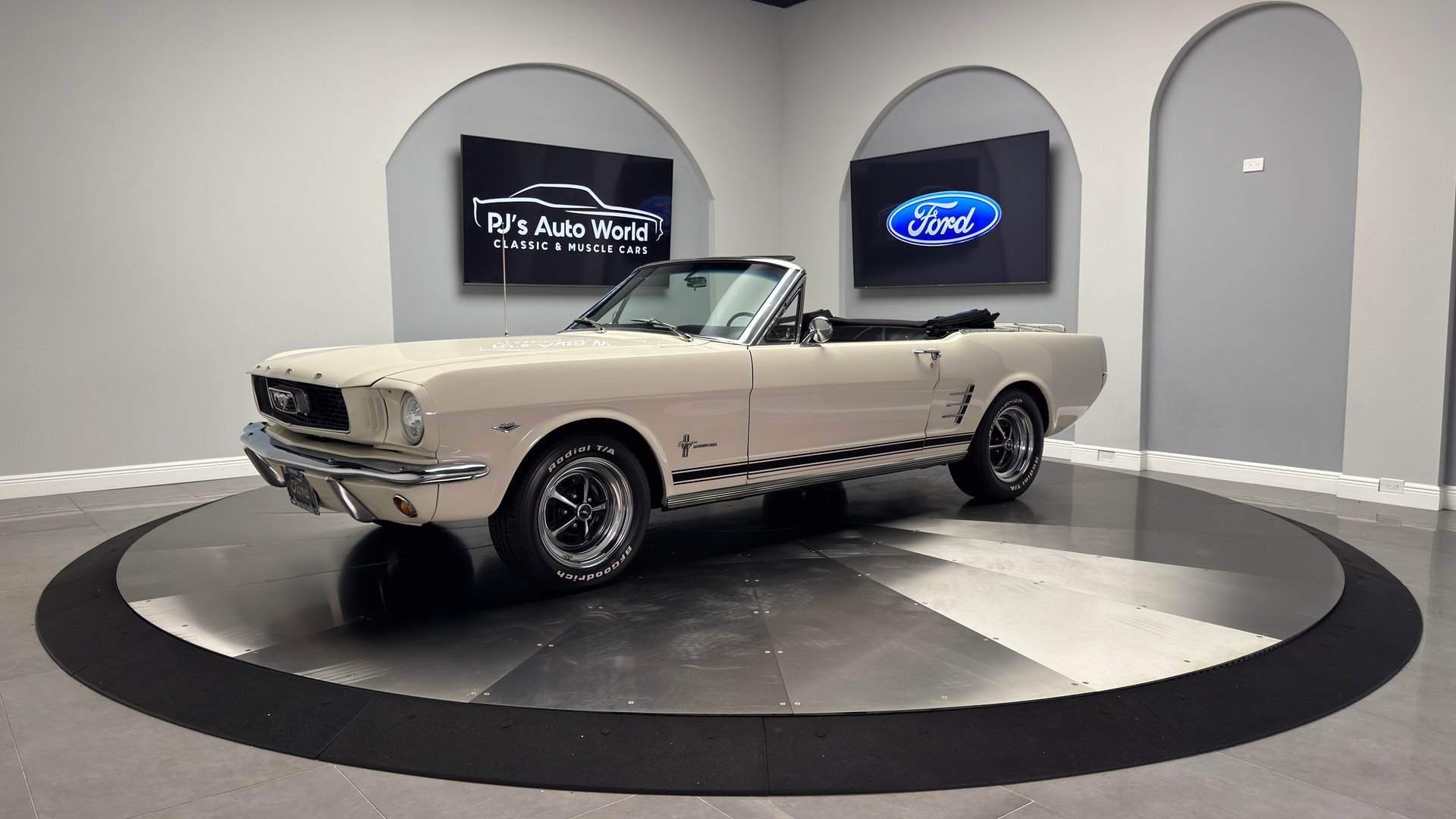
The car arrived on 17 April 1964, launched as an early 1965 model — the cars built before August 1964 are the ones everyone calls 1964½. The Mustang sat on Ford Falcon underpinnings, a simple unibody with leaf springs at the rear and a huge options list that let a buyer build anything from a six-cylinder economy car to a 271 hp street racer. Three body styles were offered from the start: hardtop coupe, convertible, and, a little later, the 2+2 fastback. The convertible was there from day one because Ford understood the image: nothing advertised youth in 1964 America like an open top, bucket seats and a floor shifter.
That first generation runs, in the pool behind this guide, from 1964 to 1973 — through the 1967–68 enlargement, the much bigger 1969–70 cars and the longest, heaviest 1971–73 generation, the last convertibles Ford would build for a decade. There was no factory Mustang convertible in the Mustang II years, 1974–78, and none in the first Fox-body years either. When the open car returned for 1983 it did so by an unusual route, detailed below: Fox coupes converted for Ford by an outside contractor. The Fox convertible ran to 1993, through the aero-nose facelift of 1987 and the long 5.0 LX and GT twilight that makes up most of the Fox cars you will actually find. The SN95 of 1994 brought a properly integrated factory convertible again, stiffer, safer and better sealed, and that design — updated in the 1999 New Edge restyle — carries the convertible to 2004, the end of the span covered here.
The pool tells the story of survival and fashion plainly. Of 1,260 Mustang Convertibles tracked for this guide, 808 are first-generation cars, 432 are Fox-body cars and just 20 are SN95s. The early cars dominate because they were collectible soonest; the Fox cars survive because the 5.0 era made them modern classics while still cheap; the SN95 is, for now, a used car in most buyers' minds, which is precisely what makes it interesting.
One warning belongs here. In our photo-note sample for this model — 1,115 cars examined — rust was mentioned in only 10 sets of notes, leaks in 2 and damage in 8, with no smoke mentions at all. Do not read that as a clean bill of health. Those are mentions in sellers' photo sets, not inspection results, and sellers photograph convertibles top-down on sunny days, not inner rockers on a lift.

The models
Every Mustang convertible shares the same bargain: you trade the roof's contribution to stiffness for open air, and Ford buys some of that stiffness back with steel you cannot see. The eras differ mainly in how much steel, and where.
| Era | Years | Engines | Character |
|---|---|---|---|
| Gen 1, original | 1964½–1966 | 170/200 six; 260, 289 V8 | The lightest, simplest, purest convertible; manual top standard, power optional |
| Gen 1, enlarged | 1967–1968 | 200 six; 289, 302, 390 V8 | Wider, heavier, big-block available; the structure works harder |
| Gen 1, SportsRoof era | 1969–1970 | 250 six; 302, 351, 390, 428 V8 | Muscle-era convertibles, Cobra Jet included; Boss cars were fastbacks only |
| Gen 1, last of the line | 1971–1973 | 250 six; 302, 351 V8 | The biggest Mustangs ever; 1973 is the last convertible until 1983 |
| Fox, contractor-built | 1983–1986 | 3.8 V6; 5.0 V8; four-cylinder on some LX | Four-eyed cars; converted from coupes by Cars & Concepts for Ford |
| Fox, aero | 1987–1993 | 2.3 four; 5.0 V8 | The 5.0 LX and GT convertibles everyone remembers; LX is the sleeper |
| SN95 | 1994–1998 | 3.8 V6; 5.0 (94–95), 4.6 V8; Cobra DOHC | Factory-integrated top and structure; glass rear window, better sealing |
| SN95 New Edge | 1999–2004 | 3.8 V6; 4.6 SOHC; Cobra DOHC | Sharper styling, the most usable and the least collectible — for now |
The 1964½–66 cars. These are the convertibles the market is built around — 1965 and 1966 alone account for 236 and 251 cars respectively in the year-by-year pool, the two biggest single years in this guide. They are small, light and honest: a top one person can raise by hand in under a minute on a manual car, a shallow trunk partly filled by the top well, and a back seat that is real, if snug. Trim runs from the plain standard interior to the Deluxe "Pony" interior, and the GT group added disc brakes and quicker steering on V8 cars. Shelby built convertibles only in 1966 in this period — a small run of GT350 convertibles, most automatic — so any claimed early Shelby convertible needs paperwork of a standard no other variant demands.
The 1967–68 cars grew in every direction to make room for the 390 big-block, and the convertible gained weight it could feel. The structure was revised with it and power tops became commoner. These are arguably the sweet spot of the first generation: still recognisably the original car, with the option of genuine big-block pace. The 1968 Shelby GT350 and GT500 convertibles sit at the top of this tree; again, documentation is the car.
The 1969–70 cars are muscle cars that happen to be convertibles. The range runs from a 250-six economy car through the 351s to the 428 Cobra Jet, and a documented R-code 428 convertible is one of the most serious Mustangs of any body style. Equally important is what does not exist: there was no Boss 302 or Boss 429 convertible from the factory; both were SportsRoof fastbacks only. A "Boss convertible" is a tribute, a swap or a story, and should be priced as the first of those.
The 1971–73 cars are the largest Mustangs ever made, designed around the 429, although by 1973 the engine list had settled to the 250 six, the 302 and the 351 Cleveland in two states of tune. They ride better, feel more like the Torino they increasingly resemble, and flex more. The 1973 car was the last Ford convertible of its era — Ford, like every US maker, was retreating from open cars under rollover-safety pressure that in the end never became law.
The Fox cars, 1983–93, are two cars in one shell. The 1983–86 "four-eye" cars brought the convertible back after ten years, initially as a GLX with V6 or V8 power. Ford did not build them as convertibles on the line: coupes were shipped to Cars & Concepts in Michigan, which cut the roof, added reinforcement and fitted the top. That contractor origin is not a defect — it was a proper Ford programme — but it explains the Fox convertible's particular mix of talents and squeaks. The 1987 aero facelift brought the famous LX 5.0 and GT pair: same 225 hp engine, the GT wearing a body kit, the LX plainer, lighter and now often dearer for it. Special editions — the 1992 "Summer" LX, the 1993 Feature cars, Saleen and SAAC conversions — multiply from here; verify each against its own registry, not the seller's enthusiasm.
The SN95 cars, 1994–2004, returned the convertible to the production line, engineered in from the start, with a power top, a glass rear window and far better sealing. GT, V6 and the SVT Cobra make up the range. Only 20 appear in this guide's pool, against 432 Fox cars — a fashion statement, not a verdict on the car.

Engines and gearboxes
A convertible weighs more than the coupe it is based on and was usually ordered by a buyer who wanted cruising more than racing. That shapes the survivors: sixes and small V8s with automatics dominate the early pool, the 5.0 dominates the Fox pool, and the genuinely violent engines are rare in open cars — which is why documented examples matter so much.
The sixes: 144's descendants — 170, 200 and 250
The first Mustangs used Ford's Falcon six, an overhead-valve inline engine of famously simple construction. The 1964½ car started with the 170 cu in (2.8-litre) unit at about 101 hp; from 1965 the standard six became the 200 cu in (3.3-litre) at about 120 hp, with seven main bearings from late 1964 making it the smoother, longer-lived engine. The 250 cu in (4.1-litre) version arrived for 1969 and carried the six-cylinder convertible to 1973. None of these is fast. All are tough, cheap to rebuild and honest at the pace a 1960s convertible actually wants.
What kills them is neglect, not design. The single-barrel carburettor wears its throttle shaft, giving an idle that will not settle and a flat spot just off idle that owners chase through the ignition for months; wiggle the throttle shaft — play you can feel is air the carburettor cannot meter. The intake manifold is cast into the head on the 200 and 250, so a cracked manifold is a cylinder-head conversation, not a gasket. A six that smokes on start-up is usually valve stem seals — cheap — while smoke under load is rings, and a full rebuild, roughly $2,500–4,500, has to be weighed against the car. Judge a six on cold starting, even idle and clean pulling to 3,500 rpm, and do not pay V8 money for six cylinders: the market does not.
Later base engines follow one rule: the Fox and SN95 3.8 Essex V6 is smooth and unstressed but weak on head gaskets after overheating — check for mayonnaise under the oil cap and a falling coolant level — and the 2.3 Lima four in Fox LX convertibles is nearly indestructible but works hard in a convertible. The SN95's developed 3.8 gained split-port induction from 1999.
The small-block V8s: 260, 289, 302 and 351 Windsor
This is the heartland. The 260 cu in V8 of the 1964½ cars gave way within months to the 289 (4.7 litres), and the 289 in its three period tunes is the engine the early convertible market is priced around: the C-code two-barrel at about 200 hp, the A-code four-barrel at about 210–225 hp, and the K-code High Performance 289 at 271 hp, with solid lifters, a dual-point distributor and a bottom end built to rev. The K-code in a convertible is a serious claim: the engine code is the fifth character of the VIN, stamped on the driver's inner fender apron and the door data plate, and a K-code car with a replacement engine is worth a fraction of a matching one. Check the VIN before you listen to the story.
From 1968 the 302 (5.0 litres) took over as the standard V8, in two-barrel form for most convertibles, with the four-barrel J-code for 1968. The 351 Windsor arrived for 1969 — taller deck, stronger bottom end, two-barrel at about 250 hp and four-barrel at about 290–300 hp in period gross terms. These small-blocks are understressed, parts are everywhere, and failure is almost always age, not design. Oil leaks from the rear main seal and cork rocker-cover gaskets are normal, not damning. A rattle at cold start that fades is usually a lazy hydraulic lifter; a rattle that stays is a worn cam lobe, and a Windsor with a wiped exhaust lobe idles with a soft chuff through the carburettor that a compression test will confirm. Overheating is the real enemy, because so many convertibles have spent decades with a marginal radiator and a missing fan shroud. Look for the shroud — its absence explains a traffic-jam temperature climb better than any head-gasket theory.
The Fox 5.0 is this same 302 in its finest road form: roller camshaft from 1985, sequential fuel injection from 1986, and 225 hp and 300 lb-ft from 1987 to 1992, with a nominally lower 1993 rating that reflected measurement more than the car. Its known faults are specific: the harmonic balancer's rubber ring walks and throws the timing marks off, so an engine that "won't time up" may need a balancer, not a tune; the idle hunts when the throttle body and idle air control valve gum up, a cleaning job, not an ECU; and the TFI ignition module fails with heat, giving a car that cuts out hot and restarts cold — carry a spare, as every experienced Fox owner does. The 1994–95 SN95 GT kept this engine at 215 hp in a heavier, stiffer car, and those two years are now sought out as the last of the pushrod line.
The big-blocks and the Cleveland: 390, 428, 429 and 351C
For 1967 Ford widened the car for the FE big-block, and the 390 GT — about 320 hp in period terms — became the heavyweight option, with the 428 Cobra Jet arriving in mid-1968 and dominating 1969–70. The Cobra Jet is a working engine, not a showpiece: a 428 with 427-style heads, a big Holley four-barrel and, in Ram Air form, a shaker hood, rated at a deliberately modest 335 hp nobody believed. In a convertible it is rare, valuable and frequently faked. The R-code in the VIN (Ram Air) or Q-code (non-Ram Air) is the starting point, the Marti Report — the licensed production record for 1967-onwards Fords — is the proof, and date-coded block, heads and carburettor are the corroboration. A 390 dressed as a 428 is the commonest fraud in this corner of the market, dressed precisely because the convertible premium rewards it.
The 351 Cleveland, offered 1970–73, is a different family entirely — canted-valve heads, huge ports on the four-barrel versions, a reputation for top-end power. The 1971–73 convertibles offer it in two-barrel form (about 240 hp gross, falling as net ratings arrived) and four-barrel form, the 1972–73 cars progressively softer. Checks: oil pressure at hot idle (low pressure shows first as top-end noise), cracked exhaust manifolds, and the knowledge that Cleveland parts are not Windsor-cheap. The 429 appeared in the 1971 convertible only, in Cobra Jet form; any example needs the full documentary treatment. Boss engines in convertibles are transplants by definition.
The modular V8s: 4.6 SOHC and DOHC
The SN95 changed over in 1996 to the 4.6-litre modular V8: single overhead cam, two valves per cylinder, about 215 hp at first, then, with the Performance Improved heads on the 1999 New Edge GT, a genuine 260 hp. The SVT Cobra used the DOHC four-valve version — 305 hp in 1996–98, 320 hp in 1999 and 2001, and the supercharged "Terminator" of 2003–04 at 390 hp, which did come as a convertible and is the performance summit of this guide. Timing chains, guides and tensioners wear past 100,000 miles and announce themselves as a cold-start rattle from the front cover — a $1,500–2,500 job done properly, all together. Plastic intake manifolds on 1996–2001 SOHC cars crack at the coolant crossover; an aluminium-crossover manifold is the permanent fix. Spark plugs on early two-valve heads have little thread engagement — a plug that blows out is a thread-repair job, not a catastrophe, but it is a negotiation. Judge a modular by oil history and noises, not by pushrod rules.
Gearboxes
Early cars offer a three-speed manual nobody wanted then or now, a four-speed manual, and the C4 Cruise-O-Matic automatic. The four-speed is the Toploader, one of the strongest manual boxes Ford ever made; it should select cleanly and stay in gear on the overrun. Worn second-gear synchromesh is the first failure, felt as a crunch on a hurried downchange. A Toploader rebuild runs roughly $1,200–2,200; a C4 rebuild, $1,500–2,500, both routine work anywhere in America. Big-block cars used the heavy C6; some 1971–73 cars used the FMX, strong but with thinner parts support. On any automatic, judge the fluid — bright red and sweet is maintained, brown and burnt is a deferred rebuild — and the engagement: a long pause, then a thump into reverse is the classic worn-box signature.
Fox cars pair the 5.0 with the T-5 five-speed — light, pleasant, marginal behind a tuned 302, its weakness showing as third-gear synchro wear — or the AOD automatic, which lives or dies by its throttle-valve cable adjustment: a misadjusted cable does not cause a bad shift, it causes a burnt transmission, quickly, so a Fox automatic with a recent cable change and a flare on the 2–3 shift is a car to price very carefully. An AOD rebuild runs $2,000–3,000. SN95 cars use the stronger T-45 and later TR-3650 manuals, and the AOD-E/4R70W automatic, the most durable in this guide and the least characterful. Automatics dominate the pool — 700 against 480 manuals in the tracked listings — which is period-correct: these were cruisers when new, and the market now pays a premium for the manual cars it cannot find enough of.


Problem areas
A convertible Mustang fails differently from a coupe, in places a coupe buyer never has to think about. The roof of a coupe is structure: it ties the windshield frame to the rear of the car and stops the shell twisting. Take it away and every load the suspension feeds into the body has to travel through the floor, the sills and the cowl instead. Every generation of Mustang convertible therefore carries extra steel low in the shell to do the roof's work. That steel is also, not coincidentally, the steel that traps water lowest in the car and rusts first. The whole buying logic follows from that one fact: the reinforcement is the rust, and the rust is the structure.
Rust and structure: the convertible map
Inner rocker panels — the convertible's spine. On a first-generation car, the painted outer rocker below the door is largely cosmetic. The strength is in the inner rocker panel, a heavy box section inside it, running from the front torque box to the rear, fitted to convertibles precisely because there is no roof. It is invisible in normal viewing, sits in the spray path of both wheels, its drain holes block, and it rots from the inside out. A car can present with clean outer rockers — replaced, filled or simply luckier — over inner rockers that are lace. The tests are physical. Lift the car and prod the inner rocker along its length from underneath; sound metal rings and resists, rotten metal crunches and flakes. Watch the door gaps as the car is lifted by one corner: a shell that twists visibly, gaps closing at the top, is telling you the inner rockers and floor are no longer doing their job. Inner rocker replacement is structural welding — roughly $2,000–4,000 a side done properly with paint — and a car needing both sides, floors and torque boxes has consumed most of the value difference between a project and a good car before you have discussed its engine at all.
Torque boxes. Where the front subframe rails meet the body, and again at the rear spring mounts, first-generation Mustangs carry torque boxes — gusseted boxes that transfer suspension loads into the shell. On convertibles these are heavier, and they trap mud thrown straight off the tyres. Front torque-box rot shows as vague, wandering steering that no alignment cures; rear rot shows as a car sitting unevenly and, in the limit, a leaf spring trying to part company with the car. Prod all four areas on a lift. Replacements are available — $800–1,800 a corner fitted and painted is a fair planning figure — but, as with inner rockers, they rarely rot alone.
The floor, and the seat-riser pan. Coupe and convertible floors differ. The convertible uses a reinforced floor with a one-piece seat-riser pan and additional cross-bracing under the seats, tying the inner rockers together across the car — this pan is a structural member, not a seat mount. Water reaches the floor from three convertible-specific routes: past the top's rear curtain and side seals into the top well, then forward under the rear seat; through the cowl (see below) into the front footwells; and through perished door and quarter-window seals, into drain holes that block with debris. Lift the carpets and the rear seat base: the area under the rear seat, directly below the top well, is the convertible's truth-teller. Surface rust is a weekend's cleaning and treating. Holes are a welding bill — floor pans fitted run $1,000–2,000 a side — and holes around the seat-riser pan and its braces mean the cross-bracing is compromised, which is structural money, not floor money.
The cowl. The vented cowl panel ahead of the windshield is the classic first-generation rust trap on every body style — but on a convertible the stakes are higher, because the cowl and windshield frame are the front end of what little torsional structure the open car has. Cowl rust announces itself as water dripping onto the front carpets in rain — sellers will describe this as a windshield seal, and sometimes it is — and as bubbles at the lower corners of the windshield opening. The repair is one of the worst on the car: dashboard-out, windshield-out, and $2,500–5,000 is realistic for both side panels done properly. Test it with a jug of water into the cowl vent, as described below, and believe the result.
The windshield frame. Coupes do not ask their windshield frame to be a torsional link; convertibles do. Rust in the header rail and A-pillars — from water sitting under the header seal and in the pillar drains — weakens the one part of the upper body that locates the top and the doors. Bubbling at the pillar bases, a header rail that flexes when you pull on it, and top latches that no longer pull down evenly are all the same story. Header and pillar repairs are fabrication, priced per car, and a convertible with a rotten windshield frame and rotten inner rockers is a parts car wearing a whole car's price tag.
The top well, rear quarters and trunk. Behind the rear seat, the folded top sits in a vinyl-lined well. Water past the top's rear seal collects there if its drains block, and attacks the well floor, rear seat pan and inner wheelhouses. Rear quarters rust behind the wheels and around the arch lip — and the quarter also carries the top mechanism's pivots and quarter-window regulators, so rust around those mounts matters mechanically too. In the trunk, check the drop-off panels and the top of the fuel tank, which is the trunk floor on these cars: a rusted tank top is a rust finding and a fuel-system finding. Trunk repairs are panel work, $800–2,000 depending on extent — less critical than rockers and cowl, but they complete the picture of how wet the car has lived.
Fox and SN95 structure. The Fox convertible's contractor origin shows underneath: Cars & Concepts added underbody bracing tying the subframes together, plus inner sill strengthening, and those added pieces and their welds are where Fox convertibles rust and crack. Check the braces for rust at the welds and cracking where they meet the floor — a hard-used 5.0 convertible, launched for years on sticky tyres, can tear at its own reinforcement. A Fox with no subframe connectors, a tuned engine and a life of drag strips will feel loose in a way no bushing refresh cures. The SN95 is the stiffest shell here by a wide margin and rust is a salt-belt question rather than a design one: check sills, floor seams and strut towers, and expect surface corrosion rather than perforation on a cared-for car.
Scuttle shake — symptom, not diagnosis. Every open Mustang shakes its cowl over sharp bumps; the Fox is famous for it, and even the SN95 is not immune. Separate design shake from damage shake. Design shake is a brief shudder through the wheel and mirrors, in a car whose doors latch cleanly, gaps are even and structure prods solid. Damage shake comes with evidence: doors that need a lift to latch, gaps that vary, a top that latches unevenly, cracked paint at the A-pillar bases. Shake plus evidence means the reinforcement has gone soft, and no strut brace or subframe connector will put back steel that has rusted away.
The top, and its hydraulics
The top is the convertible's defining component and its most misjudged one. Sellers price a shiny new top as a major virtue; experienced buyers price the frame, the header, the seals and the hydraulics, because cloth is the cheapest part of the system.
Judging the cloth. Original and quality replacement tops are pinpoint vinyl on the early and Fox cars; canvas is the premium replacement and the SN95-era material. Material: vinyl that has gone shiny, stiff and chalky is at the end of its life even without a hole in it, because it will crack at the folds within a season; canvas that has lost its water repellency will soak rather than shed. Rear window: early and Fox tops use a plastic window that yellows, clouds and goes brittle — a window you cannot see through is a failed window, and while a trimmer can replace just the window, roughly $400–800, a top old enough to need one usually needs everything. Glass windows — standard on SN95, a popular upgrade earlier — can delaminate at the edges, but they fold and see through properly. Seams and listings: seams that are opening, pads disintegrated so the bows print through the cloth, and a top that drums at speed all point to borrowed time. A quality replacement top, fitted by a trimmer who knows these frames, with pads and a new well liner, runs roughly $1,500–2,500 in vinyl and $2,000–3,500 in canvas — which is why top condition is a price lever, and why a new top fitted badly, over a bent frame, is worth less than an honest old top on a straight one.
The frame. The folding frame is a linkage of bows, rails and pivots, and it wears at the pivots. Raise the top halfway and stop: it should hold position symmetrically. Wiggle each side rail — pivot play translates, at the header, into inches of misalignment. The header bow, the frontmost bow that latches to the windshield, rusts from inside where condensation sits in it, and a header bow soft at its ends will not pull the top down evenly however the latches are adjusted; reproduction header bows exist for the early cars, at $300–600 plus fitting. Bent bows — from a top forced against a frozen pivot — show as a top that sits high on one side and wears a hole in the cloth at the same point on every fold. Straightening a frame is trimmer work; price it as such.
Power tops and hydraulics. Power operation was an option on the early cars and the norm on Fox and SN95. The system is simple: an electric pump, usually behind the rear seat, two hydraulic rams that drive the frame, hoses between them, and a reservoir of automatic transmission fluid or, on some later systems, hydraulic oil — use what that car's manual specifies, never brake fluid. Rams leak at their seals, showing as wetness at the ram bodies and a top that creeps down on one side; rebuilt or new rams run $150–300 each, plus labour. Hoses go brittle and burst, spraying the well and rear seat area; a full hose set is $150–350 and a morning's work. Pumps fail electrically (motor, switch, breaker, relay) or hydraulically — a pump that runs but moves the top slowly and noisily is usually starved by a leak elsewhere, not dead, and topping up without finding the leak buys a week. A complete hydraulic overhaul runs $800–1,500, and a car whose top "just needs a switch" needs, in the order you should check: fluid level, the leak that lowered it, then the switch. Manual tops — standard early, found on some Fox LXs — are not a defect: lighter, simpler, and their check is the frame check alone.
Water management. A convertible top is a managed leak, not a seal. Water is expected to enter at the side rails and rear curtain, and is caught by gutters, the well and drains, and conducted out of the car. The system fails when drains block — top-well, rocker, cowl and door drains — and every structural horror above starts as a blocked drain and a car parked outside. The header, side-rail and rear curtain seals are replaceable rubber, $200–500 a set depending on era; perished seals make a car wet and noisy but do not, alone, rot it — the water they admit still drains if the drains are clear. Judge water management as a system on inspection, with a hose, as below.
Mechanical
Beyond the engine-specific points, the convertible shares the coupe's mechanical weaknesses, with two twists. The first is weight and flex: bushes, steering boxes and shock absorbers work harder in a shell that moves, so a convertible that wanders and knocks is often a car whose steering box, idler arm, ball joints and bushes are all at 80 per cent worn — individually passable, collectively awful. Budget a front-end refresh — $800–1,800 — into any vague-feeling car, after the structural checks have cleared the shell. Brakes follow the classic pattern: single-circuit master cylinders on the earliest cars are a safety item most owners upgrade to dual-circuit; front discs were optional early, standard on GTs. The second twist is use: convertibles were second cars, garaged and lightly used, which means low mileage and long sitting — perished seals, varnished fuel, seized calipers, a tank full of rust sediment. A car that has sat for a decade needs $2,000–4,000 of recommissioning before its low mileage is worth anything.
Rear axles are the Ford 8-inch on most early cars and the near-indestructible 9-inch behind big-blocks and K-codes; both whine with wear, leak from pinion seals, and cost $800–1,500 to rebuild. Fox 5.0s use the strong 8.8-inch, whose limited-slip wears its clutches and then behaves as an open diff — test it as described in the inspection. Early leaf springs sag, and the front spring eye is a torque-box neighbour, so sag plus rust is a combined finding.
Interior: sun and water damage
A coupe interior ages by wear; a convertible interior ages by weather. Ultraviolet is the first agent: dash pads crack, seat vinyl splits at the stitching on the top surfaces first — look at the top of the rear seat back, the most sun-exposed upholstery in the car, as the interior's sundial — and red and blue interiors fade to a patchwork no dye job fully reconciles. A full early interior is available as reproduction kits, $2,000–4,000 in parts and $1,500–3,000 in trimming labour done well; Fox interiors are less completely reproduced and good used convertible-specific rear quarter and top-well trim is the constraint; SN95 interiors are plentiful used and cheap, leather wear aside.
Water is the second agent. Musty carpets, damp underlay, surface rust on seat frames, and silt lines inside the door and quarter trims all record the car's wet history. The well liner behind the rear seat hides the top well; lift it. Judge an interior from the rear seat top and the rear footwells inward: those are the places sun and water reach that a quick valet does not.
Electrics
Mustang electrics are simple, and their failures are correspondingly honest. Early cars suffer at the connections: corroded fuse boxes, tired voltage regulators, headlamp switches whose built-in breakers trip and give flickering lights, and earth straps that rot and produce everything from slow cranking to a fuel gauge with opinions. None of it is expensive; all of it is tedious, and a car where everything works has been maintained by someone who cared, which is information. Convertible-specific electrics are the top circuit — switch, breaker, pump motor and, on Fox and SN95 cars, relays — and the quarter windows: rear quarter glass runs on regulators buried in the quarters, awkward to reach and often seized, and a quarter window that will not align with the top's side rail is both a regulator job and a water leak. On SN95 cars add window motors, the top module's microswitches, and airbag and ABS lights that need a code reader, not a guess. Budget $300–800 for a typical car's electrical niggles; a car needing a full rewire is telling you about its whole life — listen to it.


How to inspect one
Allow two hours, not one — a convertible has a whole second car, the top and structure, hiding inside the first. Bring a torch, a magnet in cloth, a screwdriver for prodding (with permission), a jug for the cowl test, and a friend to watch gaps while you work. If the car passes you, pay for a lift inspection before money moves.
- Paperwork and identity first. Match the VIN — on the driver's inner fender apron on early cars, on the door data plate, and on the dash plate through the windshield on Fox and SN95 — to the title. Read the fifth character of an early VIN for the engine code, and the door plate for original colour and trim. For 1967-onwards cars, a Marti Report settles how the car was built; for any Shelby, Cobra Jet, K-code or special-edition claim, no report means no premium.
- Cold start. Insist the engine is cold. Watch for blue smoke at start-up (valve seals) and smoke under load (rings), and listen for chain rattle on modular V8s and lifter clatter on Windsors. A car that will not start cold for the seller will not start cold for you.
- Doors, gaps and the lift test. Before the car moves, open and close both doors: they should latch without a lift or a slam. Read the gaps along their full length — evenness at the top rear corner matters most. Then have the seller jack one front corner while your friend watches the gaps: movement you can see, a door that suddenly binds, is the inner rockers and floor speaking. This step, with step 5, decides whether you continue at all.
- Top operation — three full cycles. Raise and lower the top three times. It should move evenly, at a steady speed, without one side leading, groaning or stopping mid-travel. Stop it halfway on one cycle: it should hold without creeping down — creep means a leaking ram or valve. On a manual top, feel for even resistance. At full raise, check both header latches pull down evenly and the header meets the windshield frame along its whole width.
- Underneath: rockers, torque boxes, floor. On the lift, prod the inner rockers along their full length, all four torque-box areas on an early car, the seat-riser pan and its braces, and the floor seams. Crunching, flaking or a screwdriver that sinks settles the car. On a Fox, add the contractor bracing and its welds; on an SN95, strut towers, sills and floor seams. Read fresh underseal blown over everything as a question the seller must answer, not an answer.
- The cowl test. On an early car, pour a jug of water slowly into the cowl vent while your friend watches the front footwells with the carpets pulled back. Water inside means cowl side-panel rust, the dashboard-out repair from the problem areas section, priced into the offer or walked away from. Damp carpets on arrival are the same finding delivered early.
- The water test for the top. With the top up and latched, run a hose — not a pressure washer — over the header, side rails and rear curtain for several minutes, then inspect inside: the top well, under the rear seat, the rear footwells, the trunk drop-offs. Some dripping at the side rails on an early car is period-normal; water in the well with blocked drains is a maintenance finding; water under the rear seat and in the trunk is the rust mechanism caught in the act.
- Top condition, close up. Judge the top itself as the problem areas section sets out: cloth stiffness and shine, seams and pads, rear window clarity — sit in the back seat and try to read a number plate through it — header bow ends prodded for softness, side-rail pivot play with the top half-raised, and the well liner lifted to see the well floor. Price what you find against the replacement figures in that section, not against the seller's "tops are cheap."
- Glass alignment. Raise all four windows with the top up. Front glass should meet the side-rail seals evenly; quarter windows should rise fully and seal against the top. A quarter window that stops short, tilts or grinds is a regulator job inside the quarter — awkward, priced accordingly — and a guaranteed leak until done.
- The test drive, top down and top up. Twenty minutes, both configurations. Top down, find a rough road and watch the windshield frame and mirror over bumps: brief shudder is design; shake with rattling doors is evidence, and steps 3 and 5 have already told you which this car has earned. Top up, at highway speed, listen: a top that drums or whistles at one corner has frame or seal faults. Test the gearbox as its section describes — Toploader synchromesh, C4/C6 delay into reverse, AOD 2–3 flare, T-5 third gear — and brake hard: the car should stop straight, without the pedal pulsing or sinking.
- Running checks. Hot idle oil pressure, temperature stability in traffic (and is the fan shroud present on a small-block?), charging, and every electrical item: lights, washers, horn, heater blower on all speeds, window switches, top switch through one more cycle. On a limited-slip car, a safe launch tells you whether the clutches still lock — one wheel spinning freely alone means they do not.
- Interior and trunk, last. Sit in every seat. Read the top of the rear seat back for sun, feel for collapsed foam, smell the carpets, lift the rear seat base and trunk mat, lift the spare, and check the top of the fuel tank and the drop-offs. A sound, dry, original interior in a convertible is rarer than a sound engine — weight it accordingly.

Values
The site's computed market block below this guide carries the listing numbers — what is for sale, what has sold, and at what figures — refreshed at every build, and this section deliberately carries none. What follows is how to read those numbers like a buyer who has read the rest of this guide.
The convertible premium is real, and it is not uniform. In the first generation, the convertible was the most expensive body style when new and has stayed the most desired, so an open car carries a clear premium over an equivalent coupe — but the premium is largest on the cars people buy for sunshine: standard and GT small-blocks, nicely trimmed cruisers in period colours. At the performance summit the logic inverts: the fastest Mustangs were fastbacks, the Boss cars were fastbacks only, and a Cobra Jet convertible's value is driven by rarity and documentation rather than a body-style premium as such. On Fox cars the premium is modest and condition-led — a small step over the hatchback, not a leap — and on SN95 cars it thins further still, because the open car was common and the coupe is the one performance buyers chase. Read any premium in the computed figures below against that era logic before deciding a car is cheap or dear.
Condition spread is the whole market. A Mustang convertible's value is set, in order, by structure, top and hydraulics, interior, and only then by engine and mileage — the reverse of the order sellers advertise. The gap between a sound, dry car with a good top and a shiny car with soft inner rockers is not a discount, it is the cost of the welding in the problem areas section, plus the repaint that welding makes necessary, plus a year. Project convertibles look cheap against drivers by a margin that almost exactly equals the honest cost of making them into drivers, which is why there is no such thing as a cheap early convertible that stays cheap. Asking prices sit above achieved prices, and the gap widens at the top: documented K-code, Shelby and Cobra Jet cars sell on paperwork and patience, tribute cars are asked at documented money and achieved at tribute money, and auction results — a large share of this model's tracked pool comes from auction listings — are the cleanest read on what the market actually pays.
Top condition is a price lever you can compute. Unlike most value judgements, this one is arithmetic: a car needing a quality top, pads and well liner is worth less than the same car with a new, well-fitted top by roughly the trimmer's bill for that work, a car needing rams and hoses by that bill too, and a car needing both by the sum. The reverse trap is the new top fitted over a bent frame or a rotten header bow: it photographs as the expensive job done, and it is the cheap half of the job done. The inspection's frame and header checks separate the two.
Buy, in short, on structure and documents, negotiate on top, hydraulics and recommissioning, and let the computed figures below tell you where your specific car sits once you know which of those things it actually is.
Parts and ownership
The early Mustang is one of the best-supported classics in the world — Ford built convertibles by the tens of thousands, the coupe shares most of what matters, and the reproduction industry has remade nearly everything at least once. The convertible-specific parts are the exception, and knowing which list a part sits on is the ownership skill.
Easy: everything mechanical that a coupe shares — engine internals for the sixes, Windsor small-blocks and the Fox 5.0, brake and suspension wear parts, steering, cooling, exhausts, seals, interior kits for the early cars, and tops themselves in vinyl and canvas, in the original colours, from multiple suppliers. Order today, fit this weekend is a realistic rhythm for most needs, at prices close to modern-car money.
Harder and dearer: the convertible's own hardware. Inner rockers, torque boxes, floor and seat-pan pressings are reproduced for the early cars — the supply is good, the cost is the welding — but Fox contractor-bracing pieces are not a catalogue item, and a rotten Fox is repaired by fabrication. Top frames and header bows are reproduced for the early cars and increasingly scarce for Fox; rams and pumps are rebuildable, hoses straightforward; quarter-window regulators, top-well trim and Fox convertible-specific mouldings are the hunted parts, priced by scarcity at swap meets and breakers. SN95 top modules, microswitches and Cobra parts sit in the modern pattern: available, electronic, priced by Ford and SVT rather than the reproduction trade. Chrome replated properly is a serious bill, and a quality repaint starts in five figures — the standing reason this guide keeps telling you to buy the body.
Running costs. A sorted Mustang convertible is a realistic regular-use classic: fuel consumption from the mid-teens mpg for a V8 cruiser to the low twenties for a six or a Fox 5.0 driven gently, servicing any competent independent shop can handle, insurance in line with other cars of the value. The budget lines that catch new owners are convertible lines. A top lives ten to fifteen years in regular use, less in sun-belt outdoor storage, so a mid-life top is a known four-figure appointment in the future; hydraulic service, seals and drain-clearing are annual, cheap, and skipped at structural prices. Cars that have sat need the recommissioning priced earlier: fuel system end to end, all brake hydraulics, every fluid, belt and hose. Garaging is not a luxury; a convertible that must live outside needs clear drains checked monthly and a top left up and latched, never folded wet, because a folded wet top mildews in its well and a frame left folded seizes at the pivots you tested on inspection.
Which one to buy
- The all-rounder: 1967–68 small-block. Enlarged shell, mature top, disc-brake availability and the deepest parts support in the guide, in the car that still looks like the original idea. A 289 or 302 with a power top, bought on structure, is the convertible most owners keep.
- The value buy: 1965–66 six-cylinder or C-code 289. The lightest, simplest open Mustangs at the softest end of the early market — provided the inner rockers are sound, because on these cars the cheap buy and the expensive buy are separated by steel, not specification.
- The cruiser: Fox LX 5.0, 1987–93. The plainer Fox convertible with the full 225 hp engine, a power top and modern manners, still bought for driving rather than showing. Buy the best-documented, least-modified car; the T-5 manual is the one to hold out for.
- The serious car: 1969–70 428 Cobra Jet. One of the great muscle convertibles, bought entirely on VIN, Marti Report and date codes. At this level you are buying documents with a car attached — add a marque specialist to the inspection in this guide.
- The modern buy: SN95 Cobra or GT, 1994–2004. The stiffest shell, the best sealing, a glass rear window and, in the 2003–04 supercharged Cobra, the fastest car in this guide — bought now, while the market still treats these as used cars, by the buyer who wants to drive rather than restore.
- The character buy: 1973. The last of the line, the biggest and softest of the first generation, unloved for decades and honest for it. A good 351 car is a boulevard convertible in the true sense.
And the rule that overrides all of the above: buy the least rusty convertible you can find, with the soundest top frame, in the specification you can live with. Engines, gearboxes, hydraulics and even tops are fixable at prices you can plan for. Inner rockers, a cowl and a windshield frame rotted together are the one combination that costs more to put right than the finished car will be worth.