
Ford ltd buyer's guide
Ford ltd -- the model's own buyer's guide: variants, values and what to check.
Years listed: 1968-1991 · Series: Torino
Overview and history
The Ford LTD is the car that taught Detroit how to sell quiet. When Ford launched it for 1965 as the Galaxie 500 LTD, the advertising made a claim that would have been unthinkable a decade earlier: at highway speed, this Ford was quieter inside than a Rolls-Royce. Ford had the measurements to back the boast up, and buyers understood the message instantly. The LTD was not a sports car, not a muscle car and not a stripped price leader. It was the top of the full-size Ford line, a big, formal, V8-powered American sedan, hardtop, coupe or wagon trimmed like a car costing far more, and sold on silence, ride quality and upholstery rather than speed.
The formula worked so well that the LTD stepped out of the Galaxie range and became a model line in its own right for 1967, sitting above the Galaxie 500 and the Custom in Ford's full-size hierarchy. Through the late 1960s it was the car a successful American family bought when they had arrived but did not want to shout about it: hideaway headlamps on the late-sixties cars, deep pile carpeting, woodgrain appliqué, a clock, courtesy lights everywhere, and a ride tuned to erase expansion joints. A convertible joined the range, the Country Squire wagon carried the LTD idea into the school run with its famous simulated-wood sides, and the LTD Brougham pushed the interior trim a step further still, with plusher seats and more brightwork.
The car grew with the decade. The 1969 restyle made it longer, lower and more formal, and the 1971 generation was the biggest LTD of all, a genuinely huge automobile built when fuel was cheap and size was a virtue in itself. Then the world changed. The 1973 cars gained the heavy federally mandated bumpers, the fuel crises of 1973 and 1979 squeezed the big-car market from both ends, and Ford's answer, when it came for 1979, was one of the most successful downsizings Detroit ever managed. The 1979 LTD moved onto the new Panther platform, shedding roughly 700 pounds and nearly a foot of length while keeping a proper full-frame chassis, a V8 up front, rear-wheel drive and room for six. It is the car most people picture from our listings, and it carried the line, as the LTD and then the LTD Crown Victoria, all the way to 1991.
There is one fork in the family tree you have to understand before you buy anything. For 1983 Ford split the name in two. The full-size Panther car became the LTD Crown Victoria and continued, little changed in concept, until 1991, when the LTD badge was retired and the Crown Victoria name carried on alone. The plain LTD name, meanwhile, moved down onto a completely different car: a mid-size, Fox-platform sedan and wagon, a relative of the Fairmont, sold from 1983 to 1986 with four- and six-cylinder engines alongside the 5.0 V8. Same badge, different automobile in almost every dimension. This guide covers the whole LTD story, but the centre of gravity of today's market, and of our listings, is the full-size car: the 1965 to 1978 giants and the 1979 to 1991 Panther cars.
Why buy one now? Because the LTD delivers the classic full-size American experience — the float, the silence, the bench seat, the column shift, the vast trunk — in a car that is mechanically simple, enormously well understood, and supported by one of the deepest parts networks in the hobby. These were working cars, not garage ornaments, and they were built in the hundreds of thousands, so survivors are plentiful and prices have stayed sane while flashier nameplates ran away. The catch is the same one that governs every big Ford of the era: the mechanicals will forgive almost anything, but the body and frame will not. Buy the structure, and an LTD will reward you for decades.

The models
An LTD badge can sit on four distinct generations of full-size car, one mid-size namesake, a flagship wagon and several trim levels that sellers routinely blur together. Learn the generations first, because parts, problem areas and values all follow the platform, not the badge.
| Model | Years | Engine | Output | Built | Character |
|---|---|---|---|---|---|
| Galaxie 500 LTD | 1965–1966 | 289, 352 or 390 V8 | 200–300 hp | Volume seller | The original; quiet-ride pioneer, Galaxie bones |
| LTD (first standalone) | 1967–1968 | 289, 302, 390, 427 or 428 V8 | 200–425 hp | Volume seller | Hideaway lamps, formal roof, rare big-block cars |
| LTD (second generation) | 1969–1970 | 302, 351W, 390 or 429 V8 | 210–360 hp | Volume seller | Bigger, smoother; 429 makes a quiet hot rod |
| LTD (third generation) | 1971–1978 | 302, 351W, 351M, 400, 429 or 460 V8 | 134–220 hp | Volume seller | The giants; smog-era tuning, 460 the pick |
| LTD (Panther) | 1979–1982 | 302 or 351W V8 | 130–145 hp | Volume seller | The successful downsizing; frame car, lighter |
| LTD Crown Victoria | 1983–1991 | 302 (5.0) V8, 351W to 1987 | 140–160 hp | Volume seller | The last traditional full-size Ford sedan |
| LTD Country Squire | 1965–1991 | As the sedans, by year | As the sedans | Steady seller | The flagship wagon; woodgrain sides, rear-facing seat |
| LTD (Fox, mid-size) | 1983–1986 | 2.3 four, 3.8 V6 or 5.0 V8 | 88–165 hp | Volume seller | The namesake, not a full-size car; LX is the prize |
(Outputs are period figures and mix the gross ratings used before 1972 with the net ratings used after; treat them as orientation, not gospel, and read the engines section for what each motor actually feels like.)
The early cars, 1965–1968. The Galaxie 500 LTD of 1965–66 is the connoisseur's starting point: the lightest, simplest LTD, on the Galaxie platform, with the small-block 289 as the common engine and the FE-series 352 and 390 as the step-ups. The standalone LTD of 1967–68 added the formal, squared styling and hideaway headlamps, and at the very top of the order sheet sat the 427 and 428 FE big-blocks, which turn a luxury cruiser into something startling. Almost none were sold, almost all were driven hard, and a genuine big-block early LTD is a rare and valuable thing — which is exactly why you verify the VIN engine code rather than the air-cleaner decal, as the inspection section explains.
The middle giants, 1969–1978. The 1969–70 cars are the sweet spot of the big-car era for many buyers: the 351 Windsor and the 429 big-block give effortless pace, the styling is the cleanest of the large generations, and the smog equipment has not yet strangled the engines. The 1971 redesign made the car bigger again, and from 1973 the 5-mph bumpers added length and weight while net horsepower ratings and emissions tuning took the edge off performance. The engines that matter here are the 400 and, above it, the 460, the largest engine ever fitted to an LTD and the one that restores the effortless torque the car's character depends on. A late-seventies LTD with the 460 is a magnificent highway car; the same car with a wheezing small-block and two decades of deferred maintenance is a barge.
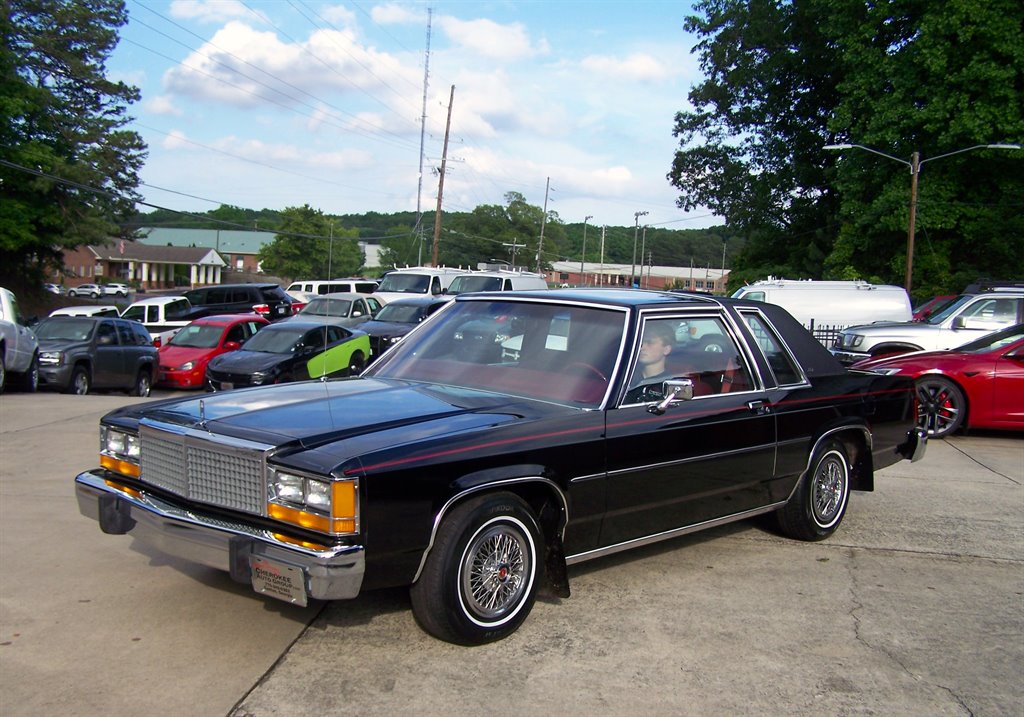
The Panther cars, 1979–1991. The downsized LTD of 1979 kept everything that mattered — body-on-frame construction, V8 power, six seats, a trunk you could lose luggage in — and lost the excess. From 1983 the full-size car was renamed LTD Crown Victoria, the Crown Victoria name having served as the top trim level from 1980. These are the easiest LTDs to own: the 5.0-litre 302 is one of the most durable engines Ford ever built, the AOD automatic (from 1980 on the 302 cars) gives overdrive cruising, parts are everywhere, and the platform went on to underpin the Crown Victoria police cars and taxis that ran to mileages that would flatten most classics. The Country Squire wagon continued on this platform to 1991, the last traditional wood-sided American wagon, and good ones have a following of their own.
The Fox LTD, 1983–1986. Do not let a seller blur this car into the full-size story. The mid-size LTD is a Fairmont descendant: unibody, strut front suspension, four-cylinder base engine. It is a perfectly decent eighties sedan and the high-output 5.0 LX of 1984–85, effectively a four-door Mustang GT in a quiet suit, is a genuine cult car. But it shares almost nothing with the Panther car beyond the badge, and it should be priced, inspected and valued as what it is.
Trim traps. Three badges cause endless confusion. The LTD II of 1977–79 is not an LTD at all but an intermediate car, a renamed Torino wearing LTD jewellery; it is covered by its own market and should never be sold to you as a full-size LTD. The XL was the sportier companion line in the sixties, and LTD Brougham was a trim level, not a separate model. And a Country Squire is an LTD wagon with the woodgrain treatment; a plain LTD wagon without it is the Country Sedan's descendant and worth less to the wagon faithful.

Engines and gearboxes
Every full-size LTD ever built is a V8 car in practice, whatever the base order sheet said, and the engines fall into four Ford families. Learn the families and you can judge any LTD ever offered to you, because each family has its own strengths, its own sounds and its own way of failing.
The Windsor small-blocks: 289, 302 and 351W
The small-block Windsor is the default LTD engine and the easiest classic-car engine in the world to own. The 289 (1965–68) and its 302 successor (from 1968, and the standard Panther engine, badged 5.0 in metric years) are compact, light, chain-driven pushrod V8s that will run to mileages that embarrass modern engines if the oil has been changed at all. The 351 Windsor, from 1969, is the same architecture stretched taller and wider, and it is the connoisseur's pick in the big cars: the extra 49 cubic inches arrive exactly where a two-ton sedan needs them, in low- and mid-range torque, and a 351W LTD feels unstrained in a way a 302 car of the same weight never quite does.
A healthy Windsor starts instantly, idles with a soft, even lope and shows no smoke. The family's wear pattern is well mapped. Timing chains stretch with age and mileage, retarding the cam and dulling response long before anything breaks; a chain and gear set is a modest job, roughly $400–900 fitted, and transforms a lazy engine. Valve stem seals harden and give the classic puff of blue smoke on start-up after sitting, which is a weekend job with the heads on, not a rebuild. The two-barrel Motorcraft and Autolite carburettors fitted to most cars are simple and rebuildable for $250–500 properly done, and most running complaints on a carburetted Windsor — hesitation, a flat spot off idle, a rich hot idle — trace to a perished accelerator-pump diaphragm, a clogged idle circuit or a choke pull-off that has stopped pulling, not to the engine underneath. From 1986 the Panther 5.0 gained sequential electronic fuel injection, and these engines are the sweetest-running of all: the failure points move to the idle air control valve (a dirty one gives a hunting or hanging idle), the throttle position sensor and tired injectors, all cheap, all diagnosable, none of them a reason to walk away.
What kills Windsors is neglect of the cooling system, not wear. These are heavy cars with big air-conditioning loads, and an engine that has been repeatedly overheated will eventually blow a head gasket or crack a head between the valve seats. Milky oil, a cooling system that pressurises within minutes of a cold start, or a seller who mentions topping up the coolant weekly are your warnings. A compression test and a cooling-system pressure test, both cheap, settle the question before money moves.
The FE and 385-series big-blocks: 352, 390, 427, 428, 429 and 460
The big-blocks are why the early and middle LTDs have their legend. The FE family — 352, 390, and the rare 427 and 428 — powered the sixties cars. The 390 is the realistic big-block buy: a deep-skirted, massively overbuilt engine making around 300 hp in period gross terms, with torque from idle and a service life measured in decades. The 427 and 428 are collector engines wearing an LTD suit; verify them by the VIN engine code and the casting numbers, because a 390 with 428 badges is the oldest trick in the Ford world, and the price difference is not small.
The FE's known weaknesses are specific. The exhaust manifold bolts seize and snap in the heads, turning a simple manifold gasket job into machine-shop work, so listen for the ticking of a manifold leak on a cold start and price it honestly, $600–1,500 if the studs fight back. The rocker shafts and their oiling are the top end's soft spot, and an FE that has run low on oil pressure wears its cam bearings early. Oil pressure that is healthy hot at cruise and merely adequate at idle is normal; pressure that fades as the engine warms is a bottom-end conversation.
For 1969 Ford added the 385-series 429, and its longer-stroke brother the 460 became the flagship engine of the seventies cars, fitted from 1974 to 1978 and worth seeking out in those years. The 385 series is even tougher than the FE: a deep-skirt block, huge bearings and a timing set that, on the smog-era engines, was retarded from the factory to meet emissions rules. Fitting an early-style straight-up timing set to a 460 is the single best-value performance change on a late big LTD, restoring the response the cam timing took away, and it is ordinary service work, not hot-rodding. The 460's appetite is the real cost: expect fuel consumption in the low teens at best, single figures around town, and budget for it with your eyes open. The mid-seventies 351M and 400, from the modified Cleveland family, sit between the Windsors and the 460 in size but not in affection: they are durable enough, heavy for their output, and saddled with the era's emissions tuning. A good 400 is a perfectly usable engine; it is simply nobody's first choice, and the car should be priced accordingly.
The Panther 5.0 and the Fox cars
The Panther LTD and LTD Crown Victoria standardised on the 302, and from 1980 the combination of the 302 with the AOD overdrive automatic defined the car: relaxed, economical by big-car standards — high teens on a highway run is realistic — and nearly unburstable. The 351W remained available on Panther cars into the late eighties, mostly in police and trailer-tow specifications, and a civilian 351W Panther car is a find. Police-package cars deserve a word of their own: they were maintained on schedule and driven brutally hard, often idled for entire shifts, so judge a former police LTD entirely on present condition and hour-meter thinking rather than odometer miles, and expect the desirable heavy-duty cooling, suspension and charging parts to come with tired interiors and drilled holes where equipment was mounted.
The Fox LTD of 1983–86 is a different mechanical world: a 2.3-litre four or 3.8 V6 in most cars, strut front suspension, and, in the LX, the 5.0 high-output V8 with the Mustang's state of tune. The V6's head gaskets are its known weakness — budget $900–1,600 for the pair if the history is silent — and the four-cylinder cars are simply slow. The LX is the one to hunt, and its engine is the same well-supported 5.0 as the Panther's, with the same checks.

Gearboxes
Almost every LTD you will ever see is an automatic, and there are four boxes to know. The C4 (behind small-blocks in lighter-duty sixties cars) and the C6 (behind big-blocks and in heavy-duty service) are three-speed automatics of legendary strength; the C6 in particular is effectively unbreakable in a stock LTD, and both are rebuildable anywhere in America for $1,200–2,500. The FMX, fitted to many 351 cars of the seventies, is a strong iron-case box that specialists like less simply because fewer of them stock its parts. The AOD, fitted to Panther cars from 1980, adds the overdrive fourth gear that makes a Panther LTD a genuine modern-highway car — and it has one famous trap. The AOD's throttle-valve cable, which tells the box how hard the engine is working, is retained by a small plastic bushing at the throttle linkage that crumbles with age. If the bushing fails and the cable goes slack, line pressure collapses and the transmission can destroy itself within a few dozen miles of ordinary driving, presenting as early, soft shifts and then no drive at all. A five-dollar bushing and five minutes is the fix before failure; a $1,800–3,000 rebuild is the fix after. Check that bushing on every AOD car before the test drive, not after.
Manual gearboxes — three-speed column-shift cars in the sixties, a handful of four-speeds behind big-blocks — are genuine rarities in an LTD and were usually the cheapest cars when new, so they are often the most worn now. A three-on-the-tree LTD is a charming thing, but judge it on synchromesh and clutch judder and do not pay a rarity premium for a worn one. On all automatics, the test is the same: engagement of drive and reverse should be prompt and without a thump, shifts should be clean rather than flaring, and the fluid should be red and sweet-smelling rather than brown and burnt. Burnt fluid in an otherwise honest car is a negotiation point; burnt fluid with slipping is a rebuild priced into the offer.
Problem areas
Everything mechanical on an LTD can be fixed with money you can plan for. What writes these cars off is corrosion in the structure, and what makes them miserable is a dozen small systems — vacuum, air conditioning, power windows — that sellers describe as minor and price as nothing. Start with the honest evidence we have. In the small sample of LTD listings whose sellers' photo sets we have examined in detail so far, just three cars, rust was noted in the photographs of all three, and visible damage in one. Three cars prove nothing statistically, but they match the wider truth of the model exactly: assume corrosion is present until you have personally proved otherwise, and let a genuinely solid car surprise you.
Rust and the frame: the map
The full-size LTD is a body-on-frame car, which changes the rust conversation completely compared with a unibody classic. A rotten floor in a unibody car is a structural crisis; in an LTD the frame carries the loads and the body sits on it. That is good news, but it is not a free pass, because the frame itself is a closed box section in the vulnerable places and it rots from the inside out.
The frame. Work along it with a torch, a small hammer and your fingers, in this order. The torque boxes and the frame sections just behind the front wheels collect road grit and moisture thrown up by the tires and are the classic Panther and sixties-frame failure point. The rear frame horns, around the rear bumper mounts and the spring and shock mounts, trap mud above the axle line. The side rails under the doors fill through their drain holes with silt that holds water against the inner wall for decades, so the frame can be paper-thin inside a rail that still rings when you tap the outer face. Tap every suspect section and listen: sound steel rings, rotten steel thuds and crunches. Perforated frame metal is fabrication work, priced per car, and on a cheap LTD it exceeds the car's value faster than any other single defect. A frame that needs one localised repair on an otherwise excellent car is a negotiation; a frame perforated in several places is a parts car wearing a price tag.
Floors and trunk. The floor pans rot where water sits, and water gets in past the windshield seal, the cowl vents and the rear window, then lives under the carpet and the sound deadening where nobody looks. Lift every carpet you can, front and rear, and prod the pans at the low points by the seats and in the footwells. The trunk floor and the spare wheel well are the twin of the problem at the back: the trunk seal and the rear window leak, the water gathers under the spare, and the well floor perforates quietly. Replacement floor and trunk sections are available and a side fitted and painted runs roughly $500–1,500, but treat floor rust as a marker: a car that has rotted its floors has usually started on its frame and its lower bodywork too.
The lower body. Door bottoms fill with water when their drain slots block, and they bubble along the lower edge from inside; run a fingertip along every door bottom and feel for the roughness under the paint. The lower rear quarters behind the wheels, the dogleg where the rear door meets the wheel arch, the bottoms of the front fenders behind the wheels and the rocker panels all follow the same rule — mud thrown up, water held, rot from within. On the big seventies cars add the vinyl roof: a padded vinyl top traps moisture against the roof skin and the windshield and rear-window frames, and a vinyl-roof car with bubbling at the roof edges or around the glass is hiding rust you cannot see until the vinyl comes off. Price that as a roof repair, not a paint touch-up. Wagons add the tailgate, which rots around its window and along its lower edge, and the rear side glass seals, whose leaks fill the rear quarters and the folding-seat well.
The battery tray and inner fenders. The tray rots from the top down under the battery, invisibly, and the acid track runs onto the inner fender beneath it. Lift the battery or at least rock it and inspect the tray edges and the apron below with a torch. A tray is cheap; apron and core-support rot is not, and the radiator core support itself, down low where it catches everything the road throws, is a known weak panel on the Panther cars.
Suspension, steering and brakes
The LTD rides on a conventional layout — coil springs and unequal-length arms at the front, a live rear axle on coils (Panther) or leaf springs (earlier cars vary by year and body) — and everything in it wears slowly, predictably and cheaply. What you are judging is not design weakness but fifty years of deferred maintenance.
Front end. Worn ball joints, idler arms, tie-rod ends and control-arm bushings turn the LTD's famous ride into a wandering, knocking barge that eats front tires. Rock each front wheel at the top and at the sides, have a helper turn the steering lock to lock while you watch the linkage for lost motion, and look for the feathered inner edges on the front tires that betray worn geometry. A full front-end refresh with quality parts is $800–1,800 fitted, which is why it is so often skipped — and why a car that steers straight and tight is telling you something good about its whole maintenance history. The steering box itself wears at the centre of its travel; a dead band straight ahead that adjustment will not remove is a box rebuild or exchange unit, $350–700.
Rear suspension. On Panther cars the rear axle locates on control arms whose bushings perish, giving a rear end that steers the car over bumps and clunks on take-off. On leaf-sprung cars, sagging springs and perished shackle bushings do the same work. Air shocks and helper springs fitted to a wagon are not a crime, but ask what they are compensating for: a wagon that only sits level with its air shocks pumped up has tired springs underneath.
Brakes. Discs at the front (standard across the range from the late sixties) and drums at the rear, power-assisted on most cars. The parts are cheap and everywhere; the cost is undoing sitting. Seized calipers, perished flex hoses, corroded hard lines and a tired master cylinder are the standard recommissioning list, $700–1,800 for a full hydraulic refresh with labour. Two era specifics: the hard lines run along the frame where they corrode invisibly under their clips, so squeeze-test the sections you can reach and budget for lines on any car that has lived in the salt belt; and the rear drum self-adjusters seize, leaving a long pedal and a handbrake that barely holds, which is a small job in itself and not a verdict on the whole system. Judge the discs for a rust band and a worn lip on any car that has stood — a car parked for years wears its storage on its brakes first.
Interior, trim and electrics
The LTD's cabin was its selling point, and it is where deferred maintenance shows in the most expensive ways.
Seats and upholstery. Bench seats in cloth, vinyl or the Brougham's plusher trims. The foam and the underlying burlap and padding crumble with age and heat, so a seat that looks presentable can sit like a hammock; sit in the driver's seat, because it goes first, and feel for the spring frame through the pad. Splits at the seams and sun-cracked vinyl on the rear seat top, where the sun beats through the rear window, are the standard cosmetic faults. Re-foaming and re-covering a bench in correct-style materials runs $800–2,000 a seat at a trimmer; a full interior in a Brougham or a wagon is a bigger bill, which is why an original, supple, uncracked interior is worth real money and should be weighted heavily in the price.
The dashboard and the heater. Dash pads crack in the sun, worst on southern cars, and a cracked pad is cosmetic but very visible; good used pads and quality covers exist. The heater and air-conditioning controls on the later cars are vacuum-operated, and the blend and mode doors are moved by vacuum motors fed through a bundle of small rubber hoses that perish as a set. A car whose vents blow only at the windshield, or whose temperature will not change, is usually a $20 hose and an afternoon of tracing rather than a control-head rebuild — but it can also be the first sign of the vacuum story told below. The blower motor is a cheap part in a moderately awkward place; test the fan on every speed on every viewing.
Power windows and locks. The LTD's party tricks were power everything, and the window regulators and motors are now the age of the car. Slow windows are usually hardened grease in the regulator tracks plus a tired motor; a window that drops into the door has lost its regulator or its plastic drive parts. Budget $200–450 a door for motor and regulator work and count the dead windows honestly — four dead windows is a four-figure conversation, not a fuse.
Electrics generally. Fifty-year-old Ford wiring fails at its connections: the bulkhead connector, the grounds at the core support and inner fenders, and the fusible links. Dim lights, a wandering gauge and intermittent accessories are earth faults until proved otherwise. The ammeter or charge light, the voltage regulator on earlier cars and tired alternators on later ones are all cheap, standard Ford service items. A car where every electrical item works — windows, locks, blower, wipers, washers, clock, radio, courtesy lights — has almost always been a used and maintained car, and that is the best single predictor of a good LTD there is.
Air conditioning, vacuum and the small systems
Air conditioning. Most LTDs were ordered with air, and most of it no longer works. The York and Tecumseh compressors on the early cars and the later Ford units are rebuildable, the systems are conventional, and a full recommissioning — compressor work, hoses, drier, expansion valve or orifice tube, and a refrigerant charge — runs $900–2,200 depending on how much has died. The honest way to price a car with dead air is to assume the full job, because a system that merely needs a charge has almost always leaked the last one out through a seal or a hose, and the leak is the repair. Cars converted to R134a refrigerant vary in quality from factory-correct to a can of sealant and a prayer; ask what was actually changed.
Vacuum. The seventies LTD runs on vacuum: hideaway headlamp doors where fitted, the parking-brake release, the heater controls, the cruise control, the EGR and a dozen emissions devices, all fed from a reservoir canister through rubber hose that is now decades old. Perished vacuum hose causes a rough idle, inoperative accessories and fault-finding misery that gets blamed on carburettors and distributors. The fix is methodical replacement of the hose runs, which is cheap in parts and slow in labour — and a car whose seller has already done it, with the receipts, has saved you the worst weekend of LTD ownership. On the 1979–82 Panther cars, add the early feedback carburettor and, on some engines, the Variable Venturi carburettor, whose mixture control is vacuum- and diaphragm-dependent and which even period mechanics disliked; a VV car that runs badly is a specialist conversation, and many have been converted to a conventional carburettor, which you should know about before you value the car's originality.
The details that price a car. Hideaway headlamp doors that sit crooked or open at different speeds have worn pivots and tired vacuum motors. The automatic parking-brake release that no longer releases is a vacuum motor or its hose. Cruise control that surges is usually a perished servo diaphragm or a cracked hose. The power antenna, the cornering lamps, the opera lamps on the formal cars — each dead accessory is small money alone and a telling pattern together. Count them, price them, and let the total inform the offer rather than discovering them one by one through your first year.


How to inspect one
Allow at least an hour, bring a torch, a small hammer for tapping frame sections, a magnet wrapped in cloth, and a helper to work the steering while you watch the linkage. If the car passes you, pay for a lift inspection before money changes hands — on a frame car, the underside is where the truth lives, and an hour on a lift is the best money in the whole purchase.
- Start with the paperwork and the VIN. Match the title to the VIN plate — on the sixties cars it sits on the door jamb or the cowl depending on year, on later cars at the base of the windshield on the driver's side. Decode the engine letter in the VIN and check it against the car in front of you: a big-block price demands a big-block code, whatever the air-cleaner decal says. On a Panther car, read the door-jamb certification label for the original engine, axle and trim codes. A thick history file with invoices is worth real money on an LTD; a car with no paper and a fresh detail is priced on what you can see, nothing more.
- Cold start. Insist the engine is cold when you arrive, and be suspicious of a car that has been warmed up for you. A healthy Windsor or big-block fires at once on the choke, settles to a fast idle and steps down cleanly. Watch the exhaust: a brief puff of blue that clears is valve stem seals; continuous blue smoke under load is rings, and white vapour that smells sweet and does not clear is coolant, and either ends the viewing at this price.
- Oil, coolant and the dipstick story. Pull the dipstick: oil that is milky, or a level that has risen, means coolant or fuel is getting where it should not. Open the radiator or reservoir cap cold and look for oil sheen and rust-coloured neglect. Smell the automatic transmission fluid on its dipstick — red and sweet is serviceable, brown and burnt is a negotiation, as the gearbox section explains.
- The frame, on your back or on a lift. This step decides whether you continue at all. Torch and tap your way along both rails: the torque boxes behind the front wheels, the side rails under the doors, the rear horns and spring and shock mounts. Ringing steel is sound; a dull thud or a crunch is perforation inside the box section. Read any fresh underseal the way the rust section teaches — a uniform new coat over everything, applied for the sale, is a question, not an answer.
- Floors, trunk and the water path. Lift the carpets in all four footwells and prod the pans. In the trunk, lift the spare wheel and the mat and inspect the well corners. Then trace the leaks that caused it: the windshield seal, the cowl, the rear window seal and, on wagons, the tailgate and rear side glass. Wet carpet in a car described as dry-stored means leaking seals and rust already started.
- Body and gaps. Run the magnet over the rockers, the lower quarters, the doglegs and the door bottoms; filler announces itself where the magnet will not hold. Sight down each flank for ripples, check the panel gaps for accident history, and on a vinyl-roof car, press gently around the roof edges and window frames for the crunch of rust under the vinyl.
- The AOD bushing and the transmission check. On any Panther car with the AOD automatic, find the throttle-valve cable at the throttle linkage before you drive anywhere and confirm its retaining bushing is present and sound, exactly as the gearbox section describes. A missing bushing turns your test drive into the car's last journey. Then drive: engagement of drive and reverse should be prompt, shifts clean, and the overdrive should engage and hold without hunting.
- Front end and steering. Rock each front wheel top-to-bottom and side-to-side for ball-joint and bearing play. With your helper at the wheel, watch the idler arm and tie-rods for lost motion as the steering moves off centre. On the road the car should track straight with a small, consistent dead band at the centre at most; wandering, knocking over bumps or feathered front tire edges price a front-end refresh into the offer.
- The test drive. Fifteen minutes minimum, with a highway stretch. The engine should pull cleanly from idle to cruise without hesitation — flat spots on a carburetted car mean carburettor and vacuum work, and the problem areas section tells you how to tell them apart. Listen for the cold-start manifold tick of an FE big-block as it warms. Brake hard from speed: the car should stop straight, without judder or a sinking pedal. Let the overdrive cars cruise and confirm the converter locks and the engine settles.
- Heat, cooling and idle. Let the car idle hot at the end of the drive. The temperature gauge should sit stable; a gauge that climbs at idle and falls at speed points at the fan clutch, the radiator or the water pump, in that order of cost. Check the oil pressure story hot, and watch for leaks appearing as everything heat-soaks: rocker covers, the rear main seal area and the steering box are the usual weepers.
- Every accessory, worked. Run the heater and air conditioning through every mode and fan speed. Work every power window and lock, the wipers and washers, the lights including the hideaway doors where fitted, the horn, the radio and the cruise control if you can. Test the parking brake and its automatic release. Make the list the problem areas section warns about — each dead item is small, and the total is a price input, not a surprise for later.
- Interior and stance, last. Sit in every seat, driver's first, and feel for collapsed foam and spring frame. Check the headliner for sag and water staining, the dash pad for cracks, and the rear seat top for sun damage. Stand back and judge the stance: level is right, a sagging rear is springs or bushings, and a car sitting oddly at one corner is telling you a frame or spring story that sends you back to step 4.

Values
The market block beneath this guide carries the current numbers — what is listed now, and what recorded sales have achieved — and it is refreshed as the market moves, so this section teaches you how to read it rather than repeating figures that would stale. The LTD market has a shape, and once you know the shape, the numbers interpret themselves.
The first driver is generation, and the spread is wider than the badge suggests. The sixties cars trade on style and rarity, and the genuinely scarce ones — a verified big-block car, a convertible, an early Brougham with its original interior intact — sit in a different market from a bread-and-butter sedan of the same year. The giant seventies cars are the value end of the story: supply is still plentiful, the collector spotlight has not fully arrived, and condition decides almost everything. The Panther cars trade on usability, and the LTD Crown Victoria has an extra current under its prices, because the same platform's police and taxi fame has built a young following that wants the civilian car with the vinyl roof and the bench seat. Wagons break the pattern in every generation: the Country Squire name, the woodgrain and the sheer survival rate — wagons were used up by families and demolished in derbies at a rate sedans never matched — mean a good wagon consistently out-earns the equivalent sedan.
The second driver is condition, and on an LTD the condition spread is enormous because the failure mode is structural. A rust-free, original-paint car with a working everything commands a multiple of a cosmetically similar car with perforated frame rails, because the second car is not a cheaper version of the first — it is a different proposition entirely, a parts source or a fabrication project. Read every asking price against the frame first and the paint second. Project cars are priced by sellers as if the work were half done when it is barely started; the honest project discount on an LTD is deep, because floors, frame work and a dead interior together consume the price of a good car. Drivers — sound, serviced, cosmetically honest cars — are where the value in this market lives, and they are the cars the recorded sales reward.
Third, asking prices and achieved prices part company on LTDs more than on most classics. These were never blue-chip cars, the buyer pool is wide but not wealthy, and optimistic asks sit unsold for seasons while correctly priced cars move. The auction record is the corrective: watch what cars actually achieve, note how long the optimistic listings have been sitting, and negotiate from the evidence. Originality carries a premium where it is verifiable — matching engine code, original interior, documented history — and modifications are worth what they add to usability and nothing more: a tasteful overdrive swap or a timing-set correction on a 460 helps a car sell, while a non-original engine in a car priced as a big-block original is a deduction, not a feature. The Fox-platform LX is the one emerging exception to the sleepy pattern, priced increasingly as the four-door Mustang relative it is; buy the best one you can find rather than the cheapest, because the following is growing faster than the supply of good cars.
Parts and ownership
The LTD sits on some of the deepest parts support in the classic hobby, because it shares its mechanical heart with the best-selling cars and trucks Ford ever made. The Windsor small-blocks powered everything from Mustangs to F-series pickups for four decades, the C4 and C6 automatics are serviced by every transmission shop in the country, and the Panther platform ran in police and taxi service into this century, which kept wear parts in production long after the LTD badge retired.
Easy: engine service and wear parts for every engine in this guide, carburettor kits, brake discs, drums, pads, calipers and hydraulics, suspension and steering wear parts, steering boxes on exchange, exhaust systems, cooling parts, alternators, starters, glass rubbers and weatherstrip for the common body styles, and almost everything an AOD or C6 needs. Order today, fit this weekend, at prices close to modern-car money.
Harder and dearer: body panels. Rust repair sections exist for the common rot points, but full quarter panels, good trunk floors for the early cars and wagon-specific sheet metal — tailgates above all — take hunting. Trim is the other frontier: year-specific grille and brightwork, hideaway headlamp mechanisms, Country Squire woodgrain (quality reproduction appliqué exists and fitting it well is skilled work), Brougham interior fabrics, dash pads in the less common colours, and the small vacuum motors and switches for the accessory systems. None of it is unobtainable, but a car missing its trim is a car with a scavenger hunt in its future, and that should be in the price.
Running costs. A sorted LTD is a realistic regular-use classic with one honest caveat: fuel. The small-block Panther cars are the thriftiest, the big-blocks and the giant seventies cars drink in the low teens or worse, and no tune changes that arithmetic. Everything else is gentle: insurance in line with other classics of the value, servicing any competent independent shop can handle, and tires in sizes that remain cheap because the fitments were shared with trucks and later police cars. The budget line that catches new owners is the first year. Catching up deferred maintenance on a running car — fluids, brakes, hoses, vacuum lines, front-end wear, a carburettor rebuild — honestly costs a four-figure sum before you improve anything, and recommissioning a car that has sat for years costs more again, because sitting is what kills these cars: fuel systems varnish and rot from ethanol fuel, brake hydraulics seize, seals dry out and tires square off. Buy a car in regular use over a sleeping beauty at the same money, every time.
Which one to buy
- The all-rounder: a Panther LTD or LTD Crown Victoria with the 5.0. The frame car with the overdrive automatic and the injected engine from 1986 is the easiest classic Ford ownership there is: it cruises at modern speeds, sips by big-car standards and can be fixed anywhere. Check the AOD bushing, buy the best interior you can find, and drive it everywhere.
- The value buy: a 1977–78 LTD with the 460. The giant cars are the cheapest route into a proper big-block Ford, and the 460 restores the effortless torque the era's smaller engines lost. Buy it on frame condition alone, fit the early-style timing set, and accept the fuel bills as the price of the experience.
- The classic buy: a 1965–68 LTD. The original formula, the lightest cars and the prettiest detailing, with hideaway lamps on the later ones. A 390 car is the sweet spot; a verified 427 or 428 car is a collector piece, and the word verified is doing heavy work in that sentence.
- The highway car: a 1969–70 LTD with the 429. The last of the unstrangled big-blocks in the cleanest of the big bodies. Magnificent on a long road, hopeless around town, and all the better for knowing it.
- The family classic: a Country Squire, Panther years. The last traditional wood-sided wagon, with room for everything and a following that keeps values honest. Judge it at the tailgate and the rear quarters, and buy the best wood and the best interior you can find.
- The sleeper: a Fox-platform LTD LX. The four-door Mustang GT nobody notices. Thin on the ground, rising in esteem, and mechanically a Mustang underneath, with everything that means for parts and tuning support.
And the rule that overrides all of the above: buy the least rusty frame you can find, in the specification you can live with. Engines, gearboxes, brakes, vacuum hoses and window motors are all fixable at prices you can plan for. A perforated frame costs more to put right than the finished car will be worth, and it is the one thing about an LTD that can never be made original again.
See the 11 ltd cars currently listed.