
Ford Falcon buyer's guide
Ford Falcon -- the model's own buyer's guide: variants, values and what to check.
Years listed: 1961-1964 · Series: Torino
Overview and history
The Ford Falcon is the car that taught America to buy a compact — and then, almost by accident, gave America the Mustang. Launched in the autumn of 1959 as a 1960 model, it was Ford's answer to a market suddenly full of Volkswagen Beetles, Rambler Americans and imported sedans, and to Chevrolet's radical rear-engined Corvair. Where the Corvair was clever, the Falcon was deliberately conventional: a front-mounted inline six in a unitary body, a three-speed gearbox, drum brakes, and not one idea a small-town mechanic had not seen before. That was the point. Ford's general manager Robert McNamara championed the Falcon as honest basic transport, engineered down to a price but engineered properly, and buyers rewarded the formula in enormous numbers. The Falcon outsold the Corvair, became the best-selling compact in the country, and stayed in American production through 1970.
Three generations cover the run, and they are three quite different cars to buy. The first, 1960 to 1963, is the original "round-body" Falcon: soft, curved styling, a 109.5-inch wheelbase, and two- and four-door sedans, wagons, the Ranchero pickup and the panel-sided Sedan Delivery. The second, for 1964 and 1965 only, kept the same shell dimensions but squared the styling off, sharpened the handling and — crucially — made the small-block V8 a mainstream option rather than a late-arriving novelty. The third, 1966 to 1970, was a bigger car altogether, re-engineered around the intermediate Fairlane platform, and sold alongside the Mustang whose mechanical DNA the Falcon had supplied in the first place. When production wound down, the name briefly migrated onto a stripped intermediate for part of 1970 — a different car wearing this one's badge, and not what this guide covers — before the Maverick took over the compact slot the Falcon had created.
The bloodline matters to a buyer because it explains the Falcon's great ownership virtue: the Mustang was developed directly from Falcon mechanicals — suspension, axles, gearboxes, the lot — so a vast performance and reproduction industry built for early Mustangs serves the Falcon as a side effect. The Falcon also donated its hardware across the Ford range, to the Mercury Comet and generations of six-cylinder Fords. Few classics are as cheap to keep mechanically alive.
Our own listings show where the surviving market sits. We currently track 31 Falcons, 18 for sale and 13 recorded sold: 10 of the 31 are 1963 cars and another 10 are 1964s, with five 1962s and three 1961s behind them. The market you will actually shop in is dominated by late round-body cars and the first squared cars — the Futura and Sprint years — while the 1966–70 third generation is represented by a single 1968 coupe and the final years do not appear at all. That is partly survival and partly fashion: the early cars are the ones collectors saved, and the plain third-generation sedans were used up as transport.
These were cheap cars when new, and most were treated that way: run hard, maintained lightly, parked outside. The mechanicals are some of the most durable Ford ever built — the seven-main-bearing six will outlast almost anything asked of it — so the difference between a good Falcon and a bad one is almost entirely the shell, the trim, and how much of the car's original specification survives under later owners' improvements.


The models
The Falcon range looks bewildering in a classified ad and is actually simple once you separate three things the badge conflates: body style, trim level, and engine. Body styles were two- and four-door sedans, two- and four-door wagons, a two-door hardtop (from 1963), a convertible (1963 to 1965), the Ranchero car-pickup (1960 to 1965 in Falcon form; from 1966 it moved to the Fairlane platform and left this guide behind), and the Sedan Delivery, a windowless panel version of the two-door wagon sold in tiny numbers. Trim ran from the plain base Falcon — rubber mats, no brightwork to speak of — through the Deluxe to the Futura, launched during 1961 as the smart Falcon: bucket seats, extra chrome, a plusher cabin, and later the home of the hardtop and convertible. On top of that, from mid-1963, sat the Sprint: the performance Falcon, a hardtop and a convertible with the 260 V8, bucket seats and a tachometer as its whole reason for existing.
| Model | Years | Engine | Output | Built | Character |
|---|---|---|---|---|---|
| Falcon sedan/wagon (base) | 1960–1970 | 144 or 170 six | 90–101 hp | The volume of production | The honest compact; specification is everything |
| Falcon Deluxe | 1960–1965 | 144, 170 or 200 six | 90–120 hp | High volume | Better trim, same mechanicals; the sensible early buy |
| Futura | 1961–1970 | Sixes; V8 from 1963 | 101–200 hp | Substantial minority of output | Buckets and brightwork; home of the hardtop |
| Sprint | 1963½–1965 | 260 or 289 V8 | 164–225 hp | Low thousands per year | The performance Falcon; the collector premium lives here |
| Convertible (Futura/Sprint) | 1963–1965 | 170 six, 260 or 289 V8 | 101–225 hp | Small fraction of output | Open Falcon motoring; shell condition is the whole game |
| Ranchero | 1960–1965 | Sixes; V8 from 1963 | 90–225 hp | Steady commercial volume | A pickup with a car's manners; bed and cab corners decide value |
| Sedan Delivery | 1960–1965 | 144 or 170 six | 90–101 hp | Very few — the rarest body of all | Panel wagon rarity; survival, not specification, is the story |
| Falcon (third generation) | 1966–1970 | 200 six, 250 six, 289/302 V8 | 120–230 hp | Full production, low survival | The big Falcon; roomy, torquey, and thin on the ground today |
(Outputs are period gross ratings, which flatter every engine here by modern net standards; treat them as relative measures between variants, not as promises at the rear wheels. Production is described rather than numbered where a variant's true figure is entangled with the parent range's — Ford counted bodies and trims in ways that make false precision easy and honest precision hard.)
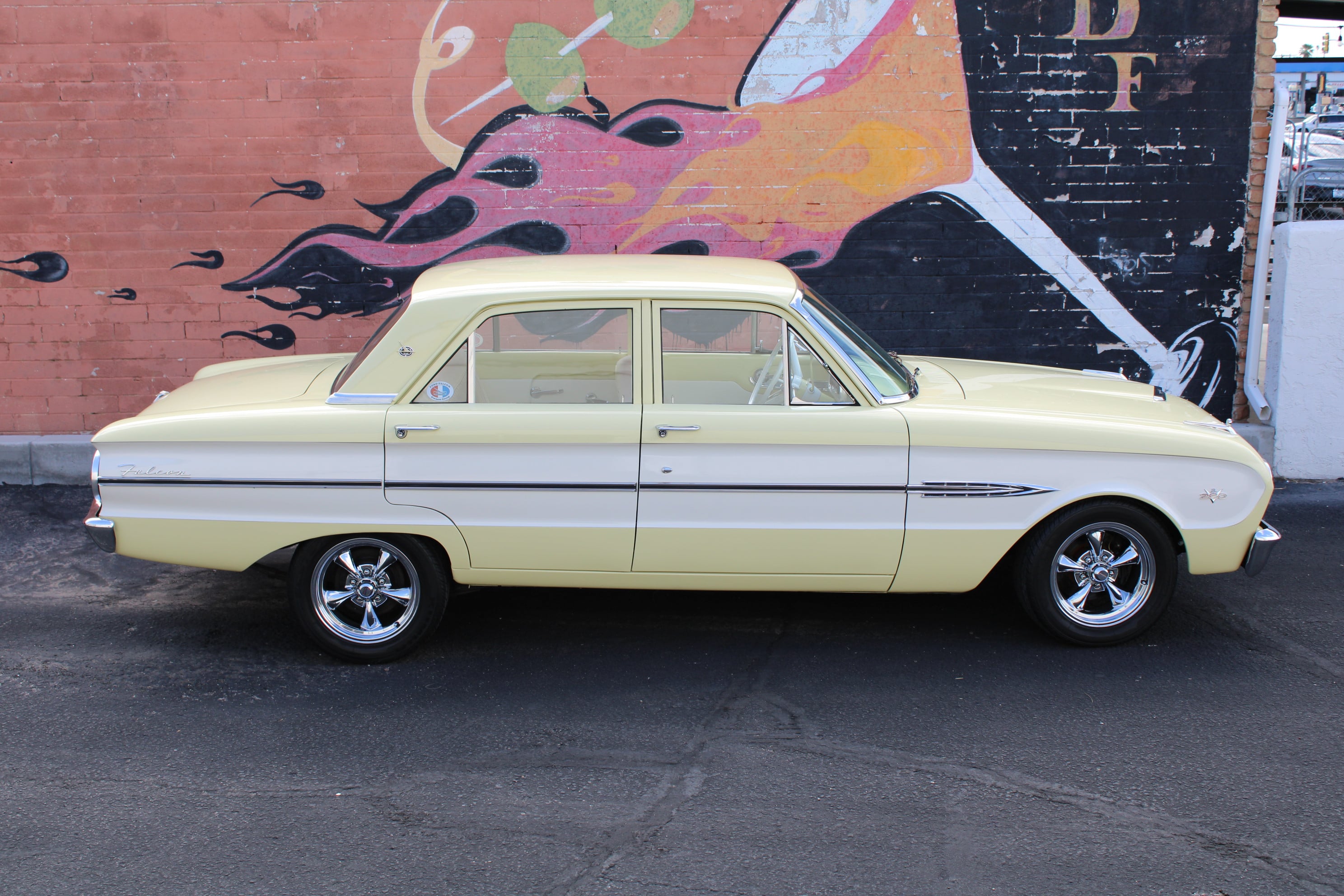
The round-body cars (1960–63). These are the Falcons most buyers picture: curved wings, a friendly face, a cabin trimmed like a scaled-down Fairlane. First-year cars are six-cylinder only, and the 144 is, frankly, slow — adequate around town in 1960, hard work in modern traffic; the 170 from 1961 is the better tool. Affection rises through the generation: a 1960 sedan is a curiosity, while a 1963 Futura hardtop or convertible with the late-arriving V8 is a genuine collector car. The mid-1963 changes matter — that is when the hardtop, the convertible and the 260 V8 all arrive, and when the Sprint is born.
The squared cars (1964–65). Ford reskinned the Falcon for 1964 with straight lines and a much more modern stance, and sorted the chassis to match: these are the best-driving of the small Falcons. The Sprint continued, the 289 replacing the 260 during 1965, and a Sprint hardtop with the four-barrel 289 and a four-speed is the quickest factory Falcon of the small-body years. The convertible ended after 1965, capping the open-car supply at three model years.
The big cars (1966–70). The third generation grew onto the Fairlane's platform — wheelbase up to 111 inches for sedans — and lost the hardtop and convertible; the range settled into sedans and wagons. Engines grew too: the 250 six arrived for 1969, and the 302 joined the 289. These are comfortable, torquey cars the market has largely ignored, which cuts both ways — little competition when you buy, and trim and sheet metal the reproduction industry has barely touched because it was busy with Mustangs.
Futura and Sprint: read the badge, then verify it. Because the premium attaches to names, names get transferred. A Futura should have the bucket-seat interior and the trim to match; a Sprint should have started life with a V8, which you can check the way you check any Falcon of the period — count the wheel lugs. Factory V8 cars are five-lug; six-cylinder cars are four-lug, front and rear, and the whole running gear differs with them. A "Sprint" sitting on four-lug hubs is a six-cylinder car in costume, whatever the paperwork says, and a genuine V8 car converted the other way is equally easy to spot once you know to look. The door data plate's engine code settles arguments: learn the code for the year you are shopping and decode the plate before you discuss money.


Engines and gearboxes
The sixes: 144, 170, 200 and 250 — the Thriftpower family
Most Falcons you will ever see are sixes, and that is no hardship. Ford's small six — the Thriftpower family — is a cast-iron, overhead-valve inline six with seven main bearings, a specification Detroit usually reserved for much more expensive engines, and the single biggest reason a Falcon can be recommissioned after decades of neglect and then simply run. The family grew by lengthening the stroke and, later, raising the deck: the 144 (1960–63) makes about 90 hp and works hard for it; the 170 (1961 onward) makes about 101 hp and is the first Falcon six that feels adequate everywhere; the 200 (mainstream from 1965) makes about 120 hp gross and is the family's sweet spot — smooth, torquey enough, and the engine the Mustang made famous in six-cylinder form; the 250 (1969–70, third-generation cars) trades revs for torque and suits the heavier late shell. All idle with a sewing-machine evenness when right, all tolerate astonishing abuse, and all share one design decision that shapes their character and their faults: the intake manifold is not a separate casting. It is cast as one piece with the cylinder head — the famous "log" manifold, a hollow cast log running along the side of the head with the single carburettor mounted on top of it.
Understand the log head and you understand the six. Casting the manifold into the head saved money and warm-up time, and gives even fuel distribution at gentle throttle openings, which is where a Falcon six spends its life. It also caps airflow: the log's passages are small and the centre cylinders breathe better than the ends, so the engine runs out of breath early and no bolt-on short of a different head changes that. The classic symptom owners chase is a six that is sweet to 50 mph and flat, breathless and slightly rough beyond it — that is the log doing what it was cast to do, a characteristic, not a fault. The fault versions of the same complaint are covered below, because the six has three genuine weaknesses and all three imitate each other.
The first is the carburettor and ignition pairing. Early cars use a Holley 1904 single-barrel with a glass float bowl; most use the Autolite 1100, later cars the 1101 and related units. The 1100 works with Ford's Load-O-Matic ignition: the distributor has no centrifugal advance at all and takes its entire advance curve from a vacuum signal metered by a spark control valve in the carburettor. Carburettor and distributor are a matched system. Fit a later carburettor without the spark valve, or a conventional distributor with the Load-O-Matic carburettor, and you get the signature driveability mess — hesitation off idle, a flat spot in the middle, timing never right anywhere — which generations of owners have tried to cure with rebuild kits aimed at whichever half of the pair they blamed. The test is identification, not adjustment: confirm the two belong together before paying for tuning work. A matched pair drives cleanly; a mismatched pair never will.
The second weakness is the cooling system, sized for 1960 traffic. The radiator is small, the fan modest, and the margin disappears as the core silts up and the pump's impeller corrodes. A six that creeps hot in summer queues but behaves on the open road is telling you about capacity and flow, not a head gasket — although a head gasket is what it will need if you let it boil repeatedly. Treat temperature stability as a purchase test, in traffic, not on the seller's chosen route.
The third is simple age in the valve gear and timing drive. The timing chain stretches slowly and quietly — no dramatic failure, just a gradual retardation of valve and ignition timing that makes an old engine feel tired in a way a tune-up only partly restores. Hydraulic lifters tick on old oil and usually quieten with fresh; a tick that does not is a lifter or a worn rocker shaft, both ordinary jobs. Oil leaks come from the places fifty years of heat cycles guarantee: rocker cover, timing cover, rear main. None of it is expensive, because the Mustang world keeps every gasket, pump and hard part for these engines on the shelf.
The V8s: 260, 289 and 302 — the Windsor small-blocks
The small-block V8 arrived in the Falcon the way it arrived everywhere at Ford: carefully, and then all at once. The 260 — the enlarged Fairlane V8, 164 hp in Falcon tune — became available during 1963, created the Sprint, and turned the Falcon into a genuinely quick car by the standards of the day. For 1965 the 289 took over in two- and four-barrel forms, about 200 and 225 hp gross respectively, and the third-generation cars added the 302 from 1968. These are Windsor-family engines: thin-wall cast-iron blocks, hydraulic lifters, a front-mounted distributor you can actually reach, and a depth of parts support that borders on the absurd. A 289 Falcon shares its engine's consumables, and most of its hard parts, with the most popular classic car in America.
A healthy Windsor starts instantly, idles with a slight lope if it carries the four-barrel cam, and pulls without smoke. Its age faults are shared with every Mustang ever written about. Valve stem seals harden and crumble, giving the classic puff of blue smoke at start-up after sitting and on the overrun — a top-end job, not a rebuild. The rear main seal weeps onto the exhaust and convinces sellers the car "burns oil" when it leaks it. Timing chains stretch and, on the nylon-toothed cam gears fitted in some years, the teeth shed — an engine that cranks but never catches on an otherwise healthy car is a timing set until proven otherwise. Exhaust manifolds crack, and the right-hand manifold's heat-riser valve seizes, which upsets the automatic choke and gives a car that starts rich and stays rich. None of these is a reason to walk away; all are reasons to price the car as the sum of its invoices, not its paint.
The trap with V8 Falcons is not the engine — it is provenance. The swap is so easy, and six-cylinder cars so plentiful, that a large share of "V8 Falcons" began life as sixes. A swap done completely is a legitimate car: engine, five-lug hubs and brakes, heavier front springs, the stronger 8-inch rear axle in place of the six's light 7¼-inch integral unit, V8 steering linkage and mounts. A swap done cheaply keeps the four-lug brakes, the six-cylinder springs (so the nose sits low and the geometry is wrong), and the light axle behind Windsor torque (so the axle lives on borrowed time). Neither badge nor description distinguishes them; the lugs, springs and axle do, in about ninety seconds, and the inspection section walks you through it. Price a complete, documented conversion as a good driver; price a partial one as a six-cylinder car with an engine problem.
Gearboxes: three-speeds, four-speeds, Fordomatic and Cruise-O-Matic
The standard Falcon gearbox is a three-speed manual with a column change, and there are two different boxes behind that description. Six-cylinder cars use a light-duty three-speed adequate behind a 144 or 170 and marginal behind anything stronger — its synchromesh, second gear first, is the wear item, and a box that crunches into second on a cold morning is telling you its remaining life honestly. V8 and later cars use heavier Ford-built three-speeds related to the 3.03 family: strong, slow-shifting and nearly indestructible. Judge any manual on second-gear synchromesh, on whether it jumps out of gear on the overrun, and on clutch behaviour: judder from rest is usually an oil-contaminated or worn plate, and the clutch linkage is mechanical, so a heavy or notchy pedal is adjustment and wear you can see.
The four-speed is the desirable box: Borg-Warner T-10s in the earliest V8 cars, then Ford's own Top Loader — strong, precise when the linkage bushes are fresh, vague to the point of comedy when they are not. Most "worn Top Loader" complaints are worn external linkage, a cheap kit and an afternoon. Four-speed Sprints and Futuras are the Falcons the market fights over, and the gearbox is a large part of why.
Automatics divide by era. The Fordomatic is a two-speed fitted to most automatic Falcons through 1964: smooth, slow, and utterly characteristic of the early cars — and behind a 144 it makes the slowest Falcon ever sold, a combination to buy only with your eyes open. From 1965 the C4-based three-speed Cruise-O-Matic replaced it, and this is the automatic to have: light, strong, cheap to rebuild by automatic standards, and supported by every transmission shop in America. On either box, judge the fluid before the shift quality — bright red and sweet-smelling is a maintained box; dark brown and burnt is a rebuild conversation. A Fordomatic that slips on the 1–2 shift under load or a C4 that flares between second and third is quoting you its rebuild price through the seat of your pants; a full rebuild of either sits in the low thousands, and the C4 can be rebuilt for noticeably less than most European automatics of the period.
Problem areas
Everything in this section is drawn from the cars themselves, and the first number is the one to hold onto. We examined the sellers' photo sets for 12 of the Falcons in our current sample in detail, and rust was mentioned in the notes for 3 of those 12 cars — a quarter of a small sample, and if anything an understatement, because sellers photograph the metal they are proud of. Damage was noted on 1 of the 12. No smoke and no leaks were recorded, which matches the mechanical story below: Falcon running gear is tough and rarely embarrasses a seller on camera, while Falcon sheet metal has been quietly dissolving since the Nixon administration. Assume the shell needs a forensic examination and be pleasantly surprised when a car passes. Almost everything mechanical can be fixed with money you can count; structural rust in a unitary shell is the cost that eats the car.
Rust: the map
A Falcon has no chassis. The body is the structure — floor pans, rocker panels, front and rear frame-rail sections, torque boxes and inner wings are all welded into one shell — which means rust is never merely cosmetic below the waistline, and it also means the rust map is predictable, because the same water paths attack every car. Work through it in this order.
Floor pans. The first and commonest failure. Water enters past perished windshield and rear-window rubbers, through the cowl vents whose drains block with leaves and silt, and past the heater box, then sits under the carpets and sound-deadening pads, which hold it against the steel indefinitely. The pans rot from the top down, footwells first, worst under the driver's feet. Lift every carpet. Surface scale is treatable; pinholes mean the pan is thin everywhere you cannot see, and perforation means a replacement section welded in — a few hundred dollars a side in panels if you weld, into the low thousands a side fitted and painted. Treat floor rust as a marker for the whole shell: the water that ate the floors passed other steel on the way.
Rocker panels and torque boxes. The rockers are the shell's main longitudinal strength, and on convertibles and hardtops the torque boxes — the boxed reinforcements tying floor to rockers and frame rails at the cowl and ahead of the rear wheels — carry loads the roof would otherwise share. They trap road dirt, hold it wet, and rot from the inside out, so the outside can present smooth paint over structure with the consistency of wet cardboard. Press hard along the full rocker length and treat fresh underseal or fresh paint on the rockers of an otherwise scruffy car as a question the seller must answer. Torque-box and rocker repair is fabrication measured in days — budget in the low-to-mid thousands per side, more on a convertible — and a shell needing both sides, floors and rails is a parts car with a title, whatever its engine does.
Front frame rails and the engine bay. The front rails carry the engine, the suspension crossmember loads and the bumper irons, and they rot where they pass under the battery, around the suspension mountings, and at their closed rear ends where they meet the torque boxes. The battery tray dissolves from acid spillage, and the apron beneath follows. None of this shows in a listing photograph taken from standing height. Get under the car and prod the rails along their full length: sound steel rings and resists; rotten steel crunches and flakes. Rail repair is specialist fabrication, priced per car, and the commonest reason an apparently solid Falcon turns out to be an economic write-off.
The cowl. The fresh-air vent chambers at the base of the windshield are the Falcon's built-in water feature. Their drains block, the chambers fill, and the seams rot through into the cabin, delivering water onto the front floors and the wiring behind the dashboard — the same failure, by the same mechanism, that afflicts early Mustangs, because it is the same design. The test is decisive: pour a jug of water into the cowl grille and watch where it emerges. It should pour from the drains behind the front wheels within seconds. If it arrives in the footwells instead, the cowl is perforated, and repair means dashboard out and serious surgery — in the thousands rather than the hundreds, and a legitimate reason to walk away.
Rear quarters, trunk and wagon tailgates. The rear arches and lower quarters rot from mud trapped between outer skin and inner arch; the trunk floor rots from the spare-wheel well outward, fed by the rear window rubber and trunk seal; wagon tailgates go at their lower seams, and Ranchero beds rot at the front corners and along the seams where the bed meets the cab. Lift the trunk mat and spare wheel on every car. A trunk floor is a panel replacement in the high hundreds to low thousands fitted; rear quarters are dearer, because the repair has to be invisible. On a Ranchero, add the cab's rear panel and the floor under the seat — they live a splash-filled life the sedans never see.
The smaller traps. Door bottoms (the drain slots block, the door fills, the skin bubbles along its lower edge — run a fingertip along every one), lower front fenders behind the wheels, headlamp buckets, wagon drip rails, and the bottom of the windshield frame. None alone kills a car. Together they are the car's biography, and the panel work adds up: four door bottoms, two fender bottoms and a pair of arch lips is a body shop season, priced like one.


Six-cylinder engines: the faults behind the folklore
The Thriftpower six's reputation for indestructibility is earned, but it has specific failure modes, and they cluster around heat, fuel and the matched carburettor-ignition system described in the engines section.
Overheating and its sequelae. The small radiator, silted cores and corroded pump impellers produce the classic pattern: fine at speed, creeping in traffic. Repeated overheating cooks head gaskets, and a boiled six often presents with a slow coolant loss and a misfire on one cylinder that owners chase through the ignition for months. The distinguishing tests — a cooling-system pressure test and a sniff of the coolant for combustion gas — are cheap and belong in any inspection of a six with a temperature story. A recore or quality replacement radiator, a pump and a thermostat are a few hundred dollars in parts, and a fair deduction from any asking price.
The Load-O-Matic flat spot. In buying terms it presents as a car that hesitates pulling away, surges at a steady 30 mph, and has a glovebox full of invoices for carburettor kits. Because the system only works as a matched pair, the fault is usually a previous owner's substitution, and the cure is identification and correct parts, not money — a few hundred dollars at most once you know what you are looking at. A six with this complaint priced as a "carburettor problem" can be the value buy of the whole range.
Fuel system age. Steel tanks rust from the inside, especially on cars that have sat with part-full tanks of modern ethanol fuel, and the rust migrates: blocked filters, a starved carburettor, a car that dies after twenty minutes and restarts when cool as the debris settles. A tank clean or replacement, new rubber lines throughout (ethanol eats the originals), and a rebuilt carburettor are the standard recommissioning package on a long-stored six — budget in the high hundreds to low thousands fitted, and treat a seller's "it just needs the carb cleaned" as an admission that this package has not been done.
Wear, honestly assessed. With seven main bearings and modest outputs, bottom-end wear is rare under 150,000 miles unless the oil was neglected. What you will find is oil consumption past the valve guides and seals, a stretched timing chain, and lifters that tick on old oil. A full rebuild of a six is among the cheapest engine rebuilds in the classic world — in the low-to-mid thousands at a machine shop — because the Mustang trade keeps pistons, bearings and gaskets on the shelf. Buy the shell; the six can almost always be negotiated with.
V8s, brakes, steering and suspension: the chassis systems
The brakes are the safety headline. Every Falcon left the factory with drum brakes all round, sized for 1960 traffic and a 2,300-pound car. Six-cylinder cars carry smaller drums than V8 cars — one more reason the lug distinction matters — and, critically, cars built before the 1967 model year use a single-circuit hydraulic system: one master cylinder, one circuit, so a single failed hose, pipe or wheel cylinder can take the entire brake system with it. Dual-circuit master cylinders arrive with the 1967 cars. On any pre-1967 Falcon the whole hydraulic system is a service item, not a repair item: master cylinder, wheel cylinders, hoses and as much steel pipe as shows corrosion, renewed as a package in the high hundreds to low thousands fitted. Budget it automatically into any early car that has sat. Front disc conversions using Mustang-pattern parts are the commonest and most worthwhile upgrade in the Falcon world — they bolt to the V8 spindles, transform the car's stopping in modern traffic, and a car already converted, with paperwork, is worth more to a driver than one that is not.
Front suspension. The Falcon's front end is the Mustang layout in embryo: coil springs seated on top of the upper control arms, working through ball joints, with the loads fed into the spring towers. The wear items are the ball joints, the control-arm bushings, the spring saddles (whose dying rubber produces a groan over bumps that owners misdiagnose as a ball joint), and the idler arm. Play is checked the Mustang way — pry-bar under each joint, loaded and unloaded in turn — and a full front-end rebuild is a four-figure job at a shop, or a long weekend and a few hundred dollars in parts at home. The structural check matters more: the spring towers crack and rust where the loads concentrate, and a tower that has moved gives you a car that will not align. Sight along them for cracked paint and previous welds.
Steering. Recirculating-ball boxes wear in the centre of their travel, where the car spends its life — more than an inch or two of dead movement at the wheel rim before the road wheels respond means box wear, linkage wear, or both. Power-steering cars add a pump, control valve and ram, all prone to weeping; a groaning pump is low fluid or a dying pump, both cheap, while a leaking ram is a rebuild. None of this is Falcon-expensive; all of it is negotiable money.
Rear axle and springs. Six-cylinder cars carry the light 7¼-inch integral-carrier axle — quiet and adequate behind a six, a known casualty behind a V8 swap, where it whines, then complains, then fails. V8 cars carry the removable-carrier 8-inch, strong and supported by the entire Mustang aftermarket. Rear leaf springs sag — measure the arch heights side to side — and worn shackle bushings give a clonking, wandering rear end that mimics axle trouble. A whining 8-inch is a bearing job in the high hundreds, not a death sentence.
The V8-specific traps. Beyond the swap-provenance question: cooling again (a V8 in a Falcon bay has even less margin than a six, and the small core that copes with a 200 will not cope with a tired 289), exhaust manifold cracks, and starter heat soak on cars with headers — a car that will not crank hot and always starts cold is having a solenoid and heat-shield conversation, not an engine one.
Interior, trim and weather sealing
The Falcon cabin is simple, hard-wearing and — this is the catch — trimmed in materials the reproduction industry has only partly bothered with, because it was following Mustang money. Seat vinyl in standard colours, carpets, headliners and door panels for the common bodies are available and reasonably priced. What is not easily available is the detail: Futura and Sprint trim, brightwork and badges, correct-pattern upholstery for the less common years, wagon rear trim, and almost everything unique to the third-generation cars. A complete, original interior in a rare variant is worth more than its weight in engine parts, because you cannot simply order another one.
Water is the interior's enemy, by the routes already mapped: window rubbers leak onto floors and parcel shelves, the cowl vents drown the front footwells, and door membranes vanish during past repairs, letting the doors fill and the trim panels rot from behind. Lift the carpets, feel the underlay for damp, and smell the car with the doors shut — a musty Falcon is a wet Falcon, and the wet is coming from somewhere structural until proven cosmetic. Seat frames survive well; bucket-seat padding crumbles, and a Futura whose buckets sit like hammocks needs a retrim priced in the low thousands for the pair. Convertible tops are standard classic fare — a quality top fitted is a four-figure job — but the frame and header-rail seals are the scarce parts, so check the frame's operation, not just the canvas.
Electrics are the Falcon at its simplest: a generator through 1964, an alternator from 1965, a handful of circuits, and failure modes dominated by earth points, tired switches and aged insulation at the bulkhead. Everything is diagnosable with a test light and fixable for small money — which is why a Falcon with multiple electrical faults is such a useful tell: nobody has cared for the car at the level of a test light, and the rest of the maintenance will match.
How to inspect one
Allow at least an hour, bring a torch, a cloth-wrapped magnet, a screwdriver for prodding (with the seller's permission) and a jug of water for the cowl test. If the car passes you, pay for a lift inspection before money changes hands — on a unitary car, the underside is the truth, and an hour on a lift is the best money in the whole purchase.


- Start with the paperwork and the plate. Match the title to the car in front of you, then decode the door data plate — model year, body, trim and, above all, the engine code. The plate tells you what the car was born as; everything else you check either confirms it or prices the difference. A thick history file, old registrations and invoices are worth real money on a car whose value lives in its specification.
- Count the lugs. Five lugs at every corner means factory V8 running gear; four means a six-cylinder car, whatever engine now sits in the bay. If the car is sold as a V8 or a Sprint and sits on four lugs, you are looking at a conversion or a costume — and step 9 of this list is where you find out which. This ninety-second check settles more Falcon arguments than any other.
- Cold start. Insist the engine is stone cold when you arrive. A six should start with a brief churn and settle to an even idle; a V8 should fire at once. Watch the exhaust: a blue puff that clears is valve stem seals, continuous blue smoke is rings or guides, and white vapour that does not clear as the engine warms is coolant until proven otherwise. Listen for a V8's timing-chain rattle and a six's lifter tick, and note which ones fade as oil pressure builds.
- The cowl test. Pour a jug of water into the cowl grille at the base of the windshield, as described in the rust section. Water should stream from the drains behind the front wheels within seconds. Water arriving in the front footwells means a perforated cowl — dashboard-out surgery — and on an early car that single result can end the viewing.
- Under the car. Torch and screwdriver along both front frame rails, the torque boxes, the rockers and the rear rails, prodding as you go. Perforation in rails, boxes or rockers is structural, and structural is the walk-away category unless the price already says parts car. Read the underseal as you work: patchy, chipped and honestly dirty is factory age; a fresh, uniform black coat blown over everything the week before the sale is a question, not an answer.
- Floors and trunk, from inside. Lift all the carpets and feel the pans with your knuckles, footwells first. Lift the trunk mat and spare wheel and inspect the well corners. Damp underlay, water tracks down the inner cowl sides, or a trunk well you can see through each map directly onto the rust section's prices.
- Body, gaps and the magnet. Run the magnet over the rockers, arch lips, lower doors and lower front fenders — filler announces itself by the magnet's indifference. Check every door bottom with a fingertip, and on a hardtop or convertible pay double attention: a convertible whose doors pinch or drop is telling you its reinforced shell has softened, the torque-box story told in panel gaps.
- Front suspension and steering. Rock each front wheel top-to-bottom and side-to-side, then have a helper move the steering while you watch the linkage: play should not exist at the ball joints, tie-rod ends or idler arm. Check the spring towers for cracks, distortion and old welds, and measure the free play at the steering-wheel rim, wheels straight — an inch or two of dead travel is a front-end budget priced into your offer.
- The running-gear audit on a V8 car. Verify the installation as a system: five-lug hubs, the 8-inch rear axle (removable carrier, bolts around the front of the housing) rather than the six's 7¼-inch integral unit, front springs holding the nose at the right height, and V8 steering linkage. A complete conversion is a driver; an engine-only swap on six-cylinder brakes, springs and axle is three future invoices wearing a V8 badge.
- The test drive. Fifteen minutes minimum, including traffic and a stretch at highway speed. A six should pull cleanly without the Load-O-Matic flat spot from the problem areas — hesitation off idle and a surge at a steady cruise mean the carburettor and distributor are strangers, and that is a deduction, not a disaster. A Fordomatic should engage its two ratios without slipping; a C4 should change firmly through all three. Brake firmly from speed, twice: the car should stop straight, and on a pre-1967 single-circuit car you are confirming that the hydraulic renewal is either done or budgeted. Listen for axle whine on a trailing throttle and the clonk of worn shackle bushes.
- Heat and electrics. Let the car idle in traffic after the drive. The temperature gauge should stabilise, not climb — a six that creeps at idle has the cooling-capacity story from the problem areas, and a V8 that creeps has less excuse and less margin. Work everything electrical: lights, wipers, heater fan, gauges, horn. On a Falcon every electrical fault is cheap; several together are a biography of neglect.
- Interior and trim last. Sit in every seat, including a Futura's buckets — collapsed padding is a retrim, priced in the problem areas. Inventory the trim against the variant: Sprint and Futura brightwork, badges, correct upholstery, wagon rear trim. Missing rare trim is not a small deduction; on the scarce variants it is the difference between a car you can finish and a car you can only almost finish.
Values
The build of this page appends the current market figures — what is listed now, and what recorded sales have achieved — directly beneath this guide, refreshed as the market moves, and those figures are where your numbers should come from. What belongs here is how to read them, because the Falcon market punishes buyers who read a single headline figure and rewards buyers who understand what the spread is made of.
Start with the condition spread, which on a Falcon is wider than on almost any comparable Ford. The shell is the value. Two cars that read identically in a listing — same year, same body, same engine code — can be a structurally honest Sprint and a six-cylinder shell in Sprint clothing with filler in the torque boxes, and the honest car is worth several times the other while costing its next owner a fraction as much to own. Compare any Falcon against recorded sales whose structural condition was described in the same detail as yours has been inspected, not against the cheapest line in the table.
Asking prices and achieved prices part company predictably on this model. The Falcon spent decades as a cheap car, and sellers still price from memory — in both directions. Exceptional cars, particularly Sprints, convertibles and honest V8 hardtops, are routinely under-described by private sellers who do not know what the specification is worth, while ordinary sedans are routinely priced by dealers as though the collector premium applied to the whole range. It does not. The premium attaches to the Sprint name with a verified V8 birth, to the three convertible years, to the Futura hardtop, and to documented originality — and it evaporates, on inspection, from cars whose plates and lug counts tell a different story from their badges.
Body style moves value as much as specification. The Ranchero is the clearest case: a working pickup sharing a car's running gear, bought by people who price the bed and cab corners as carefully as the engine, and a genuinely sound one is scarcer than production suggests because the body was used as a tool. Wagons follow the same logic with a smaller premium — survivors are few because wagons were consumed by family duty — while four-door sedans remain the softest corner of the market in every generation and the cheapest honest way into Falcon ownership. The third-generation cars sit in their own quiet compartment: low demand, low supply, prices set by the few buyers who want one at the moment one appears.
The project-versus-driver gap deserves its own warning, because the Falcon inverts the usual arithmetic. On a valuable car, a project is a discount on a restoration that will repay itself. On a Falcon, the cost of structurally restoring a rotten shell — torque boxes, floors, rails, quarters, paint — approaches or exceeds the finished value of all but the Sprint and convertible variants, while a sound driver costs little more than the project did. The cheap Falcon is therefore the expensive one with unusual consistency: the money in this market follows condition and verification, not rarity claims. Negotiate on evidence — the lug count, the cowl test, the lift inspection — and a seller with a genuinely good car will usually meet a buyer who has done the work, because so few buyers do.
Parts and ownership
The Falcon is one of the easiest American classics of its era to keep, for one structural reason: the Mustang. Because the world's most popular classic was developed from Falcon mechanicals, the Falcon's engines, gearboxes, axles, brakes and suspension wear parts are served by an industry that has never had a quiet year. The honest complication is that the industry serves the Falcon incidentally — it stocks what fits Mustangs first — so ownership rewards an owner who knows which parts are shared and which are Falcon-only.
Easy: everything for the sixes and the Windsor V8s — gaskets, bearings, pistons, water and oil pumps, carburettor kits for the Autolite 1100 family, ignition consumables, timing sets. C4 parts and rebuild kits are universal. Brake drums, shoes, cylinders and hoses for both four- and five-lug cars are shelf items, as are ball joints, bushings, spring saddles, steering linkage parts, leaf springs and shock absorbers. A full hydraulic brake renewal is a few hundred dollars in parts; a front-end wear-parts kit is similar money. This is the cheapest end of classic motoring, and it is not close.
Harder and dearer: Falcon-specific sheet metal and trim. Floor pans and some repair sections are reproduced because the Mustang trade uses similar pressings, but complete quarters, wagon and Ranchero-specific panels, and third-generation body parts are used-part territory. Futura and Sprint brightwork, badges and correct interior trim, convertible frame parts, and Sedan Delivery anything are hunt-and-wait items. A quality repaint of a straight car starts in the mid four figures and climbs with the panel work beneath it — which is why this guide's recurring advice is to buy the body and the trim, and fix the mechanics.
Running costs. A sorted Falcon is a realistic regular-use classic: the six returns fuel economy in the low-to-mid twenties on a run, the V8 in the mid-to-high teens, and both run happily on ordinary fuel with the usual ethanol-era provisos about rubber fuel lines and stored cars. Servicing is within any competent home mechanic's reach, and any generalist shop in America can maintain the car. Insurance is in line with other classics of similar value, and Falcon club support is strong and welcoming of the unfashionable variants. The budget line that catches new owners is the first year: catching up deferred maintenance on a running car — brakes renewed as a system, cooling gone through, fuel system cleaned, perishable rubber replaced — honestly runs into the low thousands before you improve anything, and recommissioning a car that has slept for a decade costs more, because everything rubber, hydraulic and fuel-related is replaced at once. Buy a car in regular use over a sleeping beauty at the same money, every time.
Which one to buy
- The all-rounder: a 1964–65 Futura hardtop with the 200 six or the 289 V8. The squared shell drives the best of the small Falcons, the specification is complete, and parts support is at its deepest. If you want one Falcon to drive everywhere, this is it.
- The value buy: a 170 or 200 six-cylinder sedan, any early year, with a sound shell. The market prices sedans softly and the six is the toughest engine Ford made in the period. A matched Load-O-Matic pair and a renewed brake system turn it into the cheapest honest classic motoring in America.
- The collector car: a verified Sprint. Hardtop or convertible, 260 or 289, with the data plate, the five lugs and the 8-inch axle all agreeing with the badge. Verify ruthlessly — the premium lives entirely in the verification.
- The character buy: a Ranchero. Car manners, a working bed, and a survival rate that makes a sound one genuinely scarce. Buy the bed and the cab corners; the running gear is the easy part.
- The contrarian buy: a third-generation car, 1966–70. Roomier, torquier, ignored by the market and thin on the ground — our current sample holds exactly one. Buy the best one you can find, because trim and panels for these cars are the hardest in the range to replace.
- The first Falcon: a 1963 Futura convertible with the six. Three years of convertibles, a pretty round body, and none of the V8 market's provenance games. Judge it by the door gaps and the torque boxes, and it will judge you kindly back.
And the rule that overrides all of the above: buy the least rusty shell you can find, in the specification you can live with. Engines, gearboxes, brakes and cooling systems on a Falcon are all fixable at prices you can plan for, from an industry that will never stop supplying them. A rotten unitary shell costs more to put right than the finished car will be worth — and it is the one thing about a Falcon that can never be made original again.
See the 13 Falcon cars currently listed.