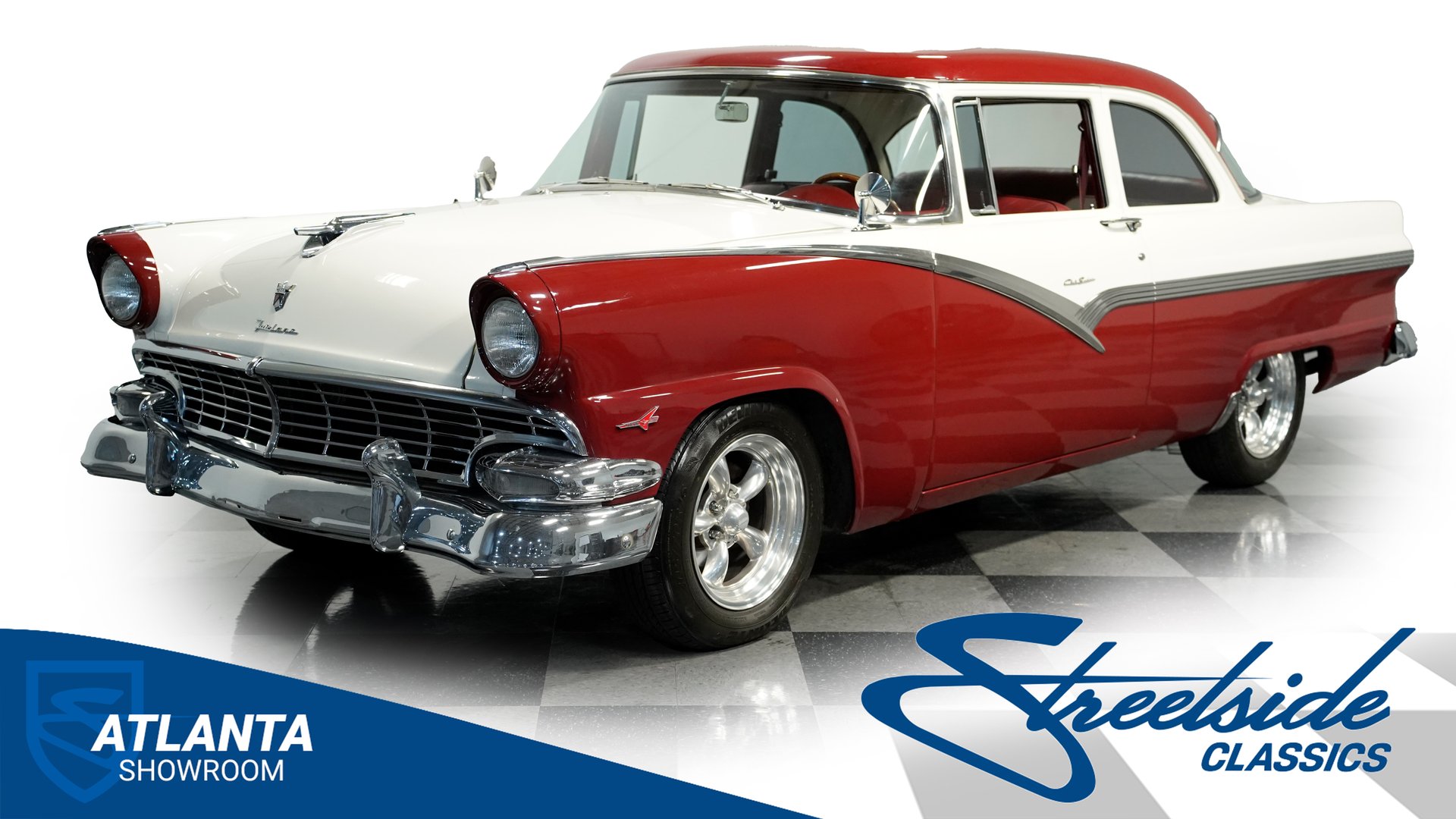
Ford Fairlane 500 buyer's guide
Ford Fairlane 500 -- the model's own buyer's guide: variants, values and what to check.
Years listed: 1956-1967 · Series: Torino
Overview and history
The Fairlane is not one car. It is three different cars wearing the same name in sequence, and the first job in buying one is knowing which of the three you are standing in front of. From 1955 to 1961 Fairlane was Ford's top full-size trim — the chrome-heavy flagship line of the big Ford, home to the Crown Victoria, the Sunliner convertible and the extraordinary retractable-hardtop Skyliner. From 1962 to 1965 it shrank to become Ford's new intermediate, the car that created the mid-size class in America and, in Thunderbolt form, one of the most serious factory drag cars ever sold. From 1966 to 1970 it grew again into the larger intermediate that carried the GT, the 427 cars and the first Torinos. The name was retired after 1970, when Torino — introduced in 1968 as the Fairlane's upmarket sister — took the whole line over.
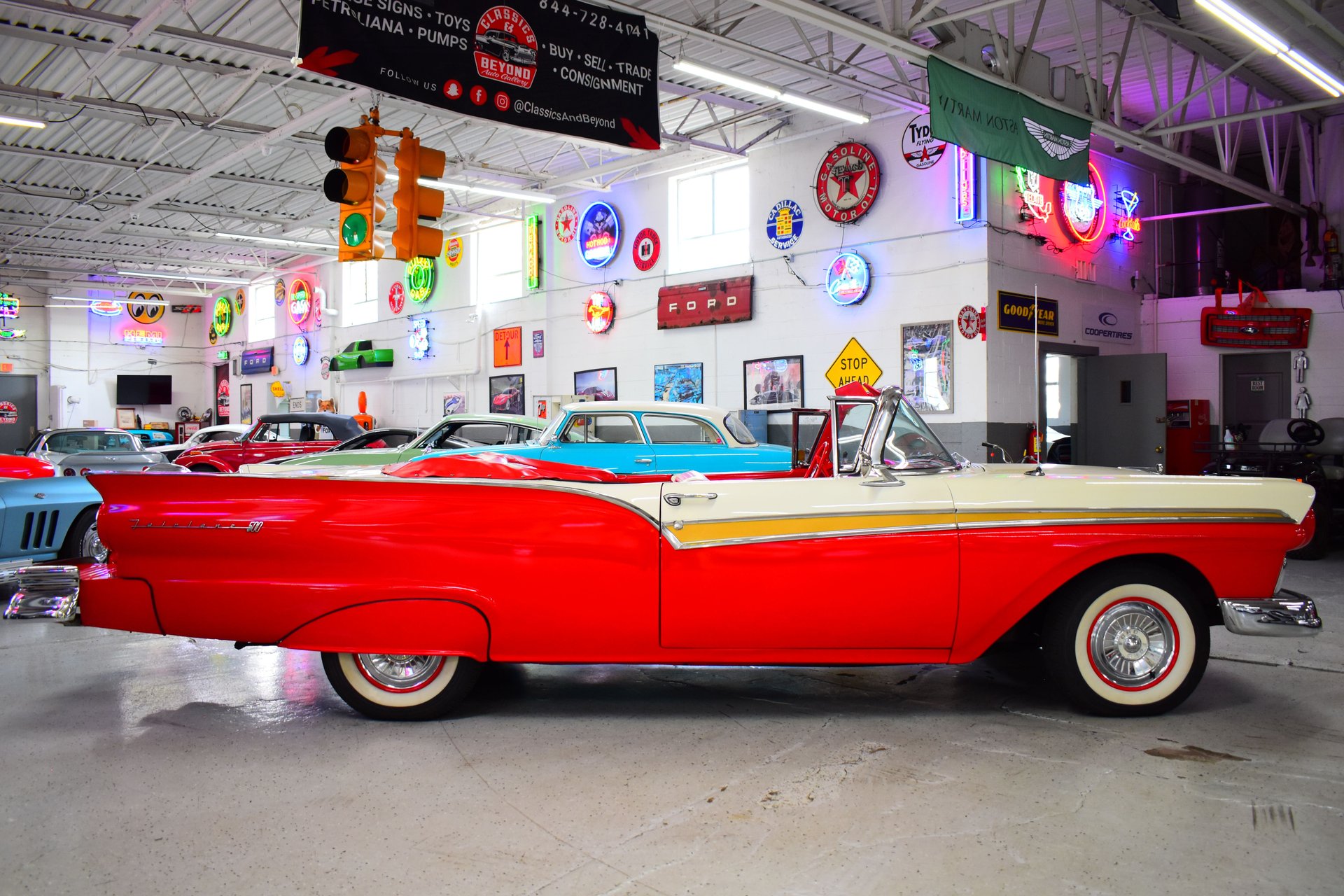
The name itself came from Fair Lane, Henry Ford's Dearborn estate, and the 1955 launch was a trim promotion: Fairlane replaced Crestline at the top of the Ford range, bringing the two-tone paint, stainless side spear and wraparound windshield that defined mid-fifties Ford styling. The 1956 cars added Ford's heavily promoted Lifeguard safety package — dished steering wheel, padded dash and visors offered as options, breakaway mirror — and the 312-cubic-inch Thunderbird V8 at the top of the options list. The all-new 1957 body was longer, lower and wider, and it did something Ford men still talk about: it outsold Chevrolet for the model year. The 1957 Fairlane 500, and the Skyliner retractable that joined it, are the high-water mark of the full-size Fairlane as a collectible.
For 1958 the car was facelifted with quad headlamps and the new FE-series V8s arrived; for 1959 the new Galaxie series was layered in above Fairlane 500 mid-year, which is the moment Fairlane began its long slide down the price ladder. In the big 1960–61 body it was the middle trim, still handsome, already less sought after. Then came the reinvention: the 1962 Fairlane was a clean-sheet intermediate on a 115.5-inch wheelbase, built to sit between the compact Falcon and the full-size Galaxie, and it introduced the small-block Windsor V8 that would power Fords for forty years. The 1964 Thunderbolt — a Fairlane 500 sedan stripped, lightened and fitted with the 427 racing engine by Dearborn Steel Tubing — was built in tiny numbers for drag racing and is the most valuable Fairlane of all.
The third act began for 1966, when the intermediate grew, gained the stacked-headlamp nose and offered the FE big-blocks in a mid-size shell: the Fairlane GT and GTA with the 390, and a handful of 427-powered cars built for the street and the strip. The 1967 facelift cleaned the styling up. For 1968 the body was redesigned again, Torino arrived as the prestige nameplate, and Fairlane settled into the role of base and mid-range trim it kept through 1969 and its final, 1970 season — still capable of serious speed in 428 Cobra Jet form, because by then the engine, not the badge, decided how fast an intermediate Ford was.
That three-lives history is exactly what our own listings show. We currently track 75 Fairlanes, 50 of them for sale and 25 recorded sold, and the shape of the pool tells the story: the 1957 cars are the single biggest group, with the 1956 close behind, then the 1966–67 intermediates, the 1959s and the 1955s. The fifties full-size cars dominate because they were built in huge numbers and saved as convertibles and hardtops; the sixties cars that survive are disproportionately the performance versions, because a six-cylinder 1964 sedan was nobody's heirloom. Read any individual listing against that background: a fifties Fairlane is a chrome, trim and bodywork purchase, a sixties Fairlane is an identity and drivetrain purchase, and the inspection sections below keep those two logics separate throughout.
One filing note before you search: because the 1968–70 Fairlane and Torino share one body and one production line, later Fairlanes are often catalogued alongside Torino in dealer and database listings — all 75 cars in our pool sit under that shared intermediate filing. Do not let a database heading talk you out of a car: judge the badge, the VIN and the trim, not the category a website filed it under.

The models
Fairlane badges describe trim first and everything else second, which is why two cars with the same badge can be worth very different money. Work through the three generations in order, and inside each one learn the body styles, because on the fifties cars the body style — hardtop, convertible, retractable — moves value more than the engine does, while on the sixties cars the engine code in the VIN does.
| Model | Years | Engine | Output | Built | Character |
|---|---|---|---|---|---|
| Fairlane Crown Victoria | 1955–1956 | 272/292/312 Y-block V8 | 162–225 hp | — | The chrome B-pillar flagship; the fifties icon |
| Fairlane Victoria / Sunliner | 1955–1959 | 223 six, 292/312 Y-block | 120–245 hp | — | Hardtop and convertible core of the full-size range |
| Fairlane 500 Skyliner | 1957–1959 | 292/312, later 332/352 FE | 200–300 hp | 20,766 (1957); 14,713 (1958); 12,915 (1959) | Retractable hardtop; mechanism is the whole purchase |
| Fairlane 500 (full-size) | 1957–1961 | 223 six to 352 FE | 145–360 hp | — | Top trim until Galaxie arrived, then the mid trim |
| Fairlane / Fairlane 500 (intermediate) | 1962–1965 | 170 six, 221/260/289 Windsor | 101–271 hp | — | The first true mid-size Ford; the sensible sixties buy |
| Fairlane Thunderbolt | 1964 | 427 FE, dual quads | 425 hp | about 100 | Factory drag car; verify everything, twice |
| Fairlane 500 / XL | 1966–1967 | 200 six to 390 FE | 120–335 hp | — | The grown intermediate; XL is the bucket-seat trim |
| Fairlane GT / GTA | 1966–1967 | 390 FE | 320–335 hp | — | The muscle Fairlane; GTA means automatic |
| Fairlane 427 | 1966 | 427 FE, single or dual quad | 410–425 hp | 57 | The R-code street racer; rarer than the Thunderbolt story suggests |
| Fairlane / Torino-era Fairlane | 1968–1970 | 200 six to 428 Cobra Jet | 115–335 hp | — | Base and mid trim under Torino; engine decides value |
(Outputs are period SAE gross ratings, as Ford published them at the time; they flatter every engine by modern net standards, and the Cobra Jet's 335 hp in particular was a polite fiction for insurance purposes. Production figures are given only for the Skyliner and the limited competition cars, where the numbers are genuinely documented; Ford's surviving records do not support honest per-trim totals for the volume models, so none are invented here.)
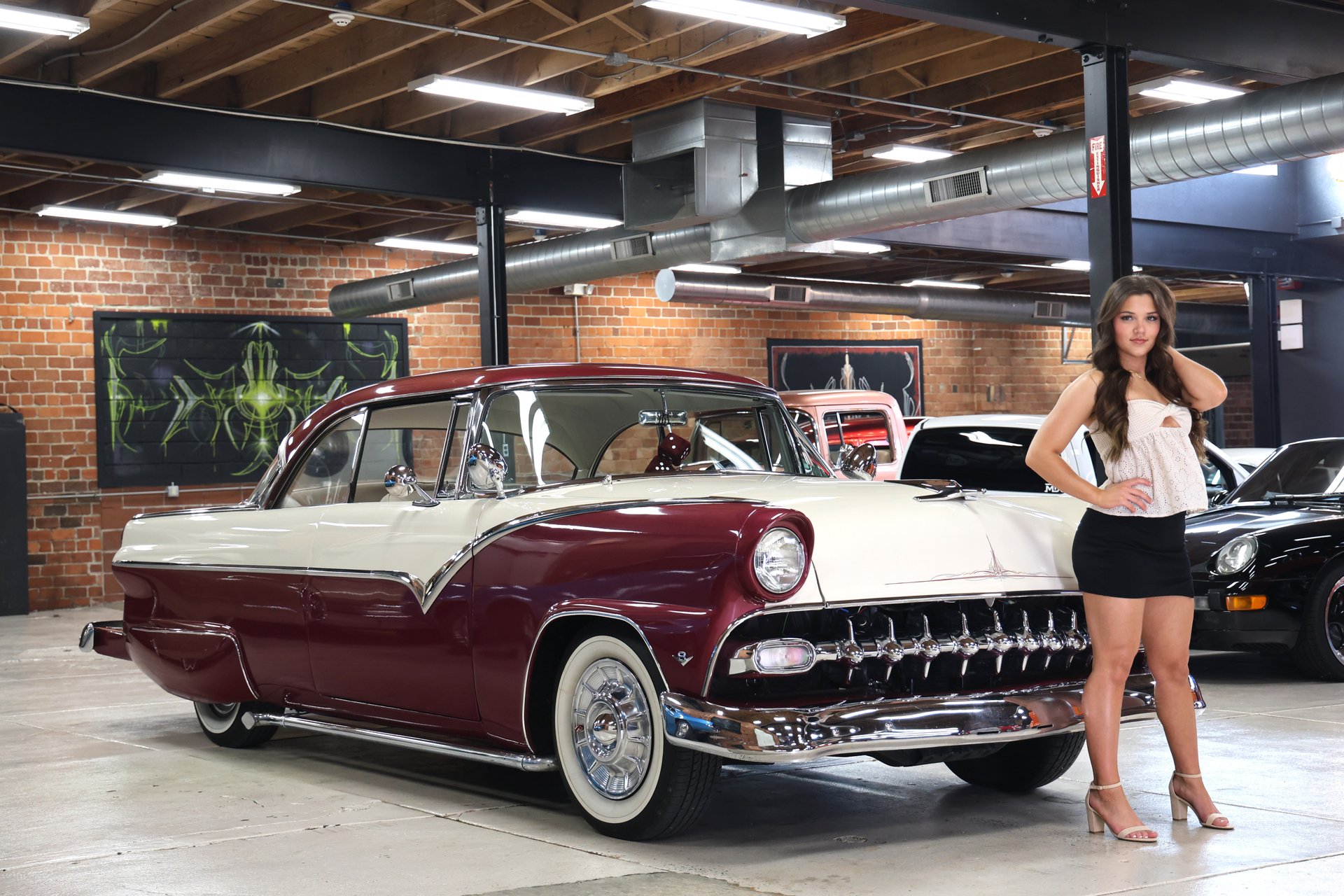
The full-size cars, 1955–59. The range opened with sedans, the Victoria two- and four-door hardtops, the Sunliner convertible and, at the very top for 1955–56, the Crown Victoria — recognisable by the wide stainless band wrapping over the roof at the B-pillar, with a transparent-roof Skylight version in 1955 that is now vanishingly rare. Town and Country wagons carried Fairlane trim too. For 1957 the wheelbase grew, the styling went low and wide, Fairlane 500 became the top series, and the Skyliner retractable hardtop joined the range: a steel roof that folds itself into the trunk at the touch of a switch, using a mechanism of motors, solenoids, limit switches and several hundred feet of wiring. The 1958 facelift brought quad lamps and a heavier grille; the 1959 cars, longer still, were the last of the line to be the flagship before Galaxie took over — and the last Skyliners.
The full-size tail, 1960–61. The big Ford was redesigned for 1960 and Fairlane and Fairlane 500 sat below Galaxie as the volume trims. These are honest, handsome cars with the same mechanical menu, but the market pays less for them than for any fifties Fairlane, which makes a good 1960–61 car one of the quiet value buys in this guide — provided you buy it for what it is and not as a cut-price 1957.
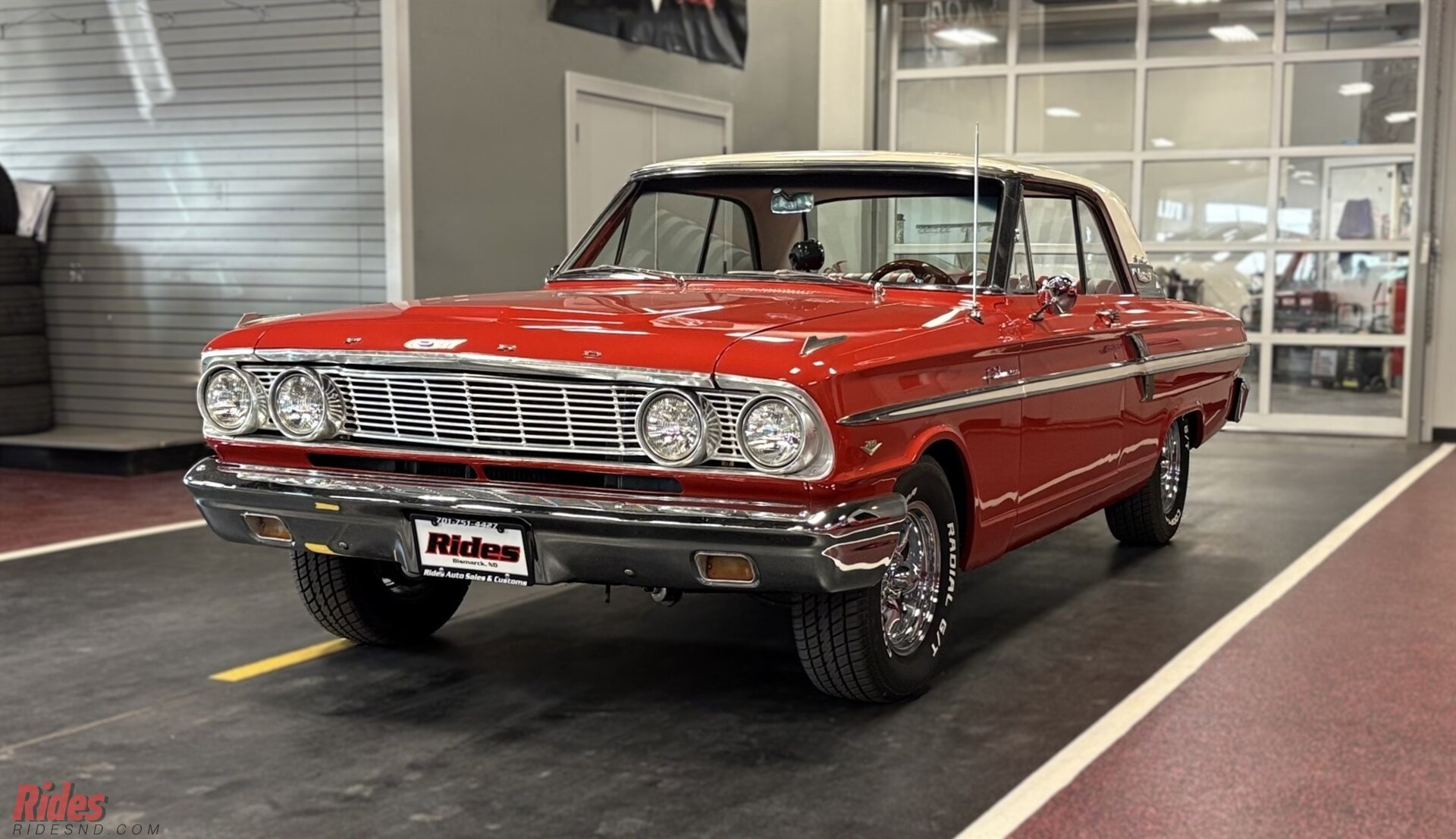
The intermediates, 1962–65. The 1962 car was all new: unit construction, a 115.5-inch wheelbase, and a trim ladder of Fairlane, Fairlane 500 and the bucket-seat Sports Coupe. Wagons included the Fairlane Squire with simulated woodgrain. The car grew slightly for 1964 and again in detail for 1965, when the stacked-quad look of the big Fords arrived in miniature. Almost all were sixes and small V8s sold as family transport, which is why survivors skew heavily to the 500s, Sports Coupes and V8 cars. The Thunderbolt stands outside the range entirely: a 1964 Fairlane 500 two-door sedan, lightened with fibreglass panels and aluminium bumpers on most cars, fitted with the high-riser 427 and built for NHRA Super Stock. About 100 were made, all effectively race cars, and any claimed example needs documentary proof, not a story.
The big intermediates, 1966–67. The 1966 redesign put the Fairlane on a 116-inch wheelbase with the vertically stacked headlamps and a proper muscle menu: Fairlane, 500, the bucket-seat 500/XL, and the GT — GTA when fitted with the SelectShift automatic. The standard GT engine was the 390, and Ford built 57 Fairlanes with the 427 for 1966, most of them plain-looking 500 two-door hardtops that are now among the most forged cars in the Ford world. The 1967 facelift is the prettiest of the sixties cars to most eyes, and 1967 GTs with the 390 are the volume muscle Fairlane.
The Torino-era cars, 1968–70. The 1968 redesign brought fastback and formal-roof bodies shared with the new Torino. Fairlane was now the entry series and Fairlane 500 the mid trim, but the engine list ran all the way to the 428 Cobra Jet, so a plain 1969 Fairlane 500 with the right engine code is a genuine performance car in a cheap suit. For 1970 the name survived one final year as the base series under Torino before disappearing. Buy these cars by engine code and body style, never by the badge's position in the range.

Engines and gearboxes
Fairlane engine history is Ford engine history in miniature: the Y-block that replaced the flathead, the FE big-block that won Le Mans in big-car form, the Windsor small-block born in this very car for 1962, and the Cobra Jet that closed the sixties. The good news is that every one of them is a known quantity with deep parts support. The buyer's job is identification first — Ford made swapping easy, and a lot of Fairlanes wear bigger engines than they were born with — and condition second.
The sixes: 144, 170, 200, 223, 240 and 250
Six-cylinder Fairlanes were the volume cars in every generation, and the sixes divide into three families. The 223 Mileage Maker (1955–60 full-size, 120–145 hp in period ratings) is an overhead-valve six of flathead-era manners: slow, unstressed and very long-lived, with a single-barrel carburettor and a reputation for cracking exhaust manifolds and for valve-guide wear that shows as a puff of blue smoke on start-up after sitting. The small Falcon-family sixes — 144 and 170 in the early intermediates, then the 200 from 1964 and the 240 and 250 in later cars — are lighter, rev happier and cheaper to keep, with a seven-main-bearing crank on the 200 and 250 that makes them genuinely smooth. Weak points are shared: the Loadomatic distributor on early small sixes depends on a spark-control valve in the carburettor, and a mismatched replacement carburettor makes the car hesitate in a way owners chase for years; head gaskets let go between the middle cylinders when a six has been overheated; and the single-barrel Autolite and Holley carburettors wear at the throttle shaft and leak air. None of this is expensive. A six-cylinder Fairlane is a cruiser, not a performance car, and should be priced as one — the trap is paying V8 money for a six-cylinder car because the body is pretty, because the engine swap the seller describes as easy is a radiator, springs, brakes, rear axle and wiring conversation as well.
The Y-block and the FE: 272, 292, 312, 332, 352, 360, 390, 406, 427 and 428
The fifties cars run the Y-block V8, named for its deep-skirted block: 272, 292 and the 312 Thunderbird Special, with outputs from about 162 hp to 245 hp for the common single-quad 312, more for the rare dual-quad and supercharged 1957 cars. The Y-block is a torquey, characterful engine with two signature faults. The first is top-end oiling: oil reaches the rocker shafts through passages that sludge up on neglected engines, the rockers starve and wear, and the classic external bypass oil tube bodge on the rocker covers tells you the problem was met and not solved. Listen for a sewing-machine tick at idle that does not fade warm, and budget for rocker shaft work. The second is rear main seal leakage — a rope seal on an engine this old weeps, and the honest question is how much, not whether. The cross-bolted 312 bottom end is strong; cracked exhaust manifolds and tired single- or two-barrel carburettors are the routine bills. A Y-block rebuild by a shop that knows the engine runs roughly $4,500–8,000; rocker shaft and rocker refurbishment alone is a $600–1,200 job, and it transforms a ticky engine.
The FE family arrived in the full-size cars for 1958 as the 332 and 352 Interceptor, and it is the engine that defines the sixties performance Fairlane: 352, 360, 390, 406, the 427 and the 428 Cobra Jet are all FEs, one architecture from family wagon to Le Mans winner. Identification is the first discipline, because FE blocks are externally similar and casting numbers lie by omission: a 390 and a 428 share a bore family look, and the only certain checks are the stroke measured through a plug hole, the casting date, and the VIN engine code matched against the car. The 390 GT engine (320–335 hp depending on year and tune) is the volume muscle motor: strong, torquey, and saddled with exhaust manifolds that crack and manifold bolts that snap on removal — price a manifold job at $800–1,800 with the snapped-bolt labour included, because it usually is. The 427 is a different order of engine: cross-bolted mains, side-oiler oiling on the later racing blocks, mechanical lifters on most performance versions, and a thirst for revs. A genuine 427 rebuild is specialist work at $12,000–25,000 depending on specification and parts, which is why documented history matters more on a 427 car than on any other Fairlane. The 428 Cobra Jet (1968–69 in the Fairlane line) is the street version of the same idea — big torque, hydraulic lifters, a 735 cfm Holley on most cars, underrated at 335 hp — and it is the engine that makes a plain 1969 Fairlane 500 worth real money. FE oil leaks from the intake manifold end seals and valve covers are normal and cheap; low oil pressure hot at idle on a high-mileage FE is the wear signal that matters, and a mechanical gauge check belongs in any serious inspection.

The Windsor small-blocks: 221, 260, 289, 302 and 351
The small-block was introduced in the 1962 Fairlane as the 221, grew to the 260 and then the 289, and became the most successful V8 family Ford ever built. For the Fairlane buyer the ladder runs: 221 (145 hp, 1962 only, now mostly of historical interest), 260 (164 hp), the 289 in two-barrel (200 hp), four-barrel (225 hp) and Hi-Po K-code (271 hp, solid lifters, standard in no Fairlane but fitted to a small number and endlessly claimed since) forms, the 302 that replaced it from 1968, and the taller-deck 351 Windsor that arrived for 1969. These are simple, light, durable engines. The checks are the universal ones, done properly: timing-chain slack on a high-mileage engine shows as a wandering timing mark; the two-barrel Autolite 2100 and four-barrel 4100 carburettors are among the best Ford ever fitted and a running fault is more often vacuum leaks, a perished accelerator-pump diaphragm or ignition wear than the carburettor itself; and the stock exhaust manifolds strangle the engine without actually failing, which is not a fault. The K-code question deserves its own sentence, because it is the small-block equivalent of the 427 problem: a genuine Hi-Po car carries the K in the VIN, solid-lifter tick, a dual-point distributor and no vacuum advance, and a car with the badges but a C-code VIN is a tribute worth tribute money. A standard small-block rebuild runs roughly $3,500–7,000; a carburettor rebuild done properly is $350–650; and a full PerTronix-style electronic ignition conversion, if you choose it, is a $150–300 afternoon — keep the points in the glovebox either way.
Gearboxes
Three-speed manual, four-speed manual, and three automatics cover the whole Fairlane story, and the automatic in the car changes with the decade. Fifties cars use the three-speed Fordomatic — in its early form effectively a two-speed in normal driving, starting in second unless you select low — and from 1958 the three-speed Cruise-O-Matic, the ancestor of the C4 and C6 in cast-iron and then aluminium cases. The intermediates brought the light-duty C4 (1964 onward), one of the best automatics of the era: cheap to rebuild at roughly $1,200–2,200, tolerant, and still supported by every transmission shop in America. Big-block cars use the C6, stronger and dearer at roughly $1,800–3,000 for a quality rebuild. Manual cars use the Ford three-speed (with overdrive on some fifties cars — a Borg-Warner overdrive that is delightful when the electrics work and baffling when they do not) and the Toploader four-speed behind performance engines, a gearbox so strong it is the default answer in period racing; a Toploader rebuild is $900–1,600, and worn second-gear synchromesh on the test drive is the standard tell. On any automatic, judge the fluid before the shift quality: bright red and sweet is a serviced box, brown and burnt is a rebuild being negotiated whether the seller knows it or not, and a long delay engaging reverse on a C4 or C6 is the classic first symptom of hardened seals — a car that does it cold and improves warm is telling you the seals, not the clutches, are tired, which is still a box-out job. Column versus floor shift is furniture, not specification, on every Fairlane generation.

Problem areas
Everything in this section follows one rule that holds across all three Fairlane generations: the mechanicals are Ford-tough and Ford-cheap, and the body is where the money goes. We have examined the seller photo sets of 43 Fairlanes in detail for this guide, and rust is mentioned in the notes on 21 of those 43 cars — one in two — with visible damage noted on 11. That is not a counsel of despair; it is a viewing discipline. Assume every car needs the full rust examination below, price what you find honestly, and let a genuinely solid shell earn its premium, because on a Fairlane the shell is the car.
Rust: the map
Rust follows the water and the road dirt, and each generation has its own version of the same map.
Floors and trunk, all generations. Start inside. On the fifties full-size cars, water past the windshield seal and cowl vents sits under the front carpets and takes the front floor pans and the toe boards; the trunk floor goes over the fuel tank and at the drop-offs behind the rear wheels, fed by perished trunk seals and rear window leaks. On the unit-body intermediates (1962 onward) the floors are structural, so a holed floor is not a cosmetic patch but a section of the car's strength: lift every carpet, prod the pans around the seat mounts and seat-belt anchors, and check the trunk floor extensions and the spare-wheel well. Floor sections are available for most years and a single pan fitted and finished runs roughly $600–1,400 a side; a full floor in a unit-body car, done with the braces it uncovers, is a $3,000–6,000 conversation. Treat floor rust as a marker, not a single fault — floors rarely rot alone.
Torque boxes, frame rails and subframes. This is the structural heart of the sixties cars and the check sellers' photographs most often avoid. The intermediates carry front subframe rails and torque boxes at the base of the A-pillars that channel crash and suspension loads; they trap mud, they rot from inside, and perforation here is fabrication work, priced per car, that can exceed the value of a six-cylinder sedan. The fifties cars have a separate frame, which changes the diagnosis rather than removing it: frames rust at the rear kick-up over the axle, at the body-mount outriggers and along the side rails where they pass the rear wheels, and a cracked or heavily scaled frame on a convertible — the body style that leans hardest on frame stiffness — is a walk-away at any price. Get the car on a lift if it passes the first viewing. It is the best money in the whole purchase.
Outer panels: the visible rust. Front fender bottoms behind the wheels, the eyebrow over the headlamps on fifties cars, door bottoms (the drain slots block, the door fills, the bottom seam bubbles — run a fingertip along every door's lower edge and feel for the blistering), rear quarter bottoms ahead of and behind the wheel arch, and the wheel-arch lips themselves. On 1957–59 cars add the complex lower rear quarters around the skirts and the dogleg at the rear door. None of these alone kills a car, but fifties chrome-era panels carry fins, spears and sculptured pressings that make repair sections dearer and blending harder: a rear quarter repair with paint on a 1957 runs roughly $1,500–3,500 a side done properly, against $800–1,800 for the plainer sixties quarter. Fresh underseal blown uniformly over everything underneath, or fresh paint only along the bottom six inches of the body, is a question the seller needs to answer with photographs of the work, not with reassurance.
Cowl, windshield surround and battery area. The cowl vent and windshield surround rot lets the water in that kills the floors, and on the intermediates a rusted cowl shows as wet front carpets and a heater box full of leaves and scale. The battery tray and the inner fender beneath it corrode from acid on every generation; lift the battery or at least rock it and read the tray edges with a torch. A tray is cheap; the inner fender and firewall damage beneath it is not.

Suspension, steering and brakes
Fifties Fairlanes use kingpin front suspension with coil springs; the intermediates moved to ball joints, and the distinction matters at inspection. Kingpins wear when the grease schedule is skipped — and it usually was — giving a knock over bumps, vague straight-ahead feel and feathered front tyre wear; a kingpin and bushing rebuild is roughly $700–1,400 a side fitted, and like the Mercedes practice of the same era, grease a dry joint properly before you condemn it, because hardened old grease can make a sound joint feel worn. Ball-joint cars are cheaper to judge and to fix: rock the wheel at twelve and six o'clock for lower joint play, check the upper control-arm shafts on 1962–67 cars for the groaning, notchy wear they develop when the threaded bushings run dry, and price a full front-end refresh — joints, bushings, idler arm, alignment — at $900–1,800 in parts and labour. Rear leaf springs sag evenly with age and crack leaves at the centre bolt on hard-used cars; a tail-down stance with broken spring leaves is a $500–1,000 spring job, while a tail-down stance on a Skyliner can also be the retractable mechanism's weight distribution, which is normal and not a fault.
Steering boxes wear at centre on every generation. Manual steering that is heavy at parking speed is correct; free play of more than about two inches at the wheel rim before the road wheels answer is a worn box, worn linkage or both, and a rebuilt manual box runs $400–800 exchanged. Power steering on fifties and sixties Fords is a ram-and-control-valve system on many cars that weeps from the ram seals and hoses as a matter of course — leaks were noted rarely in our photo sample (one car in 43), because sellers clean bays before photographing, so judge it on the test drive and on the fluid level, not on the pictures. A full hose and seal refresh is $400–900.
Brakes are drums all round on most fifties cars and front discs arrive as standard or option through the sixties depending on year and engine — big-block and GT cars are the disc cars, and a disc conversion on a drum car is common, acceptable and worth checking for quality rather than penalising. What actually stops old Fairlanes is standing: seized wheel cylinders, perished flex hoses, a master cylinder bypassing internally (pedal sinks slowly under steady pressure — test it at a standstill with the engine running), and drums scored by shoes worn to the rivets. A complete hydraulic refresh with cylinders, hoses and master is $700–1,600 fitted; add $400–800 if drums or discs and pads are also due. Single-circuit master cylinders on the earlier cars deserve the dual-circuit conversion on safety grounds alone, and its presence on a driver-quality car is a plus, not a demerit.
The Skyliner mechanism, convertible tops and body hardware
The 1957–59 Skyliner retractable is the Fairlane's party piece and its single biggest ownership risk, and it deserves plain language. The roof cycle runs on a system of electric motors, solenoids, relays, limit switches and locking screws that must work in sequence; when it is right, a full cycle takes under a minute and is one of the great sights in the classic car world. When it is wrong, the failure is usually electrical and sequential — one limit switch out of adjustment stops the cycle mid-way with the deck lid open and the roof half-folded — and diagnosis needs the factory manual, a multimeter and patience, or one of the small number of specialists who know the system, where a full mechanism recommissioning runs roughly $2,500–6,000 depending on how many motors and switches need work. The mechanical structure matters too: check the roof panel and deck lid for the creases and filler that record a lifetime of slightly misaligned landings, the trunk floor for the rust that the complex seals invite, and remember that with the roof down there is almost no luggage space, which is charm or disqualification depending on your use. Never buy a Skyliner whose roof you have not watched complete two full cycles, up and down, on the seller's driveway. A roof photographed halfway is a roof with a secret.
Sunliner and later convertible tops are conventional by comparison: hydraulic rams and a pump behind the rear seat, a frame that bends if it has been forced, and a rear window that clouds and cracks with age. A new top fitted runs $1,800–3,500 depending on material; a pump and ram reseal is $500–1,100; a bent frame is the expensive version and shows as a top that will not sit evenly on the windshield header. On hardtops and sedans, the hardware risks are quieter: window regulators wear and drop glass, vent-window frames pit, and the vast acreage of stainless and chrome on a fifties car is a re-plating bill waiting to be counted — a full brightwork re-chrome on a 1957 Fairlane 500 is a $4,000–9,000 programme, which is why original chrome in good order is worth paying for and tired chrome is worth pricing honestly rather than waving through.
Interior, trim and electrics
Interiors decide how a Fairlane feels, and fifties interiors are the expensive ones to restore. The two-tone vinyl and cloth combinations of 1955–59 are reproduced for the popular body styles, but a full professional retrim in correct materials runs $5,000–10,000 on a fifties hardtop or convertible, and correct-pattern cloth for the less common trims can be unobtainable at any price, which turns a torn original into a preservation argument rather than a simple job. Seat foam and burlap collapse with age — sit in the driver's seat and feel for the spring frame; a seat that sits like a hammock needs pads and labour at $400–900 a seat before any covering is discussed. Headliners sag, perforated hardtop headliners tear at the bows, and the padded dashes of the Lifeguard era crack along the speaker grille and the windshield line; a cracked dash on a driver is cosmetic, but price a correct replacement or restoration at $800–1,800 before you call it minor.
Sixties interiors are cheaper to live with: vinyl is tougher, reproduction covers for 500/XL and GT bucket seats are readily available, and the wear points are the driver's bolster, the console lid on XL and GT cars, and the package tray and rear seat top, which sun-cook through the big rear window on fastbacks especially. Carpet is cheap and its replacement is a weekend; what carpet hides — wet floors — is covered in the rust section and checked in the inspection.
Electrics fail at connections, not in the middle of wires, on every generation. Six-volt systems are gone by the Fairlane era — all Fairlanes are 12-volt, negative ground from 1956 — but the generator on early cars and the alternator on later ones both suffer the same tired voltage regulators and corroded grounds that make lights dim and gauges lie. The fuel gauge that reads wrong is almost always the tank sender or its ground, not the gauge. Vacuum-operated windshield wipers on the fifties cars slow to a crawl under acceleration exactly as they did when new; an electric conversion is common and harmless. Air conditioning, where fitted, is a dealer or factory under-dash or integrated system depending on year, and on a fifties car a complete, cold system is rare enough to be a genuine value point; recommissioning a dead system with modern refrigerant conversion runs $900–2,000. The pattern across all of it is the pattern of this whole guide: nothing electrical on a Fairlane is unobtainable, everything is labour, and a car where everything works has been used and maintained — which is the best single predictor of a good purchase there is.


How to inspect one
Allow ninety minutes, bring a torch, a cloth-wrapped magnet, a tyre-pressure gauge and a friend to work the pedals and lights while you watch. Bring a creeper if the seller allows it, and pay for a lift inspection before money changes hands on any car that passes you — on a unit-body intermediate it is the inspection, not an extra.
- Paperwork and identity first. Match the VIN on the title to the plate on the driver's door pillar or jamb (fifties cars) or the dash plate and door tag (sixties cars). Read the engine code in the VIN against the badge and the seller's description: a 1966–67 car claimed as a GT or a 427 car, a 1968–69 car claimed as a Cobra Jet, or any car claimed as a K-code lives or dies on this code. Check the warranty plate codes for the original engine, transmission, axle and colour, and treat any mismatch as a price conversation, not an accusation.
- Cold start. Insist the engine is cold when you arrive. A healthy Fairlane engine of any family starts promptly, settles to an even idle and shows no blue smoke beyond a first puff on a high-mileage car. Listen for the Y-block's valvetrain tick, the FE's exhaust-manifold tick that fades as it warms (a cracked manifold warming shut) and timing-chain rattle on a small-block.
- Under the bonnet, systematically. Read the oil on the dipstick for level, colour and fuel smell; check coolant for oil emulsion and rusty water; look for the Y-block rocker bypass tube that confesses an oiling bodge; check the battery tray and inner fenders for acid damage from the rust section; and note whether the engine present matches the engine code from step 1 — casting dates and a stroke check settle FE arguments.
- Underneath: the deciding step. Torch along the floors, torque boxes and front subframe rails on a 1962–70 car, or the frame kick-up, outriggers and body mounts on a fifties car. Prod the seat-belt anchor areas and floor seams. Perforation in torque boxes, rails or frame is structural and reprices or ends the purchase. Read the underseal as you go: patchy and honest is age; a fresh uniform coat over everything is a question.
- Outer body with the magnet. Work the bottom six inches first — fender bottoms, door bottoms, quarter bottoms, arch lips — then the headlamp eyebrows and windshield surround on fifties cars. Filler announces itself through the magnet and through ripples in the long flanks when you sight down them. Count pitted chrome pieces and price them as you go.
- Trunk. Lift the mat and the spare. Look for water tracks from the rear window, rust in the well and drop-offs, and on a Skyliner, stop here and go to step 7 before anything else. A damp trunk in a dry-stored car means seals, and seals mean the floor has been wet.
- Skyliner and convertible test. On a 1957–59 Skyliner, watch two complete roof cycles, up and down, listening for hesitation and watching the deck lid and roof land evenly; any mid-cycle stop is a mechanism bill from the problem section. On a Sunliner or later convertible, cycle the top, check the header fit, the rear window and the well behind the rear seat for water and rust.
- Suspension and steering. Rock each front wheel at twelve and six o'clock; grease a dry kingpin mentally before condemning it, and judge ball joints on play, not noise alone. Check stance from thirty feet: level is right, tail-down with cracked leaves is springs, and nose-down wear shows in the front tyre shoulders. Bounce each corner and watch it settle in one movement.
- The test drive. Fifteen minutes minimum, with a highway stretch. The automatic should engage drive and reverse without a long pause — delay is the hardened-seal warning from the gearbox section — and change cleanly without flare. A manual should take second gear without a crunch. The engine should pull cleanly without hesitation (Loadomatic sixes and carburettor faults both show here), and the car should track straight with the wheel centred.
- Brakes, hard. From speed, brake firmly: straight stop, no pull, no judder, no sinking pedal. Then hold firm pedal pressure at a standstill for thirty seconds — a pedal that creeps down is a master cylinder bypassing internally. Test the parking brake on a slope; on a drum car it is part of the rear brake adjustment story.
- Heat and electrics. Idle it hot. Watch the temperature gauge settle and stay, run the heater, work every window, the wipers, washers, lights, indicators, horn and radio, and check the fuel gauge against what the seller says is in the tank. On an air-conditioned car, ask for cold air and listen to the compressor engage.
- Interior last. Sit in every seat, feel for collapsed pads and spring frames, check the driver's bolster and the rear seat top for sun damage, read the dash for cracks, and lift the carpets in all four footwells one more time now the drive has shaken the car — fresh damp after rain or a wash confirms the cowl and seal leaks from the rust section.
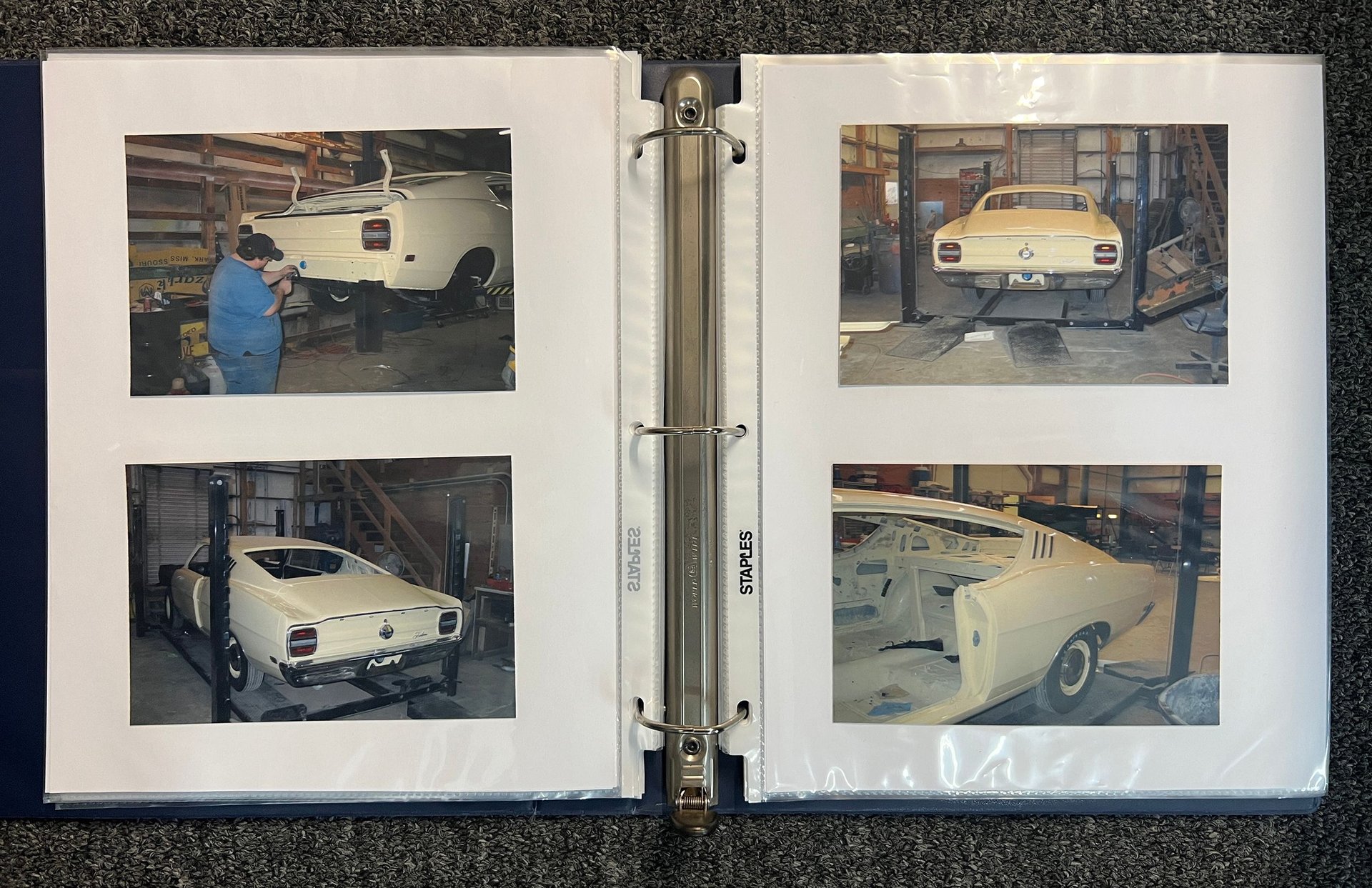
Values
The build's market block beneath this guide carries the live numbers — what is listed now and what recorded sales have achieved — so this section teaches you how to read them, because the Fairlane market punishes buyers who read a single figure and stop thinking.
The first lesson is the spread inside each generation. In every Fairlane era there is a wide gap between a project and a finished car, and it is wider than the equivalent gap on a Mustang or a Galaxie, because Fairlane restoration costs are Ford costs while Fairlane finished values sit a clear step below the fashionable names. That arithmetic cuts both ways. It means a restored car bought at market is usually far cheaper than restoring one yourself, and it means the cheap car at the bottom of the listings is rarely cheap by the time the floors, brightwork and interior in the problem sections have been paid for. Read the bottom of the market as a parts and potential market, and the middle — honest drivers with needs you can enumerate — as the value market.
The second lesson is what carries a premium, and it differs by generation. On the fifties cars, body style is the premium: convertibles and retractable Skyliners sit well above hardtops, hardtops above sedans, and the Crown Victoria's chrome band earns its keep, while wagons have climbed steadily from the bottom as the market learned to love them. Original colour combinations, a correct 312 in a 1956–57 car, and documented low ownership all add. On the sixties cars, the premium lives in the engine code and the paperwork: GT and GTA cars over plain 500s, four-speeds over automatics in the performance models, and at the top, the tiny group of 427 cars and Thunderbolts where provenance is effectively the whole value and an undocumented claim should be priced as the ordinary car it provably is. Cobra Jet cars from 1968–69 follow the same rule a step down: the code in the VIN is the premium, and it survives an engine swap only in the seller's imagination.
Asking prices and achieved prices part company predictably on Fairlanes. Dealer asking prices for pretty fifties convertibles routinely sit above what auctions achieve for comparable cars, because the dealer is selling the photograph and the season; private sellers of sixties sedans routinely ask performance money for six-cylinder cars because a neighbour's GT made it. Use the recorded-sales block below as your anchor, treat every asking price as an opening position, and negotiate from the inspection list — the costed items from your viewing are the honest currency of the negotiation, and a seller who has watched you find them knows it.
Finally, the project-versus-driver gap. For a fifties car, the gap between a running, presentable driver and a correct, finished car is mostly body, chrome and interior money, spent slowly and visibly. For a sixties performance car, the gap is identity money: the difference between a real GT and a tribute is not condition at all, and no amount of spending converts one into the other. Buy the car whose gap you are actually willing to fund — time in a driver you enjoy, or money in a restoration you have honestly totalled — and the Fairlane market will treat you well.
Parts and ownership
The Fairlane is one of the best-supported American classics you can own, for a simple reason: it shares its mechanical life with the Mustang, the Galaxie, the F-series trucks and half the Ford range, and the reproduction industry follows the Mustang wherever it leads.
Easy: engine service and rebuild parts for every family in this guide, including Y-block internals from the dedicated specialists; carburettor kits for the Autolite, Holley and Carter carburettors across the range; C4 and C6 automatic rebuild parts and Toploader gears and synchros; brake drums, discs, cylinders and hoses; suspension joints, bushings and springs; exhaust systems in standard and performance form; weatherstripping and glass rubbers for the popular body styles; and interior kits for the mainstream sixties trims and the popular fifties hardtop and convertible combinations. Order today, fit this weekend is a realistic rhythm for most of it.
Harder and dearer: fifties brightwork in good original order, and correct-pattern cloth for the less common 1955–59 trims; Skyliner mechanism components beyond the service items — motors, switches and the correct relays are a specialist and used-parts world; 427-specific engine parts, where racing heritage means racing prices; K-code Hi-Po small-block components; fifties station-wagon-specific trim and glass; and rust repair panels for the least popular body styles, where the panel you need may exist only as a used cut from a donor car. None of it is unobtainable. All of it rewards joining the marque clubs and learning which specialist answers the phone for your generation before you need them.
Running costs. A sorted Fairlane is a realistic regular-use classic: fuel consumption in the low-to-mid teens for a V8 car driven gently, worse for a big-block and much worse for a 427, insurance in line with other American classics of similar value, and servicing any competent classic shop can handle. The budget line that catches new owners is the first year of catching up: budget honestly for a full fluid and ignition service, brake hydraulics inspected end to end, tyres if the date codes say the handsome ones are old, and the deferred items your inspection listed — on a running car that has been used gently rather than maintained proudly, that first year is a real programme of work, and on a car that has sat for years it starts with the fuel system cleaned end to end, because modern ethanol fuel attacks old rubber and leaves varnish in tanks, lines and carburettors. Cars that have been in regular use are worth a premium over cars that have been asleep, on every Fairlane, in every generation.
Which one to buy
- The all-rounder: 1966–67 Fairlane 500 or GT with the 390. Big enough to use, fast enough to enjoy, supported like a Mustang underneath, and priced below the equivalent Galaxie or Mustang wherever you look. This is the Fairlane most buyers should buy.
- The fifties buy: 1957 Fairlane 500 hardtop or Sunliner. The styling year, the strongest market, the best trim support. Buy the best body and chrome you can find and let someone else's restoration receipts be your bargain.
- The value buy: 1960–61 Fairlane 500 or a 1962–65 Fairlane 500 V8. The overlooked cars of both ends of the story — full-size presence or the original mid-size package at sedan money, provided you buy condition and not a badge.
- The cruiser: 1955–56 Crown Victoria. The chrome band, the two-tone paint and the Y-block's torque make the best slow car in this guide. A 312 car with a sound frame is the one to stretch for.
- The mechanism lover's car: 1957–59 Skyliner. Buy it only with a roof you have watched cycle twice, a documented mechanism history, and the specialist's number already in your phone. Bought right, nothing else at any show does what it does.
- The performance car: 1967 Fairlane GT 390, or a documented 1968–69 Cobra Jet car. The GT is the usable muscle Fairlane at real-world money; the Cobra Jet is the serious one, bought on the VIN code and the paperwork alone.
- The collector car: 1964 Thunderbolt or 1966 Fairlane 427. Provenance is the product. Buy the documents first and the car second, with expert verification before any deposit, because the fakes are built from exactly the plain cars these started as.
And the rule that overrides all of the above: buy the least rusty car you can find, with the identity documents to prove what it is. Engines, gearboxes, brakes and tops are all fixable at prices you can plan for. A rotten shell costs more to put right than the finished car will be worth, and a performance Fairlane without its paperwork is a story, not a car.