
Ford F-350 buyer's guide
Ford F-350 -- the model's own buyer's guide: variants, values and what to check.
Years listed: 1971-2001 · Series: F-Series
Overview and history
The Ford F-350 is the one-ton member of the F-Series, and it has been that, without interruption, since the F-Series itself was launched for 1948. Where the F-100 and later F-150 were sold as much on style as on work, and the F-250 split the difference, the F-350 was always the truck you bought because the lighter ones could not legally or physically do the job: a slide-in camper that would crush a half-ton, a gooseneck trailer, a dump body, a wrecker, a dual-rear-wheel flatbed that spent its life at gross weight. That single fact explains almost everything about the trucks you will find for sale today — how they were specified, how they were used, and how they have survived.
Our listings pool for the F-350 runs from 1954 to 2001, and that spread is itself a lesson. The early trucks are thin on the ground: a handful of 1960s and 1970s survivors, a scattering of 1980s and early-1990s work trucks. The weight of the pool sits in two blocks. The first is the 1994–97 "OBS" generation — the last of the old body style — with 1997 alone the single biggest year in the pool. The second is the first Super Duty generation of 1999–2001. Those two blocks are where the market is, where the parts are, and where most buyers reading this guide will end up. The older trucks matter, and this guide covers them, but it weights its detail the way the market is weighted: the closer a truck sits to 1997 or to 1999–2001, the more forensic the advice gets, because that is where your money will actually be spent.
Through every generation the formula stayed the same even as the hardware changed completely. A separate ladder frame. A solid front axle on four-wheel-drive one-tons for most of the model's life — and, crucially, on the 1980–97 four-wheel-drive F-350 a solid Dana 60 where the lighter F-250 made do with a pivoting Twin Traction Beam axle. Leaf springs at both ends on the classic trucks. A choice of straight-six, big-block V8 or diesel power, with the diesel becoming the defining engine from the mid-1980s onward. And a bewildering matrix of cabs (regular, SuperCab from 1974, crew cab), beds (Styleside pickup box, Flareside step-side on early trucks, or chassis-cab with no bed at all), wheelbases, and single- or dual-rear-wheel axles. Two trucks both correctly badged F-350 can share almost nothing except the badge and the frame rails, so the first skill in buying one is learning to read the specification, not the badge.
The model's history divides into the eras that matter to a buyer. The 1953–56 second generation and the 1957–66 trucks that followed are now straightforward classics: simple, carburetted, bought for looks and nostalgia, priced by body condition above all. The 1967–72 "bumpside" and 1973–79 "dentside" trucks brought the FE and later 385-series big-blocks, factory crew cabs and camper specials. The 1980 redesign — the "bullnose," carried through 1986, then facelifted as the "bricknose" for 1987–91 and the "aeronose" or OBS for 1992–97 — is the long modern-classic era: seventeen years on one basic architecture, and the era that introduced the diesel F-350, first the 6.9-litre IDI in 1983, then the 7.3 IDI, then, halfway through 1994, the engine that changed the model's reputation permanently, the 7.3-litre Power Stroke direct-injection turbodiesel.
Then, for 1999, Ford split the range. The F-150 went its own way, and the F-250 and F-350 became the Super Duty: a bigger, heavier, wholly separate truck with its own frame, cabs and engines — the Triton V8 and V10 petrols and the same 7.3 Power Stroke, now intercooled and stronger. A 1999 F-350 shares its nameplate and its diesel with a 1997 and almost nothing else. Treat them as two different models that happen to share a badge, because every inspection point, weak spot and parts price differs between them.
How were they used? Honestly, and hard. An F-350 was expensive to buy and to fuel, so buyers who chose one usually had a reason — a camper, a horse trailer, a farm, a business. The typical survivor has towed, hauled, idled and been serviced on a work schedule rather than a collector's schedule. High mileage is not the warning it is on a car: a 200,000-mile diesel with documented oil, coolant and transmission care is a safer buy than a 90,000-mile truck with no paperwork and a decade of sitting. What kills these trucks is not work. It is rust, deferred diesel maintenance, automatic transmissions asked to tow without coolers or fluid changes, and long storage.

The models
Every F-350 is a one-ton truck, but "one-ton" covers several different machines. Read any listing in three layers: the generation, the configuration (cab, bed, drive and rear wheels), and the trim. The table below is the orientation map for the years in our pool; the notes after it explain the distinctions that actually move money.
| Model | Years | Engine | Output | Built | Character |
|---|---|---|---|---|---|
| F-350 (2nd gen) | 1953–1956 | 239 flathead V8 / 223 six / 272–312 Y-block V8 | 100–182 hp | Not reliably published by model | The classic-era one-ton; bought on body and originality |
| F-350 (3rd–4th gen) | 1957–1966 | 223/240/300 six, 292 Y-block, 352/390 FE V8 | 137–255 hp | Not reliably published by model | Fridge and slick-side trucks; simple, carburetted, rust-priced |
| F-350 (bumpside/dentside) | 1967–1979 | 240/300 six, 360/390 FE, 351M/400, 460 V8 | 150–245 hp | Not reliably published by model | Camper Specials and crew cabs; the last purely mechanical petrol trucks |
| F-350 (bullnose) | 1980–1986 | 300 six, 351W/460 V8, 6.9 IDI diesel from 1983 | 115–245 hp | Not reliably published by model | The diesel arrives; Dana 60 front axle on 4x4 from 1985½ |
| F-350 (bricknose) | 1987–1991 | 300 six, 351W/460 EFI V8, 7.3 IDI diesel | 145–245 hp | Not reliably published by model | Fuel injection across the range; first E4OD automatic |
| F-350 (OBS/aeronose) | 1992–1997 | 300 six, 351W/460 V8, 7.3 IDI, 7.3 Power Stroke from 1994½ | 145–275 hp | Not reliably published by model | The collector sweet spot; Power Stroke trucks carry the premium |
| F-350 Super Duty | 1999–2001 (1st gen to 2007) | 5.4 Triton V8, 6.8 Triton V10, 7.3 Power Stroke | 235–275 hp | Not reliably published by model | A different, bigger truck; intercooled 7.3 is the default buy |
Ford published F-Series production in aggregate, in the millions per generation, but did not publish clean, trustworthy F-350-only build figures for these years, so this guide does not invent them. Rarity claims for a specific F-350 ("one of only…") should always be met with a request for the paperwork behind them.
Cabs and beds decide value as much as engines do. The regular cab is the work standard and the cheapest way in. The SuperCab (extended cab, offered from 1974) adds a bench or jump seats behind the front row on a longer wheelbase. The crew cab — four full doors — is the configuration the modern market wants most, especially in 1992–97 OBS form with four-wheel drive and a diesel, and sellers price it accordingly. At the other end, a chassis-cab truck (sold new without a bed, then fitted with a dump, flatbed, service or wrecker body) has usually lived the hardest life of all and must be priced as a used piece of equipment, not as a pickup. Dual rear wheels — "dually" — were offered on pickup and chassis-cab trucks: they add towing stability and tyre cost in equal measure, and the wide rear fenders on pickup-box duallies are fibreglass, so check them for cracks and star damage rather than rust.
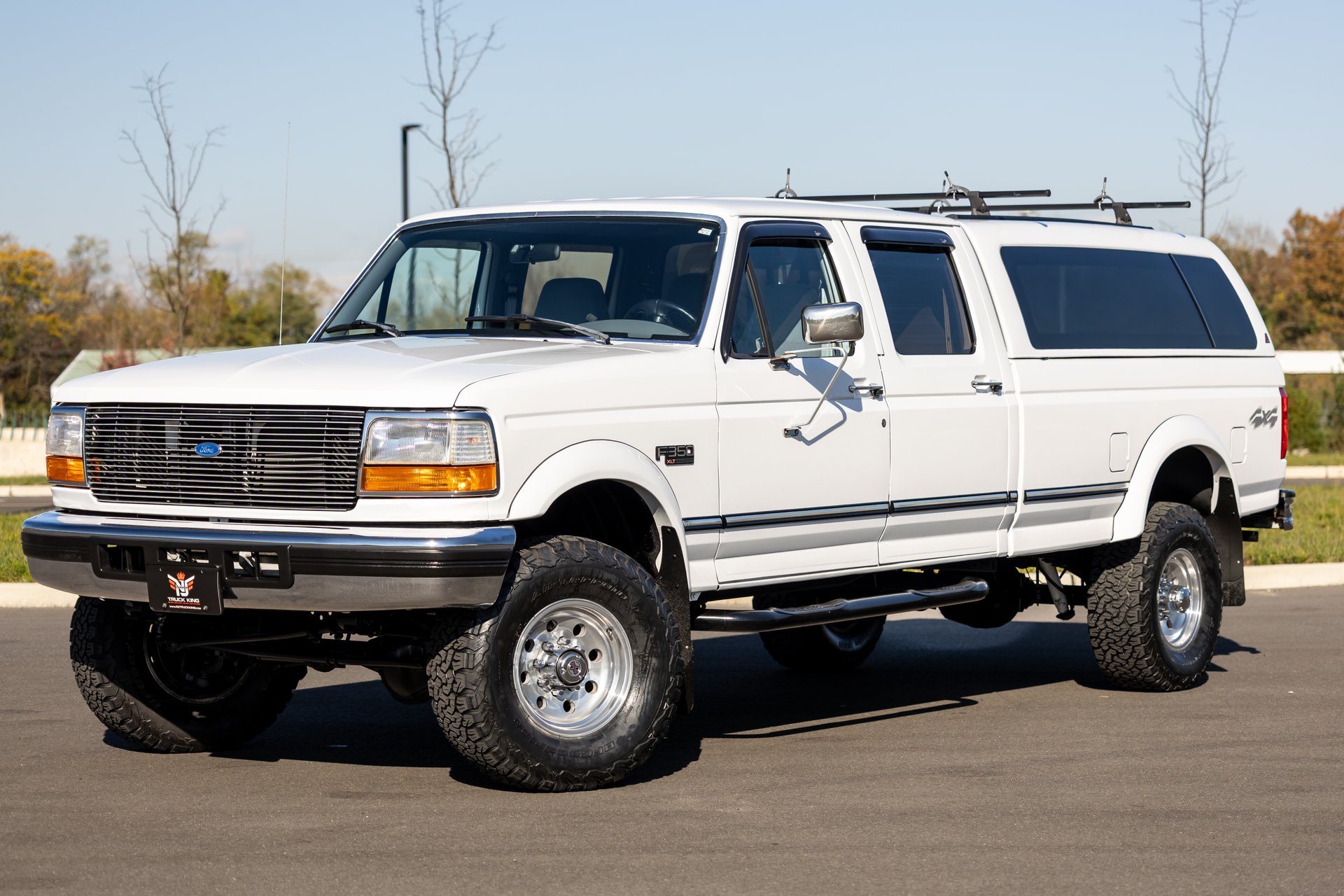
Single versus dual rear wheels, and 2WD versus 4WD. Two-wheel-drive F-350s ride on Ford's Twin I-Beam independent front suspension and are cheaper to buy and to keep; four-wheel-drive trucks command the premium and, from 1985½ through 1997, carry the solid Dana 60 front axle that off-road and plough users prize in its own right — a good Dana 60 has real standalone value, which puts a floor under any 4x4 F-350's price. Super Duty four-wheel-drive trucks use a solid Dana 50 (1999–2001, on most SRW trucks) or Dana 60 (duallies and later trucks) on leaf springs. A manual locking-hub truck that has lived in 2WD for years may have a transfer case and front axle that have effectively never been exercised; the inspection section makes you exercise them.
Trim is the smallest layer, but it is not nothing. The ladder runs from the plain Custom/XL work trim (vinyl bench, rubber mat, crank windows) through XLT to Lariat, the leather-trimmed top specification on later trucks. Trim matters for two reasons: a Lariat or XLT cab is a nicer place to spend a towing day, and trim-specific parts — seats, door cards, badges — are the hardest interior pieces to replace. Conversion trucks are a special case in this pool: companies such as Centurion converted new F-350s in the 1990s with custom paint, wood trim, extra seats and sometimes crew-cab/short-bed layouts Ford never sold. A Centurion is worth what its condition says it is worth — the conversion adds comfort, not factory originality, and its unique trim and paint are effectively irreplaceable, so damage to conversion-specific parts is a bigger deduction than on a stock truck.
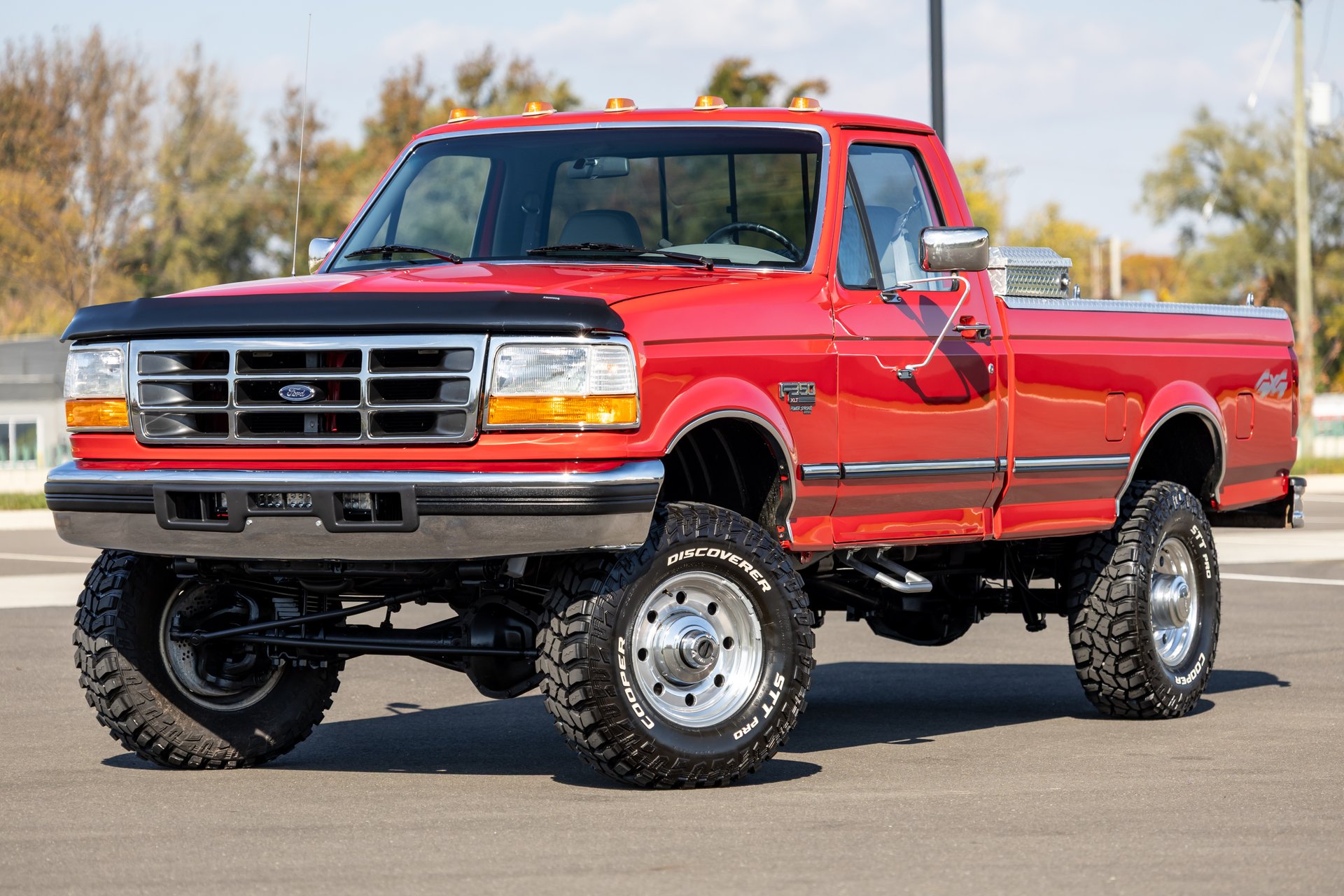

The badge traps. Three recur. First, F-250s rebadged or mis-listed as F-350s: check the VIN plate's GVWR and the certification label in the driver's door jamb, and on 1980–97 4x4s look for that solid Dana 60 — an F-250 4x4 of those years has a Twin Traction Beam front end. Second, engine swaps, especially later diesels or Cummins conversions dropped into OBS trucks: a conversion can be excellent transport and is worth driver money, but it is not an original Power Stroke truck and must not be priced as one; the door-jamb label and the engine's own identifiers settle what the truck left the factory with. Third, the year break at 1994: the 7.3 IDI, the short-lived factory IDI turbo and the 7.3 Power Stroke were all sold across 1994–94½, and sellers routinely call any 1994 diesel a Power Stroke. It is not a Power Stroke unless it is the direct-injection engine — the under-bonnet identifiers in the next section tell you which one you are looking at in ten seconds.
Engines and gearboxes
The petrol engines: sixes, small-blocks and big-blocks
The longest-lived petrol F-350 engine is the one buyers overlook: the big straight six, the 240 and then the 300 cubic inch (4.9-litre) "Big Six," sold from the mid-1960s to 1996. It makes modest power — around 145–150 hp in its later fuel-injected form — but enormous low-speed torque for its size, with seven main bearings and gear-driven timing (no chain to stretch). A 300-six F-350 is slow, honest and nearly unburstable if the oil has been changed; its known vices are cracked exhaust manifolds, carburettor wear on pre-1987 trucks, and valve-cover and pushrod-cover oil leaks. For a local-work or farm truck it is a genuinely sensible engine. For towing at modern highway speeds it is not, and no amount of tuning makes it one.
The V8 story runs in three families. The FE big-blocks (352, 360 and 390) power the 1960s and early-1970s trucks: torquey, simple, thirsty, and identified by their distributor at the front and their distinctive valve covers. The 385-series big-blocks — the 429 and, in F-350s, overwhelmingly the 460 (7.5 litres) — took over through the 1970s and lasted, fuel-injected from 1988, to 1997. The 460 is the petrol towing engine: roughly 245 hp and over 400 lb-ft in EFI form, indifferent to load, and famous for two faults — exhaust manifold bolts that snap and manifolds that crack (budget a repair cost of $400–1,200 a side if a specialist has to extract broken studs), and fuel economy in the 8–11 mpg range that no tune will fix. In between sit the 351M/400 "Modified" engines of 1977–82, adequate but unloved, with a reputation for low oil pressure at hot idle on worn engines, and the 351 Windsor small-block (5.8 litres), the middle petrol option from the early 1980s to 1997 — a good, well-supported engine, but in a one-ton truck that tows, it works hard for a living and wears accordingly.
On the early classics, add the flathead and Y-block V8s of the 1953–56 trucks and the 292 Y-block that followed. These are hobby engines now: parts and specialists exist, and condition and originality matter more than the last few horsepower. Judge them on cold starting, even idle, oil pressure and smoke, and be wary of a "rebuilt" claim with no invoice — a proper Y-block or flathead rebuild is a specialist job costing $4,000–8,000, and sellers who paid it keep the paperwork.
Across all the carburetted petrol engines, the modern ownership fact is ethanol fuel: it attacks old rubber lines and leaves varnish in tanks and float bowls on trucks that sit. A carburetted F-350 that has stood for years needs the fuel system cleaned end to end — tank, lines, pump, carburettor rebuild, realistically $800–2,000 in parts and labour — before it will run honestly.
The IDI diesels: 6.9 and 7.3 indirect injection (1983–1994)
Ford's first diesel F-350s used International Harvester's IDI engines: the 6.9-litre from 1983 to 1987 and the 7.3-litre (a bored-out development of the same engine) from 1988 to 1994, with a factory turbocharged version for 1993–94. These are indirect-injection engines: fuel is injected into a prechamber, metered by a Stanadyne DB2 rotary injection pump, with glow plugs to start them. Output is modest — about 170 hp for the 6.9, 185 hp for the naturally aspirated 7.3, around 190 hp for the factory turbo — but so is the technology, and that is the point. An IDI has no computer, no electronic injectors and nothing on it a good diesel shop cannot fix with hand tools. It is the last F-350 diesel you can maintain like a tractor.
The IDI's systems, and their tests, are specific. Glow plugs: the engine needs all eight working to start cleanly in cold weather; a truck that starts on four plugs in summer will not start at all in winter. A set of quality plugs is a $100–250 parts cost; the expensive failure is the cheap-plug habit — poor plugs swell at the tip and can break off in the head, turning a service item into a head-off job. Ask which plugs are fitted. The injection pump and injectors wear together and are typically tired by 150,000–200,000 miles: hard hot starting, haze at idle and falling power are the symptoms, and a pump rebuild with injectors runs roughly $1,200–2,500 fitted. Cavitation is the 7.3 IDI's one structural vice: coolant-side pinholing of the cylinder walls, prevented by maintaining supplemental coolant additives (SCA). You cannot test SCA history on a viewing, which is why documented coolant service is worth real money on a 7.3 IDI, and unexplained coolant loss on one is a walk-away-grade warning. Return lines between the injectors leak with age and let air in, causing hard starts that mimic pump failure; the kit is cheap ($50–150 in parts). The factory turbo IDI of 1993–94 is a nicer towing engine but rarer; do not pay a Power Stroke premium for one — it is an IDI with a turbo, a different and slower machine.
The 7.3 Power Stroke: direct injection (1994½–2001)
Halfway through 1994 Ford replaced the IDI with the engine that defines the modern F-350: the 7.3-litre Power Stroke, Navistar's T444E, built by International. It is a direct-injection turbodiesel with an entirely different fuel system: HEUI injection, in which high-pressure engine oil — from a dedicated high-pressure oil pump (HPOP) — fires the injectors under electronic control. In 1994½–97 OBS form it makes about 215–225 hp; in the 1999–2001 Super Duty, with an intercooler and revised tuning, 235 hp initially and 275 hp with the later calibrations. Torque is the real figure: around 450 lb-ft in the OBS, rising to about 505–525 lb-ft in the Super Duty. These engines have a deserved reputation for 300,000-mile durability — with three conditions: oil changes on schedule (the injection system runs on engine oil, so dirty oil is injector wear), clean fuel and filters, and a cooling system kept in order.
Learn its signature components, because every Power Stroke fault is priced by which one it is. The cam position sensor (CPS) is the famous one: a failing CPS causes random stalling, a dead tachometer while cranking and no-start conditions, and it is a $25–60 part held by one bolt. A seller describing "it sometimes just cuts out" is describing a CPS until proven otherwise — cheap to fix, but verify that is all it is. The under-valve-cover harnesses (UVCH) carry injector and glow-plug wiring through the valve covers; their connectors burn and loosen, causing a dead cylinder or a bank dropping out, rough running and a check-engine light. Harness and gasket replacement is a $300–800 job at a shop. The injector pressure regulator (IPR) and injector control pressure (ICP) sensor govern the high-pressure oil system: a sticking IPR gives surging, stalling and hard hot starts, and an ICP sensor leaking oil through its connector is a classic Super Duty sight. Glow plugs and the glow-plug relay matter as much as on the IDI: the relay is the usual failure (a $40–90 part), and a truck that needs ether to start has a glow system to fix and possibly low compression behind it — never accept ether-starting as normal. The turbocharger itself is durable; its pedestal O-rings leak oil into the valley, and on 1999½–2001 trucks the early/late turbo and intake revisions mean you must identify exactly which variant is fitted before ordering parts. The fuel bowl and its heater, the mechanical lift pump on OBS trucks (in the valley, $80–200 in parts, fiddly to change), and the Super Duty's electric pump each have their own leak signatures. None of this is exotic — a competent diesel shop knows the 7.3 intimately — but a neglected example can stack three or four of these faults at once, and the stack, not any single item, is what a pre-purchase inspection is for. Budget $1,500–3,500 to take a tired-but-sound 7.3 from "runs" to "trustworthy," and twice that if injectors themselves are worn (a full set of remanufactured injectors fitted runs roughly $2,000–3,500).
The ten-second 1994 test. Open the hood. An IDI has a conventional air filter housing over the top of the engine, a Stanadyne rotary pump in the valley with eight individual steel lines to the injectors, and "7.3L Diesel" trim. A Power Stroke has a turbocharger prominent at the back of the valley, an air intake routing to that turbo, "Power Stroke" badging on the OBS trucks, and no rotary pump or steel line bundle. If the truck is a 1994 and the seller says Power Stroke, this look — not the title, not the advert — settles it.
The Super Duty petrols: Triton V8 and V10 (1999–2001)
The Super Duty launched with two petrol engines from Ford's modular family: the 5.4-litre Triton V8 (about 235–260 hp) and the 6.8-litre Triton V10 (about 275–310 hp). In an F-350 the V8 is adequate and the V10 is the real petrol towing engine, with diesel-like torque delivery and petrol-like fuel bills. Both share the family's known vice: spark plugs that seize in the aluminium heads and, worse, plugs that can eject from the shallow threads of the early two-valve heads, taking the thread with them. A plug ejection is repairable with a thread-insert kit ($300–700 per cylinder fitted), and the questions to ask are whether any cylinder has already been repaired and whether the plugs have ever been changed at all — on a 25-year-old Triton, seized original plugs are a job waiting for the next owner. Exhaust manifold studs break just as they do on the 460. The V10 in particular is undervalued: a clean V10 Super Duty costs far less to buy than a 7.3 truck, and if you tow a few thousand miles a year rather than every week, the fuel difference may never repay the diesel premium.
Gearboxes
Manuals are the F-350's traditional gearbox and, for towing, often still the best. The early trucks use three- and four-speed manuals; the four-speeds to know are the New Process NP435 and Borg-Warner T18/T19 — immensely strong truck boxes with a very low ("granny") first gear, unsynchronised on first, and effectively unbreakable in normal use. From 1987 the five-speed ZF S5-42 (and the later S5-47) replaced them behind diesels and big petrols: a modern, synchronised box whose known points are worn synchronisers on high-mile trucks and, behind diesels, the dual-mass flywheel. The factory dual-mass flywheel fails with age and mileage, rattling at idle and shuddering on take-up; most trucks have by now been converted to a solid flywheel and conventional clutch, a $900–1,800 job fitted, and a converted truck is a plus, not a deviation — ask for the invoice. The Super Duty's six-speed ZF S6-650 is a strong box with the same clutch questions. On any manual, test second-gear synchromesh on a downchange, listen for release-bearing noise, and feel for a clutch that bites at the very top of the pedal travel.
Automatics divide by era. The C6 three-speed is simple and tough, with no overdrive — a C6 truck cruises at high rpm and drinks accordingly, but the box itself is rarely the problem. The E4OD four-speed overdrive automatic (1989–98) is the weak link of the OBS era: behind a 7.3 diesel, towing, without an auxiliary cooler and regular fluid changes, it wears out, and a rebuild realistically costs $2,500–4,500 with the upgrades (improved converter, shift kit, cooler) that stop it failing again. Judge an E4OD on fluid colour and smell, shift quality hot, converter lockup and any sign of the overdrive light flashing, which stores fault codes. The Super Duty's 4R100 is a developed, stronger E4OD, but the same rules apply: heat is the enemy, service history is the evidence, and a documented rebuild is worth paying for. On any automatic diesel, budget for a service and the largest auxiliary cooler that fits if neither is documented — the cheapest life-extension the truck can be given.

Problem areas
Everything in this section should be read against the evidence of the trucks themselves. We have photo-checked 44 F-350s from our listings in detail, and rust appears in the photo sets of 26 of them — well over half — while visible damage appears in 17. Those two numbers frame the whole model: this is a working truck whose body and structure, not its engine, decide what it is worth. Smoke appears in only one of the 44 sets and leaks in only one, which tells its own story too — sellers photograph around mechanical faults, but they cannot photograph around rust and bent metal, so weight your own inspection exactly that way.
Rust and structure: the map
Rust on an F-350 follows water, salt and mud, in that order, and the map changes only in detail between generations.
Cab corners, rocker panels and door bottoms. The classic truck rot trio. The cab corners behind the doors trap mud thrown up by the rear wheels and rot from the inside; rockers rot along their seams; door bottoms fill with water when their drain holes block. Press and prod all three, on both sides, and look from underneath as well as from the painted side — fresh underseal or a fresh sill cover on an otherwise scruffy truck is a question, not an answer. Individual panel repairs (a cab corner or rocker cut out, welded and painted) run roughly $600–1,800 a side at a body shop; both sides plus door work is how a cheap truck becomes an expensive one.
Floor pans and cab mounts. Water enters past perished windscreen seals and the cowl, sits under mats and carpets, and rots the floors; on OBS and earlier trucks, also lift the cab mounts into view — the cab sits on rubber mounts on steel brackets, and a rotten mount or bracket lets the cab sit visibly crooked and clunk over bumps. Floors are repairable with available sections ($500–1,500 a side fitted); cab-mount structure is fabrication work, priced per truck, and a cab that is dropping at the mounts is a structural conversation, not a cosmetic one.
The bed. Pickup boxes rot at the wheel arches, the bed floor (especially under drop-in bed liners and fifth-wheel hitches, where water and grit sit trapped), the front bed panel and the crossmembers underneath. A drop-in liner that the seller will not lift or let you lift is hiding the floor it sits on — assume the worst until shown otherwise. Tailgates bend and rot at the bottom edge and are worked hard; price a replacement if it is bent, because straightening one rarely lasts. Chassis-cab trucks move the question to the fitted body: a rusty dump or service body is the previous owner's equipment problem becoming yours, and its condition is part of the price.
Core support and front clip. The radiator core support rots at its lower mounts on 1980–97 trucks, letting the front clip sag and the panel gaps wander — crooked front gaps on an OBS are core support until proven otherwise. Front wing bottoms, inner wings and the battery tray area (acid-assisted) follow the pattern of every classic truck.
The frame. This is the F-350's walk-away item. Surface rust on a frame is normal and treatable. The killers are perforation and flaking scale around the rear spring hangers and shackles, the fuel-tank straps and crossmembers, the steering-box mounting area on the front rail, and — on trucks from salt states — the whole rear half of the frame where road salt collects. Get under the truck with a torch and a screwdriver and prod the hangers and rails: a frame that flakes in chunks or flexes at a hanger is not a welding afternoon, it is the end of the truck's economic life, because every repair is fabrication and the rot is always wider than the hole. In our photo sample, state of origin is the strongest rust predictor you get for free: trucks listed from the north-east and upper midwest dominate the rust figures, and a truck that has lived in the south or west starts its inspection two points ahead.

Chassis, steering and brakes
Front axles and suspension. On two-wheel-drive trucks, Twin I-Beam front suspension wears its pivot and radius-arm bushings, giving wander and uneven front tyre wear; bushings are cheap parts and a moderate labour job ($400–900 fitted for a full refresh). On 1980–97 four-wheel-drive F-350s, the solid Dana 60 is a kingpin axle on early trucks and a ball-joint axle from 1992: kingpins wear slowly and cost more to rebuild ($800–1,500 a side done properly), ball joints are a $500–1,000 axle-level job. Worn either way, the symptoms are the same — wander, shimmy after bumps, feathered tyres. Super Duty trucks use unit (hub) bearings at the front: a humming or rumbling that changes with steering load is a bearing going, at $300–600 a side fitted, and the vacuum-operated automatic locking hubs on Super Dutys are a known failure point — a truck stuck in 2WD (or in 4WD) is often hubs or vacuum lines, not the transfer case. Leaf springs sag, crack leaves (look along each leaf, especially the main leaf at the eye) and wear their bushings; a truck that sits nose-down or leans has springs in its future, at $300–700 a corner fitted depending on specification.
Steering. Ford's recirculating-ball boxes wear and leak, and play at the box adds to play everywhere else. Judge the whole chain: box, drag link and tie-rod ends, and on Twin I-Beam trucks the bushings above. A box rebuild or quality replacement runs $400–900 fitted. A whining pump plus heavy low-speed steering plus play is a front-end budget, not a single part.
Brakes. A one-ton truck is heavy empty and very heavy loaded, and its brakes live hard. Check disc condition (scoring, rust bands from sitting, lip wear), rear brakes (drums on many classic trucks, discs on Super Dutys), the parking brake — which must hold the truck on a slope, a practical necessity with a manual gearbox — and every hose and steel line. Salt-state trucks rot their steel lines; a full line replacement is a $600–1,500 job that must be done before the truck works. Budget $800–2,000 for a full hydraulic refresh on a truck that has stood. A lit ABS lamp on a later truck is a deduction and, in some states, an inspection failure.
Wheels and tyres. Tyres are real money on a one-ton: six tyres on a dually, in load range E, are a $1,200–2,200 bill, so a truck on aged, cracked or mismatched tyres has that bill built into its price — check the date codes, not just the tread. Dually rear wheels hide the inner tyre entirely; kneel and look. Steel wheels rot at the bead and around the hub; alloy wheels on later trucks crack at the spokes after hard use. A bent or mismatched spare is the norm; a missing one is a cost.
Diesel-specific problems
Beyond the engine sections above, four diesel ownership patterns catch buyers out. Cold starting tells the truth. A healthy 7.3 — IDI or Power Stroke — starts from cold in a few seconds of cranking with a working glow system. Insist on a genuinely cold start: a seller who has pre-warmed the truck is hiding glow plugs, compression or fuel-system faults, and a truck demonstrated only warm should be priced as if all three are suspect. Blow-by is the quick compression witness: with the engine warm and running, remove the oil filler cap and set it loosely on the filler neck. Light vapour is normal; a cap that is pushed off or dances with strong, pulsing pressure means ring and bore wear — on a Power Stroke, that is an engine-rebuild conversation ($6,000–10,000 at a shop) and a walk-away at any but project money. Fuel-system neglect shows as rust or water in the fuel filter bowl, black slime (algae) in a truck that has sat, and hard starting after sitting (drain-back through tired return lines on IDIs, or a failing lift pump). Cooling systems on diesels are life-support: the 7.3 IDI's cavitation risk (above) and the Power Stroke's dependence on clean coolant and a working fan clutch mean that overheating history, stop-leak residue in the coolant reservoir or a bodged radiator are serious deductions on any diesel. Exhaust smoke reads like a book once you know the code: white smoke at cold start that clears is glow plugs or unburnt fuel; persistent white is coolant or injection timing; blue is oil — turbo seals or rings; black under load is over-fuelling or a starved air side (blocked filter, collapsing intake, tired turbo). In our 44 photo-checked trucks, smoke was almost never photographed — which is precisely why your cold start matters more than the seller's pictures.
Petrol-specific problems
The petrol trucks fail more simply. Exhaust manifolds crack and studs snap on the 460 and the Tritons, announcing themselves as a ticking that fades as the engine warms — price the extraction, not the manifold. Carburetted trucks that have sat need the fuel-system recommissioning described in the engines section. The 351M/400's hot-idle oil pressure must be checked with the engine fully warm: a gauge that sinks to near zero at a hot idle, with a flickering light, is a worn engine, whatever the cold reading said. Triton plug threads (above) are the Super Duty petrol truck's defining risk, and a truck with a documented plug change and any needed thread repairs already done is worth a premium over a cheaper one still on its original plugs. Ignition components — distributors, modules and coils by era — are cheap and available; a misfire on a petrol truck is a diagnosis afternoon, not a catastrophe, unless it turns out to be low compression. Run a compression test on any petrol truck whose history is unknown: it is the cheapest certainty in this whole guide.
Body, cab and electrics
Cabs wear like workplaces. Bench seats collapse on the driver's side, vinyl splits, Lariat leather dries and cracks, and headliners sag. None of it is structural, all of it is visible, and a professional crew-cab retrim is a four-figure job, so a genuinely good interior is worth paying for. Door hinges sag (lift the door by its outer edge and feel for play), window regulators fail, and door seals perish and let in the water that rots the floors — the cab's rubber is part of the rust story. Electrics are period-simple on classic trucks: charging systems, fusible links, switches and grounds cause most faults. On OBS and Super Duty trucks, add window and lock motors and — on diesels — the dual-battery system, whose cables and grounds corrode invisibly. A diesel that cranks slowly with two "good" batteries usually has cable or ground resistance, and slow cranking masquerades as a starter or engine fault. Note the cranking speed on your cold start.
How to inspect one
Allow ninety minutes, bring a torch, a magnet wrapped in cloth, a screwdriver for prodding (with the seller's permission), and a code reader for a Power Stroke or Triton truck. If the truck passes you, pay for a lift inspection before money changes hands — on a one-ton truck, the underside is where the money is.
- Paperwork and identity first. Match the VIN on the title to the dash plate and the certification label in the driver's door jamb, and read the label: GVWR, axle codes, transmission code and paint/trim codes are all there. Confirm the truck is the F-350 it is sold as, with the engine it left the factory with. Ask for service records — on a diesel, oil, coolant and transmission history is worth more than any single inspection point below.
- The cold start. Insist the engine is stone cold. A diesel should start in seconds on its glow system, with no ether, no extended cranking and no throttle theatrics. Note cranking speed (slow cranking points at batteries, cables or starter), watch the exhaust as it fires (read the smoke using the code in the problem areas), and listen for uneven running that clears — or does not.
- The blow-by test (diesels). Warm engine, oil filler cap off and resting loose on the neck. Strong pulsing pressure that lifts the cap is ring wear and ends the viewing at any serious price. On a petrol truck, substitute a vacuum gauge or a compression test if anything about the running worries you.
- Under the truck. Torch along both frame rails, prodding spring hangers, shackles, crossmembers and the steering-box area. Perforation or heavy flaking at hangers is structural and usually terminal. Then the cab mounts, floor seams, core-support mounts and bed crossmembers. This step decides whether you continue at all.
- The rust circuit. Cab corners, rockers, door bottoms, floor pans (lift the mats), bed floor (lift or look under any bed liner), wheel arches, core support and battery tray. Run the magnet over arches, cab corners and lower doors — filler announces itself. Count the repairs the truck needs and price them from the problem areas before you fall for the engine.
- Front axle and steering. On a 1980–97 4x4, confirm the solid Dana 60 is present. Rock each front wheel top-to-bottom and side-to-side for bearing, kingpin or ball-joint play; check Twin I-Beam bushings on 2WD trucks; work the steering lock to lock and feel for box play and pump whine. Engage four-wheel drive, including the hubs, and drive it in 4WD briefly — a system that has not worked in years will tell you now, not on the first snowy boat ramp.
- Springs, stance and tyres. Stand back: the truck should sit level, side to side and front to back. Look along every leaf spring for cracked leaves, check shackles and bushings, then read all the tyres — tread, matching, load range E, and date codes, including the dually inners and the spare. Price the tyre bill into your offer there and then.
- The test drive, loaded with questions. Fifteen minutes minimum, including highway speed. A manual should take second gear on a downchange without grinding and pull from low speed in a high gear without clutch slip or shudder. An automatic should shift firmly, lock its converter (E4OD/4R100) and engage reverse without a long delay; note any flashing overdrive light. Brake hard from speed — straight, no pull, no judder — and confirm the parking brake holds on a slope.
- Diesel systems under load. On the drive, a Power Stroke should pull cleanly with modest black haze at full throttle, no surge and no stalling at junctions (the CPS signature). An IDI should pull steadily and start hot again after a five-minute heat soak at the end of the drive — hot starting is the IDI pump test, so do it while the seller watches. Check coolant temperature stability and fan-clutch roar under load.
- Petrol systems under load. A 460 or Triton should pull without manifold ticking getting worse, misfire or hesitation; a six should pull cleanly if slowly. After the drive, check hot idle oil pressure on the gauge — especially on a 351M/400 — and look for fresh oil or coolant leaks on a hot engine.
- Cab and electrics. Work everything: windows, locks, blower on all speeds, air conditioning, wipers, washers, lights, gauges, horn. Sit in every seat. Check door-hinge play, look for water tracks under the dash and behind the kick panels, and smell the cab — a musty cab is a leaking cab, and a leaking cab is tomorrow's floor rust.
- The hitch and the bed. Read the truck's working history off its hardware: a fifth-wheel hitch, brake controller and worn bed floor mean a towing life (fine, if maintained); a plough mount means a salt life (inspect the frame again); a pristine bed on a high-mile diesel means the miles were probably highway towing. Where the hardware and the paperwork disagree, believe the hardware.

Values
The market summary and recorded-sales figures appended beneath this guide carry the current numbers; this section teaches you how to read them, because on an F-350 the spread inside any single model line is wider than the spread between model lines. A rusty 1997 crew cab diesel and a rust-free one are not two prices for one truck — they are two different purchases, and the gap between them is larger than the gap between a good OBS truck and a good Super Duty.
Four things drive an F-350's value, in this order. Structure first: frame, cab and bed condition set the ceiling, because rust repair on a truck this size consumes body-shop hours at the same rate as any classic car while the finished value stays a truck's value. The diesel premium second: within the 1992–2001 pool, the 7.3 Power Stroke carries the market — a Power Stroke truck in equal condition is worth substantially more than an IDI, a 460 or a six, and a Super Duty 7.3 more than an OBS one, reflecting both capability and the engine's reputation. The 6.9 and 7.3 IDIs sit in the middle: valued by buyers who want simplicity, discounted by buyers who want power. Configuration third: crew cab, four-wheel drive, single rear wheels and a pickup bed is the retail sweet spot; regular cabs, chassis cabs with tired fitted bodies and two-wheel-drive trucks trade at a discount that reflects a thinner buyer pool, not necessarily a worse truck — which is exactly where value hides for a buyer who needs a worker rather than a collectible. Evidence fourth: documented engine, transmission and coolant history moves diesel money. A rebuilt E4OD or 4R100 with invoices, a Power Stroke with injector or harness work on paper, an IDI with coolant-service records — each removes a four-figure unknown, and the market pays for removed unknowns.
Read asking prices against achieved prices with a truck buyer's scepticism. Work trucks are often listed optimistically by sellers anchored on the best example they have seen advertised, and the recorded-sales block below is the corrective: it shows what trucks actually changed hands for, including the project trucks and the auction results that asking prices never mention. The project-versus-driver gap on this model is a chasm. A non-running or rust-structural F-350 is worth its parts — and on a 4x4, remember, the Dana 60 front axle, the diesel engine core and the transfer case give even a dead truck a real parts floor — while a sorted, documented, rust-free driver is a finished product that its seller has usually spent heavily to create. There is very little in between, and the trucks priced in between are usually projects wearing driver money. Negotiate from the inspection, not from the advert: a tyre set, a transmission with no service history, a glow system that does not work and cab corners that need welding are each priced in this guide, and a list of them, totalled calmly in front of the seller, is the strongest negotiating tool you have. Finally, buy condition over year. The market pays a premium for 1997 and for 1999–2001 because those are the fashionable bookends, but a 1995 Power Stroke in rust-free, documented order is a better truck — and usually a better buy — than a tired 1997 trading on its year alone.
Parts and ownership
The F-350's great ownership advantage is scale: Ford built F-Series trucks in the millions, the aftermarket followed the volume, and almost everything that wears out on a 1965–2001 F-350 is available, much of it from multiple suppliers at competing prices. The exceptions are specific, and they are listed below so you can check them against any truck you view.
Easy and cheap: service items for every engine (filters, plugs, belts, hoses), brake wear parts and hydraulics, steering and suspension wear parts for the common axles, leaf springs and bushings, U-joints, alternators and starters, water pumps, radiators, glass and window seals, door seals and weatherstripping, and reproduction body panels for the popular generations — floor pans, cab corners, rockers, wheel-arch sections and bed panels for the 1973–97 trucks are all catalogued parts. The 300 six, 351W and 460 enjoy full performance-aftermarket support as well as stock parts. Order today, fit this weekend is a realistic rhythm for most maintenance.
Harder and dearer: diesel injection equipment is the big one — IDI pumps and injectors are rebuildable rather than stocked new, and Power Stroke injectors, HPOPs and electronics should come from known diesel specialists, not the cheapest listing. The E4OD and 4R100 are rebuildable everywhere but the rebuild is the cost, as priced earlier. Generation-specific trim is the slow bleed: OBS and bricknose interior plastics in the right colours, Lariat seat materials, crew-cab-specific panels, Centurion conversion parts (effectively unobtainable — price any damage as a custom repair), dually fibreglass fenders in good order, and early-truck brightwork. On 1950s and 1960s trucks, add Y-block and flathead specialist parts: available, but at classic-car prices and classic-car lead times, not truck prices.
Running costs. Fuel is the headline: expect roughly 8–11 mpg from a 460, 10–13 from a working small-block or six under load, 12–16 from a Triton V10, and 14–18 from a 7.3 diesel driven gently, less towing. Diesel servicing costs more per visit (a 7.3 holds around 15 quarts of oil, and its fuel filters matter), and tyres are a four-figure consumable on a dually. Set against that, a sorted F-350 asks little else: no exotic fluids, no specialist-only routine work, insurance in line with other classic trucks. The budget line that catches new owners is the first year. Catching up deferred maintenance on a running truck honestly costs $2,000–5,000 before you improve anything; recommissioning one that has sat for years runs $4,000–8,000 at a shop. Buy a truck in regular use over a sleeping one, even at a higher price: on a one-ton diesel, use is maintenance.
Which one to buy
- The all-rounder: 1999–2001 F-350 Super Duty, 7.3 Power Stroke. Intercooled, strongest version of the great diesel, modern enough to tow anything the classic era offers, old enough to be a classic. Buy the best-documented, least-rusty example you can find, in crew cab SRW form if the budget allows.
- The classic buy: 1995–97 OBS F-350, 7.3 Power Stroke. The last of the old shape with the best engine — the combination the market has already chosen. A ZF five-speed manual version is the connoisseur's specification; an automatic is fine with a documented rebuild and a cooler.
- The value buy: 1988–94 F-350, 7.3 IDI. The simple diesel at simple money. Slower than a Power Stroke and honest about it, with no electronics to fail. A rust-free IDI truck with coolant history is the cheapest trustworthy diesel ownership in this guide.
- The petrol worker: 1992–97 F-350, 460 V8. Big-block torque, cheap parts, low purchase price, terrible thirst. If your towing is occasional and local, the maths beats the diesel premium every time — and the same logic makes a 1999–2001 Triton V10 Super Duty the value pick of the newer trucks.
- The simple-life truck: any F-350 with the 300 six. For farm, estate and local work, the Big Six truck is unburstable, fixable anywhere and the cheapest F-350 to keep alive. Just do not ask it to tow on the interstate.
- The hobby classic: 1953–79 F-350. Bought for looks, shows and light work, priced by body and originality. A bumpside or dentside crew cab or Camper Special is a charismatic classic — buy the shell, and let the engine be whatever it is.
And the rule that overrides all of the above: buy the least rusty truck you can find, with the service history you can verify. Engines can be rebuilt, transmissions upgraded, interiors retrimmed — all at prices this guide has given you. A rotten frame and cab cannot be made sound for less than the finished truck is worth. On an F-350, condition is the whole decision.
See the 27 F-350 cars currently listed.