
Ford Deluxe buyer's guide
Ford Deluxe -- the model's own buyer's guide: variants, values and what to check.
Years listed: 1936-1949 · Series: Full Size
Overview and history
The Deluxe is not one car. It is a trim name Ford moved around its range for a decade and a half, and the cars filed under it in our listings — 44 cars spanning 1936 to 1951, 20 of them for sale as we write and 24 recorded sold — cover three distinct generations: the mid-1930s cars with mechanical brakes and transverse springs at both ends, the famous 1939–41 cars that finally got hydraulics and defined the pre-war Ford look, and the 1946–51 cars that carried the pre-war design through the post-war boom before replacing it wholesale with the 1949 "shoebox." What unites them is the flathead V8. With one six-cylinder exception covered below, every car in this guide was built around Henry Ford's 1932 idea of a cheap side-valve V8 in a mass-market car, driving through a three-speed gearbox, a torque tube and a solid rear axle on a single transverse leaf spring. That architecture was already conservative in 1936 and an anachronism by 1948 — and it is exactly why these cars have the character and the following they do.
Start with the name, because sellers use it loosely and the factory did too. Through the 1930s, Deluxe (spelled De Luxe in early catalogues) was simply the better-equipped Ford: more chrome, better upholstery, colour choices the Standard car did not get — the mechanical car underneath was identical. That changed in 1938, when the Deluxe got its own front sheet metal, and again in 1941, when the range was re-cut into Special, Deluxe and Super Deluxe, with Deluxe in the middle and the Super Deluxe the flagship through 1948. Then the 1949 cars inverted the logic: Deluxe was now the entry trim below Custom, the upper 1950–51 cars are often listed as Custom Deluxe, and the Customline name arrived for 1952, just beyond our pool. A 1936 Deluxe and a 1951 Deluxe sit at opposite ends of their ranges. Never pay a "top trim" premium for a post-war car: body style, year and condition carry the money.
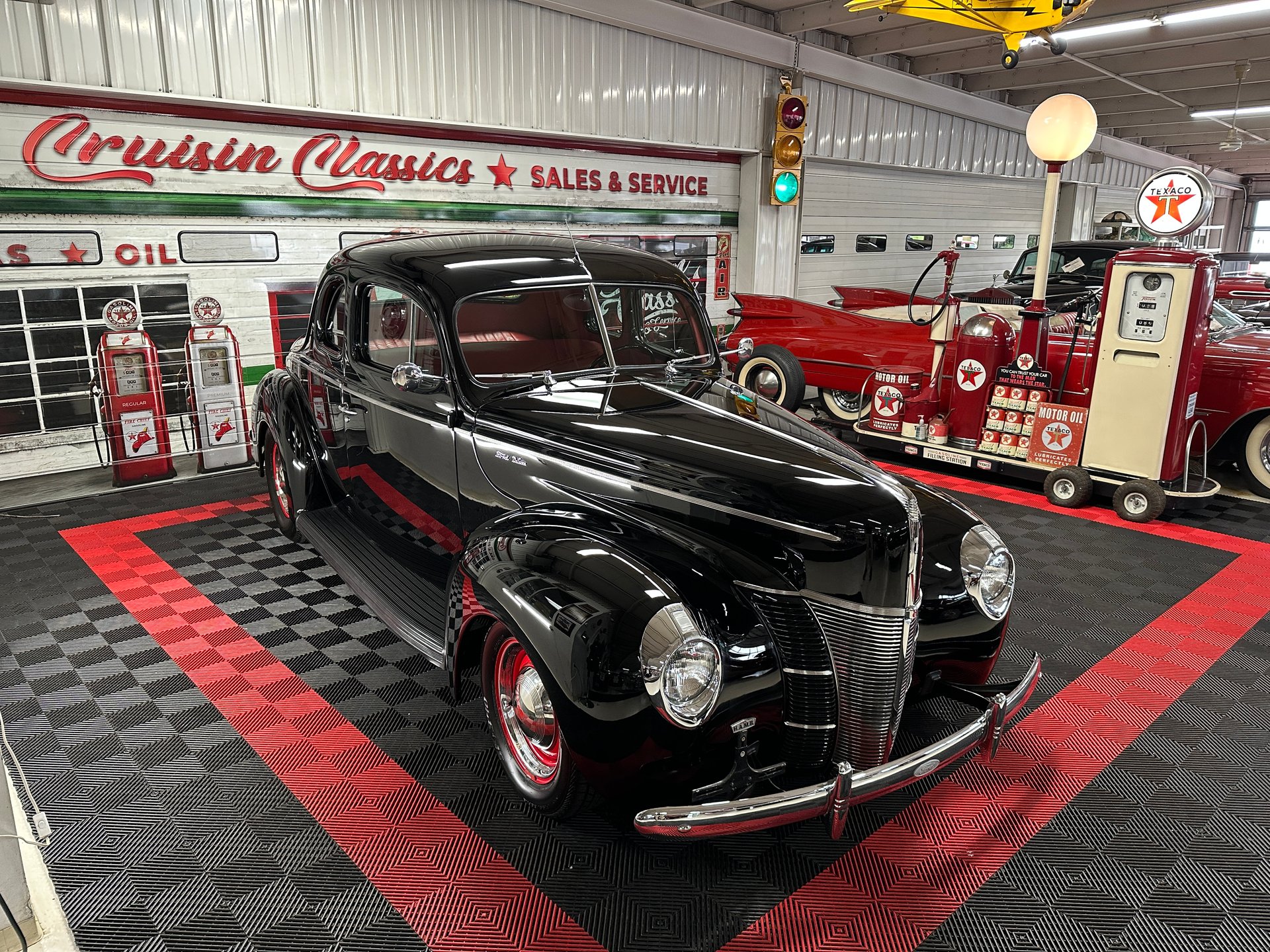
The pool tells that story plainly. It is dealer-sourced almost to a car — 43 of the 44 came through dealers, one through Facebook — and it concentrates exactly where the collector market concentrates: 19 of the 44 are 1940 cars, with 1939 and 1941 adding nine more between them, and a second cluster of post-war cars behind. The 1940 dominance is not an accident: with its sealed-beam headlamps, column gearchange and clean, pointed grille, the 1940 Deluxe is the car most people picture when they picture a pre-war Ford, and the market has traded it accordingly for forty years.
The second thing the pool tells you is that originality is now the exception you verify, not the default you assume. Ford built no automatic for these cars until the Fordomatic arrived in 1951, yet among the cars in our pool where a transmission is recorded, automatics are listed about as often as three-speed manuals. Those are swapped cars — small-block Chevrolets and modern Ford V8s, Mustang II front clips, 12-volt electrics — and there is nothing wrong with any of it, provided the car is described, inspected and priced as the street rod it is. This guide covers both cars, because you will meet both under the same listing headline.
The third thing is condition, and here our own photo work is blunt. We examined the sellers' photo sets for 18 of these cars in detail: rust was mentioned in the notes on 12 of them, and visible damage on 10 — on dealer-presented cars, photographed to sell. These were cheap cars, built down to a price, used hard, and then worth so little for so long that nobody garaged them carefully. The mechanicals forgive almost anything; the bodies do not. Read the rust section as the main text and everything else as commentary: on a Deluxe you are buying a body and chassis first and an engine a distant second.
The models
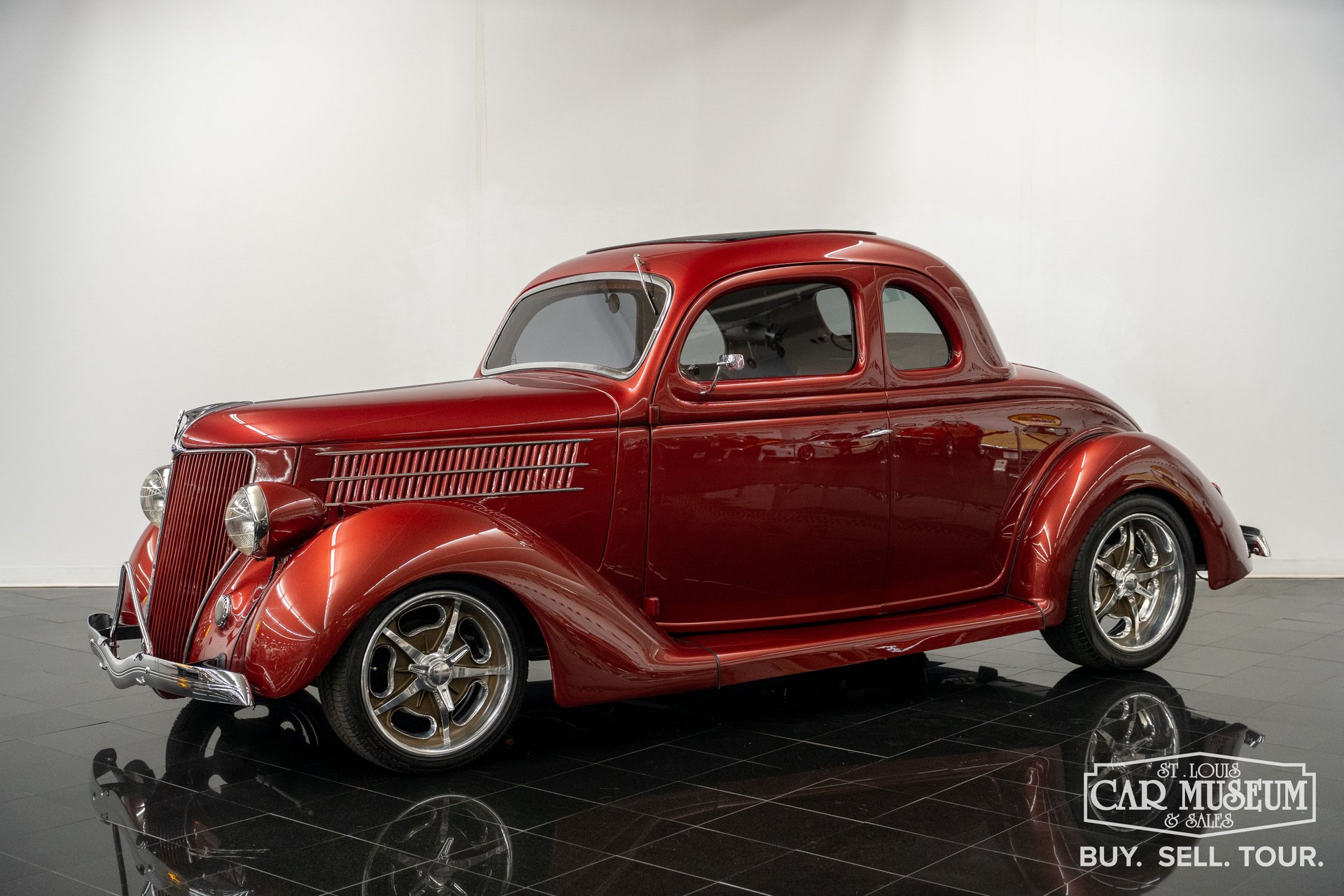
Think of the Deluxe in five chapters. The 1936 car is the last of the early flatheads: upright, mechanically braked. The 1937–38 cars are the streamlined transition, with the 1938 Deluxe carrying a heart-shaped grille the Standard car did not share. The 1939–41 cars are the mature pre-war Ford: hydraulic brakes from 1939, the definitive 1940 styling, and a wider new body for 1941 with a six offered alongside the V8. The 1946–48 cars are the 1941–42 design warmed over — the best-developed of the torque-tube cars and the last of the fat-fender Fords. And the 1949–51 shoebox cars are a clean break: independent front suspension, open propeller shaft and slab-sided styling that made everything before it look antique overnight.
| Model | Years | Engine | Output | Built | Character |
|---|---|---|---|---|---|
| Deluxe (early) | 1936 | 221 V8 | 85 hp | Not recorded by trim — see note below | Last mechanical-brake Deluxe; coupes are the collector cars |
| Deluxe | 1937–1938 | 221 V8 or 136 V8-60 | 85 hp / 60 hp | Not recorded by trim — see note below | Streamlined body; 1938 has Deluxe-only styling |
| Deluxe | 1939–1940 | 221 V8 or 136 V8-60 | 85 hp / 60 hp | Not recorded by trim — see note below | Hydraulic brakes from 1939; the 1940 is the icon |
| Deluxe | 1941 | 221 V8 or 226 six | 90 hp / 90 hp | Not recorded by trim — see note below | New wider body; Deluxe now the middle trim |
| Deluxe | 1942, 1946–1948 | 239 V8 or 226 six | 100 hp / 90 hp | Not recorded by trim — see note below | The developed torque-tube car |
| Deluxe / Custom Deluxe | 1949–1951 | 239 V8 or 226 six | 100 hp / 95 hp | Not recorded by trim — see note below | The shoebox: modern chassis, entry trim |
A word about that "Built" column: it is deliberately free of the confident figures you will see in lesser guides. Ford published production by model year and body style, and Deluxe was a trim applied across most body styles, not a model with its own tally — anyone quoting an exact Deluxe figure is adding body styles together and hoping. What is known is the shape of the years: high-volume recovery in the late 1930s, 1942 cut short in February, no civilian 1943–45 cars at all, boom years from 1946. Rarity is therefore decided by body style and survival, not by the badge: a Deluxe convertible of any year is a rare car; a Fordor sedan is not.
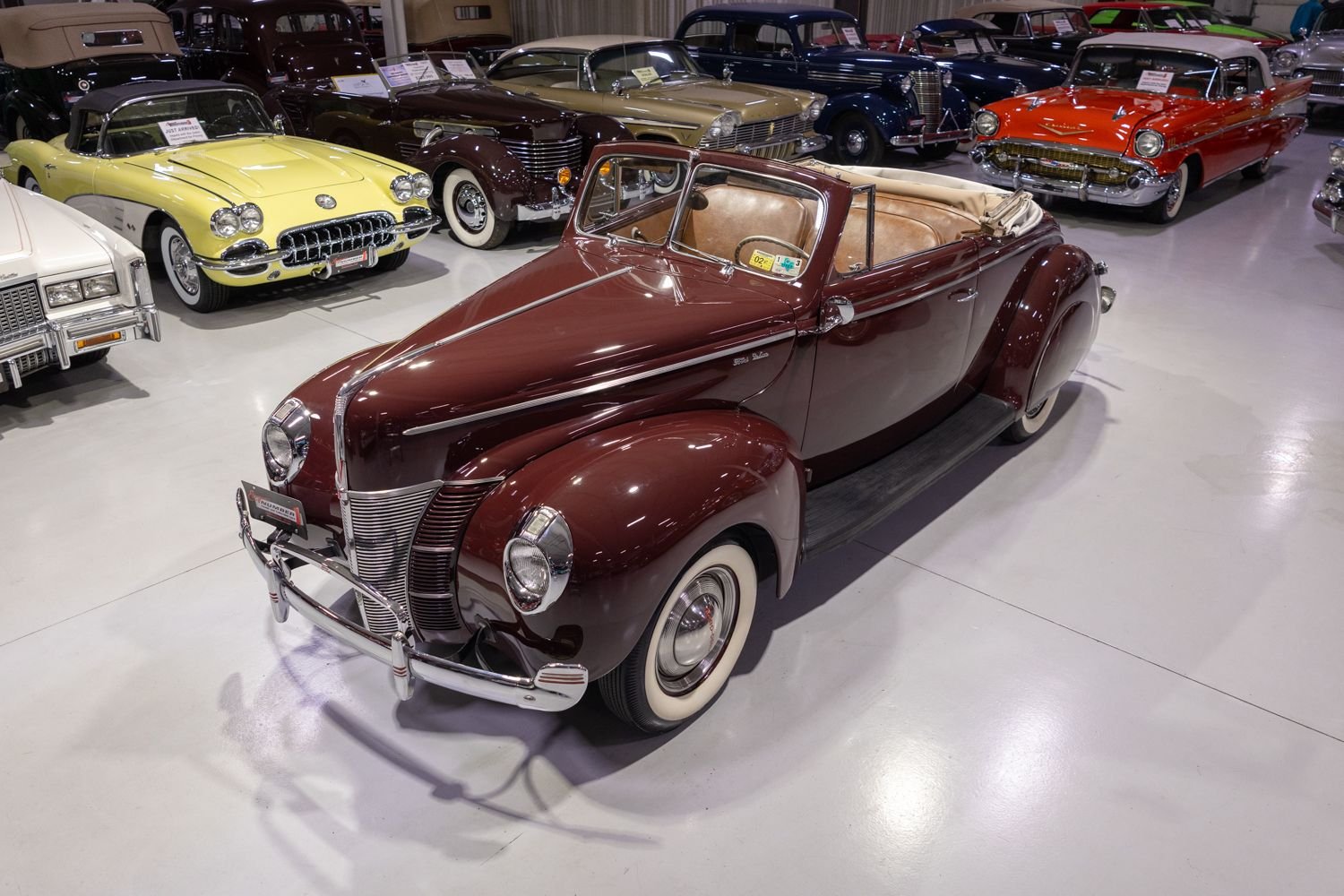
Body styles, and why they rule value. The Deluxe trim was offered on two- and four-door sedans (Tudor and Fordor in Ford's language), five-window and three-window coupes, business coupes, convertible coupes and convertible sedans in the 1930s, station wagons, and — for 1949–51 — the shoebox sedans and coupes, plus the 1950 Crestliner and 1951 Victoria hardtop, occasionally misfiled under Deluxe. In our own pool the recorded body styles are thin — only a handful of listings state one, coupes and convertibles among them — which is itself a lesson: establish the body style from the photographs, not the listing fields, because it moves value more than any other single attribute. The market order has been stable for decades: open cars and three-window coupes at the top, five-window coupes and two-doors next, sedans as the value entry. A Deluxe badge adds a modest premium over the equivalent Standard car. It does not rescue a sedan into coupe money.
1936. Two coupes worth distinguishing — the three-window and the five-window, told apart by the side glass behind the door — plus rumble-seat roadsters and coupes. This is the last year of rod-actuated mechanical brakes and the year the flathead's bottom end changed mid-stream: early cars have poured babbitt main bearings, late "LB" cars insert bearings, a difference that matters enormously to rebuild cost (see the engines section). If you want to drive distance, start at 1939.
1937–1938. The 1937 redesign put the headlamps into the fender crowns, fitted an all-steel roof and gave the Deluxe a V-shaped grille; the 1938 Deluxe kept that streamlining with a heart-shaped grille of its own while the Standard car recycled the 1937 front end. Both years offered the little V8-60 and both still stop on cable-actuated mechanical brakes. Treat any 1937–38 car as a styling purchase, and accept the brakes as part of the period package.
1939–1940. The two years that matter most, and 24 of our 44 pooled cars between them. For 1939 Ford finally fitted hydraulic brakes — the last major American maker to do so — and gave the Deluxe a low, pointed grille with horizontal bars; the Mercury arrived the same year with the bigger 239 engine the Ford would not get until after the war. For 1940 the Deluxe got the definitive look: sealed-beam headlamps, a column-mounted gear lever, and a grille of fine horizontal bars flanked by chevron trim. The 1940 convertible coupe and coupe are blue-chip pre-war Fords; the 1940 Tudor sedan is the same engineering in the cheapest wrapper. If a 1939 or 1940 car turns out to wear a V8-60, walk the price back hard: the little engine was the economy option and was never the desirable specification.
1941. A new, wider body — running boards nearly gone, headlamps in the fender tops — and a new range structure with the Super Deluxe on top. The 226 flathead six arrived as the base engine, a genuinely good engine collectors spent decades underrating, and the V8-60 was dropped. The 1941 is the roomiest of the true pre-war cars and, coupes aside, often the cheapest way into one.
1942 and 1946–1948. The 1942 car is a 1941 with a full-width grille and hidden running boards, built for barely three months before the shutdown; genuine 1942s are scarce and frequently misidentified 1946s, so verify the title and frame number before paying a scarcity premium. The 1946 car resumed the 1942 design with the Mercury's 239 V8 standard and the trim simplified to Deluxe and Super Deluxe; the 1947 update changed trim and dash detail, and true 1948s differ only in detail. All share the developed chassis — hydraulic brakes, the 239 or the 226 six, torque-tube drive and transverse springs for the last time — and are the best-driving of the fat-fender cars.
1949–1951. The shoebox cars share nothing with the 1948 car but the engines' basic architecture and the Deluxe name, now the base trim below Custom. Coil-spring independent front suspension, an open driveshaft, parallel rear leaf springs and a slab-sided body — this is the modern Ford, and it drives like one. The 1950 car added the Crestliner; the 1951 added the Victoria hardtop, a new dash, and the Fordomatic automatic as an option — the only car in this guide that could be bought with two pedals from the factory. On 1949–51 listings, read the trim off the car, not the headline: a Custom or Custom Deluxe is worth more than a Deluxe in equal condition, and the difference is badges, trim and upholstery, all checkable in photographs.
Engines and gearboxes
The 221 flathead V8: the original
Every pre-war Deluxe V8 runs the 221-cubic-inch flathead: 3.0625-inch bore by 3.75-inch stroke, side valves in the block, a single downdraft carburettor, and a distributor driven off the front of the camshaft, low down where road water and neglect find it first. Rated output was 85 hp — modest on paper, delivered with the flathead's characteristic soft, even pull and almost no mechanical noise when the engine is right. These engines are not fragile. They are, however, eighty to ninety years old, and the differences between the sub-generations decide what a rebuild costs.
21 studs, 24 studs, and the babbitt question. Count the cylinder-head fixings. Cars through early 1938 use 21-stud heads; later 1938 and onward use 24 studs, and the 24-stud engine is the one to have — better parts support and head-gasket sealing. The bigger divide is at the bottom end. Early practice poured the main-bearing babbitt directly into the block and caps; the late-1936 "LB" block introduced precision insert main bearings, which every later flathead uses. A babbitt engine is not a bad engine, but re-babbitting and line-boring adds roughly $800–1,500 to a rebuild over an insert engine's bearing set, and the shops that still pour babbitt well shrink in number every year. On a 1936 car, establish which bottom end it has before you value it — the difference is invisible until the sump comes off or the paperwork speaks.
Carburation and ignition. Mid-1930s cars wear the Stromberg 97; from 1938 Ford standardised on the Ford 94 family, built by Chandler-Groves and then Holley, a simple two-barrel the whole hobby knows how to service. What fails is everything around them: worn throttle shafts drawing air, floats sunk by modern fuel, needle valves held open by tank debris — a car that has sat will feed its carburettor rust for months. The ignition is a dual-point distributor with its coil mounted on top in the early design, working in an oven of rising engine heat; coils fail hot first, giving the classic flathead party trick of a car that starts cold, dies at twenty minutes and restarts when cool. Advance is by vacuum brake — a friction piston resisting the vacuum advance — and when it seizes or is set by guesswork the timing is wrong everywhere, which the engine reports as overheating and gutlessness. A distributor set up on a machine, $250–500 at a specialist, transforms cars owners have blamed on their carburettors for years.
The V8-60: the little engine
From 1937 to 1940 Ford offered the 136-cubic-inch V8-60: a scaled-down flathead making 60 hp, sold on economy. In Europe, where fuel was taxed and dear, it made sense; in an American Deluxe it never did. The engine is sweet and willing, but 60 hp in a car of this weight is hard work at modern traffic speeds. Parts support is thinner than for the 221 — same architecture, few shared components — and a V8-60 car should be markedly cheaper than its 85 hp equivalent. The trap is the opposite car: a V8-60 car re-engined with a 221 or 239 and sold without comment. It is a better car to drive and a worse one to authenticate. Price the car in front of you, and do not pay a matching-numbers premium for a story nobody has documented.
The 239 and 255: the Mercury engines come home
The 239-cubic-inch flathead — 3.1875-inch bore on the same 3.75-inch stroke — was designed for the 1939 Mercury. Ford cars got it as standard after the war: the 1946–48 V8 is a 239 rated at 100 hp, in the block generations collectors call the 59A family, with the distributor still at the front under a flat "crab" cap and the water pumps still mounted in the block. It is the best of the early flatheads for a driver: more torque everywhere, insert bearings throughout, 24-stud heads, and the deepest parts support of any engine in this guide. The 1949 redesign kept the 239 but re-engineered everything around it — the 8BA generation moved the distributor to the top front of the engine, accessible at last, fitted separate water pumps, and replaced head studs with bolts. Rated output stayed at 100 hp through 1951.
The 255 is the Mercury version of the 8BA, a 239 block with a 4-inch-stroke crankshaft, rated around 110–125 hp in 1949–51 Mercury service. You will meet it in Ford clothing constantly, because the Mercury crank is the oldest flathead hop-up there is and whole Mercury engines have been swapped into Fords since the cars were new. A 255 in a Deluxe is not a defect — it pulls noticeably harder — but it must be priced as a swap, not discovered as one. A seller who knows his car has a Merc crank usually says so proudly; a seller who does not know is telling you the engine's history is undocumented, which is information too.
The 226 flathead six: the honest alternative
Ford's 226-cubic-inch side-valve six arrived for 1941 (the G-series, 90 hp) and continued after the war, updated as the H-series for 1948–51 at 95 hp. It is a long-stroke, unstressed engine that shares the V8's virtues and adds two of its own: it runs cooler, because its exhaust does not pass through the water jacket the way the V8's centre ports do, and it is cheaper to rebuild, with six of everything instead of eight. For decades the market treated a six-cylinder Deluxe as a V8 with something missing. That is now a buying opportunity: a good 226 car at six-cylinder money is the cheapest honest entry into this guide. Six-specific checks: cracks around the valve seats occur but are less endemic than in the V8, and the Load-O-Matic distributor on 1948-and-later cars — vacuum advance only, matched to its carburettor's venturi vacuum signal — must stay paired with its correct carburettor, or the advance curve is wrong everywhere and the car feels strangled. Swapping a different carburettor or distributor onto a Load-O-Matic engine, six or 8BA V8, without addressing the pairing is the most common self-inflicted wound on the post-war cars.
Gearboxes, torque tube and overdrives
The standard gearbox for the whole pre-1949 story is Ford's three-speed manual: sliding gears in the earliest cars, synchromesh on second and third from the late 1930s, floor change through 1939 and column change from 1940. It is a light, pleasant box with a slow change and a non-synchromesh first you engage at a standstill or not at all. Lincoln-Zephyr gear clusters, with closer, taller ratios, were the period upgrade and still turn up; they are a pleasure to use and a complication to repair, because Zephyr parts are scarce. Behind the gearbox, everything to 1948 runs in a closed torque tube: the shaft spins inside a tube that also takes the drive thrust, with a single universal joint at the front and the axle located by radius rods and one transverse leaf. It is quiet when its seals and U-joint are good, and droning and clunking when they are not — and because the driveline is closed, almost every job starts with dropping the rear axle, which turns small parts into real labour: budget $600–1,200 in labour alone for torque-tube work before parts.
Two period answers to the torque tube's fixed gearing matter to buyers. The Columbia two-speed rear axle, a factory-approved option through the pre-war and immediate post-war years, adds a vacuum-shifted (later electric) epicyclic unit at the axle giving a roughly 28 per cent overdrive in each gear — six usable ratios and relaxed cruising. When it fails, the fault is usually in the control system — vacuum diaphragms, governor switches, wiring — rather than the axle itself, but Columbia internals are genuinely scarce and a non-functioning Columbia is a $1,500–3,000 specialist conversation. Establish that it shifts, under load, in both directions, before you pay for it. On the 1949–51 cars the equivalent is the Borg-Warner overdrive behind the three-speed, an electric unit with a kickdown switch and a lockout cable: robust, well supported, and the single best usability option on a shoebox car. The 1951 Fordomatic — a three-speed automatic with a torque converter, Ford's first — is the only factory automatic in this guide. It is durable when its bands and seals are fresh, but its presence in a 1951 car should be verified rather than assumed, because the same year's listings also contain modern automatics behind swapped engines wearing the same headline.
Problem areas
The evidence from our own pool bears repeating before the detail: of the 18 cars whose photo sets we examined closely, rust appeared in the notes on 12 and visible damage on 10 — dealer cars, photographed to sell. Assume the car in front of you has the problems below until it proves otherwise, in the order given: body first, because the body decides whether the car is worth saving at all, then the flathead's failure modes, then the chassis, brakes and electrics.
Rust: the map
A pre-1949 Ford body is a steel shell bolted to a separate frame, with a fabric roof insert on closed cars through 1936. It rusts where water sits, where mud packs, and where two panels trap dirt between them — in the same places on every car, in roughly this order.
Floor pans and body mounts. The floors go first, fed by leaking windshield rubbers, cowl vents left open in the rain, and heater cores weeping onto the front footwells. Lift every carpet and the trunk mat; surface scale is a wire brush and a coating, but perforation at the body-mount points is structural, because the body is held to the frame through the floor's outriggers and sills. A full floor replacement with braces is $2,500–5,000 a side done properly with paint; localised pans are $600–1,200 a section fitted. Floors rarely travel alone — a holed floor means the structure around it has been wet for years.
Sills, cowl and door bottoms. The rocker panels and the cowl sides behind the front fenders trap road mud thrown up by the front wheels. Prod the full length of both sills and feel along the bottom edge of every door: doors fill with water when their drain slots block and rot from the inside skin outward, so bubbling paint on a door bottom means the inner structure is already thin. A set of four doors repaired, gapped and painted is a $3,000–6,000 conversation on a Fordor — one more reason sedans must be bought on body condition above all.
Running boards, fenders and aprons. On cars through 1941 the running boards rust where they meet the fenders, and the rear fenders bolt to the body through a welt that traps moisture along the whole seam — a rust line on every fat-fender car. Front fenders go at the headlamp buckets and along the lower rear edge. None of it is structural, all of it is visible in good photographs, and it adds up panel by panel: budget $400–1,000 per fender for metalwork before paint.
The frame. The pre-war frame is a riveted ladder with a deep X-member, immensely strong in section and vulnerable in two places: the X-member's centre, where dirt and water collect around the torque-tube opening, and the rails at the body mounts and spring hangers. Surface rust is normal and honest. Perforation around the X-member or rear crossmember is fabrication work, priced per car, and on a sedan it usually exceeds the car's value. The 1949–51 welded perimeter frame rusts at the front crossmember, the body-mount outriggers and the cowl torque boxes; the same rule applies — mount-area perforation is the line between a repair and a restoration.
Trunk, spare well and tail panel. Rear window and trunk seals leak, water runs to the lowest point, and the spare-wheel well and tail panel rot quietly under mats and trim. On coupes, check the panel below the trunk lid and the rain gutters; on 1936 cars, check the rumble-seat floor if one is fitted. A trunk floor is $800–1,800 fitted and painted; its real value as evidence is what it says about the rear body mounts and crossmember directly beneath it.
The shoebox specifics. The 1949–51 cars rust in their own pattern: front fender tops behind the headlamps, the rocker panels (now structural pressings, not covers), the lower rear quarters and the floor braces. Rocker replacement runs $1,500–3,000 a side fitted and painted — and because the shoebox body is stiff and quiet, sellers describe them as solid on the strength of the doors closing well. Doors close well on rusty shoeboxes. Get underneath.
The flathead itself: heat, cracks and oil
Overheating is a system, not a symptom. The flathead V8's centre exhaust ports are siamesed — the middle cylinders of each bank share a port — and all the exhaust passages run through the water jacket inside the block. That is why these engines run hot by design margin, and why every weakness shows up at once: a radiator core scaled down to two-thirds capacity, eroded water-pump impellers (the pre-1949 pumps live in the block and double as front engine mounts, so their bearings carry engine weight too), thermostats removed by a previous owner in the mistaken belief that it helps — it does not; the coolant then moves too fast to shed heat and the car runs hotter — retarded timing from a seized vacuum brake, and sediment packed around the rear cylinders. Diagnose in order: temperature verified with a real gauge; radiator flow; pumps; timing; and only then the block. A full cooling recommission — recore ($600–1,100), pumps ($300–600 the pair on early engines), hoses, thermostats, block flush — runs $1,200–2,200 and is the first money almost every newly bought flathead needs. A car that cruises at temperature and only climbs at long idle is normal. A car that climbs steadily at speed has a capacity problem no electric fan will fix.
Cracked blocks. The flathead's known structural weakness is cracking in the valve area — from the centre exhaust valve seat toward the bore, and in the valve pockets — caused by the same heat concentration, aggravated by freezing in cars stored with plain water. Many cracks are stable, decades old, and harmless in a driver; cracks that cross into a bore or a water passage are not. There is no external test that settles it: the heads come off and the block is magnafluxed and pressure-tested, which is why a documented rebuild with a tested block is worth a real premium and an unknown engine should be priced as a core. A full flathead rebuild runs $5,000–9,000 at a specialist for a 239 or 8BA, more for a babbitt early engine — the ceiling that should discipline what you pay for any car with a tired motor.
Oil pressure and bearings. A healthy flathead shows modest oil pressure by modern standards and holds it hot. Pressure that falls away hot at idle and recovers with revs is wear talking — bearings and pump together — and on a babbitt engine it is the most expensive sentence in this guide. A deep knock on a hot restart that fades as pressure builds is bearing clearance. There is no cheap version of that fix.
Stud pull and head gaskets. Pre-1949 heads are held by studs and nuts screwed into the block, and studs seize, snap and pull threads from eighty-year-old iron. Head-gasket jobs are routine ($600–1,200 with machining checks and stud remediation), but a block with several pulled stud holes needs thread inserts, and repeated gasket failure on the centre cylinders points back to the heat and crack story above. On 8BA engines, bolts make the job simpler; the same centre-cylinder caution applies.
Chassis, steering and brakes
Transverse springs and shackles. To 1948 the car rides on a single transverse leaf spring at each end, located by radius rods, damped on most years by Houdaille lever-arm shock absorbers. The wear points are the spring shackles and perch pins: worn shackles let the axle wander, the steering goes vague and the tyres wear on their edges. Shackle and bushing renewal is $300–700 in parts and labour and transforms a sloppy car. Lever shocks that have lost their oil do almost nothing; rebuilt units run $250–450 a pair exchanged, and tube-shock conversions work well but mark the car as modified. Kingpins wear in the solid front axle's eyes and give the classic top-of-wheel rock; a kingpin set fitted runs $500–1,000. Both faults give play at the wheel, and only one of them is cheap — separate them before you price either.
Steering. The Gemmer worm-and-roller box is durable and adjustable, and most "worn-out steering" on these cars is shackle, kingpin and drag-link wear upstream of a perfectly good box. Play at the wheel rim beyond roughly two inches with the front end proven tight is box wear or maladjustment; a rebuilt box is $600–1,200. On shoebox cars the independent front end adds ball joints and bushings to the wear list — a full refresh with alignment runs $900–1,800 — and the payoff is a car that tracks like a modern one by comparison.
Torque tube and rear axle. The closed driveline's single front universal joint and its centre bearing are the service items; a rumble that rises with road speed and a clunk on taking up drive are their signatures. The banjo rear axle is strong, leaks at its seals with age, and whines when its gears are worn or mis-set after an old repair; bearings, seals and set-up run $800–1,800. On shoebox cars the open shaft adds two exposed U-joints and a conventional Hotchkiss axle: simpler, cheaper, and checkable in minutes.
Brakes: three systems, three verdicts. Cars through 1936 stop on rod-actuated mechanical brakes, 1937–38 on cable-actuated mechanicals, and everything from 1939 on single-circuit hydraulics. The mechanical systems, perfectly adjusted, stop the car adequately at period speeds and poorly by any modern measure — and they are almost never perfectly adjusted, because adjustment lives in a dozen clevises, rods and equalisers that wear oval together. A mechanical-brake car that pulls up straight is a maintained car; most pull, snatch or fade. Budget $800–1,500 for a specialist to go through a mechanical system end to end. The hydraulic cars are straightforward — drums all round, single master cylinder — with the standard age list: weeping wheel cylinders, hoses perished internally, drums scored and oversize. A full hydraulic refresh runs $900–1,800. The single-circuit system has no redundancy: a failed hose is a total failure, which is why the handbrake must work on these cars, not merely exist.
Electrics, fuel system and trim
Six volts, positive earth. Every car in this guide left the factory as a 6-volt, positive-ground machine with a generator. The system is adequate when every connection is clean and the cables are the heavy originals; it is hopeless when owners have fitted thin modern cables and painted over the earth straps. Slow cranking is a connections diagnosis first, a battery second and a starter third. A 12-volt conversion, usually with an alternator, is the most common modification in the pool: done well it is a usability gain and an originality loss, done badly it leaves gauges misreading or dead. On any converted car, verify every gauge against reality before you trust it on the test drive.
Fuel system. Tanks rust from the inside, especially on cars that sat with fuel in them, and feed debris forward until the pump and carburettor drown in it. A tank sealing or replacement ($350–800 fitted), lines flushed and a filter fitted is standard recommissioning. Ethanol attacks the old cork and leather seals in pumps and carburettors; a flathead that runs badly on fresh fuel after storage is usually varnish and swollen seals, not a worn engine. Carburettor rebuilds run $250–500; a fuel-pump rebuild $100–200. Neither should ever be quoted to you as engine work.
Interior and trim. Pre-war Deluxe trim — broadcloth or mohair upholstery, wood-grained dash and window frames on many years — survives badly and reproduces expensively. A full interior for a sedan in correct materials runs $4,000–8,000 fitted; a convertible top with pads and a new well liner $1,800–3,500. Brightwork is the other budget line: the 1940 grille and trim are reproduced, earlier and later years patchily, and re-plating original pot-metal is slow and priced per piece — a full brightwork bill on a scruffy car easily reaches $2,500–5,000. Count missing trim as money: on the less popular years some pieces are simply not available new at any price.
The modified cars, judged as modified. A street-rod Deluxe fails differently. The questions change: who built the front clip and is the welding competent; does the swapped engine overheat in its new home; do the rear axle and brakes match the performance; is the wiring a loom or a collage; does the paperwork describe the car as it stands. A well-built rod is a better road car than any stock Deluxe in this guide; a badly built one concentrates every problem in this section into one vehicle and adds its own. Price the build quality, not the parts list.

How to inspect one
Allow two hours, not one — these are simple cars with a great deal of body to examine — and bring a torch, a cloth-wrapped magnet, an infrared thermometer if you own one, and a friend to work the pedals while you watch. Insist on a cold engine: a flathead warmed up before you arrive is a car whose cold-start and hot-restart stories you are not being told. On a modified car, establish exactly what engine, suspension and electrics you are inspecting first, because the checklist forks at step 2.
- Paperwork and numbers first. Match the title to the car's numbers before you touch anything else. On pre-1949 cars the serial number is stamped on the frame, typically on the left front rail near the steering box; on 1949–51 cars use the serial plate on the firewall or door jamb and decode its trim and colour codes against the car in front of you. A frame number that does not match the title is a stop, not a negotiation. Note the engine the paperwork claims for step 3.
- Decide which car this is: stock, period-modified or street rod. Count the pedals, look for the torque tube, look at the front suspension, and check the battery voltage and polarity. An automatic gearbox in any car earlier than a 1951 Fordomatic car, overhead valves, a 12-volt alternator or a coil-spring front clip each settle the question on their own. Everything after this step is judged against what the car actually is, and the price conversation changes with it.
- Identify the engine in the metal. Count the head fixings — 21 studs dates the block family to early 1938 or before, 24 studs is later; studs and nuts mean pre-1949 practice, bolts mean an 8BA-generation engine. Find the distributor: low at the front under a helmet or crab cap is pre-1949; high at the front, angled, is 8BA. If a 255 is claimed, look for Mercury casting evidence, and treat any specification you cannot corroborate as unverified. On a six, confirm the Load-O-Matic distributor and its correct carburettor are still a pair, as the engines section explains.
- Cold start and first minutes. A healthy flathead starts on the choke with a few turns of the starter — slow cranking on a 6-volt car is normal in speed, not in struggle — settles to an even, soft idle, and shows no blue smoke beyond a first puff. Listen underneath the softness: a deep hot knock is bearings (see Problem areas), a sharp tick is valve gear, and a car that needs throttle to stay alive cold is reporting carburation or vacuum leaks, not character. Watch the oil-pressure gauge as it warms.
- The cooling interrogation. Check the hoses for the swollen softness of age, and once it is hot, use the infrared thermometer across the radiator core: hot at the edges and cold in the middle means scaled, whatever the seller says about electric fans. Then drive it and watch the gauge at a steady cruise, as the overheating diagnosis in Problem areas prescribes — climbing at speed is capacity; climbing only at idle is airflow and far less serious.
- Underneath: frame, floors and mounts. On a lift if you can possibly arrange it, torch along both frame rails, the X-member centre on pre-1949 cars, every body-mount point, the floor braces and the sills, in the order of the rust map in Problem areas. Perforation at mounts, the X-member or shoebox torque boxes ends the inspection of a sedan at any price above parts value. Read the underside's honesty too: old, patchy underseal is a lived-in car; a fresh uniform coat over everything is a question the seller answers with receipts or not at all.
- Trunk, spare well and the water trail. Lift the spare and the mat, prod the well corners and the tail panel, then work forward: rear window seal, rear footwells, front footwells. Water in these cars travels, and the wettest point is rarely the leak. Damp front carpets with a sweet smell are a heater core — on a pre-war car, a dashboard-adjacent job to price, not a shrug.
- Body, gaps and the magnet. Work the magnet over the lower doors, the rear fender seams, the cowl sides and the panel below the trunk — the rust map's addresses — and read the door gaps and running-board alignment as chassis history. On convertibles, operate the top fully and inspect the top well and cowl twice; on coupes, check the rain gutters. Count the brightwork piece by piece against a photograph of a correct car for that year, because the trim count is a price, as Problem areas sets out.
- Front end and steering, in the right order. With the front wheels off the ground, rock each wheel top-to-bottom for kingpin play and side-to-side for linkage play, then — before condemning anything — check the spring shackles for sideways movement, exactly as Problem areas separates the cheap cause from the dear one. On shoebox cars, lever the ball joints. Judge the steering box on the road only with the front end's verdict already in.
- The drive: gearbox, torque tube and overdrive. Fifteen minutes minimum, including a stretch at 50–60 mph. The three-speed should engage first at a standstill without force, change up cleanly and hold third without jumping out under load or on the overrun — jumping out is worn engagement dogs or a tired rear bearing, and it is a gearbox-out job. Listen for the torque-tube rumble and take-up clunk described in Problem areas. If a Columbia axle is fitted, shift it up and down under load, twice; if a Borg-Warner overdrive is fitted, confirm it engages, kicks down and locks out with the cable. A non-shifting Columbia is priced as absent.
- Brakes, honestly tested. From 40 mph on an empty, straight road, brake firmly with a light grip on the wheel. A hydraulic car should pull up straight with a firm pedal that does not sink or pump up; a sinking pedal is master-cylinder bypass, a pumping pedal is air or adjustment. On a mechanical-brake car, expect a longer stop and judge it on straightness and evenness. Then test the handbrake on a slope — on a single-circuit hydraulic car it is your only backup system, and it must hold the car unaided.
- Hot restart, electrics and the final walk-round. Switch off, wait ten minutes in the heat soak, and restart. The coil and distributor faults in the engines section declare themselves now, in a car that cranks and will not fire. Then work everything: lights, wipers (vacuum wipers that stall under acceleration are period-correct, not a fault), gauges, horn, heater and every switch. Finish twenty feet away, looking at stance — a transverse-sprung car sits level or tells you which shackle has sagged — and at whether the car looks like one car that has lived one life. The best Deluxes do. The rest are assemblies, and assemblies are priced as such.
Values
The Deluxe market is really three markets wearing one badge, and the first skill in reading it is knowing which one a car belongs to. The first is the original-car market: stock or sympathetically restored flathead cars, valued on body style, year and documented originality, where a 1940 convertible coupe and a 1947 Fordor sedan live in different worlds. The second is the street-rod market, where the badge is a body shell and the value sits in the build as a package — and where a sedan can out-value a tired original coupe because the money was spent where rod buyers want it spent. The third is the project market, which feeds both and obeys one rule: the gap between a project and a finished car is almost always wider than the cost of finishing it, because the finisher's risk and time are priced in. Read the recorded-sales and listed-now figures that accompany this guide by market first and by year second, or the averages will mislead you in both directions.
Within the original-car market, the condition spread is driven by the body, not the mechanics. Two otherwise identical cars separate cleanly into one with an honest, solid shell and original floors, and one with patched floors, filled fenders and fresh paint over both — and everyone who knows these cars knows the metalwork bill that separates them. In practice the spread is compressed by optimistic describing: the premium car is the one whose underside photographs match its paint. Asking prices habitually sit above achieved prices, most of all on sedans and post-war cars, where supply is deep; convertibles and good coupes, genuinely scarce in honest condition, hold their asks far better. Auction results, where they exist for a body style, are the discipline to apply to an asking figure — not because auctions are cheap, but because they are achieved.
Premiums are predictable. The 1940 model year carries one across every body style; open cars and three-window coupes carry one; a documented 239 or a knowingly fitted Mercury 255 is worth more than an anonymous engine; and a working Columbia axle or Borg-Warner overdrive adds real money to a driver because it adds real usability. The 226 six, long discounted, has been firming as buyers discover how good the cars are — treat a genuinely cheap six as the market's remaining inefficiency. Discounts are equally predictable: the V8-60, mechanical brakes on a car priced as a driver, a non-functioning overdrive sold as fitted, missing one-year trim, and any structural rust at all on a sedan. On modified cars, originality stops mattering and build documentation replaces it — but the rust rule does not invert: a rodded car with a rotten shell is worth its drivetrain and its title, and no more.
Negotiation reality, finally, is that this is a thin, relationship-driven market of mostly dealer-held stock — our pool is dealer-sourced almost to a car — where the good cars are known and move between owners without being advertised for long. That makes inspection, of the kind set out above, the whole game. Budget the recommissioning honestly, price the body ruthlessly, and let the seller keep any car whose story requires you to stop asking questions.
Parts and ownership
The flathead Ford is one of the best-supported pre-war cars in the world, because it sits at the centre of two industries at once — the restoration trade and the traditional hot-rod trade — which between them reproduce or stock almost everything the volume years consume. Long-established specialists such as Dennis Carpenter, Bob Drake Reproductions, C and G Ford Parts and Mac's, plus engine specialists such as Van Pelt and H and H Flatheads, cover the 1939–48 cars almost completely and the shoebox cars nearly as well. A 1940 or a 1947 Deluxe is a car you can keep on the road with a telephone and a parts catalogue, and that is not true of most of its period rivals at any price.
Easy: service items for every engine in this guide — gaskets, ignition consumables, carburettor kits for the Stromberg 97 and Ford 94, 8BA water pumps, clutch parts, brake shoes, wheel cylinders and hoses for the hydraulic cars, kingpin and shackle kits, exhaust systems, glass, weatherstrip, and most 1939–48 trim in reproduction. Order this week, fit this weekend, at prices that embarrass modern-car owners.
Harder and dearer: babbitt work and early 21-stud engine parts; V8-60 internals; Columbia axle internals and control parts, where supply is used, NOS and specialist-rebuilt; unworn mechanical-brake linkage; lever-arm shocks, exchanged against rebuildable cores; correct one-year trim for 1936, 1938 and 1942; convertible top frames; and good original pot-metal brightwork. None of it is unobtainable, but all of it is found by patience and club networks rather than by catalogue — price a car missing several pieces from this list as if one will take a year to find, because one will.
Running a Deluxe. A sorted car is a realistic regular-use classic within its period limits: a flathead in good order returns fuel economy in the mid-to-high teens, asks for oil changes and chassis greasing on a short, period schedule — grease points on a transverse-sprung car are numerous and they are the maintenance, not an optional extra — and wants its cooling system treated as a service item. Six-volt cars ask for clean connections and a battery kept on a maintainer. The budget line that catches new owners is the first year: catching up deferred maintenance on a running car runs into the low thousands before you improve anything, and recommissioning a car that has sat for years — fuel, brakes and cooling end to end, tyres aged out regardless of tread — is a programme, not a weekend. Join the clubs: the Early Ford V8 Club and the shoebox community hold the knowledge, the parts stashes and the honest cars, and there is no cheaper inspection than a car's reputation arriving before it does.
Which one to buy
- The all-rounder: 1940 Deluxe, V8, coupe or Tudor sedan. The definitive year, the best parts support in the guide, hydraulic brakes and the column shift. If you want one pre-war Ford to own and drive, this is the centre of the market for a reason.
- The value buy: 1946–48 Deluxe or Super Deluxe sedan with the 239. The most developed torque-tube chassis and the strongest early flathead — at sedan money. Buy the best body you can find.
- The usable classic: 1949–51 shoebox, V8 or six. Independent front suspension, an open driveline and modern road manners by the standards of this guide, with a Borg-Warner overdrive car the pick for real touring. Read the trim off the car, not the listing.
- The connoisseur's car: 1936 Deluxe three-window coupe or roadster. The purest early flathead, mechanical brakes and all, bought for the shape and the era. Verify the babbitt-versus-insert bottom end before you value the engine.
- The honest entry: a 226 six car, 1941 or post-war. The engine the market underrated for fifty years: cooler-running, cheaper to rebuild and cheaper to buy than the V8 beside it. A good six is the cheapest sound Deluxe ownership there is.
- The street rod, bought as one: any year, judged on the build. A well-built rod with a modern drivetrain, real brakes and sorted cooling is the most usable car in this guide in modern traffic. Pay for documented build quality and a title that matches the car — never original-car money for a rod, or rod money for an original car.
And the rule that overrides all of the above: buy the least rusty, most honestly described car you can find — engines, gearboxes and trim are all fixable at prices you can plan for, but a rotten shell or a false identity costs more to put right than the finished car will ever be worth.
See the 18 Deluxe cars currently listed.