
Ford Bronco buyer's guide
Ford Bronco -- the model's own buyer's guide: variants, values and what to check.
Years listed: 1966-2024 · Series: Bronco
Overview and history
The Bronco is not one vehicle. It is three different answers, built across six generations, to the question of what a short, upright, four-wheel-drive Ford should be — and the first job of a Bronco buyer is deciding which answer you actually want. There is the early Bronco of 1966–77: small, simple, coil-sprung at the front when rivals rode on leaves, and now a blue-chip classic. There is the full-size Bronco of 1978–96: a shortened F-Series pickup with a removable rear roof, built in four distinct generations, big enough to tow, haul and family in. And there is the Bronco that returned for 2021: a modern, turbocharged, removable-roof off-roader deliberately styled and engineered as a tribute to the first one. They share a name, a silhouette and almost nothing else. Parts do not interchange, problems do not transfer, and a budget that buys an exceptional full-size truck buys a project early Bronco.
One boundary first, plainly: the Bronco II of 1983–90 is not this guide's subject. It is a smaller, Ranger-based vehicle that happens to share part of the name, and the same goes for the modern Bronco Sport, a unibody crossover. Neither is a Bronco in the sense used here, and neither should be priced, inspected or described as one.
Ford launched the original in August 1965 as a 1966 model, aimed squarely at the Jeep CJ and the International Scout. Donald Frey, who had also championed the Mustang, pushed the project, and the result was more civilised than either rival: a 92-inch wheelbase, an all-steel body in three forms — open Roadster, Half Cab pickup and full Wagon — front coil springs, and a proper heating and trim package. It sold steadily rather than spectacularly for twelve years, and for decades afterwards it was simply a cheap old off-roader. Then values turned, hard, in the 2010s: the early Bronco became one of the defining collectible trucks of its era, restorers and restomod builders industrialised around it, and the supply of honest, unmodified survivors thinned to a trickle.
The full-size era began for 1978, when Ford moved the Bronco onto a shortened F-100 chassis. It grew in every direction, gained V8-only power and a removable fibreglass rear top, and sold in numbers the early truck never approached. Four generations followed — 1978–79, the lighter "bullnose" of 1980–86, the fuel-injected "bricknose" of 1987–91, and the final, airbag-equipped truck of 1992–96 — before Ford replaced it with the four-door Expedition for 1997. For a quarter of a century that was the end. The name returned for 2021 on a thoroughly modern ladder-frame vehicle with independent front suspension, turbocharged engines, a seven-speed manual with a crawler gear or a ten-speed automatic, and doors and roof panels designed to come off. Our own store reflects the whole arc: we track 369 Broncos spanning 1966 to 2024, with the deepest single-year pools in the classic years — 1974, 1995, 1973, 1969 and 1979 among them — which is another way of saying the classic generations, not the new truck, are where most buying decisions here are made.
That spread defines the market's character. At one end sit restored and restomod early Broncos built by professional shops to a standard Ford never attempted. At the other sit tired full-size trucks that were worked, parked and patched. In between is where most readers of this guide will buy: a sound early truck to use gently, or a good full-size Bronco — the last of the simple, V8, body-on-frame American SUVs — to use properly. Everything below is organised around that choice.
The models
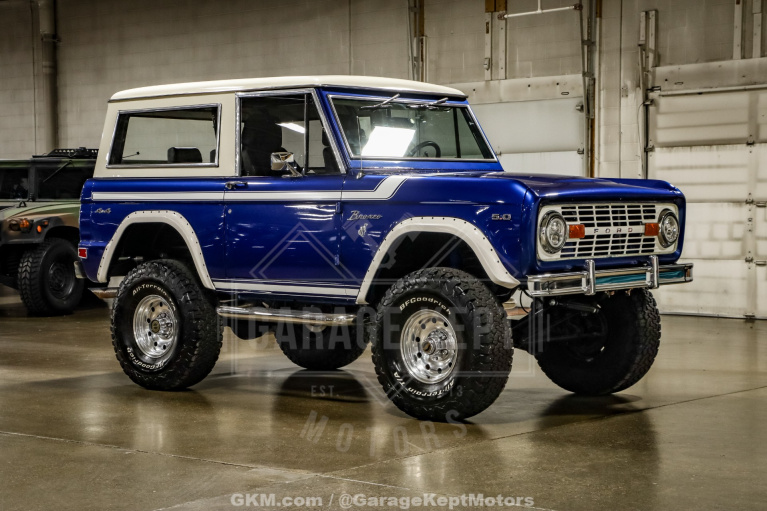
Think in generations, not trim levels. Within a generation, Bronco trim badges — Custom, Ranger, XLT, Eddie Bauer, Nite — mostly describe upholstery, chrome and options. Between generations, everything that matters changes: size, axles, engines, rust patterns and price class. The table below is the map for the whole guide.
| Model | Years | Engine | Output | Built | Character |
|---|---|---|---|---|---|
| Early Bronco (Gen 1) | 1966–1977 | 170/200 six; 289/302 V8 | 105–205 hp | about 225,000 | The classic; small, simple, valuable |
| Full-size (Gen 2) | 1978–1979 | 351M / 400 V8 | about 156–169 hp | about 182,000 | Biggest, bluntest; two years only |
| Full-size (Gen 3, "bullnose") | 1980–1986 | 300 six; 302/351W V8 | 115–210 hp | not cleanly published | Lighter, TTB front axle, carburettor era ends |
| Full-size (Gen 4, "bricknose") | 1987–1991 | 300/302/351W, fuel-injected | 150–210 hp | not cleanly published | EFI arrives; the usable modern-classic pick |
| Full-size (Gen 5) | 1992–1996 | 302/351W EFI; 300 early | 185–210 hp | not cleanly published | Last of the line; airbag from 1994 |
| Bronco (Gen 6) | 2021– | 2.3/2.7 EcoBoost; 3.0 Raptor | 275–418 hp | production continuing | The tribute act; modern truck, modern checks |
(Outputs are period figures and mix gross ratings on the earliest cars with later net ratings, so compare within a generation, not across the whole table. Where Ford never published a clean generation total we say so rather than invent one.)
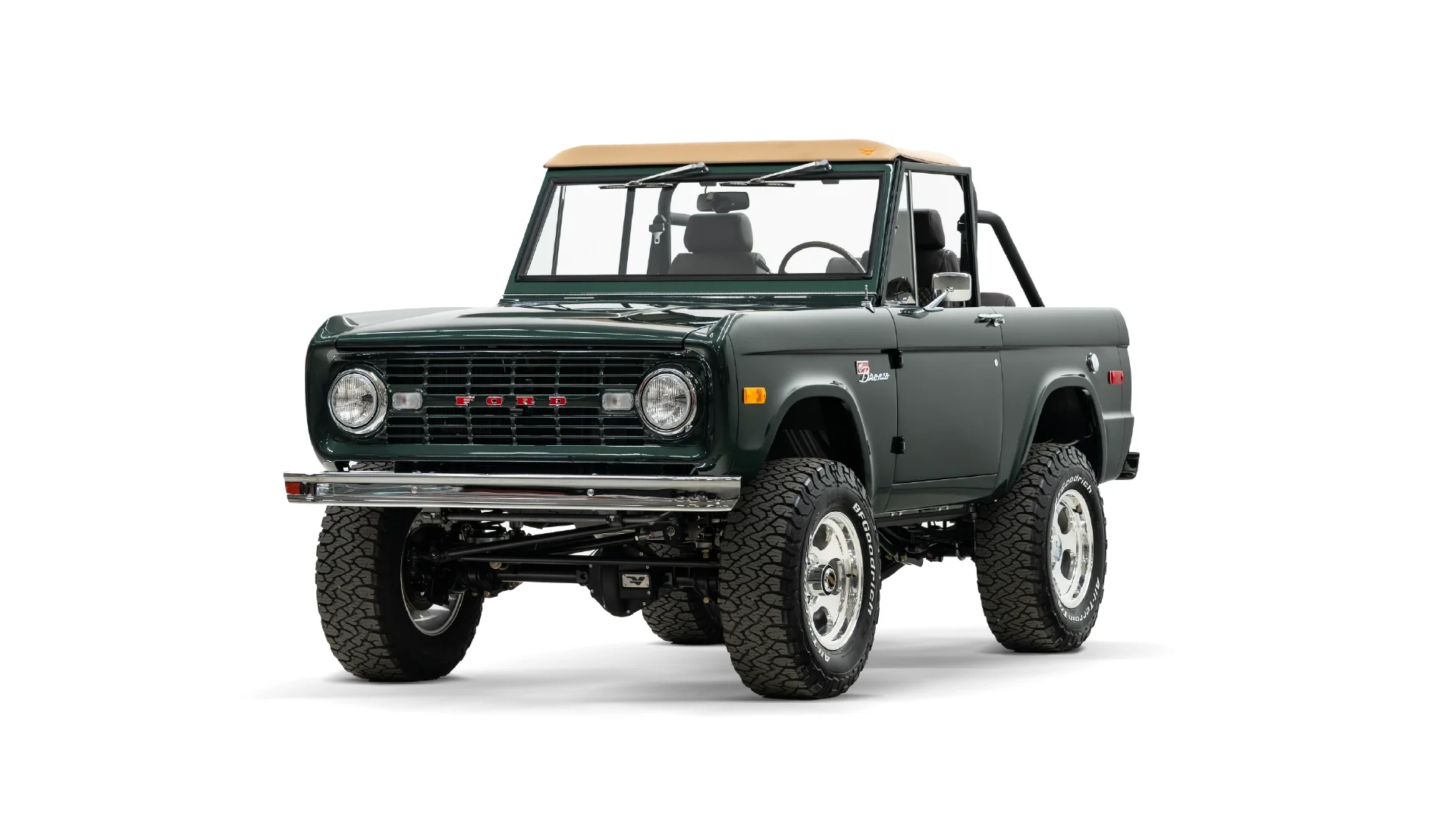
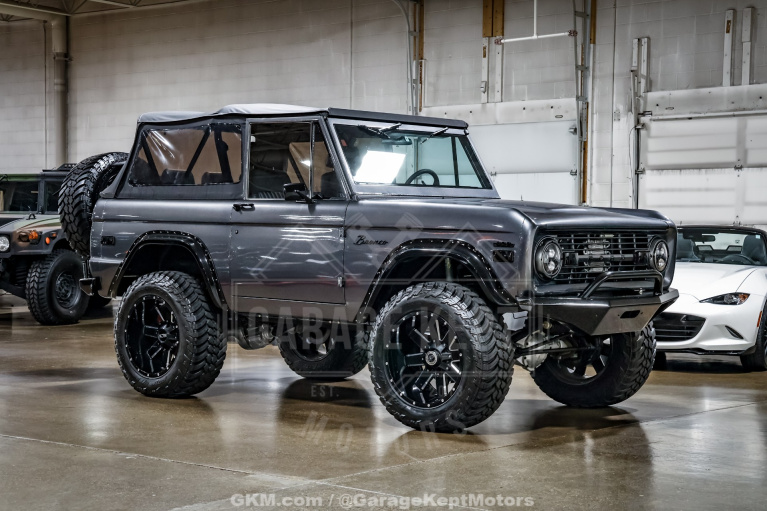
The early Bronco, 1966–77. Three bodies shared one chassis: the U13 Roadster, doorless and roofless, built only to 1968 and now the rarest; the U14 Half Cab, a short pickup; and the U15 Wagon, the full steel top that accounts for the overwhelming majority of survivors and of our listings. The body code is the second and third characters of the VIN on the glovebox door and frame — U13, U14 or U15 — and it matters, because wagons have been cut into roadster lookalikes and half cabs re-bodied. Running changes came steadily: the 289 V8 joined the 170 six at launch as the option that mattered, the 302 replaced it for 1969, front disc brakes and power steering arrived as options in the mid-1970s, and the C4 automatic — not offered at all before 1973 — transformed usability. The single most famous identity point is the rear wheelarch. From the factory the rear quarters are uncut: a small, round arch that barely clears the stock tyre. Decades of owners cut them for bigger rubber and bolted on flares. A genuinely uncut truck is now rare and carries a real premium; a cut truck is not a bad truck, but it must never be priced as an uncut one.
The full-size generations, 1978–96. The 1978–79 truck is a shortened F-100 with a solid front axle, V8s only, and a removable rear top over a steel front cab — two model years, huge sales, and a devoted following. For 1980 Ford lightened the design and introduced the Twin Traction Beam independent front axle that served, in developed form, to the end in 1996; the 1980–86 "bullnose" is the last generation with carburettors and the first with the 300-cubic-inch six as the base engine. The 1987–91 "bricknose" brought electronic fuel injection across the range and is, for many buyers, the sweet spot: modern enough to start and run cleanly in any weather, old enough to be simple. The 1992–96 final generation restyled the nose again, added a driver airbag for 1994 and refinement throughout, and closed the line — the white 1994 example in the most famous slow-speed chase in television history did more for late-Bronco recognition than any advertising Ford ever bought. Across all four full-size generations the formula never changed: two doors, a short wheelbase for a truck of its width, a removable rear roof section, and a tailgate with a power window in it — a feature that is also one of its defining problem areas, below.
Special editions worth naming. One early special stands apart from the trim badges: the Baja Bronco, prepared by Bill Stroppe's Long Beach operation in the early seventies in the image of Stroppe's desert-racing trucks. Genuine Stroppe trucks — automatic, power steering, distinctive two-tone paint, roll bar, and a documented connection to the Stroppe shop — are rare, valuable and faked with enthusiasm, because most of the visible ingredients can be assembled from parts. Treat any Baja claim as unproven until the documentation proves it; the paint scheme alone proves nothing. In the full-size years the badges are trim, honestly sold as such: the Ranger and XLT packages dress the truck up, the Eddie Bauer editions of the final generation add two-tone paint and a plusher cabin, and the 1992 Nite package blacked the truck out. None transforms value the way a Stroppe does; condition still outranks badge. On the modern trucks the hierarchy runs the other way — specification is value, with the Sasquatch package's lift, lockers and larger tyres, the Everglades and the Raptor defining the top of the used market — so a sixth-generation truck is priced from its build sheet, and getting that build sheet from the VIN is step one of any negotiation.
The sixth generation, 2021 on. Ford's revival is a real off-roader, not a styling exercise: ladder frame, removable doors and roof, a 2.3-litre EcoBoost four or 2.7-litre EcoBoost V6, the Raptor's 3.0-litre twin-turbo V6 at the top, and a choice of ten-speed automatic or a seven-speed manual whose extra gear is a crawler ratio. Two- and four-door bodies are offered — the first four-door ever to wear the badge honestly. These are used modern trucks, bought on condition, specification and warranty history rather than originality, and the inspection section treats them separately.

Engines and gearboxes
The early engines: 170 and 200 sixes, 289 and 302 V8s
The early Bronco's engines are all members of Ford's two most durable period families, and none of them is the reason an early Bronco gets expensive — the body is. The base engine at launch was the 170-cubic-inch (2.8-litre) inline six at about 105 hp, a Falcon-derived unit with a single-barrel carburettor: slow, unburstable, and adequate only because the truck is light and geared short. A 200-cubic-inch version of the same six took over in the seventies. Judge a six by its smoothness and its oil pressure, and accept the performance for what it is; a six-cylinder truck with a sound body is a better buy than a V8 truck with a rotten one, every time.
The V8 story starts with the 289 (about 200 hp in period gross terms), offered from the beginning and replaced by the 302 for 1969, which served to the end of production in carburetted forms that grew steadily softer as emissions tuning bit. These are small-block Windsors: hydraulic lifters, a single two- or four-barrel carburettor depending on year and specification, and a reputation for 150,000-mile durability on ordinary maintenance. What actually ails them at fifty years old is covered in Problem areas, but the headline items are perished vacuum hoses and advance diaphragms making them run lean and hot, worn timing chains, and rear-main-seal leaks that owners mistake for sump leaks. One myth to bury here: no early Bronco left the factory with a 351. The 351 Windsor is a popular and entirely respectable swap — it fits, it works, and it makes the truck quicker — but a truck advertised as a factory 351 is misdescribed, and a swapped truck should be priced as a modified truck, however well the work was done. The engine's identity is checkable: the small-block's casting numbers and date codes sit above the starter, and the VIN's engine code on the glovebox plate states what the truck was built with.
The full-size engines: 300 six, 302 and 351W, 351M and 400
The 1978–79 trucks came with modified-family V8s only — the 351M and the 400, both about 156–169 hp in net terms, both lazy, torquey and thirsty, and both prone to the cracked exhaust manifolds and soft timing sets detailed below. From 1980 the range rationalised around three engines that ran, in essence, to 1996. The 300-cubic-inch (4.9-litre) inline six is the connoisseur's workhorse: seven main bearings, gear-driven cam, enormous low-speed torque and a service life measured in hundreds of thousands of miles; in a Bronco it is never fast and never stressed. The 302 (5.0) and 351W (5.8) V8s followed the industry's arc from carburettors through throttle-body and then multi-point electronic injection, the injected 351W of the final generation making about 210 hp and giving the big truck genuinely adequate performance. Fuel injection is the dividing line that matters to a buyer: an EFI truck starts, idles and passes emissions like a modern vehicle, while a carburetted bullnose needs the choke, the vacuum plumbing and the ignition advance all to be right at once — achievable, but it is a state of tune you maintain, not one you inherit.
The modern engines: EcoBoost power, 2021 on
The sixth-generation trucks invert every classic assumption. The 2.3-litre EcoBoost four (about 275–300 hp depending on year and fuel) and the 2.7-litre EcoBoost V6 (about 315–330 hp) are direct-injected, turbocharged and electronically managed; the Raptor's 3.0-litre V6 makes about 418 hp. There is nothing to tune and little to adjust. What you are buying is service history: oil changes on schedule with the correct oil, coolant and timing-component health on the 2.7, and software and recall campaigns completed. A modern Bronco with a patchy dealer history is a worse bet than a higher-mileage one with a stamped book — the opposite of the early truck, where the body outranks the paperwork.
Carburettors, injection and the in-between years. How the fuel arrives decides how a classic Bronco behaves on a cold morning, and there are three distinct regimes. The carburetted trucks — everything early, and full-size trucks to the mid-1980s — run Ford and Motorcraft two- and four-barrel carburettors with automatic chokes, and their faults are the period set: choke pull-offs that fail and flood a cold engine, accelerator-pump diaphragms that perish and leave a flat spot exactly as you pull away, and float levels upset by ethanol fuel swelling old components. None of it is expensive — a carburettor rebuild kit is tens of dollars and a competent rebuild a few hundred — but it is recurring, and a truck that has been tuned around a worn carburettor with the ignition timing will need both put right together. The middle regime, on mid-eighties trucks, is throttle-body and early electronic management layered over carburettor-era hardware: the least loved by owners, because it combines vacuum plumbing with sensors, and the first thing to check is that nobody has "simplified" it by removing equipment the engine's tune depends on. From 1987 the multi-point EFI engines are a different ownership proposition entirely: the Ford EEC-IV management is well understood, its sensors are cheap and available, and its characteristic faults — idle-air control valves gumming up and giving a wandering idle, throttle-position sensors wearing a flat spot at cruise — announce themselves clearly and fix for tens of dollars. When you are choosing between two otherwise equal full-size trucks, the injected one is worth real money for this section alone.
Gearboxes and four-wheel drive
Early Broncos were three-speed-manual trucks: a column-shifted all-synchromesh box with a notoriously vague linkage, driving through a Dana 20 transfer case — gear-driven, cast-iron, and one of the strongest light transfer cases of its era, with a 2.46:1 low range. Floor-shift conversions are common and, done with a proper kit, an improvement rather than a demerit. The C4 three-speed automatic arrived for 1973 and is the specification most buyers now want; it is a simple, well-supported box whose health shows as clean, prompt shifts and unburnt fluid. Front axles split by year: the Dana 30 served to about 1971, the stronger Dana 44 thereafter, with a Ford 9-inch at the rear throughout — all of them well covered by the off-road aftermarket.
The full-size trucks used Ford's truck hardware: the NP435 four-speed manual or C6 automatic on the 1978–79 trucks with an NP205 transfer case, then the Twin Traction Beam Dana 44 front axle from 1980 with NP208 and later BorgWarner transfer cases, the AOD and then the electronically controlled E4OD four-speed automatics, and push-button transfer-case selection on later trucks. The E4OD is the one to interrogate: a strong box when serviced, expensive when not, and its shift quality on the test drive tells you most of what you need. Sixth-generation trucks use a part-time or advanced dual-mode transfer case with a ten-speed automatic, or the seven-speed manual with its crawler gear — check the mode selector cycles through every range without fault lights, and that a manual truck's clutch takes up smoothly in crawler, where abuse concentrates.

Problem areas
Our own photo evidence sets the tone before any theory. We have examined the sellers' photo sets for 216 of the Broncos we track in detail: rust is mentioned in the notes for 76 of them — better than one in three — and visible damage in 64, while fluid leaks appear in just 7 sets and smoke in none at all. Read that the way an experienced buyer does: the engines in these trucks rarely disgrace themselves, even in photographs, but the bodies and the histories written on them are where the money goes. What follows is organised by system, generation by generation where the faults differ.
Rust and the body: the map, generation by generation
Early Bronco. Rust follows a map so consistent that specialists recite it in order. Start at the front of the cabin: the door hinge pillars — the posts the doors hang from — rot from the inside where water tracks down from the windshield frame, and a door that drops as it opens, or has been shimmed at the hinges, is pointing at a pillar repair, not a hinge repair. The kick panels behind the front wheels and the inner rocker boxes go next; the rockers are structural on this unibody-style tub, and fresh outer rocker skins over rotten inners are the oldest cosmetic trick in the market — press hard along the full length and look from underneath, where the inner structure shows. Floor pans rust under the mats from leaks at the windshield frame and cowl; lift every mat, because the floors are flat, cheap to patch badly and expensive to do properly with the correct pressings. At the back, check the striker posts where the doors latch, the rear wheelhouses, the seams where the quarters meet the floor, and the tailgate lower rail. The steel hardtop rusts along its drip rails and around its windows, and a top that has leaked has usually been quietly rusting the tub beneath it. Add the windshield frame itself, the front inner wings and core support, and the battery area. A full professional tub restoration — pillars, floors, rockers, quarters — is fabrication and panel work priced in the tens of thousands once paint is included; individual items run from a few hundred dollars in panels to $2,000–5,000 a side fitted and painted for pillar-and-rocker work done properly. That arithmetic is why the uncut, unrotted truck commands what it does, and why a magnet and a torch outrank every other tool in the inspection.
Full-size Bronco. The map changes with the architecture. These are body-on-frame trucks, so rust is less often structural — the frame itself is heavy-gauge and usually survives, though you check the rear spring hangers, the radius-arm brackets and the crossmembers under the rear floor regardless. The body's signature failures are the rear wheel arches, which blister from the inside where the inner and outer skins trap mud; the tailgate, whose bottom rail rusts around the window mechanism it houses; the lower rear quarters behind the wheels; the drip rails and roof skin around the removable top's seals; and the floor at the rear seat and cargo area, fed by leaking top seals. On 1980s trucks add the cab corners and the bottoms of the doors. A tailgate shell is a significant panel — budget $800–2,000 fitted and painted for a good one — and arch repairs done in steel, not filler, run a few hundred dollars a side before paint. The removable top itself is fibreglass and does not rust, but its seals perish, its rear window mechanism lives in the tailgate below, and a top that has been off and stored badly warps and leaks forever after.
Sixth generation. Too young for a rust map, and the checks are different: aluminium and steel panels dent and crease, removable door and roof seals get pinched and torn by careless refitting, and underbody armour and suspension take the knocks the truck was marketed for. Inspect underneath as you would any used off-roader — bent arms, scarred skid plates and silt in the chassis rails tell you how hard its life has actually been, whatever the mileage says.

Chassis, suspension and steering
The early truck's front coil springs and radius arms were advanced for 1966, and the wear points are honest ones: radius-arm and track-bar bushes perish and let the front axle wander, giving steering that feels vague at speed and a truck that darts under braking — a bush kit is cheap, a few hundred dollars fitted, and transforms the truck, which is exactly why you should not let a seller blame the steering box until the bushes are proven good. The steering boxes themselves wear, and many trucks carry a later power-steering conversion of variable quality; judge the welding and the bracketry, not the badge on the pump. Dana 20 transfer cases leak from their seals as a matter of course and whine when their intermediate gears wear; a case that jumps out of low range under load needs a rebuild, roughly $800–1,500 at a specialist. Lifted trucks deserve a paragraph of suspicion: big lifts done cheaply — blocks, dropped nothing, stock steering — make an early Bronco genuinely unpleasant and occasionally dangerous, and returning one to sanity costs real money.
Full-size trucks split by front axle. The 1978–79 solid Dana 44 wears like any truck axle: kingpin-era simplicity, ball joints and wheel bearings. From 1980 the Twin Traction Beam brings its own signature faults. The axle pivot bushes and radius-arm bushes wear and the beams shift, which shows as uneven front tyre wear and a truck that will not hold an alignment — the distinguishing test is that a TTB truck with worn pivots wears tyres and wanders even though every steering joint is tight, because the geometry itself is moving. Bush replacement is a day's labour, $600–1,200 fitted. The E4OD automatic's other companion fault is the rear ABS and speed sensor on later trucks upsetting shifts — a cheap sensor blamed, expensively and wrongly, on the gearbox. On all full-size trucks, check the removable-top seals and the body mounts: perished mounts let the body shift on the frame, doors go out of alignment, and squeaks multiply — a mount kit is a few hundred dollars in parts and a long day to fit.
The tailgate window, tops and trim
Every full-size Bronco has a power rear window that lowers into the tailgate, and every long-term owner has repaired it. The mechanism fails in layers: the motor's plastic drive gears crumble with age, the regulator arms bend, the weatherstrips swell and drag, and the safety interlock — the window only operates with the tailgate fully closed — confuses diagnosis for decades. The test that separates causes is simple: if the motor runs but the glass does not move, the drive gear has gone; if nothing runs, check the interlock and the dash switch before condemning the motor. A motor-and-gear repair is $150–400 in parts; the expensive version is the rusted tailgate shell the mechanism lives in, which is why the tailgate appears in the rust section too. Early-Bronco tops have their own economy: steel wagon tops rust, liftgate struts and latches wear, and the soft tops and bikini tops fitted to many trucks are consumables. On sixth-generation trucks, work every removable panel on and off if the seller permits — misaligned latches and torn seals are the common faults, and panel fit is a warranty-era complaint you want documented, not discovered.
Engines, cooling and electrics
Period Ford engines fail in period Ford ways. The small-block V8s weep from rear main seals and valve covers, wear their timing chains slack — which retards the cam and makes a tired engine feel lazier than it is — and suffer exhaust manifolds that crack and studs that snap at removal; a manifold job that goes wrong becomes a head-off job, so a blowing manifold is a $500–1,500 negotiation, not a $100 gasket. The 351M and 400 add a reputation for low oil pressure at hot idle on worn bearings; verify with a mechanical gauge before buying the story in either direction — the dash gauge and its sender lie often enough that no 1978–79 truck should be condemned or cleared on the gauge alone. Carburetted trucks of every generation suffer the modern-fuel trilogy: perished rubber fuel lines, varnish from storage, and ethanol attacking old floats and needle valves. A truck that has sat needs its tank inspected, not just its filter changed. The 300 six's characteristic faults are exhaust-manifold warping and cracking and, on injected versions, tired engine-management sensors; its bottom end almost never features in a failure story. Across the full-size range, electrics age at the connectors: the ignition switch and its connector on the steering column are a known heat-and-melt item on eighties and nineties trucks, charging systems suffer from corroded grounds, and a Bronco whose electrics all work — windows, tailgate glass, blower on every speed, gauges honest — is a Bronco that has been used and maintained, which remains the best single sign there is.
Brakes, wheels and the lift question
Early Broncos stopped with drum brakes all round until front discs arrived as an option in the mid-seventies, and a drum-braked truck driven in modern traffic is the single strongest argument for a sympathetic disc conversion — many trucks have one, and a properly engineered conversion with the correct master cylinder and proportioning is an improvement to value, not a deduction from it. What to condemn is the half-conversion: discs fitted without the matching hydraulics, giving a hard pedal and rear lock-up. On any classic truck, budget for the standing-car trilogy regardless of what the pedal feels like on the day: perished flexible hoses, seized wheel cylinders or calipers, and a master cylinder whose seals are as old as the truck — a full hydraulic refresh runs $800–1,800 fitted and is the least negotiable recommissioning item there is. Full-size trucks are disc-front from the start and share F-Series brake parts, so their brake story is condition, not design: warped rotors from oversized tyres worked hard, and rear drums long out of adjustment.
Wheels and tyres deserve their own warning because Broncos attract both. Oversize tyres on stock gearing blunt performance, overload steering and brakes, and wear front-end components at a rate the seller rarely mentions; on an early truck they are also usually the reason the rear arches were cut. Read the tyre date codes — a lifted truck on decade-old mud tyres needs $1,000–1,800 of rubber before it needs anything else — and check that the spare matches, because a Bronco's spare is carried where you can see it and a mismatched one tells you how the last owner spent money.
Interior, seats and the evidence of use
Bronco interiors are simple, and that makes them honest witnesses. Early trucks came with vinyl bench or bucket seats, rubber mats and painted metal; wear shows as split seams on the driver's cushion edge, a collapsed seat base that puts you on the frame, and pedal rubbers and a steering wheel worn smooth in proportion to real mileage — compare those three against the odometer's claim, because early-Bronco odometers are five-digit and have usually been round at least once. Replacement seat covers and foams are reproduction staples and cheap; the expensive interior items are the correct early details and an uncracked dash pad. Full-size trucks wear like the F-Series they are: driver's bolster gone, headlining sagging on later trucks, and — the Bronco-specific item — a cargo area and rear seat marked by years of the top coming off and loads going in. Eddie Bauer and XLT trim lifts the cabin but changes nothing structural. Water damage is the interior fault that matters most: a truck whose top seals have leaked shows it as stained carpets, rust at the floor beneath them and a smell no valet removes, which is why the interior check and the rust check are the same check, done from opposite sides of the floor pan.
How to inspect one
Allow an hour, bring a torch, a magnet in a cloth, a tyre-pressure gauge and — for an early Bronco — a friend to work the doors and steering while you watch. Decide your generation first; steps 2 to 6 are written for the classic trucks, and step 12 covers the modern one.
- Paperwork and identity first. Match the VIN on the title to the plate — glovebox door and frame stamp on an early truck, dash plate and door sticker on a full-size. On an early Bronco, read the body code: U13, U14 or U15 must match the body in front of you, and the engine code must match the engine story you are being told. A 351 in an early truck is a swap, per the engines section — fine if priced as one, fatal to the deal if sold as factory.
- The uncut test. On an early Bronco, go straight to the rear wheelarches. Factory quarters are uncut, with a small round opening; cut arches under flares are a modification, not a defect, but they move the truck into a different price class. Decide which class you are in before you look at anything else.
- Pillars, kick panels and rockers. Work the rust map from Problem areas in order: open each door and feel for drop, press the hinge pillars, prod the kick panels, and get underneath to see the inner rockers rather than the shiny outer skins. Perforation in pillars or inner rockers is structural money — the viewing effectively ends here if it is bad and unpriced.
- Floors and the rear tub. Lift every mat and the rear carpet. Look for water tracks from the windshield frame, patches over the original pressings, and daylight at the seams where quarters meet floor. On a full-size truck, add the cargo floor and the seams under the removable top's seals.
- Tailgate and top. On a full-size Bronco, run the rear window fully down and up twice, from both the dash switch and the tailgate key switch, with the tailgate shut — the interlock behaviour from Problem areas tells you which layer of the mechanism is tired. Inspect the tailgate's bottom rail for rust and the top's seals for perishing. On an early truck, examine the steel top's drip rails and the liftgate fit.
- Frame and underside. On full-size trucks check spring hangers, crossmembers and body mounts; on early trucks, the frame horns, spring mounts and the transfer-case crossmember. Read the coating as you go: honest, patchy factory underseal is a good sign; a fresh uniform black coat over everything, applied for the sale, is a question.
- Cold start. Insist the engine is cold. A carburetted truck should start with choke drama no worse than period-normal and settle; an injected truck should start like a modern one. Watch for blue smoke at start-up (valve seals), smoke under load (rings), and listen to a small-block for the slapping of a slack timing chain at idle.
- Oil pressure, verified. On a 351M or 400 especially, do not trust the dash gauge. If hot idle pressure is the seller's story in either direction, a mechanical gauge reading is a cheap condition of sale. Check the oil itself for fuel smell and the coolant for oil.
- Steering and bushes before boxes. Rock the steering and have your friend turn lock to lock while you watch the track bar, radius arms and — on a TTB truck — the axle pivots. Movement at bushes is cheap; play in the box is dearer; tyre wear patterns on a full-size truck tell you whether the TTB geometry is stable, exactly as Problem areas describes.
- The test drive. Twenty minutes, including a rough road and a motorway stretch. Engage low range on a quiet surface and confirm the transfer case stays in it under load. An automatic should shift cleanly without flaring; an E4OD that hunts or slams is negotiating its rebuild price into your offer. Brake firmly: an early Bronco that darts is showing you its bushes, not its brakes.
- Electrics and comfort, all of them. Every window including the tailgate glass, blower on all speeds, wipers, washers, gauges, lights, horn. On an early truck, check the vacuum wipers on the earliest cars have been converted or work — a period quirk that matters in real rain. A truck where everything works has been maintained; price the ones where nothing does accordingly.
- The modern truck, if that is your Bronco. On a 2021-on example: cycle every drive mode and transfer-case range, work every removable panel latch, check for fault lights after a full drive cycle, verify recall and service history with a dealer printout, and inspect the underbody armour and suspension for the off-road life the marketing invites. Buy on documented history, not on shine.
Finally, whatever the generation, write the faults down in the order you found them and price them from the cost ranges in Problem areas before you discuss the truck's price at all. A Bronco negotiation conducted from a written list — pillars, tailgate, bushes, hydraulics — is a short one, because the numbers are not really arguable. And if the truck fails step 2, 3 or 4 outright, walk away without regret: the market turns over constantly, our own listings included, and the defining Bronco mistake is not overpaying for a good one — it is buying a bad one because it was there on the day.
Values
There are no prices in this section, deliberately: the figures that matter move weekly, and the market block beneath this guide carries the current numbers from our own listings. What follows is how to read them — and on Broncos, reading them well matters more than usual, because few nameplates span a wider condition and identity spread.
Start with the generation split, because it is really three separate markets sharing a search term. Early Broncos carry the collector premium, and within them the price ladder is built from identity and body, in this order: uncut versus cut quarters, original body code versus re-bodied, documented original engine versus swap, and only then condition of paint and trim. Two trucks that look identical in thumbnails can sit in different classes because one has its factory arches and pillars and the other does not — which is why early-Bronco asking prices show such a wide spread, and why the cheapest early trucks are almost never the cheapest to own. Restomod and professionally restored trucks form their own tier above original survivors: there, you are pricing the build cost and the builder's reputation, and the correct comparison is the cost of commissioning the same truck, not the price of an original.
Full-size Broncos read differently. The 1978–79 trucks have a following of their own and good ones are genuinely scarce; the 1980–86 trucks are the softest part of the classic market, priced as usable old trucks; and the fuel-injected 1987–96 trucks — especially tidy final-generation examples — have been firming as the last simple V8 SUVs become a recognised class. Across all of them, condition spread is the story: a dry-climate, unlifted, unpatched truck with working tailgate glass and honest arches is worth a strong premium over the average listing, because the average listing needs the tailgate, the arches and the bushes doing. Asking prices on full-size trucks routinely sit above achieved prices — these are emotional vehicles, often sold by owners who have over-invested — so treat the ask as an opening position and negotiate from the inspection list, item by item, with the repair costs from Problem areas as your arithmetic.
Geography moves classic Bronco money more than it moves most classics. These were working trucks, sold nationally and used hardest where winters and salt are worst, so the surviving stock divides sharply: dry-climate trucks from the South and West — our own listings lean towards Florida, California, Georgia, Texas and North Carolina — carry a condition advantage that out-of-region buyers routinely and correctly pay to capture, while a cheap truck in the salt belt is usually cheap for a reason you will find at step 3 of the inspection. Colour and specification play their smaller parts: period colours and factory-correct presentations support early-truck values, while obviously personalised builds narrow their own market to buyers who share the taste. Documentation compounds quietly in the background — an early truck with its original glovebox plate legible, its body code matching and a paper trail for engine and body work will always be the easier truck to sell on, which is a value argument for doing step 1 properly even when you love the truck in front of you.
The modern trucks are a used-car market: depreciation, mileage, specification and warranty decide, and the guide price is the ordinary used market for a three-to-five-year-old off-roader. The one classic-market habit worth importing is the project warning that applies at every level of Bronco: the gap between a project and a driver is widest exactly where the vehicle is cheapest. A project early Bronco is a body-restoration commission; a project full-size is a tailgate, arches, bushes and an E4OD away from being a truck. In both cases, the finished value rarely repays the sum of the parts and labour unless you are doing the work yourself — buy the best body your budget reaches, and let someone else's completed restoration be your bargain.
Parts and ownership
Bronco ownership splits as sharply as Bronco buying. The early truck is supported by one of the strongest classic-truck aftermarkets in America: dedicated specialists stock reproduction steel — floors, pillars, quarters, complete tubs — alongside every mechanical part for the sixes, small-blocks, Dana axles and Dana 20, and a mail-order industry exists because the trucks are worth restoring. Easy: service items, brakes, steering and suspension bushes, transfer-case seals and rebuild kits, C4 automatic parts, glass rubbers, and reproduction trim. Harder and dearer: correct early details — roadster-specific parts, early seats and soft-top frames, uncut rear quarters in steel, and good original hardtops — plus any panel work done to a standard the truck's value now demands. A quality repaint and body restoration on an early Bronco is a five-figure commitment at professional rates; that is the ownership fact that should shape the purchase.
Full-size trucks draw on the enormous F-Series parts pool, which is their great ownership advantage: engines, gearboxes, TTB suspension parts, brakes and electrics are shared with the best-selling truck in America and priced accordingly. Easy: everything mechanical, including E4OD rebuilds at any competent transmission shop (budget $2,500–4,000 for a proper rebuild with a converter), TTB bush kits, and service parts for the 300, 302 and 351W. Harder: Bronco-specific body and trim — tailgate shells and their window mechanisms, removable-top seals and hardware, rear quarters, and generation-specific interior trim in the right colours. The tailgate is the emblematic part: mechanism pieces are cheap and available, the shell is neither. Sixth-generation ownership is a dealer-and-warranty affair: parts are current-production, costs are modern-truck costs, and the ownership skill is keeping the service and recall record complete.
One ownership habit pays across every classic generation: join the marque community early. Bronco owners' clubs and forums hold the accumulated knowledge on everything from Dana 20 rebuild sequences to which reproduction quarter panel actually fits, they are where good trucks change hands before they are advertised, and they are the fastest route to the specialists — the panel men, injection shops and trim sources — whose waiting lists the rest of the market queues behind.
Running one is straightforward in any classic generation. Fuel consumption is period-truck heavy — small-block full-size trucks live in the low teens per gallon, early trucks little better — insurance is ordinary classic or modern cover by generation, and any competent independent shop can maintain the mechanicals. The first-year budget is the honest line: catching up deferred maintenance on a running classic Bronco — bushes, seals, brakes, fluids, the tailgate mechanism, perished rubber throughout — realistically runs $2,000–5,000 before you improve anything, and recommissioning a truck that has sat costs more, because the fuel system, brakes and tyres all come due at once. Our photo sample's pattern — leaks in only 7 of 216 examined sets, smoke in none — says the mechanical base is sound across the market; the money goes on bodies, rubber and time.
Which one to buy
- The collector: an uncut early Bronco wagon. A U15 with factory rear arches, sound pillars and a documented engine is the blue-chip of the range. Buy the body, verify the codes, and let the mechanicals be whatever they are — they are the cheap half.
- The usable classic: a 1973–77 early Bronco with a C4 automatic. Power steering, discs and an automatic make it a truck a household will actually use, at a step below the earliest cars' money. A well-executed 351 swap is a plus here, priced as a modification.
- The value buy: a 1987–91 fuel-injected full-size. The bricknose gives you EFI manners, TTB ride and F-Series parts prices for the softest money in the classic Bronco world. Find a dry one with working tailgate glass and you have the most Bronco per dollar there is.
- The bruiser: a 1978–79. Two years only, solid front axle, the biggest personality of the full-size run. Buy on frame, arches and a verified oil-pressure reading, and accept the thirst as the entry fee.
- The last of the line: a 1992–96, ideally a 351W truck. The most refined classic Bronco and a recognised modern classic in its own right. Original, unlifted and unpatched is the specification to hold out for.
- The daily: a 2021-on Bronco. If you want the shape, the open roof and none of the fifty-year-old-truck ownership, buy the modern one on service history and warranty — and do not let anyone sell you a Bronco Sport or a Bronco II as the same thing, because they are not.
And the rule that overrides all of the above: buy the body and the identity, and let the mechanicals follow. Engines, gearboxes, transfer cases and tailgate motors are all fixable at prices you can plan for. A rotten early tub, a patched full-size shell, or a truck whose codes do not match its story are the three purchases that never come right — and they are all visible on the day, if you do the checks in the order this guide gives them.
See the 251 Bronco cars currently listed.