Dodge Ram Charger S Sport Utility 2D buyer's guide
Dodge Ram Charger S Sport Utility 2D -- the model's own buyer's guide: variants, values and what to check.
Years listed: 1981-1991 · Series: D-Series
Overview and history
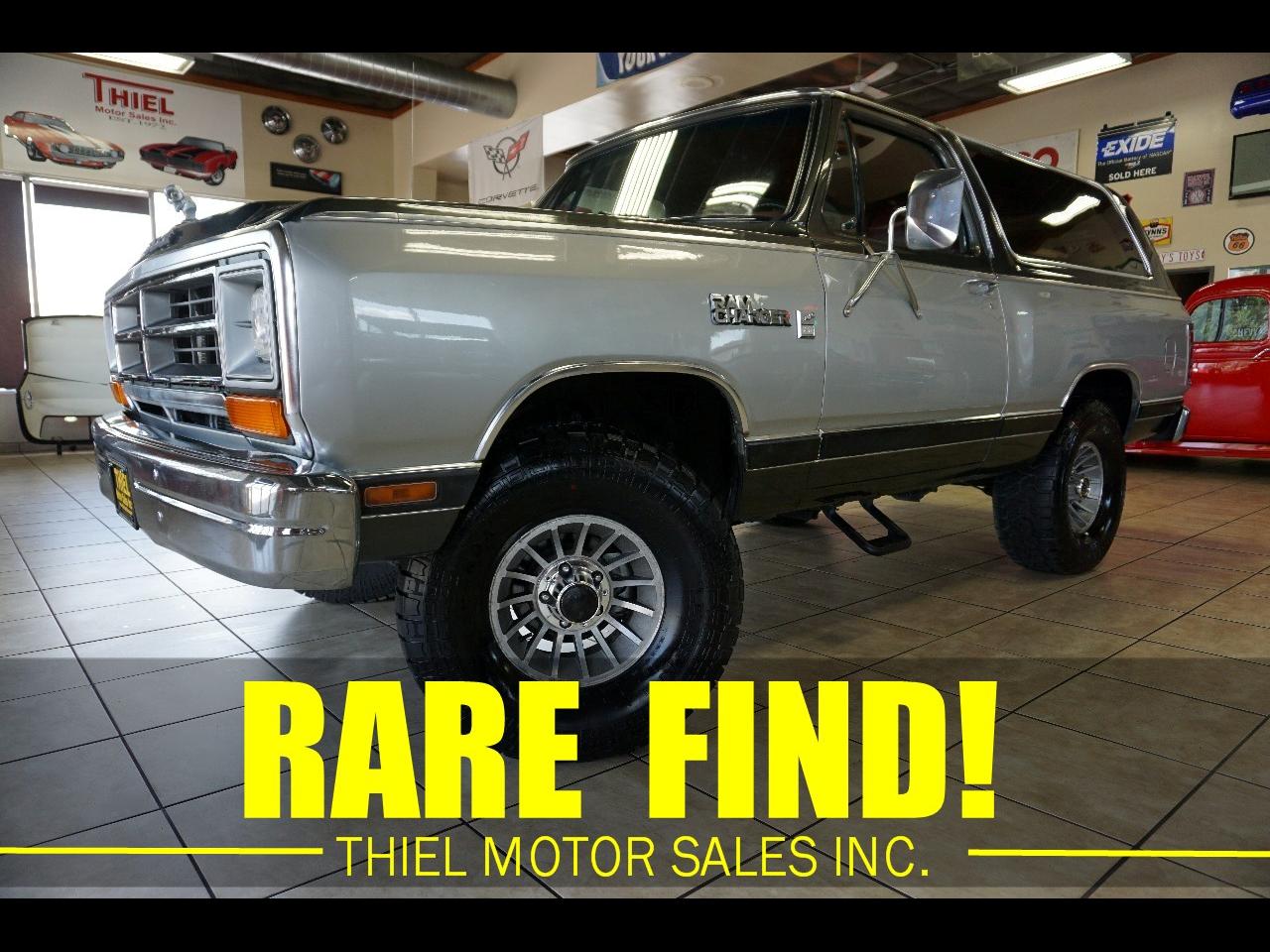
The Dodge Ramcharger is the full-size, truck-based sport utility Dodge built to answer the Ford Bronco and the Chevrolet Blazer — and it answered them in the most Dodge way possible: by taking the running gear of the D-series and W-series pickups, shortening the wheelbase to 106 inches, and bolting on a wagon body with two doors, a big rear opening and, on the early cars, a roof you could unbolt and leave in the garage. If you want a classic 4x4 with genuine presence, simple mechanicals and room for real people and real cargo, the Ramcharger is the one the other two get compared against by people who have owned all three.
Production began for the 1974 model year, and the first generation ran to 1980. Plymouth sold a near-identical twin, the Trail Duster, through 1981, and it is worth knowing about because parts, trim and occasionally whole cars cross over. The second generation arrived for 1981 on the updated pickup platform and ran, remarkably, to 1993 in the United States with only detail changes — a long production life that makes these the easiest Ramchargers to live with and the ones that dominate today's market. There was also a third generation, built in Mexico for the Mexican market from 1999 to 2001 on the second-generation Ram pickup platform; it was never sold new in the United States, it was two-wheel drive only, and it appears in American listings rarely enough that any example deserves careful paperwork checks before you treat it as anything other than a curiosity.
The shape of the story is simple. The 1974–80 cars are the open-air originals: full-time four-wheel drive in most cases, a fully removable top, carburetted engines including — until the late 1970s — the 440 big-block, and the loosest, most characterful driving experience of the range. The 1981–93 cars are the mature version: a fixed steel roof, part-time four-wheel drive, tidier trim, better rust protection (which is a relative term, and the rust section below will explain how relative), and, from 1988 onward, throttle-body fuel injection that transformed cold starting and everyday manners. Two-wheel-drive Ramchargers were sold alongside the 4x4s in both generations and are worth less today; almost everything in this guide concerns the four-wheel-drive cars, because they are what the market wants and what most listings are.
These were working trucks bought by working people, and most were used accordingly — ploughed, hunted from, towed with, parked outside. That history defines the market now. The mechanical package is fundamentally tough and almost entirely shared with high-volume Dodge pickups, so the difference between a good Ramcharger and a money pit is rust, transfer-case and front-axle wear, and decades of deferred maintenance, in that order. Mileage matters less than where the truck has lived and whether anyone ever greased, flushed and adjusted anything.
A note on evidence before we start: the Ramcharger pool on this site is small and late-model-heavy — mostly 1980s second-generation cars — and only one car in the current pool has been through a full photo examination, so this guide does not pretend the site's own photo evidence can tell you where these trucks rust. The rust map below comes from the wider record of these trucks, and it is consistent: learn it before you look at a single listing photograph.

The models
Every US-market Ramcharger is a two-door, short-wheelbase wagon on the pickup platform, with a front engine, a rear cargo area under a liftgate, and seating for five or six depending on the rear bench and whether the optional jump seats were fitted. The badge changed spelling over the years — Ramcharger, Ram Charger — but the formula never did. What separates one car from another is generation, engine, transfer case and trim, and those four things, in that order, are how you should read any listing.
| Model | Years | Engine | Output | Built | Character |
|---|---|---|---|---|---|
| Ramcharger (Gen 1) | 1974–1980 | 318 V8 standard; 360, 400, 440 optional | 150–230 hp net, varies by year | Not reliably published as one clean series | Removable top, full-time 4WD, the original |
| Ramcharger (Gen 1, big-block) | 1974–1978 | 400 or 440 big-block V8 | about 190–230 hp net | Small minority of production | The muscle SUV; rare, thirsty, collectible |
| Plymouth Trail Duster | 1974–1981 | As Ramcharger | As Ramcharger | Sold alongside, lower volume | The twin; same truck, Plymouth trim |
| Ramcharger (Gen 2) | 1981–1987 | 318 V8 standard; 360 optional; slant six in 2WD | 140–175 hp net | The volume years begin | Fixed roof, part-time 4WD, carburetted |
| Ramcharger (Gen 2, injected) | 1988–1993 | 318 TBI standard; 360 TBI from 1989 | about 170–190 hp net | The most usable cars | Throttle-body injection, the everyday pick |
| Ramcharger (Mexico, Gen 3) | 1999–2001 | 5.2 or 5.9 Magnum V8 | 230–245 hp | Mexican market only, low volume | 2WD only; a curiosity in the US |
(Outputs are period SAE net figures and vary by year, market and equipment; treat any single number a seller quotes as approximate until you see the year and specification. Dodge did not publish Ramcharger production in one clean, trustworthy annual series, so this guide does not invent one — rarity claims for individual variants should be treated with suspicion unless the seller can document them.)
The first generation (1974–80). The launch cars are defined by the top: the entire roof section unbolts, leaving a fully open wagon, and Dodge sold a soft top for owners who wanted weather protection without the steel. Early cars — 1974 in particular — have their own door and top-seal details, and top seals and weatherstripping for the removable top are a condition item on every first-generation car you inspect. Four-wheel drive was full-time in most of these trucks, through the New Process 203 transfer case described in the engines and gearboxes section, and the engine list was the full pickup list: the 318 small-block as standard, the 360 above it, and the 400 and 440 big-blocks for buyers who wanted a Bronco-sized truck with a muscle-car engine. The 440 disappeared from the order sheet after 1978 as emissions rules and fuel prices bit, which is why genuine big-block cars are the collector end of this market. Trim ran from plain work specification to the Macho package of the late 1970s — stripes, styled wheels and attitude — and the SE trim that brought plusher seats and more brightwork.
The second generation (1981–93). The 1981 redesign put the Ramcharger on the restyled pickup platform, with a fixed steel roof in place of the removable top — a loss for romantics, a gain for everyone who dislikes leaks, squeaks and wind noise — and part-time four-wheel drive in place of the full-time system. The body is cleaner, the interior more car-like, and trim names settled into base, Royal SE and the Prospector option packages that bundled appearance and equipment items. The engine list simplified: the big-blocks were gone, the 318 became the default engine in the great majority of trucks, and the 360 sat above it as the towing and altitude choice. Two-wheel-drive cars continued, including a slant-six version that nobody seeks out now. In 1988 the 318 gained throttle-body electronic fuel injection; the 360 followed for 1989, and those injected trucks are the sweet spot of the whole range for anyone who intends to drive rather than show. The last US cars were built for 1993, after which Dodge left the segment to the pickups until the Mexican third generation appeared at the end of the decade.
The Mexican third generation (1999–2001). Built on the 1994-on Ram pickup platform with Magnum V8s, a one-piece liftgate and two-wheel drive only, this is a different kind of vehicle — closer to a two-door Durango in spirit. It was never certified for US sale when new. Examples surface in the States occasionally; if one appears, the questions are paperwork, emissions compliance in your state, and parts trim unique to it, not the truck itself, which is mechanically a known quantity.

Engines and gearboxes
The small-blocks: 318 and 360 LA V8s
The LA-series small-block is the Ramcharger's bread and butter, and it is one of the most forgiving engines ever put in an American truck. The 318 (5.2 litres) was standard in almost every Ramcharger ever built; the 360 (5.9 litres) was the step up, with a longer stroke, more torque and a noticeable appetite. Both are pushrod, iron-block, iron-head V8s with hydraulic lifters, a single timing chain and a tolerance for neglect that borders on the unreasonable. A healthy one starts easily, idles with a slight lope through a stock exhaust, shows good oil pressure hot — the gauge sitting in the middle of its range at speed and dropping at idle without the warning light joining in — and pulls the truck's two-plus tons without strain. Smoke tells the usual story: a puff of blue at start-up after sitting is valve stem seals, a known and affordable job; blue smoke under load is rings and bore wear, and that is an engine-out conversation. A top-end tick that fades as the engine warms is usually an exhaust manifold leak at the flange — the manifolds crack and the studs snap, and drilling out broken studs is the labour in that job — while a tick that stays is a lifter or a worn rocker shaft, both fixable in place.
Fuelling is where the generations divide. Carburetted 318s breathe through a two-barrel carburettor (Carter and later Holley-built units); the 360 used a four-barrel, the Carter Thermoquad for much of the run and the Rochester Quadrajet in the mid-1980s. The Thermoquad deserves its reputation explained rather than repeated: its large plastic (phenolic) float bowl insulates the fuel from engine heat, which is genuinely clever, but the bowl warps and the well plugs leak with age and heat cycling, giving hard hot starting, a rich stumble and fuel smells that owners blame on everything else first. A Thermoquad rebuilt by someone who actually knows them is a sweet-running thing; one rebuilt from a generic kit by guesswork is a recurring bill. Budget $400–800 for a specialist carburettor rebuild done properly, and treat a truck that starts instantly hot and cold, on a documented specialist rebuild, as worth a premium over one with a shiny new parts-store carburettor of unknown calibration. The late-1970s cars also carry Chrysler's Lean Burn system on many engines — an early electronic spark computer, usually found mounted on the air cleaner — and it fails with age in ways that mimic carburettor and ignition faults: random stumble, no-start when hot, timing that wanders. The standard cure, applied to a large share of surviving trucks, is conversion to the earlier conventional electronic ignition or an aftermarket system; ask what a car is running before you price its running faults, because a Lean Burn car with a misfire may need a conversion kit and an afternoon, not an engine.
From 1988 the 318, and from 1989 the 360, used throttle-body injection: two injectors in a unit on the intake manifold, an in-tank electric fuel pump, and a simple engine computer. It is the single biggest usability upgrade in the Ramcharger's life — instant cold starts, no choke ritual, no vapour lock on a hot trail — and its faults are correspondingly electrical and fuel-delivery faults: tired in-tank pumps that lose pressure and make the truck lean-stumble under load, clogged injector screens, failed coolant-temperature sensors that hold the mixture rich, and corroded grounds that make all of it intermittent. Fuel pressure is the first test on a sick injected truck, before any part is replaced: a gauge on the service port settles in minutes what weeks of guessing will not. A fuel pump replacement is a tank-out job, realistically $450–900 fitted, and a truck that has had the pump, filter and sensors done in documented recent history has had the TBI system's whole known weakness list addressed at once.
The big-blocks: 400 and 440
For 1974–78 the Ramcharger could be ordered with Chrysler's big-block V8s: the 400 (a B-series engine) and the 440 (the raised-deck RB). The 440 is the headline — the same basic engine that powered the muscle cars, detuned for truck duty with a cast crank in later years, low compression by the mid-1970s, and a torque curve that makes a Ramcharger feel half its weight off the line and at towing speeds. Period net outputs sat around 190–230 hp depending on year and specification, but torque is the point: these trucks pull without ever feeling extended. They also drink without ever feeling extended — expect single-figure to low-double-figure miles per gallon in real use — and they run hot in slow going if the cooling system is tired, because the engine bay is full and the radiator is working hard. Check any big-block car for its cooling history: radiator recored or replaced, fan clutch working, hoses recent. A 440 that overheats on the test drive is not a thermostat until you have proved the radiator flows.
Identity matters here because the premium does. The engine is identified by the stampings on the block — on the 440, the machined pad near the distributor at the front of the engine carries the displacement and build information, and the casting numbers and date on the side of the block should be consistent with the truck's year. A truck advertised as a factory 440 car should also have the supporting cast: the heavier-duty cooling and the big-block's exhaust manifolds and engine mounts are all visibly different from small-block hardware. Engine swaps are common in the truck world and a swapped 440 is not a bad truck — it is simply not a factory big-block truck, and it should not be priced as one. Big-block-specific exhaust manifolds crack like the small-block ones and are dearer to replace; budget accordingly, and know that headers are the common fix, with their own heat and gasket-sealing habits.
The rest of the range: slant six and Magnum
The 225 slant six powered base two-wheel-drive cars and is exactly as durable as its reputation says, but in a two-ton wagon it is slow in a way that modern traffic punishes, and it sits in this guide mainly so you can identify one and price it as the budget entry it is. At the other end of history, the Mexican third-generation cars used the Magnum versions of the 318 and 360 (badged 5.2 and 5.9), with sequential multi-point injection, roller camshafts and outputs around 230–245 hp — stronger, cleaner-running engines whose known truck faults (intake plenum pan gasket leaks causing oil consumption and pinging, cracked exhaust manifolds) carry over to any Ramcharger so fitted.
Gearboxes and four-wheel-drive systems
The default gearbox is Chrysler's A727 TorqueFlite, a three-speed automatic of legendary strength that was fitted behind everything from slant sixes to Hemi muscle cars; in a Ramcharger it is barely working. It should engage drive and reverse promptly, shift firmly without flaring, and hold its gear under load. A long delay engaging on a cold morning that improves warm is the classic sign of hardened seals — the box is telling you a rebuild is in its future, roughly $1,800–3,200 at a transmission shop, and you should price it in rather than hope. The manual option was the NP435 four-speed, a heavy truck gearbox with a very low first gear made for pulling stumps and starting loads on hills; it is near-indestructible, shifts like the truck part it is, and is judged on synchromesh in second and third and on clutch judder. Late second-generation automatics gained an overdrive TorqueFlite derivative (the A518 family), which drops cruising revs noticeably; on those, test that overdrive engages cleanly and that the lock-up, where fitted, does not shudder.
The transfer case is the Ramcharger's defining mechanical divide. First-generation 4x4s mostly use the New Process 203, a full-time case: an internal differential splits drive between the axles on the road, with a lock position (Hi-Loc and Lo-Loc on the shifter) that locks the split for loose surfaces. It is a chain-drive case, and the chain stretches with age and mileage — the test is a clunk or ratcheting chatter on tight turns or under load, and a worn chain can be heard as a rhythmic slap from under the floor. Chain replacement is a case-out job at roughly $900–1,800 fitted. Many NP203 trucks were converted in period with part-time kits that locked the internal differential permanently and added free-wheeling front hubs; a converted truck is fine to own — often better on fuel — but ask which kit and whether the front hubs are quality items, and confirm the truck still has a working locked low range. From 1980 and through the second generation, the standard case is a part-time unit (NP208, later the NP241), chain-drive, with conventional 2WD, 4-Hi and 4-Lo positions and no on-road 4WD use on dry pavement. These are simpler and tougher in service; their enemies are being run low on oil and stretched chains from abuse, and the same tight-turn and load tests apply.
The front axle is a Dana 44 in most 4x4s, and on second-generation cars from the mid-1980s most carry Chrysler's CAD — central axle disconnect — which splits the right-hand axle shaft with a vacuum-operated sliding collar instead of using free-wheeling hubs. When it works, you shift into four-wheel drive from the seat and the system engages itself. When it does not, the usual cause is vacuum: perished hoses, a failed vacuum motor on the axle, or a seized collar from years of never being used — the truck shows every sign of being in 4WD at the lever and drives exactly like a 2WD, which owners discover in mud. The fix is usually hoses and a vacuum motor, $150–450 in parts and an afternoon, and a popular permanent cure is a cable-operated manual engagement kit. On any CAD truck, the inspection must include actually engaging four-wheel drive and confirming the front axle pulls — on gravel, where you can feel a front wheel scrabble — not just watching the dash light. The Dana 44 itself is judged on ball joints, universal joints in the front shafts, and the steering linkage described in the problem areas: it is a strong axle in a heavy truck, and its wear items are wear items, not design flaws.
Problem areas
A Ramcharger is a pickup in a wagon suit, and its problems are a pickup's problems, amplified by two things: the wagon body traps water in places a pickup bed never does, and the newest US car is now over thirty years old while the oldest are past fifty. Almost everything mechanical on these trucks can be fixed with money, patience and parts that still exist. Structural rust is the exception, and it is where we start.
Rust: the map
Rust on a Ramcharger follows the water, the mud and the road salt, and it works from the inside out. Go through the body in this order, because the order is also the order of expense.
Rear wheel arches and lower rear quarters. The single most common rot site on the second-generation cars especially. The rear wheelhouse traps mud thrown up by the tyre against the seam where the outer quarter meets the inner wheelhouse, and the metal goes from the seam outward — by the time bubbles show on the quarter panel's lip, the inner structure behind it is involved. Press around the full arch lip, look up inside the wheelhouse with a torch, and check the bottom rear corner of the quarter behind the wheel, where the panel wraps down toward the bumper. Arch and quarter repair sections exist and are a known job — realistically $800–2,000 a side cut out, welded and painted — but both sides plus inner work on a cheap truck exceeds the value gap to a clean one very quickly.
Rocker panels and the lower door apertures. The rockers are structural members on this body, they collect everything the front wheels throw back, and they rot along their full length with the worst of it at the ends, where they meet the front fender and the rear quarter. Run a hand along the bottom edge, prod the ends, and look at the pinch weld for swelling and separation. Fresh black stone-chip along the rockers of a truck being sold is a question, not an answer. Sill and rocker replacement is panel work at roughly $600–1,500 a side fitted, and like the floors below, it rarely travels alone.
Floor pans. Water gets in past the windshield seal, the cowl vents and — on first-generation cars — the removable top's seals, and it sits under the carpets and the sound deadening, where it eats the pans from the top down while the underside still looks presentable. The driver's footwell goes first, helped by wet boots and a heater that keeps the water warm. Lift every carpet you are allowed to lift; prod around the seat mounts, the transmission tunnel edges and the seat-belt anchor points, which are the structural part of this conversation. A truck with holed floors at the belt anchors is not a cosmetic project. Repair pans are available and a side fitted runs roughly $500–1,200, but floor rust is a marker for the whole shell's life, and it should move your price for the truck, not just add a line item.
The rear cargo floor and the liftgate area. The wagon body's own trap. The rear liftgate seal perishes, the gate's lower edge and its window frame hold water, and the cargo floor — especially the corners by the gate and the seams over the rear wheelhouses — rots under the mat where nobody looks. On second-generation cars the one-piece steel liftgate itself rusts along its bottom edge and around the window, and a gate that is perforated at the bottom is a hunt for a good used one, because new gates do not exist; budget $300–800 for a sound used gate before paint, and check the hinges and struts while you are there, because a heavy gate on worn hinges has usually been tearing at its mounts for years. On first-generation cars, examine the tailgate or liftgate arrangement fitted, the top's rear header panel, and the body flange the removable top seals against — that flange rusts, and when it does the top never seals again no matter how good the weatherstrip is.
The removable top and windshield frame (1974–80). The first-generation top is a big steel pressing, and it rusts along its front header above the windshield, around its side window frames and along its lower edges where it meets the body. The windshield frame and cowl on the body side suffer too, because the top's seals channel water into them. A top with perforation in the header is specialist fabrication; a sound spare top is the cheaper answer and they do change hands. Judge the seals as a system: hardened, cracked weatherstrip means water has been going somewhere it should not on every rainy day for years — go back to the floors with that thought in mind.
Front fenders, doors and cowl. The bottoms of the front fenders behind the wheels, the lower door skins and the door bottom edges, and the cowl sides at the base of the windshield pillars all rot in the usual truck pattern. Door bottoms announce themselves with bubbling along the lower edge and drain holes that have swollen shut; run a fingertip along every door's bottom edge. None of these alone kills a truck, but a full set of them is a paint-shop season, and panels in genuinely good used condition are getting scarcer.
The frame. The ladder frame is heavy-gauge and lasts well by the standards of the era, but it has its places: the rear spring hangers and shackle mounts, the crossmembers around the fuel tank, the tank straps themselves, and the area around the steering box on the driver's side rail, where stress and road grime combine. Surface scale is normal; perforation at a spring hanger or a cracked rail at the steering box is fabrication work priced per truck, and a frame that is thin at the hangers is the one true walk-away on an otherwise appealing Ramcharger, because every other system bolts to it. While you are under there, read the underseal the way you would on any old truck: factory coating is patchy and honest after forty years, while a uniform fresh black coat over everything, seams and brake lines included, has usually been applied for the sale photograph.
Steering, suspension and brakes
Steering wander is the Ramcharger's signature complaint, and it is almost never one part. These trucks steer through a recirculating-ball box with a linkage of joints, on leaf-sprung front axles (on 4x4s) with a coupler in the steering shaft — and every one of those joints and the coupler itself wears, adding its own few millimetres of free play until the truck needs constant correction at highway speed and follows every groove in the road. The methodical check: with the truck on the ground, have a helper rock the steering wheel through the free play while you watch each joint in turn under the front end — the one that moves late is a worn one. The steering shaft coupler (the small joint at the base of the column, under a rubber boot) is the most overlooked single contributor and the cheapest: a rebuild kit costs little, and a truck whose wander survives a coupler and joint refresh usually needs the steering box adjusted or rebuilt, $350–800 for a rebuilt box fitted. Play at the box combined with play in the linkage is the normal finding on a neglected truck, and a full front-end refresh — joints, coupler, box, alignment — is a $1,200–2,500 programme that transforms the truck, so price a wanderer accordingly rather than rejecting it: this is the Ramcharger's most fixable fault. What is not normal is a truck that darts or pulls hard to one side under braking — that is brakes or a bent component, and it is diagnosed as such.
Springs, shackles and bushings. The front leaf springs sag, and their shackle bushings perish; rear springs sag too, and a Ramcharger that sits visibly nose-up or lists to one side is telling you its springs have done a lifetime's work. Replacement spring packs are available and a pair fitted is roughly $600–1,200 an end including bushings and U-bolts; a truck sitting level on recent springs has had real money spent in the right place. Shock absorbers are cheap and universally neglected — budget a set into any purchase. Ball joints on the Dana 44 front axle are the safety-critical wear item: check for play with the wheel jacked and levered, because a worn set is both an MOT-style failure and a contributor to the wander above; a set fitted runs $500–1,000 a side with parts and labour at shop rates, less if you do your own work.
Brakes. Front discs and rear drums, vacuum-boosted, sized for a truck that may tow. The system is simple and the parts are cheap; the enemy is age — perished flexible hoses, seized rear wheel cylinders, callipers with sticking pistons, and a master cylinder that has been topping up the same fluid since the second Bush administration. A full hydraulic refresh — hoses, cylinders, calliper rebuilds or replacements, master cylinder, fluid — runs $700–1,500 fitted and is the best money you can spend on a truck that has sat. Judge the pedal and the pull on the test drive, and look at the hard lines along the frame rail: rust-thinned brake lines are common on salt-belt trucks and are a replace-before-driving item, not a negotiate-and-drive-home one.
Drivetrain wear beyond the engine
The transfer-case and front-axle checks are covered in the gearboxes section — chain stretch in the NP203, NP208 and NP241, and the CAD vacuum system on later trucks — and they belong in this section's budget too, because they are the costs that separate a serviced 4x4 from a truck whose four-wheel drive is theoretical. Add the universal joints: a Ramcharger has them in both propshafts and in the front axle shafts, and a driveline clunk on taking up drive, or a vibration that arrives at one speed and leaves at another, is usually a $30 joint announcing itself before it becomes a $600 shaft repair. The rear axle is the Chrysler 8.25-inch unit in lighter cars and the 9.25-inch in heavier and later ones; both are strong, both whine when their bearings or pinion preload have gone, and a whine that rises and falls with road speed on a trailing throttle is a rebuild conversation at $800–1,600. Automatic transmission behaviour is covered above; on manual trucks, listen for gearbox whine in the indirect gears and judge the clutch on a hill start — a clutch is an engine-or-gearbox-out job at $900–1,600 fitted, so a slipping clutch on a cheap truck is a real number, not a detail.
Interior, electrics and the small stuff that adds up
The interior is honest truck vinyl and cloth over simple seats, and it wears like it. Driver's seat cushions collapse and the covering splits at the entry bolster; replacement seat foam and covers are available for the common seats but a full professional retrim is real money, so judge the interior from the driver's seat, as always. The dash pad cracks in the sun — every one, eventually — and a crack-free original pad is a genuine selling point because reproduction pads vary in fit; a dash cover on a listing photograph usually means the cracks it is hiding. Headliners sag on second-generation cars; door cards warp at the bottoms where door rust and damp have been at work from inside.
Electrics fail at connections and at two known addresses. The first is the bulkhead connector, where the wiring harness passes through the firewall on the older trucks: the terminals corrode, resistance builds, and the high-current circuits that pass through it — charging and ignition feeds — overheat the connector. A truck with intermittent electrics, a melted-looking bulkhead connector or a history of charging problems needs that connector cleaned, repaired or bypassed properly; it is the one electrical job on these trucks with a fire risk attached, and it is worth an hour of any inspection. The second is the ammeter on early trucks, whose full charging current passes through the gauge itself; failed ammeters and their wiring are a known weak point, and many trucks have been converted to a voltmeter — ask, and look. Beyond those, expect the usual: earth straps corroded, window regulators slow, blower motors tired, and the heater controls' vacuum and cable linkages stiff. The heater and air-conditioning systems themselves are pickup parts and repairable; an air-conditioning system that needs everything — compressor, hoses, condenser, charge — is a $1,200–2,200 recommission, so a truck with genuinely cold air has a real, priceable advantage in southern states.
Finally, the glass and seals. Windshields are available; the side glass in the removable top and the liftgate glass are the scarcer items. Weatherstripping for the second-generation body is reproduced and a full set is a few hundred dollars in parts; for the first-generation removable top, seals are the hard part of ownership and a truck with supple, complete top seals is worth more than the same truck on new tyres.
How to inspect one
Allow a full hour, bring a torch, a magnet wrapped in cloth, a tyre-pressure gauge and a helper for the steering check, and arrange the viewing so you can get underneath — a Ramcharger hides its verdicts at sill height and below, and a truck you cannot inspect underneath is a truck you are buying on hope. If it passes you, a lift inspection before money changes hands is money well spent on any example.

- Start with the paperwork and the identity. Match the VIN on the title to the plate on the driver's door jamb and the stamping the truck carries, and decode it: the VIN tells you the model year, the plant and the original engine family, and a truck whose paperwork year, plate year and equipment disagree with each other needs explaining before anything else. On a truck advertised as a factory big-block, note the engine claim now and verify it at step 3. Ask for invoices — on these trucks a folder of transfer-case, steering and brake work is worth more than a shiny detail.
- Cold start. Insist the engine is stone cold when you arrive. A carburetted truck should start with the choke ritual and settle to a fast idle that steps down; an injected truck should fire at once and idle evenly. Watch the exhaust: a start-up puff of blue is valve seals, continuous blue is deeper, white that does not clear is coolant until proved otherwise. Listen for a timing-chain rattle that stays, and for the exhaust manifold tick described in the engines section.
- Engine identity and health. Check the oil — level, smell of fuel, and mayonnaise under the filler cap. On a claimed 400 or 440 car, find the stampings on the block pad by the distributor and the casting date, and compare them with the truck's year; a wrong or unreadable pad on a premium-priced big-block truck is a price conversation, not a detail. Pull a plug lead's worth of evidence: oil pressure behaviour hot at idle, coolant colour, and the state of the radiator core through the cap (cold engine only). On a Lean Burn-era truck, ask whether the system is intact or converted, and to what.
- Underneath: the frame and floors. Torch along both frame rails, paying for the rear spring hangers, the crossmembers by the fuel tank, the tank straps and the rail at the steering box with your closest attention. Perforation at a hanger or the steering-box rail ends the viewing for all but fabrication-budget buyers. Prod the floor pans from below at the seat-belt anchors and the seat mounts, and read the underseal as you go: patchy and honest is factory; a fresh uniform black coat over everything is a question.
- The rust circuit. Work the map from the problem areas in order: rear arch lips and the quarters behind the wheels, rockers end to end, then — carpets up where the seller allows — the footwells and cargo floor corners, the liftgate's bottom edge and window frame, door bottoms, front fender bottoms. On a 1974–80 car, add the removable top: header above the windshield, side window frames, the lower edges, and the body flange it seals against, plus the state of the seals themselves. Run the magnet over arches and rockers; filler announces itself.
- Four-wheel drive, actually engaged. This step is skipped on most viewings and is the one that prices a Ramcharger. On gravel or dirt, engage 4-Hi and drive: the truck should pull from the front as well as the back, and on a CAD-equipped later truck you must feel a front wheel scrabble under power, not just see the dash light. Select low range and confirm it engages and pulls. On an NP203 full-time truck, make tight turns on a loose surface and listen for the chain chatter or ratcheting that means a stretched chain, and check the lock positions work. A truck whose 4WD cannot be demonstrated is a 2WD truck for pricing purposes until proved otherwise.
- Steering, with a helper. Engine running, truck on the ground: your helper rocks the wheel gently through its free play while you watch the coupler at the base of the column, then each linkage joint in turn, from underneath the front. Note which joints move late. Then jack each front wheel and lever it top and bottom for ball-joint play and side to side for bearing and linkage play. You are building the steering bill from the problem areas section in real parts, which is exactly how to price a wandering truck.
- The test drive. Fifteen minutes minimum, including a highway stretch and, if the seller allows, a rough surface. The TorqueFlite should engage promptly, shift firmly and not flare; note any long delay into reverse. The truck should track straight hands-light at speed — constant correction is the wander bill from step 7 making itself known — and brake straight and hard without pulling or judder. A 360 or big-block should pull strongly from low revs; a 318 that feels breathless may simply be a tired carburettor or a sick TBI pump, and fuel pressure is the test that separates those, back at base.
- Heat, cooling and electrics. Let it idle hot after the drive. Watch the temperature gauge's story, check for leaks appearing under pressure, run the heater and blower on every speed, and work the windows, lights, wipers, washers and gauges. Look at the bulkhead connector in the engine bay for heat damage or green corrosion, and ask about the ammeter on an early truck. On an injected truck, a hot restart matters: vapour and pump faults show up on the restart after a heat soak, so switch off, wait five minutes, and start it again.
- Stance and springs. Stand back and look: level side to side, not sagging at either end, wheel-arch gaps even. Bounce each corner — it should settle in one movement on a working shock absorber. A list or a sag is springs and bushings, priced in the problem areas; combined with fresh underside paint it is also a prompt to re-check step 4.
- Interior and the top. Sit in the driver's seat and feel for the collapsed cushion; check the dash pad for cracks under any cover; work the seat belts and look at their anchor points again from inside. On a first-generation car, if the seller will allow it, look at the top's seals closely and ask when the top was last off — a top that has not been off in twenty years will need seals and patience, and one that comes off every summer usually has both maintained.
- Decide on the shell. Add up what you have found in the order the guide presents it: frame and floors first, arches and rockers second, steering and 4WD third, engine last. The Ramcharger rule is the truck rule in its purest form — mechanical faults have prices, and most of them are fair; structural rust has consequences, and they compound. Buy the shell and the transfer case, and let the engine be the thing you fix.
Values
The figures that matter for the Ramcharger are computed from this site's own listings and recorded sales, and they sit below this guide — the listed-now summary and the market block are refreshed every time the site rebuilds, so use them rather than any number quoted elsewhere. What follows is how to read them, because this market rewards readers.
The first thing to understand is that the Ramcharger pool at any moment is small — a dozen or so cars is a typical snapshot here — and small pools lie in both directions. One exceptional restored truck or one desperate sale moves the middle of the market violently, so read the range and the individual cars, never a single headline figure. Read each car against its generation before you read it against the market: the pool mixes removable-top 1970s trucks, carburetted 1980s trucks and injected late cars, and those are three different markets wearing one badge. The big-block first-generation cars sit at the top of the value structure when they are genuine and documented, because supply is fixed and shrinking; the injected 1988–93 cars carry the strongest everyday demand, because they are the ones people can actually use; and the carburetted second-generation 318 cars are the volume of the market, priced almost entirely on body condition.
Condition does more pricing work here than specification does. The spread between a rusty project and a clean, dry-climate driver is the widest in the classic-truck world relative to the badge, because the mechanical distance between the two is small and the body distance is enormous — exactly the gap the rust map in this guide exists to measure. Two-wheel-drive cars trade at a clear discount to equivalent 4x4s and take longer to sell; the slant-six 2WD cars are the cheapest way into the badge and the hardest to move on. Plymouth Trail Dusters price a step below equivalent Ramchargers, which makes them the value route to the identical truck if the badge does not matter to you.
Asking prices and achieved prices are different animals in this market. Private sellers of classic trucks routinely ask restoration-shop money for driver-quality trucks, and the cars that sit listed for months are usually the ones priced on hope; the auction record, where a model trades regularly, is the corrective, and it generally sits below asking medians. Provenance that moves money is specific: a documented factory big-block, a dry-state shell with original paint, a thick file of drivetrain work. Provenance that does not move money includes celebrity-adjacent stories, unverifiable rarity claims, and fresh cosmetic work over an unexamined underside. There is no such thing as a cheap Ramcharger that stays cheap — there are cheap shells that stay expensive, and the difference is the hour you spend underneath with a torch before you buy.
Parts and ownership
The Ramcharger is one of the best-supported classic trucks you can own, for a simple reason: almost everything mechanical is shared with the D-series and W-series pickups, which Dodge built in the hundreds of thousands, and the pickup aftermarket has kept those parts alive. If a component bolts to the frame or the engine of a same-year Dodge pickup, assume it exists until proved otherwise.
Easy: service items, filters, ignition parts, carburettor kits, TBI sensors and pumps, water pumps, alternators, starters, brake discs, drums, pads, shoes, hoses and hydraulics, steering joints and couplers, ball joints, U-joints, leaf springs and bushings, shock absorbers, exhaust systems in standard form, glass rubbers for the second-generation body, and the TorqueFlite's entire wear catalogue. Most of it is order-today, fit-this-weekend, at prices that will make a European-classic owner wince with envy. Transfer-case chains and rebuild parts for the NP203, NP208 and NP241 are all still traded, and the CAD system's vacuum motors and the cable-conversion kits are catalogue items.
Harder and dearer: body panels are the divide. Mechanicals are pickup parts; the wagon body's unique pressings are not. Rear quarter and arch repair sections exist for the common cars, but a sound second-generation liftgate, first-generation removable-top sheet metal and top seals, good original dash pads, and Ramcharger-specific trim and badges are used-parts hunts of increasing difficulty. Big-block exhaust manifolds are scarce in uncracked condition. A quality repaint on a truck this size starts where a quality repaint on a big car starts and goes up with the panel count — which is why this guide's mantra is to buy the body and fix the mechanics, in that order.
Running costs. A sorted Ramcharger is a realistic regular-use classic if your definition of running costs is honest: fuel consumption sits in the low-to-mid teens miles per gallon for a small-block in mixed use, less for a big-block or a truck that lives in low range, and there is no driving style that changes that by much. Servicing is within any competent independent shop's ability and most owners' home ability; the systems are accessible, the fasteners are large, and the workshop literature is plentiful. The budget line that catches new owners is the first year: catching up deferred maintenance on a running truck — fluids, brakes, steering wear, transfer-case and axle oils that may be decades old, tyres aged out rather than worn out — honestly runs $2,000–4,500 before you improve anything, and recommissioning a truck that has sat for years runs higher once the fuel system has been cleaned end to end and every rubber component inspected. Buy a truck in regular use over a sleeping one at the same price, and keep the four-wheel drive exercised: a CAD collar and a transfer case that are used monthly stay free, and ones left alone for years seize in the position you least want.

Which one to buy
- The all-rounder: 1988–93 Ramcharger 318 or 360, 4x4. Injected, part-time four-wheel drive, the easiest starting, running and reselling Ramcharger there is. If you want one truck to drive, tour and take off-road without ceremony, this is it — the 360 if you tow or live at altitude, the 318 otherwise.
- The value buy: Plymouth Trail Duster, or a carburetted 1981–87 Ramcharger. The Trail Duster is the identical truck for less money, and the early second-generation cars are the cheapest sound shells in the range — just make sure the carburettor and steering bills have either been paid by the seller or priced in by you.
- The open-air original: 1974–80 Ramcharger. The removable top, the full-time 4WD and the loosest charm in the range. Buy the best shell and the best top seals you can find, and treat the NP203's chain as a known, priceable job rather than a surprise.
- The collector car: a documented factory 440, 1974–78. The muscle SUV, and the only Ramcharger whose value rests on originality — so verify it ruthlessly: block stampings, casting dates and the supporting hardware, because a swapped truck wearing the claim is worth a fraction of a genuine one.
- The budget door in: a 2WD car. Cheaper to buy, cheaper to run, the same presence — and honest value if your use is roads, shows and dry trails. Just buy it knowing the resale audience is smaller.
- The curiosity: a Mexican third-generation car. Magnum power and modern manners, but paperwork, emissions compliance in your state and unique trim are the purchase — research all three before the truck itself.
And the rule that overrides all of the above: buy the least rusty Ramcharger you can find, with four-wheel drive you have personally seen engage. Engines, gearboxes, steering linkages and transfer-case chains are all fixable at prices you can plan for. A rotten shell and a perforated frame cost more to put right than the finished truck will be worth — and they are the one thing about a Ramcharger that can never be made original again.
See the 12 Ram Charger S Sport Utility 2D cars currently listed.