
Dodge Ram 3500 Regular Cab Long Bed buyer's guide
Dodge Ram 3500 Regular Cab Long Bed -- the model's own buyer's guide: variants, values and what to check.
Years listed: 1991-1995 · Series: D-Series
Overview and history
The Dodge Ram 3500 is the one-ton truck — the top of the Ram pickup range, built not for occasional hauling but for work that never really stops: a loaded gooseneck trailer, a fifth-wheel camper, a flatbed of equipment, a slide-in camper heavy enough to need dual rear wheels to carry it legally. Where a Ram 2500 is a heavy-duty pickup, a Ram 3500 is a small commercial vehicle that happens to look like one. These trucks were bought by people who intended to use the full rating, most of them did exactly that, and the wear you are inspecting is the record of it.
The one-ton Dodge predates the Ram name. Dodge had sold D-series pickups for decades, with the 350 designation marking the one-ton two-wheel-drive truck and W350 its four-wheel-drive sister. When Dodge relaunched the range for 1981 under the Ram badge, the one-ton continued on a platform whose cab dated back to 1972: flat sides, a simple ladder frame, leaf springs, and a choice of petrol V8s. It was an honest, dated truck, and for most of the 1980s it sold on price and toughness rather than novelty.
Then, for 1989, Dodge did the single most consequential thing in the model's history: it fitted the Cummins B-series 5.9-litre turbocharged diesel — a direct-injected inline six developed for agricultural and industrial work — into the one-ton. No rival offered anything like it. The Cummins made modest power on paper and enormous, low-speed torque in practice, and it had a reputation in tractors and generators for outlasting everything bolted around it. The first-generation Cummins one-tons were loud and crude, and they are now the most collectible trucks in this guide, pairing that original mechanical diesel with the lightest, simplest chassis Dodge ever wrapped around it.
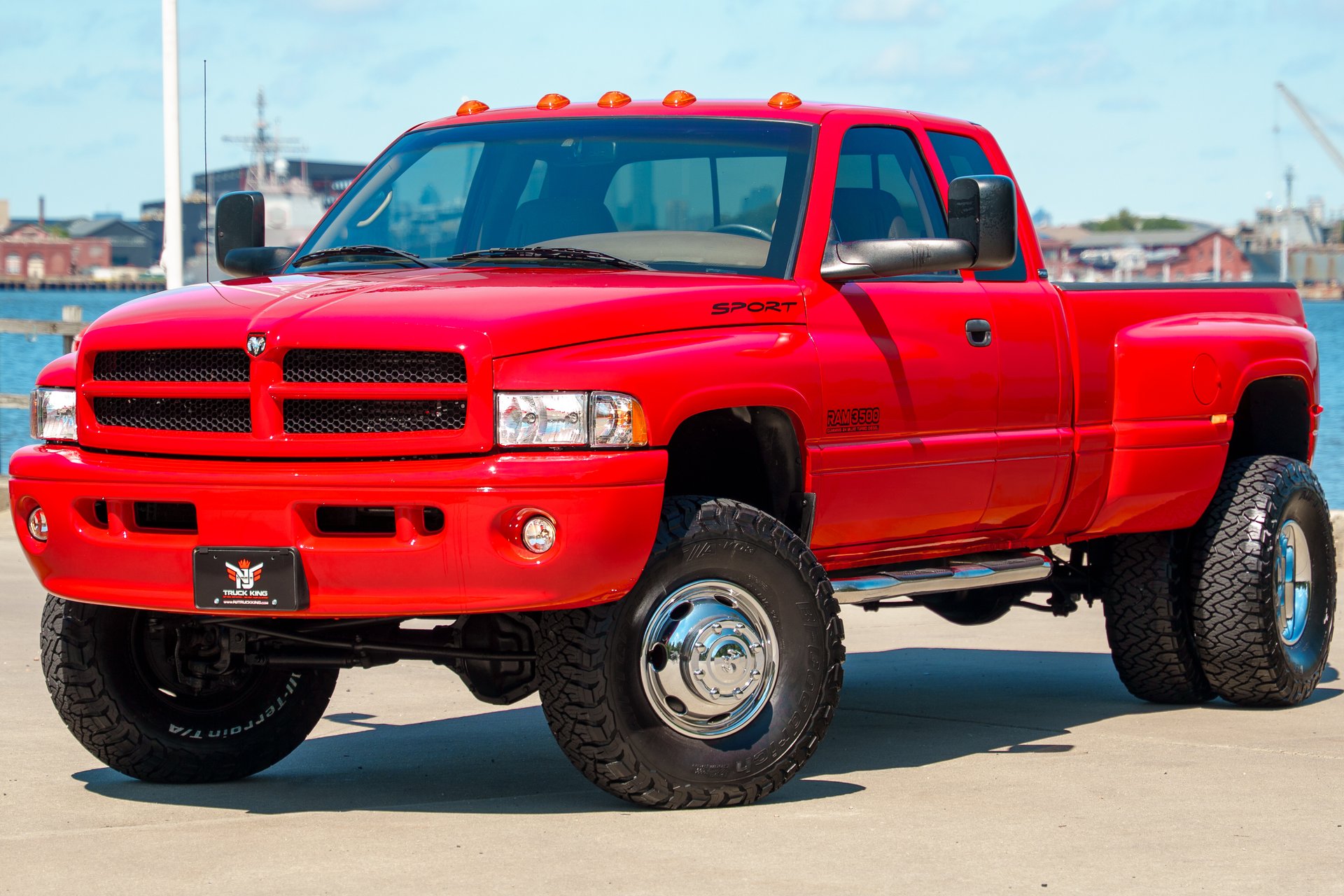
The second generation, launched for the 1994 model year, is the truck that defines the Ram 3500 for most buyers. Dodge threw out the flat-sided styling for a deliberate big-rig look — a high central hood with the front fenders dropped away on either side, a tall upright grille, a cab styled to echo a semi tractor — and it transformed the brand's fortunes. Underneath, coded BR in two-wheel drive and BE in four-wheel drive, the formula hardened rather than changed: a stronger frame, a solid front axle on four-wheel-drive trucks, leaf springs at the rear, and a one-ton specification centred on dual rear wheels. Through this whole 1994 to 2002 generation the 3500 was a dually: if a truck of this shape carries single rear wheels, it is a 2500, whatever the listing headline claims. Engines were the 5.9-litre Magnum petrol V8, the 8.0-litre Magnum V10, and the Cummins 5.9 in two distinct forms — the mechanical 12-valve to mid-1998 and the electronic 24-valve from mid-1998 to 2002. Regular Cab, Club Cab and, from 1998, a Quad Cab with small rear-hinged doors made up the bodies, in ST, SLT and Laramie SLT trim.
The third generation arrived for 2003 on the DR platform (DH for the heavy-duty line), with more rounded styling, a much better interior, rack-and-pinion steering on two-wheel-drive trucks, and a new Cummins: still 5.9 litres, but now with high-pressure common-rail injection, quieter and stronger again. A 5.7-litre Hemi petrol V8 replaced the old Magnum V8 and the V10 was dropped. Single-rear-wheel 3500s returned alongside the dually, and a short-bed Mega Cab joined for 2006. For mid-2007 the Cummins grew to 6.7 litres to meet new emissions rules, bringing exhaust aftertreatment and an integrated exhaust brake. The Dodge badge lasted to 2010; from 2011 the trucks were sold under the standalone Ram brand, where this guide stops.
Be plain about what our own listings actually contain, because it is narrower than that full history. We currently track 16 Ram 3500s, all 16 of them for sale and none yet recorded as sold. Every one dates from 1991 to 2001: 13 of the 16 are second-generation trucks from 1994 to 2001 — with 2001 alone accounting for 6 of the 16 — and the remaining 3 are first-generation trucks, a 1991 and two 1993s. There is not a single 2003-on truck in the current pool, so the later sections of this guide, covering the common-rail and 6.7-litre cars, are written from model knowledge rather than from our listings, and you should read the pool-weighted parts — the second-generation dually above all — as the heart of the guide. The pool's geography is equally telling: 8 of the 16 trucks are in Texas and 3 more in Tennessee, with the rest scattered through New Jersey, North Carolina, West Virginia and Ohio. Surviving one-tons concentrate where diesel culture is strong and road salt is weak. Ten of the 16 come through dealers and 6 through private marketplace sellers. The gearbox split is the most revealing figure of all: 8 automatics and 8 manuals, a manual share no ordinary vehicle achieves, because buyers of Cummins duallys actively hunt the manual cars and sellers know it.
Judge every Ram 3500 as a worked truck until it proves otherwise. Mileage is a weak witness — a Cummins is barely run in at mileages that would finish a petrol V8 — but a life at maximum gross weight wears out front axles, steering, springs, beds and cabs on a schedule the odometer understates. The central buying problem is the same on every generation: the Cummins routinely outlives the truck around it, and your job is to price the truck, not the engine's reputation.

The models
A Ram 3500 badge tells you the weight class and very little else. To know what you are actually looking at, decode five things: the generation, the engine, the rear wheels — dual or single — the cab, and the drive. Two trucks with identical badges can differ by a petrol V8 or a Cummins, a five-speed manual or a four-speed automatic, a regular cab or a Quad Cab, and the value and the inspection both follow those differences, not the badge.
| Model | Years | Engine | Output | Built | Character |
|---|---|---|---|---|---|
| Ram D350 / W350 petrol | 1981–1993 | 5.2 or 5.9 V8 petrol | 170–190 hp | Not published by trim | The first-generation one-ton; simple, honest, now scarce |
| Ram D350 / W350 Cummins | 1989–1993 | 5.9 Cummins 6BT, 12-valve diesel | 160 hp | Not published by trim | The original Cummins truck; crude cab, pure mechanical diesel |
| Ram 3500 12-valve | 1994–1998 | 5.9 Cummins 6BT, mechanical injection | 160–215 hp by year and gearbox | Not published by trim | The P-pump dually; the tuner's and purist's truck |
| Ram 3500 24-valve | 1998–2002 | 5.9 Cummins ISB, electronic injection | 235 hp; 245 hp High Output | Not published by trim | Stronger stock, quieter, with electronic weak points to test |
| Ram 3500 petrol V8 and V10 | 1994–2002 | 5.9 Magnum V8; 8.0 Magnum V10 | 245 hp V8; 300–310 hp V10 | Not published by trim | The cheaper haulers; V10 pulls near-diesel hard at a fuel cost |
| Ram 3500 common-rail | 2003–2007 | 5.9 Cummins, common-rail diesel; 5.7 Hemi V8 petrol | 305–325 hp diesel; 345 hp Hemi | Not published by trim | The modernised truck; quiet diesel, better cab, SRW returns |
| Ram 3500 6.7 | 2007–2010 | 6.7 Cummins diesel; 5.7 Hemi V8 petrol | 350 hp diesel | Not published by trim | Emissions-era Cummins; exhaust brake, aftertreatment complexity |
Dodge did not publish a trustworthy production split by 3500 trim, engine and cab, so treat any rarity claim with suspicion. Rarity here is a combination — engine, gearbox, cab, drive and condition together — and a seller who prices a common truck as rare on a colour or a trim badge is selling a story, not a specification.
The first-generation trucks, 1981 to 1993. D350 is two-wheel drive, W350 four-wheel drive. Most were petrol V8s and survive now as simple, increasingly scarce old work trucks. Everything sharpens from 1989, when the Cummins arrived with 160 hp and 400 lb-ft, a Getrag five-speed manual or a three-speed automatic, and intercooling from 1991. These are spartan machines — a cab design from 1972, thin insulation, a ride that reminds you the springs were specified for a full load — but the engine is the 12-valve Cummins in its original form, and a clean W350 Cummins regular cab is a genuinely sought-after truck. Note the badging trap in both directions: a first-generation one-ton is a 350, not a 3500, and a listing that headlines it as a 3500 is using the later name loosely. That is sloppy rather than sinister, but it tells you to verify everything else the listing says.
The second-generation dually, 1994 to 2002. This is the core of the market and 13 of our 16 listed trucks. All are dual-rear-wheel — there was no single-rear-wheel 3500 in this generation — on Regular Cab, Club Cab or (from 1998) Quad Cab bodies, all with the eight-foot long bed in dually form. Trim ran ST at the working end, through SLT, to Laramie SLT at the top, with leather and full power equipment on the best cars. The range divides by engine, and the Cummins divide inside 1998 matters most: 12-valve mechanical cars to mid-1998, 24-valve electronic cars after it. The petrol cars are the budget entry — a 5.9 Magnum V8 for lighter work, or the 8.0 V10, with 450 lb-ft, for buyers who wanted diesel-style towing without a diesel and accepted single-figure fuel economy under load in exchange.
The third-generation trucks, 2003 to 2010. None is in our current pool, but they are common in the wider market and belong in a complete guide. The 2003 redesign brought a stiffer frame, a far better cab, and the common-rail Cummins; the 5.7 Hemi became the only petrol option. Single-rear-wheel 3500s returned, so from 2003 the dually test no longer identifies the model — check the badge, the door sticker's gross weight rating and the VIN instead. Mid-2007 brought the 6.7-litre Cummins, a six-speed automatic option and an available exhaust brake. These are the most capable and most complex trucks in this guide, and the inspection emphasis shifts from mechanical wear toward electronics, injectors and aftertreatment.
Cabs, beds and trim across the range. The Regular Cab is the lightest and simplest, and the most likely to have been a pure work truck. The Club Cab adds a rear bench in a cab with no rear doors; the Quad Cab from 1998 cuts small rear-hinged doors into the same shell — convenient, and a known source of rattles and water leaks as the latches and seals wear. No true four-door crew cab exists in the second generation, and any listing describing a Club Cab as one is misdescribing the truck. Trim matters less than condition throughout: ST cars have the fewest toys to fail, Laramie SLT cars the nicest seats to preserve, and the dashboard plastic is the same brittle material in every trim, so no badge protects you from the cracked-dash problem covered below.


Engines and gearboxes
The Cummins 5.9, 12-valve: 6BT
The engine that made this truck. The Cummins B-series is a 5.9-litre, 359-cubic-inch inline six with a cast-iron block and head, a gear-driven camshaft, twelve valves and a single turbocharger. In the first-generation one-ton it arrived for 1989 with a Bosch VE rotary injection pump, 160 hp and 400 lb-ft of torque, non-intercooled at first and intercooled from 1991. In the second-generation truck from 1994 it received the Bosch P7100 inline injection pump — the P-pump — an industrial unit with a plunger for each cylinder, mechanical governing and a capacity to deliver far more fuel than a stock engine can burn. That headroom is why the 1994 to 1998 cars became the foundation of diesel tuning culture, and why they still command attention now.
Outputs rose across the run and depend on year and gearbox, so never accept a single quoted figure for a 12-valve. A 1994 automatic made about 160 hp and 400 lb-ft; the manual car about 175 hp and 420 lb-ft. By 1996 to 1998 the manual cars reached 215 hp and 440 lb-ft, with automatics a step behind at roughly 180 to 185 hp. All of them pull harder than the numbers suggest, because the torque arrives just off idle and does not fall away. Fuel control is entirely mechanical — a throttle cable and a governor in the pump, no computer deciding anything — which is both the charm and the discipline of the engine: there is almost nothing electronic to fail, and almost nothing electronic to warn you when a mechanical part is wearing.
Starting is by grid heater, not glow plugs: an electric heating grid in the intake warms the incoming air, cycled by the wait-to-start light, and a big high-compression six demands two healthy batteries and clean, heavy cable connections to crank at speed. A healthy 12-valve fires quickly once the light goes out, idles with a loud, even, mechanical clatter, and pulls without a miss. Treat as warnings a hard start when warm, a hunting or rolling idle, white smoke that persists after warm-up, or heavy black smoke under light load on a truck claimed to be stock — the vocabulary of pump timing, worn injectors and tired fuelling. Oil weeps from the front cover and tappet cover are common and usually manageable; diesel leaks are not, because fuel on a hot engine is a fire risk, not a cosmetic fault. The 12-valve also has adjustable valve clearances rather than hydraulic lifters, so a service history that includes periodic valve checks is a real mark in a truck's favour. The engine's one famous internal trap, the killer dowel pin, is covered in Problem areas; documented evidence it has been tabbed is worth money.
The Cummins 5.9, 24-valve: ISB and common-rail
From mid-1998 the second-generation truck received the ISB: still 5.9 litres and a cast-iron six, but with a 24-valve head, electronic engine management and the Bosch VP44 rotary injection pump, its fuelling and timing controlled by a computer on the pump itself. Standard output was 235 hp and 460 lb-ft; the High Output version, sold only with the six-speed manual, made 245 hp and 505 lb-ft. The 24-valve is quieter, cleaner and stronger as standard than the car it replaced, starts better in the cold, and gives you proper electronic diagnostics. In exchange it introduced the model's best-known weakness: the VP44 is cooled and lubricated by the fuel passing through it, and it depends absolutely on supply pressure from a small electric lift pump that was marginal when new. A lift pump that fades starves the VP44, and a replacement injection pump is a four-figure job — realistically $1,500 to $2,800 fitted — which is why a fuel-pressure gauge or a documented lift-pump upgrade (an aftermarket FASS or AirDog system is the common fix) is one of the strongest selling points a 24-valve can carry. Judge the engine by its cold start, its idle stability and its history of lift-pump attention, not by how clean the bay looks.
For 2003 the third generation replaced the VP44 system entirely with high-pressure common-rail injection, a CP3 pump feeding a shared rail at pressures the older systems never approached. Output rose to 305 hp and 555 lb-ft, then 325 hp and 610 lb-ft for the 2005-on cars. The common-rail engine is dramatically quieter and more refined, and its failure vocabulary changes: injectors become the wear item, passing fuel internally or dribbling and washing oil, with hard starting — especially hot — extended cranking and a rising oil level or diesel smell on the dipstick as the classic tells. A set of quality injectors is a major job, roughly $2,500 to $4,500 fitted depending on source and labour, so a common-rail truck with documented injector work is worth a real premium over an identical truck without it. The CP3 pump itself is notably tougher than the VP44 it replaced.
The 6.7 Cummins and the petrol engines
The 6.7-litre Cummins of mid-2007 on is a stroked development of the same family — 350 hp and 650 lb-ft with the automatic — built to work inside an emissions system the earlier engines never had: exhaust gas recirculation, a diesel particulate filter, a variable-geometry turbocharger whose sliding nozzle also provides a genuinely effective exhaust brake, and a crankcase ventilation system that needs its filter changed on schedule. Driven as intended — worked hard, run hot, allowed to complete its filter regenerations — it is a strong and durable engine. Used for short, cold, light-duty trips it soots its own systems: clogged filters, sticking turbo actuators and diluted oil are usage failures as much as part failures, and the inspection below treats them that way. Deleted trucks — emissions equipment removed and the computer retuned — are common in the market and are a legal and resale question as much as a mechanical one: in many jurisdictions such a truck cannot pass inspection, and you should price that risk explicitly rather than discovering it at registration.
The petrol engines play a supporting role, and an honourable one. The 5.9-litre Magnum V8 (245 hp in the second generation) is a simple, long-lived pushrod engine that suits a one-ton used lightly and occasionally; the 8.0-litre Magnum V10, at 300 to 310 hp and 450 lb-ft, was Dodge's diesel alternative for heavy towing and pulls with real authority, at fuel consumption that makes sense only if your annual mileage is low. In the third generation the 5.7-litre Hemi V8 (345 hp) took over both roles adequately. No petrol 3500 holds its value like a Cummins car, which makes a clean petrol dually the rational buy for the owner who tows a few times a year and wants the chassis without the diesel premium — provided the price honestly reflects the engine under the hood.
Gearboxes
Gearbox choice shapes a 3500 more than any other single decision, and the pool's even split — 8 manuals and 8 automatics among our 16 trucks — shows how contested it is. First-generation Cummins cars used the Getrag G360 five-speed manual, adequate at stock power and the weak link if the engine has been turned up, or a three-speed automatic with no overdrive, which leaves the engine busy at highway speed. Second-generation manuals are the New Venture NV4500 five-speed — a heavy, iron-cased box with a granny-low first gear and a known fifth-gear problem, the retaining nut backing off until fifth is lost, covered below — and, behind the High Output 24-valve, the NV5600 six-speed, stronger and heavier still, with parts support that is now a genuine consideration. The automatics are the 47RH (hydraulically controlled, 1994 to 1995) and the 47RE (electronically controlled, from 1996), four-speeds whose torque converter and internals were marginal behind a tuned Cummins; a stock truck used within its rating is fine, a turned-up truck on an original automatic is a rebuild waiting for a date, realistically $3,000 to $5,500 for a properly built replacement. Third-generation cars brought the stronger 48RE automatic, the Mercedes-sourced G56 six-speed manual, and, behind the 6.7, the 68RFE six-speed automatic — a clear step up for towing. On any test drive, judge an automatic by cold engagement, shift firmness under load and fluid colour; judge a manual by synchromesh into third and fifth, clutch take-up height, and any rattle at idle that vanishes when the clutch is pressed.

Problem areas
A Ram 3500 fails differently from a car, and differently from a lighter truck. Almost nothing on it is fragile in the ordinary sense — frames, axles and the Cummins block are industrial hardware — but everything on it has been asked to work at or near its rated limit, often for decades, and the failures are wear, overload and neglect made visible. Work through this section in the order given: structure first, then the front end that steers it, then the fuel system that prices a diesel, then the running gear unique to a dually, then the cab you have to live in.
Rust, beds and the evidence of work
Start underneath, because a one-ton's underside is its service record. The frame is a ladder of heavy channel and is genuinely tough, but it rusts where road salt and mud sit: around the spring hangers and shackles, at the crossmembers, along the lower flanges under the cab, and around the rear axle and fuel tank straps. Surface scale is normal on a working truck; perforation at a hanger or crossmember is structural work — fabrication and welding priced per truck, realistically $1,000 to $3,000 for a localised repair done properly, and a warning that the rest of the frame deserves the same scrutiny. Northern trucks suffer most; the concentration of our pool in Texas and Tennessee is no accident. Cab rust follows the water: cab corners, rocker panels, floor pans under wet carpet, and the bottoms of the doors. First-generation cabs, a 1972 design, rust more readily and have thinner parts support; second-generation cabs hold up better but rot in the same places when the drains block and the truck lives outside.
The bed is a document, and on a dually you should read it like one. Look for a fifth-wheel or gooseneck hitch, or the holes and witness marks where one was removed: a truck that has towed heavy is not automatically a bad truck — towing is what it was built for — but a truck that has towed heavy on deferred maintenance is the worst buy in this market. Check the bed floor for bowing between the crossmembers, the wheel tubs for dents from shifted loads, and the front bed panel for the bend that comes from a load sliding forward under braking. On dual-rear-wheel cars, examine the wide rear fender flares panel by panel: the second-generation flares are large composite mouldings that crack around their mounting points, star-craze, and split at the lower edges where they meet road debris and careless boots. Sound used flares are getting harder to find, and a cracked flare is both a cost and a clue — it tells you the truck has been squeezed through spaces and against loading docks. Check the tailgate for straightness by sighting along its top edge, check that it latches on both sides, and look at the rear bumper and hitch receiver for the sag and elongated holes of a life spent at maximum tongue weight.
Overload leaves its own signatures. Rear springs that sit flat or inverted at rest, mismatched helper springs or air bags fitted to one side only, cracked spring leaves, and worn shackle bushings all describe a truck that has carried more than it should. None of it is unfixable — a spring and bush refresh runs roughly $600 to $1,500 depending on how much is renewed — but it reprices the truck from cherished hauler to used-up tool, and it should.
Front axle, steering and the death wobble
The four-wheel-drive front end is the second-generation truck's defining weakness, and it deserves your closest attention after the frame. Dodge used a Dana 60 solid front axle located by coil springs and a track bar, and steered by a recirculating-ball box through a linkage with many joints. Every element wears, and the wear adds up in a specific order. The track bar — the lateral link that centres the axle — wears at its frame-end joint first, and a worn track bar lets the axle shift sideways over bumps, which the driver feels as vagueness and, in the developed case, as the model's notorious failure: death wobble, a violent, self-sustaining oscillation of the front wheels after hitting a bump at speed, which only stops when you slow right down. Death wobble is never one part. It is the sum of a worn track bar, tired ball joints, worn tie-rod ends, a loose steering box, incorrect caster and often under-rated or uneven front tyres — on a dually, six tyre pressures to keep right instead of four. Any seller who tells you a truck needs only an alignment or only a steering stabiliser to cure it is describing the cheapest item on the list, not the diagnosis. Budget honestly: a thorough front-end renewal — track bar, ball joints, tie-rod ends, alignment — runs roughly $1,200 to $2,800 fitted, and a steering box on top of that adds $400 to $900 depending on source.
Test it methodically. With the truck stationary and an assistant rocking the steering wheel, watch the track bar's frame joint and each tie-rod end for movement that arrives late — play you can see is play that matters. Jack each front wheel and rock it top and bottom for ball-joint wear, and in and out for hub bearing wear; unit hub bearings are a consumable on these trucks, roughly $250 to $450 a side fitted. Check the steering box for sector-shaft play and for leaks, and check the intermediate shaft joint. On two-wheel-drive third-generation cars the layout changes to independent suspension with rack-and-pinion steering, which wears more conventionally — inner tie-rod joints and rack boots — and does not death-wobble in the same way. Brakes, finally, work hard on a one-ton: judge disc condition and pad life, test for a firm pedal, and treat a soft pedal, a pulled stop or a corroded brake line as immediate money, with a full hydraulic refresh at $800 to $1,800 fitted if the truck has sat.
Diesel fuel systems: the faults that price the truck
Each Cummins generation has one fuel-system fault that dominates its price, and you should test for that fault before anything else under the hood.
On the 12-valve, it is the killer dowel pin. A locating dowel in the front timing case, pressed into the block, can walk out with age and vibration and fall into the timing gears. The outcomes range from a cracked timing case to a wrecked gear train and bent valves — a repair bill from $1,500 for a case to well over $4,000 if the pin has gone through the gears. The fix, tabbing the pin behind a retainer, costs little in parts and several hours in labour, roughly $400 to $800 at a shop, and it only needs doing once. Ask directly whether it has been done, and ask for the invoice or the photograph; a seller of a 12-valve who knows the truck will know the answer, and a blank look is information too. While the front cover is in mind, check it and the tappet cover for oil leaks, and check the vacuum pump and power-steering pump mounted behind it, a combined unit whose seals weep with age.
On the 24-valve, it is the lift pump and the VP44 it feeds, described in the engines section. The test is a fuel-pressure reading: a healthy system holds solid supply pressure at idle and under load, and a truck whose pressure sags on a pull is a truck whose expensive injection pump is being starved as you watch. If the truck has no gauge, a documented recent lift pump or an aftermarket lift-pump system is the next best evidence; an original lift pump at high mileage with no paperwork is a deduction, full stop. Add the 53 block to your 24-valve checks: a proportion of 1998 to 2002 5.9 blocks carry the casting number 53, and that casting is prone to cracking along the water jacket, typically showing as a coolant weep or a visible crack line low on the block. Not every 53 block cracks, and a high-mileage 53 that is dry has made much of its case — but you find the number, stamped on the block, before you agree a price, not after.
On the common-rail 5.9, it is injectors, as covered above: extended cranking, a hot-start reluctance, diesel on the dipstick, a haze at idle. On the 6.7, it is the emissions system used wrongly: a particulate filter that never gets hot enough to regenerate, a variable-geometry turbo whose actuator and nozzle ring soot and stick — a turbo replacement runs roughly $1,800 to $3,500 fitted — and an EGR system that fouls the intake. On every diesel, regardless of generation, check the intercooler boots and clamps for splits and oil, the turbo for shaft play and for oil in the intake tract, and the fuel filter's service history: dirty fuel is the common ancestor of half the bills in this section.
Drivetrain, gearboxes and dually running gear
The NV4500 five-speed manual has one signature fault: the nut retaining fifth gear on the mainshaft backs off, fifth gear walks, and fifth is lost — often announced by a truck that drives perfectly in four gears and simply has no fifth to find. The repair, with the updated nut and shaft remedies, runs roughly $800 to $1,800 depending on how much else the box needs while it is open. The NV5600 six-speed is stronger but its parts supply is now thin enough that a noisy one deserves a specialist's opinion before purchase, not after. Automatics fail by heat and by torque: judge fluid colour and smell, shift quality cold and hot, and converter lock-up behaviour on a steady cruise, where a hunting or shuddering lock-up shows as a rhythmic surge. A truck with a transmission temperature gauge, an auxiliary cooler and fluid-change paperwork has been owned by someone who understood the assignment.
At the rear, the one-ton runs a Dana 80 axle on most second-generation duallys — a genuinely heavy unit whose common needs are pinion and carrier bearings, a leaking pinion seal, and limited-slip clutches that have long since given up if fitted. Listen for a whine that changes between drive and overrun, and check the oil. Dual rear wheels add their own discipline: the inner tyres are the most neglected tyres in all of motoring, hidden behind the outers, run flat or bald while the truck still looks roadworthy from the kerb. Get down and look at all six tyres — tread, age, matching sizes — because a set of six is a $1,200 to $2,400 decision, and mismatched heights across a dual pair overload the taller tyre and wear both. Check the rear hub seals for leaks onto the brakes, the spare's presence and condition, and on four-wheel-drive cars the transfer case for chain noise and the front driveshaft joints for play.
Cab, interior and electrics
The second-generation dashboard is the cab's famous fault: the plastic dash top becomes brittle with heat and age and cracks, then breaks into pieces, on trucks of every trim level. A cracked dash is cosmetic in function and significant in money and labour — a replacement dash top or a quality cap, fitted, runs roughly $300 to $900 depending on route — and, more usefully, it is an honesty gauge: a truck whose owner replaced or capped the dash tended to fix other things too. Heater and air-conditioning faults centre on the blend doors and the evaporator inside the HVAC box, a dashboard-out job when it comes, so test every vent position, both temperatures and the air conditioning on every viewing, whatever the weather. Seats on work trucks wear through at the driver's entry bolster; door seals and Quad Cab rear-door latches admit water that then lives under the carpet and starts the floor rust described above, so lift the mats and use your nose.
Electrics are conventional and mostly age-related: alternator and battery-cable condition (a Cummins needs both batteries healthy and matched — one new and one old is a false economy that shows up as a winter no-start), starter draw, window and lock motors, and intermittent instrument-cluster solder joints on higher-mileage second-generation cars. On third-generation cars add door wiring looms that fracture where they flex, and integrated power module faults behind random electrical behaviour. None of this rivals the diesel bills, but a truck where everything electrical works has usually been maintained as a system, and that pattern is worth paying for.


How to inspect one
Allow ninety minutes, bring a torch, a tyre gauge, and a friend whose only job is to rock the steering wheel while you watch. Inspect cold, inspect underneath, and inspect all six tyres. If a truck passes you, pay for a lift inspection and a diesel specialist's hour before money changes hands — on a one-ton it is the best money in the purchase.
- Paperwork and identity first. Match the VIN on the title to the plate on the dashboard and the door sticker, and read the door sticker's gross weight rating: on a 2003-on truck, where single-rear-wheel 3500s exist, that sticker and the VIN — not the badge — settle whether the truck is truly a 3500. On a 1994 to 2002 truck, apply the dually test from the models section: dual rear wheels make it a 3500, single rear wheels make it a 2500 whatever the headline says. Check the title for salvage and flood brands, and ask for service records, prioritising fuel-system and front-end invoices.
- Cold start, from outside the truck. Insist the engine is cold and stand where you can see the exhaust. A Cummins should fire after the wait-to-start light with a brief puff that clears; prolonged cranking points to the fuel-supply and injector faults in the problem areas section for that generation, and white smoke that hangs around after warm-up is a deduction, not a characteristic. Listen for a front-end rattle, a belt chirp and any knock that fades or stays.
- The generation question. Before you go further, name the fuel system out loud — 12-valve, 24-valve, common-rail or 6.7 — because it decides the next three steps. On a 12-valve, ask the dowel-pin question from the problem areas section and look for the answer in the paperwork. On a 24-valve, ask for the lift-pump history and look for a fuel-pressure gauge or an aftermarket lift-pump system. On a common-rail car, ask when the injectors were done. On a 6.7, ask how the truck has been used, because short-trip use is the emissions system's enemy.
- Underneath: frame, hangers and springs. Torch along both frame rails, prod around the spring hangers, shackles and crossmembers, and check the brake and fuel lines for corrosion. Perforation at a hanger is structural. Then read the springs: flat or inverted rear leaves and one-sided helper arrangements are the overload signatures from the rust and work section, and they reprice the truck on the spot.
- The bed and the hitch evidence. Look for the fifth-wheel or gooseneck installation, or its removed-and-plated witness marks. Sight along the bed floor and the front bed panel, check the wheel tubs, work the tailgate on both latches, and examine every inch of both dually flares for the cracking described in the problem areas section. A worked bed on a maintained truck is acceptable; a worked bed on an unmaintained truck is the whole story.
- Front end, with your assistant. Have your friend rock the steering wheel while you watch the track bar's frame-end joint and every tie-rod end for late movement — the death-wobble ingredients from the steering section, visible before they are felt. Jack each front wheel, rock it top-to-bottom and side-to-side, spin it and listen to the hub bearing, and check the steering box and intermediate shaft for play and leaks.
- All six tyres, including the inners. Get down behind the rear wheels and inspect the inner duals you cannot see from the kerb: tread, sidewall cracking, matching sizes across each pair, and pressures with your gauge. Check the date codes, not just the tread — old tyres on a heavy truck are a safety item, not a negotiating detail — and confirm a usable spare exists. Price a full set of six into any offer where the rubber is tired.
- Fluids and leaks. Pull the engine dipstick: on a common-rail car, a high level that smells of diesel is the injector tell from the problem areas section. Check coolant for oil and rust, automatic transmission fluid for colour and burnt smell, and transfer-case and axle oils if the seller permits. Walk the engine bay looking specifically for diesel wetness — any fuel leak is a walk-away-until-fixed item — then intercooler boots, turbo oil, battery match and cable condition.
- The test drive, loaded with questions. Twenty minutes minimum, including broken pavement at speed and a highway stretch. Feel for the first hint of front-end oscillation over bumps — the opening note of the death wobble from the steering section. Judge the automatic's shifts cold and hot and its lock-up behaviour on a steady cruise; in a manual, test synchromesh into third and fifth, find fifth positively on an NV4500 car, and listen for the idle rattle that a pressed clutch silences. Brake firmly from speed: straight, firm, no pull, no judder.
- Towing behaviour and temperatures. If the seller permits a trailer, take one; if not, at minimum work the truck up a long grade and watch coolant and transmission temperatures, boost behaviour and smoke under load. A diesel that runs hot, hazes heavily under moderate load or loses boost has told you which section of this guide to re-read. Test the exhaust brake on a 6.7 car on the descent — it should hold speed noticeably.
- Cab, HVAC and electrics. Run the heater and air conditioning through every vent position and temperature — the blend-door test from the cab section — then every window, lock, light and wiper. Examine the dash top for the cracking that prices the cab, sit in the driver's seat and feel for a collapsed base, lift the mats and smell for the damp that means Quad Cab seals or door membranes are leaking, and check the floors your torch finds.
- Stance and the walk-away decision. Stand back and look: level front to rear, square side to side, duals aligned, bed sitting true over the axle. Then tot up what you have found in the order this guide prices it — structure, fuel system, front end, gearbox, rubber — and decide. A good 3500 tolerates a long list of small faults; it does not tolerate a rotten frame, a starving injection pump or a front end that oscillates, and no Cummins reputation pays those bills for you.
Values
The build's market block beneath this guide carries the live numbers — what is listed now and what recorded sales have achieved — and this section teaches you how to read them, because the Ram 3500 market is one of the easiest in the classic-truck world to misread from a headline figure.
The first lesson is that condition spread dwarfs model spread. A one-ton's value is set less by its year or trim than by which of three lives it has led: the cherished private hauler, garaged and serviced, that towed a camper on weekends; the honest working truck, maintained on schedule and worn in proportion; and the used-up tool, run at maximum weight on minimum maintenance until the bills queued up. The first and third can share a model year, a badge and even a colour, and they are not the same vehicle at any price. When the market block shows a wide range for a year, that spread is mostly these three lives being averaged together, and your inspection — not the median — tells you which life a given truck has led.
The second lesson is the Cummins premium and its gearbox modifier. Diesel trucks carry the market; petrol V8 and V10 cars trade at a clear discount for equivalent condition, which makes them the value route for low-mileage towing rather than a lesser truck. Within the diesels, the manual cars punch above their original share of production — half the trucks in our current pool are manuals, a proportion no manufacturer ever built — because the buyers who want these trucks for towing and tuning actively seek three pedals, and clean manual duallys are hunted out of all proportion to their numbers. Generation premiums follow the fuel systems: sorted 12-valve cars, above all the 1996 to 1998 P-pump trucks, carry a purist premium; 24-valve cars are discounted by exactly the cost of the lift-pump and injection-pump risk until the paperwork removes it; common-rail cars are valued as the modern all-rounders; and 6.7 cars split sharply between hard-worked examples with proven emissions health and everything else.
Third, read asking prices against achieved prices with a working truck's scepticism. Sellers price the Cummins badge and the best truck they can describe; the market pays for frame condition, fuel-system paperwork and a front end that does not wobble. A documented dowel-pin tab, a set of injectors, a built automatic or a renewed front end are worth real money in negotiation because they are invoices, not adjectives — and a truck offered at a cherished-hauler price with a working truck's evidence is the commonest overpricing pattern in the market. Project trucks carry a one-ton twist: a project 3500 needs everything a project car needs plus six tyres, heavy brakes and commercial-scale parts, so the cheap truck is cheap for more reasons than the listing lists. Buy on the truck the inspection describes, and let the badge go free.
Parts and ownership
The Ram 3500 is one of the best-supported working classics you can own, for a simple reason: the Cummins engine was built in industrial quantities for trucks, tractors and generators, the pickups sold in large numbers for two decades, and a working fleet still depends on them, which keeps the parts trade honest and busy.
Easy: service items for every engine — filters, belts, hoses, thermostats, water pumps — brake discs, pads and hydraulics, suspension and steering wear parts, track bars and ball joints, unit hub bearings, U-joints, alternators, starters, batteries, exhaust systems, tyres in the common dually sizes, and glass and seals for the second-generation cab. Order today, fit this week, at prices set by a competitive truck aftermarket rather than a classic-car boutique.
Harder and dearer: injection equipment, which is specialist work at specialist prices — VP44 pumps, common-rail injector sets, lift-pump upgrades done properly. NV5600 gearbox internals and good used boxes. Second-generation dash tops in uncracked condition, dually fender flares in sound condition, first-generation cab panels and trim, Laramie leather in good order, and 6.7 emissions components, where a turbocharger or a particulate filter is a major purchase and cheap substitutes have a short and unhappy record. A quality repaint on a long-bed dually is a big-panel job priced accordingly, which is why the standing advice of this guide is to buy the frame, the bed and the fuel system, and fix the rest.
Running costs. Budget like a commercial operator, not a car owner. Fuel consumption is a towing question: a Cummins dually driven empty is respectable for its size, and any of these trucks towing at gross weight uses fuel in proportion to the work, the petrol V10 in a class of its own. Six tyres, heavy brake components and 12-valve valve-clearance checks belong in the annual plan, not the emergency fund. The first-year catch-up catches new owners out: on a running but deferred truck, bringing the front end, brakes, fluids, filters and rubber to standard honestly costs a four-figure sum before you improve anything, and a truck that has sat needs its fuel system cleaned and its brake hydraulics inspected end to end before it tows. Insurance and registration vary by state and by commercial use — check both before purchase, especially for a dually. Used as intended, a sorted 3500 is among the most durable machines in this guide programme: the trucks that fail early are almost always the trucks whose maintenance was deferred, not whose design was weak.

Which one to buy
- The purist's truck: 1996–1998 12-valve manual. The P-pump Cummins at its strongest stock setting, a five-speed manual, no fuel-system electronics at all. Verify the dowel pin has been tabbed, budget for the front end, and you have the most characterful one-ton Dodge ever built.
- The all-rounder: 2001–2002 24-valve with paperwork. The strongest second-generation package for real towing — provided the lift-pump history is documented, the block is checked for its casting number, and the price reflects any gap in either. Our pool is thickest here, with six 2001 cars among the 16, so you can afford to be choosy.
- The value buy: a petrol V10 or 5.9 V8 dually. The full one-ton chassis at a clear discount to the Cummins cars. For a few heavy tows a year and low annual mileage, it is the rational truck — just buy it at the petrol price, not at a diesel price with a story attached.
- The character buy: 1989–1993 first-generation Cummins. The original: a 1972 cab, a mechanical diesel, and more charm than comfort. A clean W350 regular cab is a collector's truck now; buy the best cab and frame you can find, because first-generation body parts are the scarcest in this guide.
- The modern hauler: 2005–2007 common-rail, or a hard-worked 6.7. The quiet, strong, civilised end of the range — none is in our current pool, so shop the wider market — with injector history on the 5.9 and proven emissions health plus long, hot working use on the 6.7 as the non-negotiable evidence.
And the rule that overrides all of the above: buy the frame, the fuel system and the front end, in that order — the engine's reputation comes free with every truck, including the bad ones. A Cummins badge has launched a thousand overpriced sales. The trucks worth stretching for are the ones whose structure is sound, whose generation-specific fuel fault has been answered with an invoice, and whose steering stays calm over a broken road at speed. Find that truck, in whichever generation your budget reaches, and the rest is maintenance.
See the 6 Ram 3500 Regular Cab Long Bed cars currently listed.