
Dodge Dart buyer's guide
Dodge Dart -- the model's own buyer's guide: variants, values and what to check.
Years listed: 1963-1974 · Series: A-Body
Overview and history
The Dodge Dart is two different ideas wearing one name, and understanding which one you are looking at is the first job of any buyer. The name arrived for 1960 on a full-size, lower-priced Dodge — the Seneca, Pioneer and Phoenix — shrank with the rest of the Dodge line for 1962, and then, for 1963, was reassigned completely to an all-new compact on Chrysler's A-body platform. It is that compact Dart, built from 1963 to 1976, that fills the classic market today, and it is the car this guide covers. Every one of the 39 Darts currently tracked on Classic Listings is an A-body car, spread from 1963 to 1974 in our listings, with the heart of the pool in 1967 to 1974 — the years when the Dart was simultaneously America's sensible compact and, in the right specification, one of the most effective small muscle cars ever sold.
That double life is the Dart's whole story. Chrysler built the A-body to be cheap, simple and durable: a unitised body, torsion-bar front suspension, a live rear axle on leaf springs, and a choice between the famously unburstable Slant Six and, from 1964, a line of small V8s that grew until a big-block could be ordered in a car that weighed little more than a modern family hatchback. There is almost no exotic engineering anywhere in the car, and that is precisely the point. The Dart was designed so that a small-town dealer could fix anything on it with hand tools, and sixty years later a home mechanic still can. What separates a good Dart from a bad one is not mechanical complexity — it is rust in the unit body, worn-out suspension geometry, and how honestly a previous owner dealt with the gap between what the car was born as and what its badges now claim it is.
The compact Dart falls into two clear generations. The first, 1963 to 1966, is the smaller, lighter, more upright car: a 106-inch wheelbase, narrow body, crisp early-sixties styling, and a range built around the Dart 170, the better-trimmed Dart 270 and the bucket-seat Dart GT. The second, 1967 to 1976, is the car most buyers picture — longer at a 111-inch wheelbase, wider, with room for the engines that made its reputation, and a range that at various points included a sedan, a two-door hardtop, a convertible (to 1969), a fastback coupe and, at the top, the GTS, the Swinger 340 and the Demon 340. Production ended after 1976, when the Dart and its Plymouth Valiant sister were replaced by the Aspen and Volare.
One warning belongs here, at the front. Because the valuable Darts are defined by engine and trim codes rather than by a unique body, this market has more tributes and clones than almost any other Mopar line — our own pool includes cars honestly described as "GTS Style" and "GTS Tribute". A tribute built well and priced as a tribute is a perfectly good purchase; a tribute priced as a born GTS is not. The Dart carries its identity in its VIN and fender tag, and on this model those checks are worth more than any other hour you will spend.
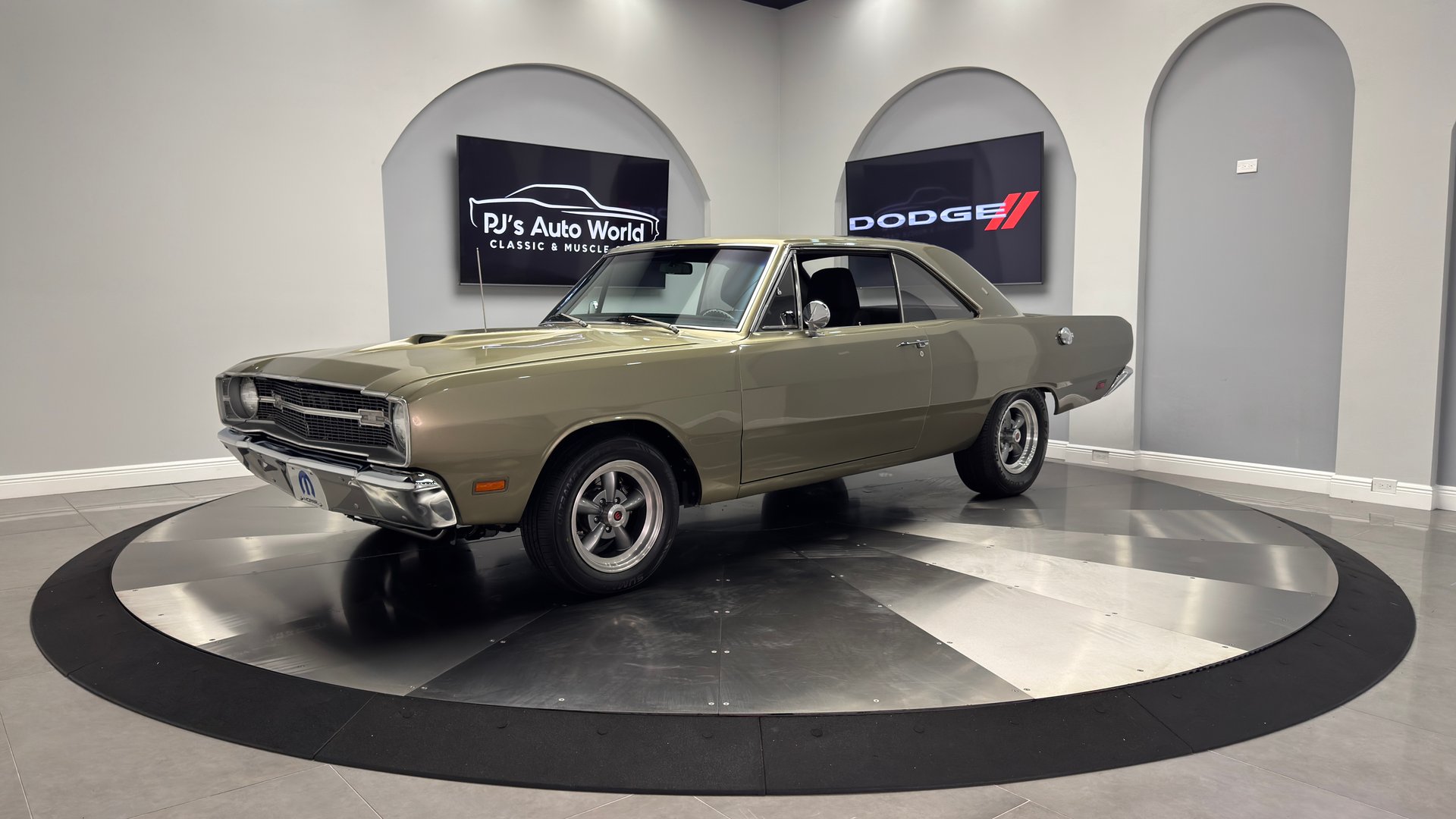

The models
Every compact Dart shares the A-body unit construction; what changes across the range is body style, trim level and, above all, engine. Read the range in three layers: the everyday cars that make up most of the supply, the performance cars that make up most of the desire, and the early-seventies fastbacks that bridge the two. Outputs below are period factory ratings — gross horsepower before 1972 and net ratings from 1972 onward, which is why the same 340 appears to lose power in 1972 without the engine changing nearly as much as the measuring method did. Production figures are given only where they are genuinely recorded; for most trim-and-engine combinations Dodge published no separate count, and any guide that offers you a precise build number for, say, a 1970 Swinger with a 318 is inventing it.
| Model | Years | Engine | Output | Built | Character |
|---|---|---|---|---|---|
| Dart 170 / 270 | 1963–1966 | 170 or 225 Slant Six; 273 V8 from 1964 | 101–180 hp | Not published separately | The first-generation cars; light, simple, honest |
| Dart GT | 1963–1969 | Slant Six, 273, 318; 340 and 383 in later GTS-based cars | 180–330 hp | Not published separately | Bucket-seat trim; a specification, not always a performance car |
| Dart GTS | 1967–1969 | 340 small-block or 383 big-block V8 | 275–330 hp | Not published separately | The flagship muscle Dart; verify the VIN before paying for one |
| Dart Swinger / Swinger 340 | 1969–1976 / 1969–1970 | Slant Six, 318; 340 in Swinger 340 | 145–275 hp | Not published separately | The value hardtop; the 340 version is the sleeper of the range |
| Dart Custom / Dart SE | 1970–1976 | Slant Six, 318, 360 | 95–230 hp | Not published separately | The seventies family Dart; trim-rich, performance-poor, often well kept |
| Dart Demon / Demon 340 | 1971–1972 | Slant Six, 318, 340 | 145–240 hp | Not published separately | Fastback coupe; the 340 is a Duster in Dodge clothing |
| Dart Sport / Sport 360 | 1973–1976 | Slant Six, 318, 340 (1973), 360 | 95–245 hp | Not published separately | The renamed Demon; later cars trade speed for equipment |
| Dart Lite / Feather Duster sibling line | 1976 | 225 Slant Six | 95 hp | Not published separately | Aluminium-panel economy special; a curiosity, bought for novelty |
| LO23 Hurst Hemi Dart | 1968 | 426 Hemi race V8 | About 500 hp | About 80 | Factory drag car, not a street model; museum territory, not a buying target |
The first-generation cars, 1963–66. The 170 was the base trim, the 270 the mid-level car with better upholstery and exterior brightwork, and the GT the bucket-seat flagship, offered as a hardtop and a convertible. These are charming, genuinely compact cars — noticeably smaller than what followed — and their character is economy-car honest: most carry the 170 or 225 Slant Six, and the 273 V8, offered from 1964, transforms them without spoiling the lightness. The 273 Commando version, with a four-barrel carburettor, higher compression and a solid-lifter camshaft in its earliest form, is the connoisseur's early Dart.
The volume cars, 1967–76. The redesigned 1967 car spread the range wide: sedans in base and Custom trim, the hardtop that became the Swinger in 1969, and convertibles through 1969. The Swinger name began as the budget hardtop and became the default two-door Dart of the seventies, which is why Swingers dominate our listings — cars from 1969, 1970, 1971 and 1972 all appear in the pool. Under the hood the pattern is consistent: the 225 Slant Six did the fleet and family work, the 318 V8 was the popular upgrade, and anything above that was a deliberate performance purchase. A 318 Swinger in good order is the Dart most people should actually buy, for reasons the final section sets out.
The performance cars. The GT became progressively more serious, and for 1967 Dodge spun the top of the range into the GTS: standard 340 power in 1968 and 1969 (the 383 was the 1967 GTS standard engine and remained an option), heavy-duty suspension, and the visual restraint that makes a correct GTS easy to understate and easy to fake. The Swinger 340 of 1969 and 1970 put the same 340 into the cheaper hardtop shell and is, pound for pound, the best-driving Dart of all — and the most cloned, because the shell is identical to a Slant Six Swinger's. The Demon of 1971 and 1972 gave Dodge its own version of Plymouth's successful Duster fastback; the Demon 340 matches the Swinger 340 mechanically in a lighter-looking body, and the name was dropped for 1973 — replaced by Dart Sport — after objections to the name and its pitchfork-wielding mascot. The 340 gave way to the 360 in the Dart Sport for 1974, a torquier, lower-revving engine that suits the heavier, better-equipped seventies car.
Reading a Dart's identity. On 1963 to 1965 cars the VIN plate sits on the driver's door hinge pillar; from 1966 it moves to the door pillar area and, from 1968, to a plate visible through the windshield on the driver's side of the dashboard, as on modern cars. The VIN's early characters encode the model line, body style and engine as the car left the factory — that engine character is the single most valuable digit on a Dart, because it is the difference between a born 340 car and a Swinger that received a 340 in 1998. The fender tag, screwed to the inner front fender under the hood, carries the scheduled build data, colours, trim and options.


Engines and gearboxes
The Slant Six: 170, 198 and 225
The Slant Six is the engine the Dart was designed around, and its nickname is literal: the inline six is canted 30 degrees to the right, which allowed a lower hood line and made room for the long, equal-length intake runners that give the engine its torque. There are three displacements in Darts. The 170, standard in the early cars, is the short-stroke original — smooth, willing, and slow. The 225, the engine most Slant Six Darts carry, adds stroke and usable torque and is the one to have. The 198, offered from 1970 to 1974 as a middle step, is the least loved: it shares the 225's block dimensions with a smaller bore, offers no real advantage, and is the engine most often swapped out. All three share the same architecture — iron block and head, a forged or cast crankshaft depending on year, and a valvetrain that used mechanical lifters on early engines and moved to hydraulic lifters in the early eighties, after Dart production ended, so every Dart Slant Six you inspect is a solid-lifter engine that expects periodic valve-lash adjustment.
A healthy Slant Six starts readily, idles with a slight mechanical rustle that is normal for the type, and pulls without the low-speed shudder that signals a lean misfire. Oil pressure is modest by design and the gauge, where fitted, tells you less than your ears do. The engine's reputation for indestructibility is earned — the bottom end is heavily overbuilt for the power it makes — but it rests on two conditions that fifty-year-old cars frequently fail. The first is cooling: the system is marginal in slow traffic on a hot day in a car whose radiator has been recored badly or never, and a Slant Six that has been repeatedly overheated warps its head and blows head gaskets in a way a never-cooked engine simply does not. The second is the exhaust manifold, covered in the problem areas below, whose cracking and flange warping are so common that a silent, gas-tight original manifold on a high-mileage car is a pleasant surprise rather than an expectation.
The small-block V8s: 273, 318, 340 and 360
Chrysler's LA small-block arrived in the Dart as the 273 for 1964 — a light, compact V8 that fitted the A-body where a big-block, at first, did not. In standard two-barrel form it made a Dart brisk; in Commando form, with a four-barrel carburettor, 10.5:1 compression in its first year and dual-point ignition on early cars, it made the little Dart genuinely quick for 1965 and remains a sweet, revvy engine that suits the first-generation car's size. The 273 was replaced as the mainstream V8 by the 318 for 1967 and 1968 in the Dart range. The 318 is the least glamorous engine in this guide and arguably the best purchase: a hydraulic-lifter, two-barrel engine in most Darts, understressed, tolerant of neglect, cheap to rebuild, and strong enough — roughly 230 gross horsepower in its early form — to make a second-generation Dart feel like a V8 car rather than a six with pretensions.
The 340, offered from 1968 to 1973, is the performance engine and the one around which the Dart's muscle reputation is built. It was designed as a high-output small-block from the outset: a forged crankshaft in the early engines, high-flow cylinder heads with 2.02-inch intake valves, a windage tray, a high-lift camshaft, and a Carter four-barrel — Thermoquad on later engines — in place of the 318's modest two-barrel. The factory rating of 275 gross horsepower was widely believed, then and now, to be conservative. In a Swinger or Demon it delivers acceleration that embarrasses bigger cars, with a hard-edged exhaust note no other Dart engine makes. Its costs are the mirror of its virtues: it wants premium fuel in early high-compression form, it wears like an engine that is revved, and because it is the engine every clone is built around, a 340 in a car is worth only what the car's paperwork says it is worth until the casting numbers and dates have been checked against the build. The 340's compression fell for 1972, cast cranks replaced forged, and electronic ignition arrived — a 1972 or 1973 340 is a milder engine than a 1969 one, and prices should reflect the difference rather than the badge.
The 360 replaced the 340 in the Dart Sport for 1974. It is a longer-stroke, lower-compression engine tuned for torque and emissions compliance, and in period it was nobody's favourite — but time has been kind to it. In a heavier seventies Dart its low-speed pull suits the car, parts are plentiful, and a 360 Dart Sport is usually priced as a lesser car than a 340 Demon while delivering most of the real-world performance.
The big-block: 383
From 1967 Dodge offered the 383 B-series big-block in the Dart, principally in the GTS, and it changed the car's character completely. The 383 is a short-stroke big-block that revs more freely than its size suggests, rated at up to 330 gross horsepower in the Dart installation, and it fills the engine bay in a way that makes every subsequent maintenance job slower: spark plugs, exhaust manifolds and starter access are all compromised, and the cars run hotter in traffic than any small-block Dart. Factory big-block Darts used the heavier 727 TorqueFlite or a heavy-duty four-speed, uprated torsion bars and a strengthened rear axle, and those supporting differences — not the engine alone — are what a correct car should show. A small-block car that received a 383 later will usually betray itself in exactly those places: light torsion bars, a light rear axle, and cooling that was never upgraded to match.

Gearboxes
Three transmissions do almost all the work in Darts, and all three are good. The TorqueFlite automatic is the default: the light-duty A904 behind Slant Sixes and most 318s, and the heavy-duty A727 behind big-blocks, 340s in some applications and heavy-duty packages. Both are three-speed automatics of exceptional durability — the TorqueFlite's reputation as one of the best automatics of its era is deserved — and both fail in predictable, diagnosable ways: delayed engagement from cold that improves as the fluid warms points to hardened seals, flaring on the 2–3 change points to wear rather than adjustment, and a box that has been run on burnt fluid will show it in the pan. A TorqueFlite rebuild by a competent shop is a known-quantity job, typically $1,800–3,200 fitted depending on model and region, and a documented rebuild is a genuine selling point rather than a worry. In our listings pool automatics dominate overwhelmingly — 25 of the cars with a stated transmission are listed simply as automatic, with a further handful specifying the 727 by name.
Manual Darts divide into the three-speed, column- or floor-shifted, fitted to economy cars, and the A833 four-speed fitted to performance cars. The three-speed is adequate and unloved; synchromesh on second is its wear point, as on every manual of the period. The A833 is a different matter — a famously strong four-speed, with a cast-iron case in early performance form and Hurst shifters on many factory installations, and it transforms a 340 Dart's character. Judge it on second-gear synchromesh, on whine in third, and on a shifter whose linkage bushings have usually perished long before the gearbox itself wears. A four-speed conversion in a car born automatic is common; it is not a defect if it is disclosed and done with the correct pedals, linkage and transmission tunnel work, and it is a misrepresentation if the car is sold as a factory four-speed.
On automatics, check the kickdown linkage as carefully as the box itself: a disconnected or misadjusted kickdown on a TorqueFlite does not merely spoil the drive, it alters line pressure and will shorten the transmission's life, and it is one of the most common bodges found on cars that have had engine work by several hands.

Problem areas
A Dart does not hide its problems in electronics or in sealed units. Its problems are structural rust in a unit body that carries its loads through its sills, rails and crossmembers, suspension wear that changes how the car steers and stops, and fifty years of owners fixing an economy car to an economy standard. In our own photo-checked sample of these cars — 17 Darts examined in detail from their sellers' photo sets — rust was noted in 4 of the 17 and visible damage of some kind in 9 of the 17. Read those numbers the right way: the sample is small, sellers photograph their cars kindly, and damage in this context ranges from a dented panel to accident evidence. The lesson is not that most Darts are rotten. It is that cosmetic and structural condition, not mechanical failure, is what the photographs of real cars keep raising — and that a Dart inspection should spend its time accordingly.
Rust and structure: the map
The A-body is a unitised shell, and rust anywhere structural is a different category of problem from rust in a bolt-on panel. Work through the car in the order the loads travel.
Front frame rails and the K-member area. The front rails run from the firewall forward and carry the K-member, the bolted crossmember that holds the engine and the front suspension. Rust starts where mud packs behind the front wheels and where the rails meet the firewall, and it is hidden from above by the engine and from the side by the inner fenders. Perforation here is fabrication work, not a patch panel: a front rail repair done properly, with the K-member dropped and the geometry preserved, is typically $1,500–3,500 per side at a restoration shop, and a car needing both sides plus floors has consumed its bargain before paint is discussed. Prod the rails with a screwdriver where you can reach them, and treat fresh, uniform underseal over the front rails of an otherwise scruffy car as a question the seller needs to answer with photographs of the work.
Torsion-bar crossmember and floor pans. The torsion bars that spring the front suspension anchor in a crossmember under the front seats, and that member is both a structural part and a rust trap where it meets the floor. Floor pans rot from the inside out: windshield and cowl leaks wet the front carpets, the water sits under sound-deadening, and the first external sign is often a soft floor discovered by a passenger's heel. Lift every carpet you are allowed to lift. Surface scale is a clean, treat and seal job; perforation at the crossmember mounts is structural, and floor sections fitted and welded run roughly $800–1,800 a side depending on how much surrounding metal goes with them. Rear floors and the area under the rear seat follow the same logic, fed by rear window and trunk leaks rather than by the cowl.
Trunk floor, extensions and rear rails. Open the trunk, lift the mat and the spare, and look at the floor, the drop-off extensions behind the rear wheels, and the rear frame rails where the leaf-spring shackles mount. The trunk seal and the rear window channel leak directly into this area, and the extensions — the vertical panels that close the space between trunk floor and quarter panel — rot early and are tedious to repair well. The shackle mounts matter most: the rear springs hang from the rails, a perforated rail at the shackle is a safety item rather than a cosmetic one, and rail and hanger repair is again fabrication, priced per car, typically starting around $1,200 for a localised professional repair and rising quickly when both sides and the trunk floor are involved.
Rear quarters, wheel lips and rocker panels. The rear wheel openings are the Dart's signature rust site. The lip traps mud against the inner wheelhouse, the lower quarter behind the wheel fills from the trunk extension, and the dogleg ahead of the wheel rots where the rocker, quarter and door jamb meet. Rocker panels themselves are structural on a unit body and rot from inside; bubbles at the bottom of a rocker mean the inside is worse. Quarter-panel work is where Dart restoration economics bite hardest, because the labour is in the metal finishing and paint rather than the panel: a lower quarter repair, welded, finished and painted to match, is commonly $1,500–3,000 a side at shop rates, and a car needing quarters, rockers and floors is a restoration project at any purchase price. Vinyl roofs, fitted to many seventies Darts, add their own trap — rust forms under the vinyl at the roof seams and around the rear window, invisible until the covering lifts or the headliner stains, and a bubbling vinyl roof should be priced as roof metalwork plus a roof covering, not as a trim item.
Cowl, windshield frame, doors and the small traps. The cowl plenum collects leaves, holds water, and rots through into the front footwells — wet front carpets on a car with sound floors usually start here. Windshield frames rust under the seal, and a new seal over a rotten flange leaks exactly as the old one did. Door bottoms fill when their drains block; run a fingertip along every door's lower edge for filler and bubbling, and check hinge pillars for cracks on hard-used two-doors. Battery trays, headlamp surrounds and lower front fenders complete the circuit. None alone ends a purchase; together they describe how the car has lived.
Suspension, steering and brakes
The Dart's front suspension is Chrysler's torsion-bar system: longitudinal torsion bars in place of coil springs, upper and lower control arms, and an anti-roll bar on performance and heavy-duty cars. Ride height is set by adjusting the torsion bars, which means a Dart sitting low at the front may need nothing more than adjustment — or may be telling you a bar has lost its set or its anchor is moving in a rusted crossmember, and only the crossmember check in the section above separates those two stories. The wear items are ball joints, control-arm bushings and the idler and pitman arms in the steering linkage. Worn upper ball joints and perished upper-arm bushings are the common findings; the practical test is to rock each front wheel at the top and bottom with the car jacked under the lower control arm, and then to drive the car and feel for wander, tramlining and a steering wheel that does not self-centre. A full front-end refresh — ball joints, bushings, tie-rod ends and an alignment — is a well-understood job at roughly $1,200–2,500 in parts and labour, and a Dart that has just had it drives like a different car from one that has not.
At the rear, leaf springs sag, and sag shows as a tail-down stance and, on cars that have carried loads or towed, as springs that have gone flat or reversed their camber. Replacement springs are available and fitting them is a half-day job, but seized shackle and eye bolts in rusted hangers can double the labour, which is one more reason the rear rail inspection matters. Rear axles divide by duty: the light 7.25-inch axle behind most Slant Sixes, the 8.25-inch unit on later and heavier-duty cars, and the prized 8.75-inch axle on performance cars. The 7.25 is adequate for a six and marginal behind a V8 conversion — a converted car still running its original small axle is living on borrowed time — while the 8.75, with its removable carrier, is strong, desirable and increasingly expensive to source if a car that should have one has lost it. Axle whine on the overrun, backlash clunk on take-up, and a pinion seal leak are the standard findings; a rear-axle rebuild runs roughly $900–1,800 depending on unit and parts.
Brakes are drums all round on early and economy cars, front discs on later and better-specified cars. Every part is available, so the buying question is condition after standing: seized wheel cylinders, perished hoses and a master cylinder weeping into the booster are the recommissioning list on any Dart that has sat, and a full hydraulic refresh is typically $700–1,500 fitted. A disc conversion on a drum car is no disgrace, but ask what was used — correct A-body disc parts are a selling point, mismatched later parts with the wrong master cylinder are a system you will be re-engineering yourself.
Steering play comes from the recirculating-ball box, the coupling and the linkage together; isolate it before pricing it, because a linkage refresh and a steering-box rebuild are very different bills — a rebuilt box fitted is roughly $600–1,100, while tie-rod ends and an idler arm are a few hundred.
Engines, cooling and electrics in old age
The Slant Six's signature fault is its exhaust manifold. Heat cycles crack the casting, most often around the centre ports, and the mating flange to the intake manifold — the two manifolds bolt together in a "hot box" arrangement that preheats the intake charge — warps and leaks, producing the classic Slant Six tick on a cold start that quietens as the metal expands. A ticking Slant Six is not a dying Slant Six, but the repair is rarely as cheap as owners hope: studs snap in the head, the paired manifolds must come off together, and a replacement manifold set fitted, with the inevitable broken-stud work, is typically $700–1,400. Carburettor wear adds the other half of the six's old-age behaviour — a worn throttle shaft on a Carter BBS or Holley 1920 draws air, spoils the idle and resists every adjustment until the carburettor is rebuilt or replaced, a $300–600 job done properly. Distributor drive gear wear and tired points or, on later cars, early electronic ignition components complete a picture in which a "bad-running Slant Six" is almost never a bad engine — it is a good engine surrounded by worn accessories, which is the cheapest kind of problem a classic can have.
The small-block V8s age differently. The 318's faults are oil leaks from rocker covers and the rear main seal area, a stretched timing chain on high-mileage engines that retards the cam timing and softens performance, and cooling systems that were adequate when new and are marginal after a cheap recore. The 340 adds valve-stem seal hardening — blue smoke on start-up after standing, clearing as the engine warms — and the consequences of hard use: a 340 that has been raced will show it in bearing noise, oil consumption and a harmonic balancer whose outer ring has slipped, making timing marks lie. On any LA V8, check for exhaust manifold cracks and for the heat-riser valve seized in the right-hand manifold, and budget $1,000–2,000 for a timing-chain, water-pump and gasket refresh on an engine with no record of the work, against $4,500–7,500 for a full stock rebuild if compression and oil pressure say the engine itself is tired. Big-block cars add heat: a 383 Dart that runs hot in traffic needs its radiator capacity, fan shroud and clutch, and ignition timing investigated as a system before anyone condemns the engine, and the investigation is cheaper than the parts cannon most sellers have already fired at it.
Electrics fail at known points: the bulkhead connector where the engine harness passes through the firewall corrodes and overheats, producing intermittent faults that come and go with under-hood temperature, and ammeter cars carry full charging current through the dashboard instrument, whose melted connections are a documented Chrysler weakness. Electronic ignition, standard from 1973 and retrofitted to many earlier cars, is reliable except for its ballast resistor, whose failure produces the classic crank-but-no-run symptom — carry a spare in the glovebox and you will one day be glad of it.
Interior, trim and weather sealing
Dart interiors were built to a price and have aged accordingly, but they have one great virtue: almost everything is reproduced or findable. Seat vinyl splits along its seams and at the driver's bolster, foam crumbles, and headliners sag or tear at the bows. A pair of front seat covers fitted over new foam is typically $800–1,500 in parts and labour; a full interior refresh — seats, carpet, headliner and door panels — done professionally runs $3,500–6,500, which is why a seventies Custom or SE with a genuinely good original interior is worth more than its specification suggests.
Weatherstripping is reproduced for most body styles and a full seal kit fitted is a $600–1,200 job in parts and labour — and it is the job that decides whether a Dart can be used in the rain, because a car whose seals are shot will fill its floors and trunk with the water that starts the rust map at the top of this section all over again.


How to inspect one
Allow a full hour, bring a torch, a magnet wrapped in thin cloth, a screwdriver for prodding (with the seller's permission), and a tyre-pressure gauge you trust. Inspect a Dart cold, on the ground first and on a lift if it passes you — on a unit-body car the lift inspection is not a formality, it is where the purchase is decided. Work in this order, and stop early if a step fails: there is no point falling for an interior in a car whose rails have already ended the negotiation.
- Paperwork and identity first. Match the VIN on the title to the plate on the car — the driver's door hinge pillar on 1963 to 1965 cars, the dashboard plate visible through the windshield from 1968 onward. Decode the engine character of the VIN and compare it with the engine in the bay and with the seller's description. A car sold as a GTS, a Swinger 340 or a Demon 340 whose VIN says Slant Six or 318 is a tribute, whatever its badges say, and it must be priced from that moment as a tribute. Read the fender tag if it survives, note the colour and trim codes, and check them against the car: a colour change is normal life, a colour change plus an engine change plus a missing tag is a car whose story you are being asked to take on trust.
- Cold start. Insist the engine is cold. A Slant Six should fire readily and settle to a slightly mechanical idle; listen for the exhaust-manifold tick described in the problem areas, which is loudest now and is a pricing point, not a walk-away. A V8 should start without extended cranking and without a cloud: blue smoke that clears in seconds is valve-stem seals, smoke that continues is rings or guides, and either is a number to put on the car. Watch the oil-pressure light or gauge and listen for timing-chain rattle or bearing knock in the first five seconds, when a tired engine tells the truth.
- Under the hood, systematically. Check the coolant's colour and level, the oil's level and smell, and the transmission fluid's colour on an automatic — pink and clean is health, brown and burnt-smelling is a rebuild being scheduled. On a Slant Six, look down the side of the engine for the manifold crack and for oil weeping from the rocker cover. On a V8, read the casting and stamped numbers if a matching-numbers claim is being made, and look for the supporting evidence of a factory performance car: torsion-bar diameter, rear axle size, radiator size and shroud. A claimed factory 340 or 383 car on small bars, a small axle and a small radiator is a conversion until documents prove otherwise.
- The structure, from underneath. This is the decisive step. Torch along the front frame rails, the K-member mounts, the torsion-bar crossmember and its floor, both rocker panels, the floor pans front and rear, the trunk floor from below, the rear rails and the leaf-spring hanger and shackle mounts. Prod suspect metal. Perforation in rails, crossmember or spring mounts is structural fabrication money, priced in the problem areas above; perforation in floors and trunk is negotiable money; a uniform coat of fresh underseal over an otherwise tired underside is a reason to slow down, not a reassurance. If the seller will not allow a lift or a thorough underside inspection, price the car as if the worst case were true, because that is the information you have been given.
- Trunk and interior floors. Lift the trunk mat and the spare wheel. Look for water staining, perforation in the floor and extensions, and daylight at the wheelhouses. Then lift the interior carpets you can: front footwells first, where cowl and windshield leaks land, then under the rear seat. Wet carpets in a car described as garaged mean active leaks, and active leaks mean the rust map is still being drawn.
- Body and panel check. Run the cloth-wrapped magnet along the rear quarters, wheel lips, rocker bottoms, door bottoms and lower front fenders — filler announces itself where the magnet's pull weakens. Sight down each flank for ripples, check door gaps and door drop on the hinges, and look at the roof if a vinyl covering is fitted: bubbles under vinyl are rust, not trim failure. Count the chrome and trim pieces that need work and price them individually, as the problem areas section advises, rather than carrying a vague allowance.
- Suspension and steering, static. Bounce each front corner and watch it settle in one movement. Rock each front wheel top-to-bottom and side-to-side for ball-joint and bearing play. Turn the steering lock to lock and count the free play at the rim before the road wheels move; a quarter-turn of slack is a system — box, coupling and linkage — to be priced as a system. Check the ride height side to side and front to rear, and remember the torsion-bar rule from the problem areas: a low front end is adjustment until the crossmember proves it is not.
- The test drive. Fifteen minutes minimum, including a stretch at highway speed and a rough surface. A Slant Six Dart should feel willing and unstressed at fifty; a 318 should feel effortless; a 340 should pull hard and cleanly to the top of second gear without hesitation or smoke. An automatic should engage drive and reverse promptly, change without flaring, and kick down when asked — a lazy kickdown is the linkage check from the gearbox section, done at speed. Brake firmly from fifty: the car should stop straight, without pull, judder or a pedal that sinks. On the rough surface, listen for the front-end knocks that worn ball joints and bushings make over sharp bumps.
- Heat and electrics. Let the car idle hot after the drive for five minutes and watch the temperature gauge's behaviour — a Dart that creeps upward at idle has the cooling conversation from the problem areas ahead of it. Work everything electrical: lights, indicators, horn, wipers and washers, heater blower on every speed, every gauge. On an electronic-ignition car, note any reluctance to restart hot.
- Interior and trim, last. Sit in every seat. Feel for collapsed foam and broken springs in the driver's seat first, check the headliner's bows, the dash pad's cracks, and the operation of every window and vent.
A sound original interior on a seventies car, or a correctly restored one on a sixties car, is the hardest part of a Dart to recreate at sensible money — weight it accordingly.
- Price the faults before you offer. List what you found in three columns — structural, mechanical, cosmetic — with the repair costs from the problem areas section against each. A Dart is a good buy when the structural column is empty, the mechanical column is priced, and the cosmetic column is a choice. It is a bad buy at any price when the structural column has entries the seller priced as cosmetic.
Values
The build's market block beneath this guide carries the live numbers — what Darts are listed for now and what recorded sales show — and this section's job is to teach you how to read them, because the Dart market is one where a single average figure misleads more than it informs. No other common classic spreads its value across so wide a range of specifications wearing the same nameplate, and the first discipline is to compare like with like: generation, body style, born engine, and condition, in that order. A price that looks cheap for "a Dart" may be full money for the Dart it actually describes, and a price that looks expensive may be fair for a specification the headline does not mention.
Condition drives the spread more than rarity does. The gap between a project Dart — running, perhaps, but needing floors, quarters and an interior — and a sorted driver in the same specification is routinely wider than the gap between two different specifications in the same condition, because the structural and trim work described in this guide costs what it costs regardless of the car's market value. That is why the bottom of the Dart market is permanently populated: cars whose repair bill exceeds their finished value change hands cheaply and often, and each new owner rediscovers the arithmetic. Read any unusually low figure as a question about the structural column of the inspection list, not as evidence that the market has softened.
Specification premiums are real but specific. A born 340 car — GTS, Swinger 340 or Demon 340, verified by VIN — carries a substantial premium over the same shell with a 318, and a verified 383 GTS carries a further one, because supply is fixed and documented. The premium collapses, correctly, when verification fails: a tribute or conversion car is worth what a well-built modified Dart is worth, judged on its shell, its engine's actual specification and its workmanship, and not a dollar of the born-car premium survives a VIN that contradicts the badge. First-generation GTs, and especially convertibles, carry a scarcity premium within their smaller market — fewer buyers chase them, but fewer good cars exist. Seventies cars invert the logic: a Dart Custom or SE has no performance premium to claim, so its value is almost entirely condition — originality, interior, and freedom from rust — and an immaculate late car can fairly outprice a scruffy earlier one that a specification-led buyer would rank above it.
Asking prices and achieved prices part company on Darts in a predictable place. Sellers of ordinary cars — Slant Six and 318 drivers — tend to ask in line with the market and sell near it. Sellers of claimed performance cars ask for the verified-car premium whether or not the verification has been done, and the gap between ask and achievement on unverified GTS and 340 cars is where the market quietly corrects the paperwork. Use that in negotiation, politely and with evidence: the VIN decode, the casting numbers, and the supporting-hardware checks from the inspection are not insults, they are the market's own method, and a seller with a genuine car will welcome them because they are what his price rests on.
Parts and ownership
The Dart is one of the easiest American classics of its era to keep, for a structural reason: it shared its mechanical life with the Plymouth Valiant and, from 1971, the Plymouth Duster, and between them Chrysler built A-bodies in the millions. Engine, gearbox, brake and suspension parts interchange across that family and across a decade, the aftermarket knows it, and the result is a parts supply that embarrasses most European classics of the same age.
Easy and cheap: Slant Six and LA small-block service and rebuild parts — gaskets, bearings, timing sets, water pumps, carburettor kits — are ordinary motor-factor stock. TorqueFlite rebuild kits and components are universally available. Brake hydraulics, discs, drums and hardware, ball joints, bushings, tie-rod ends, leaf springs and torsion bars are all reproduced or stocked, and a front-end or brake refresh can be ordered complete from a single supplier. Weatherstripping, carpet sets and seat-cover kits for the popular body styles are reproduction staples. If a Dart cannot be driven for want of a mechanical part, the part is almost never the real problem.
Harder and dearer: Year-specific trim is the Dart's genuine scarcity. Grilles, tail panels and brightwork for 1967, 1968 and 1969 each differ, good used pieces command real money, and rechroming, as noted in the problem areas, is priced per piece. First-generation body and convertible parts — top frames, early glass, 1963 to 1966 sheet metal — take hunting and reward joining the marque clubs and forums where A-body knowledge is concentrated. The 8.75-inch rear axle in correct A-body width, factory 340 exhaust manifolds, and big-block Dart-specific pieces such as the correct engine mounts and heavy-duty cooling parts are the performance car's equivalent: available, but at prices set by the clone market's demand as much as by original-car owners.
Running a Dart. A sorted Dart is a realistic regular-use classic. The Slant Six returns economy in the low-to-mid twenties per gallon and asks only for oil, valve-lash checks and ignition maintenance; the 318 trades a few miles per gallon for effortlessness; the 340 wants premium fuel in early form and should be budgeted as a performance car. Servicing is within any competent general mechanic's scope and well within a home mechanic's — there is nothing on the car that requires a marque specialist, though A-body experience speeds up the structural and suspension work. Insurance and registration costs sit in line with other American classics of similar value. The budget line that catches new owners is, as with most cars of this age, the first year: catching up deferred maintenance on a running, honest Dart — fluids, brakes, hoses, belts, ignition, a carburettor rebuild and the small leaks — honestly costs a four-figure sum before any improvement begins, and recommissioning a car that has stood for years, with its fuel system cleaned end to end and every brake component renewed, costs several times that. Buy a car in current use over a car that has slept, even at a higher price: on a Dart, regular use is the best maintenance record there is.
Which one to buy
- The all-rounder: 318 Swinger or Dart hardtop, 1969–1972. The clean pre-bumper-rule body, the understressed V8, TorqueFlite reliability and the deepest supply of cars and parts. If you want one Dart to drive, enjoy and sell on without drama, this is it.
- The value buy: Slant Six Dart, either generation. The cheapest route into a sound shell, and the six is a genuinely characterful engine in a light car. Buy the best body you can find — a six car with a perfect shell is a better purchase than a V8 car with rust, and it can be enjoyed exactly as built.
- The performance buy: Swinger 340 or Demon 340, VIN-verified. The lightest route to the 340's performance, usually priced below the GTS for the same mechanical package. The verification is not optional: an unverified car is priced as a 318 car with a 340 fitted, because that is what it may be.
- The collector car: Dart GTS, 340 or 383, documented. The flagship, with the flagship's obligations — fender tag, build documentation, correct supporting hardware. A correct GTS is a serious muscle car; a wrong one is an expensive Swinger, and the paperwork is the entire difference.
- The connoisseur's car: first-generation Dart GT, 273 Commando if you can find one. Smaller, lighter and rarer than the later cars, with a charm the bigger Darts do not attempt. Supply is thin — two first-generation cars in our current pool of 39 — so buy condition when a good one appears rather than waiting for a perfect specification.
- The seventies buy: Dart Sport 360 or a well-kept Dart Custom / SE. The Sport 360 delivers most of the 340 experience for less money in a better-equipped car, and the plain Custom or SE, bought purely on condition and originality, is the most usable Dart per dollar in the whole range.
And the rule that overrides all of the above: buy the least rusty Dart you can find, with the engine its VIN says it was born with. Engines, gearboxes, brakes and interiors are all fixable at prices you can plan for, and a Dart's mechanical life can be renewed almost indefinitely from the parts supply described above. A rotten unit body costs more to put right than the finished car will be worth, and a performance Dart whose identity lives only in its badges will be priced as a question mark every time it changes hands — including the time you sell it.
See the 30 Dart cars currently listed.