
Dodge Dakota Regular Cab Short Bed buyer's guide
Dodge Dakota Regular Cab Short Bed -- the model's own buyer's guide: variants, values and what to check.
Years listed: 1987-2003 · Series: Dakota
Overview and history
The Dodge Dakota is the truck that invented a size class. When it went on sale for the 1987 model year, American pickups came in two sizes: compact trucks like the Chevrolet S-10, Ford Ranger and Dodge's own Mitsubishi-built Ram 50, and full-size half-tons like the Dodge Ram D150. The Dakota was deliberately drawn in between — a midsize truck, on a 112-inch wheelbase in its shortest form, wide enough for three across a bench seat and for a sheet of plywood between the wheelhouses in the right bed, but short, narrow and light enough to park, fuel and insure like something smaller. That in-between idea is the whole Dakota story, and it is why the truck still makes sense as a classic buy today: it does real truck work without the bulk, thirst and climb-up height of a full-size pickup, and it does it with ordinary Chrysler mechanicals that any competent shop already understands.
Dodge built the first generation from 1987 to 1996, and it is the squarest, simplest and now the most collectible version. Underneath the conventional styling it was conventional in the best sense: a separate steel frame, double-wishbone front suspension on rear-wheel-drive trucks, torsion bars on four-wheel-drive trucks, a live rear axle on leaf springs, and engines borrowed from elsewhere in the Chrysler catalogue. Nothing was exotic, and that was the point. A Dakota was a tool first; farmers, fleets and tradespeople bought them in large numbers, used them hard, and maintained them exactly as much as a tool gets maintained — which is why condition today varies so wildly, and why this guide spends so much of its length on inspection.
Two decisions set the Dakota apart from every compact rival. The first was offering a V8. No S-10 or Ranger left the factory with one, but Dodge — after a tentative start with the limited-run Shelby Dakota of 1989 — put the 5.2-litre V8 on the regular options list for 1991, and a V8 in a truck this size changes its personality completely. The second was size discipline: when the Dakota was redesigned for 1997, Dodge styled it as a scaled-down Ram but kept the midsize footprint. The 1997–2004 truck is rounder, quieter and more car-like inside than the original, gained a proper crew cab, and carried the V8 tradition further with the 5.9-litre R/T, a factory sport truck that still has a devoted following.
A third generation followed for 2005, sold until 2011 — the last years under the Ram nameplate. Those trucks fall outside the pool this guide is drawn from: the Dakotas we currently track run from 1987 to 2003, concentrated in the early 1990s, and the advice here is written for the first two generations, where the classic market actually lives. Understand what a Dakota is not: not a heavy-duty truck (payloads and tow ratings are honest half-ton-or-less figures), not a luxury vehicle even in SLT trim, and not rare, Shelby, convertible and R/T variants excepted. Dodge built these in volume for two decades — excellent news for parts and prices, and it means you never have to settle for a bad one. Another always comes along.
What kills Dakotas is not use but neglect, and above all rust — not the cosmetic kind in the bed arches, but structural rust in the frame, spring hangers, cab mounts and brake lines, the kind that turns a cheap truck into scrap at its next inspection. The mechanicals, by contrast, are among the most forgiving of any classic truck: understressed pushrod V6 and V8 engines (the later 4.7 overhead-cam V8 is the partial exception, with its own section below), TorqueFlite-descended automatics, and wear parts shared with the Ram and Jeep ranges. Buy the structure right and nearly everything else can be fixed on a driveway for money you can predict. Buy it wrong and no mileage or paint will rescue the arithmetic. That is the thread running through everything that follows.

The models
Every Dakota is a pickup on the same basic recipe — frame, cab, separate bed — so the model story is told in three dimensions: generation, cab and bed, and trim and engine. Learn to read all three and a listing decodes itself. A "1999 Dakota SLT Club Cab 4x4" is a second-generation extended-cab truck, top trim, four-wheel drive, almost certainly a V6 or the 5.2 V8. A "2003 Dakota R/T" is a rear-wheel-drive regular or Club Cab with the 5.9 V8 and sport suspension, and nothing else — the R/T was never a crew cab and never four-wheel drive. Sellers use these words loosely, so verify each element against the truck in front of you.
| Model | Years | Engine | Output | Built | Character |
|---|---|---|---|---|---|
| Dakota base / S | 1987–1996 | 2.2 / 2.5 four, 3.9 V6 | 96–125 hp | Not published by variant | The working truck; simple, slow, cheapest to run |
| Dakota LE / SLT (Gen 1) | 1987–1996 | 3.9 V6, 5.2 V8 from 1991 | 125–230 hp | Not published by variant | The dressed-up original; the V8 cars are the find |
| Shelby Dakota | 1989 only | 5.2 V8 | 175 hp | 1,475 | The first V8 Dakota; numbered, collectible, verify everything |
| Dakota Sport convertible | 1989–1991 | 3.9 V6 | 125 hp | Low thousands | ASC-built open truck; novelty value, weatherproofing worries |
| Dakota Club Cab | 1990–2004 | V6 and V8 range | 125–250 hp | Not published by variant | The extended cab; the most usable everyday classic Dakota |
| Dakota base / Sport (Gen 2) | 1997–2004 | 2.5 four, 3.9 V6, 5.2 V8 | 120–230 hp | Not published by variant | The Ram-look truck; Sport is the sweet spot of trim and price |
| Dakota SLT (Gen 2) | 1997–2004 | 3.9 V6, 5.2 / 4.7 V8 | 175–235 hp | Not published by variant | The comfort trim; chrome, cloth or leather, most options |
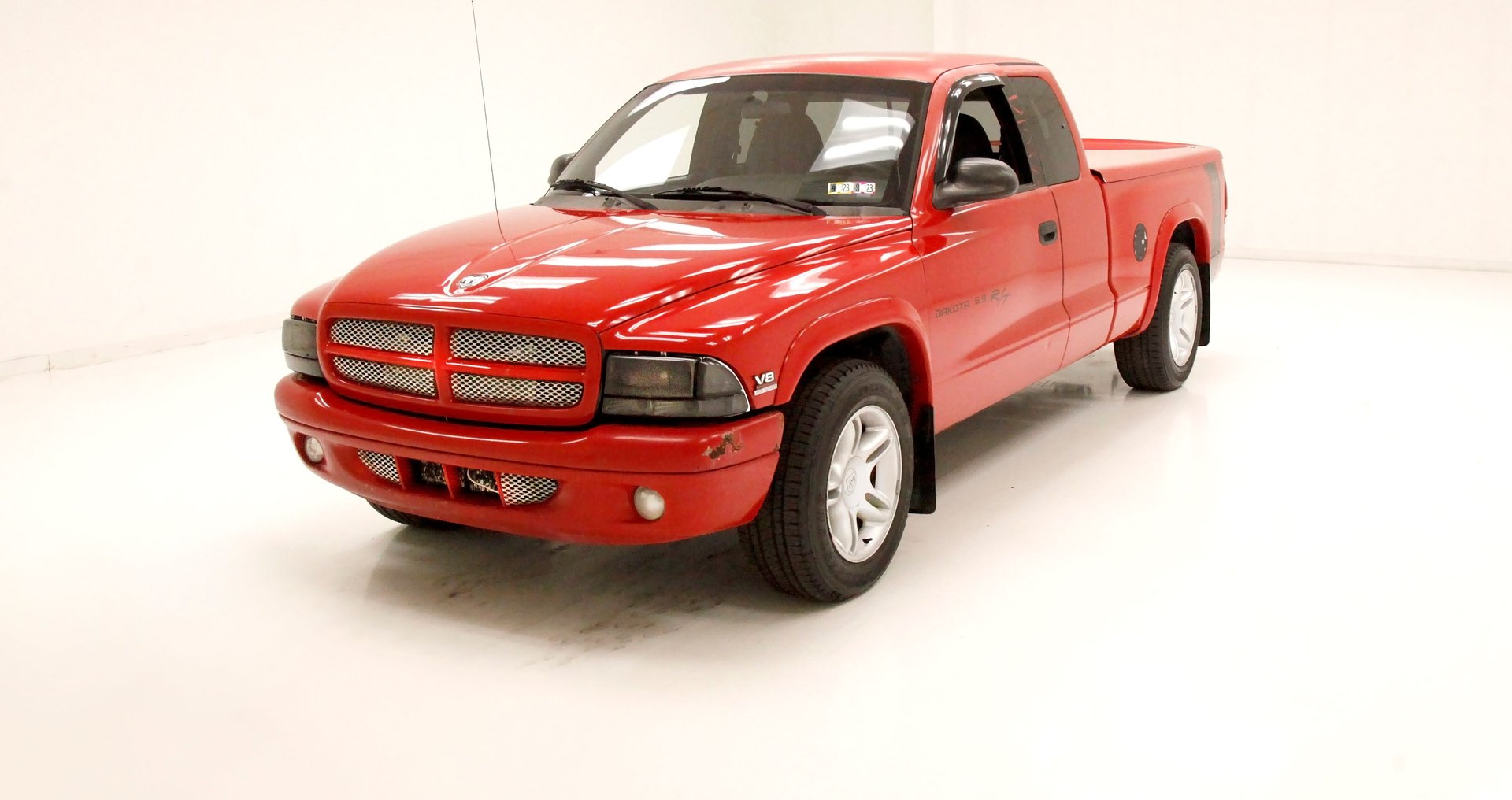
| Dakota R/T | 1998–2003 | 5.9 V8 | 250 hp | Not published by variant | The factory sport truck; rear-drive only, the performance pick |
| Dakota Quad Cab | 2000–2004 | 3.9 V6, 4.7 / 5.9 V8 | 175–250 hp | Not published by variant | The true crew cab; four full doors, 5.3-foot bed, family truck |
(Outputs are period factory ratings, which changed slightly by year; check the underhood label and VIN decoding for the truck in front of you. Dodge did not publish a clean production split by trim for most variants, so the Built column says so rather than inventing one — the Shelby figure is the documented exception.)
The first generation, 1987–1996. The original range was a regular cab only, on short (112-inch) and long (124-inch) wheelbases, with 6.5- and 8-foot beds, in base, mid-level SE and top LE trim — SLT replaced LE as the range-topper in the early 1990s, and Sport was the appearance-and-bucket-seats package. Four-wheel drive was available from the start and is common. The Club Cab arrived for 1990, on a 131-inch wheelbase with the 6.5-foot bed, adding a small rear bench — genuinely useful for children, dogs and locked storage, and the cab most classic buyers should look for in a first-generation truck. The 1992 model year brought the Magnum engines described below and a mild facelift. First-generation trucks feel like what they are: a 1980s working truck, with road manners that reward a relaxed pace.
The specials. Three first-generation variants stand apart. The Shelby Dakota of 1989 was Carroll Shelby's proof that a V8 fitted: Dodge shipped 3.9 V6 trucks to Shelby's operation, which installed the 5.2 V8 with throttle-body injection, an electric fan to clear it, a limited-slip axle and Shelby graphics and wheels. Just 1,475 were built, in red or white, and they are the most collectible Dakotas of all — which means they are also the ones most often faked, and a claimed Shelby needs its documentation and Shelby-specific parts checked line by line. The convertible, built by ASC for Dodge from 1989 to 1991, cut the roof off a Sport regular cab and fitted a manual folding top; it sold in small numbers and survives in smaller numbers still, because the conversion's seals were never a match for real weather. The Li'l Red Express Dakota and related Warrior conversions were dealer-channel step-side conversions in the spirit of the 1978 original — charming, rare, and worth no premium without paperwork, because the bed and graphics that define them are exactly what a later owner can add.
The second generation, 1997–2004. The redesign kept the frame-and-cab recipe and changed nearly everything you touch: a car-like cabin with real sound deadening, and styling copied from the big Ram. The Quad Cab, new for 2000, was the landmark: four full-size, front-hinged doors and a proper rear seat, with the bed shortened to 5.3 feet to keep the overall length manageable — the first crew-cab truck of its size in this market, and the Dakota to buy if people, rather than cargo, are the point. Trim ran base, Sport and SLT, with the R/T alongside from 1998 as a separate performance model: regular or Club Cab, rear-wheel drive only, the 5.9 V8, lowered and stiffened suspension, 17-inch wheels and a limited-slip differential. An R/T is not a trim package; check the VIN and equipment rather than the decals, because decals are cheap and plentiful.

Reading trim honestly. Trim badges on a 20-to-35-year-old working truck tell you how it left the factory, not how it sits today. Seats, wheels, radios and even beds get swapped; a hard-worked SLT can be a worse truck than a cherished base model in every way that matters. Use trim to decide what equipment to expect — air conditioning, cruise control, power windows, the better instrument cluster — then check each item is present and works, and price its absence.
Engines and gearboxes
Dakota engines divide into three families, and a buyer should know which family a truck belongs to before anything else, because they differ in character, in faults and in what they cost to keep. The Chrysler four-cylinders powered the cheap early trucks. The LA-family pushrod engines — the 3.9 V6 and the 5.2 and 5.9 V8s, in original LA form and then in the much-improved Magnum form from 1992 — power the great majority of Dakotas you will ever see, including every R/T. And the 4.7-litre PowerTech overhead-cam V8, which arrived for 2000, is the modern engine in the range — smoother, more efficient, and the one that punishes neglected servicing hardest. Diesels were never part of the US Dakota story, and any truck described as one needs its story checked from the beginning.
The fours and the 3.9 V6
The launch engines were the 2.2-litre Chrysler four, familiar from the K-cars, with about 96 hp, and the 3.9-litre V6 with about 125 hp. The 2.2 was replaced by a 2.5-litre four of about 99 hp for 1989, and a related 2.5 returned in the second-generation base truck with about 120 hp. Honest assessment: the fours are adequate in a regular-cab, rear-drive, short-bed truck used locally, and inadequate almost everywhere else — they work hard, cruise loudly, and make a four-wheel-drive or Club Cab truck genuinely slow. Their vices are head-gasket age and timing-belt history: ask when the belt was last changed, and if nobody knows, price the job into the offer. A four-cylinder Dakota is a buy only when it is cheap, local and charming, or when it is the rare convertible, where the engine matters least.
The 3.9 V6 is the engine most Dakotas actually have, and it deserves respect. It is literally the 5.2 V8 with two cylinders removed — same LA architecture, same bore and stroke, a 90-degree V6 with a split-pin crankshaft to even out its firing intervals — and it shares the V8's tolerance for hard work and indifferent servicing. In early form it used a carburettor, then throttle-body injection, and made about 125 hp. The Magnum revision for 1992 — new heads, sequential multi-point injection, better intake and exhaust — lifted it to about 180 hp with a fat, usable torque curve, and in that form it is the right engine for most buyers: quick enough in any cab, happy on regular fuel, cheaper to feed and insure than a V8. It continued in the second-generation truck at about 175 hp until the 3.7 PowerTech V6 replaced it for 2004, just beyond the years our pool covers. A healthy 3.9 starts promptly, idles with a slight lope that is normal for the design, and pulls without hesitation — and its faults are covered with its V8 brothers below, because the Magnum six and eights share their intake, ignition and accessory-drive faults almost part for part.

The Magnum V8s: 5.2 and 5.9
The V8 story starts with the Shelby conversion's throttle-body-injected 5.2 at 175 hp, continued with a regular-production 5.2 offered from 1991, and came of age with the Magnum 5.2 for 1992: about 230 hp, multi-point injection, and a torque curve that made a midsize truck feel effortlessly strong. The Magnum 5.2 powered first-generation trucks to 1996 and second-generation trucks to 1999, and it remains the enthusiast's default V8 — strong, simple, widely understood, and supported by three decades of Ram and Jeep production sharing its parts. The 5.9 Magnum, about 250 hp and a full 345 lb-ft of torque in R/T tune, arrived with the R/T in 1998 and was also offered in the Quad Cab; it is the same engine architecture with more displacement and more thirst, and in the light rear-drive R/T it makes a genuinely quick truck by the standards of its day.
These engines are tough in the ways that matter and flawed in one specific way every buyer must test. The flaw is the intake manifold. The Magnums use a two-piece "kegger" intake whose bottom is closed by a stamped-steel belly pan sealed with a gasket, and that gasket fails — with age, heat cycles and the different expansion rates of the aluminium manifold and steel pan, the engine begins drawing oil mist from the lifter valley into the intake. Look for the symptom cluster rather than any one item: oil consumption with no leak and no blue smoke, spark plugs fouling — the rear cylinders first — detonation or "pinging" under load that fuel grade does not cure, and lost power owners often blame on the transmission. The confirming test is simple: torch down the throttle body bores at the floor of the intake. A dry, dusty floor is a good engine; a floor wet and pooled with oil is a failed belly-pan gasket, full stop. The repair is a top-of-engine job — manifold off, new gasket and bolts, or an aftermarket plate that solves the material mismatch — a weekend for a home mechanic or a shop bill in the region of $600–1,200. It is not a reason to reject a truck; it is a reason to price one correctly, and a documented repair is worth a premium.
The rest of the Magnum checklist is shorter. The distributor sits at the back of the engine and carries both the ignition rotor and the camshaft position sensor that times the injection; a worn drive gear or tired sensor gives intermittent misfires and hard starting, and access is awkward enough that neglected examples are common. The crankshaft position sensor is the classic Magnum no-start: an engine that cranks healthily, has fuel pressure and no spark, or that cuts out hot and restarts cold, is describing this sensor until proven otherwise. Timing chains stretch and rattle at the front cover on start-up; water pumps weep long before they fail; the short bypass hose between pump and intake is a known burst risk precisely because it is short, stiff and forgotten; and exhaust manifold bolts — the rear ones especially — snap with heat cycles, giving the cold-start tick that fades as the manifold expands and seals. None of this is exotic, all of it is findable on a careful viewing, and most of it is fixable for hundreds, not thousands — the Magnum engines' real selling point.
The 4.7 PowerTech V8
For 2000 the Dakota gained the 4.7-litre PowerTech V8, a single-overhead-cam design first seen in the Jeep Grand Cherokee, rated at about 235 hp. It is a different proposition from the Magnums: quieter, smoother, freer-revving, and paired with a more modern automatic. In a Quad Cab it is arguably the best all-round Dakota powertrain of all — and the engine in this guide that least forgives neglect. Its reputation problem is sludge: the engine runs its oil hot, its PCV system is marginal, and owners who stretched oil-change intervals on short-trip use could fill the top of the engine with deposits that starve the camshafts and timing chains. No roadside test proves an individual engine clean, so judge the evidence — service records with sensible intervals, clean oil on the dipstick, a filler cap underside free of emulsion and black crust, and no valvetrain clatter on a cold start that takes more than a second or two to fade.
Overheating is the 4.7's other hard line. An alloy-head engine run genuinely hot can warp heads and, in the worst cases, drop a valve seat — listen for a dead beat at idle, and treat any 4.7 with an overheating history or an unexplained new radiator as a compression-test-before-purchase car. Timing chains, guides and tensioners are a high-mileage service item, announced by rattling at start-up. None of this should scare a buyer off a well-kept 4.7, but it changes the buying rule: with a Magnum, condition today is most of the story; with a 4.7, the service history is part of the condition, and a truck without one needs its price to admit it.

Gearboxes and four-wheel drive
The manual gearbox is a five-speed in most trucks you will meet — Aisin-based units in early and four-cylinder trucks, and the New Venture NV3500 in most V6 and V8 applications, a strong, slightly agricultural box whose synchromesh wears first on second gear. Judge it cold: baulking into second that improves as the oil warms is wear being announced early; a clutch biting at the very top of travel or juddering away is a clutch job to price in, roughly $700–1,400 fitted. Manual Dakotas are a minority — in the trucks we currently track, automatics outnumber manuals by roughly six to one — and a good manual is worth seeking, especially behind the V6.
The automatics are TorqueFlite descendants. Early trucks used three- and four-speed units of the 904/998 and A500 families. The Magnum-era trucks use the 42RH/RE (behind the V6), 44RE and 46RH/RE (behind the V8s), the H hydraulically governed and the E electronically governed; these are strong boxes whose common faults are electronic rather than terminal — the governor pressure sensor and solenoid on RE units cause hunting between gears, late or stacked shifts and a refusal to downshift that owners routinely misdiagnose as a dying transmission, and the parts to settle it are a few hundred dollars, not a rebuild. Bands want periodic adjustment, and any of these boxes that flares between gears, delays engagement when hot, or shows burnt, brown fluid on the stick is a rebuild conversation in the $2,200–3,800 range at a transmission shop — get the fluid's colour and smell on your fingers at the viewing, because it is the cheapest transmission diagnosis there is. The 4.7 brought the 45RFE, a modern electronically controlled automatic, the smoothest and generally the most durable of the Dakota automatics, and the least tolerant of wrong fluid.
Four-wheel drive is part-time on most Dakotas, using the New Process/New Venture 231 transfer case with a floor lever on early trucks and a dash switch on later ones, with the full-time 242 case a rarer option. Test it as the inspection section describes: it should engage without heroics and bind unmistakably in a tight turn on dry pavement — that binding is correct behaviour, and its absence on a truck claimed to be locked in four-wheel drive is the worry. The wear items are universal: CV boots on later trucks, axle U-joints and disconnect actuators on early ones, and engagement systems that fail from disuse far more often than from overuse. A 4x4 system that has not been engaged in five years is not a preserved system; it is a seized one awaiting discovery, and the discovery belongs in the seller's ownership, not yours.
Problem areas
A Dakota's problems fall into a clear hierarchy, and keeping it straight is what separates a shrewd buy from an expensive education. At the top sits structural rust, the only fault that routinely exceeds the truck's value to repair properly. Below it sit the second-generation front suspension's wear items — a safety matter as well as a cost — then the engine-family faults already described, and a long tail of electrical, brake and trim issues that are individually cheap and collectively diagnostic: a truck with six small faults unfixed is telling you how it has been kept. Our own photo-checking underlines the ordering: the examined sample behind this guide is small — eight trucks photo-checked in detail — and within it rust was noted in six of the eight and visible damage in six of the eight. Treat those numbers as a flavour of the pool rather than a statistic, but the flavour is accurate: these are working trucks, most have lived outdoors, and most carry the marks.
Rust and structure: the map
Work through a Dakota's structure in the order the rust does, from the frame outward.
The frame. The Dakota frame rusts from the inside out where mud and road salt sit in the rails — above all in the rear half, around and behind the rear spring hangers, at the rear crossmembers, around the spare-wheel carrier and at the shock mounts. First-generation frames rust too, at the cab mounts and front crossmember, but it is the second-generation frame that has ended the most trucks: perforation around the spring hangers can be advanced on a truck whose cab and bed still shine, because the frame is the part nobody washes and nobody photographs. Get under the truck — on a lift or at minimum on ramps, with a torch and a screwdriver — and prod every suspect area firmly. Surface scale that rings under a tap is treatable. Metal that flakes in layers or lets a screwdriver through is a failed structure, and frame welding done properly is fabrication work priced per truck, easily $1,500–4,000 for a rear-half repair, if a reputable welder will take it on at all. A perforated frame is a parts truck or a walk-away, whatever its mileage.
Spring hangers, shackles and mounts. The hangers and shackles locating the rear leaf springs rust faster than the springs themselves and are a favourite inspection failure: a hanger torn half away from the rail is a truck one pothole from a collapsed corner. Cab and bed mounts go the same way — perished rubber is cheap, a steel cup rusted through the floor is panel work. Rock the cab by hand and watch the mounts; a bed sitting crooked on one side is often a mount, not a spring.
Cab and bed panels. The cosmetic map is predictable: bed rear wheel arches first, bubbling from the inner lip outward; cab corners and rockers on Club and Quad Cabs; door bottoms; front fenders behind the wheels; and the bed floor, which lives under drop-in liners that trap water against the steel for decades. Always lift or look under a bedliner — the most informative ten seconds on any Dakota viewing — because a bed floor can be lace under a liner that looks brand new. Bubbling arches are a repair-panel and paint job, roughly $800–2,000 a side done to last; treat them as negotiable cosmetics, never as a reason to reject a structurally sound truck, and never let shiny arches distract you from the frame beneath them.
Brake and fuel lines. The steel brake lines run along the frame rail through exactly the zone that rusts, and they rust with it. A line that is heavily scaled, weeping at a union, or already replaced in one section while its neighbours remain original is a full-line replacement conversation — a complete set of lines fitted runs roughly $600–1,200 in labour and parts, and it is safety-critical work, not a deferrable cosmetic. Press the brake pedal hard, engine running, and hold it while a helper watches the lines, or inspect the full run yourself on the lift. Fuel lines and the tank straps deserve the same look; a tank held by one sound strap and one lace one is a small bill today and a large one on the road.

Front suspension, steering and brakes
The second-generation Dakota's front suspension is its best-known weakness, and the item is the ball joint. These trucks use sealed-for-life ball joints — uppers and lowers — that keep their grease in and, once the boot splits or the seal ages, keep moisture in instead, wearing dry and loose without the warning a greasable joint gives. Worn Dakota ball joints were the subject of a federal recall covering certain 2000–2003 four-wheel-drive trucks for upper ball joint separation, and extended warranty coverage beyond it — history worth knowing not because a 20-year-old truck has any coverage left, but because it tells you the wear is real, documented and capable, at the extreme, of letting a front wheel fold. Test as the inspection describes: unload the joint, lever the wheel, and feel for movement; any clunk or visible play in an upper or lower joint is a replace-before-driving item, not a monitor-it item. A full set of quality joints, fitted with an alignment, runs roughly $700–1,500 depending on how many are being changed and how rusted the hardware is. First-generation trucks use a more conventional, partly greasable layout and wear more slowly, but at their age every rubber bush, tie-rod end and idler or pitman arm in the steering is a candidate — judge by play at the wheel and by whether the truck wanders and follows road camber instead of tracking straight.
Steering changed with the generations: early trucks use a recirculating-ball box, later four-wheel-drive trucks a rack and pinion — boxes develop play at centre that adjustment only partly cures, racks leak from end seals and wear inner tie rods. Power steering pumps whine when low or tired; none of it is dear, all of it visible on a lock-to-lock test. Brakes are front discs and rear drums on most trucks, and the standard findings are age findings: lipped rotors, sticking calipers from sitting, rear drum self-adjusters seized so the rear brakes quietly stop contributing, perished hoses. A full hydraulic refresh is $800–1,800 at a shop, and a truck that pulls under braking or shows a long, soft pedal is asking for exactly that. The rear-wheel anti-lock warning light should behave at start-up; a light taped over is a seller telling you something.
Body, cab and electrics
Water finds its way into Dakota cabs through a short list of doors: perished windscreen seals, blocked cowl drains overflowing into the heater box, door membranes disturbed by old speaker and regulator work, Club Cab rear side windows and, on convertibles, every seam of the ASC top. The evidence is a damp carpet, a musty smell, and rust starting in the floor pans under the sound deadening — floor pans rust from this water far more than from anything thrown up underneath, so press the carpets hard in the footwells for the crunch of scale before you judge a cab solid. Convertible floors deserve double suspicion, and a convertible with dry, sound floors is genuinely rare and worth paying for.
The electrics are period Chrysler: fundamentally simple, with a handful of known characters. The blower motor resistor fails and takes speeds with it, leaving full speed only — a cheap part sellers somehow live with for years. Second-generation body wiring can give intermittent wiper, lighting and chime faults that trace to earth points and connectors more often than to modules; instrument clusters lose illumination to solder joints; power window regulators fail with the window down, in the rain, by tradition. None of these is a reason to reject a truck, but all belong on your priced list, because the pattern matters: one electrical fault is a fault, five are a maintenance biography. Air conditioning is conventional and serviceable; a system that needs "just a regas" has a leak, and the leak is the repair — budget $400–1,200 depending on whether the compressor or merely seals and a condenser are at fault — and working air conditioning on a first-generation truck is a genuine selling point, because most no longer have it.
The interior wears like a work truck's: seat foams collapse on the driver's bolster, cloth splits along seams, headliners sag on second-generation trucks, dashboards crack in sun states. Trim for common cabs is still findable used; Quad Cab rear trim and first-generation LE pieces are scarcer. A genuinely good Dakota interior is worth real money precisely because so few survive.

Drivetrain, exhaust and the worked-to-death signs
Beyond the engines and gearboxes, read the truck for the life it has led. Rear axles — the 8.25-inch Chrysler unit in most trucks, the 9.25 in some V8 and R/T applications — are strong and quiet when kept in oil, and whine on the overrun when they have not been; look for the pinion seal leak that explains a low level. Leaf springs flatten and crack leaves, rear shocks are consumables owners treat as permanent, and U-joints chirp and clunk on take-up when dry. A truck sitting low at the back with helper springs fitted has been carrying weight, and its transmission, axle and frame have shared that life — none of it disqualifying, all of it belonging in the price. The rest of the exhaust rots from the muffler forward, and a catalytic converter on a truck with a belly-pan or misfire history may have been cooked by what it was fed — treat its failure as a symptom to explain, not a part to swap blindly.
The honest summary of this section: on a Dakota, almost nothing mechanical is a walk-away fault on its own, because almost everything is available, understood and priced in hundreds. The walk-away faults are structural rust, a 4.7 with an overheating story, an automatic already slipping rather than misbehaving electronically, and any truck whose small faults form the pattern of a decade of neglect. Learn to tell a tired truck from a neglected one — the tired one has wear where work puts it and fresh parts where safety needs them; the neglected one has neither — and you have learned most of what Dakota buying requires.
How to inspect one
Allow an hour, arrange a cold start, and bring a torch, a screwdriver you may prod with (ask first) and a magnet in a cloth. If the truck passes you, a paid lift inspection before money changes hands is the best money in the purchase — on a Dakota the frame examination decides, and a frame cannot be examined from a crouch. Work in this order: the early steps can end the viewing cheaply.

- Paperwork and identity first. Match the VIN on the title to the plate at the base of the windscreen and the door-jamb label, and decode it: the VIN settles the model year, the plant, the engine the truck was built with and the cab type, which is your defence against a re-engined truck sold as a V8 original or a dressed base model sold as an R/T. Check the Shelby or R/T claims against documentation, not decals. A thick history file — oil changes, a transmission service, a timing belt on a four-cylinder, a belly-pan repair on a Magnum — is worth real money; ask for it before you look at the truck, and watch how the answer comes.
- Cold start. Insist the engine is stone cold; a warmed-up truck has had its worst behaviour edited out. A Magnum should fire promptly and settle. A 4.7 should be quiet within seconds — prolonged top-end clatter is the sludge and tensioner question being asked out loud. Watch the exhaust: blue smoke that clears is valve seals, blue smoke that stays is deeper; white, sweet vapour that does not clear is coolant, and on a 4.7 that is a stop-and-think moment.
- Under the hood, in order. Oil first: level, colour, and the underside of the filler cap — emulsion and black crust argue neglect, above all on a 4.7. Coolant next: coolant-coloured, not rust-brown. On a Magnum V6 or V8, do the belly-pan test now — torch down the throttle bores, dry floor good, pooled oil a priced repair. Then belts, hoses (squeeze them; crunchy is finished), the Magnum bypass hose, and every fluid reservoir.
- The frame, before anything else underneath. Torch and screwdriver along both rails, dwelling on the rear spring hangers, crossmembers, shock mounts, cab and bed mounts and the front crossmember. Prod hard. This step ends most Dakota viewings, and it should: perforation at hangers or rails is structural, and the price must become a parts-truck price or the viewing is over. While you are under there, read the brake and fuel lines and tank straps, and look for fresh underseal blown uniformly over everything — fresh black coating over scale the week before a sale is a question, not an answer.
- Bed, arches and cab panels. Lift the bedliner or look beneath it; check the bed floor seams. Run the magnet over the rear arches, cab corners, rockers and door bottoms. Open and shut every door — on a Quad Cab, all four — and watch the gaps; a door that drops on its hinges has lived a life, and a crooked bed points back to the mounts in step 4.
- Ball joints and front suspension. On a second-generation truck this is the safety step. Have the suspension unloaded properly, lever each front wheel, and feel for clunk and movement at the ball joints, tie-rod ends and wheel bearings. Any real play in a ball joint prices a full set and an alignment into the offer. On a first-generation truck, add steering box play at centre and the state of every bush you can see.
- Cab and water. Press the carpets hard in all footwells; lift what lifts. Damp, crunch or a musty smell sends you to the windscreen seal, cowl and door membranes, and on a Club Cab to the rear side windows. On a convertible, work the top through its full cycle and assume every seal leaks until a dry floor proves otherwise. Then sit in every seat: the driver's bolster and base foam price the interior.
- The test drive, transmission included. Fifteen minutes minimum, from cold, mixing town and a highway stretch. A Magnum should pull cleanly without pinging under load — ping plus oil use is the belly-pan cluster confirming itself. An automatic should engage promptly, shift without flare, and hold overdrive without hunting; hunting on an RE box suggests the governor pressure pair before a rebuild, but burnt fluid on the stick afterwards — check it hot, idling in park — overrides the optimism. A manual is judged on second-gear synchromesh cold and clutch bite point. Brake firmly from speed twice: straight, no judder, no pull.
- Four-wheel drive, properly engaged. Engage 4WD high and low. Engagement should be prompt, low range should pull without complaint, and in a tight turn on dry ground a part-time system should bind and hop — that protest is the system proving it is locked, and its absence means it was never engaged. A system that will not engage is priced as a repair, not forgiven as disuse.
- Heat, electrics and air conditioning. Let the truck idle hot while you work everything: temperature steady, heater hot on every fan speed (full speed only means the resistor has gone), air conditioning cold if fitted — warm air is a leak with a bill attached, not a regas. Windows, wipers, lights, horn, every gauge behaving, no warning light taped or lit. Count the faults; the count itself is evidence.
- Stance and the walk-around. Stand back: level front to rear, even side to side, arches at matching heights. Look down each flank for ripples and mismatched paint, and check tyre wear — feathered fronts confirm the step 6 findings, and four mismatched budget tyres on a claimed cherished truck tell their own story.
- The underside, second pass, and the decision. Finish with exhaust, axle pinion and gearbox seals, U-joints, spring leaves and shocks. Then decide by the hierarchy: structure first, safety second, engine-family history third, everything else as a priced list. A Dakota that passes steps 4 and 6 with a dry intake floor or a clean 4.7 history is a truck to buy with confidence; a shiny one that fails step 4 is a truck to leave with thanks.

Values
The build beneath this guide carries the live market — what Dakotas are listed at now and what recorded sales have achieved — and that block, refreshed with the listings, is where the numbers live. What belongs here is how to read that market, because the Dakota market is wider and more condition-driven than most, and the naive reading of it misleads in both directions.
The first driver is that a Dakota is two markets wearing one name. At the bottom is the working-truck market: high-mileage, cosmetically tired, mechanically honest trucks bought to work, where a V6 Club Cab with good structure is worth more than a prettier truck with a suspect frame, and where prices move with the seasons — four-wheel-drive trucks firm up in autumn. At the top is the emerging classic market: Shelbys, convertibles, clean R/Ts, low-mileage SLTs and genuinely original first-generation trucks, bought as hobby vehicles, where originality, documentation and colour move the price. A truck can migrate between the markets — a tidy Sport is a classic buy; the same truck with a perforated frame is a working buy at best — and most pricing arguments are really arguments about which market the truck belongs to. Settle that question with the inspection, not the advertisement.
Within either market, the condition spread is enormous, and it is driven by structure more than by shine. The gap between a project Dakota and a sorted one is, in practice, the price of the frame work, the ball joints, the brake lines and the deferred servicing described in this guide — which means the apparently expensive truck with those jobs documented is very often the cheaper purchase over two years, and the apparently cheap truck is merely the one whose bills are still addressed to its next owner. Asking prices in the working market habitually sit above achieved prices; auction results and recorded sales are the corrective, and the computed block below shows both so you can see the gap for yourself.
Variant premiums are real but narrow, and they attach to verifiable things. A genuine Shelby carries the strongest premium in the range and loses most of it without documentation. The R/T premium is genuine for correct trucks — right engine, suspension and axle — and evaporates for a Sport with decals. Convertibles carry a novelty premium their condition usually argues with. Four-wheel drive, a V8 in an ordinary truck, the Quad Cab's usefulness and working air conditioning each add something real but modest; a manual gearbox adds nothing in price and everything in enjoyment, which makes a good manual truck the quiet value in the range.
Negotiation reality, finally: Dakota sellers are mostly private owners and small dealers, trucks are mostly priced with room, and this guide's inspection findings are the legitimate currency of the conversation — a failed belly pan, a set of ball joints, a scaled brake line are each a priced job with a name, and naming them with their costs moves a price more honestly than any general claim that the truck is old. Bring the list, be specific, and be ready to pay in full without theatre when a truck passes everything — in a market this condition-driven, the good ones are the scarce ones.
Parts and ownership
The Dakota's parts position is one of the strongest arguments for buying one. Dodge built these trucks in volume for a quarter of a century, the engines and gearboxes were shared across the Ram, Jeep and Durango ranges in the millions, and the American aftermarket treats the Chrysler truck ecosystem as home ground. Very little on a Dakota is unobtainable.
Easy: service items of every kind, filters, belts and hoses, brake discs, drums, pads and calipers, ball joints and the full catalogue of suspension wear parts, U-joints, shocks, water pumps, radiators, alternators, exhaust systems in standard form, glass, weatherstrips for the common cabs, and the sensors — crank, cam, governor pressure — that the engine sections keep mentioning. Order today, fit this weekend, at prices close to modern-truck money. The Magnum aftermarket is particularly deep, and its performance side keeps standard parts cheap and plentiful.
Harder and dearer: structural work is labour rather than parts — repair sections exist for arches and cab corners, but a frame is welded, not ordered. Convertible top components and anything unique to the ASC conversion are the scarcest Dakota parts of all; Shelby-specific trim and graphics are hunted rather than stocked; Quad Cab rear trim, first-generation LE interior pieces, good dashboards and rust-free beds in salt states all take searching and freight. The search time is a real cost, and a truck complete in its rare parts is worth more than the same truck with them missing — completeness is a feature, check it like one.
Running costs. Fuel is the honest headline: a V6 driven gently returns figures in the high teens, a Magnum V8 sits in the low-to-mid teens, an R/T driven as intended does worse, and a four-cylinder earns its keep exactly here. The Dakota's economy case rests on purchase price, parts prices and absent depreciation, not on the fuel bill. Servicing is ordinary — oil and filters at sensible intervals (shorten them on a 4.7, and use the specified fluids, above all in the 45RFE automatic), coolant kept fresh, transmission fluid and filter changed rather than topped, and a second-generation truck's front suspension inspected annually whether or not it knocks.
The ownership rhythm that suits a Dakota is use. These trucks deteriorate by sitting — seals dry, brakes seize, fuel goes stale, 4WD actuators seize where they were left — far faster than they wear out by working, and recommissioning a truck that has slept for years, realistically $1,500–4,000 at a shop, routinely exceeds the premium a stored low-miler asks over a used one. Buy the truck that has been driven and serviced, run it often, wash the underside in winter as a ritual, and a Dakota will repay you with what it was designed for in 1987: honest, right-sized, unpretentious work, at a cost per year few classics can match.

Which one to buy
- The all-rounder: 3.9 Magnum Club Cab, either generation. Enough power for any sane use, the useful cab, the 6.5-foot bed, and the deepest pool to buy from. If you want one Dakota to do everything, this is it.
- The value buy: a manual-gearbox V6 Sport. Ignored by the V8 market, priced as a working truck, and the most enjoyable Dakota per dollar there is — provided the second-gear synchromesh is quiet when cold.
- The family truck: Quad Cab with the 4.7. Four real doors and the modern powertrain — bought strictly on service history and cooling-system honesty, as the engine section insists.
- The performance pick: R/T. The 5.9, the suspension and the axle, verified by VIN and hardware rather than decals. Rear-drive, thirsty and enormous fun; the Dakota most likely to be a classic in the full sense.
- The collector car: Shelby Dakota. The first V8 Dakota, and the only numbered one. Documentation is the car; a Shelby without paperwork is a conversion with a story.
- The conversation piece: the convertible. Buy it for summer, buy it only with dry, sound floors, and never as your only truck.
- The first-generation purist buy: a 1992–1996 V8 regular or Club Cab. Magnum power in the square body, the simplest specification that still has the good engine — the sweet spot of the original design.
And the rule that overrides all of the above: buy the frame, then the history, then everything else. Engines, ball joints, belly pans and brake lines are all fixable at prices this guide has named. A perforated frame or a cooked 4.7 is the purchase price spent twice — and the right truck is never the one you have to talk yourself into.
See the 30 Dakota Regular Cab Short Bed cars currently listed.