Dodge D-150 Long Bed buyer's guide
Dodge D-150 Long Bed -- the model's own buyer's guide: variants, values and what to check.
Years listed: 1969-1991 · Series: D-Series
Overview and history
The Dodge D150 is the half-ton, two-wheel-drive pickup that carried Dodge through its leanest years — a simple, square, ladder-frame truck that began as a paperwork answer to an emissions rule, produced the most famous performance pickup of the 1970s almost by accident, and then settled down to become the Ram D150, sold with remarkably little change underneath all the way to 1993. If you are standing in front of one today, you are not looking at a delicate classic. You are looking at a machine that was bought to work, priced below a Ford or a Chevrolet when new, and usually run for years on the maintenance its owner could afford at the time. The ones that survive well are the ones somebody kept garaged, kept serviced, or both.
Start with the name, because the name is the first identity check. Dodge had sold its half-ton two-wheel-drive truck as the D100 since 1961: D for two-wheel drive, W for four-wheel drive, and the number for the rating. In the middle of the 1977 model year Dodge redesignated the D100 and W100 models rated above 6,000 pounds gross vehicle weight as the D150 and W150. The truck itself barely changed — same 1972 cab, same engines, same chassis — but the heavier rating moved it into a lighter emissions category, and that single fact shaped everything the D150 became famous for. For 1978 and 1979 Dodge used that loophole to build the Li'l Red Express, a short-bed D150 with a high-performance 360 V8 and, in 1978, no catalytic converter at a time when passenger cars were thoroughly strangled. For 1980 the lighter D100 line was folded into the D150 altogether, and the D150 became the entry-level full-size Dodge for good.
The truck under the badge dates from 1972. That year's third-generation D-Series brought the cab every D150 still wears: a roomier, quieter cab than the trucks before it, independent front suspension with coil springs on two-wheel-drive models in place of the old solid axle, front disc brakes spreading through the range, and the Club Cab — an extended cab offered years before extended cabs became the default American pickup. Read any D150, however late, as a 1972 truck that was facelifted rather than replaced: the cab structure, the rust traps, the suspension and most of the running gear carry straight through to 1993.
For 1981 Dodge renamed the range Ram: the D150 became the Ram D150, the W150 became the Power Ram, and a new grille gave the old cab a fresh face. It was a facelift, not a new truck, and Dodge facelifted it twice more — for 1986, and for 1991 with a large crosshair grille that made the twenty-year-old cab look almost modern. Underneath, the changes that mattered were to the engines — throttle-body injection from 1988, a V6 replacing the slant six, and, in 1992 and 1993, the Magnum V8s. Production ended in the autumn of 1993, when the redesigned 1994 Ram 1500 replaced it and the D badge disappeared.
Across all sixteen years the buying logic never changes. These were the cheapest of the Big Three half-tons for much of their life, they sold in smaller numbers than the Ford F-150 or the Chevrolet C10, and they were worked accordingly. The mechanicals — slant six, LA small-block V8s, TorqueFlite automatic — are among the toughest and simplest ever put in a pickup. The difference between a good D150 and a money pit is almost entirely the cab and frame, and after that, whether the engine and trim in front of you are the ones the paperwork claims.
The models
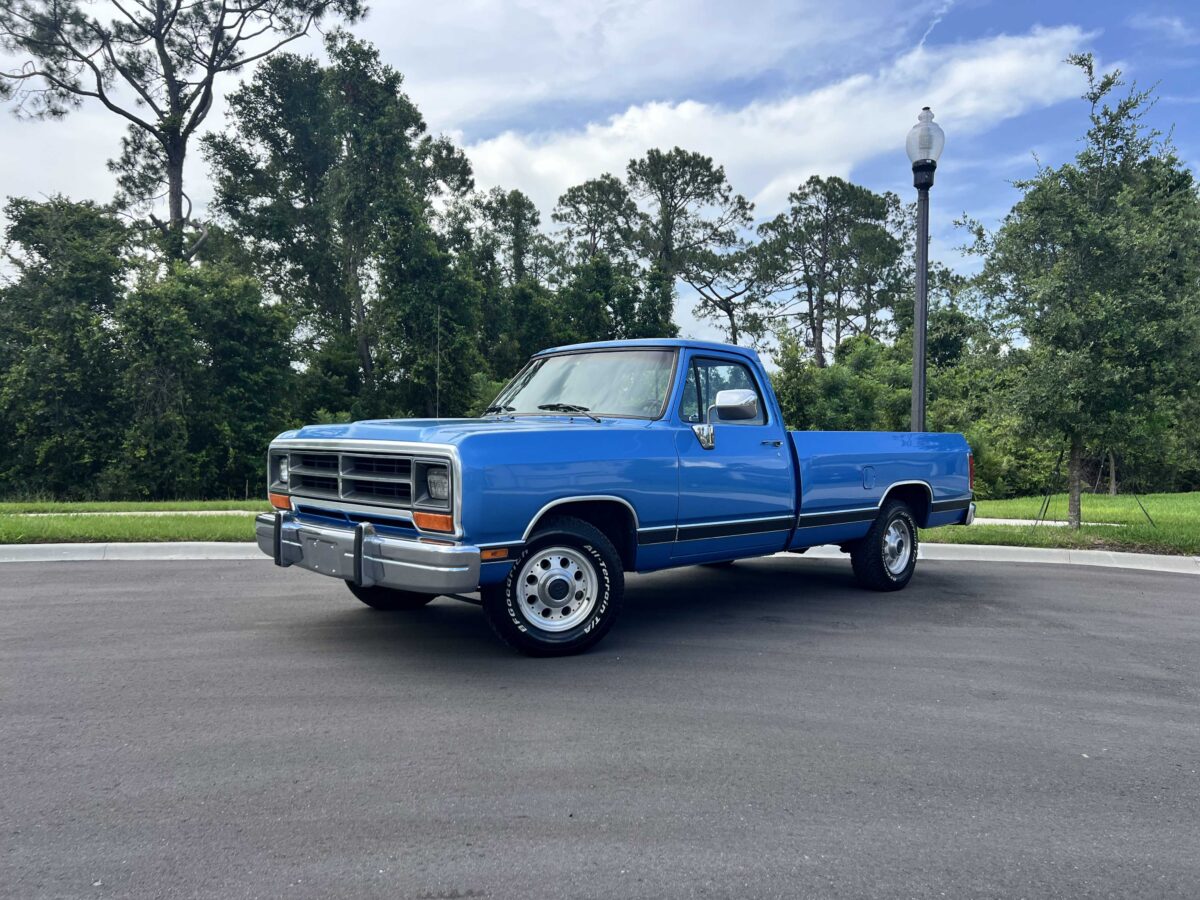
Read a D150 badge as a rating first and a model second. Every D150 is a half-ton, two-wheel-drive, full-size Dodge pickup; what varies is the cab, the bed, the trim and the engine, and those four choices — not the badge — decide what a truck is worth and what it is like to own. Its four-wheel-drive twin is the W150 Power Ram, covered in the D-Series guide.
| Model | Years | Engine | Output | Built | Character |
|---|---|---|---|---|---|
| D150 regular cab, Sweptline bed | 1977–1980 | 225 six / 318 / 360 / 400 / 440 V8 | 95–225 hp net by year | — | The pre-Ram original; big blocks still on the list to 1978 |
| D150 Utiline stepside | 1977–1980 | 225 six / 318 / 360 V8 | 95–200 hp net by year | — | Separate rear fenders and a step; the style bed, and the Li'l Red base |
| D150 Club Cab | 1977–1980 | 225 six / 318 / 360 V8 | 95–200 hp net by year | — | Extended cab on the longer frame; room behind the seats, jump seats on many |
| Li'l Red Express | 1978–1979 | 360 V8, high-output E58 tune | 225 hp net | 2,188 in 1978; 5,118 in 1979 | The factory hot rod: stacks, wood bed trim, Adventurer trim |
| Warlock | 1977–1979 | 225 six / 318 / 360 / 440 V8 | 95–225 hp net by year | — | The dress-up stepside: pinstripes, gold wheels, oak bed racks |
| Ram D150 regular cab | 1981–1993 | 225 six, then 3.9 V6 / 318 / 360 V8 | 95–230 hp net by year | — | The core Ram-era half-ton and the default buy |
| Ram D150 Club Cab | 1981–1993 | 3.9 V6 / 318 / 360 V8 | 110–230 hp net by year | — | The extended cab carried into the Ram era; the family-and-work compromise |
| Ram D150 Miser, 100 and 150S | 1982–1989 | 225 six / 3.9 V6 | 95–125 hp net by year | — | The economy special: light trim, tall gearing, honest poverty specification |
| Ram D150 with Magnum V8 | 1992–1993 | 5.2 Magnum V8; 5.9 Magnum in 1993 | 230 hp (5.2) | — | The last and quickest cooking D150s; multi-point injection |
(Outputs are period net ratings, which is why the same 318 reads so differently across the years: compression and emissions equipment changed under it. Production totals for ordinary D150 variants were not published separately from the wider D-Series and Ram lines, so none are claimed here — the Li'l Red Express is the exception, because Dodge counted it.)

Cabs and beds. The regular cab is the default: a bench seat, or buckets on the plusher trims, and either the short or the long Sweptline bed — Sweptline meaning the flush-sided bed whose walls run straight back from the cab, the normal modern pickup bed. The Utiline is the stepside: separate rear fenders, a step ahead of each fender, and a narrower bed floor with wood planks and steel strips. Utiline trucks are the style pick and the Li'l Red and Warlock base, and they carry less and date faster if the bed wood rots. The Club Cab adds length behind the doors on a longer frame, with a small rear bench or folding jump seats; it is the most usable D150 as a family classic and the hardest cab to find unrotted in the rear corners. A four-door crew cab existed in the wider range, mostly on heavier ratings and fleet orders; a crew-cab half-ton wearing a D150 badge deserves a paperwork check before it deserves a premium.
Trims. Trim describes upholstery, chrome and carpet, not strength. In the pre-Ram years the ladder ran from the base Custom up through Adventurer to Adventurer SE; every Li'l Red Express was built on Adventurer trim. In the Ram era the names changed to a base truck, the mid-range Royal, and the top Royal SE, joined later by the LE, with the Prospector packages bundling popular equipment on top. A base D150 with a 360 will out-work a fully trimmed D150 with a slant six every day of the week. Buy the engine and the cab first and the trim second — with one exception: on a Li'l Red or a Warlock, the trim and graphics are the value, and they have to be original and provable.
The specials. The Li'l Red Express of 1978 and 1979 is the famous one, and the only D150 built as a performance vehicle from the factory: a short-wheelbase Utiline in red — every one was red — with vertical stacks behind the cab, wood bed trim, gold door lettering, Adventurer trim and a 360 V8 in the E58 high-output tune. The 1978 truck is the legend, because its rating put it outside the catalytic-converter requirement that applied to lighter trucks, and contemporary tests made it one of the quickest American vehicles of its year; the 1979 truck gained a catalyst and sold more than twice as many. Because the premium rides entirely on originality, verify one ruthlessly: the VIN's engine digit should be the special code, the stacks, bed wood and decals should all be present and period, and a standard red stepside with a sticker kit is an ordinary D150 with a costume, worth ordinary money. The Warlock, sold from 1977 to 1979, was its dress-up stablemate: a short Utiline with pinstriping, gold wheels, bucket seats and oak bed racks, with a choice of engines up to the 440 while it lasted. A Warlock is worth a modest premium over the truck underneath it; a Li'l Red is worth a multiple. Never let a seller blur the two.
The economy trucks. At the other end of the range, the D150 Miser of 1982 was Dodge's fuel-crisis answer: a stripped truck with economy gearing, sold on price and consumption. It was replaced for 1984 by the Ram 100, and the same idea returned as the 150S at the end of the decade. These trucks are simple and often honestly preserved, but they are slow, sparsely equipped, and worth less than an equivalent V8 truck, not more, whatever a seller says about rarity. Rarity without demand is just scarcity.

Engines and gearboxes
The slant six and the 3.9 V6: 225, then 239 cubic inches
The 225 slant six is the base engine for the first decade of the D150, and it earns its reputation honestly. It displaces 225 cubic inches, about 3.7 litres, and leans 30 degrees to one side — done to lower the hood line and make room for a long intake manifold. In the D150 years it is a hydraulic-lifter engine rated at about 95 hp net, which in a full-size pickup means exactly what you expect: it will run forever, pull steadily, and lose an argument with a long grade and a loaded bed. What kills slant sixes is almost never the bottom end. It is a cracked exhaust manifold — cracks are common, audible as a ticking that quietens as the engine warms — a worn single-barrel carburettor, a distributor drive gear wearing until the timing wanders, and oil leaks from the rocker cover. A slant six that starts cleanly, idles without hunting and pulls without blue smoke is a sorted engine. Buy it for what it is: the simplest, cheapest classic truck ownership in this guide, and the wrong engine entirely if you intend to tow.
The 3.9-litre V6 replaced the slant six in the late 1980s and is, mechanically, a 318 V8 with two cylinders removed — same LA architecture, same strengths, most of the same parts. It arrived with throttle-body injection and made roughly a quarter more power than the six it replaced. Judge it exactly as you judge the 318 below: timing chain stretch, valve stem seal smoke on start-up, and injection health. Its roughness at idle, which owners chase for years, is on many of these engines simply how it runs. Smooth it is not; reliable it is.
The LA small blocks: 318 and 360, carburettor to Magnum
The LA small blocks are the default D150 engines, and rightly so. The 318, at 5.2 litres, powered more D150s than everything else combined. The 360, at 5.9 litres, is the same family with a bigger bore and a longer stroke: stronger everywhere, noticeably thirstier, externally balanced where the 318 is internally balanced — which is why flywheels, flexplates and harmonic balancers do not swap carelessly between the two — and the better engine for towing, for a camper, and for anyone who simply wants the truck to feel unstressed. All LA engines share one character: iron block and heads, hydraulic lifters, a single timing chain that stretches with mileage, and a tolerance for neglect that no modern engine matches. A stretched chain retards the cam timing and makes the engine feel soft and thirsty long before anything breaks — the slop is there to feel by rocking the crank pulley against the distributor rotor — and a double-roller chain set is a modest parts bill that transforms a tired engine. Valve stem seals harden with age and give a puff of blue smoke on start-up after sitting, which is a weekend job, not a rebuild. Smoke that continues under load is rings and bores, and that is an engine-out conversation.
Fuel delivery is the dividing line inside the LA years, and you should price a truck by which side of it the engine sits on. The carburettor trucks use two-barrels on most 318s and a mix of two- and four-barrels on 360s, including the Carter Thermoquad spread-bore four-barrel on many 360s: a clever carburettor with a plastic main body that can warp with heat and age. A Thermoquad rebuilt by someone who knows the type works very well; a warped body leaks fuel externally, which is a fire risk and a replacement, not an adjustment. From 1988 the 318 gained throttle-body injection, the 360 followed for 1989, and the 3.9 V6 was injected from the start. Throttle-body injection is a better daily proposition — reliable cold starting, no choke, no float bowl to flood — provided its injectors, idle-speed motor and wiring are healthy. A converted-back-to-carburettor late truck is a question, not an upgrade: ask why, and look at the workmanship of the answer.
Two period systems cause more misdiagnosis on LA trucks than the engines themselves ever will. The first is Chrysler's electronic Lean Burn system, fitted from the late 1970s into the 1980s under names including Electronic Spark Control: a computer on the air cleaner managed spark advance from a bundle of sensors, and when it fails — and forty years on, most have, repeatedly — the truck hesitates, surges, stalls and refuses to tune. Generations of owners have cured it by converting to conventional electronic ignition with a vacuum-advance distributor, and a truck so converted, neatly, is worth more to a driver than one with a failing Lean Burn box still fitted. Ask which ignition the truck has before you price a running fault. The second is Chrysler's standard electronic ignition itself, whose ballast-resistor failure the problem-areas section covers in full — because it looks exactly like a dead engine and costs almost nothing to fix.
The Magnum engines of 1992 and 1993 are the LA family rebuilt for the electronic age, and they close the D150 story. The 5.2 Magnum arrived for 1992 and the 5.9 Magnum for 1993: multi-point fuel injection, better-flowing heads, higher compression and a roller camshaft lifted the 5.2 to about 230 hp, which makes a Magnum D150 a genuinely quick truck by the standards of everything else in this guide, with modern starting and manners to match. They have one signature fault, diagnosable in minutes. The intake manifold seals its underside with a separate plenum plate — the belly pan gasket — and when that gasket fails the engine draws oil and vacuum from the lifter valley. The symptoms are oil consumption with no external leak, spark knock under load that no fuel grade cures, and oil visible looking down the throttle body. Budget a gasket set and a day's labour, or a few hundred dollars in parts and a shop bill in the region of $600 to $1,100 fitted, and treat a Magnum that just uses oil as this gasket until proven otherwise.
The big blocks and the diesel footnote: 400, 440 and a Mitsubishi
For its first two model years the D150 kept an option no later half-ton Dodge would offer again: a big-block V8. The 400 B-block and the 440 RB were on the half-ton list through 1978, and a 440 in a short-bed D150 makes one of the fastest-accelerating stock pickups of its decade — and one of the thirstiest. Judge one on oil pressure, on exhaust manifold studs, which snap and are miserable to extract in the truck, and on cooling: a marginal radiator shows up as a temperature gauge that climbs on grades and never quite comes back. Parts support is excellent. But verify the claim before you pay for it: big-block D150s are rare, swaps are common and easy, and the difference between a factory 440 truck and a conversion is paperwork and stampings, not the seller's memory.
The footnote is the diesel. For 1978 Dodge offered a naturally aspirated Mitsubishi diesel in its half-ton pickups — about 105 hp and very few takers. It is genuinely rare, genuinely slow, and a curiosity rather than a recommendation. The Cummins diesel that made diesel Dodge trucks famous never came to the D150 at all; it was a 250- and 350-series option from 1989. Any D150 presented as a factory Cummins truck is a swap, and should be priced and inspected as one.
Gearboxes
The automatic most D150s carry is Chrysler's TorqueFlite, and in three-speed form — the A727 — it is one of the strongest automatics ever put in a pickup. It has no overdrive, so a D150 with short rear gearing is a busy, thirsty highway companion, but it is tough and cheap to rebuild by modern standards, roughly $1,800 to $3,500 for a full specialist rebuild. Changes should be firm and prompt; a long, sliding 2-to-3 shift, or a delay engaging drive or reverse from cold that improves as the box warms, is wear announcing itself. Check the fluid on the dipstick: it should be red and smell of nothing much. Dark, burnt-smelling fluid in an unserviced box is a negotiation, not a detail. Late trucks gained overdrive automatics of the A518 and 46RH family — the same basic TorqueFlite architecture with an overdrive unit added at the back — and they are the nicer highway trucks and the weaker gearboxes: heat is their enemy, the overdrive section is the wear point, and on a test drive you must hold a steady cruise long enough to feel overdrive engage and the converter lock without shudder.
Manual gearboxes split by duty and by era. The heavy-duty choice is the New Process NP435 four-speed, with a very low first gear — a granny gear — for starting a load on a grade, unsynchronised in first and nearly indestructible; judge it on bearing noise, on jumping out of gear under load, and on a clutch that takes up smoothly without judder. Lighter trucks were also offered with Chrysler's A833 four-speed, including an overdrive version in the economy years, judged first on its synchromesh — second gear wears first, and a crunch on a brisk change into second is the bill announcing itself. A five-speed arrived in the last years and suits the injected trucks well. On any manual, check the linkage and clutch actuation too: a worn linkage makes a sound gearbox feel like a broken one, and it is one of the few faults on this truck that is both common and cheap.
One axle note belongs here, because gearing decides how a D150 feels more than power does. Rear axles are Chrysler units, the 8¼-inch in lighter trucks and the stronger 9¼-inch behind most V8s, with ratios from economy-tall to towing-short. Neither extreme is a fault. Read the axle for whine under load that lifts off on the overrun, for backlash you can feel as a clunk taking up drive, and for a leaking pinion seal — then decide whether its ratio suits the driving you actually do.

Problem areas
Everything in this section follows one rule: on a D150, rust decides, machinery negotiates. The engines and gearboxes above are simple, tough and cheap to put right by classic standards. The cab and frame are none of those things once they perforate, because every repair is cutting, fabrication, welding and paint, priced per truck and rising with every panel the rot has reached. Our photo-note base for this model is too small to quote percentages from honestly, so no incidence figures are claimed here — but the field pattern on this 1972 cab, shared with the whole D-Series, is consistent: most of these trucks spent part of their lives in salt, mud, farm chemicals or coastal air, and the cab usually rusts a full stage ahead of the bed. Work through the truck in the order below, worst first.
Rust: the cab, the bed and the frame
Cab floors, cab mounts and rocker panels. This is the inspection that decides the purchase. Water enters at the windshield seal, the cowl vents and the door seals, sits under rubber mats and carpet, and rots the floor from the top down, while the cab mounts — the rubber and steel sandwich that carries the cab on the frame — rot from the bottom up. Lift every mat you are allowed to lift, press the floor hard at the front footwells and under the seat, then get underneath and look at the mount brackets and the floor braces. Surface scale is normal and treatable. Perforation at a cab mount is structural: the cab is separating from its support, the doors misalign because the cab is moving on its mounts, and the repair is cutting, fabrication and welding, realistically $800 to $2,500 a side done properly once floors, mounts and rockers are counted together. Rocker panels bubble from the inside out; by the time the paint blisters, the panel behind it is thin. Press along the full length of both rockers, not just where you can see a bubble, and be suspicious of fresh stone-chip paint blown over the lower six inches of the cab the week before the sale, because nobody does that to a sound cab for your benefit.
Cab corners, the roof and the drip rails. Behind the cab, the rear corners trap mud thrown up by the rear wheels and rot from inside the double skin — on a Club Cab, add the corners and floor of the extension itself, which collect the same mud and are harder to repair neatly. On top, the roof drip rail is a folded seam that holds water against itself for fifty years, and it rusts along its length, eventually perforating into the roof edge: a repair fiddly out of all proportion to the size of the metal involved. Check the windshield surround in particular. A surround repair means the screen out, welding, paint and a new seal, and it is the rust job sellers most often hide under a fresh seal and a prayer. Run a fingertip around the seal and look for lifted, cracked rubber and rust staining at the lower corners.
Doors. Door bottoms fill with water when their drain slots block, which they all do, and rot along the lower seam from the inside. Run a fingertip along the bottom edge of every door, feel for bubbling under the paint, then open the door and look at the inner lower skin and check that the drain slots are clear. A door holed in its frame is a replacement or a reskin; good used doors for this cab are still findable, which is the one mercy in this section, but colour matching and fitting them is real money on top of the purchase.
The bed. Sweptline bed floors rot along the crossmembers, at the front panel where debris collects against the cab, and over the rear wheel arches, where the skins meet and trap everything the tyre throws up. Utiline beds rot in the wood floor first — boards are replaceable and count as normal maintenance — then in the steel strips and the lower edges of the separate rear fenders. Tailgates bend and rust along the bottom edge, and they were removed, stood on and used as workbenches for decades; a straight original tailgate is a genuine plus. Look inside the bed of a truck advertised as rust-free before you look anywhere else: sellers detail cabs, they rarely detail bed floors, so the bed tells the truth about the truck's life.
The frame. D150 frames are strong ladder frames and usually outlast the cab — but the exceptions cluster, and they end inspections. Check the rails where the steering box mounts, the spring hangers and shackle brackets, which trap mud against the rail, the rear kick-up over the axle, and any section that has carried a camper, a gooseneck hitch or a snowplow. Heavy scale that flakes in sheets, or a rail you can deflect with a screwdriver, ends the inspection there. A plow truck has rust, front-end wear, gearbox wear and frame stress all at once, however clean its paint looks in April. Also read the frame for accident history — a rippled, kinked or re-straightened rail means the truck has been hit hard enough to bend the strongest part of it.

Steering, suspension and brakes
The two-wheel-drive D150 uses independent front suspension with coil springs, and after forty years the wear list is predictable. Ball joints and bushings perish, idler and pitman arms develop play, and the steering box wears at its sector shaft until the wheel has a dead zone at centre that no adjustment fully removes — and a box adjusted tight to hide wear feels notchy and binds off-centre, which is its own tell. Have a helper work the wheel while you watch each joint from underneath, engine running, and condemn only what actually moves. A replacement steering box is a few hundred dollars in parts; a full front-end refresh with joints, bushings and an alignment runs roughly $800 to $1,800 fitted, and it transforms a vague truck, so price it in rather than walking away from an otherwise sound one. Check the coil springs for a broken bottom coil: a nose-down D150 is usually tired springs or perished mounts, not a mystery.
Rear suspension is leaf springs, and its faults are honest ones: sagged or broken leaves on trucks that carried campers or towed heavy, worn shackle bushings that let the axle shift and clunk, and U-bolts thinned with rust where they wrap the axle. Air helper springs and overload leaves are period accessories, not faults in themselves, but ask what they were helping with — a half-ton that needed help carrying its loads has lived a heavier life than its rating suggests, and its axle, brakes and frame have lived it with it.
Brakes are front discs and rear drums across the whole D150 run, and the parts are cheap. What is not cheap is undoing twenty years of sitting: seized calipers, perished flexible hoses, corroded hard lines and wheel cylinders that weep into the drums are the standard list, and a full hydraulic refresh done as a system — calipers or kits, cylinders, hoses, lines where needed and a master cylinder — runs roughly $700 to $1,600 with labour. Judge the system, not just the pedal. The trap is a master cylinder that bypasses internally, giving a pedal that feels acceptable at rest and sinks slowly under steady pressure at a long traffic light; test exactly that, foot held hard on the pedal for a full minute. A truck that pulls to one side under braking has a seized or contaminated brake on the opposite side, and a parking brake that barely holds is usually stretched cables and contaminated rear shoes, its own small job rather than a verdict on the whole system.
Electrics, ignition and the Chrysler quirks
Fifty-year-old truck electrics fail at connections, and Chrysler fitted this family with two connection points you must know by name. The first is the bulkhead connector, where the harness passes through the firewall. On trucks of the 1970s the full alternator output passes through this connector and through the dashboard ammeter, and the terminals corrode, overheat, melt the housing and, in the worst cases, start fires. Look at it from the engine side: discoloured, melted or bypassed terminals are common. The common period fix — running the charging wire directly through the firewall, bypassing the ammeter — is legitimate when done with proper wire and protection, and a hazard when done with household cable and tape. Judge the workmanship, not the concept. The second is the ballast resistor, the small ceramic resistor on the firewall in the ignition circuit. It fails open, and its signature should be in every buyer's pocket: the engine starts while the key is held in start and dies the instant the key is released to run. Sellers describe it as a mystery fault. It is a part that costs very little and takes minutes to fit — carry a spare in the glovebox, along with a spare ignition control box, whose failure gives a total no-spark no-start that owners routinely misdiagnose as a distributor or a coil.
Beyond those two, the list is universal old-truck electrics with a Chrysler flavour: voltage regulators that overcharge and boil batteries, corroded fusible links that give an intermittent total electrical death, neutral safety switches that give an intermittent no-crank, and gauges that lie because their senders and earths are tired. On the injected late trucks add the computer's grounds: a throttle-body truck that hunts or stalls at lights is usually asking for grounds cleaned, a throttle body cleaned and its idle motor freed — not for a computer, which is the part sellers replace last and blame first. Test the heater on every viewing, whatever the weather: heater cores leak into the passenger footwell, blower motors die, and access ranges from awkward to genuinely miserable, so a dead blower or a sweet coolant smell in the cab is a priced job, not a shrug.
Fuel systems deserve their own warning. Tanks rust from inside on trucks that sat with old fuel, senders fail, and every rubber fuel line on a pre-injection truck now lives in a world of ethanol-blended fuel it was not made for: replace suspect rubber as a matter of course, a small bill set against a fire. On any Thermoquad 360, add the warning from the engines section — external fuel leakage from a warped Thermoquad body is the one fuel fault that should stop a test drive, not merely inform it.
Interior, glass and trim
The cabin is where a cheap truck stayed cheap. Bench-seat vinyl splits along its seams and over the driver's entry bolster, foam underneath it crumbles until you are sitting on the spring frame, and the driver's seat always goes first — sit in it, not the passenger side, when you judge the interior. Replacement covers and foam are available, but a Club Cab's jump seats and a top trim's patterned upholstery are harder to match exactly. Dash pads crack in the sun, door cards warp at their lower edges where door leaks have wet them for decades, and headlinings sag. None of it stops a truck working; all of it costs to make nice, and a clean original interior is worth real money precisely because so few survive in working trucks. Window regulators wear, vent-window seals perish and whistle, and every perished seal is another entry in the water path that rots the floors above. Chrome pits, grilles crack and go brittle, and Ram-era plastic trim fades; count the damaged pieces and price them, because trim is where a cheap truck quietly becomes an expensive one.

How to inspect one
Allow at least an hour, bring a torch, a magnet wrapped in cloth and a screwdriver for prodding, with the seller's permission. If the truck passes you, pay for a lift inspection before money changes hands — on a D150 it is the best money in the purchase, because everything that ends these trucks lives underneath them.

- Start with the paperwork and the numbers. Match the VIN on the title to the plate on the driver's door jamb and the stamping on the frame. Decode the VIN's engine digit and check it against the engine in front of you: on a truck where 318s, 360s, big blocks and later swaps all fit the same hole, the digit is the difference between a factory specification and a story. On a claimed Li'l Red Express the special engine code must be there, or the stacks and decals are decoration. A thick history file, with invoices that name this truck, is worth real money.
- Cold start. Insist the engine is cold when you arrive. A carburettor truck should start with a pumped throttle and a set choke and settle to a fast idle that steps down; an injected truck should start at once and idle cleanly. Watch for blue smoke at start-up that clears — valve stem seals, a weekend job — and blue smoke that stays, which is rings. Listen for timing-chain rattle and for the slant six's manifold tick that fades as it warms.
- The ignition tests. Note whether a carburettor truck still carries Lean Burn or has been converted to conventional electronic ignition, and judge the conversion's workmanship. Know the ballast-resistor signature before you arrive — starts in start, dies in run — so a truck that does it becomes a negotiation, not a mystery. Check the bulkhead connector for melted or discoloured terminals, and read the wiring generally: original and tired is fixable; amateur and creative is a warning about the whole truck.
- Under the truck — the step that decides. Torch along the frame rails, the steering-box mounting, the spring hangers and the rear kick-up. Prod the cab mounts and floor braces, check the rockers along their full length, and read the coating as you go: patchy and honest is factory, a fresh uniform black coat over everything is a question, not an answer. Perforation at a cab mount, a frame rail or a spring hanger is structural, and it reprices the truck or ends the viewing. This step comes before the test drive on purpose.
- Floors, cab corners and the water path. Lift every mat you are allowed to lift. Prod the front footwells and the floor under the seat, feel for damp, and look for water tracks from the windshield base and the heater box. Check the rear cab corners, the Club Cab extension floor if it has one, and the windshield seal and drip rails above. Wet floors in a dry-stored truck mean leaking seals and rust already starting.
- Bed, doors and tailgate. Look inside the bed before you admire the paint: floor along the crossmembers, front panel, wheel arches, and on a Utiline the wood, the strips and the fender bottoms. Run a fingertip along the bottom edge of every door for bubbling, check the drain slots are clear, and work the tailgate — it should latch squarely on both sides without being lifted and persuaded.
- Body, gaps and the magnet. Run the wrapped magnet over the rockers, cab corners, lower doors and wheel arches; filler announces itself where the magnet falls away. Check panel gaps for accident history and look down each flank for ripples. Count the pitted chrome, the cracked grille and the damaged trim, and price them as a list, not as an impression.
- Steering and front suspension. With the engine running, have a helper work the wheel while you watch the linkage from underneath, and condemn only the joints that actually move. Rock each front wheel for bearing and ball-joint play. On the drive, the steering should be reasonably accurate with a modest dead zone at centre; vagueness plus a knock over bumps is the front-end refresh from the problem-areas section, priced into the offer.
- The test drive. Fifteen minutes minimum, including a highway stretch. The TorqueFlite should change firmly, engage drive and reverse without a long pause, and, on an overdrive truck, hold a steady cruise in overdrive and lockup without shuddering. A manual should take second gear cleanly both ways. The engine should pull without hesitation — flat spots mean carburation or Lean Burn on an early truck, injection and grounds on a late one. Brake hard from speed: it should stop straight, and afterwards hold your foot hard on the pedal for a full minute to test for the sinking pedal of a bypassing master cylinder.
- Heat, idle and electrics. Let it idle hot. Watch the temperature gauge, run the heater and blower on every speed whatever the weather, and smell for coolant in the cab. Work every window, the wipers and washers, the lights, the horn and every gauge. On an injected truck, a hunting idle or a stall at the first traffic light points at grounds, the idle motor and the throttle body before it points at the computer.
- Stance and the loaded look. Stand back. A D150 should sit level, or very slightly nose-down unladen. A sagging rear is springs that have carried weight; a sagging front is springs or mounts; a lean to one side is a broken leaf or a tired coil on the low side. Look for pinion-seal leakage, listen for whine that changes between power and overrun, and feel for the clunk of backlash as drive takes up.
- Interior last. Sit in the driver's seat and feel for the spring frame through collapsed foam. Check the dash pad, the door cards' lower edges for water staining, and the headlining. A sound, original interior is the hardest thing about a working truck to recreate, so weight it heavily — then let step 4's underside, not the interior, have the final word.
Values
The market block beneath this guide carries the current listings and recorded sales, refreshed at every build, and it is the only place in this guide where prices belong — because the D150 market moves by condition far more than by year, and any figure printed here would be out of date before the rust on the next project truck dries. Learn to read that block by condition first. The spread is enormous and it is honest: a perforated parts truck, a running but rusty farm truck, a presentable driver, and a genuinely original, rust-free, documented truck are four different markets wearing one badge, and the distance between the bottom and the top is mostly the distance between their cab floors.
What drives a D150 up the range is, in order: a sound cab and frame, originality where originality is the point, the engine, and the paperwork. Rust-free trucks from dry country carry a real and justified premium, because the repair they have avoided is the most expensive one this truck knows. A 360 carries a premium over a 318, and a 318 over a six, roughly in proportion to how much nicer they are to drive. The Magnum trucks of 1992 and 1993 sit at the top of the ordinary range because they are the quickest and among the last built — but only when the rest of the truck matches the engine; a rusty Magnum prices nearer the engine's value than the badge's hopes. At the bottom, project trucks are priced by their parts and panels, and a project with a perforated cab is worth less than a project with a blown engine every time, because engines are cheap and cabs are not.
Two premiums deserve a colder eye. The Li'l Red Express premium is real, but it attaches to verified trucks only: the engine code, the equipment and the paperwork are the premium, and a clone or a red stepside with a story should be priced as the ordinary D150 underneath. The Warlock premium is smaller and softer for the same reason in miniature. Asking prices run ahead of achieved prices as a matter of routine, because sellers price the truck they remember and buyers price the truck in the photographs; the recorded-sales figures in the market block are the corrective, and the gap between a long-listed asking price and those achieved figures is your negotiating room. Finally, the project-versus-driver gap: the cheapest D150 to own is almost never the cheapest to buy. A driver with a sound cab, serviced brakes and a documented engine costs more on the day and less in the year, and the difference is not close.
Parts and ownership
The D150 is one of the best-supported American trucks of its era to keep: Dodge built this basic truck for over twenty years, the engines powered millions of other vehicles besides, and the mechanical parts never really went away. What you cannot buy is the truck itself, panel by panel — so ownership is easy and restoration is selective, and the mantra follows: buy the cab and the frame, and fix the mechanics.
Easy: service items, filters, plugs and ignition consumables, ballast resistors and ignition control boxes, brake discs, drums, pads, shoes, calipers, wheel cylinders and hoses, suspension wear parts, steering linkage, water pumps, radiators, alternators and starters, TorqueFlite service and rebuild parts, timing chain sets, gasket sets, glass rubbers and most seals, and bed wood kits for the Utiline. Order today, fit this weekend, at prices close to modern-truck money — the LA engines are supported by an aftermarket built for the muscle-car world as much as for trucks.
Harder and dearer: correct cab repair panels are patchier in supply than the equivalent Ford and Chevrolet panels, because Dodge sold fewer trucks; good used cabs, doors and tailgates are the real currency, and dry-country panels travel a long way to rust-belt trucks. Add Thermoquad carburettors rebuilt by someone who actually knows them, Lean Burn computers worth trusting (most owners convert away instead, which is itself the practical answer), overdrive automatic rebuilds, which cost more than a plain A727 rebuild, Li'l Red-specific equipment — stacks, correct decals, bed wood trim — where originality is the point, and top-trim interior pieces in the right pattern and colour. A quality repaint costs what a quality repaint costs on any full-size truck, which is why the mantra above is a financial statement, not a slogan.
Running costs. A sorted D150 is a realistic regular-use classic truck: fuel consumption in the low-to-mid teens in miles per gallon for a V8, worse for a big block and better for a carefully driven six, servicing any good independent shop can handle, and insurance in line with other trucks of the value. The budget line that catches new owners is the first year. Catching up deferred maintenance on a running truck — brakes done as a system, every fluid, the cooling system, ignition consumables, perished fuel lines replaced for ethanol fuel — honestly costs in the region of $1,500 to $4,000 in parts and labour before you improve anything, and recommissioning a truck that has sat for years runs higher: its fuel system needs cleaning end to end and its brake hydraulics renewing rather than trusting. Buy a truck in regular use over one that has been asleep, even at a higher price: on a D150, use is maintenance, and storage without use is just slow rust with better paint.
Which one to buy
- The all-rounder: Ram D150 with a 318, 1988 on. Throttle-body injection, TorqueFlite manners, the best balance of price, parts and usability in the range. If you want one D150 to drive and enjoy, this is it.
- The value buy: a carburettor-era 318 or slant-six regular cab with a sound cab. The cheapest route into a good D150 — just make sure the cab is the good part, because the engine discount is only a bargain when the floors are solid.
- The worker: a 360 long bed, any era. The strongest cooking engine in the longest bed — inspect the rear suspension and frame for a towing life, then enjoy the most capable ordinary D150 there is.
- The modern classic: a 1992–1993 Magnum truck. Multi-point injection and about 230 hp in the old cab. The easiest D150 to live with daily and the quickest cooking model — after the plenum gasket question is answered.
- The collector car: a verified Li'l Red Express, 1978 for preference. The uncatalysed first year is the legend. Verify the engine code and equipment ruthlessly, because everything that makes it valuable can be bolted onto an ordinary stepside except its paperwork.
- The style buy: a Warlock or a Utiline stepside. The looks of the specials without the Li'l Red premium. Buy it as a handsome stepside, pay a modest premium for original trim, and never pay Li'l Red money for it.
- The family truck: a Club Cab. The extra cab space turns a regular-use classic into a genuinely usable one. Rarer, harder to find unrotted in the extension, and worth the search if people will ride in it.
And the rule that overrides all of the above: buy the least rusty D150 you can find, in the specification you can live with. Engines, gearboxes, brakes and ignition quirks are all fixable at prices you can plan for. A perforated cab costs more to put right than the finished truck will be worth — and it can never be made original again.