
Dodge Coronet buyer's guide
Dodge Coronet -- the model's own buyer's guide: variants, values and what to check.
Years listed: 1949-1970 · Series: B-Body
Overview and history
The Dodge Coronet is not one car. It is one name worn by two completely different kinds of Dodge, separated by a five-year gap in which the name disappeared altogether, and a buyer who does not understand that split will misjudge almost everything about the car in front of them — structure, engines, value, and what can go wrong. Learn the split first and the rest of this guide falls into place.
The first Coronet, from 1949 to 1959, was Dodge's top full-size car: a separate body on a steel frame, styling that flowered into Virgil Exner's finned Forward Look, flathead six power at first and then Chrysler's early hemispherical-head V8s. The second Coronet, from 1965 to 1970 in the years that matter to most buyers today, was something else entirely: a mid-size, unit-construction B-body with torsion-bar front suspension, and a range that ran from a slant-six family sedan to the R/T and the Super Bee — two of the defining American muscle cars — with the 426 Hemi available to anyone who paid for it. Same badge, different century in engineering terms. After 1970 the name continued to 1976 as sedans and wagons only, once the coupes became Chargers; those later cars sit outside the pool most buyers shop in today.
Our own listings show the split plainly. We currently track 49 Coronets for sale or recently sold: 38 are B-body cars and 11 are early full-size cars. The years cluster where you would expect — 1967 is the biggest year with 10 cars, 1965 follows with 9, then 1968 and 1969 with 6 each — while the 1950s cars arrive in ones and twos. The market you will actually shop is mostly a 1965–70 B-body market with a thin tail of earlier cars. This guide covers both, but weights its depth where your money is most likely to go: the B-body.
The early history explains the survivors. The Coronet arrived for 1949 as the flagship of Dodge's first true post-war range, above the Wayfarer and Meadowbrook, on a 123.5-inch wheelbase with the 230-cubic-inch flathead six and Fluid Drive semi-automatics: upright, heavy, six-volt cars built for durability, with a Diplomat hardtop and a convertible for glamour. The turning point came in 1953, when Dodge fitted its new 241-cubic-inch Red Ram Hemi V8 and the Coronet became genuinely quick by the standards of the day. For 1955 Exner's Forward Look lowered and lengthened the cars, and by 1957–59 the Coronet was a full fin-era Dodge — pushbutton automatic, wraparound glass, optional D-500 performance packages, big B-series wedges at the end of the run — before Dodge reorganised around the Dart and Polara and shelved the name after 1959.
Its return in 1965 was a market correction. Dodge had misjudged buyers by downsizing its full-size cars in 1962, and the revived Coronet filled the gap as a proper intermediate on a 117-inch wheelbase: big enough for a family, light enough to fly with a big-block fitted. Trim ran Deluxe, 440 and 500; engines ran from the 225 slant six to the 426. When the muscle market exploded, Dodge was already in exactly the right place: 1967 added the R/T flagship with the 440 Magnum as standard, and the restyled 1968–70 cars — the Coke-bottle shape most people picture — added the Super Bee. A 1969 Coronet could be a slant-six sedan or a Hemi Super Bee, and the distance between those cars is the subject of everything that follows.
Two consequences follow. First, identity matters more here than on almost any other Dodge: the valuable cars share shells and badges with cheap ones, clones and tributes are everywhere, and the VIN, fender tag and broadcast sheet — not the stripes, not the seller's story — settle what a car is. Second, construction matters: an early car rusts in a frame and body you can separate; a B-body rusts in a welded unit structure where floor, cowl and torsion-bar crossmember are the car's strength, and rot there is a different order of problem.

The models
Read this section as a map, not a shopping list. Coronet badges describe trim first and performance second, and in every generation a cheap car and a valuable car wear confusingly similar names. The table gives the spine of the range in the years our listings cover; the notes explain where the traps sit. Production figures appear only where genuinely well established; where the records do not support a precise number, this guide does not invent one.
| Model | Years | Engine | Output | Built | Character |
|---|---|---|---|---|---|
| Coronet (first generation) | 1949–1952 | 230 flathead six | 103 hp | Not reliably split by trim | Top post-war Dodge; Diplomat hardtop is the collectible body |
| Coronet Red Ram | 1953–1954 | 241 Hemi V8 | 140 hp | Not reliably split by trim | First V8 Coronet; small Hemi, big step in pace |
| Coronet (Forward Look) | 1955–1956 | 270 / 315 Hemi and poly V8s | 175–218 hp | Not reliably split by trim | Exner styling arrives; D-500 option is the performance car |
| Coronet (fin era) | 1957–1959 | 325 poly / 361 and 383 B V8s | 245–325 hp | Not reliably split by trim | Peak fins and pushbutton TorqueFlite; D-500 is the prize |
| Coronet Deluxe / 440 | 1965–1970 | 225 slant six / 273 / 318 V8 | 145–230 hp | The bulk of B-body production | The everyday cars; value lives in body condition, not rarity |
| Coronet 500 | 1965–1970 | 318 / 361 / 383 V8 | 230–335 hp | Smaller share of production | Bucket-seat flagship trim; the best-appointed cruiser |
| Coronet R/T | 1967–1970 | 440 Magnum / 426 Hemi | 375 / 425 hp | 1967 about 10,100 including convertibles; later years in the low thousands per year for Hemi cars far fewer | The flagship muscle Coronet; verify everything |
| Super Bee | 1968–1970 | 383 Magnum / 440 Six Pack / 426 Hemi | 335–425 hp | 1968 about 7,800 coupes and hardtops; 1969 about 27,800 including the Six Pack cars | Budget muscle; 1969 is the volume year, Hemi cars are rare in every year |
Outputs are period gross ratings, which flatter every engine equally; judge pace by the engines section, not the brochure number. Built figures for the early cars are deliberately left unsplit: trim-by-trim splits for 1949–59 are quoted inconsistently between sources, and a precise-looking number this guide cannot stand behind helps nobody.
The early cars, 1949–59. Within the first generation the body is the decision. Sedans are honest, durable and slow, bought for charm and price; the Diplomat hardtop and the convertible are the bodies collectors want, and a convertible must be judged on its top mechanism, floor and trim completeness, because none is cheap to recreate. The 1953–54 Red Ram cars add real pace but remain early-1950s cars underneath: six-volt electrics, drum brakes all round, cruising speeds set by gearing and brakes rather than power. The 1955–56 cars are the styling sweet spot — Forward Look without the full excess of the fins — while the 1957–59 cars are the full fin-era statement, with torsion-bar front suspension from 1957, pushbutton TorqueFlite and the D-500 packages. A claimed D-500 needs paperwork: the engines were also sold in ordinary cars and badges were fitted for decades, so the premium belongs to a documented car only.
The B-body family cars, 1965–70. Deluxe was the base trim, 440 the mid trim — the number is a trim name, not an engine size, and the most common Coronet misunderstanding is a seller presenting a Coronet 440 as if it carried a 440-cubic-inch engine; most carry a slant six, a 273 or a 318. The 500 sat at the top with bucket seats and a V8 as standard in most years. Wagons and four-doors are the cheapest way into a sound B-body shell, but share almost no muscle-car premium: buy them for condition and use, never as a cheap route to R/T money.
The R/T, 1967–70. R/T stands for Road and Track, and Dodge meant it: heavy-duty suspension and brakes, the 440 Magnum as standard, the 426 Hemi as the only optional engine in most years — no small-block, no six, no exceptions from the factory. That narrow specification is your protection. A claimed R/T whose VIN history shows a 318, or whose fender tag will not decode to the car in front of you, is not an R/T, whatever sits under the hood today. Convertibles are rare and valuable; hardtops are the volume car. Structure decides value alongside specification: a rusty real R/T can be worth less, finished, than its own welding bill.
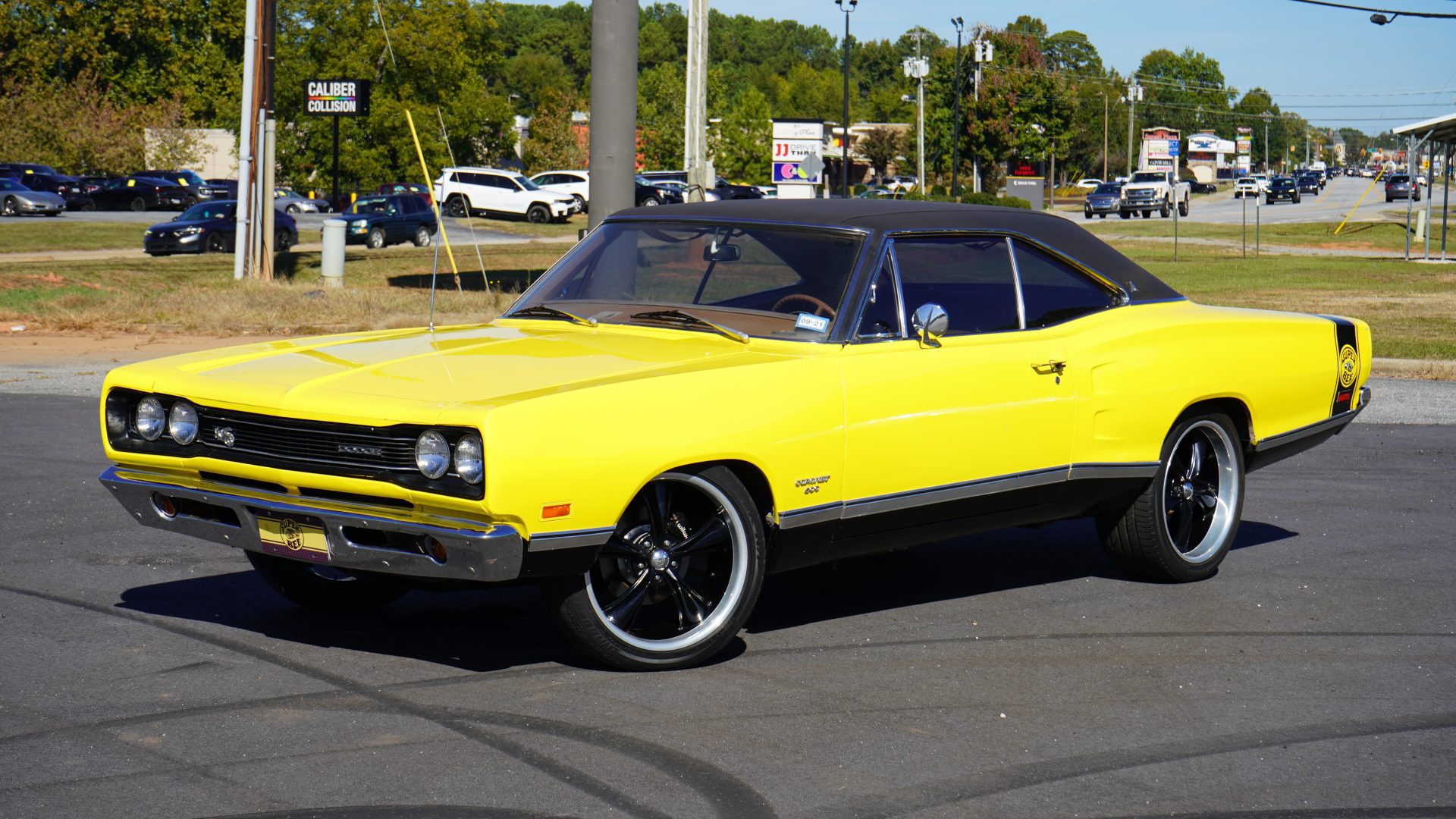
The Super Bee, 1968–70. Dodge's budget muscle car: coupe and hardtop, 383 Magnum as standard, bench seat, minimal trim, bumblebee stripe. For 1969 the range peaked — the 440 Six Pack with its lift-off fibreglass hood arrived mid-year and sales were the strongest of the run. For 1970 the twin-loop front bumper divides opinion, and after that year the model moved to the Charger line. The trap is the mirror of the R/T trap: because the recipe — a 383 in a plain coupe with stripes — is so easy to copy, tributes are everywhere, including in current listings, where a car honestly described as a Super Bee Tribute sits alongside cars described with less care. A tribute bought at tribute money is a perfectly good purchase. A tribute bought at real-car money is the most expensive mistake in this market, and step 1 of the inspection exists to prevent it.

Engines and gearboxes
Coronet engines fall into four families, each with its own buying logic: flathead six and early Hemis in the first cars, polyspherical and B-series wedges bridging the 1950s, then the B-body spread of slant six, LA small-blocks and big-block wedges topped by the 426 Hemi. Judge every engine the same way at first — cold start, oil pressure, smoke by phase, leaks, evidence of regular use — then apply the family tests below. Engine numbers and casting dates matter on performance cars: a correct-code, date-consistent block supports value, while a replacement block in a driver is no disgrace if you pay for the car that exists, not the car described.
The early engines: flathead six, Red Ram Hemi and the polys
The 230 flathead six (1949–53) is a side-valve, 230.2-cubic-inch six rated at 103 hp, and its virtues are simplicity and low-speed torque. It should start readily, idle almost silently and pull without fuss; performance is period leisurely, and sustained modern motorway speeds are not its habitat. What kills flatheads is heat and neglect: a cooling system scaled up after decades of plain water, a block or head cracked by a freeze or an overheat, and worn valve guides showing as smoke and oil consumption. Basic rebuild parts — pistons, rings, bearings, gaskets — remain obtainable through early-Mopar specialists, but machine work is specialist money: budget a repair bill in the low thousands of dollars for a proper rebuild with labour, and walk away from any seller who calls a smoking, overheating flathead a tune-up issue. The test is a long idle followed by a drive: temperature that climbs and keeps climbing, bubbles in the radiator, or oil that looks like coffee all end the conversation until compression and cooling-system pressure tests have had their say.
The Red Ram Hemis (241 for 1953–54, then 270 and 315 in the Forward Look cars) are true hemispherical-head V8s, smaller than the Chrysler 331 and 354 but built the same way, spark plugs through the rocker covers, a character entirely unlike a wedge. The 241 made 140 hp and transformed the Coronet; the D-500 versions, with higher compression and factory performance equipment in some years, are the fast early Coronets. They are strong but not cheap to own: Hemi-specific parts — rocker gear, pistons, gaskets — cost multiples of wedge parts, and a full rebuild with correct components is routinely a five-figure repair cost with machine work and labour at a specialist. The buying test is completeness and quiet running: a complete, quiet, non-smoking small Hemi with good oil pressure is worth a premium; an incomplete or noisy one is a project engine, not a driver with needs. Check for plug-tube oil leaks, listen for rocker-shaft wear as a top-end rattle that does not fade, and confirm the car still carries its Hemi rather than a later poly or wedge swapped in when Hemi parts got dear — common, honest if declared, and fatal to paying Hemi money.
The polyspherical A-engines (277, 301 and the early 318 poly, found in fin-era and earliest B-body Coronets) share block architecture with the early Hemis but use polyspherical chambers and single rocker shafts. They are tough, torquey and unloved, which makes them good buying: a poly car is usually cheaper than the Hemi or big-block beside it and gives away little as a driver. The weakness is support, not reliability: performance parts barely exist, some service parts take hunting, and many poly cars have been re-engined with later LA small-blocks, so verify what is fitted by casting and by the heads and rocker covers rather than by listing text. Service parts are a modest repair cost; a full rebuild is a considered decision, because a poly car's finished value rarely repays deluxe engine work. Buy the best-running poly you can find rather than a cheap one to rebuild.
The B-body six and small-blocks: slant six, 273, 318 and 340
The 225 slant six — canted 30 degrees to clear a low hood line — is the base B-body engine and one of the most durable Chrysler ever built. With a single-barrel carburettor it made about 145 hp gross and will run, apparently forever, on neglected oil and stale fuel. That durability is a trap: because the engine forgives everything, slant-six cars are often the most deferred-maintenance cars of all, with brakes, suspension and structure neglected alongside an engine that still starts. Judge the car, not the engine's willingness. Checks are few: manifold gasket leaks where the combined intake and exhaust manifold warps and ticks when cold, carburettor wear giving a hunting idle, and skipped valve clearances announcing themselves as top-end clatter. All are small repair jobs with parts costs in the tens to low hundreds of dollars plus labour. A slant-six Coronet will never be quick; bought cheaply and honestly it is the most usable daily classic in this guide.
The LA small-blocks — 273, 318 and 340 — are the sweet spot for B-body buyers who want a V8 without big-block running costs. The 273 is sweet and revvy but the least torquey in a heavy B-body and the least supported for performance parts. The 318 in LA form, standard in Coronets from 1967 onward, is the workhorse: two-barrel in almost every fitment, unstressed, and capable of very long life if the timing chain has been changed — the factory nylon-toothed cam sprocket is the known weakness, shedding teeth with age until the chain jumps, so a documented replacement is worth money and a rattling front cover at idle is a job to price in, typically a repair cost of a few hundred dollars in parts with several hours of labour. The 340 is a different animal — high-compression, four-barrel, 275 hp gross, eager to rev — and in a Coronet it is most often a swap, so establish factory, period or recent before valuing it, and test it as a high-performance engine: hot oil pressure, overrun smoke for valve seals, a valvetrain quiet at speed. Small-block service parts are cheap and everywhere, which is precisely the appeal.
The big-blocks: 361, 383, 413, 426 Wedge, 440 and the 426 Hemi
The B and RB wedges are why the Coronet matters. The B-series — 361 and, above all, 383 — is the low-deck family; the RB — 413, 426 Wedge and 440 — is the raised-deck family. Tell them apart by the distributor and the pad beside it: on a B-engine the stamped pad sits beside the distributor at the front and the engine looks compact; RB engines sit taller and wider. Every big-block claim should survive that ten-second look plus a decode of the pad stamp, because B and RB swaps are easy, common and frequently misdescribed.
The 383 is the core muscle Coronet engine: standard in the Super Bee as the 383 Magnum at 335 hp gross, optional across the 440 and 500 lines, and the best balance of pace, price and parts support in the range. In Magnum form it carries the 440's heads, camshaft and manifolds in most fitments and a Carter AVS four-barrel, and should pull hard from low revs. Failure modes are age modes, not design flaws: a stretched timing chain, a carburettor dried out by ethanol fuel and standing, snapped manifold bolts, oil leaks from every cork gasket. All are ordinary repair jobs — a carburettor rebuild is a few hundred dollars, a gasket and chain refresh a low-thousands repair bill with labour — and none should frighten you off a sound car.
The 440 in Magnum form (375 hp gross, single four-barrel) was the R/T's standard engine. For 1969 and a half the 440 Six Pack — three Holley two-barrels, 390 hp gross — headlined the Super Bee options, and it is the most misrepresented engine here after the Hemi: the induction was sold over the counter and retrofitted for fifty years, so a Six Pack under the hood proves the induction is present today and nothing about how the car left the factory. The tag, the VIN and paperwork prove the car; the carburettors prove the carburettors. On test a good 440 is defined by torque and temperature: it pulls from idle without hesitation and holds temperature in traffic. Big-blocks run hot when radiators are tired, fan clutches have failed or pump impellers have corroded, and a 440 driven hot will warp heads and cook gaskets. A cooling-system overhaul — radiator, pump, hoses, thermostat, fan clutch — is a repair cost in the high hundreds to low thousands of dollars fitted, and money to expect on any big-block that has sat.
The 426 Hemi (street form 1966–71, offered in R/T and Super Bee Coronets) is the legend and the liability in one engine: two huge hemispherical heads, dual Carter AFB four-barrels in most street fitments, 425 hp gross by the famous underrated factory figure — and a parts economy unlike any other engine here. A street Hemi should start with a choppy, mechanical idle and pull with a violence no wedge matches. It should also come with paperwork, a decoded engine stamp and a seller who welcomes inspection, because a correct rebuild is a repair bill well into five figures, and correct heads, intake and carburettors bought loose can cost as much as a whole good 383 car. Never buy a Hemi Coronet on appearance: clone Hemis and replacement blocks exist, and the difference is entirely in stamps, dates and documents, checked cold before any money moves.
The 361 and 413 bookend the story. The 361 is the early big-block, adequate and cheap; the 413 belongs mainly to full-size cars and to the Max Wedge racing prehistory, and a Coronet carrying one today almost always carries a swap story to be told and priced as such. Neither rejects a good car; neither supports a premium without documents.
Gearboxes
Almost every Coronet you will see is an automatic, and the automatic is a TorqueFlite, which is good news. Our listings agree: of the cars that state a transmission, automatics outnumber manuals by roughly five to one. Learn the two TorqueFlites. The A904 serves sixes and LA small-blocks; the A727 serves big-blocks and high-output small-blocks and is one of the strongest three-speed automatics ever built. Both should engage drive and reverse promptly from cold and shift firmly without flaring. A long delay into reverse on a cold morning is the classic warning of hardened seals; flaring on the two-three shift means the box needs work. A rebuild is a well-understood repair job, typically a low-thousands dollar cost fitted with the converter checked — budget for it on a slipping car rather than walking away from a sound shell. The pushbutton TorqueFlite of the fin-era cars adds its own check: every button must select cleanly and the cable mechanism must be intact, because a pushbutton car that will not select is immobile in a way a lever car is not.
Manuals are the minority and the delight. The base three-speed should be judged on synchromesh into second and a clutch that bites without judder. The A833 four-speed — Hurst linkage in the performance years — is a strong box whose faults are wear faults: second-gear synchromesh, sloppy linkage that is usually bushes and adjustment, and a clutch priced as a consumable, a repair cost in the high hundreds of dollars plus labour. A factory four-speed big-block car carries a premium over its automatic twin; verify it by tag, hump, linkage and pedals telling one story. Early cars add Fluid Drive, Gyro-Matic and the two-speed PowerFlite: judge them by whether they work today, because specialist repair for them is a hunt rather than a phone call.

Problem areas
Everything here follows one rule: structure first, mechanics second, cosmetics last — because the mechanics are almost always fixable at a plannable price, while structure decides whether the finished car can ever be worth what it cost. Our own photo examination underlines the point. Of 25 Coronets in our listings whose photo sets were examined in detail, rust was noted in 7 cars and visible damage in 10 — roughly three in ten showing rust in photographs a seller chose to publish. Seller photographs flatter a car. Assume the car in front of you needs a closer look than the listing gave it.
Rust and structure: two architectures, two maps
The early cars, 1949–59: body on frame. A separate frame changes the economics of rust. Floor, sill and body-mount rust still matters — a fin-era convertible with rotten floors is a major welding project — but the frame is heavy steel that usually survives, and panels can be repaired in sections without unpicking the car's whole strength. Work the map in this order: floor pans and the mounts beneath them, inner and outer sills, lower front fenders behind the wheels, door bottoms where drain slots block, the trunk floor around the spare-wheel well, and on 1957–59 cars the headlamp brows where Forward Look styling traps water behind bright trim. Check the frame at the steering box and spring hangers; surface scale is normal, perforation at a mount or hanger is structural and priced as fabrication, not a patch. A body-off repair on an early car is at least thinkable; on the cars below it effectively is not.
The B-body, 1965–70: unit construction. The B-body has no separate frame. Strength lives in the floor, the cowl, the inner fenders, the front subframe rails that carry the torsion-bar crossmember, and the rear rails that carry the leaf-spring hangers. Rust in those places is not cosmetic and cannot be judged from a shiny top side. The map, in the order it kills cars: first, the torsion-bar crossmember and the front frame rails around it — the bars anchor here, the area traps road salt and mud, and perforation means the front suspension is anchored to rust, a fabrication repair that belongs on a jig and prices per car, not per panel. Second, the cowl and the floor beneath it: the fresh-air vents and the windshield seal leak, water runs inside the cowl and out through the floor seams, and the classic B-body tell is a wet carpet, a rusted front floor at the toe boards and rust at the base of the A-pillars and door hinges. Third, the trunk floor and its extensions over the rear rails, fed by the rear window channel, the trunk seal and failed seam sealer; lift the mat and the spare and look at the seams, not the middle of the panel. Fourth, the rear wheelhouses, quarter-panel lowers and the dogleg ahead of the rear wheel, where filler hides in almost every repainted car — run a cloth-wrapped magnet over every lower panel and treat a dead spot as a question that needs a torch and a prod, not an answer. Fifth, the rear spring hangers and shackle mounts and the floor above the rear axle. Reproduction floor pans, trunk floors and quarter skins exist for the B-body and are a known repair cost — a floor pan set fitted and painted is a low-thousands dollar job per side once labour is counted, a trunk floor rather less, quarter work more once paint blending is included — but crossmember, cowl and rail work is fabrication, and two structural areas gone at once is the point at which experienced Mopar buyers walk away and buy the dearer car instead. Fresh black underseal blown uniformly over rails, seams and brake lines the week before a sale is a cover-up until the seller proves otherwise; honest underseal is patchy, chipped at the edges and dirty in a way that matches the rest of the car.
Two cross-generation traps complete the map. The battery tray rots from the top down under the battery on both architectures, the acid track damaging the inner fender or firewall beneath — lift the battery or at least rock it and torch the edges. And a convertible that flexes, whose doors pinch or drop, is telling you about structure, not adjustment, until a lift inspection proves otherwise.
Suspension, steering and brakes
Every Coronet from 1957 onward — and every B-body without exception — uses Chrysler's torsion-bar front suspension: longitudinal bars anchored in the crossmember, upper and lower control arms, an anti-roll bar on performance models. It rides and handles better than its contemporaries, and its wear points are predictable. Ball joints wear and must be checked with the suspension loaded and unloaded correctly, because a torsion-bar car unloads its joints differently from a coil-spring car and a careless check passes a worn joint. The bars rarely fail, but their rear sockets corrode (see the rust map) and their adjusters seize; a car sitting low or uneven at the front usually needs adjustment or socket repair, not a spring — there are no front coil springs. Bushings are fifty-plus years old unless documented as changed; a full front-end refresh with joints, bushings and alignment is a repair job in the low thousands of dollars with labour, and it transforms a vague car, so price it in rather than fearing it. At the rear, leaf springs sag and shackles wear, and on Super Bee and R/T cars the heavy-duty springs should still be present rather than generic sedan springs that sit wrong. The stance check in the inspection reads all of this at a glance.
Steering divides by era. Early cars use worm-and-roller boxes that are vague by modern standards even when perfect; judge them against the period. B-body cars use recirculating-ball boxes, manual or power-assisted — the power boxes famously over-assisted and light — and wear shows as centre free play that adjustment only partly cures; a rebuilt box is a mid-hundreds dollar repair part plus fitting. The column pot coupling wears and knocks, and the idler arm is the classic Mopar wear item behind a wandering car and uneven front tyre wear; both are cheap parts whose neglect tells you about the last owner. On the drive the car should track straight, return to centre and stay silent over bumps; a knock plus vagueness is a front-end bill, not a character trait.
Brakes are where period standards bite hardest. All early Coronets and most B-body family cars left the factory with four-wheel drums; front discs arrived as a B-body option and as near-standard fitment on later performance cars. Drums in good order stop a Coronet adequately once; they fade on repeated stops and demand honest adjustment. The safety-critical fact is the master cylinder: cars before 1967 generally carry a single-circuit system in which one leak empties the lot, while 1967-onward cars carry dual circuits — a dual-reservoir conversion on an earlier driver is the first money many owners spend, a repair kit and fitting cost in the low hundreds of dollars, and a sign of a thinking owner. On any car that has sat, budget for a hydraulic refresh — master and wheel cylinders or calipers, hoses, fluid, every steel line inspected — as a repair bill in the high hundreds to low thousands of dollars. A sinking pedal, pulling under braking or a handbrake that barely holds are each their own job; together on a stored car they are simply the recommissioning bill arriving on schedule.
Interior, trim and electrics
The cabin hides costs in plain sight. Seat covers and foams are reproduced for the popular 1968–70 interiors and are a manageable repair cost — a bench or buckets retrimmed with correct covers and new foam is a low-thousands dollar job fitted — but 1965–67 patterns, early-car interiors and convertible pieces take hunting, and a complete, original interior in any year is worth a premium because it cannot be ordered. Check the dash pad for cracks (a replacement pad or quality cap is a mid-hundreds dollar part), the cluster for dead gauges, and the odometer's story against paperwork and pedal wear. Carpets hide the floor rust you most need to see — always lift them — and door cards warp where drains blocked years ago. Heater cores leak into the front footwell and masquerade as rain leaks; a sweet smell and a greasy windshield film are the tells, and on air-conditioned cars access turns a cheap part into a labour bill in the high hundreds of dollars. Air conditioning should be judged present-but-dead unless it blows cold on the day; returning a dead system to cold is a repair cost starting in the high hundreds and climbing with every component that tests bad.
Electrics fail at connections, bulkheads and switches, not mid-wire. On the earliest cars (twelve volts arrived for 1956) dim lights and slow cranking are usually earths, cables and a tired generator, and any voltage or alternator conversion must be judged on its wiring quality. On B-body cars the bulkhead connector is the known weak point — heat and corrosion in the main feeds give intermittent everything and, at worst, melted plastic — and the ammeter circuit routing full charging current through the dash is the related design experienced owners inspect first. Ballast resistors fail and stop a Mopar dead with a crank-but-no-start owners misdiagnose for weeks; every glovebox should carry a spare. A car in which everything electrical works, clock and washers included, has almost always been used and maintained — a pattern worth more than any single test here.
Performance-car traps: clones, cooling and driveline wear
Because the valuable Coronets share their shells with cheap ones, the performance market's problem areas are documentary before they are mechanical. Stripes, hoods, badges and even complete drivetrains swap onto a base Coronet in a weekend, and they have been swapped for fifty years. The defences are dull and total. The fifth character of a B-body VIN encodes the engine the car was built with; the model codes distinguish an R/T (WS) from a Super Bee (WM) from a 500 (WP); the fender tag decodes the build, options and original engine and transmission; and the numbers stamped in the body — radiator support and trunk lip — tie the shell to the paperwork. A car whose story changes between those sources is priced as the lowest version the evidence supports, every time. The broadcast sheet, often under the rear seat, is the gold standard where it survives. None of this makes a tribute a bad car; it makes an undocumented car a tribute-priced car.
Mechanically, performance Coronets add three bills family cars rarely present. Cooling, first: a 440 or Hemi has little spare radiator and less spare airflow, and a tired core, failed fan drive, missing shroud or corroded pump shows as traffic overheating that will, if endured, take head gaskets and heads with it. Second, driveline wear: the 8.75-inch rear axle is strong and its centre section swaps easily — which means the ratio and Sure-Grip limited-slip fitted today may not be the ones it was born with, so verify both by test rather than by tag; the Dana 60 behind four-speed Hemi and 440 cars is stronger and correspondingly valuable, and its presence belongs in the paperwork check. Third, the cost of correctness: date-coded carburettors, distributors and manifolds separate a finished R/T or Hemi car from a fast Coronet, and each correct component bought loose is a hunt with a three- or four-figure price. Buy correctness already on the car, or buy at driver money and enjoy it without the hunt.

How to inspect one
Allow at least an hour, bring a torch, a cloth-wrapped magnet and a friend to work the pedals and lights while you watch. Insist on a cold engine when you arrive. If the car passes you, pay for a lift inspection before money changes hands — on a B-body it is the best money in the purchase, and on an early car the only way to see the frame properly. Work in this order and stop early when a step fails: the cheapest checks kill the worst cars first.

- Paperwork and identity first. Match the title VIN to the VIN plate and, on a B-body, to the numbers stamped in the shell. Decode the fender tag. On any R/T, Super Bee, Six Pack or Hemi claim, decode the VIN engine character and model code before you look at the engine at all — the shell and the tag outrank the stripes and the hood. Ask for the broadcast sheet if it survives, and for invoices. A thick history file is worth real money; a story with no paper is priced as a story.
- Cold start. From stone cold, a carburettor car should start with the choke procedure the seller demonstrates, settle to an even idle and show no blue smoke beyond a puff. Blue smoke that persists is valve seals or worse; smoke under load later in the drive is rings. Listen for timing-chain rattle, top-end clatter on a Hemi or a poly, and exhaust ticks that fade as manifolds warm.
- Under the car, structure before shine. Torch the torsion-bar crossmember and front rails on a B-body, or the frame, mounts and spring hangers on an early car. Prod the cowl-base floors, the toe boards, the rear rails and the spring hangers. Perforation in a crossmember, rail or hanger is structural — re-read the rust map and price fabrication, or walk away. Read the underseal as you go: patchy and honest is factory; fresh and uniform over everything is a question.
- Trunk and rear window. Lift the mat and the spare wheel. Look for water tracks, seam rust and daylight. Check the rear window channel and the trunk seal, the two feeds for almost every wet B-body trunk. On an early hardtop or convertible, check the well and the top boot area the same way.
- Floors from inside. Lift every carpet you are allowed to lift. Look for water tracks from the cowl and windshield base, prod the front pans, and smell for the sweet trace of a leaking heater core. Wet carpets in a dry-stored car mean leaking seals and rust already started.
- Body, gaps and magnet. Walk the car slowly. Run the magnet over sills, quarter lowers, doglegs, fender bottoms and door bottoms. Check panel gaps for accident history, door bottoms for bubbling, the battery tray for acid damage, and count the missing or damaged bright trim pieces — on a 1950s car that count can be the biggest single bill after rust.
- Engine bay truth test. Check the oil — level, colour, smell — and the coolant for oil, rust or bubbles with the engine running and warm. Verify the engine that is actually fitted against the claim: distributor and pad position for B versus RB big-blocks, plug-through-covers for a true early Hemi, casting dates where a numbers claim is being priced. Note every leak by source, not by puddle.
- Suspension and steering by hand. Rock each front wheel for ball-joint and bearing play, remembering a torsion-bar car must be checked loaded and unloaded to judge joints fairly. Bounce each corner. Check the idler arm, the column coupling and the steering box free play. Price a front-end refresh into any car that knocks, wanders or wears its front tyres unevenly.
- The test drive, fifteen minutes minimum. Include town work, a hard brake stop from speed, and a sustained faster stretch where the law allows. The TorqueFlite should engage promptly, shift firmly and select reverse without a long pause. A manual should find second cleanly up and down. Note temperature in traffic after the drive as carefully as at speed — that is where big-block cooling tells the truth.
- Brakes and handbrake, judged separately. The car should stop straight, without judder, pull or a sinking pedal. Then judge the handbrake alone on a slope. On a pre-1967 car, note whether a dual-circuit conversion has been done; if not, add it to your first-year list.
- Heat, stance and electrics together. Let the car idle hot while you work everything: heater and every blower speed, wipers, washers, windows, lights, horn, radio, every gauge. Then stand back and read the stance — level, correct rake, arches even. A car that sits wrong is telling you about bars, sockets, springs or structure, in that order of cost.
- Interior last, from the driver's seat. Sit in every seat, but judge from the driver's: collapsed foam, a worn-through bolster and a cracked dash pad price the interior, not the tidy passenger side. Check seat belts are sound and correctly anchored. A complete, original interior is the hardest thing about a Coronet to recreate, so weight it heavily — and only now decide what the car is worth to you.
Values
The build beneath this guide carries the live market — the cars listed now and the recorded sales — refreshed at every build, and that block is where every current number lives. This section teaches you how to read it, because Coronet values are not one market but at least four, stacked on top of each other and sharing a badge.
At the bottom sit the family cars: slant-six and small-block sedans, wagons and four-doors, and most early sedans, whose worth is set almost entirely by condition and usability. A sound, driving family Coronet is worth what a sound, driving classic costs; a rusty one is worth its parts and paperwork, and the gap between those states is the whole negotiation. Rarity rescues no base car — Dodge built them in large numbers; completeness and structure are what is scarce. Price any example by the welding and recommissioning it still needs, using the repair costs in the earlier sections as your arithmetic.
Above them sit the well-specified cruisers: Coronet 500s, big-block 440-trim cars with specification proven, convertibles in every generation, Lancer and Diplomat hardtops, documented D-500 fin-era cars. Here specification pays, but only documented specification — the same car with and without its tag decoded and invoices present is two different purchases, and the market block shows the spread if you separate proven cars from described ones. Asking prices in this tier run ahead of achieved prices by a wider margin than below, because sellers price the brochure and buyers price the car. Expect the negotiation to turn on structure and completeness, not colour or shine.
At the top sit the performance cars — R/T, Super Bee, Six Pack and Hemi — where the market is really a market in evidence. Two cars identical in photographs separate by multiples once VIN, tag, body stamps and engine numbers have been checked, because the real car carries a scarcity the clone cannot copy. Tributes trade in their own honest tier, roughly with the cruisers, valued as fast, handsome drivers — no shame in that tier, provided the price was set there. Treat any performance-car result without a stated identity check as unproven, and any unusually cheap Hemi or Six Pack result as a car whose evidence or structure failed, until you know otherwise. Project-versus-driver gaps are widest here: a project needing structure, a correct drivetrain and an interior is not a discounted finished car, it is a finished car's price spent in instalments, usually to a higher total.
Two habits protect you in every tier. Separate asking from achieved wherever the data lets you, and weight achieved sales of comparable, identified cars over any asking figure. And price the car in front of you from its structure outward — shell, identity, drivetrain correctness, interior completeness, cosmetics — letting the market block set the tier, never the car's story. A Coronet bought in that order rarely disappoints; bought in reverse order, it is how most expensive mistakes here begin.
Parts and ownership
Parts supply follows the same split as everything else here. The B-body is one of the best-supported American cars of its era: Chrysler built B-bodies by the million across Dodge and Plymouth, the muscle market keeps the reproduction trade busy, and almost everything a 1965–70 Coronet needs can be ordered today. The early cars are a specialist proposition: support is real but thinner, organised around early-Mopar clubs and dedicated suppliers, and some parts are a hunt rather than an order. Neither car is exotic to work on, and any competent shop that knows Mopars can maintain either.
Easy, on a B-body: service items, filters, ignition parts including the spare ballast resistor you should carry, brake shoes, cylinders, calipers and hoses, ball joints and bushings, TorqueFlite parts for both the 904 and the 727, engine gaskets and timing sets for slant six, LA and wedge engines, floor pans, trunk floors and common rust panels, glass rubbers for the popular bodies, and seat cover and foam sets for 1968–70 interiors. Prices are ordinary classic-car money and availability is measured in days.
Harder and dearer: correct date-coded performance components — Carter carburettors in the right numbers, factory Six Pack induction, Hemi heads, intakes and internals — where a correct part is a four-figure hunt and a Hemi rebuild with proper machine work is a five-figure repair commitment; early Hemi and poly parts, where the same job costs multiples of its wedge equivalent; 1965–67 and early-car trim and stainless, where completeness on the car you buy beats any promise to find pieces later; convertible top frames in every generation; pushbutton transmission components; and quality chrome work, where re-plating a full set of brightwork is a bill in the low thousands of dollars. The pattern is the guide's pattern: buy completeness, because completeness is what the parts market charges most to replace.
Running a Coronet. A sorted B-body is a realistic regular-use classic: fuel consumption in the mid-teens miles per gallon for a small-block driven gently, low teens or less for a big-block driven as intended, servicing any Mopar-literate independent can handle. The early cars ask for a slower life — period gearing, drum brakes and period electrics — and reward it by being simple, durable and cheap to feed. The budget line that catches new owners is the first year: catching up deferred maintenance honestly costs a low-thousands dollar sum before you improve anything, and recommissioning a car that has sat for years — fuel system cleaned end to end, because modern ethanol fuel attacks old rubber and varnishes tanks, every brake component inspected, all fluids, hoses and seals renewed — runs into the mid-thousands with labour at a shop. Buy a car in regular recent use over one that has been asleep, even at a higher price: use is maintenance and storage is a slow repair bill.

Which one to buy
- The all-rounder: a 1968–70 Coronet 500 or 440-trim car with a 318 or a 383. The handsome body, the best parts support in the range, real pace in 383 form, and a market deep enough to buy well and sell honestly. If you want one Coronet to drive and enjoy, this is it.
- The value buy: a sound slant-six or 318 family car, wagon included. The cheapest route into a structurally honest B-body. Buy the shell and the interior; the engine's modesty is the discount, not a defect.
- The muscle car, honestly bought: a documented 383 Super Bee or a documented 440 R/T. Proven by VIN, tag and stamps, structurally sound, bought at the tier its evidence supports — the Coronet experience at its fullest without the Hemi's costs.
- The collector car: a documented 426 Hemi R/T or Super Bee, or a documented D-500 fin-era car. Priced on evidence, bought on evidence, verified by a marque specialist before money moves. In this tier you are buying paperwork with a car attached, and that is the market working as it should.
- The charmer: a 1955–56 Coronet Lancer hardtop, or a 1953–54 Red Ram car. Forward Look style or the jewel-like small Hemi, period pace, a crowd at every fuel stop. Buy completeness above all; trim and chrome decide these cars.
- The tribute, bought knowingly: a clean Super Bee or R/T tribute at driver money. Stripes, stance and a strong 383 or 440 make a wonderful car to drive — at the price of the car it is, never the car it depicts.
And the rule that overrides all of the above: buy the least rusty, most completely documented Coronet you can find, in the specification you can live with. Engines, gearboxes, brakes and interiors are all fixable at plannable prices. A rotten unit body, a missing identity or a Hemi bought on a story cannot be planned back to sense — and every one was avoidable on the day, with a torch, a tag decode and an hour of your time.
See the 36 Coronet cars currently listed.