
Dodge Charger buyer's guide
Dodge Charger -- the model's own buyer's guide: variants, values and what to check.
Years listed: 1966-2026 · Series: Charger
Overview and history
The Dodge Charger is not one car. It is a name Dodge has applied, across six decades, to a fastback personal coupe, to the most famous muscle car shape ever drawn, to a fuselage-styled early-1970s coupe, to a Cordoba-adjacent luxury two-door, to a front-wheel-drive hatchback, and to a four-door modern sedan with supercharged V8s. If you are buying through Classic Listings, though, one Charger dominates everything else, and this guide is weighted the way the market is weighted. Of the 160 Chargers we currently track, the overwhelming majority are the classic B-body coupes of 1966 to 1974 — 1969 alone accounts for 32 cars, 1970 for 31, 1968 for 27, and 1966 for 16 — with just a handful of modern LX and LD sedans (single cars from 2006, 2017 and 2023 in the current pool, plus a 2026 listing) at the far end. Learn the B-body first. Everything else is orientation around it.
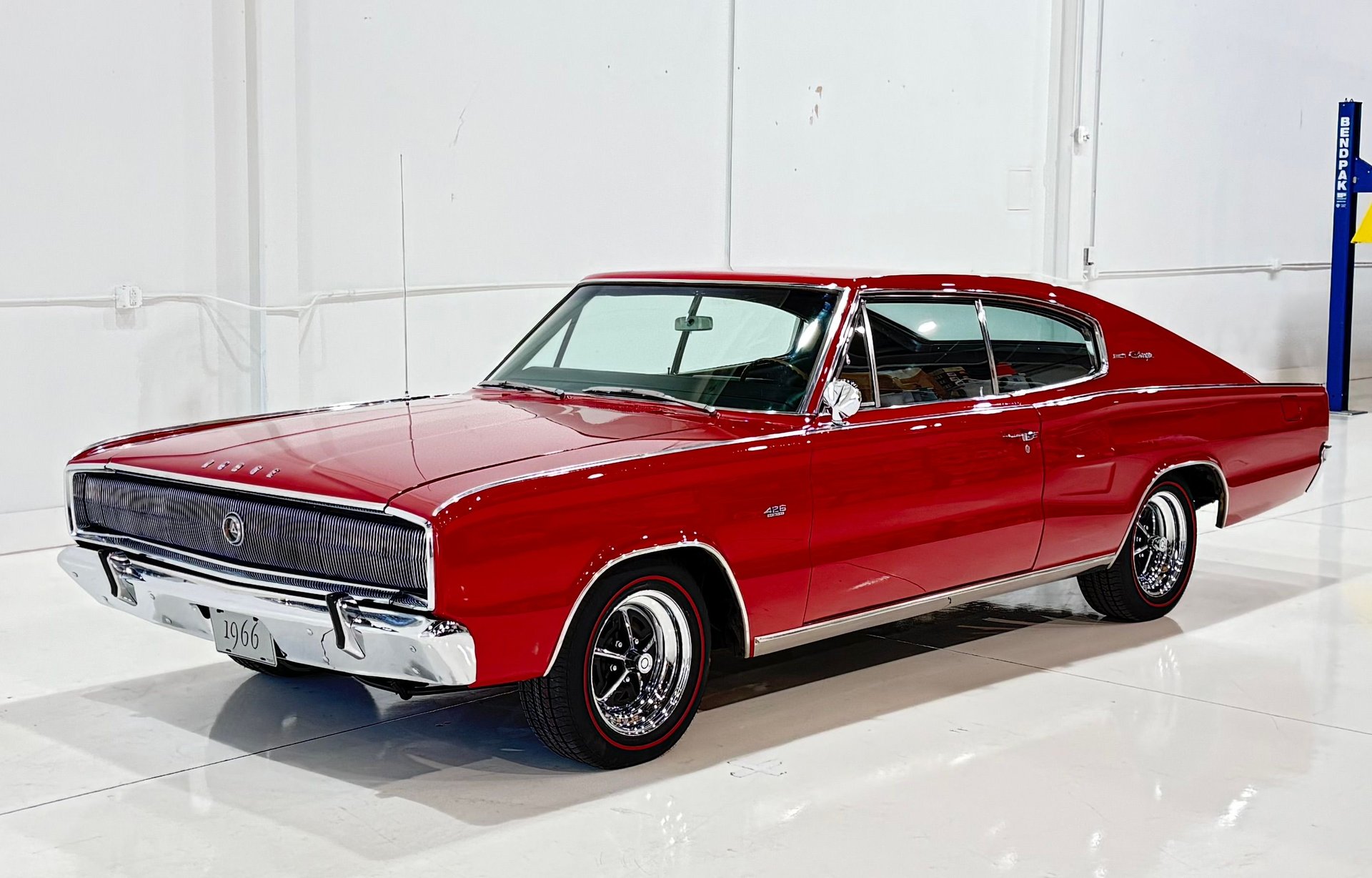
The Charger arrived for 1966 as Dodge's answer to the personal-fastback idea: a Coronet-based B-body intermediate wearing a dramatic full-width grille with concealed headlamps, a sweeping fastback roof, four individual bucket seats, a full-length console and a full-width rear lamp. It was a show car made real — the production version of the 1965 Charger II concept — and it sold the idea of speed through styling as much as through hardware, though the hardware was there if you paid for it: the engine list ran from a 318 small-block V8 up through the 383 and 361 big-blocks to the new 426 Street Hemi, the detuned racing engine that made a Charger genuinely fast and genuinely expensive. First-generation cars (1966–67) are the connoisseur's Chargers: distinctive, lower-volume than what followed, and built around an interior nobody else offered.
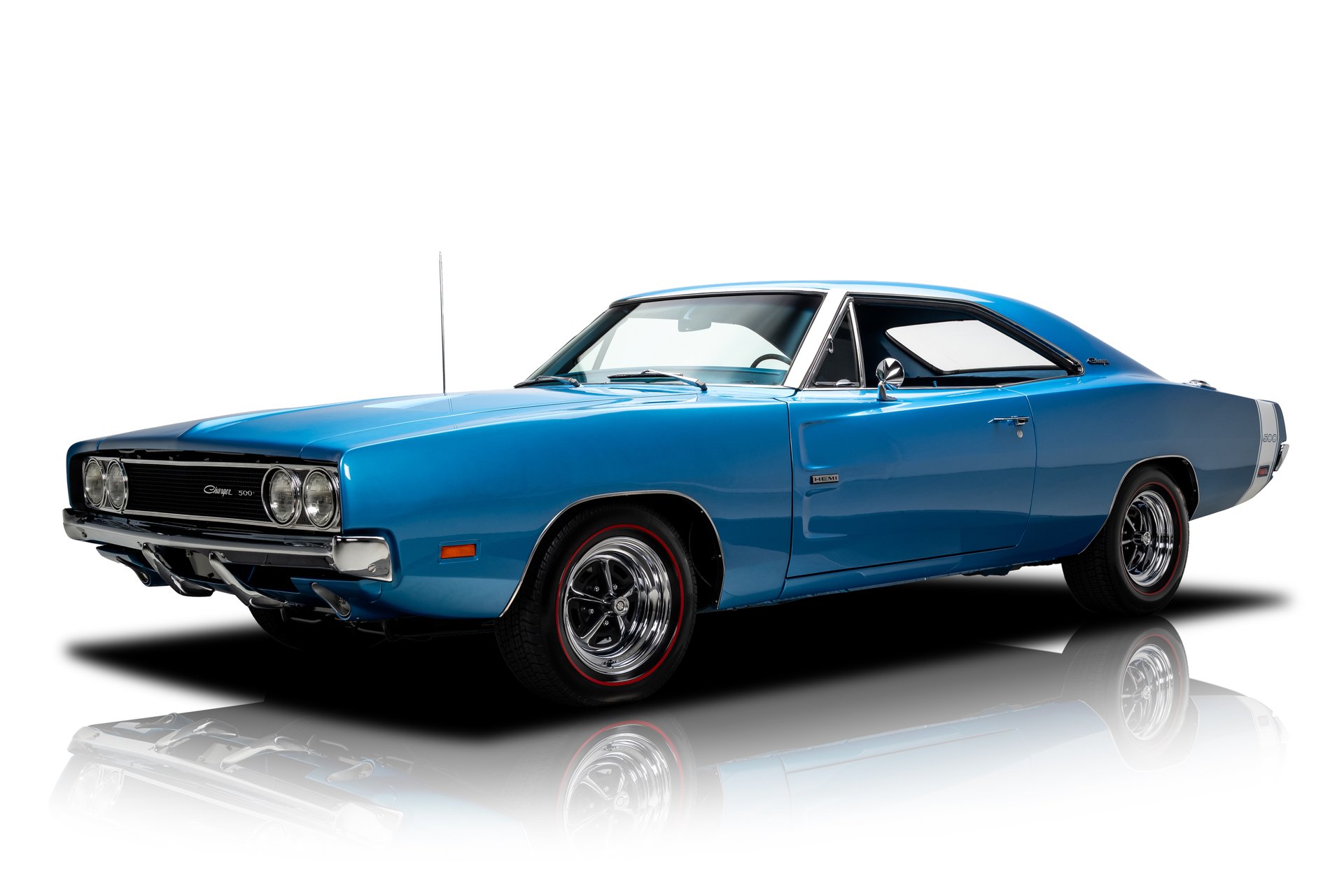
Then came 1968, and the Charger became an icon. The second generation (1968–70) replaced the fastback with the famous Coke-bottle profile — sculpted rear quarters, a recessed flying-buttress roofline, a divided grille still hiding the headlamps, and round tail lamps for 1968 giving way to full-width lamps for 1969 and 1970. Richard Sias's styling, refined under Bill Brownlie, is the reason a 1969 Charger is recognisable to people who know nothing else about cars, helped along by a generation of screen appearances. Underneath it remained a unit-body B-body: torsion-bar front suspension, leaf-sprung live rear axle, and an engine range stretching from the 225 Slant Six and 318 V8 through the 383 and the R/T's standard 440 Magnum, with the 426 Hemi on top. The R/T — Road/Track — was the performance model from 1968: 440 Magnum or Hemi only, heavy-duty suspension and brakes, and the bumblebee stripe around the tail. The racing programme spun off two famous homologation specials, the flush-grille, flush-rear-window Charger 500 for 1969 and the winged, nose-coned Charger Daytona for 1969, built to win on NASCAR superspeedways.
The third generation (1971–74) restyled the car completely in the fuselage idiom — longer, wider, curvier, with a split grille and (from 1972) exposed or concealed lamps depending on model — and broadened the range downward and upward at once: base coupes, the luxury SE with its formal roof and opera-style rear treatment, the Rallye replacing the R/T as the performance trim from 1972, and for 1971 only, the last true high-compression muscle Chargers, including the 440 Six-Pack and the final year of the Hemi. After 1974 the name drifted: the 1975–78 Charger became a personal-luxury coupe closely related to the Chrysler Cordoba, the badge rested, returned on the Omni-based front-drive Charger 2.2 hatchbacks of the 1980s, rested again, and came back for 2006 as a four-door sedan on Chrysler's LX platform — controversial as a sedan, undeniably successful, and eventually home to the 5.7 and 6.4 Hemi V8s and the supercharged Hellcat cars that made the modern Charger the fastest family sedan of its era. Production of the LD sedan ended after 2023, and the name has since moved onto a new generation — one of which accounts for the 2026 car in our pool.
What unites the classic cars, and what decides value and grief today, is construction. Every 1966–74 Charger is a unit-body car with a bolt-on front stub frame (the K-member assembly) carrying the engine and front suspension, welded floor and cowl structure doing the real work, and torsion bars instead of front coil springs. They were built in large numbers, driven hard, raced, crashed, stored badly and restored unevenly for fifty years. The engines are among the toughest America ever made; the bodies and the paperwork are where Chargers are won and lost. Buy the shell and the numbers first, the engine second — that ordering runs through everything that follows.

The models
A Charger badge alone tells you very little. Across the classic years the same body could leave the factory with a Slant Six and a bench seat or with a Hemi and a four-speed, and the spread in value, performance and running cost between the bottom and the top of the range is the widest of any American car of the period. Work by generation first, then by model, then — always — by the VIN and fender tag, because badges are cheap and swaps are fifty years old in some cases.
| Model | Years | Engine | Output | Built | Character |
|---|---|---|---|---|---|
| Charger (first generation) | 1966–1967 | 318 V8 standard; 361, 383, 426 Hemi optional | 230–425 hp | About 53,000 over both years | Fastback personal coupe; four buckets, full console |
| Charger (second generation, base) | 1968–1970 | 225 six, 318, 383 V8s | 145–335 hp | The bulk of about 235,000 second-generation cars | The icon shape without the R/T price; the clone and restomod base |
| Charger R/T | 1968–1971 | 440 Magnum standard; 426 Hemi optional | 375 hp (440); 425 hp (Hemi) | A minority subset of each year's production | The real muscle Charger; heavy-duty chassis, stripe, premium |
| Charger 500 | 1969 (also a 1970 trim name) | 440 Magnum or 426 Hemi | 375–425 hp | Under 400 of the 1969 aero cars | Flush grille and rear window; the Daytona's understudy |
| Charger Daytona | 1969 | 440 Magnum or 426 Hemi | 375–425 hp | 503 | Wing and nose cone; the homologation special, priced accordingly |
| Charger SE | 1971–1974 | 318, 340, 360, 400, 440 V8s | 150–280 hp net era-dependent | A large share of third-generation production | Luxury trim, formal roof; the comfortable third-gen buy |
| Charger Rallye | 1972–1974 | 340, 360, 400, 440 V8s | 240–280 hp net era-dependent | A subset of third-generation production | The R/T's successor; performance trim after 1971 |
| Charger (LX/LD sedan) | 2006–2023 | 3.5/3.6 V6; 5.7, 6.1, 6.4 Hemi V8s; supercharged 6.2 Hellcat | 250–807 hp | Well over a million across both platforms | Four-door modern car; a different purchase entirely |
Outputs are period gross ratings for the classic cars (net ratings apply from 1971–72 onward, which is why later figures look lower for similar hardware) and modern net ratings for the sedans. Treat any single production figure for a trim subset with care: Chrysler's surviving records are good by the standards of the era, but clone and tribute cars muddy every count in the market itself.
First generation (1966–67). The fastback cars are the most distinctive Chargers and, Hemi cars aside, the least expensive way into a classic Charger. Standard power was the 318; the 383 two- and four-barrel cars are the sweet spot for use; the 440 arrived for 1967; and the 426 Hemi was available both years at a price that kept numbers tiny. The interior is the car's party piece — four buckets, a console running the full length of the cabin, an electroluminescent instrument cluster for 1966 — and its weakness: one-year and two-year trim, glass and interior parts are far harder to source than anything for a 1969. The 1967 car added front fender-mounted indicators, a standard centre console revision and dual-circuit brakes. Buy a complete one; a project missing its unique trim is a long hunt.
Second generation (1968–70). This is the centre of the market — 90 of our 160 tracked cars are 1968, 1969 or 1970 models — and the range is layered. Base cars came with the 225 Slant Six (rare, and mostly long since engine-swapped), the 318, and the 383 in two- and four-barrel form. The R/T sat above them with the 440 Magnum as standard, the Hemi optional, heavy-duty torsion bars, springs, brakes and cooling, and a four-speed manual or TorqueFlite automatic. The SE package (Special Edition, 1969–70) added leather front buckets, woodgrain trim and brightwork to base or R/T cars — an SE R/T is a desirable combination, not a separate model. The 1969 Charger 500 took an R/T-based car and fitted a flush Coronet grille and a flush rear window to cheat the wind; the Daytona went all the way with its pointed nose cone and high rear wing, and 503 were built to legalise the parts for NASCAR. For 1970 the Charger 500 name became a mid-range trim rather than an aero car — a naming trap that catches buyers every year: a 1970 Charger 500 is a nice coupe, not a homologation special. The 1970 model year also brought the 440 Six-Pack (three two-barrel carburettors) to the R/T option list, a loop bumper wrapping the grille, and high-back bucket seats.
Third generation (1971–74). The fuselage cars are bigger, quieter and more road-car than racer. The 1971 range still offered the full muscle menu — R/T with 440 Magnum, 440 Six-Pack or Hemi, plus the Super Bee moving onto the Charger body for one year — and it is the last year any of that was true. From 1972 compression fell, ratings switched to net, the R/T name was replaced by the Rallye package, and the range settled into base, SE and Rallye coupes powered by the 318, 340 (to 1973), 360 (from 1974), 400 and a detuned 440. These cars are the value end of the classic Charger market: 30 of our tracked cars are 1971–74 models, they drive more modern than a 1969, and a 1973–74 SE is a genuinely plush period cruiser. Their trap is the opposite of the 1969's — not clones, but neglect dressed as originality, and isolated-mount subframe and suspension hardware specific to the later cars.
The in-between years (1975–87). The 1975–78 Charger was a personal-luxury coupe sharing its structure with the Cordoba; the 1980s Charger was a front-drive Omni-based hatchback, latterly with Shelby tuning. Neither appears in our pool in any number, and neither is covered in depth here, because their construction and parts world share almost nothing with the B-body cars. If one is your target, buy on the same principles: completeness, rust and paperwork, in that order.
Modern sedans (2006–23). The LX (2006–10) and LD (2011–23) cars are modern used cars, not classics: buy them on service history, accident record, electronics health and (on Hellcats) evidence of how the car has been used. One warning applies to no other Charger: modern Hemi cars have a documented appetite for camshaft and lifter wear on cylinder-deactivation (MDS) engines, covered below.

Engines and gearboxes
Charger engine identity is stamped, coded and documented better than on most American cars of the era — and it still gets faked, because the value gap between a 318 car and a Hemi car is the price of a house in some postcodes. Every classic Charger engine below is a pushrod V8 except the Slant Six, all of them are fundamentally durable, and almost none of them is the reason a Charger is a bad buy. Condition, originality and matching numbers are the reasons. Learn the families, then verify the specific engine in the specific car using the checks in the inspection section.
The Slant Six and the LA small-blocks: 225, 318, 340 and 360
The 225 Slant Six powered the cheapest second-generation cars: canted 30 degrees (hence the name), legendarily tough, and hopelessly outmatched by a 3,800-pound coupe. Almost every six-cylinder Charger you meet today wears a V8 swapped in decades ago — which matters, because the car still carries a six-cylinder VIN, and its value is a small-block car's value minus a discount, whatever is under the hood now.
The LA small-block family is the Charger's bread and butter. The 318 (5.2 litres) was standard or near-standard across most years and trims: two-barrel carburettor, hydraulic lifters, around 230 gross horsepower in classic form, and an engine that tolerates neglect better than any other in this guide. It will not make a Charger fast, but it makes it usable, economical by period standards, and cheap to keep — every service part is available everywhere. The 340 (1968–73) is the connoisseur's small-block: high compression in its early form, a forged crank in early cars, big-valve heads, a factory rating of 275 gross horsepower that period testing suggested was conservative, and a willingness to rev that no big-block matches. In a Charger it was always the thinking driver's option — the car is nose-lighter and better balanced — and original 340 cars, especially 1971–73 cars, have a following of their own. The 360 replaced it from 1974: more displacement, lower compression, emissions-era tuning, still a perfectly serviceable engine and the easiest of the family to find parts for. Small-block failure modes are mundane: timing-chain stretch (the factory nylon-toothed cam sprocket sheds teeth with age and heat — a slack chain you can feel at the crank pulley means a chain set, roughly $400–900 fitted), oil leaks from the rear main seal and the intake manifold end seals, tired valve seals giving a puff of blue smoke at start-up, and on high-mileage engines, low oil pressure at hot idle from worn bearings. None of it is exotic, and a small-block rebuild by a competent machine shop runs roughly $3,500–6,500 depending on specification.
The B and RB big-blocks: 361, 383, 400 and 440
The big-blocks are what most Charger buyers actually want. Two deck heights share one architecture: the low-deck B engines (361 in 1966, then the 383 that became the range's workhorse, and the 400 that replaced it for 1972) and the raised-deck RB engines (the 426 Wedge of the earliest cars and, above all, the 440). All are wedge-head, hydraulic-lifter (except early performance variants), iron-block engines of enormous strength, and all share the same service logic: keep oil in them, keep them cool, and they outlast the car.
The 383 is the balanced classic Charger engine. In four-barrel Magnum form (335 gross horsepower in the late 1960s, with the high-performance cam, heads, intake and exhaust manifolds borrowed from the 440 programme) it pulls a Charger hard, revs more freely than the 440, and asks nothing special of its owner. Two-barrel 383s are softer but sweeter-running daily cars. The 440 Magnum (375 gross horsepower, 480 lb-ft of torque) was the R/T's standard engine and the definitive Charger motor: effortless, understressed, and supported by the strongest aftermarket in the Mopar world. The 440 Six-Pack (1969½ in the wider Mopar range, a Charger R/T option for 1970–71) added three Holley two-barrels on an aluminium or iron intake, rated 390 gross horsepower; it is the most misrepresented engine in the Charger world after the Hemi, because the carburettors and intake bolt onto any 440. A Six-Pack claim is a paperwork claim — VIN engine code, fender tag and documentation — never a hardware claim, because the hardware is a weekend's work to fit. The 400 (1972–74) is the emissions-era big-block: low compression, lean tuning, still torquey and durable, and the basis of many stroker builds precisely because its large bore and short deck are prized by engine builders — an original, unmolested 400 car is now rarer than a modified one.
Big-block specifics to test on any car: exhaust manifold heat-riser valves seize and cook the choke and intake crossover, giving cold-running miseries that look like carburettor faults; the passenger-side manifold on 440 cars cracks with age and heat cycling (a ticking that fades as the engine warms is the classic tell); electronic ignition (standard from 1972, retrofitted to thousands of earlier cars) fails at the ballast resistor and the ECU box, both cheap, both worth carrying as spares; and the factory Carter AVS and Thermoquad carburettors (the Thermoquad on later cars) suffer warped air horns and, on the Thermoquad, a plastic centre body that cracks and leaks internally — a rich, uneven idle on a 1971–74 car is the carburettor until proven otherwise. A correct big-block rebuild runs roughly $5,000–9,000; a Magnum-specification rebuild with quality pistons sits at the top of that range.

The 426 Hemi
The Street Hemi (1966–71) is a different engine from everything above, not a bigger version of it: hemispherical combustion chambers, huge ports and valves, a forged crank, cross-bolted main caps, dual four-barrel Carter AFB carburettors on an aluminium intake, solid lifters in early form (hydraulic from 1970), and a factory rating of 425 gross horsepower at 5,000 rpm that was a polite fiction for insurance purposes. Dodge charged roughly $900 for it when a whole Charger cost under $3,500, so production was always tiny — Hemi Chargers across 1966–71 number in the low thousands in total — and survivors with their original engines are the blue-chip end of this entire market.
A Hemi is also the most demanding engine here to own. It wants valve lash attention on solid-lifter cars, it is heavy (the front suspension and brakes on a Hemi car are the heaviest-duty versions, and their presence or absence is an originality check in itself), it drinks fuel in the single digits around town, and its specific parts — heads, rocker gear, intake, exhaust manifolds, the unique air cleaner — are priced like jewellery when genuine. The failure modes are those of any highly tuned period engine: detonation damage on modern fuel if the timing and mixture are set by ear rather than by instrument, oil consumption past the valve guides, and the consequences of amateur rebuilds, because a Hemi rebuilt wrong is a five-figure mistake. A proper Hemi rebuild by a recognised specialist runs roughly $12,000–20,000, and a correct set of date-coded carburettors alone can cost $3,000–5,000. None of this should put you off a documented car. All of it should put you off an undocumented one at a documented price.
The modern engines: V6s, the 5.7, 6.1, 6.4 and Hellcat V8s
Briefly, because they are a different purchase: the LX/LD sedans run the 3.5 and 3.6 V6s, then a ladder of modern Hemis — the 5.7 with cylinder deactivation (MDS) on automatic cars, the 6.1, the 6.4/392, and the supercharged 6.2 Hellcat family from 2015, at 707 horsepower and rising to 807 in final forms. The documented modern-Hemi issue is camshaft and lifter failure, concentrated on MDS engines: a ticking that rises with rpm, a misfire on a deactivation cylinder, and metal in the oil filter are the presentation, and the repair runs roughly $2,500–5,000 at a shop. On any modern car, a diagnostic scan and a cold start matter more than anything in the classic sections.
Gearboxes
Two gearboxes cover almost every classic Charger. The TorqueFlite automatic — the heavy-duty A727 behind big-blocks and Hemis, the lighter A904 behind small-blocks and sixes — is one of the strongest automatics ever fitted to a production car, and the default choice: the majority of Chargers in our pool are automatics, by a wide margin. A healthy 727 shifts firmly, kicks down decisively and engages reverse without delay. Flaring on the 2–3 shift, a long pause into reverse on a cold morning, or dark, burnt-smelling fluid all point to a rebuild, roughly $1,800–3,200 at a transmission shop, less if you remove and refit the box yourself. The manual option is Chrysler's A833 four-speed — with the 18-spline input shaft (the so-called Hemi four-speed) behind 440s and Hemis, and the 23-spline version behind smaller engines. Four-speed cars carry a premium in every year, and the checks are synchromesh on second and third, a whine in first and third that suggests worn bearings, and the shifter itself: the factory Hurst linkage wears sloppy, and a tight, accurate shift is a sign of a cared-for car. Three-speed manuals exist on the cheapest early cars and are a curiosity, not a target. Rear axles are the Chrysler 8¾-inch unit on most cars (with a removable carrier, in ratios typically from 2.76 to 3.91, Sure-Grip limited-slip optional) and the Dana 60 on Hemi and 440 four-speed cars — the Dana under a car that should not have one, or its absence under a car that should, is another originality tell. Modern sedans use five-speed (early) and eight-speed ZF automatics; the eight-speed is excellent, and its sealed-for-life claim should be treated as marketing — fluid and filter service history is a plus on any higher-mileage car.

Problem areas
Start with the honest picture from our own pool. We have photo-checked 98 of the Chargers we track in detail. Rust was noted in 18 of those 98 cars and visible damage in 14 — figures that flatter the model, because sellers' photo sets are chosen to flatter, and because the places a Charger rots worst are the places listing photographs least often show: under the rear window, inside the trunk, beneath the vinyl roof, and along the frame rails behind the rear wheels. Read the numbers as a floor, not a verdict. A Charger is a unit-body car approaching sixty years old; assume rust until the car proves otherwise, in the specific places below, in this order.
Rust: the map
Rear window channel and trunk floor — the signature rot. The second-generation car's recessed rear window sits in a channel that collects water, and the buttress design feeds that water into the corners of the window opening, where it rusts through into the trunk and the package tray. The trunk floor then rots from above, under the mat, around the fuel tank and into the trunk extensions that drop down behind the rear wheels. Lift the trunk mat on every car, press the floor around the tank, and look at the lower corners of the rear window from inside the trunk with a torch. A window channel and trunk floor repair done properly — glass out, metal cut back to sound steel, panels welded, glass refitted — runs roughly $1,500–3,500; a floor patched over rust is a $500 job that buys two years and a worse problem. The 1969 Charger 500 and Daytona flush window exists precisely because this recess was an aerodynamic and water trap; standard cars all have it.
Lower quarters, wheel arches and trunk extensions. The rear quarters rot at the wheel lip, at the bottom behind the wheel where the trunk extension closes the panel, and along the lower edge ahead of the wheel where road spray sits against the rocker end. Replacement quarter skins and full quarters are available for 1968–70 cars (roughly $400–900 a panel before fitting and paint; a pair of quarters fitted and painted is a $4,000–8,000 conversation), and the existence of that reproduction supply is exactly why you must check what is underneath fresh paint: a magnet wrapped in cloth, run along the lip and the lower quarter, tells you where filler lives. First- and third-generation panel supply is thinner and dearer; price a 1966 or a 1973 on the metal it actually has, not the metal a catalogue promises.
Floor pans and the cowl. Windshield leaks, a perished cowl seal and blocked cowl drains put water under the carpets, and B-body floors rot at the front footwells and along the transmission tunnel seams first. Lift every carpet. Surface rust is a weekend; perforation at the seat mounts or the torsion-bar crossmember's neighbourhood is structural. The torsion-bar crossmember itself — the heavy transverse member the front torsion bars anchor into — is a critical check unique to these cars: it rusts where the bars pass through and where the floor meets it, and a soft crossmember is a fabrication repair, roughly $1,200–2,500 with the interior and bars out, on a car whose front suspension geometry literally hangs off that member.
Frame rails, front and rear. The front rails run from the K-member back under the floor and rot at the torsion-bar crossmember junction and around the K-member mounts. The rear rails — the curved sections that kick up over the rear axle and carry the leaf-spring hangers and the bumper and fuel tank loads — rot at the spring hanger mounts and at the lowest point of the kick-up, and they are the single most expensive rust on the car: rail sections are available for the popular years, but fitting them is jig-and-measure work at roughly $2,000–4,000 a side with the axle, tank and springs removed. A Charger with soft rear rails at the hangers is a parts car or a professional project at parts-car money, whatever its engine. Prod with a screwdriver, with the seller's permission, and walk away from any seller who refuses: that refusal is the inspection result.
The rest of the map. Front fenders rot behind the wheels and around the headlamp buckets; the 1968–70 concealed-headlamp doors hide rust and their own vacuum and pivot problems (below). Hoods rot along the front edge and at the hinge mounts. Doors rot at the bottom skin fold — run a fingertip along the lower edge and feel for bubbling, then check the drain slots. Vinyl roofs (fitted to a large share of SE and third-generation cars) trap moisture against the roof skin and the A- and C-pillars: bubbling under vinyl at the pillar bases means the roof is perforated underneath, and the repair is vinyl off, metal welded, roof refinished and vinyl replaced, roughly $1,500–3,000. The K-member itself rarely rots through but cracks around the steering box mount on hard-used big-block cars; welds there are a tell of a hard life. Battery trays and the inner fender beneath them rot from acid, cheap to fix, useful as a neglect gauge.
Front suspension, steering and brakes
The torsion-bar front end is simple, strong and completely dependent on condition. Torsion bars themselves rarely fail (a broken bar drops one corner dramatically and is obvious), but their anchor sockets in the crossmember wear and rust, the ride height sags as bars fatigue and as owners wind the adjusters to compensate, and every rubber bush in the system — upper and lower control arm bushes, strut rod bushes, sway bar links — is fifty years old unless documented otherwise. A full front-end refresh with quality parts (bushes, ball joints, tie-rod ends, idler and pitman arms, alignment) runs roughly $1,200–2,500 fitted, and transforms the car; budget for it on any Charger without invoices. Ball joints are the safety item: the lowers carry the load, and play there is an immediate repair, not a negotiation point.
Steering is a recirculating-ball box, power-assisted on most cars, and wear shows as a dead band at straight-ahead with the engine running. A rebuilt box runs roughly $400–700 exchanged; slop that survives a box is usually the coupler at the column and the idler arm, both cheap. Read the steering as a system before pricing any one part. The power steering pump (the early Federal and later Saginaw units) whines when worn and leaks from the reservoir seams — annoying, not fatal.
Brakes divide the range. Front discs were optional for years and standard-fit expectations vary by model — R/Ts and later cars are disc cars; many base cars left the factory with four-wheel drums, and drum-to-disc conversions of varying quality are everywhere. Judge what is fitted, not what the badge implies: a good conversion uses correct spindles, proportioning and master cylinder; a bad one mixes parts and shows as a long pedal, rear lock-up or uneven pull. Budget roughly $800–1,800 for a full hydraulic refresh (master cylinder, hoses, calipers or wheel cylinders, hardware) on a car that has sat, and treat any car that has stood for years as needing it until invoices prove otherwise. The parking brake cables seize in their housings as a matter of routine.
At the rear, leaf springs sag and lose arch (a tail-down stance with tired eye bushes), axle tramp under power points to worn spring eye and shackle bushes, and the 8¾ axle whines on worn ring-and-pinion sets or growls on worn wheel bearings. A Sure-Grip that no longer grips is usually worn clutches in the clutch-type unit — a rebuild is roughly $500–900 — and is tested by the simple method in the inspection section.
Engines, originality and the numbers problem
The mechanical failure modes are covered per engine above; the problem area that defines Charger buying is identity. These are the checks that separate a car from a story. The VIN on a classic Charger sits on a plate on the driver's side of the dashboard, visible through the windshield (1968 onward) and on the driver's door jamb area on 1966–67 cars; it decodes the model, engine, year and plant. The fender tag, screwed to the driver's inner fender in the engine bay, carries the scheduled build data, engine and transmission codes, colours and options. The body itself carries stamped partial VINs — on the radiator core support and under the trunk weatherstrip on the driver's side for the key years — and the engine block carries a stamped pad (at the front of the block near the distributor on big-blocks; on the oil-pan rail on Hemis and small-blocks depending on year) with a partial VIN on 1968-and-later cars. When all of these agree, you have a numbers car. When the fender tag is missing (they rust, and they walk away at shows, and replacements are sold openly), when the core-support stamp has been filled, or when the engine pad has been ground or restamped, you have a car to price as a non-numbers car — full stop, however good the story is.
The specific traps: base 318 cars re-badged and re-engined as R/Ts (the VIN's second character and engine code settle it — an R/T is an XS car in 1968–70, a base car is XP, and no paperwork changes that); 440 cars sold as Six-Packs on the strength of bolt-on carburettors; Hemi tribute cars priced with genuine ambiguity in the listing language; and swapped dashboards carrying a VIN plate from a better car, which is fraud in most jurisdictions and a title problem in all of them. A build sheet — the broadcast sheet, often tucked in the rear seat springs, above the glovebox or under the carpet — is the single most valuable document a classic Charger can carry, because it settles engine, transmission, axle, colours and options in one factory-printed page. Ask for it by name. Its absence is normal; its presence is worth a premium; a seller who has never heard of it is telling you about their ownership, not the car.
Interior, trim and electrics
Interiors are where a cheap Charger gets expensive quietly. Seat covers, foams and carpet are reproduced for the popular years and a full interior refresh in reproduction materials runs roughly $2,500–5,000 fitted; correct 1966–67 and SE leather-trimmed interiors cost more and take longer. The headliner, dash pad and door panels are all available for 1968–70; for first- and third-generation cars, availability thins and used parts carry the load. Specific traps: the 1966 electroluminescent cluster (beautiful, and its power pack and gauge faces are specialist repairs when they fail); cracked dash pads on sun-state cars (a correct pad is $400–800 before fitting); and console and shifter parts for four-speed cars, which are hunted by every restorer simultaneously.
The concealed headlamps on 1966–70 cars are vacuum-operated (electric on 1966 cars, vacuum thereafter), and the failure is almost always perished vacuum hoses, a cracked vacuum canister (the reservoir under the battery tray or inner fender, depending on year) or seized door pivots — not the doors themselves. A car with one lamp up and one down, or lamps that creep open overnight, is describing a vacuum leak, and the parts to fix it run roughly $150–450; a car with the whole system removed and the doors fixed shut has had a shortcut taken that a correct car should not have. Electrics generally follow the fifty-year rule: grounds first, then the bulkhead connector (the multi-pin plug where the engine harness passes through the firewall is a known corrosion and heat point on B-bodies, and intermittent everything is its signature), then the ammeter on early cars, whose full charging current passes through the instrument — a melted ammeter connection is a fire that has not happened yet, and many cars carry a bypass for exactly this reason. Air conditioning, where fitted, is the factory integral system; assume a recommission (compressor, hoses, drier, conversion of refrigerant) at roughly $1,200–2,500 on any car where it does not blow cold on the day.

How to inspect one
Allow two hours for a classic car, bring a torch, a magnet wrapped in cloth, a screwdriver for prodding (with the seller's permission), a tyre-pressure gauge and a phone for photographs of every stamp and tag. Do the steps in order: the sequence is designed so the checks that kill a car come before the checks that merely price it. If the car passes you, pay for a lift inspection before money moves — rear rails and the torsion-bar crossmember cannot be judged properly from a creeper.
- Paperwork and VIN first. Match the title VIN to the dashboard plate (1968 on) or door-area plate (1966–67). Decode it on the spot: model prefix, engine code, year, plant. An R/T claim needs an XS prefix on a 1968–70 car; a Hemi claim needs the Hemi engine code in the VIN itself. A mismatch between title and plate ends the viewing.
- Fender tag and body stamps. Photograph the fender tag and decode engine, transmission, colours and options against the car in front of you. Then find the partial VIN stamps on the radiator core support and under the trunk weatherstrip, driver's side. They must match the VIN's sequence. A missing tag is a discount; ground or filled stamps are a walk-away.
- Engine pad and casting dates. Read the stamped pad (front of the block on big-blocks; pan rail on Hemis and small-blocks by year) for the partial VIN on 1968-and-later cars, and check casting dates fall before the car's build date. A warranty or unstamped block is not a crime, but it is not a numbers-matching engine, and the price must say so.
- Cold start. Insist the engine is stone cold. A big-block should fire on the starter with the choke set, settle to a fast idle, and step down cleanly. Blue smoke at start-up is valve seals; smoke under load later in the drive is rings. Listen for the exhaust-manifold tick that fades with heat, and for lifter clatter that does not fade at all.
- The rust circuit, outside. Magnet along the lower quarters, wheel lips, rocker ends and lower fenders. Fingertip along every door bottom. Look at the lower corners of the rear window for bubbling in the channel, and at the pillar bases on any vinyl-roof car. Fresh paint over any of these areas moves the car into the lift-inspection-before-deposit category.
- Trunk. Lift the mat and the spare. Press the floor around the tank, look into the trunk extensions behind the wheels, and shine the torch up at the package tray and window corners from inside. Water staining is history; soft metal is money. Check the trunk-stamp from step 2 while you are here.
- Underneath. On a lift if at all possible. Prod the rear frame rails at the spring hangers and the kick-up, the torsion-bar crossmember at the bar sockets, the front rails at the K-member, and the floor seams. Perforation at rails or crossmember is structural — re-read the rust section and price it as fabrication, not as cosmetics.
- Interior and documents together. Sit in every seat; feel for broken springs and collapsed foam. Work the headlamp doors (they should open together and stay shut overnight — ask), every window, the heater fan on all speeds and the wipers. Then ask for the broadcast sheet by name, and for invoices. A thick file with engine and bodywork receipts is worth more than any single option.
- Suspension and steering on the ground. Rock each front wheel top-to-bottom and side-to-side: play top-to-bottom is ball joints or bearings; side-to-side is steering linkage. Bounce each corner — a Charger should settle in one movement. Check ride height side to side; a low corner is a fatigued or broken torsion bar or a sagged leaf spring, per the suspension section.
- The test drive. Twenty minutes minimum, including highway speed. The TorqueFlite should shift firmly with no flare on the 2–3 change and engage reverse promptly; an A833 four-speed should take second and third without a crunch on a gentle shift. Brake firmly from speed: pull, judder or a long pedal each have a named cause in the problem areas. On a quiet stretch, lift off and reapply the throttle — a clunk is driveline slack, most often U-joints or axle backlash.
- Sure-Grip and axle check. On a safe surface, a firm start from rest: a working Sure-Grip leaves two even marks or none; one long single mark on a car sold as Sure-Grip means worn clutches and a rebuild priced in. Listen on a light-throttle cruise for axle whine that changes with load.
- Hot restart and idle. Back at base, switch off, wait five minutes, restart. Heat-soaked starters and vapour-lock-prone fuel systems declare themselves here and nowhere else. Let it idle hot: temperature stable mid-gauge, oil pressure steady, no fuel smell from a Thermoquad car, charging voltage healthy. Only now talk about money.
Values
The build's market block beneath this guide carries the live numbers — what is listed now, and what recorded sales have achieved — and that is where every figure belongs, because the Charger market moves by model year, engine and paperwork in ways a static number cannot survive. What follows is how to read those numbers when you get there.
The first spread to understand is the generation spread. The 1968–70 cars are the market's centre of gravity: they dominate listings, they dominate demand, and within them the spread runs by engine and prefix, from base 318 coupes at the bottom through 383 cars, genuine R/Ts, Six-Pack cars and Hemi cars at the top, each step a multiple of the one below rather than an increment. The 1966–67 cars sit below the second generation for equivalent specification (Hemi cars excepted) because the audience is smaller, even though the cars are rarer — scarcity without demand is not value. The 1971–74 cars sit below both, with 1971 muscle specification cars (R/T, and any genuine 440 or Six-Pack car) holding a clear premium over the 1972–74 range, and SE luxury cars valued as cruisers rather than as performance cars.
The second spread is condition, and on a Charger it is wider than on almost any comparable car, because the expensive work is bodywork. The gap between a project car and a driver in the same model and year routinely exceeds the cost difference between two engine options, and the gap between a driver and a correctly restored, documented car is wider again. Asking prices cluster optimistically: sellers price from the best comparable they can find, while achieved prices follow documentation and metal. Expect the negotiation gap to be narrowest on honestly described cars from long-term owners and widest on freshly painted cars with thin paperwork — the paint is the seller's investment, not yours, and it prices accordingly in the room.
Premiums that survive scrutiny: matching numbers on an R/T, Six-Pack or Hemi car, proven by stamps and a broadcast sheet rather than asserted in the listing; a four-speed behind a big-block; factory high-impact colours with the fender tag to prove them; and documented, known-ownership history. Premiums that dissolve: tribute and clone specification priced near the real thing, Six-Pack hardware on a non-Six-Pack VIN, Hemi power in a car whose VIN says otherwise, and modern restomod builds priced as if the build cost were recoverable — build cost is recoverable only from the one buyer who would have built exactly that car. Modern sedans follow modern used-car logic entirely: mileage, accident history and specification move the number, Hellcat cars carry a theft-and-abuse discount unless the history is impeccable, and no modern Charger should be bought as an investment on any timescale this guide will bless.
The project-versus-driver judgement costs buyers most. A cheap classic Charger is cheap because of rust, missing numbers or missing parts, each a five-figure correction at shop rates. The rational purchase is usually the best-documented driver you can reach, priced to leave the front-end and hydraulic refresh in the budget.
Parts and ownership
The Charger sits near the top of the American classic parts league, with one sharp divide: 1968–70 cars are supported like few others, and everything else is a step down. For the second generation, reproduction sheet metal (quarters, fenders, floor pans, trunk floors, window-channel repair sections), weatherstripping, interior kits, glass, wiring harnesses and brightwork are all in current production from the Mopar reproduction trade, and mechanical parts for the 318, 383 and 440 are effectively universal. For 1966–67 and 1971–74 cars, mechanical supply is just as good — the engines and running gear are shared across the whole B-body family and beyond — but year-specific trim, glass, grilles and interior parts move from catalogue items to swap-meet and used-parts hunting, and prices follow.
Easy and cheap: service items for every classic engine, brake hydraulics and hardware, suspension wear parts, TorqueFlite and A833 rebuild parts, carburettor kits for the Carter and Holley families, ignition consumables (carry a ballast resistor and an ECU on electronic-ignition cars — together under $60 and they end the two most common roadside failures), U-joints, and 8¾ axle bearings and seals.
Harder and dearer: Hemi-specific engine parts (a correct date-coded carburettor set at $3,000–5,000, genuine exhaust manifolds and rocker gear priced per piece when they surface), 1968–70 grille assemblies and headlamp-door hardware in undamaged condition (a complete correct grille can run $1,500–3,000), Charger 500 and Daytona panels (reproduction Daytona wings and noses exist; correct originals are priced like the cars), 1966 electroluminescent cluster repairs, correct dash pads for the fuselage cars, and any SE-specific leather-trim interior component for 1971–74.
Running costs. A sorted classic Charger is a simple car to keep: annual servicing is fluids, filters, plugs and points or electronic-ignition checks at a few hundred dollars in parts, valve lash on solid-lifter Hemis aside. Fuel consumption is the honest shock for new owners — expect low-to-mid teens on a gentle small-block cruise and single figures around town in a 440 or Hemi — and tyres in period sizes are a budget line on cars driven hard. The first-year catch-up is the real number: on a running car bought without recent invoices, budget $2,000–4,500 for the standard recommissioning list (fluids throughout, brake hydraulics, hoses and belts, a front-end wear audit, carburettor service) before any improvement spending. Insurance through a classic policy with an agreed value is straightforward for the classic cars; modern Hellcat sedans insure as modern performance cars, at modern performance prices. Storage matters more than mileage: a Charger garaged dry loses almost nothing year to year, while one kept outside in a wet climate is consuming its rear window channel and trunk floor on a schedule you can set a watch by.
Which one to buy
- The all-rounder: 1969 or 1970 Charger with a 383 or a non-R/T 440. The icon shape, the strongest parts support in the range, real performance, and a price that leaves room to sort the car properly. If you want one classic Charger to own and drive, this is the centre of the target.
- The value buy: 1973–74 Charger SE with the 400. Fuselage comfort, big-block torque, the lowest entry price of any classic Charger in our pool's core years, and a car the market underrates because it arrived after the muscle era ended. Buy the best one you can find — they reward condition and punish projects like everything else here.
- The driver's pick: a genuine 340 car, 1968–73. Lighter nose, freer revs, better balance, and a fraction of big-block running costs. The connoisseur's Charger, and priced like it only when the seller knows what it is.
- The collector car: a documented 1968–70 R/T, and above it the Hemi cars. Buy paperwork first and car second: VIN, fender tag, body stamps, engine pad and broadcast sheet agreeing with each other. A genuine car with needs beats a shiny car with a story, every time.
- The first-generation choice: a complete 1966–67 383 car. The most distinctive Charger per dollar, with the finest interior of the classic range. Completeness is the whole game — walk past any car missing its unique trim, however cheap.
- The modern buy: a 5.7 or 6.4 LD sedan with full history. Bought as a used car, on scan results, service records and a cold start — and on a cam-and-lifter listen on any MDS automatic. The Hellcat is a magnificent thing and a specialist purchase; buy it like one.
And the rule that overrides all of the above: buy the least rusty, best-documented car you can find, in the specification you can live with. Engines can be rebuilt, gearboxes exchanged and interiors retrimmed at planned prices. Rear frame rails, a rotted torsion-bar crossmember and numbers that do not agree are the three things no budget reliably fixes.
See the 116 Charger cars currently listed.