
Dodge Challenger buyer's guide
Dodge Challenger -- the model's own buyer's guide: variants, values and what to check.
Years listed: 1970-2023 · Series: Challenger
Overview and history
The Dodge Challenger is really three cars wearing one name, and a buyer who understands which of the three he is looking at is already halfway to buying well. There is the original E-body car of 1970 to 1974 — a genuine muscle-era pony car, built to fight Mustang and Camaro with the full Chrysler engine catalogue behind it. There is a small, easily missed interlude from 1978 to 1983, when the badge sat on a Mitsubishi-built captive import coupe that shares nothing with the original except the name. And there is the modern car of 2008 to 2023, a large, heavy, deliberately retro coupe that revived the 1970 shape, then spent fifteen years escalating horsepower until it ended production making more power than any muscle car in history. This guide is a cross-generation orientation: it concentrates on the two generations that dominate the listings — the 1970–74 originals and the 2008–23 revival — because those are the cars you will actually cross-shop, insure, restore and resell.
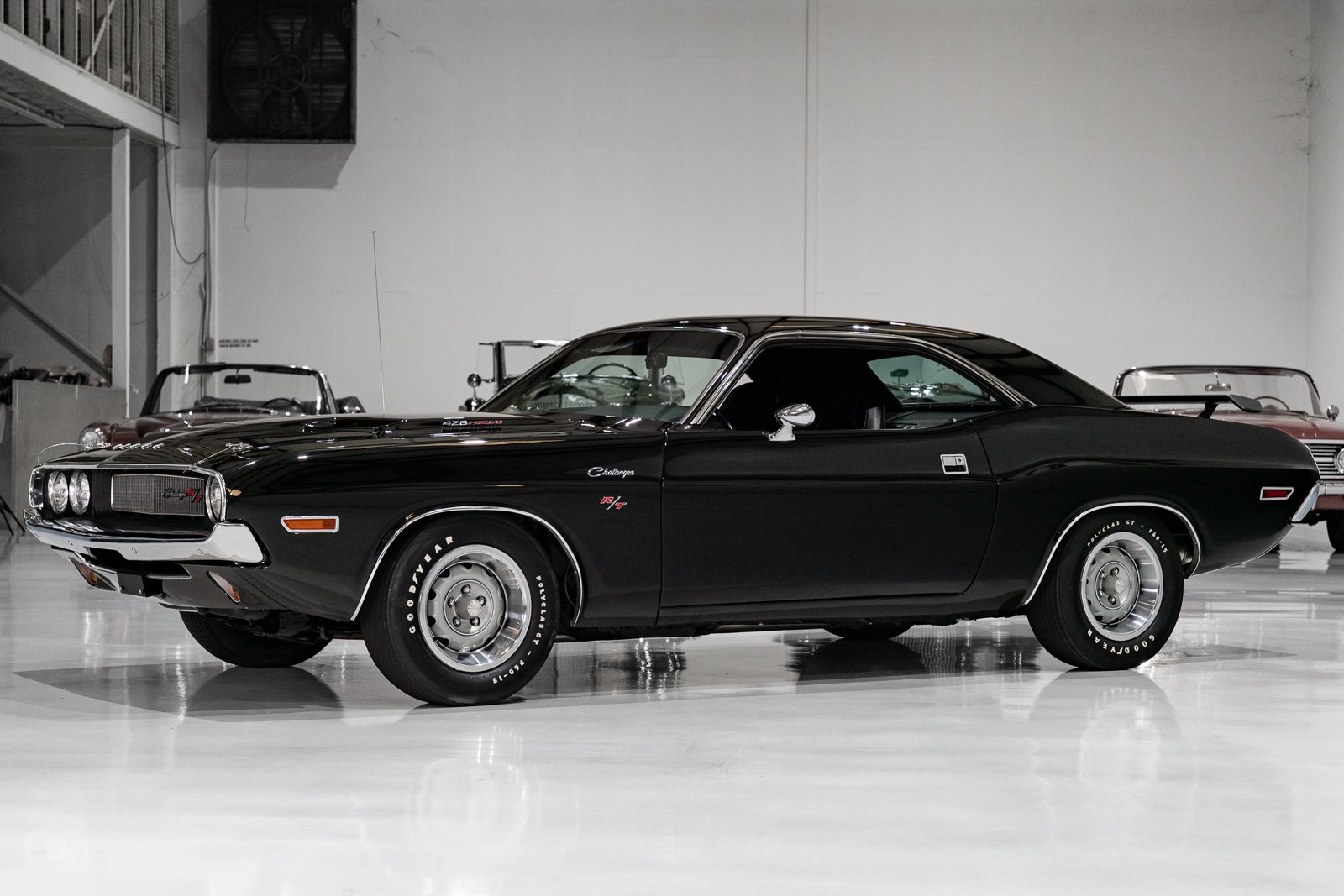
The original arrived late. Ford had created the pony-car market in 1964 and Chevrolet had answered in 1967; Dodge did not field the Challenger until the autumn of 1969, as a 1970 model, just as the muscle market was about to be hit by insurance surcharges, emissions rules and, a few years later, fuel crises. That lateness shaped everything. Chrysler's E-body platform was shared with the Plymouth Barracuda, but the Challenger rode on a longer 110-inch wheelbase against the Barracuda's 108, and Dodge used the extra length to give the car a more formal, more grown-up stance: longer doors, a broader rear seat claim, and sheet metal that reads as a scaled-down intermediate rather than a compact with a long hood. The styling — long hood, short deck, a full-width grille and those deeply set headlamps — was clean when new and has aged into one of the defining shapes of the era.
What made the Challenger different from a Mustang was choice. Because it was a Chrysler, it could be ordered with almost the whole corporate engine shelf, from a slant-six economy coupe your aunt could drive to a 426 Hemi car that was effectively a drag engine in a street body. That spread is why, fifty years on, two cars that look nearly identical in a listing photograph can be entirely different machines with entirely different running costs, parts needs and ownership experiences. On a Challenger, the badge, the VIN and the fender tag matter more than the silhouette.
The first generation lasted only five model years, and its arc is the familiar muscle-car arc in compressed form. Nineteen seventy was the peak — the full engine list, the R/T performance line, a convertible, the one-year-only T/A homologation special. Nineteen seventy-one kept most of the hardware with a revised face. From 1972 the big-blocks and the convertible were gone, compression fell, power ratings switched from gross to net figures that made the decline look even steeper, and by 1973–74 the car was a 318 or 360 coupe with big safety bumpers, sold into a market that had moved on. Production ended after 1974. The best cars, and almost all of the collector money, sit in the first two years — a fact the listings reflect: in our own pool of 101 Challengers, 46 are 1970 cars and another 20 are 1971s, against just 21 cars for 1972 to 1974 combined.
The 1978 revival deserves a sentence so you can place it: Dodge rebadged the Mitsubishi Galant Lambda — a rear-wheel-drive Japanese coupe with 1.6- and 2.6-litre fours — as the Challenger. No V8 was ever offered and no part interchanges with an E-body; judge one as an obscure captive import on condition and originality, not as a cheap route into the name.
The modern car was previewed by a concept at Detroit in 2006 that was, essentially, the 1970 car redrawn at larger scale, and it reached showrooms for 2008 in a single form: the SRT8, with a 6.1-litre Hemi, built in limited numbers. From 2009 the range filled out downwards with V6 and 5.7-litre R/T models, and from there the story is one of continuous escalation — a bigger naturally aspirated Hemi in 2011, a thorough 2015 refresh with an eight-speed automatic and a much better interior, and then the supercharged years: Hellcat, Widebody, Redeye, the drag-strip Demon of 2018 and, as a final act in 2023, the Demon 170. Production ended in December 2023, closing a fifteen-year run that made the Challenger, improbably, both a mainstream rental-fleet coupe and the horsepower king of the entire industry. Fourteen of the cars in our pool are modern cars, spread from 2009 to 2023 — a minority next to the classics, but a fast-growing one as the last-of-the-line cars become collectible in their own right.
Two threads run through both generations. Condition and documentation separate the cars far more than mileage does: a classic's value lives in its unibody and its numbers, a modern car's in its service history and freedom from hard use. And the Challenger was always the big, comfortable choice in its class — roomier and heavier than a Mustang. Buy it for that character and you will love it.


The models
Read this section as two ranges separated by thirty-four years. Within each range the logic is the same — a base car, a performance line, and a small number of specials that carry the collector premium — but the names move around, and on the modern cars the badge on the fender is a trim-and-engine package that changed almost yearly. The table gives the cars that matter; the text after it explains the ones a table cannot.
| Model | Years | Engine | Output | Built | Character |
|---|---|---|---|---|---|
| Challenger (base) | 1970–1974 | 225 six / 318 V8 | 145 / 230 hp (gross, 1970) | The bulk of about 77,000 cars in 1970 alone | The honest coupe; sixes rare now, 318 cars are the drivers |
| Challenger R/T | 1970–1971 | 383 / 440 / 426 Hemi | 335–425 hp (gross) | A minority of production; Hemi cars in the hundreds | The muscle flagship; verify everything |
| Challenger T/A | 1970 only | 340 Six Pack | 290 hp (gross, underrated) | About 2,400 | Trans-Am homologation special; one year only |
| Challenger Rallye | 1972–1974 | 318 / 340 / 360 | 150–245 hp (net) | Small and falling yearly | The performance name after R/T; 340/360 cars are the sleepers |
| Challenger (import) | 1978–1983 | 1.6 / 2.6 four | 77–105 hp | Modest US sales | Mitsubishi captive import; a curiosity, not a muscle car |
| Challenger SE / SXT | 2009–2023 | 3.5 V6, then 3.6 Pentastar | 250–305 hp | High volume | The modern base car; GT adds all-wheel drive from 2017 |
| Challenger R/T | 2009–2023 | 5.7 Hemi V8 | 372–375 hp | High volume | The everyday V8; the modern range's centre of gravity |
| Challenger SRT8 / SRT 392 | 2008–2018 | 6.1, then 6.4 Hemi | 425–485 hp | Limited in 2008, then regular | The big naturally aspirated car; Scat Pack is its value twin |
| Challenger R/T Scat Pack | 2015–2023 | 6.4 Hemi (392) | 485 hp | Strong seller | SRT engine without SRT pricing; the driver's pick |
| Challenger SRT Hellcat | 2015–2023 | 6.2 supercharged Hemi | 707–717 hp | Thousands, not hundreds | The horsepower war made metal; Widebody from 2018 |
| Challenger SRT Demon | 2018 only | 6.2 supercharged, drag-tuned | 840 hp on race fuel | 3,300 | Single-year drag special; documentation is everything |
| Challenger SRT Demon 170 | 2023 only | 6.2 supercharged, E85 | 1,025 hp | About 3,300 planned | The final car and the fastest; a collector asset first, a car second |
(Outputs for 1970–71 are period gross ratings, for 1972 onward net ratings — the two systems are not comparable, which is why a 1974 360 at 245 net horsepower is a stronger engine than the bare number suggests next to a 1970 318 at 230 gross. Production figures are given only where they are genuinely established; for most mainstream variants the honest answer is that trim-level splits were not consistently published, and any seller quoting you an exact build count for an ordinary variant should be asked for his source.)
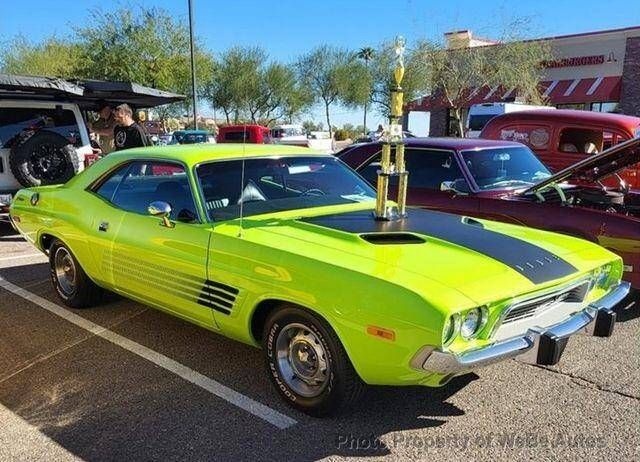
The base classics, 1970–74. The standard Challenger was a hardtop coupe (a convertible was also offered in 1970–71, and is now one of the most sought-after body styles in any specification). Most base cars left the factory with the 318; the 225 six cars are now so often engine-swapped that a surviving original six is a curiosity. The SE — Special Edition, 1970–71 — was a luxury package, not a performance one: a smaller rear window in a padded vinyl roof panel, an overhead console, leather-faced seats. Do not let a seller price an SE as if it were an R/T; the badges mean opposite things. From 1972 the performance badge became Rallye, and the Rallye 340 (1972–73) or 360 (1974) is the connoisseur's late car: nearly the early car's real-world pace, a fraction of an R/T's price, and far less likely to have been cloned.
The R/T and the specials. R/T — Road/Track — was the performance line for 1970–71, standard with the 383 Magnum and optional with the 440 Magnum, the 440 Six-Pack and the 426 Hemi. Everything about an R/T needs verification, because the premium invites fabrication: the VIN's second character and engine code, the fender tag, and ideally the broadcast (build) sheet are the evidence, covered in the inspection section. The T/A of 1970 was built to legalise the car for SCCA Trans-Am racing: a 340 with a six-barrel induction setup on an Edelbrock manifold, a matte black fibreglass hood with a functional scoop, side-exit exhausts ahead of the rear wheels, staggered tyre sizes and fast-ratio steering. It is the best-handling classic Challenger by a wide margin and the only one that was ever meant to go round corners.
The modern range. The modern hierarchy is a ladder you climb by engine. The V6 cars (SE, then SXT) are handsome daily transport — and from 2017 the GT put all-wheel drive under the V6, the only AWD muscle coupe ever offered, which makes it a distinct buy rather than a poor relation. The R/T's 5.7 is the traditionalist's car. The 6.4-litre cars split into the SRT 392 (adaptive suspension, bigger brakes, more equipment) and the Scat Pack (the same engine in a plainer car for markedly less money) — same straight-line car, different proposition. Above them the supercharged cars form their own market: Hellcat, Widebody, the 797-horsepower Redeye, and the two Demons, which are drag cars with number plates and should be bought as you would buy a race car, on paperwork and provenance.

Engines and gearboxes
The classic six and small-blocks: slant-six, 318, 340 and 360
The base classic engine is the 225 cubic inch slant-six, Chrysler's famously durable inclined six. It will run almost forever on neglect, it will not make a Challenger feel like a muscle car, and its real significance today is negative: a six-cylinder VIN under a car wearing a V8 is the classic clone tell, because swapping a V8 into a six car was always easier than restoring one. The 318 LA small-block is the default classic Challenger engine — a mild, torquey, understressed V8 with a two-barrel carburettor in most cars, happy on regular fuel, cheap to service and entirely adequate for how these cars are actually driven now. Parts are everywhere and everything about it is known. If you want a classic Challenger to use rather than to show, a good 318 car is not a compromise; it is the sensible specification.
The 340 is the enthusiast's small-block and a genuinely different engine: high compression in 1970–71, a forged crank in the early cars, big-valve heads and a real appetite for revs. The standard 340 carried a four-barrel Carter; the T/A version carried three two-barrel Holleys on an Edelbrock intake — the Six Pack setup — rated at 290 gross horsepower and widely understood to be underrated for insurance and racing reasons. From 1972 compression fell and from 1973 the 340 was replaced during 1974 by the 360, a longer-stroke, low-compression engine that makes its power as torque. A 360 car is a pleasant driver; a 340 car is a collector specification. The small-block failure pattern is age rather than design: oil leaks from every gasket surface, worn timing chains (a slack chain retards the cam and makes an engine feel tired in a way owners misdiagnose as carburation), and flat lifters ticking at start-up. Carter carburettors deserve their own sentence: a warped or cracked Thermoquad plastic main body causes fuelling faults no rebuild kit cures, and Thermoquad specialists exist because generalists keep missing it.
The classic big-blocks: 383, 440 and the 426 Hemi
The B- and RB-series big-blocks are the R/T's reason for existing. The 383 Magnum (335 gross horsepower, standard in the R/T) is a strong, simple, iron engine with a single four-barrel — the sweet spot of the big-block range, nearly as quick in a street car as a 440 and generally cheaper to buy and to rebuild. The 440 Magnum (375 gross horsepower) adds torque everywhere; the 440 Six-Pack, with three Holley two-barrels, was rated at 390 and is the connoisseur's big-block — superb when the linkage and the vacuum-operated outboard carburettors are set up by someone who knows them, maddening when they are not, and a setup job to budget for rather than a Saturday adjustment. All the big-blocks share the same ownership truths: they are heavy (the car's handling and front tyre wear show it), they run hot in traffic if the cooling system is marginal, exhaust manifold bolts seize and snap, and their appetite for fuel is in the high single figures to low teens per gallon. None of that is a reason to avoid one. All of it is a reason to buy the best-documented one you can find.
The 426 Hemi is a separate subject. The Gen II Hemi — hemispherical combustion chambers, two rocker shafts per head, a cross-bolted block, 425 gross horsepower by the factory's famously modest rating — was a racing engine sold for the street to keep it legal for NASCAR and drag racing. In a Challenger it is rare (hundreds of cars across 1970–71), valuable, and demanding: solid-lifter valve clearances to maintain on the early specification, a dual four-barrel induction system to keep in tune, a prodigious thirst, and a parts economy in which Hemi-specific components cost multiples of their wedge-engine equivalents. A Hemi rebuild by a recognised specialist is a five-figure job before anything exotic is found, and the engine's value is inseparable from its numbers — the partial VIN stamping on the block is as much a part of the car as the engine itself. Buy a Hemi Challenger the way you would buy a painting: provenance first, condition second, price third. The inspection section gives you the checks in order.
The modern engines: Pentastar V6, the Hemi revival and the supercharged cars
The modern range starts with sixes: the 3.5-litre SOHC V6 of 2009–10 (250 horsepower, the weak point of the early modern range — adequate, uncharismatic, and the engine that makes early modern cars cheap) replaced for 2011 by the 3.6 Pentastar (305 horsepower), a thoroughly modern all-aluminium V6 that suits the GT's all-wheel-drive brief and gives a modern Challenger entirely respectable pace with far lower running costs than any V8. Pentastar ownership points are known and manageable: oil cooler housing leaks in the valley of the engine, and on high-mileage cars, rocker and lifter wear that announces itself as a tick. Neither is a walk-away; both are price adjustments.
The modern Hemis are the heart of the range. The 5.7 Eagle (from 2009, 372–375 horsepower) is the workhorse — and the engine with the modern range's best-known fault: on automatic cars, the Multi-Displacement System that shuts down four cylinders under light load is implicated in the lifter and camshaft wear that owners call Hemi tick when it goes beyond the normal injector and exhaust-manifold noises. Learn to separate the three ticks before you view a car: a manifold leak ticks cold and fades as the manifold expands; injector tick is light, even and harmless; a failing lifter is a heavier, rhythmic tap that follows rpm and does not fade warm. A cam-and-lifters job on a 5.7 is a four-figure repair with parts and labour, and it is the single most valuable thing to listen for on a test drive. The 6.1 of the 2008–10 SRT8 (425 horsepower, no MDS, a forged crank) is the purest of the modern naturally aspirated engines; the 6.4 Apache that followed (470, then 485 horsepower) adds real pace and, in the SRT 392, the adaptive suspension that makes the big car feel keyed-in. Automatic 6.4s also carry MDS and the same lifter conversation as the 5.7; manual 6.4s do not.
The supercharged 6.2 Hellcat engine (707 horsepower at launch in 2015, more in later and Redeye tune, 840 in the Demon on race fuel, 1,025 in the Demon 170 on E85) is a different ownership category: an iron block, a 2.4-litre (later 2.7-litre) supercharger, forged internals — and service items to match, from supercharger drive and bearing wear that presents as a whine beyond the normal one, to intercooler coolant pumps, to the simple fact that a 700-plus-horsepower car consumes rear tyres, brakes and fuel at a rate that surprises owners arriving from a 5.7. The two-key system is a useful inspection tell: the car limits itself to about 500 horsepower on the black key and releases full power only on the red key — a seller who can only produce one key is telling you something about the car's life, and a full-power test should be done on the red key, with permission, or not at all.
Gearboxes: TorqueFlite and A833, then the modern automatics
Classic Challengers offer three gearboxes and the choice matters. The TorqueFlite automatic — the heavy-duty 727 behind big-blocks and the lighter 904 behind small-blocks and sixes — is one of the strongest automatics ever made, changes cleanly when healthy, and is cheap by classic standards to rebuild (budget roughly $1,800–3,500 for a quality rebuild with labour). Slipping on the 2–3 change, a long delay engaging drive or reverse from cold, and dark, burnt-smelling fluid are the warnings; a TorqueFlite that changes well and has clean fluid will usually keep doing so. The A833 four-speed manual is the enthusiast's box, with the Hurst shifter — the famous Pistol Grip from 1970 — and it is strong, notchy and honest; judge it on second-gear synchromesh, on whether it jumps out of gear on the overrun, and on clutch judder. The three-speed manual fitted to base cars is a poverty specification then and now. Column-shift automatics exist and are worth no premium and no penalty — it is the same gearbox wearing different furniture.
Modern cars divide by era. Early cars use a five-speed automatic (a Mercedes-derived unit behind the V8s) that is durable but dates the experience, or a six-speed Tremec manual on R/T and SRT cars — the manual to have, with a heavy clutch. From 2015 the eight-speed TorqueFlite (a ZF 8HP under licence) transformed the range: faster, more economical and reliable, it is the automatic to choose. On any modern car, a gearbox service history is worth money, because both automatics were sold in the era of sealed-for-life claims that experienced owners ignore.

Problem areas
Of the 101 Challengers we track, we have examined the sellers' photo sets in detail for 65 cars. Damage of some kind was noted in 19 of those 65 — nearly three in ten — and rust was specifically mentioned in 9. Read those numbers the way they were measured: they count what photographs show, and photographs flatter. Sellers shoot the tops of cars, not the undersides, and on the classic cars the underside is where the money goes. Treat the photo evidence as a floor, not a ceiling, and work through this section in the order it is written: structure first, then the systems that make a structurally sound car expensive.
Rust and the unibody: the classic map
The E-body is a unibody — there is no separate frame to save a rotten car — and it rusts in a predictable map that follows water and trapped mud. Work it in this order.
Trunk floor and rear quarters. The rear window channel leaks, the trunk seal leaks, and the water settles in the trunk floor and the lower rear quarters, which then rot from the inside out, taking the drop-off panels and the valance with them. Lift the trunk mat and the spare on every car, press along the floor seams, and look at the quarter panels from inside the trunk with a torch. Bubbling low on a quarter behind the wheel is almost never just the skin. Trunk floor and quarter work is panel replacement and paint — budget roughly $2,000–5,000 a side for quarters done properly with metal, not filler, and understand that a car needing both sides and a trunk floor is a restoration project whatever the listing calls it.
Floors, cowl and front structure. Windshield leaks and wet carpets rot the front floor pans; leaves in the cowl rot the cowl sides and the lower firewall; and the front of the car hangs its torsion-bar suspension from a crossmember and frame rails that are structural in a way a bolt-on subframe is not. Front frame rail and torsion-bar crossmember rot is the classic Challenger's most serious repair — fabrication-grade work, priced per car, and the one finding that should end a viewing of anything except a genuinely rare variant. Check also the K-frame (the engine cradle) for rust and for cracking around the steering box mount, the inner front fenders and battery tray area, the rocker panels along their full length, the door bottoms (drain holes block, doors fill with water — run a fingertip along the bottom edge and feel for bubbling), and the Dutchman panel between the rear window and the trunk lid. Fresh, uniform underseal blown over everything the week before a sale is a cover-up until proven otherwise; factory coatings after fifty years look honestly patchy.
The modern comparison. Modern Challengers do not rot like the classics, but they are not immune: check the rear subframe and its mounts on northern cars, the sills and jacking points on anything that has lived on salted roads, wheel-arch lips, and — on cars that have sat — brake and fuel lines. A rusty modern Challenger is usually a northern, high-mileage, cheap car, and the correct response is to buy a southern one instead; the supply is large enough that you never have to accept structural corrosion on a modern car.
Suspension, steering and brakes
The classic front suspension is Chrysler's torsion-bar system: longitudinal torsion bars instead of coil springs, upper and lower control arms, and a ride height set by adjusting the torsion bars — which is also why so many cars sit wrong. A nose-down or uneven classic is often an afternoon's adjustment rather than a fault, but check why it was left that way. Worn ball joints, idler arm and tie-rod ends give the vague, wandering steering owners describe as character; it is wear, and a front-end rebuild with quality parts is roughly $1,200–2,500 fitted. Torsion bars themselves rarely fail, but their crossmember anchors are in the rust section above for a reason. At the rear, leaf springs sag, shackles and bushings perish, and axle tramp under power is the system's honest limitation. Brakes: front discs were standard on performance cars and optional elsewhere, drums all round on base cars; a full hydraulic refresh on a car that has sat — master cylinder, calipers or wheel cylinders, hoses, hard lines where corroded — runs roughly $900–2,000 with labour, and should be assumed on any long-stored car until invoices prove otherwise.
Modern cars wear their weight. At over 4,000 pounds even in V6 form, a modern Challenger consumes front suspension components, wheel bearings and brakes at a rate that shows up from about 60,000 miles: listen for front-end clunks over broken pavement (tension struts and control arm bushings are the usual bill), feel for steering shimmy under braking, and price the big Brembo brake packages on SRT and Scat Pack cars before you buy — a full set of rotors and pads on a Brembo car is a four-figure parts bill, not the few hundred dollars a base car's brakes cost. Adaptive dampers on SRT cars are excellent and expensive; a car with a damper warning or a set replaced with cheap passive units has lost part of what you are paying for.
Identity, clones and paperwork faults
This is the problem area that costs classic Challenger buyers the most money per incident, and it is a paperwork problem, not a mechanical one. The price spread between a base 318 car and a genuine Hemi R/T is so large that cloning is an industry. The defences are built into the car. The VIN (on the dash plate, visible through the windshield, and stamped elsewhere on the body) carries the model and engine codes: the second character distinguishes a base car from an R/T (H for the high-class line against L or M for lesser lines in 1970), and the fifth character is the engine — U for a 440 Magnum, V for a 440 Six-Pack, R for a 426 Hemi, H for a 340, G for a 318, C for the slant-six. A car wearing Hemi badges whose VIN fifth character is not R is not a Hemi car, whatever has been bolted into it since. The fender tag under the hood carries the option and colour codes — a missing tag on a supposedly premium car is a serious question, and a reproduction tag fitted to support a story is a known practice, so read a tag's age and rivets as carefully as its codes. The broadcast sheet, often tucked in the seat springs, door panels or above the glovebox, is the strongest single document. Numbers-matching on a Mopar means the partial VIN stamped on the engine block pad and the transmission case agrees with the car's VIN; on a six-figure car, pay a marque specialist to verify all of it before money moves, because the fee is trivial against the spread it protects.
Modern cars have their own version: title washing on flood and salvage cars, Hellcat and Scat Pack badge engineering on lesser cars (the VIN decodes the original engine — check it, because a widebody kit and badges bolt onto a V6 just as easily), odometer inconsistencies against service records, and theft history — modern Challengers, especially the supercharged cars, are heavily targeted for theft, and a car with replaced ignition or door-lock hardware, a reprogrammed key situation or gaps in its key count deserves hard questions. Run the history reports, decode the VIN, and count the keys: two keys, including the red one on a Hellcat, is the standard to expect.
Engines in service: wear, leaks and the faults that hide
Beyond the engine-by-engine notes above, the cross-range patterns are these. Classic cars that have sat — and many have, for years at a time — need the fuel system cleaned end to end before anything else is judged: modern ethanol fuel attacks old rubber, varnish blocks carburettor passages and fuel pickups, and a car that runs badly after storage is usually describing its fuel, not its engine. Budget roughly $800–2,000 to recommission a stored classic's fuel and brake systems properly. Oil leaks on classic cars are universal and mostly gaskets; the leaks that matter are the rear main seal (an engine-and-gearbox conversation) and any leak onto exhaust manifolds, which is a fire risk, not a cosmetic one. Overheating in traffic on big-block cars is a cooling-system verdict — radiator capacity, fan clutch, shroud, water pump — and a car that cannot idle in a queue is not ready to be driven home. On modern cars, add water pumps (a known 5.7 and 6.4 service item), alternators, and on the supercharged cars the supercharger drive and intercooler system already described; a Hellcat with a noisy supercharger at idle is pricing a major component into the deal, and the correct move is to have the noise diagnosed by name before you negotiate, not after.
Interior, trim and electrics
Classic Challenger interiors suffer sun and time in a fixed order: dash pads crack (a reproduction pad is available, fitting is fiddly, budget $600–1,200 supplied and fitted), seat vinyl splits at the seams and the foam beneath it collapses, headliners sag, and the Rallye instrument cluster's gauges and the standard cluster's ammeter both give trouble — the ammeter in particular is a known weak point in Chrysler wiring of the era, with connections that loosen, heat and, in the worst cases, scorch the bulkhead connector. Any classic with intermittent electrics, a melted-looking bulkhead plug or a dashboard that smells hot should have its wiring inspected before its gauges are blamed. Bright trim and chrome are reproduced for the popular years; 1970 one-year-only pieces — grille, tail panel details, T/A components — are the expensive exceptions, and a T/A missing its correct hood, air cleaner or side exhaust is missing a meaningful part of its value.
Modern interiors wear better but date faster: the pre-2015 cabin is plain and hard-plastic, seat bolster wear is the standard mileage tell, and Uconnect screens delaminate on late-2010s cars — a bubbling, ghost-touching screen is a replacement unit, roughly $800–1,500 fitted, not a software update. Test every electrical consumer on both generations: windows, locks, lights, wipers, blower on all speeds, air conditioning actually blowing cold, and on modern cars the drive modes and adaptive systems, because a warning light is a diagnostic session you are buying along with the car.

How to inspect one
Allow ninety minutes for a classic, an hour for a modern car, and bring a torch, a cloth-wrapped magnet, a tyre tread gauge and — for a classic — a friend to work the pedals and lights while you walk around. Do the steps in order: the early ones can end the viewing cheaply, and on a classic the paperwork step comes first because no condition of body or engine can rescue a car whose identity is wrong.
- Start with the paperwork and the numbers. Match the title VIN to the dash plate. On a classic, decode the fifth character (the engine) and the second (the model line) and compare them with the badges the car wears; find the fender tag, read its colour and option codes against the car in front of you, and ask directly whether a broadcast sheet exists. On a premium classic — any R/T, any Hemi or Six-Pack car, any T/A, any convertible — ask for the engine and transmission stampings to be shown to you, or budget a specialist verification. On a modern car, decode the VIN the same way, run the history reports, and count the keys.
- Cold start, from outside the car. Insist the engine is cold. Stand at the rear and watch the exhaust as it fires: a puff of blue that clears is valve seals on a classic; continuous blue smoke is rings; white vapour that smells sweet and does not clear is coolant, and that ends the viewing until it is explained. Listen from cold for the modern Hemi's ticks and separate them as the engine section describes — manifold (fades warm), injector (light and even), lifter (heavy, rhythmic, stays).
- Under the hood, systematically. On a classic: oil on the dipstick (level, colour, smell of fuel), coolant colour, brake fluid, evidence of leaks baked onto manifolds, the state of hoses and belts, and whether the wiring is factory or a biography of previous owners. On a modern car: the oil cooler valley on a Pentastar for leaks, the supercharger on a Hellcat for noise beyond its normal whine, coolant level in both circuits on a supercharged car, and any sign of non-factory wiring, piggyback electronics or recently removed modifications.
- The structure — classics first, and it decides everything. Torch along the trunk floor with the mat and spare lifted, the quarters from inside the trunk, both floor pans from underneath, the rockers, the front frame rails and the torsion-bar crossmember, the K-frame around the steering box, and the rear spring hangers. Prod seams with a screwdriver where the seller allows. Perforation in rails, crossmember or spring hangers is structural: on an ordinary variant, walk away; on a rare one, price fabrication, not patches. On a modern car this step shrinks to subframes, sills and arch lips — and any finding sends you to a different, sounder car.
- Body and paint. Walk the car in flat light and look down each flank for ripples. Run the cloth-wrapped magnet over the lower quarters, rockers, door bottoms and around the rear window — filler announces itself by the magnet's weaker pull. Check panel gaps, door fit, and whether the colour inside the trunk and under the hood matches the colour outside: on a High Impact car, the fender tag's colour code from step 1 is the verdict, not your eyes.
- Interior and electrics, every switch. Sit in every seat; feel for collapsed foam under intact vinyl. Work every window, lock, light, wiper speed, washer, the blower on every speed and the air conditioning until it blows genuinely cold. On a classic, look at the ammeter and bulkhead connector for heat damage and smell for hot wiring. On a modern car, check the Uconnect screen for delamination, cycle the drive modes, and note every warning light that stays lit.
- Suspension and steering on the ground. Rock each front wheel top-to-bottom and side-to-side for play; bounce each corner and watch it settle in one movement. On a classic, stand back and judge stance — level, or nose-down and uneven in the way that suggests torsion bars adjusted to hide wear. On a modern car, listen later on the drive for the front-end clunk that prices tension struts and bushings; on the ground, check tyre wear patterns, because uneven fronts on a modern car are a suspension bill written in rubber.
- The test drive — fifteen minutes minimum. Include a cold start pull-away, a stretch of broken pavement, hard braking from speed (straight, no pull, no judder), and a full-throttle run where legal and safe. A classic automatic should change firmly without flaring; a classic four-speed should take second gear cleanly up and down. A modern eight-speed should be nearly invisible; a modern manual should not crunch second. On a Hellcat, test full power only on the red key, only with the seller's explicit agreement, and treat a refusal to demonstrate the car at full power as information.
- Heat and idle. After the drive, let it idle for five minutes. Watch the temperature gauge's story — a classic big-block that climbs steadily at idle has a cooling system to price; a modern car should simply sit at temperature. Recheck for the lifter tick now that the engine is hot, sniff for fuel and hot wiring, and look underneath for fresh drips on clean ground.
- Tyres, brakes and consumables — price them, do not just note them. Measure tread on all four (five, if a classic has its spare). On modern performance cars, read the brake discs and pads and price the Brembo set if they are near the end; on a Hellcat, rear tyre wear against front tells you how the car has been driven more honestly than the seller will. A car needing tyres and brakes is not a bad car; it is a car whose price must move by the cost of both.
- History and use, asked plainly. Why is it being sold, how long owned, how stored, what has been done and where are the invoices? For a classic, a thick file with a broadcast sheet is worth thousands and a story with no paper is worth nothing. For a modern car, service stamps at the right intervals and unmodified condition are the equivalent currency.
- Decide on the structure and the numbers, not the shine. On a classic, the hierarchy is: identity, structure, mechanicals, cosmetics — in that order, and a failure at any level is not compensated by excellence at the next. On a modern car it is: history, mechanical health, consumables, cosmetics. If the car passes you, pay for a lift inspection before money changes hands — on a classic it is the best money in the whole purchase, and on a modern performance car a specialist pre-purchase inspection with a diagnostic scan earns its fee the first time it finds the fault the dashboard had not yet reported.
Values
The build beneath this guide carries the live numbers — what is listed now, and the recorded-sales picture — and those figures move with the market in a way printed numbers cannot. What this section gives you is how to read them, because the Challenger market, in both generations, is one where the spread inside a single model name is wider than the spread between models, and the median for a badge is close to meaningless until you know which end of that badge's range you are looking at.
Start with the condition spread, which on the classics is really an identity-and-structure spread. A classic Challenger's value is set first by what it verifiably is — engine code, model line, body style, colour code — and second by the state of its unibody. Two 1970 hardtops that present identically in photographs can be a documented 440 R/T with a solid shell and a cloned 318 car with filler in both quarters, and the market prices them as different species, correctly. Projects sit far below drivers by more than the cost of the work between them, because the buyer of a project is also buying the risk of what the strip-down reveals; that gap is widest on the rare variants, where a Hemi or T/A project is a speculation on paperwork as much as on metal. On convertibles and High Impact colours, premiums are real but conditional — they attach to cars coded that way at the factory, and evaporate on repaints and re-bodies presented as the real thing.
Asking prices and achieved prices part company most visibly at the top of the classic market, where dealer presentation, auction theatre and one exceptional result get quoted as if they were the level. Judge a classic against recorded sales of genuinely comparable cars — same engine code, same body, same structural honesty — and treat a single headline auction result the way you would treat weather in one town. The middle of the market, the good 318 and 340 drivers, is the most honest segment: cars change hands regularly, supply is visible, and prices there mean what they say.
The modern market reads differently. Depreciation did the early work, and the end of production in 2023 has since put a floor under the desirable cars: the market now separates clean, unmodified, well-documented V8 cars — which are firm and, for the last-year and limited cars, rising — from the high-mileage, multiply-owned, modified cars that continue to soften. Mileage matters more on a modern car than on a classic, specification matters in a fixed order (engine first, then Widebody, then transmission, then options), and the Demons sit outside normal logic altogether as numbered collector assets whose value is provenance and completeness — crate, paperwork, delivery condition — more than use. On any modern car, an accident record costs more, proportionally, than the same record on a classic, because the modern buyer has hundreds of clean alternatives and the classic buyer may have three.
Negotiation reality: the seller's strongest card is documentation, the buyer's is the costed inspection. A classic offered with a broadcast sheet, matching stampings and a lift inspection already done has very little discount in it. A car with a list of identified, priced faults has exactly that much movement in it, and presenting the costs calmly moves a price further than any claim that the market is soft. There is no cheap Challenger that stays cheap: the money is spent at purchase, on the right car, or afterwards, on the wrong one, with interest.
Parts and ownership
The Challenger is two ownership propositions, and they share almost no parts, suppliers or costs. Take them in turn.
The classics. Few American cars of the era are better served. Chrysler built the E-body in volume, the restoration industry followed the money, and today the catalogue for a 1970–74 Challenger runs from service consumables to complete reproduction body shells' worth of sheet metal: floor pans, trunk floors, quarters, fenders and frames rails are all reproduced (AMD is the name you will meet most often for steel), along with interior trim, seat covers and foam, weatherstrips, glass, wiring harnesses and brightwork. YearOne, Classic Industries and a deep bench of Mopar specialists cover most of the rest, and the LA small-block and big-block wedge engines are among the best-supported engines in the world — every service part, and most performance parts, off the shelf. The expensive exceptions are predictable: genuine Hemi components, T/A-specific parts (the hood, the air cleaner assembly, the side exhaust), 1970 one-year-only trim, convertible-specific pieces, and quality chrome and grille work, where the bill is in the labour and the plating rather than the finding. Budget honestly for the first year of a classic that has been in regular use at a four-figure catch-up for deferred maintenance, and materially more for recommissioning a stored car, as the problem areas section sets out. Insurance through a classic policy, garaged and mileage-limited, is inexpensive for the car's value; fuel consumption is not — expect the teens from a small-block driven gently and single figures to low teens from a big-block driven as intended.
The modern cars. Ownership is mainstream-modern while the cars are young: service parts, filters, brakes for the standard cars, suspension components and tyres are all ordinary catalogue items at ordinary prices, and any competent independent can service a V6 or a 5.7. The costs step up with the badges. Brembo brake consumables on Scat Pack, SRT and Hellcat cars are a four-figure service event; the wide rear tyres on Widebody and supercharged cars are a recurring expense, not an accident; adaptive dampers, supercharger components and model-specific electronics are dealer-and-specialist territory, and as the cars age out of production the pattern to watch is electronic modules — screens, control units, key and security components — which go out of production years before mechanical parts do. A modern car with a full service history is not just nicer to own; it is the hedge against the one cost nobody can budget, the undiagnosed electronic fault. Extended running costs are dominated by fuel and insurance: a Hellcat in ordinary use drinks at a rate that makes a classic big-block look abstemious, and insurance on the supercharged cars reflects both their value and their theft statistics — get a quote, by VIN, before you buy, not after.
Both generations. Join the owners' world: the Mopar clubs and registers hold the decoding knowledge, the parts cross-references and the cars that never reach the open listings. Store either generation dry and on a battery tender, and keep every invoice — on the day you sell, the file you kept is part of the price you get.
Which one to buy
- The all-rounder, classic: a 1970–71 318 or 340 hardtop. The shape, the sound and the full classic experience, with the best parts support in the range and running costs a normal human can carry. A 340 car if the budget stretches, a good 318 if it does not — and in either case, the least rusty example you can find.
- The value buy, classic: a 1972–74 Rallye 340 or 360. The late cars are overlooked because the brochures lost their big numbers when ratings went net. The cars themselves are nearly as quick in the real world, far cheaper, and much less likely to be cloned or thrashed. Buy a dry-state car and you have the smartest money in this guide.
- The muscle flagship: a documented 1970–71 R/T, 383 or 440. The 383 is the driver's big-block, the 440 Six-Pack the connoisseur's. Either way, the word documented is doing the work in that sentence — verification first, as the inspection section sets out, and walk away from any car whose seller resists it.
- The collector car: a 426 Hemi or a T/A, bought on provenance. The Hemi for rarity and theatre, the T/A for being the one classic that handles. Both are paperwork purchases; specialist verification is not optional.
- The modern all-rounder: a 2015-onward R/T or Scat Pack. The eight-speed automatic, the better interior and, in the Scat Pack's 6.4, all the pace you can deploy on a public road. Unmodified, serviced, two keys — the modern mantra.
- The modern value buy: a Pentastar SXT or GT. Ninety percent of the presence for a fraction of the running costs, and the GT's all-wheel drive makes it a genuine four-season car.
- The horsepower car: a Hellcat, Widebody if you can. Bought on history and originality, insured by VIN before purchase, with eyes open about tyres, brakes and fuel. The standard car is already beyond reasonable, which is rather the point.
- The asset: a Demon or Demon 170, complete. Crate, paperwork, delivery miles, unmodified. If any of those words is missing, it is not the asset — it is an expensive used drag car, priced as one.
And the rule that overrides all of the above: buy the car whose identity and history you can verify, in the best structural or documented condition you can afford — engines, brakes, interiors and electronics can all be fixed at prices you can plan for, but a classic's rotten unibody and a modern car's hidden history are the two things no cheque makes original again.
See the 77 Challenger cars currently listed.