
Chrysler LeBaron Convertible 2D buyer's guide
Chrysler LeBaron Convertible 2D -- the model's own buyer's guide: variants, values and what to check.
Years listed: 1978-1995 · Series: LeBaron
Overview and history
This guide is about one car wearing one badge in several different bodies: the Chrysler LeBaron convertible. The LeBaron name ran from 1977 to 1995 on rear-drive sedans, front-drive coupes, wagons and hatchbacks, but the car the market actually trades in — and the car our listings are full of — is the open car. Of the 20 LeBarons we currently track for sale, spanning 1978 to 1995, the named convertibles dominate the pool, 18 of the 20 cars reach us through Facebook Marketplace sellers, and 19 of the 20 are automatics.
The name is older than Chrysler's use of it — a New York coachbuilding house founded in 1920, later the top trim of the Imperial — but those cars are a different market entirely. The LeBaron as a Chrysler model in its own right arrived in the spring of 1977 as a survival measure: a luxury name taken downmarket onto a mid-size rear-drive platform, the M-body, shared with the Dodge Diplomat — coupe, sedan and wagon, slant-six or V8, to 1981. The single 1970s car in our photo pool, a brown 1978 Medallion sedan in Burlington, Iowa, is that first LeBaron, a formal rear-drive car that shares nothing but its badge with everything that followed.
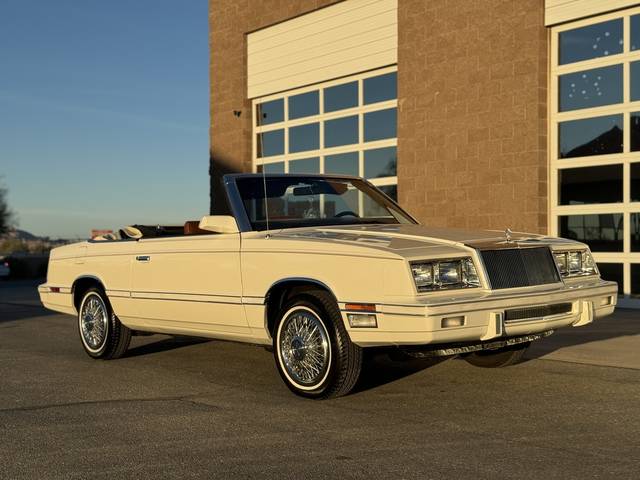
The second LeBaron is the one that changed the industry. Chrysler bet the company on the front-wheel-drive K platform under Lee Iacocca, and for 1982 the LeBaron was reborn as a compact K-car: coupe, sedan, wagon and convertible. The convertible is the landmark. The big American ragtop had been killed off in the mid-1970s, and the industry had decided the open car was finished. The 1982 LeBaron convertible — coupes converted by Cars and Concepts in the early years — proved the buyers were still there: it sold, and every other American manufacturer followed it back into the convertible business.
The third LeBaron arrived for 1987: the J-body coupe and convertible, a smooth, rounded redesign with hidden headlamps, and — crucially — a convertible engineered as a convertible from the start rather than adapted from a coupe, with a cleaner top stack and a stiffer shell to show for it. It ran through a 1993 facelift to 1995, the last year of the name. Alongside the three main acts sit three branches the listings barely touch — the GTS hatchback of 1985 to 1989, the AA-body sedan of 1990 to 1994, and the name's strangest offshoot, the two-seat Chrysler TC by Maserati of 1989 to 1991, built in Milan with a removable hardtop. None is named in our current pool. Say it plainly: the listings concentrate in the convertibles, K-body and J-body, with a thin tail of early cars, and a buyer should expect the same concentration in the wider market.
Why buy one? Because no cheaper route into open-top classic motoring gives you this much equipment: power everything, air conditioning, a proper back seat, and parts support drawn from platforms built in the millions. The catch — the whole subject of the middle of this guide — is that these cars fail by accumulation. Learn to price the little things and the LeBaron is a bargain; buy on colour alone and it is a bill with a badge on it.


The models
Place the car in its generation before you place a value on it: the generation decides the drivetrain layout, the engine family, the gearbox risk, the rust pattern and the parts shelf. The badge stayed the same for eighteen years while the car underneath changed completely, twice. Our listings carry the LeBaron under a single model line, summarised below — the convertible is the display face of the range because it is what the market supplies.
| Model | Years | Engine | Output | Built | Character |
|---|---|---|---|---|---|
| Chrysler LeBaron Convertible 2D | 1978–1995 (as listed) | 2.2 / 2.5 four, turbo fours, 3.0 V6, V8s on early cars | about 84–174 hp by version | 20 currently listed here | The core of this market: K and J-body ragtops, plus the M-body tail |
That single line hides four distinct ranges, taken in turn below. Production totals for individual LeBaron body styles were not consistently published separately from platform totals, so no built figures are quoted in this guide.
The M-body cars (1977–81). The first Chrysler LeBaron: coupe, sedan and wagon, all rear-wheel drive, on the platform shared with the Dodge Diplomat. The base engine is the 225-cubic-inch slant-six; the 318 V8 is the sensible choice; the 360 V8 appears in the early years and is thirstier without being much more rewarding. Trim climbs from base to Medallion — the 1978 sedan in our photo pool is a Medallion, the top sedan trim of its year. These are the most conventionally classic LeBarons, with a parts world shared with the Diplomat, the Plymouth Gran Fury and the later Chrysler Fifth Avenue, which carried the same platform to 1989 in fleet service. They are also the least common LeBarons in today's listings — one car in our pool of 20 — because the market's centre of gravity moved to the ragtops and never came back.
The K-body cars (1982–88). The relaunch, and the generation that made the convertible matter again. Coupe, sedan, wagon and convertible on the transverse-engine, front-drive K platform. The trim ladder runs from plain base cars up through the Mark Cross editions, and the body that defines the range is the convertible: launched for 1982, built in the early years by sending coupes to Cars and Concepts for conversion, and an immediate success. The Town and Country name appeared on the wagon and, from 1983 to 1986, on a convertible wearing simulated wood side panels — a car with no functional justification whatsoever and more period charm than anything else Chrysler built in the decade, which is exactly why survivors are sought after now. The coupe and sedan were facelifted for 1987 and ran to 1988; the wagon ended after 1988, its role eaten by the minivan. Two honest warnings about K cars. First, build quality varies car to car more than the design does — these were built in Chrysler's most cash-strapped years, so judge panel fit and water sealing on the individual car, not the brochure. Second, the early convertibles are conversions: the top frame, body reinforcement and sealing were all added to a coupe shell, and they age like conversion work — the top well, the sills and the header seal need the forensic look the problem section gives them.
The J-body cars (1987–95). The final generation and the bulk of the modern convertible market. Coupe and convertible only, styled as one smooth, rounded shape with pop-up hidden headlamps and a much more integrated open car: where the K convertible was adapted, the J-body ragtop was designed in, and it shows in the tidier top stack, the better-sealed cabin and the stiffer feel on the road. Trim runs from base and Highline through Premium and LX to the GTC. The pool carries the line across its life — a red 1987 LX convertible in Ohio, a blue 1989 car in Tennessee, and 1990, 1993, 1994 GTC and 1995 convertibles through the 1993 facelift to the end of the name. From 1990 the Mitsubishi 3.0 V6 became the main convertible engine, which means the late cars concentrate two specific risks this guide returns to repeatedly: that engine's valve-guide oil burning, and the A604 Ultradrive automatic's dependence on the correct fluid and an honest service history. A J-body convertible that passes those two tests is the easiest LeBaron of all to own; one that fails both is the most expensive cheap car in this guide. Alongside the J cars sat the AA-body LeBaron sedan (1990–94), effectively an upmarket Dodge Spirit — competent, forgotten, and now an identification trap: a seller describing a 1992 LeBaron may mean that sedan, not a J-body car.
Engines and gearboxes
There is no such thing as "the LeBaron engine": across three generations the badge sat over four engine families, and the only one that matters is the one in the car in front of you. The two you will meet most often — Chrysler's own four-cylinder and the Mitsubishi V6 — each carry one expensive, well-documented habit, and the automatic gearbox bolted to the late V6 cars has a reputation it earned. Learn those three stories and you know most of what there is to know about pricing a LeBaron.
The M-body six and V8s: slant-six and small-block
The 1977–81 cars are old-school Chrysler. The base engine is the 225-cubic-inch slant-six, canted 30 degrees so its long, low shape would fit under a lower hood line, and one of the most durable American engines ever built. It does not wear out in any way that matters to a buyer; it fails around the edges, with age. The Carter carburettor gums up and its choke sticks. Vacuum hoses perish, and a slant-six with a wandering idle is usually sucking air through a hose that costs pennies. The ignition module fails intermittently, then completely. And on 1978 and later cars there is the Lean Burn system, whose spark computer sits on the air cleaner housing and cooks in the heat there: the classic presentation is a hot no-start, or a cut-out that recovers once the car cools. So many owners bypassed Lean Burn for a conventional module that finding it already done is a point in a car's favour. Oil leaks come from the rocker cover and distributor seal; blue smoke on start-up is usually valve stem seals, a weekend job. Buy a slant-six for smoothness, honesty and parts prices, not speed.
The V8s are the 318 and, in the first years, the 360, both small-blocks in mild two-barrel tune. The 318 is the one to have: tough, torquey, quiet, and supported by one of the deepest parts networks in the hobby. Its failure modes are textbook. The carburettor gums and the choke sticks. The ignition module and the ballast resistor fail — the resistor is the classic roadside strand, a small ceramic part whose failure stops the car dead and whose replacement takes minutes, which is why experienced owners carry a spare. The water pump weeps before it fails. The timing chain stretches: a chain that rattles on a cold start is a tired timing set, and the sensible job is chain, gears, front seal and water pump together, roughly $600–1,100 fitted. A rear main seal leak is a gearbox-out job, so a car dripping from the bellhousing is priced with that labour in mind — but check first that the drip is not oil from the top of the engine running down, because it very often is. The 360 is thirstier and was dropped early; in a LeBaron the 318 is the better proposition in every way that costs money.
The Chrysler four: 2.2 and 2.5, naturally aspirated and turbo
The K and J cars run on Chrysler's own overhead-cam four-cylinder family: the 2.2-litre, introduced in 1981, and its stroked 2.5-litre sibling from 1986. The base 2.2 made about 84 horsepower in its earliest forms, rising to roughly 93–97 horsepower in later tune; the 2.5 made about 100 horsepower. Be honest about what that means in a convertible with an automatic: adequate, unstressed, cheap to keep — and slow. A base 2.5 automatic ragtop will be busy and vocal on a freeway on-ramp — if that will bother you, buy a turbo car or a V6 car.
The engine itself is durable; the failures live around it. Oil leaks are chronic at this age and arrive in sequence: valve cover gasket, oil pressure sender, distributor seal, cam and crank seals, pan gasket. The timing belt is a maintenance item with one merciful property: the 2.2 and 2.5 are non-interference engines, so a snapped belt stops the car without bending valves. You will still be at the roadside, so a belt, tensioner and water pump service is the job to buy whenever there is no receipt for one — roughly $500–800 fitted. The real engine-level risk is the head gasket. An iron block and an aluminium head expand at different rates through thousands of heat cycles, the composite gasket eventually gives up, and the symptoms are emulsion under the oil filler cap, coolant loss with no visible leak, a sweet-smelling exhaust and overheating no thermostat change cures. A head gasket replacement with a head skim runs roughly $1,200–2,000 at a shop, and it is the single most common reason a cheap K-car is genuinely cheap rather than merely unfashionable.
The turbo fours are the interesting engines, and they divide by name, so learn the names. The Turbo I, from 1984, is a turbocharged 2.2 making about 146 horsepower, without an intercooler. The Turbo II adds an intercooler and makes about 174 horsepower; it arrived in the GTS and powered the GTC. The Turbo IV, also rated about 174 horsepower, uses a variable-nozzle turbine — the nozzle area changes with engine speed, so boost arrives earlier and the flat spot between off-boost and on-boost largely disappears — and appeared in the 1990 GTC, one of the most technically ambitious American engines of its day, with special parts to match. A healthy turbo LeBaron is a genuinely brisk car; a GTC with the manual gearbox is the quickest LeBaron ever built. Buy a turbo car on boost behaviour, never on promises. The wastegate actuator must hold steady boost. The turbo must not smoke blue on the overrun (oil passing its seals) or whine like a dental drill (bearing failure). A turbo rebuild or good used replacement is roughly $800–1,500 fitted — but the expensive failure follows a neglected oil system: the turbo's small oil feed line cokes up and blocks if oil changes were skipped, the turbo starves, and a turbo job becomes an engine-out conversation. So ask for an oil-change history, look for sludge under the filler cap, and watch the boost: boost that spikes and falls away is a vacuum-line or wastegate problem; boost that never arrives is a turbo, actuator or cracked-manifold problem, and a cracked exhaust manifold is common enough that you should listen for its ticking leak, which worsens as the manifold heats. One identification check settles seller claims: the Turbo II and Turbo IV carry an intercooler and different intake plumbing from the Turbo I. The parts under the hood, not the badge, tell you which turbo a car has.
The Mitsubishi engines: 2.6 four and the 3.0 V6
Chrysler also bought engines from Mitsubishi. The first, a 2.6-litre four used in K cars from 1982 to 1985 — smooth, balance-shafted, and prone to head gaskets and oil use — is rare now in the unhelpful way: walk past one unless the car around it is exceptional. The engine that matters is the second one, the Mitsubishi 3.0-litre V6, the 6G72. From 1990 it became the main convertible engine in the J-body cars, and it powers most of the 1990s convertibles in our listings — the 1993, 1994 and 1995 cars in the pool should be assumed to be V6 cars until the hood is open. It makes about 141 horsepower and suits the convertible perfectly: smooth, free-revving, quiet, refined in a way no LeBaron four ever is. It is also home to the most expensive engine habit in this guide. The valve guides wear. On the 6G72 they are a known weak point, and as they wear, the valve stem seals can no longer hold the oil back: oil is drawn down the guides into the cylinders, most noticeably on start-up after the car has sat — a puff of blue smoke on a cold start — and at idle after a hot run. The diagnostic picture to memorise is a car that leaves a blue haze at the first traffic light after a freeway exit, then clears as you pull away. The early stage is an oil-consumption habit, a quart every few hundred miles, that owners live with. The late stage is fouled plugs, misfires and smoke that no longer clears. A proper valve-guide and seal job runs roughly $1,500–2,500, and it is the single most important price test on any 1990–95 V6 convertible. Always start a V6 car cold, let it idle hot, and watch the mirror.
Two more V6 items belong in every viewing. The timing belt: the 6G72 is belt-driven, its water pump is driven by the same belt, and unlike the Chrysler fours this is an interference engine — a snapped belt means bent valves and a head rebuild. A car with no belt receipt is a car you buy assuming the belt is overdue, at roughly $700–1,200 for belt, tensioner and pump done together. And the leaks: the distributor seal and valve cover gaskets weep oil onto the exhaust manifolds, where it burns off as a smell owners describe as character. It is not character; it is a seal kit and an hour.
Gearboxes
Every M-body LeBaron uses Chrysler's TorqueFlite three-speed automatic — the 904 behind the slant-six, the 727 or 904 behind the V8s — one of the toughest drivetrain combinations ever put in an American car. It changes firmly, engages reverse promptly, and lasts for decades on occasional fluid changes. Its failure modes are leaks (front pump seal, pan gasket, governor seal) and, on a car that has sat, a stuck governor giving late, hard shifts until it frees with use. A TorqueFlite that flares between gears, slips under throttle or takes more than a couple of seconds to engage reverse is a rebuild, roughly $1,500–2,500 at a specialist.
The front-drive cars split three ways. The K and early J cars use the TorqueFlite-derived A413 three-speed automatic: simple, durable if serviced, and the gearbox in most K convertibles. Some turbo cars carry a five-speed manual instead, and the manual GTCs are the desirable cars — judge them on clutch wear, synchromesh (second gear goes first) and a clutch that slips under boost, with a clutch job at roughly $900–1,600.
That question is the A604 Ultradrive, the four-speed fitted to the 3.0 V6 cars from 1989–90 onwards, and the gearbox that decides whether a late LeBaron is a bargain or a trap. The A604 was Chrysler's first electronically controlled four-speed, and its early years were troubled for a specific reason: it was designed around a specific fluid, Chrysler ATF+3 and later ATF+4, whose friction characteristics its clutch packs and control strategy assume. Many cars were filled with Dexron at quick-lube shops, which is chemically wrong for the box, and the wrong fluid starts the failure chain. The symptoms are unmistakable: harsh or delayed shifts, a box that slips out of gear, and the signature failure, limp mode — second gear only, no overdrive, no converter lock-up. The failure points are the solenoid pack, the input and output speed sensors, the torque converter clutch solenoid and, ultimately, the clutch packs. Costs escalate fast: a sensor or solenoid job is roughly $400–900, a full rebuild $2,000–3,500, and a rebuild by a shop that does not understand the A604 will fail again within a year. Two rules govern any A604 purchase. Pull the dipstick first: the fluid should be clean, pink-red and smelling of oil; brown, black or burnt-smelling fluid means walk away or price a rebuild. Then drive through every gear, including a hot restart, because an A604 that behaves cold and misbehaves hot is the classic presentation. A rebuilt A604 with a specialist's receipt naming the fluid is worth paying for; one with no history carries the largest single downside bill in this guide.

Problem areas
A LeBaron rarely fails in one dramatic place. It fails by accumulation — a top that leaks a little, a V6 that burns a little oil, a gearbox that shifts a little late, a sill that bubbles a little — until the little things add up to a four-figure list and the car is sold to someone who has not added them up. That mechanism is why LeBarons are cheap, and why the inspection matters more than the asking price. Work through the car system by system, in the order below, and price what you find before you fall for the paint. One caution about evidence: our photo-note sample for this pool is a single examined car, which is no basis for incidence claims, so this section makes none — everything here is the model's documented behaviour, turned into tests in the inspection section.
Rust and structure: where the water sits
The M-body cars rust like every other 1970s American sedan: at the bottom, from the inside out, wherever water and road salt collect. The critical areas are the front subframe and its mounting points — the K-frame that carries the engine and front suspension bolts to the unibody, and its rails perforate — the floor pans under the carpets, the rear spring hangers, the trunk floor around the spare wheel well, and the bottoms of the doors and the rear arches. A perforated subframe rail is structural fabrication work, priced per car, and it is the one M-body defect that can exceed the value of the car on its own. Prod the floors from underneath, with the seller's permission. Lift the trunk mat and the spare wheel. Check the inner wings around the battery tray, which rots from the top down, underneath the battery, where you cannot see it until the battery comes out. Surface rust on a floor pan is a clean, treat and seal job. Holes are a panel job, roughly $500–1,500 a side fitted — and floor rust rarely travels alone, so treat it as a marker for the whole shell.
The front-drive cars have a different map, and the convertible conversion redraws it again. The K and J bodies left the factory better protected, and a garaged ragtop from a dry state can be remarkably clean underneath. But start at the sills anyway. On a unibody car the sills are structural; on a convertible they are reinforced, because they carry loads the roof would otherwise share; and they rot from inside when their drain holes block. Press hard along the full length, look for bubbling behind the front wheel arch and ahead of the rear wheel, and be suspicious of fresh black underseal applied the week before a sale. Next, the floor pans, and on a convertible lift the carpets expecting water damage: a leaking top or windshield seal fills the footwells, the underlay holds the moisture against the steel, and the pan rusts quietly under a carpet that feels dry from above. Then the trunk, and on a K convertible the well the top folds into. That well collects every drop that gets past the rear window and the boot seal, hidden under the folded top and its liner, which is precisely why sellers' photographs never show it. Rust there is a convertible-specific repair, roughly $400–1,000 to cut out and weld, and it is one of the first places to look on any ragtop. Finally, the strut towers: they carry the MacPherson struts, they are loaded and structural, and perforation around the top mount is a serious defect, not a cosmetic one — on a cheap car it is a walk-away.
The convertible top, seals and water management
Budget for the top as a system with a service life, because it has one: fifteen to twenty years for the fabric or vinyl, whether the car is driven or not. The material shrinks, cracks at the fold points, the stitching rots in the sun, and the rear window — plastic on the K cars, glass on later J cars — clouds, yellows and splits along the fold. A replacement top fitted professionally runs roughly $1,200–2,500 depending on material and on whether the rear window and headliner are included, and a cheap top fitted badly will leak and flap from the first day. The frame is the hidden cost: a linkage of pivots and bows that wears at its joints, and a frame that has been forced or bent will never align the top to the windshield header properly again, no matter how new the fabric is. Operate the top slowly and watch for the frame's symptoms — a side that lags, a bow that does not fold flat, a latch that needs pulling down by hand. Those are frame symptoms, not fabric symptoms, and they are priced differently. The J-body power top adds hydraulics: a top that moves slowly or unevenly is usually low fluid, a leaking cylinder — roughly $300–600 a cylinder, rebuilt or replaced — or a tired pump motor. Look for fluid staining in the top well and the trunk, where a leaking cylinder announces itself first.
Seals are the other half of the system: perishable rubber asked to do an impossible job against wind and water at speed. The header seal across the top of the windshield, the side rail seals above the windows and the top-well seal all harden and shrink with age, and a convertible that leaks in a car wash will leak in the rain — onto the seats, into the footwells and down inside the door bottoms, where standing water rots the door from the inside out. Replacement seal sets are available from the convertible-top trade at roughly $300–700 for a set; fitting them is fiddly rather than skilled. Check the door glass alignment while you are there: on a frameless-glass convertible the window must meet the seal exactly, and a dropped or worn regulator leaves a gap no new seal will close. The Town and Country convertible adds one more water trap, unique to it: the simulated wood panelling is applied trim over the standard body, water gets behind it and sits against the steel, and bubbling paint at a panel edge means the steel underneath needs to be seen before you price the car — the panel has to come off to repair what is behind it.
Engines in service: smoke, leaks and cooling
The V6's valve-guide oil burning, covered in the engine section, is the cost that defines the late cars: price the head work into your offer, and do not let anyone tell you an oil additive cured it — no additive re-makes a worn guide. The fours smoke for different reasons, and the distinction prices the car: blue smoke under load is usually rings and bore wear, an engine-out conversation; smoke on start-up only is valve stem seals, roughly $400–800 as a repair. A four that loses coolant, runs hot in traffic and shows emulsion under the oil filler cap is telling the head gasket story — and the cooling system is usually a co-conspirator. The radiator's plastic end tanks crack, its core blocks, the thermostat sticks, and the electric fan switch fails so the fan never cuts in, which is why these cars overheat in traffic and behave at speed. The heater core weeps coolant into the passenger footwell and mists the windshield with a sweet-smelling film; replacing it is a dashboard-out job at roughly $800–1,400 fitted. Watch the temperature gauge on a long idle, because the pattern diagnoses the system: creeping toward hot at idle and cooling at speed means fan or radiator; heating at speed means head gasket, water pump or blocked core. Different bills — and the gauge tells you which one you are buying.
Oil leaks: every LeBaron leaks a little, and the questions are how much, and from where. Valve cover gaskets, cam and crank seals, the V6 distributor seal, the oil pressure sender and the pan gasket are cheap parts with very different labour — a sender is a small fix, while a rear main seal is a gearbox-out job at $800–1,400 in repair cost. Learn the classic misdiagnosis: a leak from the top of the engine that drips off the bellhousing is routinely condemned as a rear main seal, and the cure is a gasket at the top, not a gearbox on the floor. A freshly steam-cleaned underside means leaks hidden, not leaks fixed.
Electrics, instruments and the accessories that sell the car
A LeBaron was sold on equipment, and at thirty to forty-five years old every accessory is a cost item — with one useful reverse: a car where everything electrical works has usually been maintained by someone who cared, the best single predictor of the rest of its condition.
Start with the headlamp doors on a J-body car, driven by an electric motor and linkage. Their failure modes have names among owners: a door that will not rise, a door that rises and falls back, a door that cycles on its own — the winking car — and doors out of sync. The causes are worn linkage bushings, a failing motor gear and corroded connections; parts are increasingly a used or rebuilt proposition at roughly $150–400 a side in repair cost. A car presented with one door permanently up has usually had its linkage disconnected to hide the fault, so check both doors are connected and cycle them several times. Power windows matter doubly on the convertibles, for the alignment reason given above: a slow window is a tired motor or a dry regulator; a window that drops into the door is a broken regulator or cable, at roughly $250–500 a side fitted as a repair. The electronic instrument clusters on upmarket K and J cars fail by going dim, losing segments or going dark; rebuilt clusters exist through the specialist trade at roughly $300–600 exchanged as a repair cost, and a dark cluster on a car sold as low-mileage is a reason to disbelieve the mileage. Air conditioning is a system, not a part: these cars were built for R12, most survivors have been converted to R134a with varying competence, and a conversion done without changing the seals, drier and oil will leak and underperform for as long as you own it. A full recommission runs roughly $800–1,800 in repair cost, so cold air on the test drive is worth real money and warm air is a priced defect, not a regas. Work every switch and write down every failure as you go; the accessory list is where a cheap LeBaron quietly becomes an expensive one. One convertible-specific trap: a car that has sat with a leaking top will have corroded fuse-box and ground connections, and intermittent faults that come and go with the weather are usually water's work, not a module's — look for green corrosion at the fuse box on any car with a damp interior.
Suspension, steering, brakes and the cost of sitting still
The M-body cars use torsion-bar front suspension and leaf springs at the rear. The wear items are ball joints, tie-rod ends, the idler arm and the torsion-bar anchor mounts, which rust; a front-end rebuild with alignment runs roughly $800–1,500 in repair cost. The K and J cars use MacPherson struts in front and a beam axle at the rear: struts, strut top mounts — a clunk over bumps is usually the mount, not the strut, and replacing struts alone leaves the clunk behind — control-arm bushings, wheel bearings, and the steering rack, which leaks from its seals and then wears its inner tie rods. A strut set fitted is roughly $600–1,100 as a repair and a rack roughly $500–900 fitted. Neither is a reason to walk away from a sound car; both are reasons to price it correctly.
Brakes are discs in front and drums at the rear on most cars, with rear discs on some turbo and GTC versions. On a car that has sat, expect seized calipers, perished hoses, a corroded master cylinder and hard lines rusted along the floor beside the sill. A full hydraulic refresh runs roughly $800–1,800 in repair cost, and on a standing car it is not optional work: budget it.
How to inspect one
Allow an hour, bring a torch, a cloth-wrapped magnet and a notebook, and settle two conditions before you arrive: the engine must be cold, and you must be able to operate the top and drive the car for at least twenty minutes. A seller who will not allow either has answered the most important question already.
- Paperwork and identity first. Match the VIN on the title to the plate on the dashboard, visible through the windshield, and to the door jamb sticker. Decode the year and engine from the VIN and check them against what the seller claims. On a LeBaron the generation matters more than the badge, so confirm whether the car is an M-body, K-body, H-body, J-body or AA-body car before you discuss money. Then ask for receipts, weighted by system: a timing-belt receipt on a V6, a transmission rebuild receipt on an A604 car and a top receipt on a convertible are each worth more than a folder of oil changes.
- Cold start, eyes on the exhaust. Stand behind the car and watch someone else start it from cold. A puff of blue smoke that clears in seconds is valve stem seals, or early guide wear on a 3.0 V6; smoke that continues is the full guide story from the problem section, priced as head work. White vapour that smells sweet and does not clear is coolant — head gasket until proved otherwise. On a four, listen for belt slap or a bearing rattle; on a turbo car, for the turbo's whistle turning into a whine.
- Under the hood, in order. Check the oil: level, colour, smell of fuel, emulsion under the filler cap. Check the coolant: coloured coolant at the mark, not rusty water — a low level with no visible leak is a question that needs an answer before money moves. On a V6, note the timing belt's age from any sticker or receipt; no evidence means overdue, and you price the belt job from the engine section into the offer. On an M-body car, check the ignition module, ballast resistor and battery tray.
- Operate the top, twice. One full cycle down, one full cycle up, watching for a lagging side, a bow that does not fold flat, a latch that needs force, and a rear window that is cracked, cloudy or split. Look into the empty top well: water staining, rust and hydraulic fluid there are the convertible's confession, exactly as the top section describes.
- Underneath. Torch along both sills, prod the jacking points and floor seams, and check the front subframe and strut towers on a front-drive car — or the K-frame, its mounts and the rear spring hangers on an M-body car. Perforation in a sill, a tower or a subframe is structural money, and on a cheap car it ends the inspection. Read the underseal as you go: patchy and honest is original; a fresh uniform coat over everything is a question, not an answer.
- Interior and water evidence. Lift the carpets in all four footwells and feel the underlay. Damp underlay in a dry week means the car leaks, whatever the seller says about garages. Smell for coolant in the passenger footwell — the heater core's signature — and for mildew everywhere else. Sit in the driver's seat, work the seat motors, check the dash top for sun cracks, and judge the leather on a Mark Cross car as trim, not as a badge.
- Every electrical item, without exception. Both headlamp doors on a J-body, cycled several times, not once. Every window in both directions, watching the convertible's glass meet its seals along the full edge. Locks, mirrors, cruise, wipers, washers, the blower on every speed, the heater hot and the air conditioning genuinely cold. Read the cluster for missing segments and for a mileage that makes sense against the wear on the pedals and the seat. Write down every failure — the list is your negotiation.
- The gearbox test, cold and hot. In a TorqueFlite or A413 car, shifts should be prompt and firm, reverse should engage within a couple of seconds without a thump, and there should be no flare between gears. In an A604 car this step is the whole purchase: check the fluid colour and smell first, as the gearbox section directs, then drive through every gear, use kickdown, let the box find overdrive and converter lock-up on a steady cruise, then stop, switch off, restart hot and do it again. A box that misbehaves only when hot, hunts between gears or drops into second and stays there is in limp mode and needs transmission money — do not accept that it just needs a service.
- The drive itself. Twenty minutes, mixed roads, a freeway stretch. A four should pull cleanly without hesitation; a turbo car should build boost smoothly and hold it; a V6 should be quiet and smoke-free in the mirror on the overrun and after a hot idle at the lights. Brake hard from speed twice: the car should stop straight, without judder or a sinking pedal. Listen for strut-mount clunks, wheel-bearing hum that changes with steering load, and wind noise around the top — on a convertible some is normal; a roar is a seal bill.
- Heat and idle. Park, idle for five minutes with the heater on, and watch the temperature gauge. Creeping temperature at idle points to the fan, its switch or a tired radiator; temperature that climbs at speed points back to the head gasket and cooling checks in the problem section. Confirm the heater blows genuinely hot — an airlock or failing heater core shows here first — then confirm the air conditioning blows cold, not merely cool.
- Stance and structure. Stand back and look at the car on level ground. A convertible that sits crooked, a door that needs lifting to close, or gaps that widen at the top of a door aperture suggest a flexed or accident-repaired shell — and on an open unibody car that matters more than on any sedan, because the shell is doing the roof's job too. Look down each flank for ripples and run the magnet over the sills, arch lips, lower doors and, on a Town and Country, the steel at the edges of the wood panels.
- Price the list, then decide. Turn your notes into money before you turn them into an offer: top, seals, belt, head work, gearbox, brakes, tyres, air conditioning, accessory repairs. Add the figures honestly, using the job costs in this guide, and compare the total plus the asking price against what a sorted car costs. A LeBaron bought cheaply with a priced list is a good purchase; one bought on a hope is how the expensive ones change hands.
Values
The LeBaron market is a condition market and a generation market, in that order, and the computed market block below this guide is where the numbers live. This section is about how to read those numbers, because the spread between the cheapest and the dearest car wearing the same badge is wider, proportionally, than on almost any other American classic of its era — and nearly all of it is explained by a short list of causes.
The first cause is the roof, and it is not close. Convertibles carry this market. A closed K-car sedan or coupe is a curiosity bought by an enthusiast for its own sake; the same drivetrain in a convertible is a summer car that a much wider pool of buyers wants, and the listings reflect it — the cars we track are overwhelmingly open cars, and the closed cars that appear tend to sit while the ragtops move. Within the convertibles, the special editions carry the premiums. A Town and Country woody in genuinely sound condition is the most sought-after K-car of all, because production was always smaller and survival is poor. A Mark Cross car carries a smaller premium that depends entirely on the state of its leather, because the badge without the trim is worth nothing extra. And a GTC — above all a turbo GTC with the manual gearbox — is the J-body car collectors look for, because it is the only LeBaron that was ever quick.
The second cause is the engine-and-gearbox combination, and here the market is rational in a way sellers sometimes are not. A 3.0 V6 convertible that does not smoke, with a timing belt in date and an A604 gearbox that shifts cleanly hot and cold, is worth a clear premium over an identical-looking car with a smoking engine and no gearbox history, because the second car's buyer is purchasing two known bills along with the car. So read every listing for those three facts — smoke, belt, gearbox — before colour and mileage. On the four-cylinder cars the equivalent test is the head gasket and the turbo: a documented head gasket and a healthy turbo move a K-car from the project end of its range toward the driver end more surely than any detailing.
Asking and achieved prices are different things in this market, and the gap is widest at the two ends: at the top a seller prices a good convertible against the best auction result the model ever achieved; at the bottom a project is priced as if its problems were cosmetic. The honest middle — a sound, dry, smoke-free driver with a working top and an honest gearbox — is where most real transactions happen, and it is a narrower band than the listings suggest. Negotiation follows from the inspection: an itemised list of costed defects is a fair and effective tool here, because the defects are real, the costs are knowable and the seller usually knows both. Use the list. Do not pay driver money for a project because the paint photographs well — in this market, paint is the cheapest thing on the car. Finally: all 20 cars in our current sample are listed for sale, none sold, so treat any listing as an asking position, not a market verdict.
Parts and ownership
The LeBaron is one of the easiest cheap classics to keep, provided you understand which generation you own, because parts supply follows the platform, not the badge. The M-body cars share their mechanical world with the Dodge Diplomat, the Plymouth Gran Fury and the Chrysler Fifth Avenue — a platform that served fleets for a decade — and the slant-six and small-block V8 are supported by one of the deepest parts networks in the hobby. The K and J cars share theirs with the entire K-platform family — Dodge Aries, Plymouth Reliant, Dodge Daytona, the contemporary New Yorker and dozens more — built in the millions, and mechanical parts for the 2.2, the 2.5 and their transmissions remain cheap and plentiful. The Mitsubishi components are the partial exception: service parts for the 3.0 V6 are still readily available, but some V6-specific items, and most 2.6-specific items, now come from specialist or old-stock sources.
Easy: filters, plugs, belts, hoses, brake discs, pads, calipers and hydraulics, suspension wear parts, struts, water pumps, alternators, starters, exhaust systems, and service items for every engine. Order today, fit this weekend.
Harder and dearer: convertible top frames and linkage parts, increasingly a used or rebuilt proposition; J-body headlamp door motors and linkage; electronic instrument clusters, where rebuilt exchange units come through specialists; A604 rebuilds done properly, by a shop that understands the box; 3.0 V6 head work; Town and Country woodgrain panels; Mark Cross leather in the correct finish; good used trim of every kind — dash tops, door panels, small brightwork — and GTS-specific body and trim parts, because so few of those cars survive. The pattern is the same as on every car in this price class: the mechanicals are cheap, and the cosmetics are the money.
Running costs. Budget the first year honestly. A LeBaron in regular use needs ordinary servicing — oil, filters, coolant, brake fluid, and a timing belt on schedule for the belt-driven engines — and it will run on regular fuel, with one exception: the turbo cars want premium, and a Turbo II or Turbo IV run on regular will protect itself by giving up the performance you bought it for. A car that has sat needs the recommissioning list from the problem section first, and the realistic first-year figure for catching up a neglected but sound car sits in the low thousands at shop rates — or a fraction of that for an owner who does the simple work at home, because these are simple cars to work on, with room around the engines. Fuel economy is period-typical: the fours are frugal, the V6 convertible is thirstier, and the M-body V8 is a car you fuel without keeping score. Insurance is unremarkable for a car of this value, and agreed-value cover is worth having on a Town and Country or a GTC.
These are not cars to restore to concours standard — the values do not support it, except perhaps for the very best Town and Country convertibles — they are cars to keep dry, keep serviced, drive all summer and improve one system at a time.
Which one to buy
- The all-rounder: a J-body 3.0 V6 convertible that does not smoke. The mature car — refined engine, proper convertible engineering, the best trim and the deepest supply of good examples. Buy it on the three tests: cold-start smoke, timing-belt evidence, and A604 behaviour hot and cold.
- The icon: a Town and Country convertible, 1983–86. The woody ragtop is the LeBaron people picture, and the one with the strongest following. Buy the steel behind the panels and the state of the top frame before the woodgrain itself, and expect to pay for a genuinely sound one.
- The value buy: a K-body convertible with the 2.5 or a Turbo I. Simpler than the V6 car, cheaper to run, parts everywhere, and the full open-top experience. A documented head gasket and a recent top make it the bargain of the line.
- The enthusiast's car: a GTC with a turbo engine and the five-speed manual. Turbo II, or the rare Turbo IV, intercooled and genuinely quick — the only LeBaron with a sporting claim that survives a test drive. Verify the engine is what the badge says, using the intercooler check from the engine section, and buy on boost behaviour.
- The traditionalist's car: an M-body coupe or sedan with the 318 V8. Rear-drive, TorqueFlite, small-block simplicity and the deepest parts support of any LeBaron. The Medallion sedan is the sleeper of the range: unfashionable, durable and cheap to keep.
- The left-field pick: a LeBaron GTS hatchback. The forgotten turbo fastback — rare because nobody saved them, and priced like the sedan it resembles rather than the performer it can be.
And the rule that overrides all of the above: buy the dry, smoke-free car with the working top and the honest gearbox, in the generation you actually want. LeBaron mechanicals are fixable at prices you can plan for — but a rotten shell, a V6 that needs head work and an A604 that needs a rebuild, all on the same car, will cost more together than a good example costs outright. Good examples exist in every generation. Wait for one.